



Abstract
This article describes an exercise that allows students to experience and understand the importance of perception in leader emergence. Based on implicit leadership theories, this exercise asks students to provide one another with anonymous feedback about what extent they exhibit various trait-based leader behaviors. This exercise, which can be implemented either over the course of a semester or in two sessions, facilitates students’ understanding of perceptions and from where they stem. It allows students to become aware of how they are perceived by their peers and the implications of these perceptions on leader emergence. Thus, the exercise invites students to move beyond their comfort zones through developing self-awareness, it challenges various perception biases that influence their own views of leadership, and it creates awareness regarding their ability to change behaviors in order to obtain desired responses from others. The exercise is appropriate for use in leadership and organizational behavior courses for students near graduation or graduate-level courses.
Keywords
Justification and Theoretical Background
Self-development and self-leadership are central to many conceptions of leadership and leadership development. As part of the development of self-leadership skills, it is important for leaders to become aware of how their behaviors have an effect on others by understanding how these can be perceived differently from what was intended. Research indicates that individuals that adjust their behaviors based on feedback from others are perceived as effective managers (Alimo-Metcalfe, 1998). We thus contend that students can benefit from learning how to gain self-awareness by learning how others perceive them, how they perceive others, and by questioning their perceptions of others (Hackman & Wageman, 2007).
To this purpose, we created an exercise that introduces students to the development of self-leadership and leader emergence behaviors. Through teaching students the various traits associated with leader emergence, we incorporated a self-awareness element by using peer feedback to identify how the participants perceive each other in terms of leadership traits. We also discuss the perceptual patterns we use to assess one another and the actions taken in response to such perceptions.
Implicit leadership theories (ILTs) is the theoretical foundation for this exercise. ILTs suggest that, based on past social interactions, people identify an individual as a leader through preconceived ideas of what a leader ought to be (Epitropaki, Sy, Martin, Tram-Quon, & Topakas, 2013; Shondrick, Dinh, & Lord, 2010). These attributes may include positive (prototype) and negative (antiprototype) traits. ILTs influence how leaders and followers interpret each other’s behavior and how they respond (Epitropaki et al., 2013). Therefore, understanding our own and the perceptions of others may serve to explain the behaviors of others and our reaction to them (Schyns, Kiefer, Kerschreiter, & Tymon, 2011). Offermann, Kennedy, and Wirtz (1994) developed an ILTs model of 41 leadership prototypes and antiprototypes using a sample that included students and business professionals. In this exercise, we use Offermann et al.’s (1994) model since it reflects leadership attributions made by students, which is reflective of our audience.
Emerging Leaders Exercise
Learning Goals
The overall purpose of this exercise is to initiate students in the development self-leadership behaviors by increasing self-awareness through learning: The importance of perception in leader emergence, how others perceive them, how they perceive others, where own perceptions come from, and how modifying our own behaviors can lead to creating the desire perceptual response from others.
Audience
We have used this exercise in leadership classes of 25 to 35 students in two formats: A semester-long exercise and a two, 30-minute session experience. Since the exercise requires dealing with positive and negative feedback, maturity appears to be a factor for its acceptance and success. The exercise is well received in undergraduate leadership courses, where students are within a year from graduating, and in graduate-level leadership courses.
Semester-Long Version
The semester-long version of this exercise places students in charge of their own leadership development. At the beginning of the semester, we announce that students will vie to become the emerging leader(s) of the class based solely on the votes of their classmates related to positive and negative leadership traits. We explain that each week, students will cast their votes on specific traits indicated by the instructor, for the students they believe exhibit those traits the most. We inform students of the purpose and the expected learning outcomes of the exercise, and the fact that they may receive disconcerting feedback and may have to operate outside their comfort zones. We then present the theoretical foundation of the exercise to students and discuss the potential benefits of actively engaging in the exercise. To engage students further, we announce that the top three students, who earned the most votes by the end of the semester, will earn bonus points. We typically assign 15, 10, and 5 bonus points to the first, second, and third place, respectively.
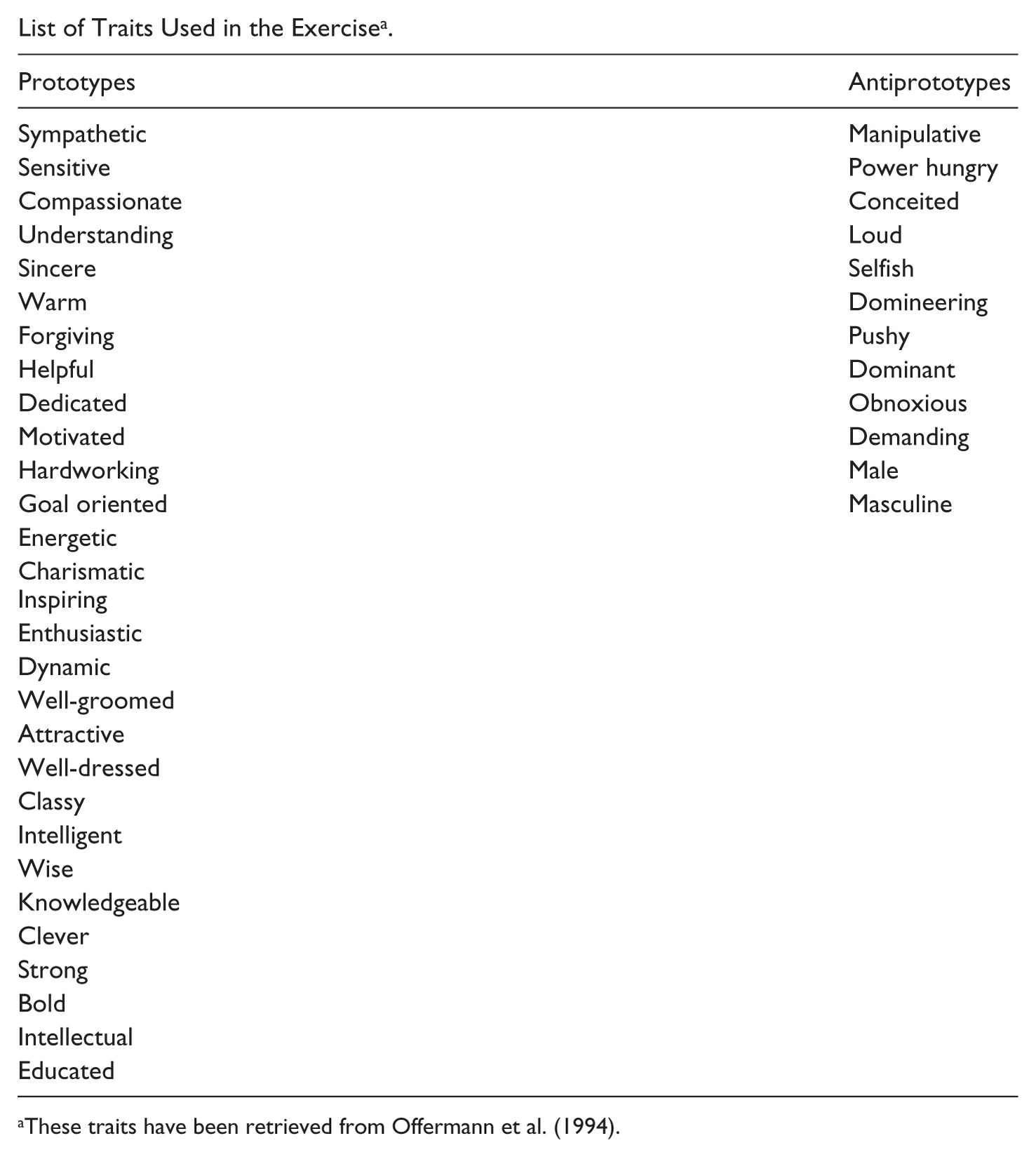
Each week throughout the semester, we select two traits from Offermann et al.’s (1994) ILTs model (Appendix A) which are announced aloud and written on the board. We do not provide a definition of the traits. If students asks for it, we invite the class to aid in the definition. We avoid providing definitions to prevent from influencing students’ votes. We then ask students to look around the room and silently decide which two people, relative to all class members, most exhibit each of the announced traits. If necessary, we ask each student to loudly state their name and we read aloud the names of any absent students. Students cannot vote for themselves. We ask students to write down on a piece of paper their votes and to briefly explain the reason for each vote, and we collect the votes. We state very clearly the importance of a brief explanation of each vote: It is important for students who provide feedback to explore where their perceptions arise from and for students who receive feedback to understand which of their behaviors generated certain perceptions in others. For example, to say Student A is “Hardworking” because he or she “works hard” provides no useful information to the person nor does it demonstrate a deep analysis of where our perceptions come from. We have, on few occasions, repeated a vote, usually at the beginning of the semester, when we find that most of the votes are not explained clearly enough. We invite students to point out the specific behaviors or characteristics they observed that lead them to vote for an individual. We then compile the information on a feedback report for each student with the number of votes received for each trait and the reasons for the votes. While doing so, we examine the feedback for any harsh language. If necessary, we reword some phrases in a manner that retains the intended message without being offensive. We maintain the voters’ confidentiality, as the reports do not include any identifying information. Anonymity allows students to freely express their views without fear of conflict or retaliation. During the following session, we provide each student with his or her feedback report. We discuss the votes in class in a general sense for learning purposes. As part of the discussion, we remind students that perceptions of leader behaviors differ across followers and situations and that student who want to emerge as leaders must learn to adapt as necessary. Thus, a critical component of this exercise is for students to learn how to seek and interpret feedback. In case of any specific concerns, we encourage the student to speak with us on an individual basis and to write about them in their weekly reflective journals. Each student, regardless of whether he or she received any votes, receives a feedback report (Appendix B).
Students receive weekly feedback on an ongoing basis throughout the semester so that they can see the emergence of perceptual patterns. Since the votes are based on both prototypes and antiprototypes, students can see whether an intended positive behavior is perceived as negative or vice versa. For example, a student who feels “self-confident” and participates frequently in class may discover that others perceive such behavior as “Conceited.” Students may also learn how peers may perceive behaviors undertaken without any specific purpose in mind, as being positive. For example, a student may discover how greeting peers on entering the room is perceived as “Sincerity.” Through the feedback, students learn about how others perceive their behaviors and they use this awareness to adjust behaviors that are eliciting different responses than intended. To allow for the reflection of the votes received and cast, students use weekly journals to self-reflect and set forth plans about how they can change the behaviors that their peers are misperceiving in order to create the desired impressions in the future. The journals also serve as a space for students to reflect on their perceptions of others and to examine from where they stem. This allows students to become aware of their behaviors, as well as how ILTs affect actions and perceptions.
As the exercise progresses, we add the votes and comments to the feedback report so that students receive a cumulative summary of their votes and comments each week. In terms of scoring, each vote for prototype counts as one point and each vote for an antiprototype counts as a minus point (Appendix B). At the end of the semester, we determine the emerging leader by adding all the votes each student received (Appendix C). Finally, at the end of the semester, we announce the top three emerging leaders and award them with bonus points. These students share their experiences with the class discussing the behaviors they changed, how they went about undertaking the change, and the resulting reactions.
Short Two-Session Version
As an alternative to the semester-long version, we use a modified version of this exercise to discuss the importance of perceptions, and their influence on leader emergence and effectiveness. While the modified version raises students’ awareness of perceptions and encourages them to engage in self-development, unlike the semester-long version, it does not offer them the opportunity to put the latter into practice. Even though this exercise does not offer the development of self-leadership behaviors, it is very successful in making students conscious of the importance of self-awareness and its implications for leader emergence. We developed this version for instructors that are concerned with dealing with the demands that the full-semester version requires in terms of the amount of time required to type votes on the feedback reports every week, and the possibility of dealing with emotions that students may face due to the feedback received.
We introduce the exercise to the class after discussing theories of perception, leadership traits, and ILTs, typically within the first 3 weeks of the semester. We explain to students that the purpose of the exercise is to understand the importance of perceptions in leadership and foster their desire to develop self-awareness skills. We then use the same process as in the semester-long version to collect votes and distribute feedback reports to each student. We conduct the first vote using two prototypes “Hardworking” and “Dynamic” as both these traits are easily understood and observable by students. Once the students receive their feedback report, we discuss how initial perceptions influence our attitudes toward others, where our perceptions come from, and what behaviors may elicit certain perceptions.
Toward the end of the semester, we conduct a second vote using the prototype “Dedicated” and the antiprototype “Conceited” as observable behaviors in the classroom. We clarify to students that this vote is independent from the first one and we remind them that they should vote for the individuals who demonstrate these traits the most, relative to the rest of the class. In this instance, we discuss how perceptions can change over time. For example, some individuals identified as “Hardworking” in the first vote because they frequently participate in class may receive “Conceited” votes the second time. The discussion here focuses on the importance of learning how to become self-aware including how to seek and interpret feedback.
Exercise Observations and Further Considerations
The semester-long version of the exercise requires the instructor to spend a considerable amount of time typing students’ votes. We have not found other “more efficient” ways of doing this. We have considered using online surveys to make the process less ominous but none of the coauthors has tested this strategy.
With respect to the short version, the exercise allows students to become aware of their own perceptions, how others may perceive them, as well as the environment around them. Since cognition is the first step necessary when behavior needs to be adapted, this exercise can be the first step to enhance cognition and may develop further into taking action to change behaviors (Schyns et al., 2011).
It is important that students are well aware that they may receive feedback that may hurt their feelings. We note that some students may not be receptive to feedback either due to an inability to receive feedback or due to a diminished self-esteem. Thus, instructors must be able to identify and reach out to such individuals to ensure that the exercise is not detrimental to their well-being.
The choice of prototypes or antiprototypes used, as well as the number of traits to be voted on each week, is entirely up to the instructor. An instructor may feel more comfortable using prototypes only. However, we consider valuable and important that students develop the ability to give, receive, and handle negative feedback and the emotions that emerge from such experience. We offer the following recommendations to reduce the possibility of students shutting down due to negative emotions generated by the feedback received: (a) Use only prototypes in the first few weeks of the semester; (b) The first time an antiprototype is used, take time to clarify that votes are relative to the rest of the class, and should not be used to define one self. For example, receiving “Selfish” votes must not be interpreted as being a selfish person overall. It means that certain behaviors, likely unintended, generate this perception; (c) Lead feedback discussion in a very general way without using students’ votes as examples. Appendix D illustrates the reflection and learning of a student who received negative votes.
Conclusion
Through this exercise, students learn how others perceive behaviors and how they themselves form perceptions. The feedback they receive as well as awareness of their own perceptions allows student to recognize their own mental models, question, and change them to allow changes in behaviors. Students also gain an understanding on the importance of context as a relevant factor of leadership. Students understand that leaders need followers, and followers will not follow unless they perceive and accept a leader. Students therefore, question their own leadership abilities when they realize that what they believe to be leadership behaviors are not perceived as such, thus engaging in a process of self-leadership by refocusing away from defensiveness toward something we can control—our own actions.
Footnotes
Appendix A
List of Traits Used in the Exercise a .
| Prototypes | Antiprototypes |
|---|---|
| Sympathetic | Manipulative |
| Sensitive | Power hungry |
| Compassionate | Conceited |
| Understanding | Loud |
| Sincere | Selfish |
| Warm | Domineering |
| Forgiving | Pushy |
| Helpful | Dominant |
| Dedicated | Obnoxious |
| Motivated | Demanding |
| Hardworking | Male |
| Goal oriented | Masculine |
| Energetic | |
| Charismatic | |
| Inspiring | |
| Enthusiastic | |
| Dynamic | |
| Well-groomed | |
| Attractive | |
| Well-dressed | |
| Classy | |
| Intelligent | |
| Wise | |
| Knowledgeable | |
| Clever | |
| Strong | |
| Bold | |
| Intellectual | |
| Educated |
These traits have been retrieved from Offermann et al. (1994).
Appendix B
Appendix C
Appendix D
Declaration of Conflicting Interests
The author(s) declared no potential conflicts of interest with respect to the research, authorship, and/or publication of this article.
Funding
The author(s) received no financial support for the research, authorship, and/or publication of this article.