



Abstract
We advance research on narcissism in the workplace by examining the effects of coworker narcissistic rivalry on focal employee emotional states and behavioral intentions. We rely on social function of emotions theory to explain why coworker narcissistic rivalry results in focal employee negative emotions. We then explain that the focal employee is likely to handle their negative emotions arising from coworker narcissistic rivalry differently depending on individual differences of bottom-line mentality (BLM), which captures a defensive competitive posture, or trait competitiveness, which captures an offensive competitive posture. Across three studies, our results generally support our predictions by revealing that the indirect effect of coworker narcissistic rivalry onto focal employees’ social undermining of that coworker (through focal employee negative emotions) is more strongly positive when the focal employee is higher in BLM, whereas the indirect effect of coworker narcissistic rivalry onto focal-employee-intended work-goal progress relative to the coworker (through focal employee negative emotions) is more strongly positive when the focal employee's trait competitiveness is lower.
Keywords
“Few interactions are as annoying, exasperating, and unpleasant as those with people whom we perceive as behaving egotistically” (Leary, Bednarski, Hammon, & Duncan, 1997: 111). Leary et al. went on to note that we often label egotistical individuals as narcissists, defined as those who exhibit an “. . . unusual self-reference in their interactions with people, a great need to be loved and admired, and an inordinate desire for tribute from others” (Kernberg, 1967: 655). The difficulty of working with narcissists seems to be significant enough that practitioner articles advise leaders and employees on “How to Manage a Narcissist” (Kets de Vries, 2017) and ways to “wield [workers’] narcissism for the betterment of a team or a project” (Wallace, 2019). The general consensus suggests that narcissists can be affable, but they also make our lives miserable because they are high-maintenance and fail to abide by social norms (e.g., Leary et al., 1997).
Extant research has generated a wealth of insights on narcissism in the workplace (Kets de Vries, 2017; Leary et al., 1997), with most research focusing on the complexity of narcissism with respect to the narcissist's own positive and negative social and behavioral outcomes (e.g., Bushman & Baumeister, 1998; Paulhus, 1998; Owens, Wallace, & Waldman, 2015; Smith, Hill, Wallace, Recendes, & Judge, 2018). More recently, research has started to examine leader narcissism in relation to subordinates’ unfavorable reactions in the form of reduced self-esteem, citizenship behaviors, and performance (e.g., Carnevale, Huang, & Harms, 2018; Fehn & Schütz, 2021; Nevicka, de Hoogh, den Hartog, & Beschak, 2018). Leaders are typically afforded power and influence over their employees (e.g., Hinkin & Schriesheim, 1989), such that a leader's high narcissism should, presumably, have a significant bearing on the reactions of followers. Extending beyond leadership, we argue that coworkers’ personalities in the workplace can also have far reaching effects on other employees because each party must regularly deal with the good and bad of the other's temperament (e.g., Back & Vazire, 2015). In this respect, we theoretically extend the narcissism literature by examining why and when a coworker's narcissistic rivalry affects the emotional states and intended behaviors of focal employees. 1
We theoretically examine Leary et al.'s (1997) speculation that narcissists are difficult for other employees to work with by utilizing theory on narcissism (e.g., Back et al., 2013) and the social function of emotions (Keltner & Haidt, 1999). We first follow recent trends in the narcissism literature by considering two overarching dimensions of narcissism: narcissistic admiration and narcissistic rivalry (e.g., Fatfouta, Gerlach, Schröder-Abé, & Merkl, 2015; Helfrich & Dietl, 2019; Lange, Crusius, & Hagemeyer, 2016). Narcissistic admiration captures an “. . . optimistic pursuit of one's uniqueness and thoughts about one's own grandiosity,” whereas narcissistic rivalry reflects a “. . . motivation to reinstate and defend one's superior status, in particular when compared to perceived social rivals” (Back et al., 2013: 1016). We contend that narcissistic rivalry, more so than narcissistic admiration, has a significant effect on employees as it evokes emotional reactions underlying the need for fair competition within the workplace (Back et al., 2013; Fülöp, 2009). In support of this contention, we utilize social function of emotions theory (Keltner & Haidt, 1999) to explain that a coworker's narcissistic rivalry may drive a focal employee to experience negative emotions (i.e., feelings of “anxiety, anger, and irritation” in the workplace; Bono, Foldes, Vinson, & Muros, 2007: 1361), which indicate that the narcissistic rival is not a fair opponent and therefore the focal employee needs to take targeted action in response to the narcissistic rival (Shepherd & Cardon, 2009). These emotions, then, conditionally guide the focal employees on whether to respond to the narcissistic rival with offensive or defensive countermeasures (e.g., Pekrun, 1992).
Importantly, social function of emotions theory (Keltner & Haidt, 1999) implies that emotions arising from concerns related to fair competition (e.g., Fülöp, 2009; Marchant, Morris, & Anderson, 1998) may provoke subsequent response strategies that depend on a person's individual attributes (e.g., Converse & Reinhard, 2016; Neuberg & Cottrell, 2008; Pekrun, 1992). In this respect, we examine the second stage moderating roles of the focal employee's bottom-line mentality (BLM) (i.e., a singular focus on securing bottom-line outcomes; Greenbaum, Mawritz, & Eissa, 2012) and trait competitiveness (i.e., a desire to excel relative to others; Helmreich, Beane, Lucker, & Spence, 1978) because both individual attributes have been conceptualized in terms of competition (Newby & Klein, 2014; Wolfe, 1988), but with each attribute having unique underlying motives that affect whether negative emotions motivate defensive or offensive reactions to a narcissistic rival. As such, we identify BLM as a moderator that is likely to strengthen the relationship between negative emotions and defensive competitive reactions (i.e., energy is directed toward preventing the advancements of opponents) (e.g., Fülöp, 2009). In contrast, we identify lower trait competitiveness as a condition that strengthens the relationship between negative emotions and offensive competitive reactions (i.e., energy is directed toward self-accomplishments). We identify social undermining of the narcissistic rival (i.e., intentionally hindering another's reputation, success, and relationships; Duffy, Ganster, & Pagon, 2002) as a defensive competitive reaction because it is intentional and specific in its focus on thwarting another's successes. We identify work-goal progress (i.e., advancing one's own set objectives; see Greenbaum, Deng, Butts, Wang, & Smith, 2022) as an offensive competitive reaction because it captures efforts to accomplish one's own goals to outcompete others.
Individuals high in BLM tend to view bottom-line attainment as a zero-sum game, such that one person's “win” is another's “loss” (Greenbaum et al., 2012; Wolfe, 1988). As such, we argue that focal employees high in BLM are more likely to view their negative emotions (as provoked by narcissistic rivalry) as indicating a high-stakes threat to their coveted position of “winning” their bottom-line goals. When negative emotions signal that a goal is in jeopardy (Pekrun, 1992; Shepherd & Cardon, 2009), people often react with defensive strategies that serve to immediately ameliorate the threat by targeting the source of the threat (e.g., Fülöp, 2009; Marchant et al., 1998; Reh, Tröster, & Van Quaquebeke, 2018; Tjosvold, Hui, Ding, & Hu, 2003). Thus, we theoretically argue that focal employees higher in BLM will react to their negative emotions with enhanced defensive reactions in the form of socially undermining the narcissistic rival. In comparison, we suggest that because focal employees higher in trait competitiveness naturally adopt offensive work strategies related to self-improvement (Helmreich et al., 1978), they are not as likely to respond to their negative emotions resulting from narcissistic rivalry with a different than normal focus on work-goal progress (e.g., Diefendorff & Mehta, 2007). Rather, we theoretically delineate the positive influence of negative emotions onto work-goal progress for focal employees who are lower in trait competitiveness because, in comparison to those higher in the trait, they often require a contextualized source of emotional arousal to provoke offensive reactions to possible competitors (e.g., Fletcher, Major, & Davis, 2008; Helmreich et al., 1978; Pekrun, 1992; Tjosvold et al., 2003). Please see Figure 1.

Theoretical Model
Through our research, we intend to make several contributions to the literature. First, although scholars have long speculated that working with a narcissist can be difficult (Leary et al., 1997), we utilize social function of emotions theory (Keltner & Haidt, 1999) to provide theoretical backing for why this may be the case. Drawing on the call to examine personality in relation to partner effects (i.e., the influence of personality on relationship partners; Back & Vazire, 2015), we contribute to the literature by relying on social function of emotions theory to explain why a coworker's narcissistic rivalry violates social norms that affect focal employees’ negative emotions and then their intended behaviors. Importantly, we theoretically discuss the ambivalence of these negative emotions, such that their influence is likely to depend on the focal employees’ individual differences (Pekrun, 1992). Here, we intend to advance the field by being the first to clarify the ways in which BLM and trait competitiveness are similar and different with respect to competition, such that each attribute affects how negative emotions, stemming from narcissistic rivalry, are regulated in terms of next reactions. Additionally, we contribute to the literature by noting that negative emotions (due to narcissistic rivalry) can conditionally affect a focal employee's defensive or offensive reactions in the form of social undermining of the narcissistic rival or work-goal progress relative to the narcissistic rival. This is an important element of our research because it further outlines why and when a coworker's narcissistic rivalry, through the focal employee's negative emotions, operates with plurality in terms of motivating negative behaviors in some employees, but desirable behaviors in other employees. In this respect, our research provides a unique contribution to the literature by theoretically arguing that a coworker's narcissism may serve as a positive, rather than a negative, motivating force for some employees. Finally, as with recent trends in narcissism research (e.g., Back, et al., 2013), we examine a coworker's narcissism in relation to the two broad dimensions of narcissistic rivalry and narcissistic admiration and provide theoretical backing for why the former is more relevant to the social function of negative emotions as proposed by our theoretical model.
Theoretical Background and Hypotheses
Two Facets of Narcissism: Admiration and Rivalry
Personality scholars have long recognized that narcissistic individuals often embody paradoxical characteristics, such that they can exhibit charming and self-assured traits but also a sense of aggressiveness and antagonism in their social encounters (Kernberg, 1975; Brown, Budzek, & Tamborski, 2009). Recent research has directly addressed the paradoxical nature of narcissism by theoretically and empirically identifying narcissistic admiration and rivalry as two broad dimensions of narcissism (Back et al., 2013). Narcissistic admiration is a personality trait that involves assertive self-enhancement (i.e., a tendency to secure social clout via self-promotion tactics) as a motivational strategy for preserving one's grandiose self (Back et al., 2013). In comparison, narcissistic rivalry is a personality trait that involves antagonistic self-protection (i.e., a tendency to avoid social failure by using self-defense tactics) as an additional motivational strategy for maintaining the grandiose self. Although narcissistic admiration and rivalry tend to be correlated as they both serve the purpose of maintaining grandiose self-views (Back, et al., 2013), they are also distinct constructs because they each encapsulate unique motivational strategies that produce diverging nomological networks (e.g., Fatfouta et al., 2015; Geukes et al., 2017; Helfrich & Dietl, 2019; Lange et al., 2016).
As motivated by assertive self-enhancement, narcissistic admiration captures the degree to which a person feels, thinks, and behaves in accordance with an exaggerated need for praise and admiration (Back et al., 2013). Those high in narcissistic admiration are captivated by the need to stand out as being “unique” in comparison to others. They also cultivate grandiose fantasies and position themselves as being better than other people. In an effort to get others to admire them and to view them as special, they tend to behave with a high degree of charm. In comparison, narcissistic rivalry is motivated by antagonistic self-protection, such that people high in this trait feel as though they need to defend their superior status. They tend to think about other people as being inferior and are quick to devalue another person's accomplishments as being less than their own. To defend their position of superiority, they also behave with a great deal of aggression. Because the traits of narcissistic rivalry are in direct contrast to normative expectations of fair competition (e.g., Johnson, Johnson, & Stanne, 1989; Stanne, Johnson, & Johnson, 1999; To, Kilduff, & Rosikiewicz, 2020), we argue that narcissistic rivalry, more so than narcissistic admiration, will provoke employee effects that involve negative emotions as supported by social function of emotions theory (e.g., Keltner & Haidt, 1999).
A Social Function of Emotions Perspective on Narcissistic Rivalry
Social function of emotions theory contends that people typically benefit from communal living, but not all social situations are equally valuable or helpful to one's overall well-being (Keltner & Haidt, 1999). In this respect, the theory contends that emotions play the important role of allowing people to assess the meaning of a social encounter to their personal welfare, as well as how to react to the social situation moving forward (Ekman, 1992; Marcus & MacKuen, 1993). Regarding next reactions, emotions tend to provoke subsequent behaviors that are most supportive of one's own interests (Keltner & Haidt, 1999). For example, emotions may indicate whether another person has abided by usual norms of conduct for a social situation (Lutz & White, 1986), including whether a person has upheld expectations of fairness, general respect, and competition (Blascovich, 2013; Cropanzano, Goldman, & Folger, 2003; De Dreu, Baas, & Nijstad, 2008). In the event that emotions indicate violations of social norms (e.g., Neuberg & Cottrell, 2008), a common, default reaction is to behave in ways that counteract the norm violation for one's own benefit (Ekman, 1992; Keltner & Haidt, 1999).
Organizations are “competitive” in the sense that they usually have limited resources, assignments, or promotion opportunities, which can pit employees against one another (Deustch, 1949). In such contexts, people often abide by norms of appropriate competition that outline how to fairly arrive at a winning outcome (To et al., 2020), with these norms ensuring that each person has a fair shot at earning coveted resources and rewards (e.g., Folger, 1998, 2001). Unfortunately, narcissistic rivals typically do not abide by norms of fair competition (Back et al., 2013) because their approach to protecting their egos is to tear others down (e.g., Nicholls & Stukas, 2011). They defend their superiority by derogating and sabotaging others (e.g., Neuberg & Cottrell, 2008) and by suggesting that others are “losers” and/or less capable of success (Back et al., 2013). More than through words, narcissistic rivals violate norms of competition by using aggression as a way of ensuring their superiority (Bushman & Baumeister, 1998). They display intimidation and annoyance toward anyone who may threaten their success (Back et al., 2013). Generally, they come across as poor sports, which is likely to be evident to employees who regularly work with them over an extended period of time (Paulhus, 1998).
We suggest that because narcissistic rivals come across as violating prescribed norms of competition (e.g., Back et al., 2013), focal employees will react to them by experiencing negative workplace emotions that serve the social function of indicating that the narcissistic rival is troublesome and harmful to one's own interests (e.g., Keltner & Haidt, 1999; Pekrun, 1992). Arguments related to social function of emotions theory suggest that negative emotions indicate that something of value is in jeopardy (Luce, Payne, & Bettman, 1999; Shepherd & Cardon, 2009), often because of another's misdeeds (Keltner & Haidt, 1999). In the case of narcissistic rivalry, focal employees’ subsequent negative emotions are likely to convey that the narcissistic rival will make it difficult for them (and others) to obtain desired and worthy outcomes (e.g., Fülöp, 2009). Negative emotions in the workplace include feelings of anger, anxiety and fear, and a general sense of frustration or distress regarding the situation at hand (e.g., Bono et al., 2007; Lee, Kesebir, & Pillutla, 2016). These negative emotions reveal the extent to which people within the organization have violated prescribed social norms (Folger, 1998, 2001), with the activation of these negative emotions indicating a need to counteract a norm violation (Berkowitz, 1990; De Dreu et al., 2008; Keltner & Haidt, 1999). Thus, in accordance with social function of emotions theory (e.g., Keltner & Haidt, 1999), we predict that narcissistic rivals will provoke focal employees to experience negative workplace emotions, which serve as a strong, activating signal that the focal employee needs to direct attention toward the narcissistic rival to counteract any potential harm (e.g., Schwarz & Clore, 1983; Shepherd & Cardon, 2009).
Hypothesis 1: Perceptions of a coworker's narcissistic rivalry is positively related to the focal employee's negative workplace emotions.
The Moderating Roles of Bottom-Line Mentality and Trait Competitiveness
Social function of emotions theory (Keltner & Haidt, 1999) offers additional complexity when considering exactly how people use their emotions to produce relevant and adaptive responses to social situations. Although a social situation may produce rather typical emotional responses (Fülöp, 2009; Pekrun, 1992), individuals’ attributes and goals can substantially affect how their emotions are then regulated to produce the most adaptive behaviors for their particular needs (e.g., Converse & Reinhard, 2016; Shah, 2003a, 2003b; Shepherd & Cardon, 2009). In this respect, we anticipate that narcissistic rivalry is likely to spark a focal employee's negative emotions, but these negative emotions are likely to result in different behavioral reactions depending on the focal employee's BLM or trait competitiveness. These two attributes have been conceptualized in terms of competition (e.g., Greenbaum et al., 2012; Helmreich et al., 1978; Wolfe, 1988), but we clarify their differences by proposing that BLM captures a defensive competitive posture, whereas trait competitiveness underscores an offensive competitive posture, such that each attribute affects the extent to which negative emotions are channeled into defensive or offensive reactions in response to the narcissistic rival. We focus explicitly on social undermining as a defensive competitive reaction because it aligns with directing energy toward stopping an opponent (e.g., Fülöp, 2009). The concept of social undermining suggests that these behaviors would be used to intentionally hinder a narcissistic rival's reputation, success, and relationships (Duffy et al., 2002), which would stop the narcissistic rival from winning any competition vis-à-vis the focal employee. Likewise, we focus on work-goal progress as an offensive competitive reaction because it aligns with directing energy toward self-improvement as a way of winning relative to an opponent (e.g., Fülöp, 2009). Work-goal progress suggests that focal employees would focus on advancing their own work objectives (Greenbaum et al., 2022) as a way of outcompeting the narcissistic rival.
Bottom-line mentality
We argue that BLM captures a defensive competitive posture because those high in this attribute focus so heavily on a singular, prominent outcome that they become consumed by possibly not winning the esteemed outcome (Wolfe, 1988). Because of the extreme importance placed on “winning” one's own bottom line (e.g., Fülöp, 2009; Tjosvold et al., 2003), individuals high in BLM tend to be self-protective and view other people as opponents who can strip them of their coveted goals (Greenbaum et al., 2012; Mawritz, Greenbaum, Butts, & Graham, 2017; Wolfe, 1988). Hence, they are often on high alert for threats to the bottom line and tend to respond to such threats with defensive competitive strategies in which they try to prevent their opponents from infringing on their bottom-line goals (e.g., Wolfe, 1988). Indeed, past research suggests that when people think about competition in terms of “winning at all costs,” they are more likely to view threatening stimuli as a high-stakes situation that requires defensive reactions in the form of tearing down their opponents as a way of protecting themselves (e.g., Fülöp, 2009; Marchant et al., 1998; Pekrun, 1992; Reh et al., 2018; Tjosvold et al., 2003). For these individuals, their focus on outcome obtainment is so narrow that winning becomes a zero-sum game in which one person's win is viewed as another person's loss (Sirola & Pitesa, 2017), such that any threat to winning can trigger them to directly attack their opponent as a form of self-defense (e.g., Marchant et al., 1998; Wolfe, 1988).
Social function of emotions theory (Keltner & Haidt, 1999) suggests that a focal employee's negative emotions (arising from a coworker's narcissistic rivalry) may be regulated differently when the focal employee is high in BLM because of the unique way in which they think about their goals (Pekrun, 1992; Shepherd & Cardon, 2009). In comparison to those lower in the attribute, focal employees higher in BLM are more likely to process their negative emotions as a high-stakes threat because the narcissistic rival poses a serious risk to the focal employee's highly coveted bottom-line objectives. Because losing to the narcissistic rival is not an option (Wolfe, 1988; Greenbaum et al., 2012), they are more likely to regulate their negative emotions by using a defensive strategy in the form of social undermining in which they have stronger intentions of hindering the narcissistic rival's work-related success, relationships, and reputation (see Duffy et al., 2002). Indeed, past research suggests that social undermining serves the distinct purpose of tearing down an opponent (Duffy, Scott, Shaw, Tepper, & Aquino, 2012; Reh et al., 2018), often for the purpose of ensuring one's own well-being relative to the opponent (e.g., Duffy, Ganster, Shaw, Johnson, & Pagon, 2006; Greenbaum et al., 2012). In comparison, coworkers lower in BLM are unlikely to respond to their negative emotions arising from narcissistic rivalry with strongly defensive reactions, because they do not have a vested interest in winning at all costs and therefore are not in it for the fight to win.
Hypothesis 2: The focal employee's bottom-line mentality moderates the relationship between this individual's negative workplace emotions and social undermining of the coworker. When the focal employee's bottom-line mentality is higher (versus lower), the relationship between this individual's negative workplace emotions and social undermining of the coworker is more strongly positive.
Hypothesis 3: The focal employee's bottom-line mentality moderates the mediated relationship between perceptions of the coworker's narcissistic rivalry and the focal employee's social undermining of the coworker through the focal employee's negative emotions, such that the positive indirect effect is stronger when the focal employee's bottom-line mentality is higher versus lower.
Trait competitiveness. In comparison, we argue that trait competitiveness captures an offensive competitive posture because those high in this trait typically focus on improving themselves relative to those around them (Houston, Harris, Howansky, & Houston, 2015; Helmreich et al., 1978). In fact, trait competitiveness is often described as capturing a focus on achievement because those high in this trait regularly and consistently rely on their social circles to motivate them to improve their own capabilities and performance (Hibbard & Buhrmester, 2010; Helmreich et al., 1978). They also regularly seek out contexts that offer them opportunities to compete and to enhance their capabilities and tend to experience emotional arousal and enjoyment from such arrangements (e.g., Brown, Cron, & Slocum, 1998; Gill & Deeter, 1988; Newby & Klein, 2014). In this respect, those high in trait competitiveness often do not require a specific, external stimulus to get them to direct energy toward achievement, because they show an eagerness to act on their own (Newby & Klein, 2014). In support of this notion, past research has shown that people high in trait competitiveness are unlikely to experience additional motivation from working in a competitive environment (Fletcher et al., 2008). Thus, we argue that for focal employees high in trait competitiveness, their negative emotions (in response to a coworker's narcissistic rivalry) are unlikely to provoke enhanced desires of self-improvement because they are already offensively “in the game” of competing with the narcissist.
Yet, social function of emotions theory (Keltner & Haidt, 1999) explains that emotions can provoke people to experience response strategies that otherwise would remain dormant (Campos, Campos, & Barrett, 1989; Clore, 1992; Oatley & Jenkins, 1996). Emotions play the unique role of drawing attention to ancillary desires and goals that, under normal circumstances, do not seem that important (Keltner & Haidt, 1999; Schwarz, 1990). In this respect, those low in trait competitiveness often need an external stimulus to provoke them to have stronger intentions of enhancing their success (Fletcher et al., 2008). As they are not naturally inclined to compete on their own (Houston et al., 2015), they may require their negative emotions (stemming from a coworker's narcissistic rivalry) to activate a need and desire to offensively respond to the narcissist. Indeed, negative emotions that indicate a violation of appropriate competition can motivate offensive response strategies for those who have “nothing to lose” by trying harder (e.g., Fülöp, 2008; Pekrun, 1992). We suspect that coworkers low in trait competitiveness will perceive that they have nothing to lose by trying harder relative to the narcissistic rival because they do not view their potential failure as a high-stakes problem (e.g., Helmreich et al., 1978); they do not focus on the “need” to win but instead interpret their emotions as a chance to improve themselves relative to the narcissistic rival by intending to advance their own work goals (Diefendorff & Mehta, 2007). Indeed, past research suggests that negative emotions can provoke some people to work harder in pursuit of their work goals (Wanberg, Zhu, & Van Hooft, 2010) because doing so provides them with markers of success (e.g., Latham & Locke, 2007; Latham & Pinder, 2005) that help them to advance relative to opponents (Pekrun, 1992). Thus, negative emotions arising from narcissistic rivalry may provoke focal employees lower (versus higher) in trait competitiveness to up the ante by using offensive strategies in the form of work-goal progress (i.e., attempts to improve oneself by setting more goals relative to an opponent).
Hypothesis 4: The focal employee's trait competitiveness moderates the relationship between this individual's negative workplace emotions and intended work-goal progress relative to the coworker. When the focal employee's trait competitiveness is lower (versus higher), the relationship between this individual's negative workplace emotions and intended work-goal progress relative to the coworker is more strongly positive.
Hypothesis 5: The focal employee's trait competitiveness moderates the mediated relationship between perceptions of the coworker's narcissistic rivalry and the focal employee's intended work-goal progress relative to the coworker through the focal employee's negative emotions, such that a stronger, positive indirect effect occurs when the focal employee's trait competitiveness is lower versus higher.
Overview of Studies
Our research leverages a multistudy design (Shadish, Cook, & Campbell, 2002) by employing a field study and two experiments and conforms to ethical principles by studying intentions to socially undermine in the experiments (e.g., avoiding the emotional distress that could occur with actual social undermining) (see Hershcovis, 2011). Study 1 establishes external validity by testing Hypotheses 1–3 (i.e., those pertaining to the moderating role of BLM) utilizing field data from employees working in a large manufacturing company in Brazil. Study 2 experimentally assesses Hypotheses 1, 4, and 5 (i.e., those pertaining to the moderating role of trait competitiveness) via a student sample. Study 3 establishes internal validity and tests our entire theoretical model (Hypotheses 1–5) using an experimental study in which participants work with a high-versus-low narcissistic rival via a computerized confederate. Study 3 also improves upon Study 2. Study 2 asks participants about their work-goal progress via a count measure of intended work goals (e.g., Schunk, 1990), but does not directly ask about these goals relative to the coworker. Study 3 addresses this limitation by directly asking about intentions to have higher work-goal progress relative to the coworker.
Study 1 Method
Sample and Procedure
Data were collected from employees of a leading manufacturer of automotive parts in Brazil to test Hypotheses 1–3 (those pertaining to the moderating role of BLM). A total of 620 employees, who served as the focal employee of our theoretical model, were invited by an on-site member of the research team to participate in the study. Participants were given a paper survey during their work break and asked to return the completed survey to the researcher. Of the 620 employees, 416 returned completed surveys for a response rate of 67%; however, 24 cases were dropped due to a failed attention check or incomplete data (Meade & Craig, 2012), providing a final sample of 392. All respondents were Brazilians ranging in age from 20 to 62, with an average age of 34.1 years (SD = 9.6); 90% of respondents were male, 80.4% worked full time, 21.4% were managers, and the average length of employment was 5.3 years (SD = 6.4).
Measures
Newly created or adapted measures are shown in Appendix A. Unless otherwise noted, items for all measures were rated on a seven-point, Likert-type scale (1 = strongly disagree to 7 = strongly agree). Surveys were translated from English to Portuguese (the official language in Brazil) and back translated to English by a professional translation company and a member of the research team fluent in both languages (Brislin, 1980).
Narcissistic rivalry of a coworker
To evaluate a coworker's narcissistic rivalry, we asked focal employee participants to write on a piece of scrap paper, or in their minds (for those concerned about anonymity), the names of up to five coworkers that they interact with at least three to four times per week. We asked that they list the names in alphabetical order. We then asked participants to choose the second name listed and rate this person's narcissistic rivalry using the nine-item narcissistic rivalry measure (Back et al., 2013). A sample item includes: “My coworker . . . secretly takes pleasure in the failure of his/her rivals” (α = 0.93).
The focal employee's negative emotions
Bono et al. (2007: 1361) conducted a literature review and pilot study to “select a small number of affect terms . . . to cover the full range of work-relevant affect and emotion.” In turn, their research demonstrated that workplace interactions can contribute to a highly activated, negative emotional state that includes feelings of anxiety, anger, and irritation. Additionally, these emotions have been identified as stemming from interactions with others (Knobloch & Theiss, 2010). Hence, we selected two items from existing measures of anxiety (Warr, 1990), anger (Wright, Zammuto, & Liesch, 2017), and irritation (Han, Back, & Barrett, 2010) to represent a six-item measure of negative emotion (see Appendix A). Participants responded to: “When working with this coworker, I tend to feel . . .” (α = 0.87), with the six items of negative emotions demonstrating factor loadings of 0.63 or higher.
The focal employee's bottom-line mentality
Participants rated their own BLM using Greenbaum et al.'s (2012) four-item measure. A sample item includes: “When at work I . . . am solely concerned with meeting the bottom-line” (α = 0.70).
Social undermining of the narcissistic rival
Participants responded to seven items from Duffy et al. (2006) to capture social undermining; yet, results of a measurement model revealed that two items (viz., “Talk down to this coworker”; “Go back on your word to this coworker”) had unacceptably low factor loadings (.24, .33) and thus were dropped from the measure (see Piccolo & Colquitt, 2006). Our results remained generally the same with or without the inclusion of these problematic items. A sample item from the final measure includes: “Please indicate how much you intentionally . . . criticize this coworker in front of other coworkers” (α = .79).
Control variables
Because the study variables were rated by the same source at the same point in time, we controlled for the employees’ social desirability to account for possible same source biases (Podsakoff, MacKenzie, & Podsakoff, 2012). Participants rated their social desirability using five items from Strahan and Gerbasi's (1972) scale. An example includes: “I’m always willing to admit it when I made a mistake” (α = 0.68).
Additionally, we controlled for perceptions of the coworker's narcissistic admiration, the second dimension of narcissism. We controlled for this because research has suggested that narcissistic admiration can also affect the reactions of others (Back et al., 2013). Yet, per our theory, we wanted to demonstrate that coworker narcissistic rivalry is the main driver of our theoretical model and not coworker narcissistic admiration. Focal employee participants rated the coworker's narcissistic admiration using Back et al.'s (2013) nine-item measure, with an example item being: “My coworker . . . believes he/she is great” (α = 0.80).
Lastly, extant research suggests that narcissistic individuals are more likely to project their narcissism onto others (Back et al., 2013), such that they tend to see other people as being similarly narcissistic. Accordingly, the focal participant's own narcissistic rivalry could affect their reactions to a coworker's narcissistic rivalry. Additionally, recent research on personality and partner effects has noted the importance of controlling for one's own personality when predicting relevant outcomes (Solomon & Jackson, 2014). Thus, we control for the focal participants self-ratings of narcissistic rivalry using Back et al.'s (2013) nine-item measure (α = 0.84). Importantly, support for our hypotheses, as shown below, remained generally the same with or without the inclusion of these control variables (Becker, 2005).
Study 1 Results
Descriptive statistics, correlations, and reliabilities for Study 1 are shown in Table 1.
Study 1: Descriptive Statistics, Correlations, and Reliabilities
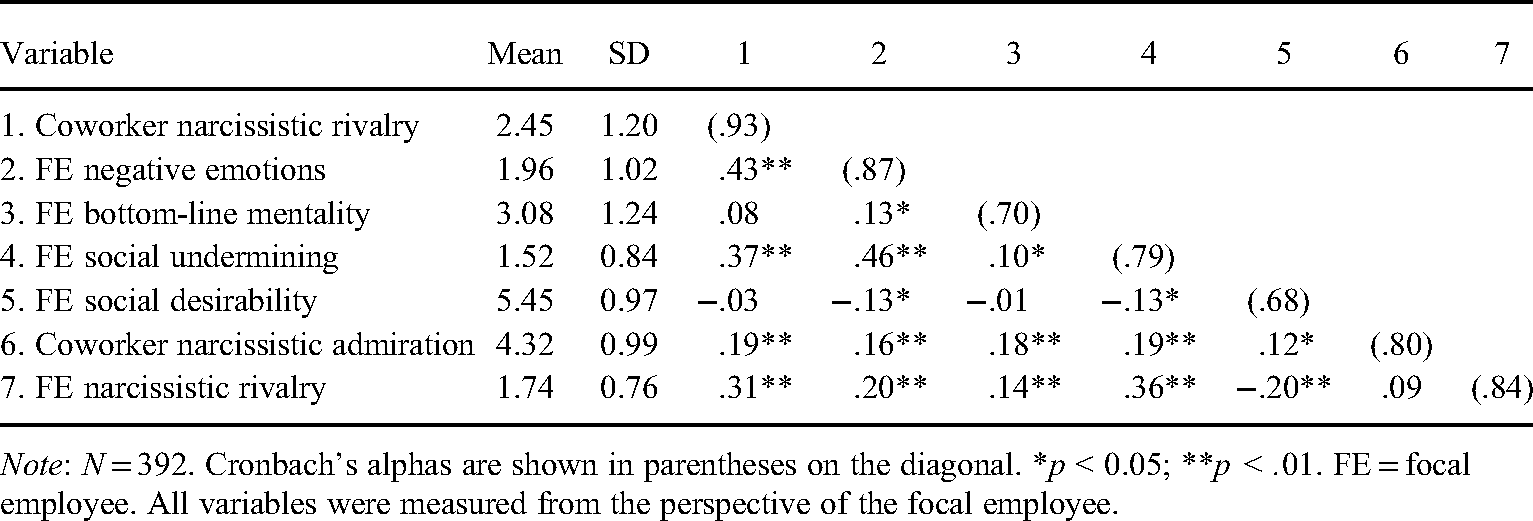
Note: N = 392. Cronbach's alphas are shown in parentheses on the diagonal. *p < 0.05; **p < .01. FE = focal employee. All variables were measured from the perspective of the focal employee.
Tests of Common Method Variance
As suggested by Podsakoff et al. (2012), we followed the procedures outlined by Williams, Hartman, and Cavazotte (2010) to test for the potential biasing effect of common method variance (CMV) in our data. We first identified a marker variable that is unrelated to our study variables, namely trait-positive affect. We then ran a model with the study's variables specified to load onto the marker variable (χ2 = 1307.11, df = 380) and compared it to a model that did not specify the variables loading onto the marker variable (χ2 = 1305.79, df = 379). As the chi-square difference test is nonsignificant (Δχ2 = 1.32, Δdf = 1, ns), common method variance is not likely to be creating a biasing effect for the variables specified in our model.
Confirmatory Factor Analyses
We also examined our measurement model via a series of confirmatory factor analyses (CFA). Our baseline measurement model included seven primary latent factors that captured our core study and control variables. The measurement model produced an acceptable fit to the data (χ2 = 2301.82, df = 1004; RMSEA = .06; SRMR = .07, CFI = .85). Although the CFI is lower than desirable, it is not uncommon for this fit statistic to deviate from conclusions of “good fit” that are supported by RMSEA, with such deviations being attributable to subjective cut-off values and inconsistent views on the meaning of good fit (Lai & Green, 2016). The measurement model fit was superior to (a) a six-factor model combining coworker narcissistic rivalry and coworker narcissistic admiration (control) (Δχ2 = 185.63, Δdf = 6, p <.05); (b) a six-factor model combining focal employee BLM and focal employee narcissistic rivalry (control) (Δχ2 = 16.59, Δdf = 5, p <.05); (c) a five-factor model combining coworker narcissistic rivalry, coworker narcissistic admiration (control), and focal employee narcissistic rivalry (control) (Δχ2 = 551.66, Δdf = 11, p <.05); and (d) a four-factor model combining both coworker narcissistic rivalry and admiration (control) with focal employee BLM and narcissistic rivalry (control) (Δχ2 = 554.81, Δdf = 14, p <.05). These results demonstrate the distinctiveness of the measures.
Hypothesis Testing
Using Hayes's (2013) PROCESS macro in SPSS (Model 14), we tested Hypotheses 1–3 (Table 2). In support of Hypothesis 1, narcissistic rivalry is positively related to the focal employee's negative emotions (B = 0.33, p <.000). Hypothesis 2 is also supported as there is a significant interactive effect between the focal employee's negative emotions and BLM (B = 0.08, p = .004), and the plotted interaction (Figure 2) and simple slopes tests indicate that the relationship between focal employee negative emotions and social undermining of the coworker is more strongly positive when the focal employee's BLM is higher (B = 0.36, p = .000) compared to when it is lower (B = 0.17, p = .001). To test Hypothesis 3, we used 5,000 bootstrapped samples to create 95% bias-corrected confidence intervals at three levels of BLM. Supporting Hypothesis 3, focal employee negative emotions mediated the positive relationship between perceptions of coworker narcissistic rivalry and social undermining such that when the focal employee's BLM is higher ( +1 SD above the mean) the effect (B = 0.12, SE = .03, 95% CI [.067, .184]) is stronger than at mean levels of BLM (B = 0.09, SE = .02, 95% CI [.047, .140]) and lower levels of BLM (−1 SD below the mean) (B = 0.06, SE = .02, 95% CI [.012, .110]). In further support of Hypothesis 3, the index of moderated mediation does not include zero (B = 0.03, SE = .01, 95% CI [.004, .051]). Our results held above and beyond the effects of the theoretically derived control variables. Finally, post-hoc power analyses (Bliese & Wang, 2020) revealed power with values exceeding 0.80 for predicting relationships in this study.

Study 1 Moderation Effect of Focal Employee BLM on the Relationship Between Focal Employee Negative Emotions and Social Undermining of the Coworker
Study 1: Moderated Mediation Results
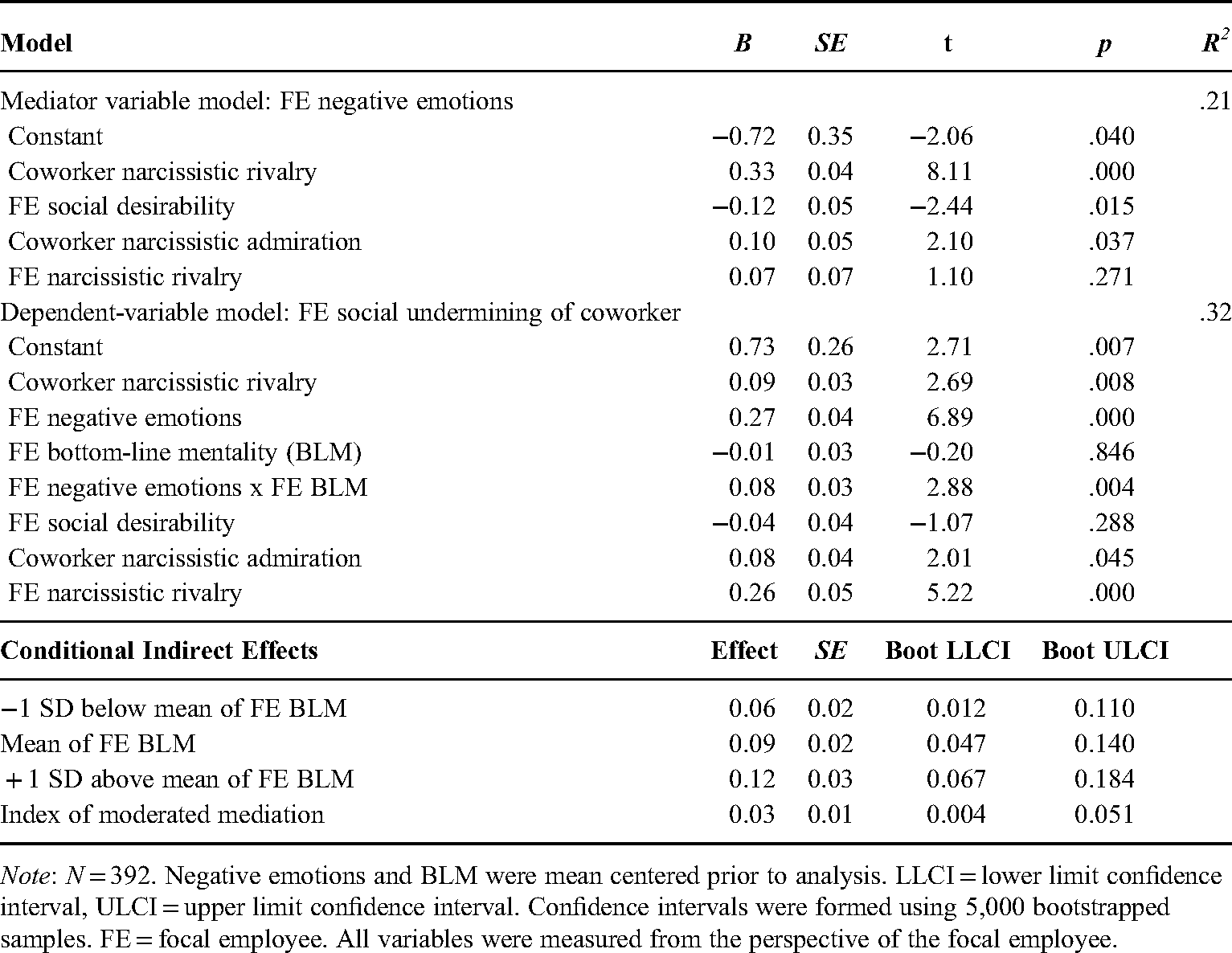
Note: N = 392. Negative emotions and BLM were mean centered prior to analysis. LLCI = lower limit confidence interval, ULCI = upper limit confidence interval. Confidence intervals were formed using 5,000 bootstrapped samples. FE = focal employee. All variables were measured from the perspective of the focal employee.
Study 2 Method
Study 2 involved an experiment with participants randomly assigned to a narcissistic rivalry condition or a neutral condition and was used to test Hypotheses 1, 4, and 5 (those pertaining to trait competitiveness). Participants were undergraduate students at a large university in the United States. They were recruited via business classes and were told they could earn $5.00 by participating in a 30-min lab study. The study required them to sign up for a timeslot to work with an assigned coworker. Of the 249 participants, 22 were removed for failing an attention check and one was dropped due to missing data, resulting in a usable sample of 226 participants (113 = high narcissistic rivalry condition; 113 = low narcissistic rivalry condition). Participants’ average age was 21.05 years (SD = 2.07), 54.06% were female, and the majority of participants were white (74.0%).
Upon arrival to the lab, participants were informed that they would complete individual work at a computer, but then would be moved to a different room with an assigned coworker for the purpose of completing an anagram task. Participants’ individual work involved the completion of a personality inventory that included trait competitiveness. Participants were then randomly assigned to the manipulated conditions. Participants first read the following message: “Now that you’ve completed the personality inventory, we are going to give you a chance to get to know your coworker before meeting him/her face-to-face. We requested a letter of reference from your coworker's last employer. Your coworker's last employer provided the following letter.”
In both the narcissistic rivalry and the control conditions, participants read a letter from the former employer that was on letterhead and signed by Casey Townsend, the general manager of Crawford Insurance (see Appendix B). Casey Townsend stated that the coworker was a summer intern who had been evaluated with 360-degree feedback from supervisors, customers, and coworkers. The letter then listed comments obtained from the feedback. In the narcissistic rivalry condition, items from Back et al.'s (2013) narcissistic rivalry questionnaire were adapted to form the comments. Examples include: “I always got the sense that Aubrey wanted to see me fail. Aubrey seemed to think that I was an inferior person.” —Coworker 2
“Aubrey does not like it when other people are the center of attention.” —Supervisor 1
In the neutral condition, the comments were structured to demonstrate an absence of narcissism: “I always got the sense that Aubrey wanted me to be content. Aubrey seemed to think that I was an acceptable person.” —Coworker 2
“Aubrey is fine with other people being the center of attention.” —Supervisor 1
In both conditions, the letter concluded by stating that the coworker's performance was adequate.
After the manipulation, participants responded to items regarding their emotions and a manipulation check. They were then asked to list their goals and objectives for their next performance task with their assigned coworker, which served as our operationalization of work-goal progress. In reality, participants did not partake in a next task with the assigned coworker. They were told that the task was cancelled and were debriefed.
Measures
Items for all measures were rated on a seven-point, Likert-type scale (1 = strongly disagree to 7 = strongly agree).
The focal employee's negative emotions
After being exposed to the manipulation, focal participants read: “Please respond to the following regarding how you feel right now,” and then rated the same six items as Study 1 (α = 0.80), with all items having factor loadings of .64 or higher.
The focal employee's trait competitiveness
Before the manipulations, participants rated their trait competitiveness using Helmreich et al.'s (1978) four-item measure. An example item includes: “I enjoy working in situations involving competition with others” (α = 0.81).
The focal employee's work goals
After being exposed to the manipulation and rating their negative emotions, participants were asked to create a list of their intended work goals for their next performance task (related to the creation of anagrams) with their soon-to-be coworker. They read: “With respect to your next task, please list any goals or objectives that you would like to fulfill.” A count of the total goals listed was used to capture intended work-goal progress, with past research demonstrating that listing goals can serve as a significant indication of intentions to make progress toward one's goals (e.g., Austin & Vancouver, 1996; Schunk, 1990).
Manipulation check
To assess our manipulation, participants rated their perceptions of their soon-to-be coworker using Back et al.'s (2013) nine-item narcissistic rivalry measure, which was also used in Study 1. Participants read: “Based on what you learned about your coworker, please indicate how strongly you agree with the following about this person” (α = 0.99).
Control variables
Random assignment in experimental studies typically accounts for potential biases from individual differences (Aronson & Ellsworth, 1990). Yet, to be consistent with Study 1, we continued to control for participants’ social desirability as our variables were assessed by the same person at the same point in time (Podsakoff et al., 2012). Participants rated their social desirability using the 10-item version of Strahan and Gerbasi's (1972) measure (α = 0.73). Also, to be consistent with Study 1, we controlled for the focal participant's self-ratings of narcissistic rivalry (α = 0.86). Support for our hypotheses were generally the same with or without the control variables in our analyses (Becker, 2005).
Study 2 Results
Descriptive statistics, correlations, and reliabilities for Study 2 are shown in Table 3.
Study 2: Descriptive Statistics, Correlations, and Reliabilities
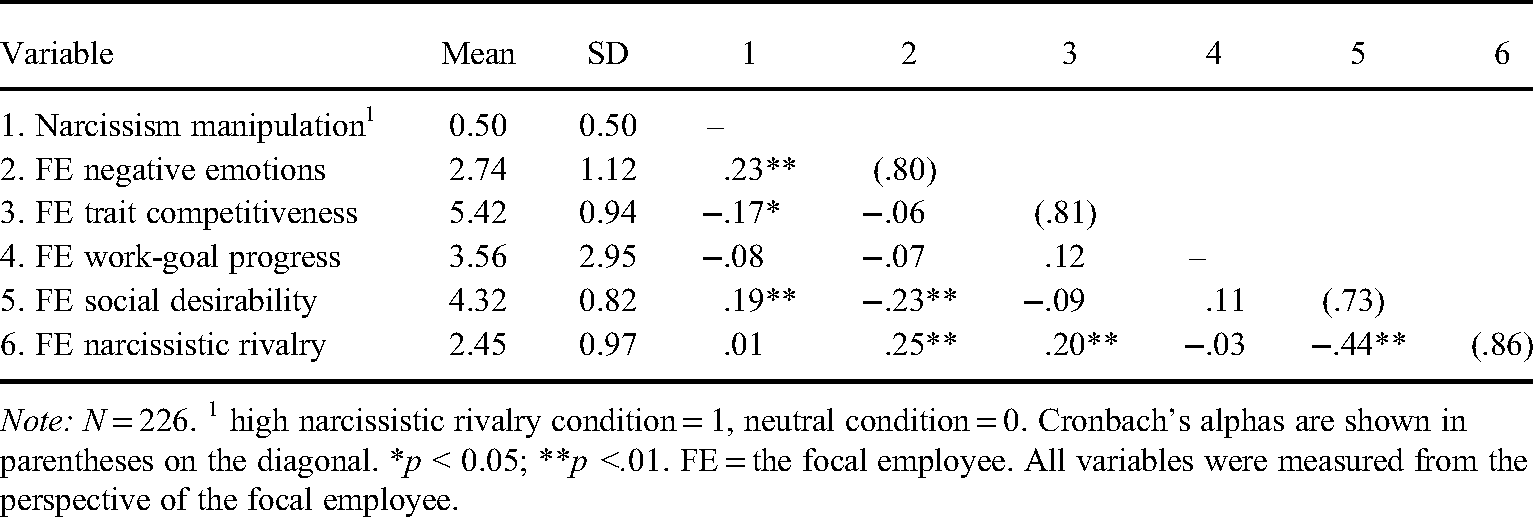
Note: N = 226. 1 high narcissistic rivalry condition = 1, neutral condition = 0. Cronbach's alphas are shown in parentheses on the diagonal. *p < 0.05; **p <.01. FE = the focal employee. All variables were measured from the perspective of the focal employee.
Manipulation Check
Participants in the narcissistic rivalry condition rated their coworker as higher in narcissistic rivalry (M = 5.95, SD = 1.25) than those in the control condition (M = 2.13, SD = 1.11), F(1, 225) = 591.74, p = .000, d = 3.23.
Hypothesis Testing
We tested Hypotheses 1, 4, and 5 using Hayes's (2013) PROCESS macro in SPSS (Model 14; see Table 4). In support of Hypothesis 1, we found a positive relationship between the narcissistic rivalry manipulation and participants’ negative emotions (B = 0.60, p <.000). Those in the narcissistic rivalry condition experienced higher negative emotions (M = 2.99, SD = 1.10) than those in the control condition (M = 2.47, SD = 1.09), F(1, 225) = 12.78, p = .000, d = .47.
Study 2: Moderated Mediation Results
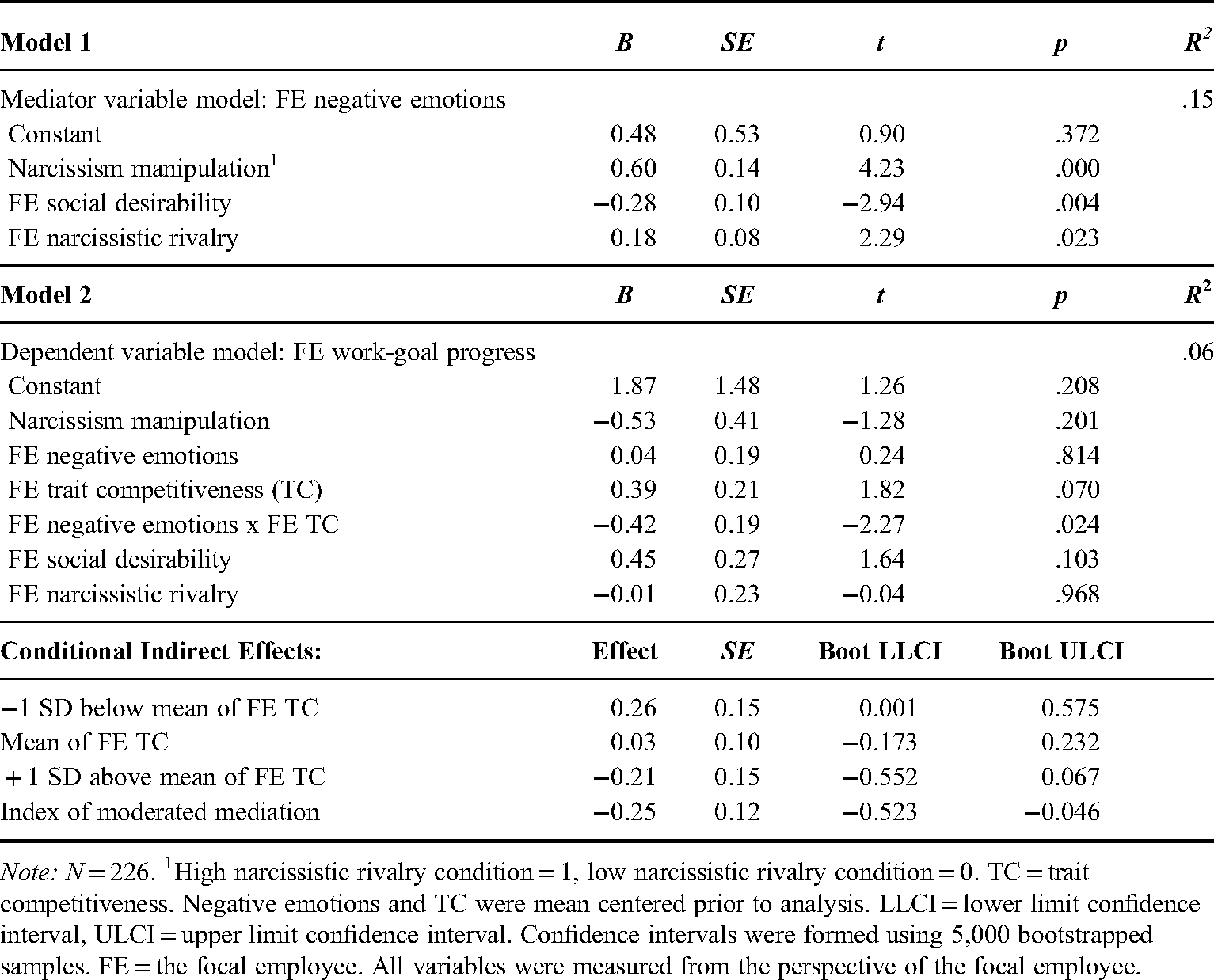
Note: N = 226. 1High narcissistic rivalry condition = 1, low narcissistic rivalry condition = 0. TC = trait competitiveness. Negative emotions and TC were mean centered prior to analysis. LLCI = lower limit confidence interval, ULCI = upper limit confidence interval. Confidence intervals were formed using 5,000 bootstrapped samples. FE = the focal employee. All variables were measured from the perspective of the focal employee.
For Hypothesis 4, the interactive effect between the focal employee's negative emotions and trait competitiveness was significant (B = −0.42, p = .024). As posited, the plotted interaction (Figure 3) for lower trait competitiveness demonstrated a positive slope for the focal employee's negative emotions onto work-goal progress but not to a statistically significant degree (B = 0.44, p = .117). For high trait competitiveness, the plotted interaction indicated a negative slope for the focal employee's negative emotions onto work-goal progress but not to a statistically significant level (B = −0.35, p = .132). These results offer support for Hypothesis 4, because the interaction was significant and the plot for lower trait competitiveness was in the predicted direction, but support is weak due to the nonsignificant slope of the plotted line. To test Hypothesis 5, we used 5,000 bootstrapped samples to create 95% bias-corrected confidence intervals. Hypothesis 5 was supported. The effect of narcissistic rivalry onto the participant's work-goal progress through negative emotions was positive and significant at lower trait competitiveness (−1 SD below the mean), B = 0.26, SE = .15, 95% CI [.001, .575], but was not significant at the mean (B = 0.03, SE = .10, 95% CI [−0.173, .232]), nor at higher levels ( +1 SD above the mean) of trait competitiveness (B = −0.21, SE = .15, 95% CI [−0.552, .067]). The index of moderated mediation was significant (B = −0.25, SE = .12, 95% CI [−.523, −.046]). Post-hoc power analyses (Bliese & Wang, 2020) revealed power above 0.60 for testing the proposed relationships with these data.
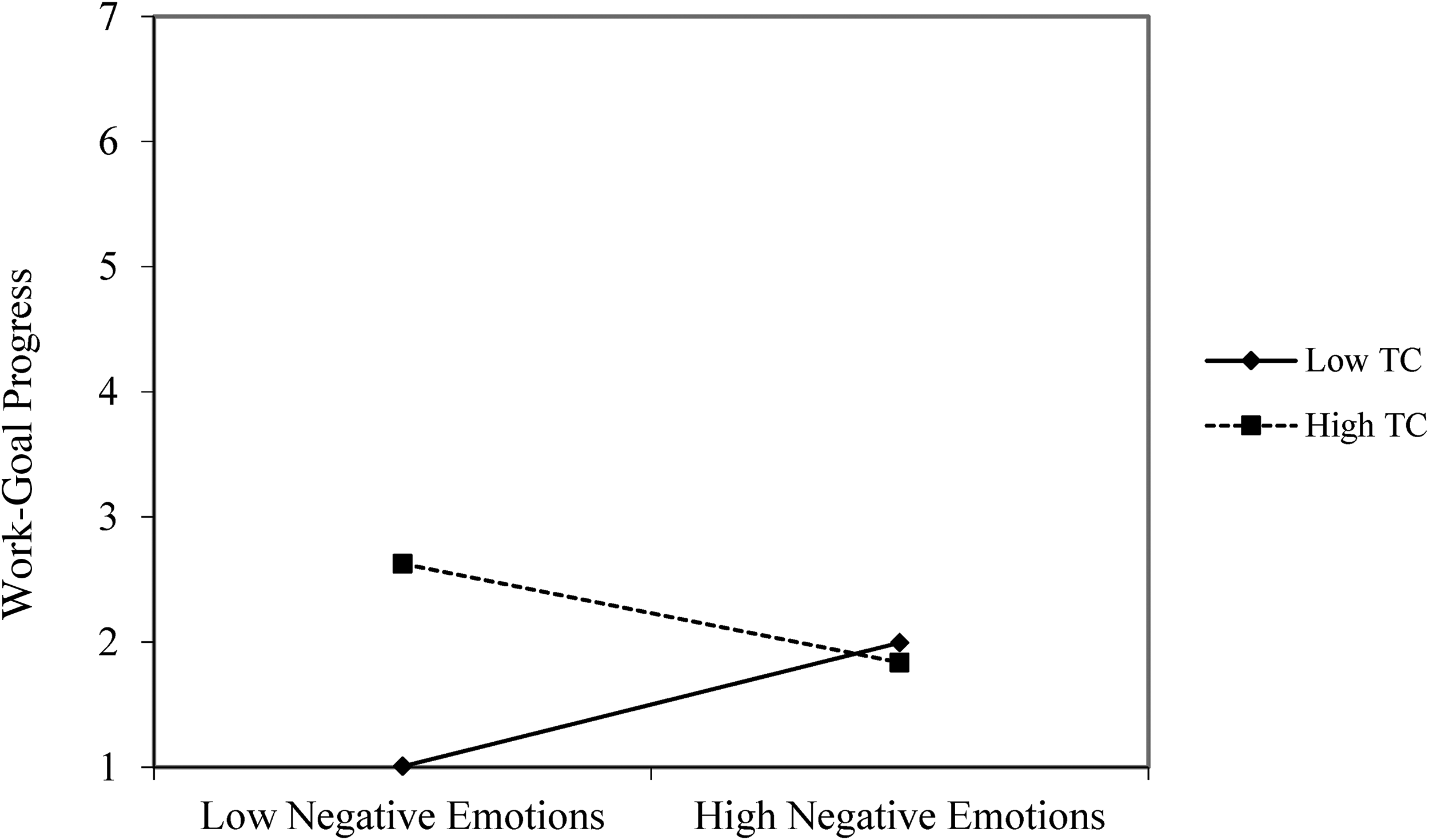
Study 2 Moderating Effect of Focal Employee Trait Competitiveness on the Relationship Between Focal Employee Negative Emotions and Work-Goal Progress
Study 3 Method
Sample and Procedure
Study 3 used Amazon's Mechanical Turk (MTurk) to recruit working adults living in the United States to partake in a study across two time periods. MTurk can be a reliable source (e.g., Buhrmester, Kwang, & Gosling, 2011; Burton, Taylor, & Barber, 2014; Weber & Bauman, 2019) for gathering generalizable data. Yet, to ensure the integrity of our MTurk data, we followed best practices outlined by Aguinis, Villamor, and Ramani (2021). Specifically, we only recruited full-time working adults within the United States with a HIT approval rate above 95%. We based compensation on a $15.00/hour minimum wage and structured compensation to reduce attrition. Compensation was $1.00 for completion of the Time 1 survey, $3.00 for completion of the Time 2 experimental survey, and a bonus of $1.00 for successfully completing both surveys. To detect careless responding and/or possible bot activity, we included three attention checks, an open-ended question (i.e., about their typical day on the job), and observed response times for each page of the survey (DeSimone, Harms, & DeSimone, 2015). Possible participants were informed via the MTurk posting that tools would be in place to detect careless responding and that compensation would depend on effortful completion of the study. This information was reiterated in both the Time 1 and Time 2 survey instructions.
We recruited 292 participants who completed a Time 1 survey, which captured BLM, trait competitiveness, control variables, and demographics, in advance to avoid the possibility that ratings of individual attributes could bias our experimental results (Spencer, Zanna, & Fong, 2005). At Time 2 (approximately one week after Time 1), we employed the experiment, which included a computerized coworker that represented high-versus-low narcissistic rivalry and collected data on the remaining study variables, with 223 participants completing this part of the study (retention rate: 76.37%). Although no participants failed attention checks (Aguinis et al., 2021; Meade & Craig, 2012), we ensured the integrity of our data by removing 8 participants who failed to follow instructions and 14 participants who suspected that their coworker was a computerized confederate rather than a real person. Our final sample came to 201 participants (100 = high narcissistic rivalry condition, 101 = low narcissistic rivalry condition), with an average age of 40.54 years (SD = 10.93), 50.2% being female and 79.6% white.
For the Time 2 experimental study, focal participants were told that they would be paired with a coworker to make decisions about copyediting for a company in the United States. Unbeknown to participants, the experiment manipulated the coworker's high-versus-low narcissistic rivalry via a computerized confederate. The participants were told that prior to partaking in the copyediting task with their coworker, they would engage in a one-way interview of a coworker where: (1) they would be given three structured questions to ask the coworker for the purposes of facilitating the next task, and (2) the coworker would have a chance to respond to the structured questions (where we introduced the manipulation). For added realism, we told participants that after they interviewed the coworker, the coworker would have a chance to interview them via a one-way structured interview. After receiving these instructions, participants were asked to introduce themselves to the coworker via a textbox (first name only). Participants then received an introductory response from a coworker: “Hey, I’m Casey. Let's get this done.” After exchanging introductions, the participant received one structured question at a time to ask Casey. Casey then responded in ways that reflected high or low narcissistic rivalry according to Back et al. (2013) conceptualization. The questions and responses are as follows:
After each response from Casey, participants were prompted to move on to the next structured question. After the questions, but before the copyediting task, participants responded to items about their interview with Casey and were assured that their responses would not be shared with Casey. We asked participants to rate their negative emotions, intended social undermining of Casey, intended work-goal progress relative to Casey, and the manipulation check. Participants were then told that there would not be a subsequent copyediting task and were debriefed.
Measures
Focal employee negative emotions. After the manipulation, participants rated their negative emotions “right now” using the same six-item measure as Studies 1 and 2 (α = 0.93), with the items having factor loading of. 64 or higher.
Focal employee bottom-line mentality. At Time 1, participants rated their BLM using the same four-item measure as Study 1 (α = 0.92).
Focal employee trait competitiveness. At Time 1, participants rated their own trait competitiveness using the same four-item measure as Study 2 (α = 0.90).
Focal employee social undermining of the coworker. After the manipulation, participants rated their intentions to undermine Casey (same items as Study 1) (1 = I don't plan to ever use this behavior with Casey, 7 = I plan to use this behavior with Casey) (α = 0.90).
Focal employee work-goal progress relative to the coworker. After the Time 2 manipulation, work-goal progress was captured using a measure from Greenbaum et al. (2022) that was slightly adapted to fit our experiment (items listed in Appendix A). Compared to Study 2, this measure more directly asks about the focal employee's work-goal progress relative to the coworker. Participants read: “Please think about your work in relation to Casey. Please indicate how strongly you agree that you will focus on the following behaviors” (α = 0.97).
Manipulation check. At Time 2, to check our manipulation, participants rated Casey's narcissistic rivalry using the same 9-item measure as Studies 1 and 2 (α = 0.95).
Control variables. Control variables were measured at Time 1. As in Study 2, we controlled for the participants’ social desirability (10 items, Strahan & Gerbasi, 1972) (α = 0.86) and focal participants’ self-ratings of narcissistic rivalry (α = 0.85). Support for our hypotheses were the same with or without the inclusion of the controls in our analyses (Becker, 2005).
Study 3 Results
Descriptive statistics, correlations, and reliabilities for Study 3 are shown in Table 5.
Study 3: Descriptive Statistics, Correlations, and Reliabilities

Note: N = 201. 1 High narcissistic rivalry condition = 1, low narcissistic rivalry condition = 0. Cronbach's alphas are shown in parentheses on the diagonal. *p < 0.05; **p <.01. FE = the focal employee. All variables were measured from the perspective of the focal employee.
Manipulation Check
Our manipulation checks revealed that participants in the narcissistic rivalry condition rated their coworker, Casey, higher in narcissistic rivalry (M = 5.74, SD = .80) than those in the low condition (M = 3.89, SD = 1.30), F(1, 200) = 173.21, p = .000, d = 1.71.
Hypothesis Testing
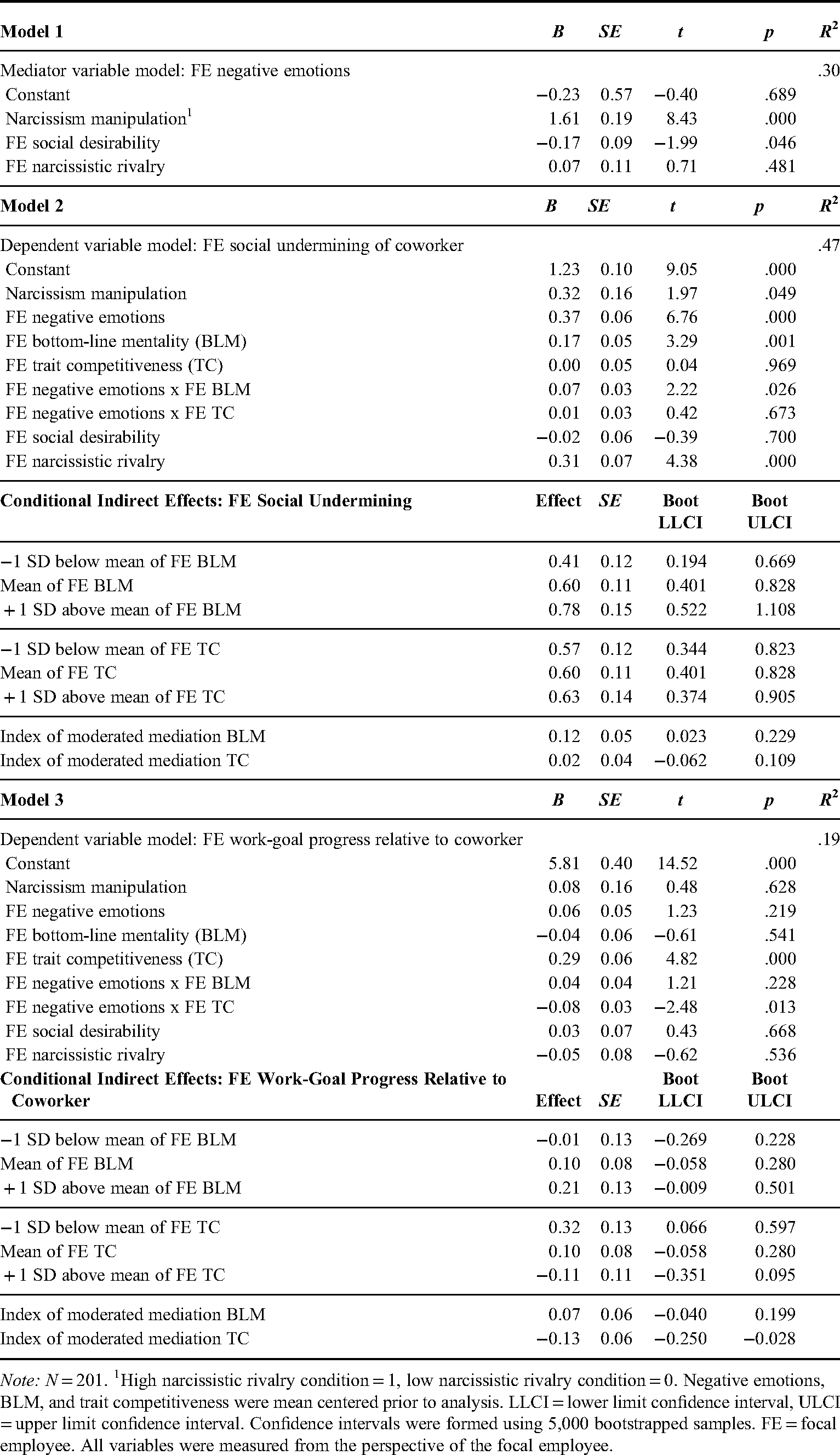
As our full theoretical model includes two dependent variables, we tested our results via path analysis in MPlus Version 8 (Muthén & Muthén, 1998−2017) (see Table 6). Supportive of Hypothesis 1, there was a significant positive relationship between the coworker's narcissistic rivalry and the focal employee's negative emotions (B = 1.61, p <.000). Additionally, those in the high narcissistic rivalry condition reported higher negative emotions (M = 3.64, SD = 1.55) than those in the low condition (M = 1.99, SD = 1.09), F(1, 200) = 76.67, p = .000, d = 1.23.
Study 3: Moderated Mediation Results
Note: N = 201. 1High narcissistic rivalry condition = 1, low narcissistic rivalry condition = 0. Negative emotions, BLM, and trait competitiveness were mean centered prior to analysis. LLCI = lower limit confidence interval, ULCI = upper limit confidence interval. Confidence intervals were formed using 5,000 bootstrapped samples. FE = focal employee. All variables were measured from the perspective of the focal employee.
Supportive of Hypothesis 2, the interaction of the focal employee's negative emotions and BLM onto social undermining is significant (B = 0.07, p = .026). As shown in Figure 4, the relationship between focal employee negative emotions and social undermining was more strongly positive when BLM is higher (B = 0.48, p = .000) compared to when it is lower (B = 0.26, p = .000). We assessed Hypothesis 3 using 95% bias-corrected confidence intervals (5,000 bootstrap samples). The results show that the positive indirect relationship between the coworker's narcissistic rivalry and a focal employee's social undermining of the coworker, through the focal employee's negative emotions, was stronger when BLM was higher ( + 1 SD above the mean) (B = 0.78, SE = .15, 95% CI [0.522, 1.108]) and became progressively weaker at the mean of BLM (B = 0.60, SE = .11, 95% CI [0.401, 0.828]) and at lower levels of BLM (−1 SD below the mean) (B = 0.41, SE = .12, 95% CI [0.194, 0.669]). Additionally, the index of moderated mediation was significant, further supporting Hypothesis 3 (B = 0.12, SE = .05, 95% CI [0.023, 0.229]). Although not predicted, we also tested our theoretical model by examining the interactive and moderated mediation effects of focal employee negative emotions and BLM onto work-goal progress relative to the narcissistic rival and did not find significant results.
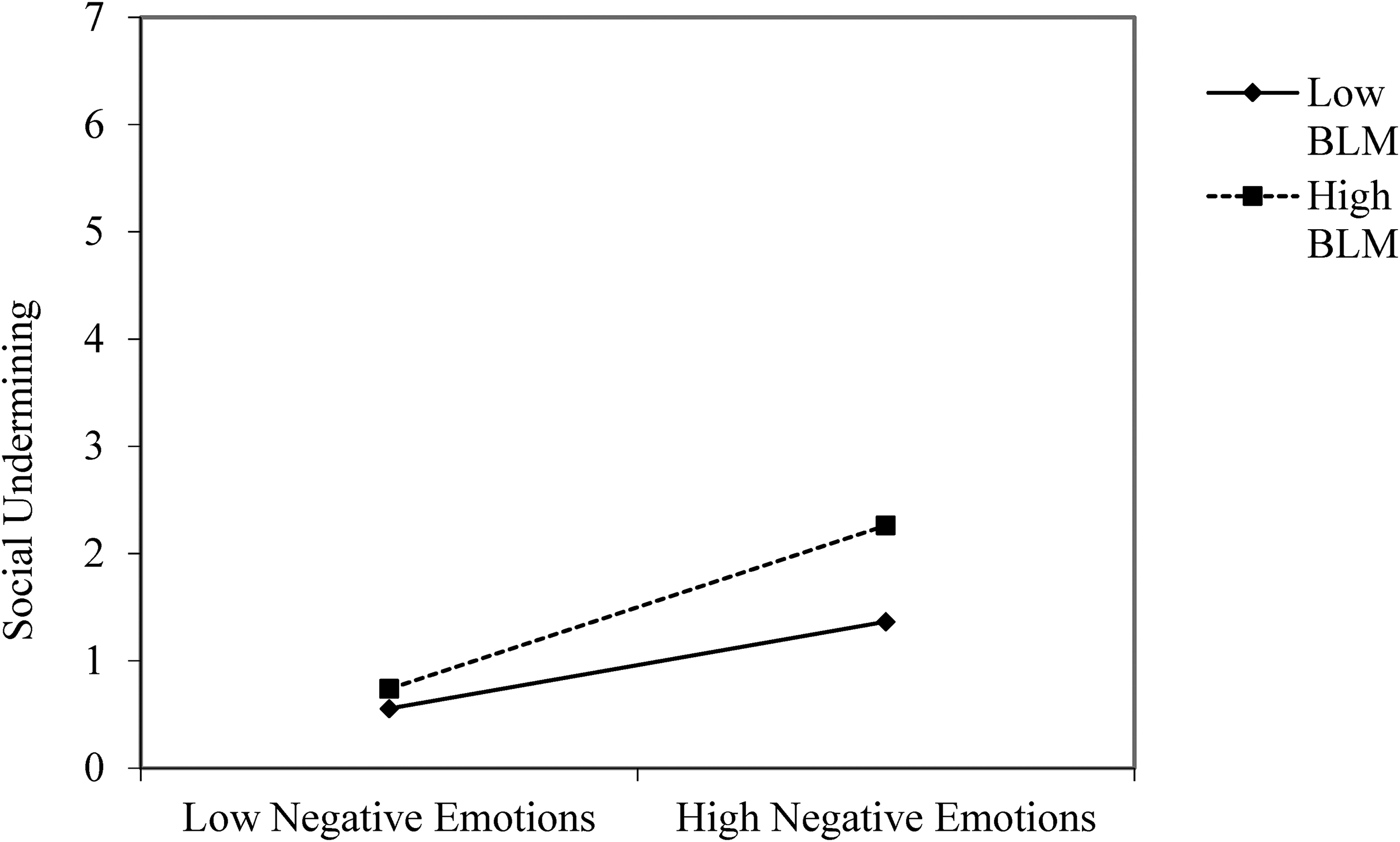
Study 3 Moderating Effect of Focal Employee BLM on the Relationship Between Focal Employee Negative Emotions and Intentions to Socially Undermine the Coworker
Supporting Hypothesis 4, the interactive effect of focal employee negative emotions and trait competitiveness onto work-goal progress relative to the coworker was significant (B = −0.08, p = .013). Figure 5 reveals a positive relationship between focal employee negative emotions and work-goal progress when trait competitiveness is lower (B = 0.20, p = .015), and there is not an effect when trait competitiveness is higher (B = −0.07, p = .317). In support of Hypothesis 5, the positive indirect effect of narcissistic rivalry onto focal employee work-goal progress relative to the coworker, through focal employee negative emotions, is significant when trait competitiveness is lower (−1 SD below the mean) (B = 0.32, SE = .13, 95% CI [0.066, 0.597]) and is not significant at mean levels of trait competitiveness (B = 0.10, SE = .08, 95% CI [−0.058, 0.280]), nor at higher levels of trait competitiveness ( + 1 SD above the mean) (B = −0.11, SE = .11, 95% CI [−0.351, 0.095]). The index of moderated mediation was also significant, supporting Hypothesis 5 (B = −0.13, SE = .06, 95% CI [−0.250, −0.028]). Although not predicted, we also tested our theoretical model by examining the interactive and moderated mediation effects of focal employee negative emotions and trait competitiveness onto social undermining of the coworker and did not find significant results. As a robustness check, we also tested Hypotheses 4 and 5 by examining our theoretical model with different operationalizations of work-goal progress. Participants also reported their intended work proficiency (Griffin, Neal, & Parker, 2007) and job performance (Williams & Anderson, 1991) relative to the coworker. When testing the moderating role of trait competitiveness, support for Hypotheses 4 and 5 remained the same using these alternative operationalizations of the DV. 2 Finally, post-hoc power analyses (Bliese & Wang, 2020) revealed power at or above .60 for detecting effects per these data.
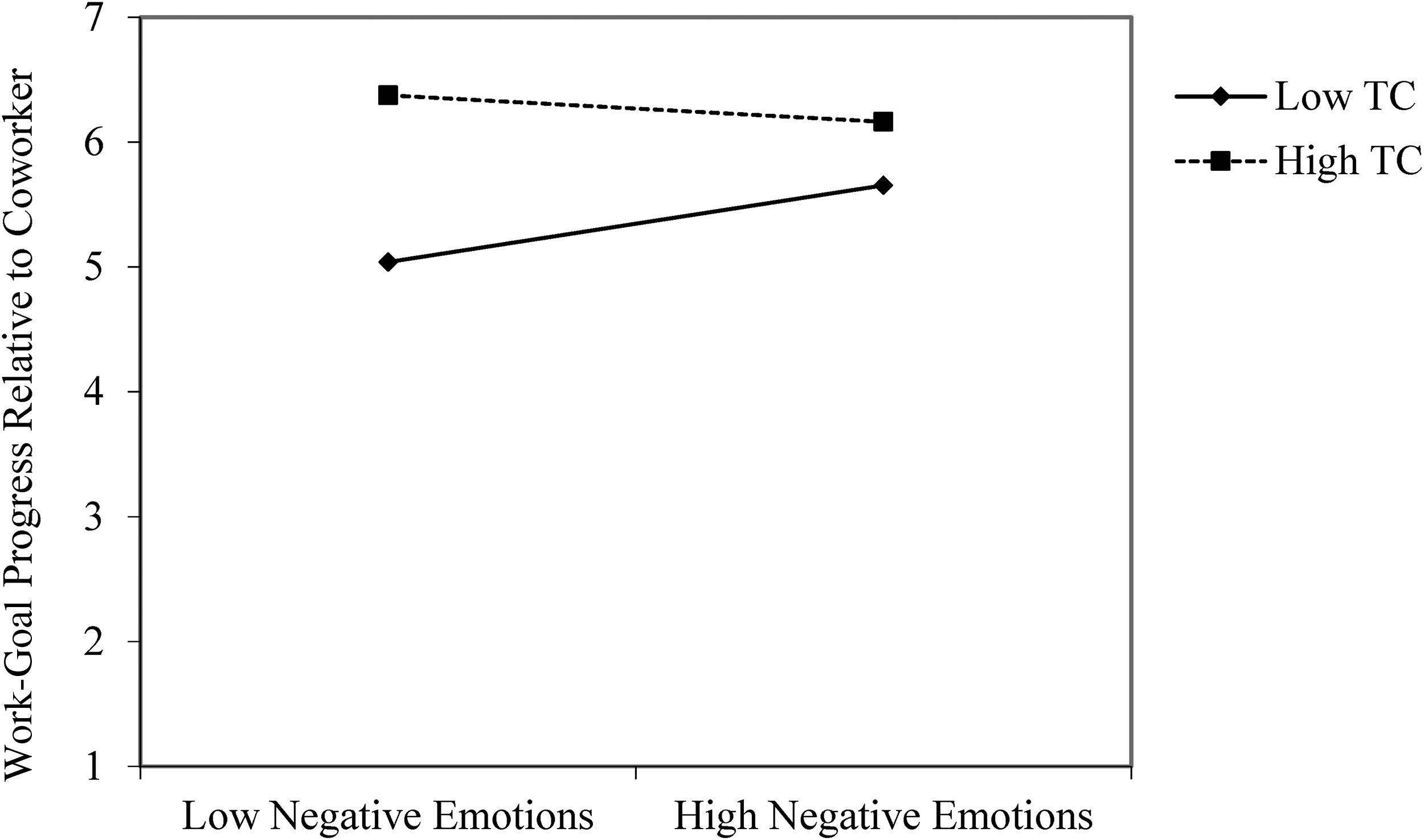
Study 3 Moderating Effect of Focal Employee Trait Competitiveness on the Relationship Between Focal Employee Negative Emotions and Work-Goal Progress Relative to Coworker
Discussion
Theoretical Implications
Our research offers several theoretical contributions. First, narcissism has evolved as an important personality type for promoting or hindering organizational outcomes (Campbell, Hoffman, Campbell, & Marchisio, 2011; Forsyth, Banks, & McDaniel, 2012). For example, past research has shown that narcissistic individuals tend to emerge into influential positions (Deluga, 1997; Grijalva, Harms, Newman, Gaddis, & Fraley, 2015), but once there, the detrimental nature of their self-importance can wreak havoc as they tend to be ineffective leaders (Owens et al., 2015), hostile toward others (Golec de Zavala, Cichocka, & Iskra-Golec, 2013; Goncalo, Flynn, & Kim, 2010), and risk taking in a way that can result in large failures (Chatterjee & Hambrick, 2007). Although much has been learned about the complexity of narcissism at work, most research has examined narcissism with respect to the narcissist's own outcomes (Back et al., 2013) or outcomes that effect the organization (e.g., deviant behavior) (e.g., Forsyth et al., 2012). More recently, research has started to examine the effects of leader narcissism on employee outcomes (e.g., Carnevale et al., 2018; Fehn & Schütz, 2021; Nevicka et al., 2018), but this literature remains underdeveloped in terms of understanding the effects of coworker narcissism on employees’ motivational states and behaviors. Thus, we contribute to the literature by providing a more socialized view of narcissism by using social function of emotions theory (Keltner & Haidt, 1999) to explain why this strong personality type is likely to provoke other employees’ negative emotions, which then conditionally influence employees’ behaviors.
Our research also contributes to the broader personality literature. Personality scholars that have been calling for research to adopt a more encompassing view of the social consequences of personality (Back & Vazire, 2015; Back et al., 2011). Back and Vazire (2015) noted that most personality research on “partner effects” has been limited to romantic relationships (e.g., Malouff, Thorsteinsson, Schutte, Bhullar, & Rooke, 2010). For example, Solomon and Jackson (2014) demonstrated that a spouse's conscientiousness can positively influence the second spouse's career-related outcomes, above and beyond the second spouse's own conscientiousness (Solomon & Jackson, 2014). Yet, little research has investigated the effects of coworkers’ personality traits onto other employees’ motivational states and behaviors. Given that coworkers are an integral, dominant social factor within the workplace (Methot, Lepine, Podsakoff, & Christian, 2016; Methot, Melwani, & Rothman, 2017), it is worthwhile to understand how coworkers’ innate tendencies motivate or hinder those around them. In this respect, our research begins to study personality in relation to partner effects through the lens of narcissistic rivalry—a highly provoking personality type that may conditionally affect an employee's offensive and defensive reactions above and beyond this person's own narcissistic rivalry.
We also contribute to the literature by using theory on narcissism (Back et al., 2013) and the social function of emotions (Keltner & Haidt, 1999) to extend Leary et al.'s (1997) original claims that detailed why people, generally, do not like narcissists. Moving beyond Leary et al.'s contention that narcissists are disliked, we offer a novel theoretical account of why a coworker's narcissistic rivalry is likely to provoke an employee's negative emotions that conditionally affect diverging outcomes. Our theorizing allows us to extend Leary et al.'s sentiments by explaining the social role of negative emotions (e.g., Keltner & Haidt, 1999) and how these emotions serve as a guiding force for evaluating coworkers’ adherence to norms of appropriate competition (e.g., Fülöp, 2009; Marchant et al., 1998). Our work draws focus to the ambivalent nature of negative emotions (Pekrun, 1992), such that they may conditionally provoke an employee's motivation to improve their work goals relative to the narcissistic rival or to socially undermine the narcissistic rival. In this respect, our research provides strong theoretical support for why and when a coworker high in narcissistic rivalry may indirectly motivate an employee's behaviors that could be both functional and dysfunctional for the organization more broadly.
By examining both trait competitiveness and BLM as moderators of our theoretical model, we also contribute to the literature by clarifying the similarities and differences between these two attributes. Although past research has discussed each attribute with respect to competitive tendencies (Helmreich et al., 1978; Wolfe, 1988), we clarify their differences by explaining that trait competitiveness reflects an offensive competitive posture in which the focus on competition is directed toward improving oneself relative to perceived opponents (e.g., Newby & Klein, 2014), whereas BLM underlies a defensive competitive posture that captures a tendency to direct energy toward stopping a perceived opponent (Greenbaum et al., 2012). Because of these different approaches to competition, our research suggests that the activating nature of negative emotions for employees high in BLM may produce stronger social undermining of the narcissistic rival because the focal employee reacts to their negative emotions with a desire to hinder the success of the narcissistic rival to protect their own bottom line. Interestingly, our research contributes to the literature by identifying a way in which people low in trait competitiveness may benefit from social situations that activate their negative emotions to instill motivation. Past research has suggested that there may be benefits of low trait competitiveness because an activating context may prompt these individuals to feel as though they have nothing to lose by trying harder (e.g., Fletcher et al., 2008; Helmreich et al., 1978; Pekrun, 1992). We reveal a context and emotional state whereby this may be true for those low in trait competitiveness.
To reconcile why narcissism tends to produce both beneficial and problematic outcomes for the narcissist, Back et al. (2013) showed that narcissism entails two primary dimensions: narcissistic rivalry and admiration. From Back et al.’s research, subsequent studies have shown that narcissistic admiration is positively related to the narcissist's hope for success and motivation to perform well (Lange et al., 2016), steady levels of high self-confidence (Geukes et al., 2017), empowerment that then propels voice behaviors (Helfrich & Dietl, 2019), and enhanced empathy that results in less revenge and avoidance behaviors (Fatfouta et al., 2015). In contrast, narcissistic rivalry is related to the narcissist's fear of failure and social conflict (Lange et al., 2016), low and unstable self-esteem (Geukes et al., 2017), reduced empowerment and less voice behavior (Helfrich & Dietl, 2019), and enhanced anger that results in revenge and avoidance behaviors (Fatfouta et al., 2015). We contribute to this growing body of research by examining both types of narcissism in relation to partner effects, such that we demonstrate that a coworker's narcissistic rivalry can indeed conditionally motivate an employee's work-goal progress, above and beyond the effects of the coworker's narcissistic admiration. Thus, we provide a different perspective with respect to narcissistic rivalry; rather than it serving as a purely negative attribute, it may be a motivating force for some coworkers.
Practical Implications
Practitioners can benefit from learning that narcissistic rivalry, at times, can be effective in motivating other employees to have higher work-goal progress. Although narcissists are often deemed awful colleagues (Kets de Vries, 2017; Leary et al., 1997), they can provoke employees to develop negative emotions that may drive them to focus on their work goals as a way of improving themselves relative to the narcissistic rival. Yet, other employees may respond with more dysfunctional behaviors, perhaps by viewing social undermining as an effective way of offering self-protection against the narcissistic rival. To promote more effective response patterns, managers may work with employees to understand their negative emotions as indicating an opportunity for improvement rather than self-protection.
To optimize desired outcomes, practitioners need to understand the mechanisms by which a context produces diverging outcomes (Back & Vazire, 2015). Such insights may allow practitioners to tailor their intervention strategies to the particular mechanisms that generate good rather than bad outcomes. Thus, practitioners should know that negative emotions in the workplace can propel both higher work-goal progress and social undermining. In this respect, training could focus on functional ways to handle negative emotions. For example, these emotions could be met with mindfulness techniques that allow employees to more effectively recognize that negative emotions indicate a need for action, but such action could include functional behaviors and does not need to entail social undermining.
Finally, practitioners should be aware that employee BLMs may reflect a defensive competitive posture because it entails a high-stakes mentality in which the bottom line is more important than all else. Although a defensive competitive posture may seem necessary to protect one's own interests (e.g., Marchant et al., 1998), it could also propel those high in BLM to respond to triggering events with behaviors that are generally viewed as dysfunctional for the organization. Managers may be able to help temper an employee's high BLM by reminding them that the best way to protect one's own bottom line is to perform at higher levels, even if the work environment suggests threats to the bottom line. With such an intervention by management, it may be possible for employees high in BLM to adopt a growth mindset, even if temporarily.
Limitations and Future Directions
Our research has limitations, which pose opportunities for future research. One is that our experimental data is limited by outcome variables reflecting behavioral intentions rather than behaviors. In this respect, we followed recent experimental research (viz., Burgess, Colquitt, & Long, 2022) that also examined behavioral intentions in the lab because these intentions can capture in-the-moment motivation (Locke, 1996; Tubbs & Ekeberg, 1991) that is a core element of our theorizing (Keltner & Haidt, 1999). Additionally, past research suggests that intentions can serve as strong predictors of corresponding behaviors (e.g., Steel & Ovalle, 1984; Webb & Sheeran, 2006), and our use of intentions match the conceptualization of social undermining as intending to hinder another's success (Duffy et al., 2002). Even so, future research may improve upon our research by examining more explicit behavioral outcomes. Relatedly, though we operationalize negative emotions as done in past workplace research (Bono et al., 2007), future research may benefit by using measures that capture discrete emotions (e.g., anger, anxiety; Ferris, Yan, Lim, Chen, & Fatimah, 2016), as discrete emotions sometimes enhance predictive validity in terms of relating to associated outcome variables (e.g., Roseman, 1991).
Our research is also limited in that we only tested second-stage moderation effects. It is possible that a coworker's narcissistic rivalry more strongly influences another's negative emotions under certain conditions. For example, those high in emotional stability are more well-adjusted and thus are less likely to respond to trying situations with negative ruminative states and emotions (e.g., Judge, Rodell, Klinger, Simon, & Crawford, 2013). In this respect, it could be that emotionally stable employees are less likely to respond to a coworker's narcissistic rivalry with negative emotions. Finally, our research is limited because our theory and theoretical model primarily considered the role of narcissistic rivalry, and not narcissistic admiration, in terms of how a coworker's narcissism affects other employees’ motivational states and behaviors. Because narcissistic admiration is usually viewed at the “bright side” of narcissism (Back et al., 2013), perhaps future research could examine the effect of this dimension onto employees’ psychological engagement and positive organizational behaviors, such as helping behaviors.
Conclusion
Narcissism in the workplace has been widely studied as a personality trait with mixed effects for the organization. We build a more socialized view of the effects of narcissism by studying it in relation to partner effects. Using theory on the social function of emotions, we explain why and when narcissistic rivalry affects employees’ emotional states and behaviors. Our research demonstrates that narcissistic rivalry drives employees’ negative emotions, but these emotions result in different behavioral outcomes of social undermining or work-goal progress depending on the employee's BLM or trait competitiveness. We hope our research serves as a launching point for future research on personality and partner effects in the workplace.
Footnotes
APPENDIX A
Negative Emotions (Based on Bono et al., 2007)
Tense Uneasy Contempt Anger Irritation Frustration
Work-Goal Progress Relative to Coworker (Greenbaum et al., 2022; adapted from Wanberg et al., 2010)
I hope to be better than my coworker in terms of…
Being productive in achieving my work goals. Making good progress on my work goals. Moving forward on my work goals.
APPENDIX B
High Narcissistic Rivalry Condition
General Manager
Trey Crawford Insurance Group
Wylie, TX 75098
Email: caseyltown@tcrawins.com
March 14, 2018
Dear Selection Committee:
I am writing per your request to evaluate Aubrey Jorgensen for your position (Position #: 12678). Aubrey worked for me last summer as an intern. Some of Aubrey's responsibilities included (1) following up with clients regarding their insurance needs, (2) attending sales meetings with brokers and clients, (3) creating PowerPoint presentations to solicit customers’ interest in our products. At the end of summer, Aubrey was evaluated using 360-degree feedback from supervisors, customers, and coworkers. In terms of written feedback from supervisors, customers, and coworkers, here are some comments we received:
“I was in a meeting with Aubrey. Aubrey said that most people won't achieve anything in life, and so many people in the world are losers.” —Coworker 1 “I always got the sense that Aubrey wanted to see me fail. Aubrey seemed to think that I was an inferior person.” —Coworker 2 “Before Aubrey's sales pitch, I told a personal story. I think Aubrey was annoyed that people were paying attention to me and not Aubrey.” —Customer 1 “Aubrey does not like it when other people are the center of attention.” —Supervisor 1 “I once tried to provide Aubrey with feedback. Aubrey took the feedback as criticism and seemed annoyed.” —Supervisor 1 “Aubrey always tries to come across as superior than others.” —Coworker 3
I offer this written feedback regarding Aubrey so that you can make your own assessment of Aubrey's fit for your position. I should also note that Aubrey's competency rating was adequate. Please let me know if you have any questions.
Kind Regards,
Casey Townsend
Neutral Condition
General Manager
Trey Crawford Insurance Group
Wylie, TX 75098
Email: caseyltown@tcrawins.com
March 14, 2018
Dear Selection Committee:
I am writing per your request to evaluate Aubrey Jorgensen for your position (Position #: 12678). Aubrey worked for me last summer as an intern. Some of Aubrey's responsibilities included (1) following up with clients regarding their insurance needs, (2) attending sales meetings with brokers and clients, (3) creating PowerPoint presentations to solicit customers’ interest in our products. At the end of summer, Aubrey was evaluated using 360-degree feedback from supervisors, customers, and coworkers. In terms of written feedback from supervisors, customers, and coworkers, here are some comments we received:
“I was in a meeting with Aubrey. Aubrey said that most people make adequate achievements in life, and so many people in the world are just fine.” —Coworker 1 “I always got the sense that Aubrey wanted me to be content. Aubrey seemed to think that I was an acceptable person.” —Coworker 2 “Before Aubrey's sales pitch, I told a personal story. I think Aubrey was alright with people paying attention to my story.” —Customer 1 “Aubrey is fine with other people being the center of attention.” —Supervisor 1 “I once tried to provide Aubrey with feedback. Aubrey took the feedback well and seemed okay.” —Supervisor 1 “Aubrey comes across as being equal to others.” —Coworker 3
I offer this written feedback regarding Aubrey so that you can make your own assessment of Aubrey's fit for your position. I should also note that Aubrey's competency rating was adequate. Please let me know if you have any questions.
Kind Regards,
Casey Townsend
