



Abstract
The emergence of new technologies together with the process of globalization and global outsourcing raise a question mark over the potential advantages of locating in an industrial district. In this context, there is a clear need for new studies to investigate whether the district effect still exists in these new circumstances. We propose that the increased availability of social capital, knowledge, and innovation would justify the firms in industrial districts obtaining competitive advantages and, therefore, greater levels of performance over the rest of the companies in an industry, allowing us to explore why the district effect is maintained in the current circumstances. The development of this study, in the footwear industry in Spain, has allowed us to analyze the existence of significant differences between industrial district firms and firms outside industrial districts. The results obtained in our study show that agglomerated firms, that is, firms located within industrial districts, achieve a greater performance than firms outside the industrial districts. With this study, we contribute to a deeper analysis of the competitive differences arising from the district effect. On one hand, we analyze if the competitive advantages of companies located in the districts will reveal differences in the obtained performance—growth, profitability, innovation performance, and general performance. We also analyze three key competitive factors in the competitive dynamics of industrial districts, with particular attention to social capital. In this sense, we look separately at the three dimensions of social capital—structural, relational, and cognitive.
Keywords
Introduction
Since the early studies of Becattini (1979, 1990), numerous empirical studies have detected that firms belonging to an industrial district produce superior levels of performance than those firms, which, although they belong to the same industry, are located outside the industrial district (Signorini 1994; DeCarolis and Deeds 1999; Brioschi, Brioschi, and Cainelli 2002; Molina and Martínez 2003; Cainelli and De Liso 2005). This phenomenon, called “district effect,” has been traditionally justified by the development of economies of agglomeration (Marshall 1890) and a combination of technological, economic, social, and cultural factors (Porter 1990). However, several authors highlight the vulnerability of this model in certain circumstances, for example, when companies have to respond to radical external changes (Glasmeier 1991). It is also highlighted that, with the emergence of new technologies, firms will be connected electronically without geographical proximity. Thus, important technological developments involving the emergence, among other factors, of virtual social networks promote virtual collaboration (Sutanto et al. 2011). These factors together with the process of globalization and global outsourcing (Sachetti and Tomlinson 2009) raise a question mark over the potential advantages of locating in an industrial district. In this context, there is a clear need for new studies to investigate whether the district effect still exists in these new circumstances (Arikan and Schilling 2011).
Moreover, in recent years, the strategic management literature has highlighted the relevance acquired by several key factors for the achievement of sustainable competitive advantages. Among these factors are social capital (Tsai and Ghosal 1998; Adler and Kwon 2002; McFadyen and Cannella 2004), knowledge (Spender 1996; Grant 1996), and innovation (Damanpour 1991; Zaheer and Bell 2005; Boix and Trullen 2010). We consider that these factors have particularly important implications in the competitive dynamics of industrial districts. However, there are as yet no solid results on the existence of significant differences in the importance of these factors between companies belonging within and outside industrial districts. In the line of the previous arguments, we propose that the increased availability of these factors would justify the firms in industrial districts obtaining competitive advantages and, therefore, greater levels of performance, over the rest of the companies in an industry, allowing us to explore why the district effect is maintained in the current circumstances.
The basic objective of this article, therefore, is to analyze the existence of district effect in the current context, that is, to investigate whether firms located within the industrial district have greater levels of performance than those firms located outside the district. In addition, as a complementary aim, we intend to analyze whether the firms located within the district develop greater social capital, acquired knowledge, and innovation than firms outside the district. These differences could justify the existence of the district effect.
With this study, we contribute to a deeper analysis of the competitive differences arising from the district effect. On one hand, we analyze if the competitive advantages of companies located in the districts will reveal differences in the obtained performance—growth, profitability, innovation performance, and general performance. In addition, we make an initial contrast of the sustainability of competitive advantages of firms in the district, through the assessment-obtained performance over the last three years. We also analyze three key competitive factors in the competitive dynamics of industrial districts, with particular attention to social capital. In this sense, we look separately at the three dimensions of social capital—structural, relational, and cognitive. Moreover, following the approaches of Becattini (1990), we contribute to corroborating the concept of industrial district, verifying whether there are significant differences in the feeling of belonging—common identity—and the level of cooperation with the upcoming companies among those both inside and outside a district, following a geographical criterion. Finally, this empirical study focuses on the Spanish footwear industry. The industry is characterized by the predominance of small- and medium-sized enterprises that are located both inside and outside industrial districts, although the geographically agglomerated firms predominate in the latter group. In addition, despite this industry being mature and traditional, companies keep up an innovative tension marked by changes in fashion and competing strongly globally. This is shown in their great exporting vocation. Therefore, we believe that this dual approach to the industry, with its mature and traditional character together with its competition at a global level, makes the analysis of the district effect in this industry particularly suitable.
This article is structured as follows. First, we explain the theory and derived hypotheses. Then, we describe the methodology used, followed by results obtained. Finally, we present the discussion, conclusions, and implications for theory and practice.
Theory
The industrial district concept emerged with the study of A. Marshall “Principles of Economics” in 1890, who tried to explain the advantages obtained by the location of firms in small geographic areas. Based on the definition provided by Becattini, industrial districts are considered as socioterritorial entities characterized by the active presence of both a community of people and a group of companies in a natural and historically determined area (Becattini 1990). The industrial district is comprised of numerous small businesses, among which there is the existence of networks of cooperation and a community of people who have a strong feeling of belonging and common cultural characteristics, each district being the result of a unique and unrepeatable historical and social process. This feeling of belonging is a consequence of the high degree of interdependence of the individual and the companies within the social context and is an element that is used to identify the members of the district (Becattini 1979). Therefore, the high interdependence of individual and collective behavior, as well as the commitment of all parts of the population, generates a sense of local belonging and social commitment among the companies (Paniccia 1998). In addition, we expect that firms belonging to an industrial district show a higher level of involvement and cooperation with the firms located in their population (McEvily and Zaheer 1999).
Although different studies have shown benefits for companies belonging to industrial districts (e.g., Signorini 1994; DeCarolis and Deeds 1999; Brioschi, Brioschi, and Cainelli 2002; Molina and Martínez 2003; Cainelli and De Liso 2005; Molina and Martínez 2008), some studies point out that industrial districts also have considerable disadvantages or risks (Martin and Sunley 2003; Palazuelos 2005). Therefore, we can find several studies that question the validity or potential of the industrial district model (Harrison 1994), and its vulnerability to respond to radical external changes (Glasmeier 1991). This discrepancy, coupled with the growing technological advances, increases the interest in developing studies looking for empirical evidence on the competitive superiority of these firms.
In the literature, we can find various factors that affect the competitive advantages of the company, which may have implications in the field of industrial districts. These factors include social capital, knowledge, and innovation.
Social capital is a key element for the current company due to its contribution to competitive advantage, which receives growing attention in the strategic management literature (Tsai and Ghoshal 1998; Adler and Kwon 2002; McFadyen and Cannella 2004). This concept can be defined as “the sum of current and potential resources inserted in, available from, and derived from the network of relations possessed by an individual or social unit” (Nahapiet and Ghoshal 1998, 243). Networks provide access to information, resources, markets, and technologies that have the potential to maintain or enhance the competitive advantage of the firms. Therefore, knowing the strategic networks of the firm becomes a central theme for understanding its strategy and performance (Gulati, Norhia, and Zaheer 2000). Therefore, understanding the nature of social capital allows us to explore the performance differences between companies (Koka and Prescott 2002).
On the other hand, at present, there is a strong interest among academics in knowledge as a key element for the success of firms. In particular, the fact of sharing knowledge has become an important focus in the field of strategic management, since this concept has received a growing emphasis as a key determinant of firms’ competitive advantage. In the words of Grant (1996, 376), knowledge “is the strategically most important resource possessed by organizations.” In addition, it has been recently shown in several studies that some kinds of knowledge, such as tacit, social, and complex knowledge, are difficult to imitate (Helfat and Rubitschek 2000), thus becoming a main source of value creation (Nonaka 1991; Li, Poppo, and Zhou 2010).
In this line, firms’ innovation, including the development of new products or services, as well as new administrative systems, is considered an important source of sustainable competitive advantage (Damanpour 1991). Thus, recognition is given to the positive influence that innovation has on a firm’s performance and, hence, survival (e.g., Covin and Miles 1999). In this sense, innovation is identified as a key capability for firms (Eisenhardt and Martin 2000), since it is critical for a firm’s performance (Zaheer and Bell 2005).
These three key factors for the competitive advantage of companies can be seen to a greater extent in geographic business concentrations such as industrial districts. Thus, several studies suggest that geographic proximity and interaction between individuals or companies favor the generation of social capital (Coleman 1990; Boland and Tenkasi 1995). On the other hand, there are several studies that argue that a spatially concentrated configuration allows a greater exchange of information between companies (e.g., Utterback 1974; Jaffe, Trajtenberg, and Henderson 1993). In this sense, the transfer of knowledge between companies in the district is one of its major externalities (Krugman 1991), whereas industrial districts act as accelerators of the knowledge diffusion (Brenner 2001). With regard to innovation, we can observe that certain characteristics inherent in the industrial district, as the existing rivalry, the resources shared by companies, the presence of local institutions, among others, show a positive association with the number of innovations that are developed, which translates into a positive relationship between belonging to an industrial district and the innovation (Baptista and Swann 1998; Muscio 2006; Molina and Martinez 2010; Boix and Galletto 2009; Boix and Trullen 2010).
Although there are many theoretical studies about these concepts in the field of the industrial district, the studies that develop a comparative empirical study to confirm the existence of comparative differences for these factors between the companies inside and outside industrial districts are still scarce. However, we consider that these analyses are of great importance to the literature on industrial districts, since they allow us to compare the importance of the district effect currently as well as to provide information about the explanatory variables of the firms’ performance.
Hypotheses
The Firms’ Performance
As noted above, the literature on industrial districts assigns significant value to the existence of a “district effect” that allows, in the context of an industry, the firms located in the district to achieve superior performance to those firms located outside the district (e.g., Signorini 1994; DeCarolis and Deeds 1999; Brioschi, Brioschi, and Cainelli 2002; Molina and Martínez 2003; Cainelli and De Liso 2005; Becchetti, De Panizza, and Oropallo 2007).
We can justify the existence of higher profits among firms located in industrial districts due to agglomeration economies (Marshall 1890). This author identifies a class of external economies that benefit companies due to common factor endowments. Thus, these companies benefit from the existence of a few qualified human resources, inputs and specialized services, as well as the industrial atmosphere, which translates into intangible resources that are based on the experience, knowledge, and the common information of the companies of the district. The geographical, cultural, and institutional proximity that an industrial district provides is an element that supports the firms in gaining a special access to close relationships, better information, powerful incentives, and other benefits difficult to obtain at a distance (Porter 1998; Molina and Martínez 2008). This allows the firms located in the industrial district to achieve sustainable competitive advantages that translate into better performance.
In this sense, as is highlighted by Porter (1990), the competitive advantage of grouped firms comes from a combination of technological, economic, social, and cultural factors. Therefore, we can consider the industrial district as a sectoral–spatial form of industrial organization that is based on the collective skill of a system of small firms, which proves its competitive advantage over the forms of organization based on large companies operating in the same sector. This advantage stems from the capacity of district firms to replace economies of scale with external economies and, in particular, relational economies (Mistri and Solari 2001).
In summary, we can state that companies belonging to an industrial district obtain advantages that are reflected in the existence of certain external economies of agglomeration and scope ensuing from the spatial proximity between companies—direct relationship with suppliers and customers, a qualified workforce, specialized services, subcontracted networks, support infrastructures, knowledge overflows, shared resources, and so on (Molina and Martínez 2008). This gives rise to a combination of relations of cooperation and competition. Apart from obtaining these economies, there are also outsourcing and vertical disintegration processes that allow the companies to avoid the risk derived from the high demand and technological uncertainty they face, while allowing to keep activities that bring greater added value inside the firm. Such vertical disintegration allows to respond more efficiently and with greater alacrity to changes in demand. These elements allow companies belonging to an industrial district to achieve competitive advantages that translate into superior performance, with regard to those firms located outside the district we can now propose the next hypothesis:
Social Capital
The literature on strategic networks asserts that the location of firms in networks of external relationships with other organizations has significant implications on the firm’s performance (Gulati, Norhia, and Zaheer 2000; Rampersad, Quester, and Troshani 2010). In this line, we can find several studies that reveal a relationship between social capital and a firm’s performance (Peng and Luo 2000; Acquaah 2007).
On the other hand, there is evidence indicating that proximity is an element of social relations which leads to the development of high levels of social capital. In fact, it has been demonstrated that the proximity of actors in a network facilitates the development of shared norms, identity, and trust (Coleman 1990; Roskruge et al. 2012). Similarly, physical proximity facilitates relationships “face to face,” and frequent and close interactions. On the other hand, according to Boland and Tenskasi (1995), when individuals interact they build and rebuild their language and knowledge as well as developing and adapting their expectations and obligations together with their social norms.
Therefore, social capital is developed to a far greater degree in contexts such as industrial districts. The interest in this aspect becomes evident in the large number of studies that, in recent years, have been studying social capital in this type of corporate networks (e.g., Inkpen and Tsang 2005; Molina 2005; Oba and Semergiöz 2005; Molina and Martínez 2010; Roskruge et al. 2012). In order to delve into the implications of social capital, we assume the three dimensions identified by Nahapiet and Ghoshal (1998): structural, relational, and cognitive.
The Structural Social Capital
The structural dimension tries to encompass all social interaction that occurs in the network, focusing on the properties of the social system and the network of relationships as a whole (Nahapiet and Ghoshal 1998). This dimension of social capital can be analyzed from the perspective of the network links mapping out the specific way in which the actors are related in terms of strength, frequency, and narrowness, and also from the network configuration, which determines the joining model between members of a network in terms of density, connectivity, and hierarchy (Nahapiet and Ghoshal 1998). With regard to this dimension, social capital theory highlights that spatial proximity facilitates frequent and close relations between the companies, in the same way as it allows interactions “face to face” (Molina 2005). Therefore, to the extent that firms are geographically and historically linked, an increase occurs in the number of “face-to-face” relationships and continuity of interactions (Paniccia 1998).
In industrial districts, it is easy to find cases in which different family members or friends are working for different companies (often competitors) of the district. This context, where family, social, and professional ties are connected, facilitates the formation of a dense network of relationships and often overlapping links (McEvily and Zaheer 1999). Therefore, agent contacts are mutual acquaintances and maintain relationships with a frequency of interaction higher than that of companies located outside this network.
These features, among other typical elements of an industrial district, imbue relations between the companies of an industrial district with a different character to relations between firms external to the district, since they are difficult to reproduce in other contexts. Following this argument, we can see that companies located in the districts are part of a cohesive, dense network and with strong ties, in which we can also find some degree of redundancy in interaction (e.g., Pyke and Sengenberger 1992; Brioschi, Brioschi, and Cainelli 2002; Molina 2005; Inkpen and Tsang 2005).
Relational Social Capital
The relational dimension refers to the characteristics and attributes of relations, such as trust and other incentives, which are mainly derived from the history and reputation of the company (Gulati, Norhia, and Zaheer 2000). One of the key facets of this dimension is relational trust (Nahapiet and Ghoshal 1998). In this regard, proximity has been highlighted as an element that develops trust between agents (Lorenzen 2002). Thus, industrial districts are considered forms of organizations governed by trust and cooperation (Paniccia 1998). This is because the companies of an industrial district are integrated into local social support structures that contribute to attenuate opportunistic trends and serve as the basis of trust (Staber 2001). In fact, in industrial districts there are more frequent verbal agreements than written ones, so it might be thought that it increases the risk of opportunistic behavior; however, the absence of this opportunistic behavior in industrial districts is explained by trust. The industrial district is characterized by a high degree of cooperation between firms. This cooperation has important effects on trust, because it increases the “normal” level of confidence, so that it not only helps to extend confidence among actors but also encourages its growth in the district (Dei Ottati 2002). On the contrary, the absence of an environment conducive to cooperation increases the risks of opportunism and, therefore, the lack of confidence.
According to Dei Ottati (2002, 456), two types of trust can be distinguished: the trust that stems from belonging to the same community, on account of the set of routines that arise from social and economic practices that have demonstrated their effectiveness over time, and the trust based on repeated interactions between agents. The industrial district, thanks to its economic and social environment, is capable of promoting both types of trust (Oba and Semergiöz 2005). Therefore, we can expect that companies in industrial districts present a greater level of trust than firms located outside.
Cognitive Social Capital
Finally, the cognitive dimension of social capital represents the resources provided by shared understanding and meaning among members of the network (Nahapiet and Ghoshal 1998). The two main aspects of this dimension are the shared culture and goals between members of the network. When we analyze this dimension, we note that proximity and social interaction play a crucial role in sharing a set of aims and common values among the members of a relationship. Therefore, through this process of social interactions, actors adopt a few codes, values, and common practices (Tsai and Ghoshal 1998). Thus, we observe that firms located in an industrial district will be more likely to share a common culture as a result of the frequent relationships between these firms (Paniccia 1998).
Similarly, through the proximity of firms in the district, members share a system of values and a cultural homogeneity. In this regard, it is possible to observe a shared vision by firms located in the district with regard to those firms located outside (Parra-Requena, Molina-Morales, and García-Villaverde 2010). Thus, it is expected that firms located in industrial districts show greater shared culture and values. Therefore, industrial districts are recognized as a group of companies that are rooted in a strong local culture (Dei Ottati 1994) and share a relatively homogeneous system of values and ideas (Becattini 1990), against firms outside districts.
In view of the arguments expounded above, we propose one hypothesis and three subhypotheses for each of the three types of social capital:
Knowledge Acquisition
The literature has highlighted that acquired knowledge improves the firm’s ability to achieve competitive advantages (Grant 1996; Yli-Renko, Autio, and Sapienza 2001; Li, Poppo, and Zhou 2010; Presutti, Boari, and Majocchi 2011), which are the basis of achieving superior business performance (Weber and Weber 2007). In the case of industrial districts, the transfer of knowledge between companies becomes a key element for the competitiveness of firms. This is because through local processes of knowledge transfer, companies can obtain knowledge essential for a swift response to changes in the market and show an innovative activity (Cohen and Levinthal 1990; Chen and Huang 2008). This transfer of knowledge opens new productive opportunities, improves the ability of firms to exploit them, and generates better performance (Yli-Renko, Autio, and Sapienza 2001).
It is not easy to transfer knowledge, since knowledge is not something that flows in a rapid and uniform way in an organization or between several organizations. Since knowledge is indefinite and difficult to encode, it is transmitted best through repeated interactions “face to face,” that is, through direct, personal relationships (Audretsch 1998). Hence, interorganizational relationships produce opportunities for knowledge acquisition and exploitation (Lane and Lubatkin 1998). In fact, there are several studies that argue that a spatially concentrated configuration allows a greater exchange of information between companies (e.g., Utterback 1974; Jaffe, Trajtenberg, and Henderson 1993; Sedgley and Elmslle 2004). We propose that even in the current environment, characterized by the presence of information technologies, certain types of knowledge, such as tacit knowledge, are transmitted better when agents are close geographically (Uzzi 1996). This is because tacit knowledge requires intensive interaction (Dyer and Nobeoka 2000), for transmission, whereby geographical proximity favors its dissemination.
In the literature on industrial districts we find many references about the existence of “industrial atmosphere” (Marshall 1890), a concept that refers to the fact that in the interior of the industrial district, knowledge is automatically shared by members of the district, in the words of Marshall “is in the air.” Thus, knowledge transfer and the creation and exchange of new ideas are important attributes that distinguish geographic clusters (McEvily and Zaheer 1999). In this regard, industrial districts will derive advantages when it comes to transmitting knowledge. Thus, for example, geographical proximity is identified as an element that facilitates knowledge flows and technical exchanges between the co-located companies (Paniccia 1998; DeCarolis and Deeds 1999; Boschma and ter Wal 2007; LeSage and Fischer 2012). In this sense, when knowledge is in the abilities of the individual, the learning process can occur only through interaction or observation. Therefore, physical proximity will favor such a transfer. Greater geographical proximity between organizations can facilitate the transfer process since it will be possible to establish a greater number of personal contacts.
According to McEvily and Zaheer (1999), another important element in the geographical cluster is local institutions that provide support services to the companies in the region, since they gather and spread knowledge among firms, thereby reducing search costs (Molina 2005). The mobility of employees in an industrial district is also another of the opportunities for the exchange of information (DeCarolis and Deeds 1999). Inside industrial districts there is a high mobility of employees, although these tend to look for a job within the district. Therefore, the mobility of employees serves as a vehicle of transmission of experience, tacit knowledge, codes of communication, and so on. Thus, industrial districts are considered to be accelerators of the diffusion of knowledge (Brenner 2001). In this sense, one of the explanations of the geographic concentrations of firms is that knowledge that develops within the same flows much more easily in the interior, as it flows more slowly outside and across its borders (e.g., Sedgley and Elmslle 2004). This fact is recognized as one of the externalities arising from locating in a cluster (Krugman 1991). Therefore, we can expect that the companies located inside a district have access to greater knowledge than those located outside. From the above arguments, we can propose the following hypothesis:
Innovation
As noted above, innovation is considered an important source of sustainable competitive advantage (Damanpour 1991; Covin and Miles 1999; Eisenhardt and Martin 2000; Zaheer and Bell 2005). Thus, according to Hurley and Hult (1998), the ability to innovate is one of the most important factors that influence business performance.
One of the main distinctive characteristics of an industrial district is the particular combination of competition and cooperation between firms (You and Wilkinson 1994). This combination of relations becomes an element of competitive advantage hardly reproducible in other contexts. These relationships are critical to the development and dissemination of new knowledge and often have significant implications in innovation (Staber 2001). Although traditionally it has been considered that competition is detrimental to the success of firms, several studies claim that it can offer specific beneficial aspects. Indeed, this increase in rivalry in the industrial district causes an increase in the incentive for firms to engage in the activities of innovation as a means to deal with the competitive challenges. Since this approach (Porter 1990) considered the location in a cluster as a driving factor of the domestic rivalry that, in turn, is the most important determinant of competitive advantage of a nation. In his own words, the location increases the rivalry and “the more intense is, better” (Porter 1998, 181), since the competitive structure of clusters ensures a continuous pressure to improve technologies, innovate, and so on (Porter 1990).
Competition between companies inside a district is very high, offering goods and services that are, to a large extent, substitutes. This means, for example, that if a company introduces a new machine, the use of this machine may reduce costs or improve the quality of the products or services offered in some aspect. In this situation the remaining agents specialized in the same activity are forced, at least, to introduce the same machine, since otherwise they would lose their customers (Dei Ottati 1994). To cope with this high competition, companies located in the district will be motivated not only to incorporate all those improvements made by its competitors but also to try to incorporate their own innovations to differentiate themselves. Therefore, it forces companies to look for lower levels of costs, at the same time as it requires them to invest in product and process innovation (Mistri and Solari 2001; Molina and Martínez 2010).
In addition to the rivalry, there are several elements in an industrial district that encourage innovation among companies. One example of these is the resources shared by firms (Molina and Martínez 2008) and local institutions (Molina 2005). Following this line of research, we found several works that show evidence of greater innovation among companies belonging to an industrial district (e.g., Baptista and Swann 1998; Molina and Martínez 2003; Muscio 2006; Boix and Galletto 2009; Boix and Trullen 2010). The previous arguments allow us to propose the following hypothesis:
Method
Sample
Data for this study were obtained by means of a postal survey directed to managers of companies with more than five employees in the footwear sector in Spain. This industry represents 1.2 percent of Spanish gross domestic product and 2.3 percent of Spanish employment. The industry is characterized by the presence of small and microenterprises (99 percent of the total) that are concentrated in Spanish regions such as the Valencian Community, Castilla-La Mancha, La Rioja, and the Balearic Islands, among others. The study of Boix and Galleto (2006) shows that this Spanish industry is mainly structured in industrial districts. Thus, we can find thirty industrial districts in the footwear sector in Spain.
The population studied comprises 1,4031 firms. A questionnaire was distributed among these firms, of which a final total of 224 valid complete questionnaires were returned, constituting a response rate of 16.97 percent, which we can consider acceptable in view of the low index of response to mail surveys. With regard to the sampling error, for a confidence level of 95 percent, and the least favorable situation of p = q = 0.5, we have an error of 5.96 percent.
In order to check if the data obtained are representative of the population, we conducted two tests related to the size and the age of the firm. We obtained data from the population of the Social and Behavioral Instruments (SABI) database and used the analysis of variance (ANOVA) to ascertain whether there were significant differences between population and our sample in a matter of age and size. The results show that there were no significant differences between the population and the sample, so we can accept the null hypothesis of equality of means. Thus, the data suggest that the sample is representative of the population.
Finally, we developed a t-test for all the variables included in the study between the firms that responded during the first three weeks and the firms that responded later. No significant differences were found between these two groups. Therefore, following Armstrong and Overton (1977), a “non-response bias” was not detected.
Measurement
Prior to addressing the measurement of each of the variables, we must highlight that all of them were measured by means of a seven-point Likert-type 2 scale, with the exception of the district membership, to favor the response rate. In all the questions, the company manager should establish its valuation.
District Membership
To identify district membership, we asked for the location of the firms. Therefore, once the companies indicated their location, following the study of Boix and Galleto (2006), 3 we grouped the companies into two groups, those belonging to an industrial district and those firms located outside. 4
Then we proceeded to check whether there were differences between companies located in the industrial districts. Thus, we analyzed the mean differences for all the variables included in the existing districts. 5 To analyze possible differences, we applied a Scheffé test to observe the differences between the companies of each pair of industrial districts. The obtained results show that there are no significant differences in any of the variables between the various industrial districts, which allow us to control the potential bias in the grouping of the companies in the two mentioned groups.
As noted above, according to Becattini (1979), we can expect companies in industrial districts to have a greater sense of local belonging and social commitment (Paniccia 1998), at the time as they show a higher level of involvement and cooperation with companies belonging to their location (McEvily and Zaheer 1999). We check through a test for mean difference if the companies belonging to the districts show a greater sense of belonging and a greater level of participation than the rest of the companies in the footwear sector. We identified a total of thirty industrial districts in Spain.
Of the sample firms (224), 166 firms are located in industrial districts. 6 The obtained results 7 show a greater feeling of belonging in firms within industrial districts (5.13) as opposed to the firms located outside (3.69). Likewise, the companies in the districts have a greater level of participation (5.46) than the firms located outside (4.02). In both cases, the differences are significant (p < .001). The results obtained allow us to reinforce the nomological validity of the established criteria to differentiate between companies belonging or not belonging to an industrial district.
Firm Performance
The measures of a firm’s performance are established by a subjective index, obtained by the valuation of the company manager on the degree of importance and satisfaction with a series of items, following Gupta and Govindarajan (1984), and using a seven-point Likert-type scale. 8 The measures of the firm’s performance are placed in two groups, relative to the general performance of the company and the innovation performance (see Appendix), respectively. Within the first group, the construct of profitability is established from the first two items (α = .856), the other two items being included in the construct growth (α = .831). These four items, along with the item that measures the performance in a broad sense, constitute a construct named general performance (α = .921). On the other hand, innovation performance was measured through two items (α = .929).
Social Capital
As we highlighted previously, to analyze social capital, we propose three constructs that correspond to three dimensions established by Nahapiet and Ghoshal (1998): structural, relational, and cognitive, using in all the cases a seven-point Likert-type scale.
To measure structural social capital, we used six items corresponding to networks links and network configuration (α = .842). 9 Thus, we used the scale of Maula, Autio, and Murray (2003) to measure network links, through three items. With regard to network configuration, we measured it with network density, using a three-item scale adapted from Molina and Ares (2007) and Expósito-Langa and Molina (2010) which has been used in recent studies by Parra-Requena, Ruiz-Ortega, and García Villaverde (2012). The first two items measure redundancy, that is, the degree to which exchanges are similar in their content or even overlap. The third item measures the degree of interconnection of the network, that is, the degree in which the actors in the network know each other.
With regard to relational social capital, in the process of selection of the most appropriate scale for measuring this variable, we reviewed different studies (e.g., Tsai and Ghoshal 1998; Kale, Singh, and Pelmutter 2000; Yli-Renko, Autio, and Sapienza 2001). Finally, we used the scale of Kale, Singh, and Pelmutter (2000), which is considered the most comprehensive for its application to the external networks of companies. This scale includes five items (α = .892). With regard to cognitive social capital, we used eight items about shared goals and shared culture (α = .897). On one hand, we used six items relating to shared goals, obtained by adapting to the characteristics of our study items used in previous studies by Tsai and Ghoshal (1998), Young-Ybarra and Wiersema (1999), and Yli-Renko, Autio, and Sapienza (2001). In order to measure shared culture, we include two items adapted from Simonin (1999).
Knowledge Acquisition
In the process of choosing the most appropriate scale for measuring knowledge acquisition, we reviewed several studies (Tsai and Ghoshal 1998; Simonin 1999; Kale, Singh, and Pelmutter 2000; Yli-Renko, Autio, and Sapienza 2001; Maula, Autio, and Murray (2003); Dahl and Pendersen 2004). Finally, we measured this variable from an adaptation of the scale of Kale, Singh, and Pelmutter (2000; α = .921).
Innovation
Innovation is identified as a key capability for the company, because previous literature points out that it exerts a significant positive influence on business performance (e.g., Baldwin and Johnson 1996; Zaheer and Bell 2005; Zhou, Yim, and Tse 2005). In our study, we focus on product innovation, as it is often raised in most of the studies dealing with the analysis of mature industries, such as the footwear industry (Grando and Belvedere 2006). To measure this construct, we used a scale of four items adapted from Covin and Slevin (1989; α = .938).
Analysis
To analyze the differences in the analyzed constructs arising from membership or not of an industrial district, we proceeded to the application of an ANOVA. With this analysis we tried to determine if there were significant differences in the constructs of performance, social capital—structural, relational, and cognitive—knowledge acquisition and innovation, among the companies that belong to an industrial district and those external to them. Through the obtained results, we can contrast the proposed hypotheses. We must take into account the statistical F of ANOVA that is based on the fulfillment of two fundamental assumptions: normality and homoscedasticity. However, there is evidence (Hinton 1992) that the ANOVA F test is robust with respect to these assumptions, except in some extreme cases. Thus, if group sizes are large, the statistical F behaves reasonably well even with population distributions appreciably away from normality. On the other hand, the failure of the homoscedasticity or equality of variances requires monitoring, particularly when the groups have different sizes. Since in our case the two subsamples presented different sample size, we proceeded to the study of variance homogeneity using the Levene test. In cases in which the Levene test does not allow us to assume equal variances, we use the statistic of Brown and Forsythe (1974) and Welch (1951), which are a robust alternative to the ANOVA F statistic. Both statistics are distributed according to the F probability model but with the corrected degrees of freedom. As happens with the ANOVA, when the critical level associated with both statistics is less than the significance level chosen, we can reject the hypothesis of equality of means.
Results
Before proceeding to the ANOVA, we will analyze the homoscedasticity of the constructs. Thus, we check the equality of significant variances between sampled populations, using the Levene test. Analyzing these results (Table 1), we note that for the constructs of structural social capital, knowledge acquisition, and age, the critical level is less than 0.05, so that in these three cases we should reject the hypothesis of equality of variances. In the rest of constructs, we accept the hypothesis of homogeneity. Therefore, we proceed to apply the ANOVA for all the constructs except structural social capital, knowledge acquisition, and age to which we will apply the Brown–Forsythe and Welch statistics.
Test of Variance Homogeneity.

Age and Size
We perform an analysis of mean differences on the variables age and size between companies belonging within and outside industrial districts. The ANOVA was used for the variable size, while for age we used the Welch and Brown–Forsythe test. The obtained results can be observed in Table 2.
Equality of Means Test.

Note. Age and size N = 220. ID = industrial district.
***p < .01.
As we can observe, companies in both samples do not present differences in terms of size, although the mean size of firms outside industrial districts is slightly greater than that obtained for the companies inside the industrial district. On the other hand, there are significant differences in terms of the age of the companies belonging to both groups. Thus, the companies belonging to industrial districts are on average younger than the companies outside the districts.
Firms’ Performance
With regard to the firms’ performance (Table 3), we observe that firms in industrial districts show a higher level of general performance (25.82) with regard to companies located outside industrial districts (21.95), these differences being significant at the .01 level. These differences are maintained for measures of profitability and growth, although, for growth the level of significance is lower (p < .05). On the other hand, innovation performance does not offer significant differences between the two groups analyzed, since we only obtain differences for the item sales from new products, but at a level of significance of .1. In view of the above results, we can corroborate Hypothesis 1.
Equality of Means Test.

Note. ANOVA = analysis of variance; ns = not significant.
Firms’ performance N = 220.
*p < .10. **p < .05. ***p < .01. ****p < .001.
Social Capital
The results show us that mean structural social capital is higher in firms belonging to the districts (4.59) than in the external firms (4.10)—Table 4. If we review the items that define the construct, we note that the biggest difference is in the degree of narrowness in relationships.
Equality of Means Test.
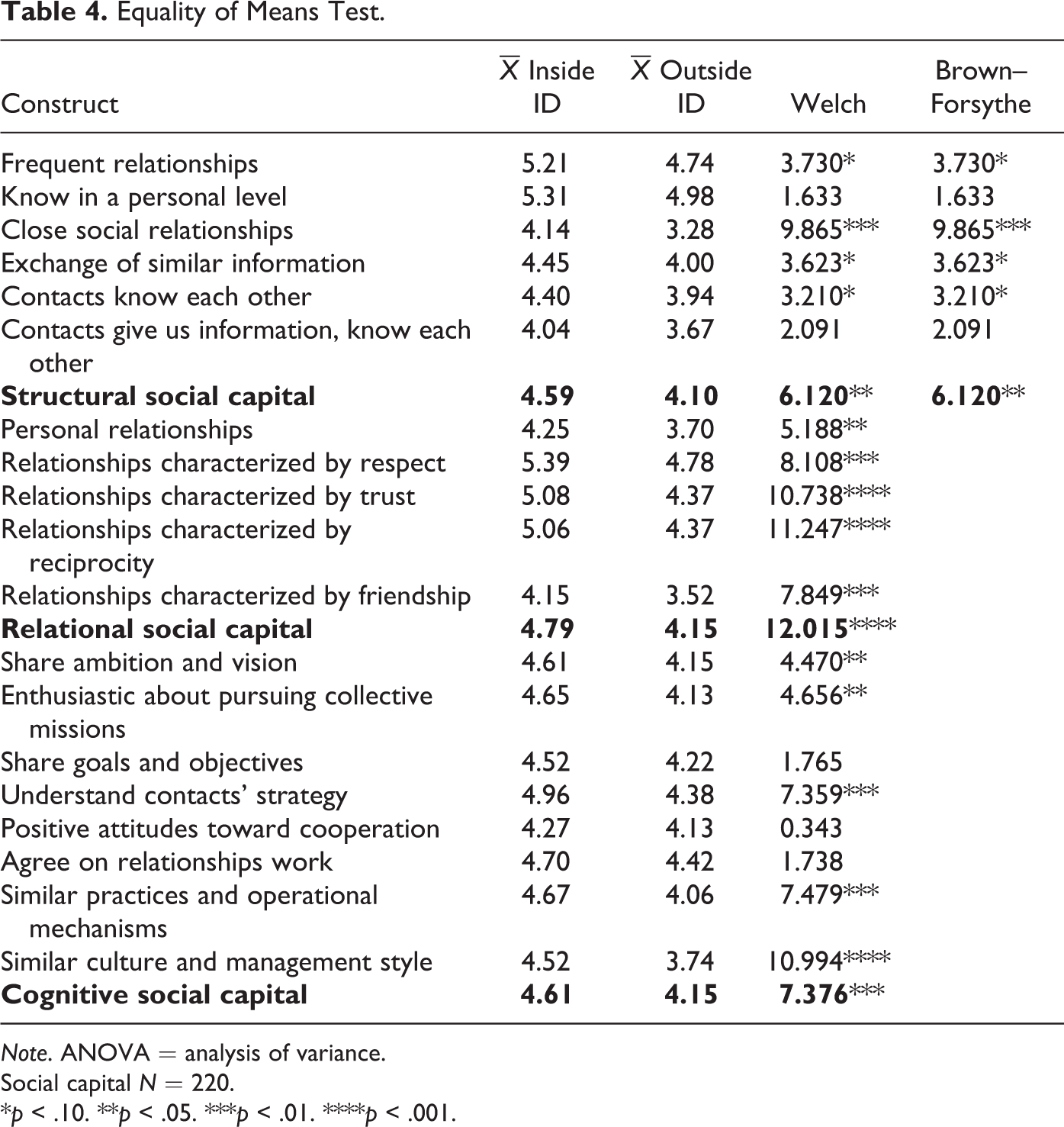
Note. ANOVA = analysis of variance.
Social capital N = 220.
*p < .10. **p < .05. ***p < .01. ****p < .001.
With regard to relational social capital, the results obtained on the ANOVA show a very low critical level value (p < .001), so we can reject the hypothesis of equality of means between the two groups of firms. In this case, we observe that the mean value of relational social capital for firms inside districts (4.79) is greater than that obtained for firms located outside (4.15), for all the items that define the construct.
As regards cognitive social capital, we can observe that also for this dimension companies located in a district have a significantly higher mean value than those located outside (p < .01). This difference is higher in the item concerning the similarity of the culture and management style between the companies. From the obtained results, we can corroborate the Hypotheses 2a–2c and generally Hypothesis 2.
Knowledge Acquisition
As we can see in Table 5, there are significant differences between knowledge acquisition by the companies belonging to an industrial district (4.67) and those outside it (4.31). We should point out that the significance of these differences occurs at a level of .1. These differences can be traced to a larger acquisition of information and critical capabilities by the companies belonging to districts. The results allow us to corroborate, but with some caution, Hypothesis 3.
Equality of Means Test.

Note. Knowledge acquisition N = 220.
*p < .10.
Innovation
With regard to innovation, as we can observe in Table 6, there is a significant difference (p < .01) between the innovation of companies belonging to the industrial districts (4.35) and those outside the districts (3.74). For this reason, we can reject the hypothesis of equality of means, and we can conclude that the two subsamples develop different levels of innovation. The item that presents major differences between the two groups of companies refers to investment in the development of new products, with an average 4.27 for firms internal to an industrial district and 3.43 for firms external to it. These results allow us to corroborate Hypothesis 4.
Equality of Means Test.

Note. ANOVA = analysis of variance.
Innovation N = 220.
*p < .10. **p < .05. ***p < .01. ****p < .001.
Discriminant Analysis
In order to reinforce the results of the ANOVA, and to ascertain which variables discriminate more clearly between membership of one group or another, we developed a discriminant analysis between the two groups defined previously—companies inside and outside the industrial districts. As independent variables, we introduced general performance, 10 the three dimensions of social capital—structural, relational, and cognitive—knowledge acquisition and innovation. The dependent variable is the categorical variable that refers to membership or otherwise of an industrial district. Since the size of the groups to be compared varied widely, according to the recommendations of Hair et al. (1998), we carried out a random sampling of district firms in order to reduce its size to a comparable level with the smaller group. Moreover, before our discriminant analysis, we carried out a study of the normality of independent variables by the Kolmogorov–Siminov test. The data in Table 7 show that the variables analyzed satisfy the normality assumption.
Normality Test.

Note: SC = social capital.
In Table 8, we can consider the six independent variables as significant discriminant variables, as they show significant values for the Wilks’ Lambda and F test. Therefore, the groups differ in the selected variables of classification, although as happens in the ANOVA, we must assume, with some caution, differences with respect to the variable knowledge acquisition, since it is only significant at a level of .1. This variable, therefore, discriminates least between the two groups.
Test of Equality of Mean of Groups.

Note: fd = freedom degree; SC = social capital.
The results in Table 9 show that the hypothesis of equality of the covariances of the two groups was rejected. For this we use the M Box test. The results show a value of M Box of 33,960 and a level of significance of .055. The table also shows the canonical correlation and the test of equality of means. Specifically, we can observe that the eigenvalue is 0.128 and the statistical Wilks’ Lambda is 0.886, with a critical level of significance of .010 corresponding to the value of χ 2 . Thus, these values allow us to reject the hypothesis of equality between the means vectors and confirm that the function variables have a significant influence on the separation of the groups measured by means of the discriminant function.
Significance Test Analysis.

Note: fd = freedom degree.
In Table 10, we present the standardized coefficients of the discriminant function and the variables that show greatest discriminant ability, that is, those that are the best predictors of belonging to the district. As we can see, the first predictor is performance, closely followed by innovation, thirdly knowledge acquisition, then relational social capital, cognitive social capital, and, lastly, structural social capital. Moreover, we must emphasize the negative sign of the variable knowledge acquisition in the discriminant function.
The Discriminant Function Coefficients.
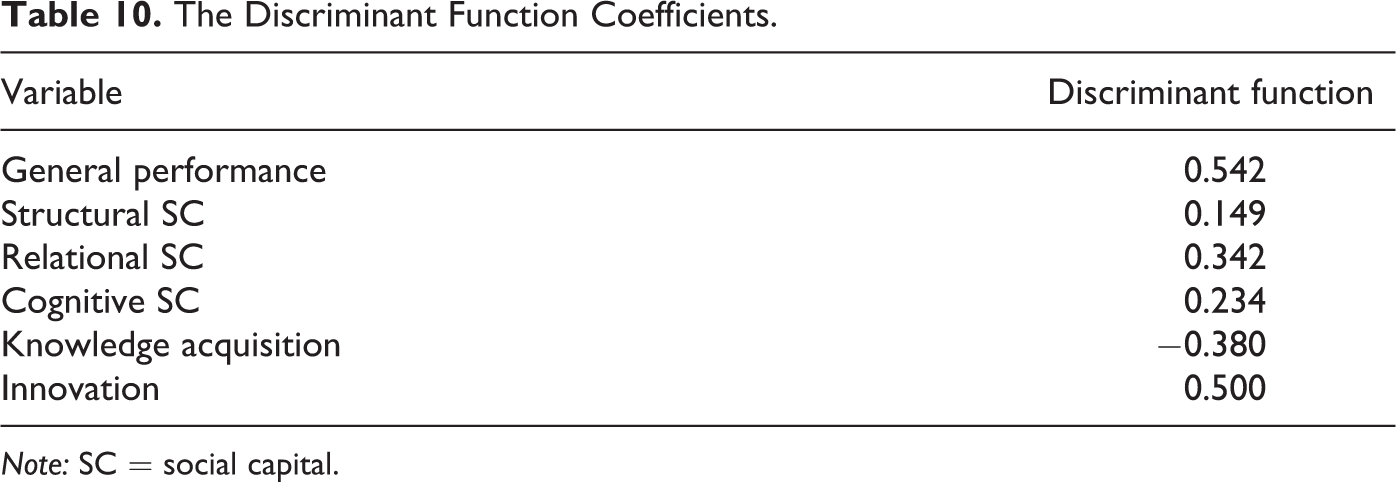
Note: SC = social capital.
Finally, Table 11 shows the percentage of the sample analyzed cases correctly classified—63.5. In addition, the proposed function classifies correctly in both cases, the percentages for the two groups being similar.
Classification Results.
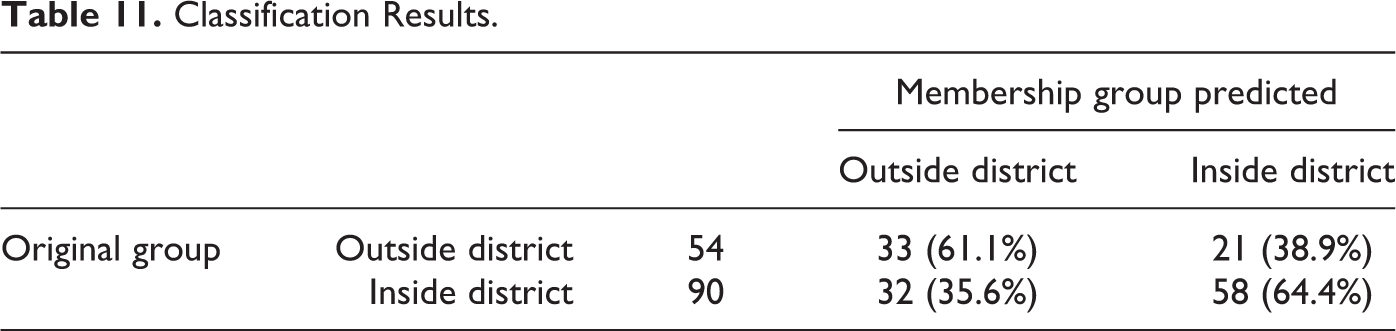
Thus, the results of the discriminant analysis confirm those obtained on the ANOVA, since they show that groups differ in the above-mentioned variables and together correctly discriminate between the companies belonging to a district and those outside it. Again, the variable that has a weaker significance when it comes to discriminating between groups is knowledge acquisition.
Discussion and Conclusion
The development of this study has allowed us to analyze the existence of significant differences between industrial district firms and firms outside industrial districts. We analyze differences not only in respect of obtaining competitive advantages but also as regards several basic factors to explain the competitive dynamic in industrial districts: social capital, knowledge acquisition, and innovation. Furthermore, we show that the higher values obtained in the factors analyzed for firms belonging to industrial districts are not due to differences in the firms’ size, since differences in size are not significant. On the other hand, we detected that firms in industrial districts have a lower mean age than nonmember firms, which may be due to the characteristic features of industrial districts, namely, the high rate of business creation that occurs inside. However, this difference in age, rather than question the competitive superiority detected between industrial district firms could strengthen it, since several studies point out that consolidated firms have higher performance (Chandler and Hanks 1994).
The results obtained in our study show, as we expected, that agglomerated firms, that is firms located within industrial districts, achieve a greater performance than firms outside industrial districts. These differences are significant in terms of profitability and growth but are not evident in innovation performance. Furthermore, the results show that agglomerated firms have greater social capital in its three dimensions: structural, relational, and cognitive. We also found that firms in industrial districts acquire more knowledge than firms outside districts, although in this case the differences are weak. Finally, on the same line, firms located within the district have a higher level of innovation linked to the development of new products.
This study reveals the existence of the so-called district effect for the analyzed companies (Amighini, Leone, and Rabellotti 2011). In this sense, we verify that firms located in industrial districts achieve higher levels of performance than firms outside the districts. These differences are significant, in terms of both profitability and growth. Unlike the studies that question the potential of industrial districts to obtain competitive advantages (Harrison 1994; Martin and Sunley 2003), especially in the current context (Arikan and Schilling 2011), we detect that industrial districts develop several competitive conditions that favor the development and sustainability of higher levels of performance (Signorini 1994; Molina and Martínez 2003; Cainelli and De Liso 2005).
However, the advantages of firms in industrial districts are not significant when we focus on innovation performance. Our research reflects the contradictory results in the literature on the effectiveness of innovation performance of firm efforts at innovation in industrial districts. In this sense, and in agreement with Molina (2005), we consider that the specific conditions under which districts develop the innovation process determine the performance of this process. Thus, we interpret that, at district level, a certain redundancy in the obtained information and the lack of effectiveness in innovation management can limit the possibilities of firms in industrial districts to achieve a higher innovation performance than firms outside districts.
As we can see, the obtained results allow us to provide empirical evidence for the studies that highlight the existence of a higher social capital in certain contexts, such as industrial districts (Inkpen and Tsang 2005; Molina 2005; among others). Thus, firms located within an industrial district will maintain a higher density of the network of relationships, greater bonding in the relationships, greater trust between firms, and a higher culture and shared values, than firms outside districts. The development of social capital, which is based on a strong sense of belonging and a high level of participation, can be a solid support for firms in industrial districts to obtain competitive advantages, as has been shown in several studies (Koka and Prescott 2002).
In relation to knowledge acquisition, our results indicate that there is breath and diversity in shared knowledge flows in industrial districts (Paniccia 1998), which allows firms to access relevant information. However, the weakness of the observed differences may reflect that the information may be redundant and not contribute to a significant improvement of the district firms’ capabilities, according to Glasmeier (1991).
With regard to innovation, the results are consistent with those obtained in other geographical and sectorial contexts (Baptista and Swann 1998; Molina and Martinez 2003; Muscio 2006). In this sense, we note that the strong competitive dynamic that is generated in the districts of mature industries, as in our case, drives companies to invest in innovation (Mistri and Solari 2001).
With this review of the literature we have broadened the understanding of the links between several factors: social capital, knowledge acquisition, and innovation, with the competitive dynamic in industrial districts. Our results provide empirical support for the “district effect” reflected in the literature, which several studies have questioned (Amighini, Leone, and Rabellotti 2011; Arikan and Schilling 2011). We also note that in industries with a mature and traditional character, with a global competition that must adapt continuously to new fashion trends, such as footwear industry, firms located inside the districts can obtain competitive advantages over those outside.
One of the contributions of this study consists in analyzing the “district effect” from four different measures of performance—profitability, growth, innovation performance, and general performance. Moreover, we attempt to offer an approximate view of the sustainability of the competitive advantages district firms enjoy, by averaging the performance for the previous three years. In addition, we offer a detailed analysis of the existing differences in three key competitive factors in the competitive dynamic of industrial districts such as social capital, knowledge acquisition, and innovation, on which there is a limited number of empirical studies. Furthermore, in the case of social capital, we draw out fully the implications of the three basic dimensions proposed in the literature—structural, relational, and cognitive.
Our results suggest a link between the analyzed factors and the “district effect.” In this regard, we detected that three of the factors that the literature related to the generation of competitive advantages have greater presence among firms within industrial districts. Thus, our article contributes to a deeper understanding of the role that social capital (Peng and Luo 2000; Acquaah 2007), knowledge acquisition (Yli-Renko, Autio, and Sapienza 2001; Weber and Weber 2007), and innovation (Baldwin and Johnson 1996; Zaheer and Bell 2005) have in the generation of competitive advantages among firms within industrial districts.
Finally, this article serves to clarify the concept of industrial district and its limits, following Becattini (1990). Thus, we demonstrate, with objective criteria, that there are significant differences in the sense of belonging and in the level of participation between firms inside and outside industrial districts. Thus, the high sense of belonging and the level of participation of firms inside industrial districts contribute to differentiating the industrial district from other agglomerations of firms.
Among the limitations of the study should be noted our focus upon the footwear industry in Spain, thereby restricting the extension of the obtained results. However, we believe that the similarities with other mature industries allow us to infer parallel results. Furthermore, both the measurement of innovation and innovation performance are centered upon new products. Although these measures have been widely used in the literature (Covin and Slevin 1989), it must be pointed out that the results obtained cannot be extended to other types of innovation—process, incremental, and so on. Furthermore, we should note that we do not address an explanatory analysis. In line with the research objective, we focus on the analysis of significant differences in the analyzed factors between companies both within and outside the districts. More exactly, a possible extension of this study could be the analysis of the effect of the studied factors on business performance in the industrial districts. Thus, by focusing on the firms located in industrial districts, we could test if the availability of more social capital, acquisition of more relevant knowledge, and a higher innovation effort can explain the obtaining of competitive advantages between district member companies.
We consider it especially valuable to provide an in-depth analysis of the influence of the different dimensions of social capital on firm performance in industrial districts. Our results indicate that the high density in the district network, with strong ties among its participants, is not reflected in the obtaining of relevant information by companies that allow these companies to access and improve their critical capabilities. In this sense, it would be interesting to explore whether the excess of integration could inhibit the flows of relevant knowledge within the network (Uzzi 1997). In this case, social capital could be a disadvantage for firms inside industrial districts, because when actors interact frequently, much of the information circulating on this social system is redundant. It would also be important to analyze the role played by other actors in the district, such as large companies and local institutions (Sachetti and Tomlinson 2009). In this sense, we could check if local institutions, acting as brokers, could provide district firms with new sources of opportunities and resources collected through their external networks, which are rich in structural holes (Molina 2005; Molina and Martínez 2008).
As a recommendation for district firms, we can suggest that they should guide the development of social capital, through contacts with other agents, in order to obtain relevant information related to the critical capabilities of the industry. They should also promote the development of complementary information flows unaware of district firms in order to promote innovation, as the basis for achieving competitive advantages. Finally, we recommend that the institutions of the industrial district, should guide its activities to provide companies with new and relevant information to achieve competitive advantages in the industry and provide support for a more efficient management of the innovative efforts of district firms.
Footnotes
Appendix
Appendix

| Please, show your level of agree with the next assertions both how important is this objective for the firm and how successful is the achievement of this objective in relation to the expected results in performance (1 = totally disagree; 7 = totally agree) Performance Profitability over investment Net margin of benefit Market share Growth of sales General performance Performance innovation Profitability of new products Sales of new products Please, show your level of agree with the next assertions about your contactsa (1 = totally disagree; 7 = totally agree) Structural social capital (network ties) We interact frequently with our contacts We know our contacts in a personal level We maintain close social relationships with our contacts Structural social capital (network configuration) The exchanges of resources, information, and so on, among our contacts usually have a similar content The contacts with which we maintain frequent relationships, in general, know each other The contacts from which we receive advice, information, or whatever element for making important decisions know each other, that is, they maintain reciprocal relationships Relational social capital (trust) There are personal relationships with our contacts The relationships are characterized by mutual respect between the parties The relationships are characterized by mutual trust between the parties The relationships are characterized by high reciprocity between the parties The relationships are characterized by personal friendship between the parties. Cognitive social capital (shared goals) We share the same ambition and vision as our contacts. My firm is enthusiastic about pursuing the collective goals and missions of our relationships We share our goals and objectives with our contacts We understand our contacts’ strategy and needs My firm’s employees and my contacts’ employees have positive attitudes toward a cooperative relationship My firm and my contacts tend to agree on how to make the relationship work Cognitive social capital (shared culture) The business practices and operational mechanisms of your contacts are very similar to yours The corporate culture and management style of your contacts is very similar to yours |
| Please, show your level of agree with the next assertions about the acquisition of knowledge (1 = totally disagree; 7 = totally agree) Knowledge acquisition Your company has learnt or acquired new or important information from your contacts Your company has learnt or acquired critical capability or skill from your contacts Your relationships or contacts have helped your company to enhance its existing capabilities/skills Please, show your level of agree with the next assertions about the innovation (1 = totally disagree; 7 = totally agree) Innovation Your company invests substantial economic resources in the development of new products Your company develops a broad variety of new lines of products Your company increases the rate of introduction of new products to market Your company increases its commitment to the development and commercialization of new products |
aConsider as contact people, firms, or institutions of the same industry, which they have relationships.
Declaration of Conflicting Interests
The authors declared no potential conflicts of interest with respect to the research, authorship, and/or publication of this article.
Funding
The authors disclosed receipt of the following financial support for the research, authorship, and/or publication of this article: We are grateful to the Junta de Comunidades de Castilla-La Mancha for research funding (Project: PEII10-0332-0679).