



Abstract
The labor market effects of the recent financial and economic crisis are rather heterogeneous across countries and regions. Such differences in labor market performance among industrialized countries are an issue of ongoing research. The objective of this article is to analyze labor market disparities among European regions and to provide evidence on the factors behind these differences. Whereas previous research focused on the effects of national labor market institutions, we also take structural characteristics of regions into account and investigate differences in labor demand responsiveness and their potential determinants. The data set covers the Nomenclature des unités territoriales statistiques 2 regions in the EU15 for the period 1980 to 2008. We employ an error correction model that is combined with spatial residual correlation. Our findings point to substantially distinct wage and output elasticities of employment among European countries and regions. Moreover, the rate of adjustment to disequilibrium is subject to significant variation across units of observation. There is robust evidence that labor market institutions affect the adjustment speed of regional labor markets and the wage elasticity of employment. Moreover, the findings suggest that some characteristics of regional labor markets matter as well. However, corresponding results are less robust compared with the evidence on labor market institutions.
Introduction
The labor market effects of the recent financial and economic crisis are rather heterogeneous across countries and regions (see Eichhorst et al. 2010). The pronounced disparities in labor market performance among industrialized countries and their potential causes are an issue of research for a long time. Differences between European economies and the United States are frequently attributed to more rigid labor market institutions in Europe (e.g., Nickell 1997). In contrast, Solow (2000) stresses low output growth and a corresponding weakness of labor demand as primary factors behind the persistently high unemployment in several European economies. Arguments in Eichhorst et al. (2010) suggest, however, that during the recent crisis the country-specific labor market effects are marked by a considerable variation and likely governed by national labor market institutions.
Our analysis of labor market disparities among European regions draws on different strands of literature: studies that deal with demand for labor, research on the labor market effects of institutions, and studies on regional labor market disparities. Previous research on demand for labor has focused on the estimation of labor demand elasticities based on industry- and firm-level data. 1 Up to now, evidence on the relationship between labor demand and institutions is scarce. Referring to the second group of analyses, there are numerous studies of the effects of institutions on labor market performance. Their focus is, however, on patterns of unemployment (e.g., Nickell, Nunziata, and Ochsel 2005). Similarly, research on regional labor market disparities deals primarily with the spatial pattern and persistence of unemployment differences (e.g., Overman and Puga 2002). Moreover, Elhorst (2003) notes that there is a lack of studies that integrate research on national and regional factors for European countries. Summing up, evidence on the impact of institutions and structural characteristics of labor markets on regional employment is scarce.
The objective of this article is to analyze dimensions of labor market disparities among European regions that have been largely neglected so far. We focus on disparities in the adjustment of employment to violations of the long-run equilibrium and in the responsiveness of labor demand to changes in labor costs and output. Apart from the quantification of regionally diversified labor market performance, we investigate if differences in these measures can be explained by labor market institutions and structural characteristics of regional labor markets. An improved understanding of the relationship between institutions and adjustment dynamics of regional labor markets is of particular importance for a currency union like the European Monetary Union (EMU). The lack of monetary independence and perfectly mobile capital imply that labor market flexibility and institutions are of core importance for intra EMU adjustments to macroeconomic shocks.
Regional labor demand is specified by means of an error correction model (ECM) coupled with spatially autoregressive disturbances. We investigate if wage and output elasticities of employment and the adjustment speed of labor demand differ significantly across regions and countries in Europe. To uncover potential determinants of distinguished labor market performance, we follow two alternative/complementary approaches. In the first place, we run a two-step approach and subject cross-section-specific parameter estimates to surface regressions on exogenous national and regional characteristics. In the second place, we implement a functional ECM where core model parameters are assumed to be linear functionals of characteristics.
Our findings point to a considerable variation in the marginal responses of employment to output and wages across and within European Union (EU) countries. Moreover, the adjustment speed spreads across regional labor markets. The results point to an important role of institutions for the adjustment speed of labor demand. We also detect significant effects of institutional settings on wage and output elasticities of employment. In contrast, the influence of most structural characteristics of regional labor markets lacks robustness. However, the findings for the population density (POP) point to important differences in labor market performance across region types.
The next section provides a brief view at the empirical literature on the links between labor market performance, institutions and structural characteristics of regional labor markets, and motivates our choice of potential determinants of labor market performance. The third section outlines the ECM with spatial error distribution (ECM/SEM), and the strategy employed to uncover potential factors behind the region-specific model specification. The data are introduced in the fourth section. The fifth section provides the empirical results. Concluding remarks are given in the sixth section.
Determinants of Region-specific Labor Market Performance
While the literature on labor demand has mainly focused on the determination of employment elasticities, a few studies address the impact of labor market institutions on employment. Neumark and Wascher (2004) investigate the employment effects of minimum wages for a cross section of Organization for Economic Cooperation and Development (OECD) countries. Buscher et al. (2005) examine the impact of labor market institutions on aggregate labor demand for a sample of EU countries. Most studies on the influence of labor market institutions focus on their significance with respect to the level of unemployment or long-run changes in unemployment (e.g., Nickell, Nunziata, and Ochsel 2005). 2 Altogether, this literature has documented that rigid institutions tend to increase unemployment.
Whether a specific regulation exerts an adverse or beneficial effect on market performance depends, however, on the type of the considered institution. Most studies point to significant effects of the unemployment benefit system. According to Nickell and Layard (1999), generous and long-lasting benefit entitlements go along with higher unemployment. Unemployment insurance is supposed to reduce the search effort and increase reservation wages, thereby resulting in fewer matches between job seekers and vacancies. Brown and Köttl (2012) note that passive labor market policies, like unemployment insurance, can distort incentives for work and job search. Nymoen and Sparrman (2014) detect important effects of unemployment benefits and wage coordination on equilibrium unemployment rates in OECD countries. Moreover, Flaig and Rottmann (2013) note that a generous unemployment insurance system might invoke incentives for trade unions to largely neglect negative employment effects of high wage claims. A high benefit replacement ratio therefore tends to negatively affect employment. There is also evidence of an adverse effect on the average unemployment duration (e.g., Lalive, van Ours, and Zweimüller 2006). Furthermore, strong trade unions are expected to raise unemployment. Evidence in Eichhorst et al. (2010) suggests that countries with a low collective bargaining coverage (CBC) tend to be characterized by a relatively high wage flexibility. The adverse effects of strong trade unions might, however, be offset if wage setting is characterized by highly coordinated bargaining (Nickell and Layard 1999).
Findings are less clear-cut for other institutions. There is no unambiguous evidence that stricter labor standards and employment protection legislation (EPL) result in higher unemployment. Since EPL reduces the risk of job loss and shifts associated costs from workers to employers the latter might refrain from firing in downturns but also from hiring in booms. Thus, the overall effect of EPL on employment is ambiguous. Bertola, Blau, and Kahn (2002) detect a significantly positive impact of EPL on unemployment; however, Nickell et al. (2005) argue that this correlation mainly operates via the effect of EPL on unemployment persistence. Following Bean (1994), the most important effect of such legislation is on the dynamics of employment. Moreover, Eichhorst et al. (2010) stress the capacity of labor market institutions to absorb shocks. The benefit system, for instance, might act as an automatic stabilizer during recessions. Agell (1999) concludes that although it seems likely that certain institutions adversely affect labor market performance, others might give rise to beneficial effects.
In contrast, the literature on regional labor market performance largely ignores the significance of labor market institutions for regional disparities. Most studies deal primarily with the spatial pattern and persistence of unemployment disparities (e.g., Overman and Puga 2002). Decressin and Fatás (1995) investigate regional labor market dynamics in Europe and the United States. They provide empirical evidence on adjustment mechanisms to region-specific shocks. Baddeley, Martin, and Tyler (2000) analyze wage flexibility across EU regions and US states, and examine if regional differences in wage flexibility are associated with structural characteristics of labor markets. Herwartz and Niebuhr (2011) consider regional differences in Okun’s law and provide evidence on the main regional and national determinants of these disparities. Elhorst (2003), however, notes that there is a lack of corresponding studies that integrate research on national and regional factors for European countries. Furthermore, evidence in Kosfeld and Dreger (2006) suggests that an analysis at the regional level has to account for spatial dependence, since regions are linked by labor mobility, aggregate demand, and other forms of interaction. Summing up, evidence on the impact of institutions on regional employment is scarce.
Apart from the institutional settings, structural characteristics of regional labor markets are likely to impact labor market performance for at least three arguments. Firstly, the sectoral structure of the economy might affect the adjustment speed and employment responses to changes in output and wages. Robson (2009) argues that there are distinct transmission channels through which the sectoral structure might affect regional labor markets. The specialization of the economy can influence its vulnerability to the effects of adverse shocks. Furthermore, regions marked by a more diverse industry structure likely show a more rapid adjustment to shocks as a result of intersectoral labor mobility. In the light of productivity differences across industries, one might also expect stronger marginal responses of employment to output in regions that are characterized by high shares of technologically less developed branches (see, e.g., Mourre 2006).
Secondly, structural change may influence the labor market effects of output variations. The implementation of new technologies requires labor reallocation across sectors. Thus, the intensity of structural change might matter since—with given labor market flexibility—regions characterized by more pronounced reallocation of jobs between industries face higher adjustment burdens. Matching frictions can arise because of industry-specific skills. Skill requirements in expanding branches may not coincide with skills of workers laid off in declining industries (Petrongolo and Pissarides 2001). Therefore, the marginal effect of output changes on employment might be smaller in economies characterized by rapid structural change.
Thirdly, agglomeration economies may affect the matching process in regional labor markets. The likelihood of a match possibly improves when more agents try to match. In case of increasing returns to scale, a proportional increase in the number of job seekers and vacancies results in a more than proportional increase in job matches. More vacant jobs and job seekers reduce search frictions on local labor markets and the proportion of unemployed workers (Duranton and Puga 2004). Benefits of a matching function that exhibits increasing returns to scale accrue in dense urban labor markets. Therefore, one might expect that output growth results in more pronounced increases of employment in highly agglomerated regions in comparison with rural labor markets.
In this article, we analyze regional patterns of the speed of adjustment of labor demand and the long-run effects of wages and output on employment. With regard to potential determinants of (regional) dynamics of labor demand, we draw upon the quoted literature since labor market institutions, the sectoral structure and the density of regional labor markets are natural candidates for a conditional description of region-specific employment patterns. We consider the unemployment benefit system, the system of wage determination and EPL as well as structural characteristics such as the sectoral composition of the economy, the region type, or the intensity of structural change. 3
The Spatial Regression Model
The Single Equation and Panel ECM
The empirical analysis rests on a neoclassical framework where cost minimization of firms subject to a production constraint yields an expression for labor demand as a function of planned output and factor prices. Addison and Teixeira (2005) note that the ECM has become the standard approach to investigate the dynamic characteristics of labor demand. In the regression analysis, we use employment as a proxy for labor demand. Let lit denote the log of employment in region i and year t. For a cross section of N = 191 European regions, the following ECM is applied to investigate regional labor demand

In (1), qit is the log real output, wit and rit are the log of the real prices of labor and capital, and Δ is short for the first difference operator, for example,

where

In (3), “ʘ” indicates element-by-element vector multiplication, and vectors
As formalized in (1), the single equation ECM allows efficient estimation of the error correction and long-run parameters conditional on region-specific sample information. In the present context of evaluating regional labor market response patterns, it is most natural, however, to take neighborhood conditions into account for parameter estimation. Recently, the combination of (panel) cointegration or error correction methods and spatial econometrics is attracting an increased interest in the applied and methodological literature (see, e.g., chapter 4.6 in Elhorst 2014; Beenstock and Felsenstein 2010; Marquez, Ramajo, and Hewings 2006, 2010; Mitze and Özyurt 2014). In the terminology of Beenstock and Felsenstein (2010), the ECM in (1) focusses on cointegration within panel units (“local” cointegration). The cross-sectional system might be considered restrictive, as it does not entail “spatial” cointegration, a panel homogeneous response to spatially filtered equilibrium violations (Beenstock and Felsenstein 2010). Noticing that regional units of observation (Nomenclature des unités territoriales statistiques [NUTS] 2 level) are rather large, local cointegration does not appear overly restrictive, since adjustments to shocks should take place mainly within these regional labor markets. Moreover, we refrain from spatial filtering of variables to yield region-specific parameter estimates that concentrate on local labor market conditions and, hence, appear better suited to second step conditioning on exogenous regional and institutional settings. To take spatial dependence patterns into account, we assume as in Herwartz and Niebuhr (2011) that model disturbances eit in (1) are contemporaneously correlated, that is,

In light of the large cross-sectional dimension which exceeds the time dimension by a factor of almost ten, it is not possible to estimate Ω without structural assumptions. Single region regressions reveal that (estimated) residual variances differ markedly across regions. Moreover, geographic distance is likely governing the dependence of error terms. For both reasons, diagnosed heteroscedasticity and spatial correlation, we construct estimates of Ω from (unrestricted) cross-sectionally heterogeneous variances combined with a correlation pattern that is built from a spatial weights matrix. To be explicit,

with R denoting the correlation matrix associated with Ω. To implement generalized least squares (GLS) estimation, the a priori presumed correlation pattern and variance estimates are, respectively,

In equation (6), |Z| is the column dimension of Z, W is a known spatial N × N weights matrix with zero diagonal elements, and
Estimation with Unobserved and Observed Parameter Heterogeneity
In the empirical analysis, we rely on two complementary approaches to estimate employment elasticities and error correction dynamics and their potential determinants. In the following, these two approaches are briefly sketched in turn. Moreover, we comment on their relative merits and the scope of a complementary evaluation.
Two-step regressions
Following a two-step approach, we first estimate cross-section-specific parameters and then subject these estimates to surface regressions on their potential determinants. Conditional on

Under multivariate normality, the log likelihood conditional on

The estimator in (7) may be seen as a fixed effect estimator that covers “unobserved” heterogeneity not only for the intercept but for each model parameter. The introduction of cross-section-specific fixed parameters
Functional regressions
Quotes of potential determinants
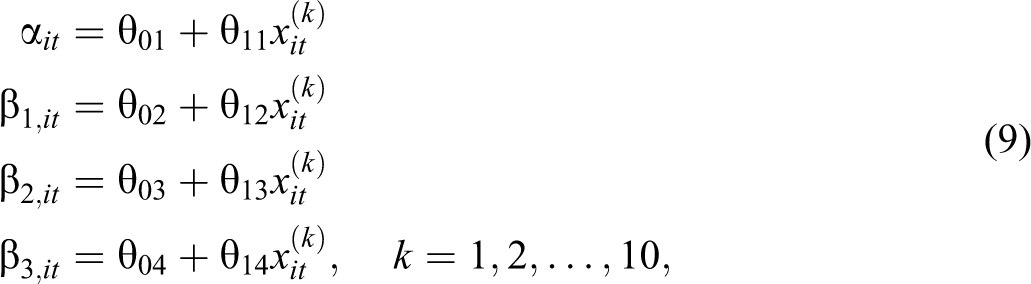
where
The ECM/SEM panel approach characterized by means of the estimator in (7) is general in that it allows region-specific ECM parameters. Error correction dynamics and labor demand elasticities are selected in an equation-specific manner to optimize the contribution of region i to the models’ overall accuracy of fit. Apart from fixed effects and region-specific short-run parameters, 764 ECM parameters (9.4) are determined within the ECM/SEM model specification. In the functional model framework that is parameterized in (9), the informational content of these 764 parameters is approximated by means of 8 “deep” parameters (
Data
Determinants of Labor Demand and Stochastic Trends
We analyze regional labor demand for a cross section of 191 EU15 regions (NUTS 2 level). 6 The empirical analysis conditions on annual data for these regions on employment, real gross value added, and compensation per employee for the period 1980 to 2008. The corresponding information is taken from the European regional database of Cambridge Econometrics which, in turn, draws upon the EUROSTAT Regio database and official data from national providers. The data on national interest rates are collected from the annual macroeconomic database of the European Commission’s Directorate General for Economic and Financial Affairs. Missing data of Sweden, Portugal, and Greece are replaced by data extracted from the International Financial Statistics database of the International Monetary Fund. Next, we first describe the panel data entering the ECM/SEM model and, second, turn to a description of eventual determinants of its model parameters.
Panel unit root diagnostics provided in Table 1 for employment, output, and factor prices show that these variables can be reasonably assumed to be integrated of order one. Conditional on level data the panel unit root hypothesis cannot be rejected while all test statistics are significantly against the null hypothesis when first differences are subjected to unit root diagnosis. Although the diagnostic outcomes are identical over the set of employed test statistics, it is noteworthy that for the present analysis the statistics proposed by Demetrescu and Hanck (2012) or Herwartz and Siedenburg (2008) are most suitable as they retain their pivotal asymptotic distribution under contemporaneous (cross sectional) correlation of panel members and do not require an explicit estimate of the contemporaneous covariance matrix.
Panel Unit Root Diagnostics.
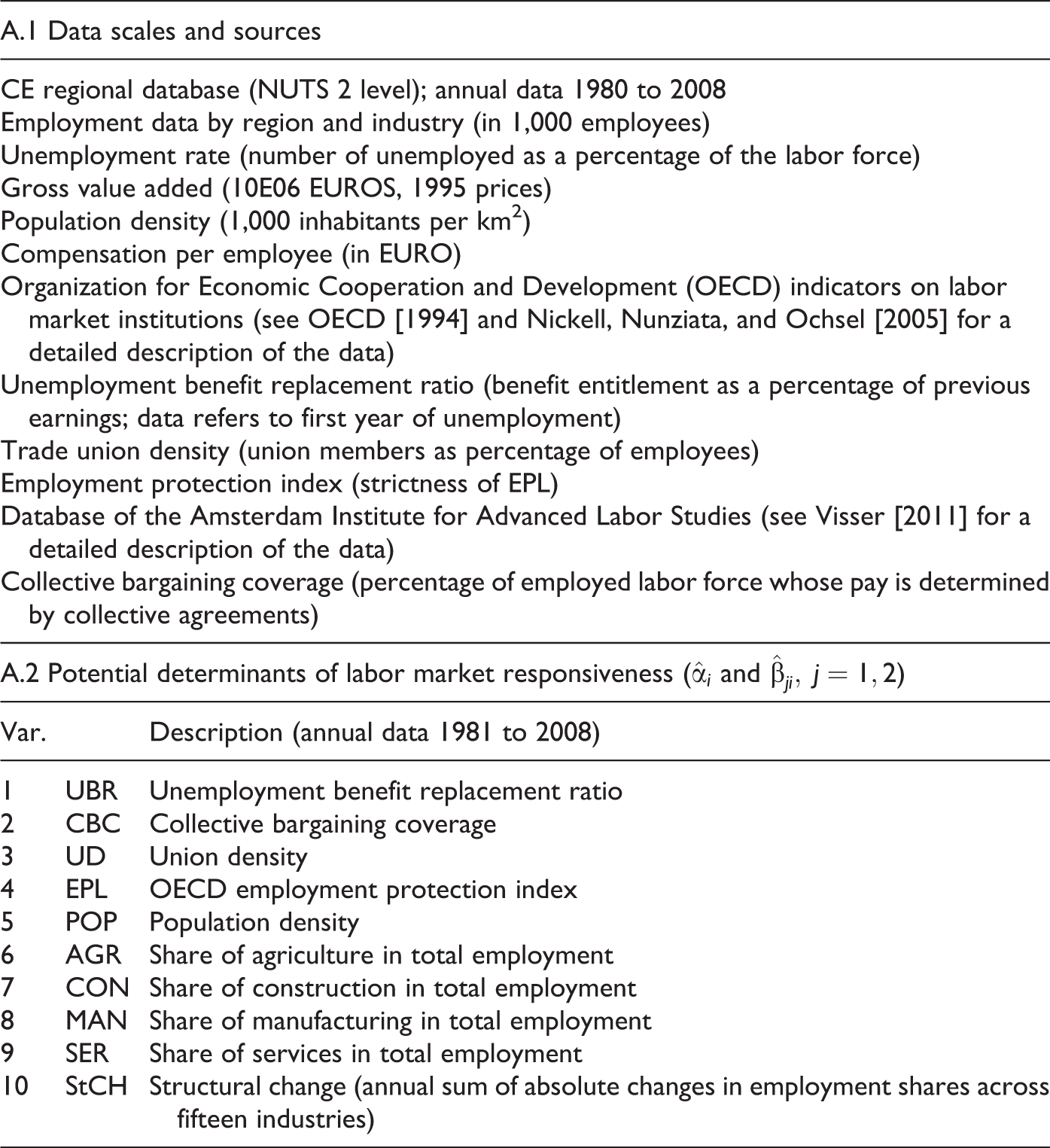
Note: The table provides diagnostics for panel unit roots as suggested by Levin, Lin, and Chu (2002), Breitung and Das (2005), Herwartz and Siedenburg (2008), and Demetrescu and Hanck (2012). Test regressions for level data (first differences) allow a linear trend (intercept), except for testing capital cost where a linear trend is not included in test designs. With respect to conventional significance levels, diagnostic outcomes are not affected when distinguishing asymptotic and bootstrap based critical values.
Country- and Region-specific Factors
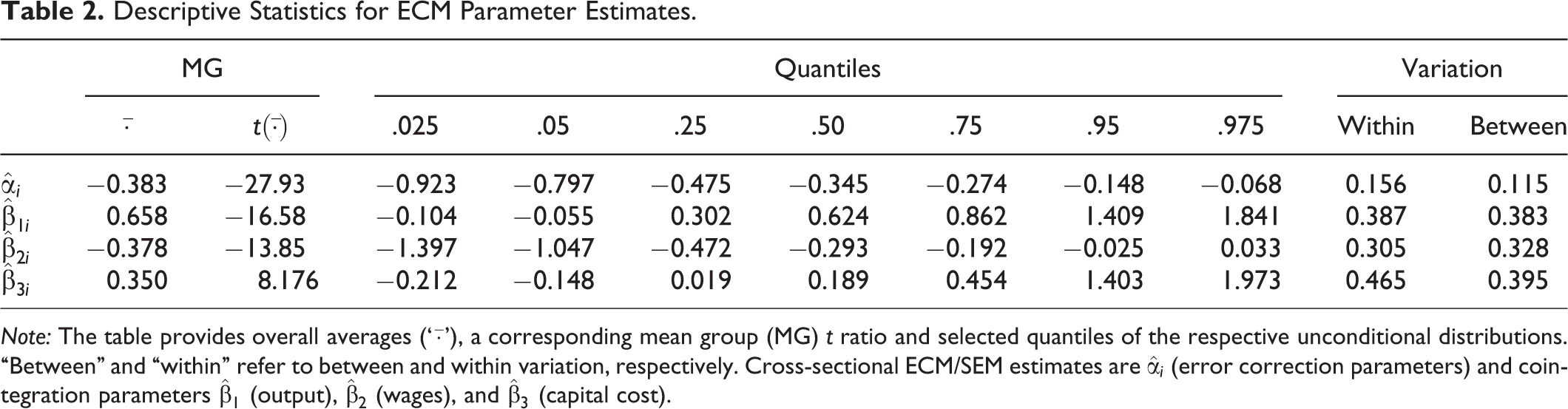
As outlined in the second section, numerous factors might affect the adjustment speed of labor demand and the wage and output elasticities of employment. In the surface regressions and the functional model, we consider country-specific and region-specific influences. Out of the full set of ten conditioning variables, four factor measures are incomplete as quotes for some regions or years are not available. In principle, surface regressions become infeasible or involve considerable loss of information if for particular cross section members factor observations are not available. Since for half of the factor variables, the panel data are complete and missings only refer to some years, regions, or countries we decide in favor of simple imputation techniques to fill data gaps. The imputed data set comprises annual information on all country- and region-specific factor variables. 7
At the country level, we consider OECD indicators of labor market institutions that refer to three main areas: the unemployment benefit system, wage determination, and employment protection (Nickell, Nunziata, and Ochsel 2005). As a measurable feature of the benefit system, we include the unemployment benefit replacement ratio (UBR). Variables referring to wage determination comprise CBC and union density (UD). Moreover, the OECD index of the strictness of EPL is included in the factor set.
Potential regional determinants of labor demand responsiveness include the percentages of regional employment across four sectors (agriculture [AGR], construction [CON], manufacturing, and market services). As an indicator for the intensity of structural change, we include the sum of absolute annual changes in employment shares of fifteen distinct industries between 1980 and 2008 across all industries. To address agglomeration economies, we rely on a density indicator derived from population figures. Sector shares, POP, and the indicator for structural change are available annually for all 191 regions.
Empirical Results
In this section, we provide the results of the regression analyses described in the third section. As outlined, the model framework builds upon the assumptions of cross-sectional heteroscedasticity, spatial correlation, and weak exogeneity of adjustments of output, wages, and interest rates in response to violations of the long-term equilibrium relations. Each of these underlying assumptions is well supported by suitable model diagnostics. 8 In the following, firstly, estimation results obtained from ECM/SEM are described. Based on these results, we comment on the evidence on the cross-sectional variation of the adjustment speed of labor demand and of wage and output elasticities. Secondly, our interest turns toward regional and national determinants of labor market performance. Thirdly, functional model estimates are discussed.
Distributional Features of Estimated First Stage Coefficients
Table 2 summarizes the distributional features of selected coefficients included in (1). We only display the adjustment coefficient and the long-run effects of gross domestic product (GDP) and factor prices. 9 At the mean group level of inference, the error correction parameter is negative at common significance levels and, moreover, the documented quantiles for this coefficient strongly indicate that the ECM formalizes intuitive adjustment dynamics for the vast majority of cross sections. The mean EC parameter is −0.383. This corresponds with evidence in Addison and Teixeira (2005). They estimate the speed of employment adjustment for Portugal (−0.342) and Germany (−0.108). The signs of the estimated average elasticity parameters correspond with theoretical expectations as well. As indicated by the interquartile range or 95 percent coverage intervals, the distribution of estimated output elasticities is concentrated to the right from zero. The same applies to the region-specific wage elasticities of employment with the majority of estimates located left from zero. Moreover, the size of the effects in absolute terms is in line with some previous estimates of labor demand functions. The average output and wage elasticities are 0.658 and −0.378, respectively. Estimates of labor demand responses to wages range between −0.04 and −1.09 in a survey by Hamermesh (1986). Falk and Koebel (2001) apply a dynamic labor demand model to the German manufacturing sector and detect wage effects on labor demand between −0.10 and −0.21. Corresponding results in Buscher et al. (2005) vary between −0.08 and −0.99 for a cross section of European countries. Output elasticities of labor demand in Buscher et al. (2005) range from 0.53 to 1.64. Hamermesh (1993) reports long-run output effects from 0.03 to 0.98.
Descriptive Statistics for ECM Parameter Estimates.
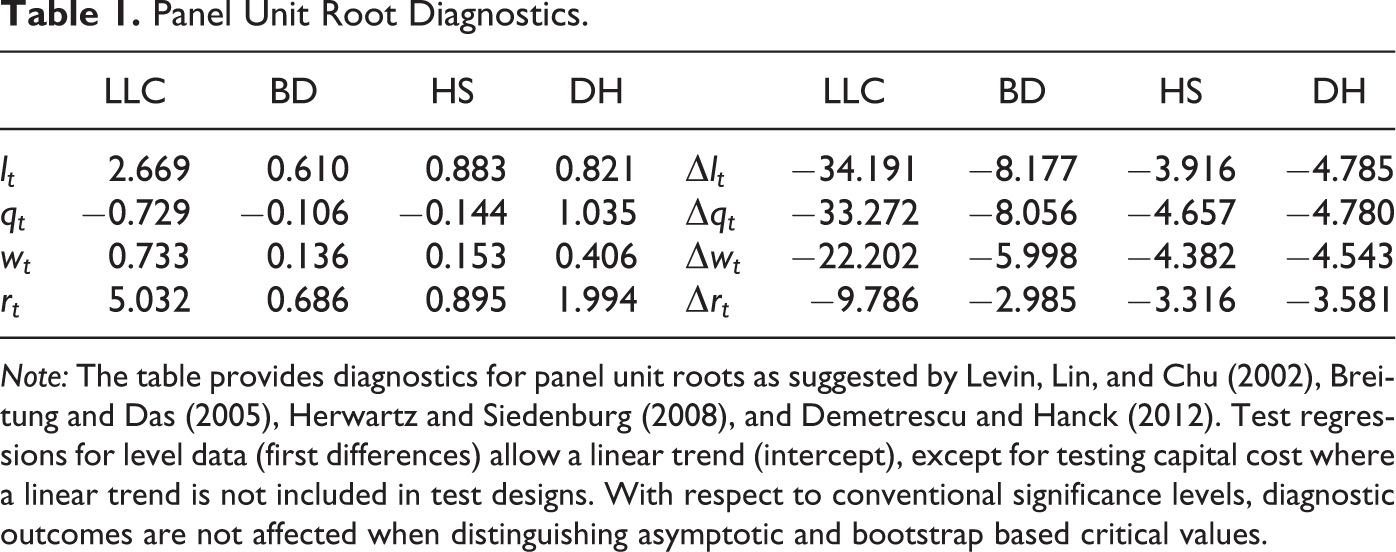
Note: The table provides overall averages (‘⨪’), a corresponding mean group (MG) t ratio and selected quantiles of the respective unconditional distributions. “Between” and “within” refer to between and within variation, respectively. Cross-sectional ECM/SEM estimates are
The estimated coefficients
Determinants of Labor Market Performance—Results from Surface Regressions
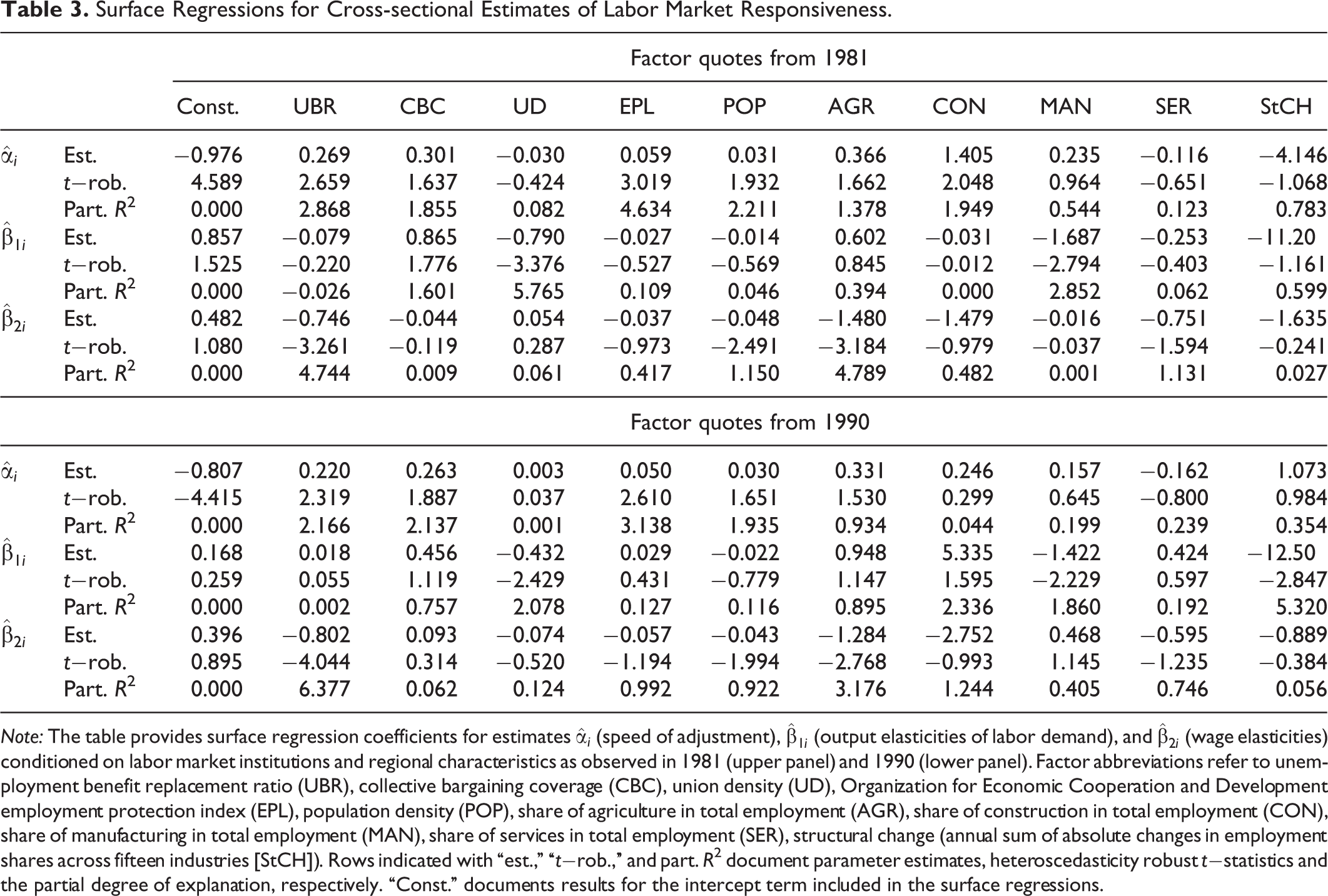
Having described the distributional properties of labor market responsiveness, we now characterize the cross-sectional shapes of ECM parameter estimates by means of surface regressions. We consider ten factor variables in the second stage of the regression analysis. Factors 1 to 4 capture national labor market institutions, whereas factors 5 to 10 describe structural characteristics of regional labor markets. Table 3 documents the surface regression estimates along with heteroscedasticity consistent t ratios (White 1980). Furthermore, the partial degrees of explanation achieved by singular covariates are documented. We do not investigate potential factors behind the variation of the interest rate coefficients (
Surface Regressions for Cross-sectional Estimates of Labor Market Responsiveness.
Note: The table provides surface regression coefficients for estimates
Determinants of adjustment speed
The estimates suggest that potential determinants considered in our analysis primarily impact on the adjustment of employment in response to violations of the long-run equilibrium. With 10 percent significance, we identify five determinants of the adjustment coefficients when conditioning on the 1981 cross section of factor variables (four for the factors in 1990). Surface regression results illustrate that both labor market institutions and regional characteristics matter for differences in labor demand responsiveness as quantified by means of the ECM coefficients. Two out of four institutional factors impact the adjustment speed of regional labor markets. All important institutional factors reduce the speed of adjustment according to our results. The partial degrees of explanation (
The second institutional factor that impacts the adjustment speed of employment is EPL. The result for EPL is in line with theoretical arguments, since the positive and significant coefficient indicates that strict legislation tends to reduce the flexibility of employment. The marginal effect of EPL is 0.059, that is, increasing the EPL index by one unit results in a rise of
Apart from the institutional factors, we diagnose three regional characteristics to impact on the speed of adjustment of labor demand. The partial degrees of explanation
Furthermore, the speed of adjustment decreases with rising POP. This result is not in line with weaker matching frictions in highly agglomerated regions because this should, in turn, support a rapid adjustment to deviations from the long-run equilibrium especially in urban labor markets. In contrast, the estimate suggests that more dense labor markets show a relatively low speed of adjustment. If the density increases by 1,000 inhabitants per km2, the adjustment coefficient increases by 0.031 on average. The POP varies considerably across European regions and countries. At the country level, we observe the lowest density for Finland (21 inhabitants per km2), whereas the most dense national labor market is Belgium (844 inhabitants per km2). Conditional on this range, we arrive at a difference in the rate of adjustment of 0.026 (6.8 percent of
Determinants of output elasticities
Turning to the findings for the output elasticity of employment, again national and regional factors significantly influence the labor demand responses to changes in GDP. The results suggest that labor market institutions are important determinants of cross regional variation of output elasticities. The two significant national factors offer a partial degree of explanation of approximately 7 percent. CBC seems to support changes in employment in response to output. Increasing the share of workers covered by collective agreements by 10 percentage points gives rise to a change in the output elasticity by 0.087, which amounts to 13 percent of the average elasticity. In contrast, UD dampens the employment effects of output. If the share of union members in total employment increases by 10 percentage points, the output elasticity declines, on average, by 0.079. In the early 1980s, there was significant variation in rates of unionization across European countries with only 8.3 percent in Spain, as opposed to 96.8 percent in Denmark. Applying this range in UD implies, ceteris paribus, a difference in the implied output elasticities of 0.625 between the Spanish economy and the Danish labor market. Given that
There is no theoretical argument that could explain the positive influence of CBC discussed earlier, whereas unfavorable effects of UD are well documented in the literature. However, we do not overemphasize the counterintuitive impact of collective bargaining on the output elasticity of employment, since the coefficient is only significant at the 10 percent level for the 1981 cross section. A lack of robustness is confirmed by the results in the lower part of Table 3 where the corresponding effect is insignificant at conventional levels.
The only region-specific factor that turns out to influence the size of labor demand responses to output variations is the share of manufacturing in total employment (MAN). The negative coefficient of MAN indicates that regions specialized in manufacturing, ceteris paribus, achieve smaller changes in employment for a given change in GDP. An increase in the share of industrial employment by 10 percentage points reduces the long-run impact of output on employment by 0.169. This is equivalent to a relative change of the mean output coefficient by 26 percent. Thus, the effect is moderate keeping in mind that the considered change in specialization is quite sizable. The mean share of manufacturing across European regions amounts to about 21 percent in 1981. At the country level, the sector share ranges between 15.6 percent in Greece and almost 29 percent in Germany. The dampening effect diagnosed for regions characterized by large shares of manufacturing might reflect the high productivity of the sector that attenuates the marginal response of employment to output (see, e.g., Mourre 2006; Robson 2009).
Determinants of wage elasticities
Finally, we consider the determinants of the wage elasticity of employment. The regression results point to three significant factors: UBR, POP, and AGR. The negative coefficients of the factors indicate that increasing these variables gives rise to more pronounced employment effects for a given change of the wage level. Regarding UBR, the result is not in line with theoretical reasoning, since we rather expect that a relatively high-benefit replacement rate should increase reservation wages, reduce wage flexibility, and, thus, dissolve the relationship between wages and labor demand. The result for AGR indicates that, ceteris paribus, rural regions specialized in the production of agricultural goods show a relatively strong relationship between employment and wages. Increasing the share of agriculture by 10 percentage points reduces the wage elasticity of employment by 0.148. This effect is sizable as it corresponds with a change of the mean wage coefficient by almost 40 percent. Moreover, the regression results indicate that more dense urban labor markets show a stronger employment change for a given variation of wages. Applying again the spread of POP at the national level (823 inhabitants per km2), we get a partial effect that corresponds with a difference in the wage elasticity of 0.04 (10 percent of
Robustness of surface regression results
The lower part of Table 2 summarizes the surface regression results for country- and region-specific factors measured in 1990. A comparison of the estimates in the upper and the lower part of the table indicates that the majority of effects identified for the factor variables in 1981 is confirmed by the findings for the factor quotes referring to 1990. There are no changes in the signs of relevant factor impacts and for the size of the coefficients, we detect only minor changes. With respect to the determinants of the adjustment speed, the influence of the institutional factors UBR and EPL is reinforced by the regression results for the 1990 cross section. Moreover, a third labor market institution, CBC, appears to be important if we use the information on institutional settings in the early 1990s. The impact of CBC reflects the importance of the system of wage determination for the rate of adjustment. An increasing bargaining coverage tends to reduce the speed of adjustment after shocks. The effect is of a similar magnitude compared with the effect of the UBR. On average, the share of workers covered by collective agreements in total employment amounted to 80 percent in the early 1990s. However, cross-country variation is moderate compared with the other institutional measures, ranging from a minimum coverage of 54 percent in the United Kingdom to a maximum of 98 percent in Austria. Applying this range, we arrive at a change in the adjustment coefficient of 0.12 (31 percent of
With respect to the estimated wage elasticities, the second surface regression supports the evidence on the three most influential factors as quoted in 1981. However, findings for output elasticities are less robust. The adverse effects of UD and MAN also show up when conditioning on 1991 factor quotes. Moreover, we estimate a highly significant impact of structural change (StCH). The negative coefficient of StCH points to an unfavorable impact possibly caused by labor reallocation that reduces the marginal effect of output changes on employment due to matching frictions. A similar though insignificant effect is obtained when conditioning on 1980 factor quotes. Applying the maximum spread of the structural change indicator at the national level (0.002 in Austria and 0.023 in Germany), we get a difference of 0.263 between the output elasticities of the two countries. This is an important impact that amounts to 40 percent of the average output elasticity.
Functional Modeling
Overall, we have ten rival determinants of “observable” parameter heterogeneity which we apply one after the other in estimating functional models. The upper line of Table 4 shows the marginal log-likelihood improvements achieved by formalizing model parameters to be linear in single indicators
Functional Estimates of Observable Parameter Heterogeneity.
Note: The first column documents results for the ECM with pooled coefficients. Coefficients describing the linear impact of indicators
Despite the conceptual differences between two-step surface regressions and functional modeling, some results turn out to be remarkably robust. In particular, most determinants of
With respect to the output elasticity of employment, the functional model estimates suggest that labor market institutions do not matter at all. The only regional characteristics that seem to influence the output elasticities is CON. Altogether, both the functional model and the cross-sectional regressions do not arrive at robust evidence on factors that affect output elasticities. Thus, labor market institutions and regional factors considered in this analysis cannot explain the variation of the output elasticity of employment across regions and countries. In contrast, the estimates of the functional model point to several important factors that affect wage elasticities. According to the estimates, both institutions and structural characteristics of regions influence the employment responses to changes in the wage level. The negative effects of UBR and POP confirm the findings of the surface regressions discussed earlier.
Moreover, the functional model provides additional evidence on important institutional factors. The positive coefficient of CBC indicates that increasing the percentage of workers covered by collective agreements tends to reduce wage elasticities. A change in CBC by 10 percentage points gives rise to a change in the wage elasticity of employment by 0.003. In view of an average wage elasticity
Finally, according to estimates of the functional model, there are also structural characteristics of regional labor markets that impact the wage elasticity. The negative effect of POP is in line with surface regression results and theoretical arguments relating to matching processes in urban and rural labor markets. Furthermore, the positive coefficient of CON indicates that regions characterized by an above average share of construction in total employment show a relatively weak association between wages and employment. This also applies to regions specialized in services, though the respective effect is much smaller than the impact of CON. It is noteworthy that we are only able to identify the relevance of the economic structure of the regions if we apply the functional model that exploits both cross-sectional and time-series variation of the data.
To summarize, the estimates of the functional model suggest that it might be misleading to rely on the results of cross-sectional regressions only. The findings of the functional approach underline the significance of labor market institutions for the adjustment speed. Moreover, the influence of the POP turns out to be rather robust and indicates that there are important differences in the functioning of urban and rural labor markets. In contrast, evidence on important determinants of regional output elasticities is fairly weak, whereas we detect significant effects of both institutions and regional characteristics on the wage elasticity by means of the functional model. Furthermore, reflecting smoothness conditions, for the majority of important factor variables the size of the estimated effects is smaller in the functional model compared with results obtained from surface regressions. Thus, exploiting the time-series variation in addition to the cross-sectional variance, we are able to confirm some results of the two-step approach and to identify some influential factors whose relevance kept shrouded analyzing the between variation only.
Conclusions
We detect a considerable variation in the marginal responses of employment to output and wages across and within EU countries. Moreover, the speed of adjustment of labor demand to deviations from the long-run equilibrium spreads across regional labor markets. The variance of region-specific employment effects points to both national and regional factors as potential causes. There is some indication that the sectoral structure of regional labor markets matters for employment effects of output and wages. Moreover, there is a robust and significant correlation between the POP of regions and the rate of adjustment to disequilibrium. The estimates also suggest that there are significant differences in the wage elasticity of employment across region types with agglomerated regions showing stronger employment effects of wage changes than less densely populated areas. But most findings on regional factors tend to lack robustness. The weak performance of most region-specific characteristics does not, however, imply that the regional dimension is irrelevant. Apart from the important effect of the POP, our estimates show that spatial dependence matters for regional employment. Accounting for spatial dependence linking neighboring regions is strongly supported by the data.
Moreover, there is evidence on significant effects of labor market institutions on regional employment dynamics. We detect important and robust effects of institutional settings especially on the speed of adjustment. Results for the wage and output elasticities of employment turn out to be less clear-cut. The finding of a significant correlation between the adjustment speed and labor market institutions is novel, because the literature on the relationship between institutions and labor market performance has not explored corresponding effects so far. Previous studies tend to focus on unemployment as outcome variable. Our findings indicate that considering unemployment disparities alone might offer an overly narrow view on the effects of labor market institutions. The regression results point to adverse effects of institutions on the adjustment speed of labor demand that are in line with theoretical expectations. Institutions that influence the adjustment of employment in response to violations of the long-run equilibrium, in particular the CBC and EPL, are important according to our results. The effect of EPL might rest on its influence on layoffs and hirings and conforms to the role of EPL discussed in the literature. EPL likely influences the speed of adjustment in the labor market, since the ability of firms to adapt production to changes of aggregate demand might be subject to corresponding institutional restrictions. The same argument applies to the unfavorable impact of the CBC on the adjustment speed.
We detect significant differences between the results of the surface and the functional regressions. However, there are also some important effects that show up irrespective of the applied method. These robust findings are likely of particular interest for (regional) policy that aims at reducing the significant disparities in labor market performance of European regions. Firstly, our results indicate that regarding the labor market effects of institutional settings and regional characteristics, policy should focus more on the speed of adjustment of regional labor markets than just on the level and change in unemployment. Secondly, the estimates point to a solid correlation between the density of regional labor markets and the rate of adjustment to disequilibrium suggesting that distinct policy measures might be appropriate for urban and rural regions. Finally, there is robust evidence on important effects across different methodological approaches for CBC and EPL. These institutional settings seem to be appropriate starting points for labor market policy. However, the analysis also indicates that the influence of policy at the regional level might be rather limited because these institutional factors tend to be determined at the national level.
The empirical evidence has important implications for the design of labor market institutions. The differentiated impact of institutions on labor market performance indicates that there is some room for country-specific strategies. This supports the view of Arpaia and Mourre (2012) who argue against “one-size-fits-all” reforms. Our results indicate that this statement might also apply to different region types in the Europe since the estimates point to important differences in the functioning of urban and rural labor markets in the EU. Moreover, the authors underline that institutions cannot exclusively be evaluated from an efficiency point of view. Equity aspects should be considered as well. With respect to the relationship between institutions and labor market performance, there are also some open issues left for future research. In this context, the endogeneity of institutional settings, that is, understanding reforms as a process that is influenced inter alia by labor market performance, becomes increasingly important. Another crucial issue that has not received much attention in the literature so far refers to a successful implementation of reforms.
Footnotes
Appendix
Acknowledgment
Helmut Herwartz and Annekatrin Niebuhr gratefully acknowledge helpful comments from two anonymous referees and the editor Tony Grubesic. We are grateful to Yabibal M. Walle for the provision of panel unit diagnostics.
Declaration of Conflicting Interests
The author(s) declared no potential conflicts of interest with respect to the research, authorship, and/or publication of this article.
Funding
The author(s) received no financial support for the research, authorship, and/or publication of this article.