



Abstract
In developed countries with declining population growth, sustainable rural economic growth is a problematic issue that is made more difficult by severe international cost-saving competition. Well-organized spatial and economic systems may play a key role in solving this specific problem. These systems can be achieved by spatial reorganization and agglomeration economies in less congested rural areas. However, rural areas typically have lower levels of social welfare partly as a result of the limited variety of goods and services, which further reduces centripetal forces on population and economic activity. Accordingly, in rural areas, it may be important to organize a spatial structure that sustains the distribution of a variety of goods and services in insufficient economies of scale and scope by coordinating a common local central place as an interregional spatial framework. This article examines a location model for forming an intermediate hierarchical center to maintain both efficiency and equity for economic agents in rural areas.
Introduction
There is severe international cost-saving competition in developed countries where cost structures on economic activity have generally been kept at higher levels that may cause more difficulty in pursuing further cost reductions. In domestic terms, these countries commonly have declining national population growth rates due to low birth rates. Well-organized rural development can play an important role in attaining sustainable economic growth in such countries, since metropolitan areas are already congested and more efficient economic activity may be available in rural areas. While Bettencourt and West (2011) argue that efficiency improvement is brought about by increased city size, this analysis assumes that the extent of urbanization diseconomies is large enough to prevent an additional population increase at the central place (CP).
For sustainable economic growth, it is necessary for firms to pursue the objective of revenue maximization rather than cost minimization. To be precise, cost minimization competition can be better in the short run, but for the long run, more effort should be given to value-added competition for sustainable firm behavior. This objective is possible using economies of agglomeration and can be achieved in rural areas but does require a sufficient population level together with efficient spatial coordination. To maintain the population level in rural areas, the accessibility of goods and services, as household amenities, needs to be satisfactorily organized. Since rural areas typically have insufficient economies of scale and scope, this article suggests an alternative interregionally organized CP system that includes the notions of functional and administrative structures. Similar problems of service provisions affecting developing economies, where rural populations may still exceed 20 percent, are equally critical and can be seen in a study by Rashid and Quayes (2000), which examined the location decision-making of firms under the concept of compact townships for the case of Bangladesh.
This article explores the socially optimal location for a firm by drawing on the literature reviewed in the following section. A simplified location model will be introduced, which is followed by a hypothetical analysis with a more complex framework. Further analysis will then explore the missing elements, followed by the concluding comments, and elaboration on the limitations of the framework of this article.
Literature Review
Agglomeration economies were initially indicated by Marshall (1892, 151–155) referring to localization economies or the concentration of specialized industries in particular localities. In location theory, Weber ([1909] 1928) revealed that there is a trade-off between agglomeration economies and transportation costs in his location triangle model. In addition to these localization economies, Hoover (1937) introduced the notion of urbanization economies, which included the advantages of varieties of labor supply and accessibility to the market. Isard (1956) addressed the difference between localization and urbanization economies as well as internal and external economies. Parr (2002) categorized agglomeration economies according to three criteria: scale, scope, and complexity. These economies are spatially constrained internal and external economies. Here, activity-complex economies were added to the spatially constrained external economies, examples of which include the aerospace industrial complex in Toulouse and the Ford Campus in Chicago.
More recently, Nakamura (2010a) revealed that the centrifugal force such as urbanization diseconomies may push the industrial location away from the CP by examining the integration of supply-area and market-area analyses within the framework of CP theory. Lösch (1938, [1944] 1954) explored CP theory in terms of supply-area analysis and market-area analysis. Supply-area analysis investigates how inputs are collected at the processing plant from an economic plain, while market-area analysis examines how final goods are distributed to the economic plain. Centrality can also be analyzed through administrative and functional systems. According to Parr (2007, 2008), the former is relevant at the center of administrative services, such as Edinburgh, the capital city of Scotland, while the latter may be related to the financial center or the center of market areas, such as Glasgow in Scotland.
This article relates agglomeration economies to localization and activity-complex economies for producers and through the trade-off between urbanization economies and diseconomies at the CP. The analysis presented here is closely related to the trade-off between the agglomeration economies and transportation costs that firms face when deciding on a location. For instance, two locations can be connected by a straight line if there is no obstacle in the way and the firm minimizes its total transportation costs. If there are agglomeration economies somewhere between the two locations, but not along the straight line, the firm may choose a location that deviates from the cost-minimized transportation network to take advantage of the agglomeration economies. Initial indication of this trade-off interaction was provided by Weber ([1909] 1928), as introduced earlier.
Regarding declining rural populations, the following stream of research should also be noted. Hodge (1965) empirically investigated the prediction of trade centers in the Saskatchewan portion of the Great Plains for the period from 1941 to 1961 by means of a factor analysis among thirty-five measures of community environment. For the US case, Berry, Barnum, and Tennant (1962) examined retail locations under the situation of a declining rural population in southwestern Iowa. They found linear relationships between population, number of functional units, and number of business districts and log-linear relationships between the variables above and the number of central functions. Also, the quality of travel from the standpoint of rural residents was argued together with other alternative shopping opportunities such as mail-order systems. Berry (1964) further pointed out missing elements in spatial models on the location of cities as transportation routes, as the outcome of location concentrations of specialized economic activities, and as the CPs performing retail and service functions for surrounding areas in addition to the size and distributional characteristics of the urban populations. Moreover, the notion of urban ecology was addressed together with urbanization economies and urban ecology. Berry (1970) revealed that the degree of metropolitan labor market participation was the key variable for measuring regional potential. In the study, commuting behavior was taken as a part of the spatial variables in the welfare term. Although Berry argued that no opportunity of external economies in rural areas made self-sustaining growth enhancement more difficult, localization or activity-complex economies are possible if sufficient conditions are arranged by the local authorities as will be examined in later sections in this article. For a theoretical approach, Parr (1987) investigated CP systems through the consideration of commuting.
Moreover, Stabler, Olfert, and Greuel (1996) examined regional labor market areas based on community patterns of Saskatchewan residents by observing the change in commuting patterns between 1981 and 1991. Their argument of the concept of “multicommunity cooperative development efforts” is crucially important as will be argued later in this article. Olfert and Stabler (1994) provided community-level multipliers in Saskatchewan to assess the impact of new activities on the local economy by observing shopping patterns according to the spatial hierarchy. Stabler, Olfert, and Greuel (1996) investigated labor market areas based on commuting patterns of Saskatchewan residents. They found that commuting distances vary with the size and type of labor market areas. Furthermore, Olfert and Stabler (1999) included cross-community multiplier effects at each level in a trade center system. Ferguson et al. (2007) examined agglomeration economies on population growth and addressed that populations are influenced to differing degrees by amenity, economic, and urban scale groupings of variables. They measured the relative contribution of variable groupings for different population segments by examining Canadian migration patterns at the community level. Partridge, Rickman, Ali, Olfert (2009) included the hierarchical system of economic space and considered location decisions by both firms and households from the standpoint of commuting and access to urban amenities. Partridge, Ali, and Olfert (2010) further examined rural-to-urban commuting opportunities using Canadian data to confirm whether out-commuting is a constructive, positive adaption that allows the rural labor force to access urban agglomeration economies while choosing a rural lifestyle. They found that rural population growth is a much larger contributor to rural out-commuting than is job growth. Fallah, Partridge, and Olfert (2011) provided an empirical examination of the relationship between urban sprawl and labor productivity and found that higher levels of urban sprawl are negatively associated with average productivity. They also addressed the importance of residential preferences for workers when antisprawl policies are considered.
For regional transportation networks, Kilkenny (1998a) analyzed the socially optimal spatial pattern of firm location by reviewing the roles of transportation costs and fixed costs, such as port facilities and railheads. Also, Kilkenny (1998b) revealed the relationship between a reduction in transportation costs and the positive effects on rural development, where rural development indicates economic diversification in addition to increases in population and welfare. Connecting with the economic base model, Mulligan and Vias (1996) investigated how major economic impacts affect the employment profiles of small nonmetropolitan economies. Bukenya, Gebremedhin, and Schaeffer (2003) revealed the relationship between satisfaction and quality of life and rural development, partly measuring a goods and services availability index based on data for West Virginia. Mulligan and Vias (2006) further analyzed regional growth and change from the micropolitan area perspective during the late twentieth century. Gebremeskel et al. (2012) examined regional growth processes in Appalachia in a spatial growth equilibrium framework and showed the importance of regionally differentiated development policies with consideration of agglomeration economies.
The structural change in agricultural production should also be examined for the analysis on rural development. Gebremedhin and Christy (1996) identified the shifting structural change in agricultural production in the United States and insisted that policies for small farming families should be focused on social welfare programs rather than on income from farming or commodity programs. In terms of agricultural production within the construct of a model of regional economic growth, Deller, Gould, and Jones (2003) observed that regional growth rates were lower when the rural economy had a higher level of local dependence on agricultural production. They also found empirical support for the importance of the role played by agglomeration economies on population growth. Furthermore, Partridge, Olfert, and Ali (2009) investigated the effectiveness of public policy and public expenditures in the United States and Canada and suggested that place-based rural policies should exclude sector-based orientation. They indicated that social objectives, such as preserving rural lifestyles, saving family farms, supporting local-food initiatives, and preserving farmlands, do not broadly or exclusively affect the rural population and may have unintended consequences and negative effects on rural communities. Their analysis asserted that the roles played by agglomeration economies, technological change, industrial restructuring, and improvement of transportation are more important. They also argued that nonmetropolitan county population growth under a hierarchical-ordered spatial system depends on access to all higher-ordered urban tiers as well as the location proximity to the nearest metropolitan area.
Although there are still other studies that have not been introduced in this section, it is clear that agglomeration economies are important to include in the argument regarding the sustainability of population-declining regions.
Location Model
In this section, a simplified location model is considered based on the following conditions to reveal alternative spatial organization for sustainable population-declining rural areas. First, there is an isolated economic plain, as illustrated in Figure 1. In this figure, the double-marked circle represents the CP and the other single dots are isolated rural centers. In general, it can be common to set two or more CPs to include the impact of interregional market access on regional market area formation, but this analysis limits the isolated economic space to reveal the nature of spatial reformation process in an independent region. Within a single CP framework, the distance between the CP and each rural center is minimized by traveling along the straight line.

Central-place system.
CP theory treats the economic plain as a homogeneous condition, namely, the economic plain is completely flat and population is evenly distributed. By contrast, this article assumes that the population is distributed unequally around the CP or around rural centers. In other words, the population in this space is not uniformly distributed and the population is concentrated more around the CP. This may be applied to a real spatial organization. Namely, a CP may exhibit urbanization economies, such as the advantages of administrative accessibility, a well-organized infrastructure, a variety of labor supply, and highly advanced transportation and communication networks. However, there are urbanization diseconomies, such as higher prices of land, pollution, and congestion (Parr 2002). In contrast, rural areas do not have urbanization economies and diseconomies.
Hence, rural areas may lose their economic competitiveness without spatial advantages, unless they have differentiated economic activities or these activities can be organized in such a way as to provide services at a competitive cost. These areas commonly have lower population densities that limit the extent of regional economic growth, and household amenities can be more difficult to organize because the economies of scale and scope are lower than those of the CP. As a result, economic agents in rural areas, including households, need to have access to a large CP where more varieties of goods and services are available. However, as the distance to the center increases, higher transportation costs are incurred. This implies that some of the economic agents in rural areas do not have access to particular goods and services, which are exclusively available at the CP because of high transportation costs; this causes spatial consumer exclusion (Nakamura 2010b). It may be unnecessary to sustain rural areas if the disappearance of these areas follows a natural process. In contrast, sustainable policy on rural areas can be important when the national economy struggles due to inefficient economic systems, and more advanced spatial organization is needed. This analysis considers the situation of the latter case. To avoid these problems, an alternative spatial arrangement should be considered in which several rural areas cooperatively organize a common local CP. The arrangement may be enhanced if the decision-making behavior of firms with respect to location is also involved. Hence, the model analysis initially explores the location model for firms. A relevant argument may also be found in Rashid and Quayes (2000).
A base model is given in Figure 2, which illustrates two rural areas, A and B, as well as the CP, C. It is assumed that there are two firms located separately, one at A and another at B; this is because the two firms are operated by completely different owners, and no attempt has been made to move the firms closer to each other. Each firm produces final goods and employs local labor, and these final goods are shipped to C as the center of the market. The two firms produce different types of goods, but the center of both markets is shared at C. Note that there is no market entry by other firms outside of this particular region. Following the definition in Nakamura (2010a), distribution transportation cost refers to the shipping cost of final goods between the firm and the CP. When distribution transportation costs become significantly high, firms may consider an alternative location, for instance, at A′ and B′, in order to pursue cost minimization. If labor needs to commute between A and A′ or B and B′, the costs incurred are referred to as assembly transportation costs. Here, it should be noted that labor is assumed to be locally employed so that they can also be regarded as households in that region. Such location decisions may reduce the consumer’s utility level as long as labor comes from the household.
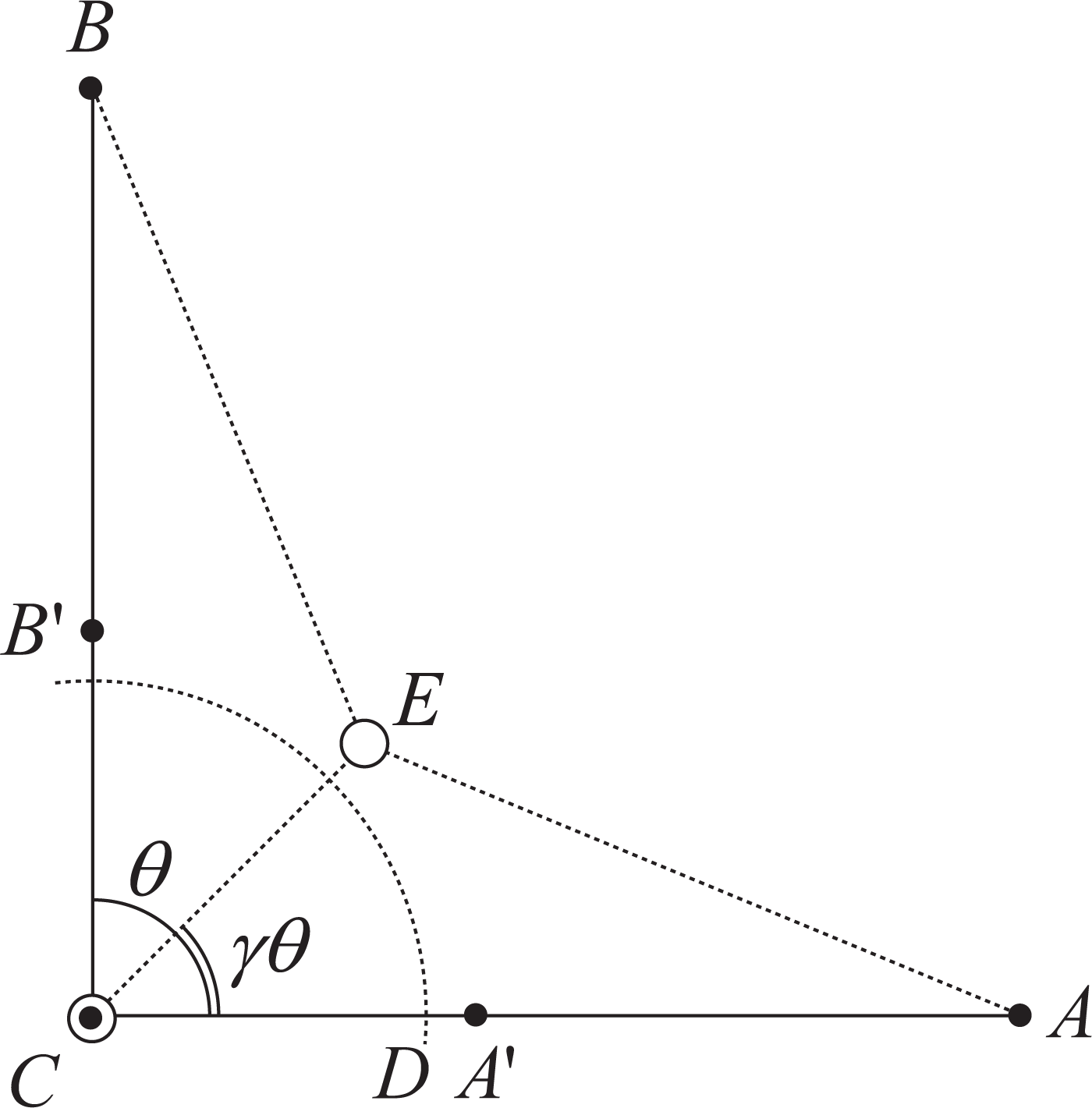
Optimal location decision-making of firms.
In order to connect the idea of consumer’s utility in the commuting factor with firm location, the argument is now discussed in more detail for deciding on a location for production. By including this additional element, an alternative location may be specified at E where firms are situated closer to each other, if agglomeration economies are available at this site and two firms are still within their critical isodapanes in the Weberian sense. In Figure 2, each variable can be related to other locational elements in the following manner. First, the distance between A and E or between B and E increases as θ increases
In addition, it should be noted that this specific model assumes that population density is not uniformly distributed across the plain as indicated earlier, which is different from conventional market-area and supply-area analyses. Moreover, the model is also different to Weber’s location triangle model. To be precise, Weber’s model can be mathematically characterized by the function f(A, B), which implies that the locations of two points, A and B, are subject to the cost minimization behavior of a firm. By contrast, this model sets the relationship between A and B as the function

This particular equation is provided based on the hypothesis which can be expressed by the population ratio and economic weight between two different areas. In equation (1), Vi
= population at location i,

From the standpoint of agglomeration economies, the following argument can be made. The location-triangle model treats agglomeration economies as a part of the profit maximization element of each firm. Hence, these economies are either spatially constrained internal or external economies or both. By contrast, the primary objective of this article is the location decision-making of the firm that can also be beneficial for the region overall. As a result, these economies go beyond spatially constrained internal and external economies that are “internal to the firm but external to the industry” and “external to the firm but internal to the industry.” More concretely, that is “external both to the firm and to the industry.” This implies that the alternative point E is determined by the agreement of the two firms according to the initial market force, which can be measured by the equations stated above.
This argument is only valid when optimal location decisions for firms are examined. The framework needs to expand to more general cases to include the formation of market areas and location decision-making for households in rural areas; these rural areas may achieve well-organized access to varieties of goods and services by utilizing existing facilities and infrastructure elements. In other words, it is unrealistic to create a new center of functional and administrative structures using this model, as it is only valid for individual manufacturing or tertiary firms, as demonstrated here. In the following section, a more plausible scenario is examined by utilizing existing centers as an application of the base model introduced in this section.
Hypothetical Analysis
The following scenario will be examined in this section. It is initially assumed that there is a center of economic space at CP, which is the highest level in the hierarchical order in an economic plain, followed by three isolated lower-order hierarchical towns, IT 1, IT 2, and IT 3, as shown in Figure 3. Next, each isolated town limits the variety of goods and services to a minimum because of a smaller population or demand. Finally, solid lines represent the main transportation routes between each isolated town and the CP. Broken lines are minor intertown transportation routes. Note that there is no direct route between IT 2 and IT 3. The triangles F 1 and F 2 show the locations of two firms. There are only two firms in this economic plain, and labor is supplied from the isolated towns IT 1 and IT 2 for a firm that locates at F 1 and from IT 2 and IT 3 for a firm that locates at F 2. In addition, each worker travels by private vehicle when they are commuting, since these firms are located away from the established public transportation route. This is the same as examined in the previous section in Figure 2 in the case of location E.
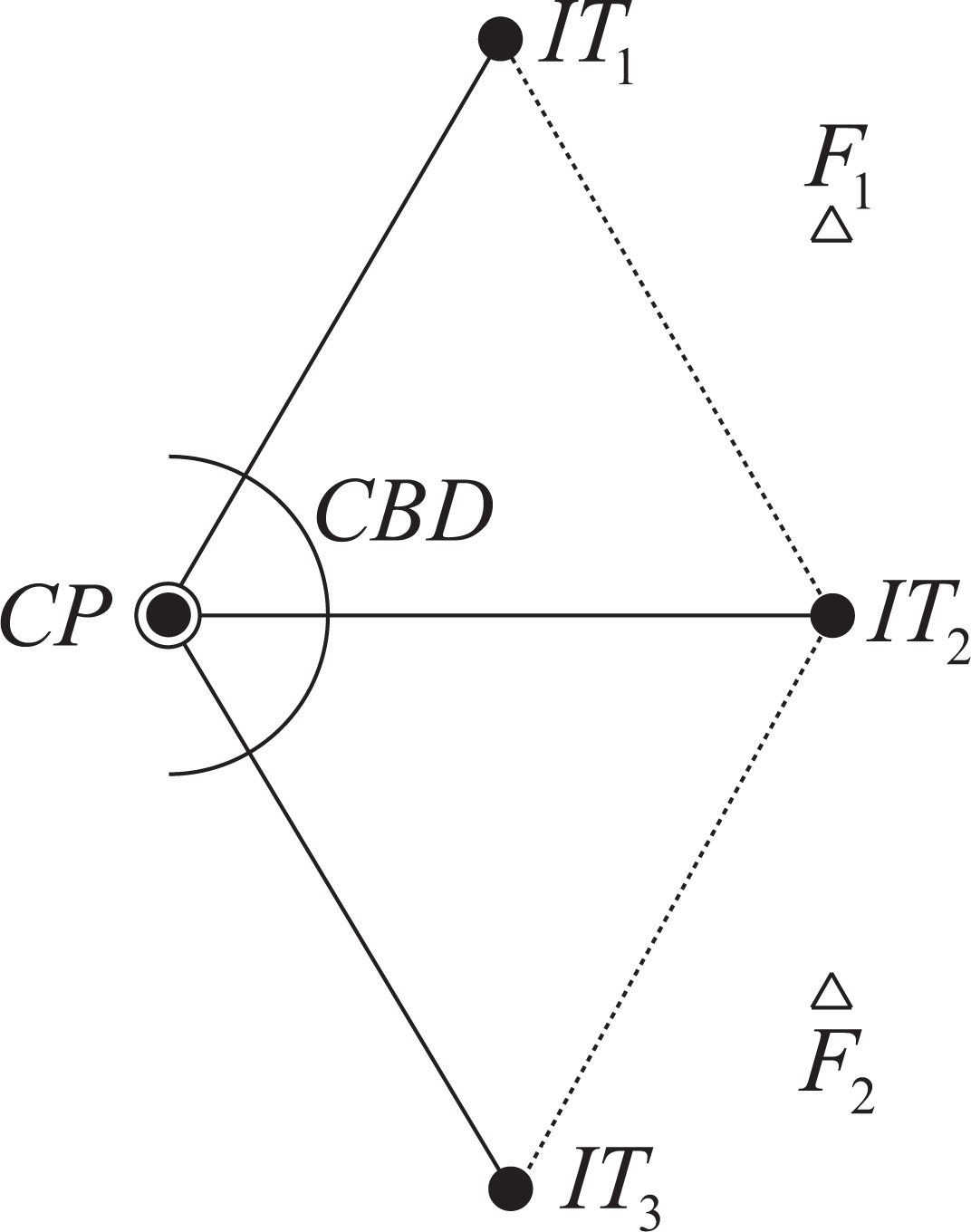
Initial spatial setting.
Under these circumstances, households in isolated towns need to travel to the CP in order to obtain goods and services that are not available at the isolated town center. Hence, the network of transportation to the CP from each isolated town plays an important role. However, the following situation can be considered, which is evident in many real cases. As the local population decreases or the density becomes low in rural areas, public transportation services face insufficient economies of scale and so reduce their frequency of operation. This is not socially optimal with respect to the accessibility of goods and services, which can be interpreted as that for the socially optimal circumstance, there is no spatial consumer exclusion and also no budget transfer from anywhere else to avoid this specific problematic issue under the following circumstances: first, in isolated towns, households who face difficulty in traveling to the CP may partly face spatial consumer exclusion from goods and services that are exclusively available at the CP; second, the public transportation operator would need to receive subsidies from the local government, the costs for which may be charged to each citizen as a local council tax, thus placing a further burden on rural residents. This tax burden will become heavier, as the local population decreases further. In these situations, an alternative spatial configuration can be given as shown in Figure 4.
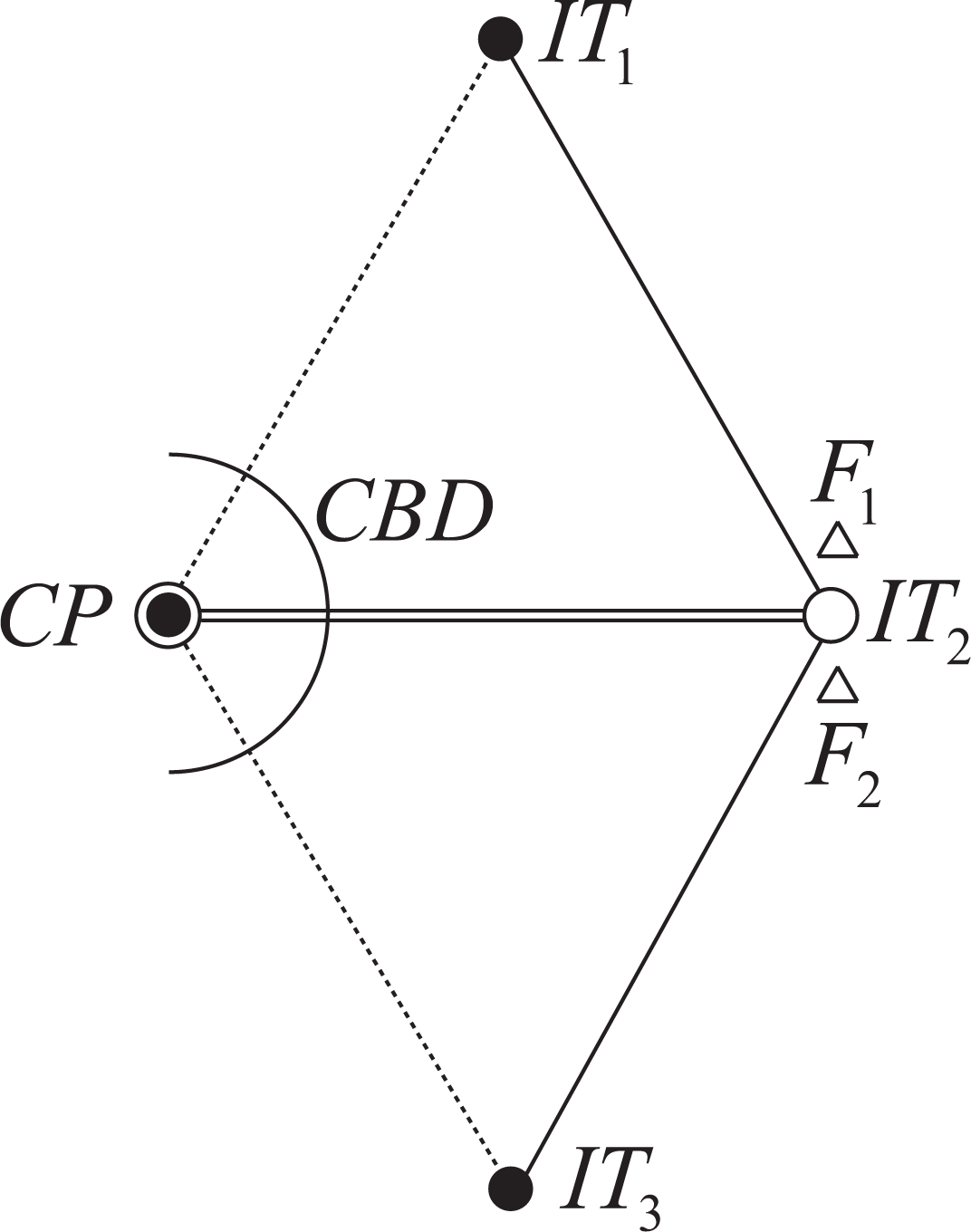
Alternative spatial setting.
In this figure, the transportation network changes so that there is one main route to the CP and two supplementary intertown routes. This reorganized spatial arrangement may also be advantageous to the CP, since the CP can reduce traffic congestion and pollution. In concrete terms, this advantage is also brought about by an enhancement of the alternative market area, IT 2, as a terminal or transit area, which reduces the necessity of trips to the CP from each isolated town. For rural economic agents, there are two main advantages. First, they benefit from the alternative locations, F 1 and F 2, being near to IT 2, if agglomeration economies and other locational advantages for firms at IT 2 are enough for firms to shift their locations there. That is, commuting workers are able to use a public transportation system and obtain necessary goods and services at IT 2 for households during their commuting trips. Here, individual optimal location and socially optimal location may coincide with each other as long as the labor is regarded as a household.
Second, transportation costs in the public sector between different areas are reduced by the recovery of economies of scale because of the integrated route to the CP as well as by increased demand from commuting intertown passengers. The alternative center, IT 2, becomes more enhanced as its function as a terminal location increases. In this way, the enhancement of center, IT 2, makes more goods and services available, which improves the consumer surplus in isolated rural town households. Moreover, the producer surplus may also improve by being close to IT 2. For example, if F 1 and F 2 maximize their spatial vicinity opportunity, this can be advantageous to access inputs and other factors and agglomeration economies such as localization or activity-complex economies become available. At the same time, a pool of labor among four towns, rather than two, can be optimized if these positive effects are fully utilized.
To sum up, the location decision for firms at IT
2 may create cost-saving and revenue-utilizing opportunities by agglomeration economies as well as improve accessibility of the firm for labor. The pool of labor also increases to four different areas. In addition, the alternative rural CP at IT
2 reduces the extent of urbanization diseconomies within the Central Business District (CBD) at the CP. Also, if the alternative CP, IT
2, already exists, there may be minimal additional investment for it to become a rural CP. The latter can be the most distinct aspect of the choice of a socially optimal location by firms that involves the hierarchical CP system. It has become apparent that an enhancement of the rural CP, IT
2, in Figure 4 as an alternative spatial structure may improve household amenities under well-organized accessibility on commuting and to the market in addition to opportunities for agglomeration economies for local firms. Within this framework, the functional structure can be reformed together with changes to the input and output of the flow of goods and services by the presence of an intermediate spatial hierarchy. However, such highly advanced spatial systems cannot be established if the existing locations of firms are better able to minimize costs. For instance, firms may not relocate to the intermediate CP, IT
2, if the additional costs for commuting and the price of land are higher than the savings offered by agglomeration economies at IT
2. This particular case can be illustrated as follows. When the total area population is at a sufficient level, the number of passengers on a public bus per day on each segment can be denoted as g
1 ⋅ (g
1 > 0). Hence, all three routes have 3g
1 passengers per day. When the total area population declines, the number of passenger of the public bus per day on each segment may decline up to g
2 ⋅ (g
2 < g
1), where the minimum requirement of the number of passengers for public bus operation is the level g
m
⋅ (g
m
> g
2). In such a situation, the integration of three routes into two recovers the sustainable level of operation as long as
An Extension
The previous sections have demonstrated that the integrated transportation network system and location of firm may establish a sustainable rural economy even in a population-declining environment. In addition to this aspect, now the concern should be given to a situation where such reorganization is not feasible solely by individual economic behavior. If spatial reorganization improves welfare levels across the economic plain, the estimated value of advantages such as a surplus brought about by the reduction in congestion at the CP, as a result of spatial reorganization can be transferred to additional elements of agglomeration economies in addition to the advantage as better accessibility of goods and services in isolated towns as a result of the integration of the transportation network. If the implicit effects of additional elements are at a sufficient level, total costs for both firms after spatial reorganization are less than the total costs without reorganization. In this way, public policy can lead firms to a socially optimal choice of location by applying a subsidy or side payment, as described by Isard (1956, 179). To establish a connection between optimal spatial organization and public policy as a subsidiary payment, the aggregate economic advantages, including the implicit effects beyond local parts of the area, need to be taken into account for the evaluation.
The model framework in this analysis can be accurately applied to spatial economic planning under the condition that each spatial variable is available in the future. Such an application can determine the variables, for instance, indicators α i , β i βi, and γ in equations (1) and (2). To combine the alternative spatial organization with location decision-making model of firms, following interpretation can be provided. Rural regions where local populations are in constant decline need to consider spatial reorganization. One possibility is to integrate transportation networks to maintain sustainable operational levels. If local firms are separately located and commuters use private vehicles due to firm locations being deviated from the main traffic route, an option would be to relocate to an area to a subfunctional CP, so that commuters can use public transport and also complete their purchasing of goods and services. For the public sector, increased public transport passengers enhances economies of scale. To relocate firms, the following conditions may be required. First, distribution transportation costs should decline since the relocated point E in Figure 2 would be outside the triangle ABC, according to Figure 4. Second, the variable γ would be prefixed, as the existing center could be chosen as an alternative firm location. Hence, each firm should be in a similar situation in terms of market power so that all firms have the incentive to relocate. Also, for all firms, the fixed costs for relocation should be kept at a low level. If the firm relocation behavior contributes to sustaining the population-declining region, this can be referred to as a social optimal behavior. When the relocation costs need to be partly subsidized by local authorities, the level of subsidiary payments has to be determined by estimation and prediction outcomes that include the implicit effects which can be empirically demonstrated and revealed.
The methodological connection between the input–output model and CP theory provides a good starting point; the exploration was initiated by Parr, Denike, and Mulligan (1975) in a city-size model using the economic base approach. In addition, Chalmers et al. (1978) provided an empirical investigation to formulate an economic forecasting model, which is applicable to small and relatively uncomplicated regions, depending on natural resources. Mulligan (1979) further expanded the economic base approach and revealed the linkages between different hierarchical sectors. Moreover, Robison and Miller (1991) examined the input–output analysis in spatial terms and showed the impact of the spatial structure of trade on intercommunity and interindustry multipliers. In a community economic base, Robison (1997) investigated the household economy and indicated that there were certain limitations, including problematic factors such as vacation trips, commuter incomes, and tourist spending. In addition, Sonis and Hewings (2003) explored a generalization of the input–output approach within the top-down and bottom-up CP framework. Finally, Sonis (2007) attempted market-area analysis using the input–output model with a hierarchical spatial structure.
While these investigations have been formalized individually in depth, there are still some missing elements between CP theory, the input–output model, and community-level regional economic approaches for completing and fulfilling direct connections with each other. Also, the impact of changes in transportation networks on basic activity and for stimulating nonbasic activity can vary with indirect and induced effects. Richardson (1978, 90) referred to direct effects as particular export sectors and induced effects as variations in the consumption patterns of workers employed in particular export sectors, both of which are associated with interindustry linkages. This may allow estimation of whether uneven employment and population levels among the same level of spatial hierarchy in a county or country can be achieved by enhancing basic activity in a region experiencing population decline. In addition, it has been revealed in particular cases that the lowest hierarchical order such as a community-level CP system needs to sustain its own CP system in terms of functional structure by integrating neighboring lower spatially hierarchical areas. However, it is also necessary to make the administrative structure more accessible to improve the amenities of rural economic agents. Hence, concern needs to be given to efficiency at the national level and equity at the regional level both for functional structure and for administrative structure by means of well-organized spatial reformation enhancing established transportation networks under limited economies of scale. Although these are beyond the scope of this article, they provide the basis for both formal elaboration of the proposed model and possible future expansions of the analysis.
Concluding Comments
This article has examined a location model for forming an intermediate hierarchical center to maintain both efficiency and equity for economic agents in rural areas. The model may be useful for spatial planning in developed countries with declining populations that operate under severe international cost-saving competition, in addition to similar cases in developing countries. Agglomeration economies can play a key role in solving this problem in terms of scale and scope. In addition, the socially optimal choice of location for firms together with a highly advanced local transportation network may enhance further economic growth in rural areas and help ameliorate the impacts of a declining population. These advanced economic activities can maintain centripetal forces in terms of the population as well as enhance household amenities in rural areas. Moreover, the analysis in this article indicates that more efficient regional economic growth may be attained by the reformation of the administrative structure on a national level. Finally, further detailed investigations are needed to predict rural population and regional economic growth.
Footnotes
Author’s Note
A preliminary version of this article was presented at the International Tinbergen Institute Workshop 2012 in May 2012 at Amsterdam.
Acknowledgments
The author would like to thank the Tinbergen Institute for their coordination of the workshop and also R. Jackson, J.-C. Thill, A. Batabyal, and anonymous referees for their valuable comments and suggestions. The usual disclaimer applies.
Declaration of Conflicting Interests
The author(s) declared no potential conflicts of interest with respect to the research, authorship, and/or publication of this article.
Funding
The author(s) disclosed receipt of the following financial support for the research, authorship, and/or publication of this article: This research was partially supported by Japan Society for the Promotion of Science (KAKENHI), grant number 25780179.