



Abstract
The unique nature of recreational marijuana policy makes for a compelling study in the policy adoption and implementation process. As a local control state, Colorado cities, municipalities, and counties may choose whether or not to adopt marijuana legalization policies in their jurisdictions and how to do so. This research is based on survey and panel data from Colorado local officials regarding issues of adoption and implementation in their jurisdictions. Overall, the initial findings show that the decision regarding adoption was a result of a combination of policy determinants (both cultural and economic) and policy diffusion (from prior policies on medical marijuana). Factors related to public opinion, economics, and prior policy on medical marijuana affected both the decision to permit and the decision to prohibit. Policy diffusion also appears important in early implementation, as cities use the existing medical marijuana policies to shape recreational marijuana policies.
Introduction
More than forty years ago, the National Commission on Marijuana [sic] and Drug Abuse issued a report on marijuana with recommendations to decriminalize the drug. Regarding the comprehensive study, the Commission Chairman, Raymond Shafer, stated in his letter to President Nixon and Congress: We on the Commission sincerely hope it will play a significant role in bringing uniformity and rationality to our marihuana [sic] laws, both Federal and State, and that it will create a healthy climate for further discussion, for further research and for a continuing advance in the development of a public social policy beneficial to all our citizens. (1972, ix)
Several decades later, although marijuana remains an illegal substance under federal law, several states (and local governments) have decriminalized marijuana use in various ways. Currently, twenty-three states and Washington, DC, allow comprehensive marijuana programs for qualifying medical conditions; approved measures in fifteen states allow use of “low THC, high cannabidiol (CBD)” products for limited medical reasons; voters in Alaska, Colorado, Oregon, and Washington state have passed initiatives legalizing the sale and distribution of marijuana for adults aged twenty-one and older; and more than a dozen states have “decriminalized” possession laws (National Conference of State Legislatures 2015; Office of National Drug Control Policy 2015). Despite these policy shifts, marijuana is still classified by the federal government as a Schedule I drug according to the Controlled Substances Act, and state marijuana laws do not change the fact that using marijuana continues to be an offense under Federal law.
As of January 1, 2013, citizens aged twenty-one and over were legally allowed to use the drug in Colorado, and recreational marijuana establishments were allowed to sell marijuana to the general public in the state beginning on January 1, 2014. Per Colorado’s Amendment 64 (passed by voters), each local government is free to decide whether or not to allow the operation of recreational marijuana establishments, just as they have been allowed to permit medical marijuana establishments (Co. Const. Art. XVIII, §16).
Little information about the structural, social, economic, and public health impacts of marijuana legalization exists. The state of Colorado has limited access to similar legalization laws or policies by which to replicate policies. Additionally, as a “home rule” or “local control” state, Colorado cities, municipalities, and counties have the ability to pass laws to govern themselves as they see fit, meaning local governments may choose whether or not to adopt marijuana legalization policies in their jurisdictions and how to do so. Thus, the unique nature of recreational marijuana policy in the state presents a compelling study in the policy adoption and implementation process for academics. More practically, the adoption and implementation of these policies is of paramount importance to state and local administrators who face the everyday implications of managing these changes. Public policies are often best understood when the work of academics and practitioners comes together—an ideal sought in this research.
First, a survey of Colorado municipal managers and administrators was conducted regarding the issues of adoption and implementation in their jurisdictions. Overall, the initial findings showed that the decision regarding adoption was the result of a combination of policy determinants (both cultural and economic) and policy diffusion (from prior policies on medical marijuana). Factors related to public opinion, economics, and prior policy on medical marijuana affected both the decision to permit and the decision to prohibit. On average, permitting cities cited between five and six departments involved in the planning process related to recreational marijuana regulations in their jurisdictions, most frequently citing law enforcement, zoning and planning, code enforcement, licensing, community development, and financing departments. Similarly, permitting cities noted, on average, three to four departments involved in the enforcement of recreational marijuana regulations, most often citing law enforcement, code enforcement, licensing, and zoning and planning departments. About half of the permitting cities had issued additional local taxes on recreational marijuana, with most of the remainder saying they had plans to do so in the future.
Next, the adoption and implementation process was discussed with a panel of local managers and administrators to add insight into the survey findings based on real-world experience. Six officials from Colorado cities of varying sizes that adopted and are implementing recreational marijuana policies were provided with survey results and then shared their opinions and experiences during a researcher-led panel discussion. This article presents the combined results of the survey research and expert discussion.
Research Approach
Survey Data
The initial data for this research were obtained from an online survey of local government officials in Colorado. City and county managers and administrators (and city and town clerks, in the absence of a manager) were targeted to complete the survey since they would have current knowledge about the policy and would also be able to speak to the policy adoption process as well as the concerns of their colleagues and communities. The survey was sent to 296 potential respondents.
The survey consisted of fifteen questions regarding the status of medical marijuana in their local governments and the decision to permit or prohibit the sale of recreational marijuana. Survey questions were grouped into two main areas: (1) status of the decision-making process (to better understand the factors involved in adoption and local governments’ current standing in the process) and (2) public policy implementation (in order to better understand what is taking place at the local level in the implementation process).
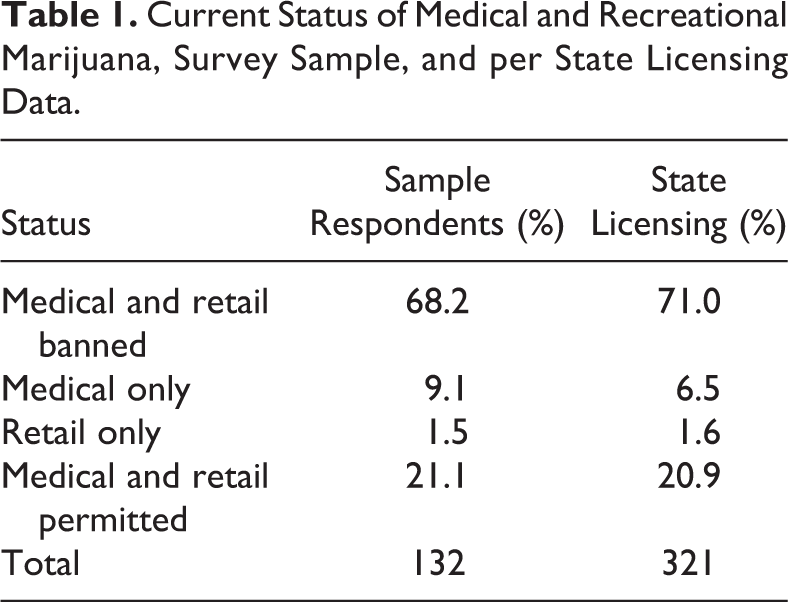
Ultimately, 110 fully completed surveys from cities were returned, making for a 45.3 percent response rate (110 of 243). A total of 22 counties completed surveys, a response rate of 41.5 percent (22 of 53). As indicated in Table 1, the responding cities and counties in the sample mirror the local jurisdiction licensing status on medical and recreational marijuana (Colorado Department of Revenue 2015). The city and county administrators who completed the surveys are experienced with local government—on average, respondents had at least twenty years of experience working in government.
Current Status of Medical and Recreational Marijuana, Survey Sample, and per State Licensing Data.
The survey asked local government officials to identify the current status of recreational marijuana in their city or county—whether their city or county had approved, denied, or was still considering permitting recreational marijuana sales. In addition, the survey asked the respondents to indicate the perceived reasons for the decision (or lack of a decision) to permit or ban recreational marijuana sales. For those jurisdictions that do permit recreational marijuana sales, a series of questions assessed initial implementation issues like planning and enforcement participants. This article presents data from city administrators to allow comparison of information shared by the expert panel, all of whom represent cities.
Panel Data
A panel of six local managers and administrators from Colorado cities of varying sizes that adopted and are implementing recreational marijuana policies in their municipalities were provided with survey results. These administrators then shared their opinions and experiences during a researcher-led panel discussion of key topics.
Overall, the results provide a wealth of information for understanding the reasons why Colorado cities permitted, or declined to permit, the sale of recreational marijuana as well as ongoing issues in the implementation process for those who have permitted sales.
Adoption of Recreational Marijuana Policies
Background: Morality Policies, Culture, and Public Opinion
Past academic studies of policy adoption have focused on unique aspects of “morality” policies, those designed to regulate the social norms or that stir strong moral responses from citizens (Mooney and Lee 1995) including community culture. Practitioners are similarly concerned with public opinion and how it impacts citizen voting choices and political decisions.
Morality policies
Academics have distinguished purely economic policies from morality policies because the adoption patterns differ between the two policy types (Gormley 1986; Mooney and Lee 1995; Sharp 2005). Morality issues are those that primarily involve religious convictions or similar fundamental ideologies (Mooney 2001). Policies related to morality issues generally evoke considerable conflict because beliefs regarding those policies are usually based on firmly held values. This doesn’t mean, however, that economics are not involved at all in morality policies—these policies often have material consequences and large financial stakes (Sharp 2005). The underlying conceptualization of morality policy, though, is that at least one side of the debate is mobilized largely because the proposed (or existing) practice is seen as a violation of some moral code (Mooney 2001).
Like many social issues, morality issues might be placed on a continuum. “Pure morality” issues are those in which arguments on both sides are grounded in morals rather than material or economic benefits (e.g., abortion clinics), and “material morality” issues are those in which arguments on one side are based on morals and arguments on the other side are based on economic outcomes (e.g., casino gambling). A number of issues might be placed in the middle of this continuum as “hybrid” issues that have components of each element (Sharp 2005). Because of these differences, studies have shown that not all types of morality policies raise the same concerns. Some types of morality policies are influenced mostly by economic factors, especially when new policies can impact the local economy, while others are influenced more by subcultural factors, yet institutional and intergovernmental concerns are also present (Sharp 2005; Meier 1999).
Colorado’s Amendment 64 ballot initiative to legalize recreational marijuana (and Proposition AA in 2013 to tax recreational marijuana) earmarked the first US$40 million of state excise tax revenue from marijuana for public school construction, with other marijuana tax revenues reserved to fund public education campaigns, health-related services, and public safety initiatives (Blake and Finlaw 2014; The Gazette 2015). In addition to the funds noted above, Amendment 64 allocates 15 percent of the sales tax collected by the state on marijuana back to cities and counties where retail sales occur (Blake and Finlaw 2014). When any locally levied taxes are included, jurisdictions allowing marijuana sales could recognize distinct economic benefits to allowing recreational marijuana sales. Given this combination of factors, local adoption of recreational marijuana sales is considered a hybrid morality issue.
Culture
Broadly, culture can be thought of as a way of life—the set of beliefs, values, common practices, and customs shared by a group of people. Since cultural expectations dictate acceptable behaviors, cultural explanations for policies posit that more widely accepted cultural practices of a community will, in turn, impact local political and policy issues (Rosdil 2011; Sharp 2002, 2005). Rosdil (2011) notes two interrelated aspects of culture that are of particular importance to the study of morality policies—cultural change and diversification and the development of nontraditional subcultures.
Cultural change and diversification happen for a number of reasons (economic development, crisis, or restructuring; technological developments; political upheavals; population movements; war or civil unrest; natural disasters; etc.) and assume a number of forms (Rosdil 2011). Cities that have large, well-established countercultures often create an unconventional culture, while cities without such subcultures tend to be more conventional. Correspondingly, we expect policy actions in unconventional cities to be more radical, supportive of new social movements, and more aligned with the political left, while we expect policy actions in conventional cities to be more consistent with traditional values and supportive of a conservative “family values” agenda (Sharp 2005).
Since morality policies are often straightforward and personally important to people by comparison to other types of policies, citizens are capable, and very willing, to express their views clearly to policy makers (Meier 1994). Thus, morality policy debates tend to encourage greater citizen engagement with government. This creates a situation in which both citizens and politicians are highly motivated to engage in policy making. The increased citizen involvement with government is generally shown to help representation of opinions on both sides of issues by increasing politicians’ responsiveness to better reflect the attitudes expressed by citizens (Camobreco and Barnello 2008; Mooney and Lee 2000; Sharp 2002).
Members of subcultures may use shared social networks (Fischer 1995) to mobilize in support of progressive morality policies. Research suggests that culture may constitute a “demand” (or set of expectations) to back favorable policies on morality issues (Sharp 2002). The proponents of Amendment 64 legalizing recreational marijuana in Colorado, for example, were very organized—they rallied around a common theme, presented an organized campaign to equate recreational marijuana use with recreational alcohol use, noted that taxing marijuana would support education budgets, and cited the “war on drugs” as misplaced government action (Blake and Finlaw 2014).
Given that recreational marijuana was legalized from a ballot initiative that passed with 54.8 percent of the population in support, high citizen engagement in the decision to allow or ban establishments for recreational marijuana sales is expected in particular localities. An initial hypothesis, then, is that local governments’ decisions on whether or not to permit recreational marijuana establishments are driven by public opinion, which, in turn, is driven by local culture. Given the nature of the issue as a hybrid morality issue, though, we also hypothesize that economic considerations will play a role in local governments’ decisions on whether or not to permit recreational marijuana sales.
Public opinion
Public opinion on the legalization of marijuana has shifted considerably over the past decade. In 2006, about one in three (32 percent) people in the United States supported marijuana legalization. By 2015, more than half (53 percent) thought the use of marijuana should be made legal, with more than two in three (68 percent) of those aged eighteen to thirty-four favoring legalization (Pew Research Center 2015). Those who support legalization cited “medicinal benefits” and a belief that marijuana is “no worse than other drugs” (including alcohol and cigarettes) along with economic benefits such as increased tax revenues and reduction in current costs of enforcement, while those who oppose legalization said that marijuana “hurts society and is bad for individuals” and is a “dangerous, addictive drug” (Pew Research Center 2015).
Effects of Morality Policies, Culture, and Public Opinion
Survey respondents indicated that substantially more cities decided to either ban (55.5 percent) or place a moratorium (24.5 percent) on recreational marijuana establishments than decided to permit them (20.0 percent). All of the cities that permitted the sales of recreational marijuana did so based on a council vote. Cities were more likely to ban recreational marijuana based on a council vote than a citizen vote.
About two-thirds (65.6 percent) of respondents from prohibiting cities cited “morality/not good for community” as a reason for banning recreational marijuana sales. Additionally, about half (49.2 percent) of the respondents from prohibiting cities said that “public opinion” was a reason recreational marijuana was banned in their jurisdictions and the same percentage (49.2 percent) indicated “public safety issues” as a reason for banning recreational marijuana. About two-fifths (42.6 percent) of respondents from cities that banned recreational marijuana sales noted “enforcement costs are too high” as a reason for prohibition, and about one-fifth (19.7 percent) of these cities expressed a view that “planning and implementation costs are too high.”
Nearly, all of the respondents from cities (95.5 percent) permitting recreational marijuana said that public opinion was a reason for doing so, and half of these cities (50.0 percent) said “culture” was a reason for doing so. Respondents also noted revenues generated by taxes (50.0 percent), revenues generated by applications for establishments (27.3 percent), and revenues generated by other related businesses (18.2 percent) as reasons for permitting recreational marijuana in their jurisdictions.
Thus, the survey data indicated that community culture and public opinion played a significant part in administrators’ decisions to permit recreational marijuana in their communities. Economic factors, though less frequently cited, were also contributing factors in community choices.
The panel discussion revealed similar overall findings. One panelist said succinctly, “My board’s answer was that the people of Colorado voted to allow marijuana and the town was upholding the voice of the people.” Much of the discussion, however, highlighted the complexities of dealing with diverse publics. For example, many of the administrators noted that citizen votes to allow marijuana businesses (both medical and retail) in their communities were often very close, showing a “split community” opinion. So, while council members felt that passage of marijuana-related bills indicated general public support, they were also mindful of the sometimes substantial percentages of voters who were not in support, particularly in considering the ways they established regulations and made council decisions.
For example, in one city, a citizen initiative to ban medical marijuana failed by a 60–40 percent voter split, so “… the town council relied on that ‘referendum’ [the vote outcome on medical marijuana] on marijuana as they moved to decide on recreational [marijuana].” In another city in which state-level Amendment 64 passed by a 63–37 percent vote, at the local level there was “… concern among trustees, but they knew they had pretty wide public support based on the vote numbers.” In this case, the city exercised caution by limiting the number and location of marijuana businesses. Similarly, in a city that had faced a very divisive political battle over medical marijuana, but in which Amendment 64 passed by a 70–30 percent margin, elected officials approached recreational marijuana regulations with a very structured plan, well ahead of state deadlines.
In a larger city that had faced a series of back-and-forth citizen initiatives including approval of medical marijuana, repeal of medical marijuana, approval of Amendment 64, and then reinstatement of medical marijuana, administrators moved forward by allowing marijuana-based businesses “in a limited capacity,” capping the number of medical marijuana outlets (1 per 500 registered patients) and limiting recreational licenses to those who already held medical licenses.
Most of the panelists clearly stated that economic considerations were not the primary factors in their city’s decision on recreational marijuana. One city administrator said, “The revenue was never the reason why for the Board, it was more about the wants and needs and desires of the voting public,” and another noted, “on the recreational side, it was not necessarily economic.” One panelist, however, was clear that there “was an economic factor” to recreational marijuana approval in her community as the city owns their utility company and marijuana growth requires large quantities of electricity (e.g., constant lighting, temperature control, etc.). She also noted that marijuana enterprises have brought “the first new commercial light-industrial construction that this town has seen in the past twenty years” and “new manufacturing operations in a community that could really use the jobs.”
In an interesting overlap of culture and economic factors, several panelists whose cities initially prioritized cultural beliefs over economic aspects of the policy change indicated that the resulting financial benefits of recreational marijuana businesses (coupled with few problems) have changed the perceptions of some former opponents. One administrator said, “… it is impossible not to give credit to the [marijuana] industry for all that the town has been able to do for the businesses and residents … the residents that were opposed in the beginning are not now because of the good things that have come from the increased revenue.”
Implementing Recreational Marijuana Policies
Background: Policy Diffusion
Previous academic studies have also studied the idea of “policy diffusion,” or how policies are disseminated across governments through processes like learning from early adopters (Shipan and Volden 2008; Nicholson-Crotty 2009). By the same token, practitioners look to inform policy implementation with evidence of past experiences of their own, or other, governments.
Policy diffusion is defined as “one government’s policy choices being influenced by the choices of other governments” (Shipan and Volden 2012, 788). The diffusion of policies takes place through various mechanisms including learning and imitation, on the more positive tact, and competition and coercion, on the more negative tact (Shipan and Volden 2012). Over time, governments may learn from early adopters, and they copy and modify aspects of policies based on experiences of other governments and their own. There are a number of mechanisms that facilitate policy learning, such as the proximity of the emulated government (Berry and Berry 1990; Light 1978) and whether the governments share ideological views (Grossback, Nicholson-Crotty, and Peterson 2004; Volden 2006). No matter the mechanism, though, diffusion encompasses not only the spread of the same policies but also the interrelated choices governments make relative to the policies and policy impacts of other governments (Shipan and Volden 2012).
Diffusion is affected by the local political environment. Colorado is an interesting case study because it is the first state that has a constitutionally adopted “local option” for sale of recreational marijuana. However, local governments in the state previously decided whether to sell marijuana for medical use. If a government allowed medical marijuana establishments and the policy was deemed successful, then this might encourage local governments to also permit recreational marijuana. In this situation, the local government essentially learns from itself. We hypothesize, then, that cities that permit the sale of medical marijuana are more likely to permit the sale of recreational marijuana. We further presume that recreational marijuana policies will be based, to some degree, on previously established medical marijuana policies.
Policy Diffusion: Relationship between Medical and Recreational Marijuana
The survey data show a strong significant relationship between the currently permitting medical marijuana and the decision to permit the sale of recreational marijuana. More than four-fifths (88.0 percent) of the cities that currently permit medical marijuana also permitted recreational marijuana sales. Similarly, all (100.0 percent) of the cities that currently do not permit medical marijuana either banned or placed a moratorium on recreational marijuana sales. Three cities that currently permit medical marijuana opted not to permit recreational marijuana.
Adapting a phrase often used to describe the relationship between marijuana use and further drug use, panelists described medical marijuana as “a gateway policy” to recreational marijuana. All of the panelists represent cities that approved recreational marijuana following prior approval of medical marijuana—all indicated learning from these experiences, both positive and negative.
An administrator from a city who had a “bad experience” with medical marijuana, for example, indicated that they learned from this experience and made improvements in land use regulation schemes to better facilitate implementation of recreational marijuana businesses. Ultimately, this led to positive outcomes for the latter process. Another panelist noted that medical marijuana “helped pave the way” in terms of “development and implementation and tolerance and community perception” of recreational marijuana. Most of the panelists’ cities transitioned the existing policies and regulations already in place for medical marijuana to recreational marijuana and found that this was a “smooth transition” for their communities.
Planning Process
The survey data show that nearly all of the permitting cities (95.5 percent) indicated that law enforcement has been or will be involved in the planning process related to recreational marijuana regulations in their jurisdictions, and more than four-fifths (86.4 percent) of the cities permitting recreational marijuana said that zoning and planning departments have been or will be involved in the planning process.
More than four-fifths (81.8 percent) of permitting cities noted inclusion of the licensing department and more than two-thirds cited the community development department (72.7 percent) or finance department (68.2 percent) as part of the planning process. About half (54.5 percent) of the permitting cities said that the code enforcement department had been or would be part of the planning process. On average, permitting cities cited between five and six departments and organizations as involved in the planning process.
Additionally, about two-fifths of cities (40.9 percent) permitting recreational marijuana said that state-level departments and organizations had been or would be involved in the planning process for their local governments.
Most members of the panel, particularly those from larger cities and towns, indicated the involvement of a diverse group of city agencies in planning and implementing recreational marijuana policies—the clerk’s office, the planning department, building and zoning departments, the city manager’s office, the fire and police departments, licensing department, and so on.
Perhaps, the most interesting aspect of “planning” described by the panel was the ongoing nature of the process. One panelist said of the early stages of planning, “it was impossible to think of everything” since government was “doing it on the fly” along with the new businesses. Several participants noted that even though the initial whirlwind—during which “it seemed like we talked about marijuana at every meeting for a long time”—has “settled down now,” a substantial amount of the council’s time is still occupied with discussing issues related to marijuana, despite it being a relatively small portion of the city’s revenue and operating functions.
Similarly, another panelist noted that the city has to “recalibrate regulations to current issues that arise [from the learning process] every six months” which is a large time investment, and one said, “the time and resources spent on the legislation and developing the regulations and then the constant tweaking and refining as the State progressed was a little overwhelming at times.” All agreed that recreational marijuana is a “policy experiment” that, by its nature, carries a learning curve that necessitates continual adaptation.
Enforcement
Not surprisingly, the survey results reveal that three-quarters (77.3 percent) of the cities permitting recreational marijuana indicated law enforcement has been or will be involved in enforcing recreational marijuana regulations in their jurisdictions. Nearly, two-thirds (63.6 percent) of permitting cities said that licensing departments were involved in enforcement of recreational marijuana regulations, and about three-fifths (59.1 percent) of these cities noted the involvement of code enforcement and zoning and planning departments in implementing recreational marijuana regulations. Approximately, one-third (31.8 percent) of these cities noted the involvement of a marijuana enforcement division.
On average, permitting cities cited between three and four departments and organizations as involved in the enforcement of recreational marijuana regulations. About 60 percent of cities permitting recreational marijuana said that state-level departments and organizations had been or would be involved in the enforcement of recreational marijuana regulations for their local governments.
In practice, three prominent issues related to enforcing recreational marijuana policies were evident in the panel discussion: the amount of time required by clerks and other agents to process applications, renewals, licenses, and inspections; issues caused by lack of support by the surrounding county; and issues caused by lack of support from the state. Several panelists called attention to the heavy workload marijuana policies created for various government offices, most notably the clerk’s office (or other licensing departments) and law enforcement. One participant said that 30–40 percent of the city clerk’s time was spent on marijuana-related questions and processing; another said the “heaviest load” was on law enforcement and the clerk’s office, which handles licensing; and a participant who is a town administrator/clerk in a small community indicated that about “90 percent of the front-end work (e.g., applications), renewals, and oversight” falls to her. Another administrator/clerk summarized the issue: When we started in 2009 [with medical marijuana], I was in no way prepared for the impact on the workload of my office. The time and resources that licensing and enforcement took was double my workload in the beginning. It has leveled out now and does not take that much time, but in the beginning it did.
Some discussants were in the process of hiring new personnel or service providers (e.g., a Denver-based company that issues licenses) to assist with the workload. One larger city is hiring a new police position to focus solely on marijuana-related issues such as inspections for license renewals, odor complaints, and illegal grow operations since the current process of utilizing detectives is taking away needed time from other criminal investigations. Several participants were also hoping to budget for new personnel to assist in the clerk’s office.
Related to the issue of workload is the perceived lack of support from counties and the state. Several of the panelists represent cities in which recreational marijuana has been approved in their cities but not in their counties. This often leads to a lack of support. For example, an administrator from a small city noted, “We do not have the support of law enforcement here as we contract with the County for police protection and the County has banned marijuana … I do all of the inspections at the local level.” A similar issue, faced by several discussants, relates to marijuana-infused products (MIPs) or “edibles”—“… since the County has banned marijuana, I do not have any support from the Health Department for inspecting the food handling and food production aspects of the MIPs.” Even in cities in which the county has also approved marijuana policies, some said health departments are often reluctant to help: “the Health Department doesn’t want to get involved because they consider it [MIPs] a drug not a food.” Another city administrator reported challenges with large grow operations, and since the County does not allow marijuana, operations cannot be moved to outlying areas and are forced into the boundaries of the city municipality which can lead to citizen complaints, particularly in regard to odor.
While about three in five surveyed cities said that state-level departments and organizations had been or would be involved in the enforcement of recreational marijuana regulations for their local governments, panelists expressed disappointment with involvement by the state. A frustrated discussant who felt the state had “dropped the ball” on enforcement issues they promised initially to help with, described a typical interaction: “Hey town, will you take care of these items? We don’t have the time to deal with it.” Several panel members singled out issues with the state not enforcing testing requirements as problematic. An administrator from a city that has a lab indicated that the lab does little business because the state is so behind on testing, and another added that she was “disappointed the State has not enforced the testing requirements” but felt that her city’s facilities were remaining compliant even though “the State is lagging.” Some participants felt that the state was “somewhat unprepared” to manage the entire scope of the policy and several thought that “state regulations would really help at the local level” in dealing with MIPs and problems associated with them.
Taxes and Revenue
Few of the cities (n = 10) surveyed indicated that their local governments issued a local tax on the sale of marijuana in addition to the state-issued excise and sales taxes, although several cities (n = 7) noted that there are currently plans or discussions to do so in the future. Most of the panelists indicated that their cities collect additional sales and excise taxes on recreational marijuana in their jurisdictions. While not necessarily a significant source of funds in the overall budget—most noted that marijuana revenues are “only a minor part of the equation”—these city administrators did point to direct uses of funds deemed to be positive outcomes for their cities. For example, one participant said, “I can draw a straight line from the revenues we’ve seen to the brand new school resource officer we have at the middle school and high school.” Another discussant said that sales and excise taxes are “… not a ton of money” but are “enough to partner with schools for youth prevention programs.” A panelist whose city does not have added taxes indicated that all of the marijuana-related revenues collected go to the general fund and that they have seen “some impacts, but not many.”
The administrator from a city who collects a fee of US$5 per transaction and takes in over US$100,000 per year from marijuana-related sales, equated the extra revenue to that generated by the “top two restaurants in town” or one large retail business. Given the added workload and other issues encumbered by marijuana-related businesses, he wondered if “the growth is worth it” and if the return-on-investment might be more easily realized from recruiting more traditional businesses.
Future Implementation Issues
Although the survey did not address future implementation issues, the panelists did discuss several matters of concern that they anticipate in the near future or that they have begun to encounter already. As previously mentioned, MIPs pose “the biggest challenge” for cities in terms of regulation and enforcement. One example of unique problem with these edibles cited in the discussion was the case of workers in the hospitality industry who are accustomed to bringing home food and chocolates that guests leave behind—as MIPs are often indistinguishable in appearance from noninfused foods, a child accidently ingested something a parent brought home.
Several panelists cited problems with short-term rentals, such as those brokered through Airbnb, which lack the same regulations as traditional accommodations like hotels as a future concern. Some administrators also noted difficulties related to unlicensed caregiver grows. While state legislation on the issue was enacted, it will not be in effect until 2017 and may face similar implementation challenges to those already noted earlier.
Conclusion
This research provides a preliminary examination of the adoption of recreational marijuana sales by Colorado local governments as well as early issues in implementation. In this initial effort, the focus was on two key factors associated with policy adoption—cultural influences (public opinion) and economic factors. Public opinion (as perceived by local administrators) greatly affected decisions to permit or prohibit the sale of recreational marijuana in a jurisdiction. The fact that public opinion and cultural factors were cited both by respondents who permitted and who prohibited recreational marijuana bolsters the argument that particular local cultures (unconventional or traditional) impact the adoption or nonadoption of morality policies. Qualitative input from local administrators whose cities have adopted recreational marijuana policies also confirms the importance of public opinion—the outcomes of citizen votes on marijuana-related issues was key to council members’ decisions about policy adoption.
Also, economic factors affected the decision to both permit and prohibit the sale of recreational marijuana, though to a lesser degree than public opinion. This supports the notion that adoption of permitting recreational marijuana is a hybrid morality issue. Economic issues influenced both sides of the debate, so local economic concerns must be examined in greater detail to fully articulate these impacts. While the majority of panel discussants indicated that economic factors were not key to their adoption decisions, most indicated that positive economic outcomes have influenced changing opinions for those who were in opposition.
In addition, policy diffusion appears to affect policy adoption and implementation in the recreational marijuana case. All of the cities that decided to permit recreational marijuana had previously permitted medical marijuana and only three cities that currently permit medical marijuana decided to ban recreational marijuana. It is likely that the two policy approaches described here for understanding the permitting of recreational marijuana sales, cultural/economic determinants and diffusion, are not totally separate. For example, the same factors that influenced the decision to permit the sale of recreational marijuana in a city likely affected the previous decision to permit the sale of medical marijuana.
In terms of implementation, all of the panel participants were clear that experiences with medical marijuana greatly impacted their policy formation and enactment. These cities used their existing medical marijuana policies and regulations to inform the policy adopted for recreational marijuana.
Overall, the initial findings show that the decision regarding adoption resulted from a combination of policy diffusion and policy determinants (both cultural and economic). These public opinion and economic factors affected both the decision to permit and the decision to prohibit. As such, this finding largely supports Sharp’s (2005) view that economic factors can indeed affect the adoption of morality policies. Future research will refine this analysis by including more variables such as local socioeconomic characteristics, institutional characteristics of local governments, and intergovernmental factors that might affect policy adoption. The ultimate result should be improved understanding of policy adoption and implementation, particularly as it relates to morality policies, as well as enhanced practice, as more states and local governments consider permitting and enacting sales of recreational marijuana.
Footnotes
Declaration of Conflicting Interests
The author(s) declared no potential conflicts of interest with respect to the research, authorship, and/or publication of this article.
Funding
The author(s) received no financial support for the research, authorship, and/or publication of this article.