



Abstract
Literature on intergovernmental partnerships suggests the importance of several factors including organizational resources, capacity, and problem severity in understanding the adoption of these partnerships. This research improves our understanding about the adoption of intergovernmental partnerships by examining tribal and nontribal governments that adopted voluntary agreements to improve the administration of justice. Using data from the Bureau of Justice Statistics, this research examines how socioeconomic conditions, problem severity, and law enforcement authority influence the adoption of partnership agreements between tribal and nontribal law enforcement. The results suggest that tribes that adopt partnerships have better socioeconomic conditions; nontribal actors have lower levels of authority and higher occurrences of violent crime. The presence of Indian gaming also increases the likelihood of adopting cooperative agreements. The results of this study provide an important insight into understanding intergovernmental cooperation in general and what drives cooperation between native and surrounding non-native communities in particular.
Keywords
Criminal and civil jurisdiction in Indian country is marked by complexity, given the legal status of federally recognized tribes relative to surrounding state and local governments (Luna-Firebaugh 2007). Several general heuristics help determine who has authority on-and-off reservation land, but there remains substantial conflict between tribal governments and states who may be reluctant to subject their citizens to the power of another sovereign (Luna-Firebaugh 2007). While studies on the relationship between tribes and states have noted a new era of cooperation between these actors partially in response to the rather hostile legal environment tribes face at the federal level (Wilkins and Tsianina Lomawaima 2001; Steinman 2004), there remains considerable friction in the area of law enforcement that can cause serious delays in administering justice.
Several tribes, states, and local actors have entered into voluntary cooperative partnerships better known as cross-deputization agreements in the United States in the interests of creating a more effective and efficient criminal justice system (Bobee et al. 2008, 10–11). The intergovernmental relations literature suggests that even the most unlikely of characters will enter into voluntary collaborative partnerships in the presence of high problem severity, increased organizational capacity, and the need for mutual problem solving and resource sharing (Ansell and Gash 2008; Huang and Provan 2007; McGuire and Silvia 2010). However, these factors may be more or less important depending on the unique characteristics of jurisdictions in the collaborative process, with less powerful actors sacrificing a degree of autonomy in exchange for additional support. Some argue that without such agreements, tribal and nontribal law enforcement are greatly limited in being able to appropriately respond to issues within their respective jurisdictions depending on the nature of the incident (Luna-Firebaugh 2007). Understanding why some tribes, states, and local law enforcement are able to overcome their differences and pursue cooperative partnerships remains a relatively unexplored area that is the focus of the present investigation.
Law Enforcement and Tribal Governments
Intergovernmental relations in Indian country requires an understanding of the unique legal status of federally recognized Native American tribes. The 566 recognized tribes in America, 341 of which are in the lower forty-eight states, are considered sovereign nations with inherent powers to self-government that predate the signing of the U.S. Constitution (Canby 2009, 79). While exercising these rights, the federal government also maintains a trust relationship with native nations as established in treaties, executive orders, and Supreme Court cases that often limit the authority of tribal governments (Wilkin and Stark 2011). This places tribes in a distinctly different and vulnerable position relative to local governments, who derive their powers from the states (Evans 2011; Wilkins and Stark 2011). To further complicate matters, evolving federal policy during the Allotment Era resulted in the sale of reservation land to non-Indians creating a “checkerboard” pattern of ownership on some reservations, where inholdings of land owned by non-Indians are scattered across the reservation (see the Online Supplemental Figure 1). Such fractionated ownership causes several governing challenges for tribal and nontribal governments (Canby 2009; Wilkins and Stark 2011; Wilson 2002).
The intergovernmental complexity in providing law enforcement in Indian country and its surrounding counties is heightened by the fact that not all crimes are considered equally by statute and across states (Nielsen 2009; Utter 2001). For instance, crimes committed under the 1885 Major Crimes Act fall within the jurisdiction of the federal government, while Public Law (PL)-280 (U.S. 67 Statute 588) passed in 1953 granted certain state courts authority over civil and criminal statutes that had been under the jurisdiction of federal courts (Bureau of Indian Affairs 2014). Congress’s intent in passing PL-280 was to both reduce the federal role in Indian affairs and to address the “lawlessness on the reservations and the accompanying threat to Anglos living nearby” (Anderson 2012, 932). The net result of this infringement on tribal sovereignty over enforcement of criminal and civil law is increased jurisdictional complexity over particular types of cases.
In some areas in and near Indian country, nontribal law enforcement agencies and tribal police have established cross-deputization agreements to streamline law enforcement services (Hill 2010). While the nature and content of these agreements vary from jurisdiction to jurisdiction, tribal law enforcement would be empowered to process individuals regardless of their tribal membership or the location of the crime (Deloria and Lytle 1983; Luna-Firebaugh 2007). Neighboring nontribal law enforcement, for example, county sheriff’s deputies, would receive similar authority over tribal members regardless of whether the crime is on or off of the reservation. Because each tribal government is a separate sovereign, each tribe and its surrounding local governments must come to their own agreements subject to federal review. In the absence of such an agreement, an arresting officer, for example, a tribal officer pulling over a nontribal member for a potential driving under the influence, would need to wait for a county officer to arrive (Barker and Mullen 1993). Approximately half of all native nations with law enforcement agencies have entered into cooperative agreements in the United States with anecdotal evidence suggesting important differences between adopting and nonadopting jurisdictions.
Intergovernmental Partnerships
Existing literature on intergovernmental relations and collaboration provides useful insight into understanding partnerships between tribal and nontribal actors. Intergovernmental partnerships have received considerable attention in public administration as local, state, and tribal governments operate in an increasingly interconnected environment across a range of policy areas (Bardach 1998; Agranoff and McGuire 2003; Meier and O’Toole 2003; O’Leary, Gerard, and Bingham 2006; Lester 2012). Understanding what drives actors from various backgrounds to enter into intergovernmental partnerships is an important first step in understanding the nature and impact of networked environments. While several studies have examined the nature of cooperation and conflict between tribal and nontribal governments (McCulloch 1994; Steinman 2004; Babee et al. 2008), few studies have systematically explored how issues of problem severity, resource scarcity, and capacity work to overcome these jurisdictional tensions.
The arguments for partnerships in local service delivery are usually couched in terms of cost savings, efficiencies, and improved service quality. Realistic appraisals of collaboration, however, concede that partnerships are more time consuming than acting alone and network structures can be difficult to sustain over time. Perhaps because of these difficulties, government-to-government partnerships are more likely to be found in jurisdictions with greater organizational capacity to take the additional time and resources needed to nurture cooperative arrangements. Such network arrangements are also the result of mounting pressure to address problems that exceed the abilities of a single actor alone (Ansell and Gash 2008).
Transaction cost theory has been quite influential in understanding networking in such areas, arguing that actors will enter into collaborative agreements when the benefits outweigh the costs associated with investing time and energy to maintain such partnerships (Williamson 1975, 1981). Costs typically associated with transactions that occur in collaborative settings include both time and actual financial resources needed to nurture networked environments (Kickert, Klijn, and Koppenjan 1997; Agranoff and McGuire 2003). With regard to tribal and nontribal governments, the costs associated with cross-deputizing law enforcement personnel may be less obvious and concern other important considerations, such as sovereignty and self-governance. Such political costs must be weighed with the expected benefits that intergovernmental partnerships may bring in light of other concerns within a community. For instance, the overall size and diversity of a jurisdiction may increase the added value of intergovernmental partnerships in areas such as law enforcement. Such conditions exacerbate existing resources needed to effectively enforce laws on tribal and nontribal land. In these instances, there may be an increased demand for cross-jurisdictional agreements, given the diversity of members and nonmembers living within tribal boundaries that require multiorganizational solutions. Similarly, actors with greater resources in such situations may be in a better position to deflect the negative costs associated with intergovernmental cooperation and participate in what the literature refers to as boundary spanning activities given their greater influence in potential collaborative endeavors (McGuire 2006). Thus, tribal or nontribal actors with greater resources and stronger socioeconomic conditions may be at a strategic advantage in arranging favorable partnerships with surrounding agencies to help manage these overlapping issues.
Alternatively, the theory of resource dependence sheds light on why communities with fewer resources may come to the negotiating table in brokering intergovernmental agreements as well. The theory of resource dependence suggests that actors who enter into cooperative arrangements with external organizations lack the resources to carry out specific tasks alone (Huang and Provan 2007). Thus, actors who enter into cross-jurisdictional agreements may be more dependent on the additional resources external stakeholders can provide. Based on these observations, actors with fewer resources may actively seek out partnerships with more influential external organizations that offer joint solutions to serious problems. Whereas tribal and nontribal law enforcement agencies may be less inclined to relinquish authority to one another for reasons stated in the previous section, such differences can be overcome when the overall benefits of doing so outweigh the costs. In this instance, agencies with fewer resources may demonstrate a greater need for cross-jurisdictional support from outside stakeholders who can share resources to help them solve common problems.
Finally, problem severity and capacity also play a major role in the formation of collaborative partnerships (McGuire and Silvia 2010). Tribes and non-Indian communities that enter cross-jurisdictional partnerships may face similar pressures within their community that necessitate law enforcement agreements. This may include factors such as high crime rates that exceed the ability of a single jurisdiction to appropriately respond to and address. Some actors with reduced law enforcement authority in a particular area may also greatly benefit from cooperation with external actors who stand to gain from such partnerships. In such instances, reduced authority and increased problem severity within a jurisdiction would collectively shape the decision to enter cooperative partnerships. Other environmental factors may also help explain when tribal and nontribal actors share law enforcement authority including economic decisions, such as the adoption of Indian gaming or the general legal climate as determined by PL-280 laws. The following section discusses the data and methods used to examine the impact of these factors on the adoption of cross-deputization agreements in Indian country.
Data and Methods
Data from a unique survey of federally recognized tribes conducted in 2002 by the Bureau of Justice Statistics (BJS) combined with socioeconomic and demographic data organized by Akee and Taylor (2014) and the 2000 U.S. Census are used to explore the nature of partnerships between tribal and nontribal law enforcement agencies in the United States. The BJS (2002) database includes 341 federally recognized tribes in the lower forty-eight contiguous states, of which 314 participated in the survey. 1 Tribal officials were asked a series of questions related to the structure of the tribe’s criminal justice system; the types of institutions in place; the general powers of tribal law enforcement; and the presence of intergovernmental partnerships between tribes, local actors, states, and federal agencies. While these data are older, it provide the most recent and comprehensive information available on the criminal justice system in Indian country.
The Online Supplemental Table 1 provides summary statistics for all tribal-level, state-level, and county-level variables in the analysis. Of the 165 tribes with law enforcement agencies, roughly 51 percent have active cross-deputization agreements with “neighboring nontribal authorities” (Perry 2005, 5). Also worth noting is the considerable variation that exists across tribes when examining the remaining variables. As shown in the Online Supplemental Table 1, tribes vary considerably on measures of population size, heterogeneity, percentage of urban, and socioeconomic status based on the reported standard deviations for each variable. It should be noted that several tribes in the Akee and Taylor (2014) data set have reservation populations reported as 0. These cases have been treated as missing in the analysis. The Navajo nation has also been removed from the analysis due to the extreme conditions that exist on the reservation compared to other tribes as noted in earlier studies (Conner and Taggart 2013).
The U.S. Census (2000) data are used combined with information from the BJS (2000, 2002) to understand differences between deputized and nondeputized tribal and neighboring nontribal authorities. Several observations in the U.S. Census data do not match observations and geographical boundaries identified in the BJS survey. Fortunately, this only affects a handful of cases in the analysis, where a number of tribal bands are grouped together for census purposes but identified individually for the law enforcement survey. The following sections discuss the demographic and socioeconomic measures used to explore the adoption of cross-jurisdictional agreements in greater detail.
Population Characteristics
The first factor considered in the analysis is a measure of size between deputized and nondeputized nations based on population. Population is reported by the U.S. Census for both American Indians only and “all races.” The location of a tribe in more urban settings is also considered to explore how this factor influences the presence of collaborative agreements. Urbanity is based on the percentage of a tribe’s population identified as living in a census defined urban area. Tribes in more metropolitan and urban jurisdictions may face a different set of challenges than tribes in more isolated and rural areas that drive the adoption of cross deputization.
State conditions are also considered in the analysis. Using data from the BJS (2000), the relative size of a state is explored by categorizing communities as having either a “large population” or “small population.” States with populations above the median for all fifty states (populations greater than 4,026,891) in 2000 were included in the former category, while those with populations below the median (populations less than 4,026,891) were included in the latter. Such information helps determine whether a disproportionate number of intergovernmental agreements are found in states with larger or smaller populations, thus capturing various degrees of need. Data from the U.S. Census (2000) are also used to explore population differences among a sample of ten counties with cross-deputization agreements and ten counties without cross-deputization agreements. The twenty counties were selected from different regions of the United States with some counties (five deputized and five nondeputized) sharing a common border with a native nation.
Social and Economic Conditions
The second group of variables captures socioeconomic differences between deputized and nondeputized communities. Based on the literature, actors with greater resources may be more active in engaging outside actors based on economic health. Two measures of income are considered to gauge economic health including per capita income for all races residing on tribal land as well as median household income. Measures of income provide a snapshot of overall community well-being and are common measures found in the native studies literature (Taylor and Kalt 2005; Conner and Taggart 2009, 2013). 2
Two additional measures of social and economic condition are also considered in the analysis. The first measure captures employment conditions on tribal land based on the unemployment rate. The unemployment rate is calculated by dividing the number of unemployed by the total number of individuals actively seeking work in the labor force. The second measure captures the proportion of families living in poverty for all races residing on tribal land.
As with demographic characteristics, general patterns among nontribal governments in cross-jurisdictional arrangements along select measures of socioeconomic status are also examined. Using 2000 U.S. Census data, the relative socioeconomic condition of a state is considered by assigning governments to one of the two groups: (1) states with high per capita income and (2) states with low per capita income. States with per capita income levels above the median for all fifty states in 2000 (above US$20,565.50) were included in the former category, while those with income levels below the median were included in the latter. This information is useful to explore whether a disproportionate share of cross-deputization agreements are found in “wealthier” or “poorer” states that have voluntarily agreed to recognize the authority of tribal law enforcement personnel. To gain a greater appreciation of how these state-level conditions translate to the local level, similar differences are examined among a sample of deputized and nondeputized counties using 2000 U.S. Census data on per capita income. Measures of state and county per capita income are reported in 1999 dollars.
Problem Severity, Class III Gaming, and PL-280
The final set of variables in the analysis includes measures of law enforcement capacity and problem severity as reported in the BJS (2000, 2002) survey and other sources. Based on observations in the literature concerning problem severity, it is expected that tribes with cooperative agreements will have higher levels of criminal activity. To explore this possibility, the total number of criminal cases reported by tribal law enforcement per 100 people is employed. This measure is self-reported on the law enforcement and provides a rough measure of workload and problem severity that may vary between adopting and nonadopting tribes.
Several measures of law enforcement activity, capacity, and problem severity are also considered at the state level in the analysis. Violent crime rates across state governments is used to measure problem severity. Violent crime rates are reported by the BJS (2000) as part of a general survey of state and local law enforcement agencies. The violent crime rate is reported as the total number of violent crimes per 100,000 people. States with violent crime rates above the median for all states (greater than 376.85) were coded as having “high violent crime,” while those below the median were considered “low violent crime” states. It is expected that a greater share of cross-deputization agreements will be in states with higher violent crime rates as opposed to states, where crime may be less severe.
A second measure captures the capacity of state law enforcement based on reported enforcement authority among sworn personnel (BJS 2000; Reaves and Hart 2000). The level of authority is based on the percentage of full-time sworn state law enforcement personnel with general arrest powers among other responsibilities. States were coded as having “high enforcement authority” if authority levels were above the median for all states excluding Hawaii (above 98 percent) and “low enforcement authority” if they fell below the median. States with greater levels of law enforcement authority may be less dependent on external tribal law enforcement agencies for support in administering justice. Another measure of law enforcement capacity included in the analysis is based on the number of full-time sworn officers in the state per 100,000 people. States were coded as having “high law enforcement capacity” if they were above the median for all states excluding Hawaii (above 67 percent) and “low law enforcement capacity” if numbers of sworn personnel were below the median. The multivariate analysis includes actual violent crime rates and enforcement authority at the state level to predict the likelihood of adopting cross-deputization agreements.
Differences in law enforcement authority, capacity, and problem severity are explored at the county level as well. Similar to state law enforcement authority, county-level authority is calculated as the percentage of sworn full-time law enforcement personnel with general arrest powers. The sample of two counties in the analysis demonstrates considerable variation in levels of authority ranging from as low as 60 percent of personnel possessing general arrest powers to 100 percent in some cases. Law enforcement capacity at the county level is based on the number of full-time sworn officers per 100,000 people. Two additional measures of capacity are also explored at the county level including the percentage of personnel who are part-time and spending on law enforcement per capita. Both the rate of violent crime (per 100,000) and the rate of property crime (per 100,000) within deputized and nondeputized county jurisdictions are included in the analysis as well.
Lastly, two additional factors that are expected to influence the adoption of cross-jurisdictional agreements are considered: (1) if the tribe has adopted class III gaming and (2) if the tribe is situated in a mandatory PL-280 state. Both variables are dichotomous and coded 1 if the tribe meets the condition and 0 if the tribe does not meets the condition.
Analysis
The analysis proceeds in two steps. First, average differences between tribal, state, and county adopters and nonadopters are explored on several measures of problem severity, capacity, and socioeconomic condition in 2000. A simple difference of means test is employed to determine whether there are significant differences between deputized and nondeputized groups. The second part of the analysis builds off these observed differences and attempts to specify a model predicting the likelihood of adopting a cross-deputization agreement using logistic regression analysis. The article concludes with a general discussion of the findings and areas for future research.
Findings
Differences between Deputized and Nondeputized Tribal and Nontribal Actors
The Online Supplemental Table 2 provides mean values on fifteen social and economic measures between two groups of actors: (1) tribes with cross-deputization agreements with neighboring nontribal authorities and (2) tribes without cross-deputization agreements with neighboring nontribal authorities (but with an active law enforcement agency). In sum, seven of the fifteen measures show significant differences at the .05 level between deputized and nondeputized actors. Regarding reservation conditions, the first set of variables indicates no significant difference between adopting and nonadopting nations on both population size and urbanity. However, socioeconomic conditions differ considerably between the two groups. Tribes with cross-deputization agreements tend to have significantly higher levels of per capita income for all races residing on tribal land as well as higher median household incomes compared to nondeputized tribes. Similarly, nations with collaborative agreements also have lower rates of unemployment by as much as 3.03 percent and significantly lower family poverty rates by more than 7 percent. The presence of Indian gaming also appears to have a meaningful impact on the adoption of intergovernmental law enforcement agreements with 71 percent of deputized tribes having class III gaming during the 1990s compared to approximately 56 percent of nondeputized nations. In sum, cross-deputized tribal communities appear to enjoy greater social and economic prosperity than tribes without collaborative agreements with local law enforcement.
The presence of deputization agreements also appear to be influenced by state-level conditions as well. First, state size and economic condition do not appear to be a factor in the adoption of cross-deputization agreements. However, the analysis does demonstrate a significantly higher proportion of agreements in states with high crime rates and low enforcement authority that is quite surprising. There is also a higher rate of use of cooperative agreements in states with high enforcement capacity and mandatory PL-280 jurisdiction, but the difference is not statistically significant.
To explore differences among nontribal governments further, the Online Supplemental Table 3 summarizes the results of the investigation comparing a sample of twenty counties with and without cross-deputization agreements on eight different measures. In sum, the results suggest that counties with cross-deputization agreements have larger populations on average than counties without such agreements. Deputized counties also have marginally higher levels of per capita income compared to nondeputized counties, although the difference is trivial. Law enforcement authority and capacity are equally telling. The results demonstrate that counties with intergovernmental agreements have considerably lower levels of authority and marginally lower levels of capacity than counties without agreements. Counties with deputization agreements also rely more heavily on part-time personnel and have lower levels of spending per capita on law enforcement activities suggesting diminished capacity. Regarding problem severity, adopting counties have fewer reported cases of violent crime and similarly lower rates of property crime than their nonadopting counterparts. The second part of the analysis builds off these observations by specifying a model predicting the likelihood of adopting a cross-deputization agreement between tribal and nontribal actors.
Predicting the Adoption of Cooperative Agreements
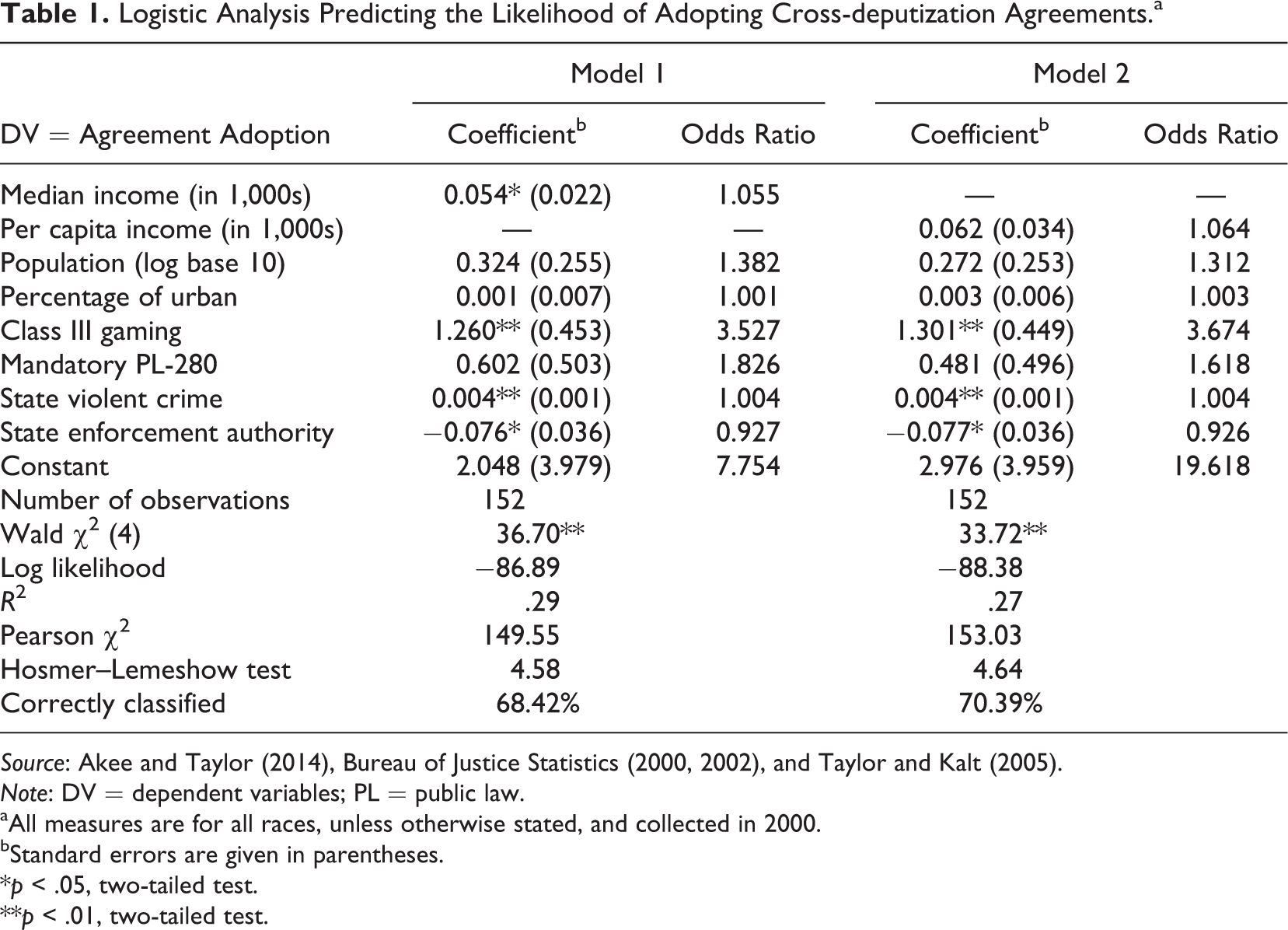
Table 1 summarizes the results of the logistic regression model predicting the likelihood of adopting a cooperative agreement between tribal and nontribal actors. The first model investigates how the likelihood of adoption is impact by several factors including tribal median household income, population size, state violent crime rates, state enforcement authority, class III gaming, and whether the tribe is in a PL-280 state. Overall, the model fit is relatively modest with 29 percent of the variation in adoption explained by the independent variables included in the analysis and more than 68 percent of all tribes correctly classified based on the specified model. 3
Logistic Analysis Predicting the Likelihood of Adopting Cross-deputization Agreements.a
Source: Akee and Taylor (2014), Bureau of Justice Statistics (2000, 2002), and Taylor and Kalt (2005).
Note: DV = dependent variables; PL = public law.
aAll measures are for all races, unless otherwise stated, and collected in 2000.
bStandard errors are given in parentheses.
*p < .05, two-tailed test.
**p < .01, two-tailed test.
As shown in Table 1, there is a positive and significant relationship between median household income and the adoption of an intergovernmental agreement holding all other variables constant. Surprisingly, population and the percentage of residents living in an urban area is not significant at the conventional .05 level, although the direction is consistent with observations in the earlier portion of the analysis. Perhaps more interesting is the impact of Indian gaming on the presence of cooperative tribal–local agreements. Tribes with Indian gaming casinos have a significantly higher likelihood of adopting cross-jurisdictional agreements with non-Indian communities than their nongaming counterparts in Indian country. This supports much of the Indian gaming literature that has noted some of the social costs associated with opening a casino on tribal land, which include increases in potential criminal behavior, substance abuse, and addiction that may warrant cooperative agreements with local law enforcement agencies (Mays, Casillas, and Maupin 2006; Light and Rand 2005; Mays and Taggart 2005; Thompson 2005; Grinols 2004). Finally, whether or not a tribe is in a PL-280 state does not appear to have a significant impact on increasing or decreasing the likelihood of adopting a cross-deputization agreement with non-Indian law enforcement in model 1.
Nontribal characteristics also have an important impact on the likelihood of adopting a cross-deputization agreement. According to Table 1, there is a positive and significant relationship between violent crime rates in a state and the presence of cross-deputization agreements. State law enforcement authority also has a significant impact on the adoption of intergovernmental agreements with a decrease in the log-odds of adoption by .08 for every one unit increase in the proportion of law enforcement personnel with general arrest powers. The results of the logit models offer additional support for the importance of both tribal and nontribal factors observed earlier in the analysis. Most of these relationships persist in model 2 that uses an alternate measure for socioeconomic condition based on tribal per capita income. Overall, socioeconomic factors including gaming status, problem severity, and law enforcement authority in the surrounding state would appear to have the most profound impact on the adoption of a cross-deputization agreement.
Discussion and Areas of Future Research
This investigation examines how problem severity, resource capacity, and enforcement authority influence the adoption of cooperative agreements between tribal and nontribal actors. The results suggest that tribes with agreements tend to have higher incomes as well as lower rates of poverty and unemployment than tribes without collaborative arrangements. This would suggest that financial health and economic well-being are important factors that allow Indian nations to invest time and resources in building meaningful partnerships with surrounding non-Indian communities on law enforcement issues. A greater share of intergovernmental agreements are also found in states with higher violent crime rates and lower levels of overall state law enforcement authority, suggesting a greater need for partnerships with tribal law enforcement. Such challenges, and the expected benefits derived from collaboration, appear to override the political costs associated with intergovernmental partnerships with tribal governments that have defined decades of conflict between tribal and nontribal actors. Many of these trends are also reflected at the local level, where counties with active cross-deputization agreements tend to have higher rates of poverty and lower levels of both law enforcement authority and capacity within their communities compared to nondeputized counties. As a result, tribal governments may be providing a vital law enforcement service to such communities which lack the individual capacity to do so on their own.
Furthermore, the results demonstrate that tribes with class III gaming also have a higher likelihood of adopting cross-deputization agreements with local law enforcement, supporting many observations in the Indian gaming literature on how the social costs of gaming can necessitate greater cross-jurisdictional cooperation (Mays, Casillas, and Maupin 2006; Light and Rand 2005; Mays and Taggart 2005). Such challenges might necessitate a greater need for cooperation among tribal and nontribal law enforcement agencies in the interest of public safety as documented in several cases. It could also be the case that revenue from class III gaming operations are being used to subsidize tribal and nontribal law enforcement efforts as well based on the reported positive impact of Indian gaming in improving reservation conditions (Conner and Taggart 2009). Finally, the results provide little to no evidence that PL-280 states have a negative impact on the adoption of intergovernmental agreements in light of more important factors in the models outlined above. Understanding the differential impact of these factors increases general understanding of voluntary intergovernmental partnerships in important ways.
However, there are several limitations in the analysis that shed light on much needed future research. Perhaps the most valuable information that is missing concerns the year a tribe adopted a cross-deputization agreement with state and local law enforcement agencies. Such information would allow researchers to isolate the impact of these agreements using longitudinal data, as some local law enforcement have been deputized since the 1980s. The current analysis is only able to demonstrate that a nation did or did not have an agreement as of 2002. Knowing when tribal and nontribal law enforcement entered into agreements could help add a level of rigor to the analysis that is currently missing. Another area of future research concerns a deeper investigation of county-level differences that drive the adoption of cross-jurisdictional agreements. The present analysis only scratches the surface of understanding general differences between counties that do and do not agree to voluntary intergovernmental cooperation based primarily on social, economic, and local law enforcement factors.
Lastly, future research should not only explore why tribal and nontribal actors enter into collaborative agreements but also, more importantly, whether such agreements are leading to desirable outcomes for native and non-native communities. As tribes continue to expand their economies and establish tribally owned businesses that invite more visitors to tribal land, the need for greater resources and increased law enforcement capacity will be a high priority. Exploring whether these agreements are leading to a more efficient and effective criminal justice system is a crucial area of future research that is currently underdeveloped. Matching information on adoption with statistics on criminal activity would allow researchers to evaluate the effectiveness of these agreements that are argued to benefit both tribal and neighboring nontribal communities. With these limitations noted, the present investigation demonstrates how problem severity, socioeconomic condition, and capacity influence the adoption of voluntary cooperative agreements.
Footnotes
Authors’ Note
This article was also presented at the 2014 Pacific Northwest Political Science Association conference in Portland, OR, where we received invaluable feedback. The first author will share all data upon request.
Acknowledgments
The authors would like to thank the anonymous reviewers and editorial staff of the journal for their very helpful contributions to improving this article.
Declaration of Conflicting Interests
The author(s) declared no potential conflicts of interest with respect to the research, authorship, and/or publication of this article.
Funding
The author(s) received no financial support for the research, authorship, and/or publication of this article.
Notes

References
Supplementary Material
Please find the following supplemental material available below.
For Open Access articles published under a Creative Commons License, all supplemental material carries the same license as the article it is associated with.
For non-Open Access articles published, all supplemental material carries a non-exclusive license, and permission requests for re-use of supplemental material or any part of supplemental material shall be sent directly to the copyright owner as specified in the copyright notice associated with the article.
