




Abstract
Large, urban governments often provide a tremendous variety of public goods, while the expenditures of small communities usually address basic needs such as fire protection and road maintenance. However, certain small local governments dedicate significant public resources to recreation, culture, and public health services, among others. This research examines the variation in services provided by these smaller, often overlooked governments. Differences are explained, at least partially, by various community characteristics, location, and capacity. For the millions of people who reside in these communities, the findings illustrate why variations exist and what, potentially, can be done to alter expenditure levels.
Local governments provide many of the services citizens encounter on a daily basis. However, the number and array of services are not consistent across communities. The most obvious explanation for these differences involves the size of a community. The expenditures of large, urban governments, for example, generally are used to provide a wide array of public goods that includes police and fire protection, street maintenance, sewer and water infrastructure, health and human services, and a host of recreation and cultural amenities. In contrast, the expenditures of smaller, typically rural communities often are associated with basic needs such as fire protection and road maintenance (Folz and French 2005; Maher and Johnson 2008).
Explaining variations in the provision of public goods is not as simple as this discussion implies, however. Large urban communities, despite having the population base and property values needed to support a robust mix of public goods, often are challenged to provide even basic levels of service. At the same time, certain smaller and more rural communities have dedicated significant public resources to cultural institutions, social services, sanitation, parks, recreational facilities, and beautification programs. In fact, many small communities now provide services that generally mirror those of larger municipalities in metropolitan areas (Diaz and Green 2001; Maher and Johnson 2008).
Efforts to explain these differences and trends have been extensive. From the competition incentives discussed by Tiebout (1956) and other public choice scholars to more recent examinations of diversity (Rugh and Trounstine 2011) and segregation (Trounstine 2016), a large number of explanations have been developed, examined, and reexamined. In most instances, the focus has been on large and midsize cities. In contrast, much less attention has been given to the services provided by smaller communities (but see Folz and Abdelrazek 2009; Folz and French 2005).
This research gap is even more pronounced when town governments are considered, particularly those that continue to use town meetings. This structure provides residents with the ability to directly influence revenues, expenditures, and public policy more broadly—a level of direct democracy no longer present in other local government structures. Expenditures should, therefore, closely reflect the desires of the citizens in these communities (DeSantis and Hill 2004; Maher and Johnson 2008). As a result, this research asks why the expenditures of certain town governments are primarily dedicated to a small number of services while the expenditures of others are more evenly divided among a much more diverse collection.
The following sections summarize existing, related research and explain the data collection process, research method, and analysis. This article concludes with a presentation of the results and a discussion of implications for both academics and practitioners. Although the results complement existing academic research, they also should be useful to those who currently manage and reside in the types of communities under consideration here.
Local Public Expenditures
For nearly a century, scholars have considered Key’s (1940) often quoted question, “on what basis shall it be decided to allocate x dollars to activity A instead of activity B?” (p. 1138). Potential answers have varied widely. For some observers, the provision of public goods is the result of competition among local governments. Since residents have the ability to move “to that community whose local government best satisfies his set of preferences” (Tiebout 1956, 418), a local government will alter the quantity and quality of the services it provides in order to attract new residents and businesses as other nearby communities attempt to do the same.
For others, government institutions and structure were thought to be related to expenditures, though results have been mixed. The impact of certain tools of direct democracy (i.e., initiatives, referendum, recall, and the citizen committee) on public spending for specific services appears to be limited (Gabrini 2010), and large institutional changes (i.e., city–county consolidations) generally are not related to overall public expenditures (Faulk and Grassmueck 2012). In contrast, the presence of mayoral terms limits reduces expenditures on certain distributive and allocative spending categories, particularly highway and road spending (McGlynn and Sylvester 2010).
The characteristics of community populations have produced more consistent results. Cities that are more diverse, for example, tend to spend less on public goods (Alesina, Baqir, and Easterly 1999; Rugh and Trounstine 2011), while a similar trend appears in cities that are in the process of diversifying (Hopkins 2009). In fact, “in a variety of settings, ethnic and racial diversity seems to dampen communities’ willingness to make large-scale public investments” (Hopkins 2009, 160). Racial segregation, in particular, has been shown to play a distinct role even beyond the impact of diversity (Trounstine 2016). At the same time, cities that become more democratic tend to spend more on a wide variety of programs and services (Einstein and Kogan 2016), though this relationship may be contingent on specific services and the degree to which cities are constrained by other levels of governments (Gerber and Hopkins 2011).
While this discussion does not fully address all of the potential explanations for variations in public expenditures, it is clear they can range from market-based conditions to institutions and partisan preferences. When taken together, the overall picture remains muddled. As Rugh and Trounstine (2011) have noted, “it continues to be the case that cities vary in their ability to provide their residents with an adequate supply of public goods. Explaining why some cities provide ample public goods and others come up short remains an important task” (p. 1049). This is particularly the case for smaller communities and towns that largely have been disregarded by existing scholarship.
Small Communities
The number of people who reside in small communities and rural areas is modest when compared to larger local governments. Nonetheless, nearly 60 million people across the United States lived in rural areas in 2010 (U.S. Census Bureau, 2010), and more than one-third of the nation’s urban population lived in communities with a population of less than 25,000 in 2003 (Folz and French 2005). Furthermore, the problems and citizen concerns in these communities often are similar to those in larger communities and the constraints are equally challenging. “With very limited budgets and staff, small town officials are expected to provide basic services that protect and advance residents’ health, safety, and welfare and also to do ‘something’ to mitigate the panoply of negative forces that may threaten community sustainability” (Folz and French 2005, 1). Depending on the locality, these forces have included rapid population growth or decline, reductions in state financial support, resistance to increasing revenues via tax increases or new fees, and additional service demands (Mohr, Deller, and Halstead 2010). As a result, the services and programs provided by these communities are no less relevant or impactful than those provided to citizens of much larger, urban areas (Browne and Reid 1990).
Unfortunately, existing research that has directly addressed small governments and rural communities is relatively limited, though there have been some exceptions. Rivenbark and Kelly (2003), for example, examine performance management in municipalities with a minimum population of 2,500. Similarly, Ward (1992) explores privatization in communities with populations less than 50,000 and Mohr, Deller, and Halstead (2010) examine service delivery methods among similar sized communities. Communities in Ohio and Mississippi are the focus of the former, while those in Illinois, New Hampshire, and Wisconsin are addressed by the latter.
Folz and French (2005) provide one of the most comprehensive examinations of small communities. The authors discuss the importance of these communities and explore executive leadership, decision-making, service quality, and performance. Folz and Abdelrazk (2009) continue this research by explaining variations in service quality and Eskridge and French (2011) use the adapted cities classification scheme to specifically focus on the impact of government form on expenditures. All three studies examine communities with a population between 2,500 and approximately 25,000. Although the focus of this research is on communities with a town form of government, none of the towns included here have a population that exceeds 21,000.
Town Governance
While existing studies address the basic management and fiscal practices of small communities to some degree, they generally do not distinguish among government structures (but see Diaz and Green 2001). A city or village designation, for example, indicates governance through an elected, representative body such as a village board or city council. A town form of government, in contrast, largely is directed by an annual town meeting during which “citizens gather to vote on the annual budget, proposed tax levy, policy pursuits, and other government business” (Carroll and Johnson 2010, 226). Commonly described as the purest form of direct democracy, this structure allows citizens to “maintain direct control over government affairs and actively participate in self-governance” (Carroll and Johnson 2010, 226), despite low participation rates at times (DeSantis and Hill 2004). However, towns in certain states are limited to only those powers granted by the state, and town land is susceptible to annexation from neighboring cities or villages (Diaz and Green 2001). This unique form of government, coupled with additional restrictions in some states, means towns should be examined as unique cases when their management and financial practices are considered.
While research on towns has been limited, there are several exceptions. DeSantis and Hill (2004), for instance, examine citizen participation in Massachusetts town meetings, while Johnson and Ihrke (2004) examine determinants of conflict on Wisconsin town boards. Regarding financial conditions, Diaz and Green (2001) find important distinctions between towns and other government types when examining the relationship between fiscal stress and growth management efforts. Similarly, Carroll and Johnson (2010) conclude town governments have less diversified revenue structures than those in municipalities and states. Finally, Maher and Johnson (2008) examine the revenue structures of towns and the degree to which they are altered for political advantage. In doing so, the authors find that while certain towns now provide services like those of larger communities, road maintenance and fire protection continue to be principle expenditures. Explanations for this variation are not considered, however.
Data and Method
Data from towns located in Wisconsin are used for this assessment. Although an examination of local governments in a single state has the potential to limit the generalizability of the results to some degree, such a strategy helps mitigate the impact of state-level factors endemic to a multistate assessment. This is particularly important for town forms of government because of the variations in authority granted to towns by their states (Carroll and Johnson 2010). It also complements previous research that has addressed Wisconsin towns explicitly (Diaz and Green 2001; Johnson and Ihrke 2004; Maher and Johnson 2008).
Town Expenditures
In Wisconsin, towns are considered units of government that consist of areas not incorporated as cities or villages. A town board of three or five officials is elected to supervise the daily operations of the community. 1 Larger policy and financial decisions, however, generally are directed by the annual town meeting of qualified voters or broader state restrictions (Carroll and Johnson 2010). In contrast to the “home rule” powers granted to cities and villages in Wisconsin, towns are limited to only those powers granted by the state which, at their most fundamental, include the ability to levy taxes, take on debt, own property, enter into contracts, and provide basic services (Diaz and Green 2001). While the boundaries of many towns have remained the same since they were initially established, others have changed as a result of annexations and incorporation. As a result, towns in Wisconsin “are constrained in ways that are very different from other municipalities” (Johnson and Ihrke 2004, 105). Nonetheless, there currently are 1,255 towns in Wisconsin, with a total population of approximately 1.7 million—nearly 30 percent of the state’s population.
All local governments in the state are required to complete an annual Municipal Financial Report Form and submit it to the state Department of Revenue. Communities detail their revenues and expenditures, which are then combined into broad categories for reporting purposes. The expenditure categories range from law enforcement, fire protection, and highway construction to health and human services, culture and education, and parks and recreation. In total, the data represent the entirety of a community’s expenditures.
Using 2013 data, Table 1 includes a list of ten primary expenditure categories, the mean expenditures towns dedicate to each, and expenditures expressed as a percentage of total operating and capital expenditures. 2 For example, on average, Wisconsin towns spend slightly less than US$300,000 on road construction and maintenance, which represents nearly 60 percent of their total budgets. The final column in Table 1 includes the percentage of towns that dedicate any money to services included in each category. As previous research suggests (Maher and Johnson 2008), towns spend significant resources on general government administration, fire and rescue, and road construction and maintenance. In some communities, more than 90 percent of expenditures are dedicated to roads and highways alone. In contrast, less than 20 percent of towns dedicate resources to culture and education. However, certain towns dedicate over one-third of their budgets to services such as law enforcement, culture, parks and recreation, or conservation and development.
Wisconsin Town Expenditures (Fiscal Year 2013).
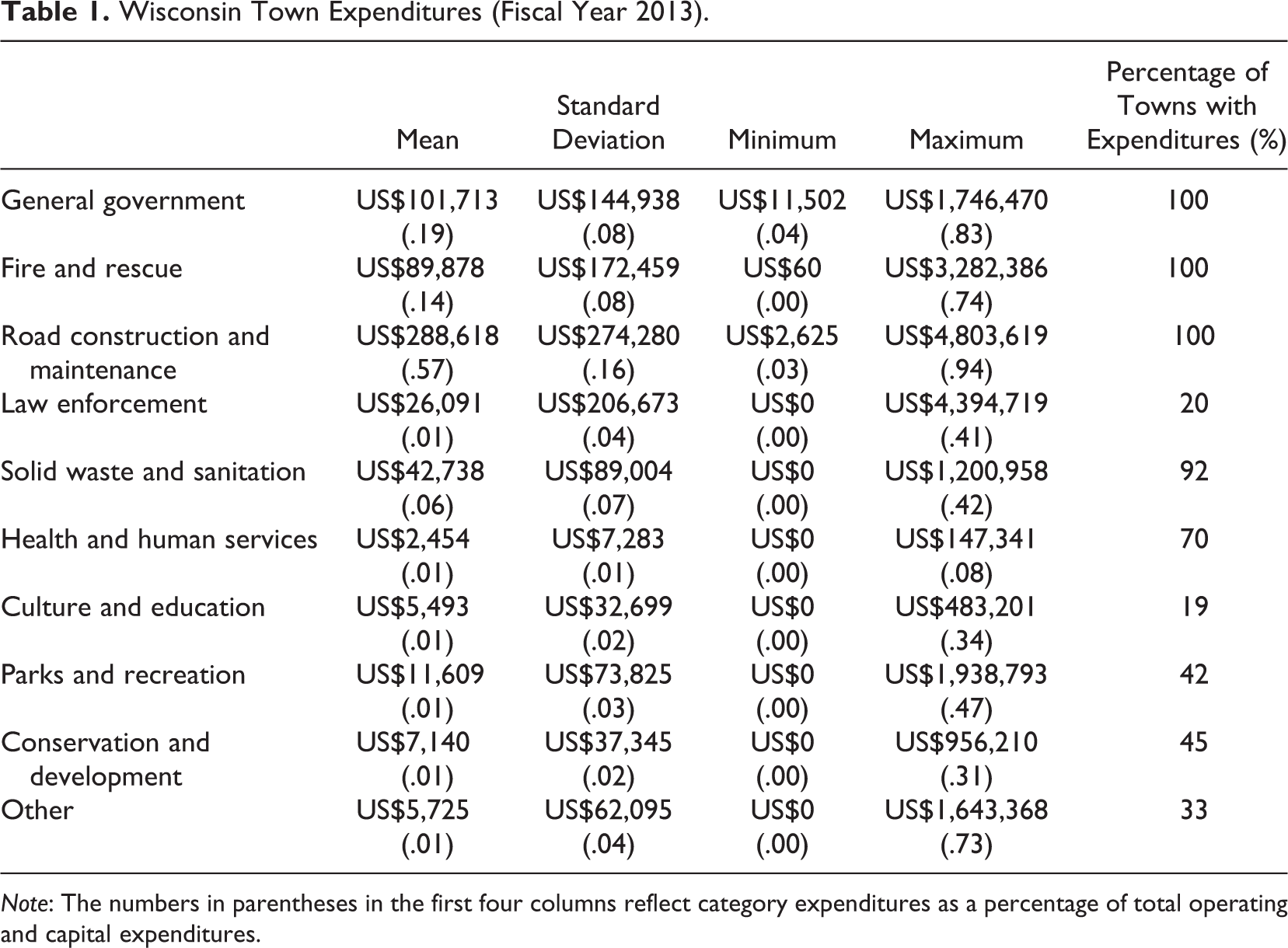
Note: The numbers in parentheses in the first four columns reflect category expenditures as a percentage of total operating and capital expenditures.
While these trends support existing assessments of towns, expenditures are much more nuanced than what has been portrayed by previous analyses. To determine why this variation exists, the Hirschman–Herfindahl index (HHI) is used to develop a measure of expenditure diversity. The index has been used to extensively examine revenue diversification among local governments and states (Carroll 2009; Carroll, Eger, and Marlowe 2003; Hendrick 2002; Suyderhoud 1994), while Carroll and Johson (2010) examine town governments specifically. The HHI produces a score that ranges from 0 to 1. A score that approaches 1 indicates greater levels of diversification, while a score closer to 0 indicates less. 3 Using the ten expenditure categories, the mean HHI score for Wisconsin town expenditures is .63. The minimum score is .14 and the maximum is .94. In comparison, the mean HHI scores for city and village expenditures in Wisconsin both exceed .90. The dependent variable for the model developed below consists of the town expenditure HHI scores.
Explaining Variation
To explain variations in town expenditures, this research draws on the limited scholarship that examines towns and small communities as well as related research that addresses public expenditures and management more broadly. It is important to note that the dependent variable used here—diversity of expenditures—differs from the magnitude of expenditures often used in existing research. Nonetheless, this approach should provide an initial framework on which to build going forward. It should also permit the assessment of existing conclusions specific to town governance as well as those that address much larger urban areas. There is little question, for example, that a city of more than 1 million residents provides a larger and more diverse collection of services than a small town. Larger communities also are more willing to support bond initiatives that have the potential to allow for new or additional services (Rugh and Trounstine 2011). Does this trend continue, however, when the focus is limited to only small, largely rural communities? To better understand this relationship, the natural log of town population is examined. Towns with larger populations should be more likely to dedicate a larger share of their resources to a wider array of services.
A variable is included to capture population density as well. Density has been hypothesized to correlate with the provision of a range of municipal service categories that include growth management (Diaz and Green 2001) and e-government (Cassell and Mullaly 2012). Similar to population size, a more compact population should be related to the provision of a wider array of services. Population data were obtained from the 2010 U.S. Census, and density is the product of a town’s population divided by its land area in square miles.
The proximity of a town to a larger, urban area also has the potential to impact its financial conditions and, likely, the services it provides. As Maher and Johnson (2008) note, “urban towns generally offer a larger number of services, similar to cities and villages, than do rural towns. Moreover, urban towns tend to spend their money differently than rural towns. For example, urban towns spend larger amounts on public safety and less on road maintenance” (p. 1524). As such, towns were coded to indicate a location within a metropolitan statistical area, which is expected to be correlated with more diverse expenditures.
The characteristics of county governments are considered as well, as towns may not feel obligated to provide certain services if their counties already provide them. County governments, for example, often own and manage parks located within a town while the sheriff’s office will patrol town roads. Given this scenario, towns would not need to provide parks or law enforcement services directly (Mohr, Deller, and Halstead 2010). To account for this possibility, HHI scores were constructed for every Wisconsin county using the same service categories used to construct the town scores. Towns located in counties that provide a diverse array of services should provide fewer services and, instead, focus on two or three core services such as road maintenance and fire protection.
Per capita property valuation of a community also has been used to examine town financial conditions. In particular, Maher and Johnson (2008) use the variable in their assessment of town revenue structures. In this case, per capita equalized property valuation is similarly used as a measure of economic conditions. However, rather than its impact on revenue, higher property values should be indicative of a greater capacity to provide a wider array of services. Data from the Wisconsin Department of Revenue were used to construct this variable.
The presence of a professional administrator and its impact on expenditures (Nunn 1996), innovation (Nelson and Svara 2012), policy adoption (Moon 2002), and many other aspects of public management has been the focus of significant discussion. While a complete review of this literature is not feasible here, it nonetheless reinforces the potential differences among communities that employ a public manager and those that do not. The relationship between the presence of a public manager and expenditures has been mixed, however, as some research has uncovered relationships (Nunn 1996), while other more nuanced assessments have been less supportive (Carr and Karuppusamy 2010). As a result, a distinction is made between towns that are managed by a professional administrator and those that rely solely on the town board. 4
The importance of various community characteristics such as age, race, ideology, and education to existing studies supports their inclusion here as well. For example, the median age of a community is highly correlated with attendance at town meetings, with older residents participating at much higher rates (DeSantis and Hill 2004). This means the opinions of this demographic should be well represented in policy and budgetary decisions. Consequently, age is included in this analysis, though limitations in current literature do not permit the development of a directional hypothesis. Median age was obtained from the U.S. Census.
Literature on race is somewhat more robust. Johnson and Ihrke (2004) find town boards with higher levels of racial diversity are also characterized by higher levels of conflict and are therefore less effective. Large, diverse cities (Alesina, Baqir, and Easterly 1999; Rugh and Trounstine 2011), or cities in the process of diversifying (Hopkins 2009), tend to spend less on public goods. As a result, a measure of racial diversity is included here. Because of the generally homogenous nature of town populations, however, the measure consists of the percentage of white residents within a town. As the percentage decreases, expenditure diversity is expected to decrease as well. Education also has the potential to play a role, as citizens with higher levels may be more aware of the need for additional investments in public services when compared to those with less (Rugh and Trounstine 2011). To account for this possibility, the percentage of town residents with a bachelor’s degree is examined. Data from the U.S. Census were utilized to construct the race and education variables.
Finally, similar to race, research on the connection between partisan preferences and the provision of public goods has been robust. Einstein and Kogan (2016), for example, find “as cities become more Democratic, they spend more on service provision across a broad array of programs” (p. 22), though intergovernmental constraints may substantially limit this relationship (Gerber and Hopkins 2011). To examine the relationship within small communities, a variable is included to account for the partisan preferences of town residents. The percentage of town residents that selected the Barack Obama/Joe Biden ticket in the 2012 presidential election is included as a measure of partisan preferences. A larger Democratic vote share is expected to correlate with a larger number of more robust services.
Results
Table 2 displays the results of a model in which the ten independent variables discussed above are used to predict the diversity of town operating and capital expenditures. Given the continuous nature of the dependent variable, the model is estimated using ordinary least squares regression. An assessment of the variance inflation factors (VIFs) did not reveal problems, as none of the VIF scores exceeded 2.0. However, diagnostics indicated the presence of heteroscedasticity. As such, robust standard errors are reported. 5
Ordinary Least Squares Regression Model Town Expenditure HHI.
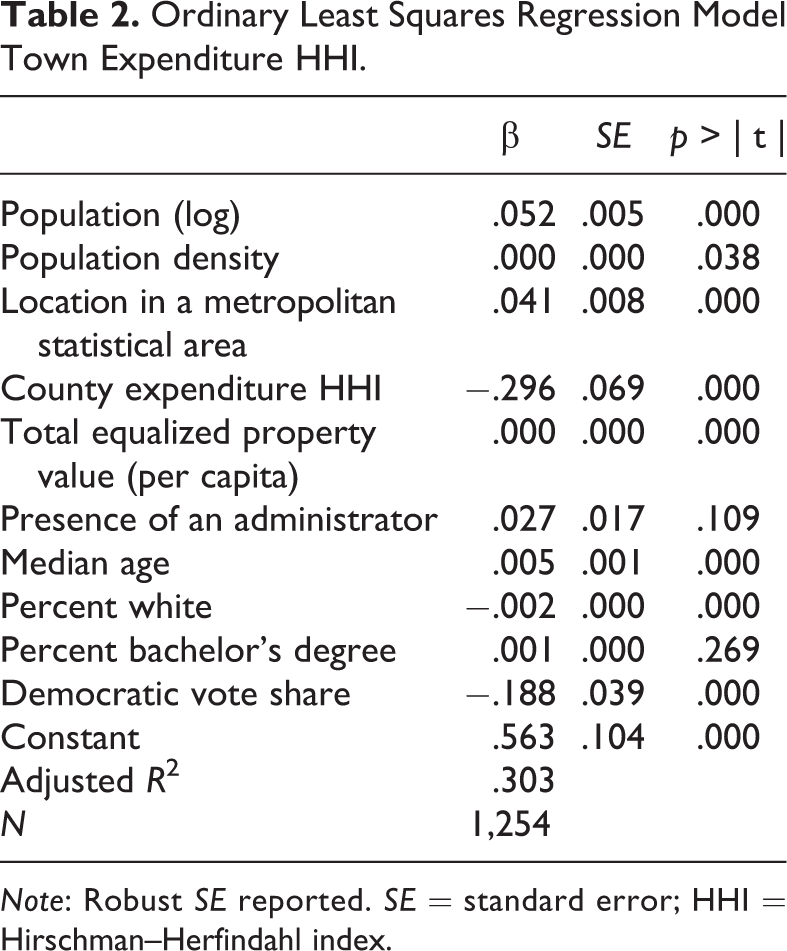
Note: Robust SE reported. SE = standard error; HHI = Hirschman–Herfindahl index.
Overall, the model fits the data reasonably well. Approximately 30 percent of the variation in the dependent variable is explained by the included independent variables, 8 percent of which obtain statistical significance. The impact of both population and population density is significant and positively related to the diversity of town expenditures. Put simply, larger towns with greater densities are more likely to divide public resources more equally among a wider array of services when compared to smaller, less dense towns. Proximity to urban areas and the degree to which a town’s county provides a diverse collection of services are significant as well. Towns located near urban areas provide a wider array of services when compared to those that are not. This was expected, given the importance of urban areas to certain town revenues (Maher and Johnson 2008). The diversity of county expenditures also performed as expected. Towns provide a less robust mix of services when located in counties with a greater diversity of expenditures. Total equalized property value per capita, included as a measure of economic condition and fiscal capacity, is significant and positively related to the dependent variable. As property values increase, towns provide a wider array of services. Again, this variable performed as predicted.
Three characteristics of a town’s citizens are significantly related to the variety of its expenditures. Towns with older populations provide a wider array of public services. In addition to participating in town meetings at much higher rates than their younger counterparts (DeSantis and Hill 2004), it appears older residents prefer a more robust collection of services. Racial composition, measured as the percentage of white residents within a town, is negatively related to expenditures. In contrast to existing research, towns with lower percentages of white residents tend to provide more services than those communities with higher percentages. Finally, democratic vote share also is significant and negatively related to the dependent variable. Again, contrary to expectations, towns with Democratic partisan preferences tend to provide a less diverse collection of services to residents. Given the inconclusive nature of previous research, however, this result should not be entirely surprising.
It should be noted that including capital expenditures with operating expenditures in the dependent variable could be problematic, as large variations in capital expenditures can occur across different years. The purchase of new playground equipment for a town park, for example, would significantly increase expenditures on parks and recreation for one year. The expenditures would then be reduced to “normal” levels for subsequent years. Expenditure categories such as fire protection, road maintenance, and law enforcement are vulnerable to similar changes. These punctuations have the potential to impact the proportion of town expenditures dedicated to specific service categories each year. Unfortunately, capital expenditures cannot be separated from operating expenditures using the existing data. To check the robustness of the 2013 data and the subsequent results, expenditures from three years (2012–2014) were averaged to smooth, at least partially, large one-year expenditure increases as a result of capital purchases. Another diversity index was then created using the three-year average. When this dependent variable was used in place of the single year data, the model fit improved slightly (R 2 = .3603) and there were no notable changes to the significance or direction of the independent variables.
Discussion
Overall, the model performed quite well and generally as expected. Towns that provide a greater diversity of services include those with a higher population, greater density, a nearby metropolitan area, a location in a county with less diverse service offerings, robust property values, and a somewhat older population. In some ways, this suggests variables related to the provision of public services within large, urban governments—population, for example—are similar to those that correlate with the expenditures of small, often rural governments. This is particularly interesting because of the unique governance opportunities available to town residents. Essentially, influential variables remain significant even with greater opportunities for direct, citizen involvement in the process. At the same time, this research extends and, in a number of instances, corroborates existing research on the provision of public goods in small communities and towns. The notable differences between urban and rural towns, for example, are directly addressed by Maher and Johnson (2008) in their assessment of town revenue structures.
There are several null and unexpected results that warrant additional attention, however. With regard to the former, the presence of a professional administrator did not reach statistical significance, though it was very close (p = .109). Given the generally mixed assessment of the impact of administrators on a wide variety of public management outcomes, this probably should not be surprising. No evidence, for example, was found to connect city structure to per capita expenditures (Carr and Karuppusamy 2010). Nonetheless, it should be noted that only a small percentage of Wisconsin towns employ a professional administrator. As this percentage increases, it is likely that the relationship with town expenditures will become clearer.
The most unanticipated results were those associated with the racial composition and partisan preferences of town residents. Previous studies of public expenditures have repeatedly highlighted the negative relationship between diversity and the provision of public goods (Alesina, Baqir, and Easterly 1999; Hopkins 2009; Rugh and Trounstine 2011). In this case, the array of public services provided by towns increased as the percentage of white residents decreased. One explanation likely involves the very limited racial diversity present in Wisconsin towns, as the mean percentage of white residents was approximately 96 percent. There simply may not be enough diversity to impact expenditures to the degree that appears within other larger and more diverse communities.
Similarly, partisan preferences did not perform as expected. A less diverse collection of public goods is provided in towns with more Democratic partisan preferences. Given the low population in some towns, however, a small number of voters in favor of one particular candidate have the potential to greatly impact a town’s aggregate partisanship. Because the diversity of services is also relatively small in some towns, the impact of ideology on expenditures may be less pronounced or fundamentally different. Partisan preferences, similar to racial diversity, illustrate the challenges of directly transferring conclusions developed from studies of larger cities to smaller, often rural towns.
For the managers and residents of these towns, there are implications as well. First, similar to larger, more urban areas, there is significant variation in the amount and variety of services available to residents of small communities. Consistent with common stereotypes, individuals have the opportunity to live in rural areas with only the most basic services. Yet, this does not have to be the case. Small communities in relatively urban areas that provide public safety, parks, recreational opportunities, and cultural institutions are also available. Furthermore, as long as residents reside in a town, the outsized opportunity to directly influence the allocation of public expenditures remains the same.
For citizens, elected officials, or public managers who would like to expand the variety of services in their communities, the results illustrate, to some extent, which communities would view an expansion more favorably. Stated another way, those who desire additional services may be more successful in certain towns when compared to others. Unfortunately, town characteristics cannot be easily changed within a short period of time to make a community more favorable. Barring unique circumstances, a town’s population, density, property value, and demographics likely would not change drastically within a few months or even a few years. Nevertheless, residents have the ability to make their case for either a more or less diverse collection of services at the annual town meeting in a way that is much more direct than their counterparts in villages and cities. When coupled with favorable town characteristics, changes to public expenditures may be more likely.
Conclusion
The expenditures of local governments, more than any other level of government, have the largest and most consistent impact on the daily lives of citizens. From police protection and road maintenance to recreational opportunities and the availability of street light and sidewalks, the impact of local government expenditures is significant. However, this does not mean all governments provide the same amount or variety of services. In fact, variation can be substantial. The problem, however, is that very little research has addressed the provision of public good within small communities, particularly those that utilize the town meeting form of government—the purest form of direct democracy. Despite their size, these communities, “face challenges and changes every bit as serious and daunting as those that confront their larger counterparts but that typically receive more publicity. Small size does not necessarily mean that problems are small scale” (Folz and French 2005, 1).
Results indicate population certainly contributes to these differences, though density, proximity to an urban area, county expenditures, fiscal capacity, and age are also important characteristics. Racial composition and partisan preferences are important as well, but their relationship with expenditures warrants greater exploration. While providing additional clarity to the financial trends and conditions of local governments, particularly small, generally rural towns, this research also adds to a continuously growing public expenditures literature.
Future research should consider several limitations to this study that will require additional efforts to address. First, this research focuses exclusively on Wisconsin towns. While this mitigates the impact of state-level factors, generalizability is problematic. The authority and expectations given to towns by their states, for example, can vary significantly. As a result, caution must be used when applying the conclusions developed here to towns in other states. However, this does not constrain the implications entirely. Existing town research largely takes a similar approach, examining single states (DeSantis and Hill 2004; Diaz and Green 2001; Johnson and Ihrke 2004; Maher and Johnson 2008; Mohr, Deller, and Halstead 2010) or small collections of states (Carroll and Johnson 2010).
Second, the role of partisan preferences, racial composition, and professional administrators should be examined specifically, and in more detail, in the context of towns and small communities. Given their impact on expenditures in larger governments, it is important to determine if the relationships hold across communities of different sizes. This is complicated to a degree by the somewhat limited variation exhibited by these characteristics, particularly racial composition and the use of professional managers, in small communities. A case study or mixed methods approach might provide additional helpful insights.
Finally, there is an implicit assumption that opportunities to participate in a very direct, democratic form of governance allows residents to receive services that closely match their preferences. This relationship is not addressed here. Subsequent research should examine the collection of services provided by towns and the preferences of town residents. In short, is the unique town meeting style of governance a useful mechanism to ensure policy responsiveness, or are expenditures largely determined by a small group of town officials, similar to other forms of government? Answers to this question in particular could have important consequences for both towns and other forms of government. Given the central role of public expenditures in the daily lives of citizens and the continued importance of small-town America, the need to fill each of these research gaps remains.
Footnotes
Declaration of Conflicting Interests
The authors declared no potential conflicts of interest with respect to the research, authorship, and/or publication of this article.
Funding
The authors received no financial support for the research, authorship, and/or publication of this article.