



Abstract
Conventional wisdom holds that municipal politics is nonideological. Recent scholarship challenges this perspective, finding representation on a liberal–conservative dimension in municipal politics. This article re-evaluates these findings using a set of questions that includes questions on land use. Evidence is shown for a multidimensional municipal ideological space with a liberal–conservative dimension and another dimension that corresponds to citizens’ preferences for balancing community needs with individual rights on land use. The results support a characterization of municipal politics as being ideological but also show that a single liberal–conservative dimension is inadequate for characterizing the municipal ideological space.
Keywords
Conventional wisdom views municipal politics as nonideological, with local government issues tending to be idiosyncratic and specific to circumstances faced a particular city at a particular time. Issues that arise are generally taken to be nonpartisan in nature, consistent with the quip apocryphally attributed to former New York Mayor Fiorello LaGuardia, “There is no Democratic or Republican way to fill a pothole.”
This received wisdom suggests that there is no ideological spectrum of attitudes about local government action and that issues are simply addressed by (hopefully) wise public servants selected by their peers in local elections. Indeed, proponents of the Progressive Movement were motivated by this type of belief when pushing for nonpartisan municipal elections around the turn of the twentieth century.
Citizens typically seek service provision of water, sewer, garbage, fire protection, and police service from municipal government. On one level, the efficient provision of these services might seem to be nonideological. However, varying levels of demand for services (and perhaps disputes over the prioritization of various services) could correlate with a systematic ideology of local service provision (consider Ferreira and Gyuorko [2009] and De Benedictis-Kessner and Warshaw [2016]). But more than simple service provision, city councils spend a substantial amount of their time and effort on matters of land use, making decisions about what types of buildings and what types of activities are to be permissible in various areas of their city (Lewis and Neimann 2002; Lubell, Feiock, and de la Cruz 2009; Simmons 2012). It is not self-evident whether land-use issues are one-time matters specific to a particular time and place or if they may map onto some underlying ideology of land use.
This research examines whether there are ideological factors that affect citizens’ policy preferences in local government. To determine whether such ideological structure exists and whether it maps onto the national liberal–conservative ideological spectrum, a novel national survey is used. Application of a factor analysis allows us to search for ideological structure among respondents and to determine the influences of various variables on the resulting scores on the dimension or dimensions that are recovered from the factor analysis.
Ideology and the Business of Municipalities
Increased polarization among elites (McCarty, Poole, and Rosenthal 2006) and better sorting into parties on the basis of ideology (Levendusky 2009) have led to the pronounced influence of a liberal–conservative ideology in American politics at the national level, particularly among individuals most engaged in politics (Jewitt and Goren 2016). Considerable evidence supports the notion that left–right ideology is very influential at the state level as well (e.g., Erikson, Wright, and McIver 1994). The extent to which municipal politics can appropriately be placed on the same liberal–conservative spectrum is less clear. Cities engage in a wide range of activities, many of which may not map easily onto conventional national political ideologies. Many cities focus the bulk of their efforts on service provision, such as water, sewer, garbage, and public safety services. Where such services are truly controlled by municipal policymakers (such as public safety services), a mayor’s partisanship predicts city policy outputs well, with Republican mayors spending more on public safety services than their Democratic counterparts (Gerber and Hopkins 2011). Tausanovitch and Warshaw (2013, 2014) develop a set of questions about municipal policy (e.g., cities striving to reduce greenhouse gasses, subsidizing transit and housing, and cutting municipal services to save money) and find that it generally corresponds to a national left–right spectrum, and that such representation is generally not conditional on institutional arrangements (but consider Trounstine [2010]).
While these findings question the conventional wisdom of nonideological municipal politics, reasons exist for the conventional wisdom. For one thing, the agenda in municipal elections has little to do with the platform of the national and state parties (Banfield and Wilson 1963, 227). Moreover, only 12 percent of city council members thought their city had a very important rivalry between Democrats and Republicans (Welch and Bledsoe 1988).
The rationale for these nonideological and nonpartisan findings is varied. One reason that city politics are bound to be nonideological is because, by their nature, no one is against public goods. While there may be conflict over where and to whom such goods will be provided, such conflicts are not inherently partisan and do not map onto the national ideological policy space (Peterson 1981). Additionally, cities deal with a fundamentally different set of issues than those dealt with at the national level (Oliver, Ha, and Callen 2012). Land use stands out from that set of issues as perhaps most important. The landmark case Village of Euclid v. Ambler Realty Co. (1926), settled the constitutionality of zoning regulations. Since that ruling, American municipalities have developed varied land-use ordinances limiting or prohibiting certain uses on areas within their jurisdictions. Municipalities may also place restrictions on the height of structures, building setbacks, the allowable density of residential units, and more. With this set of less partisan and more pragmatic issues, local elections are best characterized as a referendum on custodianship of elected officials as opposed to national elections that political scientists tend to see as determined on the basis of ideological proximity to the median voter (Oliver, Ha, and Callen 2012).
In an effort to reconcile the traditional finding that municipal political issues do not fall along a liberal–conservative with more recent research that suggests a much greater role of left–right attitudes in city politics, this article explores the possibility that local politics is characterized by a multidimensional ideological space, one of which may represent a liberal–conservative divide but with one or more additional dimensions that could reflect uniquely municipal issues. Specifically, a broader set of questions that includes land-use issues is provided, with the result being a more complex multidimensional ideological structure.
Survey Questions to Measure Citizens’ Preferences for Municipal Action
The measurement of general preferences for municipal policy poses something of a challenge in that there needs to be some coherence to the questionnaire (the same questions asked of all respondents), in spite of the fact that the situational demands of thousands of cities slung across a wide range. Of studies that take this approach, the work of Tausanovitch and Warshaw (2013, 2014) stands out for its sophistication. In their initial approach to evaluating ideology in cities (Tausanovitch and Warshaw 2013), they pool over 250,000 respondents across several large polls on national political issues to measure the policy preferences of a variety of cities across the United States. Tausanovitch and Washaw (2014) particularly acknowledge that national political questions may not cover the full issue universe of local politics. They sought to validate the use of national questions by showing their measures of ideology correlate with a battery of local government questions, finding a correlation of r = .75.
The set of question they use, though, may not be an ideal reference point for testing their national ideology questions against because the questions primarily focus on issues that are either addressed by the federal government or very closely parallel questions addressed by the federal government (these questions include items about greenhouse gas emissions, transit and housing subsidies, benefits for same-sex partners, and similar left–right issues applied to cities). Indeed, Tausanovitch and Warshaw (2014) specifically recommend that “future research should explore the extent to which we have captured the ‘key issues’” in local policy, specifically commending a closer look at questions gauging land-use policy. This suggests the need to consider a broader set of questions (particularly on land-use policy) to see if the results still produce a unidimensional liberal–conservative outcome.
In developing questions, it is important to think theoretically about the core components of land use. Salsich (1991) identifies four key aspects of land use: the type of use, the density of use, the aesthetic impact of the use, and the effect of a prospective land use on the cultural and social values of a community. These four aspects provide a theoretically informed starting point for developing items that might measure an ideology of land-use attitudes.
Type of Use
As items focused on regulations of the type of land use, two items are used, one about whether a city should be allowed to regulate the types of businesses that run in a city and another about the permissiveness of allowing a pig farm to operate in city limits. These items help to assess a citizens’ support for a city exercising the straightforward power to restrict types of uses. The wording of these questions appears in Table 1.
Municipal Ideology Questions.
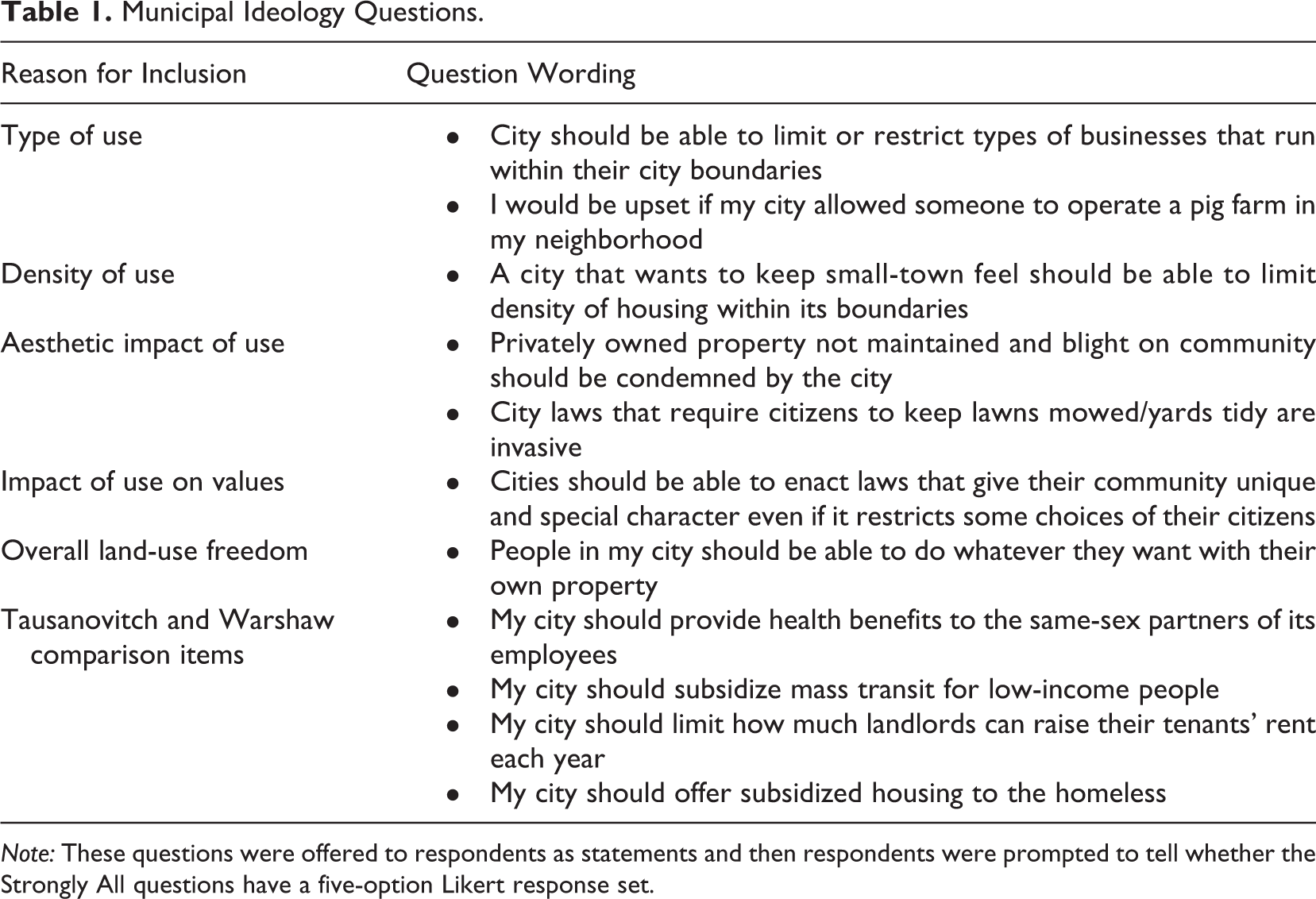
Note: These questions were offered to respondents as statements and then respondents were prompted to tell whether the Strongly All questions have a five-option Likert response set.
Density of Use
To cover density of use, an item is included focused on how acceptable a respondent finds municipal restrictions on residential density. While one might include additional items on density of retail, professional, or industrial uses, but housing density has the advantage of being relevant to virtually all communities (even those that have little or no commercial development) and is often a point of contention.
Aesthetic Impact of Use
Two items cover the subject of aesthetic impact. The first evaluates citizens’ opinions about laws that require lawns and yards to be neatly kept. The second asks citizens to consider their support for allowing their municipality to condemn property that is blighted or not maintained. Both of these items capture regulation for land-use regulations addressing aesthetic appeal.
Cultural/value Impact
Finally, to cover the impact of land use on a community’s values, a question is included about whether cities should promulgate ordinances that preserve community character in spite of the limitations on their citizens. Finally, a catchall general question is included asking about whether individuals should be allowed to do whatever they want with their own land.
In addition to using these items, several of the Tausanovitch and Warshaw validation questions see appropriate for inclusion as a point of reference to previous work. Available survey space afforded the opportunity to include a social issue question (regarding benefits for same-sex partners) as well as several economic questions (regarding subsidized mass transit, rent controls, and subsidized housing). Full question wording of each of the items appears in Table 1.
When searching for structure within these items, a number of different possible outcomes could be observed. If the single left–right dimension that characterizes national politics adequately characterizes land-use issues as well, one should find that all of these items scale on a single dimension along with the left–right questions. At first thought, one might find this possibility unlikely. While reasons exist to think land use may constitute a separate dimension, one must also remember that issues as seemingly disparate as foreign policy, abortion, immigration, and welfare policy typically scale together on a single dimension (e.g., Carsey and Harden 2010). Alternatively, one could find that one or more dimensions of land use exist distinct from the traditional left–right dimension of politics. The notion that municipalities face issues that are unique to local government and that in many cities candidates do not run under partisan labels bolsters this possibility. Finally, we might find no evidence of a cohesive ideological structure, which would suggest that conventional wisdom about local politics being idiosyncratic and nonideological is correct.
The questions outlined in Table 1 were fielded to 1,000 respondents on a team module in the 2014 Cooperative Congressional Election Study (CCES). To search for ideological structure among these items, a common factor analysis is performed on the polychoric correlation matrix for all items (to account for the ordinal nature of the items, CCES sampling weights were applied). This process produces a two-dimensional structure (Online Supplemental Text 1).
The application of an orthogonal varimax rotation produces a simple structure. The rotated factor loadings appear in Table 2. The first four items listed in Table 2 (modeled on key items used by Tausanovitch and Warshaw) all load highly on the first factor, which represents a left–right dimension of local ideology, while the seven items covering various aspects of land-use regulation load highly on the second factor (but not on the left–right factor). This second factor seems to account more for preferences on land use. Higher values on the left–right ideology dimension represent more conservative perspectives while lower values are more liberal. Higher values on the land-use dimension represent attitudes oriented toward greater personal freedom and less city government use of land-use authority while lower values represent an emphasis on community building and greater regulation of land use.
Factor Structure of Municipal Ideology.

Note: Cell entries are factor loadings (after varimax rotation) from a common factor analysis on the polychromic correlation matrix of the items. n = 918. Sample size is less than the 1,000 observations on the overall CCES model due to casewise deletion of missing data.
In short, the results confirm that citizens have coherent ideological preferences in municipal politics. However, these preferences are multidimensional and more complex that previous scholars have anticipated. While the left–right dimension that characterizes national politics has some bearing on local politics, it alone cannot sufficiently characterize the ideological space in which municipal politics transpires. Accounting for a second dimension, which highlights the trade-offs between individual property rights and the needs of the community in land use, affords a more complete accounting of the municipal ideological space.
These results clearly establish the presence of two distinct dimensions of municipal political beliefs. In one sense, these results confirm the position of Tausanovitch and Warshaw, showing a clear left–right dimension of local political ideology. In another sense, though, our evidence shows that the items employed by Tausanovich and Warshaw fail to portray the full spectrum of ideology in local governance because the questions on which their ideological measures are based target at a narrower spectrum of the issue space.
Distinguishing Predictors of the Left–right Ideology and Land-use Preferences
Finding these two distinct dimensions of ideology, it is worthwhile to explore the characteristics of individuals who score high and low on each of these dimensions. This can be accomplished with a two-equation seemingly unrelated regression (SUR) model, with the two dependent variables being the ideology scores of individuals on the local left–right dimension and the local land-use dimension and a standardized set of predictors. Data are again drawn from the CCES, with census data merged in on ZIP code population density. We focus on two sets of predictors—those hypothesized to influence left–right ideology and those focused on land-use attitudes. Variable names appear in italics.
Left–right Ideology Predictors
As an initial verification that our left–right dimension captures liberal–conservative ideology, we use a variable for liberal–conservative ideology using the standard seven-point scale. The inclusion of this covariate allows us to validate whether our left–right measure of local ideology is strongly associated with the traditional liberal–conservative measure of ideology, as well as allowing us to test whether land-use ideology is generally independent of the liberal–conservative spectrum.
Group identities are an important part of contemporary political identification. African-Americans and women are both important parts of the Democratic party’s coalition both nationally and locally, leading us to believe that both of those groups will tend to be more liberal on left–right local ideology (Hajnal and Trounstine 2014; Box-Steffensmeier, De Boef, and Lin 2004).
Finally, lower levels of income have traditionally been associated with a more liberal worldview (especially on economic issues, see Feldman and Johnston 2014); we particularly expect this to be the case with our local ideology left–right measure because several of our indicators of left–right local ideology are oriented toward subsidies for low-income individuals. We measure income as household income with the low-income group ranging from 0 to US$39,999, middle income as US$40,000 to US$99,999, and high income (the reference category) as incomes over US$100,000. We are less certain of how income might affect preferences on the land-use dimension. To some extent, exercise of eminent domain for commercial redevelopment could cause low-income individuals to tend to prefer less exercise of land-use powers (higher scores on the land-use ideology dimension). However, land-use policies that support the development of higher-density housing types that are affordable for low- and moderate-income families may lead low-income individuals to prefer aggressive use of land-use powers (lower scores on the land-use ideology dimension).
Predictors for Land-use Attitudes
A second set of predictors focuses on variables hypothesized to primarily influence land-use ideology. Individuals with children at home are often more invested in community development and the nature of the community they live in than will those who do not have children in the home, which could result in lower scores (pro-community) on our land-use ideology dimension.
Residential stability may also influence one’s willingness to support greater use of community land-use authority, so it may be that individuals who have lived for ten years or more in their current residence will have more pro-community stances (lower values) on land-use ideology.
There are competing predictions to test for our variable assessing home ownership. On one hand, homeowners have a vested interest in protecting their individual property rights and enjoying the activities of their choosing on their property. On the other hand, homeowners may see land-use policies as a way to protect the value of their investment in their home from being devalued by having less desirable land uses come in near their home.
Finally, individuals living in communities with higher population density may see zoning and land-use regulations as more important for producing a functional and orderly community in a densely populated area, while individuals living in areas with lower population density may see such regulations as unnecessary, favoring property owner’s rights. The measure of population density used here is based on the respondent’s ZIP code (thousands of residents per square mile), with the hypothesis being that lower population density will be associated with higher scores on the land-use ideology dimension, reflecting a more pro-property rights perspective.
Results
To compare the variables’ respective influence on each of the dependent variables (land-use attitudes and left–right ideology), Zellner’s (1962) SUR model is estimated, which allows for simultaneous estimation of the regression of both dependent variables on the same set of predictors. Results of the model appear in Table 3. In terms of left–right political ideology, women and African Americans have more liberal views on the local left–right spectrum, as do individuals with lower and middle incomes (relative to those in the high-income reference category). The national liberal–conservative ideology question shows a clear and strong relationship to local left–right ideology but not to land-use attitudes. Several of our variables that we predicted to be specifically influential on land-use ideology proved to be significant predictors of left–right local ideology, with homeowners being appreciably more conservative than those who do not own homes, and individuals living in more densely populated areas being more liberal (mirroring a national trend for urbanized areas to lean left).
Seemingly Unrelated Regression Model of Local Political Ideology.

Note: Cell entries are regression coefficients with standard errors in parentheses. Sample size of 771 is reduced from the survey sample size of 1,000 due to casewise deletion of missing data. RMSE = Root Mean Square Error.
*p < .05.
In terms of the land-use dimension, we confirmed several of our hypotheses. Respondents with children at home are indeed more supportive of land-use action for community building, as are individuals who have lived at their address for at least ten years. Surprisingly, home ownership has no significant effect on land-use attitudes, though competing effects of homeowners protecting their rights versus protecting home values by limiting uses on adjoining properties may cancel each other out. Population density has no statistically significant effect on land-use attitudes. Women have a more pro-community land-use orientation than do men. Moreover, individuals with low and middle incomes have a stronger pro-property rights orientation relative to high-income individuals; it may be that worries about eminent domain and redevelopment could be responsible for this dynamic.
Discussion
Local politics has long been thought to be nonpolitical and nonideological. Recent work has made strides in demonstrating that in today’s world, ideology influences local politics. This work has not contemplated, though, the importance of a tremendous portion of the activities of local governments: land use. The results presented here show that individuals have structured ideological preferences for land-use policies on a spectrum that ranges from a strong support of government activity to promote the interests of the community at large versus individuals who tend to oppose land-use action, instead preferring to maximize the liberties of property owners. These preferences for land use are a distinct dimension of ideology from the left–right dimension that characterizes national and state politics.
The confirmation of the influence of the national left–right spectrum in local politics is important. This reinforces findings that liberal–conservative values can be influential in local politics on issues that are easily mapped onto the liberal–conservative spectrum (Tausanovitch and Warshaw 2013, 2014). More important than just reinforcing previous findings, though, this research finds a distinct dimension of political ideology. This finding raises at least as many questions as it answers, though, and much remains to be learned about the land-use dimension of local political attitudes. Future research must establish the extent to which this dimension of local political beliefs is used by citizens in evaluating the specific candidates and issues that come before their city. While there is certainly debate over the extent to which nonpartisan elections remove partisan elements from elections (Schaffner, Streb, and Wright 2001; Bonneau and Cann 2015), to the extent that partisan cues are missing in nonpartisan elections, a nonpartisan format may give greater rise to the ability of candidates to campaign on issues like growth and zoning. The presence of multiple dimensions in local politics also opens a range of interesting research possibilities in multidimensional politics, including whether enterprising elected officials are able to use heresthetics (Riker 1986) to achieve their preferred political outcomes.
These findings also raise important questions about representation. While Tausanovitch and Warshaw (2014) demonstrate a high degree of representation on the left–right spectrum their measure captures, it is not clear that such a correspondence exists between the land-use preferences of citizens and the land-use policies of municipalities. Indeed, if voters are casting ballots on the basis of their placement of candidates on the left–right political spectrum, they are likely doing so to the exclusion of land-use considerations, for which there are fewer cues about candidates’ positions (like partisanship) and less information generally available. Excellent representation on the left–right spectrum may well mean poor representation on the land-use decisions that often make up a larger share of a city’s workload. Poor representation on land use may be particularly disappointing, as this tends to be an area where local elected officials have more discretion (Gerber and Hopkins 2011). The confirmation of these worries, though, remains an empirical question to be addressed by future research.
Supplemental Material
Supplemental Material, SLGR_17-0086R1_Figure_1_Supplement - The Structure of Municipal Political Ideology
Supplemental Material, SLGR_17-0086R1_Figure_1_Supplement for The Structure of Municipal Political Ideology by Damon M. Cann in State and Local Government Review
Footnotes
Declaration of Conflicting Interests
The author declared no potential conflicts of interest with respect to the research, authorship, and/or publication of this article.
Funding
The author received no financial support for the research, authorship, and/or publication of this article.
Supplemental Material
Supplementary material for this article is available online.
References
Supplementary Material
Please find the following supplemental material available below.
For Open Access articles published under a Creative Commons License, all supplemental material carries the same license as the article it is associated with.
For non-Open Access articles published, all supplemental material carries a non-exclusive license, and permission requests for re-use of supplemental material or any part of supplemental material shall be sent directly to the copyright owner as specified in the copyright notice associated with the article.
