



Abstract
Adjusting municipal structures and cross-adoption of structural characteristics between mayor-council and council-manager municipalities have been common in the United States in recent decades. This research investigates seven essential structural characteristics of U.S. municipalities and constructs a municipal structure political-administrative index. We attempt to examine the determinants of municipal structures on a political-administrative dimension. We incorporate political conflict theory and class cleavage theory into our theoretical model of the cost analysis of citizens to explain municipal structure choices. Data are collected from the Decennial Census, American Community Survey, and three rounds of national surveys of municipal structures by the International City/County Management Association in 2001, 2006, and 2011. The final data set contains 6,777 municipality-year observations, and the empirical results demonstrate that municipal structure choices are statistically significantly associated with citizens’ socioeconomic and demographic characteristics. Citizens’ income levels play a crucial role in determining municipal structure changes during the sample period (2001-2011).
Introduction
Municipal structures play an important role in organizing city politics and influencing policy formulation and implementation (Frederickson, Johnson, & Wood, 2004b; Svara & Watson, 2010). Formal municipal structures provide the framework within which the policy maker sets the rules of participation, exercises authority by making and carrying out the law (statutes, ordinances, or regulations), selects persons to politically represent all residents or some subset of residents, operates a permanent bureaucracy, provides services, and determines who will pay what in taxes. (Frederickson et al., 2004b)
Also, municipal structures can “supply particular channels for information to travel through and among organizations” (Clingermayer & Feiock, 2001).
Like most scholars in this field, in this study, we focus on U.S. municipalities with the statutory form of mayor-council or council-manager. 1 Municipalities’ structures are dynamic and adapt over time (Svara & Watson, 2010). Before the early 20th century, the strong mayor or classic mayor-council was the dominant municipal structure, which was suited to machine politics and resulted in widespread corruption of governments (Judd & Swanstrom, 2015). The reformed manager or classic council-manager structure was invented in the Progressive Era. Its proponents aimed to reduce corruption, withstand machine politics, and provide public services efficiently (Judd & Swanstrom, 2015; Wheeland, Palus, & Wood, 2014). The classic council-manager structure, first adopted in 1908 in Staunton, Virginia, was the most influential reformed municipal structure in the first half of the 20th century (Choi, Feiock, & Bae, 2013; Svara & Watson, 2010; Wheeland et al., 2014).
Conventional wisdom holds that, since the 1950s, the balance between various types of municipal structures has been stabilized (Choi et al., 2013). There have been, however, two emerging trends in municipal structure changes in recent decades. First, cross-adoption of structural characteristics between the mayor-council and council-manager structures is so common that the boundary between them has become ambiguous. The dichotomous separation of municipal structures into the mayor-council or council-manager has limitations because it ignores important subsidiary features. Scholars have proposed the so-called “Type III City” framework to reclassify municipal structures (Frederickson & Johnson, 2001; Frederickson, Johnson, & Wood, 2004a, 2004b; Frederickson et al., 2004b; Frederickson, Wood, & Logan, 2001). Second, based on data from the Municipal Form of Government surveys by the International City/County Management Association (ICMA), between 1981 and 2011, the proportion of mayor-council municipalities was still declining and the proportion of council-manager municipalities was increasing. Figure 1 displays the trends. 2
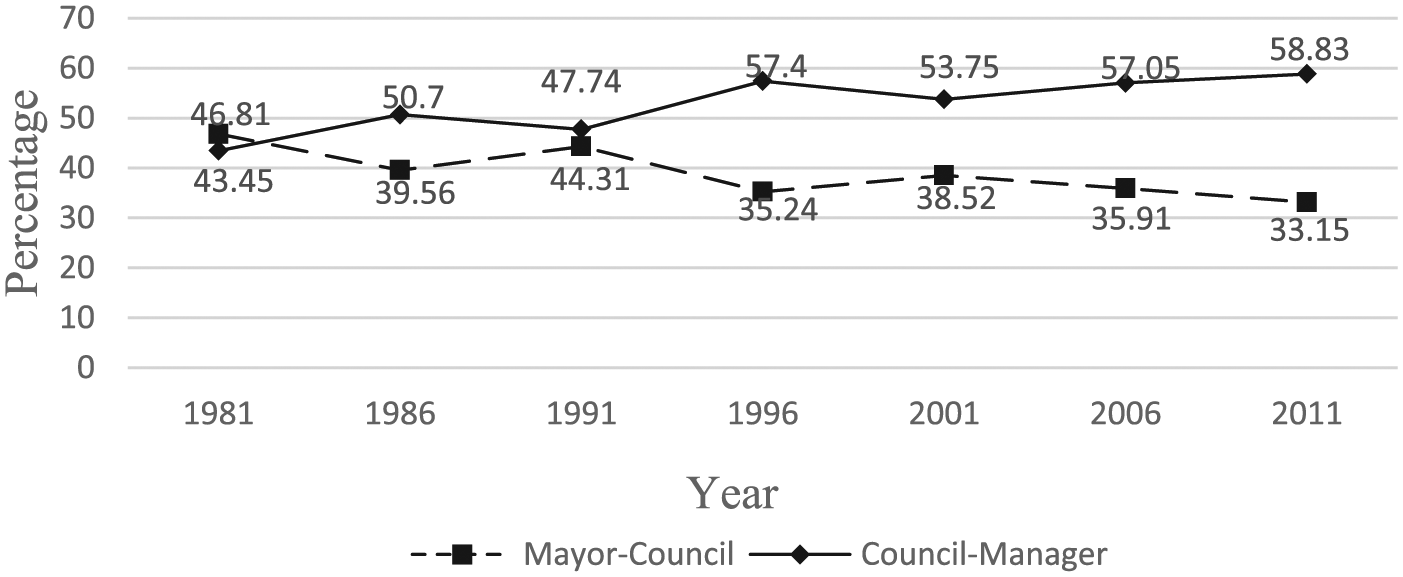
Percentages of mayor-council and council-manager municipalities by years.
We aim to examine what factors determine municipal structure choices in this study. Some previous studies have involved this topic, but most previous studies use cross-sectional data and a small sample of municipalities, usually the municipalities that have a large population size (Choi et al., 2013; Gordon, 1968; Kessel, 1962; Knoke, 1982; Lineberry & Fowler, 1967). We continue this thread of research and aim to contribute to the scholarship both theoretically and empirically with panel data for a large number of municipalities.
This research is organized as follows: Section 2 briefly introduces the related literature; Section 3 measures municipal structures on a political-administrative dimension and discusses the reliability and validity of the municipal structure index; Section 4 builds a theoretical model to explain municipal structure choices; Section 5 proposes some hypotheses; Section 6 introduces the methodology, and Section 7 presents the empirical findings. This research ends with brief conclusions in the last Section.
Related Literature
This section examines both the theoretical argument and empirical evidence on municipal structures. Scholars have developed theories from political and social science to explain municipal structure adoptions and changes. Political conflict theory and class cleavage theory dominate these theories. The research considered here is based on the idea that citizens can form and express preferences about municipal structure choices and that municipal structure reflects those preferences.
Kessel (1962) develops the political conflict theory and discusses municipal government structure choices from the perspective of a conflicting political environment. Kessel (1962) holds that the political mayor-council structure is adopted in municipalities where defined social norms and benefits must be adhered to, where conflicting benefits exist and have to be arbitrated, and where disadvantaged groups need political channels for expression.
The social cleavage theory, which is utilized by many scholars in this field, holds that groups from various backgrounds in terms of religion, wealth, profession, race, ethnicity, and educational attainment, have different preferences in methods of political participation and in pursuit of interests. Hirschman (1982) argues that municipal structures are highly dynamic and change based on the shifting values between pursuits of the private interests of individuals and the public interests of the society as an entity. Such scholars as Banfield and Wilson (1963), Lineberry and Fowler (1967), Hays (1974), Knoke (1982), Simmons and Simmons (2004), and Choi et al. (2013) believe that the shift of municipal structures from the unreformed strong mayor to the reformed council-manager is the result of contests between two groups: (a) the moralistic middle- and upper-class predominantly white native Protestants and business and professional elite, who have higher educational degrees, hold “public regarding ethos,” and seek a structure responsive to their interests and (b) the working class, minorities, the poor, and immigrants, who want a government responsive to their needs.
Different from the political conflict theory and class cleavage theory, Knoke (1982) describes the adoption of the reformed council-manager municipal structure as an innovation diffusion process. Simmons and Simmons (2004) explain municipal structure choices from five perspectives, including government design flaws, political conflicts, sociodemographic cleavage, government legitimacy problems, and leadership deficits. 3
The evidence from empirical exploration is mixed. Kessel (1962) finds that the reformed council-manager structure is associated with a medium-size population, a high growth rate, a small percentage of foreign-born population, and an economic base with a large fraction in professional service and a small fraction in manufacturing. Wolfinger and Field (1966) and Farnham and Bryant (1985) discover that the region and age of cities are essential in determining governmental structures. Findings of Lineberry and Fowler (1967) demonstrate that reformed cities are more homogeneous in terms of race, ethnicity, and religion, which is consistent with the social cleavage theory. Gordon (1968) demonstrates that the fraction of immigrants is associated with a higher probability of adopting unreformed political municipal structures. Dye and MacManus (1976) use discriminant function analysis to explore the determinants of municipal government structures, and they find that the ethnicity composition predicts the type of constituency (ward or at-large) well, but the region of municipalities is a better predictor of election method (partisan or nonpartisan).
Some recent studies also provide evidence. Simmons and Simmons (2004) use ordinal values to measure municipal structure changes on a political-administrative dimension. Utilizing the ordered logit model, they find that municipal structures are affected by the race, ethnicity, and educational attainment of citizens. Choi et al. (2013) employ a historical data set that spans 75 years and contains the 191 largest cities in 1930 to explore the determinants of adoption and abandonment of the council-manager structure. Their results show that the economic conditions of municipalities are the most essential determinants.
Previous studies of municipal structure adoption have several limitations. In considering the structural choices, almost all previous studies focus on the shift between the mayor-council and council-manager structures. However, in recent decades, municipalities on each of these statutory platforms are absorbing characteristics of the other. A pure city structure, either mayor-council or council-manager, is inadequate to reflect the complex features of municipal structures in reality. So far, there is a lack of evidence on determinants of municipal structures among multiple possible choices. Second, most previous studies focus on a limited number of municipalities, usually the ones with a large population. Therefore, lessons have limited external generalizability. Last, much prior research uses the method of comparison of sample means of municipalities’ characteristics in different structures, and most previous studies use 1-year cross-sectional data. Although some recent studies utilize a panel data set that spans a longer time period and adopt more advanced econometric models (Choi et al., 2013; Simmons & Simmons, 2004), evidence is insufficient.
Measuring Municipal Structures on a Political-Administrative Dimension
Merits of the Municipal Structure Political-Administrative Index
The motivation of reclassifying and measuring municipal structures on a political-administrative dimension is rooted in the limitation of the binary separation of the main municipal structures into the mayor-council and council-manager forms. As argued in many previous studies, the prevalent cross-adoption of characteristics between these two structures makes a dichotomous classification problematic (Carr & Karuppusamy, 2008, 2009, 2010; Frederickson et al., 2004a, 2004b; Nelson & Svara, 2010). We provide statistical evidence to support this argument, using the data from the Municipal Form of Government survey in 2011 by the ICMA.
Based on the traditional wisdom, the main characteristics of the mayor-council structure include the following: the mayor is elected separately from the council and elected directly by the voters, the mayor is responsible for administrative affairs, and the council is responsible for legislation (Frederickson & Johnson, 2001). The main characteristics of the council-manager structure include the following: the council is responsible for both administrative affairs and legislation, the council usually appoints a professional manager as the chief administrative officer to manage administrative affairs, and the mayor is a ceremonial position and is usually selected by council members on a rotating basis (Frederickson & Johnson, 2001).
Among the 3,566 municipalities responding to ICMA’s survey in 2011, 1,182 (33%) used the mayor-council structure, and 2,098 (59%) used the council-manager structure. Other structures account for 8%. Among the mayor-council municipalities, 1,093 had a mayor elected directly by voters, but 50 had a mayor that was selected by council members from themselves or council members rotated into the position. In 620 of the 1,182 mayor-council municipalities, the mayor was independent from the council; however, the mayor served in the council in 514 municipalities. Moreover, in 717 of the 1,182 mayor-council municipalities, there was a chief administrative officer who was responsible for or helped the mayor manage administrative affairs. The statistical analysis shows that the mayor-council municipalities used many of the structural characteristics of the council-manager structure. Similar cross-adoption of structural characteristics existed in the council-manager municipalities. For instance, among the 2,098 municipalities that reported a council-manager structure, 1,039 had a mayor who was directly elected by voters. This is a sharp contrast to the traditional wisdom. Data from ICMA’s surveys for other years (2001, 2006) show similar findings.
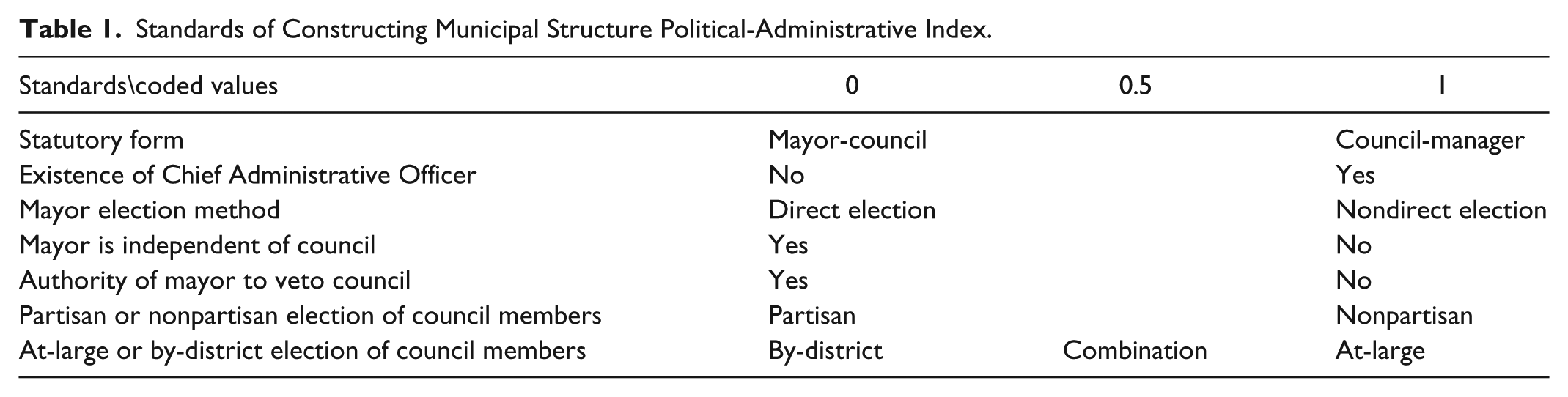
Both existing evidence from previous studies and our statistical analysis of survey data reveal that separating the main municipal structures into the mayor-council and council-manager forms is problematic. In this study, we investigate seven essential structural characteristics (presented in Table 1) of municipalities. These structural characteristics are well discussed by Carr and Karuppusamy (2008, 2009), Frederickson et al. (2004a, 2004b), and Frederickson and Johnson (2001), who attempt to use the characteristics to reclassify municipal structures. We assign each characteristic a numerical value of 0, 0.5, or 1 based on its political or administrative nature. We conduct factor analysis of the seven values of structural characteristics to construct a municipal structure political-administrative index. A lower index indicates a more political municipal structure, underscoring checks and balances between the mayor and council members, representation of interests of particular groups and specific districts, direct responsiveness and accountability of the mayor to voters, and influence of parties in local politics. On the contrary, the more administrative municipal structure, indicated by a higher index, stresses professional management of municipality affairs, membership of the mayor in the council, concentration of authority in council, and elimination of partisan influence on elections.
Standards of Constructing Municipal Structure Political-Administrative Index.
Previous studies have proposed various approaches to reclassify municipal structures, most of which attempt to reclassify municipal structures into several types. Among them, the approach of Carr and Karuppusamy (2008, 2009, 2010) is closest to ours in this study. Modifying the “Type III City” framework (the political, the administrative, and the adapted) of Frederickson et al. (2004a, 2004b), Carr and Karuppusamy (2008, 2009, 2010) classify the mayor-council and council-manager structures into six subtypes, including the political, adapted political, conciliated political, conciliated administrative, adapted administrative, and administrative. Carr and Karuppusamy (2008, 2009) argue that these subtypes of municipal structures range from the most political to the most administrative.
A limitation in the approach of Carr and Karuppusamy is that they investigate many more structural characteristics than that they use to make reclassification, and the boundaries between their subtypes of municipal structures are sometimes ambiguous. This limitation is somewhat expected because as more structural characteristics are involved to reclassify in practice, more subtypes must be defined. Otherwise, many municipalities cannot be categorized into any specific type. Therefore, our approach of constructing an index to reclassify municipal structures on a political-administrative dimension has the merit of comprehensively evaluating the political or administrative nature of municipal structures by investigating more structural characteristics. We discuss the reliability and validity of the index below.
Index Reliability
The common method to assess reliability of an index is to evaluate its “dependability, stability, consistency, reproducibility and lack of distortion” (Kerlinger & Lee, 2000). The seven components of our index are objective features for assessing the political or administrative nature of municipal structures. Municipality samples in ICMA’s surveys are selected based on their population size. In each survey year, ICMA mails survey questions to all municipalities with population size above 2,500 and to selected ones among the small-sized municipalities. To mitigate selection bias, our study includes only the municipalities with population size above 2,500. The response rates of ICMA’s surveys in 2001, 2006, and 2011 are all around 50%, which is fairly high for a national survey of local governments. Our data to construct the index are accessible from ICMA, although they are not free. Therefore, the results are reproducible. The form of ICMA’s survey questions are uniform across time, with few changes. This improves the uniformity and consistency of the data sources. Moreover, ICMA’s surveys have been conducted every 5 years since 1981. Across-time data makes the index more dependable (Clark, 2015).
A useful technique to assess reliability of an index is to evaluate the correlation of the index components. Table 2 reports the Pearson correlation coefficients for each pair of the index components in our samples and the statistical significance level. The components are positively correlated with each other at the 0.01 level, providing evidence of reliability.
Correlation Matrix of Index Components.
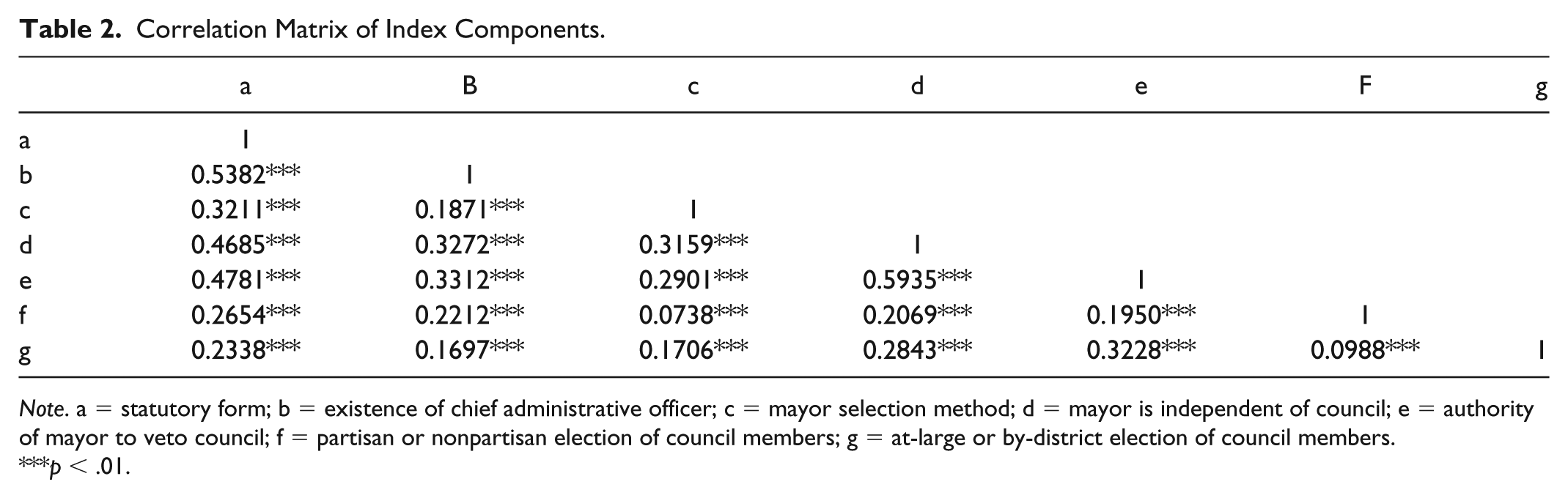
Note. a = statutory form; b = existence of chief administrative officer; c = mayor selection method; d = mayor is independent of council; e = authority of mayor to veto council; f = partisan or nonpartisan election of council members; g = at-large or by-district election of council members.
p < .01.
Another technique to evaluate reliability of an index is to calculate the value of Cronbach’s alpha. Values of Cronbach’s alpha range between 0 and 1, with a higher value indicating closer correlation between components of the index (Clark, 2015). The value of Cronbach’s alpha is 0.75 in our case, indicating that reliability of our index is acceptable (Berman & Wang, 2017).
Index Validity
“With validity, the goal is to figure out if we are measuring the concept that we intended to measure” (Clark, 2015). Adopting the method of Clark (2015), we assess validity of our index in three aspects: Content validity, criterion-related validity, and construct validity, using theoretical arguments, existing evidence, and statistical techniques.
Content validity requires that components of the index should include all possible items that can measure the core concept (Kerlinger & Lee, 2000), and there should be evidence from the literature demonstrating the validity of these items in measuring the concept. The requirement of “all possible items” is extremely strict and can be satisfied only theoretically. In practice, there may be dozens of potential components (structural characteristics of municipalities). However, we need to balance thoroughness with parsimony and to consider data availability. The seven components we include in our standards in classifying municipal structures are well discussed in the literature by studies such as Carr and Karuppusamy (2008, 2009), Frederickson et al. (2004a, 2004b), and Frederickson and Johnson (2001). Therefore, it is safe to use them to construct our municipal structure index. Particularly, we use more structural characteristics relating to institutional settings than to management practice.
Criterion-related validity requires the constructed index to be correlated with other potential measures of the same concept. In our case, the statutory municipal forms, mayor-council or council-manager, are traditionally used as a binary measurement of municipal structures. The former is the political structure and the latter is the administrative structure. The positive correlations between the statutory municipal form with other six components, which are presented in the first column in Table 2, demonstrate that the components of our index are valid.
Construct validity is the most important and complex form of measurement validity (Clark, 2015; Kerlinger & Lee, 2000; Morgan et al., 2001). Assessment of construct validity is usually conducted by theoretically connecting the components of the index to the concept that we intend to measure. Also, construct validity asks “which factors account for the variance in performance of the thing we are trying to measure?” (Clark, 2015). We first provide theoretical analyses and then use factor analysis to assess the construct validity of our index.
As noted previously, the statutory municipal form, mayor-council or council-manager, is the traditional separation of municipal structures into the political or administrative ones. Although this separation is problematic because of the cross-adoption of structural characteristics between themselves, it has intuitive validity to be used as one component of our municipal structure political-administrative index.
The existence of a chief administrative officer (CAO) is an administrative municipal structure characteristic. CAOs are usually trained experts who hold professional degrees and have extensive experience in public management and administration (Demir & Reddick, 2012; Nalbandian, 1999; Zhang & Feiock, 2009). They usually have considerable discretion in municipal governments’ policy formulation and implementation (Demir & Reddick, 2012; Selden, Brewer, & Brudney, 1999; Zhang, 2014; Zhang & Feiock, 2009). Placing local government management under a CAO has the potential to increase government management efficiency (Deno & Mehay, 1987; Stumm & Corrigan, 1998).
Political municipal structures are characterized by a mayor who is directly elected by voters and works independently of the council (Carr & Karuppusamy, 2008, 2009; Frederickson et al., 2004a, 2004b; Frederickson, Logan, & Wood, 2003). Checks and balances between the mayor and council members constrain their discretion and mitigate deviations in their behavior from citizens’ preferences (Persson, Roland, & Tabellini, 1997; Persson & Tabellini, 1999), and citizens will have alternative channels to express their preferences. Besides, as argued by Persson et al. (1997), “under appropriate checks and balances, separation of power also helps the voters elicit information.” 4
Political municipal structures are also characterized by the authority of the mayor to veto council-passed decisions. Public policies can be approved only when both of the players agree to them (Coate & Knight, 2011). The mayor’s power of vetoing increases the potential of checks and balances between the mayor and council and provides citizens more channels to defend their benefits. This characteristic reduces the cost of citizens for monitoring elected public officials but may increase the political struggles in localities and lead to inefficient government policy making or implementation (Judd & Swanstrom, 2015; Mossberger, Clarke, & John, 2015).
Partisan and district elections of council members are political municipal structure characteristics. Partisan elections and council members who are elected by district usually focus more on the benefits of particular groups or precincts. The political motivation of catering to a specific group or constituency that can contribute more political support encourages elected officials to invest a substantial amount of resources in public programs that might not produce the maximum level of marginal benefits and, hence, creates government inefficiencies.
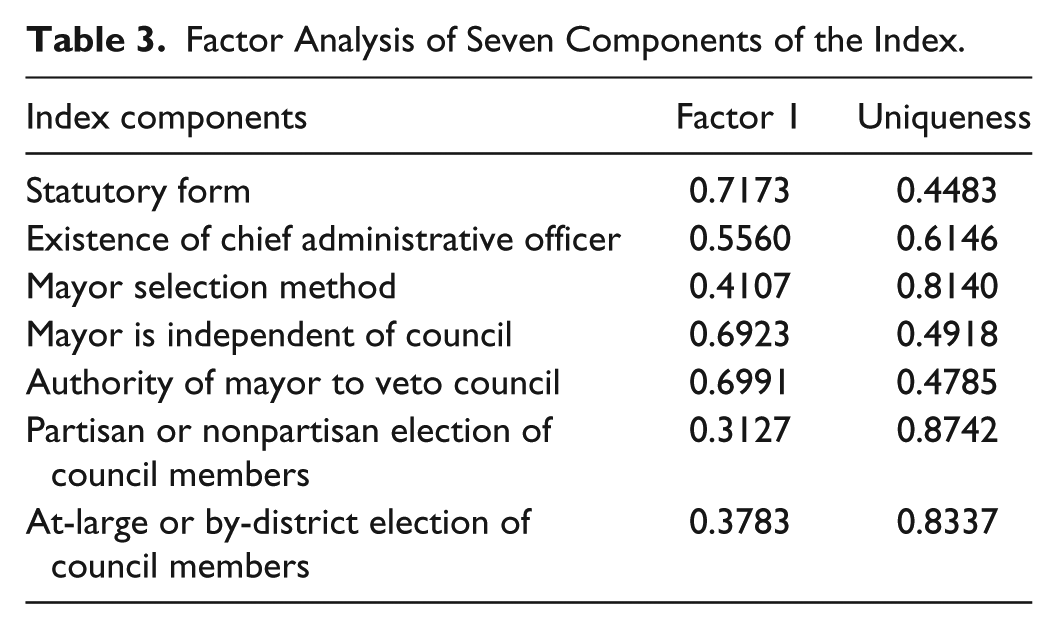
We finally use factor analysis to assess whether the seven components of our municipal structure index are appropriately loaded. The factor analysis reports only one factor with an eigenvalue greater than 1, demonstrating that the components of our index measure a core concept, which we interpret as the political or administrative nature of municipal structures. Factor loadings of the principal factor are presented in Table 3. The principal factor has positive loadings for all the seven components, among which the statutory form, existence of CAO, whether mayor is independent of council, and authority of mayor to veto council, are more highly loaded.
Factor Analysis of Seven Components of the Index.
A Theoretical Model to Explain Municipal Structure Choices
This section incorporates arguments of political conflict theory and class cleavage theory into our theoretical model of the cost analysis of citizens. The fundamental idea of political conflict theory and class cleavage theory is that the municipal structure choices are results of contests between groups with different socioeconomic and demographic characteristics, who have various interest pursuits and preferences for public policies. We further argue that the socioeconomic and demographic characteristics of citizens in municipalities can influence the costs of monitoring government officials and the inefficiency costs of policy making or implementation. The aim of minimizing the total costs determines citizens’ municipal structure choices. The main purpose of this section is to provide an alternative explanation of municipal structure choices.
The theoretical model is based on the fundamental assumption that citizens in local communities in a representative democracy tend to choose the government structure that can best delegate governmental management to professionally trained experts for efficiency gains, while holding public officials accountable. 5 In this present study, we define accountability as the extent to which citizens in municipalities can make public officials, both elected politicians and appointed bureaucrats, be representative of their particular interests and can have channels to express their preferences in public policy making. Like many scholars, we define efficiency as the capacity of governments to enhance public resource utilization.
The proposed assumption is reflected in a wide array of prior studies in political science. Shepsle (1988) argues that when evaluating a representative government, it is necessary to consider not only its responsiveness to the constituents but also its efficiency in dealing with public business. Adsera, Boix, and Payne’s (2003) standards of a well-functioning government include efficiency and incorruptness (accountability). Putnam, Leonardi, and Nanetti (1994) point out that a good democratic government is the one that can provide citizens “the right to petition their government in the hope of achieving some individual or social goal” (accountability) and actually “gets things done” (efficiency).
The second important assumption is that the elected officials place high priority on meeting the demands of their constituency; however, professional managers focus on management efficiency and effectiveness. The main goal of elected public officials is to get reelected through satisfying demands of voters, and they seek to use political power to pursue public policy and personal goals (Persson et al., 1997). The expert managers, who are appointed by elected officials, have to consider not only the demands of voters that are channeled through orders of the elected officials but also the pressure of building an outstanding reputation among peers in such professional organizations as ICMA and the Government Finance Officers Association (GFOA; Dunn & Legge, 2001). The reputation incentive of managers may compel them to deviate from mandates of elected officials when their professional judgment is at odds with orders from the latter.
Delegating government management to professionally trained managers has the potential to improve management efficiency but enhances the difficulty of holding the managers accountable (Carr, 2015; Deno & Mehay, 1987; Stumm & Corrigan, 1998). Therefore, the monitoring cost of citizens increases. However, government management under directly elected politicians, who focus more on political responsiveness and gaining reelection, can assure accountability but raise inefficiency cost due to the lack of managerial expertise. The two simultaneous goals of citizens create a dilemma: They have to make a trade-off between the interdependent monitoring cost and inefficiency cost.
We construct an index to indicate the political or administrative nature of municipal structures and array municipal structures on the political-administrative dimension (refer to discussions in Section “Measuring Municipal Structures on a Political-Administrative Dimension”). Figure 2 illustrates our fundamental theoretical arguments. The abscissa indicates the political-administrative dimension of municipal structures. The most political structure is placed at the left end, and the most administrative structure is placed at the right end. Citizens’ expected monitoring cost increases when municipal structures move from the political to the administrative; meanwhile, their expected inefficiency cost declines.
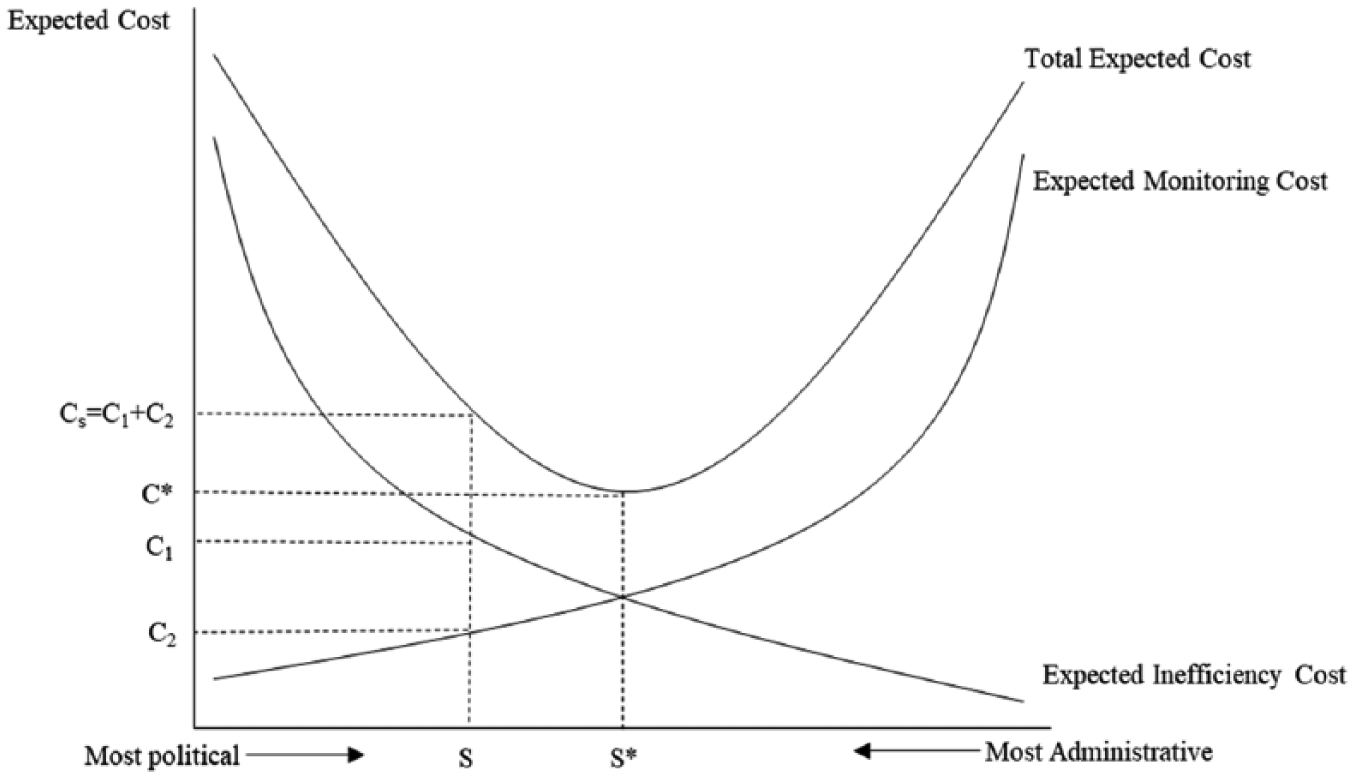
Theoretical model of optimal municipal structure.
The core of our theoretical model is the trade-off between the expected inefficiency cost and monitoring cost with movement along the political-administrative dimension. The optimal structure should be the one that minimizes the total expected costs of inefficiency and monitoring. As exhibited in Figure 2, the total expected cost (
The exact place of
The optimal structure
Hypotheses
Based on previous studies and the theoretical model, we discuss and propose hypotheses with regard to the effects of some socioeconomic and demographic characteristics of citizens or municipalities on municipal structure choices in this section. Those characteristics include income level and inequality, educational attainment, race composition, economic conditions, and industry structures. Political conflict and class cleavage theory imply that these characteristics are associated with preferences over municipal structure choices. In addition, municipality size and the existence of citizens’ initiative are controlled in the model. Municipality size relates to efficiency of government management and cost of monitoring officials, and initiative allows preferences however formed to be expressed.
High income groups have advantages in accessing necessary information on public policy making and government operation because information collection is costly (Downs, 1957). Therefore, monitoring the elected public officials is presumably easier for citizens with higher income. From another perspective, economic performance and wealth of the community contribute to accumulation of social capital (Knack & Keefer, 1997; Putnam et al., 1994); meanwhile, social capital usually leads to “low social polarization, and formal institutional rules that constrain the government from acting arbitrarily” (Knack & Keefer, 1997). Therefore, wealthy municipalities are usually imbedded with formal institutions that can effectively constrain public officials’ rent seeking behavior. In municipalities with higher per capita income, citizens may feel it is easier to make public officials accountable and more necessary to realize government efficiency. Hence, reducing inefficiency with a more administrative municipal structure is an optimal choice:
Educational attainment contributes to citizens’ active political participation and increases their exposure to cosmopolitan culture. It helps build civic engagement and interpersonal trust, which are crucial components of social capital (Brehm & Rahn, 1997; Leighley & Vedlitz, 1999). “Greater levels of civic engagement and interpersonal cooperation should lead to closer monitoring and to more abundant information about the public arena” (Adsera et al., 2003). Therefore, gathering information on government operation and monitoring public officials are relatively easier for groups with higher educational attainment. In addition, higher educational attainment is generally correlated with professional and managerial occupations. The fraction of citizens with educational attainment at high school or above among the citizens who are 25 years old and over is an indicator of the overall educational attainment of municipalities. In municipalities with higher educational attainment, citizens may feel it is easier to make public officials accountable and more important to realize government efficiency. Thus, reducing inefficiency with a more administrative municipal structure is an optimal choice:
The effect of income inequality can be examined through its relationship with political engagement in municipalities (Goodin & Dryzek, 1980; Solt, 2004, 2008) Solt (2008) argues that income inequality may increase citizens’ political engagement because “higher levels of inequality cause divergences in political preferences that fuel debates about the appropriate course of policy; these debates then cause higher rates of political mobilization.” Therefore, in municipalities with a higher level of income inequality, citizens will more actively participate in political activities and require channels to express their demands. Hence, the political municipal structures can satisfy the preferences of citizens. In municipalities with higher levels of income inequality, citizens may feel it is more important and difficult to make public officials accountable to defend their own benefits. Also, elected officials are in a better position to mediate interest conflicts in the community. This research uses the ratio of mean income to median income of citizens as measurement of the income inequality:
Previous studies have demonstrated the important role of racial and ethnic fractionalization in local politics. Alesina, Baqir, and Easterly (1999) find that racial fractionalization is associated with patronage spending. “The more fractionalized a society is, the more difficult it is to govern” (Keefer, 2007). Besides, racial and ethnic fractionalization may engender political instability (Horowitz, 1985). Racial and ethnic fractionalization can provoke fierce conflicts between diverse groups when each group actively participates in local politics to advocate its own benefits. All the characteristics described can sufficiently increase the tendency of citizens in municipalities to choose a government structure that prompts political accountability for protecting their benefits. We utilize the proportion of Blacks and the proportion of foreign-born citizens among the whole population as indicators of racial and ethnic fractionalization in municipalities. In ethnically and racially fractionalized municipalities, citizens may feel it is more important to make public officials accountable and to have more channels to protect their own benefits. Therefore, reducing monitoring cost with a more political municipal structure is an optimal choice:
The small- and medium-sized communities presumably have lower levels of social cleavages (Choi et al., 2013; Lineberry & Fowler, 1967). To the contrary, a larger population size has more potential to result in higher levels of diversity and social cleavages, as well as active political mobilization and engagement. Citizens will have more incentives to make public officials adhere to their particular benefits.
From another perspective, a larger population is generally associated with a larger bureaucratic system, increasing the cost for citizens to monitor government officials efficiently. Citizens in municipalities with a larger population may feel it is more important to constrain the behavior of officials because government has charge of more public resources. In municipalities with a larger population, citizens may feel it is more important and difficult to make public officials accountable. Thus, reducing monitoring cost with a more political municipal structure is an optimal choice:
Local economic conditions and industry structures can also affect citizens’ municipal structure choices. Choi et al. (2013) argue that “demand for changes in forms of local government may occur in response to economic or environmental concerns of crises that compel local politicians and citizens to question the legitimacy of existing institutional arrangements.” In municipalities that are mired in economic hardships, citizens’ passion for governmental structure reform may be provoked. Citizens in municipalities that face severe economic conditions may feel it is important to have professional management to improve governmental efficiency. We use the unemployment rate as an indicator of economic conditions. In municipalities with a higher unemployment rate, citizens may feel it is more important to improve economic efficiency and performance. Therefore, reducing inefficiency cost with a more administrative municipal structure is an optimal choice.
In municipalities that are more dependent on manufacturing industry, the labor force is comprised of a larger fraction of lower-income and blue-collar groups. In contrast, in municipalities that rely more on the professional, managerial, scientific, and administrative industries (PMSA), the labor force is constituted more by the middle- and upper-class groups. We use the fraction of labor force in the two categories of industries as indicators of local economic structures:
Considering the autonomy of local citizens in choosing their municipal government structures, we look into the effect of citizens’ authority of initiative, which allows citizens to place charter, ordinance, or home rule changes on the ballot by collecting a required number of signatures on petitions. Initiatives can work toward either end of the scale depending on the local socioeconomic and demographic situations.
Method
Model Specification
Municipal structure is measured up to three times for each municipality. The estimation includes pooled ordinary least squares (OLS) regression, random effects, and fixed effects. Explanatory variables implied by the theory to relate to municipal structures should also be related through the changes of explanatory variables and municipal structures, which are the focus of the random effects and fixed effects models. Both levels and changes of municipal structures are relevant measures to test the theory.
The municipal structure political-administrative index is modeled as a function of a series of socioeconomic and demographic factors and one institutional factor that are discussed in the hypotheses section. The relationship can be specified as follows:
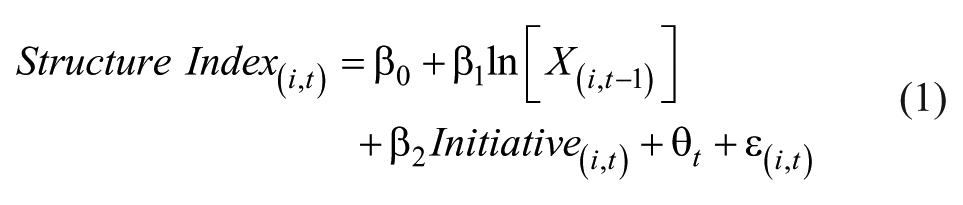
The dependent variable is the municipal structure political-administrative index.
Data
We use data from three sources. The data on municipal structure characteristics are derived from the national surveys of Municipal Form of Government conducted by ICMA in 2001, 2006, and 2011. These surveys are by far the most comprehensive resources about municipal structure characteristics and political institutions (Coate & Knight, 2011). In each survey year, ICMA mails survey questions to all municipalities with population above 2,500 and to selected ones among the small-sized municipalities. The numbers of samples in the three surveys are 7,867, 8,278, and 8,813. The respective numbers of responding municipalities are 4,244, 3,864, and 3,566 in the three surveys, representing 53.9%, 46.7%, and 40.5% of the survey samples.
Data on socioeconomic and demographic characteristics of municipalities in 2000 are collected from the Decennial Census 2000; the corresponding data in 2010 are derived from the Decennial Census 2010 and the American Community Survey 5-year estimates in 2010. The Census Bureau provides instructions to make data from the Decennial Census and American Community Survey multiple-year estimates comparable. We apply the approach of Coate and Knight (2011) to interpolate the corresponding data in 2005 by using the data points in 2000 and 2010. We match the socioeconomic and demographic data in 2000, 2005, and 2010 with municipal structure data in 2001, 2006, and 2011.
We only focus on the mayor-council and council-manager municipalities in this research. To mitigate selection bias among the small-sized municipalities, we delete the samples with population size below 2,500. After dropping observations with missing values in the explanatory variables, we obtain a total of 6,777 municipality-year observations during the sample period. The final data set is an unbalanced panel because not every municipality replies to all three surveys. Table 4 displays the descriptive statistics of all explanatory variables.
Descriptive Statistics of Explanatory Variables.
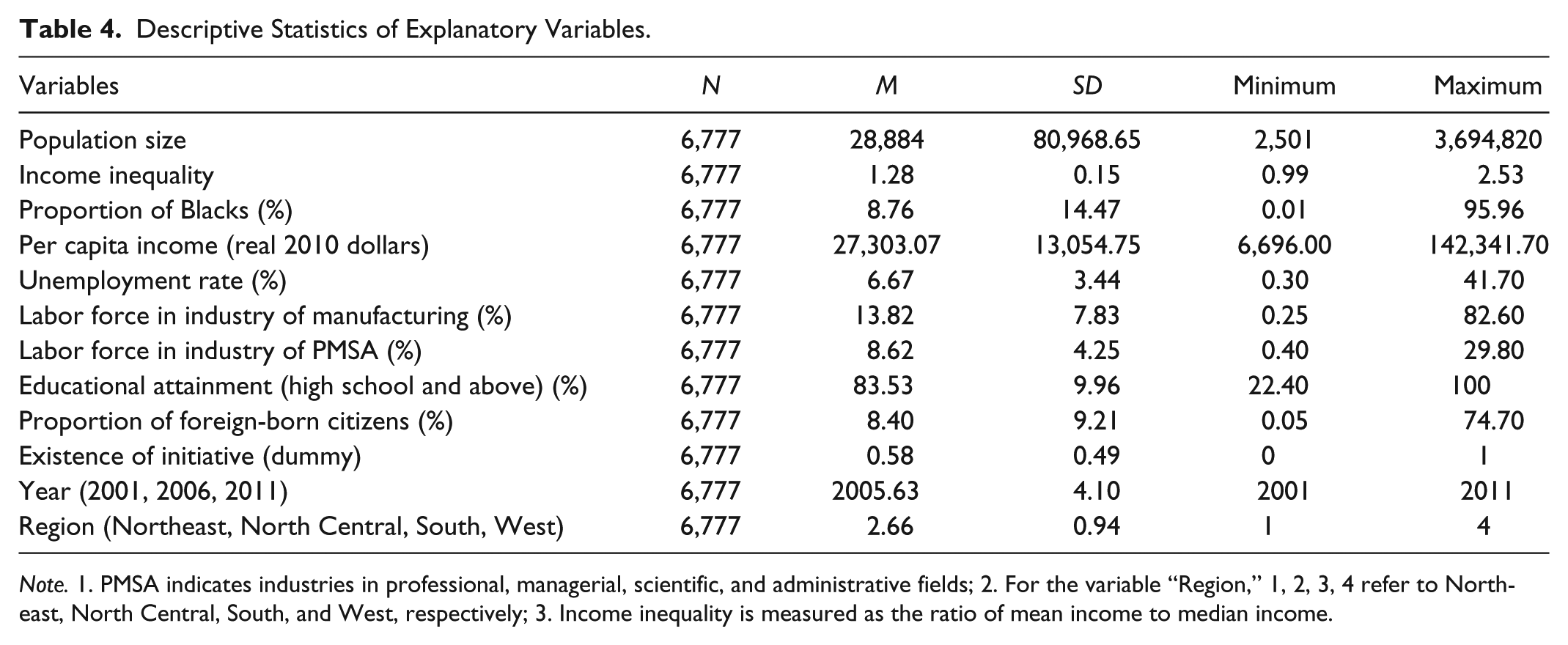
Note. 1. PMSA indicates industries in professional, managerial, scientific, and administrative fields; 2. For the variable “Region,” 1, 2, 3, 4 refer to Northeast, North Central, South, and West, respectively; 3. Income inequality is measured as the ratio of mean income to median income.
Empirical Findings
We first use cross-sectional OLS to estimate the model in equation (1). The results are displayed in column (1) in Table 5. Over 17% of the variation of the municipal structure political-administrative index is captured by the explanatory variables, and many estimated effects are statistically significant at conventional levels. The more administrative municipal structure is correlated with smaller population size, smaller fraction of Blacks, higher per capita income, higher unemployment rate, higher level of educational attainment, larger fraction of foreign-born citizens, and citizens’ authority of initiative. Signs of coefficients of all factors that exert statistically significant effects are consistent with hypotheses, except the fraction of foreign-born citizens. Results in Table 5 also show that regions of municipalities are correlated with their municipal structures. Compared to municipalities in the Northeastern United States, municipalities in the North Central, South, and West are more likely to use a more administrative structure, which is consistent with previous findings. 6
Estimation Results.
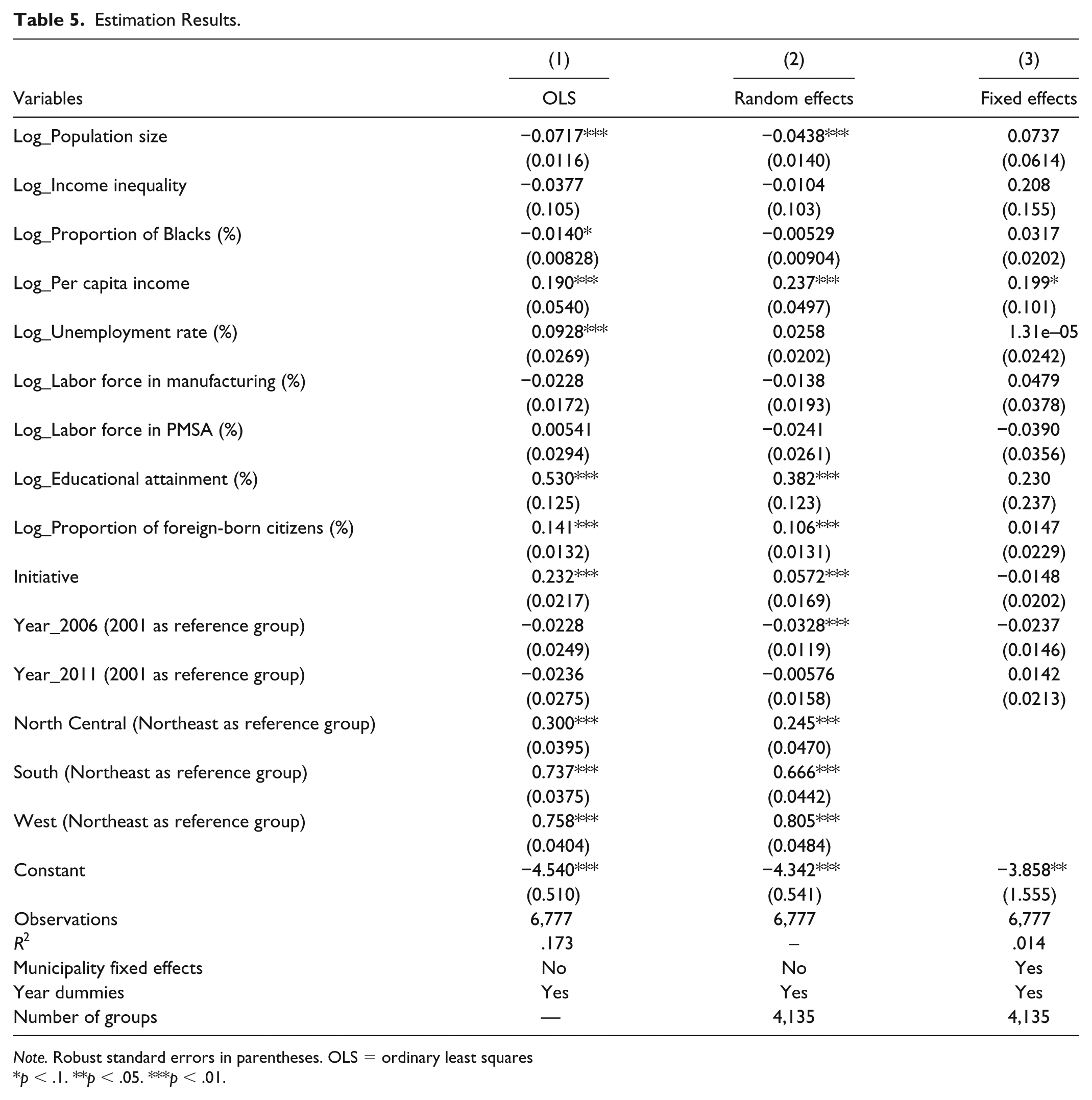
Note. Robust standard errors in parentheses. OLS = ordinary least squares
p < .1. **p < .05. ***p < .01.
Even controlling for a group of explanatory variables in the model, some unobserved factors, such as local political ideology and cultural preference, may be omitted. We therefore add the unobserved and time-invariant factors of municipalities, indicated by
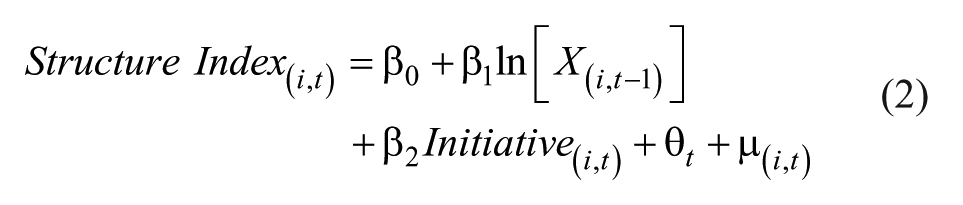
where

Random effects estimation assumes the unobserved and time-invariant municipal characteristics
Last, under the strictest assumption, municipality fixed effects estimation allows the unobserved and time-invariant variable,
Changes of structural characteristics of the samples are seldom and in small scale during the research period (2001-2011), making the variation of the municipal structure political-administrative index small. The infrequency and small scale of municipal structure index change partly explains the elimination of many statistically significant effects in the fixed effects estimation results. In column (3), only the effect of per capita income is still statistically significant. A higher per capita income leads to municipalities adopting structures that are more administrative, which is consistent with the hypothesis and prior studies. This finding demonstrates the important role citizens’ income level plays in determining structural changes of municipalities. The findings mean that the model does a better job of accounting for variation in the cross-section than it does accounting for longitudinal changes of municipal structures.
Conclusions
Conventional wisdom holds that the shift of municipal structures from the mayor-council to the council-manager form began in the early 20th century and continued until the 1950s, after which the balance between these two forms remained stable (Choi et al., 2013; Knoke, 1982). However, based on the Municipal Form of Government surveys conducted by ICMA every 5 years from 1981 to 2011, we find that the proportion of the mayor-council form was still declining, reaching the lowest point at 33% in 2011. In the same year, the fraction of council-manager municipalities increased to around 59%.
Another conspicuous trend in municipal structure adaptations is the development of the “Type III City” when municipalities on each of the two statutory platforms adopt characteristics of the other (Frederickson & Johnson, 2001; Frederickson et al., 2004a, 2004b; Frederickson et al., 2001). The boundary between the statutory forms becomes ambiguous. Research can revisit municipal structures by observing details in composition of the structure and further explore their determinants because municipal structures still matter (Nelson & Svara, 2012).
We examine seven essential components that can distinguish municipal structures and construct a political-administrative index of municipal structures. Examining the determinants of municipal structures on the political-administrative dimension is the main purpose of this research.
We summarize the political conflict theory and class cleavage theory from the related literature and incorporate these theories into our theoretical model of cost analysis. Citizens presumably would like a local government that can be both accountable and efficient. However, pursuing one goal will give rise to increasing cost in the other. The political municipal structure provides the best approach for citizens to make public officials accountable and supplies multiple channels for citizens to express demands and safeguard their benefits, but community policy making or implementation interrupted by frequent political conflicts may cause efficiency loss. Alternatively, an administrative structure has the potential to achieve efficiency due to professional management, but the concentration of authority in the council and the insulation of the appointed professional manager from ballot pressure may lead to insufficient ability of citizens to monitor public officials’ behavior.
We argue that citizens with various socioeconomic and demographic backgrounds have different preferences toward accountability and efficiency and the corresponding monitoring and inefficiency costs. Citizens will tend to choose a municipal structure that minimizes the total of the two types of cost. We collect data and use multiple methods to test our hypotheses. Empirical results demonstrate that the municipal structure political-administrative index is tightly associated with citizens’ socioeconomic and demographic characteristics, most of which are consistent with our predictions and previous studies. Regarding the changes in municipal structures during the sample period, we find from the model controlling for municipality fixed effects that municipalities that have higher per capita income are more likely to adapt toward the administrative structure.
Footnotes
Declaration of Conflicting Interests
The author(s) declared no potential conflicts of interest with respect to the research, authorship, and/or publication of this article.
Funding
The author(s) received no financial support for the research, authorship, and/or publication of this article.
