



Abstract
This observational study of local government coordination brings fresh assessment of institutions and processes of District Coordination Committees (DCCs) in facilitating horizontal coordination across local governments and vertical coordination between federal, provincial, and local governments in Nepal. Necessary qualitative data – observational notes, interview transcripts and selected official publications – were generated based on researcher's two year's professional experience at the DCC in a remote district of Rasuwa in Nepal. Analysis is conducted in line with what John Halligan (2020) has explained as analytical elements of horizontal and vertical coordination. Findings suggest that although DCCs seem less effective local institutions in fostering both horizontal and vertical coordination, they are increasingly providing the most plausible avenues for politicians, administrators, and ordinary people to get together in materialising the constitutional thirst to implement cooperative federalism in Nepal.
Introduction
Nepal introduced a federalist constitution in 2015, with a clear outline of federal, provincial, and local government structures and functions. Each level of government is empowered with constitutionally guaranteed power, resources, and responsibilities. The constitution exclusively envisions that each level of government follows the principle of cooperation, coordination and coexistence while exercising its power, utilizing resources, and thus fulfilling constitutional responsibilities (Government of Nepal, 2015). Much of the efforts to strengthen coordination, however, appear either at the federal level where focus is to enhance horizontal coordination amongst federal ministries and departments, or slightly downwards at the provincial level where concentration is to balance vertical relationships between the federal government and provincial governments. This generates a research opportunity to assess the roles of District Coordination Committees (DCCs), which are placed as political institutions at the intersection between federal/provincial entities and local government agencies.
Although literature on Nepal’s local governance is relatively rich, we do not have sufficient empirical evidence about Nepal's local level coordination mechanisms in the emerging context of federalism. Recognizing that empirical studies on local-level coordination in other (non-federal) developing country contexts provide some perceptions to this research, this study broadly positions itself in the juncture of federalism and local government literature. The specific aim of the research is to understand the degree to which DCCs contribute to broaden horizontal coordination across municipalities in the given geography; and, also to deepen vertical coordination amongst federal, provincial, and local governments.
The paper is presented in five sections. After this introduction, a brief overview of how local level coordination is understood in the relevant literature. The aim of reviewing literature is to locate this research in the broad scholarly platform of coordination studies. This will eventually help to explore the most relevant analytical framework to interpret the fieldnotes, interview transcripts and other supplementary information collected from secondary sources. The third section will explain the methodological aspects of this research. Here, a brief description of the case study is also presented. Next is the presentation of key findings by bringing empirical data into context. The final section will conclude the article by pointing out its practical implications to the studies of local government coordination in federal settings around the world.
Locating the Research in Literature
Empirical evidence on local-level coordination can be traced in two distinct groups of political systems (Evans, Marsh and Stoker 2013; Schugurensky 2016). The first group of evidence focuses on those local governments who operate in a reasonably controlled and centralised atmosphere (Humes 1991; Bardhan and Mookherjee 2006). This group of research is helpful for this study to explore vertical (or, top-down) approaches to local government coordination (Andersson and van Laerhoven 2007). The second group of evidence comes from the relatively autonomous local government atmosphere of which the focus is on horizontal coordination across the entire local governance jurisdictions (Heller, Harilal and Chaudhuri 2007; Aulich and Artist 2011). This second set of research is mostly produced in federal countries or comparatively independent local government jurisdictions (Wettenhall, Power and Halligan 1981). This distinction, nonetheless, is not mutually exclusive.
Three pertinent questions of local government coordination are ubiquitous in the second set of literature. The first is the question of who coordinates among multiple local governments in each territory. Research carried out in the context of ‘controlled atmosphere’ stresses that ensuring coordinated policymaking and implementation among local governments is the role of the central government, or similar other entities that stay at the upper tier of the government (Panday and Panday 2008). Findings of this group of research provide both optimism and pessimism regarding coordination. On the brighter side, top-down approaches to coordination are relatively better, specifically in ensuring strong hold of coordinating agencies. Such ‘hold’ is found to have been maintained through budgetary controls, policy guidelines and other performance related coordination instruments (van Dooren, Bouckaert and Halligan 2010). The darkest side of the top-down coordination is that local governments do not find adequate scale and depth of independence in seeking horizontal coordination amongst their neighbours.
The second question relates to the ‘content of coordination’ which appears in the literature as one of the most contested issues (Heller, Harilal and Chaudhuri 2007). The scholarship on local governance generally favours the notion of local public service delivery as primary content of local government coordination (Benton 2002), though elements of local policymaking are also equally visible in the latest local government studies (Homsy, Liu and Warner 2019; Mayka 2019). Literature on these two aspects of the content of coordination – public service delivery and policymaking – root on decentralisation studies and are transcending in recent times through the public administration literature to the studies of public governance (Osborne 2010).
The third question is about the extent to which local governments themselves initiate ‘coordination’ within their own jurisdictions (sub-municipal), among different municipalities within the proximate geography, and also between upper tiers of government such as provincial/state and federal government. This dimension of coordination is rather broader than previous two dimensions as it encompasses the notion of coordination between government and non-government actors (see World Bank 1997). The available scholarly materials on this particular question suggest the possibility to and need of assessing (a) intra-municipal coordination, (b) intergovernmental coordination from below, (c) collaborative policymaking and service delivery through local governments, and (d) institutions and processes that determine the level, quality and efficacy of coordination mechanisms in different political systems (Wettenhall, Power and Halligan 1981; Kuhlmann and Bouckaert 2016; Bouckaert, Guy Peters and Verhoest 2010). Evans, Marsh and Stoker (2013) argue that this notion of local government coordination provides avenues to think of local governments from the viewpoint of localism, a local government landscape in which local administrators, elected representatives and community people work together to produce specific local public policy or deliver certain local public services.
These reviews take us to the work of Halligan (2020) in which he provides a clear analytical framework to assess coordination mechanisms in public administration systems (Table 1). He defines coordination as a way of governing through institutions and processes that help diverse entities to align tasks and activities while minimizing contradictions (p. 157). Coordination instruments are either horizontal or vertical – though hybrid forms also persist in both analytical frames and practical domains.
Analytical framework to assess local coordination mechanisms.
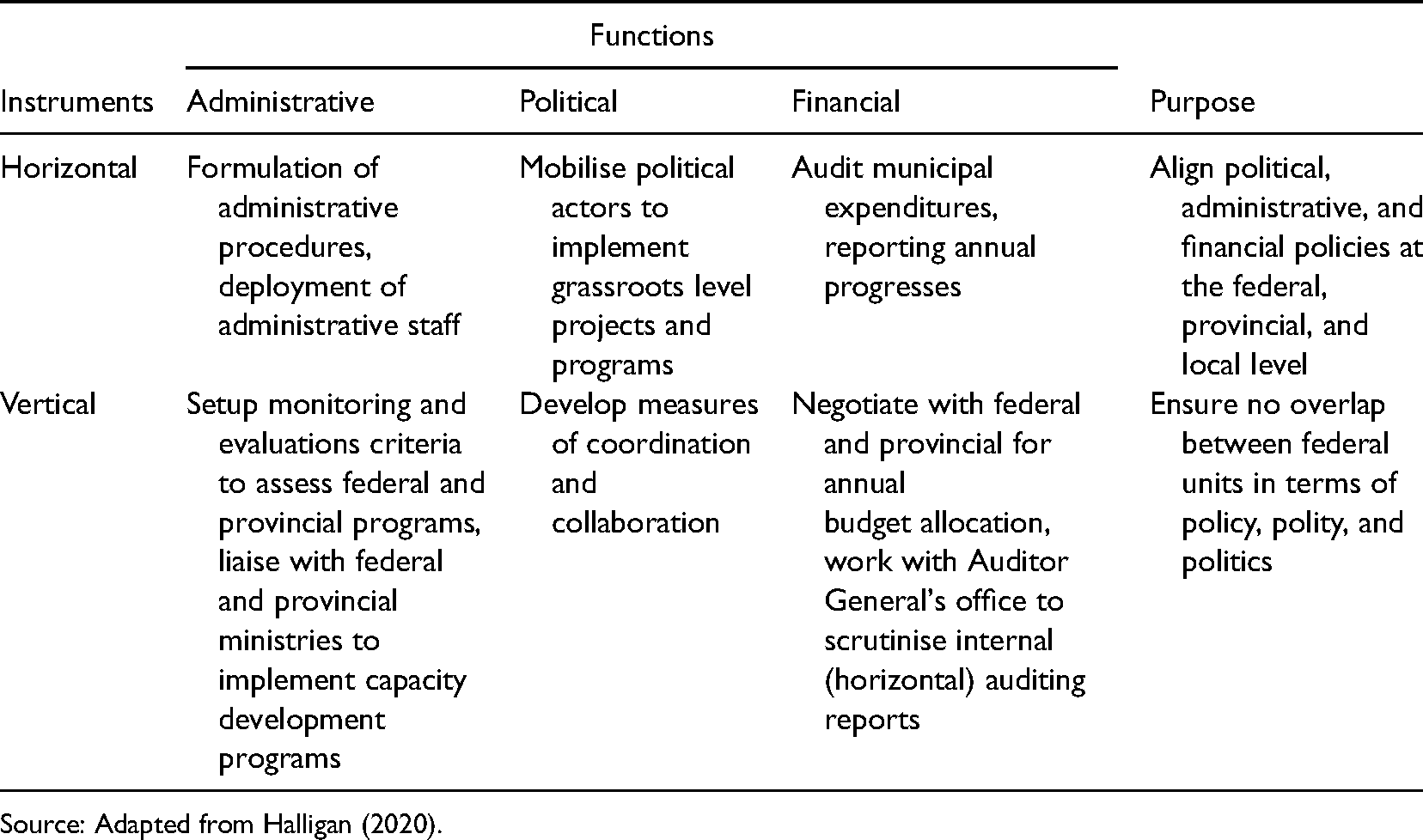
Source: Adapted from Halligan (2020).
This analytical framework helps us to interpret Nepal's district-level coordination mechanisms, their dimensions, purpose, and instruments. The justification of choosing these elements in the analytical framework is their compatibility with the institutional design of DCCs, particularly in its federal setting. As we shall see below, the structure of DCCs features spaces for both horizontal coordination across local governments within a specified territory, as well as vertical coordination between federal, provincial, and local governments. Although Halligan (2020)'s scheme to analyse coordination regime is of general purpose, it perfectly captures Nepal's local government coordination mechanisms devised under the newly promulgated federalist constitution in 2015.
Methodology
This research is primarily based on the researcher's two years long professional experience at the District Coordination Committee (DCC) in Rasuwa district, which is one of the thirteen districts of the Bagmati province in Nepal. Characterised as a relatively underdeveloped district, Rasuwa holds one of the shortest gateways to China. The Nepal-China border at Rasuwagadhi witnesses the daily inflow of hundreds of containers carrying food and other essential items as well as thousands of tourists (in normal times) from China. Of approximately 50,000 permanent residents, Rasuwa features richness in terms of its ethnic diversity: 70 percent Tamang (Tibetan heritage), 15 percent Brahmin (Arya heritage), and the rest is represented by minorities from diverse religious, lingual and ethnic origins (Central Bureau of Statistics 2012).
Although Rasuwa is the focus of this study, the institutional design, operational procedures, scope, and objective of all seventy-seven DCCs in federal Nepal are the same. What differentiates them is their political composition. The political body of the DCCs is chosen by the electoral collages of local governments, mandatorily consisting of at least three women members, one Dalit member and another member from marginalised communities (Government of Nepal 2015, 104). The legal base of the DCCs is generally provided by the provincial legislation, although District Assembly – the legislative body of DCCs consisting of Mayors and Deputy Mayors of relevant district – has the power to formulate necessary modus operandi to operationalise the tasks, including the coordination functions, of DCCs (Government of Nepal 2017b).
The research is predominantly an observational study, though it involves several characteristics of ethnographic research methodology (Ybema et al. 2009). The researcher observed the institution and processes of the DCC in Rasuwa for two years as Planning Officer, facilitating the implementation of several coordinating roles entrusted to DCCs by federal, provincial, and local government legislations. Principal informants of this research are all the nine members of the DCC, five ordinary people, five chairs and five vice-chairs of all the five local governments in Rasuwa district, one member of parliament representing the Rasuwa district, one senior-level official of the provincial government in Bagmati province and one senior level official of Ministry of Federal Affairs and General Administration. All these participants for this research were selected based on their profile of experience, expertise and involvement in the local governance coordination processes. A customised set of semi-structured interview questions – in the Nepali language – was designed to speak with these informants, which has generated plausible answers to the main research question: whether and to what extent DCCs facilitate vertical and horizontal coordination at the local level in Nepal?
Components of analysis have been drawn from Halligan (2020, 156–185) which provides relevant insights on how political systems at different levels of government embrace the notion of vertical and horizontal coordination while addressing the needs of each vertical and or horizontal entity. Textual data were gathered as part of the researcher's two years professional experience at a DCC in a remote district of Rasuwa in Nepal. A big volume of observational notes, twenty-seven semi-structured interviews with ordinary people, representatives of federal, provincial and local governments, and selected official publications were chosen to support the analysis.
Case Study: District Coordination Committees (DCCs)
Article 220 of the Constitution of Nepal envisions the formation of the District Assembly as the principal legislative body at the district level. The DCC is designated as the executive agency of the District Assembly. The Assembly is mandated to formulate legislation to cover the following four distinct yet interrelated functions: (i) horizontally coordinate amongst local governments in the specified territory; (ii) monitor the developmental programs to ensure developmental balance across municipalities; (iii) vertically coordinate between federal, provincial and local governments; and (iv) perform other tasks mandated as per the relevant provincial legislation (Government of Nepal 2017b, 105). The Assembly also has a role to elect the executive team of the DCC by making sure that representation of minorities, women, and Dalits (who are directly elected as ward members in rural and urban municipalities within the given territory) is guaranteed.
Although DCCs seem (of course, they are) entirely new institutions at the local level, previously established District Development Committees (DDCs) also featured a similar notion of coordination across municipalities in the given geographic territory. One of the similarities is the structure and election processes. The Local Self-Governance Act (1999) had clearly devised that DCCs would comprise between nine and fifteen elected members to be elected by electoral colleges. The distinctions, nevertheless, are straightforward: DDCs were established to work as authority of development planning (Adhikari 2006); the notion of coordination among local governments was merely on service delivery whereas modern day DCCs have much bigger scope encompassing political notion (Government of Nepal 1999); and, the DCCs are not empowered with taxation rights (Government of Nepal 2017b).
The analysis of constitutional provisions on DCCs helps us to construct a more detailed understanding of the structure and functions of DCCs. From the constitutional perspectives, the DCCs are highest level local government authorities with the role to vertically coordinate public policies amongst federal, provincial, and local governments as well as horizontally coordinate implementation programs amongst civil society organisations, private sector, and the local government entities. They are the highest level entity in the hierarchy of local governments because the organizational structure, roles and rights are speculated in the Constitution. To what extent DDCs can put themselves in the realm of highest level in the local government hierarchy largely depends upon the political leadership of the DCCs in the given district. As one vice-chair of a municipality expresses: “… regardless of how much power DCCs have been given to, they are mere district-level political entities with no appropriate placement in the functioning of the local government system in the given territory.”
Despite this high status in the constitution, observational notes reveal three key contradictions: institutional placement, staffing arrangements, and functions. With the first one, the DCCs are constitutionally highest-level local government authorities in the district, putting the chiefs of DCCs as equivalent to the Secretary of the federal ministry in the portfolio ranking. However, the chiefs suffer from lack of resources and legal power – meaning that their portfolio ranking is useless. The second is how staffers in the DCC are appointed. All the local governments except the DCCs can hire their staffers through the provincial public service commission whereas the DCCs cannot do so. Instead, the federal government deploys staffers in the DCCs to run all the five key tasks outlined above. The final contradiction is related to the functions assigned to DCCs. On the one hand, the DCCs are established as highest level local governments in the district with constitutionally mandated roles and rights. On the other, provincial governments can promulgate legislation to assign roles and rights to the DCCs. This duality has created ambiguity in terms of DCC's accountability toward federal and provincial governments. Based on the prevailing Local Government Act (2017), the following three key functions of DCCs illustrate how horizontal coordination across local governments and vertical coordination among local, provincial, and federal governments are implemented.
Managerial functions
Managerial functions of DCCs include two tasks: first, day to day administrative activities; and second, management of small-scale events such as awareness campaigns, capacity development programs and representation in policy-specific management boards. In recent times, DCCs are being gradually delegated with several fringe tasks by federal and provincial governments. These tasks include inter alia observing national days at the local level, collecting, disseminating and or validating public information, authorising the works of civil society and private sector, and implementing some small-scale programs if funded by any provincial or federal government entity. These tasks require the DCCs to be managerially competent, both in terms of political and administrative leadership as well as in handling the resources appropriately.
Coordinating functions
Coordinating functions involve multiple actors in the local government process, in which the DCCs stand at the centre (Figure 1). On the top of the figure shows federal and provincial government entities with which DCCs are devised to maintain vertical coordination. Rest of the actors in the figure generally involve in producing horizontal coordination, though their role does not encompass only within the horizontal sphere in the local government process. Although local governments are placed at the bottom in the figure, the role of DCCs in coordinating amongst local governments remains very crucial. This happens especially when big projects are launched by provincial or federal government entities, and such projects aim to produce advantages to residents of multiple local governments. An observational note prepared for this research states: “… the […] power project must offer their corporate social responsibility to the affected communities. These communities belong to more than two local government jurisdictions. The manager of the […] power company wishes representatives of both local governments to sit together to finalise the type of support to be covered from its corporate social responsibility fund. It took the company more than six months to initiate talks between two local governments to conclude the support package but couldn't finalise. Ultimately the chief of the [case study] DCC stepped in, brought all concerned parties to the negotiation table, and settled the support plan.”
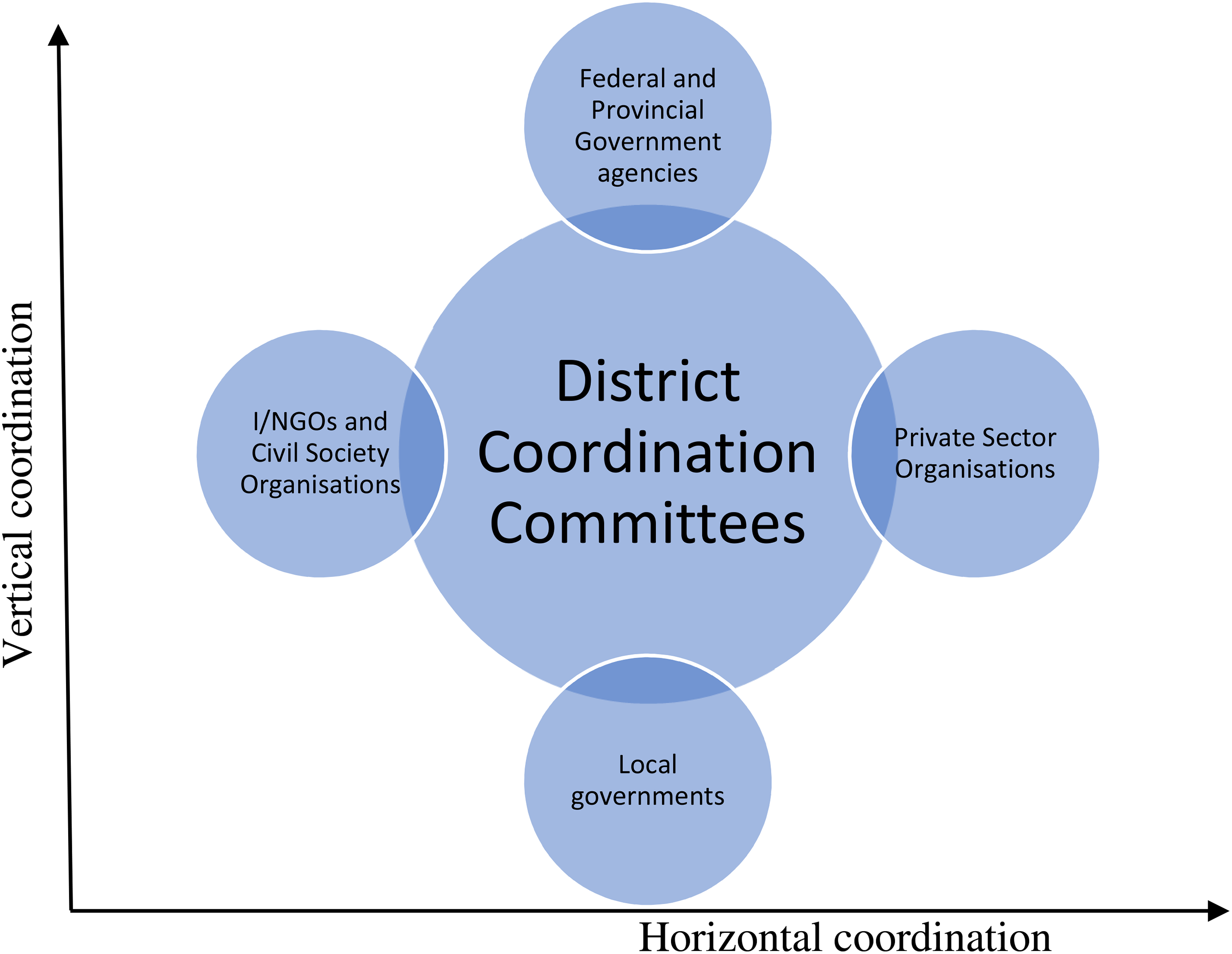
Dimensions of vertical and horizontal coordination.
The coordinating role of DCCs encompass, as the quote above signals, horizontal coordination between civil society groups, private sector organisations and different levels of the government at the local level. The case study district runs 19 privately owned hydroelectricity power projects of which the corporate social responsibility fund is bigger than the sum of total capital budget of all the five local governments. The management of such funds in a coordinating manner is one of the most complex, conflicting, and stressful activities that the DCC in Rasuwa has been handling. With the formulation of coordination guidelines, the DCC is being able to mediate between different actors, including highly influential political leaders, to bring together all the actors in communities to solve the problems associated with the corporate social responsibility fund (District Coordination Committee 2019a). The guideline provides a legislative base for mediating between private-private sector, civil society and not-for-profit sectors, private sector and NGOs, among sub-municipal entities, and between government and non-government actors.
Monitoring and evaluation functions
Monitoring and evaluation functions are the core tasks of DCCs, although there is a question of whether monitoring and evaluation reports of DCCs aim to (i) produce knowledge or (ii) target to fix implementation problems. This function of the DCC is to regularly carry out monitoring and evaluation of development works implemented by government, non-government and even the private sector in a specified district territory. There does not seem any restriction for the DCC to monitor, evaluate and publish the ongoing or completed status of any developmental project. The prevailing Local Government Act (2017) envisions that the DCCs organise yearly review of development programs of local governments and publish the review reports. From this viewpoint, DDCs are the most powerful monitoring entities at the local level (District Coordination Committee 2019b). However, as a member of the DCC puts it: “… the DCCs are like tigers without claws. We are constitutionally authorized to monitor the developmental activities of local governments, yet there is less connection between our monitoring reports and the actual works of municipalities. … Additionally, municipalities have their own monitoring mechanism. We seem unable to create a working-level connection between their monitoring mechanism and our monitoring role.”
Key Findings
This section moves on to explaining the key findings, primarily based on the interpretation of observational notes, interview transcripts and relevant publications. The purpose here is to highlight the peculiarity of the DCCs in terms of their role in laying out foundations for both horizontal and vertical coordination at the district level.
Definitional Ambiguities
The term ‘coordination’ has been found contested in terms of how it is understood at the local level. Although the constitution clearly outlines Nepal's federation as a cooperative federalism with the hope that all the 7 provinces and 753 local government entities coordinate in producing and implementing public policies, a group of ethnic activists and critics claim that each federal unit is independent from others hence ensuring coordination across jurisdiction is their internal definitional matter (Lawoti 2019). The legislative frameworks promulgated to implement Nepal's federalism also do not show much hope to define coordination in implementable manner (Government of Nepal 2017a; National Planning Commission 2021). Failure to recognise the complexity in defining the term has resulted in inter alia generating pessimism among politicians and bureaucrats who work as catalysts in ensuring coordination in policy making, implementation, and public service delivery at federal, provincial, and local level.
The definitional crisis of coordination seems to have its roots in decentralisation debates in the early years of 1980s, which brought ‘local autonomy’ as an inevitable component of devolution (Bienen et al. 1990). While the concept of local autonomy produced an enabling environment to exercise local democracy in Nepal, it did not adequately embrace the avenues for horizontal coordination among local governments at that time (Abullaish 1980). Reformers in the 1990s also focused on decentralising power and resources to local governments; yet, they seemed to have unnoticed the necessity to enlarge spaces for horizontal coordination (Government of Nepal 1999). The modern-day local governance in Nepal thus inherently brings coordination as a mere top-down notion of decentralisation, underestimating to address the needs of federal structures that must work both horizontally and vertically alike. A local politician says: “… I had never heard this word coordination (Samanwoya in Nepali) throughout my 35 years of somewhat political life. After the introduction of DCC in our district, I am gradually realising the importance of coordinated policymaking across several jurisdictions as well as the role of federal, provincial and local governments in collectively implementing certain policies.”
This indicates that the notion of coordination at the local level is grounded in relatively weak foundations of local governance in Nepal, though the emergence of DCCs in the federal setting shows some hope after 2015. In absence of strict constitutional provision of the institutional design and modus operandi, all three levels of the government – federal, provincial, and local – are utilising DCCs according to their practical needs. At the horizontal level, local governments in a specified district come together in the District Assembly to deliberate the district-wide policy and programs. Obviously, not all deliberations produce local public policies that can be implemented jointly by concerned local governments; yet many local government officials find the Assembly as a common platform to share their views on certain policy or development programs in their locality. They perceive the institutional arrangement of the District Assembly as having the potential to (a) boost horizontal policymaking, (b) joint program implementation and (c) service delivery in given local governments. In scenarios where these three tasks of the District Assembly do not work, an additional function of information sharing which can be easily achievable through deliberation in the Assembly. Although the information does not always transmit top-down (from federal government to local governments) or bottom-up (from local governments to federal government) through DCCs, the activeness of the members of the District Assembly can certainly generate effective communication flow across jurisdictions, hence enhancing horizontal coordination.
Complexity of Horizontal and Vertical Coordination Mechanisms
The definitional crisis triggers to think of how complex the existing horizontal and vertical coordination local government mechanisms are in Nepal. Two contradictory aspects of such complexity are distinguished. The first aspect relates to the question of why local governments need coordination, given that the constitution devises them to operate in an unprecedentedly independent atmosphere. The constitutionally guaranteed resources, rights and responsibilities enable local governments to operate in autonomous (if not independent) status, though federal and provincial annual budgetary frameworks and sectoral policy guidelines affect their everyday activities (National Planning Commission 2018). Despite their power to generate revenue from within their geographic constituency, many – if not all – local governments need the support from provincial and federal government which compels them to value the notion of vertical coordination (National Natural Resources and Fiscal Commission 2019). In absence of clear legislative obligations, however, local governments do not need to horizontally coordinate with their neighbours. The DCCs come forward in such circumstances and try exploring the possible policy and programmatic avenues for horizontal coordination.
The second aspect of the complexity in local government coordination relates to the method of vertical and horizontal coordination. As indicated above, tools of vertical coordination appear to be top-down (rather than bottom-up). The institutions placed at federal and provincial level primarily aim to provide policy guidelines and budgetary support to local governments, though they do not undermine the notion of local autonomy devised in the constitution. Such linear placement of different levels of government in a vertical row, in turn, suggests that governments in the lower echelons need to follow the instructions given by the government in the upper tier. An informant representing Rasuwa district in the federal parliament states: “… existing methods of vertical coordination provide the least space to flourish bottom-up coordination. The contradiction here is the question of whether local governments should accept the policy prescriptions or other budgetary conditions imposed by federal or provincial governments, given that the entire local governance regime in Nepal is designed as the third level of government.”
Dispersed Coordination Domains
Findings of this research suggest that local governments find difficulties in locating the domain for coordination. Five diverse domains have been observed where some form of involvement of the DCCs was inevitable to create and flourish both horizontal and vertical coordination (Figure 2). While these domains are not necessarily relevant to local governance coordination only, they have significant implications to the ways specific local governance coordination institutions, processes, mechanisms, and aspects are implemented.
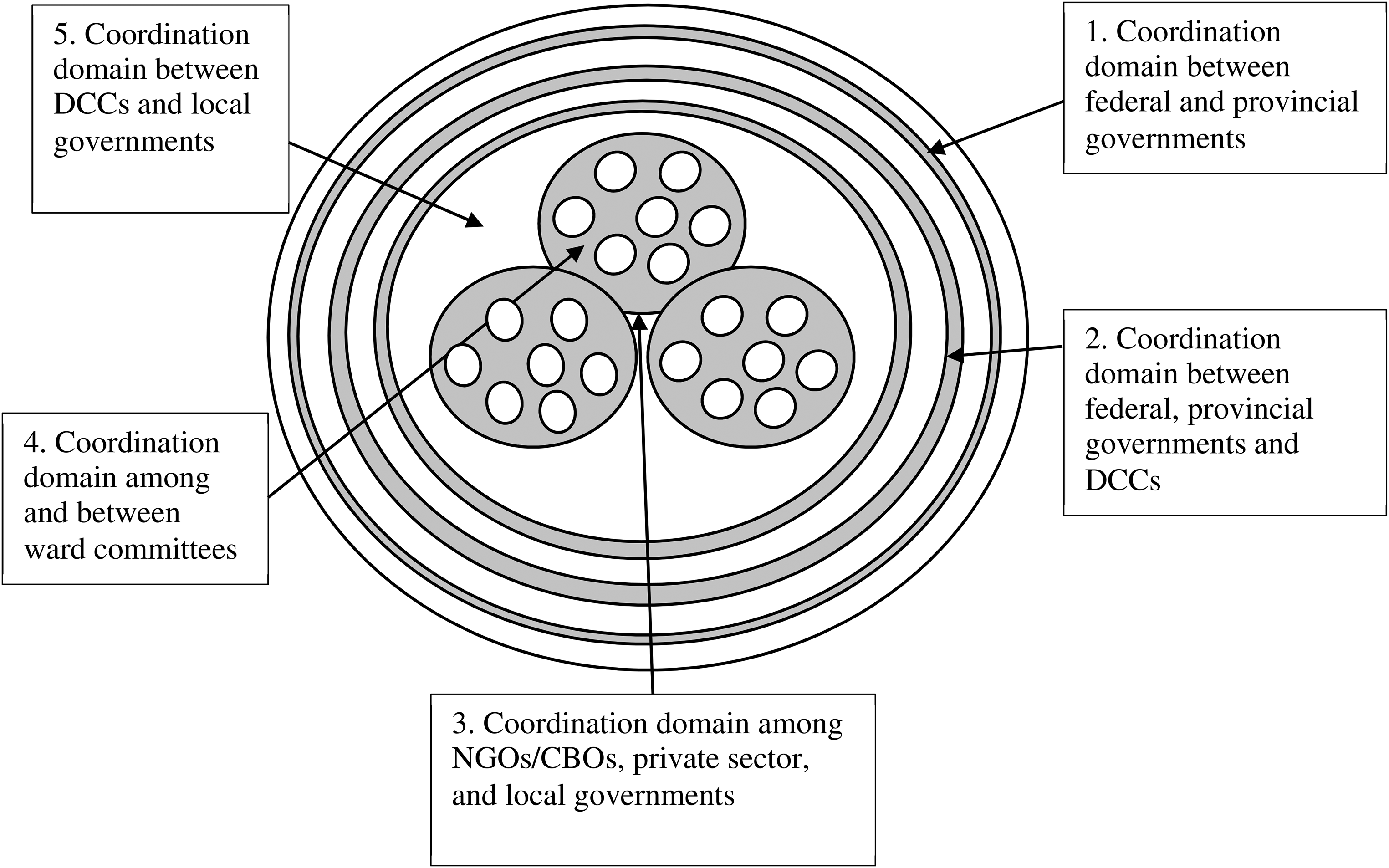
Multiple domains of coordination.
The first domain consists of coordination between federal and provincial governments. The highest-level coordination mechanism between federal and provinces is the interprovincial council, which aims to strengthen coordination between federal and provincial governments. Although the council is of political type, its mandate to mediate between federal government and provincial governments may produce technocratic inputs to the way local governments formulate their annual and periodic policy and programs. Then comes another domain in which DCCs are placed with the hope that such mechanisms play key roles in bringing local, provincial, and federal government in a single domain. As has been noted throughout this article, the DCCs operate between provincial and local governments with clear constitutional mandate to mediate among local governments, between local governments and provincial governments, and between local governments and federal government.
The third domain comprises non-governmental actors including the private sector at the local level. The prevailing local governance act specifically aims local governments to mobilise and regulate these actors with the aim of inter alia avoiding overlap in their works. Although the classical literature on public governance does not always disfavours the idea of overlap and duplication (Ostrom, Tiebout and Warren 1961), reforms in modern-day public sector management aim at minimising duplication in the works of government (Halligan 2020). One problem with this specific task of local governments is that NGOs and big private sectors need to be registered by federal government which orients the accountability of such organisations toward federal institutions.
The fourth domain entails the notion of internal coordination among ward committees within a specific municipality. Bhusal (2020) notes that when multiple political parties represent in the municipal executive committee, the mayor becomes relatively weaker, and that such weakness can produce unpleasant coordination within its municipal decision-making. This research also confirms that ward committee chairs may discourage intra-municipal coordination if they contest with each other, specifically based on their political ideologies. In such circumstances, DCCs may get into the debates and try to bring conflicting ward committees to negotiate. Although different DCCs may have differing ideas in terms of whether they should intervene intra-municipal conflicts, the evidence produced in the Rasuwa district of Nepal suggests that horizontal coordination becomes more common when the DCCs initiate to develop consensus between the mainstream executive board of certain municipality and ward committees (District Coordination Committee 2019a).
The final domain can be traced at the intersectional space between DCCs and local governments. This domain seems to be the core of the entire coordination regime, with implications to both vertical and coordination mechanisms at the local level. In terms of vertical coordination, the federal government institutions situate at the top and ward committees remain at the bottom. Although municipalities do not necessarily go through the usual communication channel of DCCs to go upward to provincial and federal government entities, the DCCs play important yet less significant roles in mediating between local governments and governments above. However, when it comes to horizontal coordination at the local level (as Figure 1 above illustrates), the DCCs bring local actors in several common platforms such as the district-level annual review. Deliberation in common platforms such as the District Assembly produce both conventional and innovative avenues for local actors to work in coordinated manner (Bhusal and Breen 2021).
Policy Coordination or Coordination in Implementation?
One question was found ubiquitous in the implementation of local coordination mechanisms in Nepal: do local governments foster policy coordination, or they grossly aim to strengthen coordination in the implementation of local programs or projects? During the observation of two consecutive year's assemblies and review meetings, members of the assembly kept on recommending expanding horizontal policy coordination across the entire local governance regime in the Rasuwa district (rather than focusing on vertical coordination). While members of the DCCs and other outsiders prefer strengthening horizontal policy coordination, the insiders (mayors, deputy mayors and executives of municipalities) wish for coordination in the implementation of developmental programs. According to a chairperson of a municipality: “… the notion of horizontal policy coordination can be tricky considering local government's constitutionally guaranteed autonomy. That is exactly why our team is in favour of coordination in the implementation of local development programs.”
This rather radical view is challenged by outsiders. A DCC member says: “… when we ensure policy coordination, there grows the obvious possibility to create coordinated implementation of local government programs.”
The idea of policy coordination at the local level is officially stated in several statutory directives of the federal government – perhaps as guidelines (National Planning Commission 2018; Ministry of Federal Affairs and General Administration 2017). The local institutions and processes such as the participatory planning process follow such guidelines, though there remains the question of the degree to which they ensure policy coordination or aim to establish coordination in the implementation of local public policies (Bhusal and Pandeya 2021).
On the other hand, coordination in the implementation of developmental programs and projects also possesses two serious questions. First is the question of implementing agency: who will lead the implementation process should there appear chances to involve two or more than two municipalities in implementing developmental projects? Constitutionally all local governments are equal and remaining one's subordinate cannot be acceptable to the other. The DCCs could lead in such circumstances but they do not have implementation rights. The second question relates to accountability: which municipality is the ultimate agency to be accountable for results? This question is particularly important when projects fail to deliver expected outcomes.
Coordination or Collaboration?
Two competing narratives of local governance – collaboration and coordination – confuse local politicians and appointed officials alike. Although the prevailing local governance legislation loosely distinguishes these two narratives, there does not seem to be any specific implementation modality which would specify the collaboration and coordination roles of federal, provincial (including the DCCs) and local governments. In absence of legislative obligation, local governments generally seem reluctant to have collaborative projects with neighbouring municipalities. However, almost all municipalities in Nepal exhibit diverse forms of collaborative works that involve NGOs, CBOs, private sector along, of course, with provincial and federal government entities (Local Governance and Community Development Program 2008).
This is a significant policy gap which is sought to be solved through coordination mechanisms. Many local governance programs launched by the federal government suggest having coordination amongst the most relevant entities at federal, provincial, and local level (Provincial and Local Governance Support Program 2019). Provincial ministries aim to involve more than one municipality to implement their programs, though local governments are not always devolved with leadership authority in such programs. In the Bagmati province where the case study district is located, provincial ministries are found to entrust the DCCs to lead certain crosscutting programs such as the capacity development programs to implement at the local level. This trade-off between coordination and collaboration has resulted in nothing but a state of confusion about when, how and who should work together in local policymaking and implementation.
When there is clear absence of adequate local collaborative projects that bring neighbouring municipalities together, the question of horizontal coordination becomes more contested. This research is unable to find an exact answer to this question but provides insights on how coordination initiatives – mostly led by the DCCs at the local level – can drive the future of local governance toward collaborative governance. Yet, much hope can be frustrating because the DCCs lack (a) basic resources to be proactive in fostering collaborative efforts, and (b) necessary legislative right to present themselves as the key authorities to strengthen collaborative governance at the local level.
Conclusions
This fieldnote attempted to critically examine institutions and process of Nepal's DCCs in terms of their possible contribution to broadening horizontal coordination among municipalities and deepening vertical coordination between federal, provincial, and local governments. The research finds that although DCCs do not seem to appear as effective institutions in fostering both horizontal and vertical coordination at the local level, they are increasingly providing the most plausible avenues for politicians, administrators, and ordinary people to get together in materialising the constitutional thirst to implement cooperative federalism in Nepal.
Findings of this research have two practical implications to the studies of local governance coordination around the world, particularly those who are or aspire to be federal countries. First, the research has produced references for federal countries which may motivate their leaders to create local governments’ coordinating mechanisms. Such mechanisms may eventually help minimise the roles of provincial or state governments yet both provincial/state and local governments can be benefitted. Second, provincial/state government agencies can take institutions like the DCCs as their collaborators to implement provincial/state development programs, which otherwise cannot be implemented either by only provincial agencies themselves or a specific local government alone.
One of the limitations of this research is that its findings are generally related to the DCC in Rasuwa district of Nepal. Although all the seventy-seven DCCs in Nepal are based on the same institutional design prescribed by the constitution, differences in terms of their working procedures, budgetary allocations, and role in facilitating horizontal and vertical coordination may differ across provinces. This research is unable to capture those possible provincial differences. Future research may therefore endeavour to have comparative in-depth studies of local government coordination, featuring provincial governments as the key designers of the DCCs in Nepal.
Footnotes
Declaration of Conflicting Interests
The authors declared no potential conflicts of interest with respect to the research, authorship, and/or publication of this article.
Funding
The authors received no financial support for the research, authorship, and/or publication of this article.
