




Abstract
The Janus vs. AFSCME District 31 legal decision forced all U.S. public-sector unions to operate under “right-to-work” conditions: any union fees for those covered by a union contract are now optional. Past experiences of successful public-sector unions operating in right-to-work states should offer lessons to all public-sector unions on how to succeed. This article examines the history and recent success of the United Faculty of Florida, a statewide higher education public-sector union. Critical turning points, crises, and lessons from that history are included.
Keywords
Introduction
Public-sector unionism remains one of the few bastions of union strength left in the United States after decades of decline in union density and power in the private sector. According to the United States government Bureau of Labor Statistics, in 2018, union density (percentage of the workforce in a union) was 33.9 percent in the public sector while the corresponding private-sector percentage was 6.4 percent (BLS 2019).
For this reason, conservative and right-wing organizations and forces in the United States have mostly shifted their focus from decimating private-sector unions to doing the same to their public-sector counterparts. Organizations such as the American Legislative Exchange Council (ALEC), Richard Berman’s many anti-union groups and websites (including the Center for Union Facts), the National Right-to-Work Foundation and many others have increasingly attempted to severely weaken or destroy public-sector unions in the past decade.
The primary focus of this assault on public-sector unions has been a legal one. In 2018, the United States Supreme Court delivered a major victory to anti-union forces with its Janus vs. American Federation of State County and Municipal Workers District 31 decision (Killion 2018; Liptak 2018). The Janus decision forbid public-sector unions from collecting agency fees (fees from nonmembers to cover the costs of representation, typically 75%-90% of regular union dues), effectively making all public employees in the United States “right-to-work” employees. (In the private sector, only some states impose this same exception to national labor law on unions, mainly those states governed by anti-union conservatives.)
Janus was widely considered to be a severe blow to public-sector unions (Bravin 2018). Preliminary evidence shows that most agency fee payers stopped paying the fees after Janus, but also that the unions lost less money than may have been expected, perhaps due to revived internal and external organizing efforts and increased actual membership (Iafolla 2019).
In any case, public-sector unions across the country will now face the same conditions as those who have been operating in a right-to-work environment prior to Janus. For that reason, it is instructive to examine the experiences of those unions that have been operating in a right-to-work environment all along to determine what makes for success or failure in that environment.
This article surveys the evolution of one such union, the United Faculty of Florida (UFF), which has always operated under right-to-work conditions. This union has grown both numerically and in union density (percentage of the covered workforce paying union dues) in the past decade and a half despite political attacks and a generally hostile state environment. We first examine the milieu within which the UFF operates, the Florida higher education system. We then examine the size and health of the UFF over the decades since its inception in the 1970s. Finally, we attempt to draw some lessons from the UFF experience for other public-sector unions now facing right-to-work circumstances.
Faculty Unionism in the Florida Higher Education System
Florida’s right-to-work provisions are not simply contained in a law but are instead incorporated in the Florida constitution (Article 1, paragraph 6). While the entire south and much of the nation is now “right-to-work,” Florida stands out as a “right to collectively bargain” state. Virtually unheard of in the south, the same constitutional provision that disallows mandatory union payments or the right to strike also provides that public-sector workers are guaranteed the right to bargain collectively through a union of their choice if they so desire. This is important because it gives union rights to all public-sector workers that cannot be taken away simply by law or executive order; to do so would require a revision of the constitution itself, which is a difficult and lengthy process. Thus, public-sector Florida workers can unionize but only under right-to-work conditions.
After the 1968 Florida teacher walk out (the first of a series of teacher uprisings in the United States not unlike today’s historical moment with the “Red for Ed” statewide strikes) where over thirty-five thousand teachers resigned en-masse and picketed and rallied across the state, the courts eventually forced the “Dixiecrats” (conservative Democrats) in the legislature to extend collective bargaining to all public employees, albeit without the right to strike (McGuire 1973). This finally opened up collective bargaining to public higher education faculty in 1976. That same year, the faculty at all state universities (which were all governed by one employer, the state Board of Regents) voted to unionize. The statewide UFF was born, with one centralized local and chapters at all ten state universities. The UFF bargained one collective bargaining agreement statewide with the Board of Regents; local chapters could bargain additional local supplemental provisions that covered only their own chapter but the main outlines of faculty working conditions were contained in the main agreement. The UFF had initially unionized as a local of the American Federation of Teachers (AFT) but it left that union and joined the National Education Association (NEA) in 1978. In 2000, along with all other AFT and NEA teacher unions in the state, UFF became jointly affiliated with both national teacher unions and the AFL-CIO (American Federation of Labor and Congress of Industrial Organizations; Bradley 2000).
In the 1980s, faculty at community colleges began to unionize in the state. (In the mid-2000s, the legislature granted authority to community colleges to grant bachelor’s degrees and shifted the nomenclature from “community colleges” to “state colleges.”) At the current time, Florida has twelve state universities and twenty-eight state colleges and community colleges. All twelve universities have UFF collective bargaining chapters and fourteen of the twenty-eight colleges do. UFF also has four Graduate Assistant United (GAU) chapters as well as one university faculty chapter in the private sector. It includes no adjuncts within its ranks; the Service Employees International Union (SEIU) is currently aggressively organizing adjuncts in the state (Bittle 2018) 1 .
The UFF has evolved in numerous ways from its inception until the present. The following section traces this evolution with special emphasis on the post-2000 period and analyzes the underlying conditions and reasons for periods of relative stagnation versus growth.
The Evolution of the UFF over Time
The purpose of this section is to briefly trace the “health” or “vitality” of the UFF over the decades between 1976 and 2019. There are numerous ways to measure the relative strength or power of a union over time. In this article, we want to initially use objective and quantitative evidence of the evolution of the union’s strength and organizational competence to indicate its health; only in later sections will subjective judgments based on firsthand knowledge and involvement by the authors be added to flesh out the picture.
Although it is not a perfect measure, in a right-to-work state, the union’s density (percentage of its bargaining unit who are members and pay dues) is a pretty good indicator of union competence and functioning. More effective unions tend to have higher density, and higher density unions tend to be more effective. Density is certainly a measure of how much the chapter is inviting colleagues to join up and communicating at a minimum, and often the higher the opt in membership, the stronger the unity and solidarity within a unit. In a fair share setting, everyone in the unit was paying toward the union, and many members are members almost automatically. In a right-to-work setting, particularly in the south, every member must make a conscious decision to join up and support their union.
In addition to strictly quantitative empirical union density figures, later portions of this article also involve assessments of and reasons for the changes chronicled, and these assessments require some qualitative judgments of the union’s inner workings. Both authors of this article are centrally located within the union, one as a previous chapter activist and veteran staff-person and one as a statewide leader and former chapter leader.
This “insider’s” perspective provides both advantages and disadvantages in determining the accuracy of our assessments and conclusions. On the positive side, internal familiarity gives a greater knowledge of the union local’s actual operations, minimizing the likelihood of ignorance about factors that may be critical but not apparent to an outsider. On the other hand, being positioned within the organization may introduce a bias toward being overly positive (or perhaps overly negative) toward the changes chronicled. To guard against the latter possibility, we have shared drafts of this article with other knowledgeable individuals both within the local and without. None have found the picture portrayed to be exaggerated in either a positive or a negative direction. Furthermore, we have relied primarily on empirical evidence (in addition to union density, factors like actual changes in staffing, actual changes in union committee functioning, actual changes in organizing of new chapters, etc.) as the markers of real change, not subjective impressions of the authors. 2
So for much of this analysis we will use union density as our chief measure of union health and effectiveness. Because the composition of the membership has changed over the decades (addition of college chapters, addition of GAU chapters, etc.), we can only ensure “apples to apples” and “oranges to oranges” comparisons if we confine our initial analysis to the density of university faculty chapters, which is what we do in the earlier parts of this analysis. (Both qualitative judgments and data beginning at a later starting period will also address the health and densities of the college and GAU chapters in a later part of this article.)
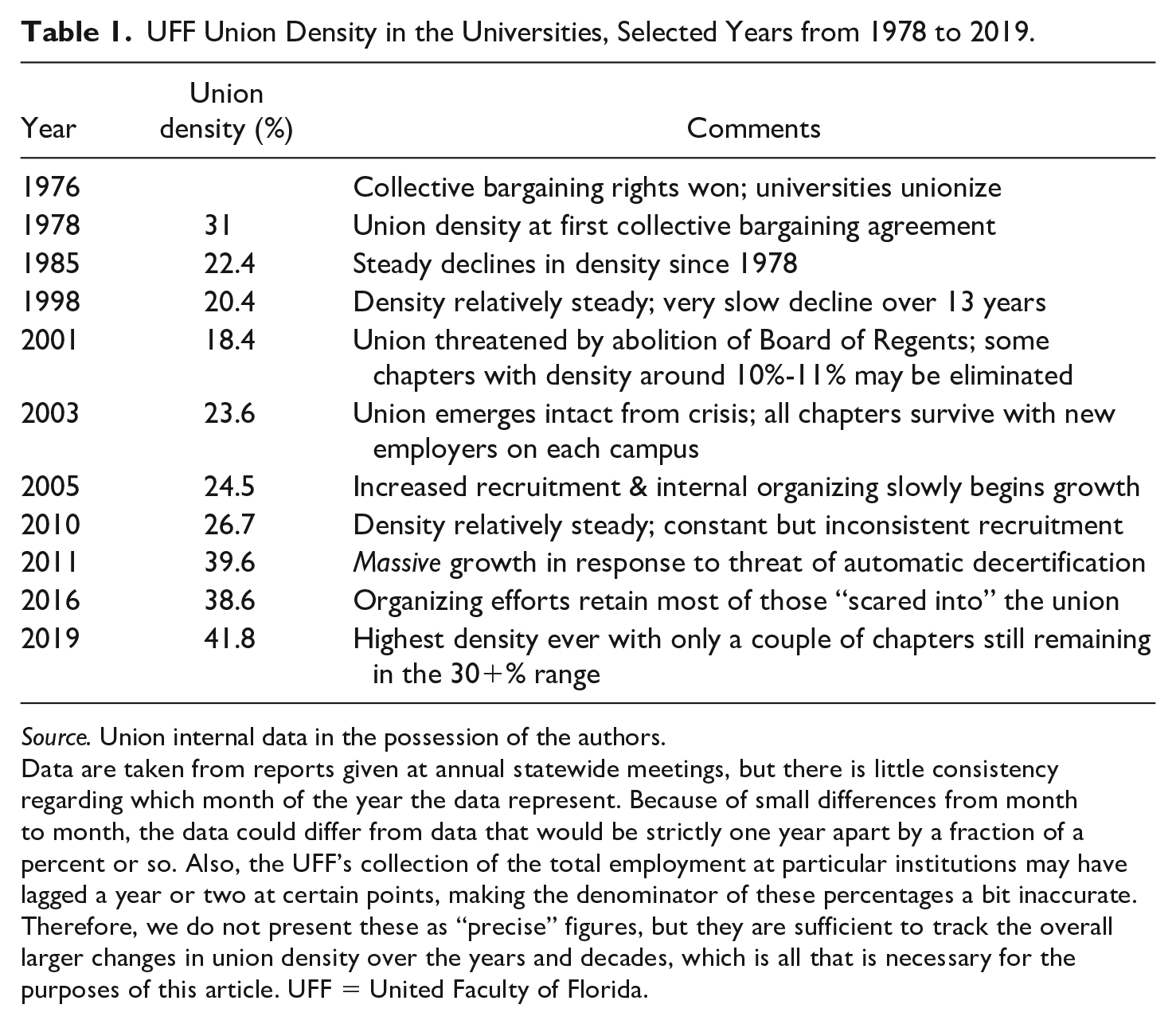
The UFF experienced a slow decline in union density after its initial founding, followed by periods of turnaround and organizational revitalization. Here, we will examine both the external jolts and internal changes that account for these changes. Table 1 shows UFF union density in the universities for selected years between 1978 and 2019.
UFF Union Density in the Universities, Selected Years from 1978 to 2019.
Source. Union internal data in the possession of the authors.
Data are taken from reports given at annual statewide meetings, but there is little consistency regarding which month of the year the data represent. Because of small differences from month to month, the data could differ from data that would be strictly one year apart by a fraction of a percent or so. Also, the UFF’s collection of the total employment at particular institutions may have lagged a year or two at certain points, making the denominator of these percentages a bit inaccurate. Therefore, we do not present these as “precise” figures, but they are sufficient to track the overall larger changes in union density over the years and decades, which is all that is necessary for the purposes of this article. UFF = United Faculty of Florida.
As Table 1 shows, union density in the universities over those years fluctuated from under 20 percent to over 40 percent. The third “comments” column explains background conditions during the time each density figure occurs. Chart 1 shows the same trends in graphic form.

Membership trends: UFF membership density in university faculty chapters, selected years.
Both Table 1 and Chart 1 show that from 1978 to 1998 and through to 2001, the union declined in relative size and power; density dropped from 31 percent in 1978 to 20.4 percent in 1998 and 18.4 percent in 2001. After that density grew either incrementally or explosively to its current high point above 40 percent. What explains the differences?
Part of the answer lies in changes in the focus and operation of the union. During its first two decades, the union was strongly and narrowly focused on bargaining a collective bargaining agreement and enforcing that agreement. Other aspects of union power such as political activism/influence or internal organizing and recruitment were not a priority. This was especially true for internal organizing and recruitment of new members but was also true to a lesser extent in the political arena.
When one of us (Bruce Nissen) moved to Florida and joined one of the chapters in 1997, he seldom heard any mention of membership activation or recruitment, either at the chapter level or at the twice-a-year statewide UFF statewide Senate meeting. Occasional political topics were brought up but only in the form of asking chapters to generate a few calls to local legislators to counter some particularly bad legislation. A few chapters had functioning political action committees or a newsletter, but the vast majority did not. And virtually no chapter had an active membership and recruitment committee.
A union has three main sources of power: bargaining and enforcing a contract, political (and community) influence, and membership organizing and growth. The UFF during this period was narrowly and lopsidedly focused on only the first. This brand of unionism, variously known as “the service model,” “business unionism,” “contracts R us,” “insurance policy unionism,” and other such names, encourages a strictly transactional relationship between bargaining unit members and the union. Viewing the union as akin to an insurance agency or a law firm, bargaining unit members ask, “What have you done for me lately?” The union is not viewed as “
With so little emphasis on membership recruitment or member ownership and involvement, it is not hard to understand the many years of stagnation and slow decline in union density. Figure 1 illustrates the lopsided emphasis on contract negotiation and enforcement compared to the other aspects of a healthy well-functioning union.
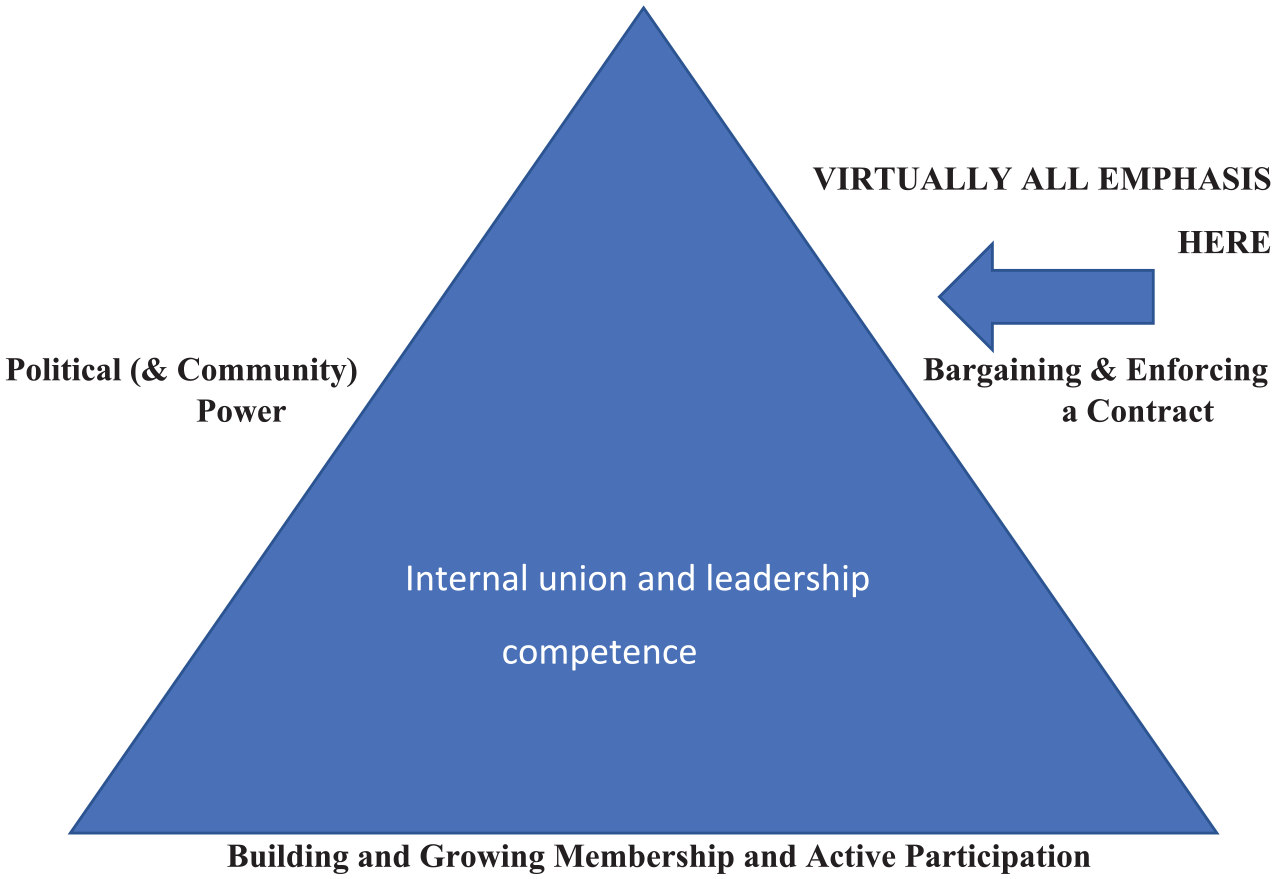
Sources of union power: UFF emphasis prior to 2000.
Giving very little attention to membership growth and participation (the base of Figure 1), the union had been concentrating primarily on the right-hand line of the “union triangle,” making for an unbalanced union that was not optimally effective.
Turning Point 1: Crisis Years 2000-2003
Table 1 and Chart 1 show that the years 2000 through 2003 were a turning point: decline turned into growth. Union density of 18.4 percent among faculty in the state universities in 2001 turned into 23.6 percent by 2003, and by 2005, it had grown to 24.5 percent. The question is, what explains the turnaround?
The answer begins with an external shock that drove the union to change its internal culture in a manner that made for a more effective union. In 2000, newly elected Florida governor Jeb Bush and the Florida legislature abolished the state Board of Regents (the employer of UFF bargaining unit members) and replaced it with individual Boards of Trustees on each university campus. Eleven new employers replaced the previous unitary one effective July 1, 2001. Almost all the new Boards of Trustees members were businessmen and women who were generally associated with Governor Bush. They consistently held anti-union perspectives, and all eleven boards refused to recognize the union. Instead, they declared their campuses union-free overnight.
This assault on the UFF stimulated internal changes that were to have a lasting impact. Some large UFF university chapters, including the flagship University of Florida which was also the founding chapter of UFF, at the time had a union density as low as 12 percent. Union survival on these campuses was in serious doubt. Since the existing collective bargaining agreement lasted for a couple of years, the union had a short window to reconstitute itself and win recognition on all eleven universities.
The union responded rapidly. The national affiliates (AFT and NEA) funded six staff organizers to assist chapter members to build Organizing Committees that would contact all bargaining unit members in person to collect union authorization cards on each campus. (One of the co-authors of this article, Candi Churchill, was hired on as a union organizer at this time. She and four of the six organizers were leaders in UFF-Graduate Assistants United chapters at the time.) By the end of the fall semester in 2002, the members succeeded in collecting between 62 and 93 percent cards and setting up organizing committees with department representatives and communications teams on all campuses within a matter of months. The minimum number of authorization cards required under Florida’s law is 30 percent.
Although the university boards of trustees denied that they were colluding with each other, their behavior made this denial look suspect. All had uniformly refused to recognize the union even after being presented with union authorization cards representing well over a majority of each bargaining unit. And just as would be done if a “union buster” was in charge, the two universities where the union’s density was lowest (barely over 10% in both cases) were the first two to demand an election to determine faculty sentiment about the union.
The UFF won both of those elections with over 90 percent voting in favor of the union. All of the organizers hired to cover the state were deployed for these elections. Whatever its weaknesses, the union had protected the rights and interests of public-sector Florida faculty enough that the faculty overwhelmingly supported its existence when asked to vote yes. These lopsided union victories ended any further elections; boards of trustees at other campuses one-by-one slowly chose to voluntarily recognize the union on the basis of the majority signed cards. By 2003, all but one of the universities had recognized the union and were setting out to bargain a successor agreement. The University of Florida, the state’s flagship, only recognized UFF after a lawsuit that went up to the District Court of Appeals in 2005 (Chun 2005; Showalter 2005).
These crisis years 2000-2003 created an internal change in the union. Although the change was uneven from chapter to chapter and far from complete, more university chapters developed active membership committees and activists within buildings that learned how to recruit potential members into the union and encourage existing members to become active in the organization. The recertification campaign focused on identifying leaders within departments to collect (re)authorization cards and build UFF’s presence at the building level. There was not one single issue driving the reauthorization campaign, the overall campaign was about faculty collective bargaining power versus unilateral administration power, and the broad message of having a legally binding agreement on their own campus was appealing. There was a statewide contract to build upon and at every campus, faculty preferred to keep a legally binding agreement rather than lose that protection entirely. Membership was not the focus; developing leaders and getting cards signed in a short time was the charge. The mantra from the Organizing Project staff led by AFT National Representative Norm Holsinger was to always “build the committee” and that “new leaders will emerge.” While a robust department rep structure did not outlast the crisis, new leaders did emerge, and many chapters kept organizing in an intentional way for first contract campaigns, something not done previously.
Inadvertently, the reorganization of the state universities created an opportunity for more members to engage in collective bargaining at the local level, directly on their campus. Bargaining teams needed to be formed, trained, and supported at the campus level, rather than at the state Capitol (a two or even nine-hour drive for campus leaders). The co-authors assert that this shift designed to break up the UFF actually brought more responsibility and power closer to the rank and file faculty, rather than having mostly staff and a small team negotiate for them at the state capitol. More chapters also created functioning political action committees or rejuvenated such committees that previously had been moribund. Because of this, once the crisis abated UFF chapters did not resume stagnation and decline. As shown in Table 1 and Chart 1, UFF density in the universities increased from 23.6 to 24.5 percent from 2003 to 2005. The union’s internal culture became (to a limited degree) more effective: more participative, less lopsidedly focused on contract bargaining and enforcement conducted in private spaces, more focused on membership growth, more politically active and assertive. This partial and uneven change probably accounts for the small but steady growth in union density from 2001 to 2005.
Between Crises: 2005-2010
The years 2005-2010 showed that the (still limited) change in union culture and functioning was not simply a temporary response to a one-time crisis. During those years, union density did not drift downward although it only increased slightly, from 24.5 to 26.7 percent (see Table 1 and Chart 1). As noted previously, the more “all-sided” nature of the union that now included recruitment and political activity probably was partially responsible for this mildly positive trend. But other changes within the union probably also contributed.
First, the union’s extremely small field staff (grown from one to three persons during these years) was augmented in 2005, 2006, and 2008 and geographically spread throughout the state (rather than having all union staff in the state capital headquarters way north in Tallahassee, far from the large population centers in Florida). This bolstered staff support for local chapter leadership development and functioning. The UFF Organizing Project that lasted from 2002-2006 was phased out, but the lead organizer (and co-author) was hired on as UFF staff, bringing the organizing model with her.
Second, more UFF chapters “opened up” bargaining and made it more transparent to the membership and campus community as some of the more effective unions in the United States had done (Najimy 2016). Even though all collective bargaining is open to the public under Florida’s broad “Sunshine Law,” previously bargaining happened in the state capitol with little engagement from—and often even little communication to—the rank and file members. This increasing visibility accelerated the union’s transition to a membership-empowering “power organization” model to replace the servicing bureaucracy model. Basic tactics included one-on-one issue surveys, town hall and “brown bag lunch” meetings in departments, task forces and regular invitations to attend negotiations and updates. These tactics began shining a light on the work of UFF chapters and moved the organization forward toward a more robust union.
Third, the union changed its grievance representation policy in 2008 (Auxter 2016; Nissen 2018). Unique to Florida, that state’s public-sector unions have to negotiate a collective bargaining agreement that covers all members of the bargaining unit, but they do not have to enforce that contract for nonmembers. (Post-Janus, probably all public-sector unions in the country will have the same option: if money is speech and forced payment of an agency fee is a violation of “free speech,” then almost certainly forcing a union to spend money to represent nonmembers is also a violation of its free speech rights.) Prior to 2008, the UFF represented all—member and nonmember alike—equally in the grievance procedure, in that year, it changed its policy to enforce the contract only for members. (In rare instances where a major standard or union principle is involved and only nonmembers rights are violated, the union will file a group “chapter grievance,” but in practice, this virtually never happens—nonmembers are on their own if their contractual rights are violated.) This changed policy likely scared some “free riders” into the union, although the change was not large.
A fourth factor that will not be fully investigated here is the union’s ability to prevail on job protections and legislative issues. During the economic downturn of 2008-2010, the boards of trustees at the University of Florida (Crabbe 2010; Stewart 2009) and Florida State University (Schmidt 2010), the most prestigious of Florida’s universities laid off dozens of faculty as a result of austerity measures stemming from budget cuts from the legislature—they were laying off certain faculty even while they were posting jobs and hiring more faculty elsewhere in the same university. In separate grievance cases, UFF was able to have the lay-offs rescinded due to strong contract language protecting a fair lay off process and proved that the university management violated the Collective Bargaining Agreements. Tenured and even non-tenure-track faculty got their jobs back. These wins proved that legally binding contracts, and a solid organization to back it up, were meaningful and powerful even in times of budget cuts. Additionally, UFF and allies repeatedly blocked legislative and Republican activist attempts to allow open carry of weapons on Florida’s public colleges and universities. Students, faculty, police chiefs, and the public united against these attempts, with UFF playing a prominent visible role stopping the bill multiple times (Flannery 2015).
All these factors appear to have enabled the union to retain its union density and to grow very slightly, if correlation of factors can be trusted to infer influence. But the next large upsurge in density grew out of one more external threat: a legislative threat to automatically decertify any public-sector union with less than 50 percent density.
Turning Point 2: Crisis Year 2010
In 2010, the Florida state legislature advanced a bill to automatically decertify any public-sector union that did not have over 50 percent membership density. Unlike previous such threats, this bill advanced rapidly and appeared to be heading toward passage in the legislative session in spring of 2011. Almost all UFF college chapters had over 50 percent membership density, but virtually all university chapters were below it, some very far below. In response, UFF university faculty chapters engaged in an energetic and massive recruitment campaign on university campuses in the spring of 2011. This time, there was no Organizing Project, but the three state staff of UFF assisted volunteer teams with one additional borrowed staff organizer from NEA. Only on one campus (University of Central Florida) were staff flown in to “blitz” the campus. The message in one-on-one conversations was simple: “Are you willing to lose your collective voice and your union contract with the standards and protections it provides? If not, you
The response was rapid and huge: union density from 2010-2011 jumped over 48 percent on the university faculty chapters (see Table 1 and Chart 1). This was especially apparent on the “flagship” campuses that had been among those campuses previously most resistant to the union. At the University of Florida, union density jumped from 23 to 41 % at Florida State University, it more than doubled from 21 to 44 percent in one year, translating into over four hundred faculty joining up in a matter of months. The surge in membership made for a much larger union, but scaring people into the union was not likely to retain the new members once the external threat subsided unless chapter leaders could involve many of these new members at least minimally and show that the union was the faculty, not a servicing bureaucracy to be bought for a fee (dues) during an existential crisis.
This decertification bill was eventually derailed at the end of the legislative session, thanks to the AFL-CIO and other public-sector union advocates, particularly the more Republican-friendly police and fire union leaders who were exempted, but an amendment was passed to an education bill some years later that does require 50 percent membership for all K-12 instructional units. At the time of this article’s completion, not one instructional unit in the Florida Education Association lost certification due to membership under 50 percent. UFF dodged a bullet in 2011 and remains vulnerable should this bill come to pass. In the years following, the UFF continued to grow as shown in the next section.
Growth and Success Following the Second Crisis: 2011 to the Present
From 2011 to 2019, the UFF shows signs of maturing into a more effective multifaceted power organization. In those eight years, union density in the universities held steady and even increased slightly from 39.6 to 41.8 % in addition, increases in density in the college and GAU sections of the union (detailed in the next section) coupled with organizing new chapters at previously nonunion colleges increased union membership greatly. Several university chapters passed the 50 percent mark: Florida Agricultural and Mechanical University (a historically black university, a “HBCU”), Florida Gulf Coast University, and Florida Atlantic University. As of 2019, UFF membership is well over eight thousand, more than double what it was in 2010.
UFF continues its balanced approach to collective bargaining, membership recruitment and growth, and political activity from the 2005-2010 period, but it also has acquired a more strategic and proactive approach to all its work. Here we detail briefly developments post-2011.
First, the union now does regular and extensive training on all aspects of its functions at biannual statewide meetings. Previously, this was ad hoc and upon request. Emphasizing “best practices” at statewide meetings, chapters share success stories and how to run an effective chapter. Some of the basics included annual strategic planning with a calendar and goals, running effective meetings that members will want to return to, and improving chapter communications (press interviews, email and text communications, one-on-one organizing conversations). More advanced chapters share lessons about winning paid parental leave improvements, building more protections for “specialized faculty” (faculty not on the tenure), and advocating and organizing faculty in less union-dense areas (engineering and business, for example). In addition to ongoing programs for leaders in collective bargaining and contract enforcement, specialized organizing and recruitment training is provided. Member organizing academies were held in six areas of the state in 2016, and ongoing training continues. Such extensive training is paying off in growing internal organizational capacity to recruit and organize in an ever-growing number of chapters. The emphasis on organizing that started with existential crises evolved into an ongoing approach to the work of identifying and supporting many leaders at the campuses level.
Second, in 2018, the UFF instituted a new internal organizing program (funded by the national affiliates AFT and NEA) known as the “UFF Organizing Fellows Program.” This program trains and pays members on a campus to do internal organizing (activate the existing members, asking them to “step up” and build their voice on campus) and recruitment (bring in new members from the bargaining unit, asking them to “step in”). UFF Fellows are paid $20 per hour for up to ten hours per week to engage in these activities as a team. In its first year, the program has shown generally favorable results, particularly at Florida Atlantic University and Florida Gulf Coast University, where the new UFF Organizing Specialist and organizing-centered chapter leaders led their chapters to cross the 50 percent membership threshold when they had hovered in the mid-40 percent range for years. The Fellows program also seems to be helping to build a dedicated organizing cadre in the GAU chapters. However, this program is too new to know the long-term benefits. Historically, UFF has not grown by paying members to build their chapters, but rather utilized staff to assist in identifying and supporting member volunteers who embark on the necessary conversations and issue organizing that involves the many rather than the few. Outside a crisis, it has been challenging to create the kind of urgency and energy necessary to make a sustained organizing campaign successful.
Third, in 2012, the union replaced its former Executive Director with another who is much more focused, strategic, and proactive. (The changeover resulted from the forced removal of the previous Executive Director by the statewide leadership body following dissatisfaction with his performance.) The new Executive Director operates in a strongly participative manner with leaders and field staff, strategizing with them about ways to address strengths and weaknesses around the state. Staff are encouraged to act as coaches and trouble shooters to help the members and leaders, rather than acting as pseudo attorneys or insurance representatives. As Executive Director of the UFF, he now produces an annual report that strategically evaluates the union’s accomplishments over the past year and sets plans and goals for the coming year to carry out the elected leadership’s will. Consequently, the union now is much less likely to simply react to problems and events as they occur: it is much more strategic and proactive.
Fourth, further changes in staff have added to the union’s strategic repertoire of operational resources. Previously all field staff were expected to do all tasks related to the chapters within their jurisdiction, but in reality they were forced to continually “put out fires” and respond to the servicing needs of their chapters, usually around contract bargaining and enforcement concerns. Even with fifty-hour work weeks, little time was left for strategic union building work. The new Executive Director said “yes” to inquiries from college faculty who wanted to organize and reallocated resources so that some staff were able to focus more on organizing while others were primarily focused on the labor relations aspects of the work. Previous inquiries from faculty who wanted to organize were not made a high priority. Sustained membership retention and growth has allowed the union to add new staff, and in 2017, a fourth field staff-person was hired solely as an “Organizing Specialist,” rather than a “Service Unit Director.” This shift in priorities toward more organizing is now reflected in actual staff and resources, enabling the union to organize (both internally and externally) much more effectively.
Fifth, the shift in priorities and resources shows results in organizing success. Since 2016, faculty at six new units (five colleges and one newly created science, technology, engineering and mathematics [STEM] university) have won collective bargaining rights and built their own UFF chapters while the union has lost only one organizing campaign at a college. Demonstrating that the change in union culture is genuine, virtually all internal organizing and organizing of new chapters is being done by faculty on organizing committees (not outside staff). Paid union staff and UFF elected leaders train and guide the on-the-ground organizers, but do not do the work “for” them (Flannery 2019).
As noted previously, UFF has grown to over eight thousand members. This is more than double its size in the period 2000-2009. With the possible exception of the GAU units (which are exceedingly hard to make a majority phenomenon), the union’s current short-term goal is to achieve more than 50 percent density in all its chapters. To do that, chapter leaders and staff need to embrace a critical assessment of strengths and weaknesses and commit to a plan to embark on a campaign (i.e., a membership drive, organizing around issues, contract campaign). Without a core of members ready to grow and do the work of building participation among members and a one-on-one campaign to recruit potential members, density growth is unlikely. Getting density up is not possible without a wider and deeper leadership team, so the work of building density begins with building activity among existing members and identifying leaders who have the respect of their colleagues. Longer term the goal will be to rise to ever higher levels of density and win on more of the chapter’s demands to the boards. The UFF is still far from a perfect union but it has made large strides toward becoming a more powerful and effective public-sector union in a right-to-work state.
Filling out the Picture: College and GAU Units
In order to keep comparisons of union density figures consistent (“apples to apples”), the previous discussion focuses solely on the university faculty chapters of the UFF. Yet, the UFF also has chapters on state college and community college campuses as well as four units of graduate teaching and research assistants. This section briefly focuses on these chapters to give a more complete picture of the union as a whole.
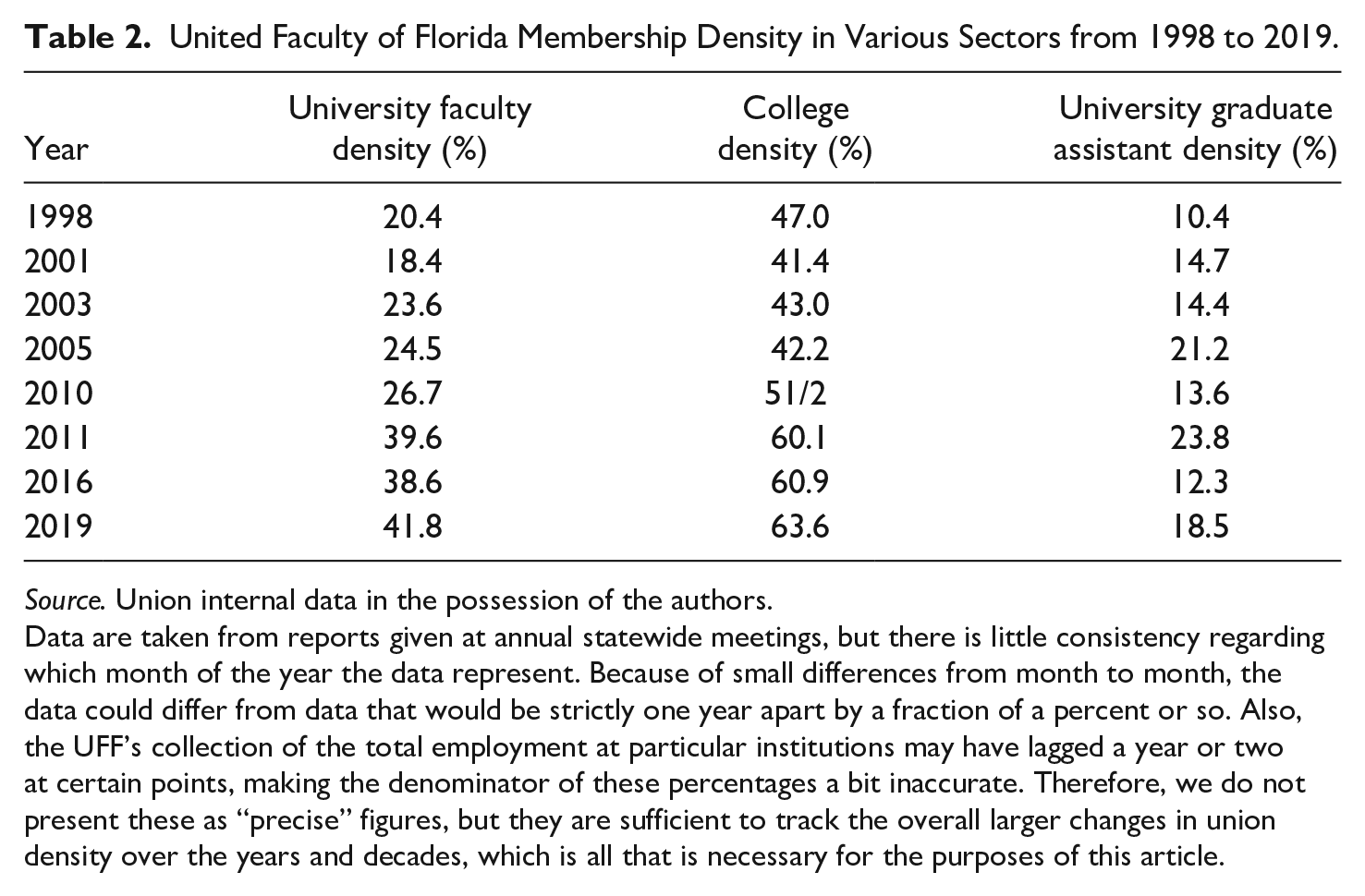
Table 2 shows the union density in each of the three sectors (universities, colleges, graduate assistants) for the years 1998 through 2019 (we lack data on colleges and graduate assistant units prior to 1998).
United Faculty of Florida Membership Density in Various Sectors from 1998 to 2019.
Source. Union internal data in the possession of the authors.
Data are taken from reports given at annual statewide meetings, but there is little consistency regarding which month of the year the data represent. Because of small differences from month to month, the data could differ from data that would be strictly one year apart by a fraction of a percent or so. Also, the UFF’s collection of the total employment at particular institutions may have lagged a year or two at certain points, making the denominator of these percentages a bit inaccurate. Therefore, we do not present these as “precise” figures, but they are sufficient to track the overall larger changes in union density over the years and decades, which is all that is necessary for the purposes of this article.
Chart 2 shows the same data graphically.

Membership trends: UFF union density in various sectors, selected years.
As shown in Table 2 and Chart 2, UFF college chapters have always had higher union density numbers than have universities. During the entire period post 1998, college union density was always over 40 percent (even when university density was down in the 20% range). It is much easier for college faculty to understand that they are teachers and workers and consequently that they need a union than it is for some university faculty who are granted much more autonomy and individualistic choice in course and textbook selection as well as individualistic research expectations on the job.
It also seems to be a matter of sheer size. College chapters range from forty-three to 450 total faculty with an average size of 225, while university faculty units range from sixty to 1800 total faculty, with an average size of nine hundred. Graduate assistant units range from two hundred to four thousand. With so few UFF staff (four are in the field at this time with only two prioritizing internal organizing and union building), volunteers must take up the day-to-day recruitment, contract enforcement, and bargaining labor. Organizers working large university campuses can log eight miles in a day going to door-to-door. With staff consulting and guidance, the colleges seem to be able to physically reach everyone in their units and function with their volunteer base. University faculty seem to need an external crisis or dedicated full-time staff to get their density up with a few important exceptions that deserve more analysis than this paper seeks to provide.
The college chapters have also benefited from the overall rejuvenation of UFF: in 2019, the college chapters collectively had a union density of 63.6 percent (up from 42.2% in 2005), the highest it has ever been. The pattern of college union density growth roughly parallels that in the university sector, although the more rapid growth began a little earlier (between 2005 and 2010). It is important to note that the 2010 threat to public-sector unions with less than 50 percent union density also threatened the college chapters, not merely those in university chapters.
College chapters represent 13 percent of the UFF’s overall bargaining unit numbers and comprise 23 percent of the membership. It is apparent that the college chapters contribute an important and disproportionate percentage of the union’s full membership; this is likely to be even more true in the future as more and more faculty at nonunion colleges reach out to unionize with the UFF. (UFF has one chapter at a private university, St. Leo University. They have a small, but participatory faculty body and their membership density is currently 59 percent. They typically caucus with the state college chapters due to size and culture but are the only unionized private higher education institute in Florida.)
The GAU chapters have by far the most difficult terrain on which to establish a stable and powerful organization. Graduate assistant chapters have been more activist based and excellent at bringing in new leaders and constantly recruiting new volunteers. They also tend to mobilize for collective action more than full-time faculty union leaders, not shying away from holding picket signs, joining campus and community rallies, holding marches and creative demonstrations on campus as tactics to build power and win on issues. They lose approximately one-fourth of their bargaining unit every year to graduation or dropping out. They work only part-time and are often subject to the whim of a certain professor or graduate coordinator concerning ongoing employment. Research assistants can be difficult to find, locked away in inaccessible labs or without space to work on campus. Graduate employees are considered expendable and are the last in line for any consideration as employees. (On the other hand, this makes them the most “progressive” in their attitudes toward broad social issues and workers’ rights: at union state senate meetings, they consistently vote and make proposals of the most “left” or class-conscious character.)
Over the period covered in this essay, the GAU chapters averaged a union density between 10 and 24 percent, usually nearer to the bottom of this range. One new GAU chapter was organized in 2009 at Florida State University, and authorization cards and membership cards were solicited in concert for the first time in UFF, so they started out with a membership base of over five hundred dues-payers. The unit size is three thousand, and the card drive and vote were won with a super majority through volunteer member leaders. Many graduate employees at other universities have reached out over the years but not met the minimum benchmarks to move a campaign forward. UFF sets a high standard for a union drive: a 10 percent organizing committee with leaders representing various parts of campus, and over 50 percent assessed as supportive. Campaigns are all done with a single organizing card now, so membership and union authorization cards must be signed by 60 percent (or as close as possible), leading to deeper commitments and a more reliable base of support from the unit than going forward with the mere 30 percent required by law.
With the 2011 decertification threat, the University of Florida GAU chapter reached nearly 40 percent membership through an aggressive volunteer member-led one-on-one campaign. There was some staff support for training and coaching, but the chapter activists led the drive from start to finish. Their remarkable growth eroded back to their 20 percent average within a couple of years, however, though a new cadre of leaders strengthened the chapter immensely. Several of the leaders now benefit the broader labor movement as full-time professional union staff, as was the case with the crisis campaign of 2001-2005.
As of 2019, the overall GAU union density was 18.5 percent, relatively high but not an absolute peak for this sector. As shown in Table 2 and Chart 2, the overall trend in union density is upward, but much less markedly than in the other two sectors. Explanations for this are somewhat speculative, but we hypothesize that the less impressive growth trend among GAU units is because a more unstable and structurally less powerful workforce like this requires greater union staff resources to thrive than does the university or college sector. (It is notable that the GAU workforce shares many commonalities with the adjunct workforce being unionized by the SEIU, and that the SEIU has [almost certainly out of necessity] put much greater monetary and staff resources into organizing and servicing its new units than does the comparatively poor UFF absent national union assistance.) Because this sector probably requires more paid staff effort, we expect the new Organizing Fellows program paying members to recruit for up to ten hours per week to work particularly well for graduate assistants in the future.
These four chapters comprise 39 percent of the UFF’s bargaining unit numbers and 20 percent of its members. GAU chapters tend to recruit most of their new members during Fall new teaching orientations, then they mobilize through socials and bargaining fights. While chapters are working on developing a stable worksite structure, it has been challenging to move to the next level with the constant turnover.
In 2019, the combined college and university density of UFF chapters was 46.6 percent (college: 63.6%; university: 41.8%). Lower GAU density brings the overall UFF density down to 35.6 percent across the entire system. Exempting the GAU chapters at least in the short run, UFF’s immediate membership goal for the near future is to get every college and university chapter above 50 percent union density. For a public-sector union in California or the northeast with 70 or 75 percent membership and a history of operating in a “union shop” environment, that may seem to be a modest goal but it is important to note that the trend in membership and effectiveness is strongly in the right direction, and also that the history and state government attitudes toward unions for such unions are very different than that for Florida. This article does not address and is not able to assess the comparative status of the UFF with other higher education unions (or public-sector unions in general) because we lack the comparative union density data. In any case, the direction of UFF union density/size/power has been in the positive direction and thus its experiences should be instructive for other higher education and public-sector unions wishing to move in that same direction regardless of their current state.
Lessons from the Experience of the UFF
The evolution of the UFF should hold lessons for public-sector unions operating under open shop right-to-work conditions in the post-Janus era. Here, we analyze the UFF experience to determine what factors make for a more effective and powerful union under these circumstances.
The first lesson to draw is that a virtually singular focus on collective bargaining and contract enforcement essentially behind closed doors in times of stability will lead to stagnation and decline in membership and internal vitality. The union must constantly focus on organization-building. This includes constant organizational focus on recruitment, member activation, and leadership development. While this lesson may seem obvious, it is frequently breached in practice. As co-author Candi Churchill has coined, “in UFF, we are putting the collective back in collective bargaining” and attempting to build a culture that is participatory and inviting. Easier said than done, but UFF is heading this direction and more people are joining and stepping up as a result.
A second lesson is that times of crisis that include threats to the union’s future can be a tremendous opportunity to shake a union out of lethargy if there are individuals within the primary and secondary leadership levels and/or within the staff who recognize the opportunity and take advantage of it to create major internal change. This is a variant of the old adage, “Never let a good crisis go to waste.” A similar point is made by labor historians Jeremy Brecher and Tim Costello in their book chapter, “American Labor: The Promise of Decline” (Brecher and Costello 2018). In the case of the UFF, the crisis points of 2000-2003 and 2010-2011 were decisive turning points that turned the union into a more powerful organization. Legal and technical strategies in times of crises will fail if not in concert with a vigorous one-on-one organizing campaign. You might win the lawsuits but have no real power or organization if the singular focus is in the hands of a drawn-out legal system (no matter how skilled the attorney and righteous the cause, the lesson is that a union must organize to be successful).
A third lesson is that the union’s internal culture (meaning its central preoccupations and ways of conducting itself) is critical but is usually ignored as a subject of self-analysis. The union’s earlier lopsided focus on “insurance policy unionism,” its almost totally reactive way of conducting business, and its failure to strategically focus on building a power organization were big obstacles to building an effective organization, just as its later reversal of all these characteristics improved the organization. These are factors that can be critically assessed and acted upon if leadership and staff are aware of them and choose to systematically and routinely do so.
A fourth lesson is that national affiliate support for local union revitalization can be a crucial addition, especially if it is aimed at clear organizational results and is contingent on local member activism to carry out the needed work. In this case, national union support to provide staff to help the membership recertify all ten university chapters in 2001 (2002-2006) and later to fund programs like the 2018 UFF Organizing Fellows Program played a crucial role in building the union.
In addition, NEA Higher Education Organizer Valerie Wilk has been a supplemental field staffer and knows the hallways and offices on many Florida campuses. AFT and NEA field organizers who work with local leaders even a few weeks a year go a long way in supporting local leaders and building their skills and confidence. National staff that come in and supplant the work of leaders without buy-in and participation is just not effective in the long term, as was the case at one campus where dozens of temp staffers were flown in and quickly got over one hundred memberships. Within a semester, those new members dropped their membership as the crisis abated and they had no relationship to the person who signed them up. When a colleague recruits a member, few ever resign once they make the decision to join in a right-to-work environment. Paying members to recruit is a new experiment in UFF to build a cadre of lead organizers around the state, but the growth outlined in this paper has come from member volunteers with very little staff or funding. Organizing Fellows should not supplant the need to find and develop leaders in the buildings who take ownership in their union any more than staff should supplant that much needed broad ownership and buy-in.
A fifth lesson is that building internal capacity within the membership and leadership pays off over the long run. The post-2011 training that the union repeatedly engages in is bearing fruit as shown by the substantial growth in membership and union density and internal union functioning. Training should not be overlooked or ignored, but many unions give it only lip service or confine training to a very small number of top leaders or supporters of the leadership.
Trainings should not be “sit and get” lectures either. They must be practical in that practice and skills are emphasized and action based, with members sharing successes and concrete tools for other members to utilize and build upon. UFF has developed an organizing booklet and makes it available for other unions to use and repurpose called “Building a Powerful Grassroots Union.” The Labor Notes website and book Secrets of a Successful Organizer has proven very helpful to UFF staff and membership teams with free handouts and tested workshop activities that engage members and inspire change. 4
A sixth lesson is that the orientation of a union’s staff and leadership makes a decisive difference. Vision, experience with issue organizing and strategic focus should not be underestimated compared to technical skills. In the UFF’s case, the transition to a new strategically focused Executive Director with decades of a proven track record building unions and the hiring of talented and committed field staff have strengthened the union’s organizational capacity many-fold. The union now grows and gains proficiency even absent a crisis, a far cry from previous periods of stability that resulted in stagnation and decline. Elected leadership also matters: in 2001, the union elected a statewide president who supported an emphasis on recruitment and growth, a decided change from his predecessor. All statewide UFF presidents since have supported the new emphasis on organizational growth and often travel to the campuses to assist chapter leaders. UFF’s focus has shifted from the bargaining table in Tallahassee to the members in the labs, libraries, and classrooms. While unions cannot “pick” elected leaderships the way they can staff, both the staff and conscious members can and should be looking to develop and nurture future leaders at all levels who exhibit strategic vision and leadership potential. Staff and leaders are needed to help build and inspire teams to accomplish their goals, not write contract language or answer grievance inquiries full-time.
For all the successes during these two decades outlined above, there is certainly room for self-criticism. While it is better to have staff and leaders at the top who believe in an organizing culture over a service model structure, the organizing culture among the chapters is uneven, to say the least, and too much of the direction is still led by staff or a handful of leaders with little member input. The co-authors really have more questions than answers: how does UFF move to a union with a proactive power agenda? Taking cues from the bargaining for the common good approach with the recent teacher uprisings, what is UFF’s plan to win “the schools our students deserve”? How does UFF create a bottom up, rank and file led union culture that is sustainable and healthy with limited staffing? The answers to these questions will have to be wrestled over in the years to come. To date, the UFF has certainly not moved to the next level as a power organization that can win what our students and members really want instead of merely surviving constant attacks. But it has been moving in that direction. We are particularly concerned with the sustainability of the union’s growth and culture change and hope that we are not merely describing a “spurt” of growth soon to be followed by a relapse into stasis and a servicing model mentality. The only answer we have to the sustainability question is to “bake into” the union’s practices, trainings, rituals, communications, language, hiring, meetings, committee structures, elections, electoral issue foci, and so on, the type of organizing practices we have been describing above. But we do realize that a change in staffing or leadership or other factors could result in retrogression; it seems that organizing and sustaining an organizing culture is a perpetual task, at least until there is a decisive change in the political orientation and culture of the country at large.
Conclusion
Public-sector unions newly facing mandatory right-to-work conditions under the Janus decision face new challenges that will almost certainly require them to operate in a manner different from what they did earlier. The experience of similar unions operating under right-to-work circumstances for decades can be instructive for such unions.
This article examines the experiences and evolution of the UFF and concludes that unions can operate effectively in a right-to-work environment, but it requires an organization-building internal union culture, leadership, and practices. It demonstrates how these things evolved in the UFF and draws lessons from its experience for other unions similarly situated. A central feature of all the lessons drawn is the centrality of creating of an “organizing culture” within the union.
Footnotes
Declaration of Conflicting Interests
The author(s) declared no potential conflicts of interest with respect to the research, authorship, and/or publication of this article.
Funding
The author(s) received no financial support for the research, authorship, and/or publication of this article.