




Abstract
When American Federation of Teachers-Local 527 launched their collective bargaining campaign in 1965, they were one of five mostly segregated teachers’ locals in New Orleans and represented a minority of the system’s educators. Spurred on by the National, who saw them as the lynchpin to organizing the South, they held a three-day job action, the first teachers’ strike in the South, in 1966 and then a longer nine-day strike in 1969. Through these mobilizations, they connected their demand for collective bargaining to racial and economic equity in the schools, aligning themselves with Black students, parents, and lower paid support workers. In the early 1970s, New Orleans underwent an ambitious faculty desegregation program that transformed the schools and led to the merger between Local 527 and the majority-white National Education Association (NEA) local to form the United Teachers of New Orleans (UTNO). Although faculty desegregation was a top-down reform, the union capitalized on teacher integration to form intentional alliances across race and mobilize new members. Following the merger, UTNO renewed their call for collective bargaining, eventually pressuring the board to approve an election in 1974. I argue that by positioning racial justice as central to their union organizing, prioritizing participatory democracy among membership, and engaging in civil rights unionism, UTNO succeeded in achieving collective bargaining when so many other Southern cities failed.
“Do you think the teachers were supported by the community?”
“Of course. They were the community.”
“We were the first teachers in the South, white or Black, who ever walked off the job. We were the real saints because we didn’t know whether we were going to have a job or not.” Veronica Hill (1994)
Introduction
In spring 2018, teachers walked out in protest in six conservative-leaning right-to-work states in the West and South. They connected their own struggles—rising health care costs, stagnant salaries, and proposed pension changes—to the quality of education their students were receiving, arguing that more education funding would increase retention, lower class sizes, and provide crucial textbooks and materials to enhance learning (McCartin, Sneiderman, and BP-Weeks 2020; Turner, Lombardo, and Logan 2018). These widespread teacher walkouts made 2018 the year with the most workers involved in strikes in the United States since 1986 and demonstrated the rhetorical power of connecting the needs of public sector workers to larger injustices in the sectors where they work (Van Dam 2019). These protests received significant media attention, especially because unions in the South and West are typically weaker than their counterparts in the Northeast and Midwest, and echoed civil rights-era union organizing that expanded demands for equality beyond the workplace. Although the most famous civil rights-era strike may be that of the Memphis sanitation workers in 1968 (Honey 2011), educators at the time also drew on the power of the civil rights movement to fight simultaneously for workplace rights and equitable schools for Black children.
However, as teachers unions became more successful in the late-1960s and early-1970s, many union leaders, including American Federation of Teachers (AFT) president Al Shanker, began to see due process and seniority protections as in tension with civil rights goals (Kahlenberg 2007; Podair 2002). For example, in 1968, Shanker led the New York City teachers in a months-long strike protesting the transfer of mostly white and Jewish teachers accused of racism by Black district administrators, which effectively destroyed the Black community’s experiment in community-controlled schools (Perlstein 2004; Podair 2002). In the subsequent decade, conflict between majority-white teachers unions and Black communities became commonplace, with Black leaders often accusing unions of deprioritizing the needs of Black students (Shelton 2017). One powerful counterexample is United Teachers of New Orleans (UTNO; Local 527). Not only did UTNO win a collective bargaining agreement, a relative rarity for teachers in the South, but they did so by effectively combining struggles for economic and racial justice and by aligning themselves with Black students and parents pushing for educational justice. Following their successful collective bargaining campaign, UTNO held two successful strikes and maintained the largest local in Louisiana for nearly thirty years until policymakers fired all union employees and destroyed the union following Hurricane Katrina in 2005 (Garda 2011; Buras 2016).
UTNO’s initial collective bargaining campaign, which ran from 1965 to 1974, demonstrates the power of civil rights unionism, a precursor to the “social movement unionism” of today which links union drives to a broader social justice agenda intended to improve the life chances for women, people of color, and the expanding service workforce (Johnston 1994). Historian Robert Korstad (2003) uses the term “civil rights unionism” to refer to the 1940s organizing by a coalition of early civil rights activists and CIO trade unionists—as well as Communists—which looked to combine working class insurgency with the Black freedom struggle (see also: Hall 2005; Honey 1993; Jones 2007; Kelley 2015; Korstad & Lichtenstein 2007). While the strikes and union growth of the 1940s fizzled out due to an employer counteroffensive, the beginning of urban deindustrialization, and the anticommunist backlash of the Cold War years (Korstad & Lichtenstein 2007), civil rights unionism emerged again in the public sector with the 1960s wave of Black protest. This reinvigorated civil rights struggle, as well as the Black power movement that followed, inspired new labor organizing, more militant union action, and the integration and democratization of existing unions (Isaac & Christiansen 2002; Jones 2010). As part of this organizing wave, UTNO educators, many of whom were civil rights movement veterans, connected their struggle for collective bargaining to dignity and rights for Black people.
UTNO drew on organizing strategies popular in the civil rights movement, such as promoting participatory democracy among members (Charron 2009; Polletta 2002; Ransby 2003), and their collective bargaining campaign centered redistributive justice, both economically, like most unions, and also racially, as they fought for increased Black employment and civic power, and quality educational experiences for all public schoolchildren. Their work was bolstered by top-down reforms by the district, including a radical program of faculty desegregation, which the district implemented in an effort to avoid losing federal funds (Cortez 1996), and the appointment of a superintendent who had experience in collective bargaining districts and believed that bargaining improved education. These factors demonstrate how the success of organizing depends on shifts in both state structures and the ideologies of those in power (McAdam 1996). However, the scarcity of other powerful Black or integrated teachers unions in the South in this era speaks to UTNO members’ ability to take advantage of the opportunities presented and push for fundamental changes in the education system.
During the process of faculty desegregation, the union orchestrated a rare merger between the AFT and National Education Association (NEA) locals, which also brought white and Black teachers together in the same organization. Unlike typical roads to integration, in the UTNO merger, white teachers joined a Black group under the leadership of a Black president, upending notions of professionalism, race, and hierarchy in a moment when most whites still would not allow their children to attend schools run by Black principals. This was an extraordinary move for unions at the time. When the AFT mandated the end of segregated locals in the South, after Brown v. Board in 1954, every white local refused to integrate and the AFT lost approximately 14 percent of its total membership (Dewing 1973). The racial dynamics among teachers unions in the North, which tended to have majority white members, were not much better. The Black community viewed contentious strikes in Ocean Hill-Brownsville, New York, Detroit, Pittsburgh, Philadelphia, and other cities as examples of middle-class white teachers striking against the mostly Black and Latinx children they taught (Perlstein 2004; Podair 2002; Shelton 2017). In Newark, NJ, where the teaching force was 40 percent Black, two teacher strikes in the early 1970s tore racial rifts through the community and the union, leaving scars for years to follow (Golin 2002). Even within New Orleans, UTNO’s interracial collaboration was notable, as staffer Bob Crowley (personal communication, March 10, 2020) explains, New Orleans was still very segregated and here, we have the Blacks and the whites coming together. I mean, we got all the ink, we got all the TV we wanted. ‘How’s the merger coming? How’s it working, whites and Blacks together?’ And it was very fortunate that at that time that we were perceived as a progressive force, an enlightened force. And it was very popular that we had integrated the organizations.
Throughout the campaign, but especially during president Veronica Hill’s tenure, the teachers presented a positive image of working and middle-class Black women willing to engage in militant protest to demand rights, both for themselves and for the students they taught. Their actions challenged gendered and racialized ideas of which categories of people have access to “economic citizenship” (Kessler-Harris 2003) and starkly illustrated the inequities of the status quo. UTNO achieved success by acting beyond traditional modes of labor organizing to combine struggles for racial and economic justice into a larger redistributive agenda as well as actively mobilizing their rank and file members and the larger community. In this, they were a proto-social movement union, building member leadership and connecting teachers’ workplace struggles to the injustices facing Black students and families (Turner & Hurd 2001). White elected officials and stakeholders resisted the campaign, with the school board denying the local’s original appeals for collective bargaining and neutralizing two strikes in the late 1960s, the business community continuously voicing their opposition, and a segregationist white local expressing dissent and filing lawsuits at every turn. Yet UTNO succeeded, demonstrating the power of teachers unions that prioritize Black leadership, member democracy, and community engagement. At the same time, the rarity of other effective campaigns in majority-Black southern cities suggests the real challenges of organizing against both white supremacy and economic exploitation simultaneously. Today, as teachers across the country fight for improved working conditions for themselves and better opportunities for learning for their students, they would be served by considering UTNO’s example, both because of what they achieved and because of the obstacles they had to overcome (see Table 1 for a summary of major events in UTNO’s collective bargaining campaign).
Major Events in the History of AFT Local 527, 1965-1974.
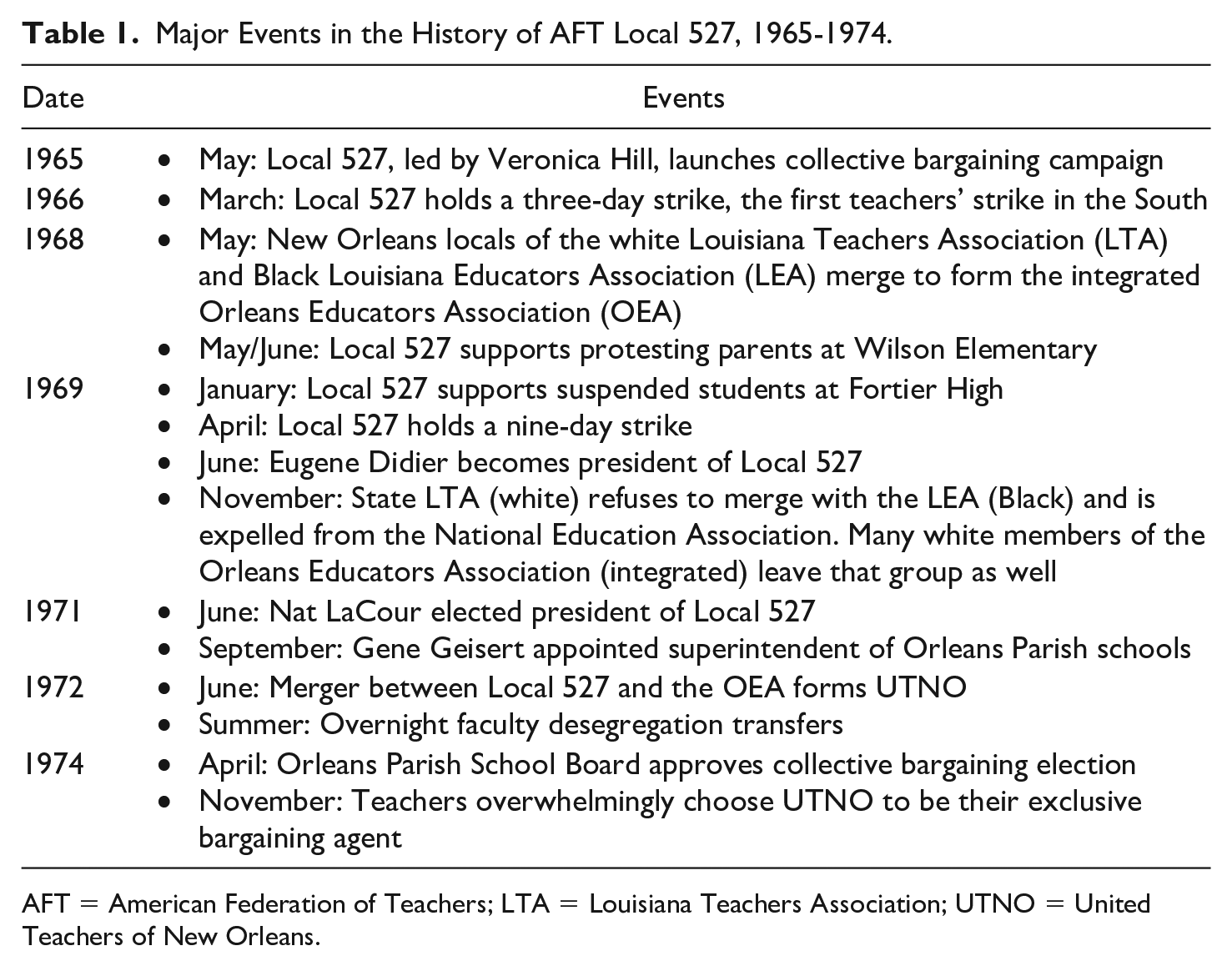
AFT = American Federation of Teachers; LTA = Louisiana Teachers Association; UTNO = United Teachers of New Orleans.
Methods
This paper is part of a larger history of UTNO from 1965 to 2008. For that project, I conducted semi-structured interviews with fifty-one stakeholders, including union leaders and staff, teachers, clerical workers, paraprofessionals, district employees, principals, and superintendents. I first contacted current union leaders and then, using a snowball method, asked them to refer me to others they recommended I speak with. These interviews were conducted in person, each lasting one to two hours, from 2018 to 2020. Following each interview, I took extensive notes and wrote a memo, transcribed the interview, coded it using the program Dedoose, and then analyzed common themes (Maxwell 2012; Spradley 2016). I have listed in the references the fourteen interviews that I cite directly in this paper, but all fifty-one interviews influenced my understanding and analysis of UTNO’s history.
I supplemented these interviews with publicly available archival data as well as personal documents and photographs provided to me by interviewees. I reviewed the Times Picayune and the Louisiana Weekly to analyze the perspectives of both the white and Black press. Using a keyword search, I read and coded every article in the Times Picayune that mentioned UTNO, the LFT, or union leaders. Because the Louisiana Weekly is not digitized, I went through that newspaper’s archives on microfilm, focusing on dates when major union activity occurred. Additionally, I reviewed the UTNO and Orleans Parish School Board (OPSB) archives held at the University of New Orleans’ Earl K. Long Library, the AFT archives held at Wayne State University, and various New Orleans mayors’ papers held at the Amistad Research Center. Finally, UTNO graciously made available for me their uncatalogued archives held at a local storage unit, which I slowly digitized, cataloged, and submitted for public access to the Earl K. Long Library.
The Initial Campaign and the First Teachers’ Strike in the South
Veronica Hill was a founding member of Local 527, 1 a segregated Black AFT-affiliate, in 1937, and served eighteen years, nonconsecutively, as its president (Hill 1990). The AFT required all its locals to integrate by January 1958 but New Orleans’ white local (#353) refused to do so and was expelled from the organization, making Local 527 the only AFT-affiliate in the city—“integrated” by its charter but in reality composed nearly entirely of Black teachers, as white teachers continued their own independent group (the New Orleans Classroom Teachers Federation [NOCTF]) or joined the segregated, white NEA-affiliate (the Louisiana Teachers Association or LTA; Parr 2010). When Hill led Local 527 into its first collective bargaining campaign, in 1965, there were five teachers’ organizations in the city, none of which could claim a majority of the approximately 3,600 teachers in the system (“N.O. Teachers Will Back Strike, Say Union Officials” 1966). However, the locals also had a history of collaboration and briefly shared an office. Most famously, in an event that spurred the formation of Local 527, Hill and the longtime president of NOCTF, Sarah T. Reed, climbed up a fire escape and entered the OPSB offices through a window to demand the restoration of Black teachers’ pay (Parr 2010).
In late May 1965, Hill formally requested that the Orleans Parish School Board (OPSB) hold an election for teachers to select an exclusive bargaining agent. Along with her request, she submitted petitions signed by nearly 2,000 teachers in the district, slightly less than half of the total teacher population (“School Board Will Study ‘Implications’ of Request” 1965). It was clear that Local 527 had the National’s support; AFT President Charles Cogen described the New Orleans local as “on the threshold of achieving collective bargaining” and reaffirmed that “the AFT has given first priority to Louisiana in its southern organizing program.” Already the idea that Louisiana was the lynchpin for organizing in the South had traction: “We regard Louisiana as our prime hope for teacher unionism below the Mason-Dixon line,” Cogen told Louisiana teachers (Cogen 1965). 2
Although the board said they would study the request, in November they voted down the proposal 4-1 (“Teacher Group Demands Vote” 1965). The racial implications of the all-white board voting down a request from the majority-Black teachers union were not lost on the teachers. The following February, Local 527 told the board that they would call a “work stoppage” unless the board granted them a collective bargaining election and met five additional demands related to racial justice: hiring a Black assistant superintendent, appointing Black supervisory staff in proportion to the number of Black teachers, appointing Black teachers to the personnel department, hiring Black clericals in OPSB offices, and using more Black bus drivers and maintenance workers (“N.O. Teachers Threaten Work Stoppage” 1966; “Picket Lines of AFT Local to Be Honored, Rally Told” 1966). These demands allied the teachers with lower paid support workers in their united fight for racial and economic justice. Local 527 said that if the demands were not met, they would ask the federal government to investigate if OPSB should continue to receive federal funds (Darby 1966c). National AFT representatives were in town to assist the local. AFT organizer Howard Hursey told the audience that a strike was necessary: “There’s no alternative. You can’t get what you want by being nice” (“Picket Lines of AFT Local to Be Honored, Rally Told” 1966).
The board was outraged by Local 527’s strike threat and found their demands around race specious. The superintendent of schools, Dr. Carl Dolce, who was white, claimed that the real issue “is not a racial one” and the board “has had the proposals under consideration for some time” (Darby 1966d). One board member was blunter: “If you need a recommendation [on what to do with the demands], I propose we file them in the wastebasket” (Darby 1966c). The board accused the local of using the racial demands to obscure their real goal, collective bargaining, and noted that OPSB hired people based on merit, not race—a claim belied by the de facto faculty segregation that would continue into the early 1970s (Darby 1966d).
Despite a growing coalition of groups announcing their opposition to the strike, the union forged ahead. On Friday, the first day of the strike, the school board reported that 507 teachers participated—though the union claimed more than 1,000 participants—and classes were canceled at only one school (“Don’t Use Aides in Strike—AFT” 1966). The vast majority of striking teachers were Black and the schools with picket lines were overwhelmingly majority-Black schools (“Fruitless ‘Strike’” 1966). Strike participation was slightly higher on Monday but it dropped again on Tuesday and Local 527, which two days earlier had pledged their intention to continue the strike “indefinitely,” voted to return to the classroom (Darby 1966b, 1966e). While the strike had lasted only three days, Hill praised the membership for conducting the first teachers’ strike in the South (Darby 1966e; Perry 1999): [It was] eye opening to the teachers to see what was going on. It had never happened before. Nobody in the South, white or Black, had ever gone on a strike. Teachers up North had gone on strike, but nobody in the South. Even in big cities like Atlanta, no teachers, white or Black, had defied their bosses and walked off the job (Hill 1994).
Superintendent Dolce announced that striking teachers would be docked pay for days missed, but would face no other disciplinary action, and Local 527 emerged mostly unscathed from the unsuccessful strike (Darby 1966b). AFT President Cogen wrote, “While no tangible gain was achieved, I feel that it has added to the union’s standing as a militant group ready to fight for its rights” (Cogen 1966).
The strike did, however, reveal fissures in the Black community. “When we went back to school,” Hill (1994) recalls, “the other people looked at us like we were dirt, like we had committed some crime. They didn’t want to speak to us.” Some Black parents had counter-protested the picketers in anger. The Times Picayune published a photograph of a Black mother holding a sign that reads, “1st BETSY/NOW STRIKE/WHAT NEXT,” noting that students had already lost instructional time due to the impact of Hurricane Betsy that past fall (Darby 1966a). This bad press was exacerbated by attacks by Local 527’s competitors for union members. At the time, the NEA considered itself a professional organization and did not affiliate with the more blue-collar AFL-CIO, arguing that both collective bargaining and strikes were the purview of private sector labor unions—not teachers (“Backing Given Orleans Board” 1966; Urban 2000). An organizer with the local NEA-affiliate described the AFT job action as a “strike against the children of New Orleans” (Darby 1966e). This argument—that the union was prioritizing their own narrow interests over those of New Orleans’ schoolchildren—would be one levied against the local for years to come. It also has a gendered element, suggesting that the striking educators, most of them women, were harming children instead of fulfilling their natural role as caretakers. Nonetheless, the strike dramatized the plight of New Orleans’ teachers, whose starting salaries ranked near the bottom of the nation’s large school systems (Doucet 1966). And some Black leaders, such as Rev. Avery Alexander, president of the local NAACP chapter, expressed support for the strikers (“Two-thirds of City’s Teachers Anti-strike” 1966). Black-led organized labor campaigns were still viewed as an offshoot of the civil rights movement and locals in New Orleans, especially the longshoremen and the letter carriers, had been crucial to relatively recent Black economic gains. The members of Local 527 indicated their support of the strike action by re-electing Veronica Hill president and electing Eugene Didier, a prominent white strike supporter, to the union’s executive board later that May (“AFT Local 527 Elects Officers” 1966).
Racial Justice, Solidarity, and a Second Strike
As the school board took reluctant steps toward student and faculty desegregation in the late 1960s, Local 527 continued to connect their collective bargaining campaign to racial justice. By 1969, 13.4 percent of students attended schools that historically served students of the opposite race, almost all of them Black students who had integrated formerly-white schools—only 25 white students were attending formerly-Black schools (“Significant Recommendations by PAR” 1969). Racial conflict arose at schools with mixed student bodies and Local 527 frequently took a prominent stand on these issues, demonstrating their commitment to a civil rights unionism that looked beyond workplace rights.
In spring 1968, they became involved with a parent group at Wilson Elementary who were accusing the principal of discriminating against Black students and parents. The school had previously been all white but by 1968 had a majority-Black student body, while the principal and teaching staff remained white (“Irate Parents Charge Board with Brushoff” 1968; “Parents Charge Principal with Bias at Wilson” 1968). Parents reported that the principal arbitrarily and frivolously disciplined Black students, suspended them for trivial offenses, and gave them inadequate lunch food (“Parents Charge Principal with Bias at Wilson” 1968). Local 527, which supported full school desegregation (“Faults in Mix Plan Alleged” 1970), sponsored parent meetings, advocated for the parents in front of the school board, and threatened to picket OPSB meetings on behalf of the parents and students at Wilson (“Pickets Hinted in Board Issue” 1968; “Teachers Union Assails Board” 1968). Local 527 blamed the school board for fomenting racial conflict in a polemical press release: “THE ANTEBELLUM DAYS of white being right was evidenced when a group of Black Parents questioned THE LEADERSHIP and quality of EDUCATION their children were receiving” (Statement of the Executive Board 1968). The union, though nominally integrated, was positioning itself squarely in the tradition of Black civil rights-era politics, a reflection of the long history of Black labor activism in the city.
By the 1960s, the civil rights movement in New Orleans was well-established and had been grounded in the work of churches, the powerful International Longshoremen’s Association (ILA), and Black community organizations (Germany 2007); Local 527 was both drawing on and continuing that tradition. Such activism also reflected the local’s own history. They had long advocated for improvements in Black school facilities and educational programs and won a hard-fought battle for racial salary equalization in 1943 (Hill 1967; Parr 2010). Similarly, the statewide Black NEA-affiliate, the Louisiana Education Association, had fought battles for Black educational justice, including pushing for school integration before Brown (Buras 2014; Middleton 1978). Due to the success of civil rights efforts as well as an influx of money and resources from federal Great Society programs, the tides finally seemed to be turning for Black workers seeking leadership positions and stable jobs, many of which had been previously only open to whites (Germany 2007). Brenda Mitchell (personal communication, September 3, 2019), later president of UTNO, recalled that few choices were available for Black people when she started college in 1964: I got into teaching because when I was a youngster, the options were teaching, the post office, and the welfare office, in social work, or a nurse. I don’t like blood, I wasn’t going to walk around the city to deliver mail and I liked the feeling of working with kids.
As one of the few middle-class jobs open to Black people, especially Black women, teaching was used as a means of both individual and social uplift by the Black community—teachers were expected to use their position to advocate for opportunities and rights for Black children and families. In involving themselves with the protesting parents at Wilson, Local 527 reaffirmed their commitment to racial activism. Eventually, the principal of Wilson was transferred to another school—a solution that would become common practice in dealing with incompetent employees at all levels of the school system.
Along with supporting parents at Wilson, in January 1969, Local 527 backed Black students at Fortier, an integrated but still majority-white high school. Students at the school were demanding Black history courses, revision of discriminatory discipline codes, and permission to start a Black student union. Administrators refused to meet with the students, so they held a protest in which fifty-four students were arrested and many more were suspended, as the police sprayed the students with mace (“Arrest 54 at Fortier ‘Confrontation’” 1969; “School Board Meeting Ends in Disruption” 1969). Veronica Hill critiqued the board’s delay in desegregating the schools and its failure to implement programs to facilitate peaceful integration: “The Fortier students by their action have pointed up a festering wound that has lingered all too long in our school system” (Hill 1969). Local 527 lauded the students’ efforts and touted the union’s own history in advocating for multiracial textbooks, the incorporation of Black history, and programs to eliminate prejudice among students and teachers (“School Board Meeting Ends in Disruption” 1969).
Spurred on by pressure from the National and the laudatory press they received in response to their racial justice activities, Local 527 yet again threatened to strike if the board refused to grant them a collective bargaining election. This time, they solicited more community and parent support and obtained more funding and personnel from the National to assist them. Mack Spears, the sole Black school board member, strongly opposed the strike: “Most of the teachers involved are Black. And it is paradoxical that an organization would call a strike of predominantly Black teachers against Black kids” (Lafourcade 1969a). In contrast, Local 527 tried to frame the strike as a means to fight apathy and frustration in the district and improve conditions for both students and teachers (Lafourcade 1969a). Black families had taken significant risks in their multigenerational struggle for quality education (Anderson 1988; Litwack 1999; T. Perry, Steele, and Hilliard 2003), so segments of the Black community understandably felt concerned by threats to close the schools. However, unlike in contentious teacher strikes in the Northeast and Midwest (Shelton 2017), Local 527 neutralized this opposition and earned the support of most of the Black community by continuously demonstrating their commitment to racial justice and equitable Black education.
Again, organizations lined up in support and opposition. The Orleans Educators Association (OEA), a majority white but nominally integrated NEA local that had formed via a merger, published a series of escalating leaflets attacking the AFT strike threat and encouraging teachers to join the OEA, painting themselves as a more professional choice: “You remember the last AFT strike—how pitiful it turned out to be! Strikes by teachers are illegal in every school district in the land!” (OEA Anti-CB and Anti-Strike Literature 1969). However, this time more organizations expressed their support as well: the Urban League held a forum on the strike, the Mayor’s Human Rights Committee passed a resolution supporting collective bargaining for teachers, and the Southern Christian Leadership Conference (SCLC) telegrammed their support (“Bargaining Concept Is OK’d by HRC” 1969; Lafourcade 1969e; “Strike Nearing, Says AFT Aide” 1969). The Black City Council, a coalition of organizations that included the NAACP Youth Council and the National Welfare Rights Organization, went a step further to call for a two-day citywide strike in support of the teachers, indicating the local’s success in presenting themselves as an organization working for racial justice (“Black Council Calls for City-wide Gen’l Strike” 1969). Community activist Kalamu ya Salaam was then part of a student group which took over Southern University in New Orleans to demand lower fees and the establishment of a Black studies department, among other requests. His mother was a striking schoolteacher and he saw these struggles as connected: “We went to the teachers and offered any support we could give” (K. ya Salaam, personal communication, November 22, 2019). The racial justice framing was unintentionally aided by the release of a report by a committee assigned by Superintendent Dolce to investigate the situation at Fortier in the middle of the strike build-up. Despite the pepper spray, arrests, suspensions, and continued racial violence at the campus, the committee found “no clear overt act of bias” (“Committee Finds” 1969).
Controversially, the night before the strike, Superintendent Dolce announced the pre-emptive closure of twenty-nine of the city’s majority-Black schools, and the reassignment of those teachers to other schools to fill in for striking teachers. The closures impacted 33,806 Black children and only sixteen white children; the teachers were thus transferred to ensure the uninterrupted education of white students while many Black students had nowhere to go (Lafourcade 1969e). Reverend Percy Simpson of SCLC said to close the schools was to “flirt with total community disaster” while community member Samuel Bell stated his displeasure more strongly: “This is a revolution—a Black revolution. The action to close twenty-nine schools was to pit Black teachers against Black parents. The board is not fighting collective bargaining, but the Black community of New Orleans” (Lafourcade 1969d). He said the board should either send white teachers to closed schools or it should bus Black children to open, white schools.
Local 527 joined in the critiques of Dolce’s school closures, accusing him of trying to divide the city along racial lines. Dolce responded that he had closed the schools where AFT membership was highest—all of which were majority-Black schools because the union’s membership was predominantly Black (Pack 1969). Although this argument sounds logical, when the teachers went on strike again, in 1978, then-Superintendent Geisert was able to keep every school open despite approximately 70 percent of teachers participating—far more than in 1969 (Atkinson 1978). The community thus saw the school closures in 1969 as indicative of a larger devaluing of Black education, a critique the local used to reinforce their own demands.
Although drawing on the power of the civil rights movement—and the rage of a Black community still denied equal participation in education and society—was a useful tactic for the union, it also genuinely reflected the beliefs of much of their membership. The Louisiana Weekly ran a story interviewing striking teachers and union leaders and while many talked about the importance of democracy and improving conditions for children, they also discussed the role of race: I feel very happy today to see MANY Black teachers finally beginning to turn Black and to begin to identify with their Black brothers and sisters. Fellow teachers, let us never forget that in our dark hour of need the Black community has come to aid us and now we shall win (“Teachers Point of View” 1969).
Strike chairman Peter Saunders said to the paper, “The real issue is a neglected Black community” (“Teachers Point of View” 1969). Local 527 looked to portray their own activism as an attempt to further the Black community’s civil rights agenda. Although there was some student integration by 1969, the vast majority of Black students still attended segregated and subpar institutions—which is also where most Black teachers taught. The teachers’ and the students’ interests were aligned.
According to the school board, 826 teachers struck on Thursday, the first day of the strike, and 900 on the following day (Lafourcade 1969d). From there, it became clear that teachers’ solidarity with the protest was waning and the local ended the strike after nine school days (“End of Walkout Announced by Federation of Teachers” 1969). Although union leadership was under the impression that there would be no reprisals, the contract they drew up was never signed by school board representatives (Derby 1969a, 1969b). Some teachers who returned found substitutes or new permanent hires still in their classrooms and, later that month, the school board fired fourteen temporary teachers who had participated in the strike (Lafourcade 1969b, 1969c). Connie Goodly was a substitute teacher in 1969: “One of the teachers told me, ‘We’re going on strike so you better not cross that picket line.’” Goodly (personal communication, May 31, 2019) was pregnant and had little protection as a substitute, so she called out sick instead of joining her colleagues on the picket lines. Grace Lomba was a probationary teacher but went on strike nonetheless. She said her principal wrote “on strike” on the top of her tenure evaluation, but she earned tenure anyway. “My attitude at the time was, I’m a certified person, I have my degree and I passed the test. Get rid of me and I’ll go someplace else because I’ve got the qualifications” (G. Lomba, personal communication, February 15, 2019). Teachers knew that they were taking risks by going on strike, especially young, Black, female teachers in a mostly segregated school system, but many of them walked out anyway.
Unable to protect their teachers, and reeling from the unsigned no-reprisals agreement, Local 527 was wracked with internal discord. Hill retired, from both the New Orleans Public Schools and the union, and the membership elected Eugene Didier to lead them, the first white president in the local’s history, with Nat LaCour as vice president from another ticket (“Didier Knocks School Board” 1969). Didier’s election brought to the fore questions of race, power, and integration and speaks to the membership’s growing commitment to integration. LaCour (personal communication, March 21, 2019) suggests that teachers had seen the negative outcome of the 1969 strike and believed they needed to have more access to power in order to reach their goals: “I assume the teachers felt that Ms. Hill had been around a long time, they needed a male, and that a white male would probably lead them to success.” Didier promised to increase member participation, fight for integrated education, and build a broader base of community support for teachers (“Didier Knocks School Board” 1969).
Despite the clear racial overtones of strike opposition, Selden, president of the AFT, stirred up significant controversy when he suggested that the AFT hold a demonstration against the “white, racist power structure” of the city during their annual convention scheduled for August in New Orleans (Fontaine 1969). A white teacher organizer wrote to him, Our racial problems in New Orleans are not, and never have been, as severe as they are in other parts of the nation . . . Let me further point out that Mrs. Hill, and the ousted ruling oligarchy of Local 527, for years pursued Black racism and politics calculated to discourage white membership in the local. (Fontaine 1969)
Victor Bussie, head of the Louisiana AFL-CIO, blamed the Black membership of the local for the defeated strike efforts: “It’s unfortunate that they, apparently, do not see the importance of giving strong support to their own organization” (Bussie 1969). Notably, no Black labor organizers or members of the local contradicted Selden’s statement about New Orleans’ racial politics. The white Louisiana labor movement’s failure to recognize the dual battles Local 527 was fighting against racism and economic exploitation speaks both to the challenges facing the union and its status as an outlier in the state, misunderstood even by its allies. Selden acquiesced to these white leaders’ demands, and canceled the planned demonstration, but continued to maintain the truth of his original analysis: There is no doubt at all in my mind that if a majority of teachers were white and that if those teachers had shown the same degree of militancy that the members of Local 527 have shown, we would now have collective bargaining in Orleans Parish. (Selden 1969)
The strikes had taken a toll on teachers and on the community. Louise Alford, a national rep who had worked both strikes, recalled with some hyperbole: “What a mark these strikes left on me . . . jailings by the busload, combat troops to break up a ‘sit-down’ in the administration building, screams, crying babies, etc.” (Alford 1984). Parents and students were frustrated from two weeks of interrupted classes, particularly in the Black community, and the Louisiana Weekly editorialized that nothing had been gained from the strike (“What Is the Lesson” 1969). However, though the teachers failed to win collective bargaining, the strike did galvanize educators and community members in support of the union effort, and leaders indicated that the struggle was far from over. Moreover, change was on the horizon. The following two years would include liberal Moon Landrieu winning the mayoral election with over 90 percent of the Black vote, two new superintendents in succession, and the true beginning of faculty integration (Germany 2007). Local 527 would be transformed in the process.
Faculty Desegregation and the Formation of UTNO
Although the school board had permitted limited staff desegregation since 1966, two prominent court rulings in 1969 led the board to fear they would be sued if they did not ramp up their faculty desegregation efforts (Cortez 1996). The board proposed that for the 1970-1971 school year, each school would have no more than 75 percent of its teachers from the majority race (Lafourcade 1970a). For the first time, the plan approved by the board for the 1970-1971 school year included forced transfers of teachers to achieve the 75/25 balance (Lafourcade 1970a). Although representatives from Local 527 participated in the advisory committee that developed the plan, and the union supported teacher desegregation, they worried that the process would result in the loss of Black teaching positions (“527 Speaks” 1970). They sponsored a motion that would require that the board protect the current Black-white teacher ratio, but the motion was voted down, leading the union to accuse the board of only paying “lip service to protecting the jobs of Black teachers” (“527 Speaks” 1970). They also sent a letter to the superintendent asking him to initiate desegregation in the central offices, which had previously employed almost entirely white personnel (Porter 1970).
Local 527’s fears about the loss of Black jobs were not unfounded. In April 1970, the NEA released a report critiquing the processes of desegregation in Louisiana. They found that faculty desegregation had resulted in educator displacement “of crisis proportions” throughout the state. Black administrators in desegregated schools were routinely demoted to teaching positions and Black teachers transferred to white schools were not given classrooms to use (“NEA Hits Desegregation in All La. School Districts” 1970). Typically, the most highly qualified Black teachers were transferred to white schools, while the least-qualified whites were transferred to Black schools (“NEA Hits Desegregation in 2 Southern States; Cites Widespread Racial Bias” 1970). The following year, the NEA found that from 1968 to 1970, the number of Black teachers had decreased by 1,072 and the number of white teachers had increased by 5,575 across Georgia, Alabama, Louisiana, Mississippi, and Florida (“NEA Files Suit to Stop Phazing out Teachers” 1971). Local 527 sought to prevent a similar phenomenon in New Orleans. Meanwhile over three-hundred teachers resigned, most of them whites who chose to leave the system rather than teach in Black schools (Lafourcade 1970b).
The board continued to rely mostly on teacher volunteers and, by the following year, still had not achieved the 75/25 goal (Cortez 1996; DeVore and Logsdon 1991). Faced with the possibility of losing almost $9 million in federal funding, in July 1972, the OPSB announced they would integrate faculties completely (Cortez 1996). Approximately 800 teachers were transferred in order to achieve close to a 50/50 Black/white ratio in all the schools (“800 Teachers to Be Shifted” 1972). Although the local originally opposed the proposal, they supported the initiative once the new superintendent, Gene Geisert, assured them that the current Black/white teaching ratio would be maintained and no teachers would be fired (“Teacher Groups Differ on N.O. Faculty ‘Mix’” 1972). Nonetheless, many members felt ambivalent about the transfers. Connie Goodly was “devastated” when she was transferred from her current school, which served the Desire Housing Project, to a school comprised of mostly middle-class white children: I love children, but I felt my greatest need was with those kids who were from single-family homes, didn’t know their fathers, and I wanted to try to make a difference with them. To show them that they could be anything that they wanted to be. (C. Goodly, personal communication, May 31, 2019)
Others avoided the transfers; Grace Lomba (personal communication, February 15, 2019) was reassigned to a majority-white school, but an older friend of hers offered to take the transfer instead of her since she was new at the school. Laverne Kappel moved to New Orleans in 1969 after teaching in rural Alabama through the National Teacher Corps. She took a job at majority-Black Lawless High School in the Lower ninth Ward and recalls that, at the time, she was the only white person in the building. When the 1972 transfers occurred, suddenly many more white teachers appeared: “They were mostly just out of college and very nice people. No experience.” Kappel felt that her Black coworkers were skeptical about faculty desegregation: They hated that some of the best young teachers, Black teachers, were being sent to Behrman. And they felt like pawns . . . But they wanted colleagues, they liked their colleagues. And most of them had gone to segregated schools, they belonged to segregated clubs and churches, and the whole thing. So it was part of the social contract that got broken. (L. Kappel, personal communication, September 27, 2019)
Paraprofessionals were especially concerned about the faculty transfers because they often worked inside other teachers’ classrooms. Susie Beard (personal communication, October 1, 2019) had mixed experiences with the white teachers who were transferred into her school: Some were good teachers and some were racist because it was during segregation time . . . I worked with teachers who wouldn’t even communicate verbally. They would write notes and have the notes written when you walked in in the morning, just give you the notes and tell you what your duties were.
Still, many of the most intolerant white teachers had left the system rather than teach in integrated schools, so the faculty was more racially liberal than it had been in prior years (Skelton, personal communication, March 28, 2019).
Although there were ongoing issues around the implementation of faculty desegregation—teachers complained about lack of preparation and being assigned to subjects they were not qualified to teach—the process was crucial to the union’s growth (LaCour, March 21, 2019; Nolan 1972). Shortly before the mass transfers, in the spring of 1972, Local 527 and the majority-white OEA announced that they were merging to form UTNO—the United Teachers of New Orleans (“Teachers Organizations to Vote” 1972). The merger was possible because of a significant shift in the NEA, which at the national level had merged with the majority-Black American Teachers Association in 1966, devoted itself fully to the cause of school desegregation, and, by the early 1970s, embraced collective bargaining as a core strategy (Urban 2000). Following the AFT’s lead, the NEA threatened to expel all Southern locals that refused to integrate and, making good on that promise, expelled the all-white Louisiana Teachers Association (LTA) in 1970. This resulted in an exodus of segregationist white teachers from the OEA, rendering its membership smaller, more diverse, and more liberal—as well as more open to a merger with Local 527. The new union would affiliate with both the NEA and the AFT, only the sixth such merger in the nation, and their first priority would be obtaining collective bargaining for teachers (“Teachers Overwhelmingly Ratify OEA-AFT Merger” 1972). UTNO would have over 2,000 members, close to a majority of the teachers in the system (Lafourcade 1972). Ken Ducote (personal communication, September 6, 2019), a teacher who later worked in planning and facilities for the district, recalls: “I was told . . . that when Alfred Hebeisen, who was the HR person for the school system, when he got the phone call that said the two unions had merged, the story was he turned white as a ghost and dropped the phone.” Nat LaCour, who was then president of Local 527—he had defeated Eugene Didier in the 1971 union elections—became president of UTNO and Cheryl Epling, a white teacher from the OEA, became vice president. Over 90 percent of the OEA and Local 527 membership voted in favor of the merger, which union leaders argued indicated widespread teacher support for collective bargaining (“Teachers Overwhelmingly Ratify OEA-AFT Merger” 1972).
Brenda Mitchell (personal communication, September 3, 2019) believes the merger was a key shift: We were diverting our energies by fighting each other. Because we all wanted the same thing, we wanted better working conditions, we wanted to have input on, for example, book selection, we wanted a limit on class size. There were certain things that we wanted, all of us wanted, it wasn’t Black or white but all of us.
The merger that formed UTNO was extraordinary not only because it was a rare joining of NEA and AFT forces but also because it was clear that Local 527, with LaCour at the helm, was leading the direction of the united organization: I think UTNO was really the first institution in New Orleans to merge where whites joined a majority Black organization. That had not happened. Integration in the South had been a movement where Blacks integrated into white situations. Blacks went to white churches, Blacks moved into white neighborhoods, Blacks went into white restaurants, but it was never whites moving into a majority Black setting. I think UTNO was the first institution I know where that happened, and that was because people understood that race was not the big factor in our progress, that we needed to be together. So, we didn’t have to love each other, socialize with each other, but we could come together and campaign for our mutual interests. And that’s what happened. (N. LaCour, March 21, 2019)
The faculty desegregation process also aided in the merger. White and Black teachers working in the same schools in large numbers for the first time built relationships and friendships and no longer saw the need for separate teacher organizations. In the 1969-1970 school year, forty-one elementary schools had no teachers of the minority race but by 1971-1972, there was only one school, all-white Lakeview Elementary, that had not achieved even token integration (see Table 2) (Informational Report on Staff Desegregation, 1969-1973). In anticipation of conflict arising out of the desegregation transfers, schools had special professional development days to orient new teachers. Ducote, then a teacher at Lawless High, said those meetings revealed more commonalities between the teachers than differences: Then, one of the things that came out of our desegregation workshops, it became that it was less and less a racial thing and more an administration thing. The faculty was kind of united in opposing the governance structure that the principal had. (K. Ducote, personal communication, September 6, 2019)
Percent of Minority Teacher Population in New Orleans Elementary (K-8) and Secondary (9-12) Schools (i.e. White Teachers Working at Formerly-Black Schools and Black Teachers Working at Formerly-White Schools).

The teachers found the principal at Lawless “oppressive” and working conditions intolerable: “There was a story that I heard . . . that he kept the teacher’s bathroom locked and you had to go to him for the key . . . even if it is apocryphal, it gives you some insight into how we saw him” (L. Kappel, personal communication, September 27, 2019). The school became one of UTNO’s strongest buildings.
In the early 1970s, working conditions for teachers were difficult and they had little recourse when they felt mistreated. This was particularly a problem along lines of race and gender. Black women, for example, were vulnerable both to sexual harassment and to accusations from racist white parents and coworkers. Brenda Mitchell experienced both. Before she was hired by the district, she was told she had to lose a certain amount of weight before they would sign the contract. Later, a white child in her class told his mother that she had hit him on the head with a ruler: The principal calls me to the office and tells me I hit a kid with a . . . I said, “Think about what you’re saying. No, I didn’t.” She then had the ranking teacher to go talk to my class while I was in the office and they told her that never happened but the parent made a charge and she just wanted her kid out of my class because I was Black. (Mitchell, personal communication, September 3, 2019)
Another Black female teacher recalls that when she first started, her principal wanted to date her: The principal tried to date me and I had just married, right after I got out of college I married my childhood sweetheart who I had a child for. And so I wasn’t into anything like that. I came to teach. But he would stand and watch and when I’d look up, he’d stand and watch and be peering around a corner and stuff like that made me very uncomfortable. (Dolce, personal communication, August 29, 2019)
When she refused, the principal rated her “unsatisfactory” and eventually she transferred to another school. Men were also victims of discriminatory and capricious hiring practices. Leoance Williams (personal communication, October 22, 2019) graduated from a program at Xavier designed to bring more men into early childhood education, but when he applied for a Kindergarten position, he was told by the principal, “Oh no, you cannot teach kindergarten, you are a man . . . I could see you working with the little boys, but what are you going to do with the little girls?.” As Ken Ducote (personal communication, September 6, 2019) remembers, The thing is, the climate was such that you had a lot of craziness. You had retaliation. You had no due process. The other teachers, especially the Black teachers, told me that there was resentment. There was feelings of if you were darker than a certain skin tone, then you were written up more than others, or that some principals had the thing that they would write all first-year teachers as unacceptable . . . to kind of control them or something.
Other teachers told stories about being unfairly assigned to duties, being forced to pay for their own photocopies, and of having successful grants and programs they had started taken away by jealous and controlling administrators. Teachers felt like collective bargaining would increase their voice and their protection in a district, and a city, that often afforded them neither.
The Final Push to Collective Bargaining
In fall 1971, the board approved Dr. Gene Geisert, a white educator from the Midwest, as the district’s new superintendent (Lafourcade 1971). For the union, Geisert was a promising, if complicated, choice. He had worked extensively negotiating teacher contracts in Michigan and New Jersey and was comfortable with collective bargaining as a concept. UTNO staffer Fred Skelton recalls: “[Gesiert] was a superintendent in a collective bargaining school system, was familiar with it, didn’t have any apprehension about it. Didn’t have any misgivings. And so he, I don’t know, whether consciously or unconsciously, made it comfortable for us” (Skelton 2019). At the same time, he had experienced a strike from the school custodians while he ran the Wilmington, Delaware schools, and he had defeated the union there: I organized the administrators and had them pick up all the rubbish and everything and we beat the union . . . My supervisors, they sent me a great big plaque . . . and it said, Yea, though I walk through the valley of death, I will fear no evil because I’m the meanest son of a bitch in the valley. And they all signed it. And I thought that was really neat. (Geisert, June 14, 2019)
Geisert, then, would not be an ally to the union, but neither was he ideologically opposed to collective bargaining.
The momentum of union organizing, both in the country and in New Orleans, also favored the teachers. Since President Kennedy signed Executive Order 10988 in 1962, permitting public sector collective bargaining, teachers had been struggling nationwide for binding contracts. From 1960 to 1974, there were over 1,000 teacher strikes in the United States, involving over 823,000 teachers, and 72 percent of public teachers were covered by collective bargaining agreements by the end of the decade (Lyons 2007). UTNO had support from both the AFT and the NEA, which expelled administrators in 1973 and committed itself further to union organizing, and the local and state AFL-CIO (Urban 2000). Riding the momentum from the merger and newly empowered by faculty desegregation, UTNO returned to their campaign for collective bargaining.
LaCour knew that to be successful in obtaining collective bargaining, the union needed more support from teachers, community groups, and the press. He had his staff bring doughnuts and coffee into schools and discuss the benefits of collective bargaining with teachers and used UTNO’s existing network of building reps to recruit new teachers. Paraprofessionals formed their own UTNO chapter in June 1973, further boosting UTNO’s numbers (Crowley 1994). United across race, educators felt empowered to stand up to principals and the school board. Skelton recalls educators’ enthusiasm for the union: It was a great time to go to school meetings. You know, we’d come in and we’d say, ‘We’re the United Teachers of New Orleans!’ And they’d be saying, ‘Can I have a membership card?’ Interrupting you as you spoke! So it was a heady time. (Skelton 2019).
Even as teachers rallied behind the new organization, LaCour and the other leaders of UTNO knew from the failed strikes of the 1960s that they needed a broad base of support: We met with all kinds of groups in the city. Civic organizations, political organizations. I brought Mr. Shanker in to meet with the editorial board of the Times Picayune. We met with The League of Women Voters. Every entity that was out there, we met with to ask them to not oppose our efforts. (LaCour, March 21, 2019)
UTNO bought large billboards advocating for collective bargaining that depicted teachers and students at work and read, “HELP THE TEACHERS TEACH” (Alford 1984; Photograph 1974).
Although the Times Picayune wrote an editorial against the union, UTNO was more successful on talk shows and radio shows, often sparring with members of the school board and ensuring that collective bargaining for teachers was a popular topic for conversation (Alford 1984). The Louisiana Weekly wrote a strong editorial in support of the campaign, at times echoing UTNO’s own press release: “Teachers in New Orleans have no voice in formulating the policies, regulations and conditions under which they work. These are decided and arbitrarily enforced by the Orleans Parish School Board” (“Collective Bargaining Is Necessary” 1974). The union also had success generating support among community groups, especially in the Black community. They set up a “Speakers’ Bureau” to solicit endorsements from civic organizations, churches, and other unions (Alford 1984). Connie Goodly explained that a lot of this work was done by members, who were asked to speak to groups they belonged to: Because so many of our teachers and members belong to sororities and fraternities and churches . . . Sometimes they would allow us to go into the churches and talk, if you were a member of Greater St. Steven’s Baptist Church, sometimes the reverend would let you stand up and say, ‘This is why we’re doing this.’ If you were a member of Alpha Phi Alpha sorority, you would explain to your sorority girls, this is what we’re gonna do and this is why we’re gonna do it. (Goodly, personal communication, May 31, 2019)
Relying on grassroots member-based organizing reinforced the sense of participation and democracy within the union. Eventually, at least twenty-four community groups endorsed the campaign (Renfro 1974e).
UTNO organizers also worked hard to secure the support of organized labor. Although the AFL-CIO had always backed the union in theory, some AFL-CIO affiliates, such as the Teamsters who represented bus drivers, had crossed Local 527 picket lines in both of the failed strikes. UTNO struggled, as a middle-class union, to ensure that blue-collar workers would see them as allies and support their campaign. “It took lots of meetings to convince [other unions] to stick their neck out for teachers and paras who had scored zero in two strikes,” recalls National Rep Alford (1984). Eventually, most local unions signed on; the president of the Teamsters local even spoke at one of UTNO’s rallies (Alford 1984; Renfro 1974i).
As the community campaign wore on, UTNO attempted to secure the three votes they needed from OPSB, who ultimately would decide whether to permit the collective bargaining election. The board had voted them down 4-1 both times they petitioned in the 1960s, but their one supporting member, a lawyer for the Longshoremen, retired in late 1970. They met individually with school board members, and also persuaded superintendent Geisert “to secretly take all Board Members across Lake Pontchartrain to a cabin and talk CB sense to them” (Alford 1984). Geisert liked the challenge of collective bargaining, which was one of his main activities before moving to New Orleans, and he also respected Nat LaCour, with whom he struck up a professional friendship. LaCour argued that collective bargaining had the potential to reduce friction between teachers and administrators because it forced them to sit down together and work out their differences (Renfro 1974k). That was certainly true for LaCour and Geisert; years later, LaCour flew down from Washington, D.C. to attend Geisert’s 90th birthday celebration (G. Geisert, June 14, 2019).
They also faced vocal opposition from the LTA, the all-white local which had been expelled from the NEA for refusing to integrate. The LTA had 430 members in New Orleans in January 1974, far fewer than UTNO’s 2,600, and knew that they would lose an election for collective bargaining if the board approved it, further diminishing their power (Renfro 1974l). Some members of the business community also opposed collective bargaining and made their views clear to the board, yet there was no cohesive resistance at the time: We heard of information that business leaders had talked to the school board about, ‘You’ll bankrupt the school system’ and all that sort of stuff. ‘It’s going to result in higher taxes’ . . . but by and large, the white community, while not overly supportive—there was no protest. (Skelton, personal communication, March 28, 2019)
By the mid-1970s, with Moon Landrieu as mayor integrating city hall, fewer people wanted to be publicly affiliated with segregationist groups such as the LTA.
Dave Selden came to New Orleans again, in February 1974, and in a sharp contrast to his speech in 1969, he said that since, “this city is different from others in that racial antagonisms have apparently been resolved, it seems like a logical place to make a breakthrough” (Renfro 1974f). Selden was likely thinking about the integrated union and the somewhat-smooth process of faculty desegregation, but it was a strange comment in a moment when white families were rapidly exiting the public schools (DeVore & Logsdon 1991). Yet Selden’s comments speak to the extraordinary work UTNO had done to integrate their membership, their staff, and their executive board and the compelling case they continued to make about the importance of combining struggles for racial and economic justice.
At the March board meeting, UTNO presented over 4,000 petitions for collective bargaining from teachers and paras (Renfro 1974d). Teachers packed the auditorium—over 1,000 teachers attended and picketed outside—and they sat by school, identified by placard, as if attending a political convention (Alford 1984). The board took the matter under advisement and said they would vote at their following meeting in April. UTNO continued campaigning: in addition to the 4,000 teacher petitions, UTNO collected petitions in support from community members by standing on street corners or at the mall (Skelton, personal communication, March 28, 2019) and businesses across the city put up UTNO posters, depicting an apple and the phrase, “We Support Collective Bargaining for New Orleans Schools” (Alford 1984). When the Louisiana Attorney General issued an opinion that teachers had the legal right to collective bargaining, in early April, it seemed that the campaign could not be stopped (Renfro 1974a). Skelton remembers that the energy and enthusiasm in the community and among teachers was overwhelming: Now part of it also was that Geisert was in support of it. And when you’ve hired this superintendent, he’s done a nice job of keeping the staff together with integration. He says he can handle this collective bargaining stuff. And we’ve got community support. We’ve got mothers here, we’ve got fathers here, we’ve got community leaders. I remember we walked down the aisle with these cardboard boxes and laid them out in front of the school board. And we said, “We’ve got 20,000 signatures on these petitions and more coming.” Well, I’m sure it was controversial. I’m sure the business community, I’m sure there were portions who said, “Do not do this.” But we created an atmosphere where it was popular. (Skelton, personal communication, March 28, 2019)
At the April board meeting, the OPSB voted 3-2 to approve a collective bargaining election. The teachers’ hero of the day was, undoubtedly, LaCour, who had quickly risen to prominence both in UTNO and with the National. Even the Times Picayune, in a scathing anti-collective bargaining editorial published the following day, could find little harsh language for the union leader, describing him as “low-keyed” and using “the mildest of threatening tone” (“Board Concedes Union Vote” 1974). LaCour would go on to lead UTNO for twenty-eight years, until leaving for the National in 1998. But the initial years were the most transformational: In hindsight, what he did was remarkable. His leadership changed a city and changed a teaching corps for decades. At the time, we didn’t know what the hell we were doing. I mean, we were just, ‘Okay, this is what the book says, okay, we’ll do this.’ I’m not sure that there’s a lot of Nat LaCours around. (Skelton, personal communication, March 28, 2019)
Although teachers focused on LaCour’s skill and magnetism in explaining the union’s success, key to his strategy was his ability to draw meaningful member participation, make democratic decisions, and ensure everyone felt heard.
The board set November election dates for teachers, paras, custodians, and maintenance workers to choose collective bargaining agents—the latter two groups were selecting either the Teamsters or AFSCME (Renfro 1974h). Schools closed early on November 12th, the date of the election, and UTNO won the vote overwhelmingly. Of 4,800 eligible teachers, 4,252 voted and 3,308 chose UTNO (Renfro 1974g). Superintendent Geisert said, “Today’s election enabled teachers to democratically express their desire for collective bargaining . . . [which] has the potential for positive improvements in teaching conditions and educational advantages” (Renfro 1974g). Later that month, the custodians voted to be represented by the Teamsters, maintenance workers voted for AFSCME, and an election for paraprofessionals was set for March 1975 (Renfro 1974b, 1974c, 1974j, 1975). UTNO’s fight had galvanized the sector, but it was still unclear what impact the unions would have on public schools and what gains for teachers could be made through their nascent collective bargaining agreements.
Discussion
The UTNO that won collective bargaining in 1974 looked very different from the Local 527 that started the first campaign in 1965. They were significantly whiter, larger, and more powerful, and their successful election signaled their relative mainstream acceptance. However, their overwhelming community support, particularly from Black churches and political organizations, demonstrates their ongoing allegiance to Black working class politics and civil rights unionism. Not only were UTNO members an integral part of the Black community, but they also aligned themselves politically with Black and working class issues, connecting their struggle for collective bargaining to ending segregation and racial oppression. By standing in solidarity with Black parents and students, they affirmed their role as middle-class mediators, promoting racial and economic justice for both themselves and the students they taught. The union achieved success by orchestrating a merger that maintained Black union leadership within an intentionally integrated governing body, effectively consolidating the white support they needed while continuing to ally themselves with the Black community. They also effectively relied on member activists to recruit their colleagues, speak to community groups, mobilize parents, and rally support. The union offered a place where both Black and white teachers could experience a genuine sense of interracial democracy and decision making, in a way that city and state politics often did not.
UTNO won collective bargaining because of the skills and commitment of members and leaders, but also because of the shifting political and social climate in New Orleans. White board members in the late-1960s had no reason to grant the majority-Black local bargaining rights, as they represented only a fraction of the segregated schools and educators. Yet Local 527’s strikes and protests during this period earned them the respect and devotion of the Black community and connected them in the public imagination to the struggles of the civil rights movement. By the early-1970s, the racial tides were shifting, both at the federal and local levels. The school board was forced to integrate, threatened by the loss of federal funds, and Mayor Moon Landrieu worked to desegregate other institutions in the city. White liberals, including Landrieu and Superintendent Geisert, saw the integrated union as a hopeful harbinger of interracial harmony and rallied behind UTNO to help them win a collective bargaining election without a strike. The local gained the NEA’s support through the merger and the public quickly began to see UTNO’s main opposition, the segregationist LTA, as a relic of the past, no longer relevant in the changing city. UTNO members and leaders capitalized on this atmosphere, connecting collective bargaining rights for educators to the city’s new turn toward progressivism and the unrealized hopes of the civil rights movement. They emerged victorious not by turning away from their earlier racial activism and embracing colorblind rhetoric about a shared economic struggle, but by maintaining their identity as a progressive, Black-led organization for which economic and racial justice, collective bargaining and the desegregation of the school system, were inseparable.
Further research might examine whether the potential for teacher organizing that existed in New Orleans was present in other southern cities. UTNO shows the benefits reaped from that organizing, as educators formed a progressive and dynamic union that provided a pathway to middle-class status and anchored the city’s Black voting bloc for over thirty years. Yet few other teachers unions in the South achieved collective bargaining in this era and the AFT alienated Black teachers and community members in union strongholds such as Newark, New York City, and Pittsburgh (Golin 2002; Podair 2002; Shelton 2017). Because of the dearth of successful southern unions, most research has analyzed teacher organizing in the Northeast, Midwest, and West Coast, yet this focus erases the contributions of Black educators, who are most prevalent in southern states (see Table 3). Moreover, the lack of attention to the South leads both researchers and organizers to conclude that successful teacher organizing is not possible below the Mason-Dixon line and, thus, to ignore the plight of Black southern educators, many of whom continue to work under substandard conditions structured by gender and racial inequities. Finally, while Shelton (2017) argues that teachers unions became incredibly unpopular through the 1970s, particularly as majority-white unions engaged in lengthy strikes that shut down major school systems, UTNO earned significant community support, particularly from Black parents and community members, at least through the early-1990s. UTNO can be seen as a bridge between the civil rights unions of the mid-20th century and the social movement unions of today.
Percent of Black and White Public School Teachers in the 2011-12 School Year, By Selected States.
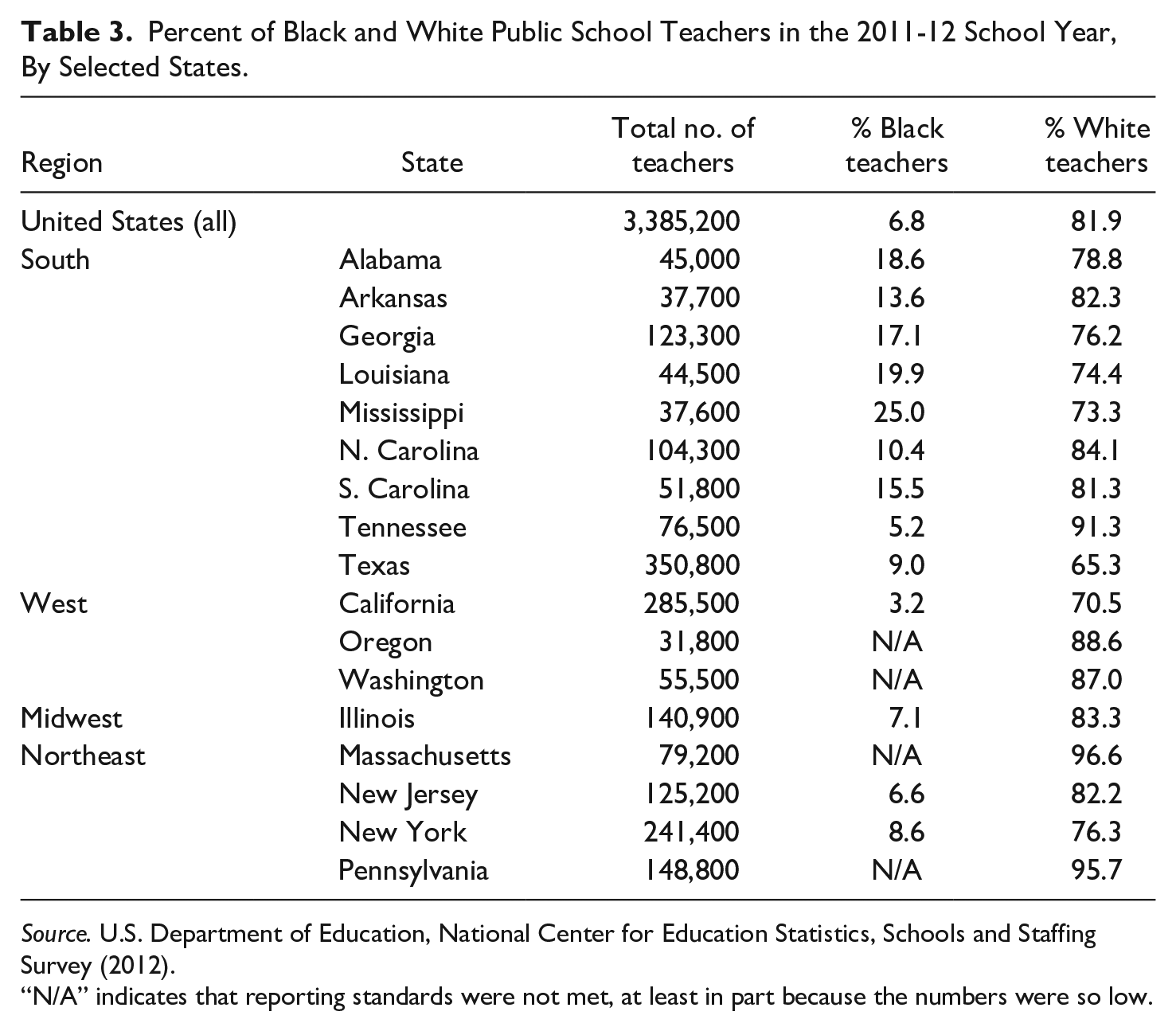
“N/A” indicates that reporting standards were not met, at least in part because the numbers were so low.
As UTNO continued to grow and consolidate power over the subsequent decade, they would build meaningful programs and institutions and win crucial raises and benefits that would begin to distance them economically from the students they taught. As Todd-Breland (2018) points out in her analysis of the Chicago Teachers Union, a union becoming more Black does not inherently make it more radical. At the same time, UTNO would expand to incorporate paraprofessionals and clerical workers, both groups of working class school employees, who would connect the union more intimately to families and communities across the city. Although the union would continue to prioritize fighting for both racial and economic justice, they would also make compromises in response to their diverse membership, such as advocating for harsher school discipline, which disproportionately affected Black students. Critics would accuse UTNO of becoming too powerful and using their influence to protect ineffective teachers and enforce arcane bureaucracy, such as seniority transfers, that did nothing to benefit students and families. Yet they also became a powerful progressive political force in the city and the state, pushing for legislation that centered the needs of their constituency, who remained overwhelmingly Black women, and helping move political discourse to the left. While UTNO, by the mid-1980s, did not look that different from the Chicago Teachers Union, a militant and diverse group led by Black president Jackie Vaughn, their actions were significantly more radical given their context, in right-to-work Louisiana rather than union-friendly Illinois. 3
There is no doubt that once UTNO won collective bargaining they began to look more like other active AFT locals, albeit more militant and with more support from the surrounding community, leaving some of their civil rights legacy behind. However, they also positioned themselves to the left of the AFT on several major issues, for example, opposing the National Teacher Exam, which they argued discriminated against Black educators, as well as the introduction of charter schools and widespread standardized testing, reforms they claimed left Black teachers and students behind (Kahlenberg 2007; McKendall 1984; Nabonne 1995; Thibodeaux 1985). They also held two popular and successful strikes, in 1978 and 1990, the latter in order to win pay raises for poorly compensated paraprofessionals. Moreover, UTNO fought tenaciously for reforms that would directly benefit students, such as more funding for the district, repairs to decaying facilities, and the introduction of innovative instructional programs at struggling schools (Behre 1984). UTNO also fostered more democratic participation than many other unions, boasting high member involvement through the 1990s. Through the twists and turns of Louisiana politics, UTNO continued to play a major role until Hurricane Katrina, advocating for quality education for the city’s children and helping anchor the city’s labor movement and Black political machine.
The 2018 Janus v. AFSCME decision established right-to-work laws nationwide for public sector unions, thus thrusting the organizing climate that UTNO faced upon teachers unions across the country. These unions, along with the teachers participating in the “Red for Ed” uprisings, could look to UTNO’s example to understand the possibilities and challenges before them. UTNO was successful because they combined racial justice and economic struggles, grounding their organizing in civil rights history and seeking changes that spoke directly to community and student concerns. As teachers unions turn toward social movement unionism to bolster their power, mobilize their rank and file members, and link their own exploitation to the experiences of the children and families who use the schools (e.g. McCartin, Sneiderman, and BP-weeks 2020), UTNO suggests one potential pathway to success—one that centers the experiences of Black and southern educators.
Footnotes
Acknowledgements
I am grateful to Patrick Rafail and Jana Lipman, my dissertation advisors at Tulane, who provided extensive comments on the manuscript. Thanks go as well to Kevin Connell and Jon Shelton who read earlier drafts and provided insightful and encouraging feedback. Daniel Golodner, archivist at the Walter P. Reuther Library, patiently guided me through the extensive AFT archives. Above all, I am thankful to Nat LaCour, the late Superintendent Gene Geisert, and all the UTNO members who generously shared their memories with me.
Declaration of Conflicting Interests
The author(s) declared no potential conflicts of interest with respect to the research, authorship, and/or publication of this article.
Funding
The author(s) disclosed receipt of the following financial support for the research, authorship, and/or publication of this article: This research was partially supported by the National Academy of Education’s Spencer Fellowship and by the Spencer Foundation.

Interviews
Billie Dolce (Teacher). August 29, 2019.
Bob Crowley (OEA and UTNO Staffer). March 10, 2020.
Brenda Mitchell (Teacher and UTNO President [1999-2008]). September 3, 2019.
Connie Goodly (Teacher and UTNO Staffer). May 31, 2019.
Fred Skelton (UTNO Staffer). March 28, 2019.
Gene Geisert (Superintendent [1971-1980]). June 14, 2019.
Grace Lomba (Teacher). February 15, 2019.
Gwendolyn Adams (Teacher). June 13, 2019.
Kalamu ya Salaam (Community Activist). November 22, 2019.
Kenneth Ducote (Teacher and District Employee). September 6, 2019.
Laverne Kappel (Teacher). September 27, 2019.
Leoance Williams (Teacher). October 22, 2019.
Nat LaCour (Teacher and UTNO President [1971-1998]). March 21, 2019.
Susie Beard (Paraprofessional). October 1, 2019.