




Abstract
This article examines the relationship between the National Organization for Women (NOW) and CODEPINK, a women’s peace organization in 2004. NOW and CODEPINK both sought to mobilize women to protest the wars in Iraq and Afghanistan and also to fight against the threats to women’s rights that emerged from the policies of policies of the George W. Bush’s presidential administration. Using content analysis of e-mails sent to supporters and survey data from individuals at protests, I find that despite their overlapping agendas, there were significant differences in the two organization’s framing and tactical repertoires. CODEPINK drew upon individualistic maternalist framing and had a broad tactical repertoire. CODEPINK was able to draw women into protest in a way that resonated with popular cultural norms and recent women’s mobilizations. By contrast, NOW drew upon libera l, rights-based feminist framing that focused on legislative change and drew upon a narrow range of movement tactics. The article argues that rather than creating divisions and undermining collaboration, this diversity in women’s movements helps to foster a symbiotic relationship that mobilized diverse women. Taking a long historical view, I argue that this symbiosis is fundamental for the longevity and continued vitality of the U.S. women’s movement.
Personal Reflexive Statement
This article emerges from my own participation in women’s rights organizations during the 1990s and then the antiwar movement of the 2000s. At those early antiwar demonstrations in 2001 and 2002, I found myself wondering why women’s rights organizations were not more visible and simultaneously baffled by the emergence of new women’s peace organizations that seemingly eschewed the more explicitly feminist language with which I was familiar in favor of maternalist framing. Over the course of the antiwar movement, I began participating in CODEPINK events and also observed an increasing confluence between women’s rights organizations and women’s peace organizations over time. My attempt to understand the relationship between women’s rights and women’s peace organizations, in both the historical context and the contemporary one, is at the heart of this article. While I am aware that these are issues that some scholars have written about in detail with historical cases, it seems to me that testing those conclusions is important for assessing the state of both the women’s movement and gender equality in the United States today.
Over the past century, there have been innumerable moments when women’s rights organizations have mobilized alongside and in concert with women’s peace organizations. Some examples are as follows: in 1914, women’s rights activists involved in the suffrage movement organized the first women’s peace organization in the United States, the Women’s Peace Party, to protest the escalations of hostilities in Europe. Their inaugural action was attended by 1,500 women dressed in mourning and marching silently to the beat of drums in New York City (Alonso 1993:56). Several decades later, in 1968, radical feminists organized a splinter march from the Jeanette Rankin Brigade (a women’s peace group) in Washington, DC. In a demonstration reminiscent of the Women’s Peace Party’s Parade 50 years earlier, those radical feminists marched to Arlington Cemetery and held a funeral for “Weeping Womanhood” (Davis 1991). In 1980, feminists organized the Women’s Pentagon Action which brought several thousand women to surround the Pentagon to protest war and militarism. In 2002, CODEPINK: Women for Peace held a four-month vigil in front of the White House to protest the Iraq war. The vigil culminated in a 10,000-person march on International Women’s Day. In 2004, the National Organization for Women (NOW) and a coalition of women’s groups organized a march and rally for reproductive rights and justice that drew more than 1 million activists to D.C. CODEPINK and other women’s peace groups were among the cosponsors.
These are just a few cases when women’s rights organizations have collaborated and mobilized alongside women’s peace organizations. In some cases, women’s rights activists splintered off to form women’s peace organizations. At other times, women’s peace organizing fostered the strengthening of a feminist consciousness and a new wave of women’s rights mobilization emerged. This article uses a mixed methods approach that analyzes organizational e-mails and data from a survey of protest participants to look at a contemporary example (2004) of coterminous women’s rights and women’s peace organizations and seeks to understand both the relationship between women’s rights and women’s peace social movement organizations (SMOs) in the twenty-first century and the potential importance of their interactions and relationship. This study does this by analyzing e-mails sent to supporters by NOW and CODEPINK: Women for Peace and protest participants survey data in 2004.
NOW and CODEPINK both sought to mobilize women to protest the wars in Iraq and Afghanistan and to fight against the threats to women’s rights that emerged from the policies of the president George W. Bush administration. Despite their overlapping agendas, there were significant differences in the two SMOs framing and tactical repertoires. CODEPINK drew upon an individualistic maternalist framing and had a broad tactical repertoire. This individualistic and maternalist framing reflected the discourses of both the ecofeminist women’s peace movement of the 1980s and third-wave feminist movements of the 1990s (Epstein 1991; Mack-Canty 2005; Mendes 2012; Snyder 2008). CODEPINK’s framing was complemented by a broad tactical repertoire, which provided a plethora of opportunities for action and encouraged individuals to innovate and be creative, another hallmark of both third-wave feminism and ecofeminism (Snyder 2008; Snyder-Hall 2010). Using this approach, CODEPINK was able to draw women into protest in a way that resonated with popular cultural norms and recent women’s mobilizations (Mendes 2012). By contrast, NOW drew upon liberal, rights-based feminist framing that focused on legislative change while emphasizing the intersectionality of women’s rights with the military, the economy, and the political system overall. NOW’s broad political agenda was balanced with a relatively narrow range of movement tactics that focused on a small number of political targets. NOW’s framing reflected the liberal feminist tradition that promoted the expansion and protection of women’s legal and political rights since the 1960s, when the organization was formed.
This study will show that rather than creating divisions and undermining collaboration, this diversity in women’s movements helps to foster a symbiotic relationship that mobilizes a variety of different groups of women, that is, those with little movement experience as well as those with experience in movements from the past several decades. CODEPINK’s framing and tactics helped to expose activists to a gendered critique of militarism and gain experience with activism. NOW’s framing and tactics exposed their supporters to a broader range of movement issues and emphasized the intersectionality of feminism with militarism and other social and political issues. Taking a long historical view, I argue that this symbiotic relationship should facilitate the continuity of the U.S. women’s movement in the future just as ideological and organizational heterogeneity has helped to sustain the women’s movement in the past. To develop this argument, the literature review first reflects upon some theoretical questions about women’s movements. Next, I review literature that reflects upon relationships between different movements within cycle of protest and waves. I then discuss the data and methods. In the conclusion, I return to emphasize how thinking about cycles of protest, abeyance, and movement strategy explains the diversity and longevity of the U.S. women’s movement.
Women’s Movements: Homogeneity and Diversity
“Women’s movement” can be defined in several ways: as a movement composed of women, a movement directed at “women’s issues,” a movement dedicated to promoting a feminist agenda, or, more generally, any movement that improves women’s lives by creating opportunities for women’s leadership and political action. Some scholars seek to distinguish between women’s movements as those that are intended to challenge the gender status quo and those that are not (Chafe 1977). Other scholars have taken a more inclusive view toward conceptualizing women’s movements. Ferree and Mueller (2004) propose that a women’s movement is any movement that serves women as a constituency. Taking this inclusive view suggests that all women’s movements—that is, movements that serve women as a constituency—serve to advance women’s rights and women’s political participation and, by extension, women’s movements and feminist goals as well. This viewpoint is also consistent with the priorities and ideologies of many contemporary women’s SMOs that seek to emphasize the importance of a feminist lens that highlights the intersectionality of gender, race, class, sex, and other social categories and asserts the importance of movements that seek to address multiple issues using a flexible tactical and ideological framework (Snyder 2008).
Reflecting upon variation in women’s movement agendas highlights also that feminist ideologies have been varied and changing throughout the twentieth century as well. Historically, these ideologies were associated with one of two distinct theories to explain gender difference. Equality feminists assert that women and men are fundamentally the same and existing differences are due to inequalities in law, culture, and social institutions. Difference feminists assert that men and women are fundamentally different and women have particular skills and aptitudes that have been undervalued and should be better included to the benefit of both individual women and society at large. This tension has often emerged in women’s peace movements as a relationship between feminism and maternalism. Maternalism emphasizes women’s difference based on biological or experiential roles as mothers and caregivers and has been dominant in women’s peace mobilizations since the early twentieth century. In her history of the women’s peace movement in the twentieth century United States, Alonso (1993) explains the durability of maternalism as due partially to the strategic use of maternalism. Maternalism can provide women a “special position” and distinct authority about an aspect of politics and also provide “a societally acceptable cover” for women’s political work (Alonso 1993:11-12).
Framing and ideology are surely shaped by the strategic reasons. But ideologies also emerge to reflect material differences in women’s lives, experiences, and social locations. Maternalism resonates with women because it highlights the fact that women experience inequality and exclusion (from war and military and from politics) and also that parenting (or mothering) relies disproportionately on women. In recent decades, some women’s peace activists and environmental activists have interpreted this connection between women, mothering and nurturing to draw connections between environmental stewardship and raising children through a politics of care (Kao 2010; Moore 2008; Stoddart and Tindall 2011). This ecofeminist ideology draws connections between gender inequality and the despoliation of the earth as due to exploitative and violent patriarchal system (Kao 2010; Stoddart and Tindall 2011). Ecofeminist and maternalist ideologies often emphasize women’s specialness in being able to bear children and assert that ability makes women essentially more nurturing and caring (of their families, people in general, and the earth) and, in ecofeminist traditions especially, more spiritually connected to the earth and fellow humans. These forms of difference feminism are particularly resonant for women whose primary identities are as mothers or for those who are invested in peace and environmental issues and see their commitments through a gendered lens.
While maternalism has been common in women’s peace movements, feminist movements since the 1960s have largely centered on a liberal feminist framework that emphasizes the importance of achieving equal rights in law and institutions as a precursor to achieving equal rights in social and cultural life. Though liberal feminism has been contested by radical feminism and other ideological traditions, in contemporary women’s right organizations the liberal feminist framework has become dominant among women’s rights and reproductive rights organizations (Echols 1989; Freeman 1975; Snyder-Hall 2010). This liberal feminist framework focuses on the expansion and protection of political rights for women as a class, often elevating the importance of gender above other social identities (like race, class, and sexuality). Concurrently, third-wave feminism, which emerged in the 1990s, is more focused on highlighting the intersection of multiple issues and identities as they shape the lives of individual women and men (Mendes 2012; Snyder 2008). Third-wave feminists critique second-wave feminism (typically liberal feminism) for being exclusionary and too narrow in interpreting women’s issues. The inclusivity, intersectionality, and diverse issue agendas of third-wave feminism were manifest in the global justice movement and antiwar movements of the 2000s and have roots in the myriad movements organized by women of color, lesbians, and other feminists who felt their worldview was inadequately represented by the mainstream women’s movement (Collins 2000; Snyder 2008; Zinn and Dill 1996). Third-wave feminists have also critiqued second-wave feminism as being dogmatic in prescribing what women’s lives should look like, resulting in a distinctly individualistic and broad interpretation of feminism that is often referred to by critics as “choice feminism” (Ferguson 2010; Kirkpatrick 2010).
Each of these distinct feminist ideologies—maternalism, ecofeminism, liberal feminism, third-wave feminism, and others—is both reflective of individual woman’s worldviews and produced through the experience of social movement activism as these women are exposed to new ideas and meet new people. These ideologies are also manifested as SMO frames (Oliver and Johnston 2000). SMOs use frames—ideologically constructed representations of interconnected issues or ideas—in ways that they hope will persuade and mobilize (Benford 1997; Benford and Snow 2000; Snow et al. 1986). SMOs construct frames that fit within their organizational ideology and tactical repertoire and which they believe will resonate with the ideology of those they wish to persuade, thus creating both a strategic and an authentic dimension to organizational framing as the individuals crafting the frames draw on both their own ideologies and their ideas about what they think will be persuasive to the intended targets of the frames (Reese and Newcombe 2003; Snow and Benford 1988).
In this way, maternalist or difference framing may be an authentic expression of an ideological position but can also be a strategic effort to expand the base of activists. In his analysis of the suffrage movement, Buechler (1990) describes how difference feminism was used as a reason for why women should have the vote—women had different skills from men and society would benefit from including those differences—and this reasoning helped to draw in a wide range of supporters, thereby strengthening the movement and ultimately leading to victory. Strategic framing is also often used to dilute the potency of the opposition’s challenges. As Cott (1986) points out, women’s rights framing has always been “in dialogue with those hostile to its aims,” and activists have always crafted arguments to counter the criticisms leveraged at them. Third-wave feminist activists may craft messages that emphasize choice and the ubiquity of feminism in order to encourage more young women to identify as feminists and develop a feminist consciousness (Baumgardner and Richards 2000; Mendes 2012). Similarly, women’s peace organizations frequently emphasize a discourse of mothering to attempt to resonate with existing cultural dialogues that valorize nurturing and devoted mothers.
This multiplicity of ideologies and distinct mobilizations highlights the utility of thinking about the U.S. women’s movement in an inclusive way with a long historical view focused on variations in the broader cultural and political environments. The U.S. women’s movement has had a continuous existence for over 165 years that has included periods of active mobilization alternating with periods of abeyance—periods with low levels of activity or dormancy (Buechler 1990; Rupp and Taylor 1987). In his work on cycles of protest within movements, Tarrow (1998) predicts that during periods of movement activity there is an “expansion of the repertoire of contention, the appearance of new organizations and the empowerment of old ones” and the “creation of new ‘master’ frames linking the actions of disparate groups” together (p. 144). During each protest wave—period of heightened movement activity—SMOs in various movements transcend movement divisions to engage in collaborative organizing in efforts to mobilize large groups of people, sway bystanders, attract media attention, pressure targets, and attract media.
Buechler’s (1990) analysis of women’s movement activists as reflecting a core and periphery specifies another dimension of this dynamic. Buechler (1990) identifies the core as being composed of “widely acknowledged leaders, self-identified followers, clearly articulated ideologies, and readily identifiable resources” and the periphery is composed of “more diffuse sentiments and attitudes, organizations that share some but not all of the goals of the movement, and networks of people sympathetic to movement goals” (Buechler 1990:3-4). This means that in each period of new mobilization, a wide range of activists are brought together, including core activist leaders who are engaged in women’s movement activism during periods of abeyance and active mobilization and new or inexperienced activists who are only peripherally engaged in women’s rights issues. Buechler (1990) describes this peripheral group as being drawn in during periods of activity, placing the direction of influence as moving from the core to the periphery. Review of historical cases encourages us to think about this from the other direction as well, the peripheral group is very important for shaping the core. Activists on the periphery are often the ones that innovate repertoires and help connect new issues with women’s rights, both by introducing new knowledge and experiences and by forcing the core groups to innovate in order to attract and draw the periphery into the organization.
During its 165-year history, the U.S. women’s movement has seen many of these periods of expansion—where diverse SMOs with myriad ideologies come together to collaborate—and contraction—when they withdraw somewhat to consolidate energy for the next period of mobilization. This article looks at one of these moments, that is, the antiwar movement of the 2000s.
Data and Methods
Beginning in late 2001, a large-scale antiwar movement emerged to protest the wars in Afghanistan and Iraq. As this movement gained momentum, existing and new SMOs organized mass protests and mobilizations that had broad agendas and far reaching coalitions (Cortright 2004; Kutz-Flamenbaum 2011; Walgrave and Rucht 2010; Woehrle, Coy, and Maney 2008) and new SMOs formed around peace and justice issues. By 2004, NOW and CODEPINK were the two largest women’s SMOs and both were highly engaged in grassroots mobilization. 1 Both organizations mobilized supporters to protest against wars in Iraq and Afghanistan and around women’s issues. NOW entered into the mobilization as an established SMO (founded in 1966) with an existing agenda, membership, and clear tactical repertoire. CODEPINK was formed in 2002 and quickly became both highly visible and influential. Each of these two organizations is representative of a larger but less well-defined set of social movement groups dedicated to women’s rights or women for peace.
This article draws on a content analysis of e-mails sent by NOW and CODEPINK to supporters between January and August 2004 and a face-to-face survey of individual protesters conducted at three mass protest events held in New York City and Washington, DC, in the spring and summer of 2004 (total survey respondents, n = 834). This time period was the apex of the antiwar mobilization in the United States.
The e-mails were sent to participants of NOW and CODEPINK from the national offices (not local chapters). There were 22 NOW e-mails and 35 CODEPINK e-mails sent during this time (which includes three months before the first protest event captured in the survey data and through the end of the summer 2004). The e-mails from NOW were formatted consistently and were either a single-issue press release or a multiissue newsletter with blurbs about several news items with links to now.org. The CODEPINK e-mails varied in length; some were brief calls for action, others included opinion pieces or essays, and some had letters from other organizations appended at the end. I coded the e-mails using a qualitative open-coding approach where I allowed patterns in the data to emerge as I reviewed the materials and used that to generate my coding categories. The unit of analysis is the phrase or passage and since social movement frames often tie more than one idea or issue together, phrases and passages could be coded for multiple topics. I also analyzed the materials housed on each organization’s Web site, including mission statements, “about us,” and FAQ statements. These data were collected from the Web pages in 2006 and updated from the Web sites in 2009 and 2013. I integrate these data throughout the analysis to supplement and enhance the e-mail analysis. I coded the e-mail and Web site documents for evidence of different ideologies, antiwar framing, issue agenda, and tactical repertoire. 2
The survey data were collected at three protest events in the spring and summer of 2004. Each of these protest events was announced and promoted at least two months in advance, cosponsored by a minimum of 10 organizations and attracted participants from around the country. The first event was an antiwar march and rally held in New York City on Saturday, March 20, 2004, with an estimated attendance of 100,000. It was organized by an antiwar coalition with dozens of cosponsors including both NOW and CODEPINK. The second event was “March for Women’s Lives” held in Washington, DC, on Saturday April 25, 2004, with an estimated attendance of 1.15 million. It was organized and promoted by a network of more than 150 local and national women’s rights and social justice groups. The third event was the first in a week of protests against the Republican National held in New York City in August 2004. The specific theme of this protest was “opposing the war and the Bush agenda” and attracted an estimated 500,000 protesters. These three events were selected because they occurred relatively close together in time and place and were actively promoted by an overlapping constellation of organizations. From the perspective of a trained participant observer, the events looked and felt very similar with regard to demographics of protesters, visibility of organizations, and breadth of issues being promoted through street theaters, banners, signs, and other protest ephemera.
The survey method employed in this project was a face-to-face survey of protest participants while they were engaging in protest. Using a systematic sampling technique, the survey site was divided into geographic sections and surveyors approached every eighth person. They distributed three surveys (on clipboards and with pens attached) to respondents, waited for the participants to self-administer the surveys, collected the surveys, and then moved to the next subsection. Surveyors remained in their section until they had exhausted their supply of surveys or until they met up with another surveyor.
The survey asked respondents if they had given money, attended an event, or were otherwise involved with a range of social justice and women’s organizations. Respondents who identified a positive response for NOW or CODEPINK are designated as NOW or CODEPINK participants in the following analysis. The issue priority and identity questions asked respondents to select all that apply and were coded as a series of binary variables. Respondents were given a list of major mass protests beginning in 2002 that were coordinated by antiwar coalitions to be held in cities around the United States on the same date and were asked to put a check mark next to the ones they had attended. Respondents were also given a list of peace, social justice, and women’s rights organizations and asked to identify which ones they were part of and in what ways they participated.
I will first discuss the qualitative meso-level organizational data followed by the quantitative micro-level survey data on individual protesters.
Comparison of NOW and CODEPINK’s Issues and Action Messages
Table 1 presents a summary of the messages that NOW and CODEPINK sent to their supporters in the winter and spring of 2004. The left column presents data on NOW and the right column on CODEPINK. I discuss each organization in turn.
Counts of Top Issues and Action Frames by Organization.

NOW
NOW is a federated organization with a national office, state and regional offices, and local grassroots chapters. The decision-making structure of the organization is highly participatory and democratic though also formalized. The grassroots chapters are semiautonomous and engage in campaigns and actions selected by local activists (NOW 2011a; Reger 2002). While the executive officers and president of NOW may initiate projects and make decisions for the organization on a day-to-day basis, NOW’s national agenda is set each year at the annual conferences by a membership discussion and vote (Barakso 2005, 2004; NOW 2011a). The issue agenda is proposed and voted upon each year at the annual meeting and reflects the campaigns and priorities of the local chapters. This organizational structure allows for maximum participation by a diverse range of local activists. On the other hand, this structure also creates delays in decision making as agenda proposals and leadership changes occur through a formal process that requires meetings and votes and can often involve long delays. Overall, NOW’s decision-making structure prioritizes democratic participation over spontaneity and formality over flexibility.
NOW is an explicitly feminist organization focused largely at the national level on formal politics, letter writing, phone calls, and pressure tactics toward politicians and business leaders. On its Web site, NOW makes it clear that its first priority is gender equity but this is interpreted in a broad framework: The National Organization for Women is fighting for your rights! NOW is the largest, most comprehensive feminist advocacy group in the United States. Our purpose is to take action to bring women into full participation in society— sharing equal rights, responsibilities and opportunities with men, while living free from discrimination…Together, we can create the change we've been dreaming of—our unity is our strength. (NOW 2011a).
Table 1 shows that NOW’s e-mails covered a diverse range of issues. The four most common issues were abortion, economic justice, women’s rights, and gay rights. 3 Abortion, economic justice, and women’s rights were mentioned 15 times each. These four issues account for more than three quarters of the issue discussion in the organization’s e-mails.
Critics of the contemporary women’s movement often assert that NOW (and other women’s rights groups) are disproportionately concerned about abortion and disengaged with material and class issues (Barakso 2004; Barakso and Schaffner 2006). The range of issues covered in these e-mails clearly challenges that critique, showing that NOW’s issue agenda was consistent with its mission of working for legal and political equality for all women. In fact, abortion accounted for only 21 percent of the issue messages in the NOW e-mails even though this was during a time period when NOW was a lead organizer on the first major national reproductive rights demonstration in almost 10 years (last march on Washington for reproductive rights was in 1995).
Although NOW was clearly focused on the political right of abortion access and most of NOW’s discussion about abortion focused on court decisions, court appointments, and threats and restrictive legislation, NOW also tried to frame abortion in broad terms. E-mails notified supporters that the founder of the women’s health club chain Curves was a major donor to antiabortion organizations. Other statements about abortion sought to assert the importance of the issue as a matter of equality and justice for all women. For example, an e-mail sent on April 25, 2004, quoted NOW President’s Kim Gandy’s speech at the rally: Today is a truly historic day for women’s rights. The March for Women’s Lives has brought together hundreds of thousands of people who believe that the fight for reproductive freedom deserves their energy, their passion and their commitment. They have come from across the nation and around the world to demand access to the full range of reproductive health options—for women and girls of all ages, races, ethnicities, economic classes, religious beliefs, sexual orientations and abilities. (NOW 2004b)
NOW’s watchdog position extended beyond the courts and legislature to include corporations. During 2004, NOW targeted corporations for sex discrimination, unfair labor practices, and corporate funding of right-wing movements. NOW’s focus on Curves, the women-only exercise franchise, donations to prolife organizations is one example. Another example is NOW’s targeting of Wal-Mart for sex discrimination and labor rights violations. In fact, NOW’s Wal-Mart campaign accounted for a little more than half of the discussion about economic justice present in the e-mails. In a June e-mail, NOW explained the campaign and announced a Civil Action Suit: NOW’s Women Friendly Workplace campaign named Wal-Mart a “Merchant of Shame” in 2002 in response to the company’s growing list of unfair labor practices. Since that time, NOW activists have participated in worker-friendly education campaigns at Wal-Mart stores throughout the country…(NOW 2004c)
NOW’s women’s rights issues drew attention to the Department of Education’s plans to implement sex-segregated public school programs, discussed elements of the Wal-Mart class action suit, emphasized how women were being underrepresented in political positions and referenced threats to abortion rights and access. NOW’s discussion of gay rights focused on both advances and threats to gay marriage, promotion of federal hate crimes legislation to include sexual orientation and disability, and framed gay rights as a reproductive right.
In all, NOW’s e-mails covered a range of issues and framed those issues in a rights-based context. NOW informed supporters of specific legislative campaigns, court cases, and mobilizations against corporations. NOW framed these issues in ways that emphasized gender, class, and sexual orientation and tried to draw out issues of race and disability rights. NOW’s e-mails were explicitly political, in the sense of formal and conventional politics, and focused on the collective rather than the individual.
NOW’s tactics and requests for actions belied the organization’s preference for formal politics. NOW’s action messages to supporters included only five forms of action, namely voting, street protest, volunteering or organizing friends, attending an event, or contacting a legislator. NOW’s press release e-mails never included action messages but newsletters often included multiple action messages. The two most common action messages were a request to join NOW’s 10 for Change Voter Registration Campaign which was launched after the April 25 march for Women’s lives and which highlighted 10 ways for individual activists to mobilize for the November elections on behalf of women’s rights, 4 and invitations to the organization’s annual conference. All of NOW’s calls for volunteering or organizing were associated with the 10 for Change campaign or volunteering to help at the April 25 march.
CODEPINK
CODEPINK is a very different organization that is less formal, less hierarchical, and less focused on formal politics. Particularly in its earliest days, CODEPINK explicitly rejected the idea of a formal organization with members, preferring instead to encourage spontaneity and fluidity—similar to NOW’s structure in the 1960s and early 1970s (Turk 2010). Instead of requiring dues or training, CODEPINK defined membership inclusively, “Just using the word member implies that there is an established organization…People committed to creative protest against militarism and injustice are CodePink…” (CodePink 2011b). In this way, the organization represents itself as a spontaneous manifestation that transcended traditional and routine SMOs. This rejection of formal membership or a formal relationship between chapters and the national organization is an important explanation for the rapid growth and expansion of the organization. All one had to do to join CODEPINK was express that identification through wearing pink clothing and buttons and speaking out against war. To start a chapter one needed only to announce that she had started a chapter, use the CODEPINK name, wear pink, and express opposition to the war. The low threshold for membership made the group highly popular and effective for mobilization (Kutz-Flamenbaum 2007). Over time, however, CODEPINK did establish a loose federated structure with local groups throughout the country (reported by CODEPINK as 250 groups in 2004) and a national office based in California and run by the organizational founders and paid staff.
Spontaneity and adaptability were key elements of CODEPINK’s repertoire and ideology. For example, when founder Jodie Evans (2005) was asked how she accounts for CODEPINK’s success, she replied that it was due to timeliness and spontaneity—“being on the moment” (Evans 2005).
CODEPINK’s growth also relied upon framing that emphasized highly resonant cultural norms of individualism as well as ideologies of motherhood. Their initial call to action is a poignant example: We call on women around the world to rise up and oppose the war in Iraq. We call on mothers, grandmothers, sisters and daughters…and every ordinary outraged woman willing to be outrageous for peace. Women have been the guardians of life-not because we are better or purer or more innately nurturing than men, but because the men have busied themselves making war. Because of our responsibility to the next generation, because of our own love for our families and communities and this country that we are a part of, we understand the love of a mother in Iraq for her children, and the driving desire of that child for life. (CodePink 2010)
As CODEPINK was founded as a women’s peace organization, it is not surprising that the vast majority of issue messages concerned war and peace. The ways that CODEPINK talked about war and peace was broad and can be divided into four general categories, that is, corporate war profiteering, descriptions of the violence and chaos in Iraq, criticisms of the Bush administration, and campaigns highlighting individual soldiers and their families. These issue messages linked peace and war with other political issues including the environment, women’s rights, and domestic issues. For example, one of CODEPINK’s environmental campaigns during this time was to target Hummers: What car better symbolized warped national priorities than the Hummer? Hummers get an environmentally disastrous nine (yes, nine) miles to the gallon. Already wealthy businesspeople get obscene tax breaks to buy them for next to nothing. They perpetuate our dependence on oil and oil wars and they normalize militarism in our neighborhoods. They have a horrendously high collision and fatality rate, so they don’t make any of us one bit safer. Let’s face it: Hummers are a bummer- for our environment, our children and our world. (CodePink 2004b)
CODEPINK also addressed women’s rights issues (15.4 percent of passages) but in ways that linked the issue directly to the war in Iraq and in ways that avoided the discourse of feminism. For example: The US is trying to fool the world that it is “handing over” power to the Iraqis while maintaining 140,000 troops controlling the reconstruction contracts and undemocratically appointing new leaders. But the Iraqi women that CODEPINK has been working with are not fooled. “The so-called transition is an attempt to cover up the total fiasco of the US occupation,” said Yanar Mohammed of the Organization for Women’s Freedom in Iraq. “Unfortunately, it will not stop the violence, it will not bring us closer to democracy and it will not improve the lives of Iraqi women. We need the solidarity of women in the United States to help us achieve true sovereignty and women’s rights.” (CodePink 2004a)
Although CODEPINK had a narrower issue agenda, it had a much broader tactical repertoire: putting greater emphasis on actions, explaining them in more detail, and drawing on a greater diversity of action types. This emphasis on dramatic direct actions drew extensive media attention that gained visibility for the organization and helped to attract supporters, further growing the SMO. Every CODEPINK e-mail focused on action, either reporting on a completed action or calling for participants to engage in action. CODEPINK’s diverse and creative range of actions included requests to submit personal anecdotes for a forthcoming book, calls for artists to help in developing protest materials, requests to write letters to the mother of a soldier claiming conscientious objector status and being prosecuted by the military for desertion, and requests to donate money to various organizations. CODEPINK represented action as the core of its organization, a position consistent with third-wave feminist ideology (Snyder 2008), and sought to encourage all supporters to engage in action. CODEPINK’s e-mails frequently included messages intended to reassure the inexperienced and mobilize them to action as in their call for action against Hummer: Join CODEPINK and Global Exchange as we celebrate Earth Day by taking action in the National Day of Action Against Hummers. Organize an April 22 rally at a Hummer or General Motors dealership in your city…Never organized a protest? Not to worry. They don’t have to be big- even a few people holding up signs in front of a local Hummer dealership would be great! We’d be more than happy to help. Just contact us at…Be sure to let us know what you’ve planned so we can publicize it as part of the national day of action. (CodePink 2004b)
NOW and CODEPINK
Reviewing Table 1 and the examples described above provides a clear sense of the differences in NOW and CODEPINK issue agenda, tactical repertoire, and framing. NOW’s messages were informative and factual. Issues were framed in a rights-based and collectivist framework. NOW positioned itself as the watchdog for rights violations, the protector for existing rights, and mobilizing for new rights to generate political equality. NOW’s framing reflected its liberal feminist ideology by remaining focused on concrete political change. NOW’s broad agenda, however, showed that the organization maintained an intersectional approach that prioritized gender but also understood how gender was differentially experienced for different groups of women. This is evidenced by NOW’s work on economic, racial, and gay rights issues as well as war and militarism. NOW’s range of actions was limited to participation in formal politics and attending marches—which neatly fits NOW’s liberal ideology—social change comes from passage of new laws which expand social and political rights.
CODEPINK, by contrast, rarely discussed “rights” and instead framed issues in ways that emphasized shared humanity and moral responsibility, particularly through the lens of maternalism and individualism. While CODEPINK’s e-mails touched on a wide range of political issues, almost all of those issues were tied to CODEPINK’s antiwar and peace agenda. Gender and women’s rights were of secondary concern to CODEPINK. CODEPINK’s individualistic framing likely appealed to many third-wave feminist activists, anarchists, and others for its nonhierarchical approach and the encouragement of individuals to engage directly and actively in expressive protest. This expressive approach to protest, which emphasized dramatic direct actions, makes particular sense when addressing peace and war issues. Whereas women’s rights, abortion, gay rights, discrimination, and other issues are addressed through legislative and court sessions, military decisions are made only through the executive branch. Thus, a legalistic approach to war and peace rarely makes strategic sense as there are few politicians who can be effectively lobbied.
Despite these differences in agenda, tactics, and framing, NOW and CODEPINK repeatedly collaborated to mobilize women to protest the wars in Iraq and Afghanistan and protect women’s rights. I argue that these differences served to draw diverse individuals to participate in protests in ways that helped to sustain the organization and women’s movement in the long term. I assert that NOW’s participation in the antiwar movement drew long-standing feminists into active protest and also connect those established, but less active, NOW members with more contemporary feminist ideologies and social issues, to rejuvenate the organization overall. CODEPINK also sought to bring less experienced activists into the antiwar movement and to bring experienced antiwar and global justice activists into a women’s movement. The following section examines the differences between individual activists to test these hypotheses.
Patterns of Support among Individuals
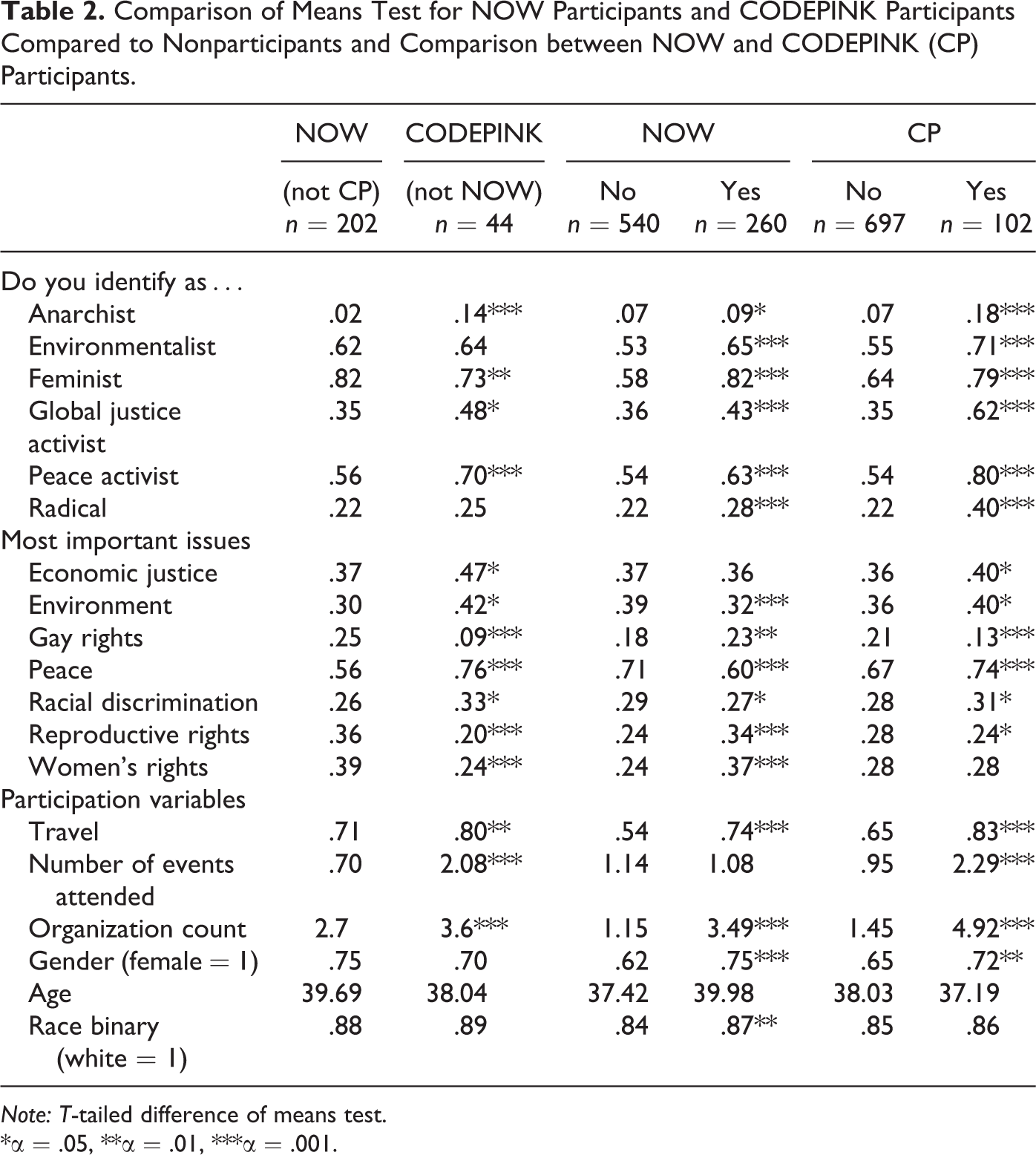
Using the survey completed by protest participants, I ran a series of t tests comparing participants in each organization with nonparticipants and with the other organization. Table 2 presents the two-tailed difference of means t tests.
Comparison of Means Test for NOW Participants and CODEPINK Participants Compared to Nonparticipants and Comparison between NOW and CODEPINK (CP) Participants.
Note: T-tailed difference of means test.
*α = .05, **α = .01, ***α = .001.
Column 1 compares NOW activists (who were not in CODEPINK) and CODEPINK activists (who were not in NOW). 5 CODEPINK participants were more likely to identify as anarchists, global justice activists, and peace activists. NOW participants were more likely to identify as feminists. NOW activists prioritized the legal rights of gay rights, reproductive rights, and women’s rights as their most important issues. CODEPINK activists were more likely to identify economic justice, the environment, peace, and racial discrimination as important. CODEPINK activists were also more likely to travel for a protest and attended significantly more protest events, specifically antiwar protests. Overall, this comparison of participants is consistent with the way the two organizations came across in the e-mail analysis. CODEPINK had more action messages and made taking action more personal. As such, it is likely that CODEPINK was able to both attract experienced activists and mobilize less experienced activists in ways that helped them build skills while attending and organizing protests. CODEPINK eschewed the label of feminist and prioritized nongender issues in its issue messages; CODEPINK participants reflect that issue priority. NOW participants prioritized rights and were most focused on the gender issues of women’s rights, gay rights, and reproductive rights.
This comparison does not tell the whole story of who CODEPINK and NOW activists were. Instead, it just shows the margins of the two groups—the NOW activists who were mobilized only around reproductive rights issues and had little other experience in the antiwar movement of the 2000s and the CODEPINK activists who were mobilized around peace issues and had little women’s movement experience. The ways that those who were involved in a women’s group (either NOW or CODEPINK) differ from protest participants who did not support either women’s SMO is truly important for understanding the SMO’s coterminous relationship. 6
NOW members were much more likely to identify themselves as feminists, global justice activists, environmentalists, peace activists, and radicals than nonsupporters. NOW participants were significantly less likely to identity peace as among the most important issues compared to nonparticipants but peace was still ranked as among the most important issues for 60 percent of NOW supporters. NOW supporters identified their top four issues as peace, women’s rights, economic justice, and reproductive rights, similar to the issues covered in NOW’s e-mails. Overall, NOW participants were more involved in activism, on average, than the overall protest population and had a broad and inclusive ideology and issue priority.
CODEPINK activists also appear to be much more integrated into activist groups and movement communities and to be highly engaged protest participants. CODEPINK participants were significantly more likely than nonparticipants to identify as anarchists, environmentalists, feminists, global justice activists, peace activists, and radicals. CODEPINK participants identified economic justice, the environment, peace, and racial discrimination as their top political issues. Interestingly, CODEPINK participants were less likely than nonparticipants to identify gender issues as a top priority. (This is different from CODEPINK’s e-mails that focused most on peace followed by women’s rights, abortion, and the environment.) CODEPINK participants showed a very high level of participation compared to other activists. CODEPINK participants were more likely to travel to attend a protest, attended more protests, on average, and supported many more organizations.
This survey data shows that both NOW and CODEPINK drew a range of activists into protest. NOW activists (column 2) were dramatically more invested in a range of social issues and, in particular, were more likely to identify as radicals and feminists than non-NOW participants. Compared to CODEPINK activists, NOW supporters (who were not in CODEPINK—column 1) were more likely to identify as feminists and more concerned about gay rights, reproductive rights, and women’s rights. These NOW supporters reflect the historical priorities of NOW and the agenda established by the second-wave women’s movement. In CODEPINK’s case, CODEPINK activists (Column 3) were also much more likely than nonsupporters to identify as radicals, global justice activists, anarchists, and feminists. Compared to NOW activists, CODEPINK activists who were not involved with NOW (Column 1) were still more likely to identify as anarchists, global justice activists and peace activists but less likely to identify as feminists or show concern for women’s issues.
This comparison shows how the two organizations complemented each other. CODEPINK drew in activists who were involved in the global justice movements and drew in peace activists who understood war and militarism as an intersecting systemic issue but were not particularly concerned about political change through the expansion of rights. Contextualized within the framework of its e-mails, we can see that CODEPINK sought to mobilize individuals from recent movements and those who were inexperienced. CODEPINK used framing that resonated with popular cultural discourses of maternalism and individualism and also with framing of third wave and ecofeminism. Concurrently, NOW mobilized individuals who identified as feminists and were concerned about expansion and protection of political rights. Those activists who participated in both CODEPINK and NOW were those who were most experienced, most radical, and most likely to embrace a feminist critique of militarism that also emphasizes the intersectionality of race, class, gender, sexuality, age, and militarism—and those who are most likely to remain activists into the future.
Discussion and Conclusion
Just like in movements of the past, the contemporary women’s movement relies upon diverse frames and organizations. The suffrage movement drew on both maternalism and feminism to promote women’s right to vote (Buechler 1990; Cott 1986). In the late 1960s, Vietnam war activists mobilized as part of Women’s Strike for Peace and also as radical feminists (Davis 1991; Freeman 1998). In this era of neoliberalism, ongoing militarism, feminist backlash, and a vigorous and well-organized religious right countermovement, women’s movements of today are similarly faced with both savvy opposition and a need to use frames that resonate with the public. Additionally, the contemporary women’s movement must contend with the success of previous campaigns as the movements seek to persuade younger women that feminism remains an ongoing struggle (Kirkpatrick 2010). Thus, in order to continue to promote women’s rights and gender equality, the U.S. women’s movement needs to successfully connect to other concurrent movements and those in the recent past, including the global justice movement, third-wave feminism, and ecofeminism to both prove its relevance and draw in contemporary activists. One strategy for communicating to diverse audiences is with multiple frames generated by one organization. Historically, it has also been common for coterminous organizations that reflect diverse ideologies to collaborate with one another. I argue that this is the case for NOW and CODEPINK in the 2000s and that this case provides a microcosm for understanding feminism in movements and theory.
CODEPINK’s e-mails showed an organization focused on war and militarism and that connected gender and war alternately through maternalism and third-wave feminist frameworks. CODEPINK’s framing emphasized individualism through inclusion of personal stories in ways consistent with “choice feminism.” CODEPINK also drew on maternalism to mobilize “mothers and other caregivers” to oppose war. Through this emphasis, CODEPINK both represented itself as an inclusive “women’s” organization and avoided direct feminist critique. Concurrently, CODEPINK’s nonhierarchical and participatory decision-making structure combined with their frequent and highly accessible action messages allowed CODEPINK participants to create the opportunity for a high level of engagement with the organization without a high-cost entry point. CODEPINK activists didn’t have to negotiate with existing leaders, they didn’t have to embrace prepackaged actions, and they didn’t have to follow talking points or consult with national leadership. CODEPINK’s strategy of encouraging individuals to engage in highly visible protest against war reflects both the organization’s agenda and its assessment of what type of change is needed. As a result, CODEPINK appears to have been able to rapidly generate a very high level of engagement and commitment from its participants and also attract experienced activists. Overall, CODEPINK succeeded in mobilizing women, as women, against war.
NOW’s e-mails present an image of an organization that is highly organized, formal, and established. The e-mails were professionally written, discussed multiple issues, and were educational. They informed supporters about issues as part of their effort to encourage mobilization and emphasized connections between issues, especially between women’s rights and other issues. For NOW, women’s rights was interpreted broadly to mean abortion, health care, education, employment, child care, racial discrimination, gay rights, disability rights, and women’s rights internationally. Their rights-based framework was explicitly political as it targeted legislators, politicians, courts, and corporations. Their action framing suggested that women should be engaged in both the formal and informal political process but in very specific and focused ways. Overall, NOW mobilized women and men around feminist issues, including war.
In one sense, NOW and CODEPINK are very different organizations. At the same time, NOW and CODEPINK are clearly part of the same social movement sector, have overlapping issue priorities and collaboratively organized marches and demonstrations around both antiwar and women’s rights issues. I argue, therefore, that comparing these two organizations is important for understanding both the historical relationship between women’s rights and women’s peace movements and the current state of the U.S. women’s movement in both theory and practice. In contrast to its reputation and some scholarship, this study has shown that NOW is neither narrow nor exclusive. Although the SMO emerged from the second-wave women’s movement, NOW has grown and changed since its founding in ways that reflect engagement with contemporary issues and dispositions. NOW’s agenda emphasizes intersectionality and encourages women’s political participation around diverse issues. But, unlike some third-wave SMOs, NOW remains explicitly feminist and does not embrace an ideology that subsumes feminism or women’s rights (even temporarily) to other issues. In contrast, CODEPINK’s emphasis on gender rather than feminism, personal experiences, and individualism facilitates participation by diverse groups of people. But, in their formal communications at least, they did not seek to stimulate ideological change among their participants. As such, NOW was more focused on ideas and CODEPINK more on action—and to this extent, their differential emphases are consistent with the tensions between second- and third-wave feminism articulated by both scholars and activists (Ferguson 2010; Heywood and Drake 1997; Kirkpatrick 2010; Snyder 2008; Snyder-Hall 2010).
Yet, I think that these differences are also consistent with the longer history of women’s movements. Previous mobilizations have also shown a bifurcation between SMOs that focused more on ideas and SMOs that focused more on action. Earlier waves of women’s rights and women’s peace organizing also emphasized the intersectionality of gender and peace, internationalism, poverty, and other issues. Earlier waves also had segments that placed greater priority on participation over ideological unity and sought to resonate with broader cultural norms about women in order to mobilize many women into action. I argue, therefore, that while many critiques of both second- and third-wave feminism have validity, looking at feminism in movements—rather than theory—shows that while critiques of exclusivity have long histories, that there are many cases that challenge that critique. Further, taking a long historical view shows that SMOs with both inclusive and exclusive ideologies, agendas and constituency are important for the longevity of the U.S. women’s movement.
Cycles of protest provide opportunities for new organizations to form and old ones to become reenergized. Those organizations seek to attract activists with varying degrees of experience to participate within the specific SMO and the movement in general. Different SMOs form agendas and frame issues in ways that reflect both their strategic and ideological positions. Taking a long historical and inclusive view of women’s movements in the United States highlights a central tension between inclusivity and diversity of constituency, ideology, and agenda (Buechler 1990; Ferree and Hess 2000; Ferree and Mueller 2004; Rupp and Taylor 1987). I argue that the relationship between women’s rights and women’s peace movements, in general, and the relationship between NOW and CODEPINK in particular, bring this tension into relief by highlighting processes fundamental to the longevity and vibrancy of the U.S. women’s movement: that coexisting women’s rights and women’s peace groups serve to draw a maximum number of women into gender-specific protest, take advantage of issue salience, and promote long-term women’s movement goals by drawing new women to gender-specific activism and thereby expanding the potential base for established organizations to draw on during periods of movement abeyance. Together, they develop a symbiotic relationship that strengthens the women’s movement, and feminism, overall.
Footnotes
Declaration of Conflicting Interests
The author(s) declared no potential conflicts of interest with respect to the research, authorship, and/or publication of this article.
Funding
The author(s) received no financial support for the research, authorship, and/or publication of this article.