




Abstract
Research on gang membership often ignores critical intersections of gender, class, and race. I seek to bridge the gap between the raced and gendered experiences of Black gang members, especially women whose experiences are often overlooked. Utilizing critical race theory, I will examine how gender performances are influenced by gang membership and how members and their associates construct their identities. An intersectional focus on Black women gang membership will broaden our understanding of gang literature where Black men are often overrepresented. This research will produce participant-led data that unearth gang members’ firsthand experiences and will produce important contributions. Findings suggest that gang members experience significant Black adolescent trauma; membership for Black women is familial, and as adults, they often use their gang identities to challenge gang culture; and there is a duality between “gang members” and “gang bangers.” I argue that this research debunks the narrative that gang members display inherent criminal behavior. Instead, I provide a counternarrative that humanizes gang members and adds validity to the structural causes of gang membership in these communities.
Personal Reflexive Statement
People beam at me with envy after I tell them I grew up in beautiful Southern California. San Diego’s year-round warm weather, beautiful beaches, and laid-back culture attract millions of tourists and transplants every year. However, “American’s Finest City” is also home to approximately 91 gangs and over 4,000 gang members ( Burks 2014 ). That was my lived reality growing up in Southeast San Diego. In my neighborhood alone, there are approximately 15 different gangs within a 10-mile radius. Growing up, I knew several young men and women who died or became incarcerated as a result of gang-related violence. When I moved away from San Diego to work on my doctorate, I was hoping to escape that life and embrace a new chapter. However, after reading Dr. Victor Rios, Punished: Policing the Lives of Black and Latino Boys, I was inspired to do this project. Something Dr. Rios wrote shook my core. As he reflects on his ethnography of gangs in Oakland, California, he writes, “One of my graduate-school professors warned me, ‘Go native, but make sure to come back.’ When I returned from the field, I told him, ‘I took your advice and went native in the academy, but I made sure to go back to the community where I come from’” (Rios 2011 :15). Being disconnected from my neighborhood allowed me to reflect. I no longer wanted to escape, instead I yearned to be engaged in the community with the hope of affecting change. It was at this moment I realized that becoming a sociologist is not just for my personal goals but can be a vehicle through which I can enrich my community. Although I write this work and submit it to the academy, I want my work to be accessible for mass consumption. I write this work for my participants. My hope is to be the vehicle through which their stories are told. Being back in my community has allowed me to reflect on the importance of empowering others and keeping the door open for those behind me.
Typically when we hear the word “gangs,” we think of boys and men. Recent studies show that women and girls make up about 30 percent of the gang population and that most gangs are mixed-gendered gangs (Curry 1998; Miller and Brunson 2000; Sutton 2017). Early researchers of women and girls in gangs argued that their participation within gangs was at a subordinate status, often seen as “sex objects” to male gang members, or the “tomboy,” rough and tough girls that participated in violent behaviors or had unfeminine-like qualities (Batchelor 2009; Brown 1977; Campbell 1984; Sutton 2017; Whyte 1943). In addition, research suggests that girl gangs are the “sister” gangs to already established boy gangs (Hagedorn and Devitt 1999) and are less likely to participate in serious violent crimes at the same rate as their male counterparts (Brown 1977; Esbensen et al. 2010; Miller and Brunson 2000; Sutton 2017). Although young women constitute a small number of gang members, other studies argue that they commit equally as violent acts as their male counterparts (Wing and Willis 1999:5). Sociologist Tara Sutton argues that these views are “founded in sexist beliefs of women as passive, subservient, weak and dependent on men, even when it comes to their involvement in crime” and calls for additional research using a feminist framework (2017:145). With this study, I answer this call for additional research on gang membership that uses an intersectional feminist perspective to explore gang culture.
Vigil (2002), sociologist and gang scholar, maintains that gangs are the result of marginalization, “the relegation of certain persons or groups to the fringes of society, where social and economic conditions result in powerlessness” (p. 7). He posits that individuals who form street gangs experience “multiple marginality” or are subjugated from multiple directions. At any given time, they face economic insecurity, lack of opportunity, family instability, racism, and cultural repression (p. 7). Therefore, gang membership must be looked at from a structural perspective. In addition, Vigil argues that identity formation among adolescents from marginalized backgrounds stems from “the psychosocial need for peer affirmation, convention, and support” (Vigil 1988:421). He claims that a “youth’s self-identity is inspired and affirmed by commitment to and identification with the gang…. Roles provided by the gang, and the symbols and rituals by which these roles are enacted, reinforce this identity” (p. 424). The gang provides a way for youth to associate their identity as “tough” or “hard.” In other words, adolescents growing up in marginalized communities are drawn to gang membership to fill the need of powerlessness.
While many scholars focus on the violence and overall criminality of youth gangs, I situate my work in a feminist intersectional framework allowing me to address the limitations of previous gang-related research (Crenshaw 1989). As such, the experiences of gang-affiliated women remain undertheorized and understudied. Moreover, studies in criminology often dehumanize gang members and advance archaic ideas of inherent criminality. For instance, some scholars argue that gang membership is linked to genetics (Barnes, Boutwell, and Fox 2011; Connolly and Beaver 2014). Studies specifically on women in gangs use individual-level analysis, “culture of poverty” arguments to stress promiscuity, and refer to girls/women as “beyond risk” (Valdez 2007). My work offers an alternative view of gang affiliation by setting aside the presumptions of criminality and highlighting the lived experiences of how Black men and women navigate gang culture.
Conversely to scholarship that dehumanizes gang members, scholars such as Rios (2011), Anderson (2000), Jones (2010), and Venkatesh (2008) consider the structural limitations of inner-city residents (concentrated poverty, violence, racism) and explain how these issues contribute to gang membership and inner-city violence. One of the earlier works on gang membership by Moore (1978) looked at the Chicano gang population in prisons in Los Angeles and focused on how structural barriers and poverty led to gang membership. Her study uncovered the subculture of Chicano gangs and their involvement with what she calls the “barrio economy” or the drug market and other illegal enterprises (Moore 1978). Scholars like James Diego Vigil take the structural argument a step further. He provides a multiple marginality analysis of gang membership using a cross-cultural examination to highlight the ways different ethnicities experience gang membership (Vigil 2002). These studies address the intersectional aspects of gang membership, but few studies account for the important intersections of race, class, and gender. Women and girls who grow up in concentrated poverty are enmeshed in violence and subjugation perpetrated by the men in their lives. The bulk of gang-related research focuses on the experiences of Black and Latino men, leaving the experiences of gang member/affiliated women largely unexplored. I seek to bridge the gap between on-the-ground experiences and sociological discourse, particularly for women whose experiences are overlooked.
I utilize critical race theory (CRT) as the overarching theory that drives this study because it focuses on using narratives from disenfranchised groups to expose racism while also validating their experiences (Bell 1995; Crenshaw 1995; Ladson-Billings and Tate 1995; Solórzano, Ceja, and Yosso 2000). CRT scholars employ several different principles for addressing social inequality; however, Solórzano et al. (2000) argue that there are five main elements. These include the following: “(a) the centrality of race and racism and their intersectionality with other forms of subordination, (b) the challenge to dominant ideology, (c) the commitment to social justice, (d) the centrality of experimental knowledge, and (e) the transdisciplinary perspective” (Solórzano et al. 2000:63). Advocates of CRT focus on the idea of using the storytelling and the “voice” of oppressed people to highlight their realities, “Stories by people of color can catalyze the necessary cognitive conflict to jar dysconscious racism” (Ladson-Billings and Tate 1995:59). CRT researchers are skeptical of grand theories and single-axis analysis and draw from multiple theories to promote the idea of praxis (Wing and Willis 1999). CRT will add nuance to this research by centering storytelling as a means toward combating racism, sexism, and economic injustice. Storytelling and identity-making go hand in hand and provide a way for gang members to present and reinforce their identity. This will help researchers to understand members as both individuals and a part of a collective.
The amalgamation of multiple theories must be used to understand the multiple dynamics at play while discussing gang culture. We must remember that gang members are not one-dimensional. Color-blind racism (Bonilla-Silva 2014) and the “imperialist white-supremacist capitalist patriarchy” facilitates the criminalization of Black and Latinx people and relentless policing, gentrification, and institutional violence (hooks 2004). Moreover, color-blind racism frames racism as a problem of the past and denies its existence in contemporary society whiledenying the existence of systemic racism (Bonilla-Silva 2014). The criminal justice system operates under color-blind ideology to mass incarcerate young Black men and women. Laws such as “stop and frisk” are employed more heavily in low-income neighborhoods, and statistics show that police detain Black and Latino men at a higher rate than white men (Alexander 2012). Numerous gang scholars frame gangs as a “problem” while failing to interrogate the societal root causes that force Black and Latinx youth into gangs in the first place. While some sociologists situate gangs as territorial subcultures that are centered on violence, I argue that violence is a symptom of oppression rather than subcultural phenomena (Sanders 1994).
Utilizing the philosophies of CRT, I employ several sociological frameworks to analyze gang membership. Because patriarchal, structural, and economic violence result in different life experiences for men and women of color, I draw on feminist standpoint theory to center the focus on gang members through an intersectional lens (Collins 2009; Harris 2000; Hunter and Davis 1992; Jackson II and Dangerfield 1997). The goal is to decenter whiteness and to value the knowledge that gang-affiliated groups produce through narratives and storytelling (Collins 2009). Intersectionality, coined by Crenshaw (1989), defines how people experience discrimination along race, class, and gendered categories. Crenshaw argues that Black women are marginalized by being both women and Black, and being from the working class adds another level of marginalization. The experiences of people of color cannot be understood wholly unless you consider the convergence of race, class, and gender (Crenshaw 1989). By acknowledging different intersecting points of identities, we can understand why being low income, a person of color, male, and a gang member will doubly compound one’s stigma within society. Adding the additional axis point of being a woman creates a more nuanced overlapping system of oppression that highlights patriarchal power within a gang.
In this article, I provide a background of gang membership in San Diego as well as literature surrounding gang membership identity formation, hypersegregation, and gendered identities. Rather than presupposing the identity of gang members as criminal, my work encourages gang members to claim self-definition. Using the docent method, a placed-based walking interview approach, I use in-depth interviews and an ethnographic analysis to explore the gang culture of Southeast San Diego. The aim of this study is to investigate how Black men and women use their gang-affiliated identities to navigate and challenge social inequality within their communities. My findings suggest that adolescents within Black gang culture experience a shared extraordinary trauma within their neighborhoods and have become cultural spaces of shared trauma identity. Second, my findings reveal that Black women, whose identity is formed from familial gang membership, are often done out of survival. My participants show that women who were exposed to gang membership as adolescents often grow up to challenge gang culture. In addition, I found that there is a duality between “gang member” and “gang banger” identity that help Black men and women navigate both gang and nongang spaces.
Background
Southeast San Diego and Mid-City residents are primarily low-income minorities. The demographics of Southeast San Diego are very similar: primarily Black, Latino, and Southeast Asian, with groups typically concentrated in overlapping ethnic enclaves (Guevarra 2012). According to the 2018 census, Black residents only make up 5.5 percent of the population compared to 34 percent Hispanic or Latino, 12.6 percent Asian, and 45.2 percent white (U.S. Census Bureau 2018). Even though Black residents only make up a small percentage of the population, most reside in the southeastern part of the city. In addition, the median household income in the city of San Diego is US$65,753 based on estimates between 2010 and 2014 (U.S. Census Bureau 2014). According to Massachusetts Institute of Technology’s living wage calculator, it takes at least US$65,989 a year for a family of four to meet the minimum living wage standards in San Diego (Glasmeir 2004). The median household incomes in the zip codes of this study range from US$28,185 to US$57,287; a vast majority live below the minimum standard. To give some context, in wealthier areas of San Diego (e.g., Rancho Santa Fe, La Jolla, and Carlsbad), the median household incomes ranged from US$95,306 to US$119,939 between 2010 and 2014 (U.S. Census Bureau 2014).
Gangs and Identity
Gang initiation is much different than what is portrayed on television, such as members being “jumped in” or girls being “sexed in.” Typically, memberships are granted due to familial association, and initiation consists of being asked to perform a criminal activity (Durán 2013; Jones 2009). Many gang members grew up in “gang families,” so being part of the gang is normalized and routine. According to Vigil (2007), families involved in gangs were one of the major push factors for youth joining a gang, while Durán (2013) argues that friendships were the major pull factors for gang membership. Moore’s (1978) seminal piece illuminated the inner workings of the familial culture of Chicano gang members (p. 99). She argues that Chicano gangs form a kin-like obligatory network of gang members and their families. She writes, “When a younger brother of a barrio friend and gang member shows up to prison he becomes the charge of the older pinto (convict),” in other words, the new prisoner becomes the responsibility of the older prisoner, making sure he is safe, offering advice, introducing him to prison culture, and providing him with small necessities (p. 99). I also found that these duties are highly valued among the gang community. There is an unspoken expectation of loyalty, gang members are to care for one another and help each other in times of need.
Yet, there is much debate on who decides what constitutes as a gang? The word “gang” is synonymous with “crime,” and most of our definitions of gangs come from law enforcement, criminologists, and government agencies. For example, CalGang (2018), the statewide gang database in California, defines gang members as having two or more of the following criteria:
(a) Subject has admitted to being a gang member.
(b) Subject has been arrested for offenses consistent with gang activity.
(c) Subject has been identified as a gang member by a reliable informant/source.
(d) Subjects associates with documented gang members.
(e) Subject has been seen displaying gang symbols and/or hand signs.
(f) Subject has been frequenting gang areas.
(g) Subject has been seen wearing gang dress.
(h) Subject has gang tattoos.
By these definitions, anyone living in a neighborhood with a large gang presence and seen associating with documented gang members would be considered a gang member. In fact, in a 2016 California State Audit Report, Howle (2016) criticizes CalGang and found the database to be noncompliant with policy and full of inaccuracies. The Los Angeles Times published an article in August 2016 stating that the audit “found the names of 42 people whose birth dates indicated they were one year of age or younger at the time they were entered into the database, 28 of which were entered for ‘admitting to being gang members’” (Winton 2016). In addition, the database audit reported that the documented gang members were overwhelming male at 93 percent and disproportionally minority, 64.9 percent Latino, and 20.5 percent Black (Winton 2016). The CalGang database is the further evidence of what Michelle Alexander calls “The New Jim Crow,” the war on low-income men of color, and the culmination of agencies organized to mass incarcerate Black and Latino men (Alexander 2012).
Nevertheless, we see much resistance of the label of criminality among gang members. For instance, Mike, a Black gang-member-turned activist, is working with the Southeast San Diego community to “reclaim their stories.” He argues Being a gang member is not illegal. It’s illegal to commit crime. And I think that people should be proud of where they’re from. That’s why I do identify as a gang member, but Imma be the first gang member to graduate from law school. So I feel like, we’ve been told what a gang member is, but we were never able to define for ourselves, what a gang member is.
Furthermore, for youth living in the segregated ghetto, gang membership was not just normalized and entrenched in the culture, but it was a way for young men and women to make money and receive protection (Del Carmen et al. 2009; Goldman, Giles, and Hogg 2014; Moore 1978; Venkatesh 2008). Goldman et al. (2014) analyze gang identity using social identity theory, and they argue that gangs provide individuals with a sense of belonging. Because of their vulnerable age, youth are especially susceptible to the allure of what gangs have to offer: a peer group of which they can be a part, a clear personal and social identity, increased autonomy from parents or guardians, a “path to manhood” (albeit violent), and the means by which to improve their social status. (P. 817)
Race and Hypersegregation
The rise in street gangs started in the late 1970s and early 1980s because of the deindustrialization process that closed access to blue-collar employment (Venkatesh and Levitt 2000). Disinvestment in low-income communities coupled with the push for the “war on drugs” and “war on gangs” initiatives, and ramped-up policing along with the dismantling of the welfare state provisions was a larger national agenda for the mass incarceration of Black and brown bodies (Alexander 2012; Venkatesh and Levitt 2000). Young men turned to the underground economy to find ways to survive such as fixing cars, selling drugs, pimping, day laborer positions, and providing protection (Venkatesh 2008). Furthermore, criminalization is embedded within the fabric of everyday life in urban ghettos; the prison becomes an extension of the neighborhood (Wacquant 2000). Rios calls this system the youth control complex (Rios 2011). He posits that young men are constantly policed, harassed, and stigmatized. Rios argues that the criminal justice system works with community institutions within urban ghettos to reproduce the school-to-prison pipeline, arguing that men of color are at the center of Foucault’s (1977) panopticon, constantly being monitored and oppressed. Rios maintains that the poor have not been abandoned by the state, but rather, the state has become embedded in their everyday lives through punitive social control (Rios 2011).
Some sociologists, such as Massey and Denton (1993), argue that racial segregation combined with concentrated poverty create the urban poor and an oppositional culture. Massey and Denton (1993) claim, “By concentrating poverty, segregation simultaneously concentrates male joblessness, teenage motherhood, single parenthood, alcoholism, and drug abuse, thus creating an entirely Black social world in which these oppositional states are normative” (p. 170). In contrast to this framework, Rios (2011) argues that youth trapped in the urban ghetto adopt beliefs and practices of resistance as they strive for their dignity which is in response to punitive social control, cruel treatment, stigmas, and lack of resources.
Moreover, concentrated poverty often coincides with gang activity. As you can see from the map (Figure 1), the southern sections of San Diego are the areas where gang territories are highlighted. The area I am focusing on exhibits all five dimensions of hypersegregation: evenness, exposure, concentration, centralization, and clustering (Massey and Denton 1993). The areas in red are notoriously areas of gangs known to be affiliated with Bloods, the blue are affiliates of Crips, the Black areas are Surenos/Hispanic gangs, and the purple are neutral or Southeast Asians groups that have formed their own gangs. Most of the Blood and Crip gangs are Black, yet some are Southeast Asian. Vigil (1988) argues that “group terminology reflects a sense of emotional attachment,” and the gang can be seen as the primary group for which members’ identities are formed (p. 433). He claims that for gang members, the neighborhood or gang name is a “symbol for the group ideal…members who share a similar background identify with one another under the group label and begin to treat one another as close friends because of the identification” (p. 434). Although minorities living in this area struggled financially, they take pride in representing the “Southeast San Diego” identity. Being from “Southeast,” gave you status, regardless if you are gang affiliated or not.
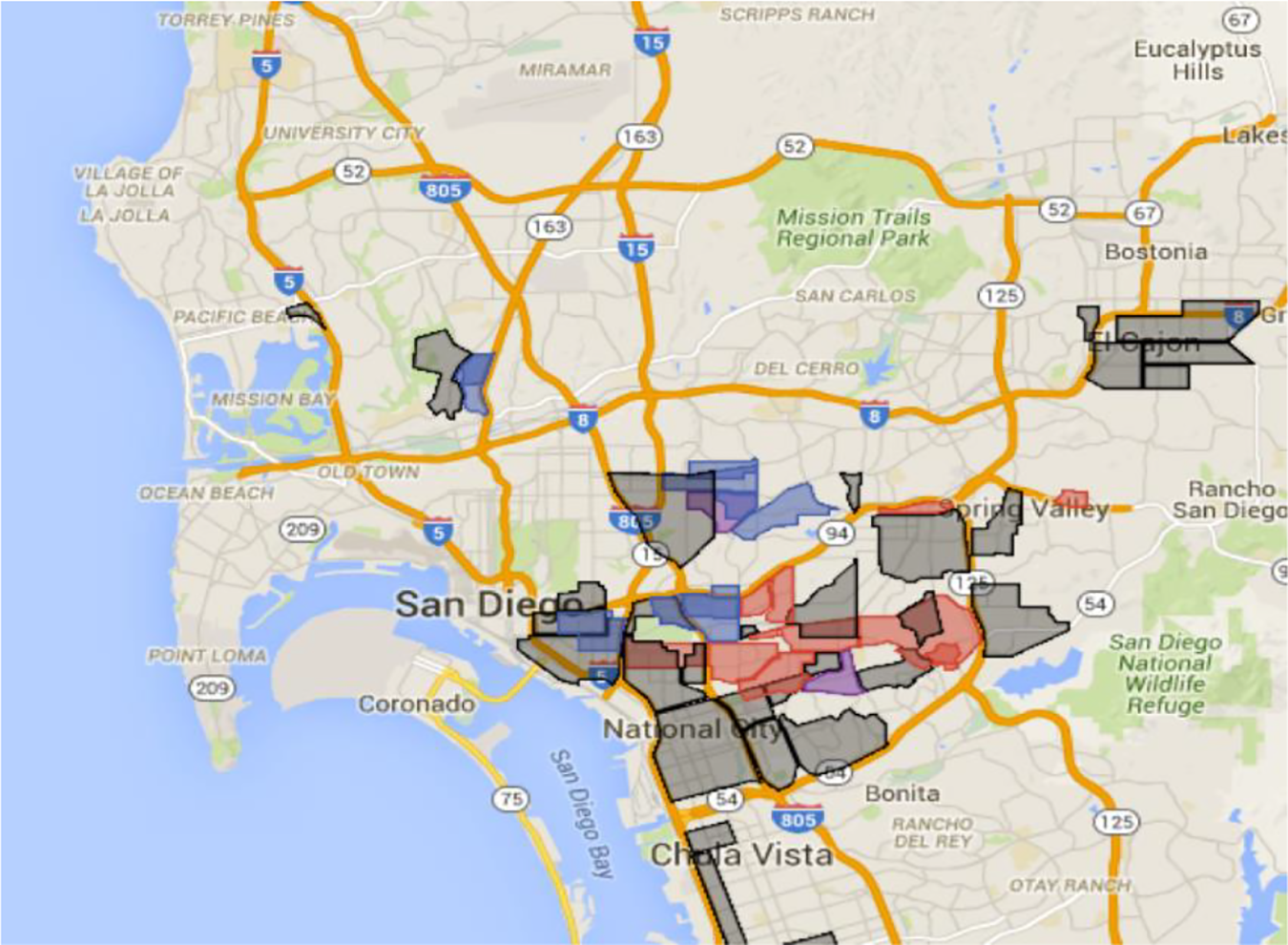
Map of San Diego gang territories.
Gender and Gangs
Although there has been a considerable amount of research on gangs and gang membership (Anderson 2000; Durán 2013; Goffman 2014; Goldman et al. 2014; Moore 1978, 1991; Rios 2011; Venkatesh 2008; Vigil 1988, 2002), few studies account for important intersections of race, class, and gender. Women and girls who grow up in concentrated poverty are enmeshed in gang violence and shape their identities from gang culture. Majority of the studies conducted on gang membership are produced from a criminology perspective (Chesney-Lind and Hagedorn 1999). However, this work is problematic because it pathologizes gang membership. Criminologists perceive gang members first and foremost as criminals who are violent and need saving. Second, they perceive gang members as men, not women.
Wing and Willis (1999) urge scholars to utilize critical race feminism to demarginalize the experiences of Black women in gangs. They argue that critical race feminism, stemming from CRT, puts women at the center of analysis (p. 4). They write: The Black female gang member is triply burdened by her class, race, and gender…. She comes from a poor family, usually headed by a single female. She feels her choices are limited and she strives to overcome economic and gender repression…. She turns to the gang to protect her from violence and to provide her with family-like relationships. Her father is often absent, and she is deprived of the kind of stable family environment every child needs. Due to all of these and other contributing factors, the needs of females within these communities are not being met. The Black female must turn elsewhere to fulfill them. In the gang she hopes to find love, protection, acceptance, belonging, guidance, and support. (P. 12)
Sociologist Nikki Jones (2010) provides an in-depth analysis of adolescent girls and women in the inner city. She argues that girls in the inner city strategically manage their reputations as “good/pretty girls” or “girl fighters” as a means of survival. Girls develop what Jones coins as situated survival strategies (p. 52). For instance, “good girls” use tactics of staying inside and out of trouble by limiting contacts with people in the neighborhood to family only. The “girl fighters” use their reputation to gain notoriety and freedom. The “good girls” feel like staying out of trouble is the best way for survival while the “girl fighters” feel like fighting offers them freedom to walk about the neighborhood without fear (Jones 2010).
Similarly, the ways in which young men seek meaningful identities reflect where they are situated within the hierarchies of race, class, and gender. Harris (2000) argues that Black men are materially and culturally “emasculated” by white supremacy by being denied the privileges of hegemonic masculinity (p. 783). In response to this, Harris argues that Black men have adopted a rebellious form of manhood that places a high value on respect, dignity, and pride because they are aware of the subordinate class position given to them within Anglo-American culture. In Vigil’s (1988) assessment of street identity among Chicano barrios, he argues, Toughness is also the gang behavior pattern most accessible for those youths who have had particularly distressing early childhoods…. It is an avenue for personal expression that uplifts the ego, enabling them to appear successful in at least one area…. Acting tough affords them pride, with the assurance of being back by the gang if trouble arises. (P. 427)
Moreover, Towns (2007) suggests that street gangs became a way for young men raised by single mothers to seek masculine fatherly love: “Gang members search for love- specifically fatherly or masculine love, so they can learn how to ‘become a man’—within the gang, kids search for father figures in the criminal underground” (p. 47). Traditional ideas of what a “family” is, a white picket fence and the American Dream, can be a sore reminder to poor urban youth of how they are different. Single-parent homes, lack of income, and lack of educational resources plague the urban ghetto. When home life is in despair, young men and women will seek family outside of the home, creating extended families among their gang community (Towns 2007; Vigil 1988). Additionally, segregated neighborhoods are perceived as carceral power. Shabazz (2015) argues that Chicago’s South Side was founded on mechanisms such as architecture, urban planning, and policing to confine and control neighborhoods, creating a prison-like environment (p. 2). Shabazz claims that in extension, carceral power had a significant impact on the formation of Black masculinity. In his analysis, Shabazz argues that the Black migrants of the early 1900s were forced to live in small one-room apartments known as kitchenettes which became an extension of prison life in the very homes they lived. Like Foucault’s theory on discipline, prisons have the ultimate ability to control and punish (Foucault 1977; Shabazz 2015:5). Shabazz highlights the way carceral power pervades poor Black neighborhoods and informs and shapes one’s identity, especially Black masculinity.
Method
I draw from the “docent” method, a qualitative placed-based approach, to allow participants to walk me through their experiences of everyday life (Chang 2017). This unique methodology is a participant-led, placed-based, ethnographical analysis that employs participants to choose sites of interest while I accompany them on a walking or driving interview. Utilizing my close ties along with snowball sampling, I interviewed 30 gang members in Southeast San Diego and Mid-City, which are made up of several neighborhood gangs. Centering the methodological process on the participant, or coresearcher, provides a rich narrative of their experiences and allowed me to outline the layout of the city to illustrate how residential segregation facilitated the formation of gangs (Leviss 2018).
Before the interview, participants were asked to map out a path that we would either walk or drive to. During the interview, I took pictures of the surrounding area to map the neighborhood. The participant spearheaded the interview, leading me on a journey of their experiences. After many of the interviews, participants felt like the discussions were therapeutic and felt good about being able to tell their stories. One of the participants Keith said, “it wasn’t as bad as I thought it was going to be, I actually enjoyed talking to you. I thought it was going to be different and really uncomfortable.” My questions do not just ask about their gang membership status but also about their family life and goals for the future. Because I am not in the gang, some of the interviews felt censored, while other interviews felt very revealing and genuine. It was dependent on if I was able to gain their trust, most importantly, that they were not feeling judged. I employed a “critical caring pedagogy” approach to conducting my research (Camangian 2010). Because many of my participants live in concentrated poverty, have economic instability, and fractured home lives, they embody and internalize deficit stereotypes and self-hate. I tried to facilitate a relaxed and comfortable environment so that the participants felt comfortable to share their stories. In order to achieve this, I wore casual clothes and reassured the participants that I am from the neighborhood. I wanted to promote self-reflection, thus creating a compassionate dynamic where the participants feel empowered, cared for, and respected allowing them to share more freely and genuinely (Camangian 2010).
I interviewed 15 men and 15 women, majority of which were Black (Table 1). The participants consisted of active or former gang members as well as those who consider themselves associates. I conducted the interviews in two phases, summer 2018 and summer 2019. On the second phase of data collection, there were several shootings in the area, many of my contacts canceled, and I was advised to cease interviews. Some limitations I encountered were gaining access to the 18–24 age-group. Most of my community liaisons were people I had grown up with, so they were familiar with me and knew that I was researching the community for my dissertation. The younger gang members were more skeptical of my presence in their community and did not want to be interviewed on record.
Participants racial breakdown.


Most of the interviews took place in the car while we were parked at each location. We would meet at the place of their choosing and either conduct the interview at the meeting point or a location close by. The neighborhood and adjacent neighborhoods I grew up in is primarily Black, specifically from Blood gangs. This limited my amount of contacts with other, often rival gangs, which again was avoided for my safety. Additional limitations revolve around my lack of access to the Latinx and Asian gangs, and this study will focus on the findings from the Black and Black-identifying participants. Aside from these limitations, I believe these young men and women’s narratives depict true stories of survival, community, and resilience.
Findings and Discussion
The interviews reveal the following salient themes. First, I found that many of my participants experienced a shared Black extraordinary adolescent trauma. Second, membership for Black girls and women in gangs tend to be familial in nature and encouraged by family members. Third, there are two types of gang membership among the Blood gangs in San Diego: gang members versus gang bangers. I argue that these themes show how gang members and associates use their gang identities to navigate and challenge social inequality within gang culture.
Black Extraordinary Adolescent Trauma
Contingent on the theory of the “routinization of extraordinary death,” Charmaz (1980) argues that death becomes “extraordinary” in circumstances such as combat or state executions. I take this a step further to argue that death in the hypersegregated ghetto is distinct and routinized by capitalistic undertakings to “maintain conditions where personalized violence is institutionalized in lower class members’ interpersonal relationships” (Charmaz 1980:210). In other words, death is pressed upon the psyche of Black men and women in the ghetto at young ages, making these scenes of “extraordinary deaths” routine and a part of the normalized experience. Early forms of extraordinary death can be linked to the lynching of enslaved Africans in antebellum America while current examples of Black extraordinary deaths would be death by police brutality (Grant and Thomas 2018).
Trauma and victimization in gang communities is a frequent occurrence (Hunt and Joe-Laidler 2001; Valdez 2007). All the participants revealed a childhood/adolescent memory that involved traumatic violence including death. Shanice, a 35-year-old Black women, whose father was part of a neighborhood Blood gang, explained why her father was incarcerated for murder. She recalls: I was about 11. I heard a loud crashing and I see my dad coming into my window and he just looked like a crazed maniac. He was dripping sweat. He had an axe in his hand and my first thought was like, “he’s gonna kill me.” But he came and he went right past. Me my brother had shared a room at the time and my little sister was like a like a baby, baby…. So he went past us, went down the hall and I like got up, but I didn’t go after him. I was like just kind of shocked there for a minute and then I heard my mom screaming and I heard her boyfriend and my dad like tussling and stuff. And I got up and I went down the hall and I saw my mom’s boyfriend and my dad like struggling and fighting…. And my mom tried to stop him too and then I guess she like got in the way and he like chopped her arm. She still has a scar right there [points to arm]. And then all of a sudden, her boyfriend stopped and then he just like was trying to get away and my dad was still like swinging the axe and he [the boyfriend] was like struggling down the hall and he went out the front door and my dad kind of pushed him out as he opened the door and closed it. And then, we were all like scared and wanted to leave and he wouldn’t like let us leave and then I think that’s when it sunk in for him like, “Oh shit, like what am I going to do?” He seemed like desperate, so he kept us in there for a while and then the police that came and then they were like standing outside and saying, “open the door and come out with your hands up,” you know, the standard stuff. I was begging him to let us go and my Mom’s arm was like open, like veins and stuff coming out, and I told him like “mom is cut and we have to get her help” and then that’s when I guess it clicked in his head because I was like screaming at him and he finally let us out. And I’m just I remember like when we opened the door, he [the boyfriend] was like right there, like he didn’t even make it like a step out the door. He was just there on the ground dead. So we had to like step over his body to get out.
Moreover, Shanice did not receive therapy or counseling directly after the incident, and she said that she has noticed that it has been affecting her life as an adult and was planning to seek therapy. When asked why, she retorts, “my mom couldn’t afford therapy, we had to worry about paying the bills.” Experiencing this type of extraordinary trauma as a child has such life-altering effects and shapes the way you operate within society. The stigma surrounding seeking mental health support in the Black community results in an undiagnosed and untreated population, many of which suffer from post-traumatic stress disorder or PTSD. Research conducted on gang member victimization report that gang members are “exposed to a combination of direct violence (as a victim) and indirect violence (as a witness) suffer higher incidences of current and lifetime PTSD” (Beresford and Wood 2016). Additional research on gang members victimization “show that 16 percent of incarcerated adolescents have been sexually assaulted, molested or raped, 57 percent have witnessed someone being killed, and 72 percent reported being shot and/or shot at” (Beresford and Wood 2016:149). What makes Shanice’s experiences extraordinary is that while this event is seen by the reader as horrific and traumatic, her community experiences similar traumas routinely. They are taught to repress the trauma and move on with their lives. Unable to grieve and heal due to the lack of access to quality health care, they are in a constant state of survival.
Another respondent, a young Black woman, Amanda, shared her experiences with gang-related violence at a young age. Amanda laments that she was just eight years old when she first experienced gang violence. Now, at the age of 28, she no longer considers herself a gang member but recalled that as a gang member, she was a “fighter” and confirmed that her two older brothers introduced her to the gang culture. During her interview, she explained that her first encounter with gang violence was a drive-by (a catch-all for assailants who shoot a firearm from a vehicle): It was bad. I think I was like eight years old and we were all outside playing and it was broad daylight and we seen the cars coming but we didn’t know what was going on. So my brothers and they friend, they was just like “RUN!” But you know when you hear run, you’re not going to run your eight! And they snatched me and my other brother up and they like dragged us and they just start shooting and then when they started shooting like, they just laid on top of us and it was really tragic and they told us “Don’t tell Mommy or Daddy!” So I finally told like a few years ago that it actually happened. I never said a word until like a few years ago.
Both Amanda and Shanice experiencing extreme violence at such a young age have remained silent about their experiences. Silence among gang members reaches far beyond the idea of snitching. There is a “code of silence” within the gang community (Anderson 2000). The avoidance of speaking about traumatic events within this community speaks volumes about the lack acknowledgment of mental health services for these victims. Speaking about past traumatic events can evoke painful feelings, and this community has a long history of suffering in silence. The structural multiple marginality experienced by Black women in our society is doubled for women gang members and affiliates. In addition to their triple burden, they are criminalized and further stigmatized in our society and lack the resources to help them cope with the extraordinary trauma they have endured.
Like Shanice and Amanda, many of male participants recalled traumatic experiences as an adolescent. For example, Randy, a 25-year-old, active, Black gang member, told me a story about one of his friends getting shot: I was born with heroin in my system. I was given the shit end of the stick…. I became an official gang member in the ninth grade, in sophomore year my house got shot up and I ended up dropping out of high school. I remember one day a friend from my neighborhood, he didn’t gang bang or anything, we were going downtown, and I ended up getting into it with some Crips. And I’m telling him like he need to go. And he didn’t want to go. He started trying to fight one of them and they pulled out a gun and shot him. That’s probably the worst memory I remember. I felt bad ‘cuz it was my fault. He didn’t even die but he ended up moving to Arizona after that and getting murdered in Arizona. I was 16.
Like Amanda and Shanice, Randy has experienced extraordinary violence, the shooting and eventual death of a friend. But like many in this community, experiences with extreme violence and trauma is normative. For many gang members, Black extraordinary adolescent trauma becomes a part of a shared collective identity. Psychologists argue that individual trauma can become collective trauma by linking shared histories. “Although trauma is primarily understood as an individual human experience, it often generalizes to symptoms in collective social settings” (Rinker and Lawler 2018:151). Gang members and their affiliates not only witnessed violence, but they also shared these violent incidents with others not just by word of mouth but virtually through videos and social media posts (Patton, Eschmann, and Butler 2013; Patton et al. 2014). As members learn of a tragedy, it is shared among the community. As such, the event becomes a shared collective trauma.
In addition, gang members are bonded by shared trauma which sometimes manifests by acting out through violence. “Learned helplessness and fatalism renders the victim or group vulnerable to hypervigilance of threat and intrusive thoughts. Similar to an individual with PTSD, collectivescycle through depression and anger often acting in before acting out. Eventually, impotent fantasies of revenge and need for justice trigger acts of violence against the oppressor” (Rinker and Lawler 2018:152). Thus, Black extraordinary adolescent trauma becomes a part of their individual and group identity. To cope, some gang members respond to social injustices by rationalizing their anger and use this as a means to justify their use of violence.
Black Girl Gang Membership as Familial
Researchers found that gang membership for girls and women is familial (Archer and Grascia 2006; Esbensen et al. 2010; Sutton 2017), with young women reporting that 71 percent had family members who were involved in gangs (Miller 2002). Among the women gang members or affiliates, all of them accessed their gang ties through male family members while engaging in acts of deviance or experiencing victimization, which again becomes routine and normalized. A former gang member, Jessica 27, reported that her entire family was from gangs and that her mother and older relatives are still actively participating within the gang community. Jessica is Black and Puerto Rican but identifies as Black. She reflects: Growing up I felt like it was like a norm right? You’re supposed to have like gang members in your family. It’s sort of like a protection for your family. It’s a way to identify where our family is from. I always thought that it was it was a good thing. Like if your family didn’t have gang bangers and it’s kind of like your family was weak. Like, why is there no tough people in your family? And I felt that way for a really long time. Like I feel like when I was in high school was the first time where I thought like, it actually wasn’t like a “cool” thing…. I got bussed out and I seen stuff that I didn’t know existed. Like I seen people like my age with really nice cars and like really nice houses and like their families like went on vacations.
While growing up in a gang-oriented family, Jessica’s identity was shaped to reflect the street culture that was challenged once she went stepped into nongang cultures. During the interview, Jessica reflects about her gang membership and how she felt like she was a gang member because it was a part of her family life: I did it because my family did it, right? But now it’s like that was a choice that I made. But I’m not making that choice now, like in this present moment. I feel as if when I try to talk to my family…even like Michelle (her cousin), because I see her just how I was like at her age. Every other word is “blood,” this and, “bracken,” that. And I’m just like, “oh my gosh, like you sound so tacky!” And I just say it to her because I wish someone would have told me that when I was her age. But now I feel, like I said before it’s a way to identify yourself and these people they don’t know any other way. We have like these roles, right? Like when you have a child, now you have the role as a mother and when you’re a kid, like that you have that role as a kid, right? Disadvantaged communities where they don’t really have access to a whole lot of knowledge, not even material, just knowledge. They don’t really have options of other roles to conform to, so what they do have is the gang role and it gives you everything that you’re looking for. Like it gives you money, it gives you the sense of like belonging, it gives you family if you don’t have none, or if you do have some it’s expanding your family, and it gives you like, you feel like more superior in your community when you’re from a gang…. I feel like because they just lack so much knowledge, that’s like the role that they want to do.
Like Shanice and Amanda, girls are subjected to violence usually through situations involving family members. For Amanda, she used this violence as a reason to join the gang and become a “girl fighter,” so she would no longer be vulnerable to attacks by others in her school and community. She employs her gang member identity for protection. She boasts, Like I don’t want you to have that impression, but I want you to know that I’m with the shits and don’t try me because if you tell somebody like your a “gang banger,” they’re not gonna fuck with you because they automatically gonna think like, “oh she crazy.” She knows this person. She can get this done to you. It’s like a shield.
Shanice on the other hand, who is now a college graduate and seeking a career in the film industry, took on the “good girl” persona (Jones 2010). Although Shanice did not identify as a gang member, her gang-affiliated identity taught her to challenge gang membership. Don’t be a follower, that’s what I learned. Being a part of a gang to be “cool” or to be affiliated with other people, seemed cool when I was younger. But it was really just stupid and a lot of people suppress their true selves and their potential trying to fit into this gang…. I do want to do more. Like when I get to a point where I feel like I can help other people I want to do things like mentorship…. I’m a female so my passion is towards helping females, to go back and help them and show them that there’s a whole world outside of your neighborhood than what you see, not that you have to leave your neighborhood, but you can pursue dreams and passions…teach people about school and ways that they can do it…. I didn’t really get that either, I’m first generation in my family going to college and graduating and I had to learn a lot on my own. So, I feel like there should be more support there and teaching them about school and getting their education.
While some girls and women use their gang member identity to navigate the violence in their neighborhoods, others use it as a means to empower their community. Wing and Willis (1999) argue, when Black women are uplifted, they will in turn uplift their communities. Girls who were initially pushed into gang membership through familial ties are now women with children who see gang membership through a different lens. These women challenge the gang culture and want to empower their communities. The huge difference between Shanice and Jessica’s experiences as opposed to Amanda’s experiences is education. After going to college, Shanice and Jessica were able to exchange their gang member identity and adopt a new one as college-educated Black women.
Gang Membership Identity
The dualism of gang members versus gang bangers portrays the idea that there are two types of roles in gangs for men and women. For instance, the sociological concept of “cultural straddlers” can be applied to gang members because they partake in other roles and identities such as father, husband, employee, or student (Carter 2006). When at school or work while speaking to someone with authority, they may code-switch (Carter 2006). I observed several instances of code-switching while conducting interviews. Some gang members used proper English and carefully chose the words they use to describe situations. For example, during an interview with 23-year-old Ty, an active gang member, he explained that he had moved to Texas when he was 16 and had just moved back. When I asked him what made him move to Texas, he replied, “I went to visit my brother.” When he said this, I thought to myself, “Who visit’s their brother for five years?” Later in the interview, he was telling this story of getting stopped by police in Arizona. He was on a road trip with his girlfriend, and he had marijuana in the car. He stated that the police booked and released him days later, and then, he had to find a way back to San Diego so he could eventually find the means to get to Texas. He stated, “The police in Arizona were dumb because they were never supposed to release me, I had a warrant out for my arrest.” Instinctively I called him out, “So when you were in Texas with your brother, you were on the run?” Looking surprised, he shook his head while looking down and said, “yeah.” In this moment, Ty’s gang member identity was not activated. Some gang bangers might have taken my “calling him out” as disrespectful. Yet, although I was asking him about his gang membership, I was not a threat to him, so there was no need for him to switch to that role.
I argue that the gang banger identity is only activated by gang members when threatened by active gang members. Like DuBois’s (1903) concept of double consciousness, gang members are able to feel like their identity is divided into several parts depending on the situation. When interacting with outsiders, gang members are aware of how they might be perceived and try to minimize their gang membership status to other nongang members or “squares.” While gang bangers, on the other hand, do not typically code-switch, nor do they frequent roles or situations where they might have to code-switch. On average, gang bangers have less contact with nongang members. Most of them have dropped out of school and are not formally employed. Many are also very active in their duties and responsibilities to promote and protect the gang.
For Jessica, she expressed similar ways that she code-switched especially during college when she replaced her gang member identity for a “college-educated” identity. She recalls when one of her professors challenged the way she thought about her gang membership identity: I had this Professor that taught Black Studies that asked me questions about it (gang membership). Like “What does it represent?” Like, “What does it like do for you?” I just think he wanted to know what it did for me and like it got me thinking…. I think he was just planting seeds in my head, but I started to think like that year and years later like “what, what is it?” and I feel like it was really like nothing. Like just a group of people who they want to like stand for something but because they lack a lot they’re standing for the wrong things…. I didn’t really understand, “Why did my family do that?” Like “Why did my mom want to say that she’s from a gang?” And I felt like this throughout those years.
There is another notion of dualism among gang members regarding how they change their identity when they use certain names. For instance, gang members differentiate between their gang names and their government names. Brandon, a 30-year-old gang member, still somewhat participates with the gang culture but holds a full-time position and has a family. He talks about his dual life and reports that at work, he is strictly “Brandon,” and his coworkers have no knowledge of his other life. He and his wife have two daughters, and his wife is a “square.” Someone’s gang name is only used within certain settings, definitely not in schools or places of business. For Brandon, and others like him, the need to balance both his gang membership and his day-to-day life, requires an intricate balance exemplifying the complexity of gang identity.
Code-switching and the use of different names allow gang members to somewhat seamlessly navigate between gang culture and nongang culture. Typically, gang identity for gang members is situational and only “activated” when in contact with other gang members. Whereas for gang bangers, their gang identity is their primary status. They are “active” in the gang culture and continually perform gang duties and expectations. Finally, the masculinity portrayed by young men in gangs, while exhibiting traits of hypermasculinity or toxic masculinity such as reacting with violence when “activated” or provoked, I argue that when members feel safe and unthreatened, they exhibit healthy masculine traits, even empathic in nature. For men and boys, gang membership offers protection, a sense of belonging and family, access to the underground economy, and loyalty (Hunt and Joe-Laidler 2001; Orozco Flores and Hondagneu-Sotelo 2013; Vigil 1988). Nonetheless, this is also coupled with hypermasculinity, violence, and deviance (Erlanger 1979; Orozco Flores and Hondagneu-Sotelo 2013; Rios 2011).
Conclusion
Highlighting the narrative of Black women gang membership adds nuance to gang literature. More women voices are needed from both sides of this research, the researcher and the participants. Collins (2009) coins the term “outsider-within” while referring to Black women doing domestic work within white families (p. 13). She argues, “being in outsider-within locations can foster new angles of vision on oppression” (p. 14). Most of the scholarly research conducted on gang membership has been done by privileged white scholars, and my truths and the truths of my participants could never be their truths. Being an outsider within the academy has afforded me a unique examination on researcher positionality. While reading other sociological and criminological studies on gang members, I could not help but to think that the research felt elitist, like a scientist from above looking down on a petri dish containing violent gang members who are dangerous to society. Because I am from this community, I believe there is a meaningful understanding between myself and my participants that “we come from the same place.” By doing this type of research, I realized that there is something very profound about self-determination and the way we uplift our communities (p. 107).
In short, by departing from essentialist notions of inherent criminality and incorporating an intersectional perspective, this research delivers evidence to further support structural explanations of gang formation so that the problem can be addressed as such—a structural problem, not one of “problem” individuals. Employing a CRT framework that utilizes Black feminist thought and intersectionality, the critical component to this project is to empower the community by depicting a more accurate representation of their narratives and to shift the public perception of Black women and men gang members as having a one-dimensional story of criminality (Collins 2009). Collins (2009) argues, Investigating the subjugated knowledge of subordinate groups…requires more ingenuity than that needed to examine the standpoints and thought of dominate groups…. Alternative knowledge claims in and of themselves are rarely threatening to conventional knowledge. Such claims are routinely ignored, discredited, or simply absorbed and marginalized in existing paradigms. (Pp. 270-79)
To summarize, this study explores how gang members use their identities to navigate or challenge their communities. I found that that there is a shared Black extraordinary adolescent trauma within hypersegregated gang communities often resulting in collective identity. Lack of access to viable jobs, education, and mental health are just some of the many obstacles gang members face. As such, gang members are bonded by a shared collective trauma identity. Gang members then utilize these identities as tools, to seek and or uplift their community, for safety, and to develop sense of belonging. My research also highlights the complexity of gang identities. Male members, who are often written off as hypermasculine, often show a wide range of positive emotions and care for their communities, an important duality that is seldom studied. I call for more trauma and mental health research for low-income communities to help these communities heal from violence and to stop generational gang membership. In addition, Black women gang members use their gang-affiliated identities as a tool to navigate violence within their neighborhoods. As adults, Black women gang members displayed resilience. Those who had access to education replaced their gang member identity for a college-educated identity and use this new identity to challenge gang culture in hopes of uplifting their communities through education. Finally, I find that gang members can switch to a gang banger identity if they feel threatened. When they feel safe, they successfully find ways to navigate gang and nongang culture by code-switching their behaviors and use a different name depending on each situation. Although these young men do engage in violent behavior, I argue that when their gang member status or identity is not activated, these men exhibit a healthy masculinity and have the potential to be upstanding citizens.
My contribution to the sociological and feminist epistemological research disrupts the imbalances of the one-sided, male-dominated research seen in gang literature, not just in the participants but in the researchers as well. Providing gang members the opportunity to share their stories on an academic platform facilitates the reclaiming of their identities and formulation of their own narratives. This study is not only participant-led and written by someone from the community but strives to deconstruct deviant stigmas that hypersegregated groups face illustrating how violence is rooted in an “imperialist white-supremacist capitalist patriarchy,” not necessarily or exclusively in individuals (hooks 2004).
Footnotes
Declaration of Conflicting Interests
The author(s) declared no potential conflicts of interest with respect to the research, authorship, and/or publication of this article.
Funding
The author(s) received no financial support for the research, authorship, and/or publication of this article.