




Abstract
The literature on twice-exceptionality suggests one of the main problems facing twice-exceptional children is that there is no consensus on the definition of the terms disability or giftedness and, consequently, the term twice-exceptional. Endeavoring to define these specific terms loops back on itself to legislation based on the medical model of disability and the defining of giftedness in a limited way, frequently through high achievement and performance, which contradicts the generally accepted notion of giftedness in Australia. It appears that a model is needed to define the apparent paradoxical term, not only for scholars within the field but also for educators and the wider community of students and parents/guardians. This article examines the contextual contributing factors in the creation of a model of twice-exceptionality, creating a preliminary point for discourse on disability, giftedness, and twice-exceptionality on which it is anticipated that future research can be grounded.
“When I use a word,” Humpty Dumpty said, in rather a scornful tone, “it means just what I choose it to mean—neither more nor less.” “The question is,” said Alice, “whether you can make words mean so many different things.”
Little did Carroll (1872) ever envision that this line in Through the Looking Glass would instigate such wide-ranging application from various individuals, including judges, presidents, and philosophers, in contemplating and disarticulating word connotations (Srikanthan & Dalrymple, 2007). With this short exchange, Carroll illustrated the classic conundrum facing researchers in defining terms and explaining definitions used. As researchers, when we use a particular axiom, we may know the exact meaning; however, this may diverge from that of our readers (Walsh & Eva, 2013). Often there are numerous meanings for particular words.
Lewis Carroll’s guidance on the philosophical construction of language and the need for inherent meanings in the language used, feeds into my research in the area of twice-exceptional children, where slippery definitions appear to be the norm. By creating characterizations based on the apparent paradoxical mix of disability and giftedness within individual children, researchers endeavor to define, categorize, and contribute to the understanding of this population within the fields of gifted education studies and critical disability studies. This article is concerned with these definitions and the relationship of and between concepts in the field, leading to the development of a model of twice-exceptionality, rather than identification and programming needs such as those identified in Project 02E’s toolkit (Morrison & Rizza, 2007). Wood and Estrada-Hernández (2009) called for “a workable and global definition of twice exceptionality that encompasses the diverse range of the individual experience” (p. 12). It is envisioned that this model will begin to enable this. In addition, the suggestion by Ambrose, VanTassel-Baska, Coleman, and Cross (2010) that “all in the field can benefit from forays into the distant interdisciplinary terrain from which they might derive new ideas and methods” (p. 459) has been taken up in examining the definition of twice-exceptionality through a disability studies discipline.
The discourse surrounding disability abounds with discussions about differing ways of comprehending disability and impairment (French & Swain, 2008a) and the negative suppositions that often underscore perceptions of children with disabilities (Priestley, 2001; Singh & Ghai, 2009). Equally, there are many definitions of giftedness with some stigmatized notions of what the defining characteristics of giftedness are. Yet, we endeavor to communicate on common ground, with little shared understanding of meanings and, by failing to agree on what a word means, we are thus often giving it different meanings. To arbitrarily use terms such as twice-exceptional and giftedness—without allocating specific definitions and therefore meaning—requires readers to use their own definitions, which may contravene or conflict with that intended by an author. It should be said that although the meaning of any expression is what the author actually intends to be understood from it by the reader (Hancher, 1981), defining terms is a prerequisite for this shared understanding. Why then do researchers frequently fail to define the term twice-exceptional, or define it in a limited way as a gifted child with a learning disability?
Background
In Australia, giftedness was given national attention in 1988 by the first Australian Senate Select Committee inquiry into the education of gifted and talented children (Commonwealth of Australia, 1988) and was a milestone in subsequent consideration about provisions for gifted education throughout Australia (Geake, 1999). In the late 1980s, the Senate Committee noted that “no Commonwealth programs targeted specifically to the gifted exist” (Commonwealth of Australia, 1988, p. 176). The report continued, stating,
The Committee considers that this situation is undesirable and that the gifted, a vital national resource, need more support at a national level, to overcome the disparities in the standard of provision . . . Many of the gifted will not achieve to their full potential, unless special educational provision is made for them. (Commonwealth of Australia, 1988, p. 177)
The Senate recommendations following the inquiry into gifted education in Australia included nine recommendations focusing on special provisions and teacher education. There were no federal policies or legal mandates that resulted from this report or formal implementation of any recommendations; however, the inquiry was significant in exposing the lack of educational provision and support for gifted children in Australia at the time. Ten years later, in a review and assessment of the implementation of the Senate recommendations for special provisions and teacher education and training to support gifted students, Geake (1999) suggested that the situation had not changed since the initial 1988 Senate inquiry. There are still no specific mandates in Australia for gifted children—or for gifted children with a disability. This is despite another senate inquiry in 2001 (Commonwealth of Australia).
Twice-exceptional children have two exceptionalities (Coleman, Harradine, & Williams King, 2005): giftedness/talent and a disability (or disabilities). According to Yewchuk and Lupart (1993), a learner “is considered twice exceptional when he or she is identified as gifted/talented in one or more areas while also possessing a learning, emotional, physical, sensory, and/or developmental disability” (p. 14). Giftedness, in a holistic definition, can co-occur with any disability, including intellectual disability. For example, the National Education Association (2006) in the United States noted that a “student with mental retardation can be a gifted artist or athlete” (p. 1). A definition of giftedness based solely on a student’s IQ is particularly limiting due to cultural and contextual factors (e.g., see Al-Hroub, 2011; Flynn, 1999; Ford, Harris, Tyson, & Frazier Trotman, 2002). Furthermore, Al-Hroub (2011) suggested that after the 1972 Marland Report proposed a more holistic definition, “the direct link between high performance or IQ and being gifted was lost” (p. 7).
When people hear the word disability, they often equate it with the stereotype of an individual lacking in intelligence (Silverman, 2003; Swain & Cameron, 1999). There are many gifted children with a physical disability who look and appear different to others. They may be hearing or vision impaired, be paraplegic, have cerebral palsy, or have missing extremities. Equally, there are other children who present as “typical” individuals but have a disability that may be sensory or neurobehaviorally based. Frequently, others may not recognize this “invisible” (Gabel, 1999) or “hidden” disability (e.g., mental illness). These children are no less intelligent because of their disability than they are because of their hair color; there is no corresponding logic or evidence to support the connection.
Watson et al. (1999) contended that the foremost obstruction for children with a disability is that they reside in a society that frequently sees their very being as problematical and objectionable. Singh and Ghai (2009) suggested the prevalence of oppressive discourses surrounding children with a disability tends to “speak and act on behalf of those children [constructing them] . . . as inexperienced, passive, and intellectually immature” (p. 132). This requires the presumption of a nonunitary identity, whereas the dominant medical model of a disability and the labeling of children with particular “disorders” suggest a unitary, homogeneous identity of disability. There is conflict between the life and experiences of a twice-exceptional child who is first and foremost a child—one who is an active and experienced voice of intellectual strength and maturity—and the disability label he or she receives.
The literature surrounding the concept of twice-exceptionality occasionally hints at the problematic issues in defining the terms gifted, disability, and twice-exceptional, yet the field has generally only included a focus on defining giftedness (which also has no universally accepted definition), rather than disability, which is contained within the concept. To be able to situate and develop a model of twice-exceptionality, it is necessary to examine both areas—disability and giftedness—to provide a clearer, more definite meaning to the term (see Figure 1).
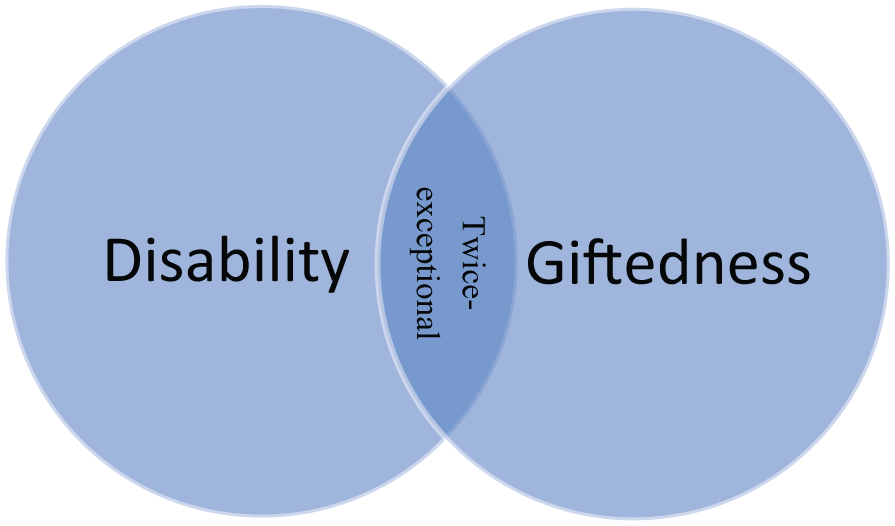
Diagram of twice-exceptionality.
Gifted and Talented
There are many definitions of giftedness, and this in itself presents problems when identifying and providing for the gifted child. There is no single, universally accepted definition of giftedness, a word that is often used reciprocally with the word talented. The two terms are utilized inconsistently within the field, which in turn leads to further ambiguity over what the nomenclatures mean and understandings of how to identify and serve these children. Therein lays a conundrum: If we cannot define giftedness or agree on a definition, who is included/excluded from the giftedness section in Figure 1? Are there absolutes of gifted and nongifted or degrees of giftedness as Brown, Avery, VanTassel-Baska, Worley, and Stambaugh (2006) advocated?
Gagné’s Definition of Giftedness
To assist in defining giftedness, differing models exist, many advocating high achievement as a key in identifying gifted individuals. Gagné’s (2008) Differentiated Model of Giftedness and Talent (DMGT) has gained increasing attractiveness among educators, particularly in Australia (Education Queensland, 2013; New South Wales Department of Education and Training [NSWDET], 2004; Wormald, 2011). The features of this model highlight the developmental nature of giftedness, or potential for talent or achievement, rather than achievement being the focal point of giftedness. This model can contribute to our understanding of twice-exceptionality, in that it does not define giftedness in a narrow sense of being only intellectually or academically based. This model incorporates multiple areas of giftedness. According to Gagné (2008), giftedness occurs in four main domains of aptitude—intellectual (e.g., general intelligence), creative (e.g., inventiveness), socioaffective (e.g., leadership), and sensorimotor (e.g., vision, endurance)—all domains where disability can also occur.
According to Gagné (2008), the words gifted and talented do signify two separate concepts. By differentiating these terms, the dissimilarity can take a variety of forms: The gifted term may be applied to “high cognitive abilities” (Gagné, 2012, p. 1) but not yet highly achieving, and talent can be applied to areas of very high achievement.
Gagné (2008) defined gifts as “the possession and use of outstanding natural abilities, called aptitudes, in at least one ability domain, to a degree that places an individual at least among the top 10% of age peers” (p. 1). He defined talents more specifically as the
outstanding mastery of systematically developed abilities, called competencies (knowledge and skills), in at least one field of human activity to a degree that places an individual at least among the top 10% of age peers who are or have been active in that field. (Gagné, 2008, p. 1)
For the purpose of this article, Gagné’s (2008) conception of giftedness is being adopted because it is widely followed and accepted in Australia (Wormald, 2011) and because it accounts for some environmental and societal factors that may affect a child’s ability to achieve (and become talented) at levels considered commensurate with his or her innate ability. The section of Figure 1 that refers to giftedness will therefore be populated by those who demonstrate gifted potential, but who might not necessarily be demonstrating high achievement. There is little value in utilizing a single test cutoff score in identifying giftedness, and any identification process needs to be multifaceted (Brown et al., 2005); a holistic view of the child and his or her potential is needed.
Giftedness and Australian Policy
Australian schools have struggled to understand the diverse nature of gifted children since the 1988 (Commonwealth of Australia) and 2001 (Commonwealth of Australia) Australian Senate reviews into gifted education. Educators struggle even more so with the concept of twice-exceptionality, even though inclusivity and equity in education have become the policies of choice for 21st-century education (Education Queensland, 2015; Gray & Beresford, 2008; New South Wales Government, n.d.; Organisation for Economic Co-Operation and Development [OECD], 2008; Queensland School Curriculum Council, 2001). With the Melbourne Declaration on Educational Goals for Young Australians (Curriculum Corporation, 2008) declaring that “all Australian governments and all school sectors must provide all students with access to high-quality schooling that is free from discrimination based on gender, language, sexual orientation, pregnancy, culture, ethnicity, religion, health or disability, socioeconomic background or geographic location” (p. 7), there should be legislation in place to adequately support all students identified as gifted and twice-exceptional.
Disability
Problems arise in discussions regarding children with disability because of the inconsistent and contradictory use of the terminology, in a similar way to that of the term gifted. The literature surrounding disability is proliferated with debate about differing ways of comprehending disability and impairment (French & Swain, 2008a), the definition of these idioms, and the negative suppositions that underscore perceptions of children with disability (Priestley, 2001; Singh & Ghai, 2009). Assumptions identified in the literature as dominating contemporary society’s understanding of children with disability are that these children are categorized as silent and voiceless sufferers (Corker & Davis, 2000) and are frequently deprived of agency because they are incapable of making choices (Singh & Ghai, 2009). Goodley and Lawthom (2005) suggested that disability research tends to be dominated by quantitative methodologies that predominantly focus on the “psychopathology of disability” instead of a “psychology of disability” (Singh & Ghai, 2009, p. 131). Again, there is a predicament: How can we define who is included/excluded from the disability section in Figure 1? Are there absolutes of disability and nondisability and, consequently, absolutes of ability?
Watson et al. (1999) contended that a problematic issue facing children with a disability is the fact that they reside in a world that diminishes their individual differences, viewing them as a homogeneous group with a single defining identity (disability) and seeing their existence as problematic and objectionable. Presumptions of children with a disability as being a homogeneous group lead to a denial of the existence of an individual identity (Singh & Ghai, 2009) beyond disability (and giftedness). Goodley and Lawthom (2005) posited that thinking surrounding people with a disability tends to focus on deficits—what they cannot do—rather than viewing children with a disability “as social actors, as controllers and as negotiating their complex identities within a disabling environment” (Singh & Ghai, 2009, p. 132). The opposite could be stated about children identified as gifted, with thinking that encompasses these children focusing on surfeit ability and what they can do, which is considered exceptionally superior to their age peers. On one hand, gifted children are viewed as “a vital natural resource” (Commonwealth of Australia, 1988, p. 177), and on the other hand, those with a disability are viewed from a standpoint of being identified as a “‘burden’ to society, an assumption reinforced as normative by prevalent bio-medical and economic paradigms” (Lero, Pletsch, & Hilbrecht, 2012, para. 1).
To a large extent, research surrounding children with a disability has tended to focus primarily on their experience of “helplessness,” where disability and childhood have been represented as states of dependency, and the child’s needs surrounding care (Singh & Ghai, 2009). Singh and Ghai (2009) cautioned against simplistic notions of childhood experiences with regard to the individual experiences of children with a disability, which they suggest are habitually assimilated into collectives of “disabled families,” leaving individuals’ lived experiences eclipsed by parental/caretaker needs and institutional and medical notions of “care.”
International Definitions of Disability
To address the discrimination, segregation, and frequent exclusion of people with a disability, many countries have attempted to define disability and create legislation that covers those with a disability so defined. Although on a whole this legislation has been extensive in its coverage of disability, it rarely acknowledges the disabling societies in which people with a disability live their lives. To come up with a clearer understanding of disability and the role it plays in twice-exceptionality, it is necessary to look at some pertinent legislative definitions of disability. First, I will highlight the worldview of disability and impairment presented by the World Health Organization (WHO; 2011, 2014). Second, I will examine how disability is defined according to the Americans With Disabilities Act of 1990 and the Individuals With Disabilities Education Act (IDEA) of 2004 (Office of Special Education Programs, 2004). Third, I will share the Australian Federal Disability Discrimination Act (DDA) of 1992’s definition of disability (Commonwealth of Australia, 1992).
The International Classification of Functioning, Disability, and Health (ICF)
The WHO has proposed an holistic definition of disability and impairment, which includes disability as a by-product of the environmental context in which people with a disability live their lives. The ICF stresses that disability discourse should emphasize “environmental factors in creating disability, . . . [with] problems with human functioning . . . categorized in three interconnected areas” (World Health Organisation, 2011, p. 5). These interconnected areas are (a) impairments in how the body functions or variations in the structure of the body (e.g., deafness, paralysis), (b) activity limitations where difficulties may exist in undertaking activities (e.g., hearing, walking), and (c) restrictions to participation that restrict a person with a disability from being involved in any area of life (e.g., facing transport restrictions due to a person using a wheelchair). The WHO (2011) report stated that a disability refers more to the “difficulties encountered in any or all three areas of functioning” (p. 5).
Americans With Disabilities Act of 1990
Under the Americans With Disabilities Act (1990), disability is defined in a broad manner in relation to an individual who has
(A) a physical or mental impairment that substantially limits one or more major life activities of such individual; (B) a record of such an impairment; or (C) being regarded as having such an impairment. (Sec. 12102, para. 1)
IDEA of 2004
Under the IDEA of 2004, disability is defined in a broad manner in relation to an individual:
Child with a disability means a child evaluated in accordance with Sec. Sec. 300.304 through 300.311 as having mental retardation, a hearing impairment (including deafness), a speech or language impairment, a visual impairment (including blindness), a serious emotional disturbance (referred to in this part as “emotional disturbance”), an orthopedic impairment, autism, traumatic brain injury, any other health impairment, a specific learning disability, deaf-blindness, or multiple disabilities, and who, by reason thereof, needs special education and related services. (Sec. 300.8 Child With a Disability, (a) General)
Australian Federal Disability Discrimination Act
Similar to the Americans With Disability Act of 1990 and IDEA of 2004, the Australian Federal Disability Discrimination Act (DDA - Commonwealth of Australia, 1992) and the Disability Standards for Education (DSE; Commonwealth of Australia, 2005)—the enabling legislation—have gone a long way to protecting and providing for some people with a disability, yet they do not go as far as IDEA (2004) in specifying and naming particular disabilities, nor in stipulating the types of interventions necessary to support these children in their education. There appears to be some acknowledgment of categories of disability in Australian legislation, but limited specific nomenclature is stipulated. For example, the word autism is not used nor is the term specific learning disability (SLD). The DDA and DSE narrow the concept of discrimination to determine which specific disabilities are acknowledged in Australia. However, this leads predominantly to individual Australian states and territories deciding which disabilities attract funding and the types of intervention programs, if any, being implemented in schools. These programs frequently appear on an ad hoc basis to those with “verified” or funded disabilities that are identified and specified by individual states. For example, autism attracts funding and early intervention, yet dyslexia does not (Education Queensland, 2007; New South Wales Public Schools, 2015; State Government of Victoria Department of Education and Training, 2015).
The Australian Federal DDA (Commonwealth of Australia, 1992) defines a disability to be
total or partial loss of the person’s bodily or mental functions; or (b) total or partial loss of a part of the body; or (c) the presence in the body of organisms causing disease or illness; or (d) the presence in the body of organisms capable of causing disease or illness; or (e) the malfunction, malformation or disfigurement of a part of the person’s body; or a disorder or malfunction that results in the person learning differently from a person without the disorder or malfunction; or (g) a disorder, illness or disease that affects a person’s thought processes, perception of reality, emotions or judgment or that results in disturbed behavior; and includes a disability that: (h) presently exists; or (i) previously existed but no longer exists; or (j) may exist in the future. (Sec. 4)
The DDA (Commonwealth of Australia, The Disability Discrimination Act [1992]) uses an expansive definition of the term disability. It expressly refers to a disability that affects learning as being “a disorder or malfunction that results in the person learning differently from a person without the disorder or malfunction” (Sec. 4, p. 5). However, it is not explicit in mentioning SLD, which remains caught up with identification and definition issues. On the surface, this appears to be an expansive definition; however, at least in the Australian context, there remains a group of intelligent children who experience a range of disabilities, often affecting their socioemotional circumstances, daily activities, and classroom learning, who are not being adequately catered for—children who are twice-exceptional. These children may have any disability (in combination with giftedness), such as autism, cerebral palsy, poor coordination, dyslexia, dysgraphia, anxiety, Scotopic Sensitivity Syndrome/Irlen Syndrome, joint hypermobility, or Asperger’s syndrome (American Psychiatric Association, 1994), to name a few. According to Silverman (2003), these children “are often teased by their classmates, misunderstood by their teachers, disqualified from gifted programs due to their deficiencies, and unserved by special education because of their strengths” (p. 4).
International and National Perspectives on Disability
In some countries’ legislation and in the WHO’s ICF, the term disability is used in describing and defining disability and in other legislation the term impairment is used (e.g., Queensland’s Anti-Discrimination Act). In disability studies, these two terms have differing meanings, which in some instances appear to conflict with regional definitions. International definitions of impairments refer to
any loss or abnormality of psychological, physiological, or anatomical structure or function to do with the body . . . Examples of impairments include blindness, deafness, loss of sight in an eye, paralysis of a limb, amputation of a limb; mental retardation. (United Nations Department of Economic and Social Affairs, 2004, para. 2)
Many national and international disability definitions describe an operative restriction or activity limitation
caused by impairment where the impairment causes restriction or lack . . . of ability to perform an activity in the manner or within the range considered normal for a human being . . . Examples of disability include difficulty seeing, speaking or hearing; difficulty moving or climbing stairs; difficulty grasping, reaching, bathing, eating, toileting. (United Nations Department of Economic and Social Affairs, 2004, para. 3)
These definitions and viewpoints on disability and impairment are set on backgrounds of contextual factors and theories of disability. This adds further layers to the conundrum of clarifying and agreeing upon definitions and terms to be utilized in twice-exceptional discourse. To gain legislative provision under these definitions, individuals have to be categorized by a medical practitioner as having a disability. Hence, the dominance of the biomedical approach to defining and categorizing disability continues to be promulgated with little alternative.
The biomedical and economic paradigms see resources and support allocated based on diagnoses that are limited to the specific definable verification categories of disability and, at least in Australia, not in conjunction with the Federal DDA’s definition of what constitutes disability. According to McDowell and O’Keeffe (2012), the current systems are based on several assumptions. First, allocating a diagnostic label to all children with “significant impairment” (McDowell & O’Keeffe, 2012, p. 3) is not feasible; in actuality, there are many disabilities not covered under the present funding systems, particularly in Australia. Second, there is nothing within the diagnosis or labeling of a particular disability that specifies the impact this may have on a child or his or her life and education. McDowell and O’Keeffe argued that existing systems frequently ignore the needs of children who have a solitary, intense disability that is excluded from authorized funding categories, but who have comparable impairment levels commensurate with disabilities that are included. The current system ignores children with multiple nonincluded disabilities but where the effect of the impairment combination is “greater than a single severe diagnosis” (McDowell & O’Keeffe, 2012, p. 4). McDowell and O’Keeffe (2012) suggested this is where “good clinical practice dictates against the premature application of diagnoses of lifelong significance” (p. 4), yet in some instances, clinicians may be forced into premature labeling to fit the funding requirements. There remains lurking in the shadows Humpty Dumpty’s disparaging insinuation that when a word such as disability is used in a particular context (e.g., funding requirements), the word’s meaning is “just what . . . [they] choose it to mean—neither more nor less” (Carroll, 1872, p. 72).
Disability Theory
The literature encompassing disability dialogue abounds with discussions about varying ways of comprehending disability and impairment (French & Swain, 2008a). Priestley (2003) described four dominant models of disability: two individual models (the biological, individual/medical model and the psychological, tragedy model) and two social models (the structural, social model and the cultural, affirmative/nontragedy model). French and Swain (2008a) contested that these are models of “the problem” rather than models of professional intervention; however, they form useful structures in which to discuss and situate the developing model of twice-exceptionality.
The individual/medical model of disability
The medical model of disability dominates policy, practice, and provision for people with a disability. This model defines and understands disability as residing in individual impairment “defect and abnormality, the clear implications are in terms of care and cure . . . the establishment of a whole range of professions, and the professionalization of western society, is grounded in and justified by this foundation” (French & Swain, 2008a, p. 130).
The medical model of disability grew out of the science behind what constitutes “normal” and “abnormal” in relation to the body, including normative cognitive functions, the corporeal “norm,” with the “suffering of disabled people [prompting] a medical solution” (Wolbring, 2001, p. 38). This medicalization of disability creates a twofold problem in that quality of life and medication are often necessary; however, medicalization leads to legitimization of disability only by the confirmation “by authorised medical professionals” (French & Swain, 2008a, p. 131).
Establishment of an “ideal” body and, as a consequence, the “ideal” mind fits in with the formation of the medicalization of the body and mind (Thomas, 2007), where terminology that is used incorporates the normal/abnormal binary constructions: “the dis-abled other” those un-able; (Barnes, Mercer, & Shakespeare, 1999; Coleridge, 2000; Goggin & Newell, 2005) and the mentally or physically “unfit.”
Perceptions of disability (and giftedness) have been tied together with advents in scientific concepts, such as the bell curve and the concept of a normal curve where those on the extremities signify the “abnormal” (Thomas, 2007). The bell curve “introduced the idea of the embodied norm, bodies and body practices became standardised and homogenized . . . Those at the curve’s extremes constitute the ‘abnormal’” (Thomas, 2007, p. 67). There became an increasing imperative for people to fit in and conform to the category of normalcy (Thomas, 2007). Disability was seen as affecting an individual’s placement on the bell curve, as was giftedness, and consequences of this perception relate to social standing in relation to the norm and resultant societal perceptions of competence (Swain & Cameron, 1999; Watson et al., 1999) or incompetence. A preoccupation with impairment indicates a fixation with corporeal perfection, cognitive and bodily fitness (Singh & Ghai, 2009), and the bell curve of normality.
The tragedy model of disability
When the then Prime Minister of Australia, Julia Gillard, cried during her speech in Parliament outlining the introduction of the National Disability Insurance Scheme (NDIS; Ireland, 2013) aimed at providing insurance cover for Australians with “significant disability,” it could be seen as a perpetuation of the tragedy model of disability.
The tragedy model represents disability as a biological state, with a limitation ascribed “as a deficit, a personal burden and a tragedy” (Wilder, 2006, p. 2), something “‘abnormal’ and to be avoided at all costs” (Oliver & Barnes, 1996, p. 66, emphasis in original). Saxton (2000) indicated perceptions of people with a disability are that they have no quality or enjoyment of life and that they are burdensome to society. The tragedy model of disability includes perceptions of people with disability that are frequently negative and stigmatized stereotypes (French & Swain, 2008b). These comprise the use of language of exclusion and concepts of “inferiority, inadequacy, pity, sadness, evil and disgust” (French & Swain, 2008b, p. 8).
The social model of disability
The social model of disability grew out of the shift to remove attitudinal and societal barriers to people with a disability predicated in social and cultural environments (Priestley, 2001). This model embraces the view that despite an impairment, which frequently cannot be changed, individuals with disability are “still of equal intrinsic worth . . . [and] it is society that must come to terms with their disability and accept them as they are” (Coleridge, 2000, p. 28) so the society is “disabling” rather than the individual’s disability. Criticisms of the purely social model of disability include the supposition that it discounts individual experiences of impairment, a critique that the affirmative model seeks to address.
The affirmative/nontragedy model of disability
The affirmative model of disability grew out of the social model that views people with disability in a positive light. This model encompasses a “way of thinking that directly challenges presumptions about experiences, lifestyles and identities of people with impairments” (French & Swain, 2008a, p. 65). This model builds upon the existent social model, providing a framework for individualistic understanding of people with disability and their daily lives and directly challenging the personal tragedy model (French & Swain, 2008a). It seeks to develop an understanding among people who do not identify with disability that disability and impairment constitute a fundamental facet of personal identity for those with disability.
The affirmative model challenges supposition regarding the lifestyles, experiences, and identities of individuals with impairments, but French and Swain (2008a) cautioned about the oversimplification of disability under this model, stating that “no disabled person is simply disabled: they are young, old, working class” (p. 66)—and even gifted. This model serves to reject the prevailing discursive practices with regard to people with a disability and their lives and affirm the validity of individual experiences, lifestyles, and notions of self (French & Swain, 2008a), as well as the notion that an individual can be gifted and have a disability.
Disability and Giftedness: Twice-Exceptionality
The literature predominantly refers to learners with giftedness and a disability as being twice-exceptional (Beckley, 1998; Foley Nicpon, Allmon, Sieck, & Stinson, 2011; Foley Nicpon, Assouline, & Colangelo, 2013). The term twice-exceptional is widely used by researchers, although it remains a relatively new term among educators (Foley Nicpon et al., 2013). The exceptional label is traditionally a special education term that is generally used to specify children with either exceptional strengths or exceptional weaknesses (Hallahan & Kauffman, 1980).
The term twice-exceptional was coined by Gallagher in referring to children who had two exceptionalities (Coleman et al., 2005): exceptional strengths (giftedness) and a disability (Assouline, Foley Nicpon, & Huber, 2006; Beckley, 1998; Foley Nicpon et al., 2011; Foley Nicpon et al., 2013). According to Assouline et al. (2006), a learner “is considered twice exceptional when he or she is identified as gifted/talented in one or more areas while also possessing a learning, emotional, physical, sensory, and/or developmental disability” (p. 14, emphasis in original). The evolving model of twice-exceptionality (see Figure 2) illustrates the connection between disability, impairment, the social and cultural milieu, and giftedness.
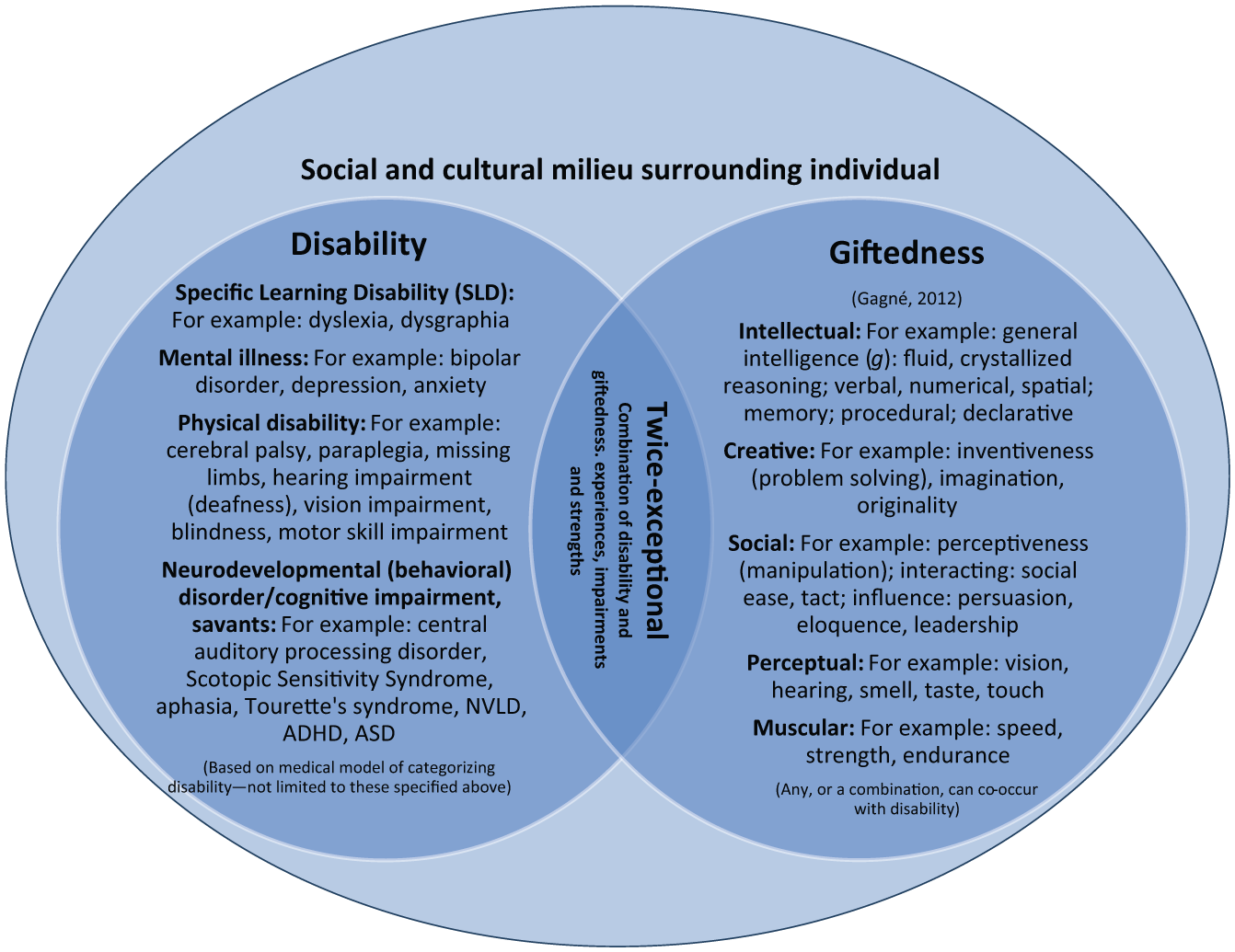
Inside the twice-exceptional model.
However, research tends to focus on educational interventions, treatment, and characteristics as learners instead of their holistic lived experiences as children rather than only school students. Other researchers imply that twice-exceptional children are only those with learning disabilities, rather than a broader use of the term to encompass all disabilities; for example, Silverman (2005) suggested that twice-exceptional students are “gifted and learning disabled” (p. 2) and noted “the condition of twice exceptionality—giftedness combined with learning disability” (Silverman, 2013, p. 13). Yet other researchers begin with discussing or referring to twice-exceptionality, when in actuality they write about only a subset of this group those with giftedness and learning disabilities (e.g., Hanlon, 2011; Nielsen & Higgins, 2005).
The term twice-exceptional is used inconsistently within the literature, frequently overlooking the use of the term to refer to children who have other disabilities (e.g., motor skill impairment; cerebral palsy). This is further compounded by researchers focusing on gifted students with learning disabilities, with the implication that this is the only area of twice-exceptionality.
However, Foley Nicpon et al. (2013) are an exception, as their study specified the rationale behind the choice of specific disability for their research while acknowledging the existence of other disability categories. Foley Nicpon et al.’s (2013) empirical study focused on autism spectrum disorders (ASD), SLDs, attention-deficit/hyperactivity disorder (ADHD), and emotional disturbances (ED). Their rationale for this selection was that, although other disability categories may well be relevant to their research, there were a number of practical reasons for restricting the categories (Foley Nicpon et al., 2013). Restricting the categories was necessary due to the availability of research literature, frequency of diagnosis in schools (SLD and ADHD are main categories in North America), increased incidence rate (e.g., ASD), the area in gifted education that is accorded extensive attention (e.g., ED), and the trepidation regarding uneven development (e.g., socioemotional development vs. academic development). This acknowledged lack of research into other disability categories means there is an extensive research gap in the literature regarding gifted children with other exceptionalities. A criticism of this categorization of disability in the literature is that it further reinforces the propensity of specific categories of disability related to medical needs models—the medical model of disability—instead of in terms of the individuality of lived experiences and “individuals with diverse educational needs” (Newsome, 1985, p. 53).
Winzer (2010) stated that children who possess exceptionalities struggle to reach their fullest potential and that “their intellectual, emotional, physical, or social performance falls below or rises above that of other children” (para. 1). Winzer maintained that twice-exceptional children possess special needs relating to their psychological, physical, cognitive, social, or emotional issues, or an amalgamation of these. These children are deemed to parallel children considered the “norm” but they are seen to digress from what is considered to be “average in physical, mental, emotional, or social characteristics” to a degree that requires special education services/intervention in order to “develop [them] to their maximum capacity” (Boykin, 1957, p. 42). Boykin (1957) suggested that twice-exceptional children’s needs and issues with adjusting to life situations were frequently heightened “by their own inability and lack of opportunity to cope with normal life situations, demands, and activities, or by the attitudes and restrictions of society and its failure to give exceptional children a fair, unbiased, unprejudiced chance to achieve” (p. 42). According to more recent understandings, little has changed since Boykin’s sentiments.
The educational life of a twice-exceptional student is often littered with negative experiences that can cause students to feel like a failure and to have low self-efficacy, increased internalized and externalized anger, and anxiety and depression (Barber & Mueller, 2011). This is particularly troublesome as Vespi and Yewchuk (1992) found that these students had an immense aptitude when it came to self-motivation and self-confidence. However, this was set against a background of contradictory academic and social skills, which led to clouded ability to deal with peers and interpret and react to nonverbal behavior, and which, in turn, led to frustration, anxiety, negative school attitudes, heightened dread of failing, and unrealistic expectations of themselves (Foley Nicpon et al., 2011; Vespi & Yewchuk, 1992).
Foley Nicpon et al.’s (2011) review of the empirical research conducted over the previous two decades in the United States into twice-exceptional students showed that many of the studies focused on limited areas of twice-exceptionality, again clouding the field with differing definitions relating to twice-exceptionality. The analysis noted 43 empirical studies examining particular areas of twice-exceptionality (Foley Nicpon et al., 2011). However, the empirical studies focused on research that had been conducted in three specific areas: SLD, ADHD, and ASD. Of these studies, 14 were qualitative, 25 were quantitative, and 4 used mixed methods, favoring quantitative data over qualitative (Foley Nicpon et al., 2011). In addition, diagnosis and identification methods and definitions for twice-exceptionality varied within the empirical studies, making comparisons across the projects problematic, with different inclusion and exclusion criteria. The majority of the studies focused on SLD rather than the full spectrum of twice-exceptionality.
There are gradations of giftedness, disability, and twice-exceptionality, but do we define twice-exceptional children by the impacts their disability has on their giftedness? And if so, how can those be measured? This current model of twice-exceptionality (see Figure 2) seeks to act as a clarifying framework with regard to research involving these children and has the potential to be utilized by researchers in defining twice-exceptionality.
The Evolving Model of Twice-Exceptionality
The rationale for developing a model to explain twice-exceptionality lies in the circumstances explained hereto. The acknowledgment and identification of twice-exceptional learners has been, and continues to be, hampered by the misperception that being gifted means being an academic high achiever (Silverman, 2003). Although educators find it hard to reconcile the apparent paradox between being gifted (implying being exceptionally able), and being “dis-able” or disabled (implying being un-able in some way; Silverman, 2003), this model intends to endeavor to reconcile this. Tannenbaum and Baldwin (1983) stated that the apparent contradiction has been, and arguably still is, viewed as “entirely incompatible and irreconcilable in any single child, yet it exists” (p. 12) and arguably still does today (Foley Nicpon et al., 2011; Silverman, 2005). There is a discord between the way we define and understand these terms within and beyond academia, therefore, this model aims to contribute to defining and understanding twice-exceptionality.
Inadequately defining or failing to define twice-exceptionality makes it problematic to acknowledge and consider students’ educational needs related to their distinctiveness. The use of a visual model can lead to better understanding by educators, parents/caregivers, and the children themselves with regard to exceptionality and daily lived experiences of impairment and giftedness. According to Foley Nicpon et al. (2011), the lack of a definition impedes research in this area.
In using the medical and affirmative models of disability to frame the development of a twice-exceptional model, it is anticipated that the resulting form will focus on the individual child who is twice-exceptional. In addition, affirming that a person who is twice-exceptional has an identity that is not solely defined as being a “disabled, gifted person” but is multifaceted and contributes to his or her uniqueness as an individual.
As discussed earlier, the medical model of disability still dominates definitions of disability, as it is medical practitioners who must make the clinical judgments regarding individuals and the diagnosis of a disability based on these judgments. Tools such as the Diagnostic and Statistical Manual of Mental Disorders (5th ed.; DSM-5; American Psychiatric Association, 2013), rightly or wrongly, dominate and have major influence over diagnosis in the field of mental disorders, particularly in Australia and America. The DSM-5 has its critics (see British Psychological Society, 2011; Frances, 2012; National Health Service, 2013; Society for Humanistic Psychology, n.d.), yet this tool remains widely used.
As a result of the medical model of disability being the prevalent way of defining and categorizing disability in our society, the labels of disorders appear in the disability section of the model to assist researchers and educators in seeing how these categories can tie in with giftedness in constructing twice-exceptionality. It is to be noted that just because a disability category is not listed, it does not mean that it is not included in the model; the categories appear as examples and as a guide only. If a disability is recognized under the DDA (Commonwealth of Australia, 1992) and international legislation, then it is automatically included within the model regardless of funding status and nomenclature.
The model should be viewed as having imprecise and blurred edges where there is no clear cutoff or boundary between “gifted/nongifted” and “disability/nondisability.” Both giftedness and disability are dynamic nonstatic conditions, which vary within and between individuals, and in differing situations depending on the prevailing social and cultural milieu. For a fuller description of how twice-exceptional children may demonstrate the two sets of traits in Figure 2, we need to consider the interface between giftedness and disability and acknowledge this interface is interceded by the social and cultural milieu where twice-exceptional children live their lives (Wood & Estrada-Hernández, 2009). Twice-exceptional children may display the same gifted tendencies as “typical” gifted students do, but these may be hidden by a disability (Brody & Mills, 1997). They also may demonstrate the same disability dispositions as those with disability, but these may be hidden by giftedness (Brody & Mills, 1997). These two hidden tendencies have been referred to as the masking effect or masking hypothesis (Assouline et al., 2006).
What appears to be different for twice-exceptional children is the way these two traits of disability and giftedness affect individuals, which is beyond the scope of this article. However, a brief outline of gifted traits that twice-exceptional children may display includes curiosity; a well-developed vocabulary; intense, wide interests; high creativity; and divergent thinking (Trail, 2011; Wood & Estrada-Hernández, 2009). Twice-exceptional children share many characteristics with typical children with a disability, in that they frequently display deficits in comparison to the so-called norm. These deficits can include inconsistent performances at school, deficits in planning and organization, deficits in cognitive processing, deficits in receptive and/or expressive communication, and deficits in motor skills (Trail, 2011; Wood & Estrada-Hernández, 2009).
The Influence of Social and Cultural Milieu
Without definitive agreement on the meaning of giftedness and disability, due in part to the influences of particular societies and culture, twice-exceptionality needs to be clarified within a social and cultural framework. The social and cultural milieu surrounding twice-exceptional individuals determines the process of “categorizing” children and the complement of characteristics considered “normal” for child members of each category of disability, giftedness, and twice-exceptionality. Further environmental influences on childhood determine, as Waksler (1991) proposed, that “children are viewed . . . in their very nature [as] not grown up and thus not something rather than something” (Coates & Ranson, 2011, p. 63, emphasis in original) and consequently become a social construct where there is no universally accepted view of childhood (Priestley, 2003).
In one society and culture, what constitutes giftedness may differ dramatically from another society’s views. As Freeman (2005) stated, “context is all in the identification of giftedness because ‘gifted’ is an adjective, a description, so the recognition of individuals who are seen as meriting that term depends on comparisons” (p. 80). Furthermore, “how each individual reacts to their classification as gifted is also dependent on personality and home support” (Freeman, 2005, p. 80) and culture. The same could be stated for disability: A child who may been identified with a disability in one culture may not necessarily be seen as having a disability in another (Utley & Obiakor, 2001). There needs to be societal and cultural shifts in acceptance of the coexistence of disability and giftedness and a shared understanding.
Conclusion
Lack of consensus on what constitutes twice-exceptionality, slippery definitions, and problems with quantifying and measuring both giftedness and disability impede research in this area. With the overlapping definitions of what disabilities are, and what giftedness is, researchers have attempted to clarify the paradoxical notion of this co-occurrence within individual children. Yet, much existent research continues to primarily focus on certain areas of twice-exceptionality (in particular, SLD, interventions, characteristics, and treatment), at the expense of others, rather than elucidating children’s lived experiences as rich sources of evidence for an action agenda. Lack of agreement within the field on what commonalities exist (if any) for twice-exceptional children further complicates research and provision.
The literature suggests one of the main problems facing twice-exceptional children is that there is no consensus of the definition for the terms disability or giftedness and consequently the term twice-exceptional. Indeed, Ambrose et al. (2010) suggested that the discipline of gifted education is fractured in areas such as practice, identification, and research. Endeavoring to locate a definition within this fractured milieu means the specific term of twice-exceptionality loops back on itself to legislation based on the medical model of disability, the categorization of disability, and the defining of giftedness in a limited way, frequently through high achievement and performance, which contradicts the generally accepted notion of Gagné’s (2008) representation of giftedness. The twice-exceptional model seeks to instigate discussion in defining the term, not only to those researching within the field but also to teachers and the wider community of parents/guardians and students. The contextual contributing factors informing the foundation of this model have created a preliminary point for discourses in disability, giftedness, and twice-exceptionality. It is anticipated that future research can be grounded upon this model to facilitate discourse, practice, and interventions for twice-exceptional children.
Footnotes
Declaration of Conflicting Interests
The author declared no potential conflicts of interest with respect to the research, authorship, and/or publication of this article.
Funding
The author received no financial support for the research and/or authorship of this article.