



Abstract
The current study compared differences between mindset beliefs about intelligence (fixed vs. growth), dimensions of perfectionism (Concern Over Mistakes, Doubt of Action, Personal Standards, Organization), and achievement attitudes among gifted underachievers (n = 15) and gifted achievers (n = 169) in Grades 6 to 8 and examined the relationship between mindset beliefs and dimensions of perfectionism. Gifted underachievers had higher fixed mindset beliefs about intelligence (d = .79), lower scores on Organization (d = −1.01), and lower Self-Regulation/Motivation (d = −1.17) when compared with gifted achievers. These factors also were statistically significant in logistic regression models predicting achievement status. In addition, for the entire sample of gifted students (N = 264), fixed mindset beliefs predicted both dimensions of Evaluative Concerns Perfectionism (Concern Over Mistakes, β = .35, p < .0001; Doubt of Action, β = .28, p < .0001), while growth mindset beliefs predicted both dimensions of Positive Strivings Perfectionism (Personal Standards, β = .35, p < .0001, and Organization, β = .21, p = .001). Our findings provide a clearer picture of the relationships among underachievement, perfectionism, implicit theories of intelligence, and achievement attitudes, providing guidance for affective interventions.
Keywords
As educators and practitioners in the field of gifted education, we must do all we can to curb underachievement. It is important to understand how students interpret and determine their personal capabilities, values and goals, and potential supports and resources, as these beliefs impact achievement (Siegle & McCoach, 2005; Siegle, McCoach, & Roberts, 2017). Beliefs, attitudes, and motivations influence how students pursue challenges or avoid them. Subotnik, Olszewski-Kubilius, and Worrell (2011) noted that qualities such as the willingness to take strategic risks, the ability to cope with challenges and handle criticism, competitiveness, motivation, and task commitment will differentiate those students who move to increasingly higher levels of talent development from those who do not. (p. 40)
Accordingly, it is important to examine factors that might potentially inhibit achievement among gifted students such as attitudes toward achievement, beliefs about intelligence, and perfectionism. Do these factors differentiate achievers from underachievers? How does perfectionism relate to implicit theories of intelligence (fixed vs. growth mindsets) among gifted students? An understanding of the relationship between mindsets and perfectionism and how they manifest in underachieving students can help educators and advocates support gifted learners so that they can be positively guided toward advanced levels of achievement. The following literature suggests that attitudes toward achievement, fixed mindsets about intelligence, and perfectionism relate to underachievement as they can be barriers to gifted students reaching their potential.
Understanding Underachievement
When gifted students underachieve, they are avoiding opportunities for new learning and challenges that could catapult them to new levels of understanding and mastery. These students may have untapped gifts that have not catalyzed into demonstrated talents (Gagné, 1995). Underachievement exists when students’ academic performance does not align to their measured potential (McCoach & Siegle, 2003; Schultz, 2002; Whitmore, 1989). Underachievement is often defined and examined as the discrepancy between expected and actual performance (e.g., Emerick, 1992; Lau & Chan, 2001; McCoach & Siegle, 2003; Reis & McCoach, 2000; Stoeger & Ziegler, 2005). In studying underachievement among gifted students, there is a lack of consistency on how underachievement is defined or reported, which may negatively impact the total number of research findings that can be reported on this topic (White, Graham, & Blaas, 2018). Furthermore, each of these definitions rests on the notion that underachievers have also been identified as gifted. Because many gifted students may first be recognized for their academic prowess, it is possible that even within the reported studies, there are students unaccounted for who may also be gifted underachievers. They may not been identified as gifted because they have not produced high marks in the classroom.
What students believe about achievement and its supports can influence them to achieve or underachieve. The Achievement Orientation Model (AOM; Siegle & McCoach, 2005; Siegle et al., 2017) can be applied to understand how students’ self-perceptions in self-efficacy, goal-valuation, and environmental supports impact their motivation and self-regulation to engage in tasks and, accordingly, achieve them. Siegle et al. (2017) used Bandura’s construct of self-efficacy in the AOM, posited as the belief that one is capable of the actions necessary to produce a given outcome. Following, those with higher self-efficacy toward a task are more likely to approach it compared with those who do not have high self-efficacy toward it. Furthermore, in a clarifying description of the AOM, Siegle and colleagues (2017) explained that within the context of self-efficacy, students’ beliefs about their abilities (whether they are malleable or fixed) can also play a critical role in how they execute effort to achieve at high levels. Next, goal-valuation is based in perceived meaningfulness of a given task. Regardless of their self-efficacy for a task, Siegle et al. (2017) explained that gifted underachievers may not achieve at school because they do not find their classwork valuable or of interest. Gifted students must find value in presented tasks; many times, this is achieved through tasks that present an appropriate level of cognitive challenge. Environmental perceptions within the AOM include perceptions of the impact of environment on achievement outcomes and the interactions between an individual and the environment. Both the perceived supports or hurdles within the environment can make a difference in the behaviors that follow. Last, the AOM requires self-regulation to progress to the highest levels of achievement expected of gifted individuals. Gifted students must be able to use metacognitive skills to maintain motivation, monitor progress, and attain desired goals.
All three attitude components (self-efficacy, goal-valuation, and environmental supports) must be present to catalyze the motivation and self-regulation necessary to produce ultimate achievement. Environmental perceptions are driven by students’ beliefs regarding the extent to which the environment is able to support and not counteract their efforts. For example, if students believe that they are pursuing a valuable task and have the skills to progress toward the task but feel that elements in the environment will belittle such work, then they may not be motivated to continue on with the task. Literature has documented the connection between underachievement and low self-efficacy or low academic self-concept (Filippello, Sorrenti, Larcan, & Rizzo, 2013; Ford, 1996; Whitmore, 1980), but the relationship between mindsets and underachievement among gifted students has not been examined.
Attitudes Toward Achievement
A number of studies have examined factors that influence underachievement within the context of the AOM, particularly attitudes of achievement as measured by McCoach’s (2000) School Attitude Assessment Survey–Revised (SAAS-R; e.g., Figg, Rogers, McCormick, & Low, 2012; McCoach & Siegle, 2003; Ritchotte, Matthews, & Flowers, 2014; Rubenstein, Siegle, Reis, McCoach, & Burton, 2012). Relevant to the components of the AOM, these attitudes of achievement include environmental perceptions (attitudes toward school, attitudes toward teacher), academic self-perception (self-efficacy), goal valuation, and self-regulation/motivation.
The SAAS-R (McCoach, 2000) measures the achievement attitudes (Academic Self-Perception, Attitudes Toward School, Attitudes Toward Teacher, Motivation/Self-Regulation, and Goal Valuation) associated with the factors of the AOM. Aiming to determine factors that distinguish achievers from underachievers, specifically how they differ among attitudes toward achievement, McCoach and Siegle (2003) examined achievement attitudes (as measured by the SAAS-R) among 178 high school students from 28 districts across the United States. They found that gifted students who were underachievers reported lower scores for Attitudes Toward School, Attitudes Toward Teachers, Goal Valuation, and Motivation/Self-Regulation factors. In this study, underachievers were defined as those in the bottom half of their high school class or a grade point average (GPA) equal to or less than 2.5/4.0. Interestingly, gifted achievers and underachievers in this sample reported high academic perceptions; both groups of students perceived that they were capable of academic success. In a number of studies (Ghazvini, 2011; Kornilova, Kornilov, & Chumakova, 2009; Susperreguy, Davis-Kean, Duckworth, & Chen, 2018), students’ academic self-concept has been positively associated with academic performance. However, in McCoach and Siegle’s (2003) study, academic self-perception did not differentiate gifted achievers from underachievers; gifted underachievers reported a commensurate level of academic self-concept. Furthermore, in McCoach and Siegle’s (2003) study, gifted underachievers had lower mean scores in most measured areas, especially among factors of Goal Valuation and Motivation/Self-Regulation, which constituted the largest mean differences among the two groups. These two factors (Goal Valuation and Motivation/Self-Regulation) were the only two factors that could predict group membership (achiever or underachiever) at a level of statistical significance among the sample of gifted high school students. As gifted students earned lower scores on the Goal Valuation or Motivation/Self-Regulation factors, they were more likely to be underachievers.
Other researchers have also investigated factors that differentiate achievers and underachievers. In a study intended to validate the AOM for gifted middle school students, Ritchotte et al. (2014) found that gifted underachievers had lower scores on all AOM constructs (self-efficacy, environmental perceptions, task meaningfulness, self-regulation). The researchers noted that the AOM purports that high self-perception in each of the three constructs (self-efficacy, environmental perception, and task meaningfulness) will facilitate self-regulation and achievement. Their data, however, revealed only self-efficacy and environmental self-perception influenced self-regulation, while task meaningfulness did not. In another study, Figg and colleagues (2012) examined factors that differentiate gifted achievers and underachievers on attitudes of achievement and preferences of thinking style. In this study, the researchers separated underachievers into two groups: traditional underachievers and selective consumers. The researchers described traditional underachievers as those who are not confident in personal abilities to succeed and are cautious in taking academic risks. The motive for underachievement differs for selective consumers; these students are confident in their personal abilities and enjoy learning. However, this group may elect to engage or not engage in academic topics or activities depending on perceived value or interest. Both groups presented academically as underachievers, but the motive behind the exhibited lack of achievement stems from disparate personal reasoning. Figg et al. found that achievers earned higher mean scores compared with both traditional underachievers and selective consumers on Academic Self-Perception and Motivation/Regulation on the SAAS-R. Among all three groups, traditional underachievers earned the lowest scores in Academic Self-Perception, Attitude Toward Teachers, and Motivation/Self-Regulation. Traditional underachievers and selective consumers earned equally low scores in the area of goal-valuation compared with achievers. Selective consumers also had lower scores on Attitude Toward School compared with traditional underachievers. These findings have practical implications and indicate that factors within the AOM (attitudes of achievement) differentiate achievers from underachievers, but some factors, especially regarding Academic Self-Perception/Self-Efficacy, are not consistent among studies (e.g., McCoach & Siegle, 2003).
Mindset
Supported by a number of studies, beliefs about ability (self-theories) have been found to influence students’ achievement and motivation (e.g., Ahmavaara & Houston, 2007; Anderson, Boaler, & Dieckmann, 2018; Blackwell, Trzesniewski, & Dweck, 2007; Grant & Dweck, 2003); these beliefs are important factors within the AOM (Siegle et al., 2017). Dweck (2006) is most known for the idea of mindset, stemming from her idea of self-theories, which proposes that individuals hold implicit beliefs about personal abilities that are either fixed (entity theory) or changeable (incremental theory).
A number of studies reveal how implicit theories of intelligence relate to achievement. Blackwell and colleagues (2007) examined the relationship between middle school students’ implicit beliefs about personal abilities and academic achievement. They found that as students progressed through seventh grade, a stronger relationship between implicit theory of intelligence and math achievement evolved. This continued for eighth grade; students who indicated an incremental (growth) theory continued to grow in terms of their math achievement. This did not happen for those who indicated entity (fixed) beliefs. In addition, in a study among 109 college students, Aronson, Fried, and Good (2002) studied the relationship between incremental mindset training and achievement. Those in an incremental theory training intervention earned higher grades compared with the other two groups. Once again, a link is found between believing that abilities are malleable and actualized achievement.
What gifted students believe about the malleability of intelligence has been explored in a more recent study by Makel, Snyder, Thomas, Malone, and Putallaz (2015). They investigated 365 academically gifted adolescents’ implicit beliefs about both personal intelligence and giftedness, finding that the participants held stronger entity beliefs about giftedness as opposed to intelligence. The researchers’ analysis also suggested that many of the participating adolescents perceived giftedness and intelligence to be separate constructs, with intelligence being the more malleable of the two.
Related to beliefs about ability, gifted students may underachieve by avoiding challenging learning opportunities because of a need to be viewed as competent (Rimm, 2007). For some gifted students, self-worth may be contingent on achievement. Underachieving students may avoid experiences or opportunities that would put their level of perceived achievement at risk (Foster, 2007). Some researchers have examined connections between entity beliefs and associated performance goals and underachievement. Even before the popularity of mindset, Jones and Berglas (1978) summarized that underachievers are willing to give up potential high-level achievements to protect the external image that they are competent and successful. Urdan and Midgley (2001) conducted a series of studies with middle school students examining the connection between type of goal (performance vs. mastery) and personal self-handicapping, which led to perceived underachievement. Consistently, the researchers found a positive connection between performance goal-setting and self-handicapping. Students who set goals to grow and gain mastery were not likely to engage in self-sabotaging behaviors that would lessen their actualized achievement but provide a reason for the perceived lackluster performance.
Beyond models for understanding achievement using the AOM as described in previous studies (Figg et al., 2012; McCoach & Siegle, 2003; Ritchotte et al., 2014), Snyder and Linnenbrink-Garcia (2013) developed a two-pathway person-centered approach to understanding underachievement among gifted students. The Maladaptive Competence Beliefs Pathway explains how underachievement can surface when gifted students desire to protect their gifted identity, established from entity views of intelligence and maladaptive beliefs about the construct of giftedness. In their minds, giftedness equates with top performance, which comes with little effort. Maintaining this status may require these students to not participate in appropriately challenging coursework in fear that the desired classroom rank or status may not be easily achieved, exposing self and negating giftedness. A second possible mechanism for underachievement is the Declining Values Beliefs Pathway, which is more about the value of the task at hand. In an academic environment where such gifted students are not confronted with appropriate challenge, they do not glean the purpose or value in participating in rudimentary tasks. Thus, this leads to a lack of participation and underachievement by consequence.
Siegle and colleagues (2017) recently refined the AOM (Siegle & McCoach, 2005), explaining how individuals’ personal beliefs concerning self-efficacy, goal valuation, and environmental perceptions interact to support students’ motivation to achieve. Within the context of self-efficacy, what students believe about their own capabilities, whether fixed or changeable, can be part of the equation to determine their progress, achievement, and success. This is also consistent with the Maladaptive Competence Beliefs Pathway, which provides a theoretical rationale for entity beliefs relating to underachievement (Snyder & Linnenbrink-Garcia, 2013).
Perfectionism
Can the striving toward perfection influence underachievement? If the set standard is too high, is it easier to avoid the challenge, and thus, underachieve? When examining the characteristics of gifted students who underachieve, such as fearing failure, avoiding challenging experiences to protect their self-image, being self-critical or perfectionistic, or feeling guilty about not meeting others’ expectations (Reis & McCoach, 2000), it is apparent that a number of these beliefs and behaviors are associated with maladaptive perfectionism or fixed mindset beliefs. Relevant to gifted students’ attitudes and what they believe about their abilities, perfectionism stems from perceptions, whether from self or perceived from others (Stoeber, 2014).
The hallmark of perfectionism typically includes the striving toward excessively high standards; however, there are different motivations, behaviors, and outcomes that are associated with how these lofty goals are approached. Hamachek (1978), an early theorist of perfectionism, differentiated two types: neurotic and normal perfectionists. Neurotic perfectionists engage in harsh self-criticism and experience personal shame and guilt when evaluating their behaviors against high standards, whereas normal perfectionists are able to enjoy the process of striving toward excellence as they progress in their work. Other theorists purport multidimensional perfectionism. Hewitt and Flett (1991) described three types: self-oriented (strong personal desire to reach perfection), other-oriented (expectations for others to be perfect), or socially prescribed perfectionism (perceiving others expect perfection). Relevant to the present study, Frost, Marten, Lahart, and Rosenblate (1990) delineated six dimensions of perfectionism (maladaptive: concern over mistakes, doubt of action, parent criticism, and parent expectations; adaptive: preference for personal standards and organization). The maladaptive dimensions can be combined to a factor called Evaluative Concern Perfectionism, as they relate to evaluating oneself against mistakes, whereas the adaptive dimensions of perfectionism are called Positive Strivings Perfectionism, as they relate to the positive aspects of pursuing a goal (Speirs Neumeister, 2016).
Clinicians and practitioners explain that thoughts and behaviors such as procrastination, fear of failure, all-or-nothing thinking, and workaholism are characteristics of perfectionism that may also contribute to underachievement (Adderholdt-Elliott, 1989; Adelson & Wilson, 2009; Foster, 2007; Rimm, 2007). Students experiencing Evaluative Concern Perfectionism may engage in underachievement as a means of coping with high standards, whether set by oneself or perceived by others (Rimm, 2007). Reis and McCoach (2000) noted that gifted students who underachieve often have poor coping skills and develop associated responses that can suppress short-term stress but hinder long-term progress and success. Underachieving behaviors, such as taking a less challenging version of Algebra II, may lessen a student’s stress level in the present, but this choice impacts potential opportunities for learning and inhibits future progress. Self-oriented perfectionists may use self-handicapping behaviors, such as not submitting assignments in a course that is perceived to be difficult, to protect their sense of self-worth, especially when they believe that they will experience failure (Hill, Hall, & Appleton, 2011).
It is often explained that both perfectionism and underachievement can be employed as defense mechanisms (Adler, 1951; Brown, 2018; Cross, 1997; Glover, Brown, Fairburn, & Shafran, 2007; Rimm, 2006; Ruggeri, 2018). Instead of accepting the feedback that comes with an assignment submission, the student avoids this potential opportunity for judgment and perceived failure by not submitting the assignment, even if it was completed. The student has an excuse for poor performance—that the assignment was not submitted—when the student believes that the self or perceived level of necessary perfection is not attainable. These behaviors may become more apparent as gifted students progress from simpler curriculum in earlier grade levels to more challenging offerings available in upper grade levels. Gifted students may be accustomed to reaching high goals with limited effort, but they have not had to extend concerted motivation or perseverance to maintain achievement, which may be required to maintain success or competition in more challenging coursework (Siegle & McCoach, 2002). Gifted students participating in challenging courses may still have high standards and goals for themselves, but they may not have the effort and motivation necessary to reach these standards (Reis, 2003). As such, self-defeating thoughts of potentially not being the best can convince a perfectionist to avoid challenging experiences that could further personal learning and mastery. Identity may be wrapped in performance; if the student cannot guarantee that a successful identity will be maintained (by spotless course performance), then he or she may engage in underachievement as a way to avoid potential failure (Jones & Berglas, 1978).
Although the relationship between underachievement and perfectionism is logical as explained by textbooks in gifted education and practitioners in the field, the literature is not conclusive. Mofield, Parker Peters, and Chakraborti-Ghosh (2016) found that gifted middle school underachievers did not show higher levels of maladaptive perfectionism but did show lower levels of adaptive perfectionism compared with other gifted middle school students. Furthermore, McCoach and Siegle’s (2003) findings proposed that the effort put forth toward goals and the types of goals set differentiated gifted achievers and underachievers (i.e., achievers had higher goals). These findings indicate that lofty goals associated with adaptive perfectionism relate to underachievement, although such findings must be interpreted by the way underachievement is defined. Further quantitative analysis is needed to determine connections between perfectionism and underachievement.
Perfectionism and Mindsets
Perfectionism and mindset beliefs go hand in hand (e.g., Chan, 2012; Speirs Neumeister & Finch, 2006; Shih, 2011). For a student who exhibits entity beliefs (fixed mindsets), the potential for challenge threatens his or her perceptions or identity regarding personal competence. On the contrary, if a student is striving for high goals to progress with mastery of a concept or personal growth, then the perfectionistic behaviors are more likely to be driven by approach orientations (Positive Strivings Perfectionism; Slade & Owens, 1998; Stoeber & Rambow, 2007).
Looking to the research literature regarding the relationship between perfectionism and mindset, Shih (2011) found a positive relationship between adaptive perfectionism and incremental beliefs about intelligence along with positive emotions and self-regulation whereas maladaptive perfectionism was associated with entity beliefs, self-handicapping, and contingent self-worth (among 481 eighth graders in Taiwan). Furthermore, in a study with gifted students (Grades 5–12), Chan (2012) found that those classified as healthy perfectionists scored highest on happiness and life satisfaction compared with unhealthy perfectionists and nonperfectionists. Those classified as healthy perfectionists also earned higher scores on growth mindset measures compared with nonperfectionists. Unsurprisingly, gifted students classified as unhealthy perfectionists in Chan’s study earned strongest scores on the measure of fixed mindset beliefs.
Related to mindset, Speirs Neumeister and Finch (2006) used Elliot and Harackiewicz’s (1996) trichotomous goal-orientation model (mastery, performance-approach, performance-avoidance) to study perfectionism and its connection to achievement-goal orientation. In this study, they found that performance approach (desire to appear smart) and performance avoidance (desire to avoid something to avoid viewing incompetent) were associated with socially prescribed perfectionism. Here, the college students’ reasoning for their responses reflected a need to sustain perceived social desirability associated with high performance and competency. The college students who were categorized as self-oriented perfectionists (associated with adaptive perfectionism) adopted more performance approach or mastery goals. These findings are consistent with other research (Speirs Neumeister, 2004) emphasizing the importance of examining the root motives of students’ achievement when interpreting high-ability students’ perfectionistic behaviors.
Overall, findings show that attitudes toward achievement, mindset beliefs about intelligence, and perfectionism are associated with achievement strivings. It is important to understand how this plays out in the lives of gifted adolescents as it influences them to achieve or underachieve.
Statement of the Problem
Although the relationship of achievement attitudes and student achievement has been explored in previous studies (Abd-El-Fattah & Patrick, 2011; Figg et al., 2012; McCoach & Siegle, 2003; Ritchotte et al., 2014), a replication with similar methodology (McCoach & Siegle, 2003) can further extend the knowledge base for quantifying factors that influence achievement. Furthermore, the role of mindsets within the AOM needs further examination. Only a handful of studies have studied implicit beliefs (e.g., self-theory, mindsets, beliefs about malleability of intelligence) among gifted populations (e.g., Esparza, Shumow, & Schmidt, 2014; Feldhusen & Dai, 1997; Guskin, Okolo, Zimmerman, & Peng, 1986; Mofield & Parker Peters, 2018; Siegle, Rubenstein, Pollard, & Romey, 2010), and little is known about how these beliefs are manifest in gifted underachievers. Whereas perfectionism has been noted to relate to underachievement among clinical observations (Adderholdt-Elliott, 1989; Grobman, 2006; Rimm, 2007) and one known quantitative study (Mofield et al., 2016), more investigation is needed to understand this relationship.
Examining how mindsets influence perfectionism will offer insight into the associated goals and beliefs of different types of perfectionists. Intervention efforts often focus on the outcome of perfectionistic behaviors (relaxation techniques, cognitive restructuring), but if fixed mindsets about intelligence predict Evaluative Perfectionism and growth mindsets predict Positive Striving Perfectionism, then practitioners might consider teaching incremental theory as an intervention for students struggling with perfectionism. These findings will be especially important as shaping optimal achievement through the cultivation of psychosocial skills within a talent development framework is an important focus of the field of gifted education (Subotnik et al., 2011; Subotnik, Stoeger, & Olszewski-Kubilius, 2017).
Purposes of the Study
The purposes of the present study were (a) to investigate differences between gifted underachievers and gifted achievers on achievement attitudes, mindsets (incremental/growth vs. entity/fixed beliefs about intelligence), and dimensions of perfectionism; (b) to examine which factors (mindsets, perfectionism, and achievement attitudes) predict group status (achievers vs. underachievers); and (c) to examine the relationship between mindsets and perfectionism among gifted adolescents.
Research Questions
We asked the following research questions:
Method
A suburban school district in the southeastern United States contributed to the current study’s sample. All students who were certified as intellectually gifted by state criteria (N = 480) from 11 middle schools (Grades 6–8) in the suburban district were invited to participate. To qualify for gifted services in this school district, students had to meet state criteria for intellectually gifted status. Criteria for gifted certification in the state of the study include earning qualifying scores on standardized measures of educational performance, cognition, and creativity or characteristics of giftedness. Students who met criteria for intellectually gifted in the state were required to meet one of three eligibility criteria: (a) high full-scale IQ (130 or above) and at the 96th percentile or above on one standardized academic achievement test composite score or 90th percentile or higher on two composite scores; (b) full-scale IQ of 123–129 and two composite scores on a standardized achievement measure above the 95th percentile or three composite scores above the 90th percentile, and qualifying characteristics or creative thinking; or (c) full-scale IQ of 118–122 and three composite areas on a standardized achievement measure above the 95th percentile or four composite areas above 90th percentile, and qualifying score on measure of gifted characteristics or creative thinking. Beyond meeting specified scores, identified students must demonstrate that their high abilities create an adverse effect in the regular classroom if not provided individualized support, typically in the form of an Individualized Education Program (IEP). Within the participating district, gifted students participate in a class for gifted students in place of one of two related arts classes (e.g., computer, health, art).
Procedures
All gifted students (N = 480) in 11 middle schools in the district were given an oral explanation about involvement in the research study. They were told that the purposes of the study were to explore the relationships between goals, work habits, mindset, and achievement of students. The teacher administered the surveys to students who returned forms of parent content and student assent. This included a total of 264 participants for the study (51% male, 49% female; 85.6% Caucasian, 3% African American, 5.3% Hispanic, .01% Other; .01% did not report race). Three survey instruments were administered in the following order: the Mindset Assessment Profile Tool (Mindset Works, 2012), the Goals and Work Habits Survey (Schuler, 1994), and the SAAS-R (McCoach, 2000).
Underachievers were identified as those who had GPAs less than 2.80. This approach is mirrored from McCoach and Siegle (2003), who used a GPA cutoff score to reflect those in the bottom half of the class (2.5 for their study). Using this same approach, we used a GPA of 2.80 (reflecting the bottom half of the class) as our cutoff score for underachievers. Similar to McCoach and Siegle (2003), we identified gifted achievers as students having a GPA of at least 3.75 or above. As such, 15 students were identified as gifted underachievers. This includes 10 (67%) males, five (33%) females; 10 (66%) Caucasian, two (13%) African American, two (13%) Hispanic, and one (8%) no report on race. One hundred sixty-nine students were identified as gifted achievers. Eighty students did not qualify as achievers or underachievers and were not used in comparison data analysis or logistic regression; however, all data from the sample of 264 participants were used for analyzing the predictive relationship between mindsets and perfectionism.
Measures
Attitudes toward achievement
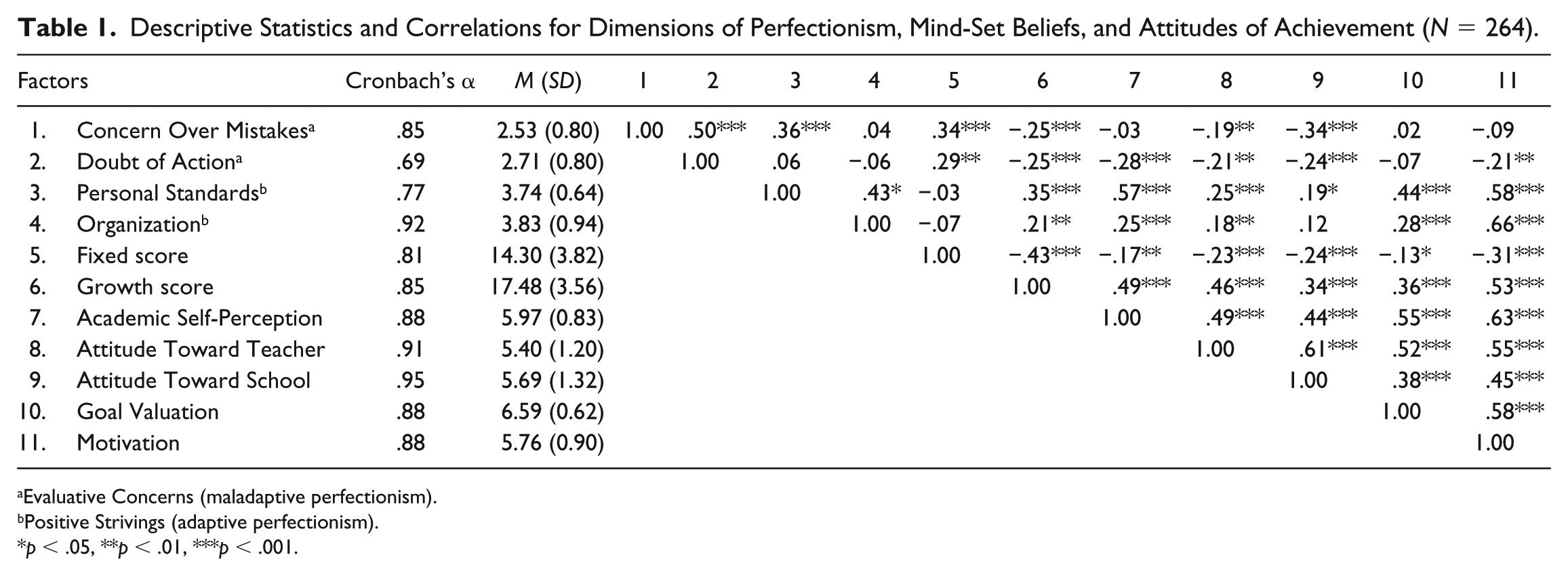
The SAAS-R (McCoach, 2000) was used to measure student achievement attitudes. This survey consists of 35 statements on a 7-point scale (1 = strongly disagree and 7 = strongly agree). This instrument was developed to evaluate a student’s vulnerability to underachievement through five subscales: Academic Self-Perception (e.g., “I am smart in school”), Attitude Toward Teacher (e.g., “my teachers make learning interesting”), Attitude Toward School (e.g., “I am proud of this school”), Goal Valuation (e.g., “I want to get good grades in school”), and Self-Regulation/Motivation (e.g., “I use a variety of strategies to learn new material”). The reported scores are mean scores for each subscale. Cronbach alpha reliabilities for the present study ranged from .88 (Academic Self-Perception, Goal Valuation, and Self-Regulation/Motivation) to .95 (Attitude Toward School; see Table 1).
Descriptive Statistics and Correlations for Dimensions of Perfectionism, Mindset Beliefs, and Attitudes of Achievement (N = 264).
Evaluative Concerns (maladaptive perfectionism).
Positive Strivings (adaptive perfectionism).
p < .05, **p < .01, ***p < .001.
Mindset
The Mindset Assessment Profile Tool (Mindset Works, 2012) measures a student’s belief about the malleability of intelligence, attitude toward effort, attitude toward mistakes, and belief about the importance of learning. It consists of eight questions, four of which relate to growth mindset beliefs with parallel statements that reflect fixed mindset beliefs. Participants indicate the extent to which they agree or disagree with the statement using a 6-point scale (1 = disagree a lot and 6 = agree a lot). Growth mindset beliefs are measured by items such as “I like my work best when it makes me think hard.” Fixed mindset beliefs are measured by items such as “To tell the truth, when I work hard, it makes me feel as though I’m not very smart.” Both the growth and fixed mindset subscores were calculated by summing four questions. Cronbach alpha reliabilities for the present study were calculated as .85 for the growth mindset beliefs and .81 for fixed mindset beliefs (see Table 1).
Perfectionism
To measure perfectionism, a version of the Goals and Work Habits Survey (Schuler, 1994; a modified version of Frost’s Multidimensional Perfectionism scale, Frost et al., 1990) was used. This survey includes 25 questions in which participants respond on a Likert-type scale from 1 (strongly disagree) to 5 (strongly agree). The modified survey did not include the dimensions of Parental Expectations or Parental Criticism (as these do not relate to personal expectations, only parent expectations). It includes eight items measuring Concern Over Mistakes with items such as “I like work best when I can do it perfectly without making mistakes.” Four items measured Doubt of Action with statements such as “I usually have doubts about the simple everyday things I do.” Seven items measured Personal Standards with statements such as “it is important for me to be thoroughly competent in everything I do.” Organization was measured with six statements (e.g., “neatness is very important to me”). Evaluative Concerns Perfectionism relates to high scores for Concern Over Mistakes and Doubt of Action. Positive Striving Perfectionism is associated with high scores on Personal Standards and Organization (Frost, Heimberg, Holt, Mattia, & Neubauer, 1993; Stoeber & Otto, 2006; Stumpf & Parker, 2000). When high Evaluative Concerns (Concern Over Mistakes and Doubt of Action) coexist with high Personal Standards, this typology is associated with maladaptive perfectionism (Dixon, Lapsley, & Hanchon, 2004; Hawkins, Watt, & Sinclair, 2006; Mofield & Parker Peters, 2015). The reported scores are mean scores for each subscale. Cronbach alpha reliabilities ranged from .69 (Doubt of Action) to .92 (Organization; see Table 1).
Data Analysis
Comparing Gifted Achievers Versus Gifted Underachievers
Descriptive statistics, correlations, and Cronbach alpha for the present study’s entire sample (N = 264) are shown in Table 1. In the case of missing data, if participants answered more than half of questions for a subscale, then we imputed the sample mean subscale scores for any missing data within the subscale. If the participant did not answer more than half of the questions within the subscale, then we did not include the subscale for that participant in the analysis. Descriptive statistics and effect sizes for the differences between gifted achievers and underachievers are shown in Table 2. Because groups are largely unequal, we used Welch’s t tests to determine differences between all criterion variables. We applied a Bonferroni adjustment, using an alpha level of .004 (.05 / 11) to control for type I error. Gifted underachievers (n = 15) had statistically significant higher fixed mindset beliefs scores (M = 16.80, SD = 4.25) compared with gifted achievers (n = 169; M = 13.85, SD = 3.67), d = .79 (95% confidence interval [CI] = [0.26, 1.32]), Welch’s t(182) = 2.95, p = .004. Gifted underachievers also had statistically significant lower scores on Organization (M = 2.99, SD = 0.72), compared with gifted achievers (M = 3.93, SD = 0.91), d = −1.01 (95% CI = [−1.54, −0.46], Welch’s t(182) = 3.73, p < .001, and lower scores on Motivation/Self-Regulation (M = 4.87, SD = 1.29), compared with gifted achievers (M = 5.86, SD = 0.80), d = −1.17 (95% CI = [−1.70, 0.62]), Welch’s t(182) = 4.33, p < .001. Unlike the results from McCoach and Siegle’s (2003) study, we only found Motivation/Self-Regulation to be a statistically significant differentiating factor between groups for Attitudes of Achievement.
Welch’s t Test: Gifted Underachievers (n = 15) Versus Achievers (n = 169).

Note. CI = confidence interval.
Evaluative Concerns (maladaptive perfectionism).
Positive Strivings (adaptive perfectionism).
p < .05 (not statistically significant at set alpha), **p < .01.
Logistic Regression: Achievement Status Predicted From Achievement Attitudes
Next, a logistic regression was used (a) to determine if achievement status can be predicted from achievement attitudes and (b) to determine which achievement attitudes are statistically significant predictors (achievers dummy coded as 1, underachievers coded as 0). This procedure replicates the study conducted by McCoach and Siegle (2003), who also used logistic regression to assess a model’s ability to correctly classify achievers versus underachievers. The first model tested all five achievement attitudes as predictor variables for achievement status. Bivariate logistic regression results indicated that the overall model of fit (−2 log likelihood = 83.64) is reliable in predicting achievement status, Model χ2(5, N = 185) = 20.31, p = .001. McFadden’s pseudo R2 statistic was calculated to determine effect size with the following formula: ρ2 = 1 − (logB / logB0) where logB is the log likelihood for the overall model and logB0 is the intercept log likelihood. This yielded a McFadden’s ρ2 = .20 (ρ2 cannot be interpreted as R2 are in linear regression models). Scores from .20 to .40 are considered an excellent fit (Hensher & Johnson, 1981). This model correctly classified 92.93% of the cases. Regression coefficients are presented in Table 3. Wald statistics indicated that Motivation/Self-Regulation was the only statistically significant predictor of achievement status, Β = 1.53, Wald (1, N = 185) = 3.53, p < .001. The adjusted odds ratio (AOR) of 4.61 for Motivation is interpreted as a strong positive relationship (Haddock, Rindskopf, & Shadish, 1998), indicating that as the Motivation/Self-Regulation scores increase by 1, participants are 4.61 times more likely to be classified as achievers (vs. underachievers). These results are somewhat inconsistent with the previous findings of McCoach and Siegle (2003), which revealed both Goal Valuation and Motivation/Self-Regulation to be statistically significant predictor variables in the overall five-factor model. McCoach and Siegle (2003) reestimated their model with these two variables, finding both to be significant predictors in a logistic regression with just two predictors. We did not reestimate our model because neither the Welch’s t test or the logistic regression indicated statistically significant differences for Goal Valuation.
Predicting Achievement Status (Underachiever vs. Achiever) From Attitudes Toward Achievement: Results From Logistic Regression Analysis (N = 185).
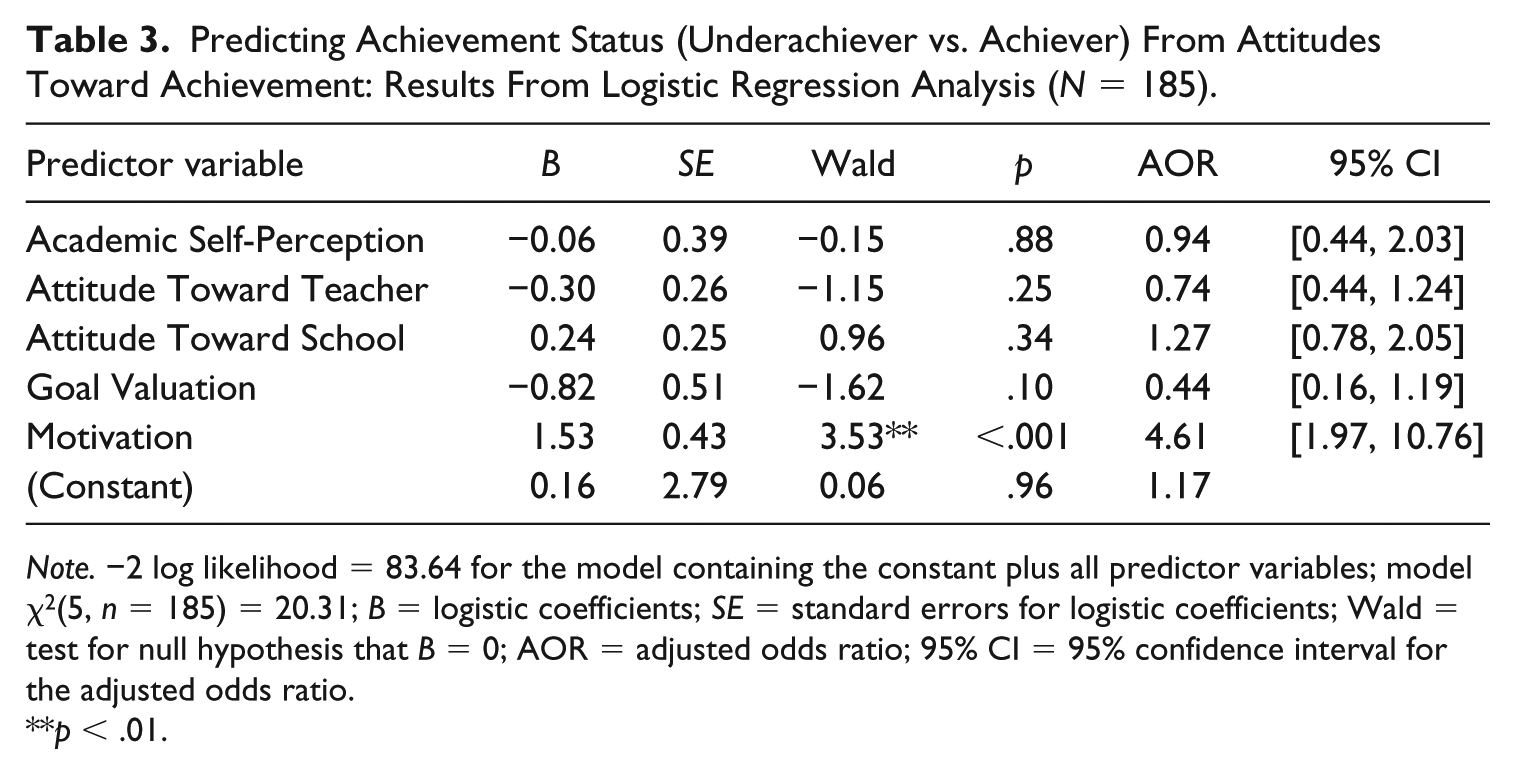
Note. −2 log likelihood = 83.64 for the model containing the constant plus all predictor variables; model χ2(5, n = 185) = 20.31; B = logistic coefficients; SE = standard errors for logistic coefficients; Wald = test for null hypothesis that B = 0; AOR = adjusted odds ratio; 95% CI = 95% confidence interval for the adjusted odds ratio.
p < .01.
Logistic Regression: Predicting Achievement Status From Mindset Beliefs and Perfectionism
To determine if other factors contribute to classifying achievers versus underachievers, the predictor variables of mindset beliefs (Step 1) and dimensions of perfectionism (Step 2) were sequentially added within a second separate logistic regression model. Because there is such a strong correlation between Motivation/Self-Regulation and many of the other mindset and perfectionism variables (see Table 1), multicollinearity would greatly affect the strength of the model. Therefore, a separate logistic regression model was employed to assess how mindset beliefs and perfectionism predict achievement status.
First, we tested the overall model with mindset beliefs about intelligences (fixed and growth) as predictor variables for achievement status. The overall model of fit was statistically significant, likelihood ratio model χ2(2, n = 185) = 8.81, p = .012, although only a small proportion of variance can be accounted for achievement status (McFadden’s ρ2 = .085). This model correctly classified 91.85% of cases. Fixed mindset beliefs about intelligence was a statistically significant predictor, B = −.23, Wald (1, n = 185) = −2.79, p = .005, yielding an adjusted odds ratio of .79. Because this number is less than one, it reveals that as fixed mindset beliefs increase, the odds of being classified as an achiever decrease. Growth mindset did not predict classification of achievement status (see Table 4).
Results From Sequential Logistic Regression: Predicting Achievement Status From Mindset Beliefs and Perfectionism (n = 185).

Note. AOR = adjusted odds ratio for predictor variable; CI = 95% confidence interval for adjusted odds ratios; model −2LL = −2 log likelihood for model; model χ2 = chi-square test for null hypothesis that the logistic regression coefficients for all predictor variables included in the model are equal to zero.
p < .05, **p < .01.
In Step 2, we added the four dimensions of perfectionism (Concern Over Mistakes, Doubt of Action, Personal Standards, and Organization). The added predictor variables improved the model (change in model χ2 = 14.59). The model was statistically significant (model χ2 = 23.40, p < .001, McFadden’s ρ2 = .25). The McFadden’s ρ2 effect size is considered to be an excellent fit (Hensher & Johnson, 1981). Furthermore, the model correctly classifies 92.66% of cases. Results indicated that fixed mindset beliefs remained a statistically significant predictor variable (B = −.27, Wald = −2.58, p = .001, AOR = .77). Organization was also a statistically significant predictor variable (Β = .87, Wald = 2.40, p = .017, AOR = 2.38). The adjusted odds ratio of 2.38 indicates a moderately positive relationship; as Organization increases by 1 point, then a participant is 2.38 times more likely to be classified as an achiever. See summary statistics for the sequential logistic regression in Table 4.
Overall, these results are consistent with Welch’s t-test differences between underachievers and achievers. Motivation/Self-Regulation, fixed mindset beliefs, and preference for organization appear to differentiate underachievers from achievers more so than other variables.
Relationship Between Mindset and Perfectionism
We also examined simple linear regression models to investigate how mindset (fixed and growth) relates to dimensions of perfectionism. We used all gifted participant subscores (N = 264) for this set of regression analyses (including gifted underachievers, achievers, and gifted students not identified as either). Fixed mindset beliefs about intelligence were statistically significant predictors for both dimensions of Evaluative Concerns (Concern Over Mistakes, β = .35, p < .0001, and Doubt of Action, β = .28, p < .0001). Growth mindset beliefs about intelligence were statistically significant predictors for Positive Strivings Perfectionism (Personal Standards, β = .35, p < .0001, and Organization, β = .21, p = .001). Growth mindsets were negatively associated with Evaluative Concern Perfectionism (Concern Over Mistakes, β = −.26, p < .0001, and Doubt of Action, β = −.25, p < .0001; see Table 5).
Simple Linear Regression Analysis Predicting Dimensions of Perfectionism (N = 264).
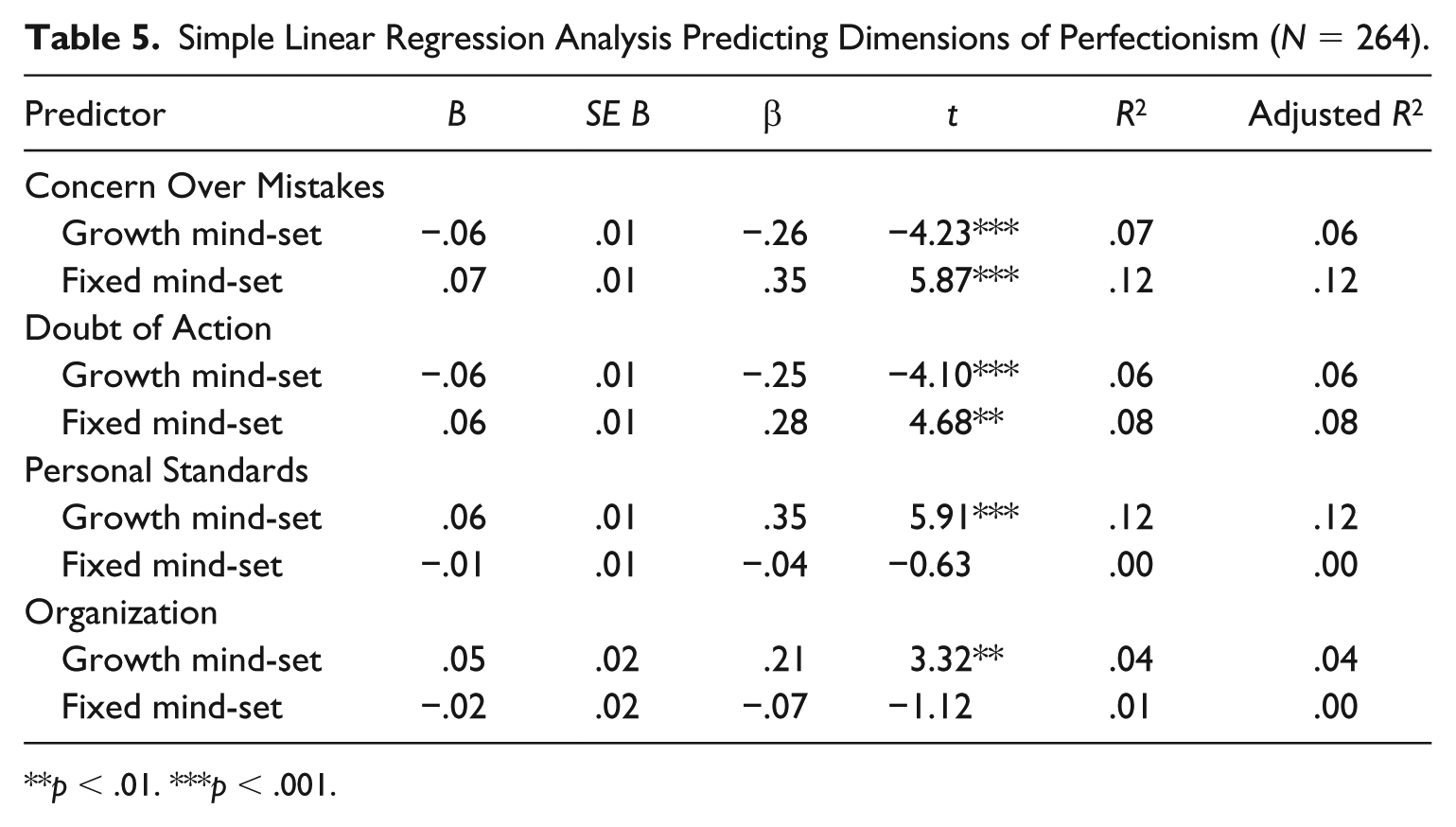
p < .01. ***p < .001.
Findings and Implications
Our findings provide a clearer picture of how achievement attitudes, beliefs about intelligence, and perfectionism are related to underachievement, especially clarifying the role of mindsets within the AOM (Siegle et al., 2017). First, we sought to determine achievement attitudes that differentiate gifted achievers from underachievers, using similar methodology of McCoach and Siegle (2003). Unlike the findings of McCoach and Siegle (2003), the participants in this study did not differ (with statistical significance) from underachievers in terms of Goal Valuation, only Motivation/Self-Regulation. Like Ritchotte et al.’s (2014) study, underachievers had lower scores on all dimensions of the AOM, but t tests and predictive logistic regression only shows Motivation/Self-Regulation as the significant differentiating factor. This implies that underachievers within our sample may value a given task or outcome, but do not want to put forth the effort to achieve the goals.
To practically address the issue of self-regulation and motivation, teachers may guide underachievers to understand that short-term endeavors (e.g., homework) are a means to a greater goal. The abstract future goal can to be linked to the present concrete reality through future planning activities. One method for doing so that has not been tested with gifted underachievers is mental contrasting with implementation intentions (MC-II; Oettingen & Gollwitzer, 2010). This involves envisioning a valuable, obtainable goal, thinking through the obstacles that get in the way of achieving the goal, and developing a specific if–then plan for when the obstacle arises. The contrast between the positive thinking of the future wish and the negative thinking about the obstacle (in this order) catalyzes motivation for behavior change in efforts to reach the goal. The if–then plan (implementation intention) is put in place for relinking the self to the positive future as a means for overcoming the obstacles. Duckworth, Kirby, Gollwitzer, and Oettingen (2013) found the use of the MC-II to be effective among disadvantaged middle school students in increasing report card grades. Because gifted underachievers lack self-regulation strategies and need organizational supports, the MC-II may be an effective part of interventions for underachievers if they value self-set goals but lack the self-regulation skills to employ effective goal-striving strategies. Self-regulation skills such as breaking large tasks into small ones, making plans for obstacles, and employing approach-coping strategies can be explicitly taught; yet we must remember that having an understanding of these skills and actually applying them are quite different. Underachievers need explicit modeling of strategies, feedback, and ongoing support. Although these intervention ideas relate to addressing some of the differences noted between underachievers and achievers, their effectiveness needs to be studied in research with gifted underachievers.
In our study, underachievers did not differ to a degree of statistical significance from achievers regarding Academic Self-Perception. This was consistent with McCoach and Siegle’s (2003) findings, which implied that underachievers continue to have confidence in their abilities even though they are not performing well. When looking at descriptive data on individual belief statements on the Mindset Assessment Profile, it is interesting to note that underachievers held much higher agreement to the statement “to tell the truth, when I work hard, it makes me feel as though I am not very smart” (M = 3.67, SD = 1.84) compared with achievers (M = 2.48, SD = 1.35), indicating a large effect size (d = 1.07). Thus, beliefs such as “I am smart at school” (measured as the construct Academic Self-Perception) may directly relate to the underachiever’s entity belief system of intelligence being stable, specifically that the underachiever seeks to avoid effort as a means to preserve ego. In other words, it appears the underachievers view themselves as smart, but this is threatened when they have to put forth effort into something difficult. This finding also provides some evidence for understanding the link between a gifted child’s perceptions about being smart, entity beliefs, and underachievement as described in the Maladaptive Competence Beliefs Pathway (Snyder & Linnenbrink-Garcia, 2013).
Furthermore, gifted underachievers reported higher fixed mindset beliefs about intelligence, meaning they were more likely to believe that intelligence is a stable entity that really does not change. Logistic regression models also support that fixed mindset beliefs can accurately predict achievement status (as fixed mindset beliefs increase, the odds of being classified as an achiever decreases). As we just described, such beliefs support the notion that smart people do not have to extend a lot of effort to succeed (Mindset Works, 2012). The rationale may be as follows: “If I am smart, I will always be smart and should not have to work hard to experience success.” Fortunately, mindset beliefs (as implicit theories) are malleable (Chiu, Hong, & Dweck, 1997; Levy, Stroessner, & Dweck, 1998; Paunesku et al., 2015). Thus, it is especially promising that educators can teach gifted underachievers about incremental theory—intelligence is malleable and abilities develop further with effort. Intervention efforts can focus on more than just the symptoms of manifesting underachieving behaviors; these efforts can actually focus on the root of such behaviors (e.g., implicit beliefs about intelligence and effort; Paunesku et al., 2015). An underachieving gifted student with a change in mindset may no longer be so preoccupied with maintaining a smart identity, leading to evading risks and challenges. When thoughts are oriented to an incremental view, these students may be more attuned to develop abilities without the fear of performance-based evaluation. Instead of giving up altogether and avoiding challenging experiences that are evidenced in underachieving behaviors (e.g., low grades), the underachieving student may be more likely to pursue incremental steps toward learning/mastery goals. Underachievement, then, may no longer be needed as a coping mechanism to deal with failure (e.g., “If I didn’t try the task, I’m not really a failure. I could have done it if I tried”). Instead, with an incremental view, the student is equipped with a more appropriate coping mechanism, to view mistakes as opportunities and effort as essential in developing abilities further. In a study by Paunesku and colleagues (2015), mindset interventions were effective among high school students who underachieve in general education contexts, although they were not as beneficial for high-achieving students. Future studies may examine if and to what extent mindset interventions impact gifted underachievers specifically.
Regarding dimensions of perfectionism, underachievers had lower Positive Striving Perfectionism, especially for order and organization. Organization was found to also predict achievement status through logistic regression (i.e., as organization increases by 1 point, then a participant is 2.38 times more likely to be classified as an achiever). This implies that specific efforts should be made to help underachievers set high standards with concerted focus on means (e.g., organization) to achieve set goals. If underachievers feel that they have an adequate method or strategy to approach their goals, then they will feel more equipped to approach the goals rather than avoid them (Ames & Archer, 1988; Diseth & Kobbeltvedt, 2010; Michou, Mouratidis, Lens, & Vansteenkiste, 2013). Similar to the results found by Mofield et al. (2016), underachievers did not indicate higher levels of maladaptive perfectionism at a level of statistical significance (although effect size for higher Evaluative Perfectionism scores in the present study are notable). Although results were not statistically significant, the mean scores for underachievers were slightly higher for Concern Over Mistakes and Doubt of Action. Nevertheless, these results combined with regression models indicate no clear relationship between underachievement and Evaluative Concern Perfectionism. The link between perfectionism and underachievement cannot be fully understood until researchers are able to study different types of underachievers as they relate to perfectionism. For example, our study includes what we might call “overt” underachievers—those whose underachievement are easily visible through poor grades. However, “covert” underachievers might not display a significant discrepancy between actual and expected performance because they choose to take less challenging courses. This type of underachievement is less noticeable, but nevertheless, the student is not achieving at a level expected of his or her ability. These covert underachievers may be underachieving by avoidance of challenges as a function of their Evaluative Concern Perfectionism and were not identified in our study.
In addition, findings reveal that growth mindsets beliefs about intelligence are predictive of Positive Strivings Perfectionism, while fixed mindset beliefs are predictive of Evaluative Concerns Perfectionism (i.e., maladaptive perfectionism), similar to past findings (Chan, 2012; Shih, 2011). These results further establish the dichotomous constructs of Evaluative Concerns (e.g., unhealthy/maladaptive) and Positive Strivings (e.g., healthy/adaptive) among gifted populations, as proposed by Speirs Neumeister (2016). By understanding the connection between fixed mindset beliefs and Evaluative Concern Perfectionism, practitioners can plan intervention efforts. Because we know that mindsets beliefs (as implicit theories) are malleable (Chiu et al., 1997; Levy et al., 1998), mindset interventions can be explored as a valid method to address perfectionism by decreasing Evaluative Concerns and increasing Positive Strivings. If a student’s belief about her abilities can change from the belief that ability is fixed to the belief that it is malleable, then she may change her typical ways of thinking and be more concerned about continuing to improve skills and abilities rather than setting out to simply prove the presence of elevated ability.
Our findings also show promise for efforts that enhance mastery goals and growth mindsets (e.g., belief in malleable intelligence) as a means to help perfectionists view mistakes as cues to adjust strategies in the attainment of goals. On a practical level, practitioners can focus on helping gifted students with maladaptive perfectionistic tendencies to strive for excellence and view mistakes and challenges as a means to progress and meet set goals. Or, for gifted underachievers with lower healthy/adaptive perfectionism scores, practitioners can implement interventions to support underachievers to set higher standards with a focus on realistic strategies and supports (e.g., organization) to achieve goals. Adaptive facets of perfectionism (e.g., organization) can be taught and relate to approach-oriented, effective, positive coping mechanisms that can support this group on the way to healthy goal achievement (Mofield & Chakraborti-Ghosh, 2010; Mofield et al., 2016).
When gifted students are taught mastery goal orientations and internalize malleable beliefs about abilities, these shifts in thinking can particularly support students who experience heightened self-criticism. Their ways of thinking can change from an attitude of ability permanence that does not allow for the risk-taking and challenges necessary to produce personal growth to one that understands the positive opportunities that come with the acceptance of challenges and potential mistakes. It is important to keep in mind, however, that gifted students may not benefit directly from mindset interventions unless they are given challenging work that necessitates real effort for successful outcomes. We also caution that our research findings show the relationship between mindset and perfectionism and differences between achievers and underachievers; studies should be conducted to further document the success of the intervention ideas mentioned.
Limitations
Inferences made from research findings are limited to only similar populations from which our sample was drawn (suburban, majority Caucasian, American gifted students). Furthermore, the study is based on self-report measures, where social desirability might influence student responses on surveys. We acknowledge we may not have included all possible gifted underachievers. Some underachievers might not be identified as gifted because their underachieving behaviors keep them from being identified as gifted. These students are not captured in our sample because the population of our sample only includes identified gifted students. Furthermore, some participants (including underachievers and achievers) may have been reticent to participate in the study and may differ in various characteristics from those who did participate. For example, those who did not participate may lack the organizational skills needed to keep up with consent forms to and from home to participate in the study. We should note that findings do not encompass the characteristics, beliefs, and attitudes of these nonparticipants.
In addition, the definition of underachiever differs in the literature. Because we wanted to replicate McCoach and Siegle’s (2003) methodology, we chose cutoff scores based on the bottom half of the class (2.80); however, studies in the field have used other methods such as using a GPA of a C average (Ritchotte et al., 2014), having a C on the report card (Mofield et al., 2016), or by using statistical methods to identify underachievers (see Lau & Chan, 2001). Finally, readers should be cautious in interpreting comparison differences between unequal sample sizes, noting the wide range of effect sizes within a 95% CI. Furthermore, the relatively low reliabilities of Doubt of Action (α = .69) and Personal Standards (α = .77) weaken the inferences that can be made from our findings.
Significance
This study quantifies factors that differentiate underachievers from achievers in regard to mindset beliefs about intelligence, achievement, and perfectionism. It provides support for the role of mindset beliefs within the context of the AOM, differentiating achievers from underachievers, adding practical significance to Dweck’s self-theories, and paving the way for the development of interventions for underachievers. Furthermore, it lends some support to the Maladaptive Beliefs Pathway Model as an explanation for underachievement in clarifying the relationships between giftedness, entity beliefs, and underachievement (Snyder & Linnenbrink-Garcia, 2013). Although we did not find factors of Evaluative Concern Perfectionism to differentiate underachievers from achievers, we found similar results from Mofield et al. (2016): Underachievers have lower preference organization, a dimension of Positive Striving Perfectionism, indicating the need to deliberately teach organizational skills such as planning, setting short-term goals, and developing manageable systems for school work.
Furthermore, we have an enhanced understanding of how specific dimensions of perfectionism are associated with mindset beliefs among gifted adolescents. This also validates intervention efforts that focus on enhancing mastery goals and growth mindsets (a belief in malleable intelligence) as a way to help perfectionists view mistakes as cues to adjust strategies in the attainment of a goal. When a student’s focus is the desire to learn and the student believes that abilities can be further developed, mistakes are no longer understood as threatening to one’s self-worth and perceived competency, but they instead are viewed as opportunities for readjustment in reaching mastery. To help students attain high academic potential and achieve healthy standards of academic excellence, we can deliberately cultivate healthy mindset beliefs, teach organizational supports, and equip students with self-regulation strategies. Until these skills are supported, we will not know the possibilities clouded by beliefs and underachievement. Just imagine what is waiting for gifted students beyond the cloud of unknown possibilities.
Footnotes
Declaration of Conflicting Interests
The authors declared no potential conflicts of interest with respect to the research, authorship, and/or publication of this article.
Funding
The authors disclosed receipt of the following financial support for the research, authorship, and/or publication of this article: The authors funding was received through the National Association for Gifted Children Hollingworth Award for this research.
