



Abstract
According to the 2014–2015 State of the States in Gifted Education, Colorado is the only state in the United States where a series of on-site, customized twice-exceptional professional development (2E PD) opportunities have been implemented. The purpose of this case study evaluation was to understand the implementation of 2E PD during 2014–2016 in a school district in Colorado. Seven training participants and four administrators who were involved in the training were purposefully selected. Data sources consisted of interviews, documentation, and archival records. Eight major themes emerged: (a) increased knowledge and skills, (b) evolved attitudes, (c) recurring challenges, (d) utilizing a team approach, (e) improved performance, (f) difficulty in measuring impact, (g) improved school culture, and (h) planning for the future. In addition to a discussion of themes, implications for improving educator and student outcomes and for creating organizational support and changes are presented.
The needs of twice-exceptional students in the United States are not being met (Reis, Baum, & Burke, 2014). Experts believe that by providing quality training in both gifted and special education to educators, twice-exceptional students will have a greater chance of getting their needs met in school (Baldwin, Baum, Pereles, & Hughes, 2015; National Association for Gifted Children [NAGC], 2013). However, in general, quality professional development is not occurring, and when it takes place, educators do not know if it is effective or not (Mizell, 2010) because systematic evaluation of professional development rarely takes place. As a result, educators, including administrators, struggle to move beyond increased knowledge and work toward instructional changes and improved student outcomes. For the purpose of accountability and sustainability, it is critical that school districts that commit the time and resources to develop and deliver professional development evaluate the quality and effectiveness of these initiatives. Colorado serves as the only example in the United States where a series of on-site, customized twice-exceptional professional development (2E PD) opportunities have been created and coordinated by a state education agency (NAGC & Council of State Directors of Programs for the Gifted [CSDPG], 2015). The 2E professional development (i.e., 2E Project named by the Colorado Department of Education [CDE]) has shown some features of high-quality professional development, including longer duration and collective participation (Darling-Hammond, Wei, Andree, Richardson, & Orphanos, 2009; Garet, Birman, Porter, Desimone, & Herman, 1999; Garet, Porter, Desimone, Birman, & Yoon, 2001; Jaquith, Mindich, Wei, & Darling-Hammond, 2010). (For more information about the 2E Project, please visit https://www.cde.state.co.us.) However, the CDE and school districts have not yet systematically evaluated the 2E Project since it started in 2014.
Literature Review
Frameworks to Serve 2E Students in Schools
Several state and local education agencies use similar frameworks to serve twice-exceptional students. In Montgomery County Public Schools in Maryland, 2E students are served under a tiered framework: School teams are required to use the collaborative problem-solving process prior to referring potential 2E students to the Educational Management Team or Individualized Education Program team. The decision for a referral is based on students’ responses to interventions at a less intensive level. The Montgomery County Public Schools also provide 2E students with strength-based instruction, which includes (a) acceleration and enrichment, (b) specialized instruction and/or interventions, (c) appropriately selected accommodations, and (d) comprehensive case management and social emotional support (Office of Curriculum and Instructional Programs & Office of Special Education and Student Services, 2015, pp. 9–10, 17). The State of Colorado requires school personnel to use a body of evidence in gifted education identification that helps professionals to find 2E students who fail to excel on achievement tests, but demonstrate a distinguished level of performance as measured by other identification tools. Also, school personnel are encouraged to develop and implement comprehensive educational plans for 2E students that have a dual emphasis on students’ strengths and challenges. A problem-solving process, which has Response to Intervention (RtI) as an evaluation approach, is used for the life cycle of an instructional plan (CDE, 2012). 2E students can benefit from the implementation of multitiered system of supports (MTSS) as well. The MTSS utilizes a collaborative data-based approach, as well as evidence-based practices, to prevent negative academic and behavioral outcomes for students. The MTSS is considered as a schoolwide framework that is very likely to improve learning outcomes for every student and is aligned with key legislation priorities (CDE, 2014a, 2016c). However, when dealing with gifted students with disabilities, schools must follow requirements of the Individuals With Disabilities Education Act or Section 504. Specifically, neither RtI nor MTSS can substitute for the development and implementation of an IEP or Section 504 Plan, but those plans can be incorporated in MTSS.
Personnel Training in Supporting 2E Students
The National Twice-Exceptional Community of Practice (National 2E CoP) indicated that working with 2E students requires specialized academic training as well as ongoing professional development (Baldwin et al., 2015). According to the State of the States in Gifted Education (NAGC & CSDPG, 2013, 2015), Nevada reported requiring all preservice teachers to take separate coursework in gifted education. Over the four years that were surveyed, fewer than eight states specified competencies for gifted education teachers; those specified relied on the Praxis exam or the state’s teacher competency standards. Fewer than four states required coursework in gifted education for administrator and counselor credentials. About half of responding states had no state policies but left the decisions to districts or continuing education units to determine requirements about gifted and talented in-service training for general education teachers (NAGC & CSDPG, 2013, 2015). Fewer than seven states reported having required professional development hours for gifted education teachers. Those decisions were up to school districts; required hours ranged from not specified to 24 hours. Differentiated instruction was the most popular topic of professional development across all school levels (Callahan, Moon, & Oh, 2014).
Given 2E students are most likely to spend the majority of their instructional time in general education classrooms, the general education teacher, even more so than the gifted and special education teacher, needs to be able to identify and serve these students. Unfortunately, general education teachers are no more prepared to do this than gifted or special education teachers. General education teachers, for example, are often relied upon to instruct gifted students, yet, most of them were unlikely to receive any training in gifted and talented education from their teacher preparation programs (NAGC & CSDPG, 2015). Furthermore, according to the U.S. Office of Special Education Programs’ (2001) Study of Personnel Needs in Special Education (SPeNSE), fewer than one third of the general education teachers surveyed reported having received any preservice training in collaborating with teachers of special education students, half received training in instructional modifications, and only two thirds were taught how to manage the behavior of students with disabilities. Newer national data are unavailable unfortunately; however, a 2010 report in researched nine jurisdictions noted that eight of the jurisdictions required preservice general education teacher of “some coursework,” which included a prescribed number of credit hours and experience with students with disabilities in partial fulfillment of the requirements for student teaching (Bocala, Morgan, Mundry, & Mello, 2010, p. i). A Michigan-based project, State of Opportunity (2012–2017), also indicates insufficient special education training that responding general education teachers had in college (Guerra, 2015). Without appropriate training in identifying and instructing students with gifts and talents or students with disabilities, it is unlikely general education teachers will be able to adequately serve students who manifest both of these traits.
Because of inadequate preservice training in gifted education, professional development becomes crucial (Johnsen, 2013). Some states were trying to improve professionals’ capacity to better serve 2E students. Among 42 responding state education agencies, three states were either educating or supporting their professionals to learn about twice-exceptionality at the state level (NAGC & CSDPG, 2015). In the category of positive developments and/or innovations in gifted education, Colorado listed its Twice-Exceptional Professional Development Project. Texas developed the Twice-Exceptional Students and G/T Services website (http://www.gtequity.org/twice.php), which is under the state’s Equity in Gifted/Talented Education framework. Rhode Island reported having designated personnel at the state education agency to provide technical assistance, and the state believed this was having a positive impact on the delivery of gifted education services in the state during the time frame when the State of the States survey was completed. Still, states in the United States have a long way to go before achieving the goal of helping every student succeed. Nonetheless, studies or reports on the development, implementation, or effectiveness of 2E PD have not yet been found. Administrators who are dedicated to helping professionals serve 2E learners are either seeking models to learn from or finding ways to establish best practices.
Professional Development
Under the Every Student Succeeds Act (ESSA), effective professional development means activities that are “sustained (not stand-alone, 1-day, or short term workshops), intensive, collaborative, job-embedded, data-driven, and classroom-focused” (§8002 (42)) and can help teachers or related service professionals implement the knowledge and skills in classrooms. Researchers have identified two major features of effective professional development over the past 15 years: structural and core (Desimone, 2009; Garet et al., 1999). Structural features are characteristics of the design of activities (i.e., reform type, duration, and collective participation), whereas core features refer to the core of professional learning experiences (i.e., active learning, coherence, and content focus). Most importantly, professional development in education should always be planned and implemented with evaluation plans.
The evaluation of professional development should include not only attendees’ perceptions, but also applications of new learning in classrooms and systemic support for those applications that will contribute positive long-term outcomes for students. According to Guskey (2000), the impact of professional development can be examined at five levels and “success at one level is necessary for success at the levels that follow” (p. 78). The first level is participants’ reactions to the structure and delivery of training. Training providers need this information to improve the design and delivery of professional development. The second level is participants’ gains of knowledge and skills. A satisfactory completion of training paves the way for applications in classrooms. The third level is organizational support and change. In education settings, organizational support comes from a school and its school district. Released time for collaboration or colleagues’ awareness of an issue, for example, are signs of increasing organizational support. Similar to Level 2, a supportive organization fosters applications in classrooms. The fourth level is participants’ use of new knowledge and skills (i.e., applications in classrooms). Training participants apply what they have learned to instructional changes. Level 5, student learning outcomes, has been the only interest of policymakers and administrators. However, based on Guskey’s (2000, 2003) framework, the improvement of student learning outcomes will not happen without instructional changes, organization support, and carefully designed and delivered training.
In this study, the implementation of the 2E Project was examined in three dimensions: (a) Educators: The educator outcomes included their reactions to and feedback on the training and the educational services developed and/or implemented as a result of the training; (b) Students: Observed changes of 2E students included progression through the education system and documented changes in social and behavioral competencies and/or functional outcomes; and (c) School/district: Outcomes at the school/district level refers to administrative supports provided after the training to develop and/or implement educational services for 2E students. With the purpose to improve professional development activities for educators, the following questions guided this case study evaluation:
Method
Participants
The case for this study was the 2E Project Training in the Hope District (pseudonym) in Colorado. The Hope District is one of the five districts that were recommended by State Administrator A (one of the research participants) for this research study. The Hope District is located in a metropolitan area in Colorado with approximately 37,000 students enrolled in the 2015–2016 school year. The majority of the student population is White (slightly more than 50%), followed by Hispanic (35%). The identified gifted and talented population is 9%. Within the identified gifted and talented population, the 2E population grew from 2.71% to 5.3% during 2014–2016 (CDE, 2014b, 2016b); the state’s average is 3.97% (CDE, 2016b). Except for the Hope Learning Specialist, the 2E cohort members and partial completers came from four schools, which were the Hope District’ pilot schools for the 2E Project (see Table 1).
Schools’ Demographics.
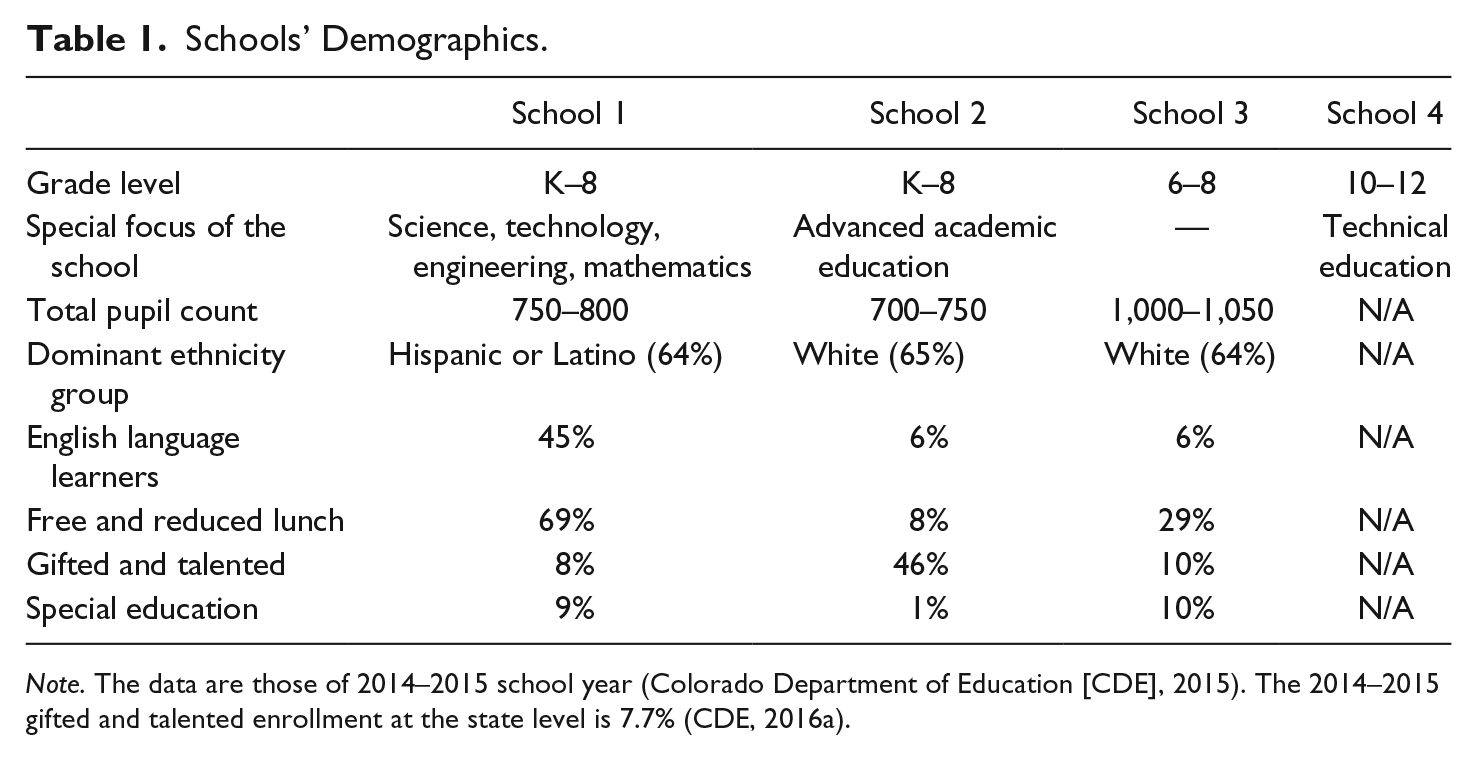
Note. The data are those of 2014–2015 school year (Colorado Department of Education [CDE], 2015). The 2014–2015 gifted and talented enrollment at the state level is 7.7% (CDE, 2016a).
There were four groups of participants in this study: (a) Group 1 (n = 5): Educators who participated in all three phases of the 2E Project (i.e., Level 1, Level 2, and the second-year, on-site initiatives); (b) Group 2 (n = 2): Educators who participated in the Level 1 and/or the second-year initiatives but missed Level 2; (c) Group 3 (n = 2): Administrators in Hope District that coordinated the 2E Project; and (d) Group 4 (n = 2): Administrators at the CDE that coordinated the 2E Project. The research participants’ academic background in relation to special education and gifted education is provided in Table 2. Five out of 11 participants had no exposure to special education or gifted education in their undergraduate training.
Participants’ Training Background.

The first author had the Hope District’s permission to collect data in the 2016–2017 school year. An Institutional Review Board application was approved on October 24, 2016. Approved research procedures comprised collecting documentation and archival records and conducting interviews. Amendments and modifications made were approved on November 18, 2016; January 20, 2017; and March 2, 2017.
Data Sources
This case study evaluation had multiple sources of data to answer research questions in relation to the three study dimensions: (a) educators’ perceptions of the training and implementation strategies as a result of the training, (b) educators’ perceptions of the training’s impact on 2E students’ learning, and (c) school- and district-level changes made as a result of the 2E Project. Data collection methods included documentation, archival records, and interviews (see Table 3). The first author, who received Levels 1 and 2 training twice during 2014–2016, collected data independently.
Chain of Evidence.
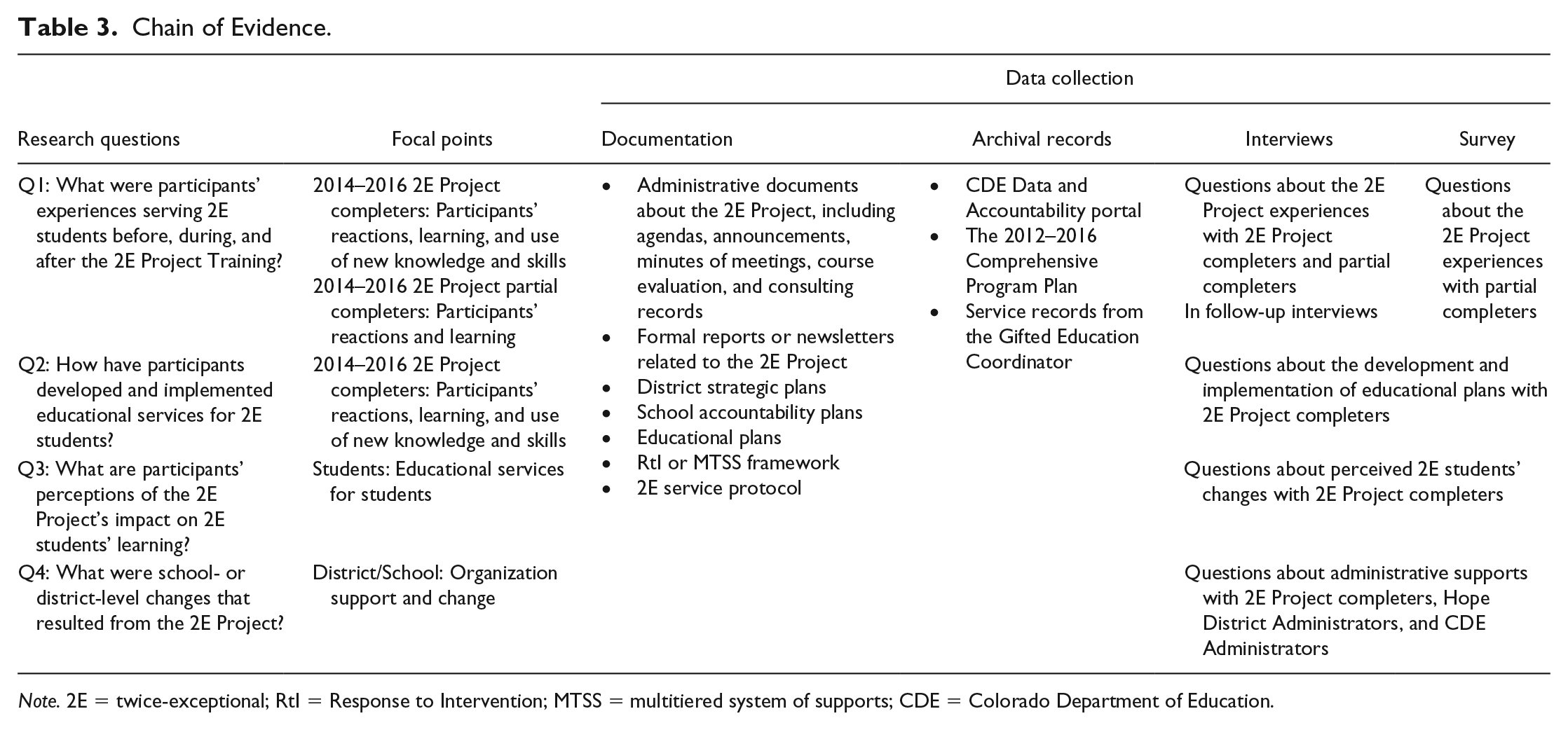
Note. 2E = twice-exceptional; RtI = Response to Intervention; MTSS = multitiered system of supports; CDE = Colorado Department of Education.
Data Analysis
Organizing the data
Two separate organizational approaches were applied to the data collected in this study: evidentiary sources (documents, archival records, and interview transcripts) and field notes. An electronic folder was created to hold evidentiary sources. A binder was used to store handwritten field notes and hardcopies of related documents and materials. Audio recordings were transcribed by a third party and then verified by the first author.
Reading and memoing
As part of the field notes, which began during the data collection and continued into the analysis phase, the first author wrote memos when reading interview transcripts and related documents. In this initial phase of exploring the case study database, the first author looked over the entire database and set aside research questions, followed by reflection on the big picture presented in the data.
Reducing the data into themes
At this stage, detailed descriptions and themes were developed to describe, classify, and interpret the data (Creswell, 2014). First, a third party transcribed audio recordings. Second, the first author verified the transcripts by listening to audio recordings. Third, all transcripts were uploaded into NVivo 10 for coding. Fourth, the first author read transcripts and did the following: (a) removed identifiable information; (b) assigned five completers into Group 1, two partial completers into Group 2, Hope administrators into Group 3, and CDE administrators into Group 4; and (c) highlighted interview questions, including follow-up questions in NVivo.
Phase 1
The first author applied open coding by sentence or paragraph because this approach is especially useful when a researcher has categories already defined and wants to code around them (Strauss & Corbin, 1990). Two theoretical propositions guided the development of initial categories. The first proposition was Guskey’s (2000) evaluation framework of professional development, which contains three focal points: participants (i.e., educators), students, and the organization (i.e., the Hope District and schools). The second proposition included the critical features of professional development: (a) content focus, (b) active learning, (c) coherence, (d) duration, and (e) collective participation (Desimone, 2009). Here, the first author entered the first stage of the constant comparative method, comparing incidents applicable to each category (Glaser & Strauss, 1967).
Phase 2
The second stage of the constant comparative method took place in Phase 2, integrating categories and their properties (Glaser & Strauss, 1967). While undergoing the second stage, the first author still found a need to repeat Stage 1. Glaser and Strauss (1967) were clear about the constant comparative method: “earlier stages do remain in operation simultaneously throughout the analysis and each provides continuous development to its successive stage until the analysis is terminated” (p. 105).
Phase 3
The first author developed themes. Themes are “broad units of information that consist of several codes aggregated to form a common idea” (Creswell, 2014, p. 186). First, the first author set aside the data after reducing the number of categories from 42 to 15. The first author read the research questions before collapsing categories into themes. Second, the first author examined the connections between research questions and categories and made notes. The second author and the first author examined the connections between themes and research questions individually and jointly. The first author read transcripts again and revised the descriptors of the themes several times to capture the participants’ responses while answering the research questions. The first author formulated major themes with a smaller set of higher level concepts, such as knowledge and skills, attitudes, and challenges; the major themes were generalized so that they pertained to all of the Group 1 and 2 participants. The first author also reduced the original list of categories and saturation (Morse, 2004) occurred when no new insights emerged.
Interpreting the data
Building detailed descriptions is a critical process in a case study (Creswell, 2014). To describe the case of this study (i.e., the 2E Project), the first author provided a thick description and a logic model with the following information: (a) descriptions of the 2E Project and on-site activities, (b) characterization of the organizational environment, (c) the period in which 2E training is examined, (d) beneficiaries and assessed needs of 2E training, (e) the underlying logic of operation and productivity, and (f) the key roles involved in the 2E Project. Due to the page limit, the thick description is not provided in “Results” section.
Trustworthiness
To validate conclusions, strategies to build trustworthiness were used throughout different phases of the research, including reliability (dependability), internal validity (credibility), and external validity (transferability; see Table 4). Overall, to enhance the quality of this case study, the first author established an audit trail. To do so, Merriam (1998) explained, “The investigator must describe in detail how data were collected, how categories were derived, and how decisions were made throughout the inquiry” (p. 207). The first author kept a researcher’s journal. The second author served as an auditor examining how categories and major themes were derived. The first author improved the final report based on feedback from the second author and research participants.
Strategies to Build Trustworthiness.
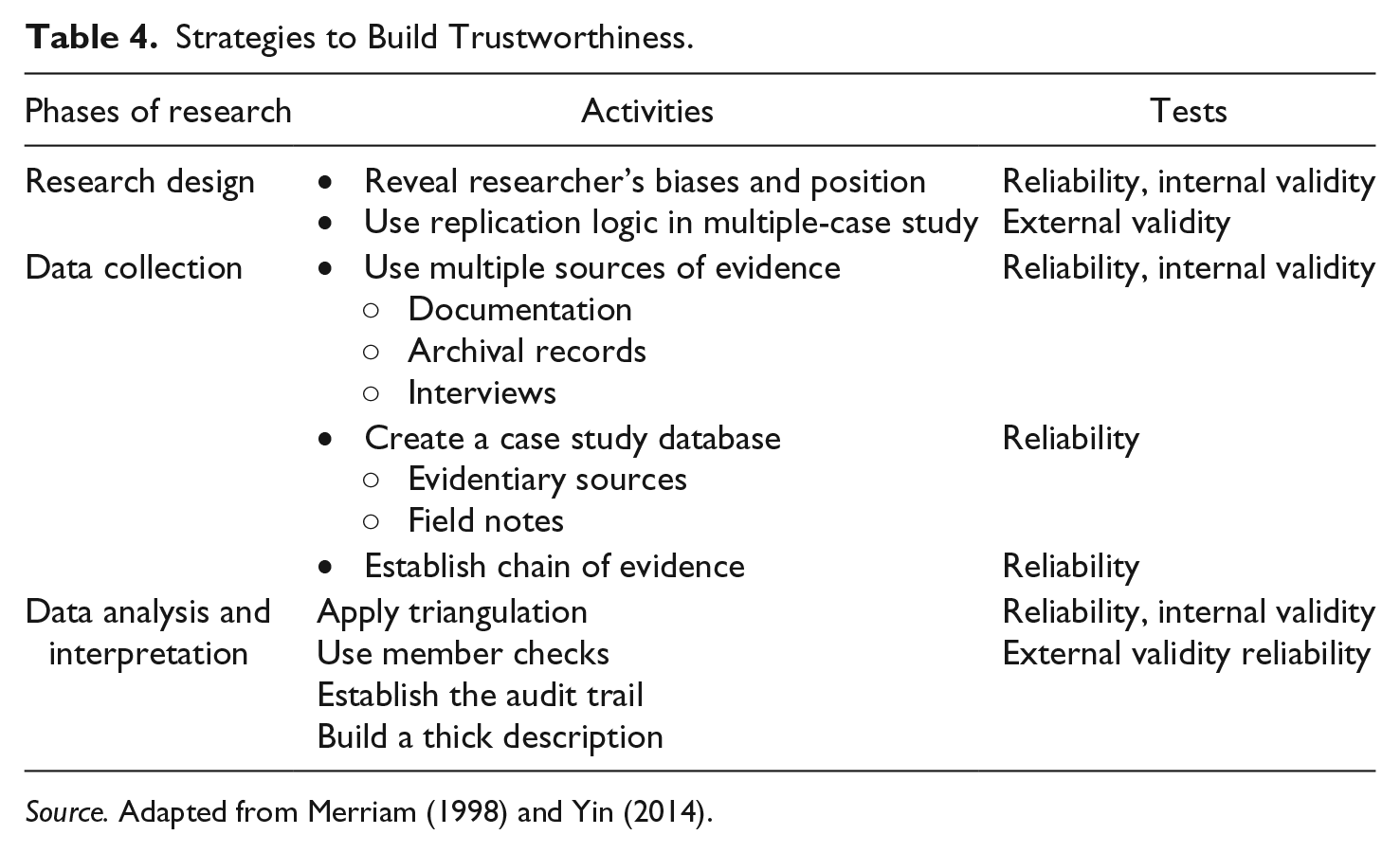
Source. Adapted from Merriam (1998) and Yin (2014).
Results
This is the first known case study to illuminate the 2E PD practices in Colorado. First, this study aimed to understand Colorado educators’ experiences of participating in the 2E Project. Second, this study aimed to understand administrative supports for 2E students and educators. Current educational service frameworks and professional development practices helped explain critical factors of systemic supports. Third, this study explored educators’ perceptions of the impact training on 2E students’ learning. Eight themes emerged from the data analysis. Three related to educators’ professional learning experiences (RQ1): (a) increased knowledge and skills, (b) evolved attitudes, and (c) recurring challenges. One related to educational services for 2E students (RQ2): (d) utilizing a team approach. Two related to student learning outcomes (RQ3): (e) improved performance and (f) difficulty in measuring impact. Two related to organizational changes (RQ4): (g) improved school culture and (h) planning for the future. In addition, 13 subthemes emerged. Research questions, themes, and subthemes are presented in Table 5.
Research Questions, Themes, and Subthemes.
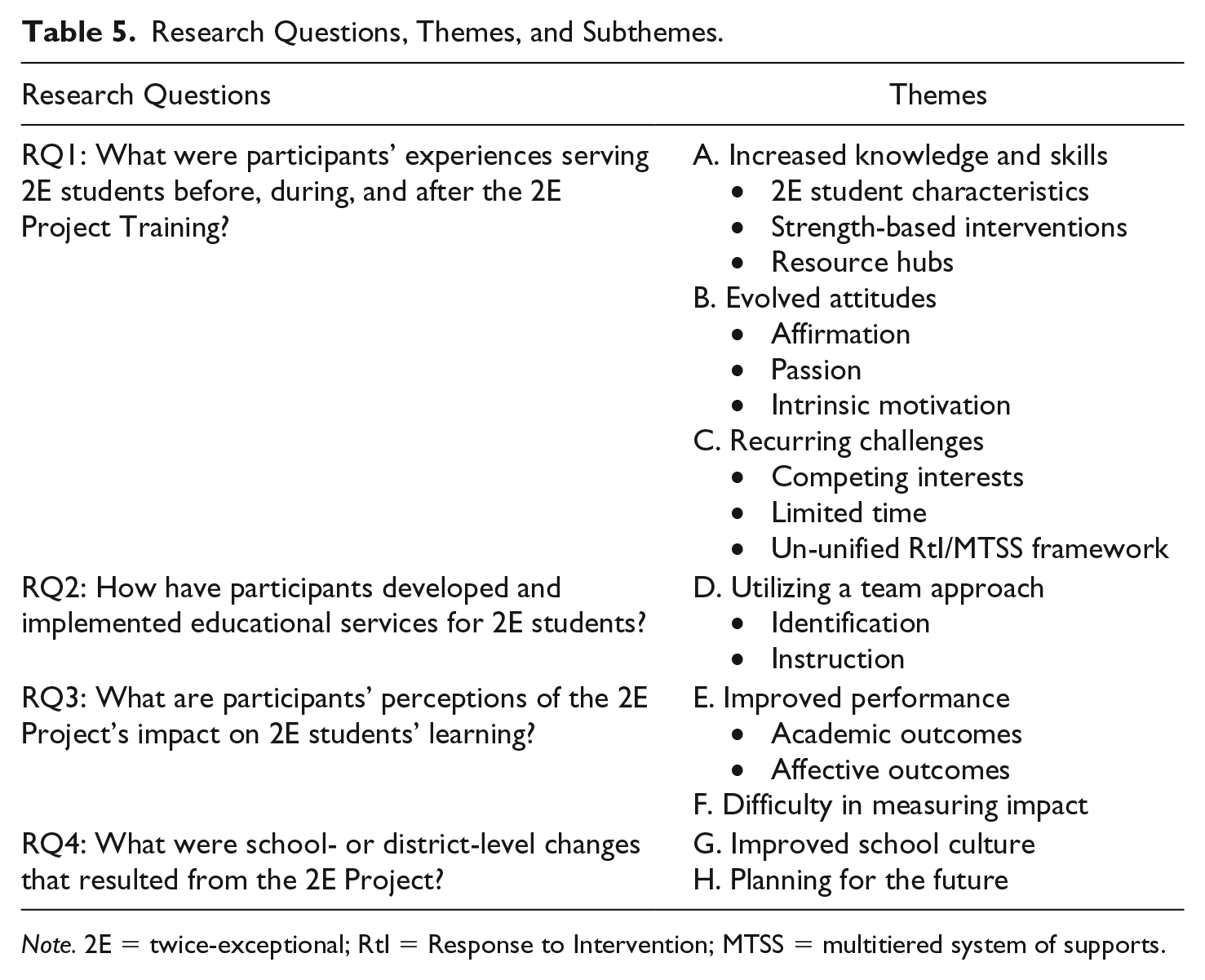
Note. 2E = twice-exceptional; RtI = Response to Intervention; MTSS = multitiered system of supports.
Themes Related to Research Question 1
Increased knowledge and skills
Evaluating their growth in the 2E Project, the 2E cohort reported increased knowledge and skills in spotting 2E students and developing strength-based interventions. Many of the participants became resource providers for their colleagues. The School 2 Teacher B described how she benefited from delivering mini-modules (see Lee, 2018): “Anytime you have to present something, you have to know what you’re talking about. So, you grow as a learner” (Interview, April 17, 2017). The 2E cohort members repeatedly reported having a better understanding of 2E students’ characteristics. In other words, they became knowledgeable about what to look for in a struggling student. The School 3 Learning Specialist recalled, Before . . . I would say I wasn’t really aware. . . . During the training, I really learned what a 2E student was and that was when [a student] popped in my mind instantly. . . . Since the training what I’ve noticed is how because I’m aware of it and because I’ve taught the school a little bit about it through some trainings how much more aware we are of those students. (Interview, March 24, 2017)
Those who had access to 2E students during the project had experiences developing and implementing strength-based interventions. Their experiences began with case studies that were part of the training assignment. The 2E participants worked with real students. The School 2 Teacher A described her life-changing moment: I still apply that [strength-based approach] . . . . It was a huge change for me to spend as much time focusing on the strength and what we’re doing with that as the deficit. That was after 20-plus years of teaching. (Interview, March 27, 2017)
With the knowledge they gained in Levels 1 and 2, the 2E cohort members became resource hubs in their buildings. They spread the knowledge and served as internal training providers. The researcher made this comment during an interview with the School 2 Teacher B: “The 2E cohort became the resource-go-to group” (Interview, April 17, 2017). The School 2 Teacher B confirmed.
Evolved attitudes
The evolved attitudes represent a stronger connection between personal and professional goals. The 2E Project also met participants’ affective needs. Hope Learning Specialist connected several of her professional growth goals to the 2E training. The School 3 Learning Specialist changed his career path from a general classroom teacher to a learning specialist. The 2E Project participants affirmed the worth of the 2E Project because it fulfilled their calling as educators personally and professionally. Educators in those four schools had students who may fit into the 2E category; they felt a need to receive the 2E training. For those who became gifted and talented coordinators, the 2E training was a must-have. Educators who participated in the 2E Project with either partial or full experience were eager to share their knowledge and skills. They took actions: presenting mini-modules at staff meetings, training people on the intervention teams, teaching SMART goals, and having informal conversations about twice-exceptionality. They cared about capacity building in their schools as well as the Hope District. Responding to an interview question about possible training in the future, the School 2 Teacher B said, “I think more training in how you can help other teachers get in the process. How do you get your school on board more?” (Interview, April 17, 2017). The Hope Administrator A called the formation of pilot schools “the coalition of the willing.” He continued, “Everyone that was a part of the pilot . . . without any extra compensation . . . and, really, any other extra incentives other than just feeling it was the right thing to do” (Interview, March 13, 2017). The 2E cohort educators demonstrated a high level of work engagement. As the Hope Learning Specialist said, “I did want to be a support to the system” (Interview, April 19, 2017). Being able to apply their learning directly was a positive reinforcement for the 2E cohort. The 2E training participants demonstrated their intrinsic motivation through the desire to learn. Having been applying what was learned from the 2E training, the School 1 Teacher was taking Level 1 again when she was interviewed in Spring 2017.
Recurring challenges
The 2E cohort expressed three challenges they faced before, during, and after the training: (a) competing interests, (b) limited time, and (c) an un-unified RtI/MTSS framework. New initiatives in the district took priority over the 2E training. School 2 School Psychologist had this observation: “When the rubber hits the road . . . people are probably going to pick things where they have more higher populations” (Interview, April 5, 2017). State Administrator A mentioned what happened in the 2016–2017 school year: “We had five [AUs] that made a commitment but none of them stuck with it. . . . It’s because they get all this pressure to do other things” (Interview, May 5, 2017). State Administrator B confirmed the pressure that administrative units were facing. The time constraint was mentioned by participants of various roles, specifically (a) the lack of time for training and implementation and (b) time conflict for attending follow-up meetings. Time conflict was an issue for the School 2 School Psychologist and School 4 Learning Specialist because they did not have the chance to complete Level 2 training. The 2E trainers at the CDE adopted the problem-solving approach of RtI for 2E services. Therefore, the 2E cohort was familiar with how to identify and provide services for 2E students using an RtI framework. During the second year of the 2E Project, the 2E cohort developed an RtI/MTSS framework in response to the lack of a districtwide framework. Having developed and implemented the framework, the 2E cohort participants revealed their concerns over the Hope District failing to serve 2E students because of RtI/MTSS protocols that are inconsistently used across schools. The Hope Learning Specialist commented, “We’re missing a big piece of what it takes to have a system that is consistently able to identify and support students with twice-exceptionality” (Interview, April 19, 2017).
Themes Related to Research Question 2
Utilizing a team approach
By utilizing a team approach, the 2E cohort developed and implemented educational services for 2E students, which consisted of identification and instruction. Several people from School 1 took the 2E training; therefore, the School 1 Teacher, who was interviewed, was able to collaborate with her colleagues on 2E cases. Her colleagues included a special education teacher, social worker, and speech pathologist. Going to the training together meant a great deal to her. She said, “I think that there’s that connection between special education and gifted education. We’re both aware. We’re on the same page” (Interview, April 7, 2017). The team/cohort culture was established since the beginning of the 2E Project. The Hope Learning Specialist said, “I really liked getting together with the teams as teachers afterwards, that second year” (Interview, April 19, 2017). The School 2 Teacher B applauded the District by saying, “The district did put the cohort together, so we give them credit for that” (Interview, April 17, 2017).
The 2E cohort created an RtI/MTSS framework for two purposes, according to the School 2 Teacher A: For teacher support and for students being better identified so that they can be more successful. The development of the framework included the implementation and feedback from the field; it went beyond the involvement of the 2E cohort members. The adaptations of instruction in classrooms were accommodations and modifications. The School 2 Teacher A conducted a case study where a strength-based approach was implemented. The School 2 Teacher B provided accommodations to address students’ sensory issues such as graphic organizers, which are typically considered a universal-level intervention. As for 2E cohort members who were not classroom teachers, they provided indirect services to 2E students through documenting and coordinating Advanced Learning Plans.
Themes Related to Research Question 3
Improved performance
For the third research question about the perceived impact of the 2E Project on 2E students, improved academic and affective outcomes were noted, including successful progression of students through the education system, increase achievement test scores, improved self-confidence, and decreased problem behaviors.
Difficulty in measuring impact
Many 2E participants as well as administrators interviewed expressed difficulties in measuring the impact of the current 2E Project on students’ learning. Approaches to documentation varied from school to school. School 1 Teacher said, “We had that paper trail to push forward. We have the ability in our building because we are K–8 to share that knowledge as we go” (Interview, April 7, 2017). Some 2E cohort members were unable to talk about student growth due to their indirect roles in supporting classroom teachers. Administrators at the CDE were asked about their knowledge of the 2E Project’s impact on 2E students’ learning. When asked to what extent they were able to observe in the pilot schools, State Administrator A responded: “Very little. Very little. That really is not something that CDE really wants you to do even because that’s consultant stuff and they don’t really want you to be a consultant” (Interview, May 5, 2017). State Administrator B said, None yet. . . . It’s just that there’s a lot of red tape you’ve gotta cut through to get to that level, and so in most places it sounds like the director has to set it up [for school visits]. (Interview, May 12, 2017)
Themes Related to Research Question 4
Improved school culture
The improved school culture was heavily related to the mini-modules, an initiative that the 2E cohort had in their second year of the training. The 2E cohort wanted to see school-level changes in rising awareness of twice-exceptionality; they had reports such as “People are using the term more” (Hope Learning Specialist, Interview, April 19, 2017). The Hope Administrator A had this observation regarding a potential change at the district level: “I think the biggest one was the attitudes. . . . I think they were able to bring that broader strength-based approach to MTSS staffing for all students, and not just potential twice exceptional students” (Interview, March 13, 2017).
Planning for the future
To sustain the impact of the 2E Project, the Hope District needed guidance from the state department of education. In the meantime, the 2E cohort members had several ideas for Level 3 training. First, the 2E cohort wanted to have more involvement in the RtI/MTSS process. State Administrator B said she had heard of teachers wanting to know about Tier 2 and Tier 3 interventions. Other suggested second Level 3 topics were legislation and special populations. State Administrator B described how leadership affected an administrative unit’s involvement in the 2E Project: “Other people said things like, ‘We’ve had big leadership change. We’ve had initiative change. We kind of lost our momentum, and I’m sorry. [We will not commit to the 2E Project]’” (Interview, May 12, 2017).
The 2E cohort called for strong leadership in the Hope District to promote twice-exceptionality. Recruiting new cohort members seems necessary. The School 1 Teacher A expressed her concern by saying, “I also think our cohort was kind of small. We weren’t getting any new ideas as we went forward” (Interview, April 7, 2017). However, opinion varied. The Hope Administrator B was positive about the growing interest in the district. The School 3 Learning Specialist thought of the access to 2E services in charter or private schools. The 2E Project was not perceived as a one-time event in the Hope District. People who were involved in the project, from cohort members to administrators in the Hope District and CDE, considered follow-ups necessary to sustain the work. The School 2 Teacher A suggested providing multiple ways of communication, including e-mails and Google Documents. Likewise, the administrators have had plans to sustain the 2E Project. Hope Administrator B recognized the timing to hold meetings did not work for everyone, so she kept educators informed by making resources available. To make a greater impact than before, State Administrators A and B provided their insights, including (a) recognizing administrative units’ need for ongoing support, (b) building regional networks with educators in special education, (c) developing a solid plan for program evaluation, and (d) providing targeted, customized assistance. Responding to the new Commissioner’s call to offer targeted, customized assistance to administrative units, the State Administrator B started revamping the 2E Project in 2016.
In the past, according to State Administrator A, [CDE] want(s) us to be in an advisory and a training capacity and that sort of thing for support, but you can’t really go in as a consultant on an individual basis. So, we didn’t do much of that and we deliberately tried to avoid [school visit]. (Interview, May 5, 2017)
The rising demand for customized professional learning may push the CDE to adopt different modes of training. Based on the findings, a logic model of the 2014–2016 2E Project in the Hope District was developed (see Table 6).
A Logic Model of the 2014–2016 2E Project in the Hope District.
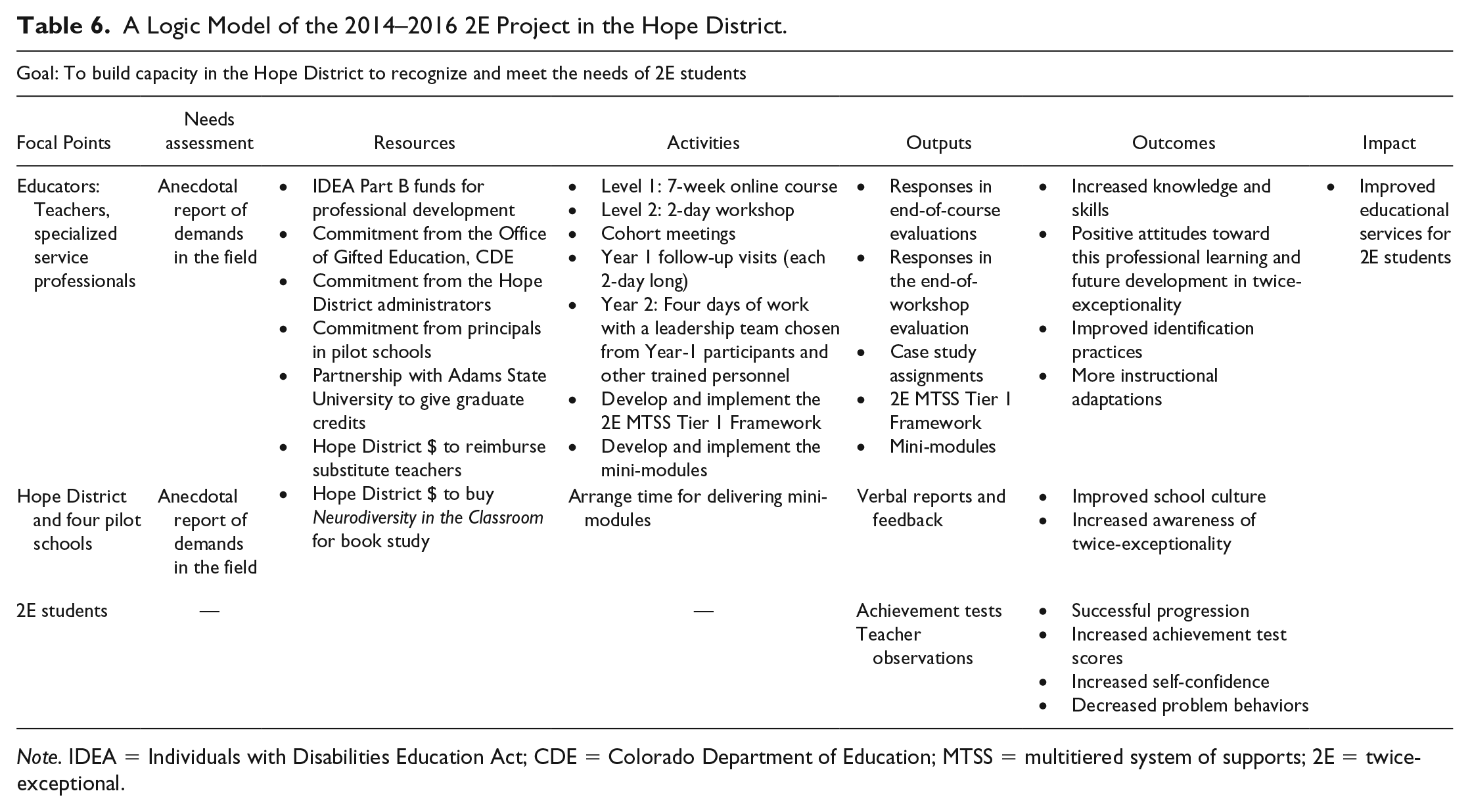
Note. IDEA = Individuals with Disabilities Education Act; CDE = Colorado Department of Education; MTSS = multitiered system of supports; 2E = twice-exceptional.
Discussion
Research Question 1
Several effective professional learning characteristics were indirectly noted by the research participants. Professional learning during the 2E Project was nontraditional and was longer in duration than typical professional development opportunities. Furthermore, it required collective participation, active learning, and coherent alignment (Darling-Hammond et al., 2009; Garet et al., 1999; Garet et al., 2001; Jaquith et al., 2010; Yoon, Duncan, Lee, Scarloss, & Shapley, 2007). First, nontraditional types of professional learning activities were featured in the 2E Project, such as a book study, case study assignments, and role-playing. Second, the 2E Project was sustained more than two years supporting educators’ active learning. Third, the CDE and Hope District were committed to the formation of collective participation that allowed educators to learn from and collaborate with other trainees from the same school. The formation of the 2E cohort also reinforced participants’ work engagement toward the betterment of the Hope District. Fourth, the 2E participants promoted changes in practice at their schools and met regularly as part of their active learning. They also met regularly to discuss their assignments for the project. Fifth, the 2E Project was aligned with the needs of the four pilot schools. According to the Hope Administrators, those pilot schools tended to bring up more potential 2E cases than other schools. The building leaders definitely wanted to address twice-exceptionality, otherwise they would not join “the coalition of the willing.” There was an alignment between 2E participants’ personal and professional goals as well. The 2E cohort participants thought the training was fulfilling and satisfying. They were eager to learn and eager to share with others their knowledge and skills. The School 1 Teacher and School 4 Learning Specialist took the 2E Training because they became gifted education coordinators and they wanted to increase their competence in gifted education. The School 3 Learning Specialist changed his role from a general education teacher to a learning specialist because he became passionate about serving students with exceptionalities.
Research Question 2
By utilizing a team approach, the School 1 Teacher learned from and collaborated with her colleagues from the same school during the training. That was an advantage of collective participation, one of the effective PD structural features (Desimone, 2009; Garet et al., 1999). The School 2 Teacher B and School 3 Learning Specialist were the only two participants who reported working with the intervention teams in their schools to identify 2E students. Their involvement with the intervention teams most likely led to a wider impact on the identification practices in their schools than working individually with teachers when individual cases were brought to their attention. Collaboration with professionals with different expertise is also vital to serving 2E students as these students have varied levels of special needs. The 2E participants appreciated working with people from the same school as well as working toward improving the 2E services in the Hope District with trainees from different schools. The 2E participants’ experiences suggested that the collective participation in the 2E Project facilitated the utilization of a team approach which is documented best practice for supporting 2E students (Coleman & Gallagher, 2015).
The 2E participants utilized a team approach to develop educational services for 2E students; however, data were not available that could demonstrate how the interventions the participants implemented were influenced by their case study assignments. That limited the investigation of potential impact of the 2E training on 2E student outcomes. Making positive changes related to student outcomes is presumably the ultimate goal of a professional learning activity (Guskey, 2003). Because the purpose of the 2E Project was to “build capacity in districts to recognize and meet the needs of twice-exceptional students” (PowerPoint: CDE 2E Project Introduction) and the primary accomplishments of the 2E cohort consisted of mini-modules and applying the MTSS framework, it is reasonable to say that it is too early to determine which instructional practices and policies most effectively and efficiently produced positive student outcomes. The next step for the 2E Project in the Hope District would be to create and implement services for 2E students once students are identified. Deliberate documentation is necessary to support meaningful evaluations of educators’ use of new knowledge and skills in classrooms (Level 4) and student learning outcomes (Level 5; Guskey, 2000).
Although little information was provided to help understand identification practices and classroom instruction, interview participants reported several necessary conditions that supported the success of the 2E Project, case study assignments, mini-modules, and the MTSS framework which included the following: (a) passion for helping 2E students, (b) hands-on activities that were relevant to their work in schools, and (c) supportive administrators who were committed to providing time, resources, and any forms of intangible support, including built-in professional learning hours, substitute teachers, reenergizing book study, positive attitudes, and the sense of togetherness. Fueled by a strong desire to help students, 2E cohort participants tried to seize every opportunity to apply their knowledge and skills to the services for struggling students. Surprisingly, educators’ passion for students and the intangible support from administrators are consistently absent from many published pieces concerning effective PD characteristics (e.g., Desimone, 2011; Desimone, Porter, Garet, Yoon, & Birman, 2002; Garet et al., 2001).
Research Question 3
The two types of student outcomes discussed by research participants in this study were academic outcomes and social and behavioral competencies. As a result of the 2E Project, success indicators of 2E students’ academic outcomes were progression through the education system and achievement test scores reported by interview participants. The indicators of students’ affective outcomes were self-confidence and students’ perceptions of themselves as reported by the participants in this study. Because the 2E Project in the Hope District was not set up to document which instructional practices and policies affected student outcomes, measures of the 2E Project’s impact on 2E students’ learning were absent. In addition, with the exception of case study assignments, the 2E participants had either direct or indirect contact with 2E students depending on their roles; this limited their observation of student growth. Furthermore, the State Administrators had no opportunities to observe students or teachers because school visits were not part of the 2E Project. Again, this indicated that the main focal points of the 2014–2016 2E Project in the Hope District were identification practices (i.e., the MTSS framework) and educator awareness (i.e., mini-modules), not instructional interventions in classrooms and measurement of student outcomes. In the future, efforts are needed to make the 2E Project more data-driven and classroom-focused.
Research Question 4
Organizational support and changes need to be in place for instructional practices and policies to be implemented. In this study, this was represented by the schools’ and district’s advocacy, accommodation, facilitation, and recognition of twice-exceptionality (Guskey, 2000, 2003). The participants in this study (i.e., Hope Administrators and educators) overwhelmingly reported improved school culture. Keeping in mind the two focal points of the Hope District’s 2E Project—strengthening the identification practice and raising the awareness—the improved school culture may be considered the foundation for new instructional practices and policies that will take place in the near future. Looking ahead, the 2E participants had high expectations for the CDE and Hope District to sustain the 2E Project. They made suggestions for administrators to support professional development training (see Table 7). Several 2E participants actually expressed desire for recognition of the 2E Project from new leadership as well as clear guidance from the CDE on the next step after the completion of the 2E Project Training.
Suggestions From 2E Project Training Participants for Providing Administrative Support.

Note. 2E = twice-exceptional.
Limitations of the Study and Suggestions for Future Research
Using the case study method to evaluate a program has several limitations (Guba & Lincoln, 1981; Stufflebeam, 2001; Yin, 2014). First, a case study does not provide scientific generalization. Naturalistic generalizations where readers can “learn from the case either for themselves or to apply to a population of cases” is left for readers (Creswell, 2013, p. 200). A suggestion for future research based on this limitation is to decide what needs to be portrayed in a case study. If the purpose of a PD evaluation case study is to understand educators’ work or learning experiences, educators’ personal stories should be the depicted object. Or, if the purpose of a PD evaluation case study is to understand several aspects of a training (i.e., educator outcomes, student outcomes, and organizational support and changes), the training, per se (e.g., the 2E Project), should be the described object.
A second limitation is that case study methods, which were appropriate for the researcher to understand the 2E Project in the Hope District, fall short of providing information for judging a program’s merit and worth (Guba & Lincoln, 1981; Stufflebeam, 2001; Yin, 2014). In other words, case study methods could not demonstrate a causal relationship between the 2E Project and 2E students’ academic growth. Neither impact of student learning data nor documentation of services provided to students were available for analysis. Little evidence was provided to inform participants’ use of new knowledge and skills in classrooms (Level 4) and student learning outcomes (Level 5; Guskey, 2000). Research findings were limited to Guskey’s (2000) first three levels of professional learning evaluation: participants’ reactions, participants’ learning, and organization support and change. Based on the aforementioned limitation, a second suggestion for future evaluation studies on professional learning is to identify which type of evaluation needs to be conducted. Researchers need to make sure they have realistic expectations when adopting a case study methodology. To demonstrate the effectiveness of professional learning on students’ learning, researchers must focus on collecting data of educators’ use of new knowledge and skills in classrooms (Level 4) and student learning outcomes (Level 5; Guskey, 2000). Experimental quantitative research is needed to demonstrate causal relationships.
A third limitation of this study was the short window for data collection and the prolonged data analysis process that resulted in limited evidence being collected and limited time for research participants to complete member checks. One strategy that could be useful to researchers to acquire a more nuanced view of the professional learning that took place for a particular project is to ask participants to provide written documents before interviews, such as the students’ intervention plans and teachers’ professional growth plans. Another strategy to acquire a more nuanced view of professional learning is to become an insider or a participant observer of the professional learning activities under investigation. Taking Levels 1 and 2 with Colorado educators helped the first author relate to the interview participants. The first author understood what the research participants experienced and, as a result, was able to paraphrase or laugh with them during interviews. Togetherness, the spirit that Hope Administrators demonstrated, could be cultivated between a researcher and potential research participants.
Implications for Practice
Implications for improving educator outcomes through professional learning
Specialized academic training and ongoing professional learning are essential to supporting 2E learners (Baldwin et al., 2015). Because preservice training in gifted education is limited (Johnsen, 2013), participating in 2E professional learning is a way for educators to increase their knowledge and skills in specialized methods to identify and provide enriched, advanced educational opportunities and simultaneous supports to special student populations. The educator outcomes in an evaluation of professional learning activities consist of educators’ attaining and utilizing new knowledge and skills (Guskey, 2000). To help educators increase knowledge of and skills in twice-exceptionality, professional learning providers must incorporate strategies that help educators access and retain information, such as hands-on practices, collaborative opportunities (e.g., networks and cohorts), case study assignments on real students, and role-playing (e.g., mock IEP/advanced learning plan meetings). Professional learning providers and administrators may also consider job-embedded training and hybrid learning options to address time and geographical challenges. Furthermore, findings from this study revealed that educators also have affective needs that need to be met in any professional learning endeavor. A clear alignment between personal and professional goals is key to a fulfilling career as an educator. Working together toward the betterment of educational services for students with exceptionalities creates a positive culture among educators and administrators.
Implications for improving student outcomes through professional learning
It is generally believed that effective professional learning should lead to improved student learning outcomes. Success indicators and measures of student outcomes must be included in evaluation plans and developed by 2E training participants because those participants are in different positions and have either direct or indirect involvement in 2E students’ school experiences. To demonstrate growth of the 2E student population is not easy. Despite which method is employed to determine impact of the 2E Project in the future, administrators must make it a priority to identify student growth as part of long-term project goals. 2E training in the future must incorporate the implementation and evaluation of 2E interventions to help determine the impact of training on 2E students.
Implications for creating organizational support and changes for professional learning
First, to receive greater administrative support, 2E training goals and outcomes must be shared with administrators. Second, 2E training must have built-in time for collaboration. This can be accompanied by a hybrid learning option where educators learn basic knowledge through online learning and strengthen their skills through real-time collaborative work, such as utilizing a team approach to applying the problem-solving model of MTSS. Third, educational services for 2E students should be part of general education initiatives, such as MTSS, because 2E students first are general education students. The 2E participants believed that 2E identification and services must work within the MTSS framework. Within the MTSS framework, educators can document services for not-yet-identified 2E students and those who have special needs but have no IEP or 504 Plan. Finally, the first author puts out a call to administrators who want to improve the education system in a way that all students have adequate opportunities to fulfill their potential. For the 2E Project in the Hope District, the interview data suggested that the structural features of professional learning (Desimone, 2009; Garet et al., 1999), along with the passionate 2E cohort members and intangible support from the Hope Administrators, facilitated the improvement of school culture. Strategies and models can be learned and borrowed from a district; however, the spirit of people cannot be easily reproduced. The 2E Project presented in this study is the story of the Hope District. Educators should feel encouraged to create a story or legacy of their own.
In short, ongoing evaluations that have clear connections between training and student outcomes are needed for accountability and sustainability. Based on the aforementioned discussion and implications, specific recommendations for educators, professional learning providers, and administrators are provided in Table 8.
Specific Recommendations for Educators, Professional Learning Providers, and Administrators.
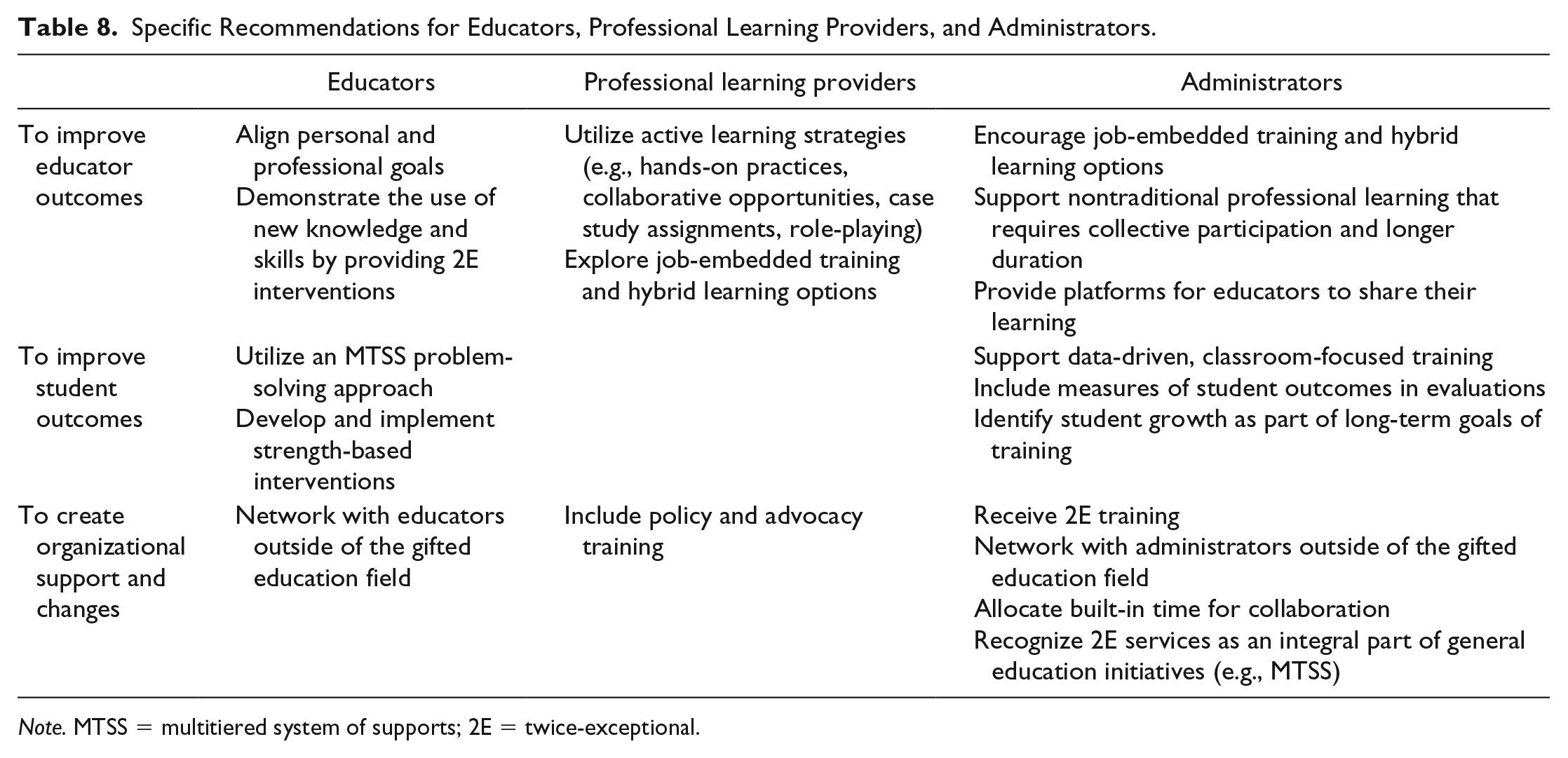
Note. MTSS = multitiered system of supports; 2E = twice-exceptional.
Footnotes
Declaration of Conflicting Interests
The authors declared no potential conflicts of interest with respect to the research, authorship, and/or publication of this article.
Funding
The authors received no financial support for the research and/or authorship of this article.
