



Abstract
This study explored understandings shared by fifth-grade gifted students as they read the book Restart, which explores bullying. Students read, created representations, and discussed the text. Grounded by Langer’s stances of envisionment, this descriptive case study analyzed student representations and conversations. Each of the stances was represented with most responses being represented in Stances 1 (getting a sense of the text), 2 (interpreting text), and 4 (analyzing the text). In addition, most students viewed bullies and their behavior as being in a fixed state, which was tied to the perceived power a bully held. The results from this study have implications for teachers who work with gifted and talented students, counselors who work with students in mental health and resilience programs, and the collaboration of these school personnel.
The author made Chase have amnesia on purpose. When readers start the book, they don’t understand, just like Chase. They understand nothing. But when Chase is in the hospital, he begins to remember things and to understand better, just like the reader. So readers and Chase understand what is happening at the same time.
The quote above came from Sydney, a gifted fifth grader, at the conclusion of reading the book Restart by Gordon Korman (2017). Her insight demonstrated an understanding of the use of amnesia and how it was critical in shaping the main character’s personality and also how amnesia was powerful in structuring the plot and revelations about characters. This understanding was quite sophisticated, as Sydney had to distance herself as she reflected on the author’s craft and how his structure positioned readers as they engaged with the book.
Sydney’s response was just one of many constructed by fifth-grade gifted students as they explored Restart. This book was purposefully chosen as it considered bullying but did not moralize about it. Rather, the main character, Chase, who is a bully, experienced amnesia and a simultaneous personality change as a result. This shift in identity offered students opportunities to explore bullying and how a person identifies as a bully. Moreover, the book was written for 8- to 12-year-olds, which meant the easier reading level supported interpretation of text, instead of students expending energy and time struggling to decode or understand words (Allington & Johnston, 2002).
We believed this exploratory study of gifted students allowed for the exploration and open discussion of bullying, an emotional topic. Students read the book, wrote about their reading, and conversed as a class about their interpretations. Similar to Langer (2011), we believed literature played a central role in addressing problems that students faced. She wrote, “Literature is an essential medium for learning from and communicating with ourselves and others—a way to reflect on our lives, our options, and the human condition” (Langer, 2011, p. 112).
Literature Review
Bullying is any unwanted aggressive behavior(s) by another youth or group of youths who are not siblings or current dating partners that involves an observed or perceived power imbalance and is repeated multiple times or is highly likely to be repeated. Bullying may inflict harm or distress on the targeted youth, including physical, psychological, social, or educational harm (Centers for Disease Control and Prevention, 2017, p. 7).
Because bullying is prevalent in schools, it negatively impacts students’ health and safety and their school engagement and achievement (Donoghue et al., 2015; Fekkes et al., 2004; Huang et al., 2019). Bullying also occurs at school, traveling to school or home, and/or in cyberspace (Swearer et al., 2010).
A recent report, The Concerns and Challenges of Being a U.S. Teen: What the Data Show, indicated that seven out of 10 teens or their friends experienced depression and anxiety related to bullying behavior (DeSilver, 2019). Furthermore, 55% of teens reported being bullied at school and another 15% reported incidents of cyber-bullying. The National Center for Education Statistics (2017) reported that 20% of students aged 12 to 18 were bullied either by being the subject of rumors, name calling, or being pushed. Of this group, 4% were threatened with physical harm.
Girls had a higher likelihood of being bullied at school than boys (24% and 17%, respectively). Hong and Espelage (2012) described bullying in elementary school, reporting that 32% of children in Grades K–2 displayed at least one aggressive behavior toward another child. For third to fifth graders, 80% of students displayed this aggressive behavior. Peter and Bain (2011) found that fifth-grade gifted students experienced a significant impact from bullying. Overall, bullying is observed and participated in by elementary school students and occurrences of bullying increase as children move through elementary school.
Gifted Children and Bullying
Gifted children are members of elementary, middle school, and high school contexts where bullying occurs. Three possibilities are hypothesized to describe the bullying behavior patterns as related to gifted students. Peters and Bain (2011) described these possibilities as (a) gifted students are subjected to more bullying behavior where they are the victim, (b) gifted students experience fewer bullying behaviors because they are socially accepted by their peers, or (c) gifted students experience the same bullying behaviors as do other students. Their study to explore these possibilities discovered no real differences in bullying behaviors between gifted and other high-achieving students. They also identified very few (9%) participants could be classified as a victim of bullying. Participants were similar across schools, but differences between schools varied in bullying behavior, which suggested that school culture was an important variable to be considered.
Francis et al. (2016) suggested that gifted students’ high cognitive abilities allowed them to cope with the emotional challenges of being bullied. However, Silverman (1997, 2009) complicated this idea by sharing that gifted students experienced asynchronous development where their advanced cognitive abilities developed unevenly from their emotional or physical development. This asynchronous development required parents, teachers, and others to support the development of all aspects of a student. Robinson (2002) also observed that the most highly gifted students often struggled with developing peer relationships with gifted and typical students, and therefore vulnerable to bullying.
Moreover, Peterson and Ray (2006b) discovered in their retrospective studies: 1. Giftedness is associated with a unique vulnerability to bullying; 2. Gifted victims perceive that external factors cause bullying but assume responsibility for resolving it; 3. Gifted children can be highly distressed by nonphysical kinds of bullying; 4. Coping strategies improve with age and emotional repair can occur over time; and 5. Gifted bullies can change their behavior. (p. 257)
They reported that no gifted students suffered academically because of being bullied. However, they noted that gifted students’ recovery from bullying was intense and prolonged. Peterson and Ray (2006a) found many bullied gifted students remained silent about the occurrences and were not offered support by parents, teachers, or counselors.
Estell et al. (2009) found that gifted students experienced being a victim less than their nongifted peers. Ryoo et al. (2017) noted that studying different forms of bullying (i.e., verbal, physical, cyber) yields different results. Describing gifted students’ experiences with bullying is further complicated by variables such as ability and achievement.
Bain and Bell (2004) investigated if there were social self-concept, social attributions, and peer relationship differences between high achievers and gifted students in fourth, fifth, and sixth grades. They discovered that gifted students scored higher in three aspects of self-concept (physical ability, physical appearance, and peer relations). They also found that gifted students shared stronger attributions for social success related to ability and effort.
Mitchell (2011) and Peterson and Ray (2006b) did not find differences between gifted students and nongifted students, although they did report that gifted students did bully other students for retaliation and stress release. Ryoo et al. (2017) also found that gifted students and their nongifted peers did not evidence differences in bullying behaviors. They suggested that school climate and peer group affiliation influenced bullying behavior for all students. Interestingly, they discovered that “sixth graders in general education are more likely than students in other grades to transition to and stay in the frequent perpetrator group” (Ryoo et al., 2017, p. 407).
Overall, the research regarding bullying and gifted students created an uneven understanding of this experience. Some researchers acknowledged that gifted students were similar to nongifted students with respect to bullying behavior with differences noted in relation to academic success and an unwillingness to disclose incidences of bullying.
Mental Health and Bullying
There are a number of mental health issues associated with bullying. Students who are bullied or engage in bullying behavior are at risk for symptoms of depression (Espelage et al., 2012). Interestingly, students who bully score lower on depression scales than do victims. Another potential health risk is substance abuse. Victims of bullying have reported alcohol consumption or substance use; however, there is no direct correlation between bullying and potential substance abuse (Thompson et al., 2008).
In addition, victims of bullying behavior frequently suffered from psychosocial issues such as loneliness, lower self-esteem, and depression (Cook et al., 2010). Fear of being bullied also resulted in some students leaving school early, impacting their outcomes for the future. Cook et al. (2010) noted, “The risk of adversity has been found to be greater for bully victims” (p. 3).
To counter the potential effects of bullying, schools supported positive student mental health (O’Connor et al., 2019), by offering social emotional learning and resilience programs. Some programs included parent involvement which correlated to reduced bullying incidents (Huang et al., 2019). However, meta-analysis results indicated no significant difference in decreasing bullying was found based on parent participation (Huang et al., 2019). A lack of clarity remains about parent participation in such programs, and more research is needed to determine the impact of parent involvement.
Peterson and Ray (2006b) recommended that school counselors focus on prevention in schools, rather than spending time focused on crisis control. They suggested teachers and counselors facilitate classroom discussions due to their positive impact in bullying prevention programs. These interventions typically included classroom lessons delivered by teachers or counselors that supported positive mental health and academic learning for students. Together, positive mental health and academic learning supports effectively engaged students.
Fagell (2019) noted the changes intermediate-grade students face, including the influences of technology and cyber-bullying and shifts in mental health. She found that students were less resilient than those from previous generations, noting that they suffered from depression and anxiety at higher rates. The one positive shift was the greater acceptance of mental health support. She also described identity issues concerning today’s students. Boys, in particular, struggled with traditional identity issues surrounding masculinity. However, boys from low-income backgrounds perceived their safety was dependent on being tough and not showing weakness. Thus, identity was a complex issue influenced by context and connected to potential bullying behavior.
Thornberg (2010) found students, 10 to 13 years old, believed that bullying was a response to social differences such as an unfavorable characteristic or being a member of a minority group. Some students wanting to improve their social status also engaged in bullying. Thornberg concluded students should be provided opportunities for open discussions regarding peers who are perceived to be different from themselves.
Suggestions to address school bullying centered on engaging prevention programs, which included parents and classroom discussion. As these programs become a more natural aspect of student support, bullying can move from crisis control to prevention. Long-term, rather than single-session, interventions also offer the opportunity for students to focus on reasons and responses for bullying as a mechanism for prevention.
Bullying and Children’s Literature
Children’s literature has been identified as an additional approach to addressing bullying. Wiseman et al. (2019) suggested that children’s literature was “a powerful method for dealing with critical social issues, including bullying and racism” (p. 465). Books, where characters were the bully or experienced bullying, provided an effective and safe vehicle for discussions to consider bullies and incidences of bullying. This intervention also allowed students to reflect about serious issues in the absence of an explicit lesson or values imposed by an adult.
Conversations around books, particularly books where central characters experienced difficult situations, created a space for students’ understandings to develop. Keene (2008) noted through conversation students discovered the many different interpretations of a text and developed increased clarity about their own and others’ interpretations. Miller and Sharp (2018) also noted books were a “launching point for deeper conversations about students’ past experiences, their lives at home, and their hopes for the future” (p. 90). Similarly, Fisher and Frey (2018) described discussion as “not a volley of teacher questions and student answers” (p. 92). Rather, dialogic conversations grounded in the ideas of Vygotsky (1978) allowed students to learn from others, expanding and clarifying their knowledge. This type of discussion reframed the teacher’s role from leader of the conversation to participate with students. Zhang et al. (2016) described dialogic conversations as openings for students to experience differing and perhaps conflicting ideas and opinions shared by other students, engage in sense making, reflect on multiple views, and interpret and refine their most current understandings. Wolf’s (2018) work regarding reading and the brain development noted, Deep reading is always about connection: Connecting what we know to what we read, what we read to what we feel, what we feel to what we think, and how we think to how we live out our lives in a connected world. (p. 17)
In addition, Fisher et al. (2017) reported the use of conversation with students had an effect size of 1.28 in relation to student learning.
Langer’s stances of envisionment
The current study relied on Langer’s (2011) Envisionment Building based on the important role of literature to one’s life. She wrote, Literature plays a critical role in our lives, often without our notice. It sets the scene for us to explore both ourselves and others—to define and redefine who we are, who we might become, and how the world might be. (Langer, 2011, p. 5)
Langer shared the term, envisionment, as a way to describe the understandings that a person has about a text at a particular time. Her theory situated readers as active meaning makers where they formed ideas, images, questions, and hunches as they read, wrote, and talked about a text—identifying stances engaged in during meaning making where each stage offered a unique perspective on meaning. The stances are not linear in that one does not always proceed to the next. Rather, an individual can be engaged in any stance during their reading of a text. The stances include the following:
Stance 1: Being Outside and Stepping In. The reader is stepping into a book and trying to get a sense of the text. The reader is forming initial ideas about the text such as information about characters, plot, and so on.
Stance 2: Being Inside and Moving Through. The reader is more immersed in the text and forms questions about characters’ motives and feelings.
Stance 3: Stepping Back and Rethinking What One Knows. The reader builds his or her own understandings as ideas from the text and are integrated into personal knowledge and experience.
Stance 4: Stepping Out and Objectifying the Experience. The reader reflects on the reading by analyzing and identifying on the author’s craft, literary elements, text structure, and so on.
Stance 5: Leaving an Envisionment and Going Beyond. The reader uses information or emotions from a current reading and applies them in a new situation.
Langer noted that Stances 3 and 5 occur less often in comparison with Stances 1, 2, and 4. Langer suggested that in Stance 3, individuals did not connect with a text, which made reflection difficult. Stance 5 expected individuals to build connections to text from a rich background of experiences, which is not always accessible, particularly for elementary students. During discussions, students’ personal envisionments or understandings are contextualized within other students’ envisionments, and the result is a potential shifting in stances as students considered others’ perspectives.
The book Restart (Korman, 2017) was chosen for this study. Bullying is presented from multiple perspectives, allowing students to explore various stances in their interpretations. The book begins with Chase, the main character, in the hospital suffering from amnesia after a fall from his roof with each chapter narrated by a different character. This structure offers readers multiple perspectives regarding events and other characters. Throughout the book, Chase reflects on who is and who he was. In the hospital, he asks, “Am I—Chase”? (Korman, 2017, p. 3). Later, he worries, “It’s like I’ve been parachuted into the middle of someone else’s life—someone who looks exactly like me, yet isn’t me” (Korman, 2017, p. 11). His return to school creates inner conflict as he is faced with the person he was before the fall. Chase reflects, “Everyone has a slightly different version of me—Mom, Dad, my friends, the kids at school, even frozen yogurt girl. For all I know, the lunch ladies know me better than anyone else. Who should I believe?” (Korman, 2017, p. 43). His reflections provide an illustration of who Chase was before and after amnesia and his eventual realization of reconciling these two identities into one.
The chapters told from other characters’ perspectives describe Chase before his fall and how he uses his status as a star football player to bully others. For example, he and his friends put cherry bombs in a piano, which explode during a school concert. Joel, the student playing the piano and the victim of numerous other pranks, leaves the school to attend boarding school where he feels safer. As a result of this incident, Chase and his friends go to court and must complete community service in a senior citizens’ home. During this experience, he is rude to the residents and even steals a medal of honor from one resident, Mr. Solway.
The book’s structure presents Chase’s life before amnesia as he gradually reinvents himself after amnesia. For instance, before the accident, Chase hung out with his fellow football teammates and then distances himself on his return to school after the accident by joining the video club. He acts as the bridge between the football players and video club members, providing these opposing student groups a chance to accept each other. The conclusion of the book finds Chase asking himself, “Who knows why that Chase did what he did? I should probably just be grateful I don’t have to be him anymore” (Korman, 2017, p. 205). In this shift, Chase acknowledges his previous identity while accepting his new one.
The book allowed students to explore bullying through Chase’s story and contemplate multiple perspectives regarding bullying and the effects of this behavior on individuals. The book also offered a vehicle for serious discussions about bullying, while supporting the development of students’ positive mental health. This research study was guided by the research question:
Method
For this descriptive case study (Yin, 2018), a socio-constructivist perspective to understand students’ conversations and written representations was used (Spradley, 1980). Students engaged in book discussions, which provided opportunities to listen and acknowledge other students’ interpretations—an appropriate environment for socio-contructivism learning episodes. In addition, we connected qualitative research and teacher research (Dana, 2016; Hahs-Vaughn & Yanowitz, 2009; Power & Hubbard, 1999). The teacher of gifted students was central to this exploration as she structured her classroom to support students’ reading and responding. Most studies about bullying with elementary or middle school students use surveys. These often lack the opportunity to explore students’ understandings of bullying more deeply (Donoghue et al., 2015). Students in response to reading talked, wrote, and drew, which honored students’ voices and generated rich and thick data used in qualitative methodologies not commonly used in former studies about bullying.
Researchers’ Background
Both researchers have engaged in the study of students’ comprehension of text—in some cases, understanding of a particular genre like historical fiction. Social justice as interpreted through poetry has also been used. The gifted education teacher (Grades 3–5) acted as the primary researcher in this study. She planned the reading and responding to the book, organized and stored all the data representations, and videoed student conversations. The university researcher, an expert in literacy research, has partnered with this gifted and talented teacher over multiple years, routinely visiting her classroom for research purposes. She was also responsible for discussion transcription.
Participants
The fifth-grade gifted students attended Albert Elementary School (pseudonyms are used throughout), a Title I magnet school in a large urban setting in the Western United States. The school consisted of Grades 1 through 5 with 732 students. The majority of the students were Latinx (70%), with the remaining students reporting 13% White, 8% Black, 3% Asian, and 5% Mixed Race. Approximately, one third of the students were English Learners and about 5% were supported with special education services, and gifted and talented students spent the majority of their school week in general education classroom. In addition, the school was an International Baccalaureate World Academy (IB) with a STEM (science, technology, engineering, and mathematics) focus. The school culture supported a worldview for all learning where students considered relevant issues from around the world. Students routinely engaged in inquiry-based instruction, working with classmates to discover information or solve a problem. Finally, as an IB school, students were expected to be inquirers, knowledgeable, thinkers, communicators, principled, open-minded, caring, risk takers, balanced, and reflective. Overall, the school presented a calm and caring environment for students to explore and learn.
To be identified as a gifted and talented student in the school district where the study took place, all second-grade students were administered a universal screener, the Naglieri Nonverbal Ability Test (NNAT). Universal screening was used to identify a greater number of underrepresented gifted students. A student who scored 80% or higher on the NNAT was tested again with the NNAT-3 and the Kaufman Brief Intelligence Test (K-BIT). If a student scored in the 98th percentile or above on either the K-BIT or NNAT-3, they qualified for the gifted and talented program.
All fifth-grade Gifted and Talented Education (GATE) students participated in this inquiry. This group of 28 students included 14 boys and 14 girls—13 were Latinx, eight were White, three were Asian, and four were Black. The teacher selected the spring semesters of fifth grade for this study as these students would soon be leaving elementary school and entering middle school. This eminent shift in schools represented an opportunity to explore bullying for students concerned about leaving elementary school, a school the overwhelming majority perceived as safe. Middle school was an unknown environment, which some students viewed as potentially unsafe based on stories they had heard about bullying. Furthermore, Ryoo et al. (2017) and Pelchar and Bain (2014) described how gifted students experienced challenges in moving from elementary school to middle school due to the lack of enrichment programs to support their emotional and learning needs.
Context
Fifth graders met with their GATE teacher twice each week for a total of 150 minutes. Most of the instructional time in GATE was normally centered on inquiry-based projects. However, their teacher substituted some of the instructional time to support reading and interpreting narrative texts, inviting students to write and/or draw about their reading, and then participating in classroom conversations for this study. This structure allowed students to use their responses to help guiding their conversations with their peers.
Data Collection
The GATE teacher introduced Restart, providing time for students to skim through the book and share their initial thoughts. Her goal was to encourage students to lead the discussion, while she served in the role of observer. Students also viewed the trailer for the book (see https://youtu.be/Rf56kldZo78) followed by the teacher reading the first chapter to the students and a discussion about the first chapter.
Because class time was limited to the two class meetings per week, students were expected to read between 25 and 40 pages at home before their next class meeting. It took 2½ weeks to complete reading this book, allowing for six discussion sessions where students engaged in response. If students had not completed the reading at home, they came to the GATE classroom before school or during breaks to read so they were prepared for discussions. During the six instructional events, students wrote or drew and then discussed their responses and other relevant chapters from the book.
After entering the GATE classroom, based on student choice, they wrote or drew about the assigned reading. The only direction provided was to respond to the reading, so students would not be focused on a teacher expected response. For instance, if she had asked them to write about the characters, students would have focused their writing about characters to meet the teacher’s expectation. Previously, their teacher had taught students about depth and complexity in texts (https://jtayloreducation.com). Students learned to explore patterns, ethics, multiple perspectives, big ideas with supporting details, and unanswered questions as they read. While not directed to do so, students could draw on this knowledge as they responded to this book.
Students had 20 minutes to complete the response activity. Once completed, the group moved to whole class discussion where they talked about their reading for approximately 30 minutes. Discussion always followed response, so their interpretations could serve as a bridge to conversation (students did not always refer to their response). In total, 191 students’ responses were collected for analysis. Six students’ conversations were video recorded with an iPhone and then transcribed. The responses and the videos formed the data set.
Data Analysis
Using deductive analysis, we coded the conversation transcripts first and then the student created representations. Both investigators individually reviewed the students’ responses and recorded initial codes based on Langer’s stances, then meeting to reconcile differences. We coded each representation using Langer’s stances (Rossman & Rallis, 2017). We identified each envisionment category and combined it with Langer’s definitions, thus reducing coding error. Data were coded continuously throughout data collection. Only 10 of the 191 responses required clarity conversations between the investigators. We then combined both sets of data based on Langer’s stances. We analyzed the data recursively where we coded discussion, analyzed representations, and then often returned to the responses for coding clarification. Finally, we identified representative conversation fragments or representations for data presentation.
Results
This section is organized following Langer’s (2011) stances. Each section provides dialogue and representations to showcase students’ interpretations of the text and their understandings about bullying.
Stance 1: Being Outside and Stepping In
In this stance, the reader is stepping into a book and trying to get a sense of the text. Interestingly, in conversations, students infrequently shared information that could be coded as Stance 1. Only nine of the 132 codes for conversation were representative of this stance. However, in written representations, this stance was dominant as 89 of the 191 codes were in this stance.
In discussion, a few students clarified what happened in a scene in the text. For example, Chloe and Oma discussed Chase’s getting kicked out of the video club:
He got into a lot of trouble and he lost some friends.
Yes, they kicked him out of the video club.
These comments were infrequent in conversation as students moved to interpretation of the text, rather than offering comments that were explicit in the text. However, student representations often focused on making sense of the text. This focus on literal aspects of the text was revealed as students questioned the text. For example, Rachel asked, Who is the person that narrates this text the most? Is Helen starting to like Chase? Do Chase’s parents know he was a bully? Who is the little girl in the blue dress that Chase remembers? Why did Chase jump off of the roof?
Similarly, Kai questioned, “What did Chase do in the past, specifically? Why do Chase’s friends bully people? Why or how did Chase fall off of the roof?”
In Stance 1, students did not necessarily interpret text; however, what they did identify led to clarification of text and allowed space for them to consider bullying. In posing questions or writing comments, students frequently asked, “Why is Chase a bully?” or “What happened to make him a bully?” These questions suggested that students believed becoming a bully required critical event resulting in this identity. They also indicated that students worried that once a person was a bully, it was difficult to change his or her identity.
Stance 2: Being Inside and Moving Through
The reader in this stance is more immersed in the text and forms questions and interprets motives and feelings of the characters. Interestingly, in conversations and representations, students frequently shared information that could be coded as Stance 2. This stance was the preferred stance. Thirty-five codes for conversation were indicative of this stance. In written representations, this stance was dominant as 83 of the 191 codes were in this stance.
In conversation, students spent time constructing the character of Chase. Following is a selection of one conversation about Chase:
The characters didn’t know how to feel about Chase. Some thought his new behavior was nice. Others thought his new behavior was terrible. The kids who hated the change wanted him to be their friend and to be a bully with them.
Chase is being nicer and stuff—like some people have a better opinion of him now than before.
I agree with Ro and Chloe. Chase lost some friends but then he gained some back. He gained the video club, mainly. Now he has to show Shoshanna that he is not a bad guy anymore.
Shoshanna doesn’t believe him. She doesn’t think he has amnesia.
Like every kid was afraid of him. The kids now have a different perspective of him. They are less afraid.
Later, students questioned Chase’s motives for being a part of the video club and his making new friends. The following is part of a conversation focused on the motives of Chase and Brandon.
Maybe Brandon is using Chase to get more views on YouTube since Chase knows more people.
It’s a small town so the video would spread.
Maybe Brandon is using Chase to get views and get money.
I think Brandon is using Chase because it said, “Filmed by Chase.” That’s why people would think he turned nice.
So one reason that Brandon might be Chase’s friend is that he was trying to get more people to like him now that he isn’t mean.
Students commented on Chase’s friendships and whether Chase had really changed, indicating the students’ reluctance to accept that Chase was no longer a bully. Their comments further reflected a tentativeness, again suggesting they were unsure of Chase the authenticity of his change. These comments also indicated their belief that being a bully was a fixed state—A person cannot “just” become nice. They also considered Brandon and his friendship with Chase. They hypothesized that Brandon was using Chase to increase his YouTube followers.
Similarly, representations focused on Chase and how others felt about him as he shifted from no longer being bully. They believed he should still be punished for actions that happened while he was a bully. Chase and his friends had to do community service in a senior citizen center as a result of putting cherry bombs in a piano. While Chase did not remember doing this, he decided he should complete the community service expectation. For example, Bryan wrote, I think that Chase restarted his life but Chase is still Chase. He stole the medal so he should pay the consequences. Chase lost his memories but not his actions. Chase still needs to be punished for his actions. There is a fight between old and new but they are one being.
Ethan also wrote about the community service expectation. He wrote, “Chase thinks he should do his part of the community service. I think that it is good because he did a crime and he has to pay.”
Kai also focused on the issue of community service and Chase’s responsibility. He created a comic strip showing the moral dilemma of completing community service even though he did not remember his part of the crime (see Figure 1). In each of his boxes, he had Chase talking to someone as he contemplated this decision rather than just internally dealing with this issue. He sometimes used punctuation to help convey each individual’s emotions.

Comic strip response.
Other students considered additional issues shared in the text. For instance, Zavier created an interesting representation where he posed questions and offered answers (see Table 1).
Zavier’s Questions and Answers.

Aaron considered how other characters perceived Chase. He wrote, “I feel like in Chase’s dad’s perspective, he sees that Chase losing his memory is terrible. But to other people, like Brendan or Shoshanna, they see it as a good thing since Chase isn’t mean like before.”
Students were aware of characters’ shifting perspectives as Chase changed. Many of their comments focused on these changes. They were mindful that not all the characters were happy with Chase’s shift in personality, noting comments by his father and previous friends. They also represented Chase’s inner conflict as he considered his past and current actions and their repercussions.
Stance 3: Stepping Back and Rethinking What One Knows
In this stance, the reader builds their understandings as ideas from the text are added to personal knowledge and experience. The reader rethinks and reflects on previous understandings as new events are shared in the text. This stance was differentiated for students between conversation and written representations as 25 turns in conversations were coded as 3 but only one written representation was.
During discussions, students often reconsidered their interpretations as they were faced with new aspects of the plot. For example, students spent considerable time exploring the old and new Chase.
There are certain points in the book where like you—like in your mind—when you’re reading it, you’re like, oh, the old Chase kind of came back in that part.
Like whenever he talks to his dad. He like really likes football and he’s like I really want to bond with the boys. He really gets into it and you think in your mind he’s coming back a little bit, but then he goes and hangs out with someone else and he’s like nicer.
Like when Aaron and Bear come around trying to figure out if he really had amnesia. With them, before he had amnesia, he messed around in community service.
Earlier in the book, Chase liked Aaron and Bear. Later, they only told him a little bit about what they stole. Chase is kind of figuring it out.
Another example is when he remembers that part where he banged Brandon’s head into the water fountain. He said, he didn’t even look back to see what happened to Brandon. He thought he could just get away with it, and he did. Now he sees how bad it was.
This conversation detailed how students continually reflected on the old and new versions of Chase. They considered and reconsidered how Chase changed and its effect on others around him.
Mary’s representation was the only one which received a code of 3. Similar to the verbal conversations, she considered the various perspectives surrounding Chase. Mary wrote, Shoshanna’s perspective is probably going to change because she used to hate Chase but she has to work with him now. Brandon’s perspective has changed because Chase used to bully him and now they hang out. Chase’s perspective has changed because he used to bully people but now he likes to hang out with the people he bullied.
Students also spent time comparing Chase and how others perceived him. They knew that amnesia had changed who Chase was as a person and they reflected on the various perspectives regarding Chase. Although they suggested that the old Chase might come back, but recognized the new Chase as a transitional state and the old Chase as a more permanent part of his character. For example, one student wondered, “If Chase never hit his head would he like ever have changed?” Students were quick to comment, “No!” They did not believe that a bully would change on their own. These thoughts were interesting as they suggested that students understood being a bully as a fixed state—Once a student was identified as a bully, they would continue to be one.
Stance 4: Stepping Out and Objectifying the Experience
In this stance, a reader distances themselves and reflects on the reading by analyzing and identifying the author’s craft, literary elements, and text structure. During conversation, students often reflected on their reading experience with 61 codes of Stance 4. There were 18 coded written representations.
Several students contemplated why Korman used amnesia as a trigger for Chase’s changed behavior and how he became a bully. They said,
I think he used amnesia because the events stand out more and maybe Korman had amnesia.
Amnesia builds up the suspense.
It gives him a second chance.
He had no choice in changing. Amnesia made him change.
No amnesia, he would have stayed a bully. It made him think about what he was doing.
Without amnesia, he would have stayed a bully. You can’t change that much. He would have still been friends with the other bullies.
Something happened to turn him into a bully. He enjoyed it. He was blinded by his popularity.
It’s really hard to change because like you know yourself so well that changing is hard.
I feel like someone could change, but like, if they have like a bad history it could take patience for people to accept the new you.
It’ll happen little by little because it takes a long time to get into a new habit. It takes a long time to change a lifestyle. You can’t just go from being a bully to being nice. It takes time.
You really need to convince people you have changed.
I really think someone can change because not only does he regret everything he did, but like, he has a chance to see what he did wrong. And at the same time, he can see what he is doing right.
Yeah, but doesn’t it depend on the person?
If Chase didn’t get amnesia, it would be impossible for him to change. He just wouldn’t care who he hurt. Not many people get a do over in life.
At the beginning, he was a bully and you understand what he is going through as he changes.
In addition, students considered the multiple perspectives offered by Korman. They shared,
I think it is good that the book has multiple perspectives because we get how people are feeling when they were in situations with Chase.
We’re seeing that at the end of the book, they have poor perspectives. It is kind of not finished.
It’s like how other people feel about the main character’s actions. Chase he was like mean and then he started being nice. It changed the perspective to see how the others felt, but if he didn’t do that, we wouldn’t know like how they felt and he was nice. Like would they be surprised or mad?
Also, he had a conflict since most people thought he was bad and they took advantage of him when he didn’t have his memory. He was trying to figure out if he was bad or good. He is also mad at himself for what he did in the past.
He is basically having a conflict with himself.
Finally, students deliberated about how someone becomes a bully. They said,
What was the reason Chase became a bully?
People want to be friends with the bully because they don’t want to get bullied.
Maybe something happened in the past because nobody is born a bully. Maybe something, like, disturbed him, or something mentally happened to him that started him being a bully. Maybe he got into a fight or seriously injured. Something like that happened to him.
His dad wanted him to be a football player and popular. Chase made his friends with the team. His friends probably started bullying people and he got pressured into it from his friends.
You have to choose your friends wisely because if you’re friends with kids who are like bad like Chase, Aaron, and Bear then you’re going to get into the habit and join them.
Like his experiences with the team affected his personality. So now that he has experienced the video club and the football team, he sees that he shouldn’t be a bully anymore.
These comments showcased students’ interpretations of a bully’s genesis and the difficulty faced when trying to reimagine this identity. They also reflected on the importance of the multiple perspectives presented of Chase and how these views enhanced the story.
Similar to students’ conversations, their representations often considered the multiple perspectives shared in the book. For instance, Rachel wrote, “So far there are four main narrators.” Leyla added, “Some people/characters aren’t in like their own point of view chapter. They are just in the story. For example, Helen, the little sister, doesn’t have a chapter of her own but it seems like Chase wasn’t nice to her.”
Other students considered and critiqued the entire book. For instance, Sydney considered what was good and bad about the book. She recognized the conflict of being or not being friends with the “jocks.” She recognized that the “jocks” might turn on him and this worried her (see Figure 2).
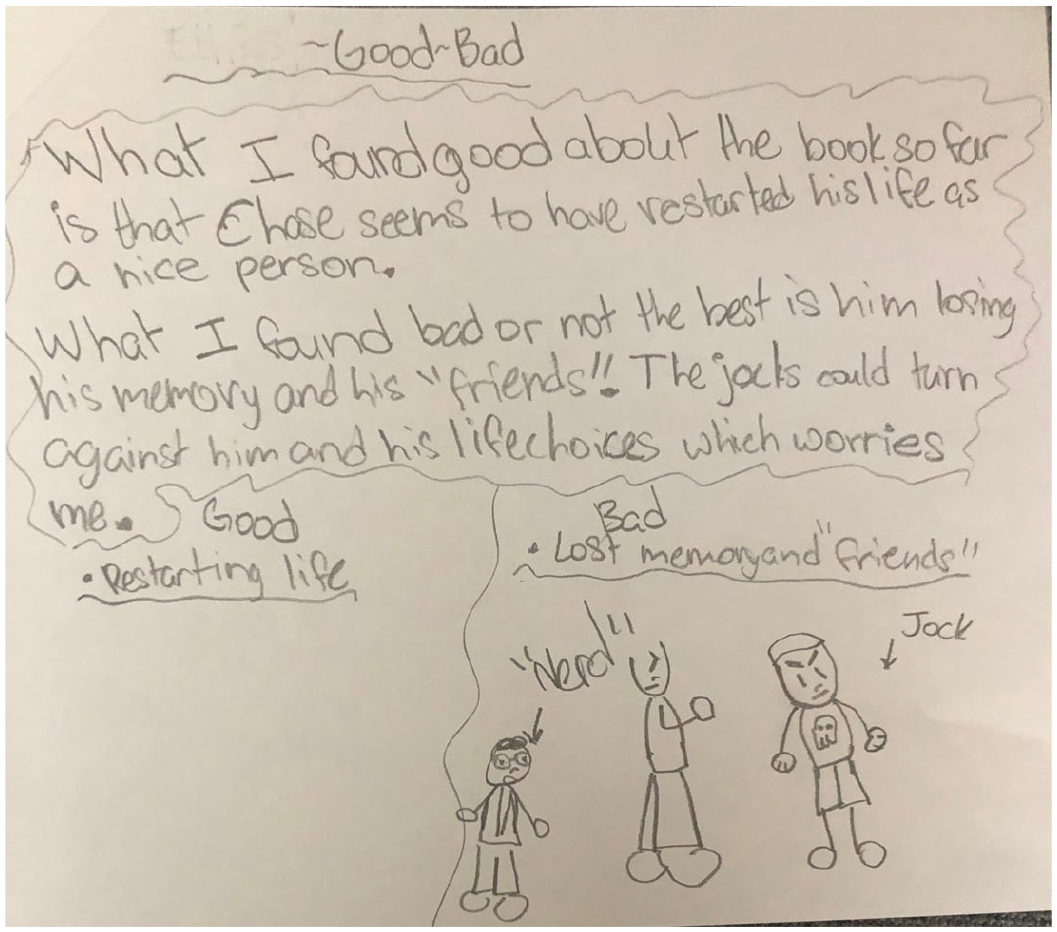
An illustration of conflict.
Within Stance 4, students pursued the multiple perspectives shared about Chase. These perspectives allowed them to see how it was difficult for others to accept major personality changes in a person. In addition, students contemplated how a person became a bully and how difficult it would be to change this persona.
Stance 5: Leaving an Envisionment and Going Beyond
A reader in this stance used information or emotions from a current reading and applied them in a new situation. For example, a writer included a poem or music within a text based on ideas from a previously read text. Langer stated that this stance occurs infrequently, and we found the same result with these data. Only one comment by a student was coded as 5.
In the book, Brandon created YouTube videos and hoped that one would go viral. In response, Bailey noted, “I can relate to Brandon because I do a lot of crazy things and weird things too. I just want to get a bunch of YouTube views.” This comment connected his reading of Brandon’s efforts to wanting to get views of his own YouTube posts. He compared this event with his similar creation of videos that were posted to YouTube.
Discussion
Based on this investigation, we learned that gifted students were aware of bullying and its possible negative effects which supported earlier findings (Donoghue et al., 2015; Fekkes et al., 2004; Ferráns et al., 2014). Similar to Thornberg (2010), students believed that a bully participated in this behavior to be a member of a prestigious group. However, students did not indicate that a bully should belong to a particular minority group or cultural group.
Specifically, students did not identify as being the targets of bullying or in engaging in bullying anymore frequently than other students based on their gifted identification (Francis et al., 2016; Robinson, 2002), which supports the hypothesis offered by Peters and Bain (2011) and Ryoo et al. (2017). Perhaps as described by Peterson and Ray (2006a), these gifted students were silent about personal bullying occurrences.
Shifting to the use of children’s literature to explore bullying, Wiseman et al. (2019) argued about the importance of bringing children’s literature to students so that they could openly discuss issues surrounding bullying and other sensitive topics. We found Restart offered a vehicle to engage students in this conversation, although their conversations for the most part were centered on the book and not their own personal experiences. The conversations and representations created by students were rich and thought-provoking because students were allowed time for deep conversations (Fisher et al., 2017; Fisher & Frey, 2018; Miller & Sharp, 2018). As evidenced in the conversational samples, students engaged in discussions responding to each other rather than the teacher’s questions. Students used the social nature of conversation to shape and reshape their understandings. This openness allowed them to consider and reconsider Chase as his character changed. In this process, they shared ideas about how others perceived a bully and if a bully can really change.
Langer’s (2011) work provided a window to explore student conversation and representations. Similar to Langer, we noted most responses were coded in Stances 1, 2, and 4. More Stance 3 examples were offered than expected based on Langer’s findings, and only one example received a Stance 5 coding which supported Langer’s previous work. Overall, students’ interpretations most often focused on Chase, the bully, and his personality changes. They also contemplated how others viewed Chase. The chapters’ structure facilitated these comparisons as each character had an opportunity to view Chase through his or her personal lens. Unlike Langer’s model for literature interpretation, students used literature as a means for learning and exploring, rather than reflecting on their own lives and interpreted this book cognitively rather than emotionally.
This study allowed students to share their interpretations of a text and through this opportunity how they understood bullying. Students indicated that a negative experience must lead to someone becoming a bully. Furthermore, they did not believe that once a person was considered a bully, they could change this identity. They saw being a bully as a fixed state, enjoying the power that resulted from bullying. This interpretation of a bully was disheartening to consider as adults. Students did not believe a person would change their identity, as the benefits of being a bully were too great to discard.
While students considered bullying within the book, they did not explicitly share personal experiences with bullying. When engaging in Stance 4, some students spoke generally about bullying, but they did not offer personal experiences. In the one response coded as Stance 5, there was discussion about personal behavior but it focused on creating YouTube videos. Students maintained a distance from personal experiences with bullying and stayed grounded in the plot and characters within the book. Furthermore, they never provided solutions about how to react to a bully or how to change a bully’s behavior, and they only offered opinions about the difficulty of changing out of the status of a bully. Students did not contemplate trying to change a person who was a bully—This change would be insurmountable as described in their writing and talking.
Implications for Practitioners
Our exploratory and descriptive study illustrated how students thought and felt about the text and perhaps their personal connections to it without a teacher leading them. We purposely did not intervene or encourage students to share personal experiences with bullying. However, if teachers or counselors used books that included bullying experiences, they might explicitly ask students to share personal connections. Through a guided conversation, they could learn more about students’ bullying experiences and be better able to support their emotional needs. By engaging in these conversations with gifted students, teachers would perhaps move beyond silence to socially considered solutions for dealing with bullies and bullying behaviors (Peterson & Ray, 2006a). We also recommend that if teachers engage students in these more personal conversations, they do so in partnership with counselors who are better able to support students’ mental health needs. In addition, schools may want to alert parents to these conversations, so that they can engage their children in similar conversation at home.
In addition, students’ comments suggested that programs that focus on bullying behavior may not be immediately successful (O’Connor et al., 2019). For instance, students perceived bullies as incapable of changing their behavior. Interventions might be more successful if implemented over longer periods of time, and suggestions were provided on how to deal with a bully and their behavior (Peterson & Ray, 2006b).
Limitations
The study’s participants included one class of gifted fifth-grade students who attended a school where a culture of student respect was cultivated and there were few discipline issues. Based on this school’s context, these students were distanced from bullying experiences. Other contexts might make students more susceptible to bullying and thus express their personal experiences. In addition, the book we chose had a bully as its main character. Different books might offer alternative contexts for students to contribute more personally about bullying and subsequent behaviors. The book, Restart, resulted in more cognitive focused conversations and representations, instead of ones with emotional and personal connections to bullying.
Suggestions for Further Research
Although reading and responding are imperfect solutions to dealing with bullying, these experiences do allow students to personally examine bullying and its consequences. Books explore multiple aspects related to bullying without easy or simplistic solutions. Through these explorations, gifted students are given a voice to explore complex issues. And while not offering a quick solution, they provide a safe space for students to consider such issues and to better understand the views of others. We suggest that future research consider other school settings and children’s books to better understand the findings from this study.
Footnotes
Declaration of Conflicting Interests
The authors declared no potential conflicts of interest with respect to the research, authorship, and/or publication of this article.
Funding
The authors received no financial support for the research and/or authorship of this article.
