



Abstract
The purpose of the present study was to evaluate the online delivery of an affective curriculum for gifted and talented youth to gain further understanding of its effectiveness and perceived advantages and disadvantages of delivering affective curriculum online. Using convergent parallel mixed-methods design, we evaluated data from 38 secondary education students and 4 camp counselors to examine their experiences with the online delivery of an affective curriculum. We found the curriculum effectively increased students' self-perceptions, planning, and self-monitoring. Further, camp counselors generally perceived the online delivery to be effective and identified several benefits of online delivery, such as increased access and easier differentiating. Yet, they continued to prefer a face-to-face delivery where possible. Implications for practice are discussed.
Keywords
There has been a longstanding interest in the social-emotional or affective development of students with gifts and talents (e.g., Colangelo & Wood, 2015). However, there is a limited amount of research on affective interventions and their effectiveness for students with gifts and talents (Jen, 2017). Recently, the Achievement Motivation Enhancement Curriculum (AME), a small-group, discussion-based affective curriculum targeting positive academic self-perceptions, goal valuation, mastery goal orientation, self-regulation, and metacognitive skills, was developed and implemented with student with gifts and talents in various settings (Desmet et al., 2022; Desmet & Pereira, 2022). Initially, the curriculum was piloted at a summer enrichment program for students with gifts and talents (Desmet & Pereira, 2022), where it was determined that the curriculum showed promise of effectiveness and was perceived positively by both educators and students. Later, the curriculum was implemented as part of an enrichment program at a STEM charter school (Desmet et al., 2022). Due to the COVID-19 pandemic, the intervention at the charter school was done through an online video conference platform and a hybrid format in which some students participated via online video conferences and others participated in person. Findings showed that participation in the AME curriculum was associated with increased academic self-perceptions and self-regulation. Yet, educators found it difficult to establish meaningful interactions with students in these online and hybrid spaces. This difficulty with establishing meaningful interactions has been identified by other researchers who conducted studies on emergency remote teaching in the context of the COVID-19 pandemic as well (van der Spoel et al., 2020). Research shows online learning opportunities can be particularly beneficial for students with gifts and talents (Periathiruvadi & Rinn, 2012), in part because it makes learning opportunities more accessible (Cavanaugh et al., 2009). However, there is limited research on the online delivery of affective interventions in general and even less on affective curricula for gifted and talented youth specifically. Given potential challenges around establishing meaningful interactions through online media, there is a need for additional research in this area. The purpose of the present study was to evaluate the online delivery of the AME curriculum to gain further understanding of its effectiveness and the advantages and disadvantages of using online video conferencing as a medium for conducting small-group, discussion-based affective curriculum with gifted and talented youth.
Literature Review
In what follows we provide a brief review of the limited literature on online gifted and talented education, the impact of small-group discussions with gifted and talented students, and finally the literature underlying the AME curriculum and its outcome targets.
Online Gifted and Talented Education
Online learning can be an effective format to increase students` motivation and learning across various disciplines (e.g., Bowen et al., 2014; Chowkase et al., 2022; Gaupp et al., 2016; Hegeman, 2015). Researchers have specifically recognized the potential benefits of online learning for students with gifts and talents (Periathiruvadi & Rinn, 2012; Wolfgang & Snyderman, 2022; Yusof et al., 2022). Research shows students with gifts and talents enroll in online classes to gain access to enrichment or acceleration opportunities that are not available in their area (Cavanaugh et al., 2009; Olszewski-Kubilius & Lee, 2004; Thomson, 2010). Therefore, online learning may make gifted and talented education more accessible. In addition, researchers have found that online learning allows for more individualized, student-centered instruction and may aid access to homogeneous grouping (Potts, 2018; Thomson, 2010). Nevertheless, researchers have also highlighted the limitations of online learning. Technical difficulties and a shortage of digital technology may challenge the online learning experience (Desmet et al., 2022; Potts, 2018; Thomas, 2010). Disuse of or inexperience with available technology also affect students’ online learning experiences (Desmet et al., 2022; Potts, 2018; Thomson, 2010). Finally, researchers have found that educators may find it difficult to establish meaningful interaction with students in online environments when they lack training in online teaching skills (Desmet et al., 2022; Potts, 2018, 2018van der Spoel et al., 2020), which is essential when implementing a social-emotional or affective curriculum. These difficulties were particularly highlighted during the global pivot to emergency remote teaching during the pandemic (Desmet et al., 2022; van der Spoel et al., 2020) and may, to an extent, result from inadequate training and ineffective designs of online spaces due to the urgency with which schools moved their learning online (Desmet et al., 2022; van der Spoel et al., 2020). Researchers have found that many gifted educators successfully established meaningful interaction and conducted effective online teaching, even in the context of emergency remote teaching, when the necessary training and support were available (Guilbault & McCormick, 2022).
Small Groups and Gifted Students
Group settings offer helpful benefits for people to improve their intrapersonal and interpersonal skills and address related needs. The groups provide opportunities for participants to use group interactions as a “natural laboratory” where they receive feedback from their peers and try out strategies to achieve their full potential (Corey et al., 2018). The positive impacts of group work with gifted and talented students are well documented in the literature not only for academic skills but also for self-discovery, communication, human relations, and leadership skills (Colangelo & Peterson, 2005). Peterson et al. (2009) suggested using small-group discussions as part of affective curriculum and argued that group discussions can enhance gifted and talented students’ expressive language to explore their developmental struggles. A longitudinal study showed the effectiveness of the small-group discussions as part of an affective curriculum with gifted and talented students (Peterson & Lorimer, 2012) Additionally, groups offer a sense of community where participants feel that they are not alone in their experiences and challenges (Corey et al., 2018).
Academic Self-Perception
Positive academic self-perception is required for academic success (Hussain et al., 2019) and influences educational and career decisions (Horta, 2018; Simpkins et al., 2006). Improving gifted individuals’ academic self-perception is critical for long-term achievement and motivation (Desmet & Pereira, 2022; Dixson et al., 2016). Dixson et al. (2016) found that academic self-efficacy, which is one of the integral constructs to predict academic self-perception, was the strongest prediction for academic success. Research evaluating academic self-perception interventions among students with gifts and talents is limited. However, based on research with general populations, affective interventions targeting positive academic self-perceptions can successfully improve students’ self-concept and achievement (O’Mara et al., 2006). In particular, interventions using attributional feedback, goal feedback, or contingent praise tend to be most effective (O’Mara et al., 2006) as well as interventions involving increased positive self-talk, such as the AME curriculum (Burnett, 2003; Desmet et al., 2022; Thomaes et al., 2020).
Goal Orientation
Goal orientation has two aspects: performance goal orientation and mastery goal orientation (Kaplan & Maehr, 2007). Students who strive for mastery focus on effort and think more about improving themselves on the task (Obergriesser & Stoeger, 2015), whereas students with performance goal orientation are more likely to avoid changes and are more resistant to feedback (Stoeger et al., 2014). Therefore, students with mastery goal orientation focus more on effort and improvement, which is important for achievement and talent development (Patrick et al., 2021; Wang et al., 2012). Researchers also found that students with mastery goals had higher grades in their classes than those who had performance goal orientation (Agaliotis & Kalyva, 2019; Skaalvik, 2018). Therefore, the AME curriculum promotes mastery goal orientation.
Goal Valuation
Goal valuation or task value refers to how desirable or significant an activity is to a person. Students’ motivation to engage in and effectively complete academic tasks is influenced by their goal valuation or task value (Eccles & Wigfield, 2020). Because students’ success and achievements are influenced by their goal valuation or task value, researchers have suggested that all students can benefit from increased goal valuation (Siegle et al., 2017). Goal-setting interventions may strengthen task value for students (Wigfield & Eccles, 2000). Research shows that engaging students in intentional goal-setting activities is beneficial for student achievement and their positive social and emotional development, in particular their self-concept (Morisano & Shore, 2010). Thus, the AME curriculum targets goal valuation through goal-setting and planning activities.
Metacognitive Skills
Metacognition is defined as awareness and control of one’s own cognitive system, or the ability to think and reflect on one’s own behavior (Schraw & Dennison, 1994). Metacognitive skills play an important role in successful learning (Callan et al., 2016). Therefore, metacognitive skills have been linked to academic success, leadership, and general well-being (Kontostavlou & Drigas, 2021; Safranj, 2019); as such, teaching metacognitive skills may improve academic performance and social and emotional well-being (Craig et al., 2020). Similarly, low metacognitive competence has been associated with academic underachievement among gifted students (Tibken et al., 2022). Researchers have suggested that eminent individuals do not only rely on their raw talents or intelligence, but they also are good at using metacognitive skills to take advantage of opportunities and learn from challenges in life (Olszewski-Kubilius et al., 2019). Olszewski-Kubilius et al. (2019) suggested that some metacognitive skills such as organization and time management, goal setting, and coping with failure may help students in their talent development. Self-regulation interventions targeting metacognition and motivational and emotional regulation strategies have shown to be effective in promoting talent development among gifted youth (Stoeger & Ziegler, 2005, 2008). Therefore, the AME curriculum involves teaching students metacognitive strategies associated with self-monitoring, planning, and self-directed learning in combination with motivational regulation (goal-setting) and emotional regulation (positive self-talk).
Methods
The present study used a convergent parallel mixed-methods design (Creswell & Clark, 2017) to examine the effects and perceptions of the online delivery of the Achievement Motivation Enhancement Curriculum, an affective curriculum for gifted and talented students. A convergent parallel mixed-methods design involves collecting and analyzing quantitative and qualitative data in a single study. We collected and analyzed the quantitative and qualitative data in parallel and then compared findings to find areas of convergence and divergence (Creswell & Clark, 2017).
Setting and Participants
For the purpose of this study, the AME curriculum was implemented at a virtual summer residential academic enrichment program for gifted, creative, and talented students at a Midwestern University in the US. Students were in Grades 5–12. At the time of the study, the program administration required students to meet or more of the following criteria: (a) 3.5/4.0 GPA related to the student’s choice of classes (i.e., school-based 3.5 GPA in mathematics if applying to a STEM course); (b) individual or group IQ test score of at least 120; (c) scores in the 90th percentile or higher on national or state achievement or aptitude tests in a particular field of study; (d) a letter of recommendation from a teacher or mentor in the talent area specifically mentioning student’s performance, experiences, and potential in the area of talent the student has chosen to study; or (e) a letter or award that shows how the student has done well in a talent area that’s linked to their class choices (Gifted Education Research and Resource Institute, 2021).
In 2021, 106 students (52% female) in Grades 5–12 signed up for the program. Of those students, 22.6% were Asian, 28.3% were African American or Black, 20.8% were White, 3.8% were Hispanic or Latinx, 13.2% were American Indian/Alaska Native, 3.7% indicated two or more races, 6.6% identified as other, and 1% chose not to answer. A total of 43% of students received financial aid to attend the program. Although 106 students signed up for the program, attendance data showed that on average only 69 students (65%) attended each respective session.
Students attended the program for 2 weeks via video conference. Students would participate in one or two enrichment courses per day as well as small-group discussions around the AME curriculum. The AME small-group discussions were held for approximately one hour each day for a total of 7 sessions. Students could choose to sign up for afternoon or evening AME sessions. For both the enrichment courses and the AME small groups, students were grouped based on their grade level. Students in Grades 5–6 were grouped together, as were those in Grades 7–8 and 9–12.
All camp counselors had at least 2 years of experience working for the program when they joined this research study. The camp counselors had implemented the AME curriculum once before in a face-to-face setting. To prepare for the online delivery of the AME curriculum, camp counselors attended a 4-hour online training before the camp started. This training reviewed the AME content as well as strategies for conducting affective curriculum in online spaces. Camp counselors also completed online training modules on the social-emotional needs and characteristics of students with gifts and talents. There were seven camp counselors in total, of which four agreed to participate in this research study. Samuel (pseudonym) identified as a White man; he has a master’s degree in school counseling and 4 years of experience working for this enrichment program. Susana identified as a Hispanic/Latinx woman with a degree in elementary education and 3 years of experience working for the enrichment program. Hayden identified as an African American man with a bachelor’s degree in Chinese studies and in the process of obtaining a doctorate in educational leadership. Hayden had 5 years of experience as a camp counselor for the enrichment program. Finally, Mary identified as a White woman. She has a degree in elementary education and special education and has 2 years of experience working for the enrichment program. Although all camp counselors had experience working with students in online settings for at least one year, none of them had previously implemented the AME curriculum in an online setting.
Intervention
This study involved the online delivery of the Achievement Motivation Enhancement Curriculum. The AME curriculum is a small-group, discussion-based affective curriculum targeting positive academic self-perceptions, goal valuation, mastery goal orientation, self-regulation, and metacognitive skills. In this study, the curriculum was implemented as part of an online enrichment program for gifted, creative, and talented students. Students participated in the small-group discussion sessions via video conference and were guided through the curriculum by a trained camp counselor. Students participated in seven AME sessions over 2 weeks in groups ranging in size from 6–12 students. Each session lasted approximately one hour.
Overview of the AME Sessions.

Note. To accommodate the camp procedures, the first session was split across two meetings. During the first meeting, students were introduced to the small-group program and engaged in the first learning activity (“hello my name is”). The second learning activity (“talent toolbox”) was conducting during the second meeting. After that, all lessons were completed during one meeting.
Session 3: Now I See Me (Self-Regulation and Self-Monitoring).
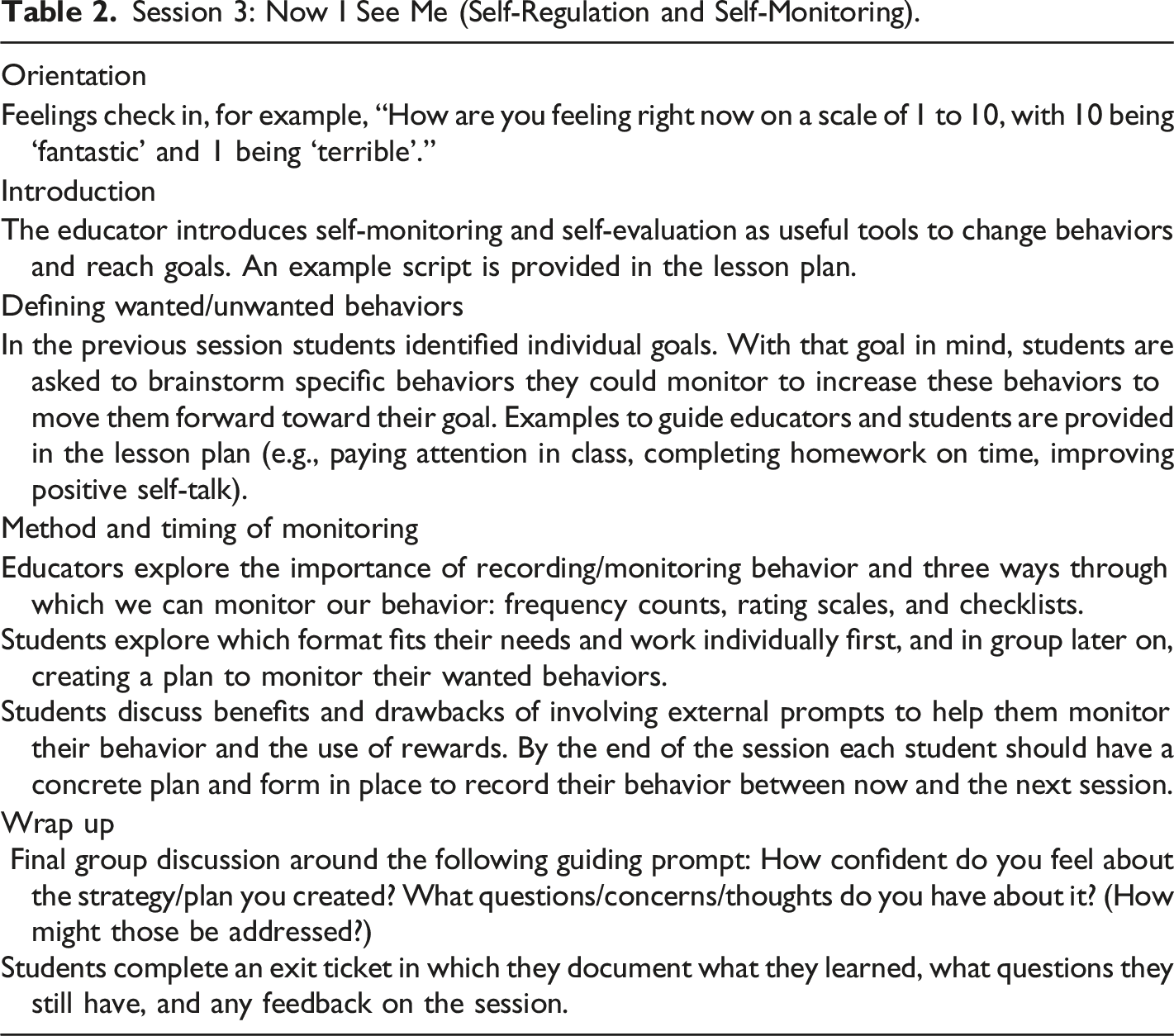
Camp counselors implementing the curriculum participated in training. The training was conducted virtually and took a little more than 4 hours. During the first part of the training, the developer and the author of the AME curriculum provided demonstrations of lessons, discussed the foundations and the content of the curriculum, and offered strategies for implementation. The rationale for the achievement motivation, strength-based, and autonomy-supportive curriculum was explored. The second part of the training primarily included discussions related to various types of groups, group leadership skills including listening and responding, and different developmental stages of a group by primarily using the texts of Corey et al. (2018). The training included case studies where camp counselors reflected on scenarios and provided their perspectives on how to implement the curriculum in group settings through a virtual format. Almost all the camp counselors (except for Hayden) implemented the curriculum in previous years in a face-to-face format. The last part of the training focused on camp counselors’ experiences with the curriculum and specific strategies for virtual delivery. Camp counselors were experienced with the online format through their teaching or counseling experiences and shared strategies that they found useful over time.
Instruments
We used the academic self-perception and goal valuation subscales from the School Attitudes Survey-Revised (SAAS-R; McCoach, 2002). Example items included “I can grasp complex concepts in school” for academic self-perception and “It is important for me to do well in school” for goal valuation. Both subscales used a 7-point Likert scale. McCoach (2002) established strong validity and reliability for use of this instrument with students in secondary school. Our sample students in Grades 5–12. The internal consistency of the two subscales were satisfactory for our sample, with Cronbach’s alphas of .89 for goal valuation and .86 for self-perception. Therefore, we used the subscales as created with no changes made to accommodate a slightly younger sample.
To measure students’ goal orientation, we used the mastery, performance, and avoidance goal orientation scales from the Goal Orientation and Learning Strategies Survey (GOALS-S; Dowson & McInerney, 2004). Dowson and McInerney (2004) established the validity and reliability of the GOALS-S for use with middle and high school students. Example items included “I want to do well at school to show that I can learn new things” for mastery goal orientation, “I want to do well in school because being better than others is important to me” for performance goal orientation, and “I want to do well at school, but only if the work is easy” for avoidance goal orientation. All items were assessed on a 5-point Likert Scale. The scale had 15 items and acceptable internal consistency for our sample (α = .71).
We used the procedural knowledge, monitoring, evaluation, and planning scales of the Metacognitive Awareness Inventory (MAI; Schraw & Dennison, 1994) to assess students’ metacognitive skills. Example items included “I try to use strategies that have worked in the past” for procedural knowledge, “I ask myself periodically if I am meeting my goals” for monitoring, “I know how well I did once I finish a test” for evaluation, and “I pace myself while learning in order to have enough time” for planning. All items were assessed on a 5-point Likert scale. Schraw and Dennison (1994) initially established validity and reliability for the MAI when used with undergraduate students. The MAI also had excellent internal consistency with our sample, α = .91. Thus, although our sample was slightly younger, we did not make changes to the scales.
To assess students’ perceptions of the online learning environment, we adapted the social presence scale and the teacher presence scale of the Community of Inquiry Survey (Swan et al., 2009) to fit our purposes. Students were instructed to answer questions based on their small-group discussion sessions. We adapted items to use language and terms that were used in the program to ensure students would understand our questions. For example, rather than use “instructor” we changed the items to use “camp counselor.” Example items included “I was able to form distinct impressions of some of the other students in my group” for social presence and “The camp counselor clearly communicated important topics for the small-group sessions” for teacher presence. Items were again assessed on a 5-point Likert scale. The scale had 16 questions and the internal consistency for our sample was excellent (α = .95).
Finally, we developed an interview protocol to explore camp counselors’ perceptions of the online delivery of the AME curriculum. The interview protocol was semi-structured with 13 open-ended questions such as, “What are your thoughts on facilitating an affective curriculum online?” and “How did technology mediate the group dynamic?” The first two authors developed the initial interview protocol together. After they each completed one interview, the authors met to discuss changes and additions to the protocol, at which point they finalized the interview protocol. The complete interview protocol is included in the appendix.
Data Collection Procedures
Research approval was obtained through the enrichment program organizers as well as through the university’s institutional review board. After all permissions were received, we collaborated with program coordinators to recruit camp counselors for interviews via email. All camp counselors participating in the program (n = 7) were invited to participate in an interview upon completing their program duties. Four camp counselors (57%) agreed to participate in a one-on-one interview. Three participants were interviewed via video conference and one participant (Samuel) responded to the interview protocol via email. The first and second authors each interviewed two participants using the interview protocol described above. The average interview time was 43.7 minutes. Interviews conducted via video conference were audio-recorded and transcribed for analysis.
Student data were collected as part of ongoing program evaluation surveys typically collected by the enrichment program organizers. All students participating in the enrichment program received a request to complete a survey before and after the camp. Part of the data collected in those surveys were the measures described above and used for this research study. Academic self-perception, goal valuation, goal orientation, and metacognitive skills were measured both before and after students participated in the program. Students’ perceptions of the online learning environment were only included in the post-intervention survey.
Data Analysis Procedures
Per the convergent parallel mixed-methods design, we analyzed the qualitative and quantitative data separately first and later explored convergence and divergence between the findings. The first and second authors analyzed the interview transcripts and the email transcript using inductive data analysis procedures (Corbin & Strauss, 1990; Glaser & Strauss, 1999). After familiarizing ourselves with the data, we independently analyzed each transcript using open coding (Saldaña, 2015) to identify initial themes. We then met to discuss our initial themes and found that our initial themes were well-aligned. In our discussion, we further established parameters for each of the themes and finalized themes and subthemes. For example, an initial category of themes was “benefits of online delivery” during our discussion we determined that we should split this category into two separate ones: “benefits of delivering an affective curriculum online” and “strategies that made the online delivery successful.” Once we agreed on how to best organize the data within categories—derived from our interview protocol—and finalized our themes, we each independently reviewed the data again. In this second round of coding, we analyzed the data with those themes in mind to locate additional evidence to identify the final, salient, and consistent themes across cases. We met again to discuss our thoughts and finalize the themes. Next, we engaged in an audit process, which served as an integrity check to improve the trustworthiness of the findings, where the third author independently reviewed our analysis to provide feedback and commentary. The third author agreed that our themes were representative of our participants’ experiences and represented the most salient themes across participants. Finally, we concluded our data analysis by presenting our participants with a copy of the results section of this manuscript. We asked participants to indicate if our results were indicative of their experiences, a process known as a member check. All participants agreed to the themes we identified. Coding the data independently, conducting an audit, and conducting a member check and at a later stage engaging in both an audit and member check allowed us to control for researcher bias and improves the trustworthiness of our findings (Madill et al., 2000).
Quantitative data were analyzed through a matched samples t-test. Cohen’s d effect size was calculated using the standard deviation of the mean difference. The pre- and post-survey was sent to all program attendees (n = 106), but we only had 38 matching pairs. Therefore, the response rate was 36%. The social presence and teacher presence scale of the Community of Inquiry Survey (Swan et al., 2009) were included in the post-survey only. We had data from 73 students (69%) for those two scales.
Positionality
The first two authors were the primary instrument for qualitative data collection and analysis. To improve the trustworthiness of our findings we address our positionality here. The first author has worked with students with gifts and talents for 8 years. She previously implemented the AME curriculum with students in one-on-one and group settings. She also worked as a teacher coordinator for a summer enrichment program for gifted, creative, and talented students in the past. The second author has primarily worked in the counseling field for 10 years. He started his career as a school counselor and then transitioned to the university setting where he trains counselors, provides service-related activities, and maintains dynamic scholarship agendas. He has taught group counseling techniques and strategies to training counselors for the last 3 years including face-to-face and virtual formats. Finally, the third author acted as a critical friend during the audit portion of the data analysis. His background is in school counseling (5 years) with expertise in gifted and talented education (6 years).
Results
In this section, we first present the qualitative findings to address camp counselors’ perceptions of the online delivery of the AME curriculum. We then present the quantitative findings to address students’ self-reported changes in goal valuation, academic self-perception, mastery goal orientation, and metacognition (procedural knowledge, planning, self-monitoring, and self-evaluation).
Qualitative Findings
Camp counselors’ explanations about their experiences with delivering the AME curriculum online were coded into four main conceptual themes including (a) comparing the delivery methodology: in-person versus online, (b) benefits of online delivery, (c) challenges of online delivery, and (d) strategies that made online delivery successful.
Comparing the Delivery Method: In-Person Versus Online
Camp counselors agreed that the online delivery was effective, and it was the only available option during the pandemic that made it possible to train students and teach them the AME curriculum. Camp counselors expressed that students responded to the curriculum well and met the curricular objective during most sessions. Although there were some challenges with executing small-group discussions online, generally, the camp counselors agreed that the online program was an effective alternative to an in-person program. For example, Mary stated that: Honestly, I don’t think it was much different than how [it] would be in person. Sometimes I would be a little flustered and be like okay hold on I’m writing down over here and I’m listening over here but in person, it would be no different. Like I’m still standing in front of you searching for this, writing this. (individual interview)
Although there was a generally positive sentiment around the online delivery, camp counselors explained they did prefer in-person interactions. For example, Hayden commented: “I think in person is still better” (individual interview) and Mary (individual interview) emphasized the in-person benefits for affective curriculum in particular: I think [the] in person [format] was slightly easier in terms of tapping into social and emotional learning and getting [students] engaged because you can say “talk to your partner,” or you can see the emotion on their face, whereas online they have the ability to turn their camera off and not show those emotions. When you’re in person you can pick up on certain tactics or tics with some kids and you think, “Okay, let’s pair them together.” Where online, it’s like “okay, you two exchange phone numbers.” I couldn’t find a way to bridge that gap between online and in person.
Benefits of Online Delivery
Camp counselors explained that the online delivery provided many benefits including continued access, broader reach, and flexibility for camp counselors and students. Online delivery made it possible to reach many students and train them in AME curriculum-related skills during the pandemic. Students participated from different parts of the world including the United States, India, Germany, Turkey, and United Arab Emirates. Camp counselors pointed out that students were able to learn positive and valuable skills in their comfortable home environment with social support. Mary (individual interview) explained, “I do think the students were more comfortable being online. Obviously, it is easier to hide behind a screen. [Students] could turn off their camera and be crying and really showing their emotion, and you could hear it, but you couldn’t see it.”
The online format provided avenues to establish personal connections that would not be easily accomplished in a face-to-face format. Samuel (individual interview) indicated that: One benefit to the online platform was flexibility for [camp] counselors and campers. Group members were able to be in their own home with support systems. Not being in the same space for small groups also allowed campers to showcase their spaces. Many campers, and [camp] counselors, showed their group aspects of their personal life that may not have been possible in person. For example, I showed my group my dogs just to let them know if they started barking, I apologize! This quick showcase turned to a pet conversation on the first day to get everyone talking about things happening at home. This type of segue is great to turn your group’s attention to topics such as confidentiality.
Camp counselors also recognized that an online delivery offered some unique functions including the chat opportunity. For example, camp counselors used chat options to encourage “shy” students to share their perspectives. Mary (individual interview) stated that: I think the kid who was messaging me would be the kid who [would have] never shared [had this been in person]. Obviously, there was a reason they were messaging me instead of sharing aloud. In that aspect, I am glad we were online. It helped teach me; it helped [students] open up as well. I would say everyday “Thank you for sharing. I hope one day you build the comfortability to share aloud. You know you’re always welcome to unmute and share.” [I was] always inviting them to do so, but I think if we were in person, it would be no different. The kids who were speaking would, and the kids who were not wouldn’t.
Challenges of Online Delivery
Camp counselors discussed some challenges with delivering the curriculum online as well. The most common challenges included inconsistent participation and attendance. Hayden (individual interview) stated: “the biggest challenge was not having consistency in group sizes throughout. So, it’s very easy for students not to show up for a day unlike in-person schooling.” Some students simply did not show up for the meetings or did not turn on their camera or their microphone, which created struggles to strengthen the relationship between students and camp counselors.
Camp counselors explained that often they experienced technical difficulties including audio quality, lack of technological tools such as a camera or microphone, and unreliable internet connection. Hayden (individual interview) pointed out that “some students’ internet connection might be slower; some students might not want to have their camera on [because of what] their home background looks like.” Technical difficulties impacted the students’ interaction and group dynamics.
Camp counselors also found the lack of physical interaction challenging and this challenge was amplified by technical difficulties and inconsistent participation. Camp counselors commented that the online format created difficulties to create synergy among group members, and it was challenging to transfer energy with a lack of physical connectedness and nonverbal interactions. For example, Mary (individual interview) indicated: I am a big high five, fist bump, do you need a hug kind of person, so I struggled with a way to show (students) my appreciation. No emojis to me on my screen match a high five or a fist bump or if you’re a hugger here’s a hug or a pat on the back. And it’s really easy to sit here and smile for an hour and talk to [students] but [I missed being] able to see [students] outside [of small-group discussion time] and still connecting. I personally really struggled with that and how to meet those ends of relationships.
Strategies That Made Online Delivery Successful
Students and camp counselors had prior experience with learning via online platforms, which made the delivery more efficient. They had at least about one year of experience before they participated in this study. Participants were familiar with online learning and the online video conference platform we used. Camp counselors used various online tools to make the groups more interactive and increase students’ participation including online polls, visual aids, emojis, balancing chat and verbal responses, and direct messages. Mary (individual interview) shared, “I am actually a fifth-grade teacher. So, having to do e-Learning last year, it was a pretty smooth transition for me. I had to be creative and make a poster and hold it up to the camera, but it worked well.”
Camp counselors were able to build a community and increase the sense of belonging through icebreakers and related online interactions. Susana (individual interview) indicated that: Since I had experience teaching online, I think for me it was easier. I knew the tools that Zoom had to offer since that is what I would use [in my previous experience]. I think overall it went well. Like I mentioned some of the lessons were more successful than others. I think using a variety of games and icebreakers and things like that, that work well online made it more successful.
Quantitative Findings
Among 38 participants, we conducted a matched samples t-test to examine changes in students’ goal valuation, academic self-perception, mastery goal orientation, procedural knowledge, planning, self-monitoring, and self-evaluation. Students placed themselves on a 5-point scale for all items. Students reported increased positive academic self-perceptions after participating in the AME curriculum (MD = .10, SD = .27), and this change was statistically significant, t(37) = −2.23, p < .05, d = .19, 1 95% CI [−0.18; −0.01]. Students also reported increased planning skills after participating in the AME curriculum (MD = .21, SD = .42), and this change was statistically significant, t(37) = −3.04, p < .01, d = .33, 1 95% CI [−0.35; −0.01]. Finally, students also reported increased self-monitoring after participating in the AME curriculum (MD = .17, SD = .55), and this change was statistically significant, t(37) = −1.92, p < .10, d = .26, 1 95% CI [−0.35; −0.01]. Contrary to expectations, students did not report statistically significant changes in goal valuation, mastery goal orientation, or self-evaluation skills.
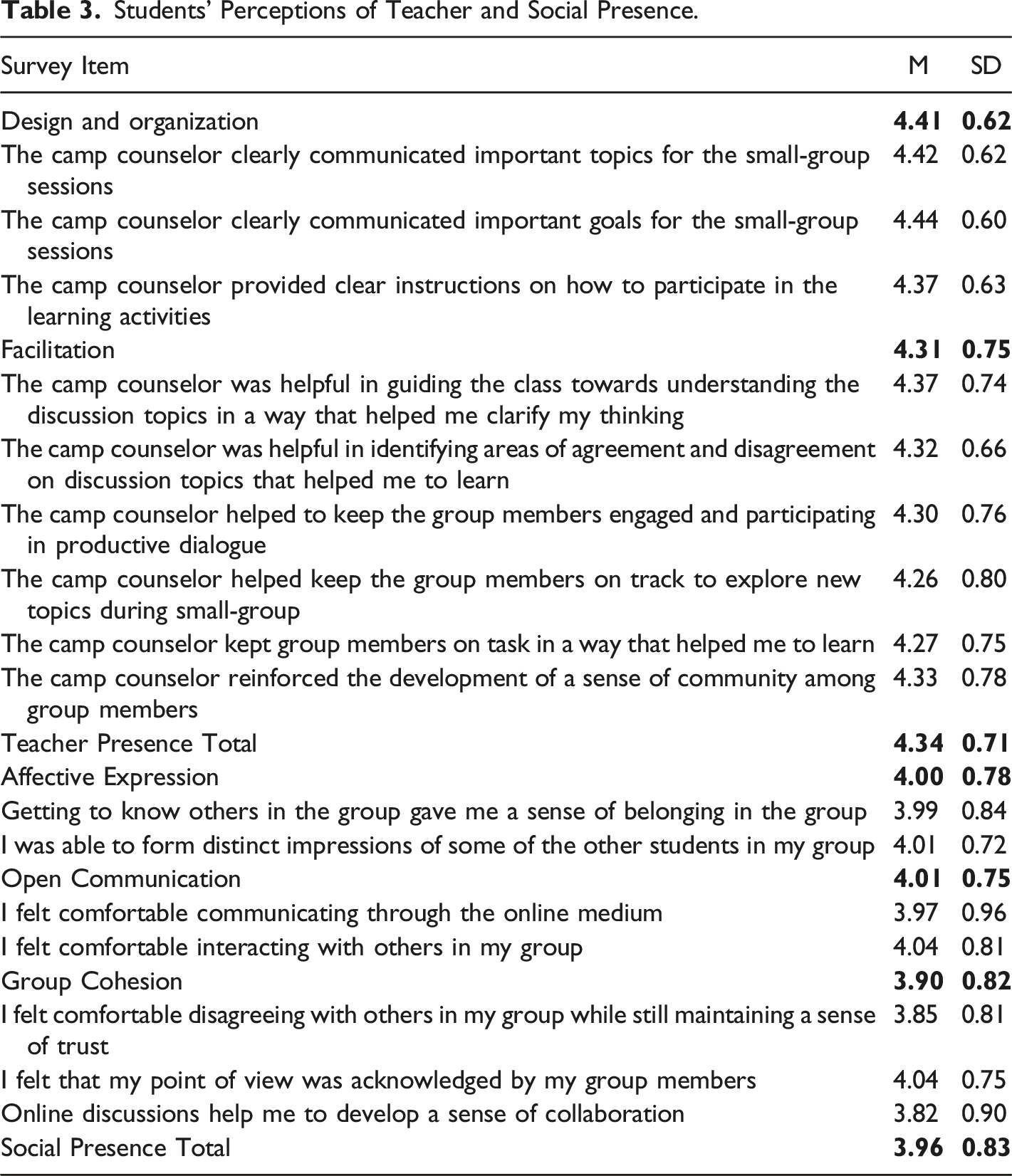
Students’ Perceptions of Teacher and Social Presence.
Discussion
The goal of the present study was to evaluate the online delivery of an affective curriculum, the AME curriculum, to gain further understanding of its effectiveness and perceived advantages and disadvantages of engaging gifted and talented youth in affective curriculum through online video conferencing. All the steps related to the AME curriculum implementations, including planning, training, and interventions were conducted through online video conferencing. Camp counselors provided their perspectives through qualitative interviews and students data were collected via quantitative questionnaires.
Our qualitative results showed that camp counselors perceived the online delivery to be effective and identified several benefits unique to the online medium, such as that the programming was more accessible and allowed for increased use of differentiation. These findings align with what Guilbault and McCormick (2022) found when surveying 310 elementary teachers about their online teaching experience during the pandemic. Guilbault and McCormick found that teachers felt confident that they successfully implemented strategies to meet students’ social and emotional needs. Other researchers have also found accessibility of services to be an important benefit of online delivery (Wolfgang & Snyderman, 2022). For example, Cavanaugh et al. (2009) and Thomson (2010) both highlighted the usefulness of online learning for gifted and talented students who may not have access to talent development opportunities in their local school or community. Furthermore, Potts (2018), Thomson (2010), and Guilbault and McCormick have demonstrated that online learning environments allow for individualized and student-centered instruction. Our findings extend this by demonstrating how online video conferencing tools may facilitate a differentiated approach to providing affective support. For example, our findings showed how having multiple ways of expressing yourself (e.g., in writing, verbally, to the whole group, to the facilitator only) allowed camp counselors to accommodate the discussion according to students’ personal preferences and individual needs.
Students had similar positive perceptions. Students perceived the camp counselors’ organization and facilitation of the online discussions positively and students were highly satisfied with their ability to express themselves and communicate openly in the online environment. Yet, our findings also indicated that camp counselors continued to favor face-to-face delivery where possible, regardless of the perceived benefits unique to online delivery. This was mainly attributed to concerns around attendance and challenges around establishing affective proximity in online spaces. This favoring of the face-to-face instruction may be due to the fact that educators recognized that not all learners thrived in online spaces, for example, Wolfgang and Snyderman (2022) recommended a combination of synchronous and asynchronous instruction to meet the needs of a more diverse student body. Other researchers have also found that technical difficulties and lack of interaction in online learning formats may affect the quality of the learning experience (Potts, 2018; van der Spoel et al., 2020). As discussed in the methods section, the attendance rate per session was on average 65%, whereas in years where the program was conducted face-to-face, the average attendance rate for each session was close to 100% because there were no alternatives to participating in the session. When students join virtually from their home, there are a variety of distractions present.
Additionally, camp counselors addressed challenges around establishing affective proximity, in lieu of physical proximity. As educators, we often use physical proximity as a tool to engage students. For example, when a student is upset, we may move closer to them or make physical contact to comfort them. This is not possible through online video conferencing, so we rely more on affective or emotional proximity to build connections. It is difficult to gauge if a student gets upset in an online intervention when their camera is off or if the student simply does not show up for a week. However, camp counselors established affective proximity through icebreakers, teambuilding games, cooperative learning, and checking in with students. It remained challenging to establish the synergy that occurs when engaging with students in person. This was confirmed by students as well; they perceived group cohesion as only moderately positive (3.90 out of 5). Camp counselors felt a disconnect between them and the students and among the students compared to previous years when the program was conducted face-to-face. These findings advance our understanding of the online delivery of affective curriculum for gifted and talented youth by highlighting benefits and challenges. It is necessary to continue the exploration of ways in which we can improve meaningful interactions in online spaces and establish affective proximity to reach a synergy that mimics the one we more easily establish while conducting the curriculum in person.
Our quantitative results showed that students reported improved positive academic self-perceptions, planning, and self-monitoring, all of which are directly targeted in the AME curriculum. These findings confirm what we found in previous research on the AME curriculum, both face-to-face (Desmet & Pereira, 2022) and online (Desmet et al., 2022). Contrary to our expectations, students did not report statistically significant improvements in goal valuation or mastery goal orientation. Based on feedback from camp counselors shared with us during the interviews, the session on goal setting, in which goal valuation and mastery goal orientation were targeted did not go over well and needs to be revised to address the need of online participants. Camp counselors shared that this session was challenging for students. Some camp counselors indicated that this session was particularly difficult for younger students. In general, this session was repeatedly highlighted as a session where there was minimal interaction and students struggled to meet the objectives. Therefore, it is likely that the session needs to be revised to improve its effectiveness. Although another study has shown that the session resulted in significant changes for older students (Desmet et al., 2022), there is existing evidence that the session may not work well for middle school students (Desmet & Pereira, 2023). Thus, we hypothesize that the lack of significant change is likely due to the nature of the session and not due to the online delivery. Taken together, our findings suggest that online delivery of the AME curriculum has resulted in similar findings to those found when we implemented the AME curriculum face-to-face and in hybrid formats. More research and direct comparisons of online versus face-to-face deliveries is of course necessary.
Limitations
There are several limitations associated with the present study. First, the attendance and response rates were low. Data showed that on average only 65% of students attended each session. Additionally, we had only 38 students (55% response rate based on average attendance rate) complete both the pre- and post-survey, whereas 106 students signed up for the program. It is possible and, based on camp counselor’s interviews, likely that the online nature of the program contributed to the low attendance and low response rates. Creating an effective group dynamic and reaching group cohesion can be difficult in online delivery. Also, students may experience online fatigue as they conducted most of their formal instructions suddenly on online platforms due to the pandemic. In previous years, when the program had been conducted in person, the program evaluation surveys were typically completed by more than 90% of program attendees. Further, we did not have access to individual participants’ attendance records. Therefore, we do not know whether all 38 participants who completed the pre- and post-survey attended all AME sessions. Some caution is necessary when drawing conclusions from these findings because of this. The low response rate may have resulted in Type II error and affected our statistical power to detect small effects.
A second limitation regards a possible social desirability bias due to the use of self-report data and interviews. We took several measures to reduce social desirability, including instructing students that all survey data would be processed anonymously and would serve to make changes and improvements to the program. For the interviews, two authors interviewed participants, and we only presented strong themes that were confirmed across participants. Exploring convergence and divergence among data sources through the mixed-methods design offsets to an extent some of the possible bias by triangulating findings across sources.
Other limitations of this study are those associated with one-group pretest-posttest designs, such as instrument reactivity, participant mortality, maturation, and history. Therefore, it is hard to determine the validity of our quantitative findings. Additional research with a more robust design is necessary. The results of this study have limited generalizability. However, the findings of this study do highlight important experiences with and perceptions of the online delivery of affective curriculum that could affect curricular decisions and interventions in other settings.
Implications for Practice
This study offers several insights that may inform decisions around the online delivery of affective curricula for gifted and talented students. First, previous research conducted on the emergency remote delivery of the AME curriculum (Desmet & Pereira, 2022) indicated that adequate training in online learning may offset several shared struggles of educators who were tasked with delivering the AME curriculum online in the context of emergency remote teaching. Based on the findings in this study, incorporating adequate training did result in a high-quality delivery of the AME curriculum and more positive perceptions of the online delivery and online experience. Therefore, adequate training regarding online learning skills as well as listening and responding skills are important to the successful implementation of the online delivery of affective curriculum. Specifically, our findings indicate that training should explore affective proximity in online spaces.
Second, our findings suggest that affective curricula adapted or designed for online delivery should have sufficient and explicit time allocated for establishing meaningful interactions, a sense of belonging, and affective proximity in online spaces. In this study, we incorporated teambuilding activities, opportunities for informal communication, and cooperative learning strategies to address this. Camp counselors attributed the successful online delivery in part to these strategies.
Third, it should be noted that camp counselors continued to favor face-to-face delivery of affective curricula over online delivery where possible. They acknowledged that online delivery has benefits regarding access and serving students with specific needs (e.g., shy students), but they valued physical proximity and its effects on group dynamics and meaningful interactions greatly. Educators and program directors may consider offering students some choice regarding attending these types of programs online versus face-to-face.
Finally, it should be noted that attendance and response rates were low, as discussed above. It is likely that this was at least in part due to the online nature of the program. Although a majority of our camp counselors pointed at a lack of physical and affective proximity as well as accountability or external regulation to explain this low response and attendance rate, it is important to consider issues of inequitable access to technology and internet as well. Educators considering online programs should ensure that all students have access to a device and a stable internet connection. Some collaboration with parents to help regulate students’ schedules for an online program may be necessary as well. When students attend an in-person program, they are guided from class to class as a group and have very little unsupervised time. This may not be the case in an online program and can cause students to not attend sessions or not respond to certain surveys. Last, online fatigue may explain low attendance and response rates as well, so educators may want to consider the amount of time students are expected to be online and/or engaging in meaningful learning online. Often times, in-person programs have scheduled unstructured time or informal interactions that may be get eliminated when moving online. Yet, as demonstrated in our qualitative results it is important that we maintain some of that unstructured time and informal interaction in online programs as well.
Directions for Future Research
Future research could build on the findings of this study in several ways. As mentioned in the implications for practice, we used several tools to establish affective proximity including icebreakers, teambuilding games, cooperative learning, and checking in with students and meaningful interactions to promote a sense of belonging in the online space. Future researchers may wish to explore additional strategies and evaluate the effectiveness of the various strategies we used. Additionally, researchers could explore online tools and media that may promote the effective delivery of online affective curriculum further. Participants mentioned several interactive online tools that benefited them, it may be of interest to explore this further. Although group sizes varied, we did not have the necessary sample size to determine evidence-based recommendations around effective group sizes for this curriculum. Future research comparing group sizes and their impact on the curriculum’s effectiveness may be of interest. Researchers may be interested in investigating affective learning in online spaces and developmental concerns or minimum age requirements as well. Additional research comparing the effectiveness of online delivery to face-to-face deliveries is necessary. Future studies may also explore hybrid formats in which synchronous and asynchronous activities are combined. Finally, researchers may find it of interest to conduct studies that capture the student perspective of online delivery as well.
Footnotes
Declaration of Conflicting Interests
The author(s) declared no potential conflicts of interest with respect to the research, authorship, and/or publication of this article.
Funding
The author(s) received no financial support for the research, authorship, and/or publication of this article.
