



Abstract
This study uses a naturalistic inquiry approach to investigate how rural educators navigate the affordances and barriers of implementing an out-of-school program to identify and develop middle school STEM talent in rural communities. At the time of this study, the STEM program was in its fourth year of implementation. Participants included 34 educators and 324 students in Grades 6–8 across 10 school districts in a predominately rural state. We used maximum variation purposive sampling to select 3 of the 10 districts as case study sites. The cross-case analysis resulted in the themes of (a) exercising local control, (b) expanding community for advanced STEM learning, and (c) leveraging the intersectionality of rurality, local agency, and expanded resources. One implication is that when supported with resources, rural educators will leverage the systems of their schools and communities to create robust ecosystems for advanced STEM talent development.
Keywords
Rural students are less likely to matriculate to postsecondary science, technology, engineering, and mathematics (STEM) majors compared to their urban and suburban peers (Goodpaster et al., 2012; Handwerk et al., 2008; National Rural Education Association, 2016; Saw & Agger, 2021). Exacerbating this finding is the persistent disparity in the percentage of students from rural areas attending a postsecondary institution—29.3% attending compared to 45% for nonrural peers (National Center for Education Statistics, 2015). Coupling these findings suggests a need to research factors that influence STEM talent development in rural communities before high school and college. In particular, we seek to understand how educators identify and develop STEM talent at the middle school level in rural communities so that we have greater insight into affordances and barriers experienced by teachers in rural schools.
Focusing on middle schools and rural communities matters because, similar to marginalized urban communities, students and teachers in rural communities face the realities of limited resources. Rural schools contend with several barriers including issues of geographic isolation and sufficient bandwidth to support online access and full adoption of technological advances that provide access to advanced coursework in mathematics and science (Banilower et al., 2018; Kittleson & Morgan, 2012), and their educators have some of the highest attrition (Monk, 2007) and lowest salaries for teachers in the nation (Beeson & Strange, 2003; Lapan et al., 2003; National Rural Education Association, 2016). Rural students are also less likely to have access to STEM family nights, STEM out-of-school enrichment programs, STEM clubs, and STEM internships (Banilower et al., 2018; Saw & Agger, 2021). These barriers can result in rural students lacking access to the formal and informal learning opportunities needed to prepare successfully for and complete STEM coursework in high school and postsecondary settings.
Because informal learning settings are free from many of the constraints of the traditional school day, out-of-school programs can engage students in education on their terms and make effective use of opportunities for significant learning (Bell et al., 2009). Extant research on positive youth development has found that involvement in after-school activities benefits adolescents by acting as an independent context for healthy exploration and interactions (Catalano et al., 2004; Eccles et al., 2003). The substantial body of research on science attitudes and interest also denotes the importance of out-of-school opportunities for science (e.g., Osborne et al., 2003). Additionally, out-of-school programs have more significant potential to reach underrepresented populations (Afterschool Alliance, 2022; Center for Advancement of Informal Science Education [CAISE], 2015; National Research Council [NRC], 2015). However, for underrepresented rural students, effectiveness of out-of-school programs needs more exploration and research support (CAISE, 2015; NRC, 2015).
Existing research literature suggests that rural students’ STEM success improves when there is a connection between their in-school learning, daily lives, and their communities (Avery, 2013; Jacobs et al., 1998). Students appear interested in having extended time for long-term investigations and discussions. Moreover, high-ability students who participate in after-school STEM programs are more likely to pursue careers in STEM than those who do not participate in after-school STEM programs (Habig, 2020; Milgram & Hong, 1999; Wai et al., 2010). Creating effective after-school STEM programming means constructing the types of educational opportunities students tell us they crave. Research is needed to provide insights into how best to design, implement, and support out-of-school learning environments to broaden participation in the highest levels of STEM education and careers for underrepresented rural students.
This study was part of a larger effort to understand the critical characteristics of after-school STEM learning environments that best support high-ability students’ STEM learning and educators’ practices in rural schools. The purpose of the current investigation was to understand rural educators’ experiences implementing an intensive after-school STEM program, attending specifically to the barriers and affordances associated with program implementation. The following research question guided this study: What barriers and affordances do rural educators encounter when implementing an evidence-based after-school STEM enrichment program?
Theoretical Framework
This study represented the use of a talent development model, chosen from many, intended to address the excellence gap in rural STEM talent development. There are a variety of talent development models (Subotnik et al., 2011). One of the more well-known and extensively researched models is the Talent Search Model (Stanley, 1976). The goal of the Talent Search Model is to discover academically high-achieving students and to use the identification information to link high-achieving students to academic acceleration opportunities. Stanley’s Talent Search Model has shown great success in identifying high-achieving students who are ready for academic acceleration. Academic acceleration appears to be the most effective way to implement a talent development pathway that leads to the highest levels of achievement (Assouline et al., 2015; Olszewski-Kubilius et al., 2016). As an academic intervention, acceleration can narrow the excellence gap—the achievement gap that exists at advanced levels of performance for underrepresented and low-income students (Plucker et al., 2013; Plucker & Harris, 2015; Plucker & Peters, 2018). Despite research showing the benefits of acceleration (Rogers, 2015) and the inclusion of academic acceleration within policy (VanTassel-Baska & Hubbard, 2015), there is limited implementation of acceleration in most schools throughout the United States. An expanded version of Stanley’s (1996) identification model forms the basis for broadening the talent identification component in the current after-school STEM program (Assouline et al., 2017).
Educators in Rural Communities
Rural educators encounter affordances and barriers related to the context in which they teach, whether that setting is in school or after school. There is limited research concerning the affordances and barriers of engaging rural students in STEM education during after-school time. The following focuses on the scholarship concerning the affordances and barriers educators’ experience in rural classrooms settings during the school day.
Affordances of Teaching in Rural Contexts
Math and science educators in rural schools are more likely than their urban and suburban peers to perceive that they have agency and control over their curriculum and pedagogy (Banilower et al., 2018; Vaughn & Saul, 2013). Math educators in rural schools are equally likely as their urban and suburban peers to experience professional development encouraging student-centered instruction—and computer science educators are more likely to have such professional development (Banilower et al., 2018). Although access to some resources proves challenging, science educators in rural communities spend more per pupil on equipment and supplies, and mathematics educators spend more than their urban counterparts but less than suburban mathematics educators (Banilower et al., 2018).
Rural educators reported increased access to ready communication with parents and their district’s administration. They believe they have a deeper understanding of their students’ interests and enjoy how the small school setting allows them to watch students grow and develop throughout their schooling (Goodpaster et al., 2012). They are also less likely to have problematic issues with students that impact mathematics and science instruction (Banilower et al., 2018). Nonetheless, these personal and professional matters make working in rural contexts neither idyllic nor completely fraught with difficulties. Understanding the issues rural educators face and the strengths they leverage during the school day has implications for effectively structuring and implementing after-school programs.
Barriers to Teaching in Rural Contexts
O’Hair and Reitzug (2008) described rural education as a neglected aspect of social justice. They summarized the challenges rural educators face: “Compared to their nonrural counterparts, rural teachers average 13.4% less in salary, live in substandard housing, experience professional, cultural, and social isolation, and receive little if any professional development (Beeson & Strange, 2003; Darling-Hammond, 2000; Education Trust, 2003; Jimmerson, 2003)” (p. 152). Rural educators and their communities have access to fewer resources that support educational endeavors (Smeaton & Waters, 2013). One noteworthy example is broadband access, with 83% of people who lack access to broadband living in rural communities (Federal Communications Commission, 2018). Sufficient human capital is also a resource that poses challenges for rural educators, as they report heavy workloads entailing myriad further problems (Buchanan et al., 2013).
Rural educators lack the same degree of academic preparation as their suburban and urban counterparts. One-quarter of all rural science educators lack either certification to teach science or academic preparation (National Science Board, 2006). Rural high school science educators are also less likely than their urban and suburban peers to either have a degree or at least three advanced courses in the subject (Banilower et al., 2018). Once teaching in rural communities, rural educators lack access to the same student-centered professional development opportunities as their urban and suburban peers. Administrators in rural schools are less likely to offer local workshops or one-on-one coaching to STEM educators. Therefore, the fact that rural educators are less likely to engage their students in the practices of mathematics and science is not surprising (Banilower et al., 2018). The current study aimed to explore whether these barriers and affordances manifested similarly for rural educators in informal out-of-school STEM contexts.
Methods
Research Approach
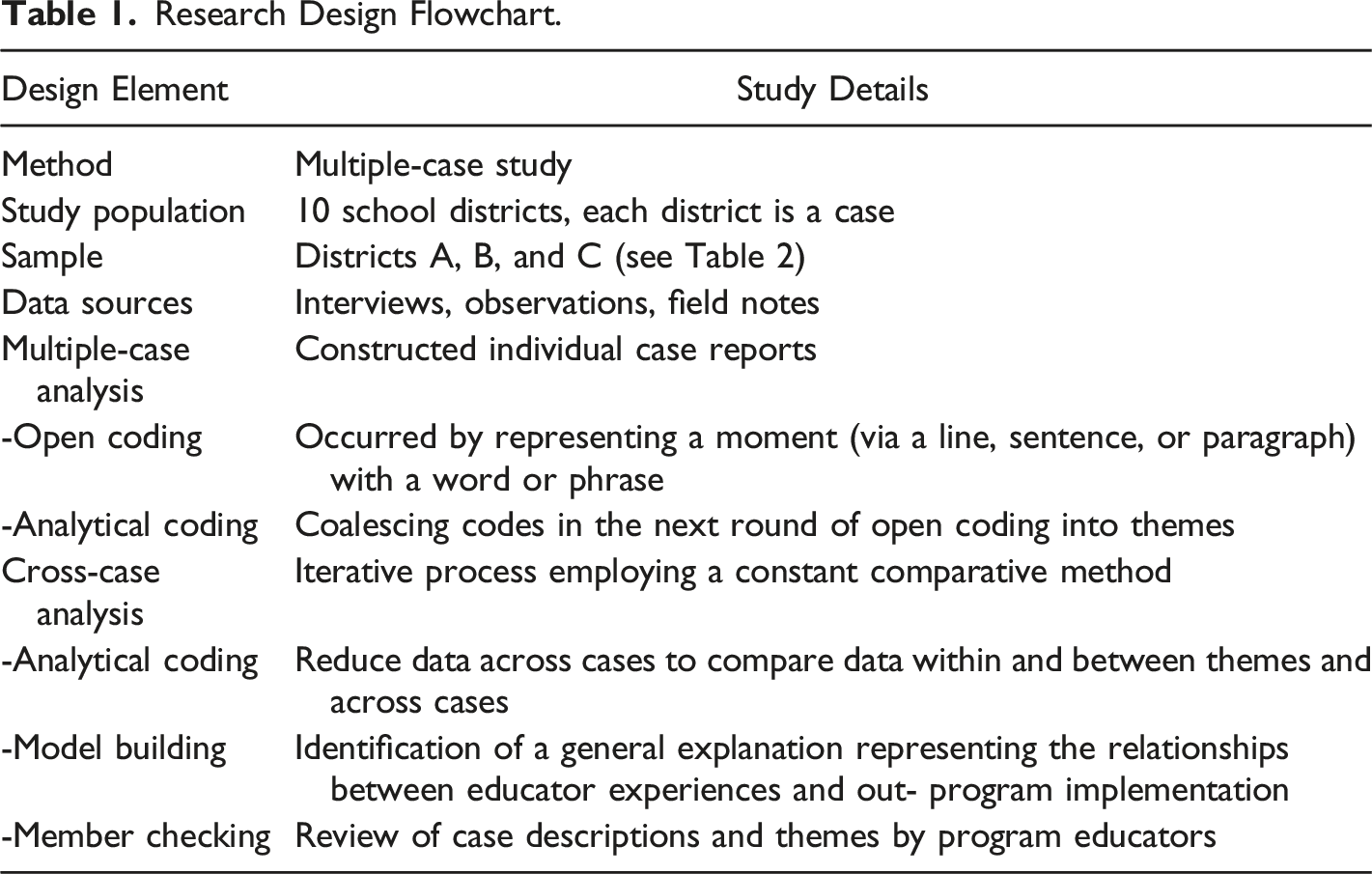
Research Design Flowchart.
Setting
Rural districts from a predominately rural Midwestern state applied to an open call to participate in a grant-funded STEM out-of-school program. The following criteria grounded the selection of ten participating districts: 1. program commitment as exhibited through the application process, 2. location (we desired implementation sites throughout the state), and 3. free and reduced-price meals (FARM) status.
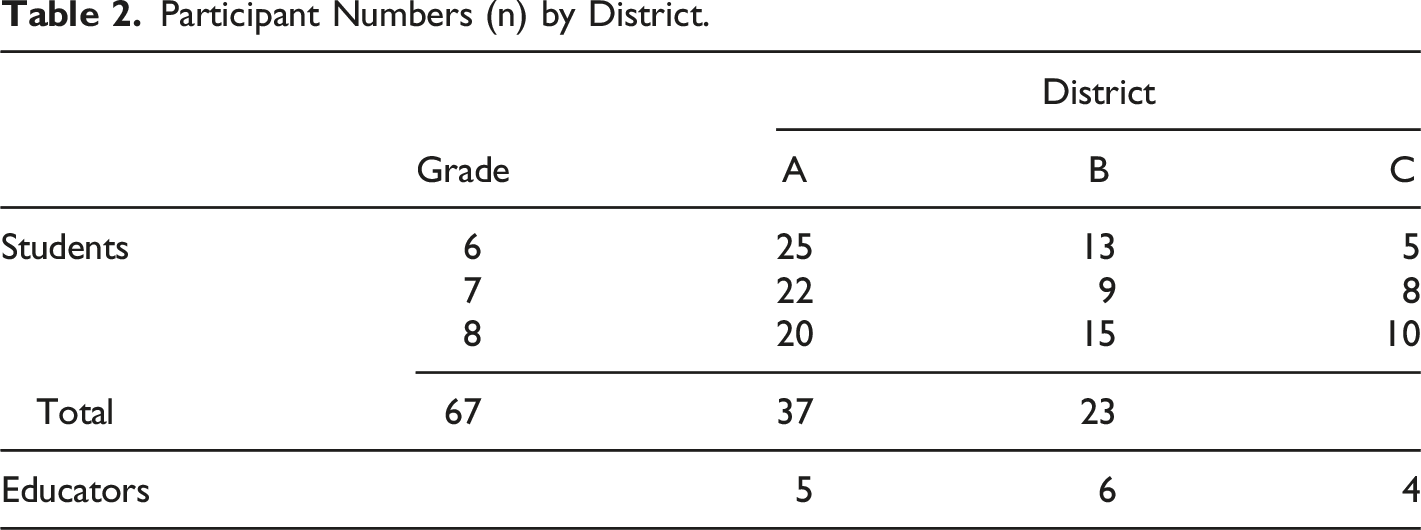
At the time of this study, the STEM out-of-school program was in the fourth year of implementation, with 34 educators serving 324 students in Grades 6–8 across 10 school districts.
Approximately 41% of the students qualified for FARM in the 10 participating districts, ranging from 13% to 63%. Districts reviewed the grade level achievement test data of the total population of rising sixth-grade students across the 10 schools (n = 1,065). A subset of students scoring in the 85th percentile or above in mathematics or science, using local norms, received an invitation to participate in academic talent identification via above-level testing (Stanley, 1996). Above-level testing offers an approach to discovering domain-specific aptitude, especially science and mathematics (Assouline & Lupkowski-Shoplik, 2012). This step produced a talent pool of students with high potential to participate in the accelerated out-of-school STEM program.
Program educators experienced annual professional development, access to curricular resources, stipends, materials, and support throughout the school year. Each participating district received funds for program implementation. A 2-day professional development workshop occurred during the summer of each year of implementation for program educators and district administrators in each of the participating districts in the program. The professional development provided tools to support curriculum implementation, such as lesson plans, pedagogical techniques, ideas for field trips, and opportunities to participate in regional STEM events hosted at the university. The professional development also included sessions on giftedness, talent development, data literacy, and social-emotional development. Importantly, the professional development session emphasized the role of local agency in identifying and developing STEM talent. The university partner did not dictate how schools should create program schedules, recruit educators, or determine curricular units of study that met the interests and needs of students. An emphasis on place-based educational decisions empowered districts to identify local structures, context, and resources that could support program implementation.
Students who participated in the intervention experienced a program designed around a minimum of 96 hours of challenging curricula in mathematics and science in an out-of-school setting. The pedagogical aims of the mathematics and science curricula were modeled with the Great Explorations in Math and Science curriculum (Lawrence Hall of Science, 2009) and the Navigations Series (National Council of Teachers of Mathematics, 2001).
Selection of Cases
Participant Numbers (n) by District.
Demographic and Geographic Data for Each District.
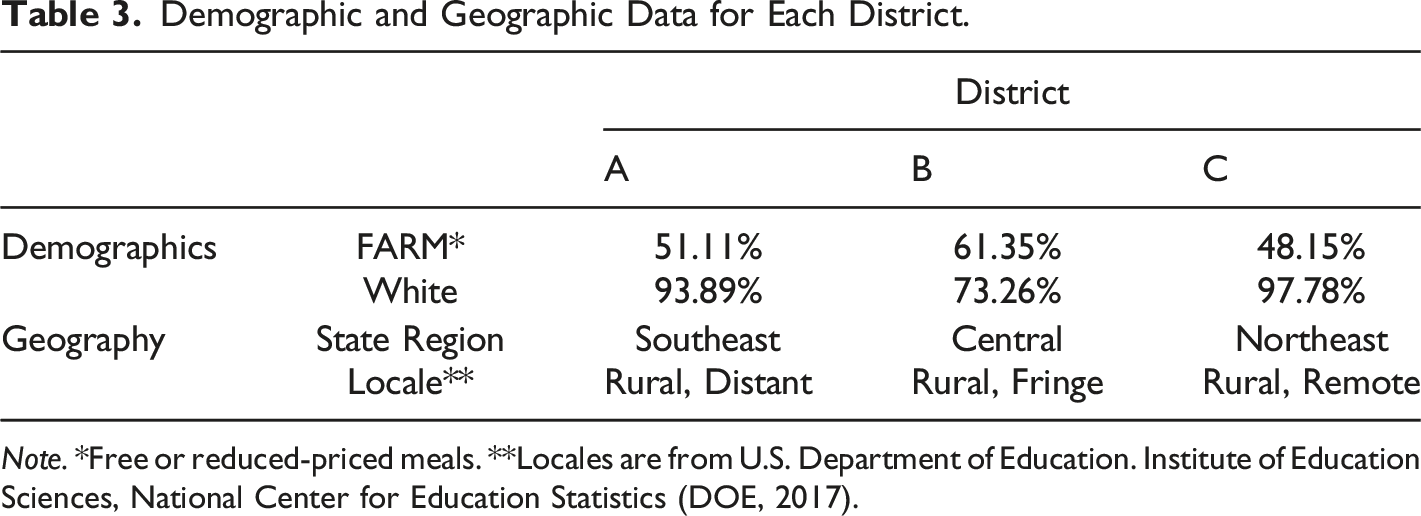
Note. *Free or reduced-priced meals. **Locales are from U.S. Department of Education. Institute of Education Sciences, National Center for Education Statistics (DOE, 2017).
District A
The middle school in District A was located approximately one mile from the edge of town. The middle school building connected to the high school, with the elementary building sitting just to the north. The building itself was just under 20 years old and was in a small community (fewer than 1,000 people), The district population was 94% White (United States Department of Education [U.S. DOE], 2017). Some Latino families and families with biracial children had begun moving into the area in recent years. The town had also experienced economic hardships, and more than 51% of district students qualified for FARM. For program initiation and implementation, District A had one person.
District B
The middle school in District B was unique in its composition because it housed Grades 5–8 and was relatively large with 1,100 students. The community was bigger than the other two. District B was geographically isolated from other large towns, and the school district drew students from all over the region. District B has a student population of 4,007 (U.S. DOE, 2017). The student body was more racially diverse than the other schools in the study; 26% of the total population being students of color (U.S. DOE, 2017) with one student who was an English language learner in their STEM out-of-school program. More than 61% of the district’s students qualify for FARM. District B had one coordinator and two educators for the program.
District C
District C was the most rural of all the sites, with the school located off a series of gravel roads. This district was created in 1962 by the merger of three small rural school districts into one. Students who attended this school came from three different small towns and a large unincorporated area. District C served 542 students in kindergarten through Grade 12. District C had 48% of students qualifying for FARM and was more than 97% White. District C had one coordinator and two educators for the program.
Data Sources
We used multiple data sources and integrated them into the data analysis. This is the hallmark of rigorous case study research (Baxter & Jack, 2008; Snyder, 2012; Yin, 2009). Our data sources included interviews, observations, and review of artifacts of lessons occurring during the program. All recordings and field notes as well as transcriptions of interviews and observations were kept in a shared file that only research team members could access. The research team followed a prescribed research process including the following steps: At each of the visits, the researcher turned on the smart pen once the session officially began. The smart pen was used to record the audio of the lesson. Field notes included descriptions of how the room or learning space was configured, how students were grouped or placed themselves within the space, where the facilitator positioned themselves within the space, descriptions of any audio or visual media used by the facilitator, and any relevant information related to physical movements or responses by the students during the lessons. At the end of each observation, the researcher recorded their reflection in the field notes. Because of the technology of the smart pen, digital capture of the notes occurred, and the notes were uploaded simultaneously as the researcher wrote into the notebook. These notes were uploaded onto an accompanying tablet device that paired with the smart pen. After the visits, the notes and recordings from the tablet were uploaded into the research team’s server. The tablet was locked with a code that was only known to the research team, and it was always in the sole possession of the research team. The shared server was a tool in our overall research process, which was collaborative and transparent.
Interviews
Semistructured interviews investigated educators’ experiences and decision-making around program implementation. The interview protocol (see Appendix A) provided a guide for the identification of interview topics to be explored in more detail allowing the flexibility to ask follow-up questions as they arose and engage in conversation around the topics of interest. The questions were purposefully constructed in an open-ended way providing space for the educators to share as much information as they wished to share. Interviews provided data regarding both structure of their district’s program and educators’ perceptions of program implementation. Eight interviews were conducted in total, with two interviews conducted in District A and three each in Districts B and C. Interviews occurred both before, during, and after program sessions. Interview times varied depending on the structure of the site and on the educator’s schedule, but most were approximately 15 minutes in length. The audio of each interview was recorded and transcribed verbatim.
Session Observations
Ten program sessions were observed in person. Four sessions were completed in District A and three sessions each in District B and C. When conducting observations, the researcher was positioned at a location agreeable to the educator. The researcher then circulated through the room during instruction and interacted with students as they engaged in the activity. A smart pen recorded audio of the lessons and descriptive field notes. Field notes documented classroom layout, classroom events, educator behaviors, and student actions. Analytical as well as interpretive memos were recorded in field notebooks to capture researchers’ reflections and to make sense of research, observations, and interactions with participants (Maxwell, 2013).
Data Analysis
A triangulated case description for each district was created based on the convergence of sources (Yin, 2009). Each case description began with a narrative of the setting for each district, capturing the researcher’s perceptions upon arriving at a district and observing the physical community and district buildings. Interviews, observations, and field notes were analyzed together to create a case description of program implementation. These artifacts were analyzed using the constant comparative process of open and analytical coding (Anfara et al., 2002; Merriam, 2009; Merriam & Tisdell, 2015). A rigorous process of open coding transcripts occurred by representing a moment (via a line, sentence, or paragraph) with a word or phrase. Coalescing codes in the next round of open coding resulted in themes. Then the open and thematic codes were analyzed by two research team members. They identified how the emerging themes related to the affordances and barriers—successes and challenges—educators experienced while implementing out-of-school STEM programming in rural schools.
Following the creation of individual cases, cross-case analysis was conducted to explore relationships, if any, and build a general explanation representing the relationship between program implementation and experiences (Yin, 2009). The cross-case analysis was an iterative process employing a constant comparative method. Two members of the research team reduced data across cases using analytical coding and theme formation to compare data within and between themes and across cases (Anfara et al., 2002; Merriam, 2009; Strauss & Corbin, 1998). These analyses were fluid and represented the creative work of qualitative research.
The larger research team discussed themes from individual analysis and smaller research group meetings. This approach brought the rich context of backgrounds from multiple disciplines to generating and understanding themes across cases. The case descriptions and themes were member-checked during summer professional development when educators in the STEM out-of-school program reviewed the findings and offered feedback.
Trustworthiness and Limitations
One concern with multiple-case study research is the relationship between the choice of program sites to the theoretical underpinnings of the research. The three cases were selected to meet maximum variation purposive sampling criteria (Palys, 2008) across enrollment sizes, FARM levels, and locale. This selection process aligns with the theoretical underpinnings investigating affordances and barriers to implementing an out-of-school program in rural schools. Data triangulation of observations, audio recordings, and detailed field notes developed trustworthiness. The members of the research team identify as female and hold a variety of professional, ethnic, and cultural identities; team members originate from urban, suburban, and rural locales. One of the team members attended severely underresourced schools in a large city and brought with them the lens of being a student in an underresourced school, which they felt gave them a unique insight into student experience. Another team member attended rural schools that were very similar to the sites in this study. We worked together to build and understand the themes of this research. Data were open coded individually, analytical coding and theme formation occurred in small teams, and then the entire research team brought the rich context of backgrounds from multiple lived experiences and academic disciplines to understand themes and implications across cases (Merriam, 2009; Yin, 2009). The cases presented in this study are unique environments in which captured data were used to understand those environments to inform future work with respect to STEM enrichment program implementation in rural middle schools.
Findings
Triangulated Case Descriptions
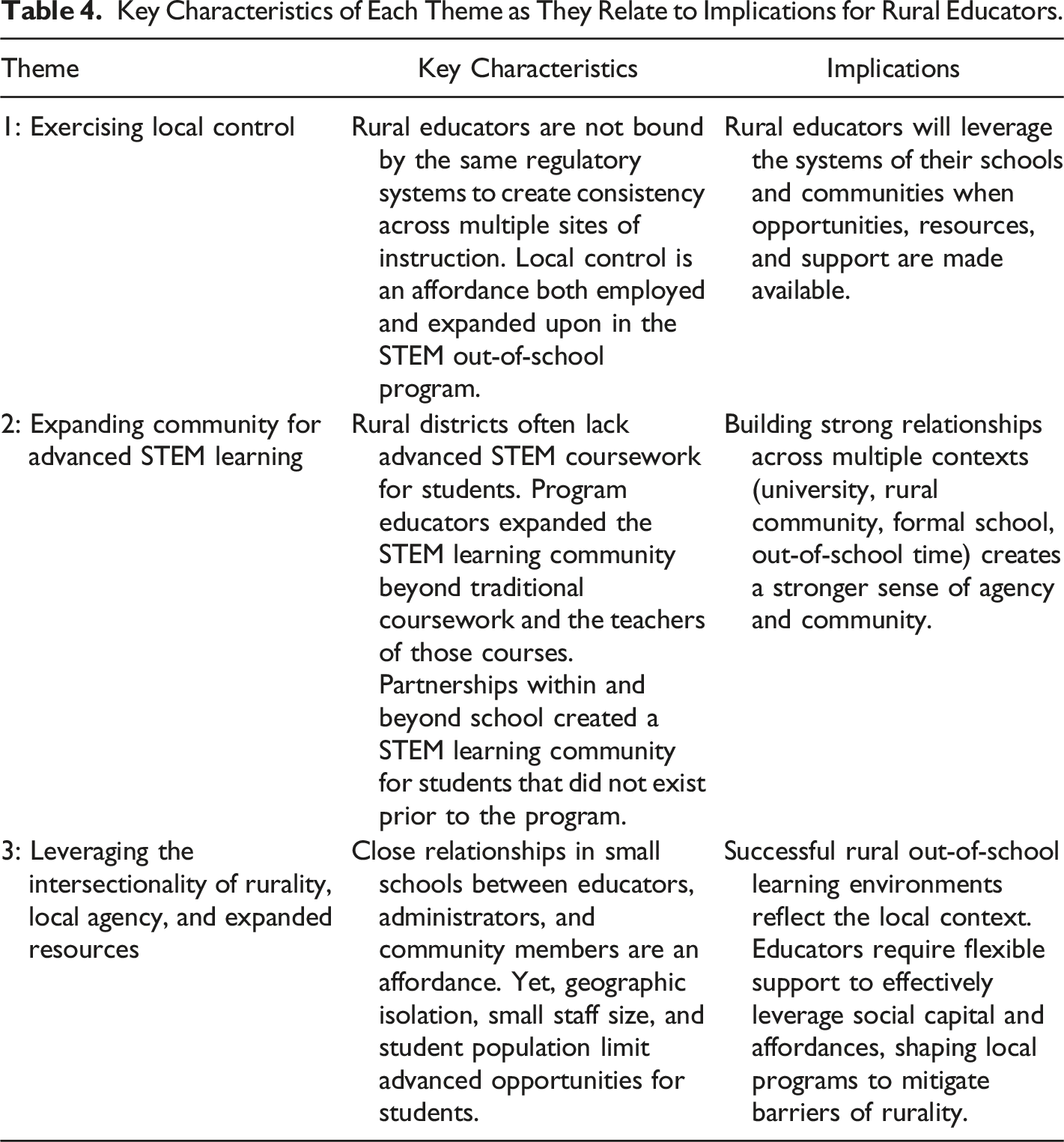
A descriptive case report of each district created a narrative grounded in the study’s questions. Each case began with a narrative synopsis of the district’s demographic, geographic, economic, and school setting. The districts’ implementation of the program was then described. Next, the analytical processes described above brought together the session observations, field notes, and interview data to understand the barriers and affordances educators encountered while navigating the program. The case description for each district documented the evidence illustrating these barriers and affordances. Three cross-case themes demonstrate the shared affordances and barriers during implementation across districts. These themes include: (a) exercising local control, (b) expanding community for advanced STEM learning, and (c) leveraging the intersectionality of rurality, local agency, and expanded resources.
Theme 1: Exercising Local Control
Rural educators identified local control as an affordance both gained and exercised in the STEM out-of-school program. Program educators leveraged a sense of agency over their settings and the curriculum to create customized learning experiences for their students and projects with local relevance. For example, in District A, an educator used formal training in special education to create personalized education plans for each student. My goal thus far is to get where they [students] have a desire to go to college. [There are] data that says. . . why that they’re in the program. Then you have basic strengths. . . what are the things they need for differentiation in the classroom? So, it’s more that PEP [Personalized Education Plan] becomes almost more of like an IEP [Individualized Education Plan] for TAG [talented and gifted] students. (District A, Interview, 1.18)
The educator at this district had their own curriculum they wanted to implement based on student needs at this school. Likewise, in District B, the educators felt empowered to design curriculum to solve a local issue concerning an unused parcel of land directly adjacent to the school building. They also extended a sense of local agency to their students. Students at each grade level of the program had the freedom to select what they would like to do within the space. The eighth-grade group designed and created bridges; the seventh-grade group designed and created benches; and the sixth-grade group designed and created pathways. As one student reported, “We are the architects!” (District B, Observation, 2.18).
Another aspect of agency is how districts modified the talent search model’s use of above-level testing to identify students for whom the program was likely a good academic fit. During professional development sessions that offered ongoing support, educators were offered guidance on identifying and interpreting above-level testing data. Each district was asked to annually consider its talent pool data to establish its program admission guidelines based on local norms and the makeup of each year’s talent pool. A cut score for participation was not supplied by the university, nor was it recommended. Districts felt empowered to modify the talent identification model to their needs.
District B created modifications to cast an even broader net resulting in inclusive identification practices. They added criteria to the talent search model to expand beyond above-level assessment data, including class performance, additional artifacts (e.g., documentation of hobbies), and off-cycle student admission to the program. For example, two students who had not started the program as sixth graders were invited into the program midway through their eighth-grade year based on their academic performance during the most recent school year (District B, Observation 1.18). One of the program educators expressed that these additional identification methods helped them be more inclusive and more accurate in their talent identification process.
District C modified the talent identification model by relying upon cut scores for program identification, despite the fact that the university partner had not imposed the practice. They believed they could use the identification process to motivate student engagement. Because program participation was highly desirable at this school, students not identified for programming through the talent search process expressed sadness over not being chosen. These students told their educators that they would try again next year to participate. Many of the students worked diligently to achieve the scores needed to be part of the group. It’s becoming a badge of honor to be part of the program. Students are really trying hard on the test. They want to get into the program and they’re really disappointed when they don’t get in. . . . The kids who were not motivated have become motivated and joined. . . . We’ve had three kids join who weren’t in the program before who have stepped up. . . . [The program] is developing a reputation. . . . What I like about it, too, [it is an] opportunity for students who aren’t necessarily identified as gifted. . . . It motivates. It gives them another opportunity for high-ability students. (District C, Interview, 1.18)
Theme 2: Expanding Community for Advanced Science, Technology, Engineering, and Mathematics Learning
Although the geographic location and community size differed across the three sites, a community of high-potential learners emerged within the STEM programs. District A experienced ample district support for the STEM informal program, evidenced by their ability to use one of the recently remodeled and technology-infused classroom spaces for out-of-school programming (District A, Observation 2.17). In District B, the creation of a community partnership occurred around the donation of a plot of land that program students restored to native prairie and designed as an outdoor learning space. Educators in District B created a dynamic community between students, local conservation groups, county officials, and school administration through their approach to program implementation. Educators invited guests such as the state’s conservation officer to speak at sessions led to students planting native species in their prairie to assist with statewide conservation efforts. (District B, Observation 2.18).
District B program educators regularly expanded students’ interactions and learning beyond the teachers within the program. For example, one educator recounts how students engaged in a project to design and build furniture for various teachers in the school. They surveyed the teachers and asked them if they needed a particular type of furniture for their classrooms. For the library, students had designed a chair that included bookshelves. They had to find a client [and] find out what the client needed. Their client is our reading teacher, and she wanted, like a modern design that kids could sit and read and have books available. They had to go in there and measure the room. Made a prototype for that teacher. Had that teacher okay it, went back, redid it. Eventually got it okayed, scaled it down. . . a scale model to show, “Okay, do you like this?” Then scaled it back up, but it’s gotta be fifty percent [new materials]. The rest is just supposed to be [reused] sources like cardboard. (District B, Observation 1.18)
They expressed that flexible, locally focused approaches maximized the benefits of the local resources and expertise available within the community. (District B, Observation 1.18; District B, Observation 2.18; District B, Observation 2.19).
In District C, participation in the out-of-school STEM program created a community of learners who served as peer mentors within their school. District C’s community of high-potential learners was one with social capital in the district. They had the ability to begin academic trends in the district, increase the number of program participants, and encourage past participants to mentor younger participants (District C, Interview, 1.18).
Theme 3: Leveraging the Intersectionality of Rurality, Local Agency, and Expanded Resources
Rurality is both an affordance and a barrier for engaging students in advanced STEM opportunities. Across all three districts, the close relationships between educators and their administration and community members were recognized and leveraged by program educators to identify students with STEM talent and implement the program. In a small school where students in grades K–12 were educated within the same building, students could move to access educators, materials, and students at different grade levels. Nonetheless, geographic isolation and small school size meant that opportunities derived from field trips, internships, competitions, and advanced coursework were not readily available to the students.
District A viewed their small rural community as an affordance that allowed them to identify and meet the academic needs of the students in the program more accurately. Educators at this school felt that their rural setting facilitated an inclusive community. Educators and administrators knew the students well and could better meet their needs due to these existing relationships. As one educator reflected, [Living in a small, rural community is] all new to me. . . I really enjoy it. . . . There is such a community. . . . They have something really good going on here. They just, it’s no matter [what] it is. . . If it’s sports, academics, they just have this community feel. (District A, Interview, 1.18)
Moreover, the configuration of the smaller educational setting maximized access to resources for all grade levels. The program met in a recently remodeled technology-rich classroom with a 3D printer, charging stations, and multimedia capabilities. The room configuration allowed for collaboration, and the program seemed to be using it to their advantage. On one observational visit, the program educator ran out of laptop computers for each student to use. She sent a student down to the high school computer lab to obtain more laptop computers connected to the middle school. This resource sharing was possible because the middle and high schools shared the same building. The educator told the researcher that she recognized this as unique and not possible in larger schools. She also recognized a level of familiarity between administration and students that seemed unique to the rural setting; she discussed the superintendent dropping in regularly to school events. She had previously worked in a large district. She had never witnessed a superintendent interacting with students regularly in a supportive fashion. Educators in each of the three districts expressed frustration over the competition for students by extracurricular programming. “Football, volleyball, and cross country, then you’re fighting basketball, and wrestling, and then track. And most of our kids are very involved” (District C, Interview 1.17). An educator in District A expressed frustrations regarding scheduling as a barrier to student participation and staffing. The biggest issue we see is the scheduling of trying to get it in with the kids, with a small school. . . . We’ve had different administration and different set ups of classes and new teachers, and that’s the hardest thing. . . . The biggest trouble in a small school I think is the scheduling. . . . Because we’re limited to the staff that can do it. And so that’s why we [changed the format from after school to]. . . during school hours because our participation’s a lot higher for middle schoolers. . . we’re competing with all the other clubs and organizations. (District C, Interview 2.18).
Technological issues were frequent for students trying to use specific engineering programs in the school’s computer lab for group projects and program funding empowered educators with provided potential solutions. [The computers have been] that way all year this year. I don’t know why. Last year it just, it wasn’t that way. Now it’s a new update. Which maybe it does use more memory than what’s on there. . . . We should use our funds from you guys to update the memory on our stupid computers so it works better (laughing). (District B, Observation 2.18)
An educator in District C discussed how the configuration of the elementary, middle, and high schools housed in one building fostered relationships across the grades. Despite living in different towns, students and educators knew each other well. There were opportunities for cross-age tutoring, mentorship by the older students, and collaborations with educators and coaches outside of the program. Well, they have come back and they’re helping [in the math] class. And they are running this [robotics] group. . . . They’re now mentoring the others. They were part of STEM and they’ve graduated and moved on but they’re here. . . . We’re kind of letting them lead the way. As they are stepping up and participating in leadership roles, they can cheer [current students] on as they go through [the program]. . . . And this being such a small school, where we only have so many students. They all participate in sports. And multiple sports, and so every season, this is an issue. . . I mean that was a concern with the parents too. We had to work with coaches [because program students] were a little late getting to practice, so we had to arrange it all and tell them, “This is really important.” That’s how we’ve been flexible with making it work. (District C, Interview, 1.18)
Access to the entire district population was beneficial to sixth-grade students learning how to conduct surveys and perform statistical analyses. Some students in the program used their newly gained skills and knowledge to work with the elementary school’s LEGO® Robotics League (District C, Interview, 1.18). Ninth-grade students from an earlier cohort of the STEM informal program chose to return to serve as mentors (District C, Observation, 2.18).
Geographic isolation from more populous areas of the state presented challenges for District A and C. One educator reflected on how the extra travel time poses challenges for educators’ workload. We have really good teachers, so I guess we could always have more resources, more opportunities to do things. Our biggest obstacle is our location. Like we were just talking about taking the kids. . . to the science museum. We’re two and a half or 3 hours away. So, we’re looking at a 5-hour, 6-hour bus trip. We’re talking like all day long and it’s hard on me and my family. . . [because] we have to do it on a Saturday. So just to be able to get to those resources, that would be our biggest obstacle right now. (District C, Interview 2.18)
Although using program resources for field trips in some districts was challenging, in another district this was a means to address geographic isolation. “We’re trying to get where it’s not just here. . . . We want to expand out this year if we can” (District A, Interview, 1.18).
Discussion
Key Characteristics of Each Theme as They Relate to Implications for Rural Educators.
Highlighted in Theme 1, rural educators made use of their agency when implementing an out-of-school program for high-potential students. One notable point of agency was educators’ modifications to the talent search above-level testing process. Whereas educators developed data literacy skills and an understanding of a talent search model that employs above-level testing, they also leveraged their relationships with other teachers, parents, and students to expand or narrow the processes of talent identification and felt there was flexibility in modifying the model to meet local needs and goals. Educators used this program to create advanced opportunities for about 18% of their school population, in comparison to the typical 3–5% of students served in gifted programming (Assouline et al., 2017). Although all three participating districts increased access to advanced academic opportunities, one district created an even more flexible identification model while another restricted the model. Thus, the districts modified the model to best suit the needs of their students.
As evidenced by Themes 2 and 3, rural educators used relationships within the school building to identify high school colleagues to serve as content experts to the program. Additionally, relationships within the community resulted in support for the program. The rural affordance of close community ties and relationships impacted the design and implementation of the program. These practices highlight the vitality of harmonious relationships in students’ experiences. The educators in our sample also believed they had a better understanding of their students’ interests. As a result, the high-potential students and their educators developed a community through the program. When educators build strong relationships across multiple contexts (rural community, formal school, and out-of-school time), students and educators alike enjoy a stronger sense of agency and community.
Despite the likelihood of increased workloads, the educators implementing this out-of-school program went above and beyond the curricular supports provided to implement the program. They created individualized education programs for the students identified for the program. They created and implemented a locally relevant curriculum. The educators implementing the program saw their work as more than an obligation to meet the minimum requirements. They recognized geographic isolation as a barrier to students having access to advanced educational opportunities. However, the districts in this study positioned students within the program to create a community for high-potential learners throughout the school district by recruiting additional programming and encouragement to serve as near-peer mentors.
The Intersection of Barriers, Affordances, and Rurality
Our findings suggest that rurality presents comparable barriers such as geographic isolation (Kittleson & Morgan, 2012) for both an informal out-of-school program and a formal academic setting. One district was too remote to overcome this barrier. Even with program support and resources, they cited the remoteness of their locale as a barrier to providing their students with opportunities such as field trips. Remoteness also played a role in decreased access to bandwidth to effectively use online resources. Although teachers had access to newly created technology-rich classrooms, findings in this study revealed that some still struggled with bandwidth and slow connections, as reported by Kittleson and Morgan (2012).
Nevertheless, rurality also emerged as a perceived affordance to implementing the informal STEM program in these three districts. In our case sample, program educators perceived increased agency over their pedagogy and curriculum through more student-centered instruction that extended well beyond the curriculum offered. Typically, rural students do not have access to advanced coursework in mathematics and science and are less likely than their urban and suburban peers to access STEM clubs, internships, family nights, and out-of-school enrichment programs (Banilower et al., 2018). However, educators created informal, community-based programming through this out-of-school STEM program in which students opted to participate (Assouline et al., 2017; Ihrig et al., 2018). Although access to an out-of-school STEM program increases opportunities, a potential tension exists for students when they had to choose between their academic and nonacademic interests. Modifying the program to account for after-school conflicts may be necessary because research suggests that when high-potential students participate in extracurricular STEM programs, they are more likely to pursue STEM careers than those who do not participate (Milgram & Hong, 1999; Wai et al., 2010).
Implications
The educators implementing this out-of-school program—explicitly designed for students with STEM potential—behaved consistently with the research on rural educators working in traditional classroom settings (Banilower et al., 2018; Buchanan et al., 2013). One crucial implication is that rural educators will leverage the systems of their schools and communities when opportunities and resources are made available. The educators in this study were aware of the affordances and barriers they faced in their schools. They scheduled their program times, structured their programs, and focused their curriculum to best address local needs. Successful rural out-of-school learning environments reflect the local context. Educators require support to effectively leverage social capital and shape local programs around the needs and interests of their students and communities.
The interplay between formal school settings and out-of-school time was fundamental to implementing the STEM out-of-school program. However, this interplay is more fully understood when situated within the influences that shape educational opportunities in rural America. Currently, rural schools have access to fewer opportunities and resources, and geographic isolation may well be a major cause of this inequity. Without access, rural educators are not engaging in this work. Not because they cannot or will not, but because they fundamentally lack access to opportunities and resources for themselves and their advanced students. As such, to sustain this work beyond the individual educator or school requires policy and structural supports.
Future Directions
Questions remain about the longitudinal impacts of these experiences on rural students’ academic outcomes, identities, and aspirations. What are the effects of teachers’ content expertise on the local agency they employ to design place-based curriculum? To what extent are students being challenged by the curriculum? Because schools in rural areas play a vital role in the community (National Rural Education Association, 2016; Schafft & Biddle, 2014), understanding how to support rural educators in creating multiple and congruent spaces for developing academic talent, fostering a well-educated citizenry, and normalizing intellectual curiosity is a significant endeavor that merits further investigation.
Footnotes
Declaration of Conflicting Interests
The author(s) declared no potential conflicts of interest with respect to the research, authorship, and/or publication of this article.
Funding
The author(s) disclosed receipt of the following financial support for the research, authorship, and/or publication of this article: This article was supported by Advancing Informal STEM Learning, National Science Foundation (1713123).
