



Abstract
Algebra is considered by many to be a gateway to higher-level mathematics and eventual economic success yet students with and without disabilities often struggle to develop algebra skills. This study builds on the limited understanding of how virtual manipulatives support students with disabilities in the area of algebra by investigating their use within the virtual-abstract (VA) framework. Using a multiple probe across behaviors, replicated across participant design, researchers found a functional relation between the VA framework and student algebraic learning. Mathematical behaviors based on grade-level curriculum included: one-step equations with positive and negative numbers, two-step equations with positive numbers, and two-step equations with positive and negative numbers. All three seventh-grade students with high-incidence disabilities improved their performance on each of the three algebra behaviors during intervention, and all participants maintained their accuracy after intervention, as compared to baseline to maintenance. Detailed results and their implications for practice are discussed further.
Developing algebraic reasoning is important for all students, as algebra is considered by many to be a gateway to higher-level mathematics and eventual economic success, as higher-level mathematics build upon algebra as well as algebra is used in everyday life (Watt et al., 2016). Yet, the abstract nature of algebra creates unique challenges for some students, including students with disabilities (Ketterlin-Geller et al., 2019; Star et al., 2015; Watt et al., 2016). Transitioning from concrete arithmetic (e.g., 3 cats + 7 cats =) to the symbolic algebra (e.g.,
Concrete-Representational-Abstract Framework
One evidence-based mathematics intervention for students with disabilities is the concrete-representational-abstract (CRA) framework (Agrawal & Morin, 2016; Bouck, Satsangi, & Park, 2018). The CRA framework focuses on conceptual understanding and students’ ability to perform mathematical procedures across lessons and is considered an effective intervention for students with disabilities across a variety of mathematical content areas including place value, basic operations, fractions, and algebra (Bouck & Park, 2018). The CRA framework is a graduated instructional sequence in which students make connections with mathematical concepts at a concrete, representational, and abstract level, with instruction provided via explicit instruction (Agrawal & Morin, 2016; Bouck, Satsangi, & Park, 2018; see Figure 1). At the concrete level, students use concrete manipulatives to aid in solving mathematical problems. Common concrete manipulatives include geoboards, base ten blocks, fraction strips, and algebra tiles (Bouck & Park, 2018). Once a set criterion level is met, students move to the representational phase where they create their own visual (i.e., picture, drawing) to make a connection to the abstract. At the abstract level of mathematical understanding, students are able to reason with numerical strategies without concrete or representational support (Agrawal & Morin, 2016). At each phase, teachers employ explicit instruction through a sequence of instruction where they first model and then provide guided practice. Finally, students are able to perform the various steps independent of teacher support (Agrawal & Morin, 2016).
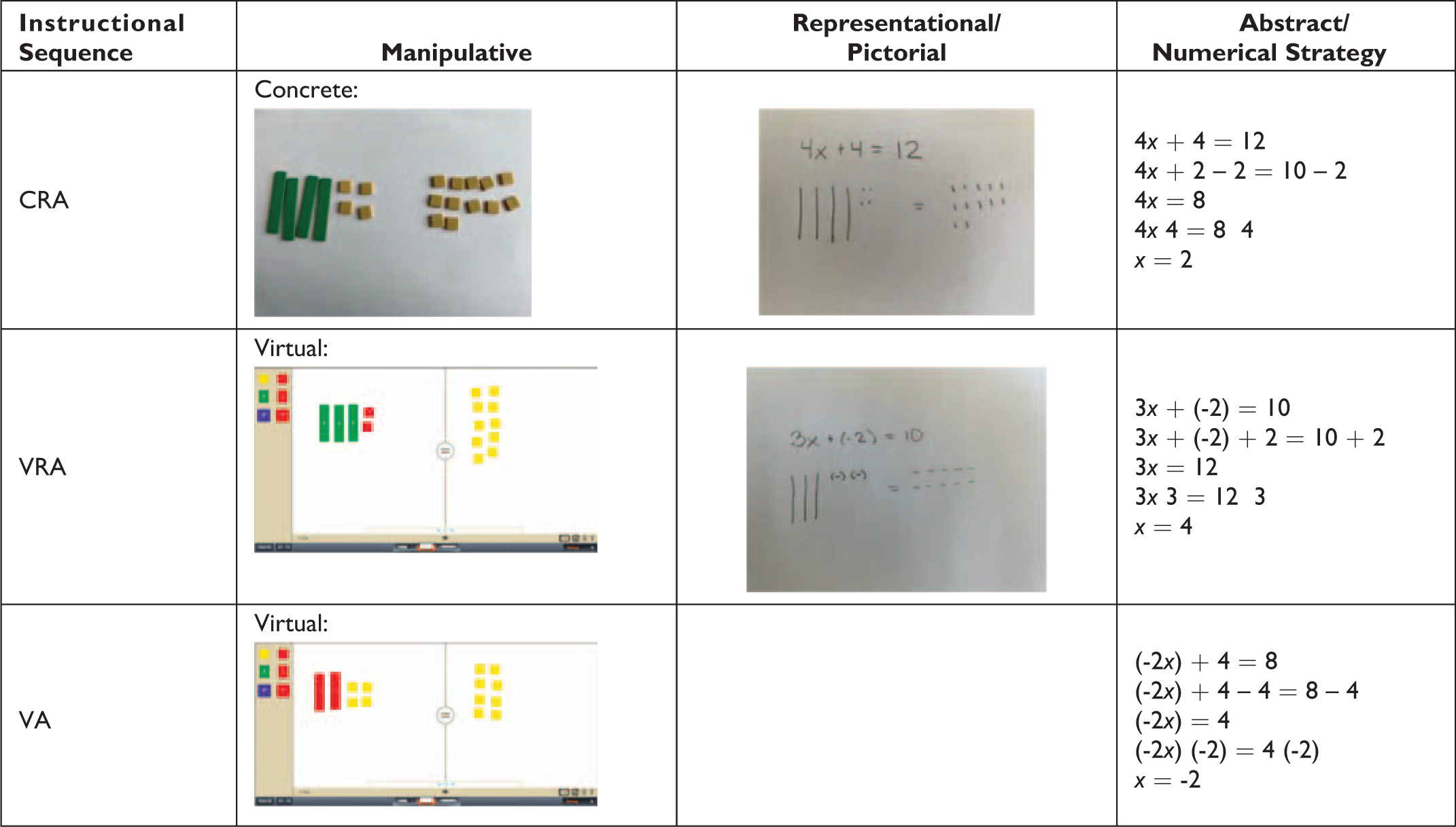
Manipulative-based instructional sequences—illustrated with algebra. Note: The concrete manipulatives are algebra tiles. The virtual manipulatives are the Algebra Tiles app from Brainingcamp.
CRA and Algebra
Researchers demonstrated the effectiveness of the CRA framework to teach algebraic concepts to students with disabilities (Maccini & Ruhl, 2000; Strickland & Maccini, 2013; Witzel, 2005; Witzel et al., 2003). Maccini and Ruhl (2000) found students with disabilities improved their ability to subtract integers when using algebra tiles as part of the CRA framework, and over time all students were able to generalize their skills to other types of problems. When comparing the CRA framework to traditional algebra instruction, Witzel et al. (2003) found the CRA framework to be more effective for middle school students with disabilities or at risk of algebra failure. Students who received the CRA instruction outperformed their matched pair and committed fewer procedural errors when solving for variables. Witzel (2005) compared the CRA framework to an approach with repeated explicit instruction without manipulatives and found sixth- and seventh-grade students with disabilities were better able to transform linear equations when they learned the algebraic concept through CRA. Most recently, Strickland and Maccini (2013) examined the Concrete-Representational-Abstract Integration strategy (CRA-I), which modified the sequence of CRA by using each phase simultaneously, on teaching multiplication of linear expressions to secondary students with disabilities. The CRA-I strategy was effective in improving students’ conceptual understanding and procedural fluency.
Mathematics Manipulatives
A vital component of the CRA framework is the effective use of manipulatives (Agrawal & Morin, 2016). Manipulatives are a recommended tool for teaching mathematics at all levels (NCTM, 2013), considered an effective instructional practice for students with disabilities (Strickland & Maccini, 2013), and shown to improve performance of secondary students with disabilities on algebra related content (Satsangi et al., 2016). Despite research supporting the benefits of using concrete manipulatives, there is a decrease in the use of manipulatives during mathematics instruction from kindergarten to middle school (Swan & Marshall, 2010). Often middle school and high school-aged students view these tools as stigmatizing and find them inappropriate for their age (Satsangi & Bouck, 2015). As schools focus more time and resources on technology, the use of virtual manipulatives rather than concrete manipulatives may be more appropriate for older students (Bouck, Working, & Bone, 2018; Satsangi & Miller, 2017).
Virtual manipulatives are dynamic visual representations of concrete objects that can be accessed through online applications and programs (Bouck, Working, & Bone, 2018). Teachers can use virtual manipulatives in comparable ways as concrete manipulatives, like introducing mathematical ideas, developing understanding through visual representation, and scaffolding students as they actively engage in learning (Bouck, Working, & Bone, 2018). Virtual manipulatives help support students with learning disabilities as they work with more advanced mathematical concepts (Satsangi & Bouck, 2015; Satsangi et al., 2016), and these tools can be customized to offer appropriate support to a variety of learners without the stigmatizing effects of being different from peers (Satsangi & Miller, 2017). When learning algebra, students with disabilities can use virtual manipulatives as part of the virtual manipulative framework.
Virtual Manipulative Frameworks
Researchers have proposed and explored a few virtual manipulative frameworks: (a) the virtual-representational-abstract (VRA) framework, which uses the same systematic approach to teaching mathematical strategies as the CRA but uses virtual manipulatives rather than concrete manipulatives (Bouck & Sprick, 2018), and (b) the virtual-abstract (VA) framework, which is an adaptation of the VRA framework where the representation phase is removed and students move directly from the virtual to the abstract phase (refer to Figure 1). In both frameworks, students begin in the virtual phase where they are provided access to virtual manipulatives (i.e., virtual algebra tiles, virtual base-10 blocks) as the teacher provides explicit instruction on how to use the tool to support their acquisition of the mathematical behavior (Bouck, Bassette, et al., 2017). Following the virtual phase, in the VRA, students move into the representational phase where they draw pictures and figures to represent the mathematical concept, and then to the abstract phase where they rely on the numerical strategies (Bouck & Sprick, 2018). In the VA, students transition directly between the virtual and abstract when mastery is demonstrated.
Virtual-Abstract Framework
Researchers examined the VA instructional sequence after finding some students with disabilities struggled with drawing pictorial representations in the representational phase when considering particular mathematical content. Bouck, Bassette, et al. (2017) found it was challenging for middle school students with disabilities to draw the fraction representations in a study examining the VRA framework, despite student acquisition (Bouck, Bassette, et al., 2017). The representational phase may have added unnecessary stress for the student. Previous researchers also found the representational phase—within the CRA framework—may not be a crucial component for all students’ conceptual understanding and/or that not all mathematical content lends itself as easily to pictorial drawings (Cass et al., 2003; Marsh & Cooke, 1996).
In their single case study, Cass et al. (2003) determined their manipulative and mathematics—geoboards and area and perimeter—did not lend themselves to a representational phase. In a single-case study involving three secondary students with learning disabilities, Cass et al. moved students from use of a concrete manipulative (i.e., geoboard) to abstract (i.e., paper-and-pencil) without a representational phase; the students acquired and maintained solving for area and perimeter. Cass and colleagues further articulated their findings supported earlier work (i.e., Marsh & Cooke, 1996) questioning the importance of a representational phase. Marsh and Cooke (1996), in their single case study, found the representational phase not needed by three elementary students with learning disabilities using Cuisenaire rods and then numerical strategies in solving word problems. In their study, the three students acquired the targeted mathematics with concrete manipulatives and generalized to solving without.
Bouck, Park, et al. (2017) found three of the four students in their study improved performance in adding fractions with unlike denominators using the VA framework. All participants experienced an immediate effect moving from baseline to intervention but two students needed additional sessions during the abstract phase in order to meet criterion. Overall, the lack of the representational phase did not seem to impact student success and eliminating it from the framework may be beneficial especially for students with spatial issues. Bouck, Park, et al. (2019) examined the effects of the VA framework on the acquisition of algebra skills for middle school students with disabilities. In their study, all four students experienced an immediate effect when moving from baseline to intervention and only two students needed to repeat sessions. However, students were not able to consistently demonstrate their learning during maintenance and the researchers highlighted the need for more research on the framework.
Current Study
Although there is an obvious need for a better understanding of the impact of the VA framework, even more can be gained from further examination of how to support students with disabilities in the development of algebra skills. The current study aims to build on the limited understanding of how virtual manipulatives support students with disabilities by investigating their use within the VA framework taught via explicit instruction. This study was a systematic replication of the recent VA research conducted by Bouck et al. (2019) in that the research design and focus on solving algebra equations were the same, but a different disability population was examined. The research questions include: (a) Using the VA framework and explicit instruction, to what extent does the performance of seventh-grade students with high-incidence disabilities on solving grade-level algebra problems improve? (b) To what extent do seventh-grade students with high-incidence disabilities maintain their performance solving grade-level algebra problems when no instruction is given? (c) What is the perception held by seventh-grade students with high-incidence disabilities regarding the VA framework?
Method
Participants
This study involved seventh-grade students previously identified as eligible for special education services due to a disability negatively impacting their acquisition of mathematics skills. Specific inclusion criteria for participants included: (a) an Individual Education Plan (IEP) with a math goal; (b) an Algebra Assessment Instruction: Meeting Standards (AAIMS) Basic Algebra (e.g., 12 + (−2) + 3; 12 – k = 4) score at or below 10, due to district norms that situate a student earning 10 or below is indicative of being at least 1 year behind peers; (c) limited or inadequate progress with the general education mathematics curriculum (i.e., failure to demonstrate growth toward meeting essential standards); (d) considered non-proficient in the area of mathematics according to the Iowa Statewide Assessment of Student Progress (ISASP); (e) identified as at-risk in mathematics based on the aMath fall screener; and (f) parental consent and student assent to participate. All three students were well-versed in using a school-issued Chromebook, which was used in the study, but did not have any prior experience with the virtual manipulative app used. In this study, all names are pseudonyms. Further, the researchers obtained Institutional Review Board approval prior to the start. Throughout the study, no harm was done to any participant.
Emily
Emily was a 12-year-old, white, female in the seventh grade. Emily had an IEP due to a learning disability and received specially-designed instruction in the areas of mathematics and reading. Emily received mathematics instruction from a special education teacher for 45 minutes daily in a small group setting. Her goal in the area of mathematics stated that in 36-school weeks given 5 minutes to work, Emily would be able to answer 14 problems correct on an AAIMS Basic Algebra probe three out of four consecutive trials. Her baseline for this goal was six problems correct. According to the ISASP assessment administered in the spring of sixth grade, Emily was not yet proficient in mathematics. In the area of equations and expressions, she answered 23% of the questions correctly. Emily scored a 206 on her aMath screener administered in the fall of seventh grade, placing her at the 8%ile nationally and flagging her as high risk in mathematics. According to this assessment, Emily had not yet mastered any skills under the umbrella of equations and expressions.
Sara
Sara was a 12-year-old Latina female in the seventh grade. Using state guidelines, she was identified as having a learning disability in the area of mathematics in fifth grade and began receiving special education services at that time. Sara was enrolled in a co-taught grade-level mathematics class in which the general education teacher and special education teacher delivered instruction using the co-teaching model. She received additional specially designed instruction in mathematics from the special education teacher in a small group setting (i.e., < 6 students) for 60 minutes weekly. Her IEP math goal stated in 36-school weeks when given 5 minutes to work, Sara will be able to answer 10 problems correct on AAIMS Basic Algebra probe on three out of four trials. Her baseline for this goal was 3 correct answers. According to the ISASP assessment administered during the spring of sixth grade, Sara was not yet proficient in mathematics. She successfully answered 54% of the questions in the equations and expressions section. Sara scored 210 on her aMath screener administered in the fall of seventh grade, placing her at the 17%ile nationally and flagging her as some risk in mathematics. While the test results indicated Sara was developing the skills needed to use variables to represent numbers and write expressions, she had not yet mastered any skills in the area of expressions and equations.
Paul
Paul was a 12-year-old, white, male in the seventh grade. Paul was found eligible for special education services in third grade and currently has goals in the areas of mathematics and reading. Paul receives mathematics instruction from a special education teacher for 45 minutes daily in a small group setting (i.e., <6 students). Paul’s math goal states in 36-school weeks when given 5 minutes to work he will correctly answer 12 problems on the AAIMS Basic Algebra probe on three out of four trials. Paul’s baseline score for this goal was five correct answers. Paul was not yet proficient in mathematics according to the ISASP assessment administered in the spring of sixth grade. Paul struggled significantly in the area of equations and expressions where he only answered 15% of the questions correctly. He scored a 206 on his aMath screener administered in the fall of seventh grade. This score placed him at the 8%ile nationally and he was flagged as high risk in mathematics. Paul had not mastered any skills under the expressions and equations category, but was developing the skills needed to use variables to represent numbers and write expressions.
Setting
The study took place in a small Midwest community in Iowa where 95% of the population identified as Caucasian. The community’s school district served 2,000 students across four buildings: lower elementary, upper elementary, middle school, and high school. The middle school had 485 students in grades 6–8 and 15.5% of students in the middle school were eligible for special education services. Of those receiving services, 61% had a goal in the area of mathematics. Data collection occurred at a rectangular table in an open classroom. This was a quiet space that students commonly used to work one-on-one with a teacher, with a peer, or independently when an alternate setting was needed. Data were collected during an intervention period, math skills period, or academic support period. Academic support was a scheduled time during the school day for students to work on their specific academic goal areas. Each session lasted 12–20 minutes; virtual sessions tended to take longer than abstract.
Materials
The main materials for this study were algebra probes, teacher model and student practice problems, a pencil, and virtual manipulatives (Algebra Tiles by Brainingcamp, 2019). Probes were constructed by the researchers and aligned with the middle school mathematics curriculum and the Common Core State Standards (2010); the probes were not piloted or tested prior to use in data collection. Each probe consisted of five algebra problems presented in four different formats in which the location of the constants and variables differed (e.g., 3 + 4x = 11, 4x + 3 = 11, 11 = 3 + 4x, 11 = 4x + 3). All probes included a problem in each of the noted formats with the fifth problem randomly selected from the four formats. Each probe contained a unique set of problems and no probe was repeated.
Probes evaluated one specific algebraic behavior based on each individual participant’s mathematical level. Mathematical behaviors were determined on an individual basis based on teacher-input and data collected from the pre-assessment. However, all participants qualified and were assessed using the same mathematical behaviors. Behaviors varied based on the number and types of steps needed to solve for the variable, as well as the inclusion of negative numbers. Mathematical behaviors based on grade-level curriculum included: one-step equations with positive and negative numbers (e.g., x + (−4) = 7 and 8 = (−1) + x), two-step equations with positive numbers (e.g., 3x + 6 = 18 and 16 = 4 + 4x), and two-step equations with positive and negative numbers (e.g., −2x + 4 = 14 and 12 = (−4) + 4x); see Figure 2).
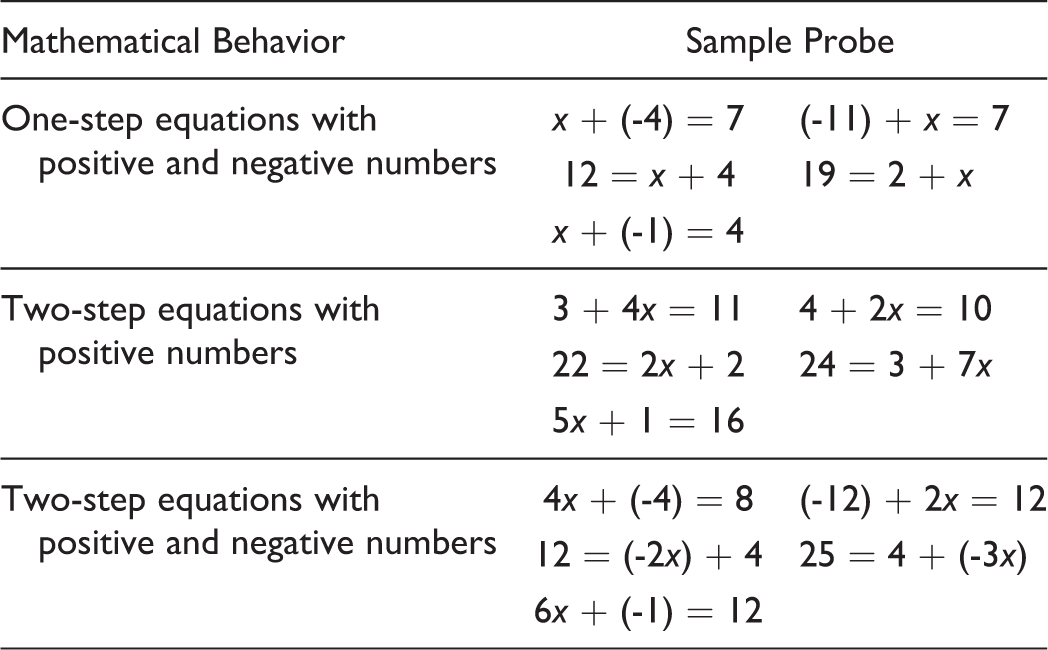
Samples probes for the three mathematical behaviors.
To construct the probes, the researchers applied criteria to each problem type. For one-step equations with positive and negative numbers, problems in each probe needed only one-step to solve, all solutions were positive numbers ranging from 1 to 20, no more than three solutions per assessment were single-digit and no more than three solutions per assessment were double-digit, and a parenthesis was placed around the negative number that was always on the same side of the equation as the variable. For two-step equations with positive numbers, the following criteria was applied to probe construction: only two steps needed to solve the problems, all solutions were positive numbers between 1 and 20, and no more than three solutions per assessment were single-digit while no more three solutions per assessment were double digit. To construct the two-step equations with positive and negative numbers, the researchers restricted solutions to range from −20 to 20 with 0 not an option and involved only two-steps. Further, no more than three solutions per assessment could be single digit, double digit, negative, or positive.
Participants used virtual Algebra Tiles from Brainingcamp LLC (2019), accessed on their school-issued Chromebook (refer to Figure 1). The app is for purchase, costing $1.99 if purchased individually; it can also be purchased as part of a suite of separate virtual manipulative apps (e.g., base 10 blocks, fraction pieces). The app works with a mouse or via a touchscreen. The app involved an equation background, which helped participants organize the algebra problem by separating the two sides of the equation with the equal sign. Participants had access to an unlimited number of algebra tiles used to represent constants and variables. Positive constants were represented by small yellow squares, negative constants by small red squares, positive variables (x) by green rectangles, and negative variables by red rectangles. A large blue square was also available to represent x2, but was not used for the purpose of this study.
Independent and Dependent Variables
The independent variable for the study was the VA framework plus explicit instruction used for teaching the framework for each of the three behaviors examined across participants. The dependent variable was accuracy, defined as the number of algebra problems answered correctly out of five. The researcher summed the problems participants solved correctly (no partial credit) and divided the number by five to calculate percent accuracy. Researchers recorded accuracy using event recording.
Experimental Design
This study employed a multiple probe across behaviors, replicated across participants, design to examine the effectiveness of the VA framework and explicit instruction to teach and support middle school students with disabilities as they solved grade-level algebra problems (Gast et al., 2018). Researchers selected the multiple probe across behaviors replicated across participants as it allowed them to examine both intra-and inter replication with their three participants. Further, this design is practical with non-reversible academic behaviors as well as offers a shorter baseline condition (Gast et al., 2018). With the VA framework, students begin by solving mathematical problems (i.e., two-step algebra problems) with virtual manipulatives (i.e., virtual algebra tiles) before solving problems abstractly without the support of manipulatives (Bouck, Park, et al., 2017; Bouck, Park, et al., 2019). The multiple probe across behaviors design can effectively evaluate an intervention intended to accelerate the frequency of a non-reversible behavior, which for this study was solving algebra problems correctly (Gast & Spriggs, 2014). The researcher and first author, a doctoral candidate and highly-qualified special education teacher, delivered all sessions in a one-on-one format. Sessions occurred 2–3 days a week for 10–12 weeks and no participant completed more than two sessions per day.
Pre-assessment
Prior to baseline, participants completed a pre-assessment to determine their ability to solve basic algebra problems. The pre-assessment included eight problems examining four levels of behaviors: one-step addition equations with positive and negative numbers, two-step equations with positive numbers, two-step equations with positive and negative numbers, three-step equations with positive numbers and variables on both side of the equals sign, and two questions regarding basic algebra principles. The researcher scored the pre-assessment and used the data paired with current classroom progress and input from the special education teacher to determine eligibility for the study as well as the mathematical behaviors appropriate for each student.
Baseline
During the baseline phase, students worked independently to complete a minimum of five probes for each behavior (i.e., one-step equation with positives and negative numbers, two-step equations with positive number, two-step equations with positive and negative numbers). Students did not receive instruction on how to solve problems, and did not have access to manipulatives. Rather, students were given a probe and asked to complete it. Once data stability was evident and the baseline had a zero-celerating or de-celerating trend for the first behavior, students moved into the intervention phase for that behavior.
Intervention
The VA framework was conducted during intervention consistent with the CRA and VRA frameworks (Bouck et al., 2019). Participants received at least six intervention sessions (i.e., three in the virtual manipulative phase and three in the abstract phase) per mathematical behavior. The researcher used explicit instruction during each intervention session, including the modeling of two problems, before the participant completed two problems with cues and prompts, invoking the system of least prompts, from the researcher as needed. Prompts included three levels: gestures (e.g., pointing to a location on the screen), indirect verbal cues (e.g., “what’s your next step?”), and direct verbal cues (e.g., “you need to determine how many for each x”). Prompts were administered after a wait period of 10 seconds of no initiation and/or an incorrect action. After the lesson, the participant completed the five-problem probe using virtual algebra tiles without assistance from the researcher. Once the participant correctly answered 80% or more during three intervention sessions using the virtual manipulatives, they entered the abstract phase. In the event a participant failed to achieve 80% accuracy in a lesson, they repeated that same lesson the next session. After each participant entered into the abstract phase for the first mathematical behavior, they completed a probe with no support (baseline) and then began the intervention phase for the next mathematical behavior. This continued until each participant successfully completed both phases for all three behaviors.
Virtual phase
The first three lessons for each behavior involved the researcher using explicit instruction to teach participants how to access and use the Algebra Tiles by Brainingcamp (2019) to solve the problem. Each lesson began with the researcher demonstrating the steps necessary to set-up and solve the algebra problem. During this process, the researcher verbalized her mathematical approach, referred to as a think-aloud. For example, in the problem 5x + (−3) = 12 the researcher began by reading the problem aloud (e.g., “5x plus negative 3 equals 12”) and then identifying the location of the variable (e.g., “the variable is on the left side of the equals sign”). The think-aloud process continued as the researcher demonstrated each step necessary to solve the equation. In this example, the researcher placed three yellow squares on top of the red squares to represent the additive inverse of −3 (e.g., “the sum of −3 and 3 is zero”), and then three yellow squares on the right side to represent a balanced distribution of values to both sides of the equal sign (e.g., “to keep the equation balanced I have to add three to the right side too”). At this time, the researcher would be left with 5 green rectangles on the left side and 15 yellow squares on the right side (5x = 15).
The next step required division so the researcher selected the number of rows based on the coefficient (e.g., “since there are five rectangles, I need five rows”) to appropriately separate or divide the pieces. The researcher then dragged each rectangle to its own row on the left, and then divided the yellow squares on the right equally among the rows (e.g., “each row should have the same number of squares”). When the problem was solved, the researcher looked at one portioned section that contained a green rectangle representing the variable on one side of the equals sign, and a sole numerical value as represented by squares on the other side (e.g., “one green rectangle equals three yellow squares”; x = 3). Once the researcher demonstrated two problems, the participant used virtual algebra tiles to solve two new problems. The researcher provided cues and prompts to the participant as needed (e.g., “Remember if you add 3 to the left side of the equals sign, you must…”). The participant then used virtual algebra tiles to independently complete the five-problem probe.
Abstract phase
During the final three lessons for each mathematical behavior, participants solved the algebra problems abstractly by applying mathematical principles without the support of virtual manipulatives. The researcher modeled how to solve two problems using the think-aloud strategy so participants could both see the steps and hear the mathematical reasoning behind each step. The participant then completed two problems with support from the researcher in the form of cues and prompts (e.g., “Check your addition one more time, what’s your next step, etc.”). Finally, each participant completed the five-problem probe independently and abstractly for each behavior (i.e., no teacher support and no manipulatives).
Maintenance
Participants completed two maintenance probes per behavior 2 weeks after their last abstract session for that behavior. The maintenance phase followed the same procedures as baseline and the independent portion of each lesson. During maintenance, participants did not receive cues, prompts, or feedback nor did participants have access to manipulatives.
Social Validity
The researcher conducted semi-structured interviews with each participant prior to data collection and at the conclusion of the study. Each participant was asked to discuss their attitudes toward mathematics, and after completing the study how they felt about the VA framework. Specifically, participants were asked whether the framework helped them learn how to solve various types of algebra problems, whether they would use this process given the choice, and if they believed virtual manipulatives were tools they would use in the future to help support their skill development and conceptual understanding in the area of mathematics.
Interobserver Agreement and Treatment Fidelity
A middle school mathematics teacher examined student work to determine interobserver agreement (IOA) for accuracy for all participants. IOA was calculated for each probe by dividing the number of agreements between the mathematics teacher and the researcher by five (total problems on probe). IOA data were recorded for each student for at least 33% of baseline sessions, 40% for each intervention condition, and 50% of maintenance sessions. IOA for accuracy was 100% for all participants. The researcher used a checklist to collect treatment fidelity data for a minimum of two intervention sessions for each student. Treatment fidelity included participants being provided appropriate materials: a pencil, access to virtual manipulatives when appropriate (i.e., virtual phase), and the correct type of probe, and the researcher implementing explicit instruction, participants using the virtual manipulatives when appropriate (i.e., virtual phase), and the researcher ensuring participants did not receive prompting during the independent portion of the lesson (i.e., completing probe). Treatment fidelity for all participants was 100%.
Data Analysis
The researchers used visual analysis and effect size calculations to assess level, trend, and effect size for problem accuracy for each student (Gast & Spriggs, 2014). To calculate level, the researchers determined the stability using the 80/25 rule. When 80% of the data fell within 25% of the median, the data were considered stable for that particular intervention condition (Gast & Spriggs, 2014). The researcher calculated trend and determined if data were accelerating, decelerating, or zero-celerating by using the split middle method in which the researcher divided the data into quarters to determine mid-rate and mid-date (White & Haring, 1980). To determine effect size, the research used Tau-U which combines non-overlapping data between phases with trend from within the intervention phase. The researcher used an online calculator to establish the Tau-U with results being reported using numerical scores between 0 and 1 (Parker et al., 2011). Scores between 0.93 to 1 were considered a large effect, 0.66 to .92 a medium effect, and 0 to 0.65 a small effect (Parker et al., 2009).
Results
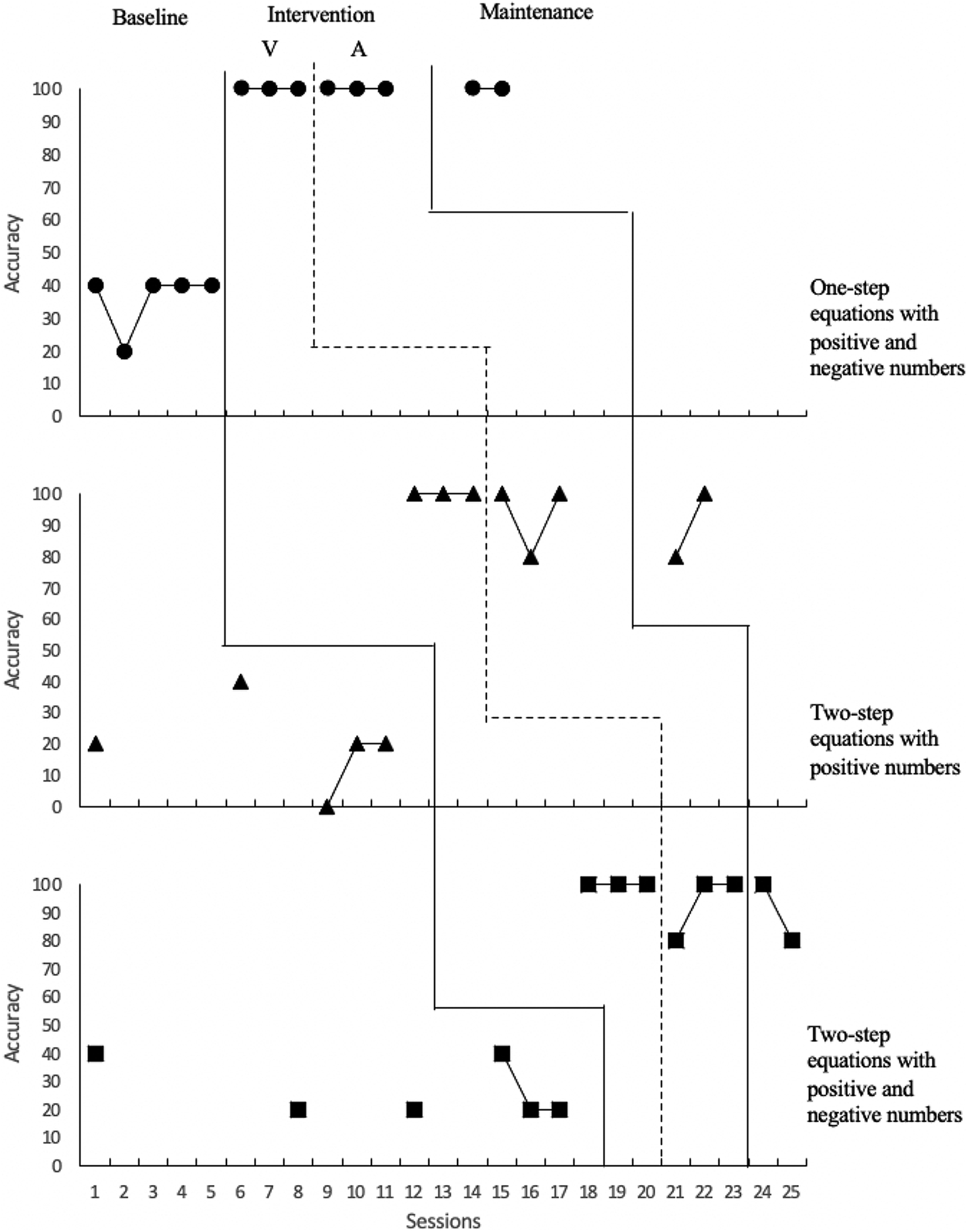
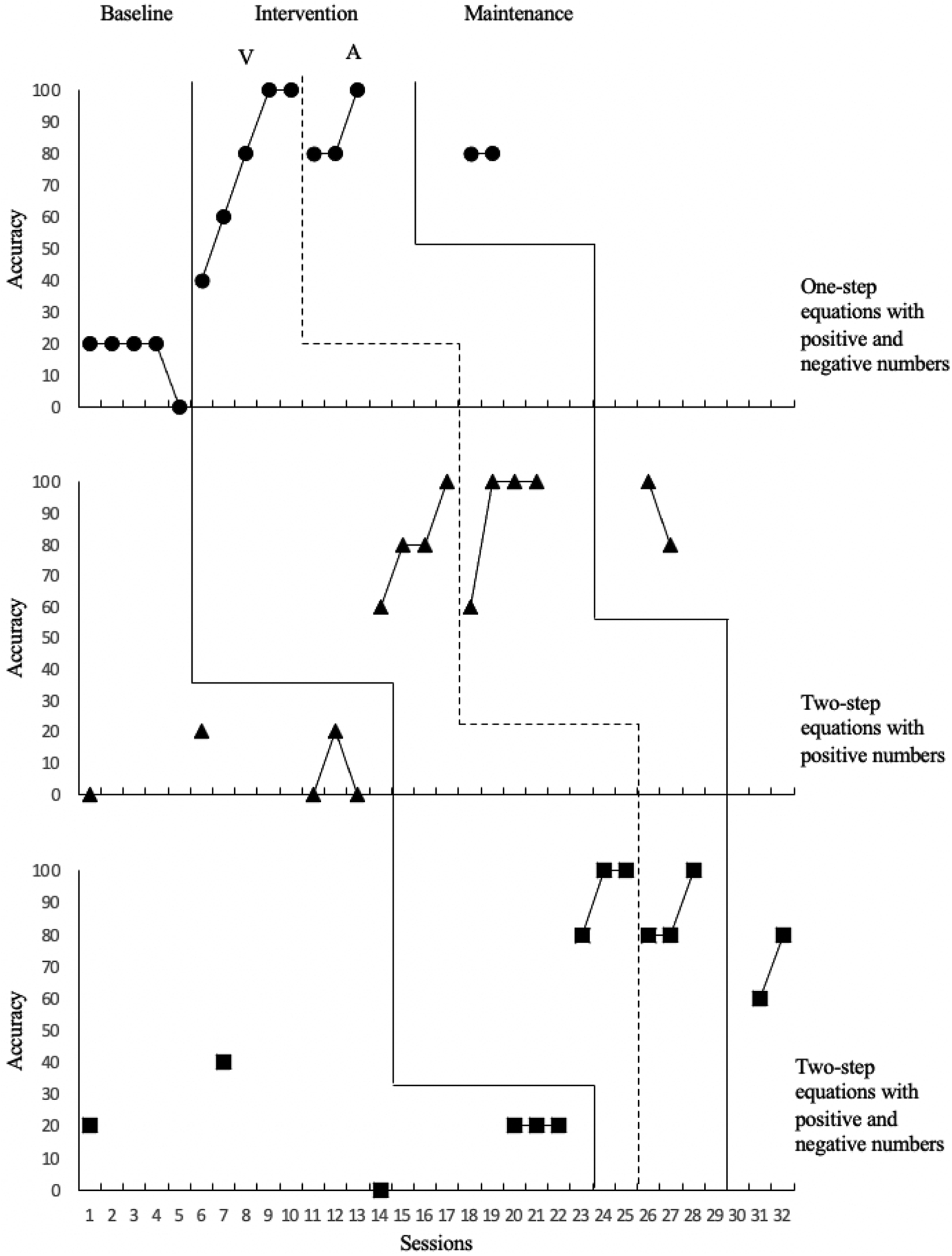
Researchers found a functional relation between the VA framework and students’ ability to successfully solve grade-level algebra problems (see Figures 3–5). All participants demonstrated an increase in the number of problems they were able to solve correctly using the VA framework compared to their accuracy during baseline. All participants also solved more algebra problems correctly during the maintenance phase as compared to baseline.

Accuracy and algebra problems for Emily.
Accuracy and algebra problems for Sara.
Accuracy and algebra problems for Paul.
Emily
Emily’s accuracy for her first behavior during baseline was 0 for each session (see Figure 3); her data were stable, with a zero-celeration trend. Emily completed eight sessions during intervention including five during the virtual phase and three during the abstract phase. Her accuracy range during intervention was 20%–100% (µ = 77.5%). Her overall intervention data were variable with an accelerating trend. The Tau-U was 1.0, indicating a large effect. Her accuracy was 80% for both maintenance sessions.
Baseline data were collected intermittently for Emily’s second mathematical behavior where her accuracy range was 0%–20% (µ = 8%) across five sessions. Data were stable with a decelerating tend. Emily completed eight sessions during intervention including four during the virtual phase and four during the abstract phase. Her scores ranged from 60% to 100% accuracy (µ = 80%). Intervention data were stable with an accelerating trend and the Tau-U was 1.0, indicating a large effect. During the maintenance phase conducted 2 weeks after the final abstract session, Emily scored 60% accuracy on both probes.
Emily’s baseline for her third behavior ranged from 05 to 20% (µ = 10%) across six sessions. Her last three baseline probes were 20, 0, and 0 indicating data were stable with a decelerating trend. Emily completed eight sessions during intervention including four during the virtual phase and four during the abstract phase. Her accuracy ranged from 60% to 100% (µ = 77.5%). Data were stable with an accelerating trend and the 1.0 Tau-U indicated a large effect size. Emily’s scores on her maintenance probes were 40% and 60% accuracy.
Sara
During her first behavior, Sara scored 40% accuracy on all but one of her five baseline sessions (µ = 36%; see Figure 4). The baseline data were stable. Sara experienced an immediate effect in intervention; her accuracy was 100% during intervention and she did not repeat any sessions. Data were stable with a zero-celerating trend with a Tau-U score of 1.0, indicating a large effect size. Sara also scored 100% accuracy on both of her maintenance probes.
Sara’s baseline accuracy scores for her second behavior were stable and ranged from 0%–40% accuracy (µ = 20%) across five sessions. Sara experienced an immediate effect, as her accuracy was 100% for the first virtual intervention session. Her overall intervention accuracy ranged from 80% to 100% (µ = 96.7%); the data were stable with a zero-celerating trend, and she did not repeat any sessions. The Tau-U for her accuracy was 1.0 indicating a large effect. Sara’s accuracy stayed consistent during the maintenance where she scored 80% and 100%.
On her final mathematical behavior, Sara completed baseline probes with 20%–40% accuracy (µ = 26.7%) across six sessions. Consistent with the previous behaviors, Sara experienced an immediate effect upon entering the intervention phase where she solved 100% on her first probe during the virtual phase. Her overall intervention accuracy ranged from 80%–100% (µ = 96.7%); the data were stable with a zero-celerating trend, and she did not repeat any sessions. The Tau-U for her accuracy was 1.0 indicating a large effect size. Sara’s accuracy scores were 100% and 80% during her two maintenance sessions.
Paul
Paul’s accuracy for his first behavior ranged from 0%–20% accuracy (µ = 16%); data were stable and zero-celerating (see Figure 5). Paul required eight intervention sessions including five virtual sessions and three abstract sessions. His intervention accuracy ranged from 40% to 100% (µ = 80%); data were variable with an accelerating trend and Tau-U was 1.0, indicating a large effect size. Paul maintained his accuracy by scoring 80% during two maintenance sessions.
During baseline of his second mathematical behavior Paul solved 0%–20% of the problems correctly (µ = 8%) across five sessions. Data were stable with a zero-celerating trend. Paul completed eight sessions during intervention: four during the virtual phase and four during the abstract phase. His scores ranged from 60% to 100% accuracy (µ = 85%); data were variable with an accelerating trend. Tau-U was 1.0 indicating a large effect size. During maintenance, Paul solved the equations with 100% and 80% accuracy.
Paul’s baseline scores ranged from 0%–40% accuracy (µ = 20%) during his third mathematical behavior across six sessions. Data were stable with a zero-celerating trend. Paul’s accuracy scores experienced an immediate effect upon entering intervention and he only required three sessions for each phase to reach criterion. He solved problems with 80%–100% accuracy (µ = 90%); data were stable with a zero-celerating trend and Tau-U was 1.0, indicating a large effect size. During his maintenance sessions, Paul solved equations with 60% and 80% accuracy.
Social Validity
Before the intervention, all participants stated algebra and algebra-related tasks were difficult. Two participants said knowing how to do basic operations made algebra easier, while one participant called operations an obstacle. Participants also shared they were easily confused by variables and algebra procedures. All participants knew they had access to and experience using multiplication charts, classroom notes, and calculators, but prior to the intervention no participants mentioned using manipulatives.
At the conclusion of the study, both Emily and Paul stated they preferred using the virtual manipulatives over the abstract phase where no manipulatives were available. Emily indicated using the virtual manipulatives helped keep her thoughts in order which was beneficial since she was still learning “how to do algebra.” Paul liked being able to hit clear to get a clean display when he made a mistake, “sometimes I get all jumbled and just need to start over, and when I do this on paper I just scribble it out and then I run out of space and all my work is all over and confusing.” Sara preferred the abstract phase because it didn’t take as long to solve the problems. She said learning how to do the problems with the virtual manipulatives was helpful, but she didn’t need to do it so many times and would rather just “do the math.” All three participants agreed virtual manipulatives would be helpful for teaching the algebra concepts to peers, and said their teachers would probably like them since they could use their Chromebooks.
Discussion
Algebra is considered by many to be a gateway to higher-level mathematics and eventual economic success (Watt et al., 2016), yet students with and without disabilities often struggle to develop the skills necessary to demonstrate algebraic thinking (Star et al., 2015). This study explored whether the VA framework supported the acquisition of three algebra behaviors (e.g., one-step equations with positive and negative numbers, two-step equations with positive numbers, and two-step equations with positive and negative numbers) for seventh-grade students with learning disabilities. Researchers found a functional relation between the VA framework, taught via explicit instruction, and student algebraic learning. All three participants improved their performance on each of the three algebra behaviors during intervention, and all participants maintained their accuracy after intervention, as compared to baseline to maintenance, with two maintaining their skills at 60% or greater.
Consistent with previous research exploring graduated instructional sequence interventions (e.g., CRA, VRA, VA; Bouck, Bassette, et al., 2017; Bouck et al., 2019; Strickland & Maccini, 2013), Sara experienced an immediate effect for all behaviors, and the effects from baseline to intervention were immediate for Emily and Paul’s second and third behaviors. In this study, students were able to successfully move directly from the virtual phase to the abstract phase, as intended in the VA framework. Consistent with previous research, the lack of a representational phase did not seem to negatively impact students’ algebraic understanding or performance (Bouck, Park at al., 2017; Bouck et al., 2019; Cass et al., 2003). Students’ ability to score at or above 60% during all abstract phases is consistent with previous research indicating the representational phase may not be necessary for some students with disabilities and certain mathematical content (Cass et al., 2003). The success, despite the lack of a representational phase, lend support to previous research suggesting for certain mathematical behaviors this form of representation (i.e., pictures) might not be necessary, resulting in a more efficient intervention.
Student performance during the maintenance phase demonstrated all students performed better as compared to baseline scores and two of the three students were able to sustain the skills learned over time (e.g., Paul > 60% and Sara > 80%). The ability for students to maintain skills over time is consistent with the findings of Satsangi et al. (2016) and Satsangi et al. (2018), in which students with learning disabilities also demonstrated the acquisition of algebra skills after being taught using virtual manipulatives. However, one major difference between the current study and Satsangi’s research was the absence of manipulatives during the maintenance phase of the current study. While students were able to solve the problems without additional instruction in the aforementioned studies, they also had access to manipulatives to assist in solving the algebra problems. In this study, Paul and Sara solving problems with 60% accuracy or greater without manipulatives demonstrates the effectiveness of the VA framework for acquiring and maintaining algebra skills in the absence of tools.
Consistent with research where the maintenance sessions are conducted without manipulatives (e.g., Bouck, Park, et al., 2017; Bouck et al., 2019), Emily scored better during maintenance as compared to baseline but struggled to maintain a consistent high level of performance when explicit instruction and representation did not proceed the independent attempt. After Emily’s first behavior, she never scored above 60% during maintenance. Some students with disabilities may benefit from additional sessions during intervention to allow for more opportunities to practice the skills (e.g., five sessions instead of three; Bouck et al., 2020). Future research should consider targeting maintenance as part of the intervention, as sustaining skills overtime is an essential part of learning (Collins, 2012; Park et al., 2020). Researchers who targeted maintenance as part of a graduated sequence of instruction, while for different mathematical areas (e.g., subtraction with regrouping, multiplication, and division) found positive impacts (Bouck et al., 2020; Park et al., 2020).
Implications for Practice
All three students with learning disabilities in this study successfully acquired three linear algebra behaviors with six-to-eight sessions using the VA framework with explicit instruction with session length ranging from 15 to 25 minutes. Overall, the results suggest the VA framework, presented via explicit instruction, is an effective and efficient intervention for middle school students with learning disabilities learning algebra, when working with students one-on-one. At the secondary level, virtual manipulatives could be used for whole group instruction, during station teaching, or even in small groups (e.g., intervention groups), especially as more students gain access to one-to-one technology (e.g., Chromebooks, iPads; Satsangi et al., 2018). Teachers using the VA framework during instruction in a large class could use a smartboard to display their work during the explicit instruction, and then students could work from their devices as the teacher walked around and provided feedback, before students completed the mathematics independently (Bouck, Mathews, & Peltier, 2019). However, it is important to remember that part of the effectiveness of the VA intervention relies on the student’s ability to move at his or her own pace with some students needing additional sessions (Bouck & Sprick, 2018), and thus whole class implementation may become more challenging.
Another implication is the support for the VA framework, which removes the representational phase and transitions students directly from the virtual phase to the abstract phase (Bouck et al., 2019, 2020). While the representational phase allows an additional opportunity to practice algebraic reasoning as students are challenged to create their own representation of the mathematics (Bouck & Sprick, 2018), it may be redundant at times and cause unnecessary anxiety, especially if the student has difficulties with fine motor skills (Bouck, Bassette, et al., 2017; Cass et al., 2003). Instead the teacher could employ the VA framework and increase the number of sessions for the other phases in order to promote maintenance of the new skills (Bouck et al., 2020). As part of an intervention package, for example, students could complete extra sessions in the virtual phase with the teacher gradually fading support (Park et al., 2020). Students would have access to manipulatives, but teacher prompts and cues would decrease across sessions. Another possibility is to have students complete extra abstract sessions with limited explicit instruction to more closely resemble what students are expected to do outside of the intervention (i.e., maintenance; Bouck et al., 2020). Providing extra opportunities to practice promotes overlearning, which helps students acquire and then maintain their skills over time (Park et al., 2020).
Teachers should regard the VA framework as a possible alternative to the CRA framework to support the acquisition of mathematics skills for secondary students with disabilities (Bouck, Park, et al., 2017; Bouck et al., 2019, 2020). This study, in conjunction with the other VA framework algebra study by Bouck et al. (2019), suggests the efficacy of the VA framework for teaching algebra to students with disabilities. In this study, the attention was explicitly focused on students with learning disabilities. Previous researchers examined the VA instructional sequence predominantly with middle school students with intellectual and developmental disabilities. This is the first study to extend the VA framework to students with more high-incidence disabilities. Although limited, there is also literature indicating the VA framework is effective when teaching other mathematical behaviors, although not focused on students with learning disabilities (e.g., fractions; Bouck, Park et al., 2017; Bouck et al., 2020). In particular, using virtual manipulatives as part of a graduated instructional sequence could be very impactful when working with older students who are either not interested in using concrete manipulatives due to stigma or are simply more interested in using technology (Satsangi & Bouck, 2015; Satsangi & Miller, 2017).
In order to be an effective intervention, teachers must know how to implement it with fidelity (Cook & Cook, 2013). Thus, graduated instructional sequences, like the VA framework, should be taught to teachers during in-service or be a part of teacher preparation courses. This instruction should be ongoing and should include additional coaching when necessary to ensure teachers truly understand implementation procedures. With this knowledge, it is likely teachers will use the intervention more regularly during instruction (Cook & Cook, 2013), whether that be small group or one-on-one.
Limitations and Future Direction
This study is not without its limitations. For one, students entered the independent portion of the lesson regardless of the degree or frequency of support given during guided practice. Guided practice should include enough support so the student can experience success solving the problem, but be gradually reduced while the teacher continues to monitor progress (Strickland & Maccini, 2013). Emily and Paul may have benefited from additional practice sessions and future research should follow recommendations to go back to the modeling stage if students struggle during guided practice (Bouck & Sprick, 2018). It may be advantageous for researchers to determine a set number of prompts as an indicator (e.g., more than five indicates a need for more modeling). To learn more about how students are using virtual manipulatives within the framework, future researchers should also include data collection on accuracy and independence based on a task analysis during various phases of the explicit instruction. Related, Emily and Paul may have experienced a learning effect with regard to their repeated sessions. However, repeating a session when less than 80% accuracy is achieved is consistent with manipulative-based frameworks, including the CRA (e.g., Mancl et al., 2012). Related, the VA, as traditional in manipulative-based instructional sequences, was delivered via explicit instruction; in this study it is not possible to disaggregate the VA from the explicit instruction used to teach the VA. Additionally, a researcher collected all the data and not the classroom teacher. Future researchers should examine the efficacy of classroom teachers implementing the intervention.
Another limitation is during her first behavior, Sara moved from baseline to intervention with an accelerating trend, which could indicate a threat to internal validity. However, after five sessions, Sara never answered more than two problems correct (40%) and her data were stable. When observing her during baseline sessions, Sara repeatedly voiced frustration and self-reported that she was guessing because she did not understand the mathematics. This statement was supported by the time spent completing her last three baseline probes (less than 1 minute) and her answers (e.g., recording the same answer for all five problems). The researcher chose to move her into the intervention phase because continuing with collecting baseline data without instruction created an aversive experience for the learner and, due to the student’s clear frustration with not understanding the mathematical content, it became ethically questionable.
An additional limitation is the three algebra behaviors may have been too closely related. The only difference between the second and third behavior was the inclusion of negative numbers. This behavior was chosen because teachers stated many students required additional lessons or re-teaching before successfully solving equations involving both positive and negative numbers, and the pre-assessment results supported this claim. However, the effectiveness of the VA framework may have been better explored if the behaviors included one-step equations, two-step equations, and three-step equations requiring knowledge of the distributive property, variables on both sides, or combining like terms. These behaviors would have also aligned with the Common Core State Standard for seventh-grade students to use tools strategically to solve multi-step mathematical problems (CCSS, 2010). The over-alignment may have contributed to the high scores during the maintenance phase. These sessions were administered 2 weeks after the last intervention of each behavior, but while algebra instruction was still occurring. In this way, students were receiving instruction that could easily be applied to the skills being assessed during maintenance. Finally, the probes were created by the researchers. They followed a set criteria and were reviewed by multiple parties including an algebra instructor, but were not formally evaluated for reliability and validity purposes.
Researchers should continue to investigate the impact of the VA framework to support students with disabilities. Future research should include exploring various types of virtual manipulatives (e.g., virtual balance scale), more advanced algebra concepts (e.g., solving systems of equations), and other mathematics strands taught at the secondary level (e.g., geometry) within the VA framework. Researchers should compare virtual algebra tiles to concrete algebra tiles and also examine, through group design studies, the differences between the VA framework to others, such as the VRA or CRA. Researchers should also consider how students access virtual manipulatives (i.e., web-based vs. app-based or even free as compared to for-purchase apps), and the implications this may have on accessibility.
Footnotes
Declaration of Conflicting Interests
The author(s) declared no potential conflicts of interest with respect to the research, authorship, and/or publication of this article.
Funding
The author(s) received no financial support for the research, authorship, and/or publication of this article.
