



Abstract
Over the last two decades, the significance of academic achievement for students with disabilities in K–12 education has increased. To meet the needs of this population, educators turned to innovative strategies and technologies for instructional support in the classroom. For students with a learning disability, the need for such solutions is vital to address many of the academic struggles they face in the area of mathematics education. One evidence-based strategy shown to support instruction for students with a learning disability is the use of manipulatives. Although concrete manipulatives were extensively studied for this population, the virtual form of this technology lacks comparable research. Using a multiple probe design across three secondary students with a learning disability in mathematics, this study assessed the benefits of an instructional strategy using a virtual manipulative balance paired with explicit instruction to teach multistep linear equations. Results showed increased percent accuracy and independence scores for all three students across an intervention and maintenance phase. These findings and their broader implications for the field of mathematics education are discussed.
Within the United States, approximately 5% to 8% of students receiving special education services in K–12 education are identified with a learning disability (learning disability[ies] (LD)) in mathematics (Geary, Hoard, Nugent, & Bailey, 2012). For these students, deficits in working memory, long-term memory, and poor organizational skills often contribute to their struggles and limit their ability to learn grade level content (Scanlon, 2013). Struggles for these students are often reflected in national assessment data measuring student achievement. For example, achievement data on tests such as the National Assessment of Educational Progress (NAEP) show 91% of fourth graders and 96% of eighth graders with a specific LD scored below proficient in the content area of mathematics (National Center for Education Statistics [NCES], 2015).
Of the many subject areas in mathematics where students with LD struggle, perhaps none warrant as much attention as algebra. The significance of algebraic instruction for students with and without disabilities is evident in multiple areas. When evaluating the composition of national assessments such as NAEP or various graduation qualifying exams adopted by numerous states, the importance of understanding algebraic thinking becomes clear. For example, 30% of assessments covered within NAEP target algebraic concepts (NCES, 2015). In addition, the Common Core State Standards Initiative (CCSSI, 2010), a set of nationally recognized K–12 standards adopted by 42 states as of 2017, places a significant emphasis on promoting algebraic reasoning and problem solving. Moreover, algebra is commonly considered a gateway subject for students to learn higher order concepts covered in advanced mathematics and science courses in high school and postsecondary education (Stein, Kaufman, Sherman, & Hillen, 2011). As the role of algebra increases in secondary mathematics, studying the performance of secondary students, particularly those identified with LD in mathematics, warrants greater merit.
Strategies for Students With LD
Several instructional strategies exist for teaching students with LD in mathematics, with the majority categorized as behavioral or cognitive in design (Maccini, Mulcahy, & Wilson, 2007). Among the many strategies Maccini and associates identify within these categories, two possess sizable research bases and are frequently used in mathematics classrooms—explicit instruction and a graduated teaching sequence. Explicit instruction emphasizes structured teaching of concepts using teacher modeling, repeated practice by leaners, and corrective feedback throughout (Bryant, Bryant, Williams, Kim, & Shin, 2012; Gersten et al., 2009). Explicit instruction was shown effective in teaching mathematics skills ranging from fractions and decimals (e.g., Scarlato & Burr, 2002) to algebraic equations (e.g., Witzel, Mercer, & Miller, 2003) to students with LD.
A second established strategy for teaching students with LD is a graduated teaching sequence (Flores, Hinton, & Strozier, 2014). This sequence for instruction in mathematics incorporates three sequential stages: concrete, representational, and abstract learning and is commonly referred to as the CRA sequence. To begin, students are provided concrete manipulatives to illustrate mathematical properties and concepts; examples include objects such as base-10 blocks, pattern blocks, fraction strips, and swing balances. As an example of this initial phase, students may be provided physical blocks to represent the minuend and subtrahend of a subtraction problem and asked to eliminate one from each section to determine the difference of two values. After learning mathematical concepts in this form, students are provided representational illustrations such as drawings or tally marks on paper to represent the same concepts that were taught using concrete materials. Finally, students are taught how to solve problems in an abstract form using symbolic notation on paper (Flores et al., 2014). As teachers complete the three stages sequentially, they continuously refer back to previous stages to reinforce how each step is connected to the next. Research on the CRA sequence often pairs explicit instruction with each of the three phases to reinforce underlying concepts and maximize student understanding of mathematical skills (e.g., Witzel et al., 2003).
With concrete manipulatives and the CRA sequence shown effective for teaching problem-solving skills for a wide range of grade levels, their use in subject areas where large numbers of students often struggle such as algebra warrants consideration. The CRA sequence was used to teach students with LD in mathematics algebraic concepts such as area and perimeter (Cass, Cates, Smith, & Jackson, 2003) and algebraic equations (Witzel, 2005; Witzel et al., 2003). Building upon this strategy, research also studied how best to use the CRA sequence in algebra for instruction with secondary students in a manner that expedites their learning. The CRA integration (CRA-I) sequence emphasizes the simultaneous presentation of algebraic concepts using concrete manipulatives, representational illustrations, and symbolic notation (Hudson & Miller, 2006). Strickland (2017) argued the immediate introduction of problems in symbolic notation when teaching a new concept may aid students in transitioning quicker from the concrete stage to solving problems in abstract notation than compared with the traditional CRA sequence. The CRA-I sequence was shown successful in teaching skills such as multiplying linear expressions and factoring quadratic expressions to students with high incidence disabilities (Strickland & Maccini, 2012, 2013).
Despite the documented success of concrete manipulatives as part of the CRA and CRA-I sequences, concerns with this technology for teaching older populations of students have arisen, with issues of availability, autonomy, and age appropriateness being chief problem areas for teachers to consider (Satsangi & Miller, 2017). In subject areas such as algebra and geometry, limited numbers of concrete manipulative constructs exist on the market for educators to use to teach many advanced concepts (Witzel, 2005). When used, concrete manipulatives often require continuous teacher monitoring to ensure students complete the proper procedures aligned to mathematical concepts (Witzel et al., 2003). In addition, offering older aged students concrete manipulatives such as pattern blocks in front of their peers may bring unwarranted stigma (Satsangi & Miller, 2017). To prevent these issues from arising, teachers often turn to advancements in technology to find new tools that provide similar supports as those of concrete manipulatives while offering added benefits aligned to the needs of students. One tool that has gained prominence in mathematics over the past decade is virtual manipulatives.
Virtual Manipulatives in Mathematics
Virtual manipulatives are computer and tablet-based two-and three-dimensional representations of concrete objects that can be manipulated (i.e., rotated, flipped, enlarged) on screen (Bouck, Satsangi, Doughty, & Courtney, 2014). Virtual manipulatives exist for teaching a wide range of mathematical concepts, including base-10 blocks to learn operational skills, three-dimensional cones, cylinders, blocks, and spheres to learn geometric properties, and two-dimensional graphs to learn properties of lines. Virtual manipulatives offer distinct benefits and drawbacks to their use for students and teachers in the classroom. Many virtual manipulative programs and apps offer built-in supports such as visual and textual prompting to guide students through the problem-solving process and potentially increase their independence solving mathematics problems (Moyer-Packenham & Suh, 2012). However, virtual manipulatives can also be costly to use for teachers, as their use is predicated on access to additional technology such as computers or tablets (Satsangi & Miller, 2017). Moreover, compared with the concrete form, virtual manipulatives have a limited research base in mathematics for students with disabilities, although studies have shown them effective in teaching this population concepts ranging from operational skills (e.g., Bouck et al., 2014) to algebra (e.g., Satsangi, Bouck, Taber-Doughty, Bofferding, & Roberts, 2016; Shin & Bryant, 2017).
For students with LD, a limited number of single subject research studies using virtual manipulatives for secondary mathematics curricula instruction were found, although their findings all produced positive results. Satsangi and Bouck (2014) used two-dimensional polyominoes to aid high school students as they successfully learned how to calculate area and perimeter of irregular shapes possessing 90° angles as part of a multiple baseline design. Elsewhere, Satsangi et al. (2016) compared the use of a two-dimensional virtual balance with a concrete balance using an alternating treatments design to teach high school students how to solve multistep linear equations. Their results showed both forms of manipulatives produced comparable positive results on accuracy and independence scores for all participants.
Beyond just the success of these studies, it is also important to note the manner in which virtual manipulatives were used for instruction. Notable commonalities were present in studies by Satsangi and Bouck (2014) and Satsangi et al. (2016) assessing the use of virtual manipulatives for instruction with students with LD in mathematics. First, virtual manipulatives were consistently paired with explicit instruction as part of the treatment condition, much like comparable research with concrete manipulatives has done (see Witzel, 2005; Witzel et al., 2003). In addition, students in each study were introduced to the symbolic notation form of concepts simultaneously as they used the virtual manipulative—similar to the approach of the CRA-I sequence. Finally, all known empirical studies assessing virtual manipulatives for students with LD in mathematics (including the two aforementioned studies) have possessed single subject designs. This trend is consistent with the research base for concrete manipulatives; an evidence-based synthesis of literature using the quality indicators and standards of evidence-based practices from Cook et al. (2014) showed concrete manipulatives to be an evidence-based strategy for students with LD based on eligibility criteria for single-case design studies only (Bouck, Satsangi, & Park, 2017). Thus, although limited in number, research on virtual manipulatives for students with LD in mathematics demonstrates notable overlap with the manner in which concrete manipulatives were studied with this population and have returned similar promising signs regarding their benefits.
Rationale for the Study
As the evidence base of concrete manipulatives and the CRA and CRA-I strategies for students with LD in mathematics has evolved and grown over the last five decades, greater attention is warranted toward studying comparable new technology such as virtual manipulatives. Virtual manipulatives show tremendous promise for instruction of students with LD in mathematics and are supported by a small yet growing body of research focused on studying secondary mathematics content (Satsangi & Bouck, 2014; Satsangi et al., 2016). The goal of this study was to advance this line of research by studying the benefits of a virtual manipulative balance paired with explicit instruction to teach high school students with LD in mathematics how to solve multistep linear equations. Through the use of a multiple probe across subjects design, the authors aimed to answer the following four questions: (a) Is there a functional relation between the use of a virtual manipulative balance paired with explicit instruction and the accuracy performance of secondary students with LD in mathematics solving multistep linear equations? (b) How independent are secondary students with LD in mathematics when using virtual manipulatives to complete multistep linear equations? (c) How long do secondary students with LD in mathematics take to complete multistep linear equations when using virtual manipulatives to solve problems? (d) What views do secondary students with LD in mathematics and their teachers hold toward using virtual manipulatives to teach and learn algebraic content in class?
Method
Participants
Three ninth grade students, two males and one female, were recruited for this study using criterion-based purposeful sampling (refer to Table 1). All students were enrolled in a self-contained Algebra 1 course focused on the first half of the Algebra 1 Virginia Standards of Learning Curriculum. All three students had the same mathematics teacher for Algebra 1; this class also contained one instructional assistant and one English Language Learner (ELL) teacher. Students were selected based on teacher recommendations in addition to the following inclusion criteria: (a) currently enrolled in an Algebra 1 course; (b) identified as having LD in mathematics by their school district’s special education eligibility criteria; (c) low mathematics performance as evidenced by their Algebra 1 grades in class, academic testing, or a mathematics goal on their Individualized Education Plan (IEP); (d) scored 50% or lower on an algebra preassessment created by researchers and administered by the classroom teacher during class; and (e) had not previously been taught mathematics using virtual manipulatives. All three students provided parental consent and assent to participate in this study.
Student Profiles.
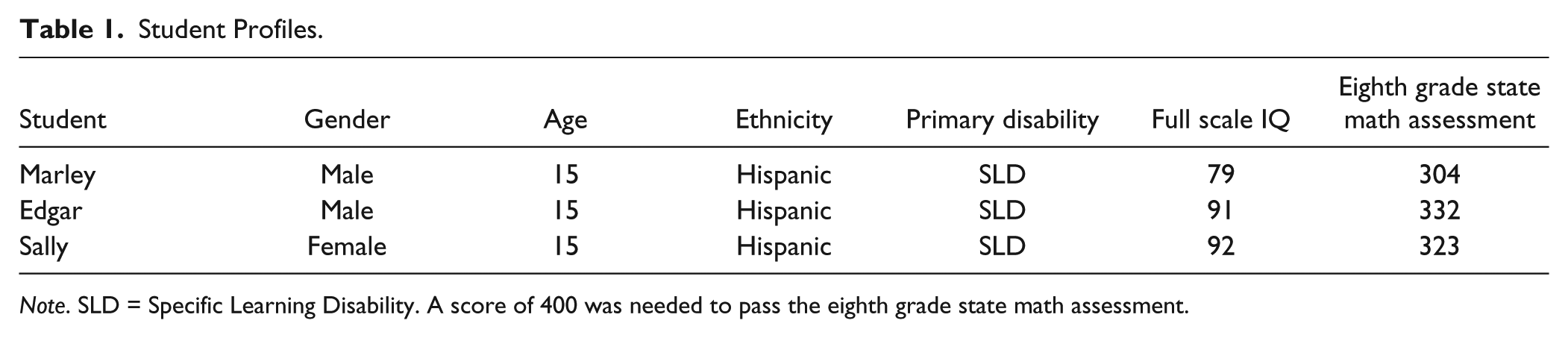
Note. SLD = Specific Learning Disability. A score of 400 was needed to pass the eighth grade state math assessment.
Marley
Marley was a 15-year-old Hispanic male in the ninth grade. Marley was designated as ELL and found to have LD in mathematics by his school district’s response-to-intervention (RTI) process (Fuchs & Fuchs, 2006), which also consisted of psychological and academic testing. He was found eligible for special education services due to processing speed and concept development difficulties that had an impact on his reading fluency, written expression, math problem solving, and math calculation achievement. Marley’s full scale IQ, as measured by the Weschler Abbreviated Scale of Intelligence, Second Edition (WAIS-II) was a standard score of 79, falling within the low range. He scored a standard score of 74 (low range) on the Broad Math subtest within the Woodcock Johnson IV Tests of Achievement (WJIV) and had a math-reasoning goal included on his current IEP. Marley received a D letter grade within his eighth grade mathematics course and scored a 304 on the state’s eighth grade mathematics Standards of Learning (SOL) standardized assessment (a score of 400 is needed to pass).
Edgar
Edgar was a 15-year-old Hispanic male in the ninth grade. He was designated as ELL and found to have LD in mathematics by his school district’s RTI process, which also consisted of psychological and academic testing. He was found eligible for a processing disorder that affected his understanding and use of written and spoken language, reading, and mathematics achievement. Edgar’s full scale IQ on the Weschler Intelligence Scale for Children, Fourth Edition (WISC-IV) was a standard score of 91, falling within the average range. No recent academic testing scores were available for reporting, although a math-reasoning goal was included on his most recent IEP. Edgar received a D letter grade in his eighth grade mathematics course and scored a 332 on the plain English version of the state’s eighth grade mathematics SOL standardized assessment (a score of 400 is needed to pass). The plain English version of the test is offered to students identified as ELL or who have difficulties with reading.
Sally
Sally was a 15-year-old Hispanic female in the ninth grade. She was designated as ELL and found to have LD in mathematics by her school district’s RTI process, which also consisted of psychological and academic testing. She was found eligible for special education services due to short-term memory and processing speed deficits that affected her progress in reading, oral and written expression, math calculation, and math reasoning. Sally’s Mental Processing Index on the Kaufman Assessment Battery for Children, Second Edition (KABC-II) was a standard score of 92, falling within the average range. She scored a standard score of 68 (very low range) on the Broad Math subtest on the WJIV and possessed a math-reasoning goal within her current IEP. Sally failed her eighth grade mathematics course the first time she took it and then received a D+ letter grade when she took an abbreviated version of the course during summer school. She scored a 323 on the state’s eighth grade mathematics SOL standardized assessment (a score of 400 is needed to pass).
Setting
All three students attended the same public high school that served Grades 9 to 12. The school was located in a suburban area outside of a major Mid-Atlantic city. The school’s enrollment was approximately 1,900 students, of which approximately 44% were reported to be Hispanic, 22% African American, 20% Caucasian, 9% Asian, 4% were two or more races, and 1% considered American Indian/Alaskan Native or Hawaiian Native/Pacific Islander. The school served students who receive special education services in a variety of settings including general education, inclusionary (co-taught), and self-contained classrooms. All sessions of this study took place in a room measuring 15 ft. long by 10 ft. wide with one 3-ft. by 8-ft. table that sat four people. Students sat next to the researcher during all lessons and intervention sessions. All sessions took place during the students’ mathematics class time and each session lasted approximately 20 to 30 minutes.
Independent and Dependent Variables
The independent variables for this study included a virtual manipulative balance paired with explicit instruction. To define the independent variables, the authors determined the use of a virtual manipulative to entail students manipulating three-dimensional virtual blocks and a two-pan balance to represent and solve multistep linear equations. Explicit instruction was defined as the researcher providing each student instruction that incorporated repeated modeling, practice, and feedback on how to solve multistep linear equations.
Guided by prior research assessing the benefits of virtual manipulatives for students with disabilities (see Bouck et al., 2014; Satsangi et al., 2016), the authors selected the following dependent variables for this study: (a) percent accuracy, as measured by the percentage of correctly solved multistep linear equations in each session; (b) percent independence, as measured by the total number of steps within each problem completed without a prompt per session; and (c) duration, as measured by the total amount of time each student needed to complete each session. To measure each dependent variable, researchers developed a recording system to track student performance; researchers sat with each student as they worked through each problem within the treatment assessment to record progress and to monitor the use of the virtual manipulative. To assess percent accuracy in each session, researchers measured the number of correct answers the student provided out of 10 questions. A problem was considered incorrect if the student required a prompt to complete any step of a problem correctly. Percent independence was measured by recording the number of steps completed without a prompt per session. A system of least prompts was used, ranging from verbal prompting, verbal prompting with gesturing, and physical modeling with verbal prompting (Doyle, Wolery, Ault, & Gast, 1988). Researchers also calculated the average number of prompts and the percentage of each type of prompt provided for each treatment phase. Duration was measured using a digital clock, with times for each session rounded to the nearest whole minute.
Materials
Preassessment
Students who provided consent were given a preassessment prior to participating in this study. The preassessment consisted of 14 algebraic problems that ranged from single step (ax = b), to multistep linear equations (ax + b = cx + d). If a student scored 50% or higher on this assessment, they did not qualify to participate in the study.
Assessments
Baseline and treatment assessments contained 10 multistep linear equations presented on one side of an 8.5-inch by 11-inch sheet of paper. All problems took the form of ax + b = cx + d, with all coefficients as well as the solution for x being positive single-digit integers. All assessment problems were unique, with no problem repeated across or within phases.
Instructional lesson
After each student completed the baseline phase, they were given an instructional lesson on how to solve multistep linear equations using a virtual manipulative balance. The instructional lesson was made in accordance with the Virginia State Standards of Learning for eighth grade and Algebra 1 (Virginia Department of Education, 2009) and the Holt McDougal Larson© (2011) Algebra 1 textbook. Researchers provided explicit instruction one-on-one with each student using a whiteboard and dry erase marker to write down example problems and a lesson handout for students to complete while following along at their seats (refer to Figure 1 for a sample of the handout used within the instructional lesson).
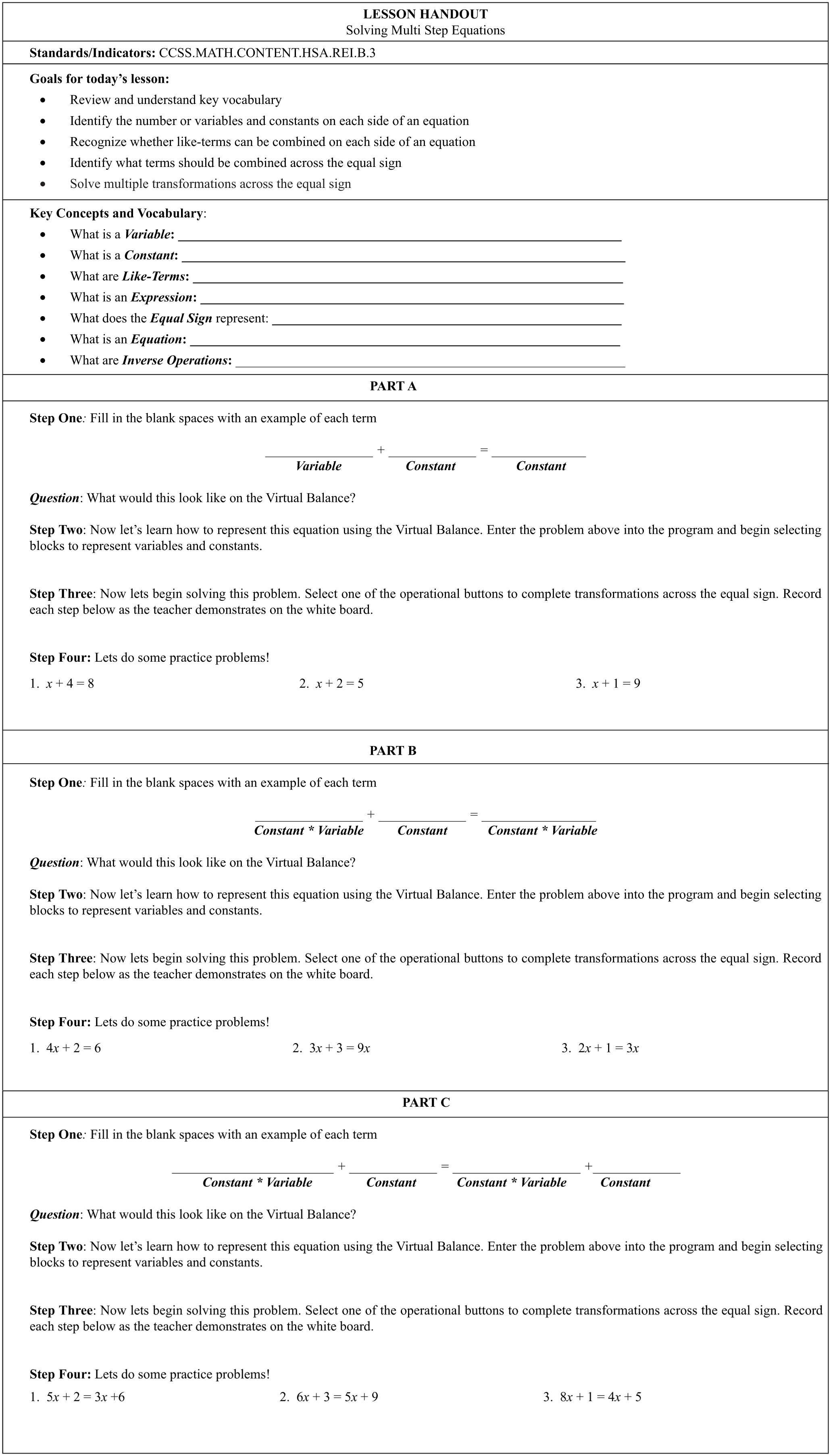
Sample of student handout used as part of instructional lesson.
Virtual manipulative
During the instructional lesson and throughout the treatment phases of this study, students used a virtual manipulative balance scale. The manipulative was accessed for free from the National Library of Virtual Manipulatives© (http://nlvm.usu.edu) using a 2015 Apple MacBook Air™ laptop computer. Refer to Figure 2 for an image of the virtual manipulative program used by students in this study.
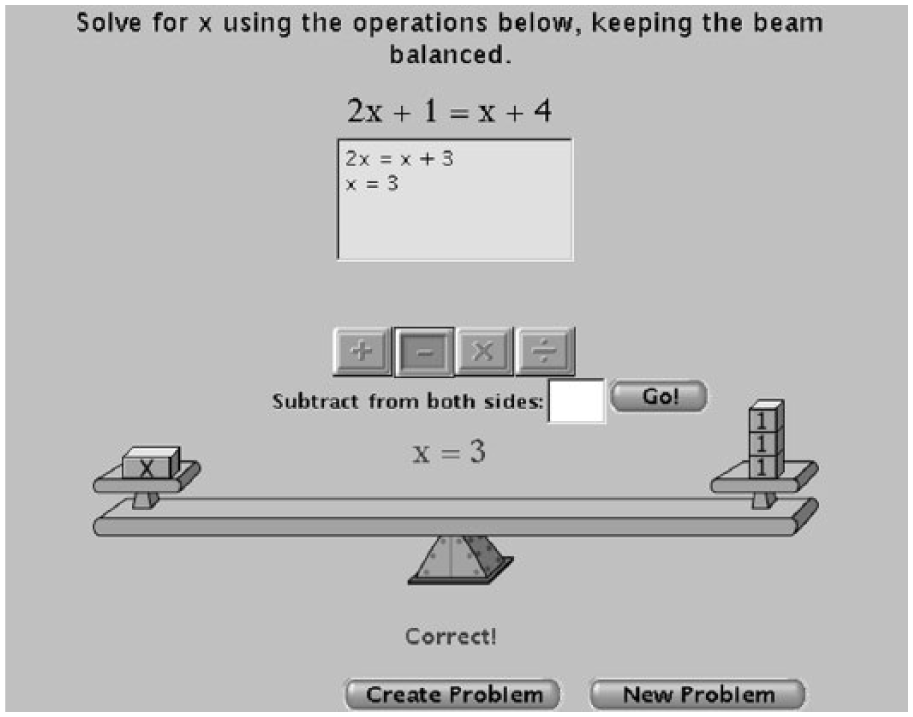
Screenshot of the virtual manipulative balance from NLVM©.
Experimental Design
A single subject multiple probe across subjects design was used to examine the functional relation between a virtual manipulative balance and student accuracy on multistep linear equations. The design and implementation of this study was done in agreement with the single subject quality indicators for methodological rigor outlined by Horner et al. (2005) and the single-case design standards of Kratochwill, Levin, Horner, and Swoboda (2014). The defining feature of a multiple probe design is the staggered introduction of participants to the intervention (Gast & Ledford, 2014). After demonstrating a stable baseline, one student is introduced to the intervention, whereas two or more students remain in the baseline condition, serving as a control for the first student. Once the first student exhibits stable intervention data, the second student enters intervention, whereas the remaining students continue in baseline. This pattern resumes until all students have entered the intervention condition. A minimum of five baseline and five intervention sessions were completed with each student and continued until their data in each phase were stable.
Procedures
This study comprises three phases: baseline, intervention, and maintenance. After a brief preassessment and answering prestudy social validity questions, students entered the baseline phase where they were answered 10 multistep linear equations with no assistance. Following baseline, researchers taught each student a lesson on how to solve multistep linear equations using a virtual manipulative balance. Upon completing intervention and a 2-week hiatus, five sessions of a maintenance phase were conducted followed by poststudy social validity questions. Students had access to a Texas Instruments TI-84 Plus™ graphing calculator during all phases. Cumulatively, this study lasted 11 weeks in duration.
Baseline
The baseline phase consisted of a minimum of five sessions per student. Each assessment possessed 10 randomized multistep linear equations that assessed the students’ ability to independently complete transformations and solve for a sole variable in symbolic notation form. The student had access to only the assessment, a writing utensil, and a graphing calculator during this phase. No prompts were given to students while they completed each session.
Intervention
An instructional lesson on solving multistep linear equations was provided to each individual student after a stable baseline was established. The lesson was taught with explicit instruction by one researcher using handouts, a white board, and a virtual manipulative. Each student was given a lesson handout that addressed the following objectives: (a) review key vocabulary pertaining to the underlying principles of algebraic equations, (b) distinguish variables and constants within equations, (c) illustrate how to reduce like-terms on one side of an equation, (d) identify which terms to combine across the equal sign, and (e) complete transformations across the equal sign. To train students on how to use the virtual manipulative, students were taught to complete the following tasks on the program: (a) identify the unique equation, (b) drag and drop the correct number of blocks corresponding to constants (1) and variables (x) within the equation onto a virtual balance, and (c) solve the equation by selecting the correct operation (i.e., addition, subtraction, multiplication, or division) and typing a numerical value and/or a variable into a text box to complete transformations across the equal sign. The instructional lesson lasted approximately 60 min in duration. Upon finishing the instructional lesson, students were required to independently solve at least four of five examples of equations using the virtual manipulative before the first assessment was provided.
For each assessment, students verbally read the problem aloud as the researcher entered the problem into the virtual manipulative program. The student then set up the problem on the virtual balance scale located at the bottom of the screen; the balance would level when the selected blocks on the scale accurately represented the equation. The student then solved the equation on screen by selecting operations and values to complete transformations. If the operation or numerical value selected was incorrect, the program would notify the user through a text prompt illustrated on screen. In contrast, if the operation and value were accurate, a corresponding number of blocks would erase from both sides of the scale. The student completed the required transformations until a sole variable was left on one side of the balance scale and a numerical value was left on the opposite side (e.g., x = 4). As students completed each step within the program, they were required to complete the corresponding step in algebraic notation on their assessment sheet.
Maintenance
Students completed five maintenance sessions after a 2-week hiatus from the treatment phase. Students were not provided a review lesson on any content prior to beginning this phase. Assessments and data collection procedures were identical to the treatment phase; students solved 10 multistep linear equations in each session with the aid of the virtual manipulative, whereas researchers measured accuracy, independence, and duration performance.
Social validity
Open-ended questions were presented to students prior to and after the conclusion of the study. A researcher posed questions orally to each individual student, and their responses were recorded on paper. Students were asked questions regarding their current classroom instruction, how technology was used in their classrooms, and their preferences for using technology in instructional settings. After the study, students were questioned on their sentiments toward using the virtual manipulative program, what they liked and disliked about the experience, and whether or not they would use it in the future. The students’ mathematics and ELL teachers were also interviewed prior to and at the conclusion of the study.
Interobserver Agreement and Treatment Integrity
Two researchers collected interobserver agreement (IOA) and treatment integrity data for all three phases of this study. IOA was established based on the percent accuracy and percent independence for 40% of all baseline, intervention, and maintenance sessions. IOA was calculated by dividing the number of agreements by the number of agreements plus disagreements, and then multiplied by 100 to report as a percentage. The following cumulative IOA data across the three phases resulted for each student: IOA for Marley was 100% for accuracy and 92.0% for independence (range = 86.0%–100%); Edgar’s IOA for accuracy and independence was 100%; Sally’s IOA for accuracy was 100% and 98.0% for independence (range = 96.0%–100%). Treatment integrity was collected for 100% of all baseline sessions and 40% of all intervention and maintenance sessions and was determined using a checklist. This checklist ensured students were provided a writing utensil, calculator, and the virtual manipulative (if needed for that phase). Treatment integrity was 100% for all three students.
Data Analysis
Data for each student was analyzed using visual analysis and two effect-size indices. The graphed data was visually inspected for level and trends. The level of data was established as stable when 80% of the data fell within 20% of the median value for that phase; trends were measured using the split-middle method technique within a phase and across phases (Gast & Ledford, 2014). For effect size measures, percentage of nonoverlapping data (PND; Scruggs, Mastropieri, & Casto, 1987) and Tau-U (Parker, Vannest, Davis, & Sauber, 2011) were calculated to determine the strength of the intervention. PND is calculated by identifying the highest-valued data point in the baseline phase and determining how many data points within the intervention phase surpass this value. This number is then divided by the number of total intervention data points and multiplied by 100. The effect size is reported as a percentage; scores ranging between 90% and 100% represent a very effective treatment, 70% and 89% an effective treatment, 50% and 69% a questionable treatment, and below 50% an ineffective treatment (Scruggs et al., 1987).
As PND does not measure trend between phases, the authors conducted a second effect size measure to supplement their analysis of student data. Tau-U is a nonparametric statistical evaluation of effect size combining nonoverlap data between two phases with the trend within the treatment phase and was calculated using an online calculator accessed from: http://www.singlecaseresearch.org (Vannest, Parker, & Gonen, 2011). Tau-U provides a numerical score between 0 and 1; scores falling between 0.93 and 1 are deemed a large effect, 0.66 and 0.92 a medium effect, and 0 and 0.65 a small effect (Parker et al., 2011). A combined weighted average Tau-U score and individual Tau-U scores are reported.
Results
All three students demonstrated markedly higher performance solving multistep linear equations using virtual manipulatives when compared with their baseline scores. Percent accuracy data for intervention and maintenance phases ranged between 70% and 100% for all three students, whereas percent independence scores ranged from 78% to 100% (refer to Table 2). Average PND between baseline and intervention phases for all three students was 100%, whereas the combined weighted Tau-U score for all three students was 1.0, 95% confidence interval (CI = [0.5968, 1]), thus indicating the treatment was highly effective (Parker et al., 2011).
Student Performance Averages.
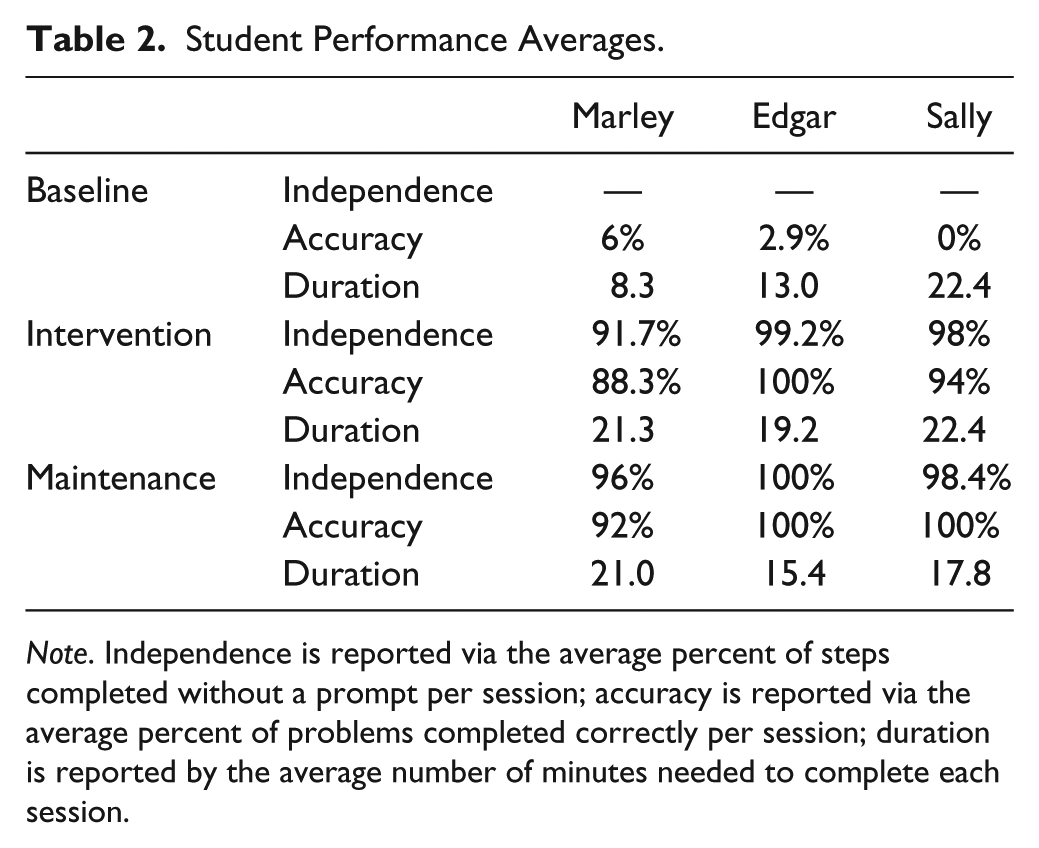
Note. Independence is reported via the average percent of steps completed without a prompt per session; accuracy is reported via the average percent of problems completed correctly per session; duration is reported by the average number of minutes needed to complete each session.
Marley
During baseline, Marley did not answer any questions correctly on three of five sessions and earned an average accuracy of 6% for the phase (range = 0%–20%) while averaging 8.3 min to complete each session (range = 7.0–9.0). Following baseline, Marley’s intervention scores rose above his baseline levels, demonstrating an immediate change in level between conditions (Gast & Ledford, 2014). With the use of a virtual manipulative to solve equations, Marley earned an average accuracy of 88.3% (range = 70%–100%) across six sessions of intervention, reaching 100% accuracy by the fourth session and sustaining this level of performance for an additional two sessions (refer to Figure 3). His average percent independence per session was 91.7% (range = 78%–98%; refer to Figure 4), while he averaged 6.5 prompts per assessment (range = 1–17), of which 52% consisted of verbal prompts, 40% were physical gesturing with verbal direction, and 8% were physical modeling with verbal direction. His average time to complete each session was 21.3 min (range = 15.0–35.0; refer to Figure 5).

Percentage of correctly solved multistep linear equations.
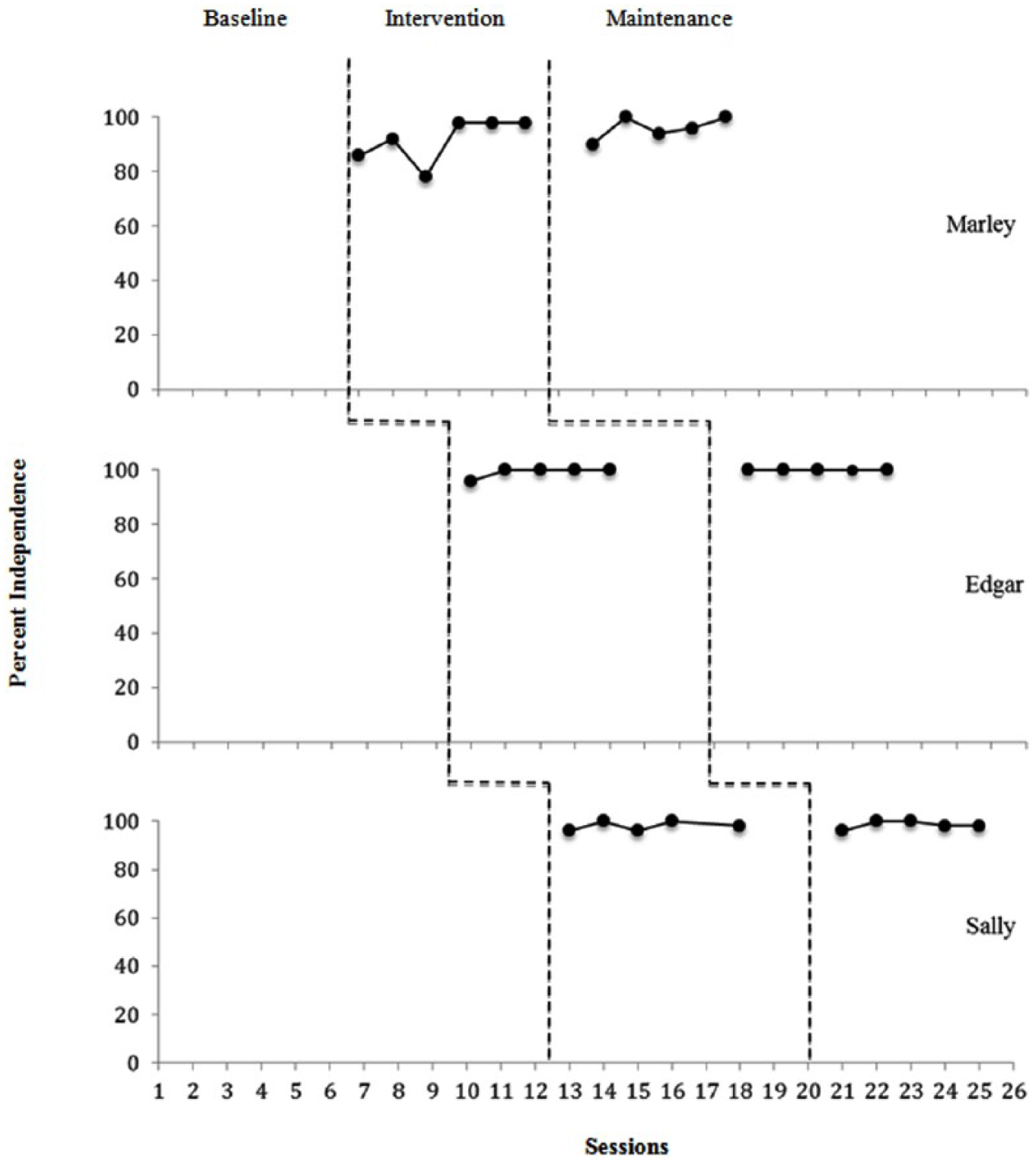
Percentage of steps solved independently.

Duration time of each session.
The level stability of Marley’s intervention data was determined stable based on 80% of his data points falling within 20% of the median level (Gast & Ledford, 2014). Researchers used the split-middle method technique to determine the trend direction of his data to be accelerating, whereas the trend stability of his data was found to be stable based on the level stability envelope and trend line (Gast & Ledford, 2014). The PND between Marley’s baseline and intervention performance was 100%, thus categorizing the intervention as very effective (Scruggs et al., 1987). A second effect size measure, Tau-U, was calculated to be 1.0 with the virtual manipulative, 90% CI [0.399, 1], indicating a highly effective intervention (Parker et al., 2011).
Marley earned an average accuracy of 92% (range = 70%–90%) across five consecutive sessions of maintenance, illustrating improved performance from his intervention sessions. His average percent independence per session increased from intervention to 96% (range = 90%–100%), while he required an average of 5.0 prompts per session (range = 0–13), of which 10% were verbal prompts, 30% were physical gesturing with verbal direction, and 60% were physical modeling with verbal direction. His average time to complete each session remained virtually unchanged from intervention at 21.0 min (range = 14.0–33.0). Level and trend stability of Marley’s data was determined stable, whereas trend direction was accelerating.
Edgar
Edgar did not answer any questions correctly on five of seven sessions of baseline, with an average accuracy score of 2.9% (range = 0%–10%) and an average time of 13.0 min to complete each assessment (range = 10.0–20.0). After exhibiting a stable baseline, Edgar’s intervention performance increased above his baseline scores, illustrating an immediate change in level between conditions (Gast & Ledford, 2014). Edgar exhibited 100% accuracy on five consecutive sessions of intervention. His average percent independence was 99.2% (range = 96%–100%), while he averaged 0.4 prompts per assessment (range = 0–2), of which 100% were verbal. His average time to complete each session was 19.2 min (range = 16.0–29.0).
The level stability of Edgar’s intervention data was deemed stable based on 80% of his data falling between 20% of the median level (Gast & Ledford, 2014). The trend direction of his data for intervention was calculated to be zero-celerating via the split-middle method technique, thus demonstrating no significant change in trend direction. The trend stability of his data was identified as stable based on the level stability envelope and trend line (Gast & Ledford, 2014). The PND between Edgar’s baseline and intervention scores was 100%, classifying the intervention as very effective (Scruggs et al., 1987). Similarly, Edgar’s Tau-U score was 1.0, 90% CI [0.421, 1], thus suggesting the intervention was highly effective (Parker et al., 2011).
Edgar scored 100% of problems correct on five consecutive sessions of maintenance following intervention. He required zero prompts to complete all questions, thus resulting in a 100% average percent independence score for this phase. His average time per assessment decreased from intervention to 15.4 min (range = 14.0–17.0). The level and trend stability of Edgar’s data was stable, and the trend direction was calculated to be zero-celerating, indicating no significant change in trend direction.
Sally
Sally did not answer any questions correctly on all seven sessions of baseline and took on average 22.4 min to complete each session (range = 10.0–45.0). Upon beginning intervention, her scores rose above baseline levels, indicating an immediate change in level between the two conditions (Gast & Ledford, 2014). Sally earned 94% average accuracy (range = 80%–100%) across five sessions of intervention, earning 100% correct on three of the five sessions. Her average percent independence per session was 98% (range = 96%–100%), while she required on average 1.4 prompts per session (range = 0–3), of which 60% were verbal and 40% were physical modeling with verbal direction. Her average time to complete each session remained unchanged from baseline at 22.4 min (range = 19.0–28.0).
The level stability of Sally’s data for intervention was deemed stable in accordance with 80% of her data falling between 20% of the median level (Gast & Ledford, 2014). Using the split-middle method technique, the trend direction was found to be accelerating, whereas the trend stability of her data was determined stable based on the level stability envelope and trend line (Gast & Ledford, 2014). The PND between Sally’s baseline and intervention scores was 100%, classifying the intervention as very effective (Scruggs et al., 1987), whereas her Tau-U score was 1.0, 90% CI [0.421, 1], also classifying the intervention as highly effective (Parker et al., 2011).
Following intervention, Sally earned 100% accuracy on five consecutive sessions of maintenance. Her average percent independence for this phase was 98.4% (range = 96%–100%), while she required an average of 0.8 prompts per session (range = 0–2), with 66.7% of the prompts being verbal and 33.3% being physical gesturing with verbal direction. Similar to Marley and Edgar, Sally’s average time to complete each session during maintenance decreased from intervention to 17.8 min (range = 15.0–20.0). The level and trend stability of her data was classified as stable, whereas the trend direction was zero-celerating, denoting no significant change in trend direction.
Social Validity
Student responses
All three students noted an interest in learning mathematics but shared that they had struggled with the subject in the past. The students stated that past teachers used “typical” strategies and technologies to teach mathematics, including white boards, worksheets, and calculators. In their current classroom, they used laptops to access a computer program that the teacher used to provide remediation and practice problems. All three students stated they enjoyed using computer- and tablet-based technologies for learning mathematics.
Upon completing the study, Marley shared that in the beginning it was difficult for him to use the virtual manipulative, but then reported that the program helped him by providing more practice opportunities. He also commented that it helped “refresh his memory” when solving problems and that he would feel comfortable using the program in front of his peers. He also noted that by the end of the study he did not feel that he needed to use the virtual manipulative to solve equations. Edgar liked using the virtual manipulative because it allowed him to not use a separate calculator. He thought the virtual balance on screen was helpful to visualize each problem, and that he would use it on his own in the future in front of other students. Like Marley, by the end of the study he felt as if he did not need the virtual manipulative to solve equations. Sally showed a preference for using the virtual manipulative because “It’s easy to solve [equations] with the program.” She liked to watch the blocks disappear as she solved each problem and noted that she would use the program on her own moving forward when she did not understand how to solve equations in class. Sally explained that toward the end of study she felt that she did not need the virtual manipulative anymore; however when asked whether she felt confident in solving equations independent of any supports, she was less certain and stated “no.”
Teacher responses
Prior to beginning the study, the mathematics teacher noted that she often used technology-based programs to complement her instruction. She liked the use of these programs due to their immediate feedback, as students with disabilities “need the repetition to commit skills to long term memory.” She also liked how these programs gave her students one-on-one attention. However, she noted that technology might also be distracting at times for her students. In addition, some of the programs she often used in class gave “explanations with a lot of words that students don’t always look at.” She added that she would prefer that these programs had a read-aloud option or a Plain English version to address the needs of her students with disabilities and ELL students.
After the study concluded, both the mathematics teacher and ELL teacher were surprised by the results of their students, particularly because all three students were not particularly strong in mathematics and struggled greatly in the classroom. The mathematics teacher noted that two of the three students seemed to exhibit much higher levels of confidence in mathematics following the study, with Edgar volunteering “almost constantly” in class. The mathematics teacher also noted that all three students should have learned the material assessed in this study in eighth grade, yet it was clear based on the preassessment that they had not retained the information. For this reason, the mathematics teacher noted that virtual manipulatives would be especially appropriate for secondary students in self-contained classes, stating, This class [self-contained] will need this kind of support, and students in co-taught classes could use it [as well], but maybe as a remediation tool or in a one-on-one setting, because they all learned this [solving linear equations] already, but they don’t remember it or didn’t retain it.
Both teachers agreed they would look to integrate virtual manipulatives into their classroom next year, but noted that it may be difficult to use this technology for whole group instruction.
Discussion
The aim of this study was to evaluate the effectiveness of a virtual manipulative balance for teaching secondary students with LD in mathematics how to solve multistep linear equations. Through visual analysis and two effect size measures, researchers demonstrated a functional relation between three students’ use of a computer-based virtual manipulative and their percent accuracy scores solving equations. Moreover, all three students demonstrated retention of these skills following a 2-week break across five sessions of a maintenance phase.
All three students in this study earned 88% or greater average accuracy across five sessions of intervention while also demonstrating high levels of autonomy as illustrated by 92% or greater average independence scores for each. Although average duration times increased from baseline to intervention for Marley and Edgar (8:20–21:20 and 13:00–19:12, respectively), researchers theorize this may be attributed to both students investing more time solving problems in subsequent phases following baseline. Overall, student performance across the three dependent variables of percent accuracy, percent independence, and duration returned positive findings in favor of the intervention treatment.
Just as research has shown the benefits of concrete manipulatives for teaching students with LD (e.g., Agrawal & Morin, 2016; Cass et al., 2003; Flores et al., 2014; Witzel, 2005; Witzel et al., 2003), our results offer evidence demonstrating the value of virtual manipulatives for this population to learn procedural and conceptual knowledge in subject areas such as algebra following one-on-one instruction using explicit instruction. In addition, our findings extend the work of Satsangi and Bouck (2014) and Satsangi et al. (2016) suggesting virtual manipulatives can produce comparable outcomes to the CRA-I sequence (Strickland, 2017) for secondary students who struggle in algebra. Students in our study successfully demonstrated the ability to solve multistep linear equations using a virtual balance while simultaneously solving problems in symbolic notation form on their assessment sheets; this approach mirrors the design principles of the CRA-I sequence used successfully for comparable populations of students with concrete manipulatives (Strickland & Maccini, 2012, 2013).
Although more research is needed, studies conducted thus far with virtual manipulatives are beginning to suggest this form of manipulative shares a great deal in common with its concrete counterpart with respect to their impact on student learning. When comparing the two manipulatives, both the virtual and concrete forms provide students with the opportunity to manipulate three-dimensional objects (Moyer-Packenham & Suh, 2012). However, virtual manipulatives also simultaneously offer students a visual representation of mathematical concepts—such as a two-pan balance representing two sides of an equation—which is akin to the representational phase of the CRA-I sequence. Whether virtual manipulatives are directly equivalent to concrete manipulatives are solely comparable with representational illustrations or are a unique combination of both is still unknown at this time. Nevertheless, results from this study support previous work showing virtual manipulatives providing high levels of problem-solving autonomy to students with disabilities and garnering positive feedback from students and teachers alike on social validity measures (see Bouck et al., 2014; Satsangi & Bouck, 2014; Satsangi et al., 2016). As a result, our findings suggest virtual manipulatives hold tremendous potential as an age-appropriate form of assistive technology to aid secondary students with LD in mathematics in need of support in subject areas such as algebra.
Limitations and Future Directions
This study possessed limitations to its design that may affect its implications for research and practice. Many limitations can be attributed to the types of problems offered to each student. First, the NLVM program used as part of the instructional strategy places constraints on the types of values users can enter into each equation, with the value of zero and double-digit numbers excluded from use. Second, the program isolates equations with all positive coefficients from those with positive and negative coefficients; researchers chose to teach students problems with only positive coefficients due to their novice skill level solving equations at the start of the study. Third, the virtual manipulative program requires all equations to be formatted in the same order, with a variable or a product of a constant and a variable placed to the left of a sole constant on both sides of the equal sign. For these reasons, students only solved problems with positive coefficients ranging from 1 to 9 inclusive in same format for every problem, thus limiting the potential generalization of our findings. Finally, the lack of a formal generalization phase assessing students on curriculum-based questions using only paper and pencil is a notable limitation to this study. With its exclusion, researchers cannot determine whether the three students developed the procedural and conceptual skills needed to solve problems without the aid of the virtual manipulative. Additional research is needed to explore the generalization of problem-solving skills that may or may not result from using this form of assistive technology.
This study and its results contribute to the growing research base studying the benefits of virtual manipulatives for mathematics instruction for students with LD in mathematics. To build upon our findings, future research in this area should continue to explore the application of this technology for teaching secondary mathematics curricula in the subject areas of algebra and geometry to this population. To date, this study is only one of a small number of empirical studies assessing virtual manipulatives to teach skills in these content areas to students with LD and only the second study to teach multistep linear equations (see Satsangi & Bouck, 2014; Satsangi et al., 2016). As all studies thus far have used single subject research methodology, further large-scale replication of these findings is warranted to validate and establish generalization of this tool’s benefits. Subsequent research should explore the use of virtual manipulatives for teaching additional higher order thinking skills emphasized within the CCSSI (2010) for secondary mathematics curricula, such as graphing linear equations and solving multistep word problems. Such work will ultimately aid educators in better understanding how and when to use this form of technology for instructional purposes for secondary students in need of assistive technology support in mathematics.
Implications for Practice
The use of virtual manipulatives has multiple applications for special education teachers in the classroom. For this study, virtual manipulatives were paired with explicit instruction practices to teach students algebraic problem-solving skills. Explicit instruction possesses an established research base demonstrating its effectiveness for teaching students with LD (e.g., Scarlato & Burr, 2002; Witzel et al., 2003). Prior to participating in this study, all three students described past mathematics teachers who used classroom practices resembling explicit instruction to teach linear equations. Through the course of this study, it appears the addition of a digital-based tool that provides onscreen manipulation to an instructional strategy emphasizing explicit instruction strengthened the students’ understanding of multistep linear equations. Social validity responses gathered at the conclusion of the study support this finding, as all three students indicated they felt the use of a virtual manipulative balance in the instructional lesson aided their comprehension and retention of these concepts. These findings are in line with previous research demonstrating the benefits of teaching secondary mathematics skills using virtual manipulatives paired with explicit instruction (Satsangi & Bouck, 2014; Satsangi et al., 2016). Teachers looking to capitalize on this new form of technology are advised to design instruction in a manner in which virtual manipulatives are used as visual illustrations of concepts that can be manipulated while emphasizing repeated modeling, practice, and feedback of the concepts to students.
Moreover, for teachers looking to adopt this technology in their classroom, our findings support its use for a range of settings, including one-on-one and small group instruction. Teachers with students identified with LD in mathematics who struggle understanding how to solve multistep linear equations in large group settings may benefit from the individualized support a virtual manipulative provides. For example, teachers can use virtual manipulatives to teach concepts to students while instructing from the front of the class and projecting these apps on an LCD projector while offering individual students a laptop or tablet to interact with figures and models at their desks. In addition to the flexibility provided in class, students are afforded greater independence with their learning as this technology extends the learning experience beyond the confines of the classroom, allowing students to work autonomously from home (Satsangi & Miller, 2017). As high independence scores from this study demonstrate, students are capable of using virtual manipulatives independently once initial instruction is provided by an adult. Furthermore, many virtual manipulative programs provide explicit instruction via textual and audio lessons with continuous prompting throughout the problem-solving process. Although such advanced programs were not used in this study, they serve as an additional example of the diverse learning options provided by a virtual manipulative medium for secondary teachers and students with LD in mathematics looking for new approaches to mathematics instruction.
Footnotes
Declaration of Conflicting Interests
The author(s) declared no potential conflicts of interest with respect to the research, authorship, and/or publication of this article.
Funding
The author(s) received no financial support for the research, authorship, and/or publication of this article.