




Abstract
The purpose of this study was to explore preservice special education teachers’ experiences within an instructional material development project for students with disabilities during a semester-long technology integration course. Data were collected from 61 preservice special education teachers through an open-ended questionnaire, instructional design reports, and instructional materials. The findings indicated that working with students with disabilities in a real-life environment helped the preservice teachers realize the importance of assistive technology in education to support these students’ needs. This experience also helped the teachers to ascertain what barriers may exist to assistive technology use in education, such as insufficient technology knowledge and skills, and inadequate infrastructure of classrooms, etc. The preservice teachers emphasized that following an instructional design process facilitated the development of effective instructional materials. They also stressed that the instructional material development project contributed to their professional development in different ways, such as practical skills through real-life experiences and technology-related skills.
Keywords
Introduction
The prevalence of people with disabilities has increased over time. According to the World Health Organization’s most recent world report on disability, about 15% of the population experiences at least one form of disability (World Health Organization, 2011). Globally, 5.8% of the 15% are children aged 14 years old or younger. In Turkey, where the current study was conducted, 6.9% of the population asserted that they live with some form of disability that impacts upon their daily activities (Turkish Statistics Institute, 2015). Among those, 27% are aged 21 years old or under. According to the Turkish Ministry of National Education, an increase has been seen in the number of students with disabilities (SWD) receiving special education or within inclusive classrooms (Türkiye Cumhuriyeti Aile, Çalışma & Sosyal Hizmetler Bakanlığı [Turkish Ministry of Family, Labor, and Social Services], 2019). Although the number of these students totaled 53,306 in the 2001–2002 academic year, it later increased seven-fold to reach 353,610 individuals by 2017–2018. With the increase in the number of SWD, strategies to meet their specific needs has become ever more crucial, and the use of assistive technology (AT) in special education has consequently drawn the attention of researchers (e.g., Cano & Sanchez-Iborra, 2015; Cranmer, 2020; Kamalı Arslantaş, Yıldırım, & Altunay, 2022; Ronimus, Eklund, Pesu, & Lyytinen, 2019; Taylor, Lohmann, & Kappel, 2022) looking to provide appropriate individualized support based on their individual needs.
AT in Special Education
The integration of ATs in the education of SWD has also been supported through legislation such as the Individuals with Disabilities Education Act of 1997 (IDEA) and the Assistive Technology Act (also known as Tech Act) of 1998. In the IDEA of 2004, AT is defined as “any item, piece of equipment, or product system, whether acquired commercially off the shelf, modified, or customized, that is used to increase, maintain, or improve functional capabilities of children with disabilities.” The 2004 IDEA mandated that AT must be considered for all eligible students receiving special education whilst developing their Individualized Education Program. In Turkey, similar legislation was introduced in 2005 that decreed that individuals with disabilities must not be prevented from receiving education for any reason, and that ATs (braille, e-books, captioned video, etc.) must be provided or produced to meet their individual needs (Engelliler Hakkinda Kanun [Turkish Disability Act], 2005, Article 15).
With the awareness of the importance of AT in special education, researchers reported various benefits of using AT in the lives of SWD. In educational settings, the benefits of ATs for SWD have been listed as supporting access to curricula (Coleman, 2011; Floyd, Galyon, & Floyd-Norris, 2020), enhancing students’ learning and academic performance (Perelmutter, McGregor, & Gordon, 2017), facilitating independent information access (Kamalı Arslantaş, Yıldırım, & Altunay Arslantekin, 2021), providing independence in completing schoolwork (Bouck, Doughty, Flanagan, Szwed, & Bassette, 2010; Nordström, Nilsson, Gustafson, & Svensson, 2019), enabling students to learn at their own pace (Atanga, Jones, Krueger, & Lu, 2020), increasing their motivation and interest to learn (Lindeblad, Nilsson, Gustafson, & Svensson, 2017; Nordström et al., 2019), and increasing the inclusion of SWD into the general education setting (Chambers, 2020; Nordström et al., 2019). Furthermore, AT use is known to impact on the development of basic skills such as communication (Hill & Flores, 2014), reading (Ronimus et al., 2019), writing (Dawson, Antonenko, Lane, & Zhu, 2019), mathematics (Ok, Bryant, & Bryant, 2020; Xin et al., 2017), and language skills (Kamalı Arslantaş et al., 2021; Rodríguez & Cumming, 2017). Also, AT offers a crucial support for inclusive educators who are responsible to provide accessible materials and equal education for SWD to make them benefit from the learning environment as their peers (Bong & Chen, 2021; Taylor et al., 2022). Liman et al. (2015) highlighted the importance of ATs in inclusive settings as “the place of assistive technology devices in an inclusive education can never be underestimated” (p. 31) since it helps the SWD to be independent, and confident. Bouck, Maeda, and Flanagan. (2012) suggested that SWD who have access to ATs as students use AT at schools produced more positive post-school outcomes (i.e., employment, wages, and participation in postsecondary education) in general.
Although ATs have the potential to support the needs of SWD (McNicholl, Casey, Desmond, & Gallagher, 2021; Sadler, 2019), they are still not utilized at their full potential (Judge & Simms, 2009; Park, Bagwell, Bryant, & Bryant, 2022). Obtaining and maintaining ATs is one of the major challenges because of funding issues, a lack of resources and materials in classrooms or schools (Atanga et al., 2020; Copley & Ziviani, 2004), time constraints, the cost of AT, inadequate assessment and planning process for AT integration (Ahmed, 2018), the rapid development of new apps, products, and hardware (Thomas, Peeples, Kennedy, & Decker, 2019), and finding appropriate AT based on students’ individual needs (Atanga et al., 2020). Student characteristics (Atanga et al., 2020; Copley & Ziviani, 2004) and students’ lack of AT knowledge (Ahmed, 2018) is another major challenge for AT use at schools. Moreover, teachers’ attitudes (Atanga et al., 2020; Copley & Ziviani, 2004) and inadequate teacher training (Atanga et al., 2020; Bausch & Ault, 2012; Copley & Ziviani, 2004; Schaaf, 2018; Thomas et al., 2019) has been reported as the most significant challenge to the integration of AT in education.
AT Training in Teacher Education
As teachers are the frontline educators who directly work with SWD and are therefore usually expected to guide administrators in making decisions about the AT needs of their schools (Bryant & Bryant, 2012), teachers should possess a certain level of knowledge and skills regarding ATs, as well as how to effectively integrate them within their lessons. However, teachers typically do not receive adequate AT-related training to be able to fully support these students (Schaaf, 2018).
The current literature (e.g., Atanga et al., 2020; King & Allen, 2018; Park et al., 2022) has demonstrated the need for AT training in teacher education programs. Teachers’ lack of knowledge and skills related to AT and its integration into teaching and learning practices for SWD hinders successful AT implementation (Judge & Simms, 2009; Park et al., 2022; Schaaf, 2018; Wilson et al., 2011). The literature (Atanga et al., 2020; Schaaf, 2018) has indicated that teacher education programs inadequately prepare special education teachers to use AT, and that deficiencies in AT education in teacher education programs is considered to be one of the main barriers to successful AT implementation (Atanga et al., 2020; Kutlu, Schreglmann, & Cinisli, 2018; Maich, van Rhijn, Woods, & Brochu, 2017). Atanga et al. (2020) claimed that special education teachers who completed an AT course in their undergraduate program self-reported higher AT-related knowledge in the workplace. Receiving AT education within undergraduate programs helps novice teachers to be better prepared to integrate AT in the actual classroom setting (King & Allen, 2018). Therefore, providing the requisite AT knowledge and skills in teacher education programs is essential to enable preservice special education teachers (PSETs) to fulfil their future responsibilities related to the AT needs and services of SWD (IDEA, 2004).
The studies on teacher education suggested three different approaches to the provision of AT knowledge in teacher education programs. One approach is to integrate AT into existing courses (Bryant et al., 1998; Park et al., 2022), which requires faculty expertise, additional space to be allocated for the extra content in these courses, and of course additional resources (Park et al., 2022; Van Laarhoven, Munk, Chandler, Zurita, & Lynch, 2012), which may not be feasible for all faculties. As a second approach, Jones, Peterson-Ahmad, Fields, and Williams (2021) and Park et al. (2022) suggested an AT lab approach that PSETs visit the lab to attend the AT orientation developed by the AT experts within their existing coursework. However, this approach requires purchasing expensive AT lab equipment and an AT specialist whose only job is to operate the lab. Another approach is to provide PSETs with specific AT knowledge and skills through separate AT courses in which they learn about various ATs and their application in the actual classroom setting (Kamei-Hannan, Howe, Herrera, & Erin, 2012).
During AT course activities, practice-oriented activities help PSETs to adopt technology integration into special education. Experiencing the complexity of technology integration in practice, through a systematic learning environment with constant support, enables them to comfortably utilize the principles of technology integration ready for when they come to practice it in a real-life setting (Benedict, Holdheide, Brownell, & Foley, 2016). For example, Peterson-Ahmad, Stepp, and Somerville (2018) utilized Web 2.0 tools in an AT course as part of a teacher preparation program, and proposed factors affecting Web 2.0 use in inclusive settings as an apprehensible form of training with hands-on experience, guidance through experience-based feedback, and peer-support. They suggested course activities be formed in a way that encompasses content-based pedagogical strategies in special education. PSETs can then learn how to use AT to meet their students’ needs through appropriate strategies. They stressed the importance of well-managed approach for the course quality.
Hands-on experience in which PSETs can use content-based pedagogical strategies with appropriate guidance form a valuable part of their AT education. Furthermore, authentic learning environments enable PSETs to develop instructional materials according to the particular needs of their students by orienting them towards learner-centered designs (Best, MacGregor, & Price, 2017). Learner-centered design is considered to be of particular importance in special education because each student has specific and diverse needs, as well as other variables such as different characteristics and knowledge levels. Adebisi, Liman, and Longpoe (2015) stressed that “the choice of the appropriate use of AT, whether available or improvised, the right selection depends on the individual child, the skills problems, the setting and the particular tasks the child wants to achieve” (p. 18). Therefore, the application of a systematic approach is crucial in making the right AT selection which matches the individual needs of the students (Adebisi et al., 2015; Liman, Adebisi, Jerry, & Adewale, 2015; Schmidt, Lin, Paek, MacSuga-Gage, & Gage, 2017). An instructional design (ID) process is a systematic approach that provides opportunities for PSETs to apply ATs through authentic and learner-centered hands-on practices by integrating in the real special education classrooms.
ID Process and AT Training
Instructional design is a design-oriented approach in which learners complete tasks through the ways ID identifies by following detailed broken steps of the complex situation (Reigeluth, 1999). It offers guidance for practice-based learning in which a product is developed. ADDIE, an acronym used to define the steps of Analyze, Design, Development, Implementation, and Evaluation, is a framework that is used to organize the ID process and a common structure used in ID models (Branch, 2009). Following the ID process within the ADDIE framework provides a step-by-step guide to attain a complex task such as preparing technology-integrated instructional materials for unique needs of SWD.
Instructional design has been recognized for decades as a systematic approach that can make learning more efficient (Gustafson & Branch, 2007; Rothwell & Kazanas, 2011). Following the ID models provides a general roadmap for teachers (Branch & Dousay, 2015), and “help to ensure that what is produced serves as a necessary purpose, meets the needs of students, is attractive and well organized, is delivered in an appropriate mode, and continually evaluated and improved” (Morrison, Ross, Kalman, & Kemp, 2013, p. 4). Also, ID models assist teachers to develop high-quality student-centered instruction, and to adapt the available materials so as to meet the particular needs of their courses (Morrison et al., 2013). Branch and Dousay (2015) stressed that when the ID process is applied appropriately, the products are more effective and appealing instructions to learners. Therefore, the ID process can be used as a means to guide PSETs in providing AT education, to make appropriate AT-related decisions, and to meet the individual needs of SWD through the development and usage of effective instructional materials.
Even though the use of ID models in technology decision-making and instructional material development has certain benefits, only a limited number of studies have investigated the use of ID models in the AT training of special education teachers. For example, Schmidt et al. (2017) suggested to use ID model as a systematic approach for inservice teacher training in decision-making processes to identify educational apps. They utilized an ID process that included needs assessment, product review, implementation, and evaluation. The results indicated that the suggested ID process enabled special education teachers to feel more confident and comfortable in identifying mobile applications for use in their instruction. However, the findings of the study focused only upon the evaluation of the needs analysis and product review phases, and the teachers did not implement or evaluate these products in a real-life setting. Also, the research study was limited to inservice special education teacher training concerning educational app identification and evaluation.
It is clear, however, that AT education for teachers should begin at the preservice level (Atanga et al., 2020). In this sense, technology integration courses in teacher education programs have gained in strategic importance as a potential mechanism to equip preservice teachers with the necessary AT knowledge and skills to support the students in their education. Such technology integration courses should provide preservice teachers with hands-on experience in using various ATs for instructional purposes, and in how they can be implemented within a real classroom setting. To understand the effectiveness of these technology integration courses, it is essential to first explore the experiences of preservice teachers who have a clear requirement to be able to use ATs in their future classrooms. In order to address this gap in the literature, this study aimed to provide an ID approach for AT education in which PSETs follow ID steps to design and develop instructional materials that aim to meet the individual needs of SWD.
In this sense, the purpose of the current study was to investigate PSETs’ experiences in an IMD project for SWD during a semester-long technology integration course. Following research questions guided this study: • How does the IMD project contribute to the PSETs’ understandings of AT integration into special education? • How do the PSETs perceive the contribution of the IMD project on their professional development? • How does the ID process followed in the IMD project impact the instructional material development?
Methodology
This study employed a qualitative case study design (Stake, 1995; Yin, 2014) utilizing multiple data sources (i.e., open-ended questionnaire, reports, and instructional materials). The purpose of the study was considered to be served better through a qualitative case study because it aimed at revealing PSETs’ experiences in detail so as to explore their understanding regarding AT integration within the special education context.
Participants
The participants of this study were 61 PSETs (62.3% female, 37.7% male) enrolled in a semester-long technology integration course. Their ages ranged from 17 to 31 years old, with a mean of 20.48 years (SD = 2.83). Regarding their grade level, 54.1% were freshmen, 39.3% sophomores, and 6.6% were juniors. Only 13.1% of the PSETs reported that they had previously worked with SWD. None of the participants had received any previous training on AT. The participants were divided into 16 groups of 3–4 PSETs while working on the IMD project.
Setting
The study was conducted in a college-level technology integration course that was offered to PSETs at a public university in Turkey by the first author of this paper. The aim of the course was to develop PSETs’ AT knowledge and skills, and to enable them to apply those skills to support SWD. The content of the course consisted of (1) introduction to ATs and computer-supported education, (2) accessibility and universal design for learning, (3) screen readers, (4) speech recognition tools, (5) Google apps (i.e., Google Docs, Google Sheets, and Google Slides), and (6) Web 2.0 tools (e.g., Powtoon, Prezi, Kahoot, and Cacoo) used for presentation, animation, as well as mind mapping.
Demographics of the Students With Disabilities.

The rehabilitation center in this study was a private institution that provides individual support to the students with a variety of disabilities including students with learning disabilities, intellectual disabilities, physical disabilities, autism spectrum disorder, and psychological disabilities. The majority of the students in this institution had a learning disability and received support from the center after school hours. All of the teachers at the rehabilitation center had a certification in special education. Although teachers were allowed to use ATs to provide support to the students, there were very limited technologies available at the center. They had to use their personal devices if they would like to integrate it in their instruction. There were only two computers, a printer and Internet access for their use. Teachers mainly used the computers to print out handouts and search learning activities while preparing instructions for the students.
The students analyzed their assigned students and identify teaching methods and techniques to reach targeted gain during the first half of the course. Then, they began to design and develop their materials in the eighth week of the course and the instructor examined and provided feedback during the course hours so that the PSETs revised their designs or materials for more appropriate materials and learned how to prepare an instructional material better than one-shot material development. The detailed ID process followed in the IMD project was explained in the procedures section.
Procedures
This study consists of three phases. In Phase I, the institutional review board approval was obtained for all study procedure and the consent of the participants were received before the course started. The participating PSETs were formed into 16 groups of 3–4 PSETs to work on the IMD project collaboratively since decision making process for ATs at schools are conducted by teams including special education teachers, classroom teachers, administrators, parents, and SWD (Reed, 2009). The course instructor arbitrarily assigned a student among SWD the manager of the center determined to each group. Then, each group of PSETs prepared instructional materials that would support the needs of assigned SWD.
Phase II includes the IMD project. To prepare instructional materials, the PSETs followed the ID process, including six main steps; (1) Analyze the learners, (2) Identify Teaching Methods and Techniques, (3) Design materials, (4) Develop materials (5) Implement materials, and (6) Evaluate materials (see Figure 1). The ID process was applied iteratively and reflectively so that the PSETs were fostered continually to evaluate and improve their materials in accordance with the needs of the students. Instructional design process.
Analyze the Learners.
The PSETs visited the rehabilitation center to observe the students assigned to their groups and obtain information regarding their disabilities, learning needs, characteristics, interests, etc. The PSETs reflected their observations and gathered information into analysis reports. The Analysis Report template, which includes guided list of student characteristics (e.g., age, gender, and identified functional limitations) and three guided questions, was provided to help the PSETs. One example guided question is, “Based on your observations and student’s developmental report, in which areas (e.g., language development, fine motor skills, social skills, etc.) does the student need support.” These analysis reports were then examined and revised based upon feedback of the researchers.
Identify Teaching Methods and Techniques.
After identifying the needs of the students, the PSETs researched the teaching methods and techniques in special education, and decided the specific ones that could be beneficial to meet the SWD’s needs stated in the analysis reports. The groups’ reflections for specific teaching methods and techniques were reviewed and feedback was provided by a faculty member from Special Education and the course instructor individually to each group during the scheduled group meetings.
Design Materials.
. Sample Web 2.0 Tool Identified by Preservice Special Education Teachers.
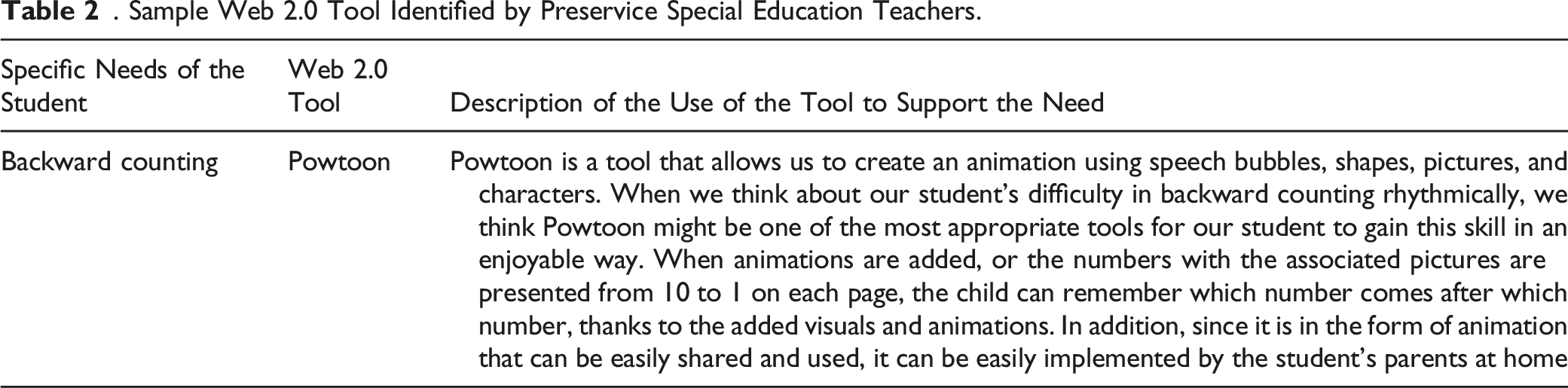
Develop Materials.
The PSETs developed their instructional materials according to their design reports. The researchers reviewed the materials and provided feedback.
Implement Materials.
After receiving their instructor’s approval, each group implemented their materials at the rehabilitation center. During the implementation stage, the PSETs were permitted to seek help from their assigned student’s teacher when needed. The participants then explained their implementation experiences in their reports by considering the three guided prompts which asks to provide the detailed explanation of the implementation, the negative factors impacting the implementation and outcomes of the implementation.
Evaluate Materials.
The PSETs reported on the evaluation of their instructional materials based on the provided guided prompts in the template; for example, stating whether or not an expected learning outcome was achieved, whether it was successfully implemented, how the student’s reaction was, and how it could be improved, etc.
In the last phase, following completion of the IMD project, the PSETs were each asked to complete an open-ended questionnaire. An identification number was assigned to each student and one of the researchers has collected the data online, so the course instructor did not know which response belongs to whom and the students could honestly answer to the questions.
Data Collection
The qualitative data of the study was collected from multiple data sources, including an open-ended questionnaire, ID reports, and instructional materials.
Open-Ended Questionnaire.
The open-ended questionnaire includes 13 open-ended questions (see Appendix A) such as, “What did you like most about the IMD project?,” and “If any, what challenges did you face during the IMD project?,” The PSETs individually answered these questions to reflect their experiences of the IMD project at the end of the course.
ID Reports.
During the IMD process, each group completed four ID reports: analysis, design, implementation, and evaluation. For each report, the PSETs were provided with templates to frame what they were expected to reflect in each step. These templates include prompts and guided questions.
Instructional Materials.
The PSETs developed their instructional materials as a group, using Web 2.0 tools based on their analysis and design reports to meet the needs of their assigned students with appropriate AT. To evaluate the materials, the researchers developed a rubric (Appendix B) which had a maximum score of 100.
Data Analysis
The qualitative data from the open-ended questionnaire were analyzed using the inductive analysis technique (Creswell, 2014) with a constant comparative approach (Glaser & Strauss, 1967). As a first step, the two researchers of the study read through the completed questionnaires in order to familiarize themselves with the collected data. Then, four of the participants’ open-ended questionnaires were coded together in NVivo and emergent patterns and recurring words were noted. After creating the codes, the researchers each coded 12 participants’ open-ended questionnaires independently, and percentages of the common codes were calculated as the intercoder agreement for the purposes of quality assurance. Both of the researchers agreed on 96% of the codes, which demonstrated a high level of agreement. Then, one of the researchers proceeded to code the remaining data. Through iterative rounds of data reduction, the codes were grouped into categories and then themes were created from similar categories. The two researchers then discussed the codes, categories, and themes through peer debriefing sessions.
Instructional materials and ID reports were reviewed to corroborate evidence to support the themes that emerged from the open-ended questionnaire data. Also, the researchers created an Excel spreadsheet in which the ID steps of each group were narrowed down into keywords and summaries so as to inquire whether an alignment existed among the steps of the ID process. In their design reports, the researchers looked for whether or not the PSETs considered the outputs of their analysis reports (e.g., students’ needs and interests) while selecting their Web 2.0 tools, learning outcomes, content, and the features of their instructional materials. Then, the participants’ instructional materials were reviewed to check the alignment of the developed material with their design. For the implementation and evaluation reports, narratives were written regarding the success of their materials.
Findings of the open-ended questionnaires were triangulated through analysis of the instructional materials and ID reports to present a rich description on the processes of the IMD project for SWD. The developed instructional materials were scored using a rubric. Through the rubric, the materials were evaluated as “insufficient,” “partially sufficient,” or “sufficient” based on 13 criteria such as serving for targeted skills, being designed in accordance with visual principles, and including appropriate and sufficient content for targeted skills, etc. Two researchers separately scored the materials and then, they met to agree on the scores of the materials.
Results
The findings of the study revealed that the IMD project provided the participant PSETs with real-life experiences where they had the opportunity to work with SWD. As the researchers deeply explored the collected data from the open-ended questionnaire, four themes emerged: (1) Contribution of AT to the education of SWD, (2) Barriers to using AT in special education, (3) Contribution of following an ID process for the IMD project, and (4) Contribution of the IMD project to the PSETs’ professional development. Pseudonyms were assigned to each participant to protect their anonymity when presenting examples of the participants’ statements. Themes are presented by research questions in the following section.
Q1: How Does the IMD Project Contribute to the PSETs’ Understandings of AT Integration Into Special Education?
After the IMD project, the PSETs realized the contribution of AT to the education of SWD and barriers to using AT in special education. Therefore, two themes emerged related to the research question 1.
Contribution of AT to the Education of SWD.
The PSETs developed and administered the instructional materials in real-life classroom settings. Based on these experiences, the vast majority of them (n = 59) thought that the use of AT in the education of SWD greatly impacted on their education. Accordingly, three contributions were revealed: (a) supporting students’ learning, (b) supporting student’s skill development, and (c) promoting knowledge access.
The PSETs explained that the use of AT supported the students’ learning by drawing the students’ attention to the content, promoting their active participation, making learning fun for them, and enabling the students to learn at their own pace. Furthermore, the use of AT helped to meet the students’ individual needs and to make the learning permanent. Drawing students’ attention to the content was the benefit most frequently mentioned by the PSETs for AT use (n = 26). For example, Brooklyn explained, “Since these technologies require interactive participation and are more interesting, they maximize the students’ motivation and attention to the lesson,” Group 9 stressed the following in their implementation report: It also helps the teacher and the student saves time due to the accelerated learning process. Thanks to existing visuals and auxiliary video [in the material], the process facilitated the student’s retention and perception of what had been learned, as well as having provided a repeatable learning opportunity.
The PSETs stated that AT helped the development of 11 different skills for their students. The most frequently mentioned skills were mathematical skills (n = 25), reading skills (n = 13), and language and communication skills (n = 12). Comprehension, concrete reasoning, social, technological, psychomotor, attention, independent living, and retention skills are the other skills also mentioned by the PSETs.
Lastly, a few of the PSETs (n = 5) pointed out that AT promotes knowledge access due to the ease of using AT and by providing opportunities to unlimited access. On this, Staci said, “I had never thought of doing such a project. It was very nice that the instructional materials we developed for the students with special needs were easily used by the students, their teachers, and parents.” They also mentioned that it was very beneficial for them since it lets them have “much repetition to learn” (Bennett).
Barriers to Using AT in Special Education.
The IMD project enabled the PSETs to experience the whole ID process. Throughout this process, they had a chance to observe the use of AT in special education in real classroom settings and came across several challenges. This experience led them to realize some of the barriers to AT usage in special education. Overall, seven barriers were mentioned: (a) limited technology knowledge and skills, (b) students’ attitudes toward AT, c) health-related issues, (d) teachers’ concerns related to AT usage, (e) challenges in the development of appropriate materials, (f) barriers related to tools and resources, and (g) challenges during the implementation of AT.
Around half of the PSETs (n = 31) stressed that limited technology knowledge and skills was the most important barrier to the use of AT in the classroom. During the implementation phase, 20 PSETs acknowledged that SWD had no or very limited technology knowledge and skills since most of them had either no technology access or experience of using it in their education. On this, Ian said, “Insufficient computer skills of the students in the rehabilitation center constrained their technology use.” Besides the students, 14 PSETs also reported teachers’ limited technology knowledge and skills as being a barrier. Tessa commented, “In general, teachers cannot use the computers and they find it difficult to prepare materials using computers.” Amy summarized the issue by saying that; “The biggest barrier is that teachers and students do not know how to use the emerging technologies.”
The pre-service teachers (n = 15) also indicated that the students’ personalities and unwillingness to participate in technology-integrated activities were considered to be a challenge. Some of the students were shy, stubborn, or became overexcited, whilst some became bored much more easily or were disinterested in the activities. For instance, Samuel said, “The disadvantage of this project was that our student was unsociable and unresponsive. She did not show any improvement in these [targeted] skills. The student was only interested in the technological material and was not sufficiently focused on the content.”
The PSETs worked with SWD who had diverse needs and various competency deficiencies. Some of the students were only permitted limited time to use the computers due to health-related conditions such as epilepsy. On this, 11 of the PSETs reported that some health-related conditions could be considered a barrier. These types of conditions were reported in their analysis and design reports as follows: It has been suggested by the doctor that the student, who has to intensively use a computer for a longer period of time, has been kept away from using technologies such as computers, tablets, and television as much as possible since it had recently triggered a chronic illness in the student. (Group 5, analysis report) At the same time, we kept our animation time short since our student should not spend a long time with the computer due to having epilepsy. (Group 5, design report)
For the majority of the PSETs, it was their first time working with SWD, and also in being involved in this type of material development process. Therefore, a few of them (n = 4) expressed concerns that this first-time experience as a barrier for them.
Another barrier to the AT use was reported as challenges in the development of instructional materials (n = 31). The PSETs explained that deciding upon the tool to use for developing appropriate instructional materials to meet their students’ needs was difficult, and that the whole material development process took up too much time.
In addition to the barriers during the development process, barriers related to the implementation of their instructional materials in the classroom were also reported by the PSETs (n = 12). They stated that using computers distracted the students’ attention, and that sometimes it was hard for them to maintain the students’ engagement in the activity. Also, they commented that the implementation of the instructional materials took longer than they thought, and some encountered technical difficulties. Sadie noted, “As the instructional material was on the computer, it seemed that playing on the computer was the student’s priority rather than the activity itself.”
The final barrier mentioned by the PSETs (n = 14) was regarding issues related to the tools and resources used. They pointed out that the infrastructure of the classrooms was inappropriate for the use of AT, with examples given as having very small classrooms, a limited number of classrooms for individualized instruction, and an inappropriate classroom layout. Another problem related to the classrooms was “poor Internet access” (Sebastian). Some of the instructional materials required reliable, high-speed Internet access. In their implementation report, Group 8 mentioned, “The Internet connection was interrupted and slow,” which negatively affected their implementation. Due to this negative experience, Averie stated, “We might not have access to the computer or Internet everywhere” and expressed this as a potential barrier to AT use. Furthermore, the PSETs also expressed certain limited features of the available tools were seen as a barrier. Sadie said: The number of programs that have both visual, text and audio features is low. The program with good font size feature has an audio issue, the one which has good audio features has a visual problem. There are not many programs that have all three features together.
Q2: How do the PSETs Perceive the Contribution of the IMD Project on Their Professional Development?
The PSETs mentioned the different impact of the IMD project on their professional development as future teachers. All these listed contributions were combined into one theme.
Contribution of the IMD Project to the PSETs’ Professional Development.
The IMD project contributed to the PSETs’ professional development in different ways. According to the vast majority of the PSETs (n = 59), it had a positive impact on their (a) technology-related skills, (b) ID skills, (c) practical skills through real-life experiences, and (d) sense of competence to use AT for instructional purposes.
The PSETs developed their technology-related skills during the material development process. Some of the PSETs (n = 17), especially those who described themselves as a technology novice, affirmed that the project improved their fundamental level of technology knowledge and skills. Additionally, the PSETs declared that they developed knowledge and skills related to how to use AT (n = 21), and how to integrate technology in the education of SWD through the help of the project (n = 31). Also, 13 PSETs emphasized that they understood the importance of technology for SWD. For example, Kevin said: The project enabled us to gain new knowledge and experiences, to use programs that we had never used before, and to gain a better idea of how to use technology in special education. It showed how we can make learning easier and more effective by using the power of technology as an advantage for students with special needs.
According to the PSETs, the IMD project enabled them to develop their ID skills. A high number of PSETs (n = 31) believed that they gained the required skills to design and develop the appropriate materials for SWD. Of the PSETs, 19 of them stated that they learned how to apply technological materials with SWD. Three of the PSETs considered themselves to be successful in identifying students’ needs and four of them in reporting the ID process. Sarah described the project’s contribution to her ID skills as, “I felt successful in understanding the student, what could be done for her, what we could design, how we could understand her the best, and realizing her needs as a special educator.”
The PSETs expressed that they were afforded the opportunity to gain practical skills through real-life experiences with the help of the project. According to the PSETs, those experiences gave them a chance to practice teaching (n = 26) and to work with SWD (n = 27). For example, Abigail said: [I realized that] not everything is as it is written in theory; every child is different; their characteristics may not be as described in the books. Also, I have experienced the [teaching] profession in its actual environment. I can say that it is the best part of this project.
The project also had a positive influence on the PSETs’ sense of competence in using ATs for SWD. According to three PSETs, the project helped them to develop self-awareness, in that they realized their strengths and weaknesses in using AT for SWD. Almost half of the PSETs (n = 28) affirmed that the project improved their self-confidence to use AT for SWD. Moreover, the vast majority of the PSETs (n = 56) clearly stated that they would like to use AT in their professional teaching life based on the experiences gained in the project. On this, Kate shared: I wasn’t sure when I started the project. There were topics that I was hesitant about. For example, it was more difficult to do this on the computer, even when it was difficult to design an activity on paper for a special education student. Now, these negative thoughts have gone.
In their evaluation reports, group 4 summarized their project’s contribution as:
[It enabled us] to develop ourselves in many areas such as interaction with the child, pedagogical knowledge, observation skills, gaining experience, teaching, implementing [instructional] materials, knowledge of the [special education] field, and to create the desire to have sufficient knowledge in these areas.
Q3: How Does the Instructional Design Process Followed in the IMD Project Impact the Instructional Material Development?
The PSETs followed the ID process during the IMD project. They generally found the ID process beneficial for the project. All of these benefits were organized in one theme.
Contribution of Following an ID Process for the IMD Project.
The vast majority of the PSETs (n = 58) stated that the ID process positively affected their materials development. According to the PSETs, the ID process helped lead the materials development process (n = 44) and enabled the development of high-quality products (n = 14). Among these 44 PSETs, 21 asserted that the ID process aided the development of the instructional material by providing a pathway to the development of materials that met the students’ special needs. In total, 13 of the participants believed that the ID process helped guide the material development by providing input for the next step. Lastly, 10 of the PSETs claimed that following an ID process facilitated the development of their instructional materials with a deeper level of thought having been applied. Eva expressed her thought on this as: Reflecting what we had done during this process into the reports and evaluating the application [instructional material] helped us to think in detail about what we could do for our project to develop and elaborate upon them in this context.
Instructional design reports also indicated that the ID process enabled the PSETs to progress appropriately in their materials development. Examination of the reports showed complete alignment between the analysis and design reports for nine of the 16 groups. In the design reports of these nine groups, they were seen to have provided technological tools and sample uses of those tools for the specific needs described in their analysis reports. Among the remaining seven groups, four groups designed materials for the general needs written in their analysis reports such as vocabulary development (in the design report) to enhance reading fluency (in the analysis report). However, the other three groups focused upon needs that they had not mentioned in their analysis reports.
When the instructional materials were examined, only one group had changed the tool reported in the design step and developed a different material instead; although the developed material still aimed to meet the targeted needs of their assigned student. Other groups developed their materials as they planned in their design reports. For example, Group 7 reported that their student needed support in reading comprehension, language and communication, and attention skills according to their analysis report. Then, they decided to use ProProfs Brain Games by merging a visual story prepared in PowerPoint to support the student’s reading comprehension. The PSETs explained the purpose, their material’s features, and its implementation in detail within their design report and developed their material as planned. The story prepared in PowerPoint was considered very creative, appropriate for the student’s age, and reflected the student’s interests to maintain attention during reading. Following the story, a crossword was created using ProProfs Brain Games that included questions about the story so as to develop the student’s attention and comprehension skills. As mentioned in their implementation report, the materials were applied successfully with eager participation of the assigned student who has multiple disabilities (i.e., learning disability and ADHD). According to the group members, the only revisions required for the materials were to shorten the story and to change the names used in the story to the student’s native language. As researchers, the only suggestion put forward with regards to the material was making the text more readable in terms of visual principles.
According to the questionnaire results, some of the PSETs (n = 14) acknowledged that following an ID process also enabled them to develop high-quality materials. Among those, 10 PSETs confirmed that following an ID process helped to make the materials more meaningful. Ivan expressed that, “The steps we followed facilitated us to present how the materials were developed and what they contained; so, it made the material more understandable and affected it positively.” Four PSETs agreed that they developed more appropriate instructional materials for their students with special needs by following the steps of the ID process. Dylan stated that, “Going over the written reports was very useful for undertaking planned and logical work.”
The PSETs’ instructional material scores (M = 92.00, SD = 6.00) showed that they successfully developed the instructional materials according to the criteria provided by their instructors. In their implementation and evaluation reports, 15 out of the 16 groups reported their implementation as being successful, and that their assigned students were able to achieve the expected learning outcomes following the implementation. Also, 14 of the groups said their instructional materials were considered as being appropriate to the student’s level.
Discussion
In this study, the researchers explored the experiences of PSETs in an IMD project conducted within a technology integration course. The results of the study indicated that following an ID process provided useful guidance for the development of instructional materials for SWD, which corroborates the findings of Branch and Dousay (2015), Schmidt et al. (2017), and also Zain, Muniandy, and Hashim (2016). The instruction quality was also maintained with the help of the rigid guidelines of ID process as suggested by Peterson-Ahmad et al. (2018). The participant PSETs progressed step-by-step through the IMD process with constant support from their instructors, so that they managed to adopt the use of AT for SWD without being overwhelmed by the complexity of the technology integration itself (Benedict et al., 2016). This finding is aligned with the research study by Schmidt et al. (2017) who utilized the ID process to identify the appropriate educational apps and found that following the ID process gave special education teachers more confidence and comfort in identifying mobile applications for use in their classes. Moreover, the participants in this current study used the outcomes of each step as input to the next step, and in that way, they were able to take firm steps forward to meet their students’ needs (Morrison et al., 2013). With the help of the ID process, the PSETs pondered the requirements of each step in some depth (Zain et al., 2016), which afforded them the opportunity to prepare effective instructional materials that met the special needs of their assigned students, complete with detailed instructions about the materials; which also supports the claims of Morrison et al. (2013).
The IMD project enabled the participant PSETs to become equipped with the required knowledge and skills for the successful application of AT in a special education context. The participants were provided with step-by-step instructions delivered as small chunks of information and with continuous instructor feedback (Benedict et al., 2016) to provide a set of enduring real-life opportunities and challenges (Zain et al., 2016). The project provided an exemplary AT course through which to develop the PSETs’ knowledge and utilization of AT to meet the instructional needs of the SWD, which also supports the findings of Schmidt et al.’s (2017) study. The IMD project also improved the participants’ ID skills as they progressed through each step by analyzing whether or not what they had served the specific needs of their assigned students, and helped to continually improve the materials they developed based on their analysis (Morrison et al., 2013). Furthermore, the IMD project promoted a learner-centered design by leading the PSETs to develop instructional materials that met the particular needs of SWD through the help of an authentic learning context, as Best et al. (2017) also reported.
In addition to the analysis, design, and development of the materials, the PSETs had opportunities to work with the actual SWD whilst implementing the materials that they had developed. Through a blend of hands-on experience and authentic learning, the PSETs gained meaningful and purposeful teaching experience (Best et al., 2017). As to the last point on the contribution of the IMD project, the PSETs improved their sense of competence in using AT for instructional purposes, as also reported in the study of Schmidt et al. (2017). The project promoted the participants’ self-awareness and self-confidence, and a desire to use AT for SWD.
The real-life experience of working with SWD helped the PSETs to realize the importance of AT in the education of SWD. This result is crucial in that their beliefs about the importance of technology significantly affect their intentions to use technology (Nelson & Hawk, 2020). According to their experiences, they asserted that AT supported the students’ learning and skills development, and facilitated the students’ knowledge access. Overall, the findings from the current study can be said to align with earlier research about the benefits of AT in the educational setting (e.g., Atanga et al., 2020; Chiang & Liu, 2011). Regarding the enhancement of their students’ learning, the PSETs mentioned that AT drew the students’ attention to the lesson content, and increased their active participation. This same finding was also reported in the research conducted by Atanga et al. (2020).
AT has been shown to influence the skills development of SWD (Kirkpatrick et al., 2017). Congruent to the published literature, the PSETs in the current study asserted that AT improved the mathematical skills (Ok et al., 2020; Xin et al., 2017), reading skills (Ronimus et al., 2019), and language and communication skills (Ferreira, Travassos, Sampaio, & Pereira-Guizzo, 2013; Kamalı Arslantaş et al., 2021) of their students, as well as their independent living skills (Ok, 2018; Parette & Stoner, 2008).
Based on the PSETs’ experiences during the IMD project, limited technology knowledge and skills was the most mentioned barrier to AT use in the special education context. This reported barrier also confirmed the finding reported by Schaaf (2018) and also by Atanga et al. (2020), that a lack of teacher training was one of the most significant barriers to AT use. Besides teachers’ lack of knowledge of AT use, the PSETs in the current study stressed that insufficient computer skills of the students to also be a barrier to AT use in their education. Therefore, these findings indicate that successful AT use in the classroom could be fostered when both the teachers and students have adequate prior AT knowledge (Taylor et al., 2022).
The PSETs also listed the barriers noted during the development of the instructional materials, and also in the implementation of AT in the classroom. Some of them explained that selecting the appropriate tool to create the instructional material to meet their students’ individual needs was a challenging task. One of the reasons for this may be due to limited time being available during the analysis phase of the ID process in which to understand the needs and characteristics of the target students. Also, most of the PSETs in this study were freshmen, so were therefore still learning about the different disabilities and the various instructional strategies applied within the special education context. It was also notably their first hands-on experience with AT. Consistent with this finding, Schaaf (2018) also reported that teachers’ inexperience in using AT and knowledge of how it supports the students’ needs was also seen as a barrier to the successful implementation of AT. Related to their pedagogical knowledge, the PSETs also mentioned that it was hard for them to maintain the students’ engagement in the technology-integrated activities. Therefore, along with knowledge and skills about the available technologies, teachers need to also be knowledgeable about their students’ disabilities and also the appropriate instructional strategies to make better decisions regarding the AT tools that can be used, and in which context.
Limitations and Further Studies
In the current study, the PSETs worked with SWD who had various disabilities such as intellectual disabilities, autism, dyslexia, etc., however, none of them had been diagnosed with any form of hearing or visual impairment. These attributes of the current study may therefore limit the generalizability of these findings to larger populations. Further studies should therefore be conducted with different samples and in a variety of settings such as inclusive classrooms. Moreover, since the current study was applied as part of a semester-long course, the PSETs had limited time in which to observe and connect with their students. As an alternative, future studies could be designed in such a way so as to allocate more time for the analysis phase. As previously mentioned, most of the participant PSETs were freshmen, and would therefore have had limited pedagogical knowledge in special education. In the future, similar studies could consider offering AT-related courses when the PSETs’ pedagogical knowledge was considered to have matured sufficiently. This study and the technology integration course aimed to train the PSETs for ATs including software that they would use to develop and implement instructional materials in their future classrooms. Further studies can also focus on different AT devices.
Implications
This study provided an AT training approach for PSETs which proposed certain implications for higher education leaders, teacher education faculty members, as well as professional development coordinators, and practitioners. It would be advisable for them to consider the development of PSETs’ use of AT through a similar technology integration course, as applied in the current study, which included hands-on practice, a learner-centered design based on an ID process, and the application of authentic learning in the classroom context. In considering the limitations of the current study, AT training would be best applied after the preservice teachers have gained sufficient knowledge of pedagogical strategies in the field.
Conclusion
The study outlined the experiences of PSETs enrolled in a technology integration course in which the teachers’ hands-on experiences were integrated into an authentic learning environment according to an established ID process. The participant PSETs applied the knowledge they had learned during their course thanks to an IMD project. Based on the findings of the current study, it is fair to assert that the AT training of PSETs which included material development through an ID process to support SWD was a successful teacher training approach.
The PSETs in the current study affirmed that the ID process helped to contribute to their professional development in the use of AT for SWD. The real-life experience of the IMD projects helped the participants to understand the contribution of AT in the education of SWD, as well as the types of barriers that may exist to the use of AT in the special education context. This level of AT awareness in preservice education is considered essential to develop the teachers of tomorrow, and to enable them to appropriately and successfully support their own SWD.
Footnotes
Acknowledgments
The authors appreciated the support of the teachers and managers of the rehabilitation center where the study was conducted.
Author Contributions
Derya Baser and Ismahan Arslan-Ari contributed equally to this work.
Declaration of Conflicting Interests
The author(s) declared no potential conflicts of interest with respect to the research, authorship, and/or publication of this article.
Funding
The author(s) received no financial support for the research, authorship, and/or publication of this article.

Appendix A Open-Ended Questions
1. What did you like most about the instructional material development project? 2. What did you like least about the instructional material development project? 3. What advantages do the assistive technologies you use in the project have in improving the skills of the special education student assigned to your group? 4. What disadvantages do the assistive technologies you use in the project have in improving the skills of the special education student assigned to your group? 5. What are the challenges you encountered during the instructional material development project? 6. What components of the instructional material development project did you find to be particularly successful? 7. What are your thoughts on the contribution of the instructional material development project to your professional development as a future teacher? (What are your gains? What are the benefits?) 8. How do you think the analysis, design, implementation, and evaluation reports you followed while developing your instructional material development project affected the development of your project? 9. What kind of technologies did you use most in your instructional material development project? With these technologies, what skills did you aim to support? 10. What are your suggestions to improve the instructional material development project for the future implementations? 11. Considering your experience in the project, what do you think is the biggest challenge in using technology in special education? 12. Do you plan to use the technology and applications you have experienced during the project in your future professional life? If so which ones? 13. How do you feel about your knowledge, skills, and self-confidence in using technology in special education before and after the instructional material development project?
Instructional Material Evaluation Rubric
Criteria
Poor
Good
Excellent
The material serves its intended purpose
Appropriate teaching methods and techniques that support the development of the targeted skills are used
The texts in the instructional material are plain and understandable, and written according to the spelling rules
The writing style and visuals/audio materials used were suitable for the target audience and the content
The instructional material is designed in accordance with visual principles (color contrast, consistency, appropriate for the target group, and usability)
The content of the instructional material is appropriate and sufficient for the targeted skill
The content of the instructional material is appropriate for the target group
Adequate visuals (e.g., images and videos) and (or) audio elements related to the content were used, so the instructional material became engaging
The tool is suitable for the targeted skill and development level of the student
Navigation between the pages of the instructional material works without any problems
The design of the instructional material is original and the overall appearance is good
The instructional material is applicable in the intended context
The instructional material does not contain elements that may harm the physical and mental development of the student