



Abstract
The COVID-19 pandemic made the use of technology across K-12 schools mandatory and ubiquitous. This sudden shift in teaching and learning highlighted educational disparities and created service disruptions for culturally and linguistically diverse (CLD) students with disabilities. One disruption, in particular, is the provision of behavioral interventions for CLD students with emotional and behavioral needs while learning at home. Unfortunately, families are often not equipped with the skills and knowledge to implement these interventions, and CLD families need coaching that is responsive to their cultural and linguistic needs. Therefore, in this article, we describe a process that includes (a) funds of knowledge as a framework to challenge teacher perceptions of CLD families by highlighting their cultural and cognitive resources, (b) family coaching using funds of knowledge framework and online tools, (c) key components prior to behavior intervention plan (BIP) development, and (d) a step-by-step description of how the BIP can be developed and implemented at home with CLD families using this coaching model.
Keywords
Introduction
Online teaching and learning are ubiquitous in U.S. K-12 schools (Basch et al., 2021) and may be increasingly common even after the COVID-19 pandemic subsides. Even though this modality has been an alternative to the traditional face-to-face mode, education stakeholders (i.e., students, families, teachers, administrators) had to adjust to a new normal when school districts went completely remote in 2020. Unfortunately, culturally and linguistically diverse (CLD) families, defined as students and family members who speak home language(s) other than English and/or have cultural backgrounds that vary from the dominant culture, often faced additional barriers (i.e., lack of access to technology, limited connectivity, linguistic isolation, learning losses), thereby making this adjustment even more challenging and complex (Dorn et al., 2020; Horowitz, 2020; Ong, 2020; Spievack & Gallagher, 2020). In fact, researchers have discussed the ways in which some students with disabilities and, in particular, CLD students with disabilities have been left behind during the pandemic (Quinton, 2020; Spievack & Gallagher, 2020). For example, once learning moved to the home environment, students with disabilities were more likely to lose access to the critical supports needed to be academically and behaviorally successful (Basham et al., 2015; Kim & Fienup, 2022; Spievack & Gallagher, 2020). For students with behavioral needs, the challenges they experienced at school often differed from the challenges they were experiencing at home, and these challenges were often unique for CLD students. Additionally, in online environments, these students often struggled to form consistent interpersonal relationships with their teachers and classmates due to a lack of skills their peers without disabilities already possessed (Spievack & Gallagher, 2020). Stunting a student’s development of skills to communicate and understand peers and adults can impact their academic performance and social development. Therefore, supporting the behavioral and social needs and development of students online is vital. However, given the unique circumstances CLD students and their families face and the rich, diverse resources they bring to an educational setting, it is important to use a method of family coaching that is attune to their needs.
One approach that supports CLD families and students during the online behavior intervention plan (BIP) process is family coaching using a framework that is culturally and linguistically responsive. Therefore, in this article, we describe a process below that includes (a) funds of knowledge as a framework to challenge teacher perceptions of CLD families by highlighting their cultural and cognitive resources, (b) family coaching using this framework and online tools, (c) key components prior to BIP development, and (d) a step-by-step description of how the BIP can be developed and implemented at home with CLD families using this coaching model. The next section focuses on the funds of knowledge framework before describing how it can be used to coach CLD families in the BIP process.
Funds of Knowledge
Relationships between school and home are paramount when implementing special education services (Achola & Greene, 2016). For CLD students and families, these relationships are often marred by discrimination and other types of deficit perspectives linked to culture, socioeconomic status, and way of life (Achola & Greene, 2016; Howard, 2003). Because relationships between home and school are key to the success of a behavior plan, educators have the responsibility to create strong relationship bridges with families, even if it is done in an online environment. Moll and colleagues (1992) presented funds of knowledge, a cultural concept that provides teachers with an avenue to create these bridges with CLD families.
Through the funds of knowledge lens, Moll and colleagues (1992) sought to reframe teachers’ perceptions of CLD families and students, representing families as possessing cultural and cognitive resources that could be used within the classroom. One key tenet of funds of knowledge is that it is based on “confianza” or mutual trust (Moll et al., 1992, p. 134). This trust develops through reciprocal practices in which the involved parties build a relationship with the expectation that both will benefit from it. Learning occurs as a result of these relationships, but the learners and learning are not constrained by the setting. In order to establish meaningful relationships with families, this idea or reciprocity, or relational interactions, needs to translate into an online format where all parties involved feel welcomed, heard, and understood.
Additionally, using funds of knowledge can help teachers recognize the harm in using deficit perspectives and stereotypes (Howard, 2003), while also understanding that learning about the student’s home can benefit classroom instruction (Moll et al., 1992). Using a funds of knowledge framework provides educators with additional tools to equitably coach CLD families in the development and implementation of a BIP online as we describe below.
Family Coaching
In this paper, we operationalize family coaching as teachers working with a student’s family members (i.e., parent, aunt, grandparent, caregiver) in online environments to develop and implement a culturally and linguistically informed BIP. Similar to Pierson et al. (2021), we define coaching as a method of delivering interventions and strategies via technology tools (e.g., Zoom to meet and record videos). Family coaching is a collaborative process between the teacher and family that allows both parties to acquire the knowledge and skills needed to meet a student’s needs (King et al., 2017). Family coaching has been used in various practices to implement communication and behavior interventions. It has been a successful strategy when working with families of students with disabilities using online technology tools (Snodgrass et al., 2017). Therefore, family coaching may be a strategy that can be used to support families in the development of the BIP while their student is learning online at home. Additionally, special education teachers should support families in the integration of culture-specific funds of knowledge during the development and implementation of the BIP at home as they support their student during online learning.
Family Coaching and Funds of Knowledge
Families are their children’s first teachers and are pivotal in their development (Snodgrass et al., 2017). Meadan and Daczewitz (2015) found that family coaching led to positive outcomes for children and their family members by building confidence in families as they support their child’s learning. One essential key element to family coaching is that families become interventionists in their home (Snodgrass et al., 2017). This is important because they are with their child throughout their daily routines.
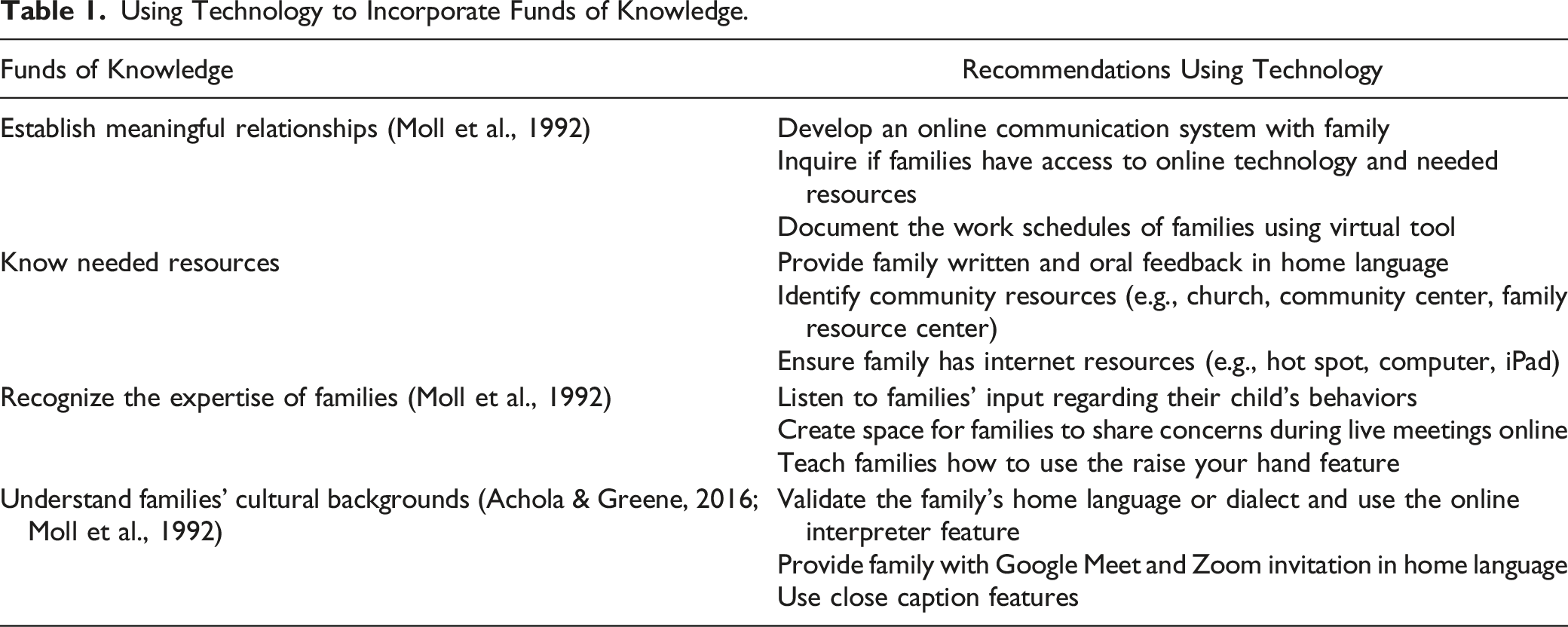
However, prior to coaching, teachers should learn about the CLD families’ funds of knowledge before developing a BIP. For example, the teacher should create a communication method that works for the family, understand the families daily routine schedule, establish a meeting time that works for the family, and inquire about the family’s knowledge regarding the use of online technology and access. Online technology tools have proven to be effective in connecting and bridging potential communication difficulties (Curtiss et al., 2016) between school and home. It is important to incorporate families’ funds of knowledge because this may lead to stronger relationships when implementing a BIP in an online environment. Thus, the teacher needs to develop communication and a relationship in order to build trust with the CLD family, both online and face-to-face (Curtiss et al., 2016). Building trust and a relationship should be at the forefront when working with CLD families online. This may create an online environment that is supportive and respectful of the families’ backgrounds and values.
Furthermore, teachers should provide the CLD family with multiple options when providing family coaching. Using live and recorded videos for coaching procedures can be beneficial (Pierson et al., 2021). Both procedures allow for flexibility with the family’s daily routine and oftentimes their busy schedule. Using both coaching procedures may provide families with multiple opportunities to review the procedures to implement with their student. Additionally, the teacher can provide written and oral feedback (Pierson et al., 2021) to the families in their home language(s). The oral feedback may be more beneficial if provided during the live videos as the family is implementing the strategies outlined in the BIP. Teachers should also model the strategies for the families and allow them to ask questions. Both procedures have their benefits and drawbacks, but it is most important that teachers determine what works best for the family as they are coaching them through the BIP process.
Family Coaching and the Utilization of Online Technology Tools
There are various online technology tools that can be used by teachers when teaching students with disabilities and holding meetings with families. However, teachers should be mindful of the skill and comfortability levels of families prior to utilizing any tool. This information can be collected via a short questionnaire at the beginning of any school year.
Online technology tools (e.g., Google Meet, Zoom) are widely known and used in schools and homes, and could be used to facilitate the BIP process (Wiyono et al., 2021). Research indicates that Google Meet and Zoom are easier for students to navigate in online learning (Fuday et al., 2021). Therefore, Google Meet and Zoom are online technology tools that are accessible for families and teachers to use to facilitate learning and meetings. Both online technology tools provide users (e.g., teachers, students, families) the capability of interacting during video conferences in live time (Bina et al., 2021).
Using Technology to Incorporate Funds of Knowledge.
Family Coaching Steps for an Equitable BIP Process
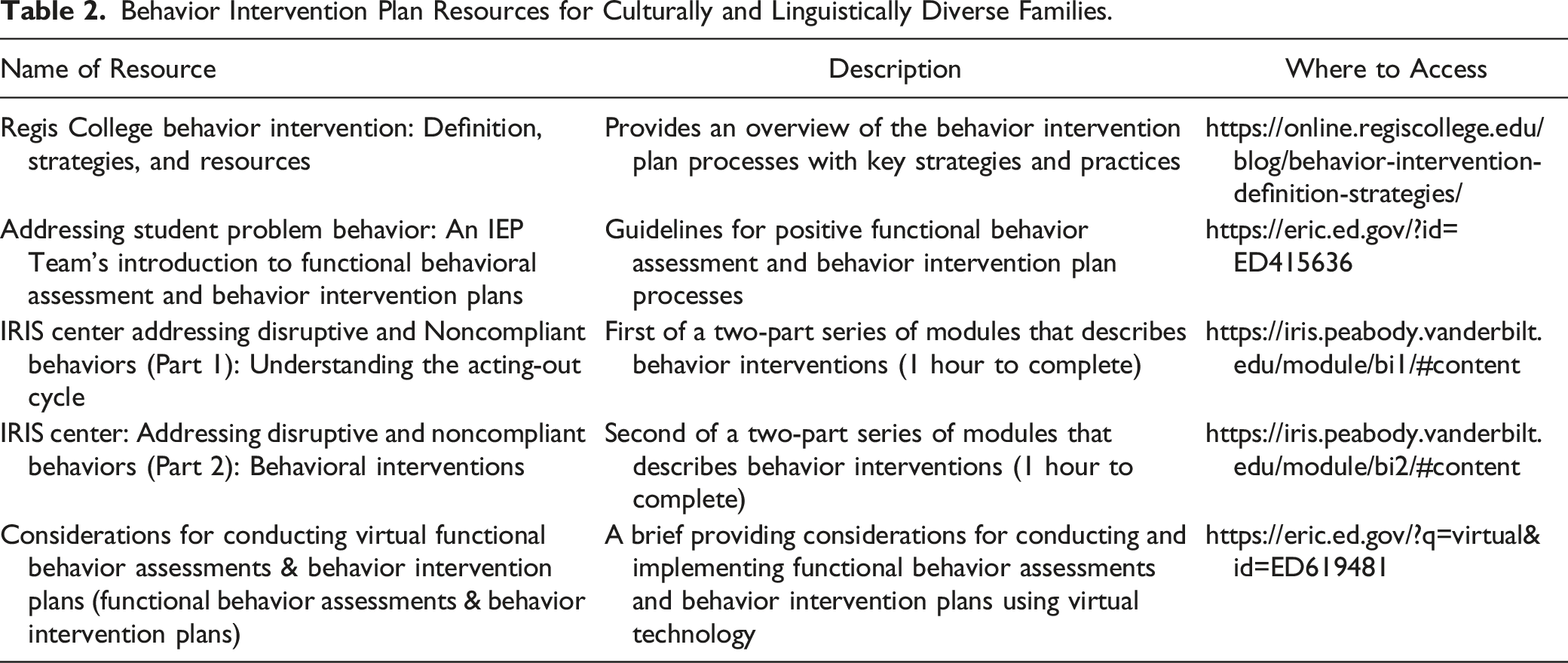
Behavior Intervention Plan Resources for Culturally and Linguistically Diverse Families.
Steps to Developing and Implementing a Behavior Intervention Plan using Funds of Knowledge and Online Technology Tools.

FBA: functional behavior assessment; BIP: behavior intervention plan.
Before the BIP Process: Functional Behavior Assessment
The functional behavior assessment (FBA) is essential to identifying and determining the function of the child’s behavior (Algozzine et al., 2010; Scheuermann & Hall, 2016) and should be completed prior to the BIP process. During the FBA process, teachers and other qualified professionals (e.g., board certified behavior analyst) utilize descriptive and indirect assessments to gather data on a student’s interfering behaviors (Scheuermann & Hall, 2016). Descriptive assessments (e.g., direct observation, narrative recording) provide data on the interfering behavior the student is exhibiting. Indirect assessment (e.g., records review, questionnaires, rating scales, functional behavior interviews) are also integral to the FBA process as they provide data from interviews with the student, family members, and previous teachers. The teacher, other qualified professionals (e.g., board-certified behavior analyst), and family will observe the child’s behaviors over a period of time (i.e., 6 weeks) to collect data. The family will be guided by the teacher to place a camera in the room to record the child during learning activities. The teacher will review the videos to collect data on interfering behaviors. Additionally, data will also be collected during virtual lessons. After the data are collected from both the indirect and descriptive assessments during the assessment process, an FBA summary (step 1 of the BIP process) can be developed with the team, which should include the CLD family. The FBA summary involves talking about the importance of the function as it was identified in the FBA and how it works to cause and sustain the interfering behavior. Understanding and agreement of this is essential to supporting implementation of the BIP with fidelity (Algozzine et al., 2010; Scheuermann & Hall, 2016). Members of the team are encouraged to use the funds of knowledge framework during the FBA process. However, the focus of this paper is on online BIP development and implementation in the home as we describe in the family coaching steps below.
Step 1: Co-Construct an FBA Summary
In the first step, the special education teacher leads an online conversation to develop an FBA summary with the team, including the CLD family, the general education teacher if the student is in integrated or mainstream classes, the school district’s board-certified behavior analyst, the school psychologist, and/or the social worker if available. The special education teacher should emphasize three key components: (1) the importance of the family’s household knowledge and other funds of knowledge, (2) the family as experts of their child and key team members, and (3) the family as co-constructors and collaborators to develop and implement the BIP (Moll et al., 1992). To ensure equitable participation and engagement of the family, language services (i.e., oral interpretation, written translation) and other resources based on the family’s needs should be arranged with prudent time before the meeting. Typically, school districts have memberships with language service providers to ensure access to information for CLD families as federally mandated. After this initial step, all members of the team should review the FBA data, with translated documents if needed, and discuss the student’s interfering behavior during online school at home. Throughout the process, the special education teacher is leading the meeting and displaying documents referenced on their screen. At the same time, they are working with other members of the team (e.g., interpreter, bilingual staff) to ensure the family understands what is being discussed, has opportunities to ask questions, and feels comfortable to share their perspective. An explanation of technical terms in English and the family’s home language should be provided for team members based on the family’s need. If there are language barriers, the special education teacher should consult central office staff about additional resources (e.g., language tools, apps, software, online services). Next, the special education teacher should lead the team to work together to outline and draft descriptive and measurable statements of the interfering behavior for the FBA summary. See Table 3 for examples and resources.
Step 2: Develop Replacement Behaviors
In this step, the special education teacher should ask the CLD family to describe their routines and the student’s behaviors in the home environment. Framing the conversation around the importance of learning about the family’s knowledge and skills for household and community functioning is key (Moll et al., 1992). These topics can include household management, such as detailing typical processes that happen every day (e.g., morning or evening routines) and the student’s typical behaviors. Some of these activities and routines may occur outside of the household, which may be impacted by the behavior. For example, is the interfering behavior a barrier to inclusion in faith communities, family functions, and other community activities that have meaning to the CLD family? During this conversation, the special education teacher should keep a running record of the draft document visible to all team members using an online tool (e.g., Google doc). In addition to interfering behaviors, this shared document should include the CLD family’s routines and activities, detailing specific funds of knowledge, such as morning prayer, traditional food preparation, and other shared rituals. See Table 3 for examples and resources.
Step 3: Identify Implementation Process and Supports Needed
At this stage, the team should discuss the proactive strategies and supports the family already provide to limit the occurrence of interfering behavior. Using the function of the behavior determined by the FBA, the team should first consider antecedent-based interventions that change the environment or conditions to reduce the likelihood of eliciting the interfering behavior (Neitzel, 2009). For example, having the family describe how the preferred learning space (e.g., kitchen table, living room desk) is prepared for online school and proactive strategies (e.g., saying affirmations, using culturally and linguistically responsive visual supports) they already implement to ensure a successful day of online school. After this information is collected, the team should work together to describe additional methods and strategies needed using the document. See Table 3 for examples and resources.
Step 4: Introduce Implementation Strategies and How to Use the Replacement Behavior
After establishing the antecedent conditions that may be eliciting the interfering behavior, the team should discuss how the replacement behavior will be taught to the student. The special education teacher should first explain and outline the general responsibilities of the family in promoting the replacement behavior (and implicitly–reducing the interfering behavior) with their child. The conversation should be focused on what is most viable for the family and most appropriate for the child based on the family’s funds of knowledge. See Table 3 for examples and resources.
Step 5: Respond to Interfering Behavior
During this step, the team should discuss how they will reinforce the replacement behavior and respond to the interfering behavior. They should talk about what would be the most appropriate response for them given their respective settings. The special education teacher should continue sharing their screen to show the document via the online tool and take notes. The document should include the response to the short-term replacement or long-term replacement behavior and redirection strategies used to respond to the interfering behavior. The special education teacher can facilitate this process by providing examples of how they would reinforce the replacement behavior and respond to the interfering behavior in a virtual learning environment. See Table 3 for examples and resources.
Step 6: Develop a Crisis Plan
After determining the consequence strategies, the team should discuss a plan of strategies to implement if there were an escalation of the student’s interfering behavior, with a focus on safety. This conversation should be focused on what the family and teacher should do if there were a crisis and how the family’s funds of knowledge play a vital role. Teachers should be mindful of how funds of knowledge and highly dangerous situations can vary for the family compared to single-parent or multiple family members households. For example, the team may want the family to reflect on the support they could call on in highly dangerous situations (i.e., elopement, violent aggressions). See Table 3 for examples and resources.
Step 7: Implement and Monitor Progress
The last step requires identifying the tools used to monitor the interfering behavior and the implementation and effectiveness of the interventions, strategies, and supports in the BIP. In this conversation, the focus should be on developing or enhancing a data collection and management and a communication system between the family and school staff. Lastly, there should be mention of service providers, such as applied behavior analysis services, if the student has an autism spectrum disorder and other services, such as occupational therapy and speech and language pathology, to ensure the student is receiving the supports needed to be able to implement the online BIP at home. See Table 3 for examples and resources.
Discussion and Implications
With the shift to online learning, CLD students, including those with disabilities, have disproportionately experienced educational disparities, such as access to technology and linguistic isolation (Horowitz, 2020). For CLD students with disabilities, these challenges are compounded as many often lose access to critical services and supports, such as addressing academic and behavioral needs during online learning at home (Kim & Fienup, 2022; Spievach & Gallagher, 2020). Given the growing need for equitable yet flexible practices, we provide an intervention for special education teachers that supports the development and implementation of a BIP using funds of knowledge, family coaching, and online technology tools. Using funds of knowledge supports the development of trusting family-teacher relationships. Whereas, family coaching provides families with needed modeling and support to implement the BIP at home. Given the shift to online learning, technology and tools, such as Zoom and Google Meet, facilitate broader communication and accessible coaching. With these three systems in place, special education teachers can support CLD families as they navigate how to address the academic and behavioral needs of their child during online learning at home.
Although, research on funds of knowledge of CLD families and online learning is still growing, there is a need for teachers to provide equitable coaching and services using online technology tools. We suggest special education teachers use CLD families’ funds of knowledge to build trusting relationships with them. Using this framework, which centers the wealth of knowledge and resources the CLD family brings, and family coaching to implement a BIP during online learning may have positive academic and behavioral outcomes for students with disabilities. In addition, using families’ funds of knowledge with coaching has the potential to improve relationships between the special education teacher and family members. Throughout the process, special education teachers need to ensure online technology tools are accessible and equitable with consideration of the family’s resources, home language(s), need for assistance with processes, access to tools and information, and need for additional support. Ultimately, using online technology tools, funds of knowledge, and family coaching can serve as an equitable approach and vehicle to CLD family engagement in behavioral interventions and strategies.
Footnotes
Declaration of Conflicting Interests
The author(s) declared no potential conflicts of interest with respect to the research, authorship, and/or publication of this article.
Funding
The author(s) received no financial support for the research, authorship, and/or publication of this article.
