



Abstract
Tablet-mediated interventions have shown promise in improving the mathematical skills of individuals with autism spectrum disorder (ASD) and/or intellectual disability (ID). This meta-analysis aims to provide a quantitative synthesis of single-case experimental studies of using tablet-mediated interventions to teach mathematics to individuals with ASD and/or ID. Twenty-seven published studies between 2012 and 2022 were included. The Tau-U effect size index was used to gauge the overall effect size of tablet-mediated interventions. The obtained effect size (Tau-U = 0.98, 95% CI 0.92–1.00) indicated large improvements in mathematics performance after using tablet-mediated interventions. The analysis of potential moderating variables, including participant characteristics, intervention components, and target mathematical skills found no statistically significant moderators. Implications for researchers and practitioners who use tablet-mediated interventions to teach mathematics to individuals with ASD and/or ID are also discussed.
Introduction
Mathematics is essential for all students, including students with autism spectrum disorders (ASD) and/or intellectual disability (ID) (Browder et al., 2008). Mathematics, as a core subject, has a large impact on different aspects of life for individuals with ASD and/or ID, including employment, independent living, and financial skills (Browder et al., 2018; Root et al., 2017b; Saunders et al., 2018). Despite the importance of mathematics, research indicates that more than 92% students that need extensive support needs (i.e., students receiving special education service under the categories of autism or intellectual disability or multiple disabilities) are not able to apply computational procedures to solve real-world or routine mathematical word problems (Kearns et al., 2011). About half of the students with ASD perform at or below average in mathematics achievement (Wei et al., 2015), and nearly 22% of individuals with ASD also have a mathematics learning disability (Oswald et al., 2016). In addition, it is recognized that students with ID may experience greater challenges with mathematics as compared to their chronological age-matched students (Brankaer et al., 2011; Hoard et al., 1999). Several studies indicate that students with intellectual disability often lack basic mathematics skills (e.g., numerical magnitude comparison, measurement concept, and arithmetic operations) and higher order skills (e.g., mathematics problem-solving) (Brankaer et al., 2013; Browder et al., 2018; Bruno et al., 2021; Celik and Varun 2014; Clark et al.,2016). These findings highlight the need for exploring effective interventions to teach mathematics to individuals with ASD and/or ID. Use of technology, specifically tablet-mediated Intervention, has been considered as one of the effective instructional methods for teaching mathematics for students with ASD and/or ID (Burton et al., 2013; Ledbetter; Cho, et al., 2018).
Tablet-Mediated Interventions for Students with ASD and/or ID
Principles and Standards for School Mathematics (National Council of Teachers of Mathematics, 2000) and Common Core State Standards for Mathematics (National Governors Association Center for Best Practices & Council of Chief State School Officers, 2010) emphasize technology as an essential tool for teaching and learning mathematics. Incorporating technology into mathematics instruction contributes to students’ mathematics learning in various ways, including opening diverse pathways for constructing mathematics knowledge (Olive et al., 2009), providing opportunities for hands-on mathematics activities (Bouck et al., 2020d), and encouraging mathematical reasoning (Cox & Root, 2020). Additionally, it has been reported that the use of technology can support students with ASD and/or ID to make progress in the area of mathematics (Burton et al., 2013; Ledbetter-Cho et al., 2018; Spooner et al., 2019).
Tablet-mediated interventions are interventions that support the process of learning various skills through using tablets such as iPad or Android devices (Hong et al., 2018). Tablet technology is one of the most popular academic learning options for students with developmental disabilities (Hedges et al., 2018; Kagohara et al. 2013; Kiru et al., 2018). Teachers and researchers choose tablets from various kinds of available technology for teaching mathematics to individuals with ASD and/or ID for a few reasons. First, tablets are small, light, and portable (Blackwell et al., 2016; Ferraro, 2018). Second, they are highly affordable (Song, 2012). Third, people may interact with tablets by simply touching the screen, making tablets easier for individuals with ASD and/or ID to operate (Blackwell et al., 2016; Price et al., 2015). Fourth, the use of images, videos, and sounds is one of the main features, which helps capture students’ interest (Ricoy & Sánchez-Martínez, 2019; Song, 2012).
Researchers have explored the effectiveness of tablet-mediated interventions for improving the performance of students with ASD and/or ID in a variety of areas, including vocational skills (Muharib et al., 2022), communications (Still et al., 2014), and academic skills (Ledbetter-Cho et al., 2018), such as literacy (El Zein et al., 2016), science (Smiths et al., 2013), and mathematics (Weng & Bouck, 2014). The increasing popularity of using tablets to teach mathematics to individuals with ASD and/or ID has generated a wide interest in their effectiveness across different mathematics content areas. Several studies of individuals with ASD and/or ID have shown that tablet-mediated interventions effectively improved skills in number and quantity (Jowett et al., 2012; Weng & Bouck, 2016), operations (Bouck et al., 2018; Yakubova et al., 2016), problem-solving (Root & Browder, 2019; Yakubova et al., 2015), and algebra (Bouck, Park, Satsangi, et al., 2019b). However, other studies have shown that tablet-mediated interventions were not as effective as expected (Alexander et al., 2013; Bouck et al., 2017; Knight et al., 2013; Weng & Bouck, 2014). For example, Weng and Bouck (2014) explored the effect of video prompting, presented on iPads, for teaching price comparison to three secondary students with ASD. The results showed that one of the three students did not receive a significant benefit from the intervention. Given the mixed results in previous studies, meta-analysis is needed to analyze the effectiveness of tablet-mediated interventions systematically and consistently.
Reviews on Tablet-Mediated Interventions for Individuals with ASD and/or ID
A recent comprehensive review of 36 studies on teaching mathematics to students with moderate to severe developmental disabilities showed that 9 of the 36 studies (25%) focused on technology-aided instruction (Spooner et al., 2019). Spooner et al. reported a positive effect of technology-aided instruction with an average Tau-U effect size of 0.94. Different technological devices were used in these nine studies, including computers (n = 4), tablets (n = 3), and calculators (n = 2). Although this review identified technology-aided instruction as an effective practice for teaching learners with ASD and/or ID, the effectiveness of tablet-mediated interventions, which has gained popularity in recent years, was not separately examined.
Several meta-analyses and systematic narrative reviews narrowed the scope of technology-aided interventions and focused on exploring the effects of a particular type of technology, such as tablets. Hong et al. (2017) investigated the effects of using tablet-mediated interventions for individuals with ASD in 31 studies. These researchers reported that tablet-mediated instruction yielded an overall large effect on academic skills, but they did not further categorize academic skills into specific areas. In addition, using meta-analysis, Ledbetter-Cho et al. (2018) and Larwin and Aspiranti (2019) both examined the effectiveness of tablet-mediated interventions to improve academic performance for individuals with ASD. The research of Ledbetter-Cho et al. (2018) included 19 studies, with 5 of these studies targeting mathematics skills. The results revealed a large effect of tablet-mediated interventions on improving the academic skills of individuals with ASD, but the researchers did not report a separate effect size for mathematics skills. The research of Larwin and Aspiranti (2019) included 7 studies and focused on both literacy and mathematics skills. The researchers reported a weighted mean Tau-U effect size of 0.86. The studies above targeted academic skills more generally, including mathematics skills as an outcome variable. However, systematic review or meta-analysis focusing on the effectiveness of using tablets with individuals with ASD and/or ID to improve mathematics learning in a variety of content areas is still very limited.
Long et al. (2022) defined virtual manipulatives as “mathematics manipulatives offered in a digital format such as app or web-based, for use on devices as computers or tablets” (pp. 1–2). These researchers conducted a review to assess the effectiveness of virtual manipulatives for students with ASD, ID, and other developmental disabilities and reported positive effects in all the included studies. However, this review only used Tau-U and PND to evaluate the overall effectiveness of virtual manipulatives, but the researchers did not explore any potential moderating variables.
The reviews mentioned above made valuable contributions on exploring the effects of tablet-mediated interventions for teaching mathematics to individuals with ASD and/or ID, but there are also limitations. The research of Hong et al. (2017), Larwin and Aspiranti (2019), Ledbetter-Cho et al. (2018), and Spooner et al. (2019) did not focus on mathematics, so the positive effects found in these studies may not be generalized mathematics learning. On the other hand, the research of Long et al. (2022) only determined the effects of virtual manipulatives for use on tablets, but tablets may be used to aid other types of mathematics interventions or serve a different function (e.g., video modeling, video prompting) in mathematics interventions.
Purpose of the Current Study
This meta-analysis explored the effects of tablet-mediated interventions in the context of mathematics learning for individuals with ASD and/or ID. Single-case design studies were chosen because individual differences are of particular interest to the field of special education. Single-case experimental design, compared to randomized controlled trials, can better capture the characteristics of individuals. Single-case experimental design also provides a more robust way to assess student performance because of its high internal validity and its intuitive intervention effects (Horner et al., 2005; Kratochwill et al., 2010). Even though the external validity of single-case designs is low, meta-analysis uses consistent standards and metrics to improve external validity and generalizability (Alnahdi, 2015; Kratochwill & Levin, 2014). Furthermore, previous studies, including those in mathematics learning, have examined the effects of moderating variables such as participant characteristics, intervention settings, and intervention components (Aspiranti et al., 2020; Hong et al., 2017; Ledbetter-Cho et al., 2018). These variables were examined in this study as well.
We designed this meta-analysis to answer the following research questions: 1. What is the overall effect of tablet-mediated interventions for teaching mathematics to individuals with ASD and/or ID? 2. What types of potential moderators have influenced the effectiveness of tablet-mediated interventions in mathematics?
Method
Definition
In this research, we explored the effectiveness of tablet-mediated interventions in mathematics learning for individuals with ASD and/or ID. Tablet is defined as a touch screen device with several components and sensors integrated (i.e., GPS, camera, etc.), but without a keyboard or mouse (Haßler et al., 2016). Tablet-mediated interventions refer to interventions that support the process of learning various skills through tablets such as iPad or Android devices (Hong et al., 2018).
Search Procedures
The literature search and screening process followed the Preferred Reporting Items for Systematic Reviews and Meta-Analyses (PRISMA) protocol (Moher et al., 2009), as shown in Figure 1. Database searches were first conducted in June 2021, then updated in November 2022. The following electronic databases were consulted to identify the appropriate studies: ERIC, PsychINFO, Academic Search Premier, Web of Science, and ProQuest. Three sets of search terms were utilized: (a) autis*, Asperger, ASD, PDD, pervasive developmental dis*, developmental dis*, intellectual dis*, mental retar*; (b) tablet, iPad, iPhone, iPod, handheld computer, mobile technology, touchscreen, app, PDA; and (c) math, problem solving, numeracy, computation, geometry, statistic, concept, algebra. Sets were combined with “AND.” There was no restriction on the publication years in the searching process. The database search yielded a total of 611 studies in the first database search, while this number increased to 860 in the updated search in November 2022. Literature search and screening procedures.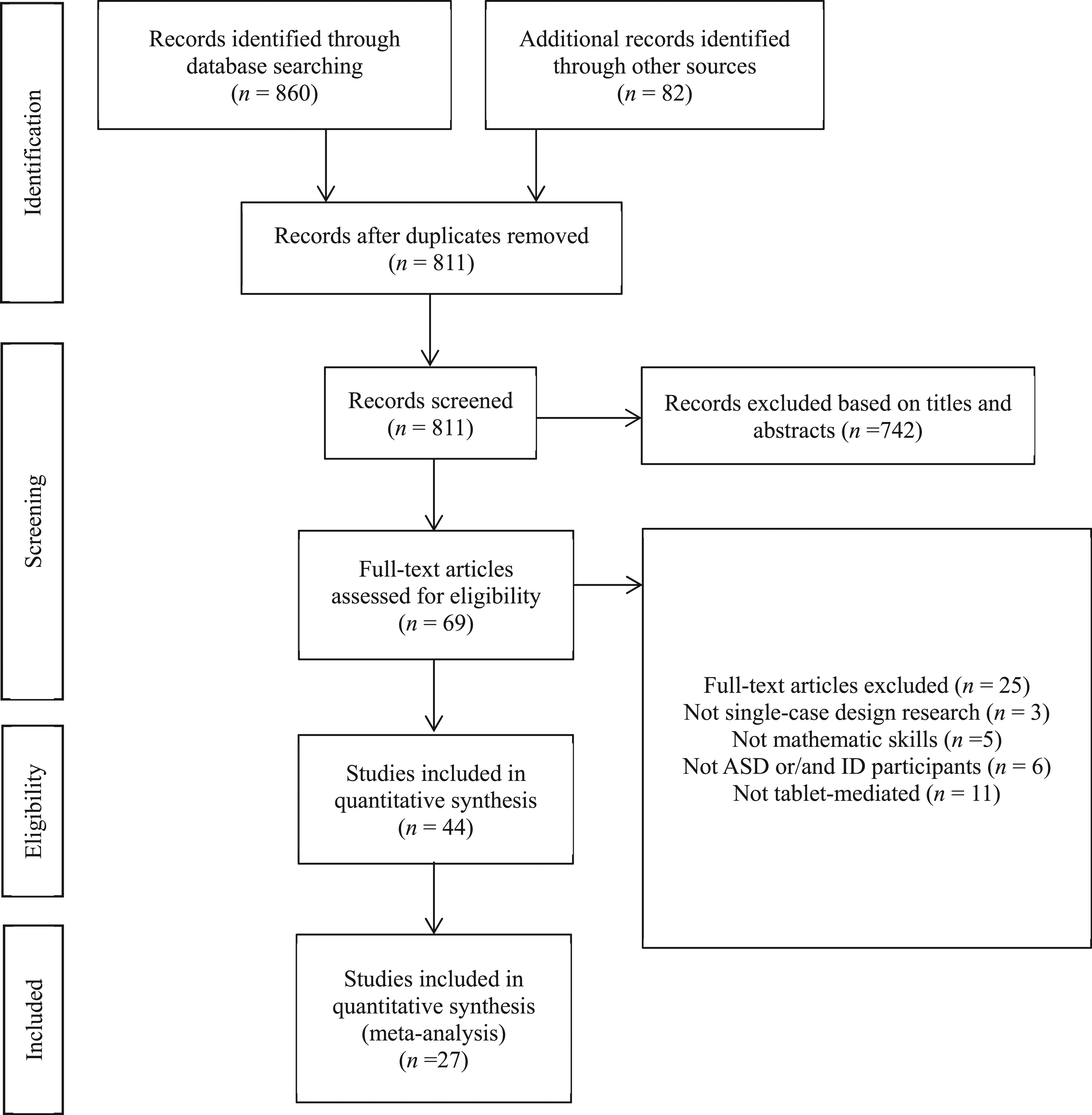
We also conducted a reference search for 22 reviews we identified as related to our study. These reviews were obtained from the same database search above (16 reviews obtained from the first database search, 6 reviews obtained from the updated search). Fifty-eight potential studies were identified from the reference search (48 of the 58 obtained from the first database search; 10 of the 58 studies obtained from the updated search). In addition, we manually searched the following journals, including (a) Education and Training in Autism and Developmental Disabilities, (b) Focus on Autism and Other Developmental Disabilities, (c) Journal of Intellectual and Developmental Disability, (d) Journal of Special Education, (e) Journal of Special Education Technology, (f) Research in Autism Spectrum Disorders, and (g) Research in Developmental Disabilities. These journals were selected for their relevance to the subject of the current study and for their ranking in the field of special education from Journal Citation Reports. Journal search was limited to the past 3 years from 2019 to 2022. Thirteen potential studies (7 studies obtained in the first search procedure, 6 studies obtained from the updated search) were identified in the journal search.
Inclusion Criteria
To be included, a study must have met the following inclusion criteria: (a) use single-case research design; (b) include at least one participant with ASD and/or ID; (c) use at least one tablet device during the intervention (to deliver the intervention, to prompt, or to perform other functions); (d) include at least one dependent variable related to mathematical skills; (e) is published in English; and (f) is a published article or published dissertation. Qualitative studies, literature reviews, and discussion papers were excluded. After duplicates were also removed, 811 studies were subjected to title and abstract screening based on the inclusion criteria. Studies that did not meet at least one of these criteria were excluded. However, some studies did not offer all the information in the title and abstract that is needed to verify their qualification for inclusion; these were not excluded until further decision could be made in the full-text screening. As a result, 742 studies were excluded, and 69 studies were included for full-text screening. For those studies who did not offer all the information in the previous screening procedure, they were screened by inclusion criteria again based on the the contexts provided in the full text. For those studies which were determined to be qualified in the title and abstract screening, studies would be carefully read again to reassure their qualification. Only studies met all inclusion criteria could be kept. In full-text screening procedure, studies were excluded if they did not use single-case design research (n = 3), not include mathematic skills as an outcome (n = 5), not included ASD or/and ID participants (n = 6), and not tablet-mediated intervention (n = 11). Finally, 41 published articles and 3 dissertations met the inclusion criteria after full-text screening.
Methodological and Quality Evaluation of the Evidence
Version 4.1 of What Works Clearinghouse’s Pilot Single-Case Design Standards was used to evaluate the methodological quality of the initially included studies (What Works Clearinghouse, 2020). This set of standards provides an index for measuring the quality of a single-case design through assessing the degree of its experimental control, which includes 6 main standards related to (a) data availability, (b) systematically manipulated independent variables, (c) inter-assessor agreement (IAA), (d) attempts at treatment effects, (e) number of data points collection, and (f) multiple probe baseline design extra requirements. The first and third authors read the full texts and rated the quality of each study based on the standards above. Only studies that either fully met the design standards or met them with reservations were included in the next evidence-based practice evaluation procedure.
After determining the methodology quality of included studies, quality indicators published by the Council for Exceptional Children (CEC) were used to determine whether tablet-mediated intervention is an evidence-based practice. CEC offers five evidence-based classifications: evidence-based practice, potentially evidence-based practice, practice with mixed effects, insufficient evidence, and practice with negative effects. To be considered as evidence-based, a practice must include at least 5 methodologically sound single-case design studies with positive effects as well as more than 20 participants across studies. CEC’s quality indicators cover eight areas (i.e., context and setting, participants, intervention agent, description of practice, implementation fidelity, internal validity, outcome measures, and data analysis). For more detailed information about the quality indicators, one may refer to the research of Cook et al. (2015).The detailed scoring rubric and results of the WWC and CEC quality evaluation of each study are presented in Appendix A.
Data Extraction
The Online software WebPlotDigitizer was used to extract data from the graphs embedded in the included studies (Rohatgi, 2019). This was necessary because in single-case design studies, researchers almost always use graphs to present performance data (e.g., accuracy, independence rate, etc.) of their participants. In addition, neatly organized data tables are often not available in single-case design studies because of their heavy reliance on visual analysis. Therefore, we collected participants’ performance data by clicking on the data points in the adjacent baseline and intervention phases on the graphs.
Descriptive Coding
A coding menu was developed based on the works of previous researchers (Hong et al., 2017; Ledbetter-Cho et al., 2018; Spooner et al., 2019). Moderator variables were coded and identified based on the extracted information, except for information with insufficient heterogeneity. These moderator variables included participant characteristics (gender, age, and disability category), intervention components (settings, interventionists, pre-training or not, instructional approach, instructional strategy, duration, frequency, and procedural fidelity), and targeted mathematical skills. Appendix B provides the operational definitions and subgroup categories for all moderator variables.
Inter-rater Reliability
Inter-rater reliability (IRR) was conducted to ensure consistency across different researchers involved in this study. It was calculated as the number of agreements divided by the total number of agreements and disagreements multiplied by 100. To assess the IRR, the first and second authors worked as independent raters. These two authors received training before performing screening, quality evaluation, data extraction, and coding. In the training sessions for screening, the two raters were given the inclusion criteria and 10 studies that were not related to the current research topic. If the two raters gained more than 80% of IRR for two consecutive training sessions, they moved to the next training sessions for quality evaluation. The training sessions ended until the two raters reached over 80% of IRR for all four stages: screening, quality evaluation, data extraction, and coding. The two raters reached 100% of IRR in each of training sessions in this study. Then, they started to conduct the IRR procedure in this research. The second raters independently screened 100% of the database search result, 100% of the journal search result, and 30% of reference search. The IRR was 100% for the database search, 98% for the reference search, 100% for the journal search, and 98% for the screening of eligible studies based on the inclusion and exclusion criteria. Regarding quality evaluation, 100% of the initially retained studies (n = 44) were evaluated through WWC standards, yielding a 100% IRR; 48% of studies (n = 27) were evaluated through CEC standards to calculate IRR, yielding a 96% IRR. For data extraction, 34% of the data (33 of 98 data sets) were extracted to calculate IRR. Each data point was evaluated for consistency. If the difference in a data point of outcome variable extracted by the two raters was less than one, the result was considered as consistent. Data extraction yielded a 97% IRR. Finally, regarding descriptive coding, 33% of the studies (n= 9) was coded for IRR, yielding a 98% IRR. The two raters would not enter the next process until they compared their own results and reached a consensus on their disagreements through discussion.
Data Analysis
Tau-U is an effect size measure that calculates the proportion of non-overlapping data between baseline and intervention with baseline trend control and can be used to calculate the effect of a single-case design (Parker et al., 2011b). It ranges from −1.00 to 1.00; 0–0.62 indicates a small effect; 0.63–0.92 indicates a medium effect; and 0.93–1.00 indicates a large effect (Parker et al., 2011a).
First, an online Tau-U calculator was used to obtain the effect size of each contrast after data values for the baseline and intervention phases were extracted from the graphs in each study (Vannest et al., 2016). Contrast refers to the versus between the baseline phase and the intervention phase. After the effect sizes of all contrasts were obtained, the aggregated effect size of each study was obtained by calculating the weighted average of the effect sizes from all contrasts using the inverse-variance weighting method (i.e., using the inverse variance scores of individual contrasts as weights). Second, the effect size of each study and its standard error were entered into Comprehensive Meta-analysis Version 2.0 (CMA 2.0; Borenstein et al., 2011) to calculate the omnibus effect size of all included studies. Third, CMA 2.0 was also used to generate the effect size of potential moderators by entering the Tau-U effect size and the standard error of each contrast. Contrasts belonging to the same level of a potential moderator were aggregated into one overall Tau-U effect size. We then compared aggregated Tau-U effect sizes across different levels of a potential moderator and determined whether they had significant differences from each other. If there were significant differences, then we knew that the variable moderated the effects of the intervention. Q-statistic between groups represents the amount of variance that can be determined by a moderating factor. Therefore, the significance of the p-value for Q-statistic between groups was used to determine whether the variable functioned as a moderator. We hypothesized that the variance between studies was due to systematic differences; therefore, the random effects model in CMA 2.0 was more appropriate than the fixed effects model (Borenstein et al., 2009).
Publication Bias
The most efficacious approach for calculating publication bias in meta-analyses is hotly contested (e.g., Dowdy et al., 2021). Therefore, we ran three tests (i.e., Rosenthal’s fail-safe N, Eggar’s regression intercept, and Eggar’s regression) and triangulated the results. The result for Rosanthal’s fail-safe N was 5623, which was larger than the desired fail-safe N (n = 277 × 5 + 10 = 145); this indicated that publication bias did not exist. In addition, the p-value (p = 0.93 > 0.05) of Egger’s regression intercept indicates that publication bias did not exist. The result of Begg and Mazumdar rank correlation also revealed the publication bias did not exist (p = 0.06 > 0.05). I 2 statistics were used to describe the percentage of total variation across studies and to test heterogeneity (Higgins & Thompson, 2002). The benchmarks of I 2 were 25%, 50%, and 75%, indicating low, moderate, and high heterogeneity, respectively (Higgins & Thompson, 2002). The result of I 2 = 0% for this research indicated no inconsistencies among the studies.
Results
Methodological and Quality Evaluation of the Evidence
Twenty-seven studies met the quality standards. Seven studies met the WWC single-case design standards without reservation. Twenty studies met these standards with reservation. Seventeen studies failed to meet these standards. One study did not include graphs for extracting needed data points. Two studies did not report results for IAA. Five studies did not satisfy the requirements for data-point collection. Nine studies did not satisfy the extra criterion for multiple probe designs. Overall, 27 of 44 studies (25 published articles and 2 published dissertation) met the quality standards.
Among the included 27 studies, all reported positive outcomes. Seventeen met all of the CEC’s evidence-based standards (8 quality indicators for single-case design). Seven of them met 7 indicators, 3 met 6 indicators. All the studies reported the indicators of context and setting, participants, internal validity, and data analysis. The remaining studies that did not meet all the standards were mainly due to missing information on intervention agent, description of practice, implementation fidelity, and outcome measures. Only 21 of 27 studies reported QI 3.1 on the role of the intervention agent. Only 20 of the 27 studies reported QI 3.2 on implementation fidelity including information on training or qualification required to implement the intervention. Detailed scores of each study could be seen in Appendix A.
Based on the classification of the CEC standards, an evidence-based practice must meet the following criteria: more than 5 studies with positive effects meet all the quality indicators, and there are more than 20 participants across all the studies concerned. The current research included 27 studies reporting positive effects, with a total of 73 participants with ASD and/or ID involved. Seventeen of studies met all the quality indicators, so tablet-mediated interventions could be seen as an evidence-based practice.
Descriptive Summary
Summary of Studies.

Note. M = male; F = Female; ASD = autism spectrum disorder; ID = intellectual disability; OSS = other school setting; PF = procedural fidelity
Potential Moderator Effect
Aggregated Results by Participant and Intervention Characteristics

Intervention components included setting, interventionist, procedural fidelity, pre-training, instructional approach, instructional strategy, and dosage. None of these variables moderated the overall effect of tablet-mediated interventions. Intervention setting did not function as a moderator (p = 0.99 > 0.05). Of the 27 studies, most were implemented in school settings: 3 studies (11%) utilized a general education setting, 5 (19%) utilized a special education setting, and 15 (56%) utilized other school settings. In addition, the variable, interventionist, did not moderate the overall effect (p = 0.99 > 0.05). All the included studies were implemented by researchers (n = 24), teachers (n = 2), or paraprofessionals (n = 1). Furthermore, procedural fidelity did not function as a moderator (p= 0.86 > 0.05). Only one study did not report fidelity values. In studies that reported this value, all the values were higher than 95%.
Neither pre-training nor instructional approach was a moderator (pre-training: p = 0.93 > 0.05; instructional approaches: p = 0.98 > 0.05; instructional strategy: p = 0.98 > 0.05). More than two-thirds of the included studies (n = 20) did not describe pre-training procedures before the formal intervention phase. All the instructional approaches had large effect sizes. More than half of the studies (n = 15) used direct instruction, and schema-based instruction was the least utilized approach (n = 5). For instructional strategies, nearly half of included studies (n = 13) used the Model-Lead-Test instructional strategy, followed by the modeling (n = 7), and then prompting (n = 6). These three strategies gained large effect sizes. Reinforcement was the least used strategy (n = 1); it only gained a medium effect size.
Neither duration nor frequency of intervention was a moderator (duration: p = 0.99 > 0.05; frequency: p = 0.98 > 0.05). Only 15 of the 27 studies described the duration of the intervention. Ten studies lasted over five hours, and five lasted less than five hours. Eleven of the 27 studies described the frequency of intervention. Nearly half of these 11 studies implemented interventions at a high frequency, or more than three times per week. The other 6 studies implemented interventions at a low frequency, or one to three times per week.
Finally, target mathematical skills did not function as a moderator (p = 0.99 > 0.05). The results showed that tablets were used to teach individuals with ASD and/or ID to learn number and operations, algebra, and data analysis. All the included studies had large effect sizes. Among 27 included studies, the most researched mathematical domain was number and operations, with 22 studies focusing on this area. There were four studies focusing on using algebra to solve word problems. The least researched skill was data analysis, with one study focusing on this area. There was no intervention targeting geometry or measurement.
Discussion
The purpose of this meta-analysis was to determine the effects of tablet-mediated interventions for teaching mathematics to individuals with ASD and/or ID. The first aim was to exam the overall effect. The result reveals that tablet-mediated interventions had a large effect on mathematics learning for individuals with ASD and/or ID. This finding was consistent with the findings of previous research (e.g., Larwin & Aspiranti, 2019; Ledbetter-Cho et al., 2018). Tablet-mediated intervention can also be considered as an evidence-based practice based on the evaluation of CEC quality indicators. The second aim was to identify the potential moderators of the effects of tablet-mediated interventions. The moderator analysis indicates that participant characteristics, intervention components, and target mathematical skills did not produce a moderating effect on tablet-mediated interventions.
Consistent with Larwin and Aspiranti (2019), gender did not moderate the overall effect of tablet-mediated interventions. The non-significant moderator effect of age was also consistent with Hong et al. (2017). The findings above suggest that tablet-mediated interventions are effective regardless of age and gender. We also intended to further explore ability level of the participants as a potential moderator variable. The research of Ledbetter-Cho et al. (2018) and Reichow and Volkmar (2010) categorized function level of participants from the perspective of IQ scores and verbal language skills. However, not all the included studies provided enough information about participants’ ability (e.g., IQ scores, verbal communication ability, performance in mathematics achievement test, etc.). Therefore, we were not able to test the moderating effect of ability level. In addition, it is confusing that some research only reported that their participants were identified as ASD, but it is not clear whether these participants also had ID as a comorbidity at the same time. We hope that future researchers provide more detailed information about their participants including ability level.
Interventionist did not function as a moderator either. In our study, different interventionists, including professional researchers, teachers, and paraprofessionals, all obtained a large effect when implementing tablet-mediated interventions. This finding indicates that teachers and paraprofessionals can be trained to deliver effective mathematics instruction to students with ASD and/or ID using tablets. Unfortunately, based on the results of CEC quality indicator evaluation, only a few studies reported how they trained interventionist to be qualified enough to implement the interventions. Some researchers have already explored the effectiveness of teacher-implemented, schema-based interventions for individuals with disabilities (Peltier et al., 2018; Root et al., 2022). The effects of these studies appear to be lower when the value of implementation fidelity is under 80%. The high fidelity of the two teacher-implemented interventions in this study may explain why the effectiveness of teachers as interventionists did not differ than that of researchers. However, this result should be treated with caution due to the small sample size. In addition, all the studies included social validity, meaning that teachers showed a high-level of acceptability of using tablet-mediated interventions to teach mathematics to individuals with ASD and/or ID. Previous research pointed out that teachers had limited professional knowledge about special education technology (Thomas et al., 2019). Therefore, it is necessary to provide more information about technical training in future research so that teachers will receive more guidance to support their role as interventionist in future practice.
Moreover, instructional approaches did not moderate the overall effect of the intervention. Our findings indicate that the practitioners can effectively implement a range of instructional methods, including direct instruction, schema-based instruction, and video modeling instruction when they use tablets to teach mathematics to individuals with ASD and/or ID. These instructional methods were all identified as evidence-based practices (Steinbrenner et al., 2020; Yucesoy-Ozkan et al., 2022). In addition, instructional strategies, such as modeling, prompting, reinforcement, and model-lead-test, were also used during the interventions, and they did not moderate the intervention effects either. All the instructional methods or strategies yielded large effects, indicating students with ASD and/or ID could effectively learn targeted mathematics skills with the support of tablet-mediated instruction. In recent years, many researchers have been using intervention packages, which require instructional method or strategy to be used simultaneously in the intervention phase to help students with ASD and/or ID to acquire concepts or skills (e.g., Bouck et al., 2020a, 2020c); therefore, it was difficult to determine which methods or strategies worked the best when paired with tablet-mediated instruction. Future researchers may consider implementing one instructional method or strategy at a time.
In addition, the included studies provided little information about the instructional contexts under which tablets-mediated interventions were implemented. For example, most included studies did not report participants’ comfortability with using tablets prior to the interventions, how participants were trained to use the specific tools on the tablets before intervention, or the response from the interventionist when participants were distracted by their surrounding environment. However, such contextual factors might influence the pre-training procedures, participant selection or the choice of instructional methods or strategies. This reporting issue may explain why we found no differences between participants with pre-training and those without pre-training, whose result was contrary to Ledbetter-Cho et al. (2018). It is possible that students were already familiar with how to use a tablet so that pre-training did not make a difference in the effect. Contextual information is especially essential for teachers and other practitioners who are often asked to teach students how to use tablets as an effective learning tool when solving mathematics problems. Therefore, we encourage researchers to provide more detailed information about the instructional contexts and processes so that future researchers and practitioners may replicate their research with more accuracy.
Regarding mathematics content areas, we found that tablet-mediated interventions had large positive effects on the learning of individuals with ASD and/or ID in areas such as number and operations, algebra, and data analysis. One possible explanation is that tablet-mediated interventions make visualization of abstract mathematical concepts in different content areas possible (Olive et al., 2009). In addition, the findings showed that most of the included studies were specifically interested in number and operations (n = 22). One plausible explanation for this emphasis is that students with ASD and/or ID are more likely to be denied access to instruction on more complex mathematics topics, such as geometry, algebra, and data analysis. One the other hand, Principles and Standards for School Mathematics (2000) emphasize that understanding the meaning of operations and the relationship among different operations are foundational for all students. Students with ASD and/or ID would be more likely to further their mathematical knowledge after they have acquired basic knowledge and skills offered through number and operations. Furthermore, the interventions targeted at number and operations included in this meta-analysis relied primarily on computational accuracy as an indicator for mastery. It is not certain whether individuals gained in-depth understandings of the mathematics content involved or whether they were able to transfer their knowledge and skills to other areas of mathematics. Future researchers may consider developing measures for higher order thinking skills such as conceptual understanding and using mathematics in real-life applications.
Limitations
There are some limitations to the findings presented in this meta-analysis. First, the small number of studies (n = 27) and sample size (73 participants) may have led to insufficient heterogeneity among the study variables. Second, although some grey literature, such as dissertations, was included, restrictions on access to some studies could have affected the number of studies that were ultimately included, and this might have led to some level of publication bias. Third, the data for the generalization and maintenance phases of the included studies were not included. Examining the effects of an intervention after withdrawal of experimental conditions, that is, during the maintenance and generalization phases, may establish a stronger proof of the effectiveness of the intervention. Although some researchers recommend including these phases into the experimental designs (Neely et al.,2016), the existing single-case design research is still more likely to attach more importance to comparing the differences between the baseline phase and the intervention phase. Additionally, caution is warranted regarding the interpretation of moderator variables. If a differential effect could not be attributed to a single variable, a combination of two or more moderator variables might have led to larger effects (e.g., a higher dosage with a shorter duration).
Implications for Future Practice
The results of this study have several implications for future practice. First, since tablet-mediated intervention is an evidence-based practice, it may be used more regularly and widely for the instruction of students with ASD and/or ID. It is important for teachers to provide training for their students with ASD and/or ID on how to use tablets as a learning tool prior to tablet-mediated interventions. For example, Jimenez and Alamer (2018) taught students with ID how to access iPad, such as pinch in and pull-out images. Otherwise, if students with ASD and/or ID, who typically are still working on their receptive skills, lack the necessary experience of using tablets in their learning, tablets may create additional cognitive load that hinders students from focusing on mastering mathematics content and skills.
Second, in this study, we found that the large, positive overall effect of tablet-mediated interventions was not moderated by participant characteristics, intervention components, and target mathematical skills. Therefore, we encourage teachers and other practitioners to use tablets in their daily instruction under a variety of conditions. In addition, we recommend that instructional strategies such as prompting, reinforcement, and modeling be frequently used during tablet-mediated instruction. This is because, students with ASD and/or ID who typically are still working on their communication skills, may choose to use maladaptive behavior to communicate or they are likely to have addiction on using tablets (Bellini et al., 2007; Ghanouni et al., 2020; Kemp & Carter, 2002). Therefore, proper instructional strategies were needed to help them focus on the learning process.
Finally, most of the studies included in this meta-analysis targeted mathematics content and skills related to number and operations. On the other hand, students with ASD and/or ID seem to have limited access to more complicated mathematics areas such as algebra, geometry, and data analysis. Since tablet-mediated interventions have been proven to be highly effective in improving the learning outcomes in number and operations for students with ASD and/or ID, we encourage future researchers and teachers to test the effectiveness of table-mediated interventions for learning more advanced mathematics topics mentioned above.
Conclusions
This meta-analysis concludes that tablet-mediated interventions have a large, positive effect on teaching mathematical skills to individuals with ASD and/or ID, and can be considered as an evidence-based practice. Overall, the included studies have a low risk of biases and meet the WWC single-case design standards. In addition, the findings suggest that tablet-mediated interventions are likely to yield positive effects regardless of participants’ characteristics, intervention components, and target mathematical skills. Additional studies using tablet-mediated interventions to teach a wide range of mathematical skills to individuals with various special needs are needed to establish a more comprehensive understanding of tablet-mediated intervention research.
Supplemental Material
Supplemental Material - Meta-Analysis of Tablet-Mediated Interventions to Teach Mathematics for Individuals With Autism Spectrum Disorder and/or Intellectual Disability
Supplemental Material for Meta-Analysis of Tablet-Mediated Interventions to Teach Mathematics for Individuals With Autism Spectrum Disorder and/or Intellectual Disability by Di Liu, Yiwen Mao, Weiwei Cai, Qingli Lei, Rui Kang, and Yingying Zeng by Journal of Special Education Technology
Footnotes
Author Contributions
Di Liu had the idea for the article, and all authors contributed to the study design. Searching procedure, quality evaluation, data extraction and descriptive coding were conducted by Di Liu, Yiwen Mao, Weiwei Cai and Yingying Zeng. Data analysis was conducted by Yiwen Mao and Di Liu. The first draft of the manuscript was written by Weiwei Cai and it was critically revised by Yiwen Mao and Di Liu. All authors commented on previous versions of manuscript. All authors read and approved the final manuscript.
Declaration of Conflicting Interests
The author(s) declared no potential conflicts of interest with respect to the research, authorship, and/or publication of this article.
Funding
The author(s) disclosed receipt of the following financial support for the research, authorship, and/or publication of this article: This study was funded by the Philosophy and Social Science Planning Project of Shanghai (Grant numbers A2013).

Supplemental Material
Supplemental material for this article is available online.
Author Biographies
References
Supplementary Material
Please find the following supplemental material available below.
For Open Access articles published under a Creative Commons License, all supplemental material carries the same license as the article it is associated with.
For non-Open Access articles published, all supplemental material carries a non-exclusive license, and permission requests for re-use of supplemental material or any part of supplemental material shall be sent directly to the copyright owner as specified in the copyright notice associated with the article.
