




Abstract
The Pearlin Mastery (PM) Scale is frequently used in health research to assess individuals’ personal mastery or the extent to which they believe they are in control of their own lives. It has been adapted from English into multiple languages including Spanish. However, no studies have assessed the psychometric properties of Spanish translations of the scale. This analysis evaluated structural validity and measurement invariance of the original Spanish translation of the PM Scale in two groups of Spanish-speaking individuals receiving primary care at community clinics in Florida. Confirmatory factor analysis (CFA) indicated that the 5-item version used in the literature yields a unidimensional factor structure as expected; however, multiple-group CFA revealed that the PM Scale items did not load equivalently on the factor across samples. This indicates that the Spanish version of the PM Scale may not measure mastery consistently across groups, possibly due to differences in respondents’ semantic understanding of items or differences in the meaning of the construct itself. Findings suggest that researchers seeking to measure personal mastery in Spanish-speaking participants from diverse cultural backgrounds should consider alternative approaches including the development of new instruments.
Personal mastery, or the extent to which individuals believe they control their own lives, is a psychological resource that buffers the relationship between stressful events and psychological distress (Pearlin, Lieberman, Menaghan, & Mullan, 1981). The Pearlin Mastery (PM) Scale (Pearlin & Schooler, 1978) is frequently used to assess personal mastery in health psychology research. Originally developed in the 1970s for a study on stress and coping among a sample of men and women living in the Midwest United States, the scale has since been used to study the role of personal mastery in the management of chronic illnesses such as diabetes, rheumatoid arthritis, and cardiovascular disease.
Individuals of Hispanic descent are the largest ethnic minority in the United States, comprising nearly 18% of the total population (U.S. Census Bureau, 2017). It is estimated that 40 million U.S. residents, or approximately 13% of the U.S. population, spoke Spanish at home in 2016 (U.S. Census Bureau, 2017), and more than 30% of Hispanics report that they are not fluent in English (U.S. Department of Health and Human Services Office of Minority Health, 2017). Valid and reliable Spanish language measures that can be administered to monolingual Spanish speakers in the United States are critical as many Hispanics in the United States experience barriers to health care that result in health disparities relative to non-Hispanic White individuals (Dominguez et al., 2015). Thus, validated Spanish language versions of the PM Scale are needed to conduct program evaluation or health research measuring mastery among Spanish-speaking individuals in the United States.
To date, studies have utilized Spanish translations of the PM Scale with various health populations including prenatal women and Latina women at risk of metabolic syndrome (e.g., Gallo, de los Monteros, Ferent, Urbina, & Talavera, 2007; Gurung, Dunkel-Schetter, Collins, Rini, & Hobel, 2005; Heilemann, Choudhury, Kury, & Lee, 2012). However, little research has examined the psychometric properties of any Spanish language translation. Psychometric analyses of Spanish translations of the PM Scale are required to assess whether the scale measures mastery as intended in Spanish-speaking populations. The current study is a psychometric analysis of the original Spanish translation of the PM Scale (Rini, Dunkel-Schetter, Wadhwa, & Sandman, 1999), evaluating structural validity and measurement invariance of scores in two samples of Spanish-speaking adults receiving primary care.
Method
This study is a secondary analysis of data collected for two separate projects sampling clinic patients with type 2 diabetes or a cancer-related abnormality in Tampa Bay, FL. Participants in each sample completed identical Spanish language PM questionnaires via self-report. Analyses used the 5-item version, which omits two positively worded items from the full measure due to poor inter-item consistency with the other, negatively worded, items (e.g., Gallo et al., 2007; Rini et al., 1999). Response options ranged from 1 (strongly agree) to 5 (strongly disagree). The mean of responses was used for analysis. Data from the two studies were merged for the initial analysis (Wolf, Harrington, Clark, & Miller, 2013).
To assess whether the PM Scale dimensional structure adhered to the expected one-factor structure (structural validity), we first conducted a CFA using Mplus 7.2 (Muthén & Muthén, 1998–2012). Overall model fit was determined by the comparative fit index (CFI; Bentler, 1990), root mean square error of approximation (RMSEA; Steiger, 1990), and the standardized root mean residual (SRMR; Hu & Bentler, 1999). Because the data did not meet criteria for multivariate normality, parameters were estimated using maximum likelihood estimation with robust standard errors estimation, which provides a χ2 test statistic (Yuan-Bentler T2*) robust to nonnormality and non-independence of observations. The Yuan-Bentler T2* test statistic was not used as a sole criterion for adequacy of model fit because likelihood χ2 statistics are dependent on sample size and cannot demonstrate degree of fit (Kelloway, 1995). Then, multiple-group CFA was used to test measurement invariance across the two samples. In multiple-group CFA, three increasingly restrictive models are typically examined: (1) configural invariance, (2) metric invariance, and (3) factor variance invariance. Multiple descriptive fit indices were examined as described above.
Results
Most participants in Sample 1 (n = 63) were female (58.7%), married (69.8%), middle age (M = 51.5 years; SD = 10.2), and had completed some high school. Most participants in Sample 2 (n = 82) were female (90.2%), married (59.8%), middle age (M = 37.6, SD = 10.1), and had less than high school education. The mean PM score for the combined sample was 3.59 (SD = 0.68), with no significant differences between the two samples. The one-factor model of the 5-item PM Scale fit well statistically, χ2(5, N = 145) = 6.65, p = .25, and descriptively (CFI = .976, RMSEA = .048, SRMR = .039) for the combined sample. Next, in the multiple-group CFA, the configural invariance of the one-factor model was tested in each group. For Sample 1, this baseline model fit well statistically, χ2 (5, N = 63) = 8.53, p = .13, and adequately descriptively (CFI = .907, RMSEA = .106, SRMR = .058). For Sample 2, the specified model fit well statistically, χ2 (5, N = 82) = 6.57, p = .26, and descriptively (CFI = 0.963, RMSEA = .062, SRMR = .054). The overall model fit for the baseline models was χ2 (10, N = 145) = 15.10. Metric invariance of the model was subsequently tested by constraining factor loadings to equivalence across samples. This model did not fit well statistically, χ2 (18, N = 145) = 36.97, p < .01, or descriptively (CFI = .765, RMSEA = .121, SRMR = .123), indicating the underlying structure of scale scores varied across samples. Factor loadings are provided in Table 1.
Factor Loadings for the 5-Item Spanish Translation of the Pearlin Mastery (PM) Scale.
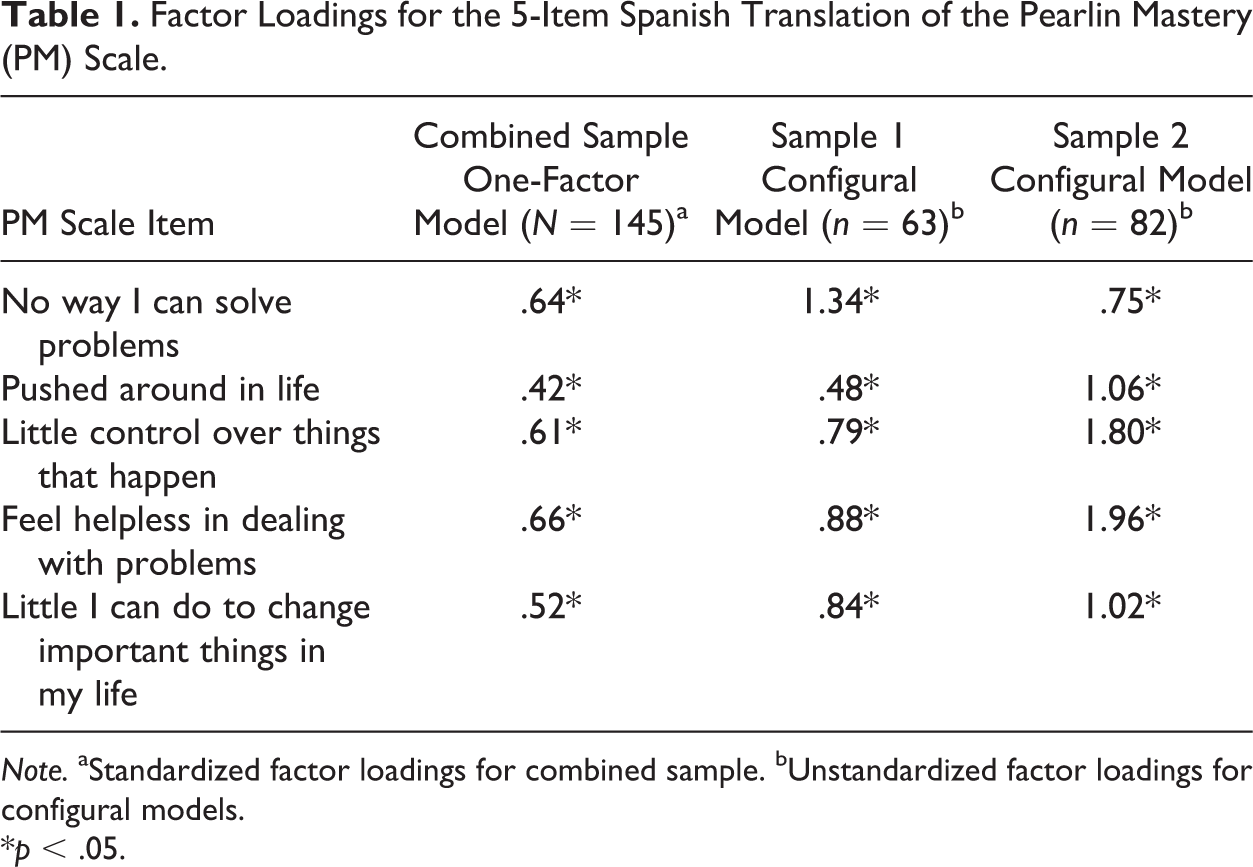
Note. aStandardized factor loadings for combined sample. bUnstandardized factor loadings for configural models.
*p < .05.
Discussion
This study evaluated structural validity and measurement invariance of the original Spanish language translation of the PM Scale (Rini et al., 1999). CFA indicated the 5-item scale measured mastery as a singular construct in both samples; however, multiple-group CFA found that constraining factor loadings across samples yielded a poor model fit. Thus, the Spanish translation may not measure mastery consistently in different groups, possibly reflecting differences in respondents’ semantic understanding of test items or differences in the meaning of “mastery” itself (Allen & Walsh, 2000). Study participants had diverse cultural backgrounds and nationalities and may not have had the same linguistic or conceptual understanding of scale items. Furthermore, Pearlin & Schooler's (1978) construal of mastery largely reflects an individualized and secular U.S. society; however, one’s sense of mastery may also be impacted by cultural factors, such as collectivist views and strong family identity (familismo). One limitation is that subgroup sample sizes were small in the multiple-group CFA, which may have impacted estimates. Ultimately, findings suggest that researchers should consider alternative measurement approaches to this PM Scale and consider developing a new measure based on a culturally driven conceptualization of control in the Spanish-speaking cultural groups they wish to study.
Footnotes
Declaration of Conflicting Interests
The author(s) declared no potential conflicts of interest with respect to the research, authorship, and/or publication of this article.
Funding
The author(s) disclosed receipt of the following financial support for the research, authorship, and/or publication of this article: This study was funded by the National Cancer Institute (NCI), through its Center to Reduce Cancer Health Disparities, National Institutes of Health, Department of Health and Human Services (U01 CA 117281-01). Dr. Wells’ contribution to this project was also funded in part by a grant from NCI (R25 CA090314; Paul B. Jacobsen, PhD, Principal Investigator).