



Abstract
The present research aims to evaluate the psychometric properties of the Romanian version of the Proactive Vitality Management (PVM) scale. Based on the Job Demands-Resources theory, PVM is a proactive behavior that helps employees manage energy at work. Two studies were conducted to test the reliability and validity of the PVM scale. The first study (N = 477) aimed to validate the Romanian version of PVM and test for measurement invariance related to gender. The results of the confirmatory factor analysis indicated a one-factor model and good values of the fit indices. Moreover, the indicators of measurement invariance showed no difference between men and women; both groups interpret the measure in a conceptually similar way. The second study (N = 307) cross-validated the one-factor model, tested discriminant and criterion validity between PVM and other constructs, such as psychological detachment and well-being (e.g., work engagement, health). The results indicated that PVM is indeed a one-factor construct associated with well-being indicators and unrelated to psychological detachment. From a practical perspective, the PVM scale is a reliable and valid instrument for assessing proactive energy management in organizations and developing strategies and interventions for employees to function optimally and reach their work-related well-being. The study also provides evidence of the PVM in the Job Demands-Resources theory as a proactive behavior at work, which represents a new strategy for employees to function optimally at work by deciding when and how to manage their energy.
Keywords
Even though working environments (e.g., health, automotive, information technology) are now characterized by increased reliance on technology, human capital remains an essential resource to organizational success. To function optimally, individuals need physical and mental energy (Ryan & Deci, 2008). Moreover, feeling alive and energized can create a mindset that enhances creativity (Atwater & Carmeli, 2009; Binnewies & Wörnlein, 2011). Besides having this energy, it is also crucial that employees know how to manage it to obtain the expected results. In this concern, organizations, institutes, or hospitals provide so-called relaxation rooms and other health programs. However, not all employers can provide these types of benefits. It is virtually impossible to consider all individual differences among employees when finding the best health program type. Thus, employees may have a better idea of when and how they prefer to boost their energy to meet job requirements.
Besides energy at work, employees’ proactivity becomes an essential pillar in achieving and exceeding targets. In the context of technological development (e.g., telework), employees need to be responsible for their own work and manifest proactive behaviors to adjust, improve, and innovate (Grant & Parker, 2009). Also, proactivity has an essential role in health professions, where demands are high, and change is inevitable. Thus, employees need to take charge and have the initiatives to adapt to adversity.
Therefore, based on energy and proactivity at work literature, this study contributes to our knowledge by providing evidence for the conceptual validity of proactive vitality management (PVM), defined as “an individual, goal-oriented behavior aimed at managing physical and mental energy to promote optimal functioning at work” (Op den Kamp et al., 2018, p. 10).
The importance of PVM is given by its goal to function optimally. Health professionals (e.g., nurses, doctors) are frequently confronted with changing contexts and are more prone to fatigue. They may become less motivated over time due to their schedule (e.g., night shifts, overtime). Thus, through proactive energy management, employees avoid exhaustion, prevent adverse events, and offer better patient services. It is a necessary characteristic that health providers see meaning in their work and therefore to invest significant time and effort. To achieve this, they need to manage their energy levels, hence the importance of proactive energy management.
Furthermore, in the digitalization and work from home context, employees may require extra energy to focus when other factors interfere with their activities (e.g., minimum interaction with the remote team, pending household activities). Employees are also more likely to work overtime when they are at home due to the thin line between personal life and work. However, due to changing circumstances and competitive markets, employees work overtime even when they are in the office. Thus, proactive energy management can make a difference in achieving targets and avoiding exhaustion both at home and in the office.
Therefore, by combining energy and proactivity constructs, we can highlight that PVM is a critical behavior. This allows professionals to manage their energy, considering the context and personal characteristics. Through PVM, employees can function optimally, provide the best services, and experience well-being.
After a thorough literature review, we concluded that the PVM scale had not yet been adapted and validated in the Romanian version for research and practice. The previous studies on PVM have been limited to the Netherlands and China (e.g., Op den Kamp et al., 2018; Ye et al., 2020). Thus, two studies were conducted to test the reliability and validity of the PVM scale in a third cultural context. Our first study focuses on translating and verifying the reliability of the PVM using a Romanian sample of employees. Additionally, we test for measurement invariance across gender to provide evidence for the robustness of the scale. The second study focuses on cross-validating the identified model using a different sample. Furthermore, we examine the relationships between PVM and relevant constructs (e.g., work engagement, burnout), providing evidence for the construct’s discriminant and criterion validity. Thus, through this research, we offer Romanian practitioners a reliable instrument to examine the PVM as a proactive work-behavior of employees.
Furthermore, because of Romania’s increasingly competitive context, organizations, institutes (e.g., health fields) pay more attention to the provided services and the employees’ well-being. Therefore, a reliable instrument will offer valuable information to create flexible work environments in which employees can manage their energy, manifest autonomy, and a positive state of mind. The scale that is examined and validated in this study includes eight items and measures a one-factor construct (i.e., PVM). The following are examples of items: “I make sure that I feel energetic during my work.”; “I try to inspire myself.”; “I make sure to approach my work with a positive mindset.” The responses are given on a 7-point Likert-type scale (1 = totally disagree, 7 = totally agree).
Theoretical Background
Globalization and increased competition determine organizations or institutes (e.g., automotive, health field) to be more flexible and rapidly adapt to customers (Korver, 2006). Besides providing their employees with more flexible work arrangements (e.g., relaxation rooms, flexible schedules, remote work, online communication), organizations also need proactive, energetic, creative, and engaged employees. The utility of the PVM has been supported by recent studies that demonstrated positive relationships with creativity, performance, and work engagement (Bakker, Petrou, Op den Kamp, & Tims, 2020; Op den Kamp et al., 2018).
Furthermore, vital and positively activated employees are less likely to get sick, which allows them to attend work and be productive, achieve their work goals, and increase their engagement levels. Employees know best when and how to manage their energy to function optimally by drawing on their available resources (e.g., proactive personality, self-insight, psychological flexibility, job autonomy). This approach is best suited to the health fields in which employees need to adjust rapidly, to remain focused, and provide the best care to their patients.
The extended Job Demands-Resources theory (JD-R; Bakker & Demerouti, 2017) can explain how personal and job resources play a role in the manifestation of PVM. For example, in health professions, self-insight and autonomy can lead to better energy management. As a result, it allows them to engage and persist in search of a solution. Furthermore, medical professionals work long shifts, and they need to have good energy management during the work schedule to function optimally. Also, the interaction with the patients overloads them emotionally and mentally, and breaks (i.e., micro-breaks) during the given program can help them recover their energy, highlighting good energy management. Another example is self-insight and a flexible schedule to help employees assess their energy levels better and decide what time is optimal to start work to achieve their work goals. This strategy can also lead to high engagement due to the conscious involvement in strategy development and implementation.
Furthermore, Bakker and Demerouti (2017) advocated for the inclusion of proactive employee behaviors in the JD-R theory to “change the meaning of their work and improve their work-related well-being” (Bakker et al., 2020, p. 2). Studies have indicated that, for example, job crafting, as proactive behavior, leads to higher levels of work engagement and performance (Dubbelt, 2016; Van Wingerden et al., 2016). When individuals used more proactive coping, the relationship between higher levels of challenge demands and engagement was stronger. Similarly, PVM is a self-initiated behavior that may help employees conserve their resources and diminish job demands, leading to higher work engagement levels. Employees proactively engage in energizing activities and optimize their vitality at work, during working hours.
Construct Validity
For a comprehensive understanding of the PVM construct, it is essential to differentiate it from other relevant constructs in the context of work and well-being, such as psychological detachment. The latter refers to an employee’s act to mentally disengage oneself from work due to strain (Sonnentag & Fritz, 2007). For example, employees can engage in behaviors to recover after work, such as physical exercises (Sonnentag et al., 2017). Conversely, PVM is a behavior that has a clear purpose of achieving work goals. As it is self-initiated, it demonstrates the proactive component related to work and the work schedule. Since these concepts refer to two behaviors with opposing characteristics, the two should not correlate. However, if a relationship is found, it should be a relatively weak one. Thus, their links to different kinds of results support the distinction between the two concepts and their potential to establish discriminant validity.
PVM is also of interest in a relationship with a series of outcomes that are part of well-being. Based on the following evidence, we will test for criterion validity. Longitudinal studies in the past decade have provided evidence for JD-R components’ impact on occupational well-being. For example, one study found that proactive dentists were more engaged over time. There was also evidence for reversed causal effects (Hakanen et al., 2008). In the present study, we operationalized well-being through work engagement and burnout, health, job satisfaction, and life satisfaction. Work engagement is defined as “a positive, fulfilling, work-related state of mind that is characterized by vigor, dedication, and absorption” (Schaufeli et al., 2006, p. 701). Vigor implies high levels of energy and mental capacity during work. The other dimension of work engagement, namely, dedication, refers to feelings of work significance, enthusiasm, and challenge. The absorption component is characterized by focus; the engaged employee is immersed in their work and perceive time as passing rapidly. The employee also finds it difficult to detach from work (Bakker et al., 2014). Instead, PVM is a self-initiated behavior that has a clear goal of helping the employees function optimally at work. Individuals manifest PVM by using different micro-breaks through which the level of energy remains optimal during the working day. In this way, as the objectives are achieved, it enhances commitment regarding work.
Moreover, if an individual engages in activities to manage their energy in- and outside the workplace, they might gain resources that can be invested in work, resulting in engagement. Thus, proactive vitality management has the potential to foster work engagement. From a perspective of day-level resources, energy increases work engagement as it contributes to employees’ belief about managing all tasks and achieving the required outcomes. Indeed, the actual energy and this belief enable the employee to act and achieve the objectives (Sonnentag et al., 2010). In other words, work engagement is an attitudinal-motivational state, and PVM is the behavior through which employees manage their energy to achieve this state throughout the workday.
Furthermore, a similar process applies to job satisfaction, defined as “a pleasure of positive emotional state resulting from the appraisal of one’s job experience” (Locke, 1976, p. 1304). When working goals are achieved, employees experience a positive state of mind. Feeling alive and positively aroused enhances feelings of overall satisfaction with life. This positive feeling results from assessing a person’s quality of life according to a unique set of criteria (Pavot & Diener, 2009). Thus, PVM can also impact individuals’ satisfaction with life by aiding in achieving work goals and enhancing job satisfaction. A spillover effect can occur whereby positive emotions and vitality transfer from work into personal life.
Employees who can manage their energy levels should experience less exhaustion and be less cynical due to their excellent state of mind. Similarly, by feeling energetic and full of resources, employees report less mental and physical health complaints, as vitality is an indicator of health and personal well-being (Ryan & Deci, 2008; ten Brummelhuis & Bakker, 2012). Also, Reis et al. (2015) found that psychotherapists, who felt generally cheerful, active, and rested, in other words, vital, were more likely to be engaged and to report a better general mental health. Based on this evidence, we share Op den Kamp and colleagues’ (2018) perspective, namely that individuals who proactively manage their physical and mental energy function optimally at work.
Present Research
In the first study of our research, we have formulated the following objectives: item translation, PVM structure analysis among a Romanian sample of employees, and testing for measurement invariance across gender. We tested for measurement invariance as gender is discussed in the literature about stress and emotional exhaustion. Studies showed that females experience significantly higher emotional exhaustion levels than their male counterparts (e.g., female doctors; Dastan et al., 2019). Moreover, individuals act following social expectations, and studies showed that proactivity is expected more from men than from women. The reason is that proactive behavior is considered risky and this attribute is more associated with men (Lynne & Freeman, 2002). As the main objective of PVM is to proactively manage energy to remain functional during work by avoiding exhaustion, it was relevant to test if there is a difference between men and women in understanding this construct. We collected the data from the same cultural context and allowed us to perform this type of measurement to provide evidence for the scale’s robustness.
Our research’s second study addressed the previous study’s measurement model’s cross-validation, using a different sample. Furthermore, we examine the relationships of PVM with relevant well-being outcomes (e.g., work engagement, burnout, and health). Through this objective, we provide evidence for the discriminant and criterion validity of the construct. To examine discriminant validity, we related PVM with psychological detachment. Work engagement, job satisfaction, satisfaction with life, burnout, mental health complaints, and physical health complaints variables were used to examine the criterion validity of the PVM scale. Based on the JD-R theory, proactive behaviors are related to occupational well-being (Bakker & Demerouti, 2017). To address the objectives of the second study from our research, we formulated the following hypotheses: Hypothesis 1: PVM is unrelated to psychological detachment. Hypothesis 2: PVM is positively related to (a) work engagement, (b) job satisfaction, and (c) satisfaction with life. Hypothesis 3: PVM is negatively related to (a) burnout, (b) mental health complaints, and (c) physical health complaints.
Method
Participants and Procedure
Our first study sample consisted of 477 employees (63% women), with a mean age of 35.77 (SD = 9.89; age range: 20–67). Seventy-eight percent of the employees had a university degree, and the average work experience was 10.60 years (SD = 9.22).
Data were collected through the voluntary collaboration of degree students of the Faculty of Sociology and Psychology from the host University for this research. Following a non-probability, they distributed the questionnaires to workers in any job. They were informed about anonymity and the research objectives of this survey. Participants were volunteers and agreed to fill out the questionnaire.
In the second study, we used a different sample (N = 307) to cross-validate the initial model and analyze the relationships of interest to determine if the scale demonstrates discriminant and criterion validity. We collected the data online from Romanian employees working in different domains, like the automotive industry (16%), medical/healthcare services (32%), telecommunication services (12%), and others. Participants were recruited voluntarily, contacted via a snowball procedure. The questionnaire had a brief description of the study’s goal, instructions on how to complete the questionnaire, and assured participants of their answers’ confidentiality and anonymity. Furthermore, socio-demographic data, such as age, sex, and tenure, were requested. This sample consisted of 61% women, with a mean age of 35.97 (SD = 10.22; age range: 20–65), 49% had a university degree, and the average work experience was 11.03 years (SD = 8.24).
Translation Procedure
Two translators translated the validated English version of PVM (Op den Kamp et al., 2018) into Romanian. In the next step, two translators independently translated the Romanian version back into English. In the final step, two psychology experts analyzed the Romanian version of the translated items to preserve accurate conceptual content (Lin et al., 2020).
Measures
In both studies, we used the Romanian version of the eight-item PVM scale. An example item is: “I make sure that I feel energetic during my work.” The answers were given on a 7-point Likert-type scale (1 = totally disagree, 7 = totally agree). Cronbach’s α values were almost the same (.95—first study; .96—second study). The other constructs of interest were measured in the second study, using the instruments described in the following paragraphs.
Psychological detachment was measured using four items from the Recovery Experience Questionnaire developed by Sonnentag and Fritz (2007). An example item is: “I distance myself from my work.” Answers were collected on a 5-point scale (1 = I do not agree at all, 5 = I fully agree). Cronbach’s α value was .93.
Work engagement was measured using the nine-item version of the Utrecht Work Engagement Scale (Schaufeli et al., 2006). An example item is: “I am enthusiastic about my job” (0 = never, 6 = always). Cronbach’s α value was .93.
Burnout was assessed using the Maslach Burnout Inventory—General Survey (Maslach et al., 1986). The score representing core burnout was calculated by summing the scores from exhaustion and cynicism (10 items). Both burnout components were measured with five items each, on a scale of 0 = never to 6 = daily. An item example for exhaustion is: “I feel burned out from my work” and for cynicism is: “I have become less enthusiastic about my work.” Cronbach’s α value is .90.
Physical health complaints were measured using the four-item General Health Scale from the SF-36 Health Survey (Ware, 1999). This scale was previously adapted in the Romanian version by Vîrgă and Iliescu (2017). An example item is: “My health is excellent.” Items 2 and 4 were reverse-scored, and answers were given on a 5-point scale (1 = totally disagree, 5 = totally agree). Cronbach’s α value was .76.
Mental health complaints were assessed with the MHI-5 screening test (Berwick et al., 1991), a five-item scale, previously adapted in Romania (Vîrgă & Iliescu, 2017). An example item is: “During the past month, how much of the time have you felt calm and peaceful?” Answers were given on a 6-point scale (1 = never, 6 = always). Cronbach’s α value was .82.
Job satisfaction was measured using the Michigan Organizational Assessment Questionnaire (three items; Camman et al., 1979). An example item is: “All in all, I am satisfied with my job.” (1 = totally disagree, 7 = totally agree). Cronbach’s α value was .90.
Satisfaction with life was measured using the five items developed by Diener et al. (1985). An example item is: “I am satisfied with my life.” (1 = strongly disagree, 7 = strongly agree). Cronbach’s α value is .84.
Data Analysis
Study 1
To test the theoretical model, we conducted a CFA on the eight items using the lavaan package in R (Rosseel, 2012). We considered four fit indices to evaluate model fit. The standardized root means square residual (SRMR) and root mean square error of approximation (RMSEA) were analyzed to establish the absolute model fit. To evaluate the relative model fit, we used the Tucker-Lewis index (TLI) and the comparative fit index (CFI). We consider an acceptable fit if obtained values are .08 and under for SRMR and RMSEA, of .90 and over for CFI, TLI (Marsh et al., 2005). Due to certain violations of normality assumption, we conducted a robust analysis using the “MLR” estimator: maximum likelihood estimation with robust (Huber-White) standard errors and a scaled test statistic that is (asymptotically) equal to the Yuan-Bentler test statistic. Also, we inspected the modification indices to identify possible sources of a misfit in the model. As a result, we correlated the errors of the two pairs of items (i.e., PVM1 & PVM2; PVM7 & PVM8).
Further, we conducted configural, metric, and structural invariance to test whether men and women interpret the same measure in a conceptually similar way (Bialosiewicz et al., 2013). The following models were estimated and compared sequentially by testing the decrease in model fit: (a) a model in which all parameters were allowed to differ across the groups (M1: Configural Invariance); (b) a model in which factor loadings were constrained to be equal, but residuals and intercepts were allowed to differ by group (M2: Metric Invariance); and (c) a model in which factor loadings and intercepts were held constrained, but residuals were allowed to differ (M3: Scalar Invariance; Meredith & Teresi, 2006). The fit indices considered for configural invariance are RMSEA and CFI. We consider an acceptable fit if obtained values are .08 and under for RMSEA, of .90 and over for CFI (Marsh et al., 2005). The decrease of model fit was tested using three criteria: RMSEA, CFI, and TLI differences. However, the changes in fit indices, precisely the difference in the comparative fit index (ΔCFI), seem the most widely used and empirically best-supported criterion to define invariance (Chen, 2007; Cheung & Rensvold, 2002). This parameter is less sensitive to sample size, compared to the χ2 difference parameter (Δχ2). Most often, a cut-off point of ΔCFI > −.01 is chosen to decide whether a more constrained model (e.g., the metric invariance model) shows a substantial decrease in model fit compared to a less constrained model (e.g., the baseline model).
Study 2
To cross-validate the theoretical model, we conducted a CFA on the eight items using the lavaan package in R (Rosseel, 2012). For reliability purposes, we used the same procedure as in study 1. Specifically, we conducted a robust analysis (i.e., MLR estimator) and correlated the errors of the two pairs of items (i.e., PVM1 & PVM2; PVM7 & PVM8). We inspected the same four fit indices to measure the model fit: SRMR, RMSEA, TLI, and CFI. We consider an acceptable fit if obtained values are .08 and under for SRMR and RMSEA, of .90 and over for CFI, TLI (Marsh et al., 2005).
Using SPSS, we calculated the average variance extracted (AVE) for each variable to analyze whether PVM can be distinguished from the other variables of interest. Specifically, we compared the AVE values with the shared variance among the constructs. If levels of the AVE’s square root for each construct are higher than the correlation involving the constructs, then the constructs can be distinguished (Fornell & Larcker, 1981). We also calculated the Pearson correlations between PVM and the other variables to test our construct validity hypotheses.
Results
Study 1—Factorial Validity
Table 1 summarizes the descriptive statistics and internal consistency values for the eight items of the scale. The mean PVM score was 5.67 (SD = 1.06) on a scale from 1 to 7, which indicates that the employees who participated in the study self-reported engage in medium-to-high levels of PVM. Item-total correlation values were higher than .80. Furthermore, if any of the items were removed, it would not significantly modify scale reliability (α = .95).
Descriptive Statistics and Internal Consistency of the Proactive Vitality Management Scale.
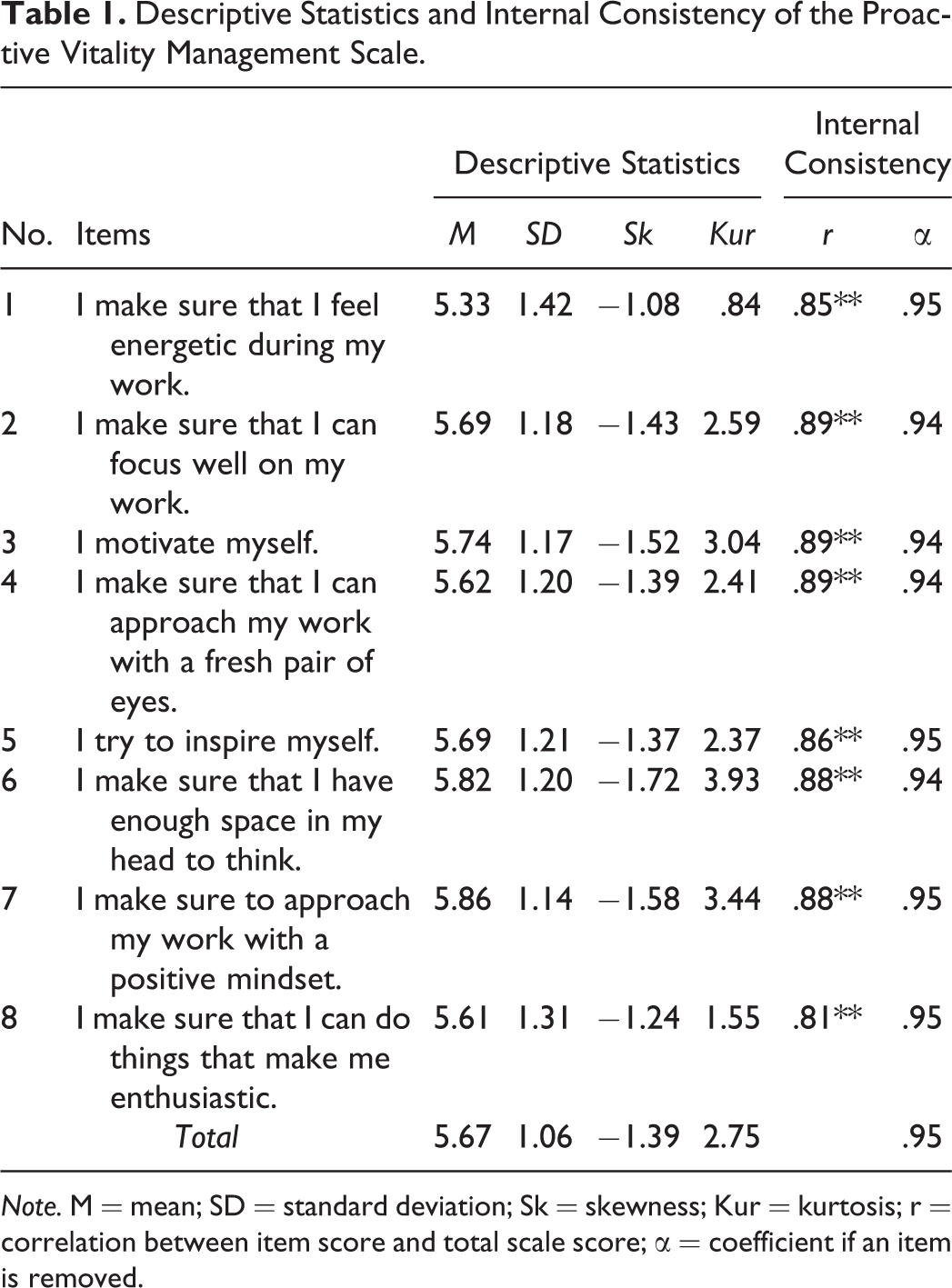
Note. M = mean; SD = standard deviation; Sk = skewness; Kur = kurtosis; r = correlation between item score and total scale score; α = coefficient if an item is removed.
Confirmatory Factor Analysis
The results of the CFA performed in the first study indicated an acceptable fit for the one-factor model, χ2(df) = 41.42 (18), p = .001, CFI = .98, TLI = .98, SRMR = .02, RMSEA[CI] = .082 [0.049, 0.116]. Inspection of the modification indices indicated that error terms for items PVM1 and PVM2 (χ2 = 30.29, expected parameter change = 0.13) and items PVM7 and PVM8 (χ2 = 80.05, estimated parameter change = 0.23) had relatively large modification indices compared with the rest. Also, as all the four items measured contents related to PVM, their residuals were expected to be correlated. Therefore, our model includes the correlations of the error terms of the pairs mentioned above. The RMSEA indicator is sensitive to the low number of degrees of freedom (i.e., df = 18). Thus, it can provide false-negative results (Kenny et al., 2015). The standardized factor loadings ranged from .74 to .89 (p < .001 for all items). Therefore, our results confirm that PVM can be adequately and reliably measured in a Romanian sample with the proposed eight-item instrument (see Figure 1).
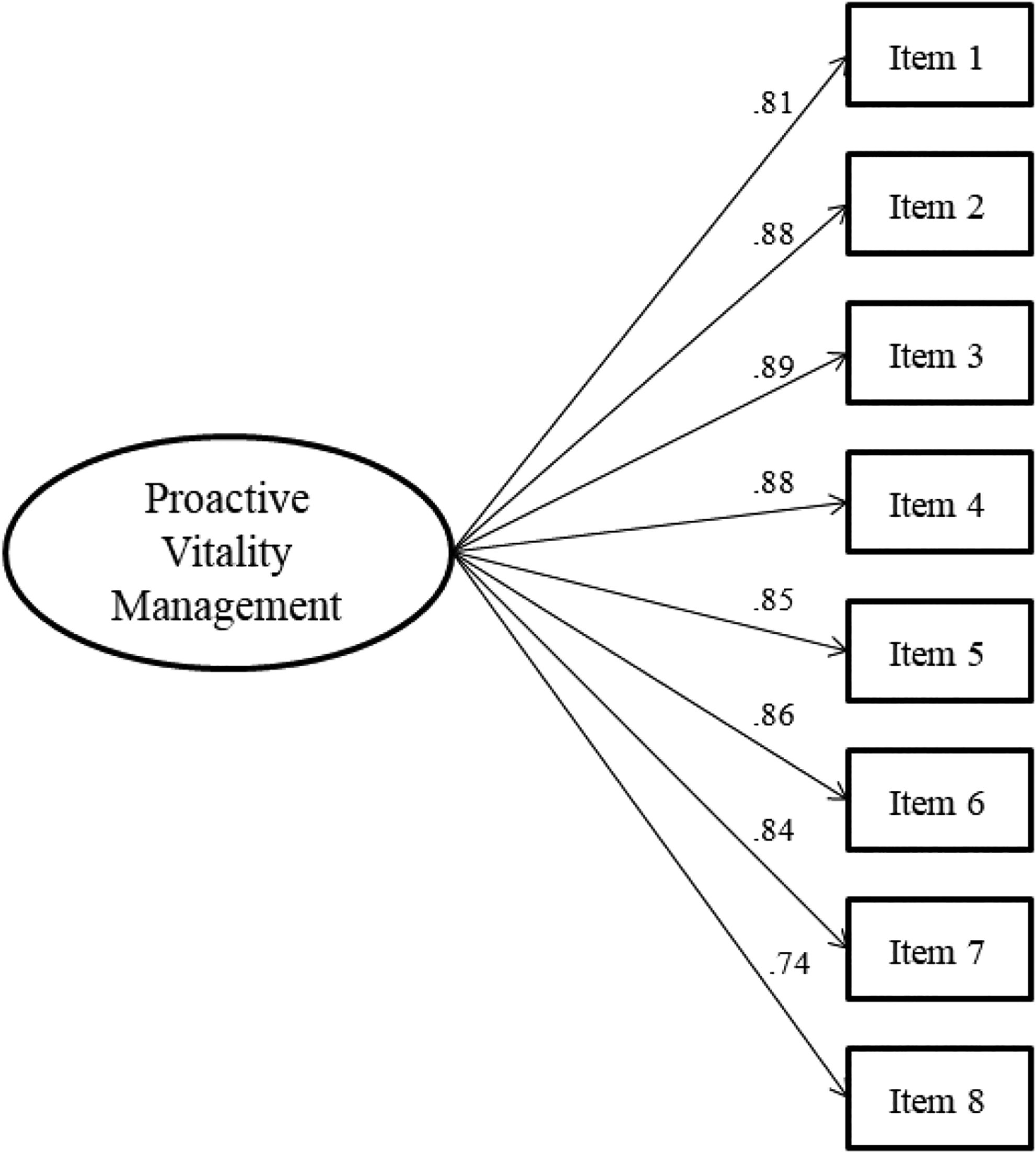
Factor loadings for confirmatory factor analysis. Note. Reported values are standardized.
Measurement Invariance
The results of the measurement invariance analysis (Table 2) show that the scale demonstrates configural invariance across gender, χ2(36) = 67.84, p < .01, RMSEA = .091, CFI = .98, and TLI = .97. Next, factor loadings were constrained to be equal for men and women, and all criteria indicated that metric invariance is also supported ΔCFI = .001. Last, the intercepts were constrained to be equal for both groups, and results indicated no difference in model fit (ΔCFI = .000), which brings support for scalar invariance.
Comparative Evolution of the Main Indicators for Model Testing.
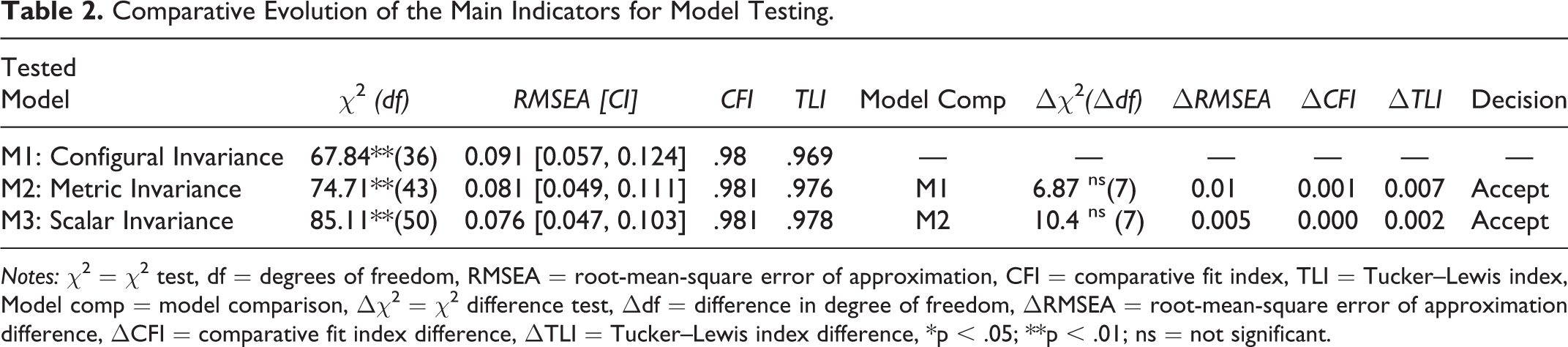
Notes: χ2 = χ2 test, df = degrees of freedom, RMSEA = root-mean-square error of approximation, CFI = comparative fit index, TLI = Tucker–Lewis index, Model comp = model comparison, Δχ2 = χ2 difference test, Δdf = difference in degree of freedom, ΔRMSEA = root-mean-square error of approximation difference, ΔCFI = comparative fit index difference, ΔTLI = Tucker–Lewis index difference, *p < .05; **p < .01; ns = not significant.
Study 2—Construct Validity
The CFA conducted on the second sample indicated a good fit of the one-factor model, replicating the findings of our first study in the second sample: χ2(df) = 29.37 (18), p = .04, CFI = .98, TLI = .97, SRMR = .02, RMSEA [CI] = .078 [0.013, 0.127]. All AVE estimates were higher than the correlations between the variables of interest, showing that constructs are different from one another (see Table 3). We also tested if PVM would be unrelated to psychological detachment, and our results support Hypothesis 1 and implicit the discriminant validity (r = .02, p = .79). Furthermore, PVM correlated positively with work engagement, supporting Hypothesis 2a (r = .35, p < .001). Additionally, all work engagement dimensions (vigor, dedication, and absorption) correlated positively with PVM (r = .35, p < .001, r = .32, p < .001, and r = .28, p < .001, respectively). We also found positive relationships between PVM and job satisfaction (r = .23, p < .001) and satisfaction with life (r = .12, p < .05). Thus, the results support Hypothesis 2b and 2c and contribute to the criterion validity.
In support of Hypothesis 3a, 3b, and 3c, the results indicated that PVM correlated negatively with (a) burnout, (b) mental health complains, and (c) physical health complains (r = −.28, p < .001, r = −.25, p < .001, and r = −.20, p = .001 respectively). Additionally, the data indicated a negative relationship between PVM and the dimensions of core burnout (exhaustion and cynicism; r = −.19, p < .001, and r = −.26, p < .001). With these results, we also add evidence to the criterion validity. All results are presented in Table 3.
Means, Standard Deviations, Average Variances Extracted, Correlations, and Cronbach’s αs (Between Brackets on the Diagonal).
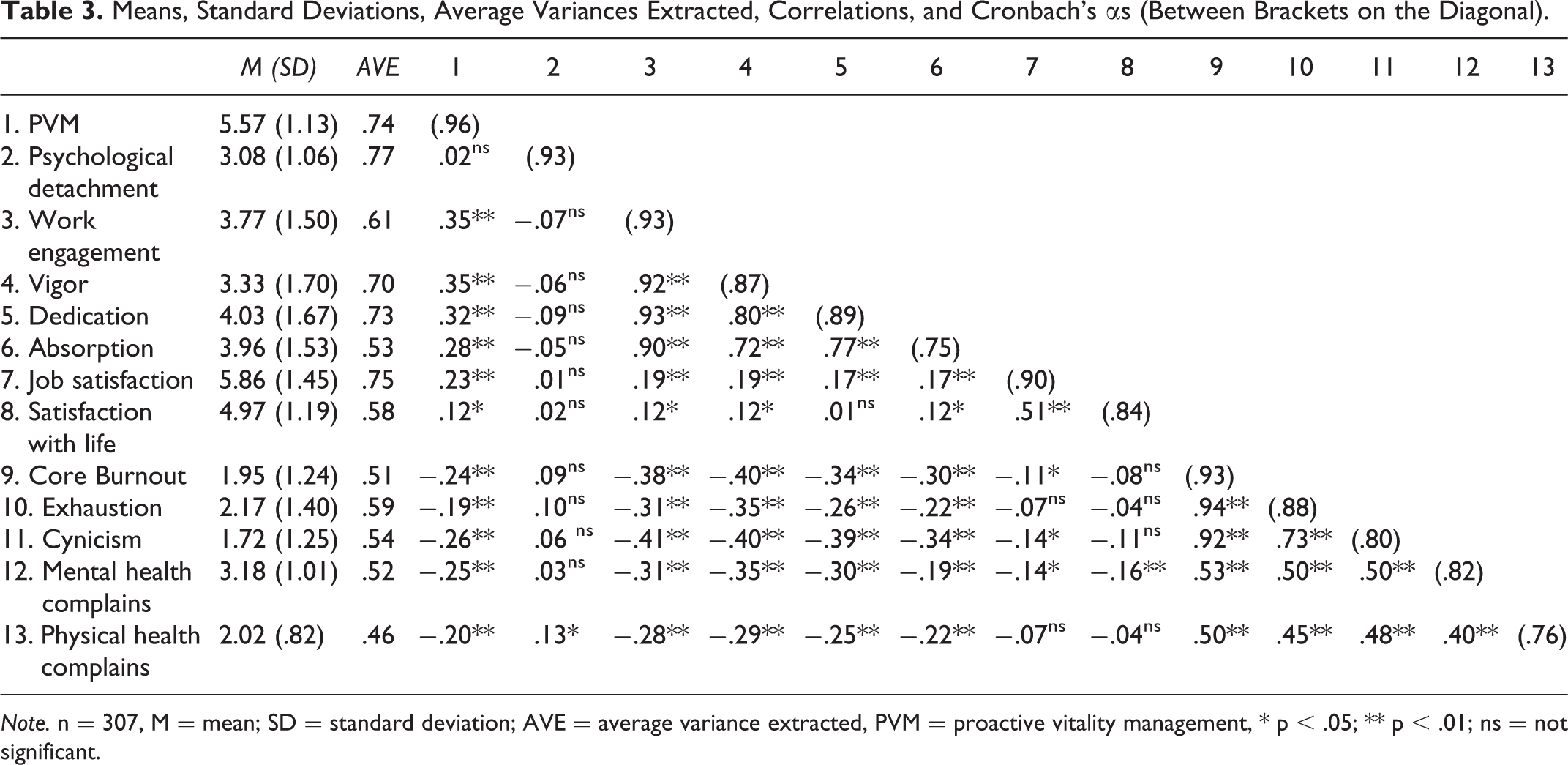
Note. n = 307, M = mean; SD = standard deviation; AVE = average variance extracted, PVM = proactive vitality management, * p < .05; ** p < .01; ns = not significant.
Discussions
The current research’s main objectives were to test the construct structure of PVM in a Romanian sample of employees and test measurement invariance across gender. The presented results emphasize higher item loadings of the translated scale than the original scale. The error correlation can be attributed to the similarity observed in the items, enhancing similarities in response patterns. For example, items 1 and 2 are both parts of a general sense of vigilance and alert state during work. In a similar vein, both items 7 and 8 highlight positivism and enthusiasm at work. Thus, the items are repetitive in their meaning and may not add unique, meaningful information to the scale.
The CFA results indicate a good fit for the one-factor model after adding the covariance between items 1 and 2, 7, and 8. Hence, the adapted PVM scale is an adequate measure that demonstrates the right internal consistency and the initially proposed factorial structure. In other words, the data harnessed by this scale shows that employees can proactively manage their energy to function optimally at work.
Furthermore, measurement invariance was subsequently tested, first the baseline model, without constraints (i.e., configural invariance) and at two more levels, namely invariance of factor loadings (i.e., metric invariance) and invariance of intercepts (i.e., scalar invariance). Metric invariance is an essential prerequisite for making meaningful comparisons between multiple groups (Meredith & Teresi, 2006; Vandenberg & Lance, 2000). The results revealed both configural and metric invariance (i.e., invariant factor loadings) of the one-factor model across gender. These findings suggest that the adapted PVM measures the same construct, regardless of men’s or women’s response. Further analyses also revealed scalar invariance across gender. Our study is the first to test and confirm the scale’s invariance across gender explicitly.
Our research
Moreover, as our results indicated a negative association with burnout, employees who proactively manage their energy are protected against energy loss. The present results suggest that employees who engage in PVM are less prone to report general health complaints. Therefore, they experience less physical or mental health problems than employees who are not managing their energy proactively to function optimally at work.
One of our research
Furthermore, another contribution is related to scale invariance indicators, which showed that the Romanian version of the PVM scale is reliable and taps into the same construct among both men and women. In other words, gender does not influence the response to the items; men and women perceive them similarly. Since Op Den Kamp and colleagues (2018) did not consider measurement invariance in their study, we are the first to analyze it and provide evidence for invariance across gender.
By conducting this research, we contribute to the literature by providing evidence of the existence of PVM in JD-R theory as a proactive behavior at work. This behavior represents a new strategy for employees to function optimally at work by deciding when and how to manage their energy. It also complements existing proactive approaches, such as job crafting (Tims & Bakker, 2010) and feedback-seeking behaviors (Anseel et al., 2015). Placing PVM in the JD-R theory (Bakker & Demerouti, 2017), we can expect it to have a buffering role by protecting employees from exhaustion and help them gain and conserve resources. For example, when an individual is aware that his energy levels are high in the morning, he decides to start the working day with the critical tasks to finalize them. Thus, during the afternoon, he will take care of jobs that do not involve high energy or resource levels. In this way, employees can protect themselves from experiencing stress. This behavior’s beneficial outcomes are more visible in health professions where employees face emotional and psychical demands (e.g., ongoing management of emotions, long work shifts). All these demands can be buffered through proactive energy management.
Limitations
The first limitation resides in our data’s cross-sectional nature, limiting our ability to draw causal inferences regarding the relationships between the examined variables. Thus, our findings cannot specify if PVM determines employees’ well-being or employees with higher well-being levels start to engage in PVM. We also cannot establish with this data whether there is a reciprocal relationship between the two. Furthermore, all constructs were measured using self-reports, and subjectivity may alter the results as common method bias is a potential risk. Hence, possible directions for future research can involve longitudinal investigations of PVM to establish antecedents and consequences of this behavior and employ multi-source data to rule out the bias of subjective evaluations of one’s proactive behaviors.
Another limitation that we need to discuss stems from studies that indicated that the need to manage energy proactively at work might fluctuate due to individual and momentary needs and preferences and the nature of one’s work (Op den Kamp et al., 2018). Therefore, daily measures of PVM could shed light on the stability of the construct and the more dynamic relationships to daily well-being. Further studies could also consider individual or contextual factors that may influence energy management’s effectiveness (Sonnentag et al., 2017).
Practical Implications
Based on data from two samples drawn from different work fields, we provide HR practitioners with a reliable instrument to measure employees’ PVM. Thus, using this instrument, organizations may examine their collective proactivity levels and identify different patterns within the same organization. Therefore, managers may encourage and facilitate PVM by providing employees opportunities to engage in various strategies to manage their vitality. This scale also opens the route for future research on PVM, which can aid organizations with essential information on ensuring their employees the appropriate context or the necessary autonomy to engage in PVM, such as a flexible working schedule or micro-breaks. The data collected with this instrument is also useful to the managers from different work fields (e.g., health, information technology) who can tailor their teams’ strategies. Finally, yet significantly, training organized for employees to manage energy at work can increase their awareness and encourage proactive, self-initiated behaviors to ensure optimal functioning.
In the fast-changing work environment where employees cannot just add extra time to their day to fulfill tasks, a valuable resource becomes the energy they have and, more importantly, how they manage it. Thus, deciding when and how to manage energy at work is a good strategy that employees use to function optimally and fulfill every-day requests or challenges. Furthermore, the data collected with the new PVM instrument allows practitioners to make the best decisions in developing procedures for employees, complementing each individual’s self-managing strategies.
Footnotes
Declaration of Conflicting Interests
The author(s) declared no potential conflicts of interest with respect to the research, authorship, and/or publication of this article.
Funding
The author(s) received no financial support for the research, authorship, and/or publication of this article.
