




Abstract
Posttraumatic growth (PTG) represents positive changes following a trauma, crisis, and/or psychologically distressing event. Experiencing cancer can serve as a traumatic event for patients, resulting in life changes among survivors. Various PTG measures have been used to assess post-cancer change among childhood cancer survivors (CCS), but few have been evaluated for use in this population. This study examined the factor structure of an adapted, 11-item version of the Posttraumatic Growth Inventory (PTGI) among CCS. A randomly selected subgroup of participants (N = 332) was selected from the Los Angeles Cancer Surveillance Program (mean age of 26.5 years at time of survey, mean age at diagnosis of 12 years, primarily male [53.6%], and Hispanic [51.5%]). Participants indicated the degree to which they experienced positive, negative, or no change in their life because of their cancer experience. An exploratory factor analysis (EFA) identified two factors: Appreciation of New Possibilities and Spiritual Change. The adapted, 11-item PTGI was deemed appropriate for use among CCS. Additional research is needed to confirm the use of the two-factor model with confirmatory factor analysis in an independent sample. Future research on PTG among CCS can consider spiritual change as a potential independent factor.
Keywords
Introduction
Posttraumatic growth (PTG) includes positive life changes following a trauma, major crisis, and/or psychologically distressing event (Tedeschi & Calhoun, 2004). Traumatic events are associated with changes in self, changes in relationships with others, and/or changes in life philosophies (Tedeschi & Calhoun, 1996). For example, the diagnosis and treatment of cancer can serve as a traumatic event for patients (Cordova et al., 2017), which may result in positive or negative changes in quality of life (Arpawong et al., 2013). Cancer survivorship includes unique challenges such as follow-up care, financial burden, changes in functional abilities, as well as further physical and psychosocial obstacles (Arpawong et al., 2013). This is particularly true among childhood cancer survivors (CCS), for which few evidence-based interventions to address disparities and barriers to survivorship care exist (Mobley et al., 2021).
Past research, both qualitative and quantative, has sought to characterize PTG among CCS. A review characterizing correlates of PTG among childhood and adolescent cancer survivors found that PTG was negatively related to time from diagnosis and time from treatment completion, and was positively related to age at diagnosis, age at survey, post-traumatic stress symptoms, and social support (Turner et al., 2018). Optimism was also found to be positively related to PTG (Turner et al., 2018). Similarly, in another study, older age, shorter time from diagnosis, younger age at diagnosis, and female gender were found to be correlates of PTG among CCS (Tremolada et al., 2016). Given its multidimensional nature, characterizing PTG after cancer is important to ensure that appropriate psychological intervention is offered to cancer survivors.
The Posttraumatic Growth Inventory (PTGI) is a 21-item questionnaire designed to measure change after trauma and has been used to assess post-cancer change among CCS; however, it has not been validated for use in this population. The PTGI has been shown to have normally distributed scores, good internal consistency (α = 0.90), and acceptable test-retest reliability. Prior psychometric validation among university students revealed five meaningful factors: Relating to Others (α = 0.85), Spiritual Change (α = 0.85), New Possibilities (α = 0.84), Personal Strength (α = 0.72), and Appreciation of Life (α = 0.67) (Tedeschi & Calhoun, 1996). To decrease participant response burden in the present study, approximately two high-loading items per factor (Tedeschi & Calhoun, 1996) were selected for use, resulting in an adapted PTGI of 11 items. These 11 items have been successfully used in prior research among both clinical and non-clinical populations in the targeted age range (Milam, 2004; Milam et al., 2004). Notably, the original PTGI primarily measures positive change (Tedeschi & Calhoun, 1996). However, given the multidimensional nature of PTG, not allowing respondents to report change on a scale ranging from negative to positive change hinders the full characterization of PTG after cancer. As such, the 11-item PTGI was modified to measure negative, none, or positive change after experiencing cancer, allowing for a more comprehensive examination of CCS’ cancer experiences.
Present Study
Understanding the psychometric properties of the adapted PTGI in a sample of CCS is necessary to reliably measure and understand cancer-related PTG to ensure that optimal supportive care is delivered to survivors. The purpose of the present study is to utilize exploratory factor analysis (EFA) to examine the factor structure of an adapted, 11-item version of the PTGI stemming from a cancer experience among CCS (Yi et al., 2015). It is hypothesized that multiple latent factor constructs will emerge as predictors for the PTG items.
Methods
Procedures
The Project Forward Cohort is a population-based, cancer-registry derived, study of risk and protective factors associated with cancer-related follow-up care in young adult CCS (Milam et al., 2021). Data on all cases were obtained from the Los Angeles Cancer Surveillance Program (LA CSP), the cancer registry for LA County (part of the Surveillance, Epidemiology, and End Results [SEER] program). Eligible participants included CCS who were diagnosed up to 19 years of age between 1996–2010 in LA County with any cancer type (stage 2 or greater, except for brain and melanoma, which included stage 1 or greater), who were at least 5 years from diagnosis, and 18–39 years of age at time of study launch in 2015. Patients who were treated less than 2 years prior to the study were excluded, except for those with chronic myeloid leukemia due to the routine use of protracted maintenance therapy with tyrosine kinase inhibitors.
Introductory postcards and self-report surveys were mailed in English or Spanish (upon request), with the option to complete the survey online, over the phone, or in person in either language. Reminder mailings and calls occurred for those who did not respond. Participants received $20 cash and a lottery entry ($300) as incentives to participate. Procedures were approved by the California State Committee for the Protection of Human Subjects, the Institutional Review Board (IRB) at the University of Southern California (USC), and the California Cancer Registry.
Measures
Statistical Analysis
Demographic and clinic variables from the cancer registry were examined to determine differences between responders and non-responders. No differences between responders and non-responders in age at diagnosis, years since diagnosis, age, cancer diagnosis, or stage of disease were found. However, survivors who responded were more likely to be female (vs. male), non-Hispanic White, and have higher (vs. lower) socioeconomic status (SES). Additional details are described elsewhere (Milam et al., 2021).
Results
Final Two-Factor Model With Oblique Rotation and Equations.
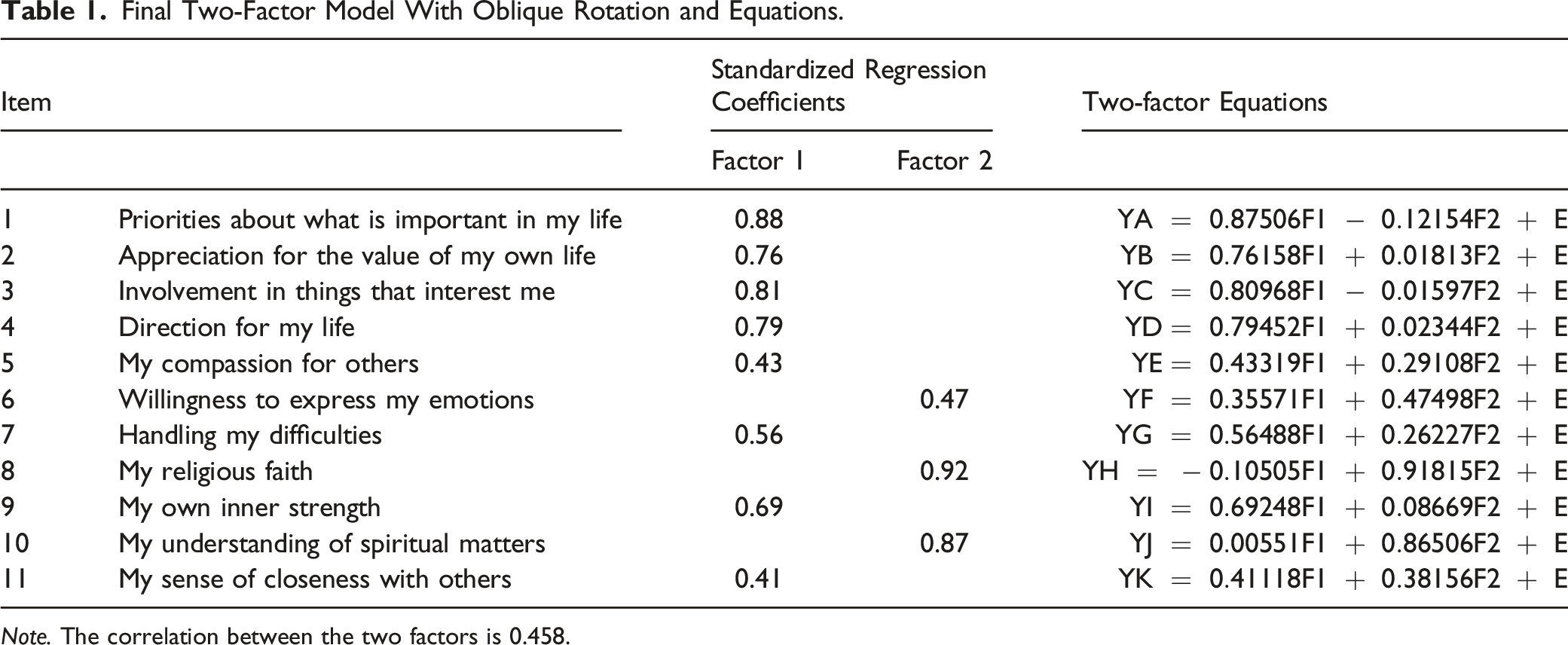
Note. The correlation between the two factors is 0.458.
Discussion
The present study sought to utilize EFA to examine the factor structure of an adapted, 11-item version of the PTGI stemming from a cancer experience among CCS. These data suggest the adapted PTG assessment is appropriate for use in a CCS sample, representing two PTG factors: Appreciation of New Possibilities and Spiritual Change.
The factors identified in the present study are partially comparable to those identified in the original measure validation among general, non-cancer affected university students (Tedeschi & Calhoun, 1996). Two of the five previously identified factors, Appreciation of Life and New Possibilities, have item-overlap with Factor 1 in the present study. Further, the previously identified Spiritual Change factor was also found in the present study, representing Factor 2. Therefore, despite a decrease in items and subsequently a decrease in factors, these findings suggest similarities between the original 21-item measure and the adapted 11-item measure.
The identification of two distinct factors indicates independent value should be attributed to each factor. Appreciation of New Possibilities reflects a core PTG construct. As such, future research concerning PTG should consider separating the spiritual change items to be unique enough to examine independently, in relation to their topic of interest, among CCS. Factor structure similarities between the original 21-item PTGI and the adapted 11-item measure, in addition to the internal consistency among the 11-items, suggest that the adapted PTGI is applicable for use in this population.
These findings further contribute to those of prior research supporting the option to report none or negative change as a result of ones’ cancer experience (Milam, 2004; Milam et al., 2004). It is possible that prior research using the PTGI may conflate low change with negative change due to lacking item response options. As such, the response format used in the present study reflects the broader, multidimensional nature of PTG and likely yields a more comprehensive characterization of PTG after cancer. However, given limited research modifying the PTGI, the addition of reporting negative change is worthy of further exploration. For example, Taku et al., 2021 has assessed negative change as posttraumatic depreciation (Taku et al., 2021).
The present study has several strengths and some limitations. These findings contribute to the limited research surrounding PTG among CCS and provide a novel and brief approach to measuring PTG by including the response option of negative change. Confirmatory factor analysis is to be conducted which will enable future researchers to verify the use of the two-factor model in an independent sample. Further, prior research indicates PTG differs by gender, cancer type, and age (Boyle et al., 2017; Liu et al., 2021), and therefore should be considered in future examinations of factor structure. These findings may inform future qualitative studies aimed to better understand individual cancer survivorship experiences (e.g., researchers using a narrative approach to characterize life-histories that reflect PTG elements, such as appreciation of new possibilities and spiritual changes stemming from the cancer experience) (Tremolada et al., 2018).
Conclusion
Results suggest that an adapted, 11-item PTGI is well-suited for use among CCS. Providing a response option that includes negative change may facilitate clinicians’ abilities to identify patients who require additional support. Thus, this adapted PTGI yields a rapid screening of PTG that can be used to detect both positive and negative change attributed to the cancer experience among CCS. These findings also suggest the potential for spiritual change to be considered as an independent factor.
Footnotes
Declaration of Conflicting Interests
The author(s) declared no potential conflicts of interest with respect to the research, authorship, and/or publication of this article.
Funding
The author(s) disclosed receipt of the following financial support for the research, authorship, and/or publication of this article: This work was supported by grant 1R01MD007801 from the National Institute on Minority Health and Health Disparities of the National Institutes of Health and P30CA014089 from the National Cancer Institute of the National Institutes of Health. Author JT was supported by the VA Office of Academic Affiliations through the Advanced Fellowship Program in Health Services Research and Development as well as the T32CA009492 from the National Cancer Institute of the National Institutes of Health.
Disclaimer
The contents do not represent the views of the U.S. Department of Veterans Affairs or the United States Government.
