



Abstract
Moving beyond the current focus on the individual as the unit of analysis in the privacy paradox, this article examines the misalignment between privacy attitudes and online behaviors at the level of society as a collective. I draw on Facebook’s market performance to show how despite concerns about privacy, market structures drive user, advertiser and investor behaviors to continue to reward corporate owners of social media platforms. In this market-oriented analysis, I introduce the metaphor of elasticity to capture the responsiveness of demand for social media to the data (price) charged by social media companies. Overall, this article positions social media as inelastic, relative to privacy costs; highlights the role of the social collective in the privacy crises; and ultimately underscores the need for structural interventions in addressing privacy risks.
After years of outstanding financial success that defied widespread calls for improved privacy practices, the Cambridge Analytica revelations kindled hopes for proximate ties between financial performance and privacy protection. When Facebook’s share price recorded a subsequent drop, it appeared that these hopes had finally been realized. From $185.09 the day before the story broke, the company’s share price dipped as low as $124.06 in December 2018. 1 But some financial analysts, unfazed by the drop in share price, noted that Facebook was operating in a multi-sided market and further that advertisers and users were unlikely to abandon the platform. The fallout from the scandal, they reasoned, was going to be a “modest revenue hit” (Jhonsa, 2018). Subsequent events appeared to support these analysts’ forecasts, as the company reassured investors that user numbers and advertising were holding steady (Facebook, 2018) and further that the company had set aside funds to cover potential fines (Facebook, 2019: 16). By the time the company reached a $5 billion-dollar settlement with the Federal Trade Commission of the United States on July 24, 2019, the company shares were selling at $204.87. Given Facebook’s outsized revenues, it was not clear that the large settlement sum constituted sufficient disincentive to exploit user data in problematic ways (Chopra, 2019; Slaughter, 2019), nor did the subsequent attempts by some users and advertisers to penalize Facebook through boycotts create sustained financial impact.
The episode raises an important question about the link between privacy and financial performance among social media companies—why, despite widespread demand for improved user privacy protection, have users, advertisers and investors failed to launch an impactful boycott of social media companies? The incongruity between stakeholders’ desire for privacy on the one hand and continued conscious creation of value for and derivation of benefits from social media platforms on the other, which mirrors and magnifies the privacy paradox—the misalignment between users’ expressed preference for privacy and their privacy-threatening online behaviors, exposes the role of society as a whole in the privacy crises. It also highlights the economic conditions that allow social media platforms to thrive, notwithstanding widespread disapproval of their approach to digital rights governance. This article highlights the paradoxical nature of demanding privacy on a platform whose data practices, which are essentially antithetical to popular notions of privacy as control over personal information, launched it from Ivy League notoriety to global powerhouse and draws on economic principles to explain why Facebook’s social media business model has simultaneously drawn public censure and market reward.
Extensive collection, use and sharing of data by social media companies pose privacy risks but simultaneously generate revenue and growth opportunities for companies thereby creating a misalignment between profits and privacy. Since the idea of shareholder primacy has been dominant in corporate circles for decades (Berle, 1931; Hansmann and Kraakman, 2001; Smith and Rönnegard, 2016), publicly traded companies have tended to focus on earnings, paying attention to issues such as privacy only to the extent they affect their market performance. Of course, privacy regulations can impose compliance costs on datacentric businesses and limit their avenues for monetizing data, thus affecting their growth and revenues, which ultimately influence their market performance. In addition, regulators can impose fines, which may affect revenue projections and the growth outlook of corporate violators of privacy laws. For instance, France fined Google about $57 million (Romm, 2019) and the US Federal Trade Commission fined Facebook about $5 billion (Kang, 2019). However, in the absence of steep regulatory fines, the stock market appears unresponsive to listed companies’ data practices.
This divergence of the stock market from public concerns is not unique to privacy. Animal rights, environmental impact and labor policies are other serious social issues whose gravity the stock market has not always reflected. To bridge this gap between social concerns and stock market performance, socially responsible investing (SRI) initiatives, which channel investor funds into socially responsible businesses that either promote social benefits or avoid negative social impact, have been on the rise. Inflows into ESG funds—which make investment decisions based on companies’ approaches to environmental, social and governance issues—grew from less than $1 billion in 2010 to $17.76 billion in 2019. Locating data privacy among issues that are central to SRI might nudge companies to treat data privacy as an important aspect of their business strategy thereby aligning investor behavior with privacy concerns. Despite the growing interest in socially responsible investment funds, however, it is not clear that data privacy is a consideration for building SRI stock portfolios. Outside of ESG funds, investors are hardly neutral arbiters of socially desirable corporate behavior. Furthermore, there is no conclusive evidence that socially responsible corporate behavior offers companies economic advantages, and they may in fact impose additional costs (Alexander and Buchholz, 1978; Aupperle et al., 1985). Likewise, the data practices of companies with platform business models may have no bearing on their stock market performance, which may instead be driven by their market share. For instance, Facebook’s revenue is primarily driven by its dominance in the user market where it has 2.6 billion monthly active users (Q1 2020) and advertiser markets from which it generates 98.5% of its total revenue. Arguably, a decline in user numbers would force a corresponding decline in advertising revenue and a consequent decline in stock market performance. If privacy was significantly valued by society, by implication, business models with high risk of undermining privacy should suffer. However, the logic of shareholder primacy values a company’s capacity to consistently generate significant advertising revenue based on its large user base over user privacy. This contradiction mirrors the privacy paradox, which has been the subject of experiments in behavioral economics and philosophical debates about privacy more broadly.
The paradox relates to the trend among consumers to make decisions that undermine their privacy in spite of expressing significant concern about their privacy. Rather than consider this contradiction a misnomer, I argue that the public outcry that followed the Cambridge Analytica revelations is incontrovertible evidence that people collectively care about data privacy. I also offer insight into why the narrative about Facebook has split into two tracks: one of public excoriation about unethical data handling and another of market optimism about the company’s stock market performance. Facebook was lambasted in op-ed pieces and news stories for commodifying users, poorly regulating content on its platform and threatening global democracy. But while Facebook was suffering a reputational problem among privacy advocates that demanded changes in its data practices, the market seemed satisfied with its financial performance, signaling the company to stay the course.
This article’s focus on markets is consistent with perspectives in political economy approaches to the study of media, which focus on economic aspects of media including ownership structures, market share and revenue models (Elmer, 2019; Winseck, 2010). Furthermore, by taking a market-oriented perspective, I move beyond the current understanding of the privacy paradox, which locates individual users as the unit of analysis and characterizes them as largely irrational actors. As an alternative, the market-oriented approach adopted in this article repositions users as a social collective whose social media behavior is in fact rational, given the social, economic and political structures of the digital age. In addition, the market-oriented perspective lends visibility to other stakeholders—including advertisers and governments whose actions contribute to the existence of the privacy paradox, thereby broadening the existing user-centric focus of the privacy paradox. Using Facebook as a case study, this article explores how Facebook’s performance among users, advertisers and investors belies the company’s privacy struggles, thereby creating a paradox at the societal level.
The privacy paradox and its limitations
In decades of research on the privacy paradox, scholars have focused on the individual user as the unit of analysis. This approach provided insight into human behavior, particularly the tradeoffs associated with exchanging data for convenience or economic reward. Specifically, it showed the limitations of particular privacy policy frameworks such as notice and consent, and set the stage for conversations about the accessibility of privacy policies to average users (Mcdonald et al., 2009). It also allowed scholars to explore economic perspectives on the privacy behaviors such as the economic tradeoff argument, that digital media users make rational exchanges of their data for media use (Obar and Oeldorf-Hirsch, 2020) or were willing to pay more for privacy protection (Tsai et al., 2011). A more subtle implication of this approach was the idea that a change in user behavior or attitude could resolve the privacy paradox. In essence, people could stop claiming to care about privacy or stop using media that put their privacy at risk. Research on the privacy paradox, however, has failed to address the conditions for resolving the issue, including the fact that individual user action is not responsible for the privacy paradox. Rather, the privacy paradox needs to be reconceptualized in light of the social collective, such that society’s role in the creation of conditions where user privacy attitudes and behaviors are mismatched becomes apparent and individual user responsibility for the paradox is rightly discounted.
In Nobody’s Business: Paradoxes of Privacy, feminist social critic, Brill (1990) asked: “how do we reconcile asking for more secrecy and more privacy while using the most public of legal devices and other national forums?” (p.xiii). Put in a more recent context, the question might be: how do we reconcile asking for more privacy while using social media, platforms designed for public performance and well-known for data mining? Although Brill focused on abortion rights, homosexuality and end-of-life decisions, she set the stage for a societal reckoning with the seeming absurdity of the very public politics of privacy.
Adopting a similar society-level focus, legal scholarship has highlighted the inherent contradiction in prizing the free flow of information while seeking to protect privacy (Jorstad, 2001). On the one hand democratic ideals support the free exchange of information. On the other, the call for human flourishing in liberal societies (Cohen, 2013) drives a corresponding requirement for privacy protection and highlights the need to balance the historical tensions between free speech and privacy. These tensions, which are particularly relevant to journalistic practices and online search engines, have been the subject of old and new scholarly and policy debates. For instance, the seminal treatise on privacy torts in the United States developed out of a distaste for the practice of taking and publishing photographs of individuals without their permission (Warren and Brandeis, 1890). Similar concerns with the press’s encroachment of people’s privacy have appeared in Europe where the tension, as it relates to search engines, was addressed by introducing the right to be forgotten. Thinking about privacy at the society level thus highlights tensions in democratic freedoms and lays bare the political considerations that give rise to the privacy paradox. This approach treats privacy as a product of the ideologies that shape society, such that any contradictions that emerge, including the privacy paradox, are attributable to larger societal forces. Notably, these existing scholarly perspectives adopt a predominantly philosophical slant, leaving out discussions of economic interactions among stakeholders in the privacy debate.
In other disciplines, some empirical studies, while plugging the gap left by largely philosophical approaches, have moved away from the society-level perspective. Locating the privacy paradox within ecommerce, Spiekermann et al. (2001) conducted an experiment comparing people’s self-reported privacy preferences in questionnaires with their actual self-disclosure behaviors to a bot during an online shopping session. The researchers found that despite expressing concern about privacy in questionnaires administered prior to the shopping session, study participants generally disclosed personal information to the bot during the shopping session. They concluded that the interactivity of electronic commerce environments lulled shoppers into a false sense of security that led them to deviate from their professed privacy preferences. A study by economics and computer science scholars, Acquisti and Gross (2006), reached similar conclusions, although in the context of social media and among a population of predominantly undergraduates. They compared participants’ survey responses to their actual behavior on Facebook and found no correlation between participants’ self-reported privacy attitudes and the level of their self-disclosures on Facebook. In another study that focused on students, marketing researchers reached similar conclusions about the misalignment of privacy attitudes and privacy behaviors (Norberg et al., 2007), expressly describing this phenomenon as the privacy paradox.
Likewise, research in communication has explored age as potentially influencing privacy behavior and an early view was that the privacy paradox represents contradictions between adults’ concerns about privacy and teenagers’ practice of indiscriminately sharing personal information (Barnes, 2006). In a departure from attributions of the privacy paradox to contrasting political ideologies and legal concepts—control versus autonomy and free speech versus privacy (Brill, 1990; Jorstad, 2001)—researchers in communication studies have positioned the privacy paradox as a product of age-related ignorance (Boyd, 2014; Livingstone, 2008; Marwick and Boyd, 2014). Moreover, this age-based definition further redefines the privacy paradox as an interaction among actors rather than a misalignment of attitudes and behaviors of the same actors. In this between-actor context of the privacy paradox, Barnes (2006) ascribed privacy concerns to parents and reckless online behavior to teenagers, noting that while teenagers shield the contents of their journals from their parents, they seem unaware of the risks associated with posting personal information online. Although she proposed interventions that occur at the society level, they are directed at managing problems at the individual level, such as ignorance about digital media, rather than the socioeconomic structures that drive the unfettered use of social media among teenagers.
More recent research in privacy, however, suggests that ignorance does not sufficiently explain the privacy paradox. Instead, these studies focus on psychological drivers of attitude-deviating behaviors. In other words, despite a clear understanding of the privacy risks associated with particular media uses, there are other factors compelling users to persist in those risky use patterns. For instance, among young adults, the absence of a sense of control over data sharing, rather than ignorance, accounts for what is perceived as oversharing (Hargittai and Marwick, 2016). Likewise, a study of the broader population argues that digital resignation, a sense of helplessness that consumers feel about protecting their privacy, informs consumer response to corporate intrusions on privacy rather than ignorance (Draper and Turow, 2019). Together, these studies suggest that despite a reasonable understanding of the privacy risks associated with particular media use patterns, people may continue to engage in behaviors that conflict with their privacy attitudes because of apathy rooted in the belief that online privacy is impossible to achieve. Consequently, given the pervasiveness of the privacy discourse in the digital age and widespread knowledge of the risks associated with Internet use, learned helplessness, not ignorance, may better reflect people’s privacy behaviors.
In addition to offering alternative explanations for the privacy paradox, these recent studies challenge the characterization of users as irrational privacy actors by showing why the privacy behaviors that contradict self-disclosed privacy attitudes are perfectly reasonable in the context of people’s psychological responses to pervasive privacy threats. Still, approaching the misalignment between privacy attitudes and behaviors in this manner locates the paradox within individual responses to the corporate surveillance environment. Although useful, the user-centric perspective places responsibility for the resulting absurdity on individual users, who can address the problems of ignorance, apathy and digital resignation through education about privacy management techniques.
What these empirical studies have not explored in extensive detail are the external structural mechanisms that create the conditions under which privacy-related contradictions thrive. In other words, there are social, economic and political factors that account for the conditions—such as digital resignation—that scholars have used to rationalize the privacy paradox. Illustrating this point, popular advice recommends caution when dating people without social media profiles (Manjoo and Yoffe, 2012); political engagement is increasingly conducted online (Gibson and Cantijoch, 2013); and the rise of influencing as a career connects social media performance to economic reward (Duffy, 2017). This multifaceted pressure to engage in online interaction may drive what would otherwise be illogical persistence in using social media at the risk of privacy. Network effects, whereby the value of a good or service increases with each additional user, partly captures the pressure to engage in the online behaviors that conflict with attitudes about privacy. The widespread use of social media increases its value to users and irrespective of associated privacy risks spurs even more use. This effect of “highly networked social settings” can override a user’s privacy preferences (Hargittai and Marwick, 2016: 3752).
Rather than attempt to find rational explanations for the privacy paradox, some other approaches challenge the assumption of equivalence between behaviors and attitudes. Social psychology employs the theory of planned behavior: the idea that behavioral intentions qualify the relationship between attitudes and behaviors. Behavioral intentions, which address whether after forming a preference, users develop a corresponding intention to engage in behavior that is aligned with that preference, mediates the reflection of attitudes in behaviors (Dienlin and Trepte, 2015). As such, despite expressing a preference for privacy, users may have no intentions of engaging in corresponding behaviors. Recent legal scholarship, stretches this equivalence challenge beyond the introduction of an intervening variable, arguing that the privacy paradox is “an illusion created by faulty logic, unwarranted generalizations, and conflated issues” because privacy attitudes are determined by values while privacy behaviors are the product of contextual risk analysis (Solove, 2021). According to this logic, since there is no reason to expect privacy attitudes to predict privacy behaviors, the privacy paradox is a myth.
A new perspective: Market orientation
Rather than discard the privacy paradox as a myth, I proceed from the premise that people’s behavior does not reflect their privacy attitudes and explore key drivers of the privacy paradox. This approach emphasizes factors external to the user, to demonstrate how the privacy paradox is the product of rational human behavior. Moving beyond attempts at resolving the paradox through claims rooted in user ignorance, an absence of control, digital resignation and claims of faulty logic, I propose a reconceptualization rooted in the idea of a collective responsibility for privacy and the market logic of the social media space. More specifically, I offer a framework for thinking about the collective responsibility for the privacy paradox and the overarching social, political and economic structures that contribute to its existence. To answer these questions, I propose a two-pronged macro-level explanation for the privacy paradox in the social media context. First, I position the issue as a collective societal phenomenon. Second, I center economic considerations in my analysis, showing how demand, market share and stock market performance drive the conflicts in privacy attitudes and behaviors.
Although market behavior has little bearing on the analysis of the privacy paradox on an individual level, which has been the focus of many researchers on the subject, it is relevant to corporate responses to large scale collective privacy concerns about social media platforms. Fast food restaurants offer a helpful analogy. People may express a desire to consume healthy food but as long as there is strong demand for convenience options, fast food restaurants have no reason to change their offerings. Just as income and geographic location represent structural factors, outside of people’s desires, that drive the consumption of fast food, there are factors, outside of the preferences of online users for privacy, driving online behavior that negates disclosed privacy attitudes. However, unlike the production and sale of fast food, which involves moving the product from manufacturers through distributors and retailers to consumers, social media platforms operate under a more complex market structure called a multisided market. Companies in multisided markets act as intermediaries that enable interactions between two or more business segments (Hagiu and Wright, 2015). Unlike a one-sided market where a company focuses on the delivery of value to a particular audience, success in a multi-sided market depends on the company’s ability to simultaneously offer value to multiple business segments (Rochet and Tirole, 2003). Companies with this business model rely on cross-group externalities—when the value of the company to one segment depends on its success with the other business segment(s) (Armstrong, 2006: 668)—and subsidize one business segment in the hopes that its success there would drive profits in the other segment. For example, an online news agency may subsidize readership fees to attract more subscribers, which may draw interest from online advertisers and ultimately result in more advertising revenue. In Facebook’s case, users pay nothing to join the network and constitute the subsidized segment while advertisers, the profit-making segment, pay to have their ads shown to users. Facebook’s user engagement statistics drives its value to advertisers.
Non-academic conversations about privacy have broached the market relevance of privacy concerns, recognizing that continued use of social media—by users and advertisers—in spite of privacy complaints, creates a situation where market performance is unaffected by public sentiment. As a result, stakeholders are exploring ways to send market signals reflecting privacy preferences. But the effectiveness of these attempts is unclear. For instance, in response to a market-related question about the impact of #deletefacebook on Facebook use patterns among members and ad buys by advertisers, Mark Zuckerberg said, “I don’t think there has been any meaningful impact we’ve observed” (Facebook, 2018). The disconnect between stakeholder activism and business impact compels us to seriously consider the privacy paradox in relation to market incentives.
We thus have yet another version of the privacy paradox built on the attitude-behavior gap. Behavior in this rendering of the privacy paradox is not limited to user behavior. Rather, it positions market responses to social media as behavior. If social media use constitutes behavior at the individual level of a user-centric analysis of the privacy paradox, then the aggregate statistics of user engagement would account for a collective orientation to the behavior prong of the privacy paradox in the user segment. The advertising segment can be analyzed as another behavioral prong of the privacy paradox, which fails to reflect the collective privacy concerns expressed in public discourse. Similarly, the stock market presents yet another behavioral prong to which social media companies pay attention and in which one may expect to see reverberations of the public’s concerns for privacy. This collective perspective allows us to unpack the hitherto broad expression of the privacy paradox as a disconnect between attitudes and behaviors into smaller segments for more nuanced actor-focused analysis.
Within the user segment, another layer of multisidedness leverages the simultaneous production and consumption of content among networks of users whose interactions on the platform multiply its value within the segment. As users begin to form communities on the platform, non-users start to experience the informational cost of non-membership (Portwood-Stacer, 2013). Facebook’s monopoly position magnifies the cost of non-membership given its widespread adoption for information dissemination among universities, social groups, political campaigns and government agencies. Consequently, decisions to join Facebook and engage with other users on the platform, thereby incurring serious privacy risks, may hinge on the desire to avoid incidental ostracism rather than an irrational disregard for one’s privacy preferences. Crucial to this logic of situating network effects at the core of the privacy paradox is the role of the critical mass of users, social institutions and broad information dissemination systems of the digital age in perpetuating the dominance of social media platforms. In essence, the privacy paradox does not operate primarily at the level of the individual user. Rather, it reflects a societal conflict between the desire for privacy and an interest in sharing information freely on a corporatized platform.
The market-oriented framework also expands the privacy paradox beyond the restrictive lens of the user market. Rather than ask why individual users exhibit online behaviors that contradict their privacy preferences, this framing allows us to ask a broader question: why does society reward business models that threaten privacy when it claims to care about privacy? This approach not only highlights the collective responsibility for privacy in society, but it also brings to the fore the role that other stakeholders, specifically advertisers and investors, play in the privacy paradox.
Similar to recent research on the privacy paradox, the proposed framework contrasts attitudes toward privacy with actual behaviors in privacy risk situations. The public censure represents broad society attitudes expressing a preference for privacy while patterns in user engagement, advertising revenue and share price movements serve as a proxy for actual societal behavior.
Privacy paradox from a market perspective
The market-oriented perspective that I propose is best understood by examining three different market categories—the user market, the advertiser market and the stock market—and the key actors in each—users, advertisers and investors respectively. Each of these categories feeds into the others and contributes to the external conditions that I argue set the stage for the privacy paradox. Specifically, advertising revenue is influenced by audience engagement, which in turn influences investor behavior on the stock market.
Facebook presents an ideal case study for the application of this framework. It is a publicly traded company owning the most popular social network sites in the world, with almost all of its $70 billion revenue generated from advertising on its Facebook and Instagram social network sites (Facebook, 2020: 11). The company’s business structure exemplifies the market multisidedness that is crucial to the application of the framework. Moreover, it has been embroiled in the biggest privacy debacles relating to social media use. In sum, the company’s financialization (Elmer, 2019), notoriety in privacy discourse (Arora and Scheiber, 2017; Boyd, 2008; Fuchs, 2012) and business structure (Arvidsson, 2016) properly position Facebook as a case study for analyzing the social collective perspective of the privacy paradox and drawing broader conclusions about society’s relationship to privacy.
Across the user market, advertising market and stock market, user numbers, advertising revenue and share price depicted in Figures 1 to 3 have not shown appreciable decline despite privacy concerns arising from Facebook’s operations. In other words, user engagement, advertising revenue and share price appeared resilient to widespread concern in society about the data costs associated with social media use.
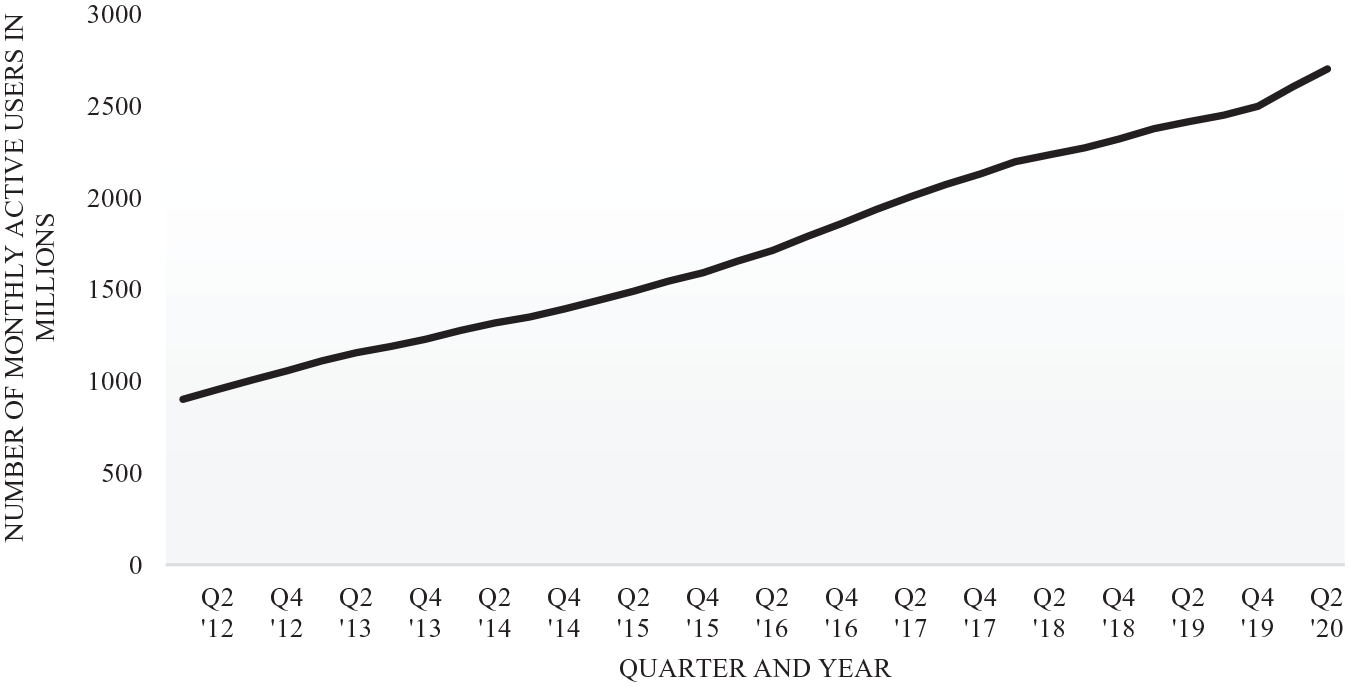
Facebook’s monthly active users from 2012 to 2020.

Facebook’s global advertising revenue from 2012 to 2020.
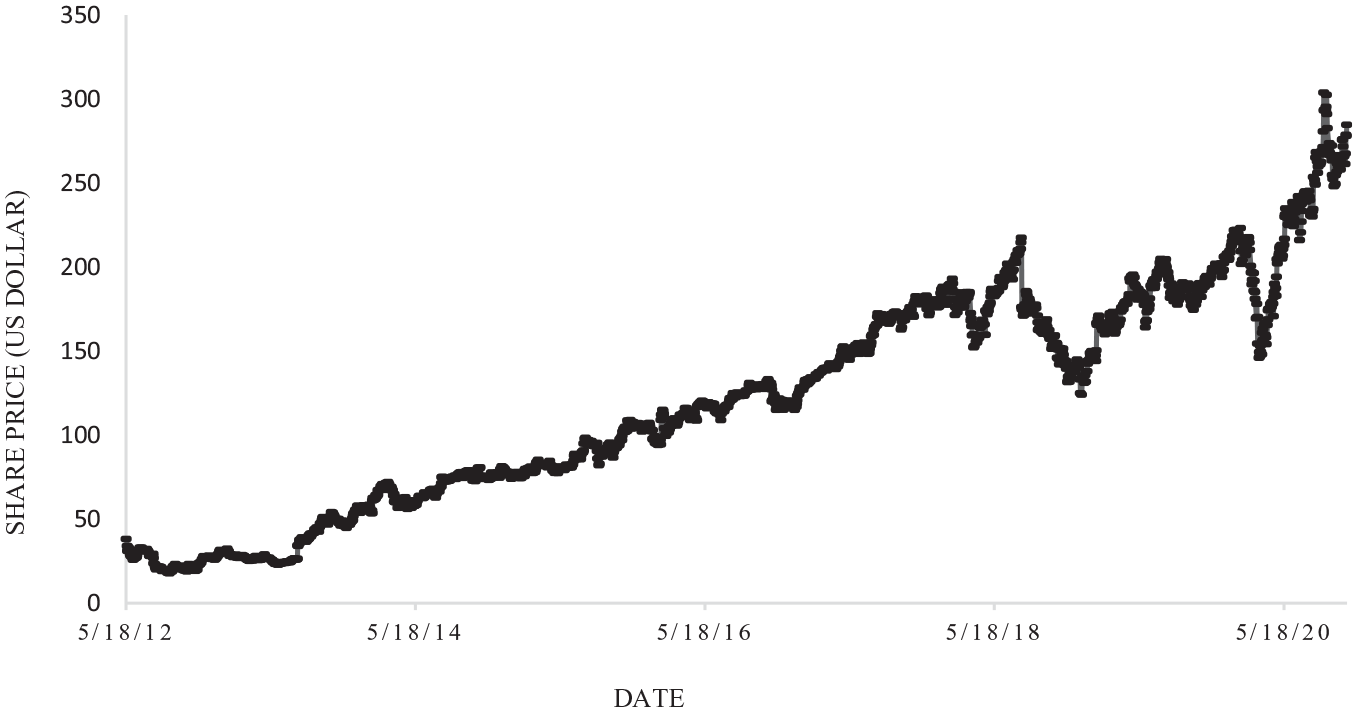
Facebook’s share price from 2012 to 2020.
Influences on the media-market disconnect in social media privacy
Existing business and legal concepts explain and account for the misalignment between attitudes and performance at the societal level. In previous studies on the privacy paradox, researchers identified the paradox through experiments, surveys and or observational studies and then attempted to resolve the absurdities they uncovered through concepts in social psychology. I adopt a similar approach of explaining the paradox identified in the previous section but rather than situate the resolution in user psychology, I point to law and business principles that explain the large-scale divergence of privacy attitudes from social media behavior. Specifically, I draw on the concept of elasticity, which characterizes the responsiveness of demand to price; the profit imperative of corporations, rooted in principles of corporate law and the idea of surveillance capitalism as overarching concepts that emphasize the broader societal role in the privacy crises.
Surveillance capitalism, which positions the behavioral surplus generated from data collection, analysis and use as analogous to surplus value in Marxist analysis of capitalism (Zuboff, 2019), partly accounts for the observed divergence between media and market responses lies in the recent focus on extracting value from data. Surveillance capitalism cuts across a variety of everyday activities including online shopping, which presents opportunities to collect data used to profile shoppers for targeted ads. Even activities as mundane as reading the news online inform targeted ads (Libert and Binns, 2019). Targeted messages online are not restricted to the commercial messaging; political campaigns also target online users with ads (Howard, 2005).
Commercial or political, social media platforms are at the center of brokering these targeted ads (Tucker, 2012; Woolley and Howard, 2019). Facebook in particular has been on the receiving end of critical research on advertising. While Facebook ads manager has created an environment for targeted ads, the real driver of the datacentrism that underlies the surveillance economy is advertising, a persuasive activity that predates social media (Ang, 1991; Gandy, 1993; Turow, 1979). Facebook monetized its social networking sites by exploiting the widespread interest in data-driven advertising, resulting in what scholars have described as the attention economy—the derivation of value from the human attention (Bueno, 2017; Wu, 2016). In a vicious cycle, the expansion of the attention economy drives data collection, which in turn drives further growth of the attention economy. Thus, the critique of datacentrism, which drives surveillance capitalism, is in some sense a critique of advertising, which now entails predictive analytics. In essence, the dominant position that companies such as Facebook occupy in the surveillance economy is largely driven by widespread demand for the data they offer.
The demand for social media in advertiser and user markets is not only strong but appears unresponsive to privacy concerns, as evidenced by sustained revenue and number of active users at the peak of the privacy discourse in the aftermath of the Cambridge Analytica scandal and the introduction of the General Data Protection Regulation (GDPR) between 2018 and 2020. This financial resilience to public censure constitutes what I describe as the elasticity explanation for Facebook’s performance among users, advertisers and investors. Economists often evaluate elasticity—the responsiveness of demand to changes in variables such as price and income. Although elasticity is measured on a scale, generally, demand for a product is described as elastic if it changes in response to a price change and inelastic when it remains constant despite price change. By replacing the price function in price elasticity with data, the concept of elasticity offers a new way to think about the demand for social media. Given our understanding of the datacentric nature of social media, we can think of data as the price paid for social media use (van Dijck, 2014). Data elasticity thus describes the degree of responsiveness of demand for a product or service to changes in data demanded. Accordingly, since user engagement is unresponsive to troves of data collected in connection to social media use, in the context of data elasticity, the demand for social media is inelastic. Unlike price elasticity of demand however, privacy elasticity does not offer a unit for unit comparison between the data demanded by platforms and changes in user behavior. Rather, using the discrete categories of “elastic” and “inelastic,” it provides a general sense of the relationship between the demand for social media products and privacy by considering whether demand changed after revelations of Facebook’s privacy missteps were made public. Rather than think of the continued widespread use of Facebook as paradoxical, elasticity redefines the behavior as a function of the kind of demand that social media enjoys.
The dominance of the idea of shareholder primacy also contextualizes the absence of complementarity between public concern about privacy and financial market data. For decades, and despite arguments to the contrary, a quote from the Michigan Supreme Court’s decision in Dodge v. Ford Motor Co. 2 was widely regarded as a foundational principle in corporate law: “a business corporation is organized and carried on primarily for the profit of the stockholders” (Stout, 2008). Therefore, when the New York Times published an essay by the Nobel prize-winning economist, Friedman (1970), declaring that the social responsibility of a corporation is to increase its profits, the idea was already polarizing corporate circles. He described the idea of corporate social responsibility as politically informed and a “fundamentally subversive doctrine” bordering on socialism. Profit maximization, Friedman argued, was the singular social responsibility of businesses. Nonetheless, recent developments in sustainable investment have challenged the exclusive corporate orientation toward profit maximization proposed by Friedman and others. Environmental impact, labor practices and animal welfare are perhaps the most notable social concerns that many businesses have been forced to confront. Oil companies have endured significant backlash for spillages and environmental degradation around the world, manufacturing companies have had to address dangerous conditions for workers especially in developing countries and cosmetic companies have been called to account for animal testing. Although we rarely think of privacy concerns on the same scale as environmental or labor issues, the tension between business and ethical concerns are broadly similar and attributable to long-held notions of corporate responsibility. On the one hand, Facebook can leverage its monopoly position and the consequent inelastic nature of user demand for its platform to generate advertising revenue and continue to post profits. On the other hand, ethical considerations require the company to review its approach to privacy in response to public concerns.
Recognizing the need to balance profits and ethics, business executives are pushing back against Friedman’s position, at least in writing. In August 2019, the Business Roundtable decided that profit making was no longer the primary purpose of a corporation and their business decisions could no longer be described as singularly focused on profits (Gelles and Yaffe-Bellany, 2019). The declaration met with skepticism given companies’ history of pursuing profits at huge costs to society (Goodman, 2020; Grill et al., 2019). The idea that companies should pursue additional objectives beyond profit is the defining principle of the corporate social responsibility field and companies may be more than happy to contribute a portion of their largesse to the pursuit of social benefits, such as scholarships. The bigger challenge, however, lies in convincing these companies to conduct their businesses in socially sustainable ways. Historically, companies have often required the push of legislation or customer activism that threatened profits to make substantial changes. For instance, there was an outcry against the use of underpaid workers in foreign sweatshops in the apparel industry, which inspired Nike to change its manufacturing process (Birch, 2012). It is not clear that these wins can be replicated in the social media space. Notably, Facebook executives are not members of the Business Roundtable so it may be presumptuous to assume that the company echoes the social sustainability sentiment expressed in their 2019 declaration. However, Mark Zuckerberg indicated that although the company’s user and advertiser market position was unaffected by the privacy concerns discussed in the media, the company wanted to address the resulting breach of public trust (Facebook, 2018). A desire to build trust with the public on the subject of privacy is consistent with the Business Roundtable’s proposed social sustainability approach to business but with only public sentiments on the line and no market consequences, the options for implementing change are limited.
Users and advertisers are not the only stakeholders about whom Facebook cares. Shareholders are another group that could exert some influence on the company’s privacy policies. Since Facebook shares are publicly traded, the members of the general public can easily secure a stake in the company. In other words, the company is owned by members of the general public (note that Facebook has a complex ownership structure in which Zuckerberg retains 60% of voting rights). As noted in the analysis of the company’s share price, investors have largely retained their faith in the company’s performance, which has allowed the share price to continue to rise despite concerns about privacy. As one of the famed FAANG stocks, financial analysts expect the company stock to continue thriving (Lee, 2019 [BBC online]), another indicator that the responsibility for the market response to Facebook’s privacy issues lies with society as a collective.
Conclusion
The market-based analysis of the privacy paradox focuses on financial structures that reward companies, such as Facebook, for data use practices that threaten privacy. As a result, user numbers, advertising revenue and share price fail to show sustained responsiveness to massive data collection by companies, thereby creating a paradox. Despite global concern about Facebook’s privacy practices in the wake of Cambridge Analytica revelations, data from the company’s annual reports and the stock market do not reveal corresponding financially meaningful and enduring negative consequences for Facebook. The implication of the absence of a connection between data management practices on the one hand and user numbers, advertising revenue and share price on the other underscores this article’s argument that the demand for digital media services is unresponsive to the price society pays in the loss of privacy.
Attempts to resolve society’s complex relationship with social media privacy can either shift behaviors to align with attitudes or shift attitudes to align with behaviors. Of course, companies in datacentric businesses would prefer the latter—often aligning themselves with the popular sentiment that privacy is dead. However, the tenor of the privacy conversation around the world suggests that people care about privacy. Perhaps because of its roots in notions of democratic freedom, privacy continues to be a topical issue that triggers regulatory and even activist interventions. The General Data Protection Regulation in Europe and the California Consumer Privacy Act are recent examples of laws designed to grapple with the pervasive threats to online privacy broadly. Legislative bodies in Europe and the United States have also conducted inquiries into the Cambridge Analytica news, governments have imposed heavy fines on Facebook, and privacy advocates have launched a campaign to encourage users to leave the social networking site—#deletefacebook. While these efforts have revealed the public’s dissatisfaction with the company’s data practices, they have failed to address the structural conditions that render companies financially resilient in the face of widespread rebuke. Nonetheless, one promising intervention lies in anticompetition laws, which could dilute the current distribution of market share and possibly drive social media companies to compete on privacy, thus allowing people to choose behaviors that align with their privacy attitudes. Some social networking sites such as Ello and Vero have already been identified as offering improved user control over personal data but given the network effects accruing to Facebook, these sites are hardly competitors, reinforcing the need for regulatory intervention. Nonetheless, these existing attempts at intervention show that stakeholders, especially Facebook critics, recognize the disconnection between financial incentives and privacy protection.
Despite a cognitive grasp of society’s inconsistent treatment of Facebook across privacy discourse and market contexts, the reasons for and implications of delivering censure and market accolades simultaneously deserves emphasis. In the conceptual puzzle that the privacy-market gap poses, the market prong of the paradox has the capacity to diminish the calls for privacy since social media companies can choose to take their cue from what society does rather than what it says.
As scholars, privacy advocates and government regulators continue to grapple with various options for privacy regulation, they need to consider that the current crises in privacy is not the simple result of a few companies gone rogue. Rather, it is the result of an intricate arrangement of social, business and legal phenomena, specifically network effects, data elasticity, surveillance capitalism and shareholder primacy. Attempts to reconcile behaviors with attitudes and close the gap between markets and media require acknowledging the multisided and collectivist nature of the problem. As such, efforts to address the privacy concerns of the digital age privacy problem ought to begin by probing the broader socioeconomic conditions that allow the data practices we oppose to thrive.
