




Abstract
This article discusses public funding of the development of Brazilian audiovisual production and the main agents involved in its conception and implementation. Public policies impacted the total revenue of US$ 4.5 billion of the national audiovisual industry in 2014, representing approximately 0.45% of the national GDP and surpassing the percentage participation of sectors such as the pharmaceutical industry. This article addresses the question of whether this innovative Brazilian policy for promoting audiovisual production can be considered to be wellconsolidated, with a well-structured active production chain. It discusses how the policy originated, how it became institutionalized, and the contribution provided by those who played a key role in its development and implementation (2009–2016). The analysis draws on theories relating to the political economy of communication. The research methods and techniques adopted include analysis of data from Brazilian government agencies, exhibitors, professional and trade-union associations, and media groups.
Keywords
Introduction
This article presents the findings of research on public funding for the development of the independent audiovisual production sector in Brazil. The legal definition of an independent production company in Brazil accords with definitions adopted in countries with a tradition of strong regulation in this sector. Independent audiovisual producers are not therefore permitted to have direct or indirect ties with broadcasting companies or pay TV operators, although there is no legal impediment to a film production company also operating as a distributor.
Brazil’s policy of promoting national independent audiovisual production was first regularized and structured, and provided with relatively secure and predictable financial resources, from 2008 onward. This was possible due to the articulation of a set of strategies at the federal level, made and gradually implemented upon the structure and purpose of the Agência Nacional do Cinema – Ancine (National Film Agency), created in 2001 as a regulatory instance of public policy to strengthen the dialog between the State and national cinema.
The Ministry of Culture succeeded in institutionalizing the sector by means of specific legislation and executive orders, clear statements of purpose, strategy and tactics, and sufficient flexibility to adapt to the emergence of new dynamics, both in terms of production strategies and new technologies. In 2016, inside a political crisis, the natural flow of production in the sector was reduced and redirected, but the processes and structures in place for financing and promoting the industry remained operative.
The present article focuses on examining how this policy was developed, laying special emphasis on its structure and implementation, from 2008 to 2016. An attempt is made to discover whether this innovative policy for promoting audiovisual output in Brazil can rightly be considered consolidated, in terms of having a well-structured active production chain. We also try to shed light on the principal agendas adopted and their impact on economic agents operating in the audiovisual sector in Brazil. The focus is on independent production companies because the policy was specifically designed to accord priority to these types of company, which are associated with decentralization, pluralism, and democratization of the production of national content, from the perspective of symbolic value. The policy seeks to develop audiovisual production as an industry, in accordance with the principles of international capitalism.
Although we recognize Audiovisual as a sector of the Creative Industries and the Creative Economy as an approach often adopted in investigations of cultural and communication policies, this text is theoretically guided by the Political Economy of Communication. This is because its analytical perspective involving the relationship between the State and the market is useful for reflection on the objective of this work.
The context of the policy
An understanding of what the policy of promoting the audiovisual sector in Brazil represents, and how it has impacted the production chain, requires that we look back over the main events responsible for raising the strategic status of the audiovisual sector as a key element in the federal government’s policy structure, from both a symbolic and an economic point of view.
A period of vertiginous growth occurred between 2008 and 2016, as the result of the development and implementation of a series of political and economic measures. Laws and regulations were approved and a new tax was created, specifically earmarked for investment in national production. All these involved close cooperation between government agencies, the exhibitor/distributor circuits, and the independent production segment, operating according to the dynamics of the national and international audiovisual market.
This should all be seen within the context of a scenario common to all Latin American countries in the early 21st century, involving the development of regulatory mechanisms capable of reorganizing the processes of production and circulation of content, using the concentration and ownership of media as their central guidelines. (Becerra and Mastrini, 2017). These are measures that were already being viewed in the context of technological convergence, in which conglomeration processes involve audiovisual, telecommunications, internet, and telephony companies. The latter started to occupy a prominent position, especially when associated with the pay TV market.
Becerra and Mastrini (2017) point out that the increasing conglomeration of communications companies in Latin American countries has paradoxically occurred at a point in time during which the region had produced a series of regulations that consider concentration to be a public policy issue. This has generally been raised by incoming governments associated with the left, the center-left, or populist wings of the political spectrum. Examples include Brazil, Argentina, Chile, Bolivia, Ecuador, Venezuela, Nicaragua, and Uruguay.
While national governments sought to redefine their regulatory frameworks for the media sector, the large groups operating in the segment were also restructuring themselves internally, redefining their strategies and market interests. This included the power to put pressure on governments to interfere in the established rules of operationalization, both for the processes of production and distribution of content and for the relationship between economic agents acting within the chain.
As a result, although audiovisual policies introduced in the early 21st century in Latin America have brought about some advances, these have been largely rooted in a neoliberal approach, prioritizing, in general, the technical and economic aspects of the industry. This can be seen, for example, in two of the main media markets in the region, Mexico and Brazil (Gómez García, 2008). In Argentina, the decade-long Kirchner administration (2003–2013) produced the so-called Law of Audiovisual Communication Services (Law 26,522/2006, known as the Media Law), which has been regarded by some as the outcome of a broad social consensus come to fruition after many years of dialog and debate (Badenes, 2017; Domingues, 2021). This law, however, came under attack in 2016, in the early years of the Macri administration and was partially suspended.
In the case of Brazil, in the late 2010s, the audiovisual sector received unprecedented levels of support as a strategic sector for the federal government, both in terms of cultural policy and as an economic sector, capable of mobilizing talent and structures in such a way as to favor the development of the kind of audiovisual industry desired (Ferreira and Jambeiro, 2015). This project for the industry bore the hallmarks of its neoliberal origins, in the sense that the rules established did not foresee a confrontation arising within the main dynamics of the relationship between market agents (production, exhibition, and distribution) to the point where it began to pose a threat to large established groups, or to the logic of production adopted by the mainstream circuit – including audiovisual esthetics and narratives.
At the same time, the series of actions that established this audiovisual policy slowly began to incorporate agendas that had been neglected by the political system in Brazil. These included the spatial decentralization of production (in relation to the major production centers of Rio de Janeiro and São Paulo) and others directly associated with this, such as regional, cultural, and gender diversity.
The policy established therefore had the potential to bring about advances, in terms of democratization of access to public resources for the development of the audiovisual industry in Brazil and diversification of production, without curbing the power of the large conglomerates operating in the sector. In the period between 2008 and 2016, gradual improvements to the rules regarding federal public funding policy - in combination with external factors - went a long way toward increasing the value of audiovisual works produced in Brazil and marketed nationally and overseas, which began to receive positive recognition at major festivals and other events important for the sector.
Methods
The present study adopted a process-tracing, or process analysis, method (Bennett, 2008; Goertz and Mahoney, 2012). This method is used principally: (i) to infer the existence of events or processes not directly observable; and (ii) to infer causal connections between one specific event or process and another, in terms of a logic of qualitative causal inference, called causal-process observation (CPO) (Mahoney, 2012). Such a method is broadly suitable for investigating “how” certain correlations are established, based on inferences from the connections between what Mahoney (2012) calls “pieces of evidence”: the constituent parts of a sequence of events capable of confirming or rejecting conclusions about a given reality.
Beach and Pedersen (2019) outline three basic variations of this method, according to the intended purpose: theory-testing, theory-building, and explaining-outcome. The theory-testing process-tracing strategy is used to ascertain the extent to which certain causal mechanisms previously hypothesized from theoretical deduction can be observed in a specific case. The theory-building process-tracing strategy, on the other hand, seeks to build a generalizable explanation based on evidence related to a specific case. Finally, the explaining-outcome process-tracing strategy is a tool that aims to formulate a sufficient explanation of a given phenomenon, in a given historical context.
As the present study adopted the last of these variations, this article presents the sequence of events associated with the historical development of audiovisual policy in Brazil. These events are classified in the literature on the methodology adopted in the present study as “pieces of evidence.” It is then possible to use these to observe the process of elaboration and implementation of the policy and, at the same time, to infer connections between the constituent parts of an analytical narrative. The explaining-outcome process-tracing strategy would seem to provide a reasonable explanation of the phenomenon under analysis, as noted in the conclusion.
The approach adopted here is based on the perspective of the political economy of communication. Concepts associated with this theory are used to analyze the context in which the policy was conceived and implemented, the context in which it was embedded, and from which it received inspiration. The conclusions section identify the causal mechanisms underlying the promotion of independent audiovisual production in Brazil in terms of its conception, institutionalization, and development.
Four milestones
Four important milestones in the development of policy relating to independent audiovisual production in Brazil were the creation of (i) Agência Nacional do Cinema – Ancine (National Film Agency); (ii) Fundo Setorial do Audiovisual – FSA (Audiovisual Sector Fund); (iii) Contribuição para o Desenvolvimento da Indústria Cinematográfica Nacional – CONDECINE (Contribution to the Development of a National Film Industry) (BRASIL (2001, 2006)); and (iv) Serviço de Acesso Condicionado – SeAC Law 12.485/2011 (Conditional Access Service) (BRASIL 2011), the aim of which is specifically that of generating effective demand for national production by way of a screen quota system (Morais, 2016).
The importance of these milestones lies in the way they have strengthened pre-existing mechanisms, particularly ANCINE, created in 2001, which provided a solid basis for the development of the sector, with special emphasis on removing barriers to the entry of new agents into the chain of production (Bolaño and Manso, 2009). These milestones also created and encouraged links between the production and the exhibition/distribution phases.
The Fundo Setorial do Audiovisual – FSA (Audiovisual Sector Fund) and the Contribuição para o Desenvolvimento da Indústria Cinematográfica Nacional (CONDECINE) are connected, in so far as all funds gathered by the latter are remitted to the former and in so far as the former is responsible for managing all public financial resources earmarked for independent audiovisual production. In this respect, the FSA performs several noteworthy functions. First, it distributes funding along various lines of investment with distinct characteristics, thereby increasing the number of resources available for productions for public TV, partnering with regional development institutions (regional arrangements), and, in the pre-production stages, encouraging professionalization and access to funding resources for novice and/or small-scale producers (lines of development). Second, the fund guaranteed screening of works produced with public resources for TV, through the requirement of a previous licensing agreement between the production company and the exhibitor, as a condition for the registration and financing of projects. This helped to overcome the historical barrier whereby independent Brazilian productions were not guaranteed exhibition and were often withdrawn from distribution and shelved, sometimes indefinitely (Simis and Marson, 2010). Thirdly, a requirement was introduced that independent production companies must hold majority property rights for economic exploitation if they have co-production contracts with exhibitors. ANCINE adopts the term “property rights” because it is the category of intellectual property to refer specifically to the right of commercial exploitation of intellectual work. In this case, the majority share producer must be an independent audiovisual company. Legally, this mechanism grants producers autonomy to the final creative and management decisions relating to the projects, for instance on licensing of exhibition rights and public commercialization of contents, although, in practice, the relationship between producers and channels is more complex.
The following aspects of the Serviço de Acesso Condicionado – SeAC Law−12.485/2011 – (Conditional Access Service Law) deserve special mention. First, it is important to note the existence of quotas for national content and independent national content for pay TV channels (screen quotas) and channel bundling companies (programing quotas). Second, we should draw attention to CONDECINE Teles – a tax paid by telecommunications companies to enable them to commercially exploit audiovisual works, the resulting revenue being earmarked for the FSA. This new tax was added to CONDECINE’s previous categories of CONDECINE Títulos and CONDECINE Remessa. The first focuses on the commercial exploitation of audiovisual works in segments of the market; and the second is a tax that is levied on remittances abroad resulting from the exploitation of cinematographic and video-phonographic works, or their acquisition or importation. The third important feature is the existence of regional quotas – requiring that FSA resources be used for the production of independent output beyond the Rio-São Paulo axis. Rio de Janeiro and São Paulo are two Brazilian cities with the most international reach in economic terms, including the audiovisual sector.
According to Brazilian law, the CONDECINE Títulos tax must be levied on any exploitation of audiovisual works, in the various markets for these products (movie theaters, TV channels, and others). Through mandatory pay TV screen quotas and the significant volume of resources from the FSA for investment in co-productions involving independent producers and channels/programmers, the SeAC Law thus helped to increase revenue from this source. While CONDECINE Teles focuses on telephone companies that bundle together subscription packages, CONDECINE Títulos applies to programmers – the economic groups that bundle together television channels.
The budget composition of the Audiovisual Sector Fund (FSA) includes revenue from the CONDECINE taxes in addition to other smaller sources of revenue. Since its creation, in 2011, CONDECINE Teles has been responsible for around 80% of the Fund’s resources.
Guidelines for the application of Sector Fund resources, along with the issuing of an annual investment plan and budget limits for each line, are the responsibility of a nine-member Management Committee, one of whose members is from the National Film Agency (ANCINE), four from government ministries, one from an accredited financial agent, and three from the audiovisual sector itself. ANCINE chairs the Executive Board, being responsible for financial and budgetary implementation, in addition to proposing general rules for the application of resources to the Committee, monitoring project execution, and preparing the Fund’s annual management report.
The most noteworthy milestone in the design and implementation of the audiovisual policy, however, was the creation of the ANCINE. This occurred in late 2001, in the context of a government management reform project (BRASIL, 1995), with the specific feature that, differently from all other agencies created at that time, which were intended only to regulate public services, this agency was entrusted with the obligation to regulate and, at the same time, fund audiovisual activities. As a public agency, ANCINE has financial and administrative autonomy and is a juridical person that can be held accountable for its actions under the law. This characteristic proved to be fundamental in the context of the political crisis that directly affected the audiovisual industry in 2016 and was crucial in preventing the dismantling of the existing audiovisual policy.
In its early years, ANCINE’s functions were largely confined to the administration of tax incentive laws, within a patronage model (Ikeda, 2015). As it upgraded its technical staff, however, the agency started to develop a set of procedures and rules to organize relations between national and international economic agents operating in the industry in Brazil. More than a regulatory agency in the conventional sense, it became responsible for the administration of audiovisual policy in Brazil.
This transition was greatly assisted by ANCINE being moved in 2003 from the Ministry of Industry and Commerce to the Ministry of Culture. This change was highly symbolic since it created connections between the agency and the debate on plurality, diversity, and the democratization of national audiovisual production. Although the bias toward economic development continued to be central to the audiovisual industry, the government showed signs that progressive and democratizing agendas would also be included in public policy.
From then on, the Film Agency gradually started to play a leading role in developing the audiovisual industry as an economic activity, including greater action to enhance the diversity of national production. Such action had various implications. These included: the expansion of the network of exhibition outlets; establishment of national film distributors; regularization and professionalization of some independent production companies; an increased share of various kinds of screening for national productions, with a special emphasis on pay TV; the development of regional centers of production and distribution of content; and the expansion of incentive programs designed to encourage national and international co-productions.
Although the attempt to achieve a balance between economic development and the promotion of diversity is a cornerstone of ANCINE’s management project, asymmetries in the industry itself – arising from the relationships between economic agents and instances of government and between economic agents themselves – also had a significant impact on the implementation of the policy.
The project for the industry overseen by the National Film Agency necessarily involves professionalization and the insertion of independent producers in the chain of audiovisual. The aim is therefore to integrate film, television, and new media markets, in a context of technological convergence and high levels of media company capital (Ikeda, 2021; Morais and Jambeiro, 2020).
The contribution of independent production companies to audiovisual policy, between 2008 and 2016, was directly associated with the pay TV screen quota mechanism for exhibitors that ANCINE calls Canais de Espaço Qualificado – CEQs (Qualified Space Channels). According to ANCINE’s Normative Ruling 100, contents with the nomenclature of qualified include “(serial or non-serial) fiction, documentary, animation, reality show, and variety programs.” Pay TV channels are classified as CEQs in so far as they include these products in their programing, meeting the minimum hour’s quotas established by the Agency.
National Film Agency reports (Agência Nacional do Cinema (ANCINE), 2017, 2018) show that the pay TV service had 19.81 million subscribers in November 2014, the highest number since the creation of the SeAC Law, in 2011. From then on, there was a decline, with the numbers stabilizing in 2016 at around 18.8 million subscribers. The economic crisis in Brazil from 2014 onward is considered one of the main causes of this decline, along with the growth of the market for streaming. Of the 233 national and foreign channels operating in the Brazilian pay TV market in 2016, 171 were classified as Canal de Espaço Qualificado – CEQ (Qualified Space Channels), and thus subject to the screen quotas for Brazilian and independent Brazilian audiovisual works. These represent approximately 60% of the channels offered as part of subscription pay-TV bundles.
The CEQ classification contains several different subcategories, including foreign channels and Brazilian Qualified Space Channels (CABEQs). The minimum quota varies from 3 hours 30 minutes a week to 12 hours per day of independent Brazilian content, depending on the channel’s classification. For every three qualified space channels in the subscription package, one must be Brazilian (a CABEQ).
Another important condition for ensuring that the participation of independent Brazilian production in the composition of qualified space genuinely complies with the screen quota is the rule established by ANCINE that an audiovisual work is only classified as independent if the majority (more than 50%) of its property rights are controlled by a production company, not by the co-producing TV channel. In public applications for the Audiovisual Sector Fund (FSA), this is a prerequisite for putting in a bid. The Film Agency has also, since 2004, issued the Certificado de Produto Brasileiro – CPB (Certificate of Brazilian Product) to every national non-advertising audiovisual work to be displayed or marketed. This document guarantees the author’s rights concerning audiovisual work and is a requirement of the ANCINE for raising funds through tax incentives (patronage). Only works registered with a Certificate of Brazilian Product can be shown on commercial film and television circuits in Brazil or be exported. The number of certificates issued for independent audiovisual works for qualified spaces soared from 314 in 2008 to 2246 in 2016, indicating a substantial increase in national production associated with the requirements introduced by the SeAC Law.
In 2016, following a political crisis in Brazil, all sectors began to experience instability, particularly: the release of resources to promote national production and the launching of calls for proposals by the Audiovisual Sector Fund (FSA); the progression from one stage in the project selection process to the next; the release of resources for approved projects; and analysis of the accountability of already concluded projects. All of them remained paralyzed or delayed.
Policy results
The ANCINE Report for 2016 shows that, for the first time, the number of hours screened on pay TV exceeded the minimum quota assigned, accounting for 56% of total programing, 39.5% being independent content on Canais Brasileiros de Espaço Qualificados – CABEQs (Brazilian Qualified Space Channels). On Canais de Espaço Qualificado – CEQs (Qualified Space Channels), Brazilian audiovisual output accounted for 12.6% of the programing, with 8.18% being independent content. Foreign content accounted for 52.3% of the total programing of CEQs (ANCINE, 2018).
This report also demonstrates that 90% of the airtime devoted to Brazilian audiovisual productions on CABEQ channels up until that year had been produced subsequent to the introduction of the 2011 legal framework (ANCINE, 2018). The significant difference between the percentages of screen quota for Brazilian and foreign channels can be explained by their classification. While a channel classified as CABEQ Super Brasileiro – SB (Super Brazilian CABEQ) is required to provide a minimum quota of 12 hours of independent content per day, a qualified foreign channel is only expected to provide 3.5 hours per week. Overall, therefore, the share of national production is greater for national channels. The channels that, on account of their status, have the largest amount of airtime dedicated to national independent production are Curta, CineBrasil TV, Canal Brasil, and Prime Box Brazil.
In terms of market positioning, three central aspects stand out about the Super Brazilian CABEC (12 hours/day of independent Brazilian content). First, Canal Brasil channel assumes a privileged position to integrate the giant programmer Globo, which divides with Time Warner the dominance of the Brazilian Pay TV market. Curta, Canal Brasil, and Prime Box Brazil channels integrate independent programmers, which gives them more restricted negotiating conditions with independent production companies. Second, these channels have built different programing identities, establishing a complementary relationship between them. Third, Curta and Prime Box Brazil were created in 2012, as a direct result of the conditions imposed by SeAC Law (Pay TV law) to encourage the exhibition of national and independent content associated with CONDECINE Teles tax. Like the others, these two channels opened into the Pay TV market with a shared strategy of offering content through their own digital platforms, due to the growth of the streaming marketing. In December 2016, national production accounted for 80% of CABEQ Super Brasileiro programing (ANCINE, 2018).
Although these numbers may seem unimpressive when viewed in isolation, they represent a significant advance when we consider the historical concentration of the Brazilian media market (Jambeiro, 2001). This is not a phenomenon specific to Brazil, but a characteristic feature of global capitalism in general (Hardy, 2014). By requiring Canais de Espaço Qualificado – CEQs (Qualified Space Channels) to license and/or co-produce content together with other companies, the SeAC Law addresses historical obstacles to the consolidation of independent production within Brazil: the concentration on the Rio-São Paulo axis and the lack of commercial exhibition spaces for audiovisual works, an issue that is related to the fragility of relations between cinema and television that have characterized the Brazilian audiovisual industry over the years (Autran, 2010; Simis and Marson, 2010).
The screen quota mechanism has brought a reorganization of the independent production sector, not only for pay TV but for all markets for audiovisual products. It has encouraged the formation of partnerships and the development of content capable of reaching the exhibition/distribution circuit in Brazil and internationally, even within the context of the conventional models and rules established by the industry. However, the difficulty experienced establishing permanent relationships with exhibitors, the high costs associated with physical structure, and operational limitations (i.e. limitations related to teams, the project portfolio, and the budget) are the main difficulties small and very small businesses face when seeking a foothold in the market. These data are especially troubling when we consider that 90% of the national independent production sector is composed of small or very small production companies (Ikeda, 2015; Morais, 2020).
In relation to films, the screen quota mechanism has existed in Brazil since the 1930s. The most recent version was established by the Law 2228-1, enacted in 2001, with the intention of establishing a minimum number of days for the screening of feature films. It determines the annual publication of the Brazilian film quota by presidential decree, based on the previous year’s sales figures and the structure of the network of exhibition spaces. Unlike the quota for pay TV provided by the SeAC Law (BRASIIL 2011), the Brazilian broadcast system is not subject to compliance with the screen quota for national content. The streaming market was already in discussion in 2016, but there was not yet specific regulation for it.
Between 2009 and 2016, 1050 new movie theaters were created in Brazil. Reports also indicate a growth in the number of cinematographic works released annually, even subsequent to 2016. A total of 84 titles were released in 2009 and 142 in 2016, but not all of these reached the commercial circuit. Neither do the reports consulted specify whether these works were intended for movie theaters as the first viewing window. Anyway, the audience for domestic and international films grew steadily between 2009 and 2016.
Another consequence of the policy was an increase in the numbers of producers registered at ANCINE, owing to the fact that, from 2009 onward, such registration became a condition for enrollment of projects in the FSA. This rule was introduced to encourage the regularization and professionalization of the independent audiovisual sector, as required for creating ties with the global media circuit, whose screening and distribution companies do not do business with individuals. According to ANCINE (2019), independent production companies accounted for more than half of the total number of economic agents working with audiovisual production registered with the agency as of 2009. From the point of view of regional diversity, there was also an increase in the inclusion of producers from outside the Rio-São Paulo axis, especially from the North, Northeast, and Midwest regions of the country, which historically have received lower levels of federal public funding for audiovisual development, despite a prestigious tradition of film production in some States in these regions (Ferreira and Jambeiro, 2015).
Finally, it is important to demonstrate policy results in terms of revenue and investment in Brazil’s audiovisual industry. The creation of CONDECINE Teles by the SeAC Law, in 2011, increased the annual values of the total collection of the Contribution by more than 1000%, added to the two previous CONDECINE categories (CONDECINE Remessa and CONDECINE Títulos). This result increased Ancine’s capacity to execute FSA investment lines with funds from industry itself, since the Law provides for transfer of contributions to the Fund.
This was responsible for the large increase in the total quantity of resources available for the development of independent productions in Brazil from 2012 onward, for cinema, television, and streaming, as well as investment in the network of exhibition spaces. Although the SeAC Law only covers the pay TV market, the CONDECINE Teles taxes levied on telecommunications companies providing packages of channels (Sky, Oi, Telefônica, Claro, and so forth) are made available for all lines of the FSA. One of the main characteristics of this Law, therefore, is that its rules affect the audiovisual sector as a whole, beyond the pay TV segment of the industry (Morais, 2020). Around 80% of FSA resources come from CONDECINE Teles. The Figure 1 shows the vastly increased impact of tax revenue on the total sum of CONDECINE contributions from 2012 onward.
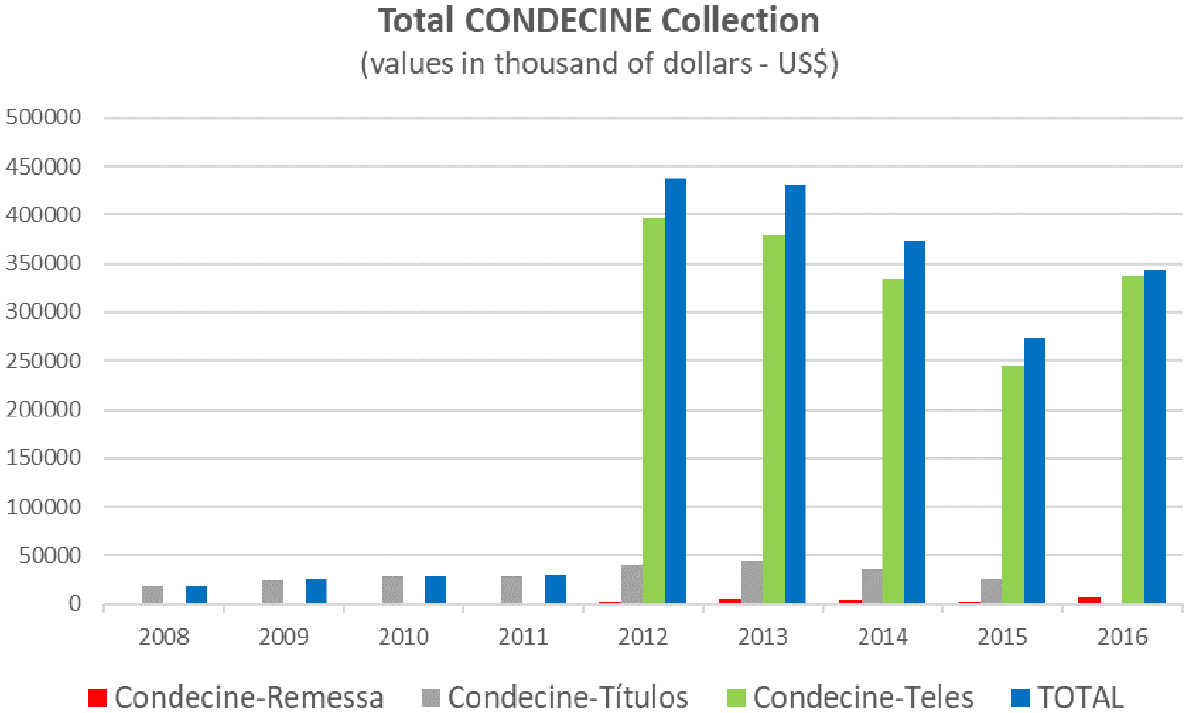
Total CONDECINE Collection (in thousands of dollars).
The introduction of the SeAC Law in 2012 also had an impact on CONDECINE categories already in existence since 2001 (Figure 1). In the case of CONDECINE Remessa, the growth in annual revenue can be attributed to the increased participation of foreign pay TV programmers in the domestic market. CONDECINE Remessa involves levying a tax of 11% on remittances abroad by foreign companies as a result of the exploitation of cinematographic and videographic works, for acquisition or import. Responsibility for collecting this tax lies with the Internal Revenue Service. Foreign companies that choose to invest 3% of remittances abroad in independent Brazilian productions are exempt from paying CONDECINE Remessa. For this reason, this mechanism is viewed within the industry as a kind of “tax blackmail” (Ikeda, 2015), with a logic similar to that of other indirect promotion mechanisms in operation in Brazil.
So far as investment is concerned, the Fundo Setorial do Audiovisual – FSA (Audiovisual Sector Fund) operates in all segments of the audiovisual industry. After commencing operation in 2008, the various FSA categories were upgraded in 2013, with the publication of the PRODAV Regulations – Program of Support for the Development of the Audiovisual Industry.
The lines of investment concentrate the largest volume of resources, as distributed by way of public calls for bids originally aimed at the cinema (PRODECINE), television and new media (PRODAV), and audiovisual infrastructure (PROINFRA) sectors. Based on the PRODAV Regulations, new categories were created to meet specific demands generated by the production sector and as a result of the improvement of audiovisual policy. Examples include: (1) public calls for bids for electronic games, in response to the growth of this sector in Brazil and the need for investment to professionalize the sector; (2) regional arrangements, through direct ties with federal entities, later named calls for co-investment; (3) public TV, with specific calls for bids in each region of the country, with less stringent selection rules in terms of the commercial performance of projects and their proponents; (4) international co-productions; and (5) lines of development that do not involve the delivery of a finished product, with investment concentrated in pre-production stages, such as research, script-writing, artistic production, and others. The last of these plays an especially important role in providing access for novice producers to bidding for public funding and in improving the quality of production, although the parameter, in this case, is a professional profile capable of meeting the requirements established by the market.
Figure 2 shows the overall quantity of FSA resources (in US dollars) used for public calls for bids from 2008 onward.

Resources applied by the FSA, 2008–2016.
Significant increases occurred in the number of resources allocated to investment lines between 2011 and 2012, the latter being the year the pay TV law came into effect, and between 2013 and 2014, with the consolidation of FSA funding lines for co-productions involving both independent production companies and TV programmers. The connection between pay TV screen quotas and the generation of CONDECINE Teles revenue in the telecommunications sector helps to explain the statistics presented in Figure 2. Around 70% of these resources were allocated to the production of feature films, TV content, and the creation of movie theaters (ANCINE, 2019).
ANCINE and FSA Management Committee report indicating that this combination of audiovisual policy mechanisms and other actions was responsible for a significant advance in the development and professionalization of the Brazilian audiovisual sector, emphasizing the benefits of independent production in Brazil. On a broader economic scale, it is significant that the sector increased its share of the total wealth produced by the country in terms of gross domestic product (GDP). The figure of around 0.45% of the national GDP surpasses that of industries of such major importance for the Brazilian economy such as the pharmaceutical and tourism sectors. Most of the increase in GDP provided by audiovisual companies in this period came from the open and pay TV markets (ANCINE, 2019).
Conclusions
The fundamental milestone in the entire process of transforming Brazilian independent audiovisual production into a markedly industrial-commercial activity was the creation of the National Film Agency (ANCINE). Set up as a state’s agency that simultaneously regulates and promotes the sector, its goals and objectives have been guided by economic and sociocultural principles that seemed, at least until 2016, to live in harmony with one another. In the case of economic principles, the agency encouraged the generation of employment, income, competitiveness, and innovation; and, in sociocultural terms, its actions accorded due value to Brazilian traditions, forms of expression, languages, and national identity. The effectiveness of its actions can be seen, to give just one example, in the increased frequency of Brazilian content on pay TV.
The data analysis presented here contributes to the field of communication policy studies and attempts to answer the following research question: Can Brazil’s innovative policy for fostering audiovisual production be considered well-consolidated, in terms of the structuring of an active chain of production? We have drawn on literature in the fields of the political economy of communication and media industries, as well as the process-tracing method, in particular the explaining-outcome process-tracing strategy.
The set of so-called “pieces of evidence” that provide information on the results for the Brazilian audiovisual sector between 2008 and 2016 can be summarized as follows: (i) a political context in Latin America that provided fertile ground for a debate regarding the regulatory mechanisms capable of reorganizing the processes of production and distribution of content, informed by criticism of the concentration of media; (ii) the already fairly well-established role that ANCINE plays in the process of institutionalization and operationalization of the measures employed to promote the sector; (iii) the launch of public calls for applications for Audiovisual Sector Fund (FSA); (iv) the introduction of the Conditional Access Service Law – SeAC – which has given rise to a significant increase in the registration of production companies, and in the number of certificates issued for independent productions; (v) the creation of CONDECINE Teles; and (vi) an increase in the volume of investment brought about by the improvement of the FSA.
There can be no doubt that these features have laid the groundwork for the structure which has helped Brazil to boost its audiovisual production and move beyond the paternalistic patterns that had traditionally characterized the sector. Before these reforms, poorly designed projects and fragile accountability were extremely common but were absorbed as public expenditures necessary for the protection of the arts and culture.
The “pieces of evidence” presented above illustrate that the combination of laws, specific public policies, new state agents, and exclusive financial funds, developed according to strict rules of conduct, have changed the environment in a highly positive manner. Between 2008 and 2016, Brazilian audiovisual production entered a phase of intensive development within the industrial-commercial logic of a market economy. With access to abundant financial resources, released following prior analysis and approval of projects, independent producers – who were the main beneficiaries of the policy – were forced by the demands of the market to explore alternative media. They expanded production from TV and cinema to games, internet content, and streaming, finding a niche for themselves within the culture of technological convergence, which alters the construction of content, suggests new demands coming from the consuming public, and imposes new forms of production and distribution, as part of the concept of multiple exhibition screens.
The increase in the industrial-commercial nature of the audiovisual industry has created a need to find new ways of reconciling artistic imagination, management, production, and distribution. This has generated a growing need, encouraged by ANCINE, for a greater degree of professionalization and coordination of the players involved. Institutional agents have also begun to demand, as a prerequisite for providing funding, that the various players involved – producers, distributors, broadcasters, and exhibitors – operate in such a way as to complement one another. In short, the product promotion strategy and policies adopted have sought to establish market autonomy and sustainability, as a way of uniting the various players involved.
The Agency has assumed that it should also create the conditions necessary for producers to compete in national and international markets. With projects for the sector, pre-established target audiences, and enhanced project governance, producers were helped to map the audiovisual market and to train players in business management skills. As they are not sufficiently well-trained in the fields of production and management processes, the Agency also encouraged them to improve their performance by producing consistent business plans, using high-quality information, and undergoing training to negotiate with financial institutions.
The other important goal was the geographical decentralization of production, and it had not been fully achieved. The intention was to bring about a significant increase in the creation or restructuring of small and medium-sized production companies located outside large urban centers. This would have resulted in a significant growth in the number of independent producers competing for public funding provided by ANCINE through the Audiovisual Sector Fund (FSA). This would also provide a robust way of supporting local and regional culture and developing a new economic sector in underdeveloped regions of the country. Some advances have occurred in this regard but they still fall far short of the desired results.
Despite its failure to achieve some key goals, the policy of promoting independent audiovisual production in Brazil has become an accepted feature of the government, providing specific financial support (by way of the Audiovisual Sector Fund, for example) and economic sustainability for the sector, and ensuring that the products thereby generated reach the screens. The conception of the operational model, the legislation, the formulation of the policy, and the structure of the state agencies responsible for regulation, supervision, and management of the promotion of audiovisual production were, from a political-economy perspective, a product of the power relations between the main categories of agent involved. This resulted in the inclusion of audiovisual production in the government’s economic plans as a sustainable, stable, essential industry.
Regardless of the ideological perspective of the new federal government in power, the independent production sector occupies a decisive position when thinking about the future and the survival of the Brazilian audiovisual policy, as well as its repercussion on the production chain. Firstly because of its high level of professionalization, presented in terms of comprehension of the production management and intellectual property; articulation and negotiation conditions with the exhibitor and distributor systems; education with universities; commercial and political representation through aggregation in class entities, among others features. And secondly because it involves numerous sections of government, thousands of producers, various TV networks and streaming channels, hundreds of movie theaters, and at least one important bank (the National Bank for Economic and Social Development), which is responsible for managing FSA funds. For both reasons it would be unthinkable that the whole process could be interrupted, even if the country is involved in a political crisis.
Although there is much to advance and the internal asymmetries of the sector must be considered, it is undeniable that the Brazilian independent production presents itself today in infinitely more solid conditions of movement in the audiovisual ecosystem, as well as with greater power of confrontation and claim together to the State. It has already demonstrated that it can survive in a hostile political scenario and that it will have the structure to adapt, reconfigure itself and develop in more positive scenarios.
This article is part of a research financed by Conselho Nacional de Desenvolvimento Científico e Tecnológico (CNPq) (Brazilian National Council for Scientific and Technological Development).
Footnotes
Author’s note
Research Fellow: Giulia Silva de Freitas, Bachelor Student - Federal University of Western Bahia (UFOB), Brazil.
Funding
The author(s) disclosed receipt of the following financial support for the research, authorship, and/or publication of this article: Conselho Nacional de Desenvolvimento Científico e Tecnológico (CNPq), Brazil.
