



Abstract
This article discusses the regulatory framework within which the television documentary production industry operates in France, and how public policies have created and then adapted a support system in response to the active agency of professionals. I give particular attention to the reform of the support system implemented between 2014 and 2017, which has privileged certain categories of non-fiction programmes and affected the patterns of production. I will look at the definition of quality criteria in documentary funding, focusing on the pivotal, though controversial, notion of ‘creative documentary’, and on the diverse approaches that inform French audiovisual policy. By focusing on policy interventions, the article will address the economic and political history of television documentary in France between 1986 and 2017.
Keywords
The French support system for television documentary
Documentary epitomises the values of French public television. As such, its production benefits from a special status, enabled by a strong regulatory framework, a comprehensive support system and the commitment from public service broadcasters. Financing for French documentaries has been mainly supplied by the state and broadcasters, with approximately 20% from the Centre national du cinéma et de l’image animée (CNC), and 50% from broadcasters over the past 10 years. Policy interventions have aimed at arbitrating tensions between professionals and broadcasters that have arisen when applying subjective quality-oriented rules for determining which projects are eligible for public funding, using a set of criteria that encompass formal experimentation, cultural and industrial values and the capacity of projects to transmit information and knowledge. These interventions have reshaped documentary production culture in France and have established different categories of works, beyond the traditional distinction between ‘journalistic’ programming and artistically ambitious films. It should be noted that in policy documents, the term ‘documentary’ (documentaire) also encompasses factual and non-fiction programmes.
French government policies have set a broad framework within which independent producers – those who have no direct financial links with broadcasters or conglomerates – operate, including an obligation for broadcasters to finance documentaries produced by independent companies. The interaction between producers’ organisations, broadcasters and policymakers has resulted in a complex and evolving support system, starting in 1986 with the launching of the Compte de soutien à l’industrie des programmes audiovisuels (COSIP), managed by the CNC. This mechanism has generated new economic conditions for television production, disconnecting this field from theatrical produced documentaries and resulting in an increasing number of programmes commissioned by broadcasters and produced by independent companies.
For example, in 2016, 2253 hours of television documentaries were granted financial support from the CNC, corresponding to 46% of the television programmes supported by this institution (CNC, 2017b: 43). This contribution amounted to 76.2 million euros (18.8% of total financing for television documentaries in the industry as a whole), a much higher figure than the 2.8 million euros granted by the CNC for producing theatrical documentaries and the 2.7 million euros allocated to the production of digital non-fictional content. It should nevertheless be noted that, as a result of the policy changes I discuss, which have aimed at excluding certain categories of factual programmes from public funding, the volume of supported hours has decreased regularly since 2013.
CNC financial support for television documentaries takes the form of automatic and selective funding and concerns both the development and production stages. Automatic funding is oriented to projects carried out by established independent companies having a regular activity and is aimed at ensuring the industry’s economic viability. In contrast, selective support is determined on the basis of quality, encompassing a wide range of aesthetic, cultural, social and industrial criteria that place the value of a project at the intersection between the economic and the symbolic. The implementation of this comprehensive approach provides the subtext of the current debates between producers, broadcasters and regulators. In particular, these debates address the difficulties in clearly distinguishing between documentary and other non-fictional forms that are not eligible for public funding, as well as the levels of financing granted to different categories of documentaries. Criticisms of the capacity of television documentary to hybridise with other forms, in particular with reality TV – which is regarded as a threat that jeopardises the generic integrity of documentaries – have come from scholars, professional organisations and individuals in the industry. On the other hand, broadcasters and audiences seem more open to accept journalistic and hybrid documentaries, including those which have entertainment as a core value.
French television and documentary
Since the late 1980s, television has been both the main financial source and the main showcase for documentaries in France. Data published by the CNC (2017b) for the year 2016 indicate that French television channels invested 204.6 million euros in the production of these programmes, corresponding to 50.5% of the total budget of television documentaries that benefited from public funds that year. As the main exhibition venue for documentary, the French terrestrial channels programmed 28,628 hours in 2016. The share of documentaries in all these channels was 16.3% of their entire programming, driven in particular by their strong presence in the private thematic channel RMC Découverte and the public channels ARTE and France 5. In contrast, French audiences only spent 10% of their viewing time watching programmes considered as documentaries (CNC, 2017b: 71). Despite the relative lack of audience interest, the presence of these programmes in French television underlines the dependence of documentaries on state support and can also be explained by their moderate cost for broadcasters.
The national public channels, mainly those of the France Télévisions Group (France 2, France 3, France 4, France 5 and France Ô), and ARTE France, commissioned 51% of the total documentary hours funded by the CNC in 2016 and provided 69% of all broadcasters’ financial contributions to the production of this genre. ARTE has commissioned the highest number of documentaries, with a total of 299 hours and an investment of 43.8 million euros in 2016. The public service’s commitment to documentary funding goes beyond legal obligations and is related to how these programmes coincide with its values and missions. The peculiarity of this service in France has been put forward by Waddick Doyle (2004: 74): Public broadcasting has tended to mean state broadcasting, and the state is the embodiment of the republic. In theory at least, the French republic is not only the protector of freedoms but also the body that forms its citizenry.
The television documentary production sector that has arisen within this regulatory framework is characterised by atomisation and bipolarisation. Since 2000, an annual average of 550 companies has produced documentaries with state support, for example, in 2016, 503 independent companies accessed CNC funding to produce 87.5% of television documentaries (CNC, 2017a: 55). Of these production companies, only about 15 are subsidiaries of television channels, notably Multimédia France Production, a subsidiary of France Télévisions, C Productions, owned by M6, and TF1 Production, a subsidiary of TF1. Some firms belong to audiovisual groups which own television channels, such as Lagardère or the AB Group. In general, companies linked to a television channel have a more regular production activity than independent companies, collaborating in the production of 15 hours of documentaries on average each year, as opposed to 4 hours for independent companies (Danard, 2013).
Alongside atomisation, another main feature of the documentary production sector in France is its bipolarisation between a large number of very small structures run by a single producer, without permanent staff – a proportion that has increased significantly between 2000 and 2013 – and a small number of large firms, with only a few middle-sized structures in between. These middle-sized firms, often run by two or more independent producers, facilitate the pooling of expertise and tend to be seen by commissioners as serious counterparts. Correspondingly, the activity of production companies varies widely. From 2012 to 2016, about 10% of the existing companies, often subsidiaries of news agencies and television channels with a track record in delivering formatted programmes, produced 50% of all the programmes funded as documentaries. Capa Presse is the leading producer, with 362 hours of programmes, ahead of TF1 Production (332 hours) and Morgane Production (298 hours). In contrast, 86% of companies produced less than 10 hours of documentary in 2016, with almost a third producing less than an hour (CNC, 2017a: 54).
This vast network of microenterprises has been seen to have favoured diversity and innovation in documentary production. Nevertheless, some institutional analyses have been critical with regard to the independent production ecosystem and the obligation for broadcasters to keep it alive. The Conseil supérieur de l’audiovisuel (CSA) points out a difficulty of this sector ‘to structure itself, to meet the expectations of increasingly demanding audiences, and to better export its programmes’ (2016: 5–6). This regulatory body has called for a simplification of the sophisticated norms governing the production of audiovisual works, which make their application complex. Moreover, a report on the future of France Télévisions (Schwartz, 2015: 23) argues that the dispersion that characterises the commissioning policy of the public broadcaster has generated a situation of economic dependence, since nearly half of the producers have France Télévisions as their sole customer.
However, declarations from public service managers bear witness to a commitment to documentary beyond legal obligations, emphasising the capacity of this genre to shape the identity of their channels. In a ‘Documentary Manifesto’ (France Télévisions, 2012), the directors in charge of documentary units in the public service proclaimed: The documentary genre is central to France Télévisions. Its presence is not a matter of quotas or constraints. It is at the heart of the very notion of public service, at the heart of creation. It is no coincidence that the private sector produces little or no documentaries.
2
These economic figures, and the discourses of broadcasters, thus seem to delineate a favourable balance for the industry and an optimistic outlook concerning the funding of documentary by television and its exposure in this medium. However, a controversy has arisen about the nature of the works, in particular the place of documentaries bearing distinctive voices, and not seeking to just entertain or inform. At the heart of the debates are the threats posed to freedom of creation, epitomised by the current marginalisation of ‘creative documentary’, the category that shows a clearer affiliation with the tradition of cinematic documentary, in particular the work of auteurs like Jean Epstein, Georges Rouquier, Chris Marker, Alain Resnais, Max Ophuls and Agnes Varda. These figures have strongly influenced the ‘new “French School”’, the generation of film-makers that enabled what Sophie Barreau-Brouste (2011: 18) and Michael Witt (2012: 11) consider a ‘documentary renaissance in the 1980s and 1990s’ and includes film-makers like Nicolas Philibert, Denis Gheerbrant, Claire Simon and Jean-Louis Comolli. The work of this generation was fuelled by the creation of La Sept (Société d’Edition des Programmes de Télévision) in 1986, confirmed and consolidated following the launch, in 1992, of the Franco-German channel ARTE (see Barreau-Brouste (2011: 38). The pivotal role of a small number of commissioning editors in the renewal of documentary which took place over the course of the 1990s, in particular Thierry Garrel, head of the documentary unit at La Sept and then at ARTE, has been central in the development of documentary tradition in France more as a televisual form than as a cinematic one. Despite this fact, the film-makers from this generation continue to make documentaries intended for theatrical release rather than for television.
A new generation of television documentary auteurs has emerged in the 2000s, including Yves Jeuland, Didier Cros, Jean-Robert Viallet and Jean-Xavier de Lestrade. Despite the production of considerable bodies of remarkable work, they struggle against the reduced risk-taking of commissioners due to increased financial pressures on broadcasters and the growing competition for audience share, which have led to a homogenisation of content (See Réseau des organisations du documentaire, 2011: 31). The frustration generated by the current situation has been trenchantly expressed by the producer Frank Eskenazi (2006), who, writing about the absence of ‘creative documentaries’ on television, stated that ‘this complex object, which relies only on a film-maker’s gaze, is no longer within the scope of what public broadcasters consider possible’.
The term most often used to express the power held by broadcasters, and the most contested by professionals, is ‘format’, which, as François Jost (2009: 49) rightly points out, is a concept in opposition to the logic of supply. According to Jost, the notion of format denotes the producer’s obligation to respect the specifications of a commissioned work, as much as the requirement to ensure the reproducibility or the serialisation of content. In a forum titled ‘France Télévisions must give more space to auteur documentaries’ (2015), almost 2000 professionals, grouped under the collective ‘Nous sommes le documentaire’ (‘We are documentary’), appealed to the Ministry of Culture and the CNC for a reorientation of the editorial policies of public broadcasters towards supporting creative forms of documentary and advocating for ‘rebuilding a public policy in favour of documentaries freed from television formatting’.
Since the beginning of the 21st century, the professionals’ rhetoric has denounced the strong dominance of television on documentary, seeking, first and foremost, to influence institutions to validate ‘another definition of the aesthetic and economic borders of the genre’ (Sauguet, 2007: 31). The most radical discourses go so far as to propose means of directly financing directors, without prior agreements with television channels or producers, that are considered as unnecessary gatekeepers. Nevertheless, the discord between documentary film-makers and broadcasters can be traced back to the late 1960s and early 1970s, when France’s intellectuals and film-makers started to emphasise their lack of esteem for television. Indeed, at the turn of the 1990s, during the period identified as ‘the golden age of documentary’, Susan Boyd-Bowman argued that ‘in France, the television documentary does not hold the same prestige as it does in the UK. The artistic impulse is almost always to deconstruct it’ (1990: 59).
It seems therefore legitimate to reconsider this mythic period from the mid-1980s to the 1990s: In comparison to the industry’s growth since 1995, the recognition of documentary by television during that era was limited to just a few titles made by a restricted number of directors, within the framework of an industry that was just beginning to structure itself. In an interview given in 2013, Serge Lalou, producer of more than 350 television and theatrical documentaries at the company Les films d’ici, questioned the existence of such a ‘golden age’ during which a virtuous television would have fiercely defended documentary creation, as opposed to a more conformist present. Even though Lalou acknowledged the increasing industrialisation of the process, he affirmed that ‘broadcasters are the only players who can maintain the current level of supply and diversity in documentary production’. This industrialisation has entailed both a degree of technical quality that surpasses that of most documentaries at the turn of the 1990s, as well as rules imposed by broadcasters with the aim to increase the audience for documentaries, such as requirements for voice-over narration, emphatic music and talking heads, which necessarily limit the film-makers’ creativity.
The processes and discourses of policy interventions in documentary
I will now discuss how French policy since 1986 has taken into consideration the agency of professionals and broadcasters through various schemes, enabling the development and growth of television documentaries in France. Previous articles have discussed recent documentary production and broadcast in France (Levine, 2015; Schmitt, 2002) and its financing (Pinto, 2011) considering both television and cinematic documentaries as interwoven fields. By focusing on policy interventions concerning the relations between producers and broadcasters and the support for production, my perspective considers television documentary as a separate sector. Policy has been designed to ‘correct’ the economic functioning of a sector that is situated between a market economy and a symbolic economy, despite the fact that the relations between the different professional actors are fundamentally market relations, with the inevitable confrontation between supply and demand.
The normative framework that regulates the relationship between producers and broadcasters and the support system for documentary has been built in three main stages. The first, between 1986 and 1995, was marked by the creation of the television channel La Sept-ARTE, the foundation of the COSIP and the emergence of the independent documentary production sector. The second stage, between 1995 and 2012, was characterised by the organisation of the professional field and the consolidation of an industry, both as consequences of the public policy put in place previously. Finally, the third phase began in 2012, with a consultation carried out by the CNC aimed at documentary professionals, that led to a reform of COSIP implemented in January 2015 in its first version and subsequently in June 2017 in a modified version. This reform revisits the determination of quality in documentaries, in order to concentrate public funding on a limited number of projects that are considered the most ambitious and creative according to a new set of criteria. I will now examine each of these periods of the economic and political history of documentary in France.
1986–1995: The reinvention of documentary
The 10 years following the creation in 1986 of the COSIP and La Sept (Société Européenne de Programmes de Télévision), a prefiguration of the Franco-German culturally oriented channel ARTE, was a period of hope, as well as misunderstandings between broadcasters and documentary professionals. As mentioned earlier, many professionals and analysts consider this as a ‘golden age’, in which an emerging network of independent producers was able to access newly established funding to produce auteur documentaries with the complicity of broadcasters. Indeed, this period is characterised by the boldness of a television that invents the notion of ‘creative documentary’ and the willingness of a public policy that enabled the structuring of the sector.
The slogan used by La Sept-ARTE in the late 1980s, ‘Le documentaire, c’est la télévision même’ (‘Documentary is television itself’), foreshadowed the triumphant entry of the genre into this medium and helped to stress its cultural and educational missions, while at the same time, broadening its aesthetic horizon. The concept of ‘creative documentary’ appears in this unprecedented context, in which Françoise Berdot sees the emergence of an ‘auteur television’ where documentary facilitated ‘the possibility to resist single thought, the stereotypes that ordinary television has created in the representation of reality’ (2003: 9). Emancipated from formats and audience shares, and moving away from journalistic practices and the primacy of the subject, documentary opened itself to formal experimentation. Moreover, it embraced the legacy of cinema and of militant practices developed by the political film-making collectives that emerged in the wake of May 1968, such as Cinélutte, Les Films du Grain de Sable, Les Films du Village or Ardèche Images. But alongside this momentum, a dependency between documentary and television began to develop, arising from the unequal balance of power between producers and broadcasters.
French public policy in the field of television documentary, considered as a cultural sector, has always been legitimised by the principle of the cultural exception, according to which output cannot be subject to the rules of free trade and investment. In practice, public intervention has been materialised mainly through the COSIP, financed by a tax levied on the revenues of broadcasters that represents a maximum of 5.5% of their turnover. These resources are then redistributed to producers, which in turn encourage broadcasters to commission new works eligible for COSIP, since in return for their contribution to the scheme, the commissioned productions will receive public financing, that enables them to recover part of the forced savings that the tax constitutes (Picard, 1999: 91). The setting up of the COSIP thus placed the broadcaster at the centre of documentary financing and generated an increase in the volume of produced works.
In order to delimit the television documentaries that can be financed with public funds and those that are not eligible, policymakers have turned to the notion of quality. This concept was at the centre of the debates that led to creation of the ‘Advance on receipts’ (Avance sur recettes) in 1959, aimed at providing state support to films corresponding to the criteria of cinematographic quality shared by French socio-professional decision makers (Gimello-Mesplomb, 2003). Nevertheless, the definition of quality in television documentary raised new questions, since, in contrast to fiction film, the genre does not rely on a star system of directors nor has been primarily intended to be an element of French cultural diplomacy, used to strengthen the country’s influence in the international cultural arena. Even if television has been central in the practice and the defence of ‘creative documentary’, the film-makers working for this medium do not benefit from the prestige ascribed to those that are produced for theatrical release. The separation imposed by the French policy system thus contributes to the establishing of two distinct economies and production cultures.
In an article about the assessment of originality in television, Dominique Pasquier (2008: 178) argues that neither the subject, the length, the budget, the reputation of the professionals involved nor the success with the public are satisfactory criteria for defining the quality of a programme. Moreover, these criteria change both over time and with the evolution of television formats, so that certain categories, initially clearly defined, may become blurred or obsolete. In particular, this has occurred with the notion of ‘creative documentary’, which was the first conceptual attempt to delimit the field of programmes that deserved public support, positioning this category as a distinctive form of non-fiction which excludes other ways of recording and representing the real. The main distinctiveness of ‘creative documentary’ includes the signature of an auteur and the aesthetic and formal ambition of works, seen as the elements most likely to warrant the label. Indeed, the traditional commitment of documentary to civic improvement, its social utility or its political character are not mentioned as elements contributing to make ‘creative documentary’ a distinct form, since these features are shared by other non-fiction forms. In 1987, the Commission nationale de la communication et des libertés, the regulatory body that preceded the CSA, proposed the following definition: Creative documentary refers to reality, transforms it by the original viewpoint of its auteur, thus reflecting an innovative spirit in its conception, realization and writing. It differs from reportage by the maturation of the subject and the deep reflection and the strong imprint of the personality of a filmmaker and/or author. To accompany filmmakers and producers of cinematographic and television creative documentaries that require elaborate writing, an important development work and propose an innovative approach with regard to audiovisual programmes. (CNC, 2017c)
1995–2012: Managing hyper-abundance and extending the perimeter of support
The period from 1995 to 2012 was characterised by the industrialisation of the sector, with a consistent increase in the number of channels commissioning documentary, the number of independent production companies and the volume of production, which doubled between 1994 and 1995. This growth was abetted by a shift to an industrialised mass production and a decrease in the cost of production and post-production, which in turn reduced the average hourly cost of documentaries from 225,000 euros in 1994 to 150,000 euros in 2012. Furthermore, by the end of this period, policymakers took into consideration new hybrid forms of documentaries and set up instruments for financing transmedia and interactive online documentaries, specifically the fund to support projects intended for new media in 2007, and the Web COSIP in 2011.
Since the end of the 1990s, production has been stimulated by the launching of new television channels, notably La Cinquième in 1994, which became France 5 in 2002, as well as a number of cable and satellite thematic channels (see Figure 1). In addition, several local and regional channels began to coproduce or pre-purchase documentaries, providing significant margins of freedom to film-makers, despite their precarious economy.
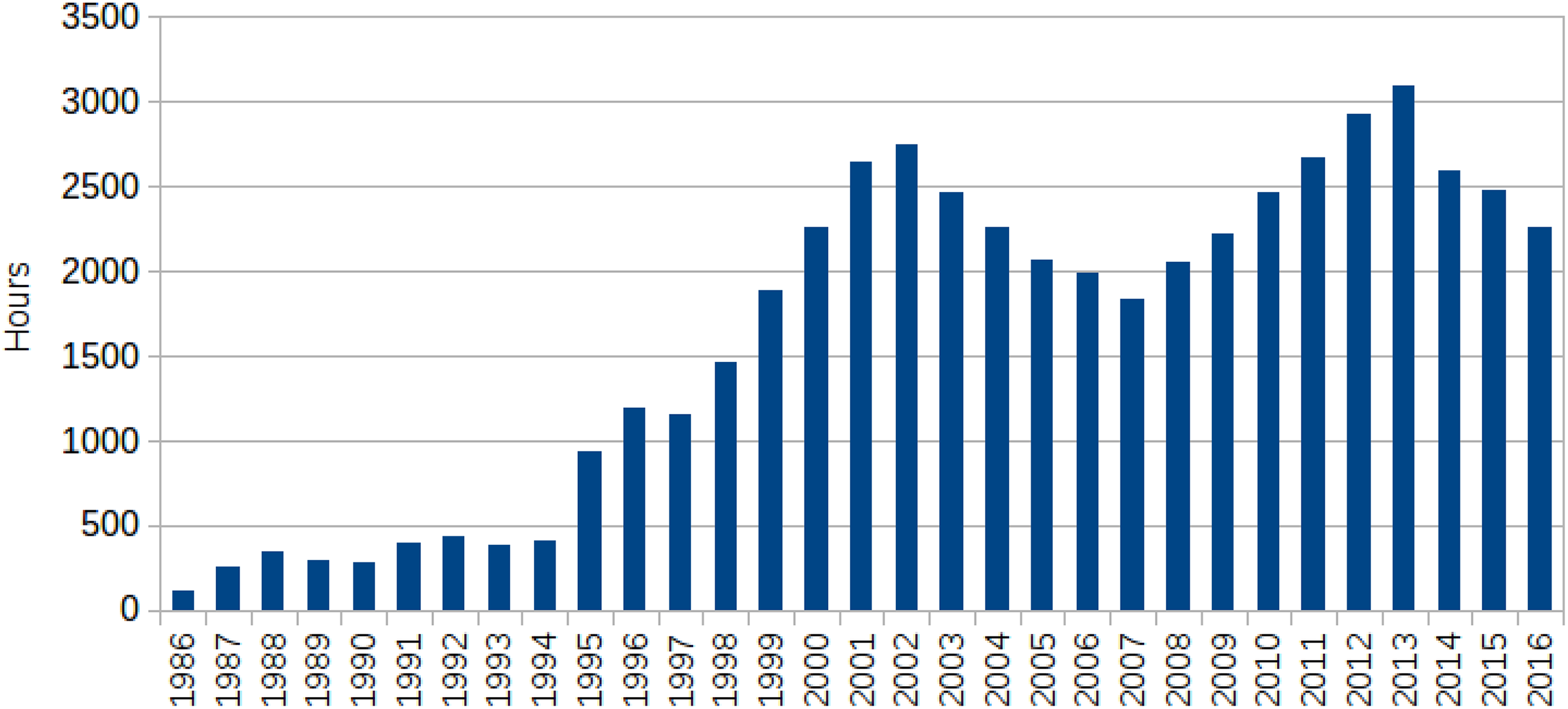
Evolution of the number of documentary hours supported by the CNC (1986–2016). Source: CNC. CNC: Centre national du cinéma et de l’image animée.
The multiplication of channels induced an expansion of the documentary industry, in particular marked by the arrival of producers of non-fiction programmes which did not show an affiliation with the tradition of ‘creative documentary’. The fact that the reality show Popstars in 2001 was placed in the ‘audiovisual works’ category, thereby providing its producer with access to the COSIP financing, and enabling the programme to be incorporated by the CSA into its calculation of quotas, sounded the alarm about the scope of intervention of the support policy. A report commissioned by the Minister of Culture to David Kessler, director of the CNC, stated that the controversy generated by the categorisation of Popstars as an ‘audiovisual work’ symptomised a drift of the COSIP interventions and proposed to re-examine the objectives of this mechanism as well as that of broadcasting quotas (Kessler, 2002).
The favourable policy framework and the multiplication of outlets for documentaries encouraged growth in the supply of works, which overtook the increasing demand from television channels. This imbalance empowered broadcasters to be increasingly selective according to their programming needs and editorial policies. Their choices encouraged the objective of expanding the audience of documentary programmes beyond intellectual and cinephile targets and favoured programmes likely to fit within a logic of time slots intended to give viewers a regular schedule aimed at increasing audience loyalty. Overall, both the hyper-abundance of the supply and the dynamics of selectivity implemented by broadcasters combined to reinforce the industrial dimension of documentary production.
Besides the inflationary effects of the support policy, other factors contributed to the broadening of supply, including the democratisation of access to shooting and post-production technologies, the proliferation of documentary-related courses by universities and by professional training organisations and the symbolic recognition of the genre in festivals and, more recently, in movie theatres. It might be noted, however, that the connections between festival and theatrical documentary, on the one side and television, on the other side, remain weak, one reason being that in order to access public funds, producers have to choose from the beginning of the production process whether a project is financed as an audiovisual or as a cinematographic documentary, considered as distinct categories. Furthermore, according to the French exploitation rule known as ‘chronologie des medias’, cinematographic documentaries must respect a mandated delay between the theatrical release and their first broadcast on television.
Post-2012: The reform of the COSIP
The third phase in the history of the policy intervention in documentary began in 2012 with the arrival of six new private digital terrestrial television channels – exacerbating the drifts noted in the previous section – and the presentation of a report to the Minister of Culture (Gordey et al., 2012), which laid the foundation for the adaptation of the financial support to documentary rules by the CNC in 2014.
This report pointed out some of the issues discussed earlier, notably the trend towards hybridisation and formatting of documentaries, that were consequences of increasing production and the evolution of broadcasters’ editorial strategies towards more factual content likely to get larger audiences. The authors of the report argued that this situation contributed to a gradual weakening of the position of film-makers and producers. While they did not deny the existence and the importance of new forms of documentary, they did advocate the preservation of the diversity of forms and the establishment of more favourable funding conditions for the most ambitious ones. Finally, the report proposed to formulate a grid of objective criteria for assessing the different types of documentary forms, while rejecting the reopening of a debate on defining ‘creative documentary’. This notwithstanding, Christophe Tardieu, Deputy Managing Director of the CNC (quoted in Ekchajzer, 2015), made reference to this notion when he summarised the initial objectives of the reform as ‘to support creative documentaries more strongly, by allocating part of the aid currently granted to non-documentary programmes, or to documentaries borrowing from the codes of the reportage or the magazine’.
At the end of the reform process, the adjustments in the support system were intended to increase public funding for the most exportable categories of works, including historical, scientific and art documentaries, as well as to encourage the search for international funding. A new set of industrial criteria was therefore juxtaposed to the existing aesthetic and formal canon. A press release from CNC (2013), at the occasion of the annual Sunny Side of the Doc documentary market in La Rochelle (an event that has provided opportunities for exchange and institutional announcements in recent years), specified the nature of the new ‘industrial’ criteria introduced by the reform, thus the development efforts made by the production company, the time required to make the documentary, the time devoted to editing and post-production and the share of international funding in the financial plan. It was also in the framework of this event that a selective committee composed of producers, directors and broadcasters, set up by the COSIP reform, expressed its views on issues under its responsibility. These include deciding which programmes could be labelled ‘documentaries’, which documentaries qualify for a financial bonus and what should be the modalities to finance films that have minimal or no cash contributions from a broadcaster, meaning that they can no longer claim automatic support and therefore must rely on selective support granted by this committee.
The implementation of the COSIP reform in January 2015 succeeded in removing from the support system a number of reality shows which claimed to belong to the documentary genre, a consequence that did not raise protests from any professional association. In contrast, the decision to grant producers of journalistic documentaries a lower level of financial aid than that granted to producers of historical and scientific works raised a number of protests. During the Sunny Side of the Doc, the SATEV (2015), the organisation that regroups the audiovisual news agencies, including most of the production companies excluded from the bonus allocation rule, announced that it would file an appeal to the Conseil d’Etat, after unsuccessfully requesting the CNC to suppress the reference which states that ‘creative documentaries borrowing from the codes of reportage or magazine cannot claim any bonus’. In order to find a consensus solution, the CNC entrusted a fact-finding mission to Yves Jeanneau (2016), the director of the Sunny Side of the Doc and former producer and co-founder, with Richard Copans, of the company Les films d’ici, the largest producer of ‘creative documentary’ in France. In presenting the mission’s objectives, Frédérique Bredin, President of the CNC, acknowledged that ‘because of their borrowing from the codes of the reportage and the magazine, some ambitious investigation documentaries are less supported since the reform’. The CNC requested that the mission propose a set of criteria for assessing the ambition of this kind of programmes, as well as standards for taking into account ‘innovative forms of documentary’, defined as those which result either from the encounter with digital culture or from a hybridisation with fiction, video games or serial forms.
In November 2016, the report by Yves Jeanneau presented the criteria to define documentary ‘in its most varied forms’, as well as ways to favour ‘heritage, creative and innovative characteristics and export potential’. To satisfy Bredin’s request that the state intervention in documentary should be more consensual, the report proposed a very inclusive generic definition that avoided the expression ‘creative documentary’ and which was very much inspired by definitions formulated by Jean Vigo and John Grierson in the past: A documentary implies an original view, a documented point of view, an intellectual construct elaborated on the basis of a long and articulate inquiry, that is to say, a time of writing, documentation and preparation.
The most recent adjustments to the documentary support reform were implemented by the CNC in June 2017. They aim at taking into account ‘the editorial and artistic quality of the works’, through artistic criteria (writing and development, music, and the time devoted to production and editing), as well as economic indicators (diversity of sources of financing, international presales and sales signed within 3 months of the completion of the work). Finally, the reform adds documentaries on art to the two categories that already were eligible for the system of bonuses (historical and scientific works). These three categories are expected to improve the position of French television documentary in the global marketplace, in an attempt to allow more cosmopolitan approaches to supersede the parochial taste often evidenced in current affairs documentaries addressing national audiences.
Since its first version in 2014, the reform of the support system for television documentary has resulted in a decrease in the number of projects supported by public funds, mainly due to the introduction of precise economic and industrial criteria in the new definition of quality. Production of television documentaries supported by the COSIP has decreased by 9.1% in 2016, compared to 2015, while the average hourly cost in the same period has increased in the same proportion. Foreign investment has also increased, representing 7.6% of the overall budget of documentary programmes, originating mainly from presales (against 4.8% in 2015). The reform has also increased the threshold of public support from 50% to 80% of the total budget of ‘difficult documentaries’ defined as those with a broadcaster contribution of less than 12,000 euros/hour, which concerns mainly works commissioned by local and regional channels. This category has appeared for the first time in the policy discourse, giving rise to specific measures that allow works without significant financing from a broadcaster to access selective grants, even though they can no longer access automatic aids.
Conclusion
Over the last 30 years, television documentary in France has been the object of a proactive and concerted public policy, which has led to the emergence of a structured sector. At the same time, the arrival of new players and industrial transformations has changed the production culture and practices, marked by a diminishing willingness to take risks by broadcasters faced with increasing pressure to get audiences. Nevertheless, the very active agency of producers and film-makers has succeeded to induce policy interventions to arbitrate demands that reflect diverse sensitivities and interests.
The shifting modalities of the public intervention in documentary in France that I have discussed might be seen as reflecting an ongoing debate about the criteria to define quality, a term which, as Jost (2014: 11) states, ‘is not a constituent property of cultural goods, but the affixing of a norm’. In the field of French television documentary, this norm is particularly unstable, being constantly negotiated between professional organisations, broadcasters and state institutions, and based on often incompatible aesthetic and industrial criteria.
While the place of the documentary in television is quantitatively significant, the genre is torn between two visions that seek to influence the editorial policies of broadcasters and to guide policy choices, which might be summarised as an auteuristic vision and a citizenly one. Although these two visions are not mutually exclusive, they naturally generate divisions and give rise to lobbying actions by different professional groups to see their interests taken into account by audiovisual policy. The auteuristic vision defends an important place for personal voices, and a capacity of accounting for the complexity of the world and the human being, without trying to reproduce reality. The most emblematic slot for this type of documentaries remains La Lucarne at ARTE, introduced in 1997 and overseen by the Swiss producer-director Luciano Rigolini for almost 20 years and by the cosmopolitan independent film and visual arts curator Rasha Salti since April 2017.
In contrast, the citizenly vision emphasises documentary as belonging to the media industry, and its capacity to help understand and analyse reality, assigning documentary a central role in social cohesion and in giving meaning to the country’s debates about current issues and historical events, thus meeting the values and stakes of the public broadcasting service. These programmes are more likely to fulfil the commissioners’ expectations regarding the increasing pressures to fund factual programmes as being best suited to getting good audience ratings. For example, the proportion of French television viewers who watch some ARTE documentaries belonging to this category has more than doubled the channel’s annual share, which is currently 2.3%. Cholestérol, le grand bluff, Un tour du monde à vol d’oiseau and Daech, naissance d’un Etat terroriste, broadcast by this channel in prime time during 2016, have reached nearly 1.5 million viewers each, with an audience share of over 5%, according to the data provided by Médiamétrie-Médiamat. Overall, the highest audiences for television documentaries in France in 2016 were achieved by two formatted series broadcast on France 2. Two episodes of Rendez-vous en terre inconnue, a programme in which a French celebrity is taken to an unknown destination to live with an ethnic minority for 2 weeks, were watched by 5.9 and 5.4 million viewers respectively, gathering 22.5% and 20.8% of the audience, when the average annual audience share of France 2 was 13.4%. They were followed by Apocalypse Verdun, an output of the Apocalypse series, that attracted 4.4 million viewers (with a 16.6% audience share). Like its predecessors in the Apocalypse series, the programme uses colourised archive footage to commemorate the centenary of one of the bloodiest battles of World War I.
Both the auteuristic and the citizenly works are henceforth included in the category of ‘creative documentary’, a notion that has proven imprecise and changing over the years, thus raising questions concerning its capacity to epitomise quality. Moreover, this notion has shown difficulties in adapting to a television culture more interested in illuminating the world rather than in facilitating formal experimentation, which has led some analysts to foresee a chance for a new era of ‘creative documentary’ in movie theatres or on the web, perceived as spaces of creativity without formatting constraints. However, few documentaries achieve considerable profits in theatres, and there is not yet an economic model for web documentaries, at least not one comparable to the complex and efficient architecture that exists for television documentaries.
In this context, public policy continues to focus mainly on the financing of television documentary and the regulation of the relationship between broadcasting and the large industrial ecosystem developed around this medium. Since 1986, in the name of cultural exception (and later of cultural diversity), political choices have favoured an abundance of supply, which paradoxically led to a standardisation of content and empowered broadcasters in their role of gatekeepers. The latest reform of the support system sought therefore to define quality in a context of industrialised mass production. Its first objective has been to identify the works that are eligible for public funding, leaving reality shows that cannot be considered as documentaries outside the aid system. The second objective of the reform has been to map out a subcategory of programmes within the eligible projects, encompassing documentaries on history, science and the arts, that is likely to benefit from extra support on the basis of a series of aesthetic and industrial criteria. Finally, changes in policy have also aimed at preserving some spaces inside the system likely to warrant formal innovation and the emergence of new voices by granting selective funding, even though some actors consider this effort insufficient.
State institutions in France have proven their willingness to maintain an open dialogue with all the parties involved in documentary production, even if the materialisation of the exchanges in policy texts and tools has exposed the difficulty of reconciling contradictory approaches. The regulatory framework relies on the centrality of broadcasters, who, in addition to the financing of the COSIP, provide half of the funding for independent documentary producers. Their central position is not contested by policymakers, who rather seek to arbitrate the tensions that arise in the context of the unequal power relationship between broadcasters and producers. Moreover, to a lesser extent, policy initiatives aim to ensure conditions that favour the emergence of new categories of programmes, including those from the margins of the industry that do not correspond to the broadcasters’ demand, as well as new hybrid forms that challenge both aesthetic and administrative criteria.
Footnotes
Declaration of Conflicting Interests
The author(s) declared no potential conflicts of interest with respect to the research, authorship, and/or publication of this article.
Funding
The author(s) received no financial support for the research, authorship, and/or publication of this article.