



Abstract
This umbrella review aimed to examine and synthesize qualitative studies that explored the barriers and facilitators of advance care planning for persons with dementia, their families, and their healthcare professionals and caregivers. The modified umbrella review approach developed by the Joanna Briggs Institute was followed. Five major English databases were searched. Four reviews based on 38 primary qualitative studies were included. The methodological quality of the included reviews was moderate to high. The synthesis yielded 16 descriptive themes and five analytical themes: making the wishes/preferences of persons with dementia visible; constructive collaboration based on stakeholders having positive relationships; emotional chaos in facing end-of-life substitute decision-making; initiating the advance care planning process; and preparedness and commitment of healthcare providers to advance care planning. Comprehensive and workable strategies are required to overcome complex and interrelated barriers involving not only healthcare professionals but also organizational and systemic challenges.
Introduction
Advance care planning is an essential aspect of contemporary end-of-life care that involves a continuous process of decision-making about an individual’s future healthcare preferences. The goal of advance care planning is to “help ensure that people receive medical care that is consistent with their values, goals and preferences during serious and chronic illness” (Sudore et al., 2017, p. 821). Advance care planning aims to respect the autonomy of individual patients and improve their quality of life and relationships with family and healthcare providers, while preparing for end-of-life (Fleuren et al., 2020).
The implementation of advance care planning can improve various end-of-life outcomes. Advance care planning with “do-not-resuscitate” and “do-not-hospitalize” orders can decrease life-prolonging treatment (Brinkman-Stoppelenburg et al., 2014; Lim et al., 2016), reduce unnecessary hospitalization (Chambers et al., 2023), facilitate dying in the preferred place (Jimenez et al., 2018), and diminish the family burden for difficult end-of-life decision-making (McMahan et al., 2021).
Advance care planning can benefit both people with and without dementia (Jimenez et al., 2018; Mountford et al., 2020). For older people with dementia and their families, advance care planning can be problematic owing to the decline in cognitive capacity during the illness trajectory of dementia. However, healthcare professionals often experience barriers to initiate such a process of communication with persons with dementia (De Vleminck et al., 2014). Difficult surrogate decision-making on behalf of persons with dementia often becomes the family’s responsibility (Kermel Schiffman & Werner, 2021).
Several reviews of advance care planning for people with dementia have been published in recent years. However, a large portion of such review articles are narrative or scoping reviews by nature. Such types of reviews can only provide an overview of the literature, limiting the confidence of the result as evidence to be used in healthcare practice. Relatively few high-quality quantitative studies are reported in such reviews (Piers et al., 2018). One possible reason is the highly sensitive nature of advance care planning for persons with dementia, and the difficulty in conducting randomized controlled trials or other rigorous study designs with persons with dementia. Consequently, review approaches such as scoping, narrative, or integrative reviews have been preferred over the standard systematic review approach (Aromataris & Munn, 2020; Page et al., 2021; The Cochrane Collaboration, 2021).
Following the rapid growth of review studies, review of reviews or umbrella reviews have recently been published to summarize the increasing evidence from review articles on advance care planning (Jimenez et al., 2018; Poveda-Moral et al., 2021). Although the reviews by Jimenez et al. (2018) and Poveda-Moral et al. (2021) provided useful information for healthcare professionals, the scope was broad and not limited to persons with dementia. A more focused umbrella review is required to articulate the evidence promoting advance care planning for older persons with dementia.
Another umbrella review by Wendrich-van Dael and colleagues (2020) targeted reviews and primary research articles specifically addressing persons with dementia. They found that advance care planning is effective in various end-of-life outcomes, such as reduced hospitalizations and meeting the wishes and/or preferences of persons with dementia. The review further synthesized studies on the experiences, barriers, and facilitators of advance care planning in persons with dementia and identified issues related to the timing of advance care planning and the willingness of stakeholders to engage. Notably the synthesis relating to facilitators and barriers was based on a mix of quantitative, qualitative, and mixed methods evidenced from a search that was conducted in September 2018.
To date, no umbrella review has specifically examined and synthesized qualitative reviews regarding the barriers to and facilitators of advance care planning experienced by older persons with dementia, their families, or healthcare professionals.
Aim
This umbrella review examined and synthesized qualitative reviews that explored the barriers to and professionals and caregivers. We elucidated stakeholders’ perspectives and experiences as well as the subtle nuances regarding such barriers and facilitators.
Stakeholders in this review are persons with dementia, family members, and healthcare personnel (i.e., physicians, nurses, psychologists, social workers, and others involved in the process of advance care planning).
Methods
The Joanna Briggs Institute (JBI) umbrella review method (Aromataris et al., 2020) was utilized. This approach aims to develop a summary of existing evidence for many review articles. However, we anticipated including a smaller number of reviews targeting qualitative studies. Therefore, the thematic synthesis method (Thomas & Harden, 2008) was adopted at the data synthesis stage to enable thorough coding of the data to capture highly subjective aspects and subtle nuances embedded in the experiences and perspectives of the stakeholders. The review process complied with the PRISMA guidelines (Page et al., 2021).
Selection Criteria
This study considered reviews of primary qualitative studies reporting on the barriers to or facilitators of advance care planning for persons with dementia, their families, and healthcare professionals. The current approach to advance care planning emphasizes continuous stakeholder engagement and communication about treatment and care decisions (Piers et al., 2018). While planning the review, it became clear that recent umbrella reviews of advance care planning—for instance, Jimenez et al. (2018) and Wendrich-van Dael et al. (2020)—included surrogate/family decision-making in their reviews. In a recently published study on the definition of advance care planning in 33 countries, in the case of dementia, advance care planning was defined as a communication process adapted to capacity and continued with family (van der Steen et al., 2023). Therefore, surrogate decision-makers were included in the review.
There were no restrictions on the clinical setting, geographical location, or type of dementia. For inclusion, a search of multiple databases and critical appraisal of the included primary studies conducted by at least two independent reviewers using a standardized assessment tool were also required.
Further, the use of explicit qualitative synthesis methods (e.g., thematic synthesis, meta-aggregation, meta-ethnography) was another criterion. Integrative and narrative reviews were not the primary focus of this review. Such reviews were only considered if the synthesis of the primary qualitative studies could be separately extracted. Mixed methods reviews were considered if the synthesis of primary qualitative studies could be separately extracted.
Literature Search
The database search was conducted using PubMed, Embase (OVID), CINAHL (EBSCO), PsycINFO (OVID), Web of Science, JBI Evidence Synthesis, and the Cochrane Database of Systematic Reviews. The reference lists of the included reviews were also scanned. Studies published between 2000 and November 2022 were included. For the detailed search strategy, please refer to Supplementary Material 1.
Selection Process
All search results were exported to EndNote X10 (Clarivate Analytics, PA, USA), and duplicates were removed. Two independent reviewers scanned the citations to identify eligible reviews. Full texts were retrieved based on relevance of the title and abstract and appraised against the inclusion criteria.
Quality Assessments
RK and KM independently assessed the methodological quality of the eligible reviews using the JBI assessment checklist for systematic reviews (Aromataris et al., 2020). Disagreements were resolved by a third reviewer (KI).
Data Collection
List of Primary Studies Included in Each Review.

GP: General Practitioner, NH: nursing home, residential aged care facilities, NS: Not specified, FC: family caregivers, AD: Alzheimer’s disease, NL: Netherlands, USA: United States of America, UK: United Kingdom, AU: Australia, SD: Sweden, CA: Canada, GB-NIR: Northern Ireland, IRE: Ireland, BE: Belgium, SG: Singapore, GER: Germany, ES: Spain.
Data Analysis
There is no widely accepted consensus regarding the best qualitative synthesis method to use in an umbrella review. As the project intended to conduct a qualitative synthesis congruent with the interpretive tradition of current qualitative research, thematic synthesis (Thomas & Harden, 2008) was chosen. Thematic synthesis involves three stages: (1) line-by-line coding, (2) generating descriptive themes, and (3) constructing analytical themes. Through the synthesis process, a comparative analysis was performed to code and generate descriptive and analytical themes. According to Thomas and Harden (2008), analytical themes tend to transcend the summary of findings from the included studies to generate an interpretive explanation of the phenomena.
First, the results of each review were pasted into Excel. Initial line-by-line coding was conducted to extract data related to barriers to and facilitators of advance care planning for each review. Then, the data were collated, and line-by-line coding (Cruzes & Dybå, 2011) was conducted for each review. These codes were then compared to generate descriptive themes, which were further synthesized into analytical themes. The thematic synthesis approach allows flexibility in coding (Maguire & Delahunt, 2017) and synthesis so that higher-order concepts and/or themes can be constructed with rich insight and contextual qualitative data. The synthesis was revised repeatedly until the end of manuscript development.
Results
A detailed selection process is presented in the PRISMA flow diagram (Figure 1). The database search yielded 459 records (Supplementary Material 1). After removing duplicates, the titles and abstracts of 348 citations were screened, and 299 were excluded. Of the remaining 49 citations, 17 were excluded as irrelevant, and 32 full texts were retrieved. Of these 32 studies, 28 were excluded for not meeting the inclusion criteria; for example, lack of assessment of the methodological quality of the included primary studies (n = 12), non-qualitative reviews (e.g., effectiveness reviews; n = 7), and other reasons (Supplemental Material 2). Four eligible reviews met our inclusion criteria (Cresp et al., 2020; Petriwskyj et al., 2014; Ryan et al., 2017; Tilburgs et al., 2018). No relevant studies were identified by other means, such as reference list of included studies or snowball searching. The four reviews were based on 38 primary qualitative studies. Study selection process. PRISMA 2020 flow diagram for new systematic reviews which included searches of databases, registers, and other sources.
Quality of Included Reviews
Result of Critical Appraisal.
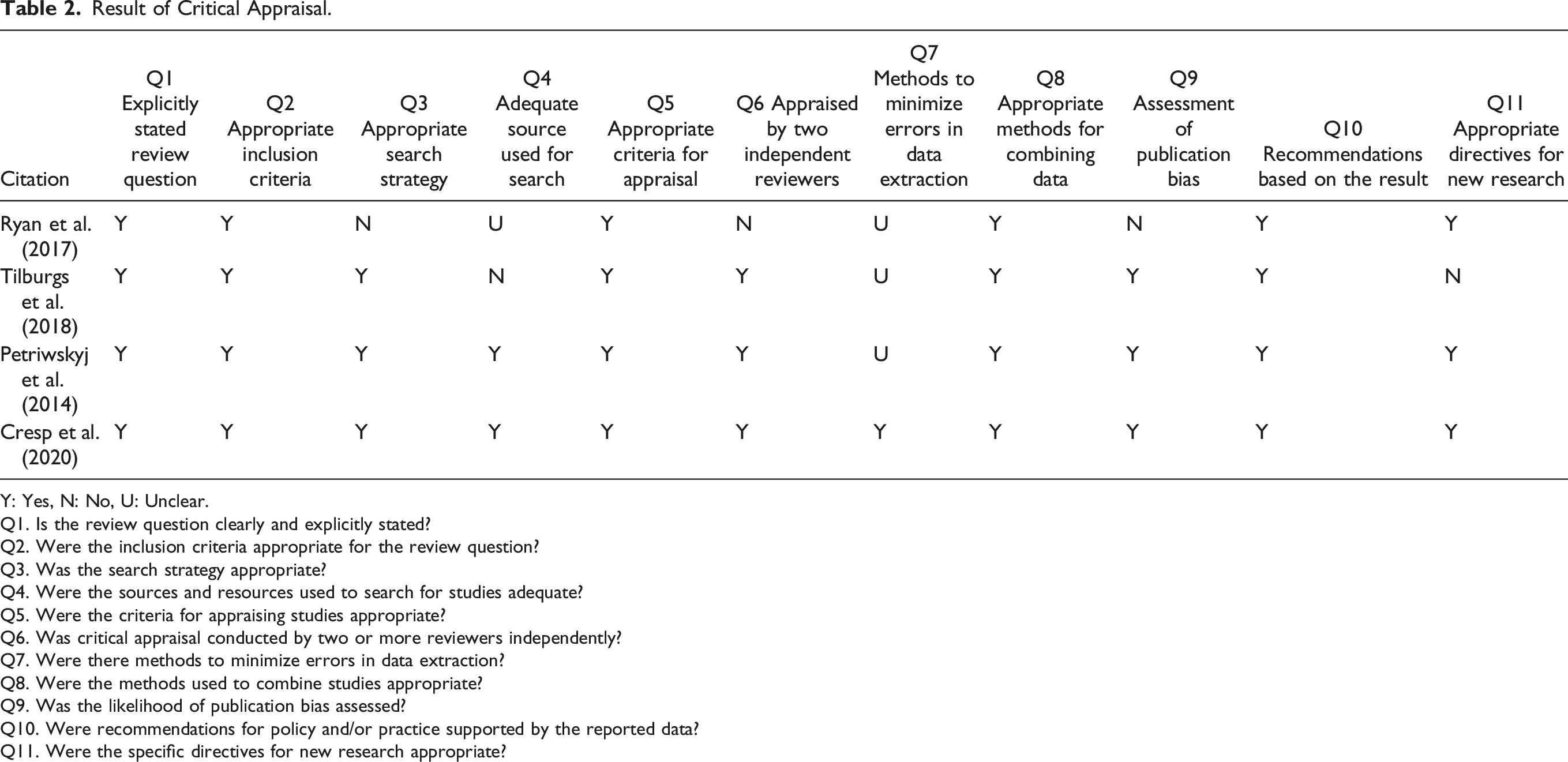
Y: Yes, N: No, U: Unclear.
Q1. Is the review question clearly and explicitly stated?
Q2. Were the inclusion criteria appropriate for the review question?
Q3. Was the search strategy appropriate?
Q4. Were the sources and resources used to search for studies adequate?
Q5. Were the criteria for appraising studies appropriate?
Q6. Was critical appraisal conducted by two or more reviewers independently?
Q7. Were there methods to minimize errors in data extraction?
Q8. Were the methods used to combine studies appropriate?
Q9. Was the likelihood of publication bias assessed?
Q10. Were recommendations for policy and/or practice supported by the reported data?
Q11. Were the specific directives for new research appropriate?
Only one review (Cresp et al., 2020) explicitly reported the method used to minimize errors in extracting data. Only two reviews met the criteria for the adequate searching. Ryan et al. (2017) searched only PubMed and PubMed Health, and another review (Tilburgs et al., 2018) did not search for gray literature. One review (Tilburgs et al., 2018) failed to provide explicit suggestions for future research and one review (Ryan et al., 2017) did not discuss possible publication bias. Petriwskyj et al. (2014) only failed one criterion about minimizing errors in extracting data.
To assess the methodological quality of the primary studies, two reviews used the JBI checklist (Cresp et al., 2020; Petriwskyj et al., 2014), while others used the consolidated criteria for reporting qualitative research (Ryan et al., 2017) and the Mixed Methods Appraisal Tool (Tilburgs et al., 2018). Quality of included primary studies in the reviews was described as low to moderate (Tilburgs et al., 2018), moderate to high (Cresp et al., 2020). Ryan et al. (2017) did not present the quality appraisal scores of the included studies.
Characteristics of Included Reviews
Characteristics of Included Systematic Reviews.

FC: Family caregiver, HCP: Healthcare professional, GP: General practitioner, PWD: Person with dementia.
Persons with dementia and their families were participants in all four reviews. Two reviews included studies on healthcare professionals (Ryan et al., 2017; Tilburgs et al., 2018). Tilburgs et al. (2018) also included studies on volunteers. The care settings were aged-care facilities (Petriwskyj et al., 2014) and various other care settings (Cresp et al., 2020; Tilburgs et al., 2018). One review did not limit care settings (Ryan et al., 2017).
Thirty-eight unique primary studies were included across the four reviews (Table 1). The number of included primary studies varied: 5 (Ryan et al., 2017), 7 (Cresp et al., 2020), and 16 (Petriwskyj et al., 2014; Tilburgs et al., 2018). Surprisingly, only six primary studies (Dickinson et al., 2013; Givens et al., 2012; Hirschman et al., 2008; Livingston et al., 2010; Poppe et al., 2013) were included in more than one review, and the remaining 32 studies appeared in only one. The search covered 27 years from 1990 in Petrieskyj et al. (2014) to 2017 in Cresp et al. (2020), but the overlap between the four reviews was only seven years from 2007 to 2013.
The inconsistencies and fragmentation of the reviewed primary studies were also found between reviews with relatively similar scopes. For example, of 21 primary studies from two reviews that specifically reported barriers and facilitators to advance care planning published one year apart (Ryan et al., 2017; Tilburgs et al., 2018), only four primary studies appeared in both reviews. Only one primary study (Givens et al., 2012) was included in two reviews on surrogate decision-making (Cresp et al., 2020; Petriwskyj et al., 2014). This was not surprising because the overlap of searched years was only about four years. Cresp et al. (2020) searched citations from 2007 to June 2017, while Petriwskyj et al. (2014) searched much earlier years from 1990 to 2013.
Umbrella Thematic Synthesis
Result of Synthesis With Reviews Contributed to Each Theme

GP: General Practitioner, NH: Nursing homes, residential aged care facilities, NS: Not specified, FC: family caregivers, AD: Alzheimer’s disease, NL: Netherlands, USA: United States of America, UK: United Kingdom, AU: Australia, SD: Sweden, CA: Canada, GB-NIR: Northern Ireland, IRE: Ireland, BE: Belgium, SG: Singapore, GER: Germany, ES: Spain.
In synthesizing qualitative data on the barriers to and facilitators of advance care planning in persons with dementia, it became apparent that such barriers and facilitators are inextricably linked. Unlike quantitatively derived facilitators or barriers, qualitative evidence captures broad factors determining or influencing advance care planning practice uptake. Consequently, not all descriptive and analytical themes explicitly indicated the direction of the impact of barriers or facilitators.
Of 38 primary studies from 4 reviews, 15 were from the USA, 7 were from the UK, and 4 were from Canada. Other countries included were Australia, the Netherlands, Ireland, Spain, Germany, Belgium, Sweden, Great Britain–Northern Ireland, and Singapore. The themes were derived across these multiple cultural and social contexts and were not restricted to a particular setting. Only one primary study was from Asia. Each descriptive and analytical theme was not largely different across settings.
Synthesis Findings (Table 4)
Analytical Theme 1: Making the Wishes/Preferences of Persons with Dementia Visible
This analytical theme was constructed using three descriptive themes based on nine codes from three reviews. It specifically highlights the unique determinants that affect the uptake of advance care planning by older persons with dementia and their families. Unlike advance care planning for people with other healthcare needs such as patients with cancer, persons with dementia inevitably decline in their cognitive status, often limiting their participation in advance care planning. Thus, a relevant assessment of cognitive capacity may facilitate the involvement of persons with dementia. Further, in the absence of documented advance care planning by persons with dementia, healthcare professionals sought information or clues to ascertain the wishes of persons with dementia from various sources.
Encouraged Involvement of Persons with Dementia
Despite advance care planning providing end-of-life care according to the wishes/preferences of persons with dementia, only one review (Tilburgs et al., 2018) encouraged the participation of persons with dementia in the advance care planning process. Healthcare professionals tended to be reluctant to ask persons with dementia about the difficult topics addressed. Conversely, direct communication could encourage persons with dementia to express their wishes or preferences.
Capturing the Updated Wishes of Persons with Dementia
Data about capturing updated wishes of persons with dementia were derived from seven primary studies in two reviews (Petriwskyj et al., 2014; Tilburg et al., 2018). Healthcare professionals’ ability to capture the unwritten wishes of persons with dementia was important. Advance care planning is a cyclical process, and regular review has been suggested (Tilburgs et al., 2018). In addition to searching for patient records to obtain any information on the preferences of persons with dementia (Tilburgs et al., 2018), personal knowledge among family members also helps to determine their wishes (Petriwskyj et al., 2014).
Assessment of Cognitive Capacity
The relevant assessment of cognitive status in persons with dementia was another factor that facilitated their participation in the advance care planning process. Not surprisingly, the decline in cognitive status is a key barrier to advance care planning (Cresp et al., 2020; Petriwskyj et al., 2014; Tilburgs et al., 2018). Assessing whether a person with dementia could participate in advance care planning was seen as highly complex with no easy and simple assessment method.
Analytical Theme 2: Constructive Collaboration Based on a Positive Relationship Among Stakeholders
Considering contemporary advance care planning practices, which emphasize a continuous process of dialogue between stakeholders, this analytical theme presents the need to foster constructive collaboration based on a trusting relationship among stakeholders. Such collaboration is critical for the trajectory of dementia and the advance care planning process. This analytical theme was the largest of the five analytical themes, indicating the enormous needs experienced by stakeholders. It was derived from five descriptive themes based on 19 codes from four systematic reviews. These five descriptive themes describe the factors affecting development of collaborative interpersonal environment among stakeholders.
Relationship Between Persons with Dementia, Family, and Healthcare Professionals
Relationships between persons with dementia, family, and healthcare professionals are key determinants of positive or negative advance care planning uptake (Cresp et al., 2020; Petriwskyj et al., 2014; Ryan et al., 2017). The need for healthcare professionals to maintain a positive relationship with families is a fundamental aspect of surrogate decision-making (Petriwskyj et al., 2014). In addition, building therapeutic (Cresp et al., 2020) and collaborative staff-family relationships (Petriwskyj et al., 2014) can facilitate end-of-life discussion. In practice, healthcare professionals should provide care for persons with dementia as well as their families and develop more personal relationships with them.
Communication Barriers Between Persons with Dementia, Family, and Healthcare Professionals
Communication between persons with dementia, family and healthcare professionals was a central concern regarding advance care planning in extant systematic reviews in this umbrella review. The family perceived the physicians’ (Cresp et al., 2020) or nursing staff’s (Petriwskyj et al., 2014) unwillingness to talk with them. This can lead to the family developing inappropriate coping strategies, such as not approaching healthcare professionals to avoid bothering them. Moreover, even if the healthcare professionals are available, the family may not know what questions to ask (Petriwskyj et al., 2014).
Personalized Care to Meet Each Family’s Needs
Providing personalized care for each family is important for developing a positive relationship and constructive advance care planning practices. This includes organizing regular meetings with staff in which families can ask questions or discuss their issues and receive updates on the condition of persons with dementia (Petriwskyj et al., 2014). Families need moral and physical support from healthcare professionals (Cresp et al., 2020) when overwhelmed by decision-making for their loved ones. Healthcare professionals can provide peace of mind for families by providing direction and assurance regarding their decisions (Ryan et al., 2017).
Trust or Distrust toward Healthcare Professionals
A sense of trust in the healthcare professionals is another prerequisite for optimal advance care planning experiences for the family. Three reviews addressed the importance of the family’s trust in healthcare professionals; lack of trust was a critical barrier to surrogate decision-making. Distrust in healthcare professionals is caused by various factors (Petriwskyj et al., 2014), including the inflexible and depersonalized care provided to persons with dementia and their family (Cresp et al., 2020). In some cases, the family perceived that healthcare professionals disregarded advance care planning (Cresp et al., 2020).
Sharing Information
Two reviews identified the importance of sharing information with family members. Sharing information is an important aspect of communication and a prerequisite for obtaining trust from persons with dementia and their families. Healthcare professionals support that persons with dementia and their family should be provided with realistic information about dementia diagnosis, disease trajectory, care, and treatment options (Tilburgs et al., 2018). In the later stages of dementia, the family appreciated the healthcare professionals sharing updated information about persons with dementia (Cresp et al., 2020). However, based on a fear of harming persons with dementia and a paternalistic approach, healthcare professionals may selectively share information with patients and family members (Tilburgs et al., 2018).
Analytical Theme 3: Initiating the Advance Care Planning Process
This analytical theme was developed from three descriptive themes based on 15 codes from all four included reviews. Initiating the advance care planning process is difficult for healthcare professionals. The factors affecting the initiation of the advance care planning process are discussed in this analytical theme. Difficulties and complexities in determining the correct timing and how to start the conversation regarding advance care planning were large barriers. Further, various strategies have been used by persons with dementia, their families, and healthcare professionals.
Timing of Initial Advance Care Planning Conversation
The difficulty in judging the best timing to initiate an advance care planning conversation can be a key barrier to advance care planning. Healthcare professionals feel that initiating advance care planning in the relatively early phase of dementia is ideal (Tilburgs et al., 2018), before the cognitive capacity of persons with dementia declines. The readiness of persons with dementia is a prerequisite; for instance, if they have not been informed about the dementia diagnosis, or they cannot accept the implications of the illness (Tilburgs et al., 2018). High-impact events, such as the institutionalization of persons with dementia, are a reasonable time to facilitate discussion about future care preferences (Tilburgs et al., 2018).
How to Start Advance Care Planning Conversations
The approach to advance care planning conversations presented another issue. There has been no clear consensus on who should initiate the advance care planning conversation. For example, the physician’s initiative has been described as an important facilitator (Tilburgs et al., 2018). Regarding how to begin communicating about end-of-life matters, starting with nonclinical issues could be less problematic than deciding on care and treatment. For example, encouraging persons with dementia to discuss financial matters and nominate the power of attorney (Tilburgs et al., 2018) can be a good start. Using decision-aid tools is also perceived as a useful facilitator (Tilburgs et al., 2018). Finally, approaching advance care planning in an informal style made it easier for persons with dementia and their families to be involved in the conversation than the form advance care planning style (Ryan et al., 2017; Tilburgs et al., 2018).
Delaying the Start of Advance Care Planning
Various factors constitute barriers to advance care planning, which delay its initiation. Avoidance of advance care planning by persons with dementia and their family hindered advance care planning conversations. Owing to the uncertainty of the dementia trajectory, postponing advance care planning was commonly reported among stakeholders, including persons with dementia, their families, and healthcare professionals. As advance care planning conversations can be disruptive for persons with dementia (Tilburgs et al., 2018), families and healthcare professionals avoid them for fear of harming persons with dementia (Periwskyj et al., 2014; Tilburgs et al., 2018). To avoid advance care planning, persons with dementia and their families actively or passively avoid discussing advance care planning (Ryan et al., 2017). Alternatively, persons with dementia and their families inform healthcare professionals that they do not yet wish to discuss advance care planning. Further, healthcare professionals’ lack of confidence in conducting advance care planning conversations is another barrier to initiating the advance care planning process (Tilburgs et al., 2018).
Analytical Theme 4: Emotional Chaos in Facing End-Of-Life Decision-Making
This analytical theme highlights families’ emotional challenges affecting their decision-making experiences and was developed from three descriptive themes based on codes from all four reviews. The decisions often involve life or death matters, such as withdrawal of medical treatment, and families experience deep sorrow and other complex emotional reactions when facing their loved one’s imminent death. Moreover, even in the presence of advance care planning reflecting the wishes of persons with dementia, it is difficult for families to witness their loved ones’ demise. Some families even ask healthcare professionals to amend the person’s previous advance care planning. While families’ emotional reactions are inevitable, they can sometimes be a barrier to protecting the wishes of persons with dementia.
Making Surrogate Decisions amid Deep Sorrow of Losing the Loved One
Surrogate decision-making has been described as an overwhelming (Petriwskyj et al., 2014) and difficult (Cresp et al., 2020) experience for the family, which can be a key barrier to optimal advance care planning practice. Cases such as institutionalizing persons with dementia in a residential home (Cresp et al., 2020) leave families with a sense of guilt. Moreover, deciding on the feeding tube (Cresp et al., 2020) was very difficult for the family. In some cases, families resist letting their loved ones go, even with the documented advance care planning, and even amend the instruction recorded in advance care planning (Cresp et al., 2020; Petriwskyj et al., 2014). However, if the family makes the necessary decisions, they may feel relieved (Ryan et al., 2017) as they may feel that difficult decisions were made to protect the best interests of the person with dementia. Moreover, some families develop mixed feelings about seeing persons with dementia at the end-of-life stage, appearing as if they are the ‘living dead.’ Families then realize that quality of life is an important factor in their decision-making. Further, in coping with emotional turmoil in surrogate-decision-making, religious faith can sometimes alleviate hardship (Cresp et al., 2020).
Family Dynamics
The status of family dynamics can be another key determinant of ideal advance care planning experiences for surrogate decision-making. The involvement of all stakeholders and family members is generally encouraged in advance care planning practices (Tilburgs et al., 2018) to achieve a shared consensus in care decisions. Constructive family collaboration can empower family decision-makers (Cresp et al., 2020). By contrast, conflicts among family members cause further challenges (Cresp et al., 2020). For instance, alternative values and preferences introduced by a relative from outside the household could make decision-making difficult. For healthcare professionals, having the skills to balance stakeholders’ opinions is required (Petriwskyj et al., 2014).
Lack of Understanding of Dementia in Families
For the family, a lack of understanding of dementia and the illness trajectory can be a key barrier to surrogate advance care planning decisions (Cresp et al., 2020; Petriwskyj et al., 2014). Therefore, educating families about the nature of dementia and sharing realistic care goals should support advance care planning communication between healthcare professionals, persons with dementia, and their family.
Analytical Theme 5: Preparedness and Commitment to Advance Care Planning in Healthcare Providers
This analytical theme indicates barriers to and facilitators of advance care planning related to organizational and professional issues. Two descriptive themes based on seven codes from three systematic reviews contributed to the analytical theme.
Organizational and Systemic Barriers
Despite the contemporary view of advance care planning as a continuous social process, healthcare professionals experience various challenges in supporting optimal advance care planning. For instance, healthcare professionals lack the time to communicate with persons with dementia and their families. This is particularly true when employers do not recognize such efforts or commitment to care (Petriwskyj et al., 2014). From an organizational perspective, fulfilling the wishes of persons with dementia is only sometimes possible under limited resources and the uncertainty of future organizational policy. There may be insufficient resources available to meet the wishes of persons with dementia (Ryan et al., 2017). Moreover, the lack of consensus within the organization regarding who should be responsible for advance care planning is another barrier (Tilburgs et al., 2018).
Healthcare Professionals’ Lack of Knowledge and Experiences
Healthcare professionals’ limited knowledge and experience are barriers to the uptake of advance care planning. Indeed, not all healthcare professionals have received appropriate communication training regarding end-of-life issues (Tilburgs et al., 2018). Further, insight into one’s professional limitations is necessary (Ryan et al., 2017) so that the required training or resources can be obtained.
Discussion
Focusing on qualitative evidence, the results captured detailed information concerning barriers and facilitators to advance care planning practice experienced by persons with dementia, their families, and healthcare professionals. The findings are broadly consistent with those of previous studies (Geshell et al., 2019; Mountford et al., 2020; van der Steen et al., 2014). The synthesis of existing qualitative evidence provides useful information for stakeholders, particularly healthcare professionals who work with persons with dementia and can be used to develop suggestions for further research.
In finalizing the synthesis, it became clear that the five derived analytical themes were all strongly interrelated. Barriers to and facilitators of advance care planning in persons with dementia are highly complex in nature, which requires an understanding of the phenomena and comprehensive strategies from healthcare professionals. With an understanding of the various difficulties and confusion in persons with dementia and their families, the provision of personalized care and a constructive relationship can be facilitated. Moreover, without addressing systemic and professional barriers including healthcare professionals’ knowledge, they may lack the opportunity to receive relevant training on advance care planning communication and dementia.
Considering advance care planning as a continuous social process, healthcare professionals’ effort to make their wishes visible is a strong facilitator of advance care planning. Generally, ways to facilitate the involvement of persons with dementia in advance care planning are still underdeveloped. Extant literature often focuses on surrogate decision-making by families without involving persons with dementia. Healthcare professionals’ fear of harming persons with dementia and insufficient knowledge about dementia and advance care planning form a key barrier, consistent with previous reviews. Direct communication with and encouragement of persons with dementia were found in this review. Further, a recent scoping review specifically addressed communication with persons with dementia regarding advance care planning (Visser et al., 2022). The importance of assessing non-verbal behaviors to judge the preference of persons with dementia, and the need to alter the approach depending on their cognitive status, have been reported. Although the scoping review may not provide a solid evidence base for practice, the availability of studies on how healthcare professionals could communicate advance care planning with persons with dementia is promising for future systematic reviews and evidence-based advance care planning practices.
Of the five analytical themes, “Constructive collaboration of stakeholders” was predominant, with the largest number of codes and sub-themes. The art of constructive collaboration is possible with factors such as “relationship,” “communication,” “personalized care,” “trust,” and “information sharing”; these are prerequisites for stakeholders to work together to meet the interests of persons with dementia. Constructive collaboration based on these factors should facilitate advance care planning. Previous studies and reviews (Dening et al., 2011; Geshell et al., 2019; Lord et al., 2015; van der Steen et al., 2014; Visser et al., 2022) have repeatedly highlighted the importance of relationships and communication among stakeholders for successfully implementing advance care planning among persons with dementia.
Such findings also apply to other groups of people, such as those with chronic obstructive pulmonary disease (Meehan et al., 2020), cancer (Seifart et al., 2020), and the general population (Hemsley et al., 2019; Jimenez et al., 2018). Collaboration among stakeholders is vital because of the difficulty of assessing and fulfilling the preferences and wishes of persons with dementia.
Initiating advance care planning was a difficult aspect of the advance care planning experience. Consistent with other reviews (Jimenez et al., 2018; Poveda-Moral et al., 2021; Wendrich-van Dael et al., 2020), judging the right timing is difficult for healthcare professionals. Moreover, determining the correct timing involves considering multiple factors, such as the readiness of persons with dementia and their families, the uncertainty of dementia trajectory, and healthcare professionals’ knowledge and communication skills. High-impact events, such as hospitalization, change in health status, or diagnosis of dementia may facilitate initiation. One narrative review (van der Steen et al., 2014) also reported that the existence of serious comorbidities, such as cancer or congestive heart failure, was associated with increased uptake of advance care planning in the case of persons with dementia. The readiness of persons with dementia and their families, as well as the initiatives of healthcare professionals, has been consistently reported as a key determinant for initiation (van der Steen et al., 2014).
Uncertain and relatively long dementia trajectories provide additional complexity and difficulty for advance care planning. Unlike people with other health conditions, such as cancer, healthcare professionals, and policymakers are inadequately prepared to meet the wishes/preferences of persons with dementia for end-of-life treatment.
Limitations and Strengths of This Review
The four included reviews were based on 38 primary studies published from 2000 to 2017. This is a key limitation of conducting a review of reviews. More recent studies may reflect novel perspectives or understandings of the phenomena of advance care planning. This review highlighted the need for evidence generated using standardized review methods. Literature reviews using narrative or integrative approaches with quantitative and qualitative designs are popular but could not be included in the synthesis. Despite many available review articles, only a few met our inclusion criteria. However, setting strict criteria for this review was necessary for summarizing the evidence and generating higher-order syntheses that elucidate the barriers and facilitators to the uptake of advance care planning experienced by stakeholders. Further, many identified reviews included data from studies on older people with and without dementia living in residential aged-care facilities. Understanding that not all residents living in such facilities have cognitive impairment is beyond the current scope.
Considering the current popularity of narrative reviews on advance care planning, the strength of this review is that it presents higher-order qualitative syntheses generated based on the findings from qualitative reviews. By purely focusing on qualitative data, the presented synthesis successfully provided a picture of the complex and interrelated nature of barriers to and facilitators of advance care planning for persons with dementia and families.
Research Implications
Primary studies seeking to overcome the barriers and enhance facilitators of advance care planning, specifically for persons with dementia, should be encouraged. Further, studies on strategies for communicating with persons with dementia in the context of advance care planning should be conducted. Patients’ dementia status should be incorporated into the design and analysis of studies in settings with high dementia prevalence (e.g., nursing homes). Review projects following the standard systematic review approach should also be encouraged.
Practice Implications
Comprehensive strategies should be introduced to overcome barriers to advance care planning for persons with dementia. These should consider building collaboration among stakeholders, effective ways to determine the wishes of persons with dementia, and implementing advance care planning at the right time and using an appropriate approach. Understanding what families experience and providing relevant support is required. Organizational and professional barriers should also be overcome, such as the training required for healthcare professionals and resources. As these determinants are interrelated, a comprehensive approach is necessary.
Conclusion
The umbrella review synthesized qualitative data from four review articles of 38 primary qualitative studies. The five analytical and 16 descriptive themes presented determinant factors that reflected barriers and/or facilitators of advance care planning for persons with dementia. Comprehensive strategies are required to overcome complex and interrelated barriers involving not only healthcare professionals but also organizational and systemic challenges. More reviews should be conducted following the standardized systematic review approach, together with narrative reviews.
Footnotes
Acknowledgments
The authors thank Professor Kiyoko Makimoto for providing professional advice in planning this project. We also thank Professor Motohide Miyahara for his advice on qualitative evidence synthesis.
Declaration of conflicting interests
The author(s) declared no potential conflicts of interest with respect to the research, authorship, and/or publication of this article.
Funding
The author(s) disclosed receipt of the following financial support for the research, authorship, and/or publication of this article: The authors disclosed receipt of the following financial support for the research, authorship, and/or publication of this article: JSPS (Japan Society for the Promotion of Science) KAKENHI Grant Number 17K12440.

Data Availability Statement
The datasets generated and/or analyzed during the current study are available in the following four studies (Cresp et al., 2020; Petriwskyj et al., 2014; Ryan et al., 2017; Tilburgs et al., 2018).