



Abstract
We tested the peer-socialization/contextual-amplification explanation for the link between early female puberty and problem behaviour. We propose that in cultures with high tolerance for adolescent heterosexual involvement, early puberty should be linked with problem behaviour—not in other cultures. We compared girls in two cultures (Slovakia and Sweden) that differ in acceptance of adolescent girls’ heterosexual involvement. Findings supported the hypothesis by showing that in Sweden, a culture that facilitates adolescent heterosexual involvement, early-maturing girls reported more problem behaviours than in Slovakia. The mediation link (heterosexual involvement as the mechanism linking early puberty with problem behaviour) was moderated by culture. The findings expand our understanding of the role of macro-cultural contexts in the developmental significance of female puberty.
Puberty is a milestone in development and has extensive implications, not only for sexual reproduction and physical growth but also for psychosocial functioning. Concerning adolescent girls’ adjustment, pubertal timing (i.e., the timing at which puberty occurs in relation to same-age, same-sex peers) seems to be particularly important. Early pubertal timing has been linked to different types of externalizing problem behaviours among girls, including substance use, aggression, and delinquency (Copeland et al., 2010; Graber, Lewinsohn, Seeley, & Brooks-Gunn, 1997; Lien, Haavet, & Dalgard, 2010; Sontag, Graber, & Clemans, 2011). Several hypotheses have been advanced to explain the link between early pubertal timing and girls’ problem behaviour and to describe during what circumstances the link is most likely to occur (for reviews, see Celio, Karnik, & Steiner, 2006; Ge & Natsuaki, 2009; Mendle, Turkheimer, & Emery, 2007). Two hypotheses have been featured frequently and have been supported by empirical data: the peer socialization hypothesis and the contextual amplification hypothesis.
The peer socialization hypothesis outlines specific pathways through which early timing leads to problem behaviour. The hypothesis posits that early-maturing girls will seek out friends whom they perceive as similar to themselves in maturity, and those will be older girls and other early maturers (Stattin, Kerr, & Skoog, 2011). They will also establish heterosexual relationships earlier than their same-age peers, most often with older boys, because they perceive older boys as similar to themselves in maturity. In these more advanced peer contexts, girls will be socialized into problem behaviour simply because problem behaviours are more common among boys and older adolescents. Substantial empirical support has been found for the peer socialization hypothesis (Caspi, 1995; Stattin et al., 2011; Stattin & Magnusson, 1990). In addition to studies supporting the premises (boys being more delinquent than girls, early pubertal timing being linked to more advanced peer relationships, and advanced peer relationships being linked to problem behaviour; Aarons, Brown, Hough, Garland, & Wood, 2001; Brendgen, Vitaro, Doyle, Markiewicz, & Bukowski, 2002; Kort-Butler, 2009; Stattin & Magnusson, 1990), several studies have directly tested and found support for the entire mediated pathway from early pubertal timing via the peer network (older, deviant peers and heterosexual involvement) to problem behaviour (Caspi, 1995; Halpern, Kaestle, & Hallfors, 2007; Haynie, 2003; Lynne, Graber, Nichols, Brooks-Gunn, & Botvin, 2007; Negriff, Ji, & Trickett, 2011; Negriff, Susman, & Trickett, 2011; Stattin et al., 2011; Stattin & Magnusson, 1989, 1990; Westling, Andrews, Hampson, & Peterson, 2008). Thus, the peer socialization hypothesis offers an explanation of the mechanism linking early timing with problem behaviour.
The second hypothesis, the contextual amplification hypothesis, focuses on the contextual conditions under which early timing might lead to problem behaviour. This hypothesis posits that the implications early timing will have for girls’ adjustment depend on external conditions; certain social contexts will either strengthen or weaken the association between early pubertal timing and problem behaviour (Ge, Natsuaki, Jin, & Biehl, 2011). Consequently, in contrast to the peer socialization model, which deals with mediation, the contextual amplification hypothesis concerns moderating conditions. Adverse psychosocial contexts (e.g., living in disadvantaged neighbourhoods or experiencing harsh parenting) will strengthen the link between early pubertal timing and problem behaviour. Supportive environments, on the other hand, which provide positive opportunities, norms and expectations, are assumed to reduce the risks for problem behaviour among early-maturing girls (Ge & Natsuaki, 2009). A growing body of research supports the contextual amplification hypothesis. For instance, studies have found that diverse context such as type of school (Caspi, 1995), family (Ge, Conger, & Elder, 1996), neighbourhood (Ge, Brody, Conger, Simons, & Murry, 2002), and the broader community (Dick, Rose, Viken, & Kaprio, 2000; Obeidallah, Brennan, Brooks-Gunn, & Earls, 2004) moderate the link between early puberty and problem behaviour among girls. Thus, the contextual amplification hypothesis describes the contextual conditions under which early timing should be most strongly linked to problem behaviour.
Recently, an integration of these two hypotheses was proposed (Stattin et al., 2011). The idea was that the negative peer socialization of early-maturing girls should be more prevalent in contexts in which there are youths of different ages and both sexes, and it should be less common in contexts that are age- or sex-segregated. The authors extended the contextual amplification hypothesis in proposing that amplifying contexts do not have to be adverse per se, as postulated in the original contextual amplification hypothesis (Ge & Natsuaki, 2009). They only need to have features that hinder or facilitate the peer socialization mechanism. Stattin and colleages (2011) showed that pubertal timing was related to the ages and delinquency levels of the peers the girls associated with outside of school, where they were free to associate with boys and older peers, but not at school, which is a more age-graded context. Similarly, the link between pubertal timing and delinquency was particularly strong for the girls who were heavily involved with peers and boys and who spent time at youth recreation centres, where delinquent youth often congregate. In other words, the findings supported an integration of the peer socialization and the contextual amplification hypotheses.
Although different kinds of everyday life contexts have been considered in research on the peer socialization and contextual amplification hypotheses, as well as the integrated hypothesis, what has never been considered before is that cultures could moderate the peer socialization process. In particular, cultures with open and accepting attitudes toward adolescent romantic and sexual contacts should provide conditions in which peer socialization of early-maturing girls should be amplified. By contrast, in cultures with less-accepting attitudes toward adolescent romantic and sexual contacts, the peer socialization of early-maturing girls should be diminished. If the integrated peer socialization-contextual amplification hypothesis is correct, then the link between early timing and problem behaviour should differ between cultures with different norms and values about adolescent behaviour. To our knowledge, however, there are no studies published in which a macro-social approach has been taken to studying the developmental significance of girls’ pubertal timing.
Building on this complementary model, we used samples from cultures that differed in the extent to which it was accepted for adolescent girls to become involved in romantic and sexual relationships with boys. The cultures chosen were Sweden and the Slovak Republic. We used data collected in the mid-1990s, when differences were likely more pronounced than they are today. In the 1990s, the Internet revolution and globalization had not taken place to the same extent as today, and both countries had not yet joined the European Union. According to the literature, these countries differed considerably on people’s views of adolescent heterosexual involvement during that period. Slovakia was a socially conservative, religious culture where socialization in general tended to be more collectivistic than individualistic, and views about heterosexual involvement, particularly about female adolescent heterosexual involvement, were traditional (Francoeur, 1997–2001; Martel, Hawk, & Hatfield, 2004; Stenner et al., 2006). For women in Slovakia under the age of 18, premarital sex was neither accepted nor endorsed by parents at that time, and there was a lack of formal sex education (Francoeur, 1997–2001). In contrast, in Sweden, heterosexual involvement was considered part of the normal transition to adult life. Since 1956, sex education in school had been mandatory. Sex education began early in schools, contraceptives were readily available to youths at government-supported free health clinics, abortions had been free and available by law since 1975, and adults were generally accepting of opposite-sex contacts and sexual behaviour among youths (Edgardh, Lewin, & Nilsson, 1999; Forrest, 1990; Stattin & Magnusson, 1990). Weinberg, Lottes, and Shaver (1995) showed that the vast majority of Swedish men and women did not disapprove of 15-year-olds engaging in sexual intercourse. To our knowledge, there have never been formal arrangements for adolescent heterosexual contacts in Sweden, such as a classical dating system or a generally accepted age at which youths should begin dating. Consequently, Sweden could be considered a sexually permissive culture (see also Martel et al., 2004).
The difference between the views of adolescent heterosexual involvement between Slovakia and Sweden has been demonstrated in two large-scale empirical studies. The first, conducted in 1994, reported that whereas approximately 60% of adults in Czech Republic (which until 1993 belonged to the same country as Slovakia, namely Czechoslovakia) considered sex before the age of 16 to always be wrong, only around 30% of Swedish adults did (Widmer, Treas, & Newcomb, 1998). In the second study, the 2006 European Social Survey, about 800 Slovakians and the same number of Swedes were asked to state what age they thought a woman is generally too young to have sexual intercourse (ESS Round 3: European Social Survey Round 3 Data, 2006). The median age reported by Slovakians was 16.8 years, whereas the corresponding age reported by Swedes was more than a year younger, 15.7 years. The median for all countries taken together was 16.2. These data show that Slovakians had more conservative views concerning sexual relationships among mid-adolescent girls than had Swedes. Thus, in Slovakia and Sweden there seemed to have been clear differences in the acceptance of adolescent heterosexual involvement, particularly where girls were concerned, and consequently a difference in the freedom with which adolescent girls could form relationships with boys. Consequently, the peer socialization process as described in the peer socialization hypothesis should be amplified in Sweden whereas it should not in Slovakia.
In this study, we extended the test of the integrated peer-socialization/contextual-amplification model to the cultural level by examining whether the pathway from early puberty via heterosexual involvement to problem behaviour, proposed by the peer socialization hypothesis, is moderated by the macro-societal context, which is commensurate with a contextual amplification hypothesis. In essence, this should be an example of moderated mediation. We use samples from two cultures, which were chosen as being cultural contexts that, theoretically, should differ in terms of the extent to which pubertal timing is linked to heterosexual involvement. If the peer-socialization hypothesis is correct, then early-maturing girls should develop problem behaviours if they associate with peers who have higher levels of problem behaviour than they do. The most important peers should be boys, because boys have higher levels of problem behaviours than girls at every age (Aarons et al., 2001; Kort-Butler, 2009). In this case, heterosexual involvement will be a mediating factor and explain the link between pubertal timing and problem behaviour. If the contextual amplification hypothesis is correct, then problem behaviour should be more prevalent among early-maturing girls compared to later-maturing girls in a culture that enables the link between pubertal timing and heterosexual involvement, and problem behaviour should be less prevalent among early-maturing girls compared to later-maturing girls in a culture that does not. In sum, we made three predictions. First, because the Swedish society generally accepts adolescent girls’ heterosexual involvement more than the Slovakian society, early pubertal development should be associated with early heterosexual involvement for Swedish girls but less for Slovakian girls. We assumed, however, that some Slovakian girls would develop relationships with boys despite the societal constraints. Thus, we predicted, second, that in accordance with the peer-socialization hypothesis, girls in both societies who had relationships with boys early in adolescence would show more problem behaviour than those who did not. Finally, we predicted that among Swedish girls in general, early pubertal development would be linked to problem behaviour, but among Slovakian girls it would not, because the mechanism linking the two—relationships with boys in early adolescence—would be largely absent.
Method
Participants and procedure
The participants were from one Swedish and one Slovakian cohort. They had all participated in broad surveys of self-experienced symptoms and adjustment problems around ages 14–15 in 1995–1996. The surveys were done in similar-sized cities in both cultures. The Swedish community, Örebro, had 120,000 inhabitants. The survey targeted all the adolescent girls attending grade 8 in the autumn term of 1995. The Slovakian survey targeted freshmen in all high schools in Banská Bystrica, a town of about 90,000 residents in central Slovakia.
The 1995–1996 survey in Sweden was conducted on two occasions, in November 1995 and then 5 months later, in May 1996. The 1995–1996 cohort included 602 girls according to school registers, and 529 (87.9%) of them were present and filled out questionnaires during the November or May data collections. Data were collected in 1995 (November) for the Slovakian participants. There were 1,018 girls registered in the town for the autumn term. Among them, data were collected for 955 girls. The participation rate was 94% for the Slovakian cohort. The average age of the girls at the November data collection was the same in both cohorts: 14 years and 5 months. All of the data reported in the present study were collected in November 1995 for the Swedish and the Slovakian cohorts, except for the measure of age at puberty. Swedish girls reported on that question in May 1996. The reason why data were collected twice in Sweden was to conduct an exact replication of an earlier study conducted in 1970–1971 in the same town. The Regional Hospital Ethics Committee accepted the design of the Swedish survey.
The administration was conducted in a similar way for both cohorts: trained test leaders were used, the same questionnaire was used, the instructions to participants were identical, and the pupils answered the questions in their regular classrooms. The questionnaire was translated to Slovakian by a native Slovakian living in Sweden and it was back-translated to insure that the questions had identical meaning. For the Swedish cohort, the pupils’ names, school and class were used as identifiers to connect the fall data collection with the spring data collection.
Measures
Problem behaviour
Measures of problem behaviour were from the Norm Inventory (Magnusson, Dunér, & Zetterblom, 1975). The measure comprised eight problem behaviours at home (ignoring parents’ prohibitions, staying out late without permission), at school (cheating on an exam, being truant) and during leisure time (smoking cannabis, getting drunk, shoplifting, loitering in town in the evening). In one part of the questionnaire, girls were asked: (a) whether they had done these behaviours and (b) how they thought about the behaviours (evaluations). In another part of the questionnaire, girls read vignettes involving each of the behaviours and made judgements about how they would behave in the situation (intentions). Concerning behaviour, girls reported how many times they had engaged in each problem behaviour: never (1), once (2), 2–3 times (3), 4–10 times (4) and more than 10 times (5) (see Magnusson et al., 1975, pp. 100–103). Concerning evaluations, responses were given on 7-point scales from: very foolish (1) to quite OK (7). Concerning intentions, responses were given on 7-point scales from: would definitely not [engage in the behaviour] (1) to would definitely [engage in the behaviour] (7). The items for evaluations, behaviours, and intentions were aggregated into three broader scales. The alpha reliabilities for behaviour were .87, and .81 in the Swedish and the Slovakian samples, respectively. For evaluations and intentions, the alphas varied between .84 and .90 for the Swedish and Slovakian samples. The largest Swedish–Slovakian difference in alpha reliability was .05. Thus, the homogeneities of the scales were similar in the two cultures. In the present study the problem behaviour scale was the main dependent measure.
Heterosexual involvement
Three items assessed heterosexual involvement (Stattin et al., 2011). One was about perceived sexual maturity: “Do you feel sexually more experienced than your age-mates?” The response options were: never (1), seldom (2), sometimes (3), rather often (4) and very often (5). Another question was about intercourse: “Have you had sexual intercourse?” The response options were: no (1), yes, once (2), and yes, several times (3). The third question was about having a steady boyfriend: “Do you have now or have you had a steady relationship to a boy?” The response options were: have never had, don’t want to have (1), have never had, but want now (2), have had earlier, but not now (3), have now, but not earlier (4), and have now, and have had earlier (5). This scale was recoded into a trichotomized measure in the calculations. Scale values 1 and 2 (never had a steady boyfriend) were coded 1; value 3 (had one earlier) was coded 2; and values 4 and 5 (current boyfriend) were coded 3. The alpha reliabilities for this 3-item measure were .74 and .57 for the Swedish and Slovakian cohorts, respectively. Even though the alpha reliability for the three-item measure was rather low for the Slovakian cohort, the inter-items correlations were adequate. The average inter-item correlation was .49 for the Swedish sample and .31 for the Slovakian sample.
Pubertal timing
Age at menarche is one of the most commonly-used measures for establishing individual differences in pubertal development in girls (Dorn, Dahl, Woodward, & Biro, 2006). We used self-reported age at menarche as an indicator of pubertal timing. High test-retest reliabilities have been reported for self-reported age of menarche (Gilger, Geary, & Eisele, 1991; Kaprio et al., 1995). Concerning validity, self-reported menarcheal age has been shown to be closely related to skeletal age, height and weight measures (Stattin & Magnusson, 1990).
The peer-socialization hypothesis makes predictions about early timing. Early timing should be linked to problem behaviour through the mechanisms outlined and in certain contexts. The hypothesis does not suggest any predictions about differences between on-time and late maturation. Thus, we used a measure of pubertal timing that focused on variations in early maturation, but did not discriminate on-time from late maturation. The age at menarche measure in the questionnaire included 6 response options: before age 10 (1), between 10 and 11 (2), between 11 and 12 (3), between 12 and 13 (4), after age 13 (5), and have not yet had my first period (6). In this study we used a condensed four-point scale: before 11 years (1), between 11 and 12 (2), between 12 and 13 (3) and 13 and later (4). Thus, consistent with our theoretical interests, we distinguished early-maturing girls from on-time and late.
Culture
In the calculations, the Swedish sample was coded +1 and the Slovakian -1.
Statistics
We used an analytical strategy designed to test moderated mediation (Muller, Judd, & Yzerbyt, 2005) to examine whether peer socialization effects (i.e., heterosexual involvement as the mechanism linking pubertal timing and problem behaviour) differed between the Slovakian and Swedish cohorts. The model to be tested is shown in Figure 1. In separate equations, we regressed heterosexual involvement and problem behaviour on pubertal timing, culture, and the interaction between pubertal timing and culture. First, to examine the moderating role of culture for slope C, we regressed problem behaviour on pubertal timing, culture, and the interaction term pubertal timing by culture. Here, we expected a significant moderation, namely more problem behaviour among Swedish early-maturing girls than among Slovakian early-maturing girls. Second, to examine the moderating role of culture for slope A, we regressed heterosexual involvement on pubertal timing, culture, and the interaction between pubertal timing and culture. We expected a significant moderation effect, namely, stronger heterosexual involvement among the early-maturing girls in Sweden than the early-maturing girls in Slovakia. Finally, in order to test mediation, we regressed problem behaviour on pubertal timing, heterosexual involvement, culture, and the interactions between pubertal timing and culture and between heterosexual involvement and culture. We expected that heterosexual involvement would be the main significant predictor and that the predictive impact of pubertal maturation and culture would be reduced or non-significant. All measures were standardized before the analyses. The standardization was made for the whole sample, including both the Swedish and the Slovakian girls. When we plotted the regression interactions, we solved the regression equation for the highest and the lowest values of the 4-point pubertal timing measure.
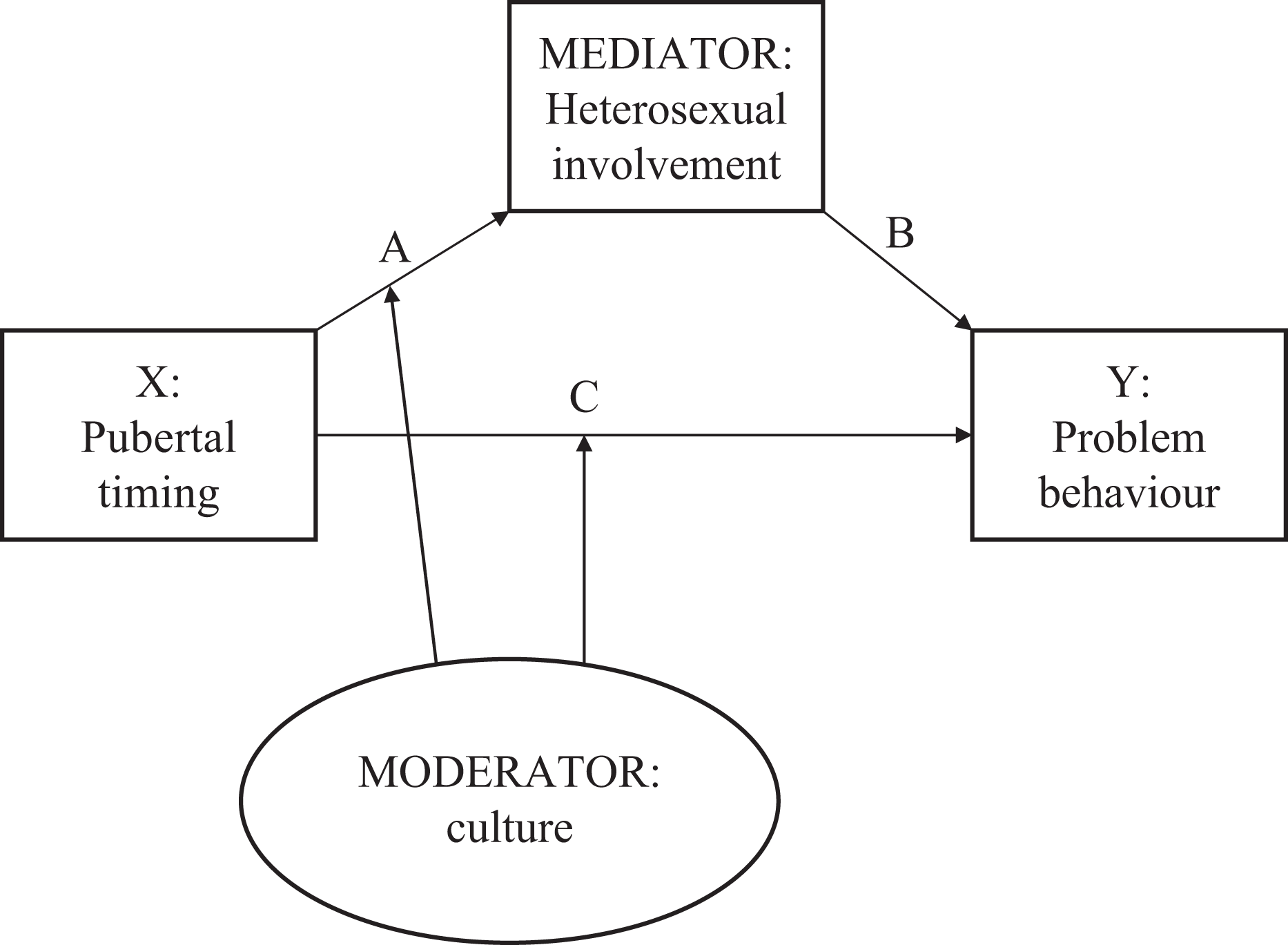
Conceptual model of the mediating role of heterosexual involvement in the association between pubertal timing and problem behaviour moderated by culture.
Concerning the issue of structure equivalence across cultures, we used confirmatory factor analysis to test whether problem behaviours and heterosexual involvement are two interrelated but independent constructs in the Swedish and Slovakian samples. Specifically, we first fit a two-factor model and then compared it to a single factor model. In the two-factor model, 8 problem behaviour items and 3 heterosexual involvement items were predicted by the respective latent factors. The single factor model was specified by fixing the correlations between the latent factors to 1, a procedure which yields nested models for statistical comparison of the fit of the two alternative models using chi-square difference test (Kline, 2011). The results suggested that the two-factor model fitted the data better than the single-factor model for both the Swedish (Δχ2(1) = 187.37, p < .001, CFI = .94, RMSEA = .070, SRMR = .049) and Slovakian samples (Δχ2(1) = 90.53, p < .001, CFI = .94, RMSEA = .062, SRMR = .038). The results suggested that problem behaviours and heterosexual involvement are two interrelated but independent constructs in both samples.
We also tested the measurement invariance of the problem behaviour and heterosexual involvement measures across the two cultures using multiple-group analysis. The factorial invariance model, in which the factor loadings, intercepts and residuals are freely estimated, revealed a good fit (χ2(68) = 294.79, CFI = .945, RMSEA = .065, SRMR = .037). In the second step, we tested a stricter model of loading invariance by adding equality constraints to the item loadings. The changes in the relative fit indices suggested that the item loadings were invariant across the factors (ΔCFI = .008, ΔRMSEA = .002, ΔSRMR = .019; Chen, 2007; Cheung & Rensvold, 2002). Overall, the findings suggest that the measures of problem behaviour and heterosexual involvement demonstrated loading invariance across cultures.
Results
Preliminary results
Cultural similarities in pubertal timing
First, to determine whether the age at menarche was equivalent in the two cohorts, we compared the Swedish and the Slovakian girls on the 4-point pubertal maturation scale. No significant differences were found (F (1, 1467) = 0.28, p > .05). Specifically, 10.7% and 8.3% reported menarche before age 11 in the Swedish and Slovakian cohorts, respectively. Between ages 11 and 12, it was 25.5% and 24.3%; between ages 12 and 13, it was 39.2% and 46.4%; and at age 13 or later, it was 24.6% and 21.1% in the Swedish and Slovakian cohorts, respectively. Thus, the distributions of menarcheal age were roughly similar in the two cohorts.
Cultural differences in prevalence of intercourse
Despite similar distributions of menarcheal age across cultures, we expected that in the relatively restrictive Slovakian culture, mid-adolescent girls would be less likely to have had sexual intercourse than mid-adolescent girls in the more open Swedish culture. The results supported that assumption. Altogether, 14.6% of the Swedish girls reported having had intercourse (2.9% once and 11.8% on several occasions), whereas only 5.6% of the Slovakian girls did (2.9% once and 2.7% on several occasions) (χ2 (1) = 34.94, p < .001).
Cultural comparisons of levels of problem behaviour
The mean levels of problem behaviour in the Swedish and Slovakian samples did not differ significantly (t (1467) = 0.45, p = .65).
Culture as a moderator of the mediated link between pubertal timing and problem behaviour
In terms of the model presented in Figure 1, we predicted that before heterosexual involvement was added to the model, there would be a link between pubertal timing and problem behaviour (slope C in the figure) and this link would be stronger for the Swedish cohort than for the Slovakian cohort. After heterosexual involvement was added to the model, the link between pubertal timing and problem behaviour should disappear, because it should be mediated by heterosexual involvement. We also predicted that the association between pubertal timing and heterosexual involvement (slope A in Figure 1) would be significantly stronger for the Swedish sample than for the Slovakian sample. The results appear in Table 1. As shown in the first column of Table 1, pubertal timing was, as expected, a significant predictor of problem behaviour. Also, the Pubertal timing × Culture interaction was significant, meaning that the link between pubertal timing and problem behaviour differed significantly between cultures. A plot of the interaction (this is a plot using the full four-point scale, where we solved the regression equations for the highest and lowest values of the pubertal timing measure; which was also done in Figure 3), which appears in Figure 2, shows the predicted difference. Pubertal timing was more predictive of problem behaviour in the Swedish sample than in the Slovakian sample, and early-maturing girls in Sweden scored higher on problem behaviour than did the later-maturing girls. In fact, as shown in Table 2, strong differences in zero-order correlations appeared between the two cohorts for evaluations of problem behaviour and intentions to engage in problem behaviour in hypothetical situations as well as for problem behaviour, itself. Thus, the societal differences in the links between pubertal timing and problem behaviour seem to be robust, and they support the contextual amplification hypothesis. The question is whether these differences are due to Swedish girls being more involved in heterosexual relationships, as the peer-socialization hypothesis would predict.
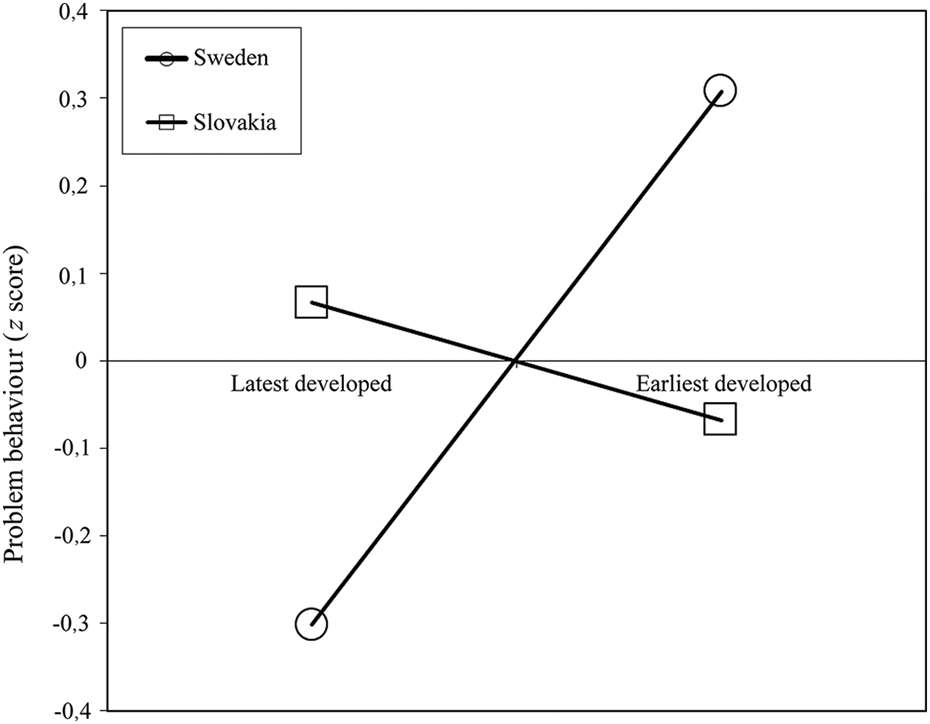
Two-way interaction between pubertal timing and culture in the prediction of problem behaviour.

Two-way interaction between pubertal timing and culture in the prediction of heterosexual involvement.
Least squares regression models testing the moderating effect of country (Sweden vs. Slovakia) on the mediation of heterosexual involvement in the association between pubertal timing and problem behaviour.
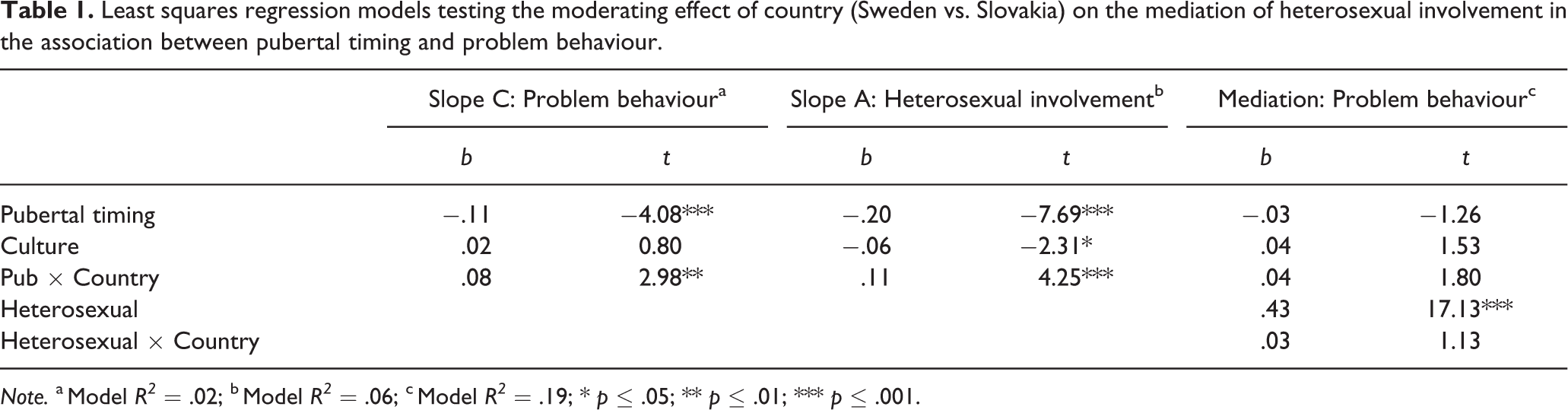
Note. a Model R2 = .02; b Model R2 = .06; c Model R2 = .19; * p ≤ .05; ** p ≤ .01; *** p ≤ .001.
Correlations between pubertal timing and different aspects of problem behaviour for Swedish and Slovakian girls.
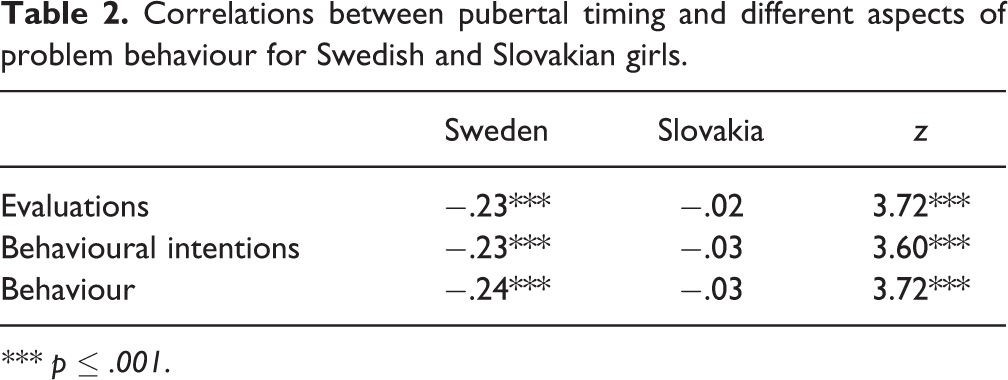
*** p ≤ .001.
The results in the second column of Table 1 present a test of whether pubertal timing is linked to heterosexual involvement to the same degree in the two cultures. Our prediction based on the integrated peer-socialization/contextual amplification hypothesis was that the link would be stronger for the Swedish girls than for the Slovakian girls. As shown in the table, early pubertal timing predicted more heterosexual involvement, and a significant effect of culture indicated that girls in Sweden were more involved in heterosexual relationships than Slovakian girls. The Pubertal timing × Culture interaction was also significant, and as shown in Figure 3, early pubertal timing was more strongly linked to heterosexual involvement in Sweden than in Slovakia.
In Table 3, we treated the pubertal timing measure as a categorical variable to examine more closely the differences among girls on each of the four-point pubertal timing values for the three heterosexual involvement measures that make up the composite used in the interaction. Clearly, as shown in the table, early-maturing girls in Sweden were more involved in heterosexual relationships than were early-maturing girls in Slovakia. We used the two-proportion z test to test whether there were significant differences in proportions between adjacent pubertal timing groups. For Swedish girls, the earliest-maturing girls (menarche before age 11) differed significantly from the next group (menarche between age 11 and 12 years) for perceived sexual maturity and intercourse. The proportion of girls who had had intercourse was also significantly higher among the girls with their menarche between age 11 and 12 years than the girls who had their menarche between age 12 and 13 years. Overall, heterosexual involvement among Swedish girls seemed to be particularly concentrated to the earliest-maturing girls. No significant differences in proportions between adjacent groups appeared for the Slovakian girls.
Percentages of early and later-maturing Swedish and Slovakian girls reporting heterosexual involvement.
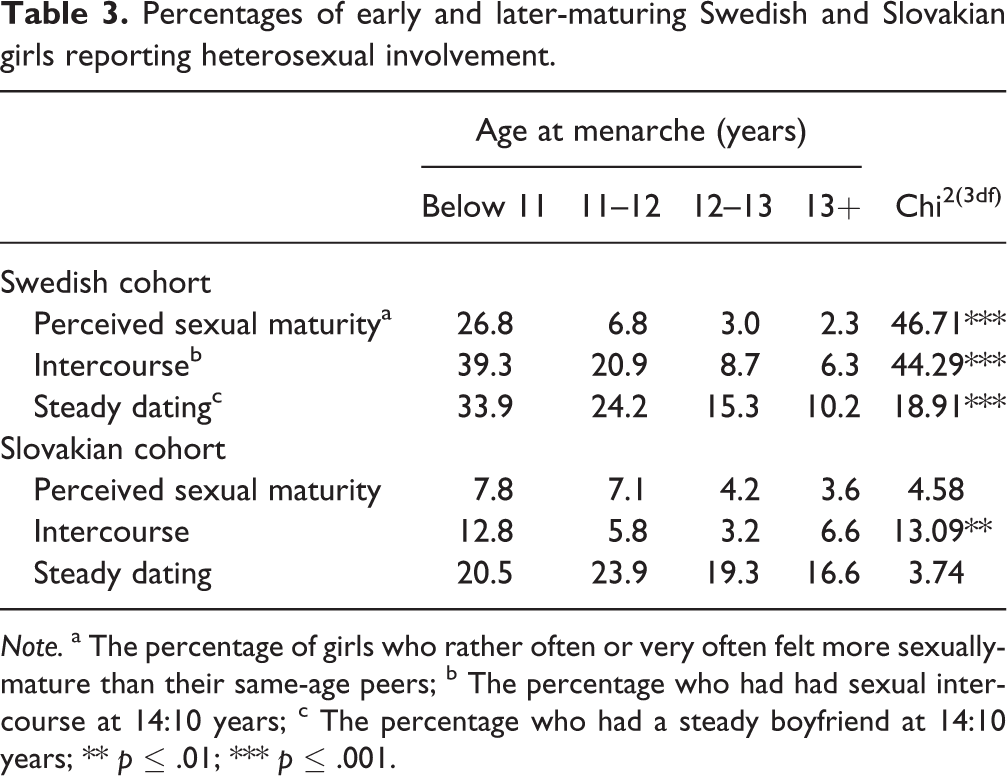
Note. a The percentage of girls who rather often or very often felt more sexually-mature than their same-age peers; b The percentage who had had sexual intercourse at 14:10 years; c The percentage who had a steady boyfriend at 14:10 years; ** p ≤ .01; *** p ≤ .001.
The third column in Table 1 shows the results of the test of whether heterosexual involvement mediates the link between pubertal timing and problem behaviour. As shown in the table, heterosexual involvement was the strongest predictor of problem behaviour. When heterosexual involvement entered the model, pubertal timing was no longer a significant predictor. In short, heterosexual relations essentially mediated the role of pubertal timing for problem behaviour. As shown in the same column, the non-significant Pubertal timing × Culture interaction suggest that once heterosexual relations entered as a predictor of problem behaviour, pubertal timing was associated with problem behaviour to the same degree in Sweden and in Slovakia. Finally, the non-significant Heterosexual involvement × Culture interaction suggests that heterosexual involvement was linked to problem behaviour to the same degree in the Swedish and Slovakian samples. Thus, even though heterosexual involvement was less common among Slovakian girls than among Swedish girls, it had the same implications in both cultures for problem behaviour.
In sum, the results strongly suggest that the role that pubertal timing has for problem behaviour depends on culture. For Swedish girls, pubertal timing was associated with problem behaviour, and the association was largely explained by heterosexual involvement. For Slovakian girls, by contrast, pubertal timing was not linked to problem behaviour. For both Slovakian and Swedish girls, though, heterosexual involvement, when it occurred, was associated with problem behaviour. It appears, then, that the Swedish cultural context amplifies the link between early maturation and problem behaviour by making it easy for early-maturing girls to have relationships with boys, whereas the Slovakian cultural context inhibits this peer-socialization process.
Discussion
Early-maturing girls have repeatedly been found to engage in relatively high levels of problem behaviour in adolescence (for reviews, see Celio et al., 2006; Mendle et al., 2007). This link calls for an explanation. Previous research has supported an integrated peer-socialization/contextual-amplification hypothesis concerning the link between female pubertal timing and problem behaviour in everyday contexts (Stattin et al., 2011). In the present study, we extended this idea to societal contexts, using data from Sweden and Slovakia. We showed, first, that the conditions favourable to peer-socialization apparently existed in Sweden, but not in Slovakia. When girls’ contacts with boys were relatively more restricted, as they purportedly were in Slovakia, early puberty was not linked to problem behaviour. When contacts with boys did occur in Slovakia, however, they were linked to problem behaviour just as in Sweden. Taken together, the results lend support to the peer-socialization hypothesis and the assertion that the processes described in the hypothesis can be amplified or inhibited on the societal level, which in turn, supports the contextual amplification hypothesis.
In the vast literature on psychosocial correlates of female pubertal development, cross-cultural approaches are remarkably few. To our knowledge, this is the first study to test a hypothesis concerning the implications of early puberty in female development with a cross-cultural design. Contexts on other levels, however, have been examined as a factor in the link between pubertal development and timing on the one hand and adjustment on the other (for a review, see Ge et al., 2011). Some of the contexts that have been examined previously are family, neighbourhood, school and urban vs. rural area (Caspi, 1995; Dick et al., 2000; Ge et al., 1996, 2002; Obeidallah et al., 2004). Another recent study had a similar approach in examining the link between early puberty and depressive symptoms and found that the social context, namely peer popularity, moderated the link (e.g., Teunissen et al., 2011). These prior studies have converged to show that context affects the implications of early maturation in female development. The present study contributes to this literature by demonstrating that the societal context also seems to play a role in the implications of early pubertal timing among girls. More importantly, the study not only indicates that the macro context affects the link between early pubertal timing and girls’ problem behaviour; it also suggests why. The fact that our analyzes indicated measurement invariance between the cultures with the respect to both the problem behaviour and the heterosexual involvement measures supports our conclusion that the difference between the cultures reflects real differences in the constructs measured and the association between them.
One might be tempted to conclude from these findings that the liberal attitudes toward heterosexual involvement in Sweden are damaging to girls’ development. One should keep in mind, however, that these attitudes are also linked to societal differences in which Swedish girls have the advantage over girls in less liberal societies. In particular, Sweden does not have particularly high prevalence of abortions and teenage pregnancies and average levels of sexually transmitted infections in international comparisons, and knowledge of contraceptive methods is good (Edgardh, 2002; Fenton & Lowndes, 2004; Persson & Jarlbro, 1992). This has been attributed to obligatory sex education in schools since the 1950s; free, on-demand abortions; low-priced contraceptives; and youth health clinics throughout the country that provide free contraceptive counselling to adolescents. Thus, although the acceptance of adolescent heterosexual involvement in Sweden apparently allowed peer socialization to work, it is linked to lower, rather than higher, levels of problems associated with teenage sexual activity.
There is a substantial body of literature to suggest that early-maturing girls do engage in many problem behaviours (Celio et al., 2006; Mendle et al., 2007). A closer look at the literature, however, paints a more nuanced picture. Several studies have shown that early-maturing girls do not only engage in problem behaviours themselves; they are also the target of others’ negative behaviours, such as being maltreated in the family and physically and violently victimized in the peer group (Costello, Sung, Worthman, & Angold, 2007; Haynie & Piquero, 2006). In the case of peer victimization, the finding held even when girls’ own violent behaviours were controlled (Haynie & Piquero, 2006). These studies indicate that just as early-maturing girls engage in problem behaviours; they are also more exposed to them. An important question for future research is how offending and victimization among early-maturing girls interact, particularly over time. Another question for future studies, related to the present findings, concerns whether the link between early pubertal timing and victimization differs between cultures.
Two studies have now converged in showing that contextual factors affect the link between early pubertal timing and girls’ problem behaviour by influencing the mechanism behind the link, namely heterosexual involvement. In this study, we showed that the societal context influences the peer socialization process. In a previous study, peer contexts (i.e., free-time vs. school peers and youth centre attendance) were in focus (Stattin et al., 2011). There are likely other contexts that affect the peer socialization process and hence the link between early puberty and problem behaviour. The family might be one such context.
According to the context-choice hypothesis, the relationship with and feelings connected to parents affects youths’ choices of leisure activities (Kerr, Stattin, Biesecker, & Ferrer-Wreder, 2003). The hypothesis says that adolescents with poor parent relations will gravitate away from adult-led structured activities and towards unstructured, unsupervised activities, which is linked to engaging in problem behaviour (Persson, Kerr, & Stattin, 2007). Adolescents with positive parent relations, on the other hand, will gravitate towards structured, adult-led activities, which are linked to aspects of positive adjustment (Cooper, Valentine, Nye, & Lindsay, 1999; Mahoney & Cairns, 1997). Taken to the subject of the current article, a malfunctioning family might be one context that could affect the peer socialization process by “steering” youth towards unstructured, unsupervised activities, where there will be an over representation of deviant youth (Mahoney, Stattin, & Magnusson, 2001), and as a consequence strengthen the link between early puberty and problem behaviour. Future research may be able to examine whether the family context moderates the peer socialization mechanism in the link between early puberty and girls’ problem behaviour in a similar way that the cultural context seems to do.
This study has limitations. We relied solely on self-reports. Including multiple informants and multiple sources of data will be an important future development of this line of research. Furthermore, we only used one item to measure pubertal timing (i.e., age at menarche). We might have missed the complexity of the broader pubertal maturation process. Menarche is a late pubertal event. Future studies should include several aspects of pubertal maturation. Because the peer socialization hypothesis concerns social relations, pubertal changes that are socially apparent, such as breast development or growth spurt, should be particularly imperative to include. In future research, it would also be interesting to examine perceived pubertal timing, which refers to girls’ own experiences of their pubertal timing. Previous research has shown that perceived pubertal timing, on behalf of girls themselves, has been linked to problem behaviour (Wichstrøm, 2001). Second, we did not assess the differences in attitudes towards romantic and sexual relationships between Sweden and Slovakia on the individual level in this study. Neither did we examine the likelihood of violating cultural norms across the two cultures. It is possible, for instance, that although the norm concerning adolescent heterosexual involvement is more conservative in Slovakia, girls might still violate this norm and engage in heterosexual involvement, for instance because the norm might not exert much influence on adolescent girls’ behaviour. The results here, however, indicated otherwise in showing that Slovakian girls engaged in heterosexual behaviours to a lesser degree than Swedish girls did in mid-adolescence. Future research should include measures concerning cultural norms on the individual level and strive to achieve cultural equivalence in all aspects of the data gathering and data analyzing processes. The heteronormative perspective is another limitation of the current study. Given that the study focused on heterosexual relationships, we do not know how the findings would be generalized to girls with same-sex relationships. Another potential limitation has to do with the time for collection of data. The question about the girls’ ages at menarche was administered 5 months later for the Swedish girls than for the Slovakian. We believe that the 5 months difference in responding to the age at puberty question did not affect the findings reported in the study. The difference may affect the frequency of very late-maturing girls. However, in our study we do not differentiate between the on-time and later-maturing girls.
Even with these limitations, the study makes important contributions to the literature. First, this is the first study to investigate macro cultural differences in the peer socialization processes as an explanation of why early-maturing girls are more likely than other girls to develop problem behaviour. This study offers a new way of looking at culture in relation to puberty. Previous studies in the pubertal timing literature have considered culture in reference to whether pubertal development has similar implications across ethnic groups, residential area and social classes (cf. Clausen, 1975; Dick et al., 2000; Obeidallah et al., 2004; Siegel, Yancey, Aneshensel, & Schuler, 1999) and whether the findings that have appeared in Western countries also apply to non-Western countries (Lam, Shi, Ho, Stewart, & Fan, 2002). They have also examined differences between countries and over time in pubertal development (cf. Tanner, 1990). They have not, however, used theoretically chosen cultures to test a specific hypothesis about mechanisms in the link between pubertal timing and problem behaviour, or considered the cultural context as playing a role in the amplification of the link between early puberty and problem behaviour. Another related contribution is that the study extends the understanding of contextual amplification of the implications of experiencing puberty early (Ge et al., 2011). However, future research needs to be conducted in order to validate the present findings. A final, also related, strength is the historical context of the data. By choosing data that were collected before major recent societal changes, we optimized the conditions to test the integrated hypothesis. There are few reasons to think that the proposed moderated-mediation has changed. In other words, whereas early puberty should be expected to be linked to problem behaviour in sexually permissive macro cultures of today, it should not be in restrictive societies.
Puberty is in many ways a milestone in human development. It has important physical, psychological, and social implications. A prevailing view among developmental scientists is that the core of development lies in person–environment interactions at different levels over time (Magnusson, 1988; Magnusson & Stattin, 1998). Seen from this perspective, pubertal timing should have different implications in different social contexts. A similar view is presented in a recent review of the research on the behavioural implication of pubertal maturation (Forbes & Dahl, 2010). In that review, the authors forwarded the hypothesis that puberty is linked to an activation of certain social and motivational tendencies, including a stronger attraction to peer and romantic contexts, which in turn are linked to the behavioural changes associated with puberty and, notably, that the social context and individual differences affect the behavioural outcomes of the process. In line with these theoretical perspectives, the present study suggests that the macro or societal contexts matter for the adjustment implications of early female puberty. In so doing, this research builds on established developmental principles and advances our understanding of the developmental significance of female pubertal timing.