




Abstract
This study examined the development of adolescent self-reported instrumental-overt, instrumental-relational, reactive-overt, and reactive-relational aggression during middle school (N = 384; 12–14 years; 53% boys). Growth modeling indicated average increases in instrumental-relational aggression, and decreases in reactive-overt and reactive-instrumental aggression over time. Further, overt and relational aggression driven by reactive reasons (functions) predicted gains in aggression driven by instrumental reasons, and overt form of aggression predicted increases in relational form of aggression across time.
Aggression increases during adolescence, likely due to pubertal reasons and peaking concerns for dominance among peers (Pellegrini & Long, 2002). Further, aggression is a multi-dimensional construct. Whereas goal-oriented instrumental (proactive) aggression is used strategically for personal gain (e.g., forcing, coercing, dominating others),1 reactive aggression includes angry defensive responses to perceived provocation (Little, Jones, Henrich, & Hawley, 2003). Both reactive and instrumental aggression are related to peer rejection, but only reactive aggression is also related to self-regulation difficulties, attributions of hostility, peer victimization, and instrumental aggression to status goals, delinquency, and popularity among peers (Little et al., 2003; Ojanen, Grönroos, & Salmivalli, 2005). Further, overt (physical and verbal) aggression (e.g., hitting, name calling) is separated from relational aggression aimed at inflicting harm via relationship manipulation (e.g., gossiping, social exclusion; Little et al., 2003). Overt and relational aggression both are related to popularity among peers during adolescence, but relational more than overt aggression, which is also related to low frustration tolerance (Cillessen & Mayeux, 2004; Little et al., 2003; Preddy & Fite, 2012).
In the forms and functions perspective on aggression, reactive and instrumental aggression represent functions (motives) for overt and relational forms (acts) of aggression (i.e., overt and relational aggression may be driven by instrumental reasons, or by anger and hostility). Cross-sectional research on the forms and function constructs exists during adolescence (e.g., Preddy & Fite, 2012; Little et al., 2003), but little is known about the development of aggression when considering multiple forms and functions concurrently across time. This research is especially worthwhile during middle school where aggression peaks and social cognitive and behavioral development may facilitate form- as well as function-developments in aggression. To this aim, we examined (1) developmental trajectories and (2) prospective associations among reactive-overt, instrumental-overt, reactive-relational, and instrumental-relational aggression (Little et al., 2003) during middle school.
During adolescence, overt (especially physical) aggression decreases while relational aggression increases, potentially due to increasing understanding of social norms that sanction overt aggression and developing social skills that enable youth to manipulate others (Björkqvist, Österman, & Kaukiainen, 1992). Likewise, while maturation and increasing self-regulation may decrease reactive aggression with age, instrumental aggression may increase during adolescence (Vitaro, Brendgen, & Barker, 2006) when concerns for status among peers peak (LaFontana & Cillessen, 2010) and are sought with instrumental aggression (Ojanen et al., 2005). On these bases, we expected youth to report increasing levels of instrumental-relational and decreasing levels of reactive-overt aggression during middle school. Further, we expected to observe stable levels of instrumental-overt and reactive-relational aggression across time. During middle school, overt aggression continues to be positively related to popularity among peers (likely especially when displayed instrumentally; Cillessen & Maueux, 2004), whereas hostility and anger may be channeled into relational aggression as an age-appropriate way to, among others, get back at peers following provocations (Godleski & Ostrov, 2010).
Further, we expected the four aggression constructs to be mutually associated across time. Previously, reactive aggression was found to predict increases in instrumental aggression (but not vice versa), potentially because control obtained with reactive aggression is rewarding and sought instrumentally over time (Salmivalli & Helteenvuori, 2007). Thus, we expected that aggression driven by a reactive function would predict increases in aggression driven by an instrumental function, in the context of overt as well as relational form. Further, since relational aggression increases with age (Vitaro et al., 2006) and social skills are likely to enable youth to increasingly channel overt into relational aggression (Björkqvist et al., 1992), we expected overt aggression to predict increases in relational aggression, in reactive and instrumental function domains across time. Collectively, these associations would provide the first evidence for concurrent function- and form-related developments in aggression during middle school. Regarding gender, we expected boys to score higher in all aggression constructs than girls (based on prior research with the present instrument; Little et al., 2003). Longitudinal findings were expected to be generally similar across gender, but for the most detailed results, we examined gender differences in the average trajectories and prospective associations among the variables.
Method
Participants
The data were collected in urban Southeast Finland. From the original data pool of 500 students, 384 students in the first two grades of two local middle schools consented and received parental consent to participate (12–14 years; 53% boys; 96% Finnish). Participants represented various Socio-economic Status (SES) levels (in Finland, school attendance is based on township rather than SES, or school districts).
Procedure and longitudinal attrition
Survey data were collected in three occasions (T1 = March of the seventh and eighth grades, T2 = October of the eighth and ninth grades, and T3 = March of the eighth and ninth grades) at school. Parent and participant consents were obtained prior to each occasion. Longitudinal attrition was 17% by T2 and 30% by T3. Youth missing at T3 scored higher in T1 reactive-overt aggression (M = 3.450, SD = 1.701) than those who remained in the data (M = 3.145, SD = 1.435), t(384) = 2.03, p < .05. For the most power and since the findings were similar when using list-wise deletion versus missing data imputation, Expectation Maximization algorithm (SAS Proc MI; SAS Institute) was used to impute missing data (N = 384 across time).
Measures
Forms and functions of aggression
An instrument by Little and colleagues (2003) was used to assess four aggression constructs (six items in each). Participants rated the extent to which they agreed that the items described them on a 7 point scale (1 = I disagree; 7 = I agree). Each scale represented a combination of a function and form of aggression. Example items included: instrumental-overt: “I start fights to get what I want,” “To get what I want, I put others down” (T1α = .89; T2α = .89; T3α = .88); instrumental-relational: “I say mean things about others to my friend to get what I want,” “To get what I want, I ignore or stop talking to others” (T1α = .81; T2α = .85; T3α = .85); reactive-overt: “When I’m hurt by someone, I fight back,” “If others have upset or hurt me, I put them down” (T1α = .90; T2α = .88; T3α = .87); and reactive-relational: “When I’m angry at others, I tell them I won’t be their friend anymore,” “If others have angered or upset me, I tell my friends to stop liking them” (T1α = .79; T2α = .83; T3α = .82).
Confirmatory factor analyses were used to assess the measure factor structure across time. A model where items loaded on four distinct factors fit the data sufficiently at T1, χ2(48) = 103.28, CFI = .97, RMSEA = .06(.040–.069), at T2, χ2(46) = 150.00, CFI = .95, RMSEA = .077(.063–.091), and at T3, χ2(45) = 142.36, CFI = .98, RMSEA = .075(.062–.089). At T2 and T3, two and three item residuals, respectively, were allowed to correlate across constructs (i.e., these variances not explained by the factors were mutually related).
Results
Descriptive statistics
Zero-order correlations, variable means, standard deviations, and mean-level differences by gender are reported in Table 1. As expected, boys scored higher in most constructs than girls. Also, the relative pattern of variable means aligned with existing research using this instrument (Fite, Stauffacher, Ostrov, & Colder, 2008).
Zero-order correlations, Means (M), and Standard Deviations (SD) of the variablesa.
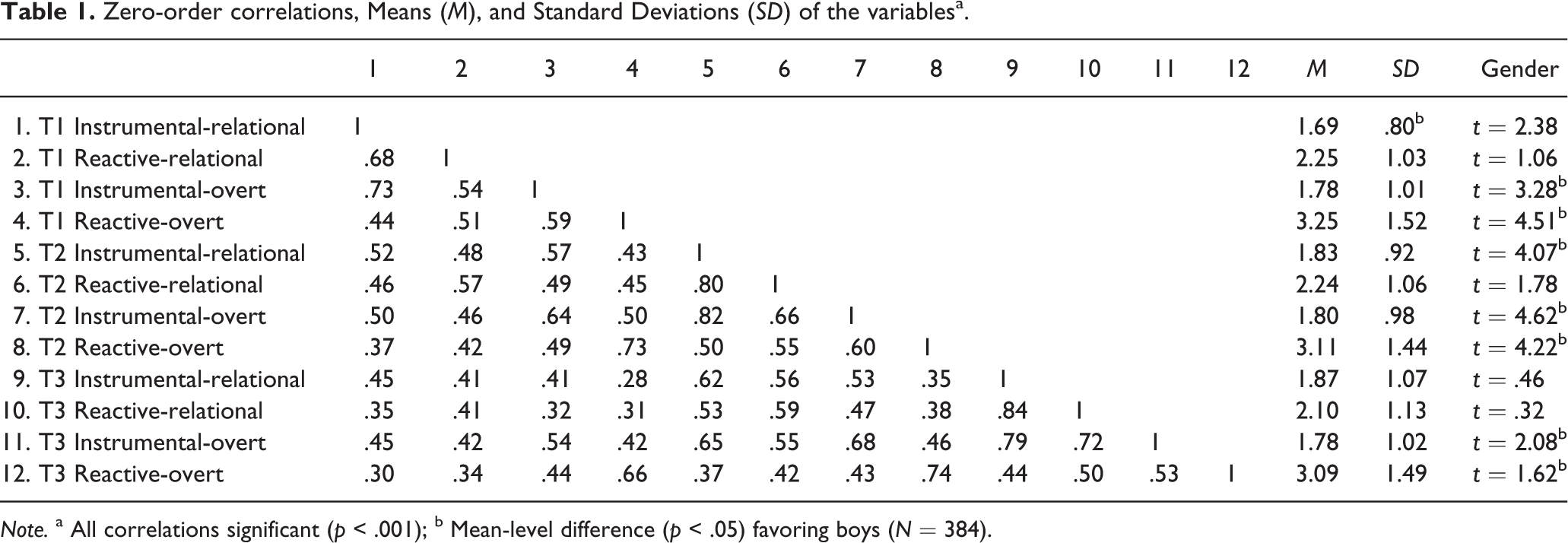
Note. a All correlations significant (p < .001); b Mean-level difference (p < .05) favoring boys (N = 384).
Forms and functions of aggression: Developmental trajectories
Latent growth modeling was used to examine average changes in aggression across time (Mplus 5.2; Muthen & Muthen, 1997–2008). In each of the four models, T1, T2, and T3 manifest variables were used as indicators for the latent Level and Change factors. All loadings were set to 1 on the Level factor (reflecting T1 level of aggression) and to 0, 1, 2 on the Change factor, representing a linear change in aggression across time. As seen in Table 2, all but one model fit the data well; for instrumental-relational aggression, the RMSEA estimate slightly exceeded the acceptable maximum (.07), likely because this trajectory was not perfectly linear. Since non-linear trends require more than three data points to be estimated, we report findings from this model.
Trajectories of aggression: Factor Means (M), Variances (Var), and model fit.
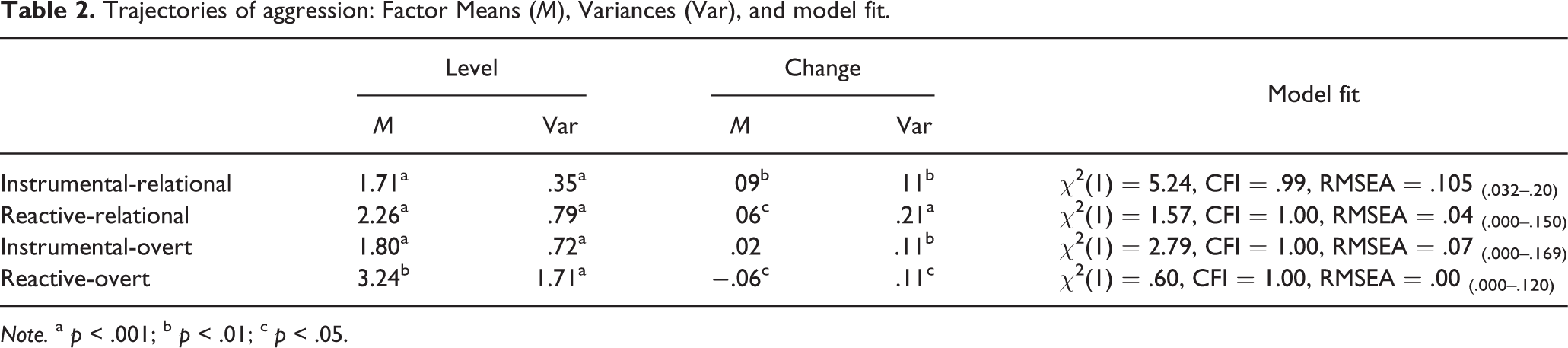
Note. a p < .001; b p < .01; c p < .05.
As expected, youth reported increasing levels of instrumental-relational aggression across time (see Table 2). Further, reactive-overt and reactive-relational aggression decreased, whereas the level of instrumental-overt aggression remained stable over time. Significant Change factor variances indicated that there was variation among individuals in all aggression trajectories. Multi-group tests by gender indicated one gender difference, Δ χ2(1) = 3.98, p < .05: reactive-overt aggression decreased for boys, β = −.12, p < .05, but not for girls, β = .00, p = ns.
Forms and functions of aggression: Prospective associations
Prospective associations among the variables were examined using path modeling. Based on the hypotheses, paths from prior reactive-overt and -relational aggression to subsequent instrumental-overt and -relational aggression, from prior reactive-overt to subsequent reactive-relational aggression, and from prior instrumental-overt aggression to subsequent instrumental-relational aggression (across both assessment intervals) were estimated, while controlling for prior levels of each construct across time. This initial model showed close to acceptable fit, χ2(32) = 109.70, CFI = .96, RMSEA = .08(.064–.096). Based on modification indices, a direct path from T1 instrumental-overt aggression to the respective T3 variable, and from T1 reactive-overt aggression to the respective T3 variable were added to the model. Accounting for this stability in aggression improved model fit, Δ χ2(2) = 37.43, p < .001. Likewise, adding a path from T1 reactive-overt to T2 instrumental-relational aggression improved fit, Δ χ2(1) = 16.264, p < .001.
The final model fit the data well, χ2(29) = 72.23, CFI = .98, RMSEA = .06(.044–.081). As seen in Figure 1, reactive function predicted gains in aggression driven by instrumental function, in the context of overt as well as relational forms, and consistently across both intervals. Likewise, overt aggression predicted increases in relational aggression across time, in the context of reactive and instrumental function, and also consistently across time. T1 reactive-overt aggression also predicted increases in T2 instrumental-relational aggression (see Figure 1). One gender difference was observed: the path from T2 to T3 instrumental-relational aggression was stronger for girls than boys, Δ χ2(1) = 6.36, p < .001.

Prospective associations among the aggression variables during middle school.
Conclusions
This study examined developmental trajectories and longitudinal associations among instrumental-relational, instrumental-overt, reactive-relational, and reactive-overt aggression during middle school. As expected, youth reported increasing levels of instrumental-relational aggression across time. This may be due to increasing social skills, which enable adolescents to manipulate others (Björkqvist et al., 1992) and peaking concerns for social status sought with instrumental (Ojanen et al., 2005) and relational (Cillessen & Mayeux, 2004) aggression. Also as expected, reactive-overt aggression decreased over time (for boys). During adolescence, increasing self-regulation may decrease aggression driven by anger and hostility (Vitaro et al., 2006), whereas increasing social skills and understanding of social norms may decrease overt display of aggression (Björkqvist et al., 1992). Why decrease in reactive-overt aggression was observed for boys only warrants further attention. It may be that, since girls generally mature earlier than boys, emotionally heated overt aggression decreases for them already prior to middle school. However, this hypothesis should be tested in future research.
Further, instrumental-overt aggression remained stable as expected, but unexpectedly, reactive-relational aggression decreased over time. While anger and hostility may be channeled into relational aggression during adolescence (Godleski & Ostrov, 2010), on average, relational aggression driven by reactive reasons may decrease over time with increasing maturation and self-regulation (like reactive aggression in general; see Vitaro et al., 2006). This finding highlights the importance to assess various forms and functions of aggression concurrently across time: although relational aggression may generally increase with age, our findings suggest that this may apply only to instrumental-relational aggression.
Longitudinal associations among the variables emerged as expected. First, reactive-overt and reactive-relational aggression predicted increases in instrumental-overt and instrumental-relational aggression over time, consistently across two longitudinal intervals. These associations support the view that, over time, aggression driven by anger and hostility increases instrumental displays of aggression (Salmivalli & Helteenvuori, 2007), and provide the first evidence for function-development of aggression in the context of overt and relational form. Second, overt aggression predicted increases in relational aggression, also consistently across time and in reactive as well as instrumental function domains. This form-development of aggression may reflect adolescents’ increasing social understanding and skills (Björkqvist et al., 1992), which may enable and motivate youth to increasingly channel overt into relational aggression across time.
Collectively, the findings align with existing research on aggression and to the best of our knowledge, provide the first evidence for concurrent developments in multiple forms and functions of aggression during middle school. Limitations of this study include self-reported data on aggression. Although functions (motives) for aggression are worthwhile to assess using self-reports, developmental patterns and/or prospective associations among the constructs may differ when peer- or teacher-reports of aggression are examined. Further, risk factors for aggression should be examined while considering multiple forms and functions of aggression across time to understand why certain forms and functions of aggression increase, decrease, or predict changes in each other during adolescence.
Footnotes
Funding
This research received no specific grant from any funding agency in the public, commercial, or not-for-profit sectors.