




Abstract
Passenger collaboration offers a potential compensatory strategy to assist older drivers who have difficulty driving in unfamiliar areas (wayfinding). This article describes a survey of 194 healthy, community-dwelling older drivers and their regular passengers to investigate how passengers assist drivers, and to identify the characteristics of drivers and passengers who regularly collaborate to assist with wayfinding. Three aspects of passenger assistance were investigated: Pre-trip planning, directional guidance and searching for visual cues. Results revealed a high incidence of collaboration amongst drivers and passengers who regularly drive together. Collaboration was dependent on the perceived wayfinding abilities of the driver by both passenger and driver, suggesting that passengers are more likely to help if they think they will be of assistance. This information provides baseline information on which future research can examine the safety benefits of passenger assistance in wayfinding.
Finding one’s way (“wayfinding”) whilst driving in unfamiliar areas is a complex activity. The components involved in wayfinding in unfamiliar areas include planning and remembering a route, finding information in the environment and using it to navigate, maintaining orientation to maps or directions and executing the correct driving manoeuvres (Arthur & Passini, 1992; Passini, 1984). The dual tasks of wayfinding whilst driving may lead to driving performance decrements as many cognitive resources are required to perform both the components required for navigation as well as manage those required for safe driving.
Previous studies have found that older drivers are more likely to report difficulties with wayfinding in unfamiliar areas than younger drivers, and are more susceptible to driving performance decrements on wayfinding tasks than younger drivers (Burns, 1999; Dingus, Hulse, Mollenhauer, & Fleischman, 1997; Mallon & Wood, 2004). The current study explored the influence of passengers in assisting older drivers to wayfind in unfamiliar areas. The focus was on healthy, community-dwelling individuals with no (self-reported) neurodegenerative disorders.
Some older drivers experience varying levels of age-related cognitive decline in the domains of processing speed and some aspects of attention, visuospatial skills, memory and executive functions (Rabbitt et al., 2004; Salthouse, 2004). As many of these processes are theoretically important for wayfinding in unfamiliar areas (Arthur & Passini, 1992), age-related cognitive decline may result in increased levels of difficulty in wayfinding for some older drivers. Indeed, there is evidence of a relationship between driving performance whilst wayfinding and age-related cognitive decline (Anstey & Wood, 2011; Mallon & Wood, 2004). Other factors which may contribute to older driver difficulties include complexity of the roadway and poor signage (Burns, 1998). These studies suggest that some older drivers are overwhelmed by the demands of wayfinding in unfamiliar areas and that this can compromise driver safety and mobility. Therefore, it is essential to evaluate strategies to reduce crash risk and maintain mobility for drivers with wayfinding difficulties.
The most obvious solution is to avoid driving in unfamiliar areas altogether, and some older drivers do report self-regulating their driving in this way (Burns, 1999; Molnar et al., 2013). However, this is not always a practical option. Driving a car is the most commonly used transportation mode used by seniors (Rosenbloom, 2003). There is also evidence that older drivers do continue to drive in unfamiliar areas. In their study of real-world travel patterns of older drivers (n = 156; 75+ years), Molnar et al. (2013) used GPS technology to record trips within 15 km away of home as a proxy measure for driving in familiar areas. The authors found that almost 10% of drivers’ mileage was spent more than 15 km away from home, and thus in potentially unfamiliar areas.
Loss of independence and mobility caused by driving cessation has been associated with significant consequences including increases in depressive symptoms and reduced activity levels (Marottoli et al., 1997, 2000; Ragland, Satariano, & MacLeod, 2005). Some researchers suggest that reduction in driving could have similar effects (Ragland et al., 2005; Whelan, Langford, Oxley, Koppel, & Charlton, 2006) and this may be particularly so when this leads to unmet mobility needs and exclusion from participation in community activities. Therefore, it is also important to investigate strategies which assist the driver to maintain safe driving practices wherever appropriate.
One potentially effective strategy to manage safe wayfinding is to engage the assistance of a passenger. A passenger can take on many aspects of the wayfinding task, potentially reducing the driver’s cognitive demands. Passenger collaboration may take a variety of forms, including assistance during pre-trip planning with map-reading and problem-solving, and directional guidance during a trip, such as visual cue searching and provision of instructions on when and where to turn. This may allow the driver to focus more attention on the driving task and hazard detection. By assisting the driver, the passenger may help reduce driving performance errors when wayfinding in unfamiliar areas and in turn reduce crash risk.
Notwithstanding its potential benefits, there is a dearth of studies regarding the impact of passenger assistance whilst driving. Studies investigating the crash risk of older drivers when they are accompanied by passengers have found a generally protective effect, but increased risk in some difficult driving conditions (Bédard & Meyers, 2004; Hing, Stamatiadis, & Aultman-Hall, 2003; Rueda-Domingo et al., 2004; Vollrath, Meilinger, & Kruger, 2002). Disadvantages of passenger wayfinding collaborations are likely to arise when the passenger experiences wayfinding difficulties, cannot communicate information effectively or distracts the driver with irrelevant information. Studies investigating the effect of passenger conversations on driver distraction have generally reported a negative effect on driving performance (Amado & Ulupinar, 2005; Gugerty, Rakauskas, & Brooks, 2004; Hunton & Rose, 2005; McPhee, Scialfa, Dennis, Ho, & Caird, 2004). However, there is a limited understanding about the effect of passenger interaction when they are assisting with the driving task, and particularly in relation to older drivers. There is limited evidence that older drivers perform better when guided by a driving instructor compared to self-directed driving (Mallon & Wood, 2004; Wood et al., 2009). However, these studies are specific to an on-road driving tests context, and it is unclear whether older drivers would gain the same benefit from being assisted by their regular passengers.
Qualitative studies have found that older married couples report reliance on their spouse for assistance with wayfinding in unfamiliar areas (Kostyniuk, Streff, & Eby, 1997; Vrkljan & Miller Polgar, 2007b). In these studies, driving pairs identified the passenger’s role in providing guidance about what direction to take, reading the map and identifying road signs. Some older married couples reported driving together more often after retirement and an increased reliance on passengers with age (Vrkljan & Miller Polgar, 2007b). Notwithstanding the important insights provided by this research, prevalence rates for wayfinding collaborations remain unclear and little is known about the characteristics of driving pairs who collaborate, to what extent the assistance is effective, and characteristics of successful assistance.
In our previous research on this issue (n = 534), we have shown that, while not the most commonly-used wayfinding strategy, around 14% of older drivers reported regularly using a passenger to find their way in unfamiliar areas, and that older drivers who reported wayfinding difficulties were more likely to use passenger assistance (Bryden, Charlton, Oxley, & Lowndes, 2013).
Findings about collaboration between older people from other domains of ageing research are potentially instructive for understanding the likely use of collaborative wayfinding for driving. While most older adults prefer to work alone, there is evidence that people are more likely to want to collaborate when they perceive that they have a difficulty and are more likely to assist based on their strengths (Berg et al., 2007; Strough, Cheng, & Swenson, 2002). Other social factors can also influence collaboration, for instance Margrett and Marsiske (2002) found that in male/female pairs, males had more influence over their female partners and were less likely to take advice from them, regardless of strengths and weaknesses.
While the evidence is limited and somewhat equivocal, intuitively, passenger-assisted navigation offers potential safety and mobility benefits for at least some older drivers. Some experts, however, are wary of recommending the use of a passenger to assist older drivers with wayfinding in unfamiliar areas (Staplin, Lococo, Martell, & Stutts, 2012). This concern appears to stem from debate in the literature about drivers with dementia using passengers, or “co-pilots,” to assist them with everyday driving tasks in familiar areas (Shua-Haim & Gross, 1996). The use of co-pilots has been subject to criticism due to safety and legal concerns (Dobbs, Carr, & Morris, 2002; Fox & Bashford, 1997; Man-Son-Hing, Marshall, Molnar, & Wilson, 2007).
Specific concerns of those who oppose the promotion of passenger assistance relate primarily to its use by older drivers with neurodegenerative conditions. It has been proposed that this may lead to increased drivers’ dependence on passengers for co-piloting; that is, assistance with safety critical aspects of driving such as visual search and hazard detection. However, these concerns may not necessarily apply to drivers without dementia. Indeed, it is important to highlight the differences between passenger wayfinding assistance described in the current study and co-piloting.
Despite the above concerns, it appears that the strategy is practised amongst a substantial cohort of older drivers and therefore it is important that further research is conducted to understand the role, characteristics and effectiveness of passenger-assisted wayfinding in unfamiliar areas. The focus of the current study is on community-dwelling older drivers without a neurodegenerative disorders and the provision of assistance with wayfinding tasks, rather than with tactical and operational aspects of driving.
The present study was conducted to further investigate the driver-passenger relationship with a particular focus on the passengers’ role in wayfinding, ways in which passengers assist the driver during wayfinding in unfamiliar areas and the characteristics of those passengers and drivers who engage in collaborative wayfinding. The research focused on three key aspects of passenger assistance: giving help before the drive (pre-trip planning), giving directions to the driver while driving (directional guidance) and helping to identify environmental information to help direct the driver (searching for visual cues). The influence of driver age and gender on the use of passenger assistance was also investigated. Driver’s perceived cognition and wayfinding abilities (relative to passenger) were also examined to explore the relationship between passenger assistance and perceived strengths and weaknesses in wayfinding ability.
Method
Participants and recruitment
Participants were community-dwelling drivers aged 65 years and over (n = 194) and their regular driving companions. All participants were resident in the State of Victoria, Australia. The sample for this study was a sub-group of drivers from a larger study who were recruited from membership of a motoring club in Victoria, Australia (Bryden et al., 2013).
Potential participants were randomly selected and stratified based on age and residential location of the Victorian population to ensure a representative sample (Australian Bureau of Statistics, 2006). It is noteworthy that around 60% of the Victorian population aged 65 and over are members of the motoring club and therefore the pool from which volunteers was drawn is likely to have good representation of the Victorian older adult driving population.
Drivers received a survey package by mail with an invitation to complete and return a driver survey using a postage-paid envelope. The package also included a passenger survey and reply-paid envelope with a request for drivers to invite their main driving companion (the person they drove with most often) to participate. Participation was voluntary and there was no financial incentive to participate in the study. Participants were excluded if they had a (self-reported) diagnosis of dementia or Parkinson’s disease. Monash Human Research Ethics Committee approval was obtained.
Of the 558 drivers recruited for the larger study (response rate = 18.6%), 221 had driving companions who also returned a survey and were therefore eligible for inclusion in the current study (41.4%). Twenty pairs were excluded because the main driver was aged under 65 years, and five pairs were excluded because either the driver or passenger had self-reported dementia or Parkinson’s disease. An additional two pairs were excluded due to excessive missing data, leaving a total sample of 194 pairs available for analysis.
The matched pairs were sorted into “main drivers” and “main passengers.” These driving roles were ascertained based on responses to three questions: how often are you the passenger on your driving trips (5-point scale: always to never), how often are you the driver on your driving trips (5-point scale: always to never), and how far do you drive per week (km). For the majority of pairs (79.4%) the participant who reported less time spent as a passenger was categorized as the main driver. A small proportion of pairs reported equal time spent travelling as a passenger. For half of those the participant who reported more time spent as a driver was categorized as the main driver (10.3% of overall sample). The remaining 10.3% of pairs reported equal time spent travelling as a passenger and a driver, and for those participants, the participant who reported driving further each week was categorized as the main driver.
Materials and procedure
Drivers and passengers completed a 20-minute self-report survey each which comprised a total of 87 items. This article reports on the results of a subset of responses about passenger assistance, wayfinding abilities, driving behaviours, demographics and health questions. The survey also included questions about use of other wayfinding strategies which are reported elsewhere (Bryden et al., 2013).
Demographic information
Information about the age group (5-year bands) and gender of the driver was included in the analysis.
Self-reported cognition
The driver’s self-rating of cognitive abilities was included in the analysis. Cognitive domains included in the self-rating scale were memory, planning and attention and were selected for their theoretical relevance to wayfinding as described in Passini’s model (Arthur & Passini, 1992). A composite score for self-rated cognition was derived from 10 questions which were rated on a five-point Likert-type scale (very good, good, fair, poor, very poor). The composite score was calculated so that equal weight was given to each cognitive domain. The questions were adapted from the Everyday Cognitive Ability scales developed by Farias et al. (2006, 2008).
Relative wayfinding classification
Of particular interest was whether passengers rated their wayfinding ability the same or different (better or poorer) than their respective driver’s wayfinding ability. In the absence of a direct measure of relative wayfinding performance (i.e. ratings of one’s own abilities compared to the driver or passenger), the researchers extrapolated this information from the self-rated wayfinding (in unfamiliar areas) scores of the drivers and passengers. Drivers and passengers self-rated their ability to “find their way to an unfamiliar location” as either good, fair or poor. If the passenger rated his or her ability higher than the driver rated their own ability, the pair was identified as having a passenger with better ability rating. If the passenger rated his or her ability lower than the driver rated their own ability, the pair was identified as having a driver with better ability rating. If the ratings given by driver and passenger about their own abilities were the same, the pair was identified as having equal ability ratings.
Passenger assistance
Passengers rated how often they assisted the driver with wayfinding in unfamiliar areas, using a five-point scale ranging from always to never. Participant pairs were identified as regular collaborators if the passenger reported helping the driver always or often with the specified groups of tasks. Wayfinding tasks were grouped: pre-trip planning (planning the route before travel), directional guidance (use of a street directory, following written directions, or helping the driver use an in-vehicle navigation system), and searching for visual cues (looking for landmarks, finding street signs). Logistic regression was employed to analyse these data, therefore participants were classified as regularly performing a category of passenger assistance if they indicated that they regularly (always or often) performed one or more of the tasks within that category.
Statistical analyses
Logistic regression models were developed to determine which factors of interest predicted use of regular driver and passenger collaboration. An alpha level of 0.01 was set for statistical significance to control for type 1 error. Statistical analyses were conducted using SPSS (version 15).
Results
Participant demographics and information
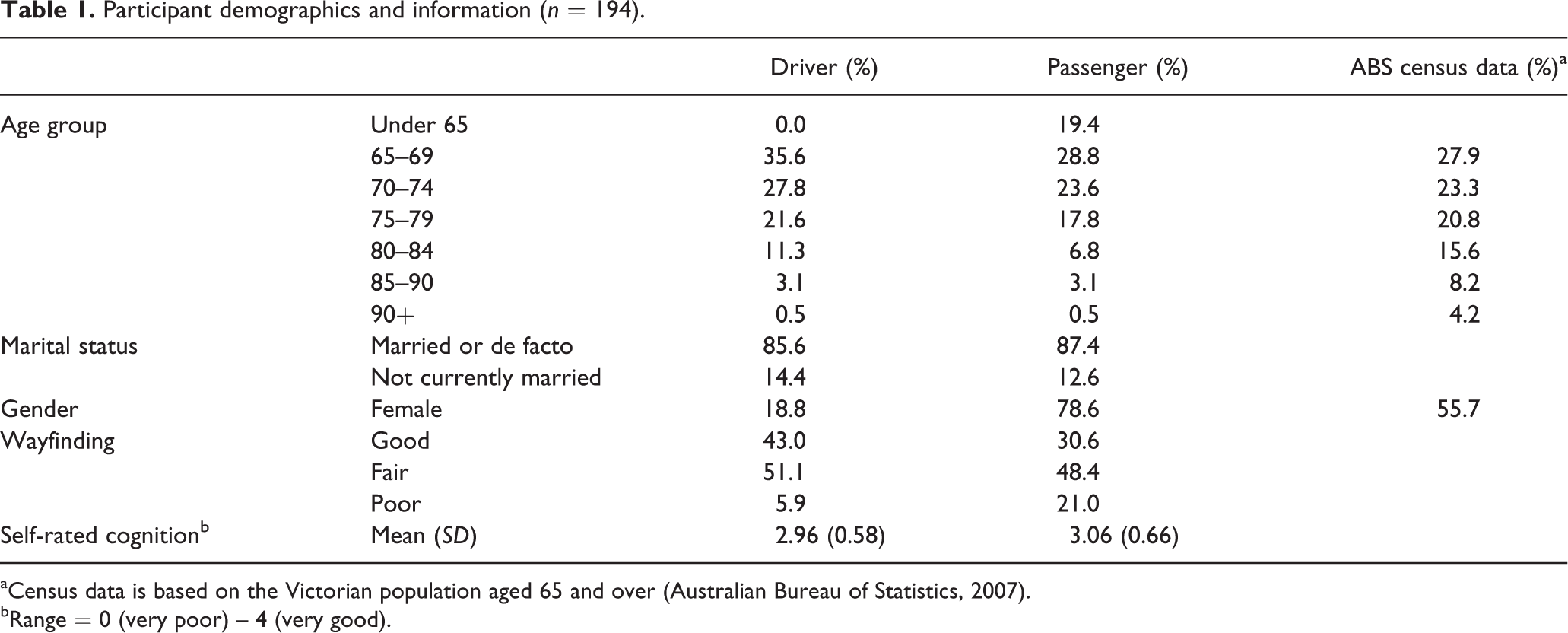
A summary of participant demographics and responses to predictor variables is presented in Table 1. Driver age group was relatively representative of the Victorian population aged 65 years and over. There was some under-representation from the older age groups however this may be at least partly due to reduced driving/licensing rates amongst the oldest age groups. Although all passengers aged over 18 years were included in the study, the majority of regular passengers were aged 65 years and older. The majority of the sample was married or in a de facto relationship, and males were more likely to be classified as drivers than females. Investigation of gender and marital status for the larger study (n = 558; i.e., including those drivers for whom there was no accompanying passenger survey response), revealed that drivers who regularly carried adult passengers (half of the time or more) were more likely to be male (76.2%) and married (89.7%) than those who did not regularly carry adult passengers (46.6% male and 43.4% married), Gender Pearson χ2(1, N = 524) = 48.55, p < .001, Marital Status Pearson χ2(1, N = 524) = 130.68, p = .129 . This suggests that over-representation of male drivers and married pairs in our study is a reflection of the gender distribution of this specific driving population (those with regular adult passengers) rather than a sampling bias. Cognition was generally reported to be fair (2) to very good (4). Table 1 also shows the proportion of drivers and passengers who self-rated their own ability to “find their way to an unfamiliar location.” There were a higher proportion of passengers who indicated perceived difficulty with wayfinding than drivers.
Participant demographics and information (n = 194).
aCensus data is based on the Victorian population aged 65 and over (Australian Bureau of Statistics, 2007).
bRange = 0 (very poor) – 4 (very good).
The majority of driver and passenger pairs were mixed gender (86.8%), and a small proportion of pairs were both males (7.9%) or both females (5.3%). The majority of drivers (80.6%) were a similar age to their passengers (within same age bracket, ±5 years), while a smaller proportion had much younger passengers (15.7%) and a very small proportion had much older passengers (3.7%). The focus of this article was how drivers and passengers rated their own wayfinding ability compared to how the respective driving partner rated their own ability (relative wayfinding classification). Almost half of the pairs reported equal ability ratings (48.7%). Around one third (36.1%) of the pairs had a driver with a better ability rating, and 15.2% of the pairs had a passenger with a better ability rating. Chi-squared tests revealed that relative wayfinding classification did not significantly differ by driver age group (65–74 years compared to 75 years and over; Pearson χ2[2, N = 191] = 3.15, p = .207) or gender (Pearson χ2[2, N = 189] = 4.09, p = .129).
Frequency of collaboration
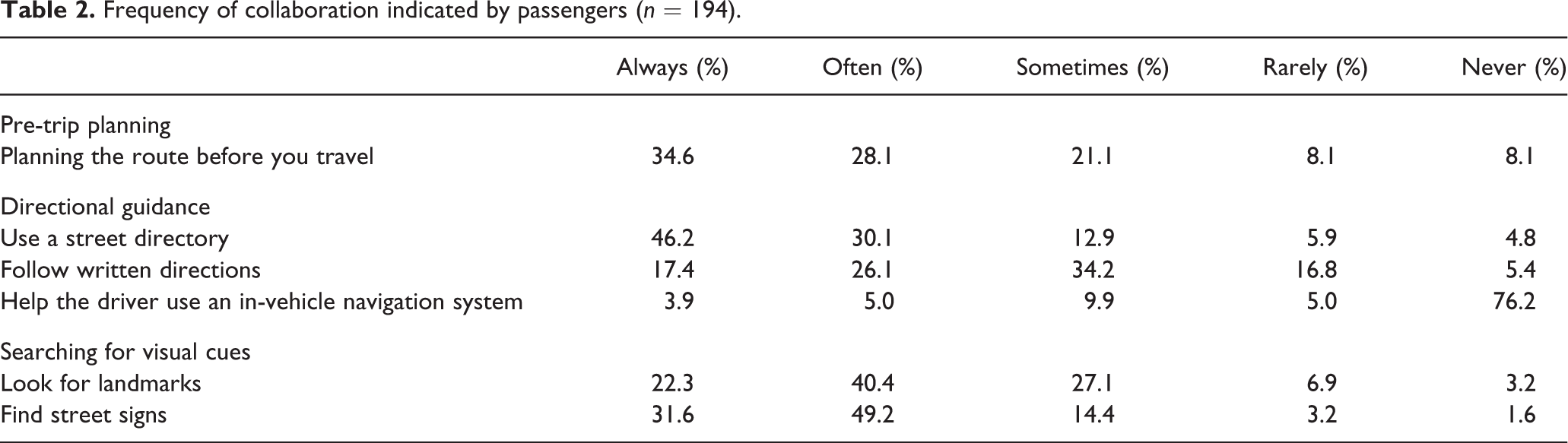
Passenger wayfinding activities are summarized in Table 2. With regard to pre-trip planning, 62.7% of passengers reported that they regularly (always or often) assisted the driver to plan the route before they left. A total of 81.5% of passengers reported regularly giving some form of directional guidance during the drive and passengers most commonly indicated that they regularly used a street directory to provide directions. Although only 8.9% of passengers reported regularly assisting the driver to use an electronic navigation system (Global Positioning System) in the overall sample, it should be highlighted that many drivers did not own a navigation system and therefore few passengers had access to one. Of the 32 drivers (16.6%) who did own a navigation system, 40.6% of their corresponding passengers reported regularly assisting the driver to use the device. A total of 84.7% of passengers reported regularly searching for visual cues during the drive and passengers most commonly indicated that they regularly searched for street signs.
Frequency of collaboration indicated by passengers (n = 194).
Predictors of collaboration
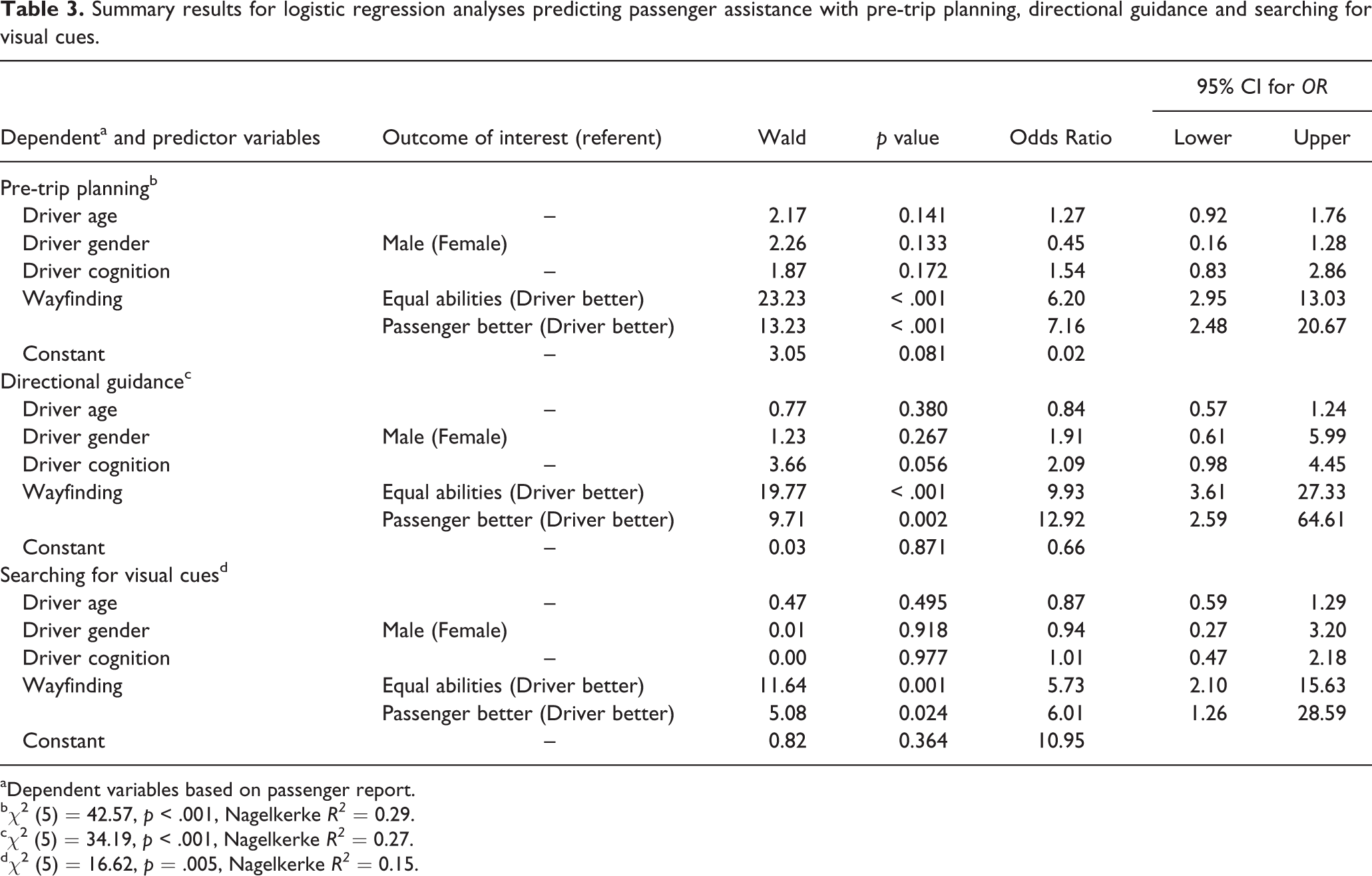
Separate logistic regression models were constructed to identify driver and passenger characteristics that predicted regular collaboration (as indicated by the passengers) for the three outcome measures: Use of pre-trip planning, directional guidance and searching for visual cues. Summary data for the three regression models are presented in Table 3.
Summary results for logistic regression analyses predicting passenger assistance with pre-trip planning, directional guidance and searching for visual cues.
aDependent variables based on passenger report.
bχ2 (5) = 42.57, p < .001, Nagelkerke R2 = 0.29.
cχ2 (5) = 34.19, p < .001, Nagelkerke R2 = 0.27.
dχ2 (5) = 16.62, p = .005, Nagelkerke R2 = 0.15.
Relative wayfinding ability was the only significant predictor of passenger collaboration in all three models after controlling for other variables. For pre-trip planning, passengers who rated their wayfinding as better than or equal to the driver were around six times more likely to collaborate than those who rated their wayfinding as poorer than the driver, OR = 7.16, 95% CI (2.48, 20.67), and OR = 6.20, 95% CI (29.5, 13.03), respectively. For directional guidance, passengers who rated their wayfinding as better than or equal to the driver were around 10–12 times more likely to collaborate than those who rated their wayfinding as poorer than the driver, OR = 12.92, 95% CI (2.59, 64.61), and OR = 9.93, 95% CI (3.61, 27.33), respectively). For searching for visual cues, passengers who rated their wayfinding as equal to the driver were around six times more likely to collaborate than those who rated their wayfinding as poorer than the driver, OR = 5.73, 95% CI (2.10, 15.63).
Discussion
This article explored wayfinding behaviours of community-dwelling older drivers and their passengers in unfamiliar areas. Specifically, the aims of the study were to describe the prevalence and types of collaboration adopted by passengers of older drivers when driving in unfamiliar areas and to identify characteristics of those who regularly collaborate. Three aspects of passenger assistance were investigated: Pre-trip planning, directional guidance and searching for visual cues.
A key finding of the present study was the high frequency of collaborative wayfinding activity reported by passengers in this sample. In an earlier study based on the larger group of older drivers from which this study sample was drawn, we report a relatively modest rate of regular collaboration (14%) and, overall, drivers were found to be more likely to rely on their own abilities to find their way rather than rely on passenger assistance (Bryden et al., 2013). However, these figures represented all driving trips to unfamiliar areas and did not take into account whether a passenger was present or not. The results of the present study suggest that when a regular passenger is present, they commonly provide wayfinding assistance to the driver when in unfamiliar areas.
The majority of passengers in this study reported regularly assisting the driver en-route by providing directional guidance and searching for information. The most common forms of assistance were providing directional guidance by reading a street directory and searching for information by identifying street signs and looking for landmarks. Use of written notes and navigation systems were less commonly used. Around half of those who regularly provided directional guidance reported using written notes. Fewer than 10% of passengers used an electronic navigation system. However, it is important to consider that relatively few drivers in this study owned a navigation system. When taking this into account the results indicated that around 40% of the passengers who had access to a navigation device reported regularly assisting the driver to use it. This finding is consistent with previous qualitative studies which found that some older drivers and passengers had a preference for working together when using navigation systems (Kostyniuk et al., 1997; Vrkljan & Miller Polgar, 2007a). However, it should also be acknowledged that as newer cohorts of older drivers become more experienced with using navigation devices they may use the technology in a different way.
Over half of passengers reported regularly helping the driver plan the trip before the drive. This assistance may be particularly beneficial for drivers who have difficulty with map-reading or planning. Although comparatively fewer passengers reported providing assistance before compared to during the drive, it is unclear whether this was because fewer drivers needed assistance because they had difficulties or because there was generally less need to plan before the drive.
Driver–passenger interactions may have a safety benefit by reducing the cognitive load on the driver, allowing them to focus on the driving task and potentially reduce crash risk. However, depending on the passenger’s own wayfinding skills and effectiveness of communication, it is also possible that the passenger interaction may be distracting to the driver and lead to an increase in cognitive load. Given the wide use of these assistive behaviours among this sample of driver–passenger dyads, it will be important to further investigate the effect of passenger collaboration on wayfinding ability and driving performance, collision risk and mobility. The current study also provides some insights into the characteristics of driver–passenger dyads who choose to collaborate, and suggestions on how these could be further investigated in future research.
The most prominent pattern of results in the present study was that regular collaboration was more likely when passengers perceived their wayfinding ability as better than or equal to how the driver perceived their own wayfinding ability. This indicates that collaboration may not only based on whether the driver believes they need assistance, but also whether the passenger perceives they can adequately assist the driver. This relationship between ability and assistance is consistent with older adults’ preference for collaboration on other tasks (Berg et al., 2007; Strough et al., 2002). This finding also suggests that passengers who are poorer at wayfinding in unfamiliar areas, and therefore potentially less likely to be of benefit due to distracting the driver or providing incorrect directional information, are less likely to provide assistance. Evidence from studies of other collaborative tasks indicates that there is greater improvement in performance when someone is assisted by a partner who is better at the task than themselves (Kimbler & Margrett, 2009). It will be important to determine whether the wayfinding abilities of drivers and passengers affects the efficacy of passenger assistance in future research using more objective wayfinding and driving measures.
Previous research on collaboration in older adults has also found that in some cases, men prefer to follow their own judgment rather than solve problems collaboratively (Margrett & Marsiske, 2002). In this study, there was no evidence that male drivers were less likely to collaborate with passengers than female drivers. However, the current finding is consistent with previous research into driving collaboration amongst older married couples. Interviews with older married couples revealed that males much more commonly identified as the “driver” in the relationship, but there were also strong themes of the couple being a “driving team” (Vrkljan & Miller Polgar, 2007a). Further research using in-depth interviews or observation of wayfinding would be useful to determine whether there are any gender differences in how passenger assistance is given and whether or not the driver invites such assistance.
Drivers’ perceived cognition was not found to be a predictor of passenger assistance. There are a number of alternative reasons for this. One possible explanation is that the passengers’ provision of assistance with wayfinding was not based on the driver’s actual difficulties on other daily tasks which required memory, planning and attention. Another explanation is that, consistent with previous literature, older adults’ self-ratings of cognition are poorly correlated with informant’s ratings (Farias, Mungas, & Jagust, 2005). That is, the driver’s perceived cognitive difficulties may not be apparent to the passenger. Alternatively, there may have been a relationship between perceived cognition and passenger assistance which was subsumed by the perceived wayfinding variable. Perceived cognitive difficulties have been shown to be related to perceived wayfinding difficulties (Bryden et al., 2013). Further research using more objective measures of cognitive functioning is required to confirm these speculations.
There were some limitations of this study. One limitation relates to the self-report nature of the data, particularly regarding wayfinding ability. This technique is vulnerable to socially desirable response bias or inaccurate data due to lack of insight into difficulties. This may have led to some misclassification—over or under-estimating—by participants in regard to their wayfinding ability. However, it could be argued that information about the relationship between perceived (albeit, potentially inaccurate) wayfinding and passenger collaboration is important in itself, as it suggests that driver and passenger pairs may be self-regulating based on their perceived abilities. The question of whether drivers are able to accurately judge their wayfinding ability is an important next step for research in this area.
Another limitation of this study is the generalizability of the sample. Firstly, the low response rate raises a question about the representativeness of the sample. It will be important to validate findings with a larger sample. As discussed, we selected participants from a larger pool of survey respondents who met the characteristics of driver–passenger pairs. Hence, the findings presented here may be unique to drivers and passengers who regularly drive together. Importantly, we identified that the demographic characteristics of driver–passenger pairs in the current study were similar to those of drivers who had regular passengers in the larger sample, that is, main drivers are more likely to be males, and drivers with access to regular passengers are more likely to be married. As a result, these findings may not reflect the experiences of drivers who do not have a regular passenger. Additionally, further research is warranted to determine whether the pattern of collaboration may be different for driving pairs who do not have a long history of driving together.
The current results extended the existing literature on the emerging topic of passenger-assisted wayfinding in unfamiliar areas. In particular, themes identified in previous research which interviewed older drivers and passengers (Kostyniuk et al., 1997; Vrkljan & Miller Polgar, 2007a, 2007b) were explored with a larger sample. Findings from this study indicate that collaboration is common when passengers are available to assist older drivers with wayfinding in unfamiliar areas. Further research to identify factors which may influence the use and effectiveness of passenger assistance is warranted. Potential areas for investigation include whether passenger assistance is invited by the driver or imposed by the passenger; how accurate and helpful passenger directions are; whether the passenger is familiar with the area; and whether passenger assistance changes in more challenging driving situations (e.g. driving at night or in more complex road conditions). Instrumented vehicle studies would provide valuable information about the characteristics of driver and passenger interactions. Future research is also warranted to address the questions of whether driving safety, wayfinding performance and therefore mobility improve or are negatively affected when collaborating with a regular passenger.
The findings from this study also suggest that passengers are more likely to assist the driver when they perceive that they have the ability to help, potentially reducing the risk of distraction to the driver. While the evidence attesting to the potential safety benefits or disadvantages of driver-passenger collaboration is limited, this study suggests that a sub-population of older drivers do work together when wayfinding in unfamiliar areas. The results of this study highlight the need to learn how to support collaborating couples to find their way through unfamiliar areas in a way that effectively extends their safe mobility.
Footnotes
Funding
This research received no specific grant from any funding agency in the public, commercial, or not-for-profit sectors.