



Abstract
Preschoolers’ inhibitory control and early math skills were concurrently and longitudinally examined in 255 Chinese, African American, Dominican, and Mexican 4-year-olds in the United States. Inhibitory control at age 4, assessed with a peg-tapping task, was associated with early math skills at age 4 and predicted growth in such skills from age 4 to age 6 among these ethnic minority children after adjusting for ethnic background. Chinese children outperformed other groups on inhibitory control at age 4 and early math skills across ages. Mediation analyses indicated that their advanced inhibitory control at age 4 partially accounted for their advantage in early math skills concurrently at age 4 and longitudinally at age 6, highlighting the role of inhibitory control in the early math skills of ethnic minority children.
There is accumulating evidence that executive function (EF) plays a major role in children’s school readiness skills (see Muller, Lieberman, Frye, & Zelazo, 2008, for a review). Despite growing attention to the importance of EF in children’s development of school readiness skills, much of the prior research is cross-sectional, thus precluding conclusions about causal directions (for exceptions, see Clark, Sheffield, Wiebe, & Espy, 2013; Welsh, Nix, Blair, Bierman, & Nelson, 2010). Moreover, prior studies mostly involved White non-Hispanic children. Whether children of different ethnic backgrounds in the United States differ in their EF remains unclear to date. This represents a serious lacuna given substantial panethnic gaps in early math skills, with Black and Latino children lagging behind both White non-Hispanic children and Asian children in national datasets such as the Early Childhood Longitudinal Study – Kindergarten (ECLS-K; Magnuson & Duncan, 2006) and Birth Cohort (ECLS-B; Han, Lee, & Waldfogel, 2012). Among Asian children, Chinese children deserve particular attention given evidence that they outperformed White non-Hispanic children in early math skills (Huntsinger, Jose, Liaw, & Ching, 1997).
Moving beyond a White non-Hispanic representation of American children, this longitudinal study involved Chinese and non-Chinese ethnic minority (African American, Dominican, and Mexican) children from low-income backgrounds first when they were at age 4 years and again at age 6 years. With a focus on inhibitory control, one of the three major components of EF, this study was designed to address gaps in the literature by examining whether concurrent and longitudinal associations between inhibitory control and early math skills are evident in the current sample of ethnic minority children after adjusting for ethnic background, whether Chinese children show an early advantage in inhibitory control and early math skills when compared to children of other ethnic minority groups, and whether ethnic difference in inhibitory control accounted for ethnic differences in early math skills at age 6 years.
The role of executive function in early math skills
EF refers to self-regulatory, general cognitive processes for planning, organizing, and implementing goal-directed behaviors (Carlson, 2005; Miyake et al., 2000). Although there is not yet a consensus as to whether EF represents a unitary construct or consists of dissociable components (e.g., Miyake et al., 2000; van der Ven, Kroesbergen, Boom, & Leseman, 2013; see Zhou, Chen, & Main, 2012, for a review), investigators who hold a multicomponent view generally agree that inhibitory control is one of the three major components of EF, along with cognitive flexibility and working memory. Inhibitory control refers to the ability to make a correct response while inhibiting a dominant but incorrect response (see Best & Miller, 2010, for a review). EF, particularly inhibitory control, has been found to predict preschoolers’ early math skills, adjusting for children’s general intellectual ability or vocabulary (used as a proxy for intellectual ability). For example, a composite measure of preschoolers’ inhibitory control and working memory was found to be positively associated with their early math skills, adjusting for their vocabulary skills (Bull, Espy, Wiebe, Sheffield, & Nelson, 2010). When the three components of EF were assessed and analyzed separately, inhibitory control and working memory were positively associated with preschoolers’ early math skills, but only inhibitory control made unique contributions to math skills beyond those of the other two EF components and vocabulary (Espy et al., 2004). Similarly, inhibitory control, but not cognitive flexibility, was uniquely associated with early math skills during the preschool and kindergarten years, adjusting for intellectual ability and vocabulary (Blair & Razza, 2007). In the elementary school years, there is also evidence that each of the three components of EF contributed to children’s math ability after adjusting for intellectual and reading abilities, although working memory appeared to be the unique predictor of math ability among these older children (Bull & Scerif, 2001).
Several recent longitudinal studies provided empirical support for the predictive role of EF, albeit not inhibitory control specifically, in children’s early math skills. In a study that spanned the preschool and kindergarten years, children’s EF was assessed at three time points with a peg-tapping task, the Dimensional Change Card Sort (DCCS; Frye, Zelazo, & Palfai, 1995), and a backward word span task, which reflect children’s inhibitory control, cognitive flexibility, and working memory, respectively; their early math skills were also assessed, and their math achievement was additionally assessed at the end of the kindergarten year (Welsh et al., 2010). Analyses indicated that a composite measure of children’s EF at the beginning of preschool predicted their growth in early math skills during the preschool year, adjusting for these skills as well as vocabulary, syntax comprehension, and expression at the beginning of preschool. Moreover, children’s growth in EF during preschool was a unique predictor of their math achievement at the end of kindergarten after taking into account their growth in early math skills during preschool. A recent report indicated that a composite measure of children’s inhibitory control and working memory at age 3 years predicted their early math achievement two years later, adjusting for their prior informal math skills, vocabulary, and processing speed (Clark et al., 2013). A study in New Zealand also found that a composite measure of children’s EF at age 4 years predicted their math achievement two years later (Clark, Pritchard, & Woodward, 2010). In a study using the Head-Toes-Knees-Shoulders task, which involves inhibitory control as well as working memory, children’s improvement in this task predicted gains in early math skills but not in literacy and vocabulary during the kindergarten year (Ponitz, McClelland, Matthews, & Morrison, 2009). In all these studies, however, White non-Hispanic children comprise the majority of the samples, leaving it unclear whether EF would predict early math skills among ethnic minority children.
Ethnic differences in executive function and early math skills
It is well documented that children of different ethnic backgrounds in the United States begin school with different levels of cognitive skills. Research using the nationally representative sample of the ECLS-K indicated that Black and Latino children lag behind their White non-Hispanic and Asian counterparts by as much as two-thirds of a standard deviation in early math skills (Magnuson & Duncan, 2006), a pattern also evident in the nationally representative sample ECLS-B (Han et al., 2012). Among Asian American preschoolers, those of Chinese descent have been found to outperform their White non-Hispanic counterparts in early math skills (Huntsinger et al., 1997). Similar results were reported in studies comparing kindergarteners in Mainland China and the United States (Geary, Bow-Thomas, Liu, & Siegler, 1996; Siegler & Mu, 2008). Whether residing in the United States or Asia, Chinese children continue to outperform their counterparts of White non-Hispanic backgrounds and other ethnic minority backgrounds in the United States in mathematics in the elementary school years and beyond (e.g., Fuligni, 1997; International Association for the Evaluation of Educational Achievement, 2011; Stevenson et al., 1990).
Much effort has been directed towards understanding the ethnic gaps in early math skills, which is likely to be due to multiple factors, including associated ethnic gaps due to income and other dimensions of socioeconomic status (see Magnuson & Duncan, 2006, for a review). Given that EF is associated with children’s early math skills, there may be a similar ethnic gap in EF, with White non-Hispanic and Asian children outperforming Black and Latino children, which may account for some of the variances in such skills. Unfortunately, little is known about children’s EF in ethnic minority groups. Prior studies of EF and early math skills have been based on mostly White non-Hispanic samples (e.g., Blair & Razza, 2007; Bull et al., 2010). In the few studies where ethnic minority children made up a substantial proportion of the sample (e.g., McClelland et al., 2007; Welsh et al., 2010), comparisons were not made among ethnic groups. As such, it remains unclear whether children of different ethnic minority groups differ in the mean level of EF after adjusting for socioeconomic status, even though it seems possible that Asian children may demonstrate a similar advantage over their Black and Latino counterparts in EF early on.
Ethnic differences in mean levels of EF, especially inhibitory control, may exist given ethnic differences in child-rearing goals and practices. In Confucian heritage cultures, including Chinese culture, impulse control has been described as the most important socialization goal along with achievement (Ho, 1994). Such control is emphasized to children from an early age by setting rules and communicating expectations at home as well as in school (Sabbagh, Xu, Carlson, Moses, & Lee, 2006; Tardif, Wang, & Olson, 2009). Indeed, as early as in the first two years of lives, Chinese children were observed to be more emotionally restrained than European American and Japanese children (Camras et al., 1998), and more behaviorally inhibited than Canadian children (Chen et al., 1998).
Chinese children may not only be required to regulate themselves at an earlier age but also at a more comprehensive level than their African American and Latino counterparts. African American culture emphasizes obedience to elders in the family (García Coll, Meyer, & Brillon, 1995) and Latino cultures such as Puerto Rican and Mexican cultures also emphasize children’s obedience and respect for others (see Harwood, Leyendecker, Carlson, Asencio, & Miller, 2002, for a review). The expectation for self-regulation in Chinese culture, however, appears to go beyond the interpersonal realm. For example, a study reported that Chinese parents may begin toilet-training for their children as early as six months and most Chinese children are toilet-trained by age one year (Chen et al., 2003). Such constant and comprehensive demand for self-regulation provides Chinese children with ample opportunity to develop their effortful control, which has been described as the temperamental ability to inhibit a prepotent response for a subdominant one (Kochanska, Coy, & Murray, 2001). Although inhibitory control is not identical to effortful control in that the former focuses more on the cognitive aspect of self-regulation in affectively neutral contexts, whereas the latter focuses on the behavioral aspect in affectively laden contexts, the two have been argued to be closely related (see Blair & Razza, 2007; Zhou et al., 2012), suggesting that the child-rearing goals and practices in the Chinese culture may also facilitate their children’s development of inhibitory control. Indeed, a recent longitudinal study based on a multi-ethnic sample found that mothers’ use of directives to control children’s disruptive behavior predicted children’s improvement in inhibitory control and other components of EF over the preschool years (Lengua et al., 2013). It has also been proposed that Chinese children may have an advantage in EF due to genetic factors. Chinese children may have an advantage in EF because they rarely carry the 7-repeat allele of the dopamine reception gene, which has been associated with attention-deficit hyperactivity disorder, which in turn is associated with poor EF (Sabbagh et al., 2006).
Although we are not aware of studies that have examined ethnic difference in children’s EF, evidence from the few studies on cross-cultural difference in children’s EF suggests that Chinese children may indeed have advanced EF. In one study, preschoolers from middle-class neighborhoods in Mainland China and the United States were administered a battery of EF tasks (Sabbagh et al., 2006; see also Oh & Lewis, 2008). Across all seven EF tasks, Chinese preschoolers consistently outperformed their American counterparts who were mostly White non-Hispanic; they performed at a level that would be expected of their American counterparts 6 months older. Likewise, preschoolers in Mainland China have been found to be more advanced in inhibitory control and attentional control, but not in working memory, than those in the United States (Lan, Legare, Ponitz, Li, & Morrison, 2011).
The possibility that there may be ethnic differences in mean levels of EF does not imply that the associations between EF and early math skills would vary across ethnicity. Because prior research on EF was based on mostly White non-Hispanic samples, relatively little attention has been given to whether EF may predict school readiness skills across ethnic backgrounds. It has been suggested that inhibitory control may contribute to early math skills because the ability to inhibit irrelevant information enables efficient processing and retrieval of relevant information (Chung & McBride-Chang, 2011; Fuhs & McNeil, 2013; Welsh et al., 2010). Unless this ability is important to the development of early math skills only among children of specific ethnic groups, one would expect the associations between inhibitory control and early math skills to be evident across ethnic backgrounds. Consistent with this proposition, in a study where ethnic minority children made up a substantial proportion of the sample, preschoolers’ performance on the Head-To-Toes task, which reflected EF, predicted their growth in early math, literacy, and vocabulary skills six months later after controlling for children’s ethnic background (McClelland et al., 2007); notably, similar associations between performance on this EF task and early math and vocabulary skills were documented among preschoolers in Taiwan (Wanless, McClelland, Acock, Chen, & Chen, 2011). A cross-cultural study also reported that the associations between preschoolers’ EF (inhibitory and attentional control) and early math skills were similar in Mainland China and the United States (Lan et al., 2011).
Overview of current study
In the current study, we examined the relation between inhibitory control and early math skills among Chinese, African American, Dominican, and Mexican children in the United States. 1 We included children from the Chinese community, who consistently show an advantage in early math skills over their counterparts of other ethnicities and constitute the largest Asian ethnic group in the country as well as the city in question (U.S. Census, 2010b). African American and Latino children were included because they represent a large proportion of the children in the Northeastern city where the data were collected; in addition, these four groups together represent over 50% of children of color in the United States. Given heterogeneity within the larger Latino population (Harwood et al., 2002), we focused on two Latino groups: Dominicans, who have a longer history of migration and a well-established community in the city (Yoshikawa, 2011), and Mexicans, who are a relatively recent immigrant group in this city, yet constitute the largest Latino group in the country (U.S. Census Bureau, 2010a). Across the four ethnic groups, we targeted children from families with relatively low income, because they are greater risk for later academic problems, especially if they experience poverty during the preschool years (Duncan, Ziol-Guest, & Kalil, 2010; Entwisle & Alexander, 1993; Wertheimer, Croan, Moore, & Hair, 2003).
Children from the four ethnic groups were tested individually at ages 4 and 6 years. The longitudinal design provided a window onto the development of inhibitory control and early math skills during a period when children begin to show substantial improvement in inhibitory control (Best & Miller, 2010). Building on the growing body of research on EF, this multi-ethnic, longitudinal study was designed to address two research questions. Firstly, given that the extant literature on EF is mostly based on cross-sectional studies with mostly White non-Hispanic samples, are there longitudinal relations between inhibitory control and early math skills from age 4 to 6 years among ethnic minority children when adjusting for ethnic background? Guided by prior research (Welsh et al., 2010), we not only sought to replicate past findings by examining the concurrent associations between inhibitory control and early math skills, but also tested whether inhibitory control predicted early math skills two years later, adjusting for initial early math skills and ethnicity. Expressive language skills were included as a covariate in all analyses, as a proxy for verbal intellectual ability (e.g., Bull et al., 2010; Welsh et al., 2010).
Secondly, is there an ethnic difference in inhibitory control that contributes to ethnic differences in early math skills, particularly between Chinese children and children of other ethnic minority groups? Given the emphasis on self-regulation in Chinese culture, Chinese children were expected to show a consistently higher level of inhibitory control than children of the other three ethnic groups. Moreover, guided by prior research (e.g., Han et al., 2012; Magnuson & Duncan, 2006), we expected Chinese children to have better math skills than the other three ethnic groups. We expected that, both concurrently at age 4 and longitudinally from age 4 to age 6, some of these ethnic differences in early math skills might be accounted for, in part, by ethnic differences in inhibitory control.
Method
Participants
Participants were 255 Chinese (n = 78), African American (n = 58), Dominican (n = 62), and Mexican (n = 57) children, balanced by gender within group. Participants were recruited from public hospitals and clinics in a large urban city. Mothers were approached by hospital/clinic staff or researchers, given flyers and a verbal description of the study, and asked whether they would be interested in letting their children participate. All children were born to mothers who were at least 18 years of age at the time of their birth. They all resided in the target city, and were born healthy and full-term (birth weight > 2500 grams). Their mothers identified themselves as Chinese, African American, Dominican, or Mexican. At the time of the first and second assessments, children were about age 4 and 6 years, respectively (see Table 1). Across the four ethnic groups, attrition rates averaged 19%, which may reflect the difficulty for mothers from low-income backgrounds to bring their young children to the lab. There were no significant differences between children who did or did not remain in the study at age 6 in terms of their demographic and family backgrounds, inhibitory control, and early math skills when controlling for ethnicity.
Descriptives for demographic and family structure variables.

Note. N = 255. All variables are from the age 4 assessment unless otherwise noted. Maternal and paternal education were reported in numbers of years. Median household monthly earnings rather than mean household monthly earnings are presented.
Children were mostly from families with relatively low levels of education and income (see Table 1). There were ethnic differences in parental education level and household earnings, Fs > 4.10, ps < .01. Mexican mothers and fathers had fewer years of schooling than other parents, ps < .001. Chinese (versus Dominican) mothers and Chinese (versus African American and Dominican) fathers also had fewer years of schooling, ps < .05. Dominican children came from households with higher earnings, ps < .05, than the other three groups, who did not differ. There were also ethnic differences in maternal, χ2(3, N = 254) = 12.98, p = .005, and paternal employment statuses, χ2(3, N = 172) = 48.94, p < .001, with Dominican mothers (79%) being most likely to be employed, followed by African American (67%), Chinese (56%), and Mexican (49%) mothers; all Mexican fathers (100%) were employed, followed by Chinese (95%), Dominican (91%), and African American (44%) fathers. Ethnic differences were also evident in family structure, F(3,250) = 9.23, p < .001; Chinese and Mexican children came from larger households than African American and Dominican children, ps < .06. Most children had mothers with a spouse (including marriage and cohabitation), but there was an ethnic difference in maternal spousal status, χ2(3, N = 254) = 67.01, p < .001, with African American children (33%) being least likely to have mothers with a spouse, followed by Dominican (59%), Mexican (84%), and Chinese (94%) children. Given the above ethnic differences, these demographic and family structure variables with ethnic differences were included as covariates in analyses. Because 12% of children had incomplete data for at least one of the demographic and family structure variables, multiple imputation was employed to handle these missing values (Graham, 2009).
Procedure
Children’s inhibitory control was assessed at age 4 and their early math skills were assessed at both ages 4 and 6. Children were tested individually in the laboratory in their dominant language first at age 4 years and again when they were at age 6. At the age 4 assessment, all children spoke English; 99% of Chinese children, 87% of Dominican children, and 95% of Mexican children also spoke a language other than English. At each age, children’s dominant language was first determined by a brief set of questions directed separately to mothers and children (e.g., “What language do you mostly speak at home?”). Children were then administered the Expressive One-Word Picture Vocabulary Test (EOWPVT; Brownell, 2000) in the determined dominant language. However, instructions were repeated in the non-dominant language for bilingual children who did not respond, and children were credited for correct responses, regardless of the language of their responses. In some instances, the language of subsequent testing was modified based on children’s spontaneous preferences. For example, if an examiner began testing in English, but the child responded primarily in Chinese or Spanish, the examiner switched to Chinese or Spanish accordingly. Following the EOWPVT, children’s inhibitory control (at ages 4 years) and early math skills (at ages 4 and 6 years) were assessed. At age 4, mothers participated in a structured interview, from which demographic measures were obtained. Protocols in English were first translated into Chinese and Spanish by bilingual speakers who were fluent in English and native speakers of Chinese and Spanish respectively. The Chinese and Spanish protocols were then checked by additional bilingual speakers of similar backgrounds, and disagreements were rectified through discussions. All protocols were piloted prior to data collection.
Measures
Inhibitory control
Children’s inhibitory control was assessed with a peg-tapping task (Diamond & Taylor, 1996; Welsh et al., 2010), in which children were asked to tap a plastic toy hammer once when the experimenter had tapped twice, and vice versa. Training trials were given to ensure that children understood the rules before the actual assessment. Out of a total of 16 trials, the number of trials with successful performance was used as an indicator of children’s inhibitory control (see Table 2).
Descriptives for central variables and language covariate.
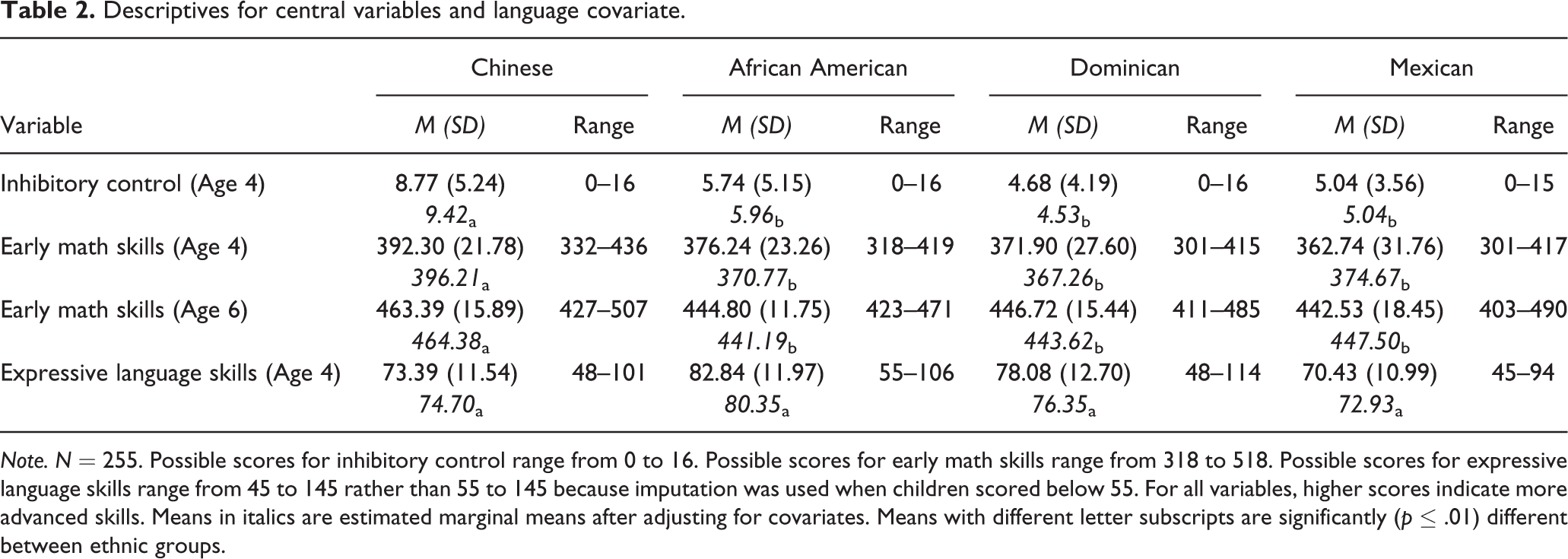
Note. N = 255. Possible scores for inhibitory control range from 0 to 16. Possible scores for early math skills range from 318 to 518. Possible scores for expressive language skills range from 45 to 145 rather than 55 to 145 because imputation was used when children scored below 55. For all variables, higher scores indicate more advanced skills. Means in italics are estimated marginal means after adjusting for covariates. Means with different letter subscripts are significantly (p ≤ .01) different between ethnic groups.
Early math skills
To assess children’s early math skills, the Applied Problems subtest from the Woodcock–Johnson III Tests of Achievement (Woodcock, McGrew, & Mather, 2001) was used with children whose dominant language was English, regardless of their ethnic backgrounds. The corresponding subtest from the Spanish version, Batería III Woodcock–Muñoz NU: Pruebas de aprovechamiento (Woodcock & Muñoz-Sandoval, 1996), was used with Spanish-dominant children, involving 21 (34%) Dominican and 39 (68%) Mexican children at age 4, and 2 (4%) Mexican children at age 6. For Chinese-dominant children, who include 49 (63%) Chinese children at age 4 and 1 (1%) children at age 6, because there is no existing Chinese version of this test, the Woodcock–Johnson III Tests of Achievement was translated into Chinese by a team of English–Chinese bilingual speakers and native speakers of Chinese. Careful attention was given to ensure that the Chinese version was not only linguistically equivalent but also culturally equivalent to the English version; the Chinese version was piloted prior to data collection.
The Applied Problems subtest required children to count a small number of objects, and perform addition or subtraction with small numbers. Children’s raw scores were converted into W scores, which were taken as indicator of their early math skills. Conversion of raw scores to W scores was performed using the Compuscore and Profiles program (Woodcock & Muñoz-Sandoval, 2001), which took into account whether children were tested with the Woodcock–Johnson III Tests of Achievement (for English- and Chinese-speaking children) or the Batería III Woodcock–Muñoz NU: Pruebas de aprovechamiento (for Spanish-speaking children). As shown in Table 3, children’s scores on the Applied Problems subtest were quite stable over the course of the study.
Zero-order correlations of central variables and language covariate.
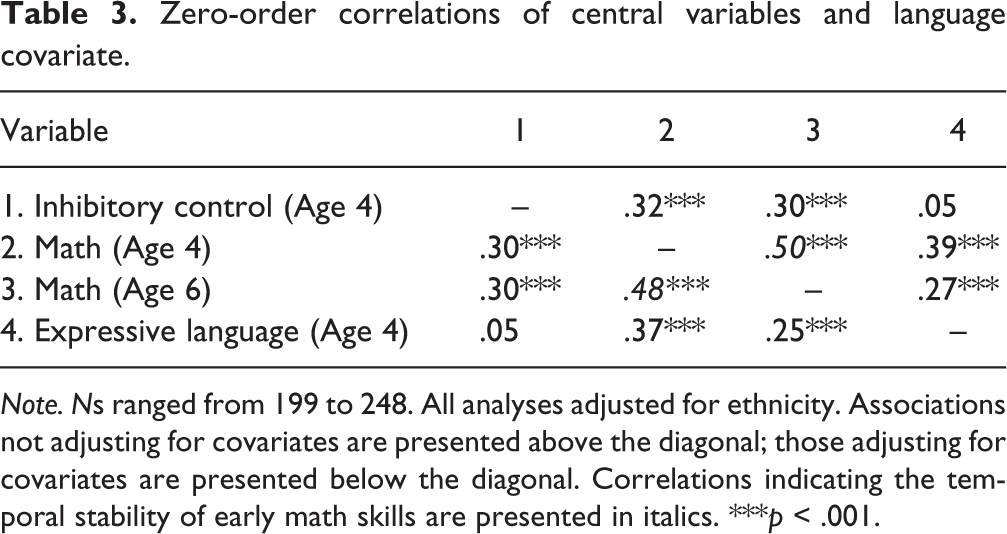
Note. Ns ranged from 199 to 248. All analyses adjusted for ethnicity. Associations not adjusting for covariates are presented above the diagonal; those adjusting for covariates are presented below the diagonal. Correlations indicating the temporal stability of early math skills are presented in italics. ***p < .001.
Expressive language covariate
Children’s expressive language skills as assessed at age 4 years were included as a covariate in analyses, following precedent of using vocabulary skills as a proxy for verbal intelligence (Bierman, Torres, Domitrovich, Welsh, & Gest, 2009; see also Welsh et al., 2010). In the EOWPVT (Brownell, 2000), children were presented with illustrations depicting an object, action, or concept, and asked to name the illustrations. Children’s standard scores on this test, converted from their raw scores, were taken as an indicator of their expressive language skills.
Demographic information
Demographic information was obtained from mothers when children were four years old. Ethnic group membership was by self-identification and represented by a set of three dummy codes indicating Chinese, Dominican, or Mexican group membership (with African American, the non-immigrant group, as the reference category). Children’ socioeconomic backgrounds were indicated by mothers and fathers’ education levels (years of education) and employment statuses, as well as total household earnings in the prior month (in thousands). Mothers reported on their children’s date of birth and preschool attendance. They also reported on family structure, which included the size of their household and their spousal status.
Results
Preliminary analyses
The means, standard deviations, and ranges of children’s inhibitory control and early math skills are shown in Table 2.
Ethnic differences in children’s expressive language skills (the proxy used for verbal intelligence) at age 4 were examined with an Analysis of Covariance (ANCOVA), with ethnicity as the between-participants factor. Children’s demographic and family structure variables, including their age, preschool attendance, parental educational attainment and employment statuses, maternal marital/cohabiting status, household size and earnings, were included as covariates in this and all subsequent analyses. 2 Results indicated only a trend for expressive language skills to differ by ethnic background, F(3,244) = 2.18, p = .09 (see Table 2); follow-up multiple comparisons with Bonferroni corrections confirmed that there were no significant differences among the four ethnic groups. Because children’s expressive language skills were associated with their early math skills (see Table 3), they were additionally included as a covariate in the central analyses. 3
Inhibitory control as a predictor of early math skills
Regression analyses were conducted to examine the concurrent and longitudinal associations between children’s inhibitory control and early math skills. Children’s inhibitory control at age 4 was entered, along with the covariates and three dummy variables representing ethnicity, as a predictor of children’s early math skills at age 4 or age 6. The concurrent and longitudinal analyses were identical except that they predicted early math skills at ages 4 and 6, respectively, with the latter additionally adjusting for early math skills at age 4. As anticipated, in the concurrent analyses, children’s inhibitory control was associated with their early math skills at age 4 after adjusting for ethnicity, β = 0.33, t(237) = 5.47, p < .001. More importantly, in the longitudinal analyses, children’s inhibitory control at age 4 was associated with their early math skills at age 6, β = 0.14, t(186) = 2.33, p = .02, even after adjusting for early math skills at age 4 as well as ethnicity. This indicated that such control predicted growth in children’s early math skills in the two years that followed across ethnic backgrounds.
Ethnic differences in inhibitory control and early math skills
Before examining whether ethnic difference in inhibitory control at age 4 might have contributed to ethnic differences in children’s subsequent math skills concurrently and two years later, it was necessary to first explore whether there were ethnic differences in inhibitory control and early math skills, especially between Chinese children and children of other ethnic minority groups. An ANCOVA was conducted on children’s inhibitory control at age 4, with ethnicity as the between-participants factor; children’s demographic and family structure variables as well as expressive language skills at age 4 were included as covariates. Results indicated an effect of ethnicity, F(3,242) = 11.12, p < .001. Follow-up multiple comparisons with Bonferroni corrections revealed that Chinese children outperformed the other three ethnic groups at this age (see Table 2). To examine whether there are ethnic differences in early math skills, a Multivariate Analysis of Covariance (MANCOVA) was conducted on children’s early math skills at ages 4 and 6, with age as the within-participants factor and ethnicity as the between-participants factor; all covariates were again included. This yielded an effect of ethnicity, F(3,190) = 20.09, p < .001. Multiple comparisons with Bonferroni corrections indicated that, paralleling the ethnic differences in inhibitory control and being consistent with prior research, Chinese children outperformed the other three ethnic groups in math at both ages (see Table 2).
Inhibitory control as mediator of Chinese children’s advantage in early math skills
Mediation analyses were next conducted to test the possibility that Chinese children’s relative advantage in inhibitory control at age 4 years may have contributed to their relatively advanced early math skills both concurrently and two years later. Baron and Kenny’s (1986; see also Kenny, Kashy, & Bolger, 1998) guidelines for detecting mediation were followed. Firstly, there must be a relation between the independent variable (i.e., Chinese group membership) and the mediator (i.e., inhibitory control at age 4). This criterion has been met, given Chinese children’s advanced inhibitory control at this age (see Table 2). Secondly, the mediator and the dependent variable (i.e., early math skills at ages 4 and 6) must be related when analyses adjust for the independent variable. This criterion has been met, given that inhibitory control at age 4 was related to math skills at age 4 after adjusting for ethnicity, as well as such skills at age 6 after additionally adjusting for prior math skills. Thirdly, the association between the independent and the dependent variable must be reduced when adjusting for the mediator.
To test the third criterion, two sets of three mediation analyses were conducted, with the first set testing for concurrent mediation and the second set testing for longitudinal mediation. In the concurrent analyses, Chinese group membership (i.e., Chinese versus African American, Chinese versus Dominican, or Chinese versus Mexican) was the independent variable, inhibitory control at age 4 was the mediator, and math skills at age 4 was the dependent variable; covariates were again included. The longitudinal analyses were similar to the concurrent analyses, except that math skills at age 6 rather than age 4 served as the dependent variable. In both sets of analyses, when all three criteria for mediation have been met, the nonparametric resampling procedure of bootstrapping was employed to test the significance of the mediation. This procedure is considered more appropriate than the Sobel test for small samples, because it is relatively robust to violations of the assumption of normality and affords higher power, with bias-corrected and accelerated confidence intervals (Shrout & Bolger, 2002). By repeatedly sampling from the dataset and estimating the indirect effect of the independent variable on the dependent variable each time, the bootstrap approach can approximate the sampling distribution of the estimate of the indirect effect, which is then used to build confidence intervals for this effect (Preacher & Hayes, 2008). As shown in Table 4, results were consistent with expectations. In both the concurrent and longitudinal analyses, when inhibitory control at age 4 was included in the models, the associations between Chinese group membership and early math skills at this age were reduced by about one-fifth. These reductions were significant when Chinese were compared to each of the other three ethnic groups, except for the Chinese–African American comparison in the concurrent analyses.
Inhibitory control as mediators of the differences between Chinese and non-Chinese children in early math skills at ages 4 and 6.
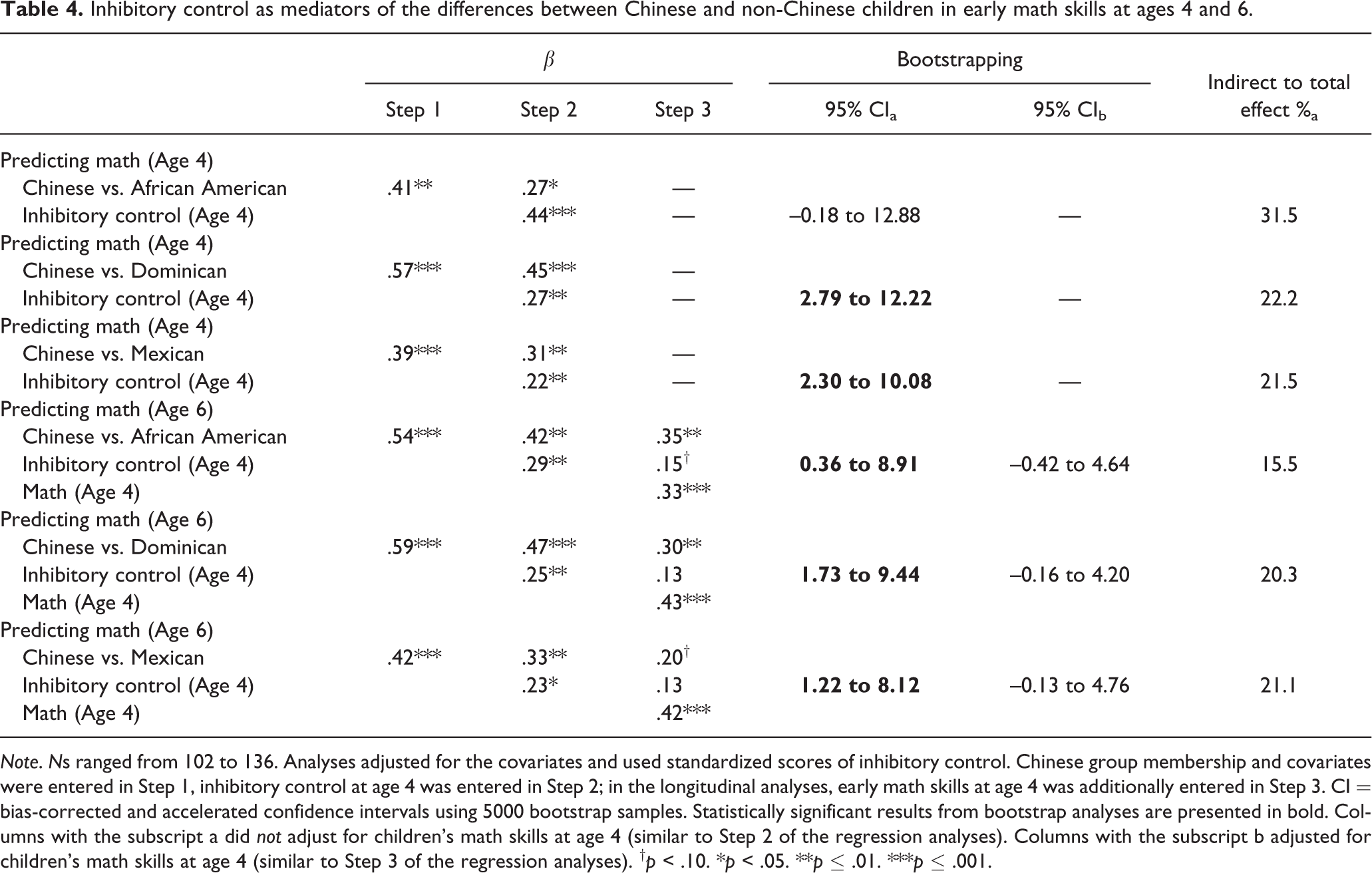
Note. Ns ranged from 102 to 136. Analyses adjusted for the covariates and used standardized scores of inhibitory control. Chinese group membership and covariates were entered in Step 1, inhibitory control at age 4 was entered in Step 2; in the longitudinal analyses, early math skills at age 4 was additionally entered in Step 3. CI = bias-corrected and accelerated confidence intervals using 5000 bootstrap samples. Statistically significant results from bootstrap analyses are presented in bold. Columns with the subscript a did not adjust for children’s math skills at age 4 (similar to Step 2 of the regression analyses). Columns with the subscript b adjusted for children’s math skills at age 4 (similar to Step 3 of the regression analyses). † p < .10. *p < .05. **p ≤ .01. ***p ≤ .001.
As a more stringent test of the mediating role of inhibitory control, in the longitudinal analyses, children’s prior math skills at age 4 was entered in the last step of the regression model, thereby testing whether inhibitory control at age 4 might have accounted for, in part, the association between Chinese group membership and children’s growth in math skills from ages 4 to 6. Once analyses additionally adjusted for children’s prior math skills, however, inhibitory control was no longer a significant mediator of the differences between Chinese children and those of the other three ethnic groups in their early math skills at age 6. This is likely to be due, in part, to the highly stable nature of early math skills from ages 4 to 6 (see Table 3).
To test for reverse causality, concurrent mediation analyses were also conducted to examine if early math skills at age 4 might partially mediate the associations between Chinese group membership and inhibitory control at this age. The bootstrap approach indicated that, at age 4, math skills only partially accounted for the Chinese–Dominican, 95% CI = 0.08 to 1.56, difference in inhibitory control. No mediation was evident for the Chinese–African American, 95% CI = –1.00 to 1.82, and Chinese–Mexican, 95% CI = –1.12 to 0.30, differences in inhibitory control at this age.
Discussion
There is growing evidence that preschoolers’ EF skills, including their inhibitory control, are positively associated with their school readiness skills. However, much of these data has been based on cross-sectional studies with predominantly White non-Hispanic children. The current study extended prior research by examining the concurrent as well as longitudinal associations between inhibitory control and early math skills among children from four ethnic groups (Chinese, African American, Dominican, and Mexican) and of relatively disadvantaged backgrounds. Children’s inhibitory control at age 4 was not only associated with their early math skills at the same age but predicted their growth in such skills in the two years that followed after adjusting for ethnicity. Comparisons of children’s inhibitory control and early math skills revealed that Chinese children were generally more advanced than the other three ethnic groups across ages 4 to 6 years, adjusting for family background factors. Chinese children’s advantage in early math skills at both ages over the other three ethnic groups could be explained, in part, by their relatively advanced inhibitory control at age 4. Overall, these findings highlight the role of EF in children’s school readiness skills and the need for greater attention to ethnic variations in EF during the preschool years.
The current findings are in line with prior longitudinal studies, which have found EF, including inhibitory control, to be a strong and consistent predictor of early math skills (Blair & Razza, 2007; Welsh et al., 2010). These findings are important given that the literature on the links between EF and school readiness skills is primarily based on cross-sectional evidence. The associations between inhibitory control and math skills documented in this research could be due, in part, to the strong emphasis on fluid cognitive skills in the mathematics curricula in the States (Blair, Gamson, Thorne, & Baker, 2005), given that such skills involve the inhibition of irrelevant, prepotent responses and information that may interfere with the execution of correct responses or the maintenance of relevant information (Blair, 2006). Indeed, some of the first math problems that children encounter in school may already require them to inhibit the prepotent tendency to respond to the most salient or recent aspect of the problem (e.g., for 2 + 3, children may have to inhibit the tendency to say 4 given that it follows 3; Blair & Razza, 2007). Among preschoolers from low-income background, the better their performance on approximate number system problems that involve conflicting properties (e.g., a group of stars of greater numerosity covers a smaller surface area than another group of smaller numerosity), the better their general math skills after adjusting for their receptive vocabulary, with this association accounted for by their inhibitory control (Fuhs & McNeil, 2013). Investigators have also pointed out that the ability to inhibit irrelevant information from intruding into working memory is important for using memory-based processes to solve math problems, such as the direct retrieval of arithmetic facts and decomposition (Geary, 2011). Additional research assessing more specific aspects of early math skills, such as subitizing, counting, and arithmetic, may better elucidate the role of inhibitory control and EF in general in the development of specific math skills.
Although results indicated that inhibitory control predicted early math skills, it should be noted that inhibitory control was only assessed with the peg-tapping task. The reliance on a single measure makes it difficult to rule out the possibility that the current findings might reflect, to some extent, the characteristics of this particular task, even though it has been widely used to assess inhibitory control. Specifically, this task requires children to be attentive to the number of taps performed by the experimenter and themselves, with both adding up to three taps for each trial in the case of a correct response. The math component of this task may, therefore, have led to overestimation of the association between inhibitory control and early math skills in the current study. Although prior studies assessing inhibitory control with other tasks that do not involve a math component have similarly found a positive association between inhibitory control and early math skills during the preschool years (Clark et al., 2013; Espy et al., 2004), further research using other measures of inhibitory control is needed. For example, the day–night task can be used in place of the peg-tapping task, given that it also requires participants to remember two rules and inhibit the prepotent response but does not have a math component (see Diamond & Taylor, 1996).
A related issue concerns whether the associations found between inhibitory control and early math skills might be specific to a particular kind of inhibitory control. Although it remains equivocal as to how many different kinds of inhibitory control there are and what they entail, there appears to be at least three kinds of inhibitory control, which involve controlling one’s attention (selectively attending to a stimulus and ignoring others, which may or may not be automatic), cognition (suppressing irrelevant mental representations), and behavior (delaying or suppressing a prepotent response and additionally performing a correct response; see Diamond, 2013; Nigg, 2000). Effortful control, which involves resisting temptations and impulsive behaviors, especially in affect-laden context, can also be viewed as another kind of inhibitory control given the overlap between the two (Nigg, 2000; Zhou et al., 2012). Given that the peg-tapping task primarily involves inhibitory control in behavior, further research is needed to determine if the current findings can be generalized to other kinds of inhibitory control. In addition, it should be noted that the peg-tapping task contains both a “delay” element and a “conflict” element in that children are not only required to inhibit a prepotent response but also perform a correct response that is incompatible with the prepotent response (Carlson & Moses, 2001; Mazzocco & Kover, 2007). Further studies are needed to reveal which of these two elements of inhibitory control may be more predictive of children’s early math skills and whether ethnic differences exist in both elements. These unanswered questions point to fruitful directions for research.
Because this research did not assess inhibitory control at age 6, it was not possible to test for reverse causality by examining whether early math skills at age 4 predicted a growth in inhibitory control from age 4 to age 6. Nevertheless, our findings that early math skills at age 4 partially mediated the difference between Chinese and Dominican children in inhibitory control at this age is consistent with prior longitudinal research indicating that the development of both EF and school readiness skills involve transactional processes (Welsh et al., 2010). To date, the causal direction in associations among early math skills and inhibitory control is not clear, with evidence suggesting both directions. A recent causal impact evaluation of a combined early math and early literacy curriculum implemented in a large public preschool program not only found moderate-to-large positive impacts on math and literacy skills, but also accompanying small positive impacts on the very same measure of inhibitory control as was used here (Weiland & Yoshikawa, 2013). Given that this curriculum focused on building math and literacy skills rather than EF skills, the small positive impacts on EF suggest that cognitively focused curricula may spillover to promote EF, offering further support for the math to EF causal direction.
A strength of this research lies in its examination of variations in children’s inhibitory control by ethnic background. There are few studies on EF with ethnically diverse samples, with even fewer comparing children from different ethnic or cultural backgrounds (for exceptions, see Lan et al., 2011; Sabbagh et al., 2006). As an initial step in filling this gap, this research examined the mean levels of inhibitory control among children from four ethnic backgrounds. Results revealed that Chinese children outperformed the other three ethnic groups in inhibitory control at age 4. This pattern does not easily line up with socioeconomic differences: For example, the Chinese parents reported lower levels of education than their African American and Dominican counterparts and a level of household income comparable to or lower than those of the other three groups. This raises the question of what factors may give Chinese children an advantage in this component of EF. A plausible explanation involves the ubiquitous demands for self-regulation that Chinese culture places on children (Ho, 1994), which may specifically facilitate the development of inhibitory control. Indeed, whether residing in Mainland China or the United States, Chinese children grow up in a highly structured home environment that requires them to display self-restraint (Luo, Tamis-LeMonda, & Song, 2013) and to continually regulate a wide range of behavior, from addressing bodily needs such as elimination to expressing their emotions, starting as early as infancy (for reviews, see Chen, 2010; Tardif et al., 2009). Similar demands for self-regulation are also placed on children early on in school: Observations of first-grade classrooms revealed that teachers in Mainland China spend three times more time than their American counterparts giving instructions to regulate children’s behavior proactively (Lan et al., 2009). Comparatively speaking, although African American and Latino cultures also place restrictions on children’s behavior, the focus may be more specific to children’s obedience to elders and respect for others. A fruitful direction of research would be to explore whether self-regulatory demands placed on children may vary by ethnic background and whether ethnic differences in such demands may contribute to ethnic variations in inhibitory control.
Moving beyond mere description of ethnic differences in inhibitory control, this study investigated the implications of these differences for ethnic minority children when they are making the transition into formal schooling. Although inhibitory control at age 4 was found to partially account for the positive associations between Chinese group membership and early math skills both concurrently and two years later, the reductions in these associations did not reach significance once longitudinal analyses adjusted for prior math skills at age 4. This likely reflects the fact that children’s early math skills were quite stable across the two-year period examined (r = .50, p < .001; see Table 3). Prior longitudinal studies have similarly reported such skills to be quite stable during the preschool and kindergarten years (Clark et al., 2013; Welsh et al., 2010). As such, the relatively small sample size in each ethnic group in this study might not have afforded sufficient statistical power to detect the expected mediation when adjusting for prior math skills. Nevertheless, the current findings offer initial support for the idea that inhibitory control may contribute, among other factors, to the well-documented ethnic gap in children’s cognitive school readiness. Empirical investigation of this idea remains rare to date. This may represent a fruitful direction for future research, which has important implications for the design of intervention programs aimed at reducing this gap.
Limitations
Several limitations of the current study warrant consideration. Firstly, although the sample consisted of more than 250 children, the sample size was only about 60 children per ethnic group. The relatively low statistical power may have rendered undetected some of the ethnic differences in inhibitory control and early math skills. Secondly, children’s expressive language skills were taken as a proxy for verbal intelligence and included as a covariate in the analyses. Given evidence that bilingual children tend to lag behind monolingual children in their expressive as well as receptive language skills (Hammer, Jia, & Uchikoshi, 2011), the intellectual ability of bilingual children in this study might have been underestimated. It may be fruitful for future research to additionally include measures of non-verbal intelligence such as the block design subtest of the Wechsler preschool and primary scale of intelligence–III (WPPSI–III; Wechsler, 2002; see Bierman et al., 2009), or assess bilingual children’s verbal intelligence in both their first and second languages (Peña & Halle, 2011). Thirdly, the current study focused on inhibitory control and did not assess children’s cognitive flexibility and working memory. Studying all three components of EF would have yielded a more complete picture about how these components may be uniquely associated with school readiness skills.
Conclusion
Despite these caveats, this research yields important empirical evidence for the longitudinal relations between inhibitory control and early math skills in an ethnicity diverse sample from low-income backgrounds. Moreover, it revealed important ethnic similarities and differences in inhibitory control among Chinese, African American, Dominican, and Mexican children. Given the well-documented ethnic gap in cognitive school readiness, it was also noteworthy that Chinese preschool-aged children’s relatively advanced inhibitory control partially contributed to their advantage in early math skills over the other three ethnic groups both concurrently and two years later when they were in first grade. Taken together, this research advanced the field beyond ethnically homogeneous or solely panethnic studies of EF among young children. It also underscored the role of EF as one of the factors that may contribute to differences in school readiness skills among ethnic minority children, when they are making the critical transition to formal schooling.
Footnotes
Acknowledgments
We thank our colleagues and staff, particularly Cristina Hunter, Carmen Jimenez-Robbins, Yana Kuchirko, Eva Liang, Julia Raufman, Emerald Shee, Irene Wu, as well as the hundreds of families who have participated in our research over the years.
Funding
This work was supported by grants from the National Science Foundation (grant numbers 021859, 0721383) to the second and third authors and from the Research Grants Council of Hong Kong (grant number CUHK451710) to the first and second authors.