




Abstract
This study examined the relations of maternal warmth, behavioral control, and encouragement of sociability to social, school, and psychological adjustment in migrant children in China. The participants were 284 rural-to-urban migrant children (M age = 11 years, 149 boys) in migrant children’s schools and their mothers. Data on parenting were collected from mothers’ reports. Data on children’s adjustment were collected from multiple sources including peer assessments, teacher ratings, self-reports, and school records. It was found that maternal warmth was associated with children’s social and school performance, and that maternal encouragement of sociability was associated with children’s psychological adjustment. Maternal behavioral control was not associated with children’s adjustment. The results indicate that maternal warmth, behavioral control, and encouragement of sociability may serve different functions in different domains of adjustment among migrant Chinese children.
Introduction
The rapid social-economic development from the mid-1980s onward in China has resulted in “the largest migration in human history” (Zhang, 2004). Millions of rural people, mostly young adults, have moved to cities to seek opportunities, with many of them bringing their families including children. According to the National Population and Family Planning Commission of China (2012), the migrant population reached 2.7 billion in 2012. It is estimated that approximately 8.73 million children aged 0–14 years have moved to the city with their parents (Gao, 2009). As a highly vulnerable group (Zhai, 2008), these migrant children face great challenges in their new environment due to various factors at policy, social, and personal levels. Because of the household registration (Hukou) system, for example, migrant families do not have an urban status and thus do not claim the same privileges and benefits that urban families enjoy (Lague, 2003). Until recently, migrant children were not entitled to attend local public schools because they did not have a regular urban Hukou (Wong, Chang, He, & Wu, 2010). As a result, a number of migrant children’s schools were established, usually in suburban areas (Li et al., 2010). Although the Chinese government has implemented a number of policies in recent years to encourage migrant children to attend local public schools, some migrant families still choose to place their children in migrant children’s schools for reasons such as high tuition fees in public schools (Li et al., 2010). In Beijing, it was reported that approximately 140,000 children were enrolled in migrant children’s schools in 2011 (Lu, Zhang, Li, & Lin, 2012). Students in these schools are from families that have moved from the countryside in different provinces. Most of the migrant schools are not registered with a school board, and the facilities and organization of the schools generally do not meet the standards set by the Ministry of Education of China (Li, 2009). Most of the teachers, who are also from provinces outside the city and live in the migrant community, do not have adequate and formal training in education and thus cannot provide as much guidance and support as regular teachers for children’s academic, social, and psychological development (Xu, 2010).
Migrant children may also experience heightened social difficulties (Tao, Xu, Zhang, Gu, & Hong, 2004). Parents of migrant children usually have low levels of education and do long hours of manual work for low wages working as, for example, cleaners, waiters, construction workers, rubbish collectors, and other blue-collar occupations (Lague, 2003). Migrant children are often treated as “outsiders” by their urban peers, and prejudice and discrimination make it difficult for migrant children to integrate into the local society (Jiang, 2007; Tao et al., 2004). At the same time, it is difficult for migrant children to maintain relationships with friends in their hometown due to the long distance and other obstacles. In short, migrant children generally live in a stressful environment that may threaten their social and psychological well-being.
Previous studies with migrant children focused mainly on comparing rural migrant children with urban non-migrant children (e.g. Tao et al., 2004; Yuan, Zhang, & Su, 2009). The results indicated that relative to their urban non-migrant counterparts, in general, migrant children had poorer academic performance and were more likely to experience a variety of psychological problems such as low self-esteem, depression, and loneliness (e.g. Jiang, 2007; Tao et al., 2004). However, little research has been conducted to investigate factors that are related to children’s adjustment. Findings from this type of investigation can help us achieve a better understanding of how migrant children adapt in adversity.
It has been argued that positive parenting is a powerful protective factor that prevents children from developing behavioral and psychological problems in adverse environments (Masten et al., 1999; Masten & Shaffer, 2006). Support and guidance from parents may be particularly important for the social and psychological adjustment of migrant children. After moving to a new location, it is difficult for migrant children to maintain regular connections with their extended families and peers. Parents may be the only major source of social support that migrant children have for a long period. Many migrant families intend to stay in the city for a long time, so their children have opportunities to receive a better education and achieve a high social and economic status in the future. However, migrant parents differ in sensitivity to, and understanding of, their children’s difficulties such as discrimination due to their migrant status and in provision of support to their children (Zhang, 2011). Thus, it is interesting to investigate what factors in migrant families would affect children’s development. In the present study, we sought to examine how parenting was linked with social, school, and psychological adjustment in migrant children.
Parenting and children’s social and psychological adjustment
Research findings have indicated that parenting plays a significant role in children’s socioemotional and school adjustment (e.g. Bornstein, 2002; Parke & Buriel, 2006). Among various aspects or dimensions of parenting, researchers have often focused on parental warmth and control (e.g. Chen, Liu, & Li, 2000; Maccoby & Martin, 1983). Parental warmth is considered to facilitate the development of competence and adaptive functioning, because it constitutes a major source of emotional and social support for children in their exploration of the environment (Rubin et al., 2004; Wagner, Cohen, & Brook, 1996). For example, children and adolescents with warm parent-child relationships are more likely than others to discuss issues with their parents (Franzoi & Davis, 1985), which increases the opportunity to obtain parental assistance. Parental warmth also helps children build confidence and feelings of security (Bowlby, 1969; Parke & Buriel, 2006), which may be particularly important in assisting those living in adverse circumstances to cope with their stress and distress. Thus, in a broad sense, parental warmth may serve to mitigate the negative influence of an undesirable environment and protect children from developing maladaptive outcomes (Masten, 2001). Consistent with these arguments, it was found that children and adolescents from families with economic hardship whose mothers were warm and supportive displayed less depressive symptoms and behavioral problems than their counterparts who had less warm mothers (Ge, Natsuaki, Neiderhiser, & Reiss, 2009; Gore & Aseltine, 1995; Wagner et al., 1996). Studies with disadvantaged groups, such as African American and Latino American children and pre-adolescents from poor families living in a high-risk neighborhood, revealed that supportive, warm mother-child relationships attenuated the impact of risk factors. Children with warm mothers developed fewer externalizing and internalizing problems (Brody, Dorsey, Forehand, & Armistead, 2002; Klein & Forehand, 2000; Loukas & Prelow, 2004).
Parental control is another parenting dimension that has received a great deal of attention in developmental research (Darling & Steinberg, 1993; Maccoby & Martin, 1983). However, the studies of associations between parental control and child outcomes have yielded mixed results (Barber, Olsen, & Shagle, 1994). The effects of parental control on child development depend, to a large extent, on the nature of parental control as well as its context. Psychological control, referring to parenting practice that impedes the development of autonomy and self-direction, tends to be associated with poor adjustment such as lower levels of self-esteem and life satisfaction (Aquilino & Supple, 2001; Pettit, Laird, Dodge, Bates, & Criss, 2001). Behavioral control, defined as parental regulation of children’s behaviors and often indicated by parental monitoring and supervision (Barber et al., 1994; Stattin & Kerr, 2000), however, is found to be associated with fewer adjustment problems, such as antisocial behavior, substance and alcohol use, delinquency, and other externalizing problems (e.g. Galambos, Barker, & Almeida, 2003; Kiesner, Poulin, & Dishion, 2010). It has been argued that parental firm behavioral control may be particularly important for children and adolescents living in a high-risk environment, as it protects them from dangerous surroundings by reducing the likelihood that children associate with deviant peers and develop behavioral problems (Beyers, Bates, Pettit, & Dodge, 2003; Brody et al., 2002). Studies with early adolescents have shown that low levels of parental behavioral control are often associated with unsupervised time “hanging out” with peers, which is associated with aggression, delinquency, and substance use (Flannery, Williams, & Vazsonyi, 1999; Pettit, Bates, Dodge, & Meece, 1999). Therefore, children of parents who exert high behavioral control and monitoring are at a reduced risk of developing problem behaviors in the undesirable environment in which they live. In the current study, we focus on parental behavioral control, which is concerned with controlling children’s behavior and monitoring their daily activities (Barber et al., 1994; Stattin & Kerr, 2000; Wang, Pomerantz, & Chen, 2007).
Parenting in Chinese migrant families
Research conducted in China indicates that major parenting dimensions or aspects, such as warmth and control, are related to the adjustment of urban children in a manner similar to that found in Western countries (Chen et al., 2000; Eisenberg, Chang, Ma, & Huang, 2009). For example, maternal warmth is associated with positive social and emotional outcomes among urban Chinese children (Chen, Wu, Chen, Wang, & Cen, 2001; Lim & Lim, 2004; Chen et al., 2000). To our knowledge, however, there is no research on parenting behaviors of migrant Chinese parents, and little is known about relations between parenting and the adjustment of children in migrant families in China.
The relations between parenting practices and social and psychological adjustment in migrant Chinese children may be different from those in urban Chinese children. Since the 1980s, China has carried out a large-scale economic reform toward a market-oriented society, along with the introduction of Western individualistic values such as initiative-taking, autonomy, and competitiveness, which has had a profound impact on parenting attitudes and practices (Chen & Chen, 2010). However, economic reform is mainly limited to urban areas, and rural residents do not have the same exposure to economic reform as their urban counterparts. As a result, rural Chinese parents may be more inclined than urban Chinese parents to maintain traditional socialization goals and beliefs (Chen & Li, 2012). Migrant families come from rural areas and are likely to continue using parenting styles and practices that are consistent with traditional values (Ho, 1989). Group harmony and obedience to authority are often emphasized in traditional Chinese society (Chen & French, 2008; Tamis-LeMonda et al., 2008). In this context, parents are encouraged to control their emotions in parent-child interactions, because the expression of emotions is thought to be disruptive to interpersonal and group harmony and to weaken parental authority (Bond, 1991). In addition to fewer emotional expressions, Chinese mothers are less elaborative when discussing emotions with their children (Wang, 2001). Therefore, it is conceivable that affective communication, which is the main form Western parents use to express warmth, may not be common in migrant parents who value traditional parenting styles and practices. Instead, migrant Chinese parents may show their love, care, and warmth toward children through providing guidance in schoolwork and preventing behavioral and social problems (Chao, 1994). Given this background, it is an interesting question whether parental warmth is associated with child behaviors and adjustment in migrant families in a manner that is similar to what has been described in existing literature (e.g. Ge et al., 2009; Maccoby & Martin, 1983; Suchman, Rounsaville, DeCoste, & Luthar, 2007). Based on the speculation that migrant parents may express their love and affection by assisting with their children’s schoolwork and helping them learn appropriate social behaviors, we expected in this study that the effects of parental warmth would be more evident on school and social adjustment than on psychological adjustment of migrant children.
Only a few studies on parental behavioral control have been conducted with Chinese families, and its relations to children’s adjustment are largely unclear. Whereas parental behavioral control was found to be associated with children’s school performance in some studies (e.g. Wang et al., 2007), nonsignificant relations were reported in other studies (e.g. Chen et al., 2000). Migrant families mainly live in an environment with poor and relatively risky conditions (Department of Floating Population Service and Management of National Population and Family Planning Commission of China, 2010). Parental behavioral control and supervision may be beneficial to migrant children’s adjustment. Parents’ awareness of their children’s activities and discipline may help children learn to protect themselves from engaging in deviant behaviors such as involvement in gang activities. Therefore, we expected in this study that maternal behavioral control would be associated with social and school adjustment in migrant Chinese children.
In addition to parental warmth and behavioral control, we were interested in parental encouragement of sociability and its relations with child adjustment. We believe that this parenting dimension may be particularly relevant to migrant children’s adjustment. After moving to the city, it is difficult for migrant children to maintain their connections with their relatives and peer groups in their hometown. Thus, it is important for them to explore the new environment to re-establish social networks. Parental encouragement of sociability represents parental efforts to help their children to socialize with others, especially peers. Parental support for sociability may help children become more confident in the new environment and form new social connections, which may be an important resource for them to cope with stress and reduce their feeling of isolation and loneliness (Wong et al., 2010; MacMillan & Violato, 2008). It has been found that sociability is conducive to adjustment mainly in psychological domains in Chinese children (Chen & Chen, 2010). Sociable migrant children may be more likely than others to form new supportive social networks, which may help them develop self-confidence and cope with emotional distress such as loneliness and depression. Therefore, we expected that maternal encouragement of sociability would have particularly evident effects on the psychological adjustment of migrant children.
The current study
The primary purpose of the present study was to investigate the relations between parenting and social and psychological adjustment in migrant children from grade 3 to grade 6. Research has shown that pre-adolescence is an important period for Chinese children as they experience increased socioemotional challenges and academic pressure (Chen, 2010; Chen, Dong, & Zhou, 1997). The challenges and pressure may be particularly heightened for migrant children due to the stress they experience in adapting to the new urban environment. It is conceivable that, whereas some migrant children are relatively well adjusted in social, school, and psychological areas, others may develop various problems. It would be interesting to examine how maternal parenting would be associated with migrant children’s adjustment and problems. We focused on three dimensions or aspects of parenting: (1) parental warmth; (2) behavioral control; and (3) encouragement of sociability with peers. We collected data on children’s adjustment including social competence, social preference, academic performance, distinguished studentship, behavioral problems, loneliness, and depression. These variables tapped social, school, and psychological adjustment that are important for school-age children in Chinese as well as many other societies (Chen et al., 2000; Masten & Coastworth, 1998).
Based on the earlier discussion that migrant parents might express their warmth and control mainly to guide children’s behaviors in social situations and to assist with schoolwork, we hypothesized that maternal warmth and behavioral control would be positively associated with children’s social and school adjustment. In addition, we expected that parental encouragement of sociability would help children explore the new environment and establish social support systems and, thus, would be associated with adjustment, especially in psychological areas.
Method
Participants
The sample consisted of 284 students (149 boys) in grades 3 to 6 in 3 migrant children’s schools (127, 77, and 80 students) and their mothers in Beijing. The participants were recruited through their schools. The mean age of the participants was 11.17 years (SD = 1.63 years).
The three migrant children’s schools were located in a suburban area of the city. There were 12 classes in the study, with mostly 20–30 students in each class. The core curriculum consisted of Chinese, mathematics, and English. One teacher was designated to be in charge of a class. This teacher taught one or more major courses and took care of the social and daily activities of the class. Students spent roughly the same amount of time in the classroom. Students were encouraged to participate in some extracurricular social and academic activities in school, which provided opportunities for children to interact with each other. The schedule of courses and other activities was typically identical for students in the same class. Children in the schools came from different provinces in China and were not official residents in the city because they did not have the urban status (Hukou). Of the children, 91.5% were from intact families, and the others were from one-parent families because of parent death, divorce or other reasons.
Procedure
We group administered to the children a peer assessment measure of social competence and a sociometric nomination measure. Children completed self-report measures of loneliness and depression. Teachers were asked to complete a rating scale for each participant concerning his or her behavioral problems and learning problems. Mothers of the children completed a parenting measure. In addition, data concerning children’s academic performance and distinguished studentship were obtained from school records. The data were collected near the end of the school year (May and June).
The members of our research team carefully examined the measures that were initially developed in the US, using a variety of formal and informal strategies (e.g. repeated discussion in the research group, interviews with children and teachers, psychometric analysis). We translated and re-translated the measures to ensure comparability with the English versions. Extensive explanations of the procedures were provided during administration. No evidence was found that the children had difficulties understanding the procedure or the items in the measures. Written consent was obtained from all children and their parents. The participation rate was 95%.
Measures
Peer assessments of social competence
Children’s social competence was assessed using a peer nomination measure adapted from the Revised Class Play (RCP) (Masten, Morison, & Pellegrini, 1985). This technique is particularly useful for assessing children’s social competence in different contexts, because it taps insiders’ perspectives. Following the procedure described by Masten et al. (1985), during administration, the research assistant read each of the behavioral descriptors (e.g. “Someone who is a good leader”), and children were asked to nominate up to three classmates who could best play the role if they were to direct a class play. When all children in the class had completed their nominations, they turned to the next item. Students were allowed to nominate a classmate for multiple items. Nominations from all classmates were used to compute item scores for each child. The item scores were standardized within the class to adjust for differences in the number of nominators. Factor analysis indicated that the 13 items (e.g. “A person who everyone listens to,” “A person with good ideas for things to do,” “Someone who helps other people when they need it”) represented the corresponding factor. Thus, the variable of social competence was formed based on the items. This procedure has been shown to be reliable and valid in Chinese children (e.g. Chen, Chang, Liu, & He, 2008; see also Chen, Rubin, & Li, 1995, for test–retest reliabilities). The internal reliability of the measure was .94 in the present study.
Sociometric nominations
Children were asked to nominate up to three classmates with whom they most liked to be and three classmates with whom they least liked to be (positive and negative nominations). The nominations received from all classmates were totaled and then standardized within each class to permit appropriate comparisons. As suggested by other researchers (e.g. Coie, Terry, Lenox, Lochman, & Hyman, 1995), cross-gender nominations were allowed. The procedure has been shown to be valid in Chinese children (e.g. Chen et al., 1995). Following Coie, Dodge, and Coppotelli’s procedure (1982), an index of social preference, which indicates the likability of each child in the class, was formed by subtracting negative nomination scores from positive nomination scores.
Teacher ratings
The teacher completed for each child in his or her class a measure of behavioral and learning problems, adapted from the Teacher-Child Rating Scale (T-CRS) (Hightower et al., 1986). The teacher was asked to rate, on a scale ranging from 1 (not at all) to 5 (very well), how well each item described the child. There were five items assessing children’s behavioral problems (e.g. “Disrupting others while they are studying,” “Often fight with peers”), and six items assessing learning problems (e.g. “underachieving,” “poorly motivated to achieve,” “having difficulties learning academic subjects”). Factor analysis of the data in this study indicated that the items loaded on the corresponding factors. Thus, consistent with the procedure used in previous studies (e.g. Chen et al., 1995), the variables of behavioral and learning problems were formed by averaging scores of the corresponding items. The teacher-rating scores were standardized within the class to control for the teacher’s response style and to allow for appropriate comparisons. The measure has been shown to be reliable and valid among Chinese children (e.g. Chen et al., 1995; Chen et al., 2008). Internal reliabilities in the present study were .84 for behavioral problems and .77 for learning problems.
Academic performance
Participants’ grades in Chinese, mathematics and English were collected from school records. The scores were based on the examinations conducted by the schools. Consistent with procedures used in previous studies (e.g. Chen, Cen, Li, & He, 2005), scores in the three courses were first standardized and then aggregated to form a single index of academic achievement. Academic achievement was significantly correlated with teacher-rated learning problems, r = −.55, p < .001. A single index of academic performance was formed by aggregating standardized scores of academic achievement with reversed standardized scores of learning problems.
Distinguished studentship
There is usually a formal evaluation of each student in each academic year in Chinese schools. Students who are judged by classmates and teachers to be socially, morally and intellectually competent may be nominated for the award of distinguished student. There are different levels of distinguished studentship, from the class level, to the school level, to the district level. Data on distinguished studentship were obtained from the school records. Distinguished studentship was coded as follows: students who did not receive any awards received a score of 0; students who received an award at the class level received a score of 1; and students who received an award beyond the class level received a score of 2. The information has been shown to be a reliable indicator of school competence in Chinese children (e.g. Chen et al., 1995). As in previous studies (e.g. Chen et al., 1995, 2005), the scores of distinguished studentship were standardized within each class to adjust for class and school differences in the selection process.
Loneliness
Children’s feelings of loneliness and social dissatisfaction were assessed by a self-report measure (Asher, Hymel, & Renshaw, 1984). Following the procedure outlined by Asher et al. (1984), children were asked to respond to 16 self-statements (e.g. “I have nobody to talk to,” “I am lonely,” “I don’t have anybody to play with at school”) using a 5-point scale (1 = not at all true; 5 = always true). The average scores of the responses were computed and used in the analysis, with higher scores indicating greater loneliness. The measure has proved reliable and valid in Chinese children (e.g. Chen et al., 2004). The internal reliability of the measure was .77 in the present study.
Depression
Children’s depression was measured by a Chinese version of the Children’s Depression Inventory (adapted from Kovacs, 1992). The Chinese measure included all 10 items in the short version (CDI-S) and 4 additional items from the full version that were considered useful by the research team in assessing Chinese children’s depressed mood (the 14-item version was highly correlated with the full version in several large samples in China, with rs = .95 −.96, ps < .001). There are three alternative responses to each item from which the participant chooses one that best describes her or him in the past two weeks. The items center on a given thought, feeling, or behavior associated with depression, such as self-deprecation, reduced social interest, anhedonia, fatigue, and self-blame. The items were scored 0, 1, or 2, and the mean scores of the items were computed, with higher scores indicative of greater depression. The measure has proved to be reliable and valid in Chinese children (Chen et al., 2005). The internal reliability of the measure was .77 in the present study.
Maternal ratings
Mothers were asked to complete a measure concerning their parenting practices, adapted from several other measures (Block’s Child-Rearing Practices Report (CRPR), 1981; Rohner’s Parental Acceptance and Rejection Questionnaire (PARQ), 1984; Schaefer’s Children’s Report of Parental Behavior: An Inventory (CRPBI), 1965). There are seven items on warmth (three from CRPR, three from PARQ, and one from CRPBI) and six items on behavioral control (three from CRPR and three from CRPBI). In addition, we developed a scale of parental encouragement of sociability (five items) for this study. Mothers rated on a 5-point scale (1 = strongly disagree; 5 = strongly agree) how the items in the measure described their parenting practices. Both exploratory and confirmatory factor analyses revealed that the items loaded on the corresponding factors: parental warmth (e.g. “I give my child comfort and understanding when he/she is upset or scared,” “My child and I have warm, intimate times together”, seven items), behavioral control (e.g. “When my child is not at home, I always want to know what he or she is doing,” “I establish some rules for my child and tell him or her to follow”, six items), and encouragement of sociability (e.g. “I encourage my child to take part in social activities,” “I encourage my child to make new friends”, five items). Average scores were computed based on the corresponding items to form the parenting variables. Internal reliabilities were .78, .73, and .73 for maternal warmth, control, and encouragement of sociability, respectively, in this study.
Results
Descriptive statistics
A multivariate analysis of variance (MANOVA) was conducted to examine the overall effects of gender and grade, as well as their interactions on all the variables. Significant main effects of gender and grade were found, Wilks’ Λ = .79, F(10, 231) = 6.09, p < .001, and Wilks’ Λ = .65, F(30, 678) = 3.62, p < .001. Follow up analyses indicated that children in grade 3 had higher scores on loneliness than those in grade 4 (M = 2.44 and 2.07, SD = .70 and .63), and children in grade 3 had higher scores on depression than those in grade 5 (M = 1.57 and 1.39, SD = .32 and .35). Boys had higher scores on loneliness and teacher-rated behavioral problems, and lower scores on social competence, social preference, distinguished studentship and academic performance. The means and standard deviations of variables for boys and girls are presented in Table 1.
Mean and standard deviations of parenting and adjustment variables.
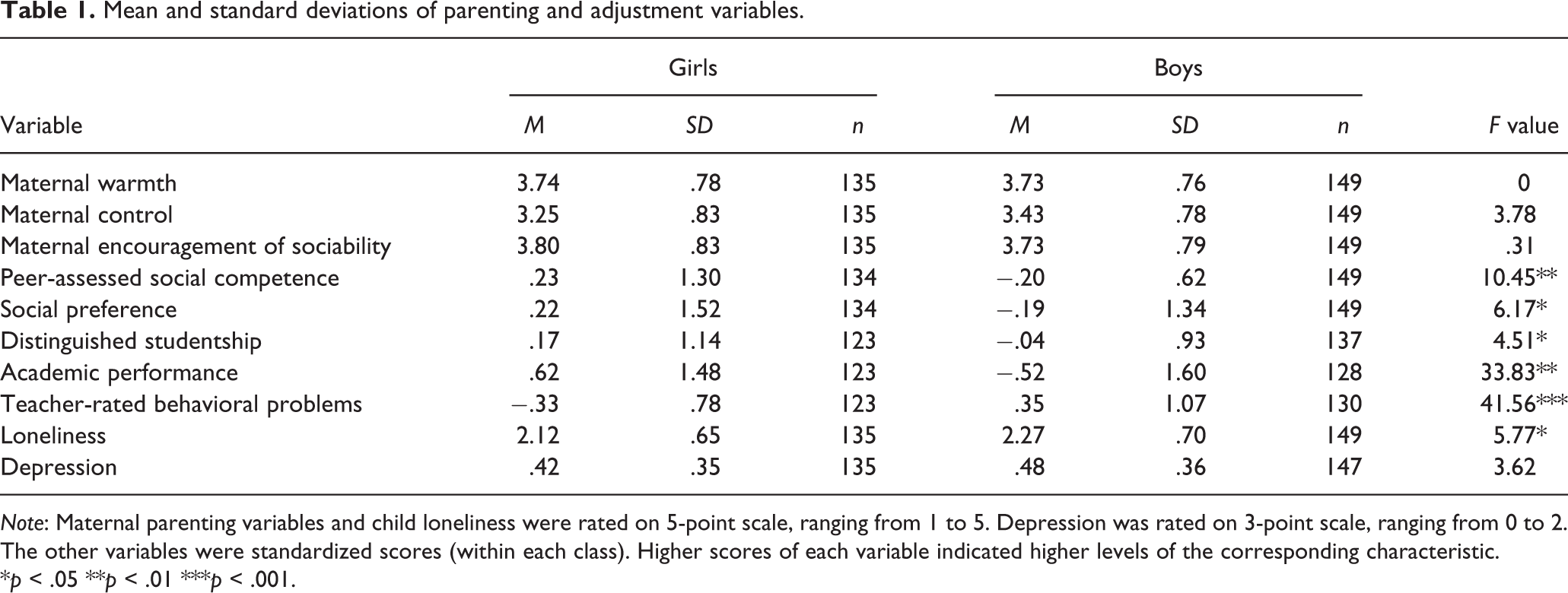
Note: Maternal parenting variables and child loneliness were rated on 5-point scale, ranging from 1 to 5. Depression was rated on 3-point scale, ranging from 0 to 2. The other variables were standardized scores (within each class). Higher scores of each variable indicated higher levels of the corresponding characteristic. *p < .05 **p < .01 ***p < .001.
Intercorrelations among parenting and adjustment variables are presented in Table 2. The magnitudes of the correlations were generally weak to moderate, suggesting that these measures tapped different, overlapping aspects of social, school, and psychological adjustment.
Correlations among parenting and adjustment variables.
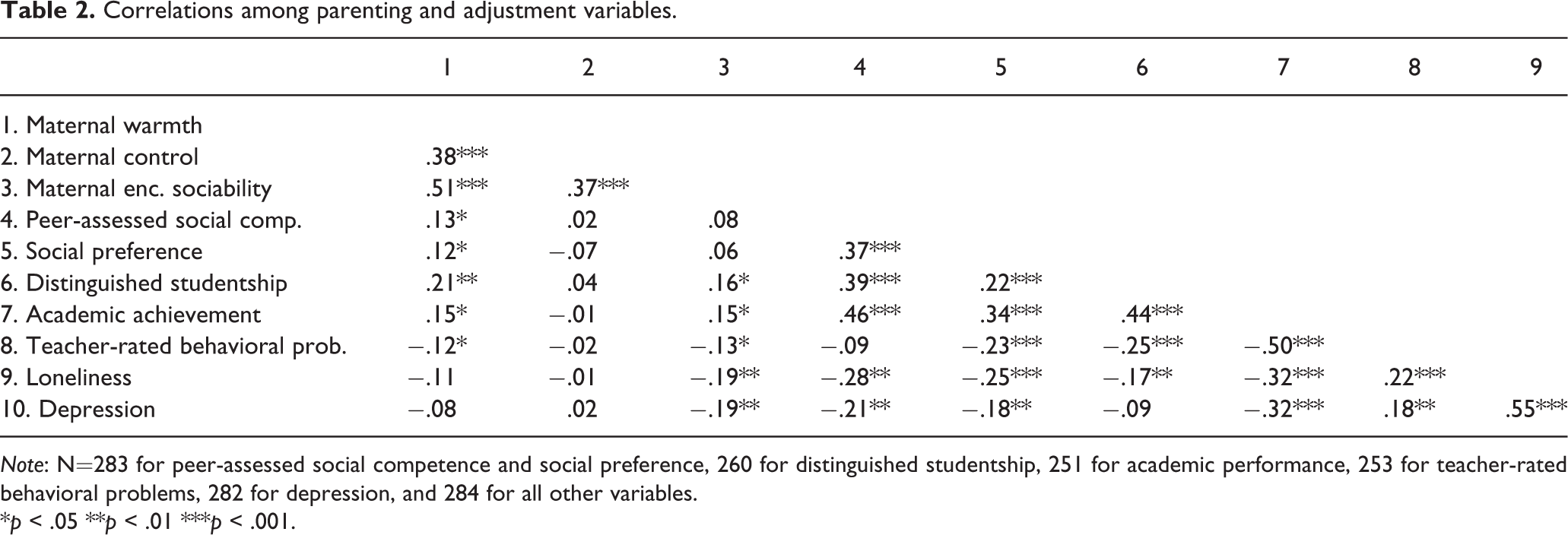
Note: N=283 for peer-assessed social competence and social preference, 260 for distinguished studentship, 251 for academic performance, 253 for teacher-rated behavioral problems, 282 for depression, and 284 for all other variables.
*p < .05 **p < .01 ***p < .001.
Relations between parenting variables and child adjustment variables
Given the nested nature of the data, we calculated intraclass correlation (ICC) for the variables. All ICC values were small (ranging from 0 to .05), indicating that there was a lack of between-class or between-school variability and that multilevel regression was not appropriate for the analysis in the study. Therefore, a series of hierarchical regressions was conducted to analyze the relations between parenting variables and adjustment variables. Children’s gender and grade were entered in the first step to control for gender and grade effects. Maternal parenting variables were entered into the equation in the second step simultaneously. The interaction terms between gender and maternal parenting variables and between grade and maternal parenting variables were entered in the last step to examine moderating effects of gender and grade. As suggested by Aiken and West (1991), all predictor variables were centered before the interaction terms were computed and entered. The variance inflation factor values were smaller than 1.6, indicating that multicollinearity was not a concern in the study.
The regression analyses indicated that the effects of gender were consistent with those in MANOVA. After controlling for the effects of gender and grade, maternal warmth had unique and positive contributions to the prediction of social preference, distinguished studentship, and academic performance. Maternal warmth also had a negative contribution to the prediction of teacher-rated behavioral problems. No significant relations were found between maternal control and adjustment variables. Finally, maternal encouragement of sociability uniquely and negatively contributed to the prediction of loneliness and depression. The results indicated that maternal warmth was mainly associated with social and school adjustment and that maternal encouragement of sociability was associated with psychological adjustment. The regression results concerning the main effects of parenting variables are presented in Table 3. No moderating effects of gender and grade were found on the relations between parenting and child adjustment. The interaction results are not included in the table.
Regression analyses in predicting adjustment variables.
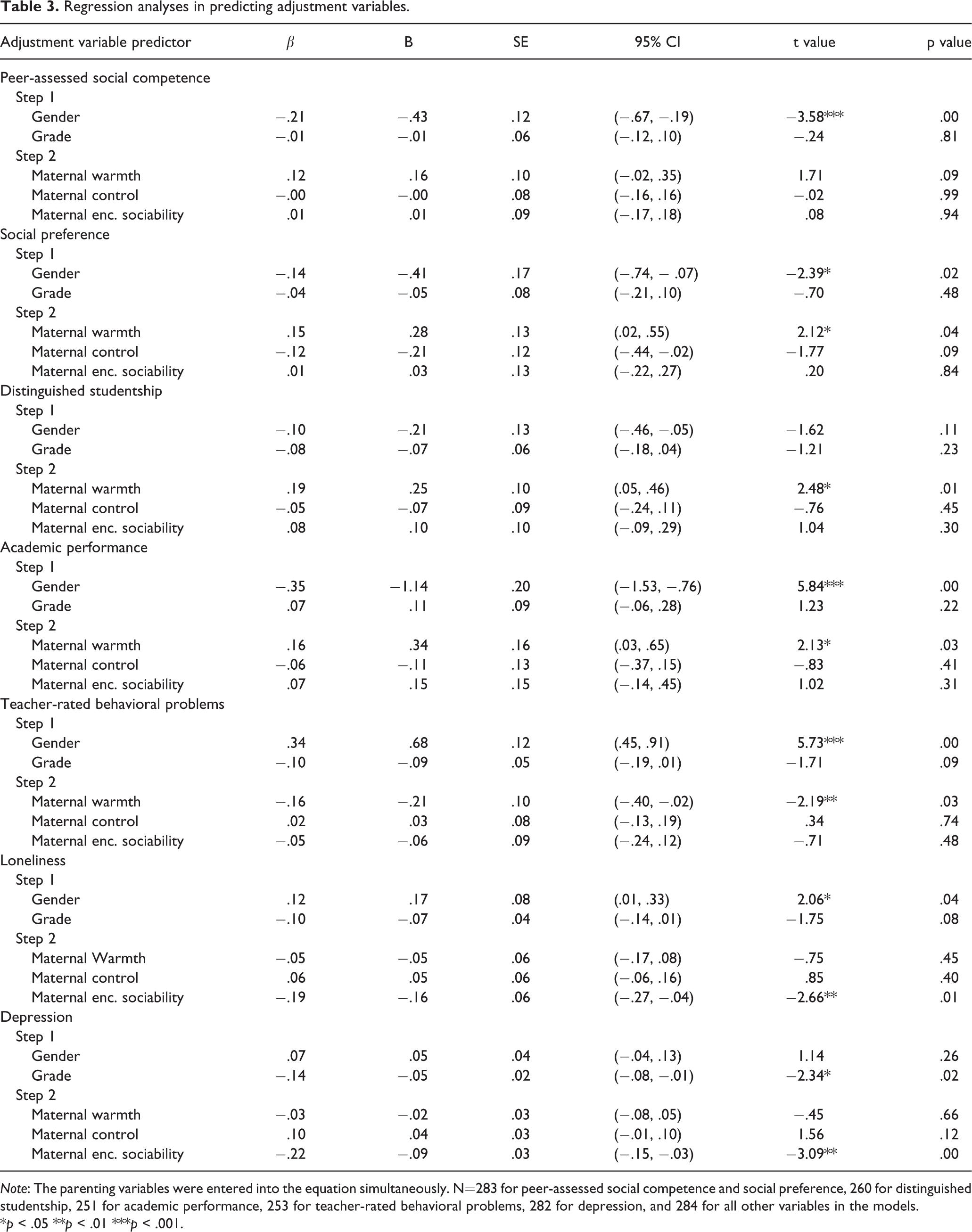
Note: The parenting variables were entered into the equation simultaneously. N=283 for peer-assessed social competence and social preference, 260 for distinguished studentship, 251 for academic performance, 253 for teacher-rated behavioral problems, 282 for depression, and 284 for all other variables in the models.
*p < .05 **p < .01 ***p < .001.
Discussion
After moving to a city from a rural area, migrant children in China typically live in a stressful environment that may elicit social and psychological problems (Chen, Wang, & Wang, 2009). Nevertheless, research findings have indicated that children may differ in their susceptibility to the negative environmental influence, and that there may be considerable variations among migrant children in adjustment (Chen et al., 2009; Yuan et al., 2009). In the current study, we examined how major parenting styles were associated with socioemotional and school adjustment in Chinese migrant children. The results indicated that maternal warmth was positively associated with social and school performance including social preference, distinguished studentship, and academic performance, and was negatively associated with teacher-rated behavioral problems. Maternal encouragement of sociability was negatively associated with loneliness and depression. In addition, maternal control was not associated with adjustment variables. These results suggest that the parenting styles or dimensions may serve distinct functions in the adjustment of migrant Chinese children, which may have implications for policy and intervention programs.
Relations between parenting and children’s adjustment
Substantial evidence in the literature has shown that parental warmth is an important factor in attenuating the negative impact of adverse environments on children’s adjustment (Gil-Rivas, Greenberger, Chen, & Lopez-Lena, 2003; Wagner et al., 1996). Our results in this study indicated that maternal warmth was positively associated with social and school adjustment, but not psychological adjustment, in Chinese migrant children. The results suggest that the expression of warmth in Chinese migrant families may be different from that in Western or regular urban Chinese families. Migrant Chinese mothers tend to use traditional parenting styles and practices that discourage frequent affective expression in parent–child interactions (Bond, 1991; Camras, Kolmodin, & Chen, 2008; Chen et al., 1998; Wang, 2001). In addition, psychological problems such as loneliness and depression are often neglected in traditional Chinese society because they do not threaten group harmony (Chen, 2010). Thus, migrant mothers might pay little attention to their children’s psychological well-being. As a result, migrant children are likely to obtain limited support from their mothers for coping with their emotional distress and other psychological difficulties. Nevertheless, migrant mothers may express their warmth in other ways such as providing specific instrumental support and guidance for children’s schoolwork and for displaying appropriate behaviors in social interactions (Chao, 2001; Ho, 1989; Wu & Chao, 2011), which may help children to gain social and academic success in school. This may be particularly the case given that acquiring social and academic achievement is viewed as the primary socialization goal in traditional Chinese cultures, which continues to exert a great impact on rural and rural-to-urban migrant parents (e.g. Chen, Yang, & Wang, 2013). Therefore, it is conceivable that maternal warmth is associated with social and academic achievement among migrant children.
It should be noted that, in this study, we conceptualized and assessed parental warmth in the same manner as that in the literature (e.g. “I have warm, intimate time with my child,” “I give my child comfort when they feel upset.” Chen et al., 2000, 2001; Lim & Lim, 2004; Rohner, 1984). However, we argue that parental warmth in migrant Chinese families may be expressed in specific ways of parent-child interaction or directed toward specific aspects of child development that are important for migrant families. This argument is largely speculative, and we did not examine how parental warmth was expressed in the study. Researchers should explore the processes in the future, perhaps using various methods such as observation, which will help us achieve a better understanding of the functional meaning of parental warmth in different contexts.
Our results showed that maternal encouragement of sociability was related to psychological adjustment of migrant children. Thus, children whose mothers encouraged them to engage in active social interaction and social initiative-taking tended to report lower levels of loneliness and depression. Parental encouragement of sociability is an indication of parental support for children’s exploration of the social environment. Adapting to the new environment is challenging and is likely to result in negative emotional reactions such as fear and anxiety for migrant children. Parental support during the process may help migrant children to develop a sense of security and self-confidence and reduce negative reactions and psychological problems. In addition, parental support for sociability may be conducive to children’s development of social relationships outside the family. Studies with immigrant and migrant children indicate that social networks are particularly important for them to adjust psychologically to their new environment (e.g. Shin, Han, & Kim, 2007; Wong et al, 2010), as they constitute a main source of social and emotional support that helps migrant children cope with their emotional distress such as feelings of loneliness. Thus, affiliation with group networks may mitigate the adverse effects of relatively limited interaction with parents at home. Migrant parents’ encouragement of sociability may facilitate children’s participation in social interactions and formation of social relationships with others, which in turn may attenuate the development of psychological problems.
We expected that maternal control would be associated with children’s social and school performance. Inconsistent with our expectations, parental control was nonsignificantly associated with all adjustment variables. Moreover, the associations between maternal control and peer preference and academic achievement, though nonsignificant, were negative in direction. Similar results were found in a longitudinal study in a sample of urban Chinese children (Chen et al., 2000). Several explanations may be offered for the nonsignificant relations. First, the “meaning” of parental control is unclear in Chinese families. It has been argued that because parental authority is traditionally emphasized in the Chinese society, parental control is regarded by parents and children as reflecting parental care, concern, and involvement in child rearing (Chao, 1994; Leung, Lau, & Lam, 1998; Steinberg, Lamborn, Dornbush, & Darling, 1992). Consequently, children may respond to parental control by displaying compliance. On the other hand, it has been argued that because parents who use high control, especially in combination with parental directiveness and intrusiveness, are likely to emphasize child obedience, their children may not understand parental guidance and may have relatively few opportunities to explore the environment and develop autonomy and social responsibility (e.g. Chen et al., 1997). Similarly, it has been argued that parental control is considered to be related to children’s feelings of being controlled, and thus compromise children’s development of independence (Black & Krishnakumar, 1998; Kerr & Stattin, 2000). As a result, this parenting practice may not be highly effective in promoting child social and school competencies. According to Kerr and Stattin (2000), the strategies parents use to exert control are important in predicting child developmental outcomes. It will be interesting in future research to examine specific strategies that migrant parents use in parenting.
Second, in Chen et al.’s (2000) study, it was found that how parental control was related to children’s adjustment depended on the initial status of the child. Specifically, parental control positively predicted later social competence for children who had initial high competence. However, parental control also positively predicted later problems for children who initially had social and behavioral problems. Thus, parental control may promote adaptive development for children who are well adjusted but, at the same time, may exacerbate problems for children with adjustment difficulties. In other words, parental control itself may not predict adjustment outcomes without considering children’s conditions. Therefore, researchers should conduct longitudinal studies with migrant children, which will allow for integrative analysis of the joint effects of parental control and children’s initial status.
Limitations and future directions
There were several limitations and weaknesses in the current study. First, the purpose of this study was to examine how the different maternal parenting practices were associated with social, school, and psychological adjustment among migrant children. The data about the associations were correlational, thereby precluding any inferences about causal directions. Our discussion of the relations focused on the direction from parent to child, mainly from a socialization perspective (e.g. Bornstein, 2002). It has been argued, however, that whereas parenting may influence child behavior, child characteristics and adjustment may in turn affect parenting practices (Bell & Chapman, 1986; Lytton, 1990). Longitudinal data will help us understand the causal processes involved in the relations.
Second, it has been argued that, like North American parents, Chinese mothers and fathers may assume different socialization duties and interact with children in different ways (Ho, 1987). Indeed, research has shown that Chinese mothers and fathers play different roles in child rearing (Chen et al., 2000). It will be interesting to investigate the relations between paternal parenting and social and psychological adjustment in Chinese migrant children.
Third, studies in Western countries have shown that immigrant parents who are more “acculturated” toward the values and lifestyles in the recipient society tend to display parenting attitudes and behaviors that are consistent with those in the society (e.g. Yagmurlu & Sanson, 2009). After moving to the big city, migrant parents in China may gradually accommodate urban values and change their behaviors. A weakness of the present study is that we did not assess migrant parents’ attitudes and acculturation. It will be important in future research to explore acculturation orientations and processes among migrant parents and investigate how they affect migrant parents’ socialization beliefs and behaviors, and ultimately child development.
Fourth, as mentioned earlier, migrant families in China experience various social, economic, and other difficulties (Jiang, 2007; Tao et al., 2004). We discussed the stressful environment mainly as a background to the population. We did not collect data on family social and economic conditions in this study. It will be important to investigate the effects of stressful circumstances and experiences, such as family socioeconomic status and parents’ working hours, on parenting and adjustment of migrant children.
Finally, we assessed maternal parenting through maternal reports in the present study. Children’s reports of parenting may also be relevant to social functioning and psychological adjustment as children’s perceptions of parenting behaviors and attitudes may mediate parental influence (Chen et al., 2000). Researchers should obtain information in the future about children’s perceptions of parenting and examine how they are associated with their behavior and performance. Despite the weaknesses, the present study provided valuable information about the role of maternal parenting in Chinese migrant children’s adjustment in different domains.
Footnotes
Author note
The research and the preparation of this paper were supported by grants from the Social Sciences and Humanities Research Council of Canada and the National Science Foundation (#BCS-1225620). We are grateful to the children, parents, and teachers for their participation.