



Abstract
The majority of episodic memory (EM) tests are far removed from what we experience in daily life and from the definition of this type of memory. This study examines the developmental trajectory of the main aspects of episodic memory—what, where, and when—and of feature binding in a naturalistic virtual environment. A population of 125 participants aged from 6 to 24 years was asked to navigate, by using a joystick, in a virtual urban environment composed of specific areas, and to memorize as many elements as possible (e.g., scenes, details, spatial and temporal contexts). The ability to recall factual content associated to details or spatiotemporal context increased steadily from the age of 8 to young adulthood. These results indicate main developmental differences in feature binding abilities in naturalistic events which are very sensitive to age in comparison with a standard EM assessment. Virtual reality therefore appears to be an appropriate technique to assess crucial aspects of EM development in children and adolescents and it should provide helpful tools for the detection of subtle memory deficits.
Episodic memory (EM) is the memory of personal specific events, and contributes to the development of a sense of identity. Despite its crucial role in daily life, the standard tools used for its assessment in children remain incomplete and do not take recent data concerning EM development into account. In fact, paper-and-pencil tools cannot distinguish between the abilities of different EM components (what, where, when), and often show ceiling effects during childhood, whereas experimental and neuroimaging data point to a lengthy increase of EM until adolescence. The present study thus aimed to propose a new ecological tool to assess multifaceted EM components from childhood to adulthood, without diminishing experimental control. A virtual reality EM task was created and proposed to 125 participants aged 6 to 24 years, and developmental profiles of these abilities were compared to those obtained with a standard EM task.
Throughout childhood, various cognitive abilities develop, including the episodic subcomponent of long-term memory. According to its most recent definition, EM refers to personal events and experiences recollected with details in the context of a particular time and place, and with some reference to oneself as a participant in the episode (Tulving, 2001). Therefore, a genuine EM test needs to focus on five abilities: memory for core factual information (e.g., objects, pictures), for their details, for their spatial and their temporal context, and the ability to memorize all of this information as a whole. It is all the more necessary to have precise EM tests as EM is known to be specifically fragile and is frequently impaired in common neurological disorders affecting children and adolescents such as epilepsy (Helmstaedter & Elger, 2009), traumatic brain injury (Scherwath et al., 2011), or developmental amnesia (Picard et al., 2013). While many standardized EM tests are available, few of them capture the complexity of its definition. In fact, these paper-and-pencil tests generally focus on the ability to memorize factual information (e.g., lists of words or figures) while the memorization of the spatio-temporal context is seldom evaluated (Lezak, Howieson, Bigler, & Tranel, 2012; Strauss, Sherman, & Spreen, 2006). Moreover, such tests are far removed from everyday situations as they use stimuli that are very different from real-world scenarios, and lack richness and self-relevance. The failure to emulate real-life may even explain their low ability to accurately predict daily functioning (Farias, Harrel, Neumann, & Houtz, 2003; Gioia & Isquith, 2004) and the poor link with daily memory complaints (Matheis et al., 2007; Plancher, Gyselinck, Nicolas, & Piolino, 2010; Plancher, Tirard, Gyselinck, Nicolas, & Piolino, 2012).
Some experimental tests have thus been created in order to better assess EM and its development. Unfortunately, the great majority of these studies have also focused on the ability to memorize core factual content, showing major changes between the ages of 2 and 6 years (Newcombe, Lloyd, & Ratliff, 2007), with nonetheless substantial developments continuing until adolescence (Chiu, Schmithorst, Brown, Holland, & Dunn, 2006; McAuley, Brahmbhatt, & Barch, 2007; Waber et al., 2007). The rare studies interested in the ability to recall contextual content have emphasized the complexity of this recall in children (Bauer et al., 2013; Friedman, 2005; Gulya et al., 2002). This process may develop independently from the ability to memorize core factual content (Czernochowski, Mecklinger, Johansson, & Brinkmann, 2005; Naito, 2003; Romine & Reynolds, 2004) and involve separate encoding processes depending on the type of context (Van Asselen, Van der Lubbe, & Postma, 2006). Beyond contextual recall, long-term binding processes could be the most complicated aspect of EM. These processes make it possible to interconnect the different characteristics of an episode, forming its cohesive mental representation (Kessels, Hobbel, & Postma, 2007). Memory for associations is in fact more age-sensitive than memory for isolated information. For example, Bauer and colleagues (2012) recently reported that memory for specific laboratory events increased between the ages of 4, 6 and 8 years, especially concerning the interrelationships between events and their specific locations (see also Lloyd, Doydum, & Newcombe, 2009; Sluzenski, Newcombe, & Kovacs, 2006). The diverse types of feature binding (factual-factual, factual-spatial, factual-temporal) seem to develop at various specific rates, underlined by various mechanisms (Picard, Cousin, Guillery-Girard, Eustache, & Piolino, 2012). Surprisingly, the EM test used by Picard et al. (2012) did not reveal developmental changes beyond the age of 10. These results go against neuroimaging studies indicating major changes during adolescence in the cerebral structures underlying EM (Blakemore, 2012). Besides, a recent study (Guillery-Girard et al., 2013) showed, with another type of experimental task (the what-where-when paradigm), significant changes in EM abilities throughout adolescence concerning the abilities to memorize factual–factual, factual–spatial or factual–temporal information (the participants had to memorize the association between animal photos and respectively 1. a photo of one of its features, 2. its location in an array, or 3. its order in relation to other photos). Unfortunately, the developmental profile of the different types of context could not be clearly depicted as the difficulty of the task varied according to the age of the participant (children aged 6 to 10 years had to memorize 10 associations, whereas older participants had to memorize 13 associations). Moreover, “genuine” EM assessment implies testing the ability to recall complex associations with all EM components as a whole. According to the two-component EM development model introduced by Shing (Shing, Werkle-Bergner, Li, & Lindenberger, 2008; see also Sander, Werkle-Bergner, Gerjets, Shing, & Lindenberger, 2012), both strategic and associative components could in fact be the root of EM development. The strategic component refers to cognitive control processes based on prefrontal regions that monitor memory functions at both encoding and retrieval, whereas the associative component refers to associative abilities based on the hippocampus that integrate the different features of the memory content into coherent long-term representations.
To sum up, there is a large gap between what the literature reveals about EM development and the instruments used for its assessment. Thus, there is a crucial need for new evaluation tools with both enhanced ecological validity and with experimental control. This is possible with virtual reality (VR). VR uses a three-dimensional computer-generated environment with multi-sensory stimulations in which participants are immersed (Schultheis & Rizzo, 2001). The numerous assets of VR technology have been recognized and various fields of neuroscience research and therapy have begun to use it (Bohil, Alicea, & Biocca, 2011). The essential advantages of VR include on the one hand the fact that the standardization of the administration of tasks can be improved with multimodal stimuli presented in a controlled manner (Mueller et al., 2012), and on the other hand the possibility of creating playful environments that stimulate several senses. This makes VR particularly appropriate for the study of EM, if we are to assess its most defining characteristics: feature-binding processes.
The few studies that have used VR to study EM processes (Burgess, Maguire, Spiers, & O’Keefe, 2001; Plancher, Barra, Orriols, & Piolino, 2013) showed that compared to standard tests, VR–EM tests are more sensitive in detecting the effects of aging (Plancher et al., 2010), more sensitive to the participants’ daily memory complaints, and more precise in characterizing EM deficits (Spiers et al., 2001). Unfortunately, although VR is particularly suitable for children who find computer-generated tasks more engaging than paper-and-pencil ones (Attree, Turner, & Cowell, 2009), and show increased motivation to participate in tests (Harris & Reid, 2005), VR studies remain scarce in children, and even nonexistent concerning EM (Parsons, Rizzo, Rogers, & York, 2009; St-Jacques, Bélanger, & Bouchard, 2007).
In view of the gap between the EM assessments proposed by pediatric neuropsychologists and EM developmental patterns, the present study aimed to propose a new ecological tool to assess multifaceted EM components from childhood to adulthood (based on our previous VR experiments in adults, Jebara, Orriols, Zaoui, Berthoz, & Piolino, 2014; Plancher et al., 2010, 2012, 2013). EM was assessed from the ages of 6 to 24 years with a new VR–EM-test that includes the intentional encoding of visuospatial scenes, and the recall of their different components (what-where-when). We also wanted to benchmark this new ecological test against a standard EM test. The Family Pictures subtest of the Children’s Memory Scale (Cohen, 2001) was selected, given that it shares crucial properties with the VR–EM-test including intentional encoding of visuospatial scenes and recall of multiple types of information. Based on previous investigations, we hypothesized that age would have a considerable effect on EM abilities in the VR-EM-test, notably when high levels of binding processes are required (e.g., Picard et al., 2012). Moreover, given that the VR-EM-test was designed to increase richness of the stimuli, and assess feature binding processes, we hypothesized that the age related improvement would be greater in the VR-EM-test than in the standard one.
Method
Participants
In this study, 125 children, adolescents and young adults aged from 6 to 24 years took part (67 girls, 58 boys). They were recruited from French schools and universities and were all native French speakers. Most participants came from middle- to upper-class families. They were divided into six age groups: twenty-four 6-year-olds (M = 6 years 7 months), twenty-four 7-year-olds (M = 7 years 7 months), twenty five 8–10-year-olds (M = 9 years 3 months), fifteen 10–12-year-olds (M = 10 years 11 months), fifteen 14–16-year-olds (M = 15 years 2 months) and twenty-two 18–24-year-olds (M = 20 years 4 months). The children’s parents filled in a questionnaire to ensure the absence of a background of neurological or psychiatric medical history, developmental learning disorders and repetition of a grade at school. Also, 79 participants distributed across the six age groups performed the Family Pictures subtest (fourteen 6-year-olds, eleven 7-year-olds, fifteen 8–10-year-olds, fifteen 14–16-year-olds and nine 18–24-year-olds).
The children’s participation was conditioned by their parents’, headmasters’ and teachers’ approval, and their own willingness to take part in the experiment. Young adults provided written informed consent for their participation in the study. All data included in this study were obtained in compliance with the Helsinki Declaration. In addition, all the participants had to perform the Progressive Matrices test (Raven, Raven, & Court, 2003) in order to assess non-verbal reasoning abilities. All of the participants performed within the normal range of their age group and were thus included in the statistical analyses.
Procedure
Participants were tested individually during approximately 1 hour. Children were seen in a quiet room at their school, and adults at their home. Tests were administered in a fixed sequence: VR-EM-test and Progressive Matrices (Raven et al., 2003). Participants who underwent the Family Pictures subtest did it at the end of the session.
The VR-episodic memory test
Materials
The virtual equipment was composed of a computer-generated 3–D model of a virtual environment. This environment was built with Virtools Dev 3.0 software (www.virtools.com) and novel 3-D software to create virtual urban environments and scenarios developed in our laboratory (Editomem & Simulamem, LMC, Paris Descartes University). The town environment was imaginary but some buildings were based on Paris, France. The environment was run on a PC laptop computer and participants had to explore the virtual town using a joystick. Before immersion in the town, they were submitted to training until they felt comfortable with the apparatus. The training path consisted of an empty track, without any common elements with the to-be-encoded environment, except for the road that was similar. Instead of simply showing the participants a video of a walk in the town (passive encoding), participants navigated through the town themselves (active encoding), since the latter condition has been shown to strengthen distinctive memory traces when compared to the former (Plancher et al., 2012, 2013; Sauzéon et al., 2012).
Participants were then immersed in a virtual urban environment, with a soundtrack of typical city noise. There was only one possible route, around which various visual elements were arranged. In total, 27 different elements were seen during the immersion (see Figure 1). Each element was encountered a single time. Some elements were very distinctive, totally different from others (e.g., the fountain, the train station), whereas others were less distinctive, combining common characteristics and distinctive details (e.g., several men are encountered but only one is bald with a brown T-shirt). Elements could be located on the left, on the right or in the middle of the road.

Map of the virtual environment and example of a view of the virtual town. The participant sees a scene with three elements: one unique element (the fountain), and two multiple factual elements (a man and a woman) presented here in a specific version (a bald man with a brown T-shirt, and a woman with curly hair and a colorful T-shirt). The yellow billboard depicting a lime allows the participants to find their route.
Procedure
Encoding phase
Participants were told that they would have to visit a friend who lives in a red building with an open door near the train station. To find their route, they had to follow big yellow billboards depicting a lime, which ensured that all the participants saw each element. During their walk in the virtual town, participants had to try to memorize as many elements as possible, in order to recall them at the end of the presentation (intentional encoding). They not only had to pay attention to the elements, but also to their details, the place and time where and when they were encountered. Participants received instructions not to make any U-turns. None of them experienced difficulties with finding their way as the billboards were positioned in obvious places. The elements to be memorized were regularly arranged, along the way around and between the billboards. Thus, all participants encountered all the elements in the same order. The exposure time was unconstrained and depended on the speed of the participants. Nonetheless, it was relatively constant (M = 9 min 42 sec, 95% CI [9 min 20 sec, 10 min 4 sec]). There was no statistical difference between the age groups, F(5, 119) = 2.06, MSE = 0.59, p = .3, ηp 2 = .07, and none of the memory scores (mentioned below) were linked with exposure time (rs between −.06 and .12, p ns). None of the participants felt uncomfortable during the immersion and all were at ease with the use of the joystick.
Test phase
After approximately 15 minutes (dedicated to the Progressive Matrices test), participants were asked to freely recall as much of the information encountered during the encoding phase as possible, without instructions concerning any specific order. To prevent information being omitted even though it had been memorized, participants were systematically asked to specify the details, the spatial and the temporal context of each factual item recalled. Answers were given orally by the participants, and the experimenter entered the participant’s responses directly in a structured response grid validated in previous studies by our group (e.g., Plancher et al., 2013).
Scoring
The VR-Factual score corresponded to the number of distinctive factual elements correctly remembered; it was obtained by summing the number of distinctive factual elements recalled (max = 27). It included all specific factual elements (whose recall was sufficiently precise to be distinguished from other factual elements). For example, recalling “the fountain” led to one VR-Factual point, as did the recall of “the bald man”. Elements that were not sufficiently precise to be clearly identified were not scored (i.e., generic elements that were not recalled with specific characteristics; for example “a man”, “a car”).
In addition, we computed three one-way binding scores concerning distinctive factual elements that were correctly associated with one feature (VR-Detail score, VR-Spatial score, VR-Temporal score). The VR-Detail score merged all unique factual elements recalled with one or several details (unique factual elements recalled with at least one detail, for example “the train station with a big clock”, and generic factual elements recalled with at least two distinctive details, for example “the bald man with a brown T-shirt”). Whatever the number of details recalled for each element, only one point was given (for example, “a French flag was sited in front of the station” or “the station was black and grey, it had four columns” led to one point). VR-Spatial and VR-Temporal scores corresponded to the number of distinctive factual elements that were correctly remembered in association to the relevant (egocentric or allocentric) spatial context and temporal context, respectively (for example “the station was on my left”, “the bald man was just at the beginning of my navigation”). Concerning the spatial context, even if egocentric and allocentric type of answers were explained during instructions, the allocentric spatial context was not used by participants, who systematically used an egocentric point of view.
Finally, we calculated a two-way binding score (VR-Episodic score) concerning distinctive factual elements recalled with both contextual features (spatial and temporal). It corresponded to the number of distinctive elements that were correctly remembered with all contexts (element + spatial context + temporal context). Recall of details was not included in this score as we were above all else interested in the ability to memorize specific events situated in their spatio-temporal context. One- and two-way binding scores were necessarily lower than the VR-Factual score. Two experts rated the responses (LP, MA); in the very rare case of disagreement between the experts, consensus was reached after a rapid discussion.
Standard episodic memory test
Among the few standard tests available for EM assessment in children, the Family Pictures (FP) test, which is part of the Children’s Memory Scale (CMS; Cohen, 2001), was selected because it tests the ability to bind multiple features of a complex visual pictorial scene (factual information = character, detail = action performed, spatial context = position of the character in the scene). In this test, participants were shown pictures depicting people doing various things and asked to memorize everything they could about each visual scene (4 scenes). Immediately after each picture and also after an interference delay of about 15 to 20 minutes, participants had to recall which characters were in the scene, what each character was doing, and where each of them was located, based on a quadrant division of the empty scene.
The Family Picture score (max = 48) pooled abilities to recall factual (one point was given for each character and two points for each action correctly recalled) and spatial information (one point for each location correctly recalled). For example, one character correctly recalled in association with his spatial location was scored two points, whereas a character correctly recalled with an action was scored two or three points, depending on the precision of the action recalled (e.g. “the dog caught an object” led to two points, since “the dog caught the plastic disk” led to three points)
Results
Statistical analyses
As the one and two-way binding scores depended on the amount of factual information recalled, repeated measures of variance could not be used to examine the age group effect on all scores simultaneously. We thus conducted five statistical analyses in order to explore the effect of age on the different VR-EM scores. First, we conducted a one-way ANOVA on the VR-Factual score, with age (6 groups) as a between-participants factor. As this analysis revealed a significant effect of age on the VR-Factual score, the effect of age on the one- and two-way binding scores was explored independently of age differences in remembering basic specific elements. To estimate purely binding scores, we thus calculated the frequency of events reported in association with additional information given the frequency of factual events (i.e., VR-Detail, VR-Spatial, VR-Temporal and VR-Episodic scores divided by VR-Factual score). We then conducted four successive ANOVAs on these new binding scores, with age (6 groups) as between-participants factor. Secondly, a one-way ANOVA was conducted on the Family Pictures score, with age (6 groups) as a between-participants factor. The direction of the differences was explored with post-hoc Tukey tests. The effect sizes were reported (partial eta-squared values: ηp 2), in order to indicate the strength of the relationship independently of the sample size. In agreement with Guéguen (2006), we considered effect sizes as small for ηp 2 < .06, medium for .06 ≤ ηp 2 < .14, and marked for ηp 2 ≥ .14.3.
Finally, simple regression analyses were conducted on the episodic scores (VR and Family Pictures Test), with chronological age as a predictor, in order to address more specifically the contribution of age to these abilities.
The effect of age on the VR-EM test
The ANOVA on the VR-Factual score revealed a strong effect of age on the quantity of specific elements correctly recalled, F(5, 119) = 59.57, MSE = 633.9, p < .001, ηp2 = .71; see Figure 2. Post-hoc Tukey tests indicated that mean performance increased with age: all comparisons were significant at p < .05 to p < .001, except the one between the two youngest groups (6- and 7-year-olds), and the one between the 8–10- and 10–12-year-old groups (see Figure 2).
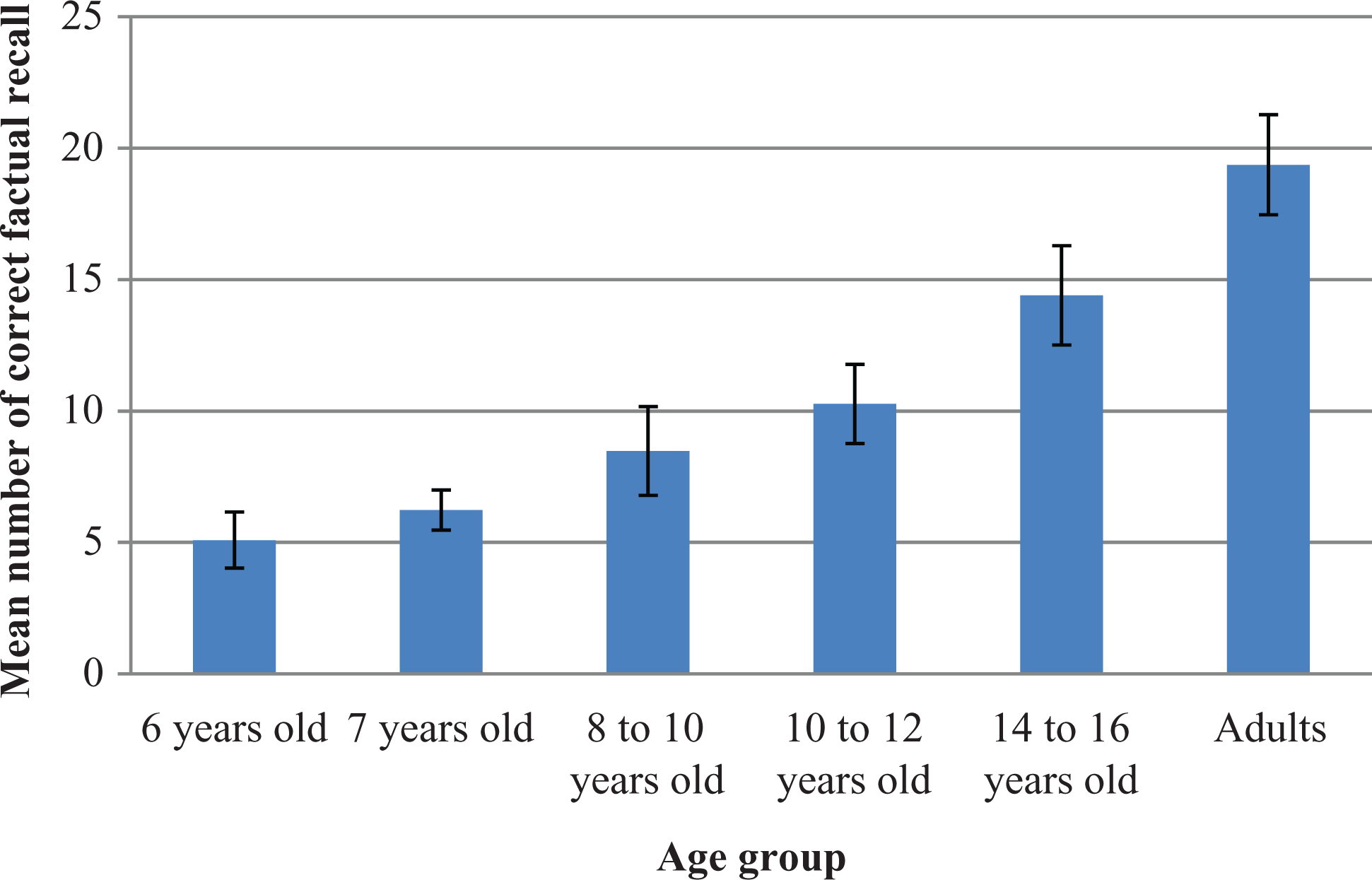
Mean and 95% confidence intervals of the Virtual Reality–Factual score (distinctive elements).
In order to estimate purely binding scores, the frequency of events reported in association with feature information given the frequency of events was calculated. Descriptive statistics are depicted in Figure 3.
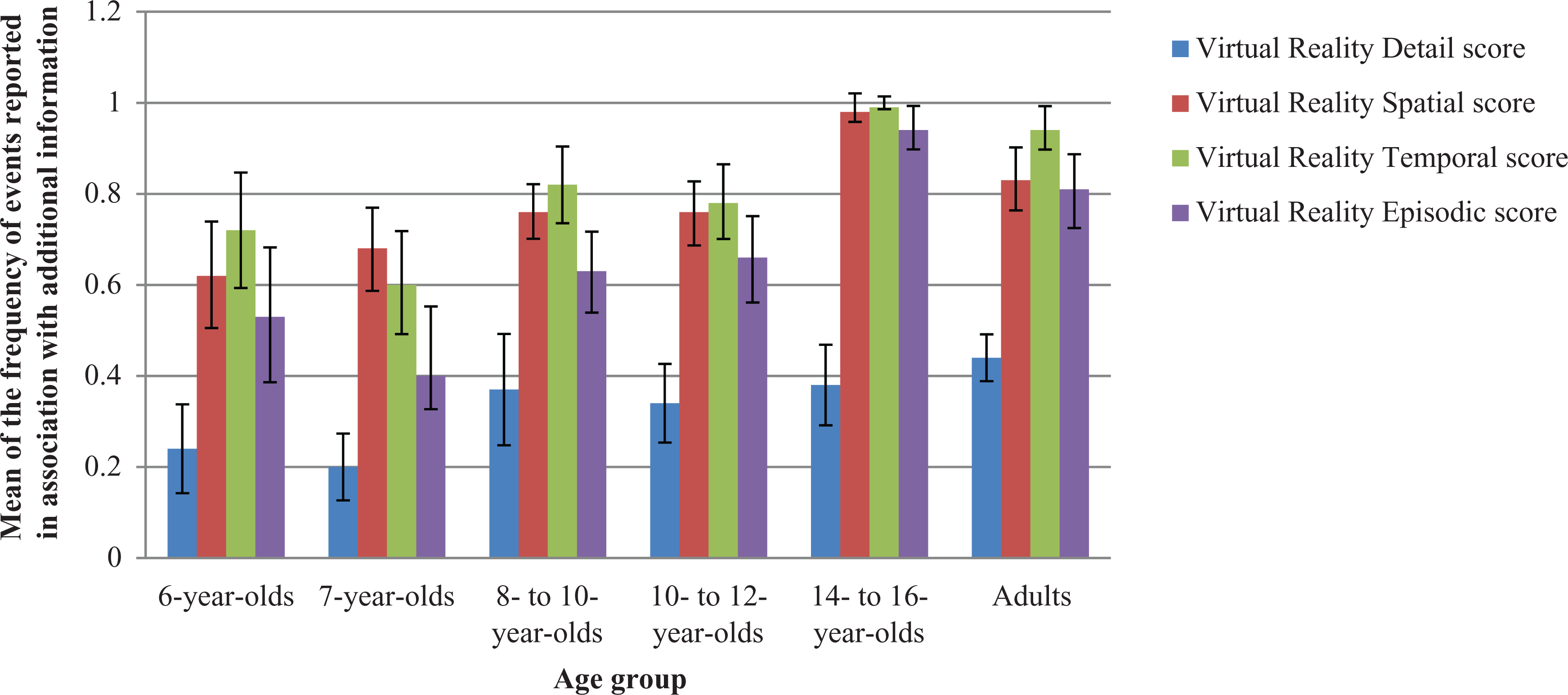
Mean and 95% confidence intervals of the frequency of events reported in association with additional information (details, spatial context, temporal context, spatio-temporal context = Episodic score) given the frequency of events and according to the age group.
The ANOVA on the between factor age group conducted on the one-way binding scores (frequency of VR-Detail, VR-Spatial and VR-Temporal scores) and on the VR-Episodic score (two-way binding) showed an effect of age; respectively, F(5, 119) = 4.62, MSE = .185, p < .001, ηp 2 = .16; F(5, 119) = 8.54, MSE = .29, p < .001, ηp 2 =.26; F(5, 119) = 10.002, MSE = .44, p < .001, ηp 2 = .3; F(5, 119) = 11.85, MSE = .66, p < .001, ηp 2 = .33; see Figure 3. Concerning the VR-Detail score, the two youngest groups (6-year- and 7-year-olds) differ from adults. The 7-year-old participants also differed from the 8–10 year-olds (p < .05 to ps < .001). The VR-Temporal scores showed a quite similar pattern, as the same differences were observed. The two youngest groups (6-year- and 7-year-olds) also differed from the adolescent group (p < .01 to ps < .001). The other two binding scores (VR-Spatial and VR-Episodic scores) showed a similar pattern: children aged 6 to 12 did not differ, nor did adolescents and adults. However, adolescents differed from all children's groups. Adults also outperformed the 6–8-year olds (p < .05 to ps < .001).
A similar pattern of findings was observed in the subset of participants who were also tested with the Family Pictures subtest.
In summary, the ANOVA performed on the VR scores globally yielded a highly significant effect of age, with performance improving with age. Our results revealed steady improvement with age and showed that the two youngest groups were less effective compared to the older groups on all recall scores, comprising factual information and its multi-component context.
The effect of age on the standard episodic memory test
The ANOVA carried out on the Total score of the Family Pictures score showed a strong effect of age, F(5, 73) = 5.1, MSE = 92.6, p < .001, ηp 2 =.26. Nonetheless, post hoc tests showed only a few significant differences. The performance of the three youngest groups differed from that of the adolescent group (ps < .05). No other comparison reached significance (see Figure 4).
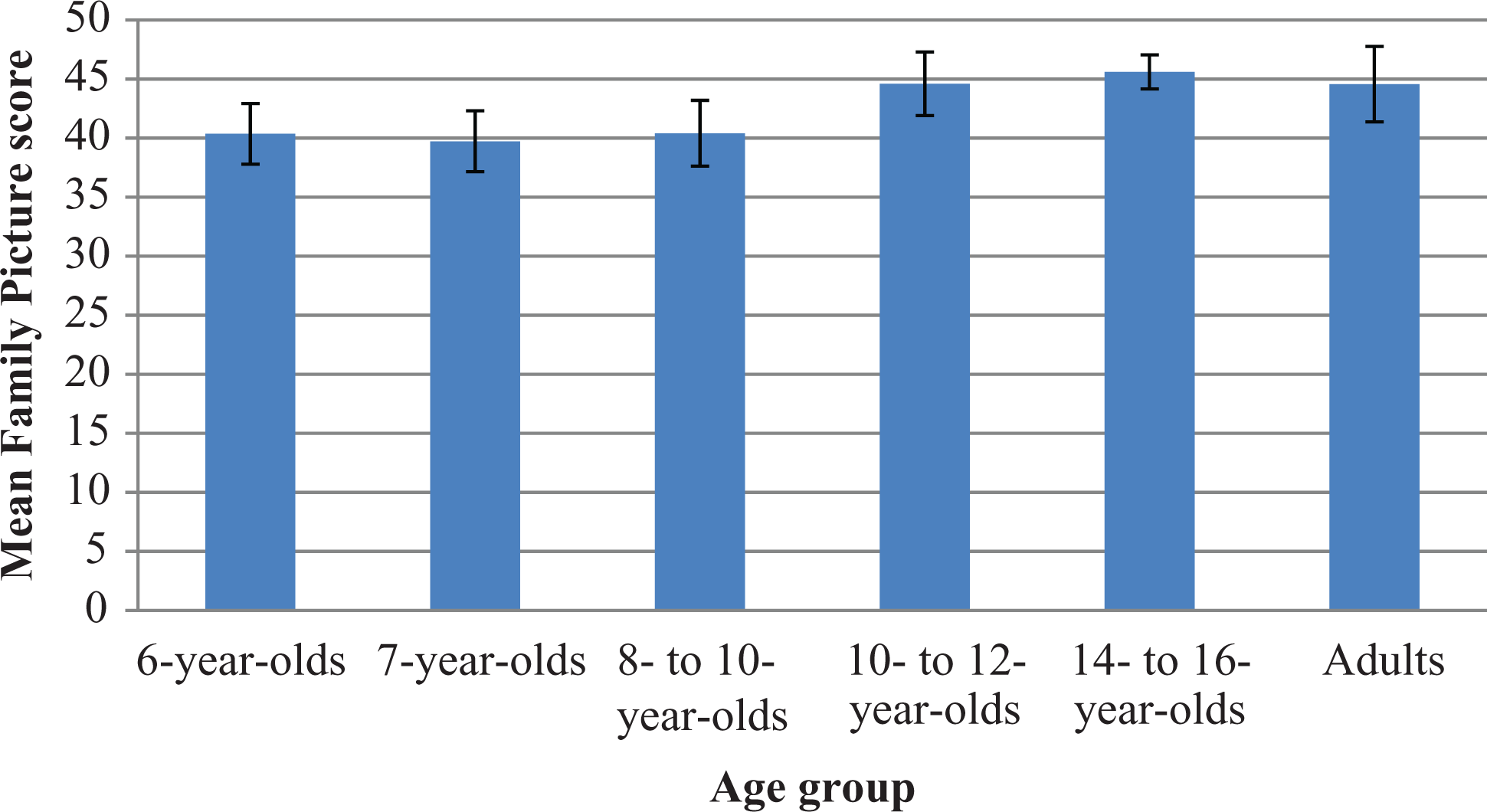
Mean and 95% confidence intervals of the Family Pictures score.
Effect of chronological age on the two EM tests
In order to compare the effect of chronological age on the two EM tests, regression analyses were conducted on the EM scores, with Age as a continuous variable. Results are presented in Table 1.
Simple regression analyses: predicting Virtual Reality Scores (Factual, Detail, Spatial, Temporal, Episodic) and Family Picture Score with chronological age.
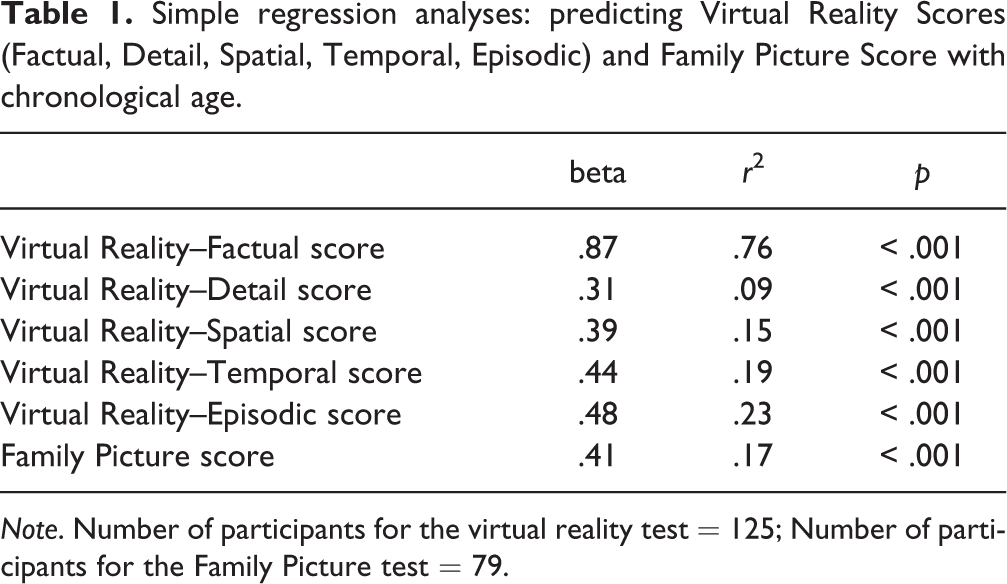
Note. Number of participants for the virtual reality test = 125; Number of participants for the Family Picture test = 79.
Discussion
The main purpose of this study was to further characterize the developmental trajectory of EM via an ecological task using the VR technique to simulate immersion in pseudo-realistic events. As hypothesized, the findings showed the slow maturation pace of the main EM components (core factual information, and its association with details as well as spatial and temporal contexts) across a wide age range, from childhood to young adulthood.
Concerning VR assessment of the core factual information, our results demonstrated that children correctly remembered a great deal of specific information from the age of 6 onwards, but that this capacity increased steadily from the age of 8 to young adulthood. This result confirms our previous study using a pen-and-pencil EM test simulating the memory of daily life activities based on what-where-when associations (Picard et al., 2012). More specifically, it had already been found that the ability to remember core factual information about activities (what happened) improved markedly during preschool years (Blakemore, 2012), continued to improve slightly between the ages of 6 and 8 years (Waber et al., 2007), and reached maturity around the ages of 9 to 10 years (Picard et al., 2012). The present finding collected in a more complex naturalistic environment suggests that the development of memory for specific factual information does not appear to be complete by the end of middle childhood (see also Guillery-Girard et al., 2013). Previous studies have already shown that relative to younger children, older children remember longer lists of items (for a review, see Bjorklund, Dukes, & Brown, 2009). A combination of different factors can explain this age related increase in the amount of specific information that children remember. Progressive increase in metamemory abilities makes children more and more aware of their own memory processes, enabling them to modify encoding strategies (e.g., Krebs & Roebers, 2010). With age, children become thus more deliberate and strategic during memory tasks, and apply different organization strategies on the to-be-remembered material (e.g., Bjorklund et al., 2009). The intentional encoding situation used in our VR study might have maximized age related differences in memory abilities, as older participants might have marshaled more appropriate encoding strategies. Shing’s two-component model (Shing et al., 2008; see also Sander et al., 2012) assumes that both strategic and associative components explain EM development. Whereas the associative component, based on the medial temporal lobe which integrates different features of the memory content into coherent episodic representations, seems to be mature by middle childhood, Shing and collaborators assumed that the strategic component had a protracted development, until young adulthood. In connection with this framework, our behavioral results suggest that the relatively protracted course of factual memory development may mainly rely on strategic processes. An alternative proposal could be that the task used here was too demanding for the youngest participants’ cognitive resources. With a very similar task to ours, Jebara et al. (2014) highlighted in fact that such active navigation involved a high level of complexity (intentional memorization combined with manipulation of the joystick). It could thus act as a divided attention condition that required a higher level of attentional resources, known to be a late developing cognitive aspect.
Regarding binding abilities (assessed through the recall of details and spatio-temporal contexts) we showed a late age-related improvement, above the development of factual memory abilities. Depending on the feature that had to be bound, developmental profiles differed slightly. The ability to recall perceptual details associated with the core specific factual information emerged in fact very slowly, with very few differences between the ages of 6 and 10 years, followed by a marked increase. In contrast, the ability to associate core specific factual information with one or two types of contextual information (spatial and/or temporal) was characterized by a progressive improvement, with a slight increase in performance during childhood and a later increase until adolescence, without any subsequent development. Note also that details were very rarely recalled, even in adolescents and adults, compared to spatiotemporal contextual information. Our results thus confirm that memory for spatial locations linked to factual information increases largely through development. An age-related increase in spatial memory abilities during childhood has been extensively described using laboratory tasks. For example, Bauer et al. (2012) reported that memory for specific laboratory events increased between the ages of 4 and 8 years for the conjunction of the events and their specific locations, with respect to allocentric reference (= “world centered reference”). Our results reveal that difficulties in remembering the location of scenes is not limited to children, and that even adolescents have a lower performance than adults. Whereas most standard and laboratory tests assess spatial memory according to allocentric reference, we show here that even egocentric strategies (= “body centered”) may develop very late throughout childhood, and even adolescence. Also, we obtained a slightly different developmental profile for temporal binding. Thus, based on our VR-EM test, memory for multiple features including spatial and temporal information did not seem to develop conjointly. This is not in accordance with the view that binding abilities do not depend on the “concurrent engagement of independent, feature specific, encoding operations, but rather on the encoding of a representation of the study event in which the disparate features have been attentionally conjoined” (Uncapher, Otten, & Rugg, 2006). Yet, our VR-EM test was realized thanks to an egocentric spatial frame of reference during both encoding and retrieval tasks, which is known to develop earlier than an allocentric one (Bullens, Iglói, Berthoz, Postma, & Rondi-Reig, 2010).
In both cases, relational memory including spatial and temporal characteristics appears to develop very late, suggesting that even adolescents have difficulty in mentally recreating the spatio-temporal context in which they experienced an event. This is in line with recent findings collected with a new measure developed for the NIH Toolbox, called the Picture Sequence Memory Test (Akshoomof et al., 2014; Bauer et al., 2013) that revealed age-related enhancements in the ability to recreate the temporal order of various unrelated actions. Therefore, one of the possible explanations for the late development of episodic event memory could be the ability to properly form and maintain bound representations of spatio-temporal context. Despite the assumption of the Shing et al. (2008) model that associative processes are in place before strategic processes, the involvement of the medial temporal lobe could be a key factor for the development of binding abilities. Indeed, protracted maturation of specific subfields of the hippocampus (volume and volume change) has been linked to memory development in adolescence (Tamnes et al., 2014). Apart from the hippocampus, the improvement in associative memory efficiency during childhood could also be linked to structural changes of the bilateral prefrontal cortex (Guillery-Girard et al., 2013). Developmental changes in the neural structures and networks that support EM may explain the late age-related enhancements in the ability to recreate the spatial–temporal context in which an event took place (see Ghetti & Bunge, 2012). Adolescence has been generally characterized as a period of substantial reorganization in the brain as well as in behavior, leading to further development. Note however that the developmental profile of spatial and temporal memory abilities observed in the present study should be necessarily interpreted in the context of the task used. A navigation task in a virtual environment may reinforce the potential link between spatio-temporal representations.
After having demonstrated the VR-EM-test’s sensitivity to benchmark EM development in a large population from age 6 to young adulthood, the present study also aimed to benchmark this virtual test against a standard EM-test. As expected, we found an age effect in both EM tests, but the developmental profile differed: the standard test was less sensitive to the late effect of age than the VR one. In fact, the standard EM test only differentiated 6–10-year-old children from adolescents, whereas the VR test showed subtle and more delayed differences, confirming the presence of developmental changes continuing beyond adolescence, in accordance with neuroimaging data (e.g., Guillery-Girard et al., 2013) and results obtained with ecological autobiographical tasks (e.g., Abram, Picard, Navarro, & Piolino, 2014). The difference of results in the two tests argues in favour of the advantage of virtual tools in providing more complex situations via immersion in naturalistic-real life events to assess the core characteristics of EM. Regression analyses confirmed in fact that EM abilities assessed in the VR task were more age-sensitive than the classical EM tool. Not all the different VR scores were equally sensitive, however; the most complex score, that took into account both contextual aspects, proved to be the most useful to depict age-related changes with respect to chronological age.
Although the results of this VR study are very promising, the profile depicted here may still underestimate age-related changes in binding abilities. Indeed, in the present study, the effect of age did not take into account the entire richness of recall: the scores used here were not sensitive to the number of details recalled for each element, whereas such quantitative information could be very informative and age-sensitive. Future studies should take into account the precision of the recall. There is also a need to clarify the origins of these age-related differences. What is the respective weight of age-related changes in encoding, storage and retrieval processes through childhood and adolescence? In a future study, one option could be to include in addition to a free recall task, a cued recall and a recognition task, in order to disentangle the different underlying processes.
Finally, future VR research is needed to pursue figuring out how and why EM develops in naturalistic settings. Apart from the mean abilities depicted here, we need to better understand the different factors that contribute to these changes and to the variability in performance within participants. In fact, large individual differences are noticeable here, notably in the 8–10-year-old group. Numerous environmental factors could explain these differences in EM during child development and beyond (for a review, see Ghetti & Bunge, 2012). In our task, based on VR technology, video-game expertise might be crucial. Such abilities may vary widely according to participants, and contribute to developmental differences, especially in a lifespan perspective. Even if all participants seemed at ease with the apparatus in our study, future studies should strictly control for this aspect, and look for its potential influence. In the same vein, the sense of presence, this “imaginary presence feeling” may vary considerably between participants. The degree to which children, adolescents and adults feel immersed in the environment may also vary greatly between age groups. Given its impact on memorization and its potential differences according to age, we cannot rule out the hypothesis that it differed between age groups, and contributed to the developmental profile depicted here. Besides, the results of this study should be interpreted with caution as the number of participants per age condition was not strictly equivalent and could thus slightly impact the statistical analysis. A fruitful direction for future research could also be to better depict qualitative differences with increasing age. Only quantitative analyses were carried out here, whereas they could hide large differences in the type of information memorized. For example, one could wonder if an ecological task such as this one can imitate the tendency observed on an autobiographical task to preferentially memorize general facts instead of detailed events in children (Piolino et al., 2007). If this is the case, young children should report more multiple factual events than unique ones.
In conclusion, with an ecological memory test based on the assessment of contextual binding of events in EM, we confirmed continuous developmental changes until young adulthood (Chiu et al., 2006; McAuley et al., 2007). Also, these changes vary according to the nature of the information (Lloyd et al., 2009; Picard et al., 2012). Hence, the present findings highlight the relevance of a novel VR–EM paradigm to assess its developmental trajectories via immersion in a naturalistic environment, as it appears to be a more sensitive tool than standard assessments. To the best of our knowledge, the present VR task is the first tool that assesses multiple EM components in an ecological fashion from childhood to adulthood. It opens up new avenues for the application of virtual environments as helpful additional standard neuropsychological memory assessment tools in evaluating subtle memory deficits, and for new perspectives of intervention for pediatric patients with memory impairments.
Footnotes
Acknowledgments
The authors would like to greatly thank Elizabeth Rowley-Jolivet for the language corrections to this manuscript.
Funding
The author(s) disclosed receipt of the following financial support for the research, authorship, and/or publication of this article: This research was supported in part by a grant from the Fondation de France allotted to University Paris Descartes (post doc position).