Sarah E. Killoren, Sue A. Rodríguez De Jesús, Kimberly A. Updegraff , [...]
View All
Abstract
We examined profiles of sibling relationship qualities in 246 Mexican-origin families living in the United States using latent profile analyses. Three profiles were identified: Positive, Negative, and Affect-Intense. Links between profiles and youths’ familism values and adjustment were assessed using longitudinal data. Siblings in the Positive profile reported the highest familism values, followed by siblings in the Affect-Intense profile and, finally, siblings in the Negative profile. Older siblings in the Positive and Affect-Intense profiles reported fewer depressive symptoms than siblings in the Negative profile. Further, in the Positive and Negative profiles, older siblings reported less involvement in risky behaviors than younger siblings. In the Negative profile, younger siblings reported greater sexual risk behaviors in late adolescence than older siblings; siblings in opposite-sex dyads, as compared to same-sex dyads, engaged in riskier sexual behaviors. Our findings highlight sibling relationship quality as promotive and risky, depending on sibling characteristics and adjustment outcomes.
Research article
Available accessResearch articleFirst published March, 2017pp. 165-174
Diamond Y. Bravo, Russell B. Toomey, Adriana J. Umaña-Taylor , [...]
View All
Abstract
Pregnant and parenting adolescents are at significant risk for educational underachievement. Educational expectations play a critical role for understanding subsequent educational attainment; yet, limited empirical attention has been given to changes in educational expectations across the transition to parenthood among adolescent mothers. This longitudinal study explored stability and change in educational expectations across the transition to parenthood among 191 first-time pregnant Mexican-origin adolescents (Mage = 16.76, SD = .98). The current study also examined how several contextually relevant risk and protective factors were associated with differential patterns of educational trajectories across this transition and subsequent educational attainment. Latent class growth analyses revealed three educational expectation trajectories: low and stable (< high-school degree), moderate and increasing (≈ associate degree), and high and increasing (≈ bachelor’s degree). Adolescent mothers in the low and stable group encountered several educational risk factors that partially explained their probability of membership in this trajectory and subsequent lower attainment. Conversely, probability of membership in the high and increasing expectations class was partially explained by adolescents’ on-track school status at the time of pregnancy and their mother figures’ educational expectations for their pregnant daughters. These findings have implications for understanding the malleable factors that help to explain why some adolescent mothers describe consistently high educational expectations and subsequent higher attainment, while others do not.
Research article
Available accessResearch articleFirst published March, 2017pp. 175-184
This study examined young children’s deception in a conflict situation. A puppet show was prepared involving a protagonist who went into hiding, an enemy who wanted to catch the protagonist, and a friend who was looking for the protagonist. In the no-conflict condition, the enemy asked the children about the location of the protagonist. In the conflict condition, the friend asked the children; however, the enemy was nearby and could eavesdrop. Thus, there was a conflict between deceiving the enemy and telling the truth to the friend. In Experiment 1, the enemy hid behind a tree and was not visible to the friend; 80 children aged 4, 5, and 6 years old participated. In Experiment 2, the enemy was visible to the friend but was disguised; 24 children aged 5 and 6 years old participated. Most 5- and 6-year-olds did not give accurate information to the enemy in the no-conflict condition. However, in the conflict condition, most of the children did not control their behavior and immediately gave accurate information to the friend although the enemy was nearby. Young children from the age of 5 years were able to deceive in the no-conflict situation, but it was difficult for them to deceive in the conflict situation.
Research article
Available accessResearch articleFirst published March, 2017pp. 185-197
Ashley M. Malooly, Kaitlin M. Flannery, Christine McCauley Ohannessian
Abstract
Previous studies have found evidence for gender and racial/ethnic differences in depressive symptoms in adolescence; however, the mechanisms driving this relationship are poorly understood. The goal of this study was to examine the role of individual differences in dispositional coping in the relationships between gender and depressive symptomatology, and race/ethnicity and depressive symptomatology. Surveys were administered to 905 15- and 17-year-old adolescents (mean age 16.10, SD = .67; 54% girls, n = 485) in the spring of 2007, 2008, and 2009. Girls reported more depressive symptomatology than boys and endorsed a greater disposition for the following coping strategies in comparison to boys: emotional social support, instrumental social support, and venting emotions. When race/ethnicity was examined, African-American adolescents reported a greater tendency toward using religious coping than Caucasian and Hispanic adolescents. Dispositional coping preferences also were found to mediate the relationships between gender and depressive symptomatology. These findings indicated that a preference for venting emotions may be particularly problematic when endorsed by girls, whereas instrumental social support may be particularly helpful for girls.
Research article
Available accessResearch articleFirst published March, 2017pp. 198-210
Tina Kretschmer, Wilma Vollebergh, Albertine J. Oldehinkel
Abstract
Romantic relationship quality in adolescence and early adulthood has often been linked to earlier parent–child relationship quality but it is possible that these links are nonlinear. Moreover, the role of social skills as mediator of associations between parent–child and romantic relations has been discussed but not rigorously tested. Using data from 2,230 participants of the longitudinal TRAILS (TRacking Adolescents’ Individual Lives Survey) sample, this study examined whether parent–child positivity assessed at age 11 predicted romantic involvement, commitment and satisfaction in emerging adulthood. Moreover, indirect effects via cooperation, assertion and self-control were tested. Parent–child positivity did not predict romantic involvement as such. However, in those who were romantically involved, linear and, by trend, nonlinear associations between parent–child positivity and commitment were found, suggesting higher levels of commitment in those who had reported positive parent–child relationships but also in individuals with particularly low levels of parent–child positivity. Satisfaction was linearly linked to parent–child positivity. Little support was found for the assumption that the association between parent–child positivity and romantic relationship quality in emerging adulthood are partly explained by social skills. These results show that neither congruence nor compensation alone are sufficient to explain the associations between parent–child and romantic relationship quality.
Research article
Available accessResearch articleFirst published March, 2017pp. 211-219
Laurence Picard, Maria Abram, Eric Orriols , [...]
View All
Abstract
The majority of episodic memory (EM) tests are far removed from what we experience in daily life and from the definition of this type of memory. This study examines the developmental trajectory of the main aspects of episodic memory—what, where, and when—and of feature binding in a naturalistic virtual environment. A population of 125 participants aged from 6 to 24 years was asked to navigate, by using a joystick, in a virtual urban environment composed of specific areas, and to memorize as many elements as possible (e.g., scenes, details, spatial and temporal contexts). The ability to recall factual content associated to details or spatiotemporal context increased steadily from the age of 8 to young adulthood. These results indicate main developmental differences in feature binding abilities in naturalistic events which are very sensitive to age in comparison with a standard EM assessment. Virtual reality therefore appears to be an appropriate technique to assess crucial aspects of EM development in children and adolescents and it should provide helpful tools for the detection of subtle memory deficits.
Research article
Available accessResearch articleFirst published March, 2017pp. 220-227
There is growing interest in understanding how beliefs about emotion regulation are related to individual emotional experiences. Extant studies have mainly focused on explicit beliefs about emotion regulation among individuals in Western societies. The current study examined implicit emotion regulation and explored their contributions to emotional outcomes in 147 Chinese adolescents. Participants were tested on their implicit beliefs about emotion regulation and their negative emotion experiences. Results showed that the down-regulation was implicitly evaluated as more positive than up-regulation. Moreover, positive implicit beliefs about down-regulation increased with age. Among younger adolescents, those who evaluated down-regulation more positively had less negative emotional experiences. These results suggest that down-regulation may have important implications in Chinese culture.
Research article
Available accessResearch articleFirst published March, 2017pp. 228-237
Lauren E. Altenburger, Sarah N. Lang, Sarah J. Schoppe-Sullivan , [...]
View All
Abstract
The paper reports on a study which tested whether infants high in negative affectivity are differentially susceptible to observed coparenting behavior in relation to their subsequent social–emotional development. Data came from a longitudinal study of 182 US dual-earner, primiparous couples and their infant children. At nine-months postpartum, child negative affectivity was reported by mothers and fathers and supportive and undermining coparenting behavior were assessed from mother-father-infant observations. At 27-months mothers reported on toddlers’ externalizing behavior and dysregulation using a clinical assessment tool designed to identify competencies and areas of concern in toddlers’ social–emotional development. Hierarchical regression analyses revealed partial support for the differential susceptibility hypothesis. Specifically, infants high in negative affectivity had lower levels of dysregulation when embedded in a more supportive coparenting context, and higher levels of dysregulation when embedded in a less supportive coparenting context. In contrast, supportive coparenting behavior was not relevant for the dysregulation of infants initially low in negative affectivity.
Research article
Available accessResearch articleFirst published March, 2017pp. 238-244
Children younger than three years old are able to detect hidden rules in numerical sequences, and this ability matches that of adults by age seven. However, the developmental trajectory of this ability during the ages of four to six remains unknown. The present study adopted a modified Brixton task to address this issue. In this task, children were presented with sequences of moving circles and were asked to predict which circle would next turn blue based on hidden rules that were either simple (e.g. + 2) or complex (e.g. + 2 – 1). Results suggested that (a) four-year-olds were only able to detect comparably few simple rules, whereas children older than 4.5 years were able to successfully detect most of the simple rules hidden in number sequences; (b) although all children performed significantly poorer when attempting to identify complex rules as compared with simple rules, rule detection (RD) ability improved rapidly with age, and children older than five were able to identify most complex rules. These findings extended previous work on rule learning by revealing the developmental trajectory of RD among preschoolers.
Research article
Available accessResearch articleFirst published March, 2017pp. 245-256
Jallu Lindblom, Mikko J Peltola, Mervi Vänskä , [...]
View All
Abstract
The family environment shapes children’s social information processing and emotion regulation. Yet, the long-term effects of early family systems have rarely been studied. This study investigated how family system types predict children’s attentional biases toward facial expressions at the age of 10 years. The participants were 79 children from Cohesive, Disengaged, Enmeshed, and Authoritarian family types based on marital and parental relationship trajectories from pregnancy to the age of 12 months. A dot-probe task was used to assess children’s emotional attention biases toward threatening (angry) and affiliative (happy) faces at the early (500 ms) and late (1250 ms) stages of processing. Situational priming was applied to activate children’s sense of danger or safety. Results showed that children from Cohesive families had an early-stage attentional bias toward threat, whereas children from Enmeshed families had a late-stage bias toward threat. Children from Disengaged families had an early-stage attentional bias toward threat, but showed in addition a late-stage bias away from emotional faces (i.e., both angry and happy). Children from Authoritarian families, in turn, showed a late-stage attentional bias toward emotional faces. Situational priming did not moderate the effects of family system types on children’s attentional biases. The findings confirm the influence of early family systems on the attentional biases, suggesting differences in the emotion regulation strategies children have developed to adapt to their family environments.
Research article
Available accessResearch articleFirst published March, 2017pp. 257-264
Jennifer Lavoie, Sarah Yachison, Angela Crossman , [...]
View All
Abstract
Lying is an interpersonal exercise that requires the intentional creation of a false belief in another’s mind. As such, children’s development of lie-telling is related to their increasing understanding of others and may reflect the acquisition of basic social skills. Although certain types of lies may support social relationships, other types of lies are considered antisocial in nature. The goal of this study was to compare several possible correlates, such as cognitive ability and children’s behavior patterns, that may be associated with children’s (N = 133) use of lies in socially acceptable versus socially unacceptable ways. Children engaged in two lie-telling paradigms: one to measure socially accepted (polite) lies and one to measure socially unaccepted (instrumental) lies. Results indicate that instrumental liars were young with low theory of mind (ToM) scores and had high social skills. Polite liars were the oldest, had high ToM, and had similar levels of social skills as instrumental liars. Truth-tellers and dual liars had lower social skills and moderate ToM in comparison to the instrumental and polite liars. These findings suggest that children use lies selectively to achieve their social goals, and also suggest that children’s lying behavior may change from being self-motivated to being other-motivated as they age, which may reflect socialization toward socially accepted behavior.
Research article
Available accessResearch articleFirst published March, 2017pp. 265-274
Internationally, girls outperform boys in overall school performance. The gender gap is particularly large among those in at-risk groups, such as children from families at economic disadvantage. This study modeled the academic trajectories of a low-income sample of boys and girls from the Concordia Longitudinal Risk Project across the full course of schooling. Results from a multiple-group latent growth curve analysis revealed that children from this low-income sample demonstrated a significant decreasing trajectory of academic performance over time, which intensified after the transition from elementary to secondary schooling. A gender gap in academic performance emerged after the children transitioned to secondary school, with girls outperforming boys. Boys continued to experience greater academic decline than did girls across the secondary school years, and individual and family characteristics assessed in early elementary school predicted these academic trajectories. At school entry, boys showed higher levels of attention problems than did girls, which in turn predicted boys’ poorer school performance. However, boys with stronger reading skills and greater maternal school involvement during the early years of schooling were protected against declining academic performance across the secondary school years. Implications for prevention programs are discussed.
Research article
Available accessResearch articleFirst published March, 2017pp. 275-284
Anjolii Diaz, Rebecca Berger, Carlos Valiente , [...]
View All
Abstract
Poor sleep is thought to interfere with children’s learning and academic achievement (AA). However, existing research and theory indicate there are factors that may mitigate the academic risk associated with poor sleep. The purpose of this study was to examine the moderating role of children’s effortful control (EC) on the relation between sleep and AA in young children. One hundred and three 4.5- to 7-year-olds (M = 5.98 years, SD = 0.61) wore a wrist-based actigraph for five continuous weekday nights. Teachers and coders reported on children’s EC. EC was also assessed with a computer-based task at school. Additionally, we obtained a standardized measure of children’s AA. There was a positive main effect of sleep efficiency to AA. Several relations between sleep and AA were moderated by EC and examination of the simple slopes indicated that the negative relation between sleep and AA was only significant at low levels of EC.
Research article
Available accessResearch articleFirst published March, 2017pp. 285-294
We investigated the association between marital quality and child behavior, assessing mother–child relationship quality as a potential mediator. The sample included 78 mothers with two target children (mean ages = 9.82 and 12.05 years, respectively). Mothers reported on their children’s behavior as well as their marital quality, while each child reported on their relationship with their mother. Confirming our hypothesis, marital quality did relate to child behavior. Contrary to our expectations, the mother–child relationship provided negligible mediation of the link, but did provide significant prediction of child behavior in its own right. Importantly, our findings show differential outcomes for children within the same family, supporting a differentiated child-specific outlook. Further evidence that both marital quality and shared, as well as differential, mother–child relationships link with child behavior is provided here. Consequently, interventions with the aim of decreasing children’s behavioral problems and increasing more positive conduct can usefully include a focus on the nature of the parents’ romantic relationship, alongside parenting.
Research article
Available accessResearch articleFirst published March, 2017pp. 295-307
Jennifer S. Green, Joshua C. Magee, Amanda R.W. Steiner , [...]
View All
Abstract
Current treatments for disorders of emotion, such as pathological anxiety, are often less effective in older adults than in younger adults and have poorly understood mechanisms, pointing to the need for psychopathology models that better account for age-related changes in normative emotional functioning and the expression of disordered emotion. This article describes ways in which the healthy aging and emotion literature can enhance understanding and treatment of symptoms of anxiety and depression in later life. We offer recommendations on how to integrate the theories and findings of healthy aging literature with psychopathology research and clinical practice and highlight opportunities for future research.
Correction
Available accessCorrectionFirst published March, 2017pp. 308-308
Wagner, J., Luyster, R.J., Moustapha, H., Tager-Flusberg, H., and Nelson, C. A. (2016). Differential attention to faces in infant siblings of children with autism spectrum disorder and associations with later social and language ability. International Journal of Behavioral Development. Epub ahead of print. doi: 10.1177/0165025416673475
Owing to errors made by SAGE, the above mentioned article, first published online on November 8th 2016, contained errors.
SAGE apologises to the authors and to the readers. The following corrections apply:
Line 6 of the article abstract originally read ‘For time scanning faces overall, HRA- and LRC showed similar patterns of attention, and this was significantly greater than in HRA-.’ This has been corrected to read ‘For time scanning faces overall, HRA+ and LRC showed similar patterns of attention, and this was significantly greater than in HRA-.’
The last line of the caption for Figure 2 originally read ‘Error bars are + standard error to the mean.’ This has been corrected to read ‘Error bars are +/- standard error to the mean.’
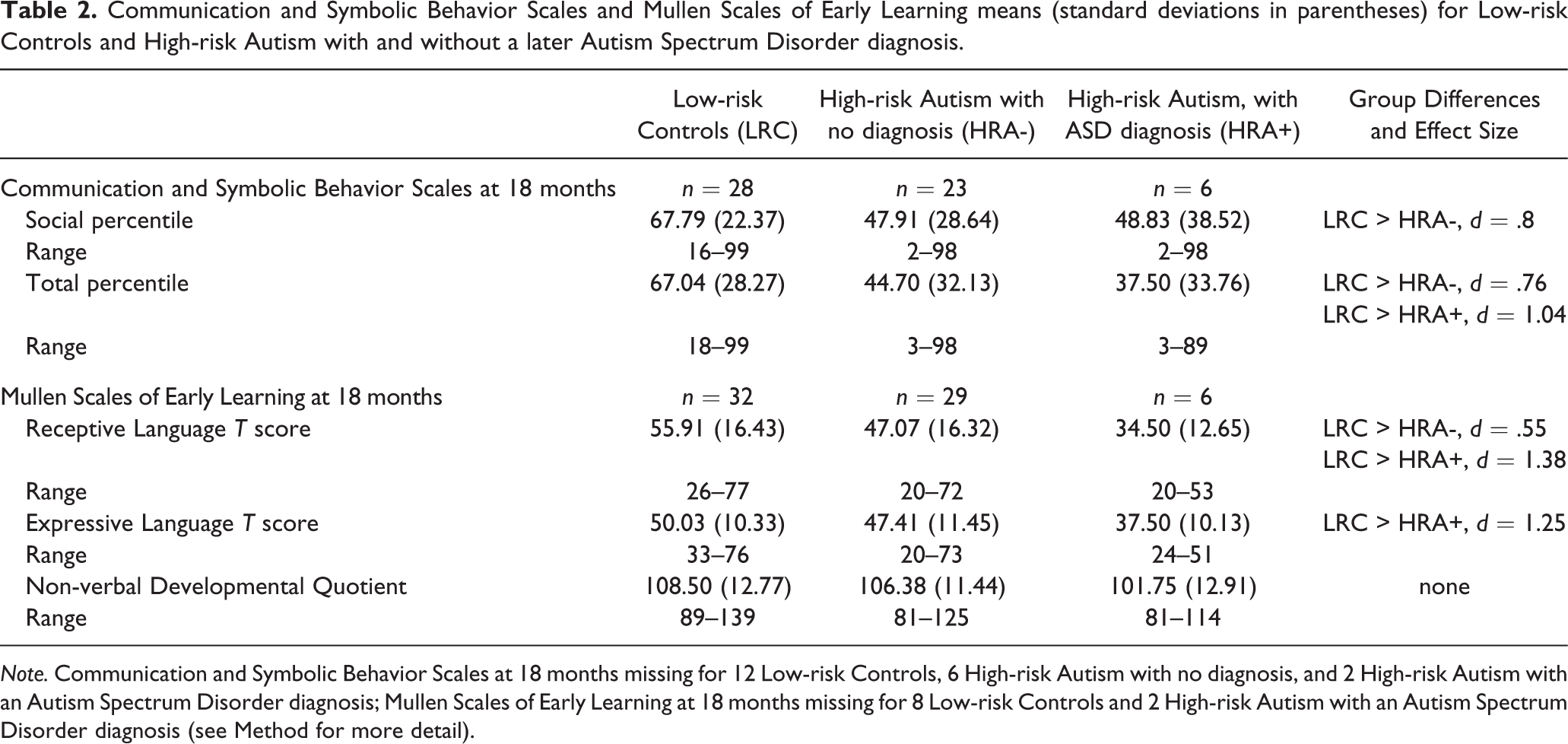
The formatting of Table 2 was incorrect. The correct table is presented below:
Communication and Symbolic Behavior Scales and Mullen Scales of Early Learning means (standard deviations in parentheses) for Low-risk Controls and High-risk Autism with and without a later Autism Spectrum Disorder diagnosis.
Low-risk Controls (LRC)
High-risk Autism with no diagnosis (HRA-)
High-risk Autism, with ASD diagnosis (HRA+)
Group Differences and Effect Size
Communication and Symbolic Behavior Scales at 18 months
n = 28
n = 23
n = 6
Social percentile
67.79 (22.37)
47.91 (28.64)
48.83 (38.52)
LRC > HRA-, d = .8
Range
16–99
2–98
2–98
Total percentile
67.04 (28.27)
44.70 (32.13)
37.50 (33.76)
LRC > HRA-, d = .76 LRC > HRA+, d = 1.04
Range
18–99
3–98
3–89
Mullen Scales of Early Learning at 18 months
n = 32
n = 29
n = 6
Receptive Language T score
55.91 (16.43)
47.07 (16.32)
34.50 (12.65)
LRC > HRA-, d = .55 LRC > HRA+, d = 1.38
Range
26–77
20–72
20–53
Expressive Language T score
50.03 (10.33)
47.41 (11.45)
37.50 (10.13)
LRC > HRA+, d = 1.25
Range
33–76
20–73
24–51
Non-verbal Developmental Quotient
108.50 (12.77)
106.38 (11.44)
101.75 (12.91)
none
Range
89–139
81–125
81–114
Note. Communication and Symbolic Behavior Scales at 18 months missing for 12 Low-risk Controls, 6 High-risk Autism with no diagnosis, and 2 High-risk Autism with an Autism Spectrum Disorder diagnosis; Mullen Scales of Early Learning at 18 months missing for 8 Low-risk Controls and 2 High-risk Autism with an Autism Spectrum Disorder diagnosis (see Method for more detail).
These corrections have been made in the most recent online version of the article, and will also be included in all subsequent versions of the article online and in print.




 Available accessResearch articleFirst published March, 2017pp. 155-164