



Abstract
Children younger than three years old are able to detect hidden rules in numerical sequences, and this ability matches that of adults by age seven. However, the developmental trajectory of this ability during the ages of four to six remains unknown. The present study adopted a modified Brixton task to address this issue. In this task, children were presented with sequences of moving circles and were asked to predict which circle would next turn blue based on hidden rules that were either simple (e.g. + 2) or complex (e.g. + 2 – 1). Results suggested that (a) four-year-olds were only able to detect comparably few simple rules, whereas children older than 4.5 years were able to successfully detect most of the simple rules hidden in number sequences; (b) although all children performed significantly poorer when attempting to identify complex rules as compared with simple rules, rule detection (RD) ability improved rapidly with age, and children older than five were able to identify most complex rules. These findings extended previous work on rule learning by revealing the developmental trajectory of RD among preschoolers.
The ability to extract general rules from specific experiences is critical to a wide range of higher-order cognition (Pinker, 1991), including categorization (Martin & Caramazza, 1980), language (Marcus, Fernandes, & Johnson, 2007), and social response (Weston & Turiel, 1980). Rules help people to learn efficiently and to apply past experiences to new environments (Murphy, Mondragon, & Murphy, 2008).
Recently, there is a growing body of evidence that infants and children can detect rules by themselves or by observation learning (Colombo & Bundy, 1983; Gopnik, 2012; Marcus, Vijayan, Rao, & Vishton, 1999; Williamson, Jaswal, & Meltzoff, 2010; Xu & Garcia, 2008). For example, when newborns were presented with ordered sequences repeatedly and constantly, their brains responded intensively, indicating that newborns perhaps have the ability to discriminate between regularities and irregularities (Gervain, Macagno, Cogoi, Peña, & Mehler, 2008). This innate rule-detection (RD) ability greatly facilitates later language acquisition and other types of associative learning (Fiser & Aslin, 2002; Johnson et al., 2009; Kirkham, Slemmer, & Johnson, 2002; Marcus et al., 2007; Saffran, Johnson, Aslin, & Newport, 1999; Saffran, Pollak, Seibel, & Shkolnik, 2007; Tyrell, Stauffer, & Snowman, 1991; Tyrell, Zingardo, & Minard, 1993).
Collectively, most infant studies utilize language-related tasks and focus primarily on grammar rules. Although some non-linguistic tasks have been applied (Johnson et al., 2009; Saffran et al., 2007), the rules to be learned by subjects were rather simple. For example, Saffran et al. (2007) found that infants were able to extract the inner structure of stimuli in the habituation (rule-learning) session. In other words, they were able to ascertain that the first animal shown was the same as the third one. As a result, the rule-learning strategy employed by infants may be pattern recognition rather than inductive inference.
Since the emergence of the Brixton test, a visuospatial task designed to test rule learning, inductive inference or executive function (Burgess & Shallice, 1996), a growing number of researchers have applied it to study the development of rule learning and executive function among both children and adults (Channon, German, Cassina, & Lee, 2004; Lehto & Uusitalo, 2006; Reverberi, Lavaroni, Gigli, & Shallice, 2005). In the Brixton test (Burgess & Shallice, 1996), participants are shown a series of sheets, each with a 2*5 display of circles numbered sequentially. One of the circles is filled blue, while all others are white. Participants are asked to judge which of the circles, numbered from 1 to 10, will be colored blue on the next sheet. For instance, one rule is +2, so that if the first circle (numbered with 1) were colored blue on the first sheet then the blue circles would be numbered 3, 5, and 7 respectively in the subsequent three sheets. This rule governing the positioning of the blue circle is changed irregularly, thereby requiring the participant to shift from one rule to another.
Recently, various versions of the Brixton test were used to test seven- to 12-year-old children (Bayliss & Roodenrys, 2000; Shallice et al., 2002). For example, Shallice et al. (2002) shortened the Brixton test and used green and gray turtles instead of blue and white circles as test items for a sample of children aged seven to 12 years. Following this study, Lehto and Uusitalo (2006) designed a new version of the Brixton test and introduced an interesting game to investigate RD among children aged three and five. They found that three-year-olds could identify just a few simple rules, while five-year-olds were able to successfully detect most of the rules.
However, in the study of Lehto and Uusitalo (2006), the rules to be learned or detected were very simple (e.g. +1, +2, +3), whereas complex rules (e.g. +2−3) were not used. The important distinction between a complex and simple rule is that more than one operation is needed between trials for the former. In our task, complex rules were used for the following two reasons: first, some studies on rule learning (Crescentini et al., 2011; Jia et al., 2011; Li, Cao, Gao, Kuang, & Li, 2012; Qin et al., 2009) used both simple and complex rules. Second, some real-life situations require learning or following complex rules. For example, the price of one product sometimes fluctuated regularly. It rose $2 per unit in the year before last year, and decreased $1 last year and then it rose $2 again this year. Based on this fluctuation, customers may think that there seems to be a “+2 –1” rule for the change of price of this product and they can predict that the price will possibly fall $1 next year, although it may not change as they expected. It is assumed that increased demand is placed on working memory and executive function during the process of discovering complex rules. Therefore, one purpose of the current study was to examine preschoolers’ performance in the detection of complex rules. Focusing on children’s complex RD can extend our understanding of the developmental characteristics associated with RD.
A secondary purpose of the present study was to identify the developmental trajectory of RD among children aged between four and six years old. In the task of discovering of the rule hidden in the number series, at least three abilities are required. The first is working memory, i.e. the ability to remember a series of Arabic digits or the corresponding locations. Previous studies on memory have suggested that the short-term memory markedly increases in children from the age of three to the age of six, and that memory capacity develops rather rapidly at around four years of age (Alloway, Gathercole, & Pickering, 2006; Gathercole, Pickering, Knight, & Stegmann, 2004; Hong, 1984). The second is mathematics ability, i.e. the ability to process numbers, and compare numerical relationships among different numbers or distances. It has been demonstrated that mathematics ability develops rapidly between approximately four and five years of age (Fang, Tian, & Bi, 2001). In order to measure this ability and to test whether this ability has a relation to RD, we will test children’s mathematical abilities by asking them some simple addition/subtraction questions. As the Arabic numerals could perturb children’s rule search in the easy condition, that is, children needed to inhibit the numerical information sometimes not relevant to solve the task (e.g. move from 12 to 1), correlations between these two abilities will only be analyzed in the complex condition. The third ability is executive function, which is involved in the process of integrating multiple pieces of information. Previous studies have revealed that executive function develops more rapidly for 3.5- to 4.5-year-olds than for children aged 4.5 years and older, implying that the rapid development of executive function is associated with the development of four-year-olds’ prefrontal cortices (Frye, Zelazo, & Palfai, 1995; Gerstadt, Hong, & Diamond, 1994; Luria, 1973). On the basis of these findings, we predicted that children aged four years and older would successfully detect some rules and that there might be a sharp increase in this ability in children aged four to five years.
In order to encourage young children to participate in the RD task and take it seriously, we used a modified Brixton task and added some game components. In the task, children were shown a clock-like display with 12 numbered circles, on which one of the Arabic numbers was highlighted. The number highlighted on successive screens was determined by either a simple rule or a complex rule.
Method
Participants
A total of 106 preschool children participated in the experiment. All children were native speakers and were recruited from a kindergarten in Chengdu, China. The measures of socioeconomic status were not obtained, but the children in this kindergarten were generally middle to upper middle class. A pilot test revealed that the performance was lower (less than 10%) for children younger than 3.5 years, reflecting a floor effect. Therefore, we did not recruit children aged under four years. In addition, complex rules were used in our study and the pilot test revealed that the RD performance rapidly increased for children aged over five years old, so we also recruited six-year-olds. There were five groups: (1) four-year-olds (10 boys and 10 girls; mean age: four years two months; age range: four years one month to four years six months); (2) 4.5-year-olds (12 boys and 12 girls; mean age: four years nine months; age range: four years seven months to five years); (3) five-year-olds (10 boys and 10 girls; mean age: five years three months; age range: five years one month to five years six months); (4) 5.5-year-olds (10 boys and 10 girls; mean age: five years 10 months; age range: five years seven months to six years); and (5) six-year-olds (11 boys and 11 girls; mean age: six years four months; age range: six years one month to six years eight months). All the recruited children were randomly sampled from each age group in this kindergarten.
Stimuli and Design
Each participant was presented with an image of a clock-like display showing 12 small circles numbered sequentially. Only one circle was colored blue, the others were white. A smiley face picture sat in the center of the image in order to attract the children’s attention.
The experiment used a mixed design with age as the between-subject factor and condition (easy vs. difficult) as the within-subject variable. Children were informed that they would play a game. They were told that the blue circle would move in a specific way and that their task was to predict where the blue circle would move to. After collecting their responses, the experimenter gave them the correct answer. In the easy condition (simple rule), the moving direction and steps (the number of circles between the current location and the next location) was fixed. For example, the blue circle might continually move two steps in a clockwise direction. In the difficult condition (complex rule), the moving direction was either fixed (e.g. always clockwise) or alternated between trials (e.g. clockwise, then counterclockwise). Moreover, the steps varied between trials in the difficult condition (e.g. +1, +2; +2, –1). There were six simple rules and six complex rules (Figure 1), and they were randomly presented to each participant.
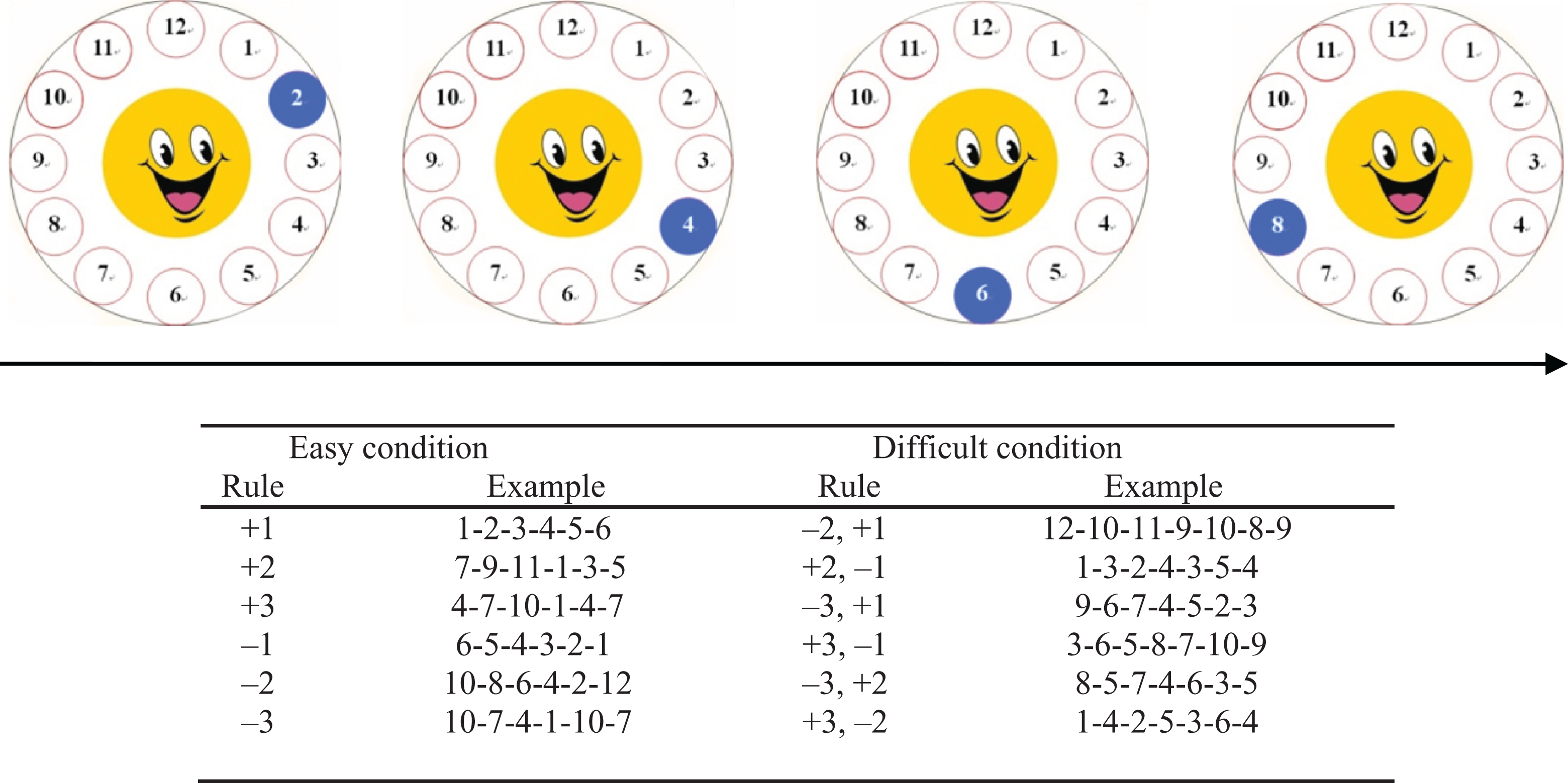
Procedures and materials. Top: The experimental procedure and the sampled cards (we presented children with a clock-like card with 12 small circles. An Arabic number was printed in the center of each circle. Only one circle was blue; the others were white. Participants were asked to predict which circle would be blue based on the hidden rule). Bottom: The rules and the examples used in different conditions.
Procedure
Children were tested individually in a well-lit, soundproof room. Stimuli were presented to each child on a 15-inch CRT monitor screen using E-prime 2.0 software. Participants were first familiarized with Arabic numbers (1–12) and the experimental procedure by practice. Each child practiced six rules (three simple rules and three complex rules) that did not appear in the formal experiment. The instructions given for the easy conditions were as follows: “Welcome to our game. One cute animal will appear at the beginning of every game. The appearance of a different animal means the start of a different game. Each animal has its own way of jumping. You should tell me which location (circle) the animal will jump to. Now, a bear first stands on the blue circle (number 2), and then he jumps to here (number 4), and then jumps to number 6. Now, please tell me which circle will be the next location the animal will go to.” Children were instructed to report their answers orally in each trial. The instructions for the difficult conditions were as follows: “A dog now stands at this location (e.g. number 4), and then it jumps to here (number 6). Suddenly, it jumps back to number 5 and then it moves ahead (number 7). Which location will the dog jump to next?” During practice, the experimenter did not say anything about the clock and did not give any hint about the rule. If a child did not respond for a long time (e.g. over 30 seconds), the experimenter would prompt the child again. After children responded to the question, the experimenter continued to the next question until the practice test was finished. After the practice trials, children were allowed to proceed to the formal experiment.
During the formal experiment, each trial began with the display of one cute animal for 3000 ms. The clock image with one blue circle was then presented, and remained on the screen until a response was given. After the children gave their predictions as to which position the animal would jump to, the blue circle moved following the predetermined rules (Figure 1). A total of 12 rules (six simple and six complex) were used. These rules were allocated in two blocks. A child could take a break for three to five minutes after finishing the first block. For each rule, six to seven trials were designed, with more trials for the complex rules and fewer trials for the simple rules. Each rule started with a total of one to three non-rule trials (i.e. the number or spatial distance between two successive blue circles is not fixed and the next location of the blue circle is not predictable. For example, a sequence of 7–9–4–12–1 is a non-rule trial), followed by six or seven rule trials.
Each child’s capacity for RD and the speed of RD were recorded. Capacity for RD was defined as the number of rules that each child learned during the formal experiment. If a child got the right answer on three or more than three successive trials, he/she scored one point, indexing she/he detected a rule. This definition was adopted from the previous study on rule learning (Crescentini et al., 2011). Actually, for each trial, there are 11 possible positions for the blue circle, that is, there were 11 possible answers to the prediction question. Nevertheless, only one is predetermined correct. Therefore, the probability of getting the correct answer by guessing is rather low (i.e. 1/11) for each trial, and the probability of correctly guessing on three successive trials is extremely low (i.e. less than 15×1/113). The highest score a child could achieve was six points (i.e. find out all the hidden rules) in each condition. Speed of RD was recorded as the number of trials needed to detect a hidden rule. The fewer trials needed, the higher the recorded speed.
After finishing the test trials, children were asked to orally answer 15 simple addition/subtraction questions, in which the numbers were smaller than 12. Children gave their answers immediately after hearing calculation questions. For example, the examiner might ask “what is your answer to 1+2?” Children might answer “3.” The examiner continued to ask the next question irrespective of their response to the previous one. If they correctly answered a calculation question, they got one point. All questions were presented in a fixed order with balanced difficulty.
Results
First, we analyzed mean RD performance for each age group by examining the number of rules detected by each child. The result is plotted for all age groups across all conditions in Figure 2. A 2 (condition: easy vs. difficult) × 5 (group: four- to six-year-old) repeated measures ANOVA revealed a significant main effect of condition, F(1, 101) = 74.39, p < .001, with better performances in the easy condition than in the difficult condition, and a significant main effect of group, F(4,101) = 11.49, p < .001, showing that older children outperformed younger children in rule learning. A significant interaction of condition × group was also found, F(4, 101) = 4.60, p = 0.03. Further analysis (Bonferroni corrected for multiple comparisons) revealed that 4.5-year-olds acquired more rules than did four-year-olds in the easy condition, t(42) = 3.17, p = 0.003, whereas no significant difference was found among age groups older than 4.5-year-olds in this condition (5 vs. 5.5: t(38) = 0.62, p = 0.54; 5 vs. 6: t(40) = 0.71, p = 0.48; 5.5 vs. 6: t(40) = 1.26, p = 0.22). Children older than 4.5 years successfully detected most of the simple rules. In the difficult condition, the 5.5- and six-year-olds scored higher than the 4.5- and four-year-olds (5.5 vs. 4.5: t(42) = 2.09, p = 0.042; 5.5 vs. 4: t(27.76) = 3.96, p < .001; 6 vs. 4.5: t(41.85) = 4.23, p < .001; 6 vs. 4: t(40) = 8.51, p < .001). The difference between 5.5- and six-year-olds was insignificant, t(40) = 1.82, p = 0.77.
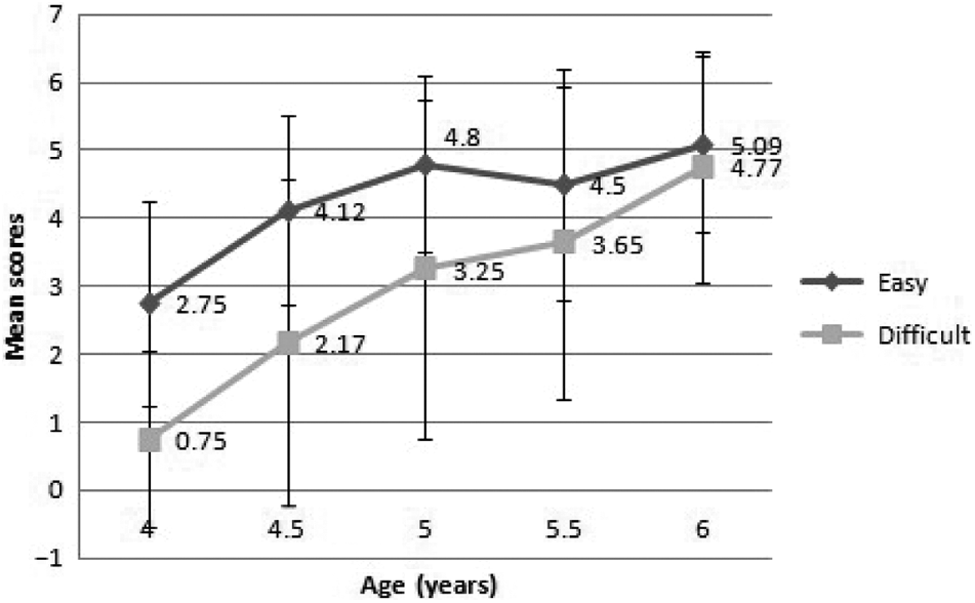
Number of rules learned by each group. Error bars represent the standard error of the mean scores.
Second, there were six rules in each condition. As described in the Method section, the chance of finding a rule by guessing is rather low. That is, a child is unlikely to find a rule by guessing. So if a child was able to find three or more rules, she/he can reliably be categorized as showing the ability of RD. As shown in Figure 3, analysis of those that possessed stable RD ability revealed a significant difference between age groups in the easy condition, χ 2 (4, 106) = 14.34, p = 0.004. Post-hoc analysis showed that the percentage of children demonstrating reliable RD ability was lower in the four-year-old group than in other groups. In the easy condition, more than 80% of children demonstrated this ability in age groups older than 4.5 years, whereas only 45% had the ability in the four-year-old group. In the difficult condition, the differences between groups were also robust, χ 2(4, 106) = 22.46, p < .001. Post-hoc analysis showed that the difference between five- and six-year-olds was significant, χ 2(1, 42) = 3.77, p = .05. The percentage of six-year-olds who had RD ability was significantly higher than that of 4.5-year-olds, χ 2(1, 46) = 11.51, p = 0.001, and the difference between four- and five-year-olds was also significant, χ 2(1, 40) = 6.67, p = 0.01. These results confirm that there was variation in the RD abilities of different ages.
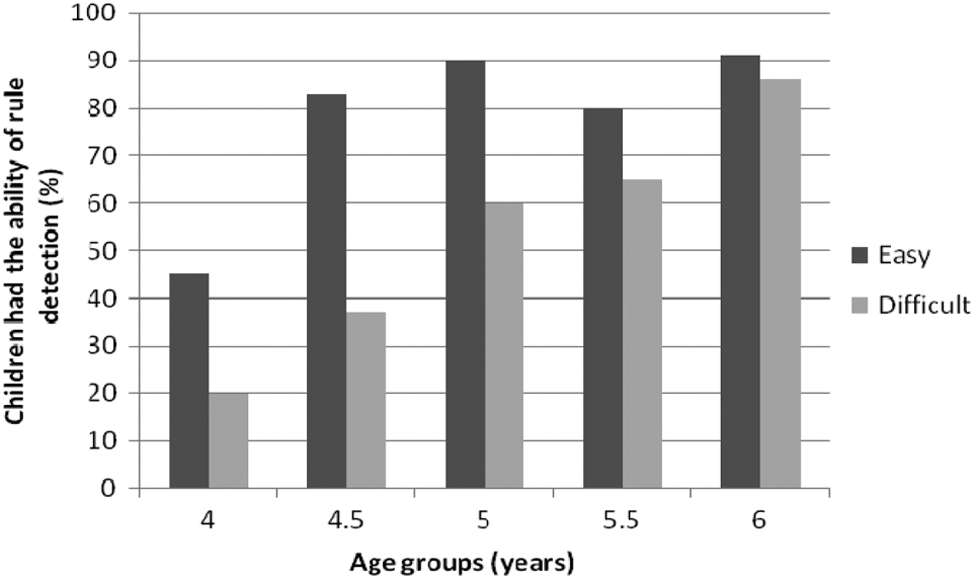
Percentage of children that detected three or more rules.
Third, we explored RD speed by comparing the number of trials each child needed to view before successfully detecting the rule. The fewer trials needed, the faster the speed. RD speed across the two conditions is shown in Table 1. An ANOVA revealed a significant effect of condition, F(1, 71) = 100.31, p < .001, indicating that children were faster in learning simple rules than complex rules. However, there were no significant differences between age groups and no interaction effect of group and condition (age groups: F(4,71) = 0.52, p = 0.73; age groups*conditions: F(4,71) = 0.61, p = 0.65). This indicates that both younger and older children identified the rule at almost the same point in each sequence.
Number of trials needed to discover rules and the calculation performance.
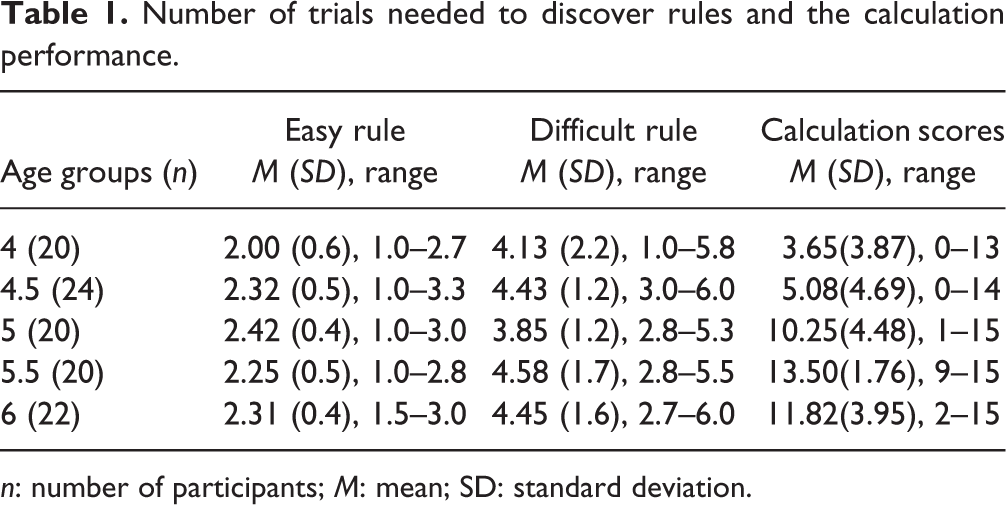
n: number of participants; M: mean; SD: standard deviation.
Fourth, we examined whether the ability of rule learning was correlated with mathematics performance. As was shown in Table 1, the performance of mental calculation was very low for the children younger than five, and improved sharply by the age of five. When we considered all the children together and analyzed the partial correlation between calculation and rule detection by controlling for age, the result indicated that the correlation was non-significant, r = 0.08, p = 0.41. However, when we analyzed it for each age group separately, the results indicated that only the five-year-olds showed significant correlation between the performance of rule learning and score in the mathematics test in the difficult condition, r = 0.48, p = 0.03. Other age groups showed no significant correlation between these two abilities.
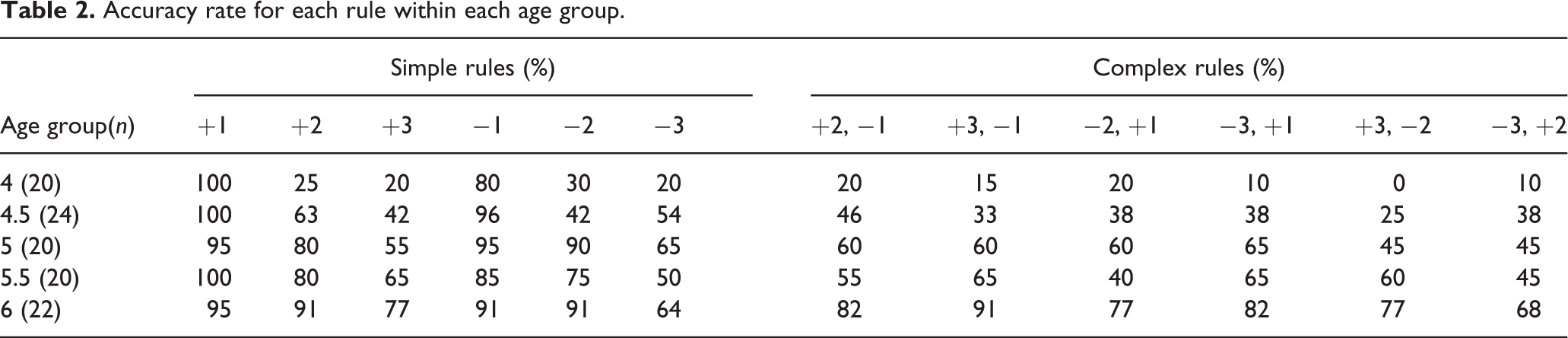
Finally, we analyzed the item effects by comparing the accuracy rate of each rule (Table 2), and the results indicated that younger children, such as four- and 4.5-years-olds, were more likely to pick up the rules involving the smaller numbers (e.g. +1, or −1) than the rules involving the larger numbers (all ps < 0.01). This finding is consistent with Lehto and Uusitalo (2006), reflecting that set size influenced children’s performance. In addition, we investigated whether children perseverate on a past rule (i.e. the frequency at which children continued to use the previous rule even after the rule had been changed). The results revealed that there was a perseverative error of only about 3%.
Accuracy rate for each rule within each age group.
Discussion
The results of the current study demonstrate that children who were 4.5 years old or above had the ability to detect most of the simple rules hidden in the number sequences. In contrast, the performance of four-year-olds was poorer than that of 4.5-year-olds. This result was similar to that of previous research (Lehto & Uusitalo, 2006), which demonstrated that RD ability in young children was poor. During the period of four to 4.5 years of age, however, RD ability increased significantly. Although the ability to detect simple rules had begun to develop by age three (Lehto & Uusitalo, 2006), the performance of four-year-olds was the worst of all age groups in this study. A considerable improvement in RD ability was observed in children between four and 4.5 years of age, while no significant differences were found at other developmental stages (e.g. from 4.5 to six years of age). This suggested that RD ability followed a rapid development pattern within four- to 4.5-year-olds before gradually improving beyond 4.5 years of age.
Why did four-year-olds not perform better in detecting simple and complex rules? There are two possibilities. First, this may be due to the limitation of working memory in four-year-olds, as we know that the capacity of working memory improves from age four to 11 years (Alloway et al., 2006). In children under the age of four, the memory storage capacity limitation constrains complex comprehension processes. As the child grows older, however, less processing is necessary, which opens more storage space for memory (Gathercole, 2003). In the current study, RD success was based on the outcomes of rule searching. During the rule search phase, young children first focused on the presented stimuli (blue circle), then detected the mathematical relationship between the blue circle and its preceding location. In this manner, they identified the regularities and learned the rule. Obviously, this process relies on working memory (Ackerman, 1988). That is, children need to remember at least three successive spatial positions in order to detect the simple rule and approximately four previous positions that are necessary to detect complex rules. However, if problems occurred in spatial memory then they would not be able to detect the rules hidden in the moving circles.
Second, the poor performance of RD in four-year-olds may be due to their poor executive functions. Executive function is an ill-defined but important construct that refers generally to the psychological processes involved in the conscious control of thought and action (Zelazo & Müller, 2003; Zelazo et al., 2003). Executive function includes mentally playing with ideas, giving a considered rather than an impulsive response, and staying focused (Diamond & Lee, 2011). It has been suggested that executive function also plays a central role in mathematical achievement (Bull, Johnston, & Roy, 1999). Poor executive function includes disrupted organizational and planning skills, memory deficits, and behavioral difficulties, such as distractibility and problems with sustained attention. It is possible that four-year-olds have poorer executive function than 4.5-year-olds and focused their attention on the algebraic symbols and ignored more abstract information when the blue circle moved clockwise or counterclockwise, which included mathematical relationship. In addition, younger children would be more vulnerable to irrelevant information that would easily negatively affect the completion of the task (Zelazo & Müller, 2003).
Compared with simple rules, the detection of complex rules requires higher cognitive skills. On the one hand, it requires a greater memory capacity to recall the approximately four previous positions that are necessary to detect complex rules. On the other hand, the mathematical (or spatial) relationship is more complicated in the complex condition. As the blue circle can move clockwise or counterclockwise, the corresponding mathematical relationship includes both addition and subtraction. Therefore, the complex rule condition requires higher executive function in order to recognize and process stable and regular information. However, under the simple rule condition, the circle moves in a fixed direction (clockwise or counterclockwise). Therefore, children’s performances are significantly lower in the difficult condition than in the easy condition.
The current study demonstrated that children could successfully detect the complex rules by the age of five. First, beyond five years of age, children’s frontal lobes may be more advanced, thereby resulting in increased executive function (Anderson, 2002; Jurado & Rosselli, 2007). Consequently, enhanced executive function may contribute to children’s performance levels in the complicated tasks. Second, along with the development of logical and mathematical understanding, children’s ability to acquire new strategies and abandon previous, less successful strategies improves with age and this may help them to organize and plan more diverse mathematical strategies in different situations (Lemaire & Siegler, 1995). In the current study, older children may have successfully used various strategies to find rules. Third, five-year-olds have been taught addition/subtraction techniques for numbers ranged 0 to 20 in their homes or kindergarten. This may be another reason why five-year-olds outperformed younger children. Importantly, five-year-olds showed the significant positive correlation between RD scores and mathematics knowledge in the complex rule condition, implying that the higher the level of mathematics ability of five-year-olds, the better performance of detecting complex rules. Some studies of inductive reasoning have also shown that five-year-old children are able to grasp abstract concepts (Long et al., 2006) and solve analogical reasoning problems (Rattermann & Gentner, 1998).
With respect to the RD speed (i.e. the trials needed to find out a hidden rule), we found that the speed is similar for both age groups, meaning that younger children identified the rule at approximately the same point in the sequence. In the present study, the relationships between trials are based on their quantity or spatial information. Children are able to identify the rules as long as they detect and process the mathematical or spatial information. That is, once children recognize the fact that the relationship between the present stimuli and preceding stimuli does not change, they can then comprehend the simple rules. This finding implies that although rule-discovery performance was lower for younger children, they did not require more rule trials to detect the regularity in a number series if they were able to recognize the fixed change in the numerical (or spatial) relationship between trials. That is, the key to RD was the ability to discover a fixed change in the numerical relationship between trials, rather than the actual number of rule trials.
It is necessary to note that children might detect the rule by mentally calculating the Arabic numbers in some trials, but this strategy might have a negative impact on other trials (e.g. transition from 12 to 1). Therefore, we are unsure whether the Arabic numbers were processed by children and how such processing contributed to RD. Although a child might finish the task simply by counting, counting was an original ability of mathematical cognition, and the children’s task was to find the mathematical rule, so we hypothesized that they should possess some mathematical skills to complete the rule-detection task. We tried to test this hypothesis by conducting a correlation analysis. However, we found the correlation between RD scores and mathematics knowledge only for five-year-olds in the complex condition. The most possible reason that no correlation was found among other age groups might be that there were some discontinuous transitions from 12 to 1. So, the present study cannot accurately measure the relationship between the ability of RD and calculations. Future studies are needed to closely reveal the correlation between RD, mathematics, and spatial cognition.
In summary, the present study utilized a modified Brixton task to examine the developmental trajectory of children’s ability to detect rules hidden in number sequences. We found that (a) performance in relation to detection of simple rules increased significantly between four- and 4.5-year-olds; (b) children older than five years old were able to detect most complex rules; and (c) the same number of trials were viewed by children before they successfully detected each rule. These results extend our understanding of the development of RD and its related factors in the context of four- to six-year-old children.
Footnotes
Funding
The authors disclosed receipt of the following financial support for the research, authorship, and/or publication of this article: National Natural Science Foundation (NNSF) Grants (Grant / Award Number: 31300844, 31571118).