




Abstract
Internationally, girls outperform boys in overall school performance. The gender gap is particularly large among those in at-risk groups, such as children from families at economic disadvantage. This study modeled the academic trajectories of a low-income sample of boys and girls from the Concordia Longitudinal Risk Project across the full course of schooling. Results from a multiple-group latent growth curve analysis revealed that children from this low-income sample demonstrated a significant decreasing trajectory of academic performance over time, which intensified after the transition from elementary to secondary schooling. A gender gap in academic performance emerged after the children transitioned to secondary school, with girls outperforming boys. Boys continued to experience greater academic decline than did girls across the secondary school years, and individual and family characteristics assessed in early elementary school predicted these academic trajectories. At school entry, boys showed higher levels of attention problems than did girls, which in turn predicted boys’ poorer school performance. However, boys with stronger reading skills and greater maternal school involvement during the early years of schooling were protected against declining academic performance across the secondary school years. Implications for prevention programs are discussed.
Across the past two decades, the achievement gap in classroom functioning between boys and girls has become of great concern (OECD, 2015). Internationally, girls receive higher grades than boys do in all major subjects, from elementary school through college (Coley, 2001; Duckworth & Seligman, 2006; Stoet & Geary, 2015; Voyer & Voyer, 2014), even in subjects in which boys score higher on standardized tests (Fryer & Levitt, 2010; Robinson & Lubienski, 2011). Girls also tend to build stronger relationships with teachers, obtain more class honors, and progress toward higher levels of education (Birch & Ladd, 1998; Coley, 2001; Duckworth & Seligman, 2006). Conversely, boys are one-and-a-half times more likely than girls are to experience grade retention, remedial services, expulsion, and school dropout (Entwisle, Alexander, & Olson, 2007; OECD, 2015, p. 54).
Effect sizes for gender differences in academic performance vary depending on the population being studied and the age of the sample. Although the size of the gender gap in classroom functioning is small among most populations, the effect is amplified among socioeconomically disadvantaged and minority populations (Arnold & Doctoroff, 2003). The academic underachievement of racial- and ethnic-minority boys in the United States has been documented consistently (e.g., Matthews, Kizzie, Rowley, & Cortina, 2010). However, the development of the gender gap in school performance among low-income boys and girls has rarely been investigated, particularly in non-US contexts.
Short-term longitudinal studies suggest a developmental trajectory for gender gaps in education: Although performance differences between boys and girls are small or nonexistent at school entry, they appear to increase with age and are consistently reported at the secondary school level (Entwisle et al., 2007; Serbin, Stack, & Kingdon, 2013). The transition from elementary to middle/secondary school is known to pose considerable challenges to youth. This transition coincides with numerous changes in psychosocial and physical development, school organization, and academic demands and is accompanied by a significant decline in academic functioning, especially for disadvantaged adolescents (Benner, 2011). By the end of secondary school, boys, in particular those from low-income backgrounds, are much more likely than girls are to receive poorer grades and eventually to drop out of school (Buchmann, DiPrete, & McDaniel, 2008; Entwisle et al, 2007).
These findings suggest that gender differences among low-income samples manifest after the transition from elementary to the next level of schooling and increase throughout the secondary years. However, no longitudinal study to date has traced the academic trajectories of boys and girls across the full course of schooling to understand the development of the gender gap in academic performance. In the present study, we applied life-course theory (Elder, Johnson, & Crosnoe, 2003) to (a) compare trajectories of academic functioning in a low-income sample of French-speaking Canadian boys and girls from early elementary until the end of secondary school, and (b) compare the predictors of boys’ and girls’ academic trajectories.
The life-course perspective has enhanced our understanding of pathways to academic success by asserting that high school failure is a process, the endpoint of a long-term educational trajectory (Alexander, Entwisle, & Kabbani, 2001; Dupéré et al., 2014). These longitudinal studies have demonstrated the important role of early family circumstances and school experiences in eventuating a high-risk trajectory for dropout for some children (e.g., Alexander et al., 2001; Duchesne, Larose, Guay, Vitaro, & Tremblay, 2005; Jimerson, Egeland, Sroufe, & Carlson, 2000). This body of work has consistently shown that economically disadvantaged children enter school with less well-developed cognitive (e.g., math, reading) and social-behavioral (e.g., attention) skills, which are robust predictors of school achievement and dropout (Alexander et al., 2001; Crosnoe & Cooper, 2010; Duncan et al., 2007; Jimerson et al., 2000). The risks of economic disadvantage seem to be rooted in family factors, including parents’ level of education, their academic competencies and attitudes, and involvement in schooling (Crosnoe & Cooper, 2010). For example, this line of work has suggested that parents with less education and lower incomes tend to hold lower educational expectations for their children, which impacts the extent to which these parents support children’s learning-related behaviors and directly influences children’s academic competency beliefs, along with their actual school performance (Benner & Mistry, 2007; Crosnoe & Cooper, 2010; Davis-Kean, 2005). In contrast, high parental educational expectations and involvement in schooling have been shown to promote educational success for low-income youth, and may be an especially important protective factor for this population (Benner & Mistry, 2007; Jeynes, 2007; Mullis, Rathge, & Mullis, 2003; Sirin, 2005).
Low-income boys and girls: Are there different equations for success?
In identifying the key early predictors of educational trajectories, the life-course literature has highlighted the importance of identifying children who are at risk for school failure early in their academic careers. However, prior work in this area has not comprehensively addressed whether early child abilities (e.g., reading, math, attentional skills) and parental behaviors (e.g., involvement in schooling) differentially predict risk for school failure for boys and girls (DiPrete & Jennings, 2011). National and international data show that at school entry, girls display better performance than boys do in basic reading, and this performance advantage widens in the high school years and at the low end of the performance spectrum (Coley, 2001; Stoet & Geary, 2013). In contrast, boys have been shown to outperform girls at the highest ranges of mathematical ability, although low-performing boys and girls perform similarly in mathematics (Stoet & Geary, 2013). In addition to showing a large advantage in literacy-related domains, girls also have better-developed attention and self-regulatory skills than boys (Rucklidge, 2010), which may translate into large gender differences in academic performance over time by incrementally affecting boys’ and girls’ ability to profit from educational instruction (Duchesne et al., 2005; Duckworth & Seligman, 2006). Although gender differences in academic skills and behaviors are well documented, these findings have not been integrated into research examining the gender gap in academic performance. Consequently, little is known about how risk and protective factors may combine to produce gender differences in educational outcomes.
According to life-course theory, risk factors are likely to accumulate over time within an individual, producing different life trajectories (Elder et al., 2003). However, the presence of protective factors may disrupt patterns of cumulative disadvantage. Because of the multitude of risk factors that low-income boys face, they may benefit most from the development of early skills and the acquisition of environment supports. Specifically, low-income boys may be protected against academic decline across the transition to secondary if they possess skills (e.g., reading) that are typically better developed in girls and among high-income groups (Sirin, 2005; Stoet & Geary, 2013). Low-income boys might especially benefit from other compensatory supports, such as parental school involvement (Pomerantz, Moorman, & Litwack, 2007). Parental school involvement has been shown to increase parental monitoring and competence-promoting parenting practices, which are associated with increases in child compliance with homework, involvement in educational activities, academic self-competence, and self-regulation (e.g., Benner & Mistry, 2007; Davis-Kean, 2005; Hill et al., 2004). This compensatory support may directly counter some of the academic risk factors boys face at the transition to secondary and ultimately impact their achievement outcomes.
This study
We applied life-course theory (Elder et al., 2003) to understand (a) whether boys’ and girls’ long-term trajectories are differentially affected by the challenging transition to secondary education, and (b) how boys’ and girls’ trajectories across the entire course of schooling are differentially predicted by early life conditions, competencies, and environmental supports. Using a multiple-group trajectory design, we examined and compared trajectories and predictors of boys’ and girls’ school performance, based on overall grade point average (GPA), from Grades 1 through 11. We also examined whether gender differences varied based on subject material by examining school marks in mathematics and reading. Our study is an extension of an ongoing project examining development and school performance in a longitudinal sample of children from low-income families (Serbin et al., 2013), incorporating two additional waves of data. In the present study, both trajectories and early predictors of academic performance could be examined and compared for boys and girls across the full course of schooling. To our knowledge, this is the first study to use a latent growth-modeling framework to explore the timing, long-term trajectories, and predictors of gender differences in academic performance among a low-income sample of children. In particular, the study’s low-income sample, its long-time frame, a focus on actual school performance (i.e., report card grades), and the detailed measurement of both academic and non-academic predictors are unique in this research area.
Hypotheses
On the basis of the literature reviewed earlier in this article, we anticipated that the academic performance of boys and of girls would be similar at school entry, measured at age 7, but would diverge after the transition from elementary to secondary schooling, with greater declines experienced by boys than by girls. After the transition to secondary, we expected girls to outperform boys in all subject areas, including math, reading, and overall GPA. A second prediction was that children with additional risk factors (i.e., males, those with poor skills and low levels of environmental support) would experience the greatest declines in academic functioning following the transition. We expected the performance of youth with these additional risk factors to further decline across the course of secondary school, while the performance of low-income students without these additional risks would recover and stabilize across the secondary school years.
We also hypothesized that the academic trajectories of boys and of girls across elementary and secondary schooling would be differentially predicted by family and individual characteristics measured soon after children’s initial school entry. Based on the literature on school performance, these predictors included (a) maternal education, (b) family income, (c) mathematics ability, (d) reading ability, (e) inattention/hyperactivity–impulsivity, and (f) maternal school involvement. We expected boys to have more attention/hyperactivity–impulsivity problems at school entry than girls, and that their higher level of attention problems would contribute statistically to poor academic performance and the emergence of a gender gap later in their school careers. Finally, we predicted that boys who possessed early skills and supports that have been consistently linked with good school performance (i.e., math, reading, attention skills, and maternal school involvement) would have better trajectories of academic performance. These protective effects were expected to be particularly important during the secondary school years, in the context of an increasing gender gap in academic performance.
Method
Participants
The original sample
The Concordia Longitudinal Research Project (Concordia Project) is an ongoing, prospective, longitudinal study of families from disadvantaged backgrounds. The Concordia Project began in 1976 with the screening of 4,109 French-speaking children attending Grades 1, 4, or 7 at public schools serving inner-city neighborhoods of Montreal, Quebec, Canada. Most of the original participants, many of whom have become parents, have been selected for follow-up studies of measures such as mental and physical health, observation of family functioning, parenting, and diurnal neuroendocrine patterns (Serbin et al., 2011). Of relevance to our study, an intensive longitudinal follow-up sample of 693 participants has been seen at 3–5-year intervals since 1976 (currently to mid-adulthood) and screened on observational and interview-based measures and questionnaires concerning health, education, family, and occupational functioning. Of these 693 people, 550 have become parents. This subsample was used to identify the families recruited for our study (see below). For a more detailed description of the intergenerational project’s methodology, please refer to Serbin et al., 1998.
Our study sample
A group of 126 participants in the original study who currently had children in the first cycle of elementary school during the first phase of our study were included in the analyses. All families with children in this specific age range who were living within a 2-hour drive from our laboratory (N of eligible families was 165) were identified and invited to participate at wave 1 of the analyses. The families spoke French at home and the children attended French-language schools. The majority of children were of French Canadian descent, with less than 5% from other ethnic backgrounds. Approximately 76% of invited families agreed to participate during the period of our study (see Procedures). These 126 families did not differ from those who did not participate (N = 39) or from the complete sample of families (N = 550) in terms of family income, maternal education, neighborhood disadvantage, single parenthood, or welfare enrollment (all p values were > .10).
In terms of demographics, families in our study sample fell below population averages on several measures of socioeconomic functioning. Mothers’ and fathers’ mean years of education were 12.11 years (SD = 2.31) and 11.91 years (SD = 1.96), respectively. Approximately 21% of mothers and 19% of fathers had not completed high school (equivalent to 11 years of schooling in the Quebec system) and 60% of mothers and 66% of fathers had concluded their education with a high school diploma or less. For comparison at that time, approximately 15% of Canadians (17% of Quebecers) did not complete high school and 39% of Canadians (38% Quebecers) left schooling with a high school diploma or less as their highest level of education (Statistics Canada, 2008, pp. 10, 28). When the children entered elementary school, families had a median annual income of C$42,050 (equivalent to US$28,022 at that time). This was well below the median family income in Quebec and across Canada (C$50,242 and C$55,016, respectively; Statistics Canada, 2003, p. 20). Approximately 65% of families in this sample had a family income less than the Canadian median, although there was also great deal of variability within the sample, which allowed us to examine interactions between family income and the other predictors in the model (McClelland & Judd, 1993).
Design
Children and their families were followed across four time points for this study. Although a total of 126 families were involved, participation rates varied across the four phases of the study (i.e., families that did not participate at a given wave of data collection were re-contacted approximately 3 years later and invited to participate at the following wave). At wave 1 (1999–2003), children had entered elementary school (Primary Cycle I in the Quebec system, Grades 1–2; M = 7.68 years, SD = .95); at wave 2 (2003–2005), children were in the final years of elementary school (Primary Cycle III; Grades 5–6; M = 10.91 years; SD = .96); at wave 3 (2005–2009), children had begun secondary school (Secondary Cycle I; Grades 7–8; M = 13.79 years, SD = 1.27); and in the final wave of data collection, at wave 4 (2010–2011), children had transitioned into the final years of secondary (Secondary Cycle II; Grades 9–11; M = 16.53 years, SD = 1.44).
Procedure
Informed consent and demographic information were obtained during a telephone interview followed up with signed forms at each phase of data collection. At wave 1 (early elementary), parents and teachers completed questionnaire-based measures of children’s behavioral functioning and of maternal involvement with schooling. Also at this time, a brief battery of achievement tests was administered during a school or home visit. Families and children were compensated with a nominal honorarium (family) and small gift (child). Children’s final report card grades for the year were obtained at each wave of data collection.
Measures
Socioeconomic status
At wave 1 (early elementary), mothers reported their final level of education obtained in years and their family income for the past year, in Canadian dollars.
Academic and cognitive skills
Standardized measures of children’s reading skills were assessed via the Bilan Qualitatif de l’Apprentissage de la Lecture, 2nd edition (Campeau-Filion & Gauthier, 1989) at wave 1 (early elementary). Children’s standardized score on the reading subtest was used to assess reading skills. Also at this time the numerical operations subtest of the Wechsler Individual Achievement Test (Wechsler, 1992) was administered to assess children’s mathematical skills.
Attention skills
To measure individual differences in attention and related behavioral problems, we administered the Child Behavior Checklist/4–18 caregiver format (Achenbach, 1991) at wave 1 (early elementary). Mothers rated their child’s behavior during the previous 6 months, indicating on a 3-point scale whether the behavior-related item was not true (0), sometimes true (1), or often true (2) for their child. Total scores from the 11-item Attention Problems scale were used. The internal consistency of the Attention scale in this sample was excellent (α = .87).
Mothers’ school involvement
Teachers rated mothers’ involvement in their child’s schooling during early elementary by using an adapted version of the Parental–Teacher Involvement Questionnaire (Conduct Problems Prevention Research Group, 1991). Teachers reported the extent to which mothers participated in school activities, attended PTA meetings, met with teachers to discuss their child’s progress, promoted school success in the home, and implemented teacher’s feedback; teachers also reported about quality of the parent–teacher relationship and the perceived value parents placed on education. These seven questions were rated on a 4-point scale, with higher values indicating higher levels of involvement. Items were averaged to create a mean score of maternal involvement that could range from 1 to 4 (α = .70).
School performance
End-of-year report cards were obtained from the administrator of each participant’s school at each successive time point. Grading systems differed between schools and school boards (most used letter grading; some used percentages); therefore, we created a standardized system of classification based on the widely used 4-point “grade point average” system so children’s school performance could be directly compared. Scholastic grades were coded on the 4.0 scale according to the extent to which they met grade-level expectations: 1 = does not meet expectations for grade level (equivalent to “D” in letter grading systems), 2 = partially meets expectations (equivalent to “C”), 3 = fully meets expectations (equivalent to “B”), 4 = surpasses expectations (equivalent to “A”). For the outcome measure, a score from 1 to 4 was assigned for children’s report card grades in French (reading, writing, and oral expression), math, humanities/social studies, science, and English (second language) from a single academic year. These scores were averaged to generate a mean score at each time point. We also examined math and French reading report card marks separately.
Statistical analysis
Multiple-group latent growth curve modeling (LGM; Muthén & Muthén, 1998) was used to examine change in school performance over time. Using a structural equation modeling approach, LGM reflects individual differences in growth trajectories through latent growth factors that estimate initial status (intercept factor) and rate of change (slope factor). LGM is a powerful approach to analyzing longitudinal data that is characterized by much higher levels of statistical power than are comparable traditional methods (e.g., repeated-measures analysis of variance, change scores) when applied to the same data. Multiple-group analysis was used to examine differences across gender in initial levels of school performance, changes in performance over time, and the predictive strength of demographic, child skills, and parenting variables. Notably, the multiple-group framework systematically includes tests of gender differences in all analyses by modeling whether there is an interaction between gender and the independent variables in the prediction of school performance trajectories (Bollen & Curran, 2006). All LGM models were estimated using Mplus Version 5.1 (Muthén & Muthén, 1998).
As with most longitudinal research, a degree of missing data was present in this sample across the four time points. All available observations were included in the analysis, for which the full information maximum likelihood (FIML) approach of Mplus was used, which is a robust estimation method when data are missing at random or completely at random (Enders & Bandalos, 2001). The amount of missing data for the outcome variable (school performance) at each wave of data collection ranged from 11% to 46% (M = 27%), reflecting increasing attrition over time. More than 70% of participating children had school performance data for at least three of four waves of data collection, and 93% of children had data available for at least two of four waves. The amount of missing data for the predictor variables measured at early elementary ranged from 0% to 17% (M = 5%). We conducted a missing-value analysis using SPSS software version 22 and Little’s MCAR test. Results of this analysis supported the missing completing at random assumption χ2(112) = 98.62, p = .81, suggesting that missingness in our dataset did not likely impact our results and permitting the application of FIML procedures.
We evaluated model fit by using Kline’s (2005) guidelines, according to which good model fit is reached when the chi-square value is non-significant, CFI values are at .95 or more, and root mean square error of approximation (RMSEA) values are at .05 or less. Chi-square difference testing was used to compare the fit of competing models. The Akaike Information Criterion (AIC) was also used to compare the alternative models with one another. The AIC takes both parsimony and fit into account and in comparison of the alternative models, the lower the AIC, the better the model.
Results
Descriptive statistics for all study variables are presented in Table 1. A gap in overall school performance, including reading and mathematics, was observed between boys and girls from school entry through the end of secondary school but became statistically significant only after the transition to secondary school (i.e., in Grades 7–8). At early elementary, boys were rated by their mothers as significantly higher than girls on measures of attention problems on the CBCL, raw scores: boys, M = 5.93; girls, M = 3.35; p < .001; d = 0.67, 95% CI (0.29, 1.03); standardized t scores: boys, M = 59.62; girls, M = 55.97; p < .05; d = 0.19, 95% CI (0.02, 0.35), with 23.1% of boys exhibiting clinical or borderline clinical attention problems, compared to 11.8% of girls. There were no statistically significant differences between girls’ and boys’ reading or math skills, levels of parental education or family income, or level of maternal involvement. The correlation matrix for all study variables is presented in Table 2.
Descriptive statistics and effect sizes.
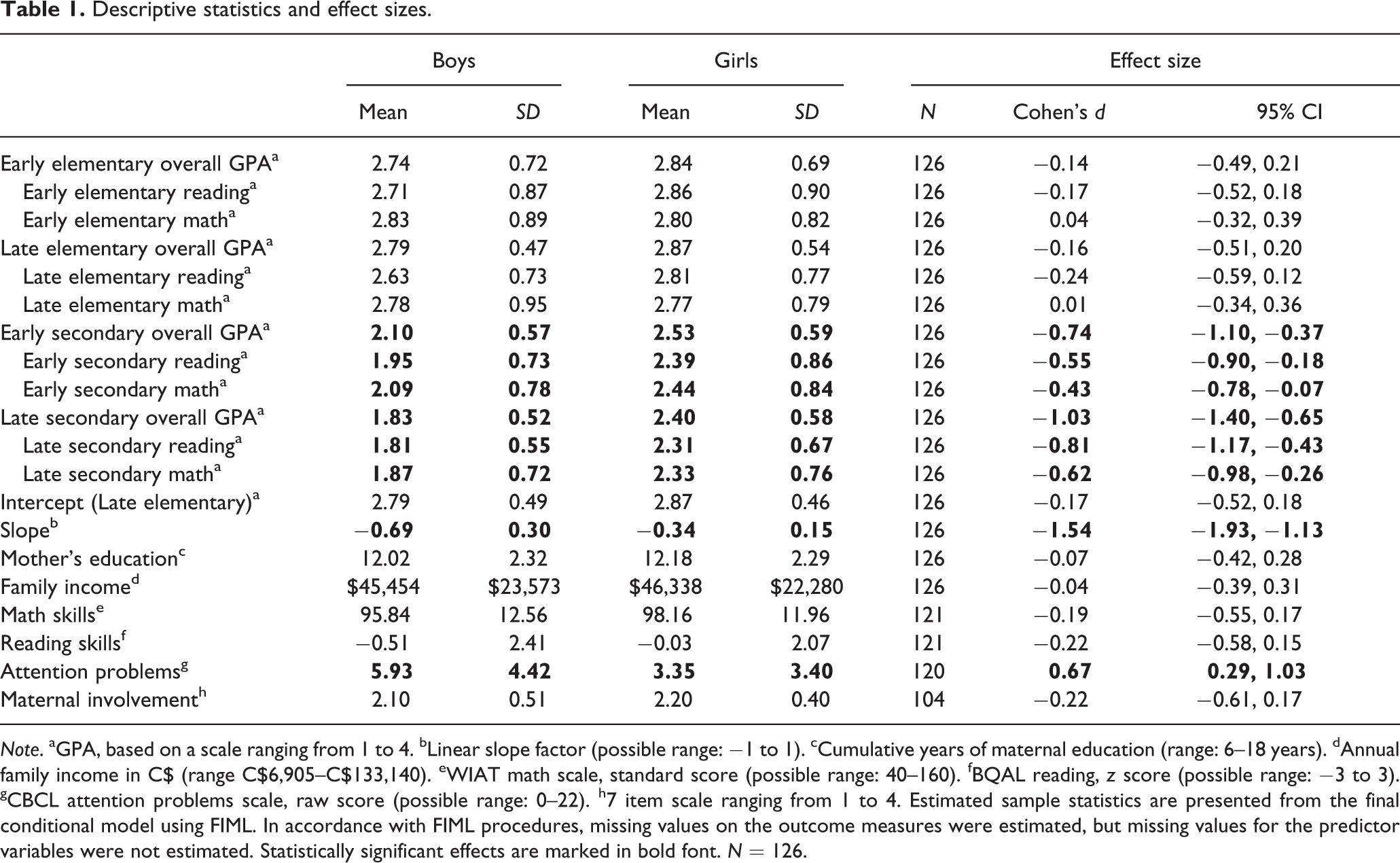
Note. aGPA, based on a scale ranging from 1 to 4. bLinear slope factor (possible range: −1 to 1). cCumulative years of maternal education (range: 6–18 years). dAnnual family income in C$ (range C$6,905–C$133,140). eWIAT math scale, standard score (possible range: 40–160). fBQAL reading, z score (possible range: −3 to 3). gCBCL attention problems scale, raw score (possible range: 0–22). h7 item scale ranging from 1 to 4. Estimated sample statistics are presented from the final conditional model using FIML. In accordance with FIML procedures, missing values on the outcome measures were estimated, but missing values for the predictor variables were not estimated. Statistically significant effects are marked in bold font. N = 126.
Correlation matrix.
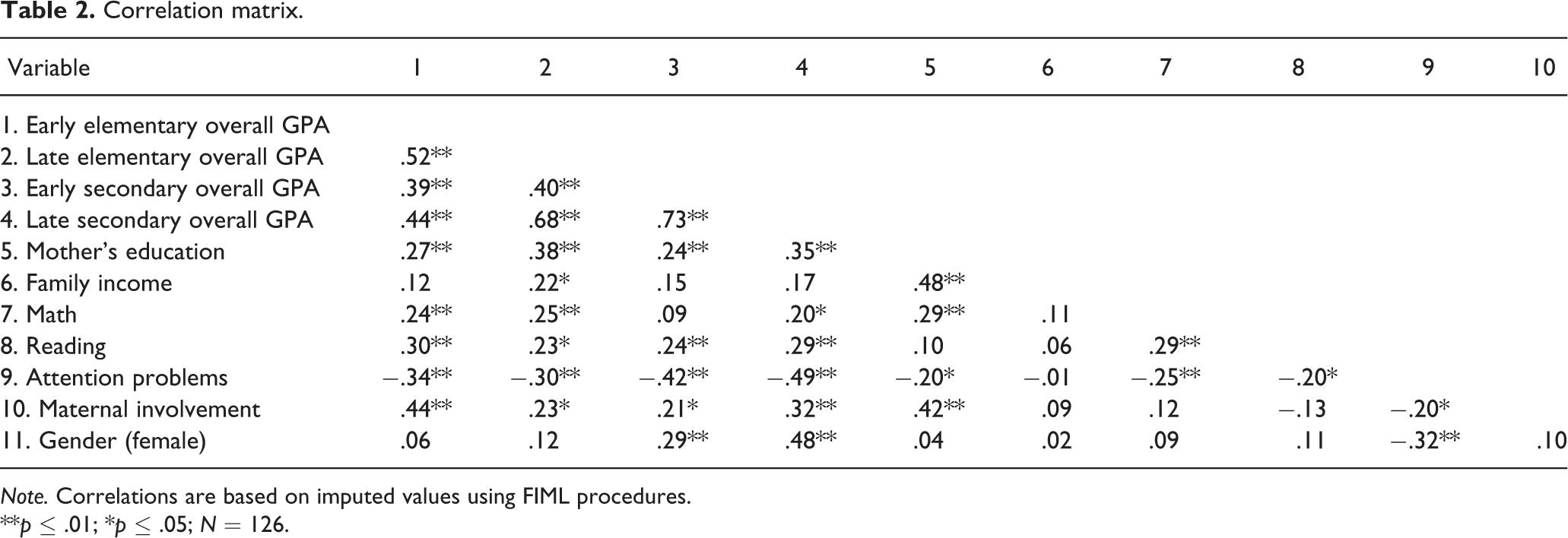
Note. Correlations are based on imputed values using FIML procedures. **p ≤ .01; *p ≤ .05; N = 126.
Trajectories of achievement
We first estimated an unconditional LGM (omitting the predictor variables) to establish the growth function that best captured achievement growth. We began by estimating a linear and quadratic model with all the time-specific residual variances set to be equal over time, which resulted in poor model fit, χ2(5) = 41.90, p < .001; CFI = 0.65; RMSEA = .24; AIC = 628.89, and χ2(1) = 21.64, p < .001; CFI = 0.80; RMSEA = .41; AIC = 616.64, respectively. We adopted a freely estimated model because growth in school performance proved to be nonlinear. Relative to a more conventional growth model involving linear and quadratic growth factors, a model with freely estimated loadings is just as flexible in fitting a nonlinear trajectory but does so more parsimoniously, given the estimation of fewer parameters (Bollen & Curran, 2006). In our model the first time point was freed, the second time point was fixed at 0 (the intercept), the third time point was fixed to 1, and the final time point was freed. We elected to fix the intercept at late elementary (the second time point) so we could understand the effects, relationships, and individual differences that emerge at the beginning of the growth process (i.e., to understand the marked decline in school performance and the gender gap that emerges from late elementary through secondary schooling). This model resulted in significant improvement in model fit, χ2(3) = 13.17, p < .001; CFI = 0.90; RMSEA = .16; AIC = 604.16. Examination of model modification indices indicated the presence of correlated error between school performance measured at late elementary and early secondary school. Given their shared method of measurement (teacher reports), we allowed the residual variances associated with school performance measured at late elementary and early secondary to be freely correlated. This resulted in a significant increase in model fit and was retained as the final unconditional model, χ2(2) = 1.72, p = .42; CFI = 1.00; RMSEA = .00, AIC = 594.71.
Results from the unconditional model revealed the mean intercept level of school performance was 2.84 (SE = 0.05, p < .001) and the mean slope was −0.51 (SE = .06, p < .001), indicating that at late elementary, children’s school performance averaged 2.84 (on a 4-point scale) and fit a trajectory of decreasing performance. The intercept variance was 0.19 (SE = 0.04, p < .001) and the slope variance was 0.04 (SE = 0.04, p = .33). There was no significant change in school performance from early to late elementary (p = .42), but there was significant change in performance from late elementary to early secondary (p < .001) and from early to late secondary (p < .001). These change coefficients indicate an intra-individual change pattern characterized by stability across the first two time points, followed by 133% decline across the remaining time points. The magnitude of the decline was largest across the transition to secondary school, with still significant but lesser decline from early to late secondary school.
Comparison of boys’ and girls’ trajectories
After finding the optimal model that explained the full sample’s growth trajectory, we tested our first hypothesis, that the trajectories of boys and girls would significantly differ. The model was first fit to boys and to girls separately and then simultaneously in the same model, as recommended by Bollen and Curran (2006). Nested model comparisons conducted separately for boys and for girls indicated that the latent basis growth curve model described above best fit the data both for boys and for girls: boys, χ2(2) = 2.81, p = .83; CFI = 1.00; RMSEA = .00; AIC = 748.35, girls, χ2(2) = 2.52, p = .28; CFI = 0.99; RMSEA = .06; AIC = 312.74.
Next, we examined whether the measurement model was equal for boys and for girls. Multiple-group analyses were conducted, with increasing restrictions placed on the model parameters. Equality of models across gender was tested using the chi-square difference test, with non-significant differences between the models indicating that the more restrictive model fit the data just as well as did the less restrictive model. If the constraint did not result in a significantly worse fit over the base model, the parameter was considered to be equal for both genders and was retained. Only the model in which all the parameters but the slope mean were free to vary across gender, (χ2(7) = 22.78, p = .00; CFI = 0.85; RMSEA = 0.19; AIC = 599.51), significantly differed from the model in which all parameter estimates were allowed to vary across gender, (no constraints across classes: χ2(6) = 4.78, p = 0.57; CFI = 1.00; RMSEA = 0.00; AIC = 583.51). Therefore, the model in which the slope mean was allowed to vary across groups and the intercept mean and variance and slope variance were constrained to be equal was retained as the final measurement model. The final measurement model fit the data well, χ2(9) = 8.30, p = .50; CFI = 1.00; RMSEA = 0.00; AIC = 581.03. This analysis provides strong evidence that the mean of the intercept and the variances for the intercept and slopes were equal for boys and for girls, but with differences in the mean of the rate of change.
As described in the analyses above, boys and girls did not differ in their initial level of overall school performance; but their rate of change did significantly differ. No significant change existed in overall school performance between early and late elementary school for boys and for girls. After the transition to secondary school, boys and girls both exhibited a sharp decline in school performance, although the rate of decline was approximately twice as large for boys than for girls. Subsequently, the overall school performance of boys continued to decline across the secondary school years. In contrast, the school performance of girls remained relatively stable once they had begun secondary schooling in Grades 7–8 and remained at approximately the same level through their final secondary school years (Grades 9–11). The estimated means and trajectories for overall school performance are presented in Table 1 and Figure 1.

Observed means, estimated trajectories, and confidence interval for overall school performance trajectories, fit simultaneously for boys and girls: χ2(9) = 8.30, p = .50; CFI = 1.00; RMSEA = 0.00; AIC = 581.03. Time scores were freely estimated to reflect the amount of change occurring in the interval rather than the length of the interval in months or years. Overall school performance was coded on a 4.0 GPA system. N = 126.
We examined whether gender differences depended on the subject material by examining school marks in reading and mathematics. Trajectories of reading and math performance were very similar to trajectories of overall school performance. Boys and girls did not statistically differ in their early and late elementary school math and reading performance, but gender differences in both subject areas emerged following the transition to secondary school, with boys showing greater rates of decline during secondary school. Given the similar trajectories that emerged for reading, math, and overall academic performance, only overall academic performance trajectories are described in detail.
Predictors of trajectories
We then tested whether demographic, child, and parenting variables predicted initial levels (intercept) and rate of change (slope) in school performance across boys and girls. Six predictors (maternal education, family income, math skills, reading skills, attention problems, and maternal school involvement) were entered simultaneously into the model as predictor variables. The effects of predictor variables on growth parameters were allowed to vary by gender, given our interest in examining moderation of gender differences by early predictors. We allowed for covariance in random error between maternal involvement and late elementary school performance for boys. This model resulted in significant improvement in model fit and was retained, χ2(32) = 34.72, p = .34; CFI = 0.98; RMSEA = .04; AIC = 3865.17. The parameter estimates obtained from the final conditional model are presented in Table 3.
Parameter estimates in the final conditional model.

Note. b = unstandardized coefficient; β = standardized coefficient, 95% CI = 95% confidence interval for the standardized estimate. Statistically significant effects are marked in bold font. **p < .01; *p < .05; N = 126.
For boys and for girls, children with mothers who demonstrated higher levels of school involvement and who had higher reading skills at early elementary had higher school performance by the final years of elementary school. Although zero-order correlations showed that early math skills were significantly related to school performance at several time points, when entered simultaneously in the prediction model, math skills did not significantly predict late-elementary performance. For boys only, individual variation in attention skills at early elementary predicted later school performance, such that boys who had fewer attention problems had higher school performance by the end of elementary schooling.
To understand the rate of change or decline in school performance across the secondary school years, we examined the slope factors for boys and for girls. The mean rate of change for boys and for girls significantly differed, such that boys (α = −0.69) had a steeper decreasing trajectory than did girls (α = −0.34). Examination of the covariance of the intercept and slope factors revealed that the initial status did not predict the rate of change for boys or girls. In other words, relatively good school performance at the end of elementary schooling on its own did not confer an advantage in terms of avoiding the typical decline that began at the transition to secondary schooling. Instead, decline was predicted by earlier academic competencies and environmental supports. In particular, boys who had more advanced reading skills and greater maternal involvement during the early years of elementary schooling experienced a less steep rate of decline in school performance across time. For girls, who as a group experienced a lesser decline in school performance than did boys, the predictor variables did not predict a significant portion of variation in their rate of change, perhaps because girls did not demonstrate significant inter-individual variability in the slope factor. Maternal education and family income did not predict late-elementary school performance or change in school performance, above and beyond the effect of the other predictors in the model.
Although maternal education and family income were positively correlated (r = 0.48), post-hoc analysis revealed that neither maternal education nor family income were statistically significantly related to the intercept or slope growth factors when the other was dropped from the final conditional model. These findings rule out an alternative hypothesis: that the null findings concerning maternal education and family income in this study arise because they account for overlapping effects. Finally, to examine whether the above-mentioned results varied by level of family income or maternal education, we added 2-way interaction terms (family income × each of the predictor variables; maternal education × each of the predictor variables) to the multiple-group model. None of these interaction terms were statistically significant (p’s > .20).
Discussion
From a life-course perspective, successful academic performance in secondary school is critical to establishing life-long patterns of economic, occupational, and social success (Henry et al., 2012). Boys, especially those from low-income families, are much more likely than are girls to experience poor academic performance in the critical secondary school years (NCES, 2006; OECD, 2015). Although cross-sectional or short-term longitudinal studies have suggested that an academic performance gap between boys and girls emerges in the late elementary and middle/secondary school grades (Entwisle et al., 2007; Serbin et al., 2013), our results are the first to document the academic performance trajectories (based on overall GPA) for boys and girls within a longitudinal sample of low-income youth across the full course of schooling. Results revealed different trajectories of school performance for boys and for girls, which became evident after the transition to secondary school. Only small (not statistically detectable), gender differences were evident in elementary school, but the gap widened substantially following the transition to secondary school. Although both boys’ and girls’ performance declined following the transition, boys declined at a much faster rate than girls (d = −1.54) and by the end of secondary the female advantage was considered large in magnitude (d = −1.03), according to Cohen’s (1988) conventions.
Not only did girls outperform boys on global academic performance measures, but we also found evidence of a female advantage in both math and reading during secondary school. Trajectories of math and reading performance followed similar patterns to those of overall GPA, with boys’ and girls’ performance becoming increasingly differentiated during the secondary years. These findings contrast popular stereotypes that females excel in languages and males excel in math and science. Instead, our results are consistent with recent meta-analytic data showing that females generally outperform males by about .25 standard deviations in school performance across all subject areas (Voyer & Voyer, 2014). Other recent studies show that among 15-year-olds, the female advantage in academics is greatest among students at low levels of achievement (Stoet & Geary, 2013,2015). Our results extend these findings, showing that large gender differences among low-income, low-achieving groups emerge and accelerate during the secondary school years.
Predictors of gender-based trajectories
Although large-scale, international studies have documented consistent differences in the academic performance of males and females (Stoet & Geary, 2013, 2015; Voyer & Voyer, 2014), little is known about the factors that produce these differences, especially among low-income samples who have the highest risk for school failure. Since academic achievement is a cumulative process that involves mastering new skills and improving on already-existing skills (Alexander et al., 2001), traits that disrupt early learning may widen girls’ initial advantages over time. In support of this hypothesis, our findings replicate the well-studied phenomenon that boys are more likely to experience inattentive-hyperactive/impulsive behaviors than are girls (Rucklidge, 2010). The current findings also indicate that school entry attention problems are an important predictor of boys’ (but not girls’) academic difficulties in late elementary school, and that the performance advantage for girls increases across the course of schooling.
These results may help explain a seemingly contradictory finding in the literature: that girls receive higher overall grades than boys in all major subjects, including those subjects in which boys score higher on standardized tests (Fryer & Levitt, 2010; Robinson & Lubienski, 2011). School performance reflects learning in the social context of the classroom, which requires attention, effort, and persistence over long periods of time. Since girls begin school with more advanced attention skills, they may be able to more fully engage with and profit from educational instruction, while boys may face increasing difficulties over time as attention problems impact sequential skill acquisition (Entwisle et al., 2007; Ready, LoGerfo, Burkam, & Lee, 2005. Alternatively, gender differences in attention skills and disruptive classroom behaviors may produce gender differences in academic performance by negatively impacting teachers’ perception of low-income boys and biasing their assignment of school grades (Auwarter & Aruguete, 2008). Although our study was not designed to test these hypotheses, this is an issue that warrants further research.
Buffers against poor school performance
Life-course theory predicts that personal characteristics, relevant skills, or environmental supports developed early in life often determine whether a challenging transition leads to success and future growth. Our results revealed that high achievement at the end of elementary schooling on its own did not confer an advantage in terms of avoiding the typical decline, which began at the transition to secondary schooling. Instead, children who had developed strong skills and supports earlier in their schooling showed better performance in late elementary grades and greater recovery after the transition to secondary school. Specifically, we found that reading skills and maternal involvement were protective against declining performance for boys, but not for girls. Reading permeates the school curriculum and literacy skills are consistently identified as a powerful predictor of future achievement (Duncan et al., 2007), especially among low-income groups (Herbers et al., 2012). Since low-income boys show weaker reading skills than girls or children from higher socioeconomic backgrounds (Stoet & Geary, 2013), efforts to bolster boys’ literacy skills in elementary school may help close the achievement gap between boys and girls that emerges later on. Similarly, because boys have attentional skills and other regulatory capacities that are relatively poorly developed, maternal school involvement may help compensate for these and other risk factors (Pomerantz et al., 2007). Maternal involvement in schooling may promote school success in boys by increasing their participation in educational activities, their self-regulatory abilities, and their academic self-competence (Davis-Kean, 2005; Hill et al., 2004).
Parental involvement may also promote educational success by countering negative gender stereotypes that are common among peers and in the social environment. For example, Hartley and Sutton (2013) have shown that as early as age 7, boys and girls hold the belief that adults expect girls to be better students than boys and these beliefs negatively impact boys’ reading, writing, and math performance. As they progress through schooling, boys from socially and economically disadvantaged backgrounds tend to disengage from academics, which places them at high risk for poor grades and school drop-out (Henry, Knight, & Thornberry, 2012). Maternal involvement may influence boys’ school engagement by directly counteracting such negative gender stereotypes and promoting boys’ competency beliefs.
Strengths, limitations, and future directions
A unique strength of this study was its multiple time point longitudinal design and use of growth curve modeling: revealing the developmental processes underlying the gender gap in school performance and comparing the predictors of boys’ and girls’ performance across the full course of schooling. Although this was primarily a low-income sample, there was also a great deal of variability in family income and maternal education, allowing us to examine whether specific predictive effects differed across a range of socioeconomic status. We did not find evidence for moderation effects involving family income or maternal education, suggesting that the effects of math, reading, attention, and school involvement on child achievement were applicable to students across a range of socioeconomic levels. These findings are consistent with meta-analytic results showing that the skills and supports identified in the present study are universally important predictors of academic performance (Duncan et al., 2007; Jeynes, 2007).
Despite these advantages of the design, the sample size was relatively small, limiting our ability to detect smaller effect sizes (Cohen, 1988). Replication with larger samples might detect additional predictors of academic trajectories for boys and girls. Although information regarding fathers’ education was available, fathers’ level of education was highly correlated with mothers’ and did not predict independently when entered into the trajectory equation. Because there was also a high rate of paternal absence in this sample, we focused on maternal rather than paternal education and maternal school involvement as predictor variables. Future research may address how mothers and fathers differentially contribute to their child’s academic achievement through school involvement. Relatively little research has examined this issue, particularly among low-income populations where rates of paternal absence are relatively high. Finally, the predictor variables were measured at only one time point, which limited conclusions about causal relations or ongoing transactional processes between child and environment over time. Ideally, the predictor variables we identified at school entry would have been assessed at each successive educational cycle so that changes in individual levels of academic abilities, attention skills, and involvement could be related to changes in children’s academic trajectories.
Conclusion and implications for prevention and social policy
The academic underperformance of low-income groups has been widely acknowledged (Sirin, 2005), however the gender gap in this population has received little attention in the research literature. The majority of research papers and interventions in this area have focused on reducing the mathematics achievement gap, which favors boys at the highest levels of achievement (Stoet & Geary, 2015). The focus on this issue may have resulted in a relative neglect of boys’ overall academic underperformance, especially among socially and economically disadvantaged groups. The present results demonstrate that initially small differences in school performance between low-income boys and girls increase across the course of schooling, ultimately leading to large differences in secondary school performance. These results are consistent with a process of cumulative disadvantage, which predicts that early inequalities lead to accumulating risk factors over time and ultimately to different trajectories of development (Elder et al., 2003).
One implication of our findings is that well-timed, early interventions may reduce the gender gap in achievement that emerges later in schooling. Focused interventions during the elementary years, such as increasing maternal school involvement and student reading skills, may help protect children at academic risk from experiencing declining school performance after the transition to secondary school. The continuing decline of boys’ performance during secondary school suggests that ongoing supports, including those that target the social/peer atmosphere within schools, may be necessary for those boys who are at highest risk of failure. Finally, attention to current stressors and precipitating factors (e.g., situations emerging in secondary school that lead to the decision to leave school) may also be required, as other work suggests that a subgroup of adolescents do not follow a clear identified path to school dropout (for a review, see Dupéré et al., 2015). Preventive intervention is likely to be complex at that level but may be necessary to prevent high-risk children from leaving school without completing their secondary studies.
Footnotes
Acknowledgements
We extend our gratitude to the graduate students, undergraduate students, research assistants, and volunteers for their hard work on the Concordia Project. We extend our gratitude to Claude Senneville, Nadine Girouard, Guang Hui Li, Alessandra Rivizzigno, and the Concordia Project team for their assistance in data collection and analysis. We also extend our deepest appreciation to the participating schools, teachers, the participants and their families.
Funding
The author(s) disclosed receipt of the following financial support for the research, authorship, and/or publication of this article: This research was partially supported by grants from the Canadian Institutes of Health Research, the Social Sciences and Humanities Research Council of Canada, and the Fonds québécois de la recherche sur la société et la culture. The Concordia Longitudinal Risk Project originated in 1976 under the direction of Jane Ledingham and Alex E. Schwartzman. The intergenerational project is directed by Lisa A. Serbin, Dale M. Stack, and Alex E. Schwartzman.