



Abstract
Directional associations between civic engagement and happiness were explored with longitudinal data from a community sample surveyed four times from age 22 to 43 (n = 690). Autoregressive cross-lagged models, controlling for cross-time stabilities in happiness and civic engagement, examined whether happiness predicted future civic engagement, civic engagement predicted future happiness, or the temporal ordering was bidirectional. Marital status, parental status, and recent unemployment experience were included as time-varying covariates of civic engagement, and analyses controlled for parent education, self-esteem, and self-rated physical health at age 18. Results indicated consistent cross-lagged associations from higher happiness to higher future civic engagement. There was no support for the path from civic engagement to future happiness, nor for bidirectional associations. Parenthood at age 22 predicted lower civic engagement, while parenthood at ages 32 and 43 predicted higher civic engagement. Recent unemployment experience was associated with less civic engagement at age 32 but more engagement at age 43, and marital status was linked with more civic engagement at age 43. Results support a broaden-and-build theoretical perspective in which happiness predicts future civic engagement across the transition to adulthood and into midlife.
Civic engagement involves participation in formal or informal organizations, groups, or associations (e.g., school, neighborhood, or community organization; religious group) aiming to improve a community’s quality of life (Pancer, 2015; Turcotte, 2015a). In 2013, 65% of Canadians aged 15 and over reported membership in such groups, and 44% reported volunteering (Turcotte, 2015a, 2015b). Civic participation may benefit not only the community, but also civically engaged individuals who report better health, greater well-being, and more social capital (Pancer, 2015). Are civic engagement and well-being positively related because one leads to the other, or are they mutually influential across time? The answer is unclear because many studies showing positive associations between civic engagement and indicators of well-being (e.g., feeling happy) are based on cross-sectional data, making it difficult to disentangle their temporal ordering (Lyubomirsky, King, & Diener, 2005). The primary goal of our study is to use longitudinal data to explore directionality in the connection between civic engagement (i.e., involvement in various community organizations) and happiness (i.e., positive hedonic affect; Diener, Suh, Lucas, & Smith, 1999) in a community sample surveyed at ages 22, 25, 32, and 43. This study also considers how contextual circumstances (marital and parental status and unemployment) differentially inform civic engagement across these ages.
A lifespan developmental perspective on civic engagement and well-being
The current study is guided by a lifespan perspective on human development, which aims to describe, explain, and optimize human development. Key tenets are that developmental (i.e., within-person) change is life long, multiple dimensions of development (e.g., psychological, behavioral) may change at different speeds and directions, and within-person change occurs as a function of mutually influential, dynamic interactions between individuals and their contexts. As such, it is important to examine the connections or continuities between earlier and later behaviors, to learn how different dimensions of development co-evolve across the life course in interaction with past and concurrent events, and to sort out the temporal ordering of related phenomena (Baltes, Staudinger, & Lindenberger, 1999; Lerner, Leonard, Fay, & Issac, 2011). These assumptions imply that it is worthwhile to examine the association between civic engagement and happiness as they unfold together across important segments of the lifespan. At the same time, it is important to consider possible early and concurrent individual and contextual influences that may help to shape civic engagement–happiness connections.
We track civic engagement and happiness as they evolved across 21 years spanning the transition to adulthood (at ages 22 and 25), young adulthood (age 32), and early midlife (age 43). Studies following individuals across these years are uncommon but important, given that the 20s through 40s comprise a third of the adult lifespan and actions during this period set the stage for later life health and well-being (Lachman, 2015).
Empirical associations between civic engagement and happiness
Little research has directly examined associations between civic engagement and happiness, but the literature has considered broader connections between civic engagement and well-being, primarily using cross-sectional data. A review of 22 studies showed that engaged individuals perceived participation in community initiatives to be associated with higher self-confidence and self-esteem (Attree et al., 2011), and more-active volunteers reported higher levels of self-efficacy and self-esteem than did less-active volunteers or non-volunteers (Brown, Hoye, & Nicholson, 2012; Ohmer, 2007). Similarly, civic engagement is related to individuals’ social capital (sense of social cohesion and belonging and social support; Berry & Welsh, 2010; Pancer, 2015; Talò, Mannarini, & Rochira, 2014). Many cross-sectional studies also show civic engagement positively associated with physical and mental health and subjective well-being (Attree et al., 2011; Berry & Welsh, 2010; Boenigk & Mayr, 2016; Brown et al., 2012; Meier & Stutzer, 2008; Pancer, 2015). Although a generally positive association between civic engagement and subjective well-being has been documented, a subset of vulnerable individuals (e.g., older adults with the highest levels of involvement) may become overburdened and experience lower subjective well-being, such as stress, physical exhaustion, and negative affect (Attree et al., 2011; Windsor, Anstey, & Rodgers, 2008).
A few, largely two-wave, longitudinal studies investigated the relationship between civic engagement and well-being. One revealed both volunteering and service-learning in university were related to higher life satisfaction 13 years after graduation (Bowman, Brandenberger, Lapsley, Hill, & Quaranto, 2010), but did not consider how prior levels of life satisfaction were related to later volunteering. Another showed increased volunteer hours were associated with increased happiness, life satisfaction, mastery, and physical health across three years. Despite a separate analysis in which baseline well-being did not predict increased volunteer hours, the authors nevertheless argued that associations between volunteer work and well-being are reciprocal (Thoits & Hewitt, 2001). To the best of the authors’ knowledge, no longitudinal studies assessed bidirectional associations between civic engagement and happiness while simultaneously controlling for cross-time stabilities in both. On the whole, the empirical evidence shows that there are positive associations in general between civic engagement and happiness, but the lack of multi-wave longitudinal studies leaves uncertainty as to the temporal direction of this association. Three theoretical perspectives offering alternative models of the temporal connections between civic engagement and happiness guide our analyses.
Broaden-and-build, warm-glow, and bidirectional perspectives
Some scholars argue that subjective well-being influences civic engagement (Lyubomirsky et al., 2005). According to the “broaden-and-build” theory, positive emotions are associated with a widening of cognitions (e.g., attention, creative thought, seeing multiple possibilities for action) that lead to actions expanding the repertoire of skills, resources, and interpersonal relationships (Fredrickson, 2001). People who frequently experience positive emotions – happy people – will more likely see opportunities and engage in activities that promote individual growth and social connections (Lyubomirsky et al., 2005). The improvement in well-being and accumulation of social capital associated with civic activities suggests that happy people may be more likely than the less happy to choose to engage in such activities. Based on this hypothesis, we test a happiness-driven model in which happiness is expected to lead to increases in civic engagement in the future.
In contrast, the economics-based theory of “warm-glow giving” proposes that individuals who give to benefit the public also benefit from the act; they experience a warm glow by helping others (Andreoni, 1989). Harbaugh, Mayr, and Burghart (2007) found increased neural activity in brain regions associated with reward processing when participants voluntarily donated to a local charity. Donators also reported greater subjective satisfaction. Civic engagement may have a similar effect; those who give their time and energy for the public good may be rewarded with elevated hedonic feelings. Based on this hypothesis, we test an engagement-driven model in which civic engagement is expected to be associated with increases in future happiness.
The broaden-and-build and warm-glow perspectives may not be mutually exclusive. Thoits and Hewitt (2001) argued that people with more personal resources (e.g., higher life satisfaction and lower depression) are more likely to engage in charitable causes, but such actions also reinforce and strengthen personal well-being. Such mutually influential associations (i.e., a bidirectional model) would evolve over time and are best tested with longitudinal data and analyses that can empirically compare unidirectional (happiness-driven and engagement-driven) and bidirectional models.
Changing contextual circumstances and civic engagement
Critical decisions concerning education, work, and family are made in the 20s and extend into the 30s for many people in western countries (Arnett, 2004). Changing roles and role demands might affect civic engagement and alter the relationship between civic engagement and happiness within and across segments of the lifespan. Based on our lifespan developmental perspective, we also consider marriage, parenthood, and unemployment as pertinent indicators of the context shaping the extent to which individuals are available and motivated to participate in community activities (Oesterle, Johnson, & Mortimer, 2004). The literature provides a precedent for examining the influence of these contextual circumstances on civic engagement.
The concept of “greedy marriage” suggests that married people have less time and energy than the unmarried to commit to others outside the marriage (Coser, 1974). In support of this idea, research has shown that married women and men have less intense ties to their parents, siblings, and friends, and give them less emotional and practical help than do never married or previously married individuals (Gerstel & Sarkisian, 2006; Sarkisian & Gerstel, 2008). Because most studies of the greedy marriage hypothesis have been cross-sectional, selection effects cannot be ruled out. A rare longitudinal study, however, showed that women (but not men) were less likely to volunteer and contributed significantly fewer volunteer hours after they married, providing support for the greedy marriage thesis among women (Einolf & Philbrick, 2014).
Parenthood could also contribute to civic engagement, but perhaps differently depending on stage in the lifespan. Parents in their 20s are likely to have young (preschool-age) children, but by midlife they are more likely to have children in elementary or high school. The demands of parenting young children might hinder volunteer activities whereas having children in school might increase such volunteerism because of children’s own involvement in school- and community-related activities (Oesterle et al., 2004). Indeed, in one study, more children under age 6 at home was associated with less volunteering among women, and more children ages 6 to 17 predicted more volunteering in women and men (Kim & Dew, 2016). In another study, preschool-age children hindered volunteering among women and men in their 20s, an effect that was more pronounced among younger parents (in their late teens and early 20s) (Oesterle et al., 2004).
Finally, studies found that higher work hours are related to reduced civic engagement (Kim & Dew, 2016; Oesterle et al., 2004), leading us to suggest that unemployment might be positively related to civic engagement. Individuals who want to work but are unable to land a job likely have time available for other productive, unpaid activities such as volunteering in community organizations. They might also volunteer hoping that this activity could lead to future employment.
The present study
We use longitudinal data with four waves of civic engagement and happiness measures from young adulthood to midlife to test: (a) the happiness-driven model (higher levels of happiness predict higher civic engagement in the future); (b) the engagement-driven model (higher civic engagement predicts higher future happiness); and (c) the bidirectional model positing reciprocal relations between happiness and civic engagement over time. Given that most studies examining these models analyzed cross-sectional data, the current longitudinal study is exploratory, and we do not favor one model over the other.
Marital status, parental status, and months of unemployment in the previous year were assessed at each wave, and are included in our models as time-varying predictors of civic engagement, constituting a second important focus of this study. The inclusion of these contextual indicators helps to illuminate the ways in which family and work may operate on civic engagement at different stages in the lifespan, and controls for potentially important sources of variance that could affect the temporal associations between civic engagement and happiness.
We also control for several variables (parent education, self-esteem, self-rated physical health, assessed at age 18) reflecting pre-existing individual differences that might predict civic engagement or happiness. First, parents’ education, a measure of family socioeconomic status, is positively associated with civic participation (Flanagan & Levine, 2010) and happiness (Diener, Inglehart, & Tay, 2013). Second, higher self-esteem is theorized to lead to greater happiness (Baumeister, Campbell, Krueger, & Vohs, 2003) and was positively associated at age 18 with greater concurrent happiness in the current sample (Galambos, Fang, Krahn, Johnson, & Lachman, 2015). Finally, physical health is a known correlate of civic engagement (Attree et al., 2011) and happiness (Galambos et al., 2015).
In this study, our happiness question asked “Thinking about your life in general, how happy are you with your life?” with options ranging from not very happy at all to very happy. In light of a voluminous literature on the conceptualization and measurement of happiness, our perspective is informed by Diener, Suh, Lucas, and Smith (1999) who argued that happiness is an accumulation of positive (hedonic) emotion, distinct theoretically and empirically from life satisfaction. Life satisfaction measures typically ask individuals to “evaluate their lives as a whole on a scale ranging from very satisfying to very dissatisfying” (Diener et al., 2013, p. 497). We use the term happiness to refer to our measure because it emphasizes happy emotion in both the stem question and in the response scale.
Method
Participants and procedures
Participants (n = 690) were from a 25-year longitudinal study beginning in spring 1985 (baseline) with 983 grade 12 students (age 18) who completed questionnaires in six schools representing working- and middle-class neighborhoods in a large western Canadian city. The baseline sample (47% women, 80% born in Canada, 15% non-White, and 26% with at least one university-educated parent) was representative of Western Canadian urban youth born in 1967 on race, immigration status, and parents’ education. Follow-up questionnaires were mailed in 1986 (Wave 2; age 19; n = 665), 1987 (Wave 3; age 20; n = 547), 1989 (Wave 4; age 22; n = 503), and 1992 (Wave 5; age 25; n = 404) to previous wave respondents. In 1999 (Wave 6), a telephone survey targeted all baseline participants (age 32; n = 509; response of 52% after 14 years). In 2010 (Wave 7), telephone and web surveys targeted all baseline participants (age 43; n = 405; 41% response after 25 years). Half (51%) had participated in all waves (for details, see Chow, Galambos, & Krahn, 2015; Galambos et al., 2015). Data for this study were from the 1989, 1992, 1999, and 2010 surveys which assessed both civic engagement and happiness; 1985 (age 18) baseline data were used to measure parents’ education, self-esteem, and self-rated physical health.
Of the baseline sample of 983, 293 were excluded because of totally absent data on civic engagement and happiness (n = 284), or no self-esteem or physical health scores (n = 9; 6 were missing on both and 3 were missing on physical health), leaving 690 in the final sample. Attrition analyses revealed 2010 participants did not differ from dropouts on baseline parents’ education, self-esteem, and self-rated physical health. Comparisons of participants and nonparticipants on civic engagement and happiness from 1989 to 2010 (12 comparisons) found one difference; participants in 2010 were happier (M = 2.64, SD = .52) in 1989 than were dropouts (M = 2.48, SD = .52).
Measures
Civic engagement was assessed by asking “In the past 12 months, have you been involved in any of the following?: charitable, service or volunteer organizations; neighbourhood, community or school-related associations; religious or church-related groups (not counting time in church or religious services); public interest groups concerned with issues such as the environment or world peace; and political organizations.” Binary responses (0 = No; 1 = Yes) were summed (possible range: 0 to 5), with higher scores indicating greater civic engagement. This measure is very similar to the civic engagement measure in Statistics Canada’s General Social Survey, which assesses participation in a variety of organizations, groups, and associations in the previous year (Turcotte, 2015a). Nevertheless, this measure does not assess individuals’ underlying motivations for civic engagement.
Happiness was assessed by asking “Thinking about your life in general, how happy are you with your life?” (1 = not very happy at all, 2 = somewhat happy, 3 = very happy). Significant correlations of this item with the “felt depressed” item on the Center for Epidemiologic Studies-Depression Scale (CES-D; Radloff, 1977), which ranged from –.38 to –.50 at six waves, and with the “felt happy” item from the CES-D as assessed in 2010 (r = .51) supported the construct validity in our data (Galambos et al., 2015). Single-item happiness measures are sensitive to objective circumstances in individuals’ lives (Dolan, Peasgood, & White, 2008) and our item is similar to single-item measures labeled as happiness in the U.S. General Social Survey (Oishi, Kesebir, & Diener, 2011), the 2000 Social Capital Benchmark Survey (Subramanian, Kim, & Kawachi, 2005), and the Seattle Longitudinal Study (Hoppmann, Gerstorf, Willis, & Schaie, 2011).
Time-varying covariates
At each wave, marital status was coded as 0 (not married) or 1 (married/cohabiting), while parental status was assessed by asking “Are you raising any children (either your own or your spouse/partner’s) who are presently living in your household?” (0 = no, 1 = yes). Unemployment experience was measured as number of months unemployed (having no job but actively seeking work) in the previous year in each of the four waves (possible range: 0 to 12).
Baseline (age 18) covariates
Parents’ education was coded as 0 (neither parent had a university degree) or 1 (one or both parents earned a university degree). Self-esteem was assessed with the mean of six items (α = .75) from Rosenberg’s (1989) Self-esteem Scale (e.g., “On the whole I am satisfied with myself). Responses ranged from 1 (strongly disagree) to 5 (strongly agree). Self-rated physical health (McDowell, 2006) was assessed by asking “In the past few months, how healthy have you felt physically?” Responses were coded as 1 (not very healthy), 2 (somewhat healthy), or 3 (very healthy).
Plan of analysis
Associations between happiness and civic engagement were examined through a series of nested autoregressive cross-lagged models computed in Mplus version 7.4 (Muthén & Muthén, 1998–2015). Autoregressive cross-lagged modeling is often used to examine associations among repeatedly measured variables (Little, 2013). Because happiness was measured on a three-point Likert-scale, it was treated as an ordinal variable and mean- and variance-adjusted weighted least squares (WLSMV) estimation was used to compute all analyses. In the presence of missing data, the WLSMV estimator uses all available data as long as there is pairwise present (Asparouhov & Muthén, 2010; for information on the proportion of missing data, see Table 1). Model fit was evaluated using the chi-square statistic (χ2), the comparative fit index (CFI), the root-mean-square error of approximation (RMSEA), and the weighted root-mean-square residual (WRMR). A nonsignificant χ2 value, CFI values equal to or greater than .90, RMSEA values equal to or smaller than .08, and WRMR equal to or smaller than 1.0 suggest adequate model fit (Cook, Kallen, & Amtmann, 2009; Kline, 2016). Chi-square difference (Δχ2) tests were conducted to compare nested models: a significant Δχ2 value indicates that two models are significantly different from each other and the model with the smaller χ2 value is a better fit to the data (Kline, 2016).
Descriptive statistics for study variables by age (n = 690).
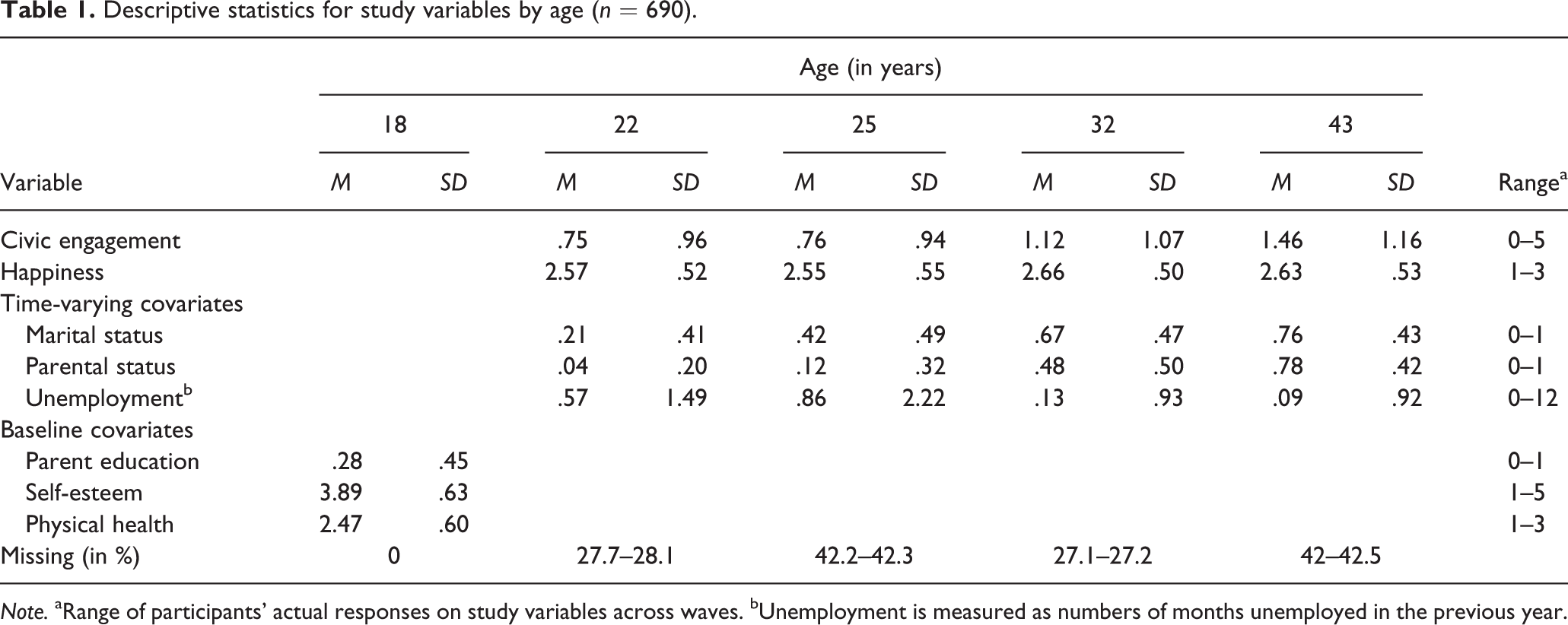
Note. aRange of participants’ actual responses on study variables across waves. bUnemployment is measured as numbers of months unemployed in the previous year.
Our baseline model was a conditional stability model which included the autoregressive paths, the within-time correlations between happiness and civic engagement, and all baseline covariates. Building on the stability model, two unidirectional models were constructed: the happiness-driven model, which added the cross-lagged paths from happiness to subsequent civic engagement, and the engagement-driven model, which included the cross-lagged paths from civic engagement to subsequent happiness. Our final model was a bidirectional model which included the reciprocal associations between happiness and civic engagement. The best-fitting model was determined based on chi-square difference testing. In the best-fitting model, we regressed the time-varying covariates on civic engagement. Although it could be interesting to also regress the time-varying covariates on happiness, we attempted to do so and our model failed to converge on a solution. We also conducted multi-group comparisons to test the possible moderating effect of gender.
Results
Preliminary analyses
Descriptive statistics and missing data information for study variables are presented in Table 1. In general, participants reported being “happy,” were involved in one or two civic organizations, and increased their involvement over time. At the mean level, across time, more participants got married or started cohabiting and became parents. The number of months that participants were unemployed, on the other hand, varied across these ages, with higher unemployment observed at ages 22 and 25 compared with ages 32 and 43.
Autocorrelations for happiness and civic engagement suggested moderate levels of stability and their intercorrelations were positive, but small in magnitude (see Table 2). Within-time intercorrelations showed that civic engagement was negatively correlated with marital status at age 22 (r = −.09), but the direction of association changed at age 43 (r = .14). In addition, civic engagement was negatively associated with parental status at ages 22 (r = −.11) and 25 (r = −.10), but it correlated positively with parental status at later waves (range in r = .12 to .14). There were no significant within-time intercorrelations between civic engagement and months unemployed.
Bivariate correlations among civic engagement and happiness (n = 690).
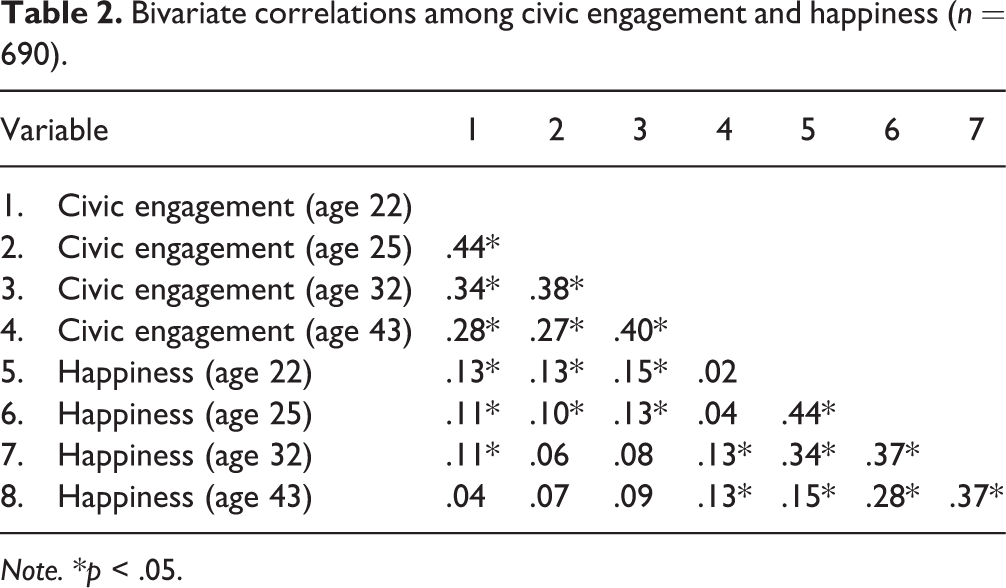
Note. *p < .05.
Correlations among the time-varying covariates suggested that being married or cohabiting was positively and moderately associated with being a parent (range in r = .14 to .53), while the associations between parental status and unemployment was variable and small in magnitude (range in r = −.11 to .15). Baseline covariates were positively correlated with one another (range in r = .08 to .24). Parent education was positively associated with happiness at ages 22 (r = .11) and 25 (r = .11) and civic engagement at age 22 (r = .14). Higher self-esteem was correlated with higher levels of happiness between ages 22 and 32 (range in r = .19 to .26). Better physical health was associated with higher levels of happiness at all times (range in r = .11 to .18), and it was correlated with more civic engagement at age 25 (r = .11).
Autoregressive cross-lagged models
Initially, the conditional stability model only included first-order autoregressive paths (e.g., happiness at age 22 predicted only happiness at age 25), within-time correlations between happiness and civic engagement, and paths from baseline covariates to happiness and civic engagement at age 22; this model did not fit the data well. A second-order autoregressive structure improved model fit (Little, 2013). Therefore, happiness at ages 32 and 43 was regressed on happiness at all previous waves; civic engagement was treated similarly. In addition, to increase power and produce the most parsimonious possible model, within-time correlations between happiness and civic engagement were constrained to equality; model comparisons with chi-square difference testing established that the equality constraints did not worsen model fit. The re-specified conditional stability model fit the data well, and was used as the baseline comparison for all subsequent models testing directional longitudinal associations between happiness and civic engagement (for model comparison results, see Table 3).
Model fit indices for the hypothesized associations between civic engagement and happiness (n = 690).
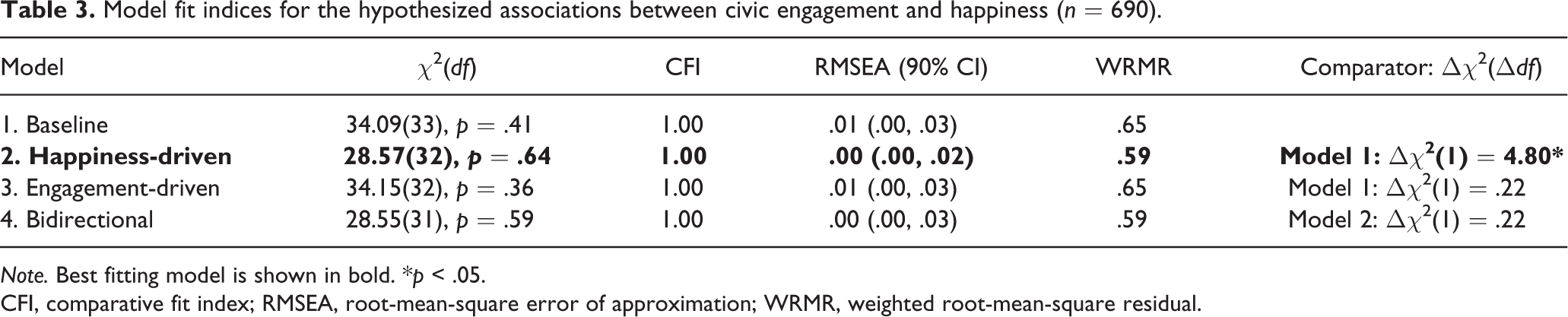
Note. Best fitting model is shown in bold. *p < .05.
CFI, comparative fit index; RMSEA, root-mean-square error of approximation; WRMR, weighted root-mean-square residual.
We next tested the directional models (happiness-driven, engagement-driven, and bidirectional). When computing these models, we first tested whether the associations between constructs differed across time by applying equality constraints to the cross-lagged pathways and computing chi-square difference tests. These equality constraints did not worsen model fit (happiness-driven model: Δχ2(2) = .14, p = .93; engagement-driven model: Δχ2(2) = .01, p = .99), which signified the magnitudes of these cross-lagged associations were equal, and were retained for subsequent model comparisons. The happiness-driven model proved to fit the data substantively better than the baseline model, while the engagement-driven model did not improve on the baseline model. Using the happiness-driven model as the comparator, the bidirectional model did not improve fit to the data. Therefore, we retained the conditional happiness-driven model as our final and best fitting model.
We next examined potential gender differences since prior research found that Canadian women were slightly more likely to volunteer than men (45% vs. 42%; Turcotte, 2015b). We first conducted a series of independent t-tests comparing mean levels of civic engagement reported by women and men at each assessment. We found no gender differences on civic engagement for men and women during their 20s, but women reported slightly more involvement in civic organizations than men at ages 32 (women: M = 1.22, SD = 1.08; men: M = 1.02, SD = 1.04; d = .20) and 43 (women: M = 1.60, SD = 1.13; men: M = 1.30, SD = 1.17; d = .26).
We then tested whether gender moderated the cross-lagged associations of happiness on future civic engagement. We computed a multi-group model for women and men and constrained all paths to equality across gender and then we allowed the cross-lagged paths to vary by gender and computed a chi-square difference test. Removing the equality constraints did not improve model fit, Δχ2(1) = 1.39, p = .24, signifying gender did not moderate the happiness to civic engagement pathway. We computed our final model with the entire sample and added the time-varying contextual variables (see Figure 1).
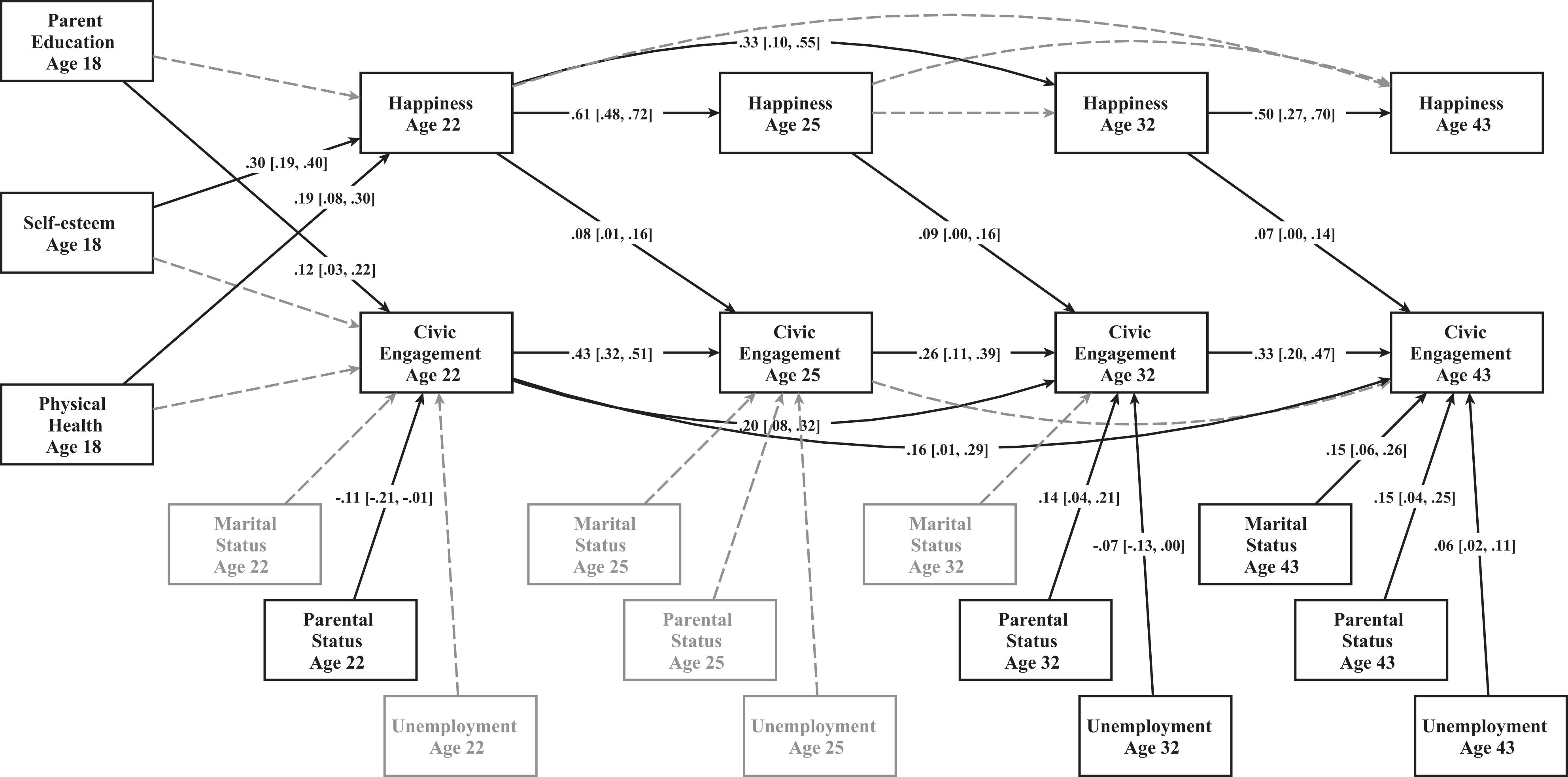
The final (happiness-driven) model with baseline covariates and time-varying covariates. n = 690. Standardized parameter estimates and bias-corrected 95% confidence intervals (CIs; based on 5000 bootstraps) are reported. All parameter estimates reported in the figure contained no zero in their 95% CIs. Dotted lines represent paths whose parameter estimates contained zero in their 95% CIs. Model fit: χ2(212) = 219.69, p = .34; CFI = .98; RMSEA [90% CI] = .01 [.00, .02]; WRMR = .89.
There was moderate stability in both happiness and civic engagement over 21 years and happiness and civic engagement were correlated within-time. Importantly, prior levels of happiness predicted future civic engagement at every measurement occasion. For the time-varying covariates, being married predicted more civic engagement at age 43, but was not associated with civic engagement at other ages. Being a parent predicted less civic engagement at age 22, but the association changed direction later in life; parental status predicted more civic engagement at ages 32 and 43. Unemployment predicted less civic engagement at age 32, but more engagement in midlife. There were also substantive associations among the age 18 time-invariant covariates, happiness, and civic engagement. Having more educated parents predicted higher civic engagement at age 22, and higher self-esteem and better self-rated physical health predicted more happiness at age 22.
Discussion
We investigated happiness and civic engagement across 21 years from young adulthood to midlife, employing a lifespan developmental perspective. Three theoretical models predicting different temporal ordering of associations between civic engagement and happiness were tested: happiness-driven, based on broaden-and-build theory (Frederickson, 2001); engagement-driven, based on warm-glow giving theory (Andreoni, 1989); and bidirectional. Across all waves, and controlling for possible antecedents of civic engagement and happiness (parental education, self-esteem, physical health assessed at age 18) as well as time-varying predictors (marital status, parental status, unemployment experience) of civic engagement, happiness predicted higher civic engagement at a later time, supporting the happiness-driven model.
These results suggest that subjective well-being might foster engagement in civic organizations, and previous theorizing describes the process through which this could occur. Fredrickson (1998) argued that individuals experiencing negative emotions (e.g., fear, anger) tend to focus on themselves or their problems and withdraw from activities (e.g., individuals living in high-conflict or high-crime areas are more likely to experience fear or anger and to focus attention on survival). Positive emotions such as joy and contentment, however, are produced in safe and stable environments in which survival is assured and accumulation of resources is possible. Positive emotions widen focus of attention, facilitate cognitive flexibility, and encourage engagement in a larger variety of actions (Fredrickson, 2001). Individuals experiencing positive emotions may look beyond their own needs and become more attentive to the quality of life of others. Thus, happy people’s greater awareness of others’ needs may translate into actions to improve the well-being of others. Altruistic behaviors, in turn, may help build cooperative social relationships that serve as social resources for individuals to draw upon later (Fredrickson, 1998). Indeed, Fredrickson argued that beneficial effects of positive emotions might not be readily observable, but would accumulate over time. Our findings support this proposition; happiness predicted civic engagement over long time intervals ranging from 3 to 11 years.
Although our findings support the broaden-and-build theory, this does not diminish the probable beneficial short-term consequences (“warm glow”) of participating in civic activities (e.g., the immediate activity in the reward circuitry of the brain upon charitable giving) (Harbaugh et al., 2007). Our study asked participants about their civic engagement in the past 12 months and their current levels of happiness. It could be that the “warm glow” occurring soon after giving dissipates with time. Future research could explore how long the warm glow lasts and whether people maintain or increase civic engagement so they can re-experience the warm glow. Momentary assessment, daily diary, and longer-term studies would be useful.
Aside from this main finding, substantial over-time stabilities were found for civic engagement and happiness, indicating continuity in these individual-level resources or assets across periods of the lifespan. One objective of the lifespan perspective is optimization of functioning across the life course (Baltes, 1987); evidence for continuity speaks to the importance of seeking ways to boost civic engagement and subjective well-being in early adulthood so that they may be maintained subsequently at higher levels, thereby optimizing individual development. Findings that higher self-esteem and self-rated physical health at age 18 predicted higher happiness at age 22 suggest that early individual resources help set the stage for the happiness-driven process. Equally important, parents’ education positively predicted civic engagement at age 22. More highly educated parents may have higher levels of civic awareness to pass on to children (Flanagan & Levine, 2010; Mustillo, Wilson, & Lynch, 2004). Such findings suggest the influence of family background on civic engagement in young adults.
We believe education and public health policies that improve subjective well-being, and contribute to other individual (e.g., physical health) and family resources, may not only benefit personal mental health but may also lead to increased civic engagement, thereby enhancing community quality of life. The OECD’s Better Life Initiative aims at better understanding factors associated with improving well-being across countries and over time, knowledge that can be used toward evidence-informed policy-making (Organization for Economic Co-operation and Development [OECD], 2013).
An important contribution of the current study was the inclusion of marital status, parental status, and unemployment experience as indicators of the individual’s context at different periods of the lifespan. Although one’s intrapersonal subjective well-being might serve as motivation to engage in civic activity, such participation must be negotiated within the present contextual reality of one’s life. Being a young parent (age 22) was associated with lower civic engagement (there was no association between parenthood and civic engagement at age 25), and being an older parent (ages 32 and 43) was associated with higher civic engagement. These seemingly contradictory findings nevertheless make sense. It is likely that the 22-year-old parents had very young children who placed strong demands on their time. By age 25, parents of even young children might be better able to handle the demands of parenthood, hence no association with civic engagement. By age 32 and 43, not only were the children older and likely to be in school, but the parents were possibly more mature and better able to manage family responsibilities. Indeed, Oesterle, Johnson, and Mortimer (2004) speculated that parents of school-age children likely volunteer because their children require parental engagement in community- and school-based activities. Mean levels of civic engagement also were higher at ages 32 and 43 than at ages 22 and 25, indicating that, in general, midlifers may have more time available for contributing to the community.
Marriage was related to higher civic engagement only at age 43. This single result for marital status is in a direction inconsistent with previous research on the greedy marriage (e.g., Einolf & Philbrick, 2014). We believe that the lack of significant associations of civic engagement with marriage during the transition to adulthood (age 22 and 25) and young adulthood (age 32) is due to the inclusion of parental status in the models. Other research indicated parental status was more strongly related to volunteering than was marital status among individuals in their 20s (e.g., Oesterle et al., 2004). Marital status might explain variance in civic engagement beyond that explained by parental status, particularly in midlife, because children are older and less demanding of time and energy while the marriage is likely to be well-established (and, hence, less greedy).
It is interesting that unemployment experience was unrelated to civic engagement in the 20s, negatively related to civic engagement at age 32, and positively related to civic engagement at age 43. The fact that most individuals in their 20s are still working on completing their educations and making decisions about their career path might make unemployment less meaningful with respect to contributing to community. By age 32, however, unemployment would likely be more troubling, and time-consuming efforts to find a job might take precedence over spending time in unpaid community work. At age 43, it could be that participants were participating in civic activities to make contacts that could lead to future employment. Indeed, Wilson and Musick (2003) argued that volunteering can lead to better subsequent employment.
Limitations and directions for future studies
The extent to which the happiness-driven model is generalizable is an important issue. Although we analyzed data from a representative community cohort, longitudinal research with nationally representative samples or samples of cohorts born in different eras would be desirable. Our single-item measure is also a limitation. Although one-item happiness measures are commonly used in surveys (Lyubomirsky et al., 2005), it would be preferable to assess happiness with multiple items loading on a latent construct showing measurement invariance across time. Still, we believe the benefits of access to a single-item measure of happiness item across 21 years in the same sample outweigh the costs, especially given evidence for its construct validity (e.g., negative associations with depressive symptoms and positive associations with parent education, self-esteem, and physical health).
Our dataset also did not have personality measures available. As conscientiousness is related to higher volunteerism (Lodi-Smith & Roberts, 2007), future research could examine how personality characteristics such as conscientiousness affect the connection between civic engagement and well-being. Future research should also include other multi-item indicators of subjective well-being (e.g., life satisfaction, daily experiences of positive or negative emotions) to enhance our understanding of precursors to and outcomes of civic engagement.
The construct of civic engagement is still in the process of theory and measurement development (Sherrod, 2015). Our summative measure of number of organizations engaged in during the past year was useful, but more fine-grained measures (e.g., hours per week across a year, participation in leadership role) would tell us more about how and why civic engagement may be related to happiness. Additional research assessing the broaden-and-build and warm-glow perspectives with different designs is necessary. Measurement burst studies, in which experiences from day-to-day are measured and embedded within longitudinal studies (Walls, Barta, Stawski, Collyer, & Hofer, 2012), assessing happiness and civic engagement across longer intervals, would help distinguish between short-term benefits of happiness and civic engagement for one another as well as track accumulation of happy feelings and civic engagement over time to assess longer-term temporal associations.
Despite these limitations, we note that our study is, to the best of the authors’ knowledge, the first to explore pathways connecting happiness and civic engagement using repeated measures from young adulthood to midlife. Hence, it makes a major contribution to a literature based heavily on cross-sectional studies. In the words of Thích Nhất Hạnh, with respect to civic engagement, “There is no way to happiness. Happiness is the way.” As our results suggest, however, stage of life and individual and family contexts work together to shape this process.
Footnotes
Acknowledgements
Data were collected by the Population Research Laboratory, University of Alberta. Special thanks to Dr. Sandra Wiebe for her helpful advice on an earlier version of this manuscript.
Declaration of Conflicting Interests
The authors declared no potential conflicts of interest with respect to the research, authorship, and/or publication of this article.
Funding
The authors disclosed receipt of the following financial support for the research, authorship, and/or publication of this article: This research was funded by the Social Sciences and Humanities Research Council of Canada (SSHRC), Alberta Advanced Education, and the University of Alberta.