



Abstract
Experiencing the moral emotions of gratitude and moral elevation are responses to witnessing virtuous deeds of others. Both emotions have been found to share similar features and behavioral consequences, including the stimulation of personal development. The broaden-and-build theory of positive emotions indicates that gratitude and elevation prompt the long-term development of lasting resources. Moral identity has been found to be a personal resource in the moral domain since it is associated with higher levels of moral functioning. Therefore, using a two-wave cross-lagged panel design, the current study investigated the causal role of trait gratitude and trait elevation as antecedents of short-term moral identity development. At two points of time (time interval 17 months), a heterogeneous sample of n = 129 adults with a broad range of age completed measures of trait gratitude, trait moral elevation (engagement with moral beauty), and moral identity (internalization and symbolization of the Aquino–Reed framework). In line with our hypotheses, trait moral elevation predicted increases in moral identity internalization. In contrast to our hypotheses, the development of trait gratitude was predicted by moral identity internalization, and not the other way around. Exploratory analyses showed that no cross-lagged effects could be found for the symbolization dimension. In addition, a multi-group analysis explored which of the cross-lagged effects could be generalized across age groups. The results are discussed in the context of the moral emotion research.
Keywords
Introduction
What makes us a better person? What factors activate our better human nature? These have been central questions in philosophy as well as psychology for centuries. Recently, the growing science of positive psychology has emphasized the importance of positive emotions in human flourishing (Fredrickson, 2001), in particular the crucial role of gratitude and moral elevation in human morality (Haidt, 2003b; McCullough, Kilpatrick, Emmons, & Larson, 2001). Both emotions are the reaction to witnessing acts of virtue, either between others (elevation) or toward the self (gratitude). However, although both emotions are posited to have lasting positive effects on individual social functioning and personal development (Fredrickson, 2001; Haidt, 2000), studies supporting this claim are scarce.
Therefore, the current study aims at investigating the short-term longitudinal effects of trait gratitude and trait moral elevation on moral identity development using a two-wave cross-lagged-panel design. In this way, we aim to shed some light on the emotional antecedents of morality identity development.
Moral Identity
Moral identity can be understood as “the degree to which being a moral person is important to an individual’s identity” (Hardy & Carlo, 2011a, p. 212). The concept has been considered central to the question of how moral judgments are translated into moral behavior (cf. Hardy & Carlo, 2011a). From a social–cognitive perspective, moral identity has been conceptualized as a complex cognitive representation (or schema) of moral values, goals, traits, and behavioral scripts (Aquino, McFerran, & Laven, 2011; Lapsley & Narvaez, 2004). Central to this approach is the concept of knowledge accessibility (Fiske & Taylor, 1991). If a moral schema (temporarily or chronically) increases in accessibility, it will exert greater influence on information processing and on subsequent moral behavior (Aquino & Reed, 2002). A further assumption is that a person’s moral identity can vary in importance within her/his overall self-definition and the motivational power to act according to this self-definition is released by the human desire for self-consistency (cf. Shao, Aquino, & Freeman, 2008). Thus, higher levels of moral identity should be associated with more frequent and spontaneous moral behavior which could be demonstrated in a variety of correlational and experimental studies (cf. Boegershausen, Aquino, & Reed, 2015; Hardy & Carlo, 2011b; Hertz & Krettenauer, 2016).
A widely used approach to conceptualize and measure moral identity within the social–cognitive perspective is based on Aquino and Reed’s (2002) framework. They define moral identity “as self-conception organized around a set of moral traits” (Aquino & Reed, 2002, p. 1424) with its dimensions of internalization, the degree to how central or important morality is to the self, and symbolization, the desire to show one’s own moral identity in public behavior. Recent reviews converge on the finding that the internalization dimension of the Aquino–Reed framework is more important than symbolization in predicting actual moral behavior (Boegershausen et al., 2015; Hertz & Krettenauer, 2016). Whereas both dimensions have been found to be associated with inhibiting the motivation for harmful acts, internalization is more robust in predicting the motivation and behavior to improve the welfare of others (Boegershausen et al., 2015). The majority of studies concerning moral identity – approximately 70% or more (Jennings, Mitchell, & Hannah, 2015) – have used Aquino and Reeds’ (2002) concept and measurement for studying moral identity centrality.
Antecedents of Moral Identity Development
Little is empirically known about the processes of moral identity development since most studies have been cross-sectional (cf. Hardy & Carlo, 2011a) or have failed to identify an age-related change in moral identity (cf. Krettenauer & Hertz, 2015; for a notable exception, see Krettenauer, Murua, & Jia, 2016). According to the social–cognitive perspective, moral identity development relates to building complex and rich prototypes of moral knowledge (cognitive structures like schemas, scripts, or categories, cf. Fiske & Taylor, 1991). Developing moral identity is like developing moral expertise in a given domain so that the person holds schemas of what it means to be a moral person including scripts of moral actions and, thus, is able to automatically respond to moral situations due to the chronic accessibility of these prototypes (Hardy & Carlo, 2011b). Hardy and Carlo (2011a, 2011b) stated that moral schemas at least in part develop through social learning but also through actual social behavior. That is, empirical research has shown that moral behavior might be both the outcome and the cause of moral identity development.
Although research on moral identity has made progress, more research on the antecedents of moral identity development is needed. Therefore, as our introduction highlighted, investigating the role of positive moral emotions in the process of moral identity development is a promising direction because these emotions have been theorized and found to promote moral functioning (Krettenauer & Casey, 2015).
Positive Moral Emotions Lead to Moral Identity Development
According to the broaden-and-build theory (Fredrickson, 2001), positive emotions broaden the momentary thought–action repertoire and share the main function of building enduring personal resources, which appears to be their evolutionary adaptive function (Fredrickson, 2004). Recent studies have found that positive emotions have the ability to build psychological resilience and to trigger upward-spirals toward enhanced well-being, physical health, flourishing, and personal growth (e.g., Emmons & McCullough, 2003; Fredrickson & Joiner, 2002; Kok et al., 2013). For instance, one study found that regular loving–kindness meditation over a span of nine weeks led to shifts in a participant’s daily experiences of positive emotions including love, joy, gratitude, contentment, hope, pride, interest, amusement, and awe (Fredrickson, Cohn, Coffey, Pek, & Finkel, 2008). Over a time period of the nine weeks these positive emotions produced increases in a wide range of personal resources (e.g., increased purpose in life, social support, and mindfulness). In sum, the broaden-and-build theory provides an approach to positive emotions that emphasizes the short-term and long-term positive effects these emotions have on our individual and social functioning (Fredrickson, 2001).
Taking a closer look on moral identity, the construct can be regarded as an important personal resource in the moral domain since it is associated with higher levels of moral sensitivity and prosocial behavior, lower levels of antisocial behavior, and it promotes moral evaluations, moral emotions, and moral judgment processes (cf. Boegershausen et al., 2015; Hardy & Carlo, 2011a, 2011b; Hertz & Krettenauer, 2016; Jennings et al., 2015; Shao et al., 2008). In sum, on the backdrop of the broaden-and-build theory of positive emotions, the core assumption underlying the present research is that the positive moral emotions of gratitude and elevation foster lasting personal resources by promoting higher levels of moral identity. The following two sections will explain in greater detail how this theory drove the derivation of our study’s hypotheses.
Moral Elevation
Moral elevation is a positive emotion that fits well into the broaden-and-build theory since it causes changes in the thought–action repertoire by triggering optimistic views about people and humanity and by prompting prosocial behavior. These characteristics of elevation are supported by a variety of experimental and correlational studies (for a review, see Pohling & Diessner, 2016). Moreover, elevation has been found to create personal and social resources by triggering upward spirals of positive change in moral functioning as well as in health indicators (Pohling & Diessner, 2016).
Per definition, moral elevation is the emotional response to witnessing acts of moral beauty (Algoe & Haidt, 2009). Powerful elicitors are strong displays of virtue, such as acts of kindness, love, compassion, and self-sacrifice (cf. Pohling & Diessner, 2016). Motivationally and behaviorally elevation leads people to admire and emulate observed acts of virtue, to act morally, and to more greatly value relationships and affiliation (cf. Algoe & Haidt, 2009). Diessner, Iyer, Smith, and Haidt (2013) showed that the trait engagement with moral beauty (Diessner, Solom, Frost, Parsons, & Davidson, 2008) moderated the susceptibility for experiencing the state of elevation. Hence, engagement with moral beauty can be labeled as “trait elevation” (Pohling & Diessner, 2016).
To explain the process of how elevation fosters moral identity we draw on the inspire-and-rewire hypothesis (Haidt, 2003a). This hypothesis states that elevation inspires and rewires the human mind by making people more receptive and open to new possibilities and by fostering the long-term development of humans’ higher and better nature (Haidt, 2003a). Since experiences of elevation are short but profound peak experiences (Maslow, 1964), elevation is sometimes labeled as a “moral reset button in the human mind” (Haidt, 2003b, p. 864). On the backdrop of social–cognitive theory (Fiske & Taylor, 1991), we further posit that frequently “pushing” this moral reset button – through repeated and frequent exposures to various stimuli of moral beauty (cf. Diessner, Iyer, Smith, & Haidt, 2013) – leads to an increase in the salience and complexity of moral knowledge structures (moral complexity, cf. Hannah, Avolio, & May, 2011) through the acquisition, elaboration, and increase in the accessibility of knowledge structures or prototypes that are associated with promoting the welfare of others and transcending selfish interests. For instance, witnessing a caring moral exemplar saving another person’s life helps to develop a more elaborated prototype about how to effectively help others in life-threatening situations. Simultaneously, the strong desire to become a better person caused by elevation facilitates the integration of these moral prototypes into the structure of the self. Using the example above, the morally exemplary behavior of saving another’s life becomes a morally relevant self-schema (a moral ideal self, cf. Hardy, Walker, Olsen, Woodbury, & Hickman, 2014).
Two studies support our claim that moral elevation and moral identity are closely interrelated. First, in a study by Diessner et al. (2013) moral identity, as measured with Aquino and Reed’s (2002) instrument, and trait moral elevation showed high positive correlations with both the internalization and the symbolization dimensions. Second, in an experimental study, Aquino, McFerran, and Laven (2011) found that higher levels of moral identity internalization were associated with higher proneness to experience elevation as an emotional state in response to reading an elevating story or watching a video clip including moral actions. Consequently, this study exemplified that higher levels of moral identity may not only be the effect of moral elevation but also the starting point for the accumulation of more states of elevation in the future. However, as explained above, our study only focusses on the path of how elevation builds higher levels of moral identity centrality:
Gratitude
Gratitude has also been subsumed under the umbrella of the broaden-and-build theory since it broadens people’s thinking by considering a wide range of behaviors that benefit others by building personal resources (e.g., well-being, and life satisfaction) and social resources (new social bonds, and improved relationships), and by inducing upward spirals of positive change (cf. Fredrickson, 2004).
Prototypical gratitude is elicited by the perception that another person voluntarily and intentionally has done something good for the self (Haidt, 2003b), especially when those benefits needed high effort or costs by the benefactor and/or the effort by the benefactor was gratuitous and not merely determined by a role-based relationship (McCullough et al., 2001). Motivationally, it prompts the tendency to repay, to praise, and to be close to the benefactor (Algoe & Haidt, 2009). According to the find-remind-and-bind theory (Algoe, 2012), gratitude is a reaction to the perceived responsiveness of another person and it is mainly a mechanism to initiate and solidify interpersonal connections with responsive benefactors (Algoe, 2012). However, the prosocial tendencies elicited by experiences of gratitude are not limited to the initial benefactor. In several studies, gratitude has been found to show spill-over effects towards people other than the initial benefactor (called “upstream reciprocity”, cf. Nowak & Roch, 2007; for empirical evidence, see e.g., DeSteno, Bartlett, Baumann, Williams, & Dickens, 2010).
Similar to elevation, gratitude has been studied both as an affective state and trait (e.g., McCullough, Emmons, & Tsang, 2002). The disposition to be grateful has been conceptualized as a wider life orientation towards noticing and appreciating the positive aspects of life and as a capacity to experience gratitude as an emotion more frequently, intensely, and across a wide range of stimuli in daily life (cf. McCullough et al., 2002; Wood, Froh, & Geraghty, 2010).
But how is gratitude a driving force for moral identity development? As noted above, gratitude signals a responsive interaction partner and motivates establishing a communal relationship with this person (Algoe, 2012). For expressing one’s own gratitude and strengthening the new social bond, prosocial behavior is highly adaptive. Further, in line with the literature cited above, gratitude will also trigger upward reciprocity and therefore promote prosocial responses towards an individual other than the initial benefactor. Therefore, we expect gratitude to prompt an upward spiral of social integration as was found empirically by Froh, Bono, and Emmons (2010). They found prosocial behavior at time 2 to be an important mediator between gratitude at time 1 and social integration at time 3.
Throughout this cascade of gratitude, positive social interactions, and social integration, elaborated moral prototypes may develop which in turn may foster moral identity development. These prototypes will then become important for the self-definition of the individual since being moral helps to achieve the valued goal of building and improving high-quality social relations (see also Emmons & Mishra, 2011). In fact, previous research has shown that opportunities for prosocial actions and for positive peer relationships foster moral identity (cf. Hardy & Carlo, 2005, 2011a). Thus, in the process of relationship building, the development of moral identity and moral behavior will be intertwined. However, in this study, we focus solely on the short-term longitudinal path between gratitude and moral identity centrality:
Aims of the Present Research
Taken together, the main purpose of the present research is to investigate the predictive role of trait gratitude and trait moral elevation in short-term changes of moral identity centrality (hypotheses 1 and 2). To operationalize moral identity centrality, we use the internalization dimension of the framework by Aquino and Reed (2002). For exploratory reasons, we also investigate the symbolization dimension of this framework because internalization and symbolization of moral identity have been found to be valid and complementary dimensions of moral identity (cf. Jennings et al., 2015) which are related to different variables (e.g., Aquino & Reed, 2002).
As noted above, previous research often failed to find age-related increases in moral identity. Therefore, scholars call for more scrutiny with regard to this aspect of moral identity research (e.g., Krettenauer & Hertz, 2015). In consequence, the current study explores the role of age in moral identity development by investigating whether the longitudinal relationships between the dispositions to feel positive moral emotions and moral identity are consistent across age groups:
Method
Participants
At time 1, Nt1 = 290 German adults (76.2% female) took part in the study. Age ranged from 18 to 71 years (mean (M) = 30.9, standard deviation (SD) = 10.0). Nine participants (3.1%) had an immigration background. With regard to their current occupation, 116 (40.0%) of the participants were students, 18 (6.2%) doctoral students, 97 (33.4%) employees, 21 (7.2%) entrepreneurs, and 34 (11.7%) held miscellaneous positions. One hundred and fifty-seven (54.1%) were not religious, 104 (35.9%) were Christian, 24 (8.3%) Buddhist, and 5 (1.7%) were of other religions.
At time 2, Nt2 = 129 participants (75.2% female) completed the questionnaires a second time. Therefore, we investigated whether the composition of the sample at time 2 was comparable to time 1. Using contingency tables with Phi for 2 × 2 tables and Cramér’s V for 2 × k tables as measures of strength of association, we tested the effects between the marker variable drop out (0 = no, 1 = yes) and the categorical variables occupation, religion, gender, and immigration background. In the case the expected frequency in at least one cell of the table was fewer than five, Fisher’s exact test was used. None of these analyses yielded significant differences. Further, a t-test found no difference between the age of those who dropped out and those who remained in the study, t(242.82) = −0.21, p = 0.83. In sum, these analyses showed that the composition of the sample at time 2 was comparable to time 1 with respect to age, gender, religion, immigration background, and occupation. In a second step, a multivariate analysis of variance found no effect of the variable drop out on the study variables (gratitude, elevation, internalization, and symbolization), Pillai’s trace: V = 0.009, F(4, 284) = 0.629, p = 0.64. That is, the participants who took part a second time did not show differences in the study variables compared to those who dropped out which precludes selection effects. To test our longitudinal hypotheses, we restricted all analyses to the participants who took part in both waves.
Procedure
We used a longitudinal design with two waves. The time period between both data collections was on average 17 months with a variation of a few days since data were collected online. We used this time frame since we assumed that both gratitude and elevation would need some time to build their capacity to sufficiently accumulate positive affective states and thus to foster moral identity (for a study that used a similiar long time frame, see Krettenauer, 2011).
Data were collected online from several venues (personal contacts, German universities, and Facebook snowballing). Participants at time 1 were asked if they would be willing to participate in a follow-up data collection. Those participants then were included in the second wave. All participants were informed about the aims and the content of the study and participated voluntarily with no remuneration.
Measurement
Moral Elevation
Trait moral elevation was measured with a German version of a subscale of the Engagement with Beauty Scale (for the original scale, see Diessner et al., 2008; for the translation and validation of the German version, see Dachs & Diessner, 2009). This subscale is a 6-item self-report instrument indicating various levels of cognitive and emotional engagement concerning the moral beauty of others. The engagement with moral beauty subscale uses a seven-point Likert-type scale (1 = “very unlike me” to 7 = “very much like me”). Composite reliabilities were ρc = 0.73 at time1 and ρc = 0.70 at time 2 (with correlated errors on item 5 and 6, see Diessner et al., 2008). The retest-reliability was 0.68. In terms of its psychometrical properties, former studies have found that the engagement with moral beauty scale is a reliable and valid measure of trait moral elevation (cf. Pohling & Diessner, 2016). Sample items are: “When perceiving an act of moral beauty, I feel emotional, it ‘moves me’, such as feeling a sense of awe, or wonder or excitement or admiration or upliftment” or “When perceiving an act of moral beauty, I find that I desire to become a better person”. Please note that the term moral beauty is explained at the beginning of the scale as “experiences with humans, in which you perceive (or hear about) some person demonstrating an impressive act of charity or loyalty or kindness or compassion or forgiveness or sacrifice for others or sincere service to others”.
Gratitude
Gratitude as an affective trait was measured with a German version of the Gratitude Questionnaire-Six Item Form (GQ-6) (for the original scale, see McCullough et al., 2002; for the German version, see McCullough, 2017; for details on the psychometrical properties of the German GQ-6, see Proyer, 2007) which is a six-item measure of gratitude and thankfulness, scored on a seven-point Likert-type scale (1 = “strongly disagree”, 7 = “strongly agree”). Higher levels of this grateful disposition entail the “generalized tendency to recognize and respond with grateful emotion to the roles of other people’s benevolence in the positive experiences and outcomes that one obtains” (McCullough et al., 2002, p. 112). The GQ-6 is a standard instrument for assessing subjective gratitude as a personality trait (e.g., Samson, Proyer, Ceschi, Pedrini, & Ruch, 2011). Composite reliabilities were ρc = 0.74 at time 1 and ρc = 0.78 at time 2. The retest-reliability was 0.72. Sample items are: “I have so much in life to be thankful for” or “Long amounts of time can go by before I feel grateful to something or someone” (reversed).
Moral Identity
Moral identity was measured using a German version of the 10-item instrument developed by Aquino and Reed (2002; the German version was provided by Reed, personal communication, March 3, 2012) that was designed to assess the importance of a moral identity to the self (moral identity centrality). Their instrument is based on a conceptualization of moral identity as a schema organized around a set of moral trait associations (e.g., compassionate, kind, and honest) and loads consistently on two dimensions, which they labeled internalization (centrality of morality to the self) and symbolization (expressing moral identity in public behavior). In the introduction of the instrument, nine moral traits are listed (caring, compassionate, fair, friendly, generous, helpful, hardworking, honest, and kind) which are used to visualize a person that has these characteristics as vividly as possible. Then the items are rated on a 7-point Likert-type scale (1 = “strongly disagree”, 7 = “strongly agree”). Sample items are: “It would make me feel good to be a person who has these characteristics” (internalization) or “I am actively involved in activities that communicate to others that I have these characteristics” (symbolization).
Since no German validation studies for the moral identity scale are available, we tested in detail its psychometrical properties. At first, we modeled a congeneric measurement model with two latent correlated factors. An acceptable model fit was achieved, χ2
At time 2, the two-factor model showed suboptimal model fit, χ2
Control Variables
Moral emotions, moral identity, and moral behavior are influenced by a variety of socio-demographic variables (e.g., Craft, 2013; Hardy & Carlo, 2011a). Therefore, we included age, gender, and religiosity as control variables. Religiosity was dichotomized into 0 = “not religious” and 1 = “religious” since all but the category “Christian” were underrepresented which did not allow inclusion of them as separate predictors. Since opportunities to act morally seem to stimulate moral (identity) development (Hardy & Carlo, 2011a), we further asked participants whether they are responsible for somebody (e.g., as caregiver of a family member, as mother of a child, as a leader in their occupational life, or similar) and included the response (yes/no) as a further control variable. These control variables were measured solely at time 1 for controlling their influence on the changes of moral identity.
Special life events can temporarily or permanently affect our self-psychological functioning and development (cf. Dambrun & Ricard, 2011). To account for this kind of variance between the two waves, we asked participants at time 2: “Did something significant change in your life since your first participation in this study?” If participants answered with “yes”, we then asked them in an open-ended question to determine what had changed. In the item stem, we gave some examples to prime the participants for those life events that can have a deep impact on the self and induce moral transformations, such as witnessing the death of close others, experiencing near death experiences, becoming parents, divorce/separation or new romantic relationships, or significant changes in occupational life such as promotions or a new job (cf. Dambrun & Ricard, 2011; Yalom, 1980). Sixty-five of the 129 participants (50.4%) reported at least one such a life event; among those 65 participants, 18.5% reported a death of close others, 24.6% reported significant transition in occupational life, 21.5% reported a new romantic relationship or separation, and the remaining participants reported other, or a mixture of several, significant life events. We controlled for this variance by including a dichotomous variable (0 = “no life event”; 1 = “one or more life events”) into our models.
Statistical Analysis
All computational procedures were performed with the IBM® SPSS® statistics package version 22.0.0.1 and IBM® SPSS® AMOS 22.0.0. For calculating the internal consistency of the scales, we used the composite reliability coefficient ρc according to Raykov (2004) with ρc > 0.60 as cut-off for good reliability (cf. Weiber & Mühlhaus, 2014). Coefficients like these are recommended since they make more realistic assumptions (a congeneric measurement model) and perform better if the assumptions for calculating Cronbach’s alpha (an essentially Tau-equivalent model) are violated (e.g., Dunn, Baguley, & Brunsden, 2014; Raykov, 2004). This was the case for all our measures. The composite reliability is calculated in the context of structural equation modeling (SEM) using factor loadings and error variances (Raykov, 2004).
To test the predicted longitudinal relationships, we conducted a cross-lagged panel analysis which allows for inferring assumptions about causality on the basis of correlational data gathered on at least two different occasions (Kenny, 2005). To partial out the autocorrelations of the study variables over time and to compare the cross-lagged relationships simultaneously, we applied an SEM approach using observed variables scores and compared the cross-lagged regression coefficients while controlling for baseline of time 1 of the respective criterion (cf. Reinders, 2006) – we named these cross-lagged regression coefficients bx1, y2 and by1, x2 (see Figure 1).

Schema of the two-wave cross-lagged panel path model used in this study.
In the cross-lagged panel analysis literature several criteria are proposed for attributing a causal interpretation (Clegg, Jackson, & Wall, 1977). The coefficients should be at least statistically different in size or, at best, one coefficient is statistically significant and the other is not (Reinders, 2006). We applied both criteria by comparing bx1, y2 and by1, x2 with respect to size and statistical significance. If both bx1, y2 and by1, x2 were not statistically significant, no causal interpretation was made. By using SEM for the cross-lagged-panel analysis, a separate test of the difference of the cross-lagged-panel regression coefficients was not necessary (Reinders, 2006).
For comparing all possible pairs of coefficients, we calculated six two-variable cross-lagged path models, each including the control variables. Figure 1 illustrates the schema of our cross-lagged panel path analysis. For calculating the SEM models, we used maximum-likelihood (ML) estimation and applied the following parameters for evaluating model fit: RMSEA (good fit: RMSEA < 0.08), SRMR (good fit: SRMR < 0.10) and CFI (good fit: CFI > 0.90) (cf. Weiber & Mühlhaus, 2014). For evaluating multivariate normal distribution, we used univariate analyses as well as Mardia’s multivariate kurtosis (with critical ratios of C.R. < 1.96 as a strict test and C.R. < 2.56 as moderate test of violations of this assumption, cf. Weiber & Mühlhaus, 2014). In case of deviations from multivariate normality, we reported Bollen–Stine bootstrap corrected p-values for the χ2 - test. Bootstrapped bias corrected confidence intervals for the paths coefficients were calculated using k = 50,000 bootstrap resamples.
Finally, for using SEM with ML estimation, a minimum sample size of n – t > 50 is required (with t as the amount of parameters to be estimated, cf. Weiber & Mühlhaus, 2014). This requirement was met by all of our models. Nevertheless, given the small sample size, we performed detailed power calculations following the procedure described by MacCallum, Browne, and Sugawara (1996). A posteriori power analysis using the online tool Webpower (Z. Zhang, Yuan, & Mai, 2017) showed that, given a sample size of n = 129, df = 9, and an RMSEA (H0) = 0.00 (exact fit), we were able to reject the null hypothesis of exact fit if RMSEA (H1) = 0.117, with an alpha of 0.05 and a power of 0.80. Given the recommendations that a RMSEA ≥ 0.10 reflects a badly fitting model (Weiber & Mühlhaus, 2014), we had almost enough power (1-β = 0.64) to detect the discrepancy between exact fit and bad fit. However, we had only moderate power (1-β = 0.39) for rejecting the null hypothesis of close fit (RMSEA (H0) = 0.05, RMSEA (H1) = 0.10). Please note that some researchers suggest not to use the RMSEA for models with small degrees of freedom and sample size (Kenny, Kaniskan, & McCoach, 2015). Therefore, we also report SRMR and CFI as fit indices. At last, using the program G*Power (Faul, Erdfelder, Lang, & Buchner, 2007), a posteriori power analysis for our correlations analysis showed that, given a sample size of n = 129, we were able to detect correlations of r ≥ |0.24| with an alpha of 0.05 and a power of 0.80 (two-tailed test).
Results
Preliminary Analyses
We analyzed the distribution of each scale for its shape and outliers. There were no serious violations of univariate normality. Univariate skewness of the eight variables (four at each time) ranged from −.983 to .001 and univariate kurtosis ranged from −.555 to 1.026. Only internalization at time 2 showed a slightly higher but not critical deviation from normality with a skewness of −1.459 and kurtosis of 3.918. Across all path models (Table 3), Mardia’s multivariate kurtosis ranged from −3.492 to 4.755 with all C.R.’s < 1.96 indicating that the assumption of a multivariate normal distribution was met across all models. Means, standard deviations, and dependent t-tests testing mean differences across waves are reported in Table 1. Looking at the means of both waves, on average the study variables did not change over time.
Descriptive statistics and time differences.

Notes: n = 129. Bootstrapping with k = 50,000 bootstrap resamples.
All tests two-tailed.
Correlation Analysis
The correlation analysis (Table 2) gives an overview of the cross-sectional associations between our study variables as well as the control variables at both times. The pattern of the correlations was in line with our hypotheses. Both trait gratitude and trait elevation were correlated positively with internalization and symbolization. Further, we explored the correlations between age and the study variables and found no correlations with either dimension of moral identity. The only age-correlations were found for religiosity, responsibility, and gratitude (see Table 2).
Correlations among the variables at time 1 (below diagonal), time 2 (above diagonal), and cross-wave correlations (on the diagonal).
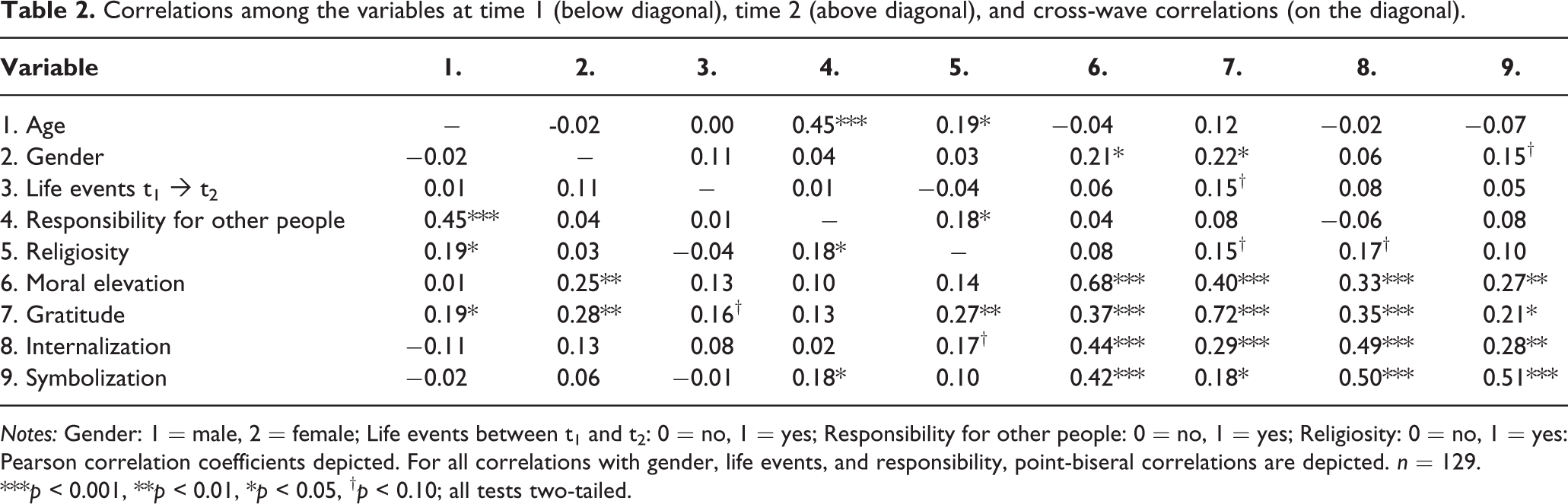
Notes: Gender: 1 = male, 2 = female; Life events between t1 and t2: 0 = no, 1 = yes; Responsibility for other people: 0 = no, 1 = yes; Religiosity: 0 = no, 1 = yes: Pearson correlation coefficients depicted. For all correlations with gender, life events, and responsibility, point-biseral correlations are depicted. n = 129.
***p < 0.001, **p < 0.01, *p < 0.05, †p < 0.10; all tests two-tailed.
Cross-Lagged-Panel Analysis
Based on the cross-lagged panel design depicted in Figure 1, we calculated six models to investigate the cross-lagged paths between all study variables. All models showed an excellent model fit with χ2 ranging from 3.683 to 5.983, df = 9, all ps > 0.05, all RMSEAs = 0.00, SRMRs ranging from 0.024 to 0.044, and all CFIs = 1.00. Table 3 shows the cross-lagged regression coefficients of each model and the cross-lagged path that was supported by the respective analysis. In sum, we found evidence to support hypothesis 1. That is, trait elevation at time 1 predicted higher levels of moral identity internalization at time 2. However, we found no support for hypothesis 2 since we found evidence for the contrary cross-lagged paths as the one that hypothesis 2 postulated, namely internalization at time 1 predicting trait gratitude at time 2. With regard to research question 1, we found no cross-lagged effects for symbolization in the whole sample. That is, neither trait gratitude nor trait elevation longitudinally predicted changes in symbolization. Note that all these effects found in the cross-lagged panel analysis could be observed regardless of the inclusion of the control variables into the model. In Table 3 we report the results of the models that included the control variables.
Cross-lagged-panel analysis.
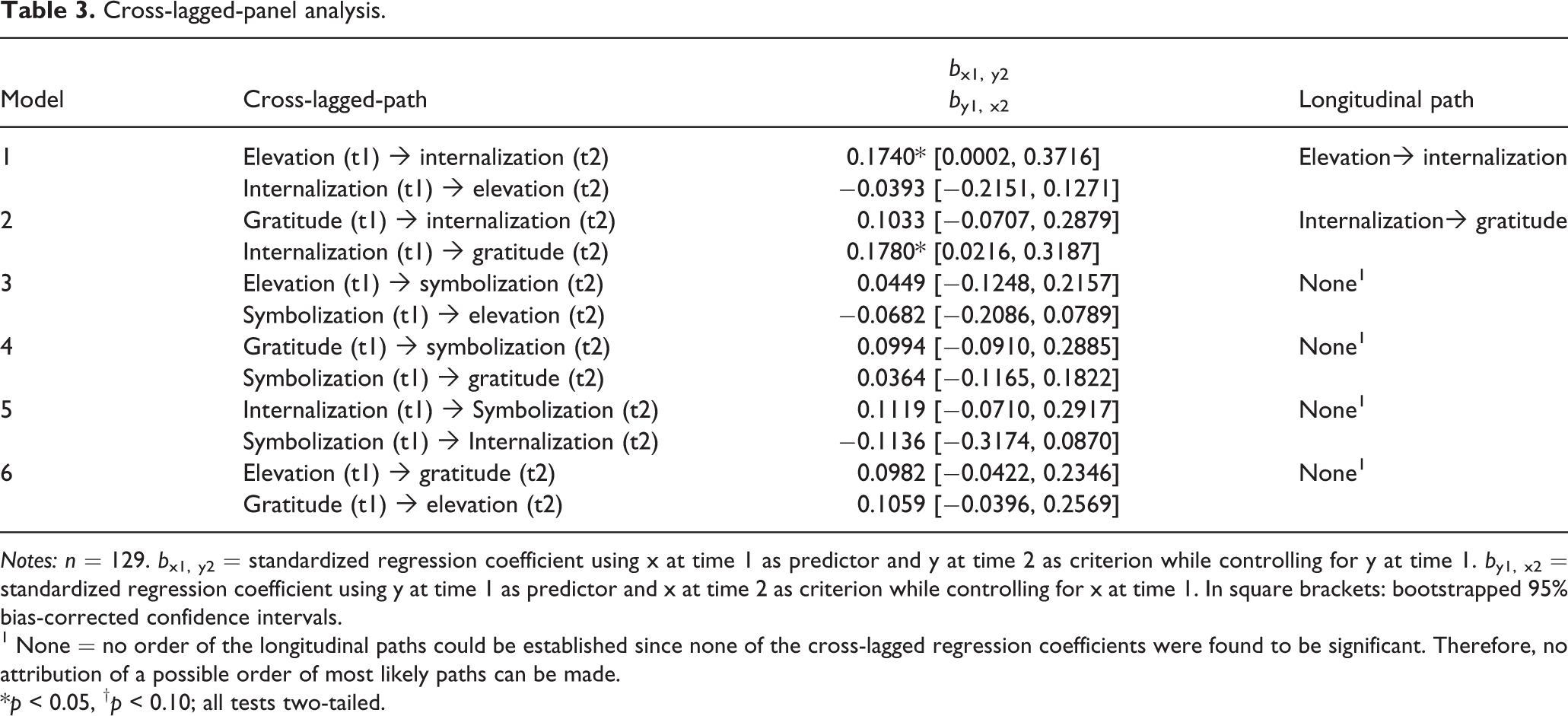
Notes: n = 129. bx1, y2 = standardized regression coefficient using x at time 1 as predictor and y at time 2 as criterion while controlling for y at time 1. by1, x2 = standardized regression coefficient using y at time 1 as predictor and x at time 2 as criterion while controlling for x at time 1. In square brackets: bootstrapped 95% bias-corrected confidence intervals.
1 None = no order of the longitudinal paths could be established since none of the cross-lagged regression coefficients were found to be significant. Therefore, no attribution of a possible order of most likely paths can be made.
*p < 0.05, †p < 0.10; all tests two-tailed.
Age-Related Multi-Group Analysis
At first, to investigate our research question 2, we divided the data set into two age groups (younger vs. older) using a median-split. The younger group consisted of n = 68 participants with age ranging from 18 to 28 (M = 23.01, SD = 3.11); the older group consisted of n = 61 with age ranging from 29 to 71 (M = 39.07, SD = 10.06). Second, we explored age-correlations with regard to moral identity in both groups to expand our initial correlation analysis. Please note that given the small sample sizes of 61 and 68, respectively, we were only able to detect r ≥ |0.34| and r ≥ |0.33| with an alpha of 0.05 and a power of 0.80 (two-tailed). In the younger group, age correlated marginally negatively with internalization, r = −0.21, p = 0.09, whereas in the older group we found a marginal but positive correlation of these variables, r = 0.23, p = 0.07. No correlation between age and symbolization was found in both age groups.
Third, we residualized trait gratitude, trait elevation and the moral identity dimensions for the control variables gender, religiosity, and responsibility for others to reduce the number of parameters to be estimated in the subsequent multi-group analysis. Fourth, we specified four cross-lagged panel models with these residualized variables (gratitude/elevation predicting internalization/symbolization) with life events as an exogenous variable predicting the time 2 measures (as depicted in Figure 1). Fifth, we constrained the cross-lagged paths to be equal across age groups in each model and then tested with AMOS how these restricted models fit compared to the unconstrained models where the cross-lagged paths are freely estimated across groups. Weiber and Mühlhaus (2014) give the recommendation that a change of ≤ 0.01 in descriptive and incremental fit indices indicates equal model fit. We relied on changes of the CFI as the main criterion for model comparison and complemented our analyses by looking at the RMSEA and SRMR changes (see also Chen, 2007).
With regard to the cross-lagged multi-group model 1 (trait elevation and internalization), the unconstrained model fitted the data well, χ2
Referring to the cross-lagged multi-group model 2 (trait gratitude and internalization), the unconstrained model fitted the data well, χ2
In line with the primary cross-lagged analysis above, our multi-group model 3 found no cross-lagged effects between trait elevation and symbolization. However, the multi-group model 4 (gratitude and symbolization) found some effects. The unconstrained model showed an excellent model fit, χ2
Discussion
The present research is the first study investigating short-term longitudinal effects of trait gratitude and trait elevation on moral identity development. Using a cross-lagged-panel design, our research provided evidence that trait moral elevation longitudinally predicts increases of moral identity internalization. Moral identity, on the other hand, turned out to be a longitudinal predictor for the development of a grateful personality.
The finding that elevation longitudinally led to higher levels of moral identity internalization is in line with the second tenet of the broaden-and-build theory of positive emotions (Fredrickson, 2004). That is, our study provided first evidence that the disposition to feel a positive moral emotion is able to build personal resources (moral identity centrality) that are adaptive in the moral domain. However, this was only restricted to moral elevation.
Although it has been assumed that experiences of elevation may lead to higher levels of moral functioning, empirical studies supporting this claim are very scarce (Pohling & Diessner, 2016). By showing that trait moral elevation longitudinally promoted higher levels of moral identity internalization, the present study is one of the few demonstrating that elevation indeed builds lasting resources and drives longitudinal moral development as predicted by positive psychologists (Fredrickson, 2001; Haidt, 2000). Moreover, our findings are consistent with previous cross-sectional research on moral elevation and moral identity. In our correlation analysis, both dimensions of moral identity were associated with trait elevation which replicates Diessner et al. (2013). Our effect sizes were only a little lower than those of Diessner et al. (2013). However, the association between elevation and symbolization could not be found in the context of the cross-lagged panel models. This could be an indication that elevation does not predict longitudinal changes in symbolization.
We recommend that future studies replicate these findings with an improved version of the symbolization scale since the German version used in the present study included suboptimal psychometrical properties (see method section). Although the overall composite reliability was acceptable at both times, the reliabilities of the indicators varied across time waves, which could be a possible methodological explanation for the inability to detect any cross-lagged effects in terms of symbolization in the whole sample. Perhaps the participants interpreted the symbolization items differently across the time waves which could have contributed to the variability of the indicator reliabilities and the relatively low composite reliability at time 2.
Taken together, the findings of the present research, along with a previous study by Aquino et al. (2011), make a moral upward spiral between moral elevation and moral identity development conceivable: first, as the present research showed, trait elevation longitudinally leads to higher levels of moral identity internalization; second, as Aquino et al. (2011) found, these higher levels of moral identity are then associated with a higher susceptibility for experiencing elevation as a state; third, in this way, states of elevation may accumulate and in turn foster higher levels of trait elevation – a lower threshold to experience the state of elevation in various situations in daily life; and finally, higher levels of trait elevation, again, foster higher moral identity in the future and so forth.
Our findings provide new insights into the developmental process of trait gratitude. In contrast to our assumptions, we identified that moral identity internalization longitudinally predicted an increase in trait gratitude. Since studies that clarify the development of the grateful disposition are still lacking, our research is therefore among the first illuminating antecedents of trait gratitude development. Perhaps increased levels of moral identity internalization allow one to have a heightened awareness of the effort or self-sacrifice in others’ moral actions, and also appreciating they do not have to act, but voluntarily choose to do so. Or alternatively, since moral identity is associated with engaging in moral actions (Hertz & Krettenauer, 2016), increased levels of internalization might be associated with frequent reciprocal moral actions of others which then lead to an accumulation of states of gratitude and, in this way, stimulate trait gratitude development.
Consistent with previous research (cf. Krettenauer & Hertz, 2015), we found no correlation between Aquino and Reed’s moral identity construct and age in the whole sample. However, in our multi-group analysis, we found small, marginally significant correlations in both subgroups. In the younger group (age ranged from 18 to 28), internalization and age were correlated negatively but in the older group (age ranged from 29 to 71) we found a positive relationship. However, these results should be viewed with caution since this part of the correlation analysis was underpowered to detect small effects. Nevertheless, this trend in the data stands in contrast to former studies (cf. Krettenauer & Hertz, 2015) and seems worthy of further exploration.
Most importantly, the multi-group analysis showed which of the results of the initial cross-lagged panel analysis could be generalized across age groups and, thus, made it possible to see whether age is a moderator for the cross-lagged effects between positive moral emotions and moral identity. We found that the longitudinal path of trait elevation predicting internalization only applied to older participants (≥ 29 years) whereas the finding that internalization predicted trait gratitude could be replicated in both age groups. Before discussing these findings, it should be acknowledged that the age range of the older group was much larger than the younger group. This reduction in variance in the younger group could be a methodological reason why we could not replicate the effect of elevation on future internalization in the younger group. Unfortunately, we could not build equal groups with the same age range since most of the participants were younger.
In addition, our findings could further be interpreted with regard to the mode of measurement of moral identity centrality used in the present study. Recent research discussed that the possibility to observe correlations between moral identity and age seems to depend upon the conception and measurement of moral identity (Krettenauer et al., 2016). Using a cross-sectional design, Krettenauer et al. (2016) investigated moral identity with an instrument that was both sensitive for various contexts (family, work, and community/society) and a broad range of possible moral identities in terms of values that define this identity. They assessed moral identity for each context separately but also calculated a mean-level of moral identity for each person – the latter correlated positively with age. Their approach showed that cross-context differentiation in moral identity increased between adolescence and early adulthood and then declined in older age groups. They found that the values of benevolence, rule-conformity, and self-direction were more important in older participants, with regard to their overall importance but also in terms of consistent importance across domains (cf. Krettenauer, et al., 2016). This could explain why we found the longitudinal effect of trait elevation on moral identity centrality only within the older age group since the Aquino–Reed framework used in the present study mainly focuses on benevolent values to define a moral person (cf. Krettenauer, et al., 2016). Further, it reflects a global measure of moral identity centrality that does not differentiate moral identities in different areas of life (cf. Hannah et al., 2011). Hence, it might be that the Aquino–Reed framework does not capture the various forms of moral identity development in young adults.
Lastly, we explored if the cross-lagged effects hypothesized for internalization could be found for the symbolization dimension of moral identity. Here, we found evidence for the longitudinal positive paths of trait gratitude predicting moral identity symbolization initially hypothesized for internalization. Especially for young adults, it seems to be important to show their moral identity publicly, perhaps to facilitate the relationship-building function of gratitude. Bearing in mind that within this phase of life building social bonds is of particular importance (e.g., building and developing an occupational career, building a family, studying at the university, etc.), it is reasonable that gratitude predicts symbolization in this age group. But it still leaves the question unanswered as to why we did not find the same longitudinal path for internalization.
Strengths, Limitations, and Future Directions
There are several limitations of our study that should be taken in consideration. First, since we used convenience samples, the findings cannot be generalized to the population. Second, our study relied solely on self-report data which may have led to common-method bias. Third, future research should investigate the path model found in the present study using a latent factor approach which was not possible in the present research due to small sample size as consequence of the drop-out at time 2. Nevertheless, all our models met the statistical requirements for SEM using manifest variables. A latent factor approach is the more accurate procedure and, if applicable, is preferred over SEM using observed variables since the latent factor approach controls for measurement error (Weiber & Mühlhaus, 2014). Fourthly, the developmental effects found in the current study might have taken place due to other factors not incorporated in this study, although we did control for several influential third variables. Therefore, future research should apply experimental designs to investigate whether moral elevation is able to foster moral identity development. Lastly, our measure used to assess religiosity entailed significant weaknesses. Although we aimed at capturing some variance of religious practice by asking “Which religion do you belong to or practice?”, the reliability and validity of this one-item measure remains questionable since it is too unspecific. More nuanced and validated measures should be used in future studies. Despite this, our religiosity measure did explain some variance in our measurement of gratitude and moral identity internalization. A similar critique could be made with regard to our measure of responsibility for others since this item measured responsibilities and obligations towards others in a quite general way which might be the reason why it explained little of the variance. Future studies could include more nuanced measures, for example, measuring the exact frequency, intensity, and time period of responsibilities.
A particular strength of the present research is the longitudinal investigation of positive moral emotions and moral identity. A further strength was the mode of measurement. Since the instruments we used captured an overlapping spectrum of morality (e.g., aspects of fairness, kindness, compassion, or service to others), this ensured that we addressed the same kind of morality within our study. Our study showed that elevation caused by care- and fairness-related acts of moral beauty led to the integration of these moral aspects into the self.
Future studies should further scrutinize whether the observed effects of elevation on moral identity development differ across the life span. Specifically, longitudinal studies with more than two waves are needed to test the upward spiral of positive change discussed above. Future research should also clarify the role of other moral emotions like compassion or righteous anger (Haidt, 2003b), as potential predictors of moral identity development. To know how to promote moral identity development might be useful for the design of new pedagogical approaches to foster moral identity development in adolescents or within members of organizations.
Interventions that focus on perceiving and appreciating the moral beauty of others seem to be a promising approach for fostering moral identity development since the present study identified trait moral elevation as a predictor of longitudinal gains in moral identity internalization. Prior intervention studies showed that it is possible to foster the state (Diessner, Kirk, Guenthner, Pohling, & Mobasher, 2017) as well as the trait of appreciating beauty including moral beauty (Diessner, Brink, & Rust, 2010; Diessner, Rust, Solom, Frost, & Parsons, 2006; Diessner & Steiner, In Press). For instance, Diessner et al. (2006) showed that frequently inducing the state of elevation by means of writing a log on daily experiences of beauty may foster trait elevation. In this quasi-experimental longitudinal study using a student sample, Diessner et al. (2006) demonstrated that writing a 12-week beauty log (about experiences of moral beauty but also natural and artistic beauty) and discussing these logs once a week within the classroom could increase students’ overall level of trait elevation and trait hope. Writing a log on moral beauty can be interpreted as a recall-technique as it is usually used in studies to induce states of elevation in experimental studies (e.g., Algoe & Haidt, 2009). Moreover, the positive emotions experienced in the face of beauty (e.g., awe, elevation, or gratitude) may lead to a decentering of the self that provides the ground for becoming more prosocial or altruistic (J. W. Zhang, Piff, Iyer, Koleva, & Keltner, 2014; Pohling & Diessner, 2016). Hence pedagogical interventions designed to increase moral identity should use techniques that help pupils/students to perceive and appreciate (moral) beauty regularly and intensively.
Footnotes
Funding
The authors declared receipt of the following financial support for the research, authorship, and/or publication of this article: The first author received financial support by the ESF (European Social Fund) and the Free State of Saxony (Germany) to conduct this research. The other authors received no financial support for the research, authorship, and/or publication of this article.