



Abstract
In the face of everyday classroom challenges, students display resilience by responding with increased agentic engagement. We hypothesized that this tendency toward greater initiative and lesser passivity was both an outcome of autonomy need satisfaction and autonomy-supportive teaching and a predictor of students’ future capacity to experience autonomy satisfaction and to recruit autonomy support. Twenty-two physical education (PE) teachers and their 1,422 Korean students (648 females, 773 males; 929 middle schoolers, 493 high schoolers) were randomly assigned to participate in an autonomy-supportive intervention program (ASIP), and we assessed their students’ autonomy satisfaction, autonomy dissatisfaction, agentic engagement, and agentic disengagement at the beginning, middle, and end of an academic year. By midyear, a multilevel structural equation modeling analysis showed that students of teachers who participated in the ASIP reported greater autonomy satisfaction and agentic engagement and lesser autonomy dissatisfaction and agentic disengagement and also that these gains in agentic engagement and declines in agentic disengagement then predicted those students who were able at year-end to self-generate autonomy need satisfaction and recruit teacher-provided autonomy support.
Keywords
In the eyes of the student, schooling can be relentless. With each new day, middle and high school teachers introduce new materials to learn, pose problems to solve, present challenges to meet, identify skills to improve, and assign homework to complete before the whole process begins all over the next day. Further, these daily challenges sometimes bring difficult-to-overcome obstacles, devastating setbacks, and a multitude of stressors. Given these hurdles, students are vulnerable to suffer motivationally and, hence, to giving up (Skinner et al., 2014). With resiliency, however, some students “bounce back” from episodes of confusion, failure, and stress to reengage the task or the environment with greater, rather than lesser, effort and resolve. When students are able to do this (rather than give up), they can convert these daily challenges into genuine academic progress.
This “bounce back” response represents the hallmark of resiliency, just as quitting or giving up represents the telltale marker of academic vulnerability. This prototypical response nevertheless highlights only a reactive resiliency. In the present article, we investigated the merits of proactive resiliency or how students cope in ways to grow and thrive that essentially prevents adversity before it materializes, which we suggest is another pathway to develop resiliency. After all, there are many pathways to academic progress. One is to not give up, but another is to be so interested and so interpersonally supported in what you are doing that it never occurs to you to give up in the first place.
Agentic Engagement and Disengagement
Agentic engagement (one type of engagement) is the proactive, purposive, and educationally constructive action students initiate to catalyze their own learning (Bandura, 2006; Reeve, 2013). Agentically engaged learners are those who take the initiative, express their preferences, and ask questions to help them learn. In other words, when agentically engaged, students contribute proactively into their own learning and into the flow of the instruction they receive. When students do this, they generally make progress, develop their skills, and attain high academic achievement (e.g., high course grades; Reeve, 2013; Reeve et al., 2019a; Reeve & Tseng, 2011).
But students are not always agentically engaged. Often students are passive. They sit quietly and simply receive whatever instruction comes their way. Such passivity is not defiance or rebellion; rather, the passive (i.e., agentically disengaged) student just sits silently, avoids asking questions, offers little or no input, and essentially does what they are told to do—but little more than that (Jang et al., 2016). This passivity self-sabotages one’s prospects for academic progress.
The primary spark that motivates students to become agentically engaged in a learning activity is an experience of autonomy satisfaction (Shin, 2019). That is, when students wholeheartedly endorse what they are doing, then that experience of autonomy satisfaction mobilizes their energy and initiative to the point that they become significantly more likely to display agentic engagement. On the other hand, the primary motivational state that leaves students vulnerable to becoming agentically disengaged (i.e., passive) is an experience of autonomy dissatisfaction.
Psychological Need for Autonomy
A psychological need is an inherent, ever-ready motivational state that is fully capable of invigorating students’ interest-taking, information assimilation, proactive engagement, personal growth, and psychological well-being (Ryan & Deci, 2017). Self-determination theory emphasizes three basic psychological needs, including autonomy (the need to experience volition and self-endorsement in one’s behavior), competence (the need to experience effectance and mastery in one’s interactions with the environment), and relatedness (the need to experience close, warm connections in one’s interpersonal relationships). In the present study, however, we focused only on the need for autonomy because its rise and fall in the classroom is linked closely to a teacher’s autonomy-supportive motivating style and to what we consider to be the telltale marker of students’ proactive resilience—namely, agentic engagement (Jang et al., 2012; Reeve, 2013).
The psychological need for autonomy can take on one of two states 1 during classroom instruction—satisfaction or dissatisfaction (Cheon et al., 2019; Costa et al., 2015). Autonomy satisfaction is an uplifting (energy-mobilizing) experience of volition and self-endorsement that leads students toward adaptive functioning, classroom engagement, and prosocial behavior (Cheon et al., 2016; Patall et al., 2013). Autonomy dissatisfaction is an energy-depleting experience of neglected volition that leads students toward diminished functioning, such as “just going through the motions” or outright disengagement from the task at hand (Cheon et al., 2019).
Teacher-Provided Autonomy Support (or Not)
An experience of autonomy satisfaction depends on autonomy-supportive classroom conditions. That is, all students walk into the classroom with a need for autonomy, but, depending on classroom conditions, its status will vary from satisfaction with autonomy support to dissatisfaction with teacher indifference (Cheon et al., 2019). With an autonomy-supportive motivating style, the teacher takes on an interpersonal tone of understanding to offer instructional behaviors such as taking the students’ perspective and encouraging or welcoming their input and initiatives (Assor et al., 2002; Reeve, 2016). Intervention programs have been developed (and validated) to help teachers learn how to become more autonomy supportive toward their students (Cheon et al., 2012, 2016, 2018). Because autonomy need satisfaction is a crucial motivational catalyst for academic resiliency, we expected that students in classes led by autonomy-supportive teachers would show greater resiliency.
But teachers are not always autonomy supportive. If teachers do little or nothing to support students’ autonomy during instruction, then students tend to experience increasing autonomy dissatisfaction as the semester goes on (Cheon et al., 2019). Week-by-week, if instruction proceeds without taking the students’ perspective, without effort to present the learning activities in interesting and need-satisfying ways, without explanatory rationales for teacher requests, and so on, then students’ learning experiences will increasingly occur in ways that are unrelated to (or divorced from) their personal interests, goals, and preferences—experiences that cumulatively grow into a sense of autonomy dissatisfaction.
In the present study, we were interested in the causal effect that teacher-provided autonomy support might have on both greater autonomy satisfaction and lesser autonomy dissatisfaction. Accordingly, we experimentally manipulated the presence versus absence of teacher-provided autonomy support. Specifically, we used a previously validated teacher-focused intervention program (autonomy-supportive intervention program [ASIP]; Cheon et al., 2012) to offer teachers a workshop just before the academic year began to provide the professional development experience they needed to acquire the skill needed to teach in an autonomy-supportive way. The independent variable was therefore whether the teacher did (experimental group) or did not (control group) participate in the ASIP. To the extent that manipulated autonomy support was able to increase students’ autonomy satisfaction, then students would possess the motivational resource they needed (autonomy satisfaction) to cope constructively with the everyday challenges of the classroom (agentic engagement), just as they would overcome the motivational vulnerability (autonomy dissatisfaction) that might otherwise leave them susceptible to classroom passivity (agentic disengagement).
Recent research has made it clear that there is a special relationship between teacher-provided autonomy support, on the one hand, and student-initiated agentic engagement, on the other (Matos et al., 2018; Shin, 2019). One tends to beget the other. Just as students respond to autonomy support with greater motivation (autonomy satisfaction), they similarly respond to autonomy support with greater engagement (agentic engagement). That is, when (and if) teachers appreciate and actively encourage students’ input and suggestions (i.e., provide autonomy support), then students become more likely to speak up and offer their input and suggestions (i.e., display agentic engagement; Jang et al., 2012, 2016). Over time (i.e., over the course of a semester), students come to see an autonomy-supportive teacher as a source of support for their input and initiative. Given autonomy support, students gain the relationship resource they needed to cope resiliently and constructively with the everyday challenges of the classroom (agentic engagement).
Benefits of Agentic Engagement
The core function of agentic engagement is to give students a self-initiated pathway to make academic progress. That is, over the course of a semester, agentically engaged students, compared to nonagentically engaged students, take the action necessary to develop their skills, make higher grades, and attain higher academic achievement (Reeve, 2013; Reeve et al., 2019b). These are well-documented functions of agentic engagement, so in the present study, we investigated two additional core functions: (1) to generate high-quality motivation for oneself (e.g., autonomy satisfaction) and (2) to recruit high-quality support from one’s teacher (e.g., autonomy support). These are particularly special functions of agentic engagement because by generating greater autonomy satisfaction and by recruiting greater autonomy support, the agentically engaged student creates the very conditions that promote greater future agentic engagement (and that prevent future agentic disengagement). That is, the downstream benefits of agentic engagement change the students’ motivation and learning conditions to such an extent that they become the antecedent conditions in which greater agentic engagement develops and grows.
Agentic engagement as a catalyst to greater autonomy satisfaction
Student motivation (e.g., autonomy satisfaction) is a potent catalyst to greater engagement (Furrer & Skinner, 2003; Jang et al., 2012, 2016). But the reciprocal relation is also true in that agentic engagement increases students’ motivation (Reeve & Lee, 2014). With agentic engagement, students self-generate intentional action to proactively engage themselves in environmental transactions in ways that make need-satisfying experiences more likely than they otherwise would be. For instance, taking the initiate to pursue a potentially interesting activity tends to nurture autonomy, taking the initiative to seek out and try to master an optimal challenge tends to nurture competence, and taking the initiative to emotionally share with one’s classmates tends to nurture relatedness (Reis et al., 2000). Just as autonomy support is one pathway to autonomy-satisfying experiences, enactment of one’s own agentic engagement is a second such pathway to these same autonomy-satisfying experiences.
With agentic disengagement, students turn passive. Sitting passively, students do little to interact with the environment in ways that might otherwise yield need-satisfying experiences. Passivity tends to create deprivation-like conditions (motivationally speaking) in which students become susceptible to experiences of autonomy dissatisfaction. Passive students go home at the end of the day to realize that they did little or nothing at school that was interesting or worthwhile. Just as teacher indifference is one pathway to autonomy-dissatisfying experiences, students’ own agentic disengagement is a second such pathway to these same autonomy-dissatisfying experiences.
Agentic engagement as a catalyst to greater autonomy support
Teacher-provided autonomy support tends to increase students’ agentic engagement during class. But this teacher–student relation works the other way as well. As shown in several recent studies, the more agentically engaged students are at the beginning of the semester, the more autonomy-supportive their teachers become toward them by the end of the semester (Matos et al., 2018; Reeve, 2013). That is, as students take the initiative and speak up during class to communicate their interests and preferences, such initiative and agency help teachers better take the students’ perspective, more appreciate their interests and preferences, and therefore yield an overall effect of pulling greater autonomy support out of the teacher. Of course, a teacher may react to students’ input with indifference or even opposition (i.e., teacher control), but, on average, students’ suggestions do, over time, tend to recruit greater autonomy support from the teacher.
In contrast, when students are quiet and passive during instruction, teachers lose an important means to come to know and appreciate what their students want, are interested in, and prefer to do (or not to do). The quieter and more passive students are, the less likely it becomes that their teachers will become autonomy supportive toward them. Thus, we expected that not only would agentic engagement recruit greater autonomy support, we further expected that agentic disengagement would beget lesser autonomy support.
Hypothesized Model
We view increased agentic engagement as an indicator of academic resiliency and regard increased agentic disengagement as a sign of academic vulnerability. In the hypothesized model, we were interested in students’ greater resiliency and greater vulnerability as developmental outcomes that emerged during the first half of the academic year (as a function of autonomy satisfaction–dissatisfaction and the presence–absence of teacher-provided autonomy support), but we were further interested in students’ greater resiliency and greater vulnerability, once developed, as predictors of their future greater autonomy satisfaction and autonomy support in the second half of the academic year.
Agentic engagement–disengagement as outcomes
How agentically engaged students are during classroom learning activities depends on the extent to which they experience autonomy satisfaction, which itself depends on autonomy support from the teacher. The two upwardly sloped blue-colored lines (labeled “a”) in the upper part of Figure 1 graphically illustrate these hypotheses. Specifically, experimental condition was hypothesized to increase T2 autonomy satisfaction (controlling for T1 autonomy satisfaction), and increased T2 autonomy satisfaction was in turn hypothesized to increase T3 agentic engagement (controlling for T1 autonomy satisfaction and T1 and T2 agentic engagement). The upper left part of the figure shows the additional upwardly slopped blue-colored (“a”) line from T1 autonomy satisfaction to T2 agentic engagement to serve as a second test of the hypothesis that autonomy satisfaction is a motivational catalyst to greater agentic engagement. We expected that teacher-provided autonomy support would not only increase students’ year-end agentic engagement, we also expected that it would increase midyear agentic engagement as well. The second upwardly sloped blue-colored line (“a”) in the upper left part of Figure 1 from experimental condition to T2 agentic engagement illustrates this “direct effect” hypothesis.
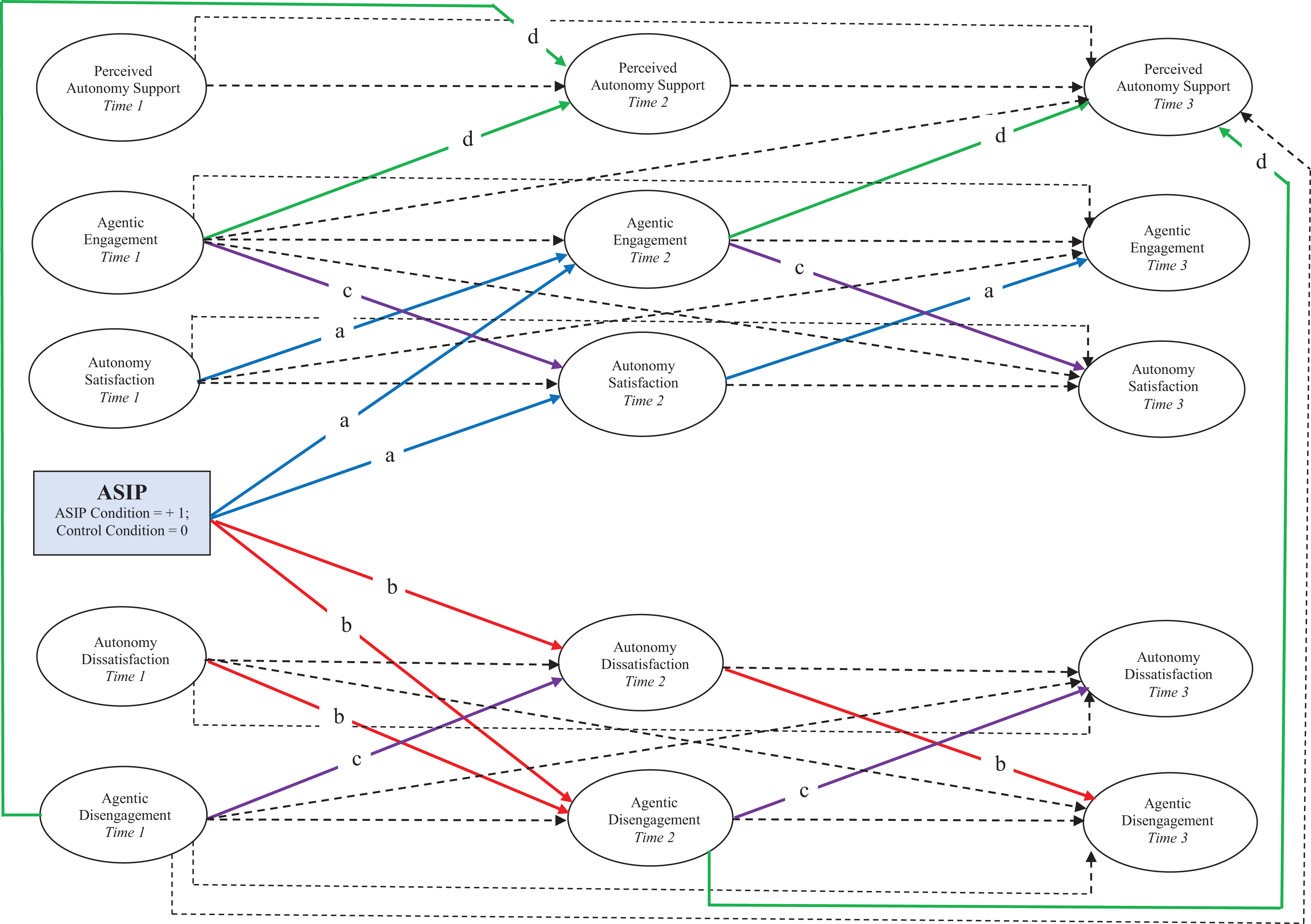
Hypothesized Model.
Similarly, how agentically disengaged students are in classroom learning activities depends on the extent to which they experience autonomy dissatisfaction, which itself depends on the absence of autonomy support from the teacher. The two downwardly sloped red-colored (“b”) lines in the lower part of Figure 1 illustrate these hypotheses. Specifically, experimental condition was hypothesized to decrease T2 autonomy dissatisfaction (controlling for T1 autonomy dissatisfaction), and decreased T2 autonomy dissatisfaction was in turn hypothesized to decrease T3 agentic disengagement (controlling for T1 autonomy dissatisfaction and T1 and T2 agentic disengagement). The lower left part of the figure shows the additional downwardly slopped red-colored (“b”) line from T1 autonomy dissatisfaction to T2 agentic disengagement to serve as a second test of the hypothesis that autonomy dissatisfaction leaves students vulnerable to greater passivity (i.e., agentic disengagement). We expected that teacher-provided autonomy support would not only diminish students’ year-end agentic disengagement, we also expected that it would diminish midyear agentic disengagement as well. The second downwardly sloped red-colored line (“b”) in the lower left part of Figure 1 from experimental condition to T2 agentic disengagement illustrates this “direct effect” hypothesis.
Agentic engagement–disengagement as predictors
We expected that an increase in students’ agentic engagement would function as a student-initiated pathway to both greater autonomy satisfaction and greater perceived autonomy support.
The upper part of Figure 1 features two downwardly slopped purple-colored (“c”) lines to illustrate the hypothesis that how agentically engaged students are at the beginning of the year predicts the extent of their autonomy satisfaction at midyear (T1 agentic engagement → T2 autonomy satisfaction, controlling for T1 autonomy satisfaction) and, further, how increasingly agentically engaged students become by midyear predicts a further increase in their year-end autonomy satisfaction (T2 agentic engagement → T3 autonomy satisfaction, controlling for T1 agentic engagement and T1 and T2 autonomy satisfaction). The lower part of Figure 1 features two upwardly slopped purple-colored (“c”) lines to illustrate the hypothesis that how agentically disengaged students are at the beginning of the year predicts the extent of their autonomy dissatisfaction at midyear (T1 agentic disengagement → T2 autonomy dissatisfaction, controlling for T1 autonomy dissatisfaction) and, further, how increasingly agentically disengaged students become by midyear predicts a further increase in their year-end autonomy dissatisfaction (T2 agentic disengagement → T3 autonomy dissatisfaction, controlling for T1 agentic disengagement and T1 and T2 autonomy dissatisfaction).
The uppermost part of Figure 1 features two upwardly slopped green-colored (“d”) lines to illustrate the hypothesis that how agentically engaged students are at the beginning of the year predicts how autonomy supportive their teachers become by midyear (T1 agentic engagement → T2 perceived autonomy support, controlling for T1 perceived autonomy support) and, further, how increasingly agentically engaged students become by midyear predicts how increasingly autonomy supportive their teachers become by year-end (T2 agentic engagement → T3 perceived autonomy support, controlling for T1 agentic engagement and T1 and T2 perceived autonomy support). The lower part of Figure 1 features two meandering green-colored (“d”) lines to illustrate the hypothesis that how agentically disengaged students are at the beginning of the year predicts how nonautonomy supportive their teachers become by midyear (T1 agentic disengagement → diminished T2 perceived autonomy support, controlling for T1 perceived autonomy support) and, further, how increasingly agentically disengaged students become by midyear predicts how increasingly nonautonomy supportive their teachers become by year-end (T2 agentic disengagement → diminished T3 perceived autonomy support, controlling for T1 agentic disengagement and T1 and T2 perceived autonomy support).
Method
Participants
Teacher-participants
Teacher-participants were 22 full-time certified physical education (PE) teachers (15 males, 7 females) who taught in one of 22 different schools (15 middle, 7 high schools) dispersed throughout South Korea. All teacher-participants were ethnic Korean. On average, teachers were 37.3 years old (SD = 4.8, range = 31–47) and had 10.3 years (SD = 4.2, range = 4–19) of PE teaching experience. All 22 teacher-participants completed all aspects of the yearlong study, and each teacher-participant received the equivalent of US$100 in appreciation of their participation.
Student-participants
Student-participants were all the students in the classrooms of the 22 participating teachers. At the beginning of the academic year (T1, March), 1,422 ethnic Korean students completed the study questionnaire. By the end of the first semester (T2, July), 1,334 of the original participants completed the questionnaire for a second time, while 88 T1 participants did not. The 88 T2 dropouts did not differ from the 1,334 T2 persisters on any T1 dependent measure or on experimental condition, gender, grade, or age, ts < 1.80, ns. By the end of the academic year (T3, December), 1,207 of the students completed the questionnaire for a third time, while 127 did not. The 127 T3 dropouts did not differ from the 1,207 T3 persisters on any dependent measure or on gender, grade, or age, ts < 1.20, ns, but they did differ on experimental condition, t = 7.64, p < .001 because all 33 students in one of the classrooms of a teacher in the control condition did not complete the study questionnaire at T3. In addition, 8 students completed the questionnaire at T1 and T3 (but not T2), and these 8 students did not differ from the 1,207 participants who completed the questionnaire at all three waves on any variable, ts < 0.60, ns. Overall, 7.4% of the data were missing, so we used the expectation maximization algorithm in SPSS25 to impute the missing values and the missing cases, which allowed us to analyze the full data set that included 648 (45.6%) females and 773 (54.3%) males (with one gender classification unidentified) whose grade levels included 929 (65.3%) middle and 493 (34.7%) high school students. On average, students were 14.8 years old (SD = 1.6, range = 13–18), and 757 students (53.2%) participated in the experimental condition, while 665 students (46.8%) participated in the control condition.
Procedure
The research protocol was approved by the University Research Ethics Committee of the second author’s university. We recruited PE teachers to participate in a yearlong study on “classroom instructional strategies.” Teachers were randomly assigned into either the experimental (ASIP intervention; n = 12) or control (no intervention; n = 10) condition. The procedural timeline for the yearlong intervention and the three waves of data collection followed the procedures of previously published three-part ASIPs (Cheon et al., 2012, 2016, 2018). Briefly, Part 1 was a 3-hr morning informational session that introduced autonomy-supportive teaching and Part 2 was a 3-hr afternoon “how-to” workshop to help teachers develop the teaching skill needed to enact six recommended autonomy-supportive instructional behaviors, while Part 3 was a 2-hr peer-to-peer group discussion. Parts 1 and 2 took place a week before the start of the academic year, while Part 3 took place on the sixth week of the first (spring) semester.
To communicate what teachers learned during the ASIP, a list of the six recommended autonomy-supportive instructional behaviors appears in Table 1, along with a sample script of what the teacher might say during instruction to enact each recommended behavior. During Parts 1 and 2 of the ASIP, each of these six instructional behaviors was introduced, explained, modeled (via verbal description—as in Table 1, professionally created videos, and specially invited “guest teachers” who had participated in a previous ASIP), practiced, and personalized until teachers felt ready to enact each recommended behavior in their own classroom with their own students in the context of their own particular teaching situation.
Illustrative Script for Each of the Six Recommended Instructional Behaviors to Help Teachers Learn How to Support Students’ Autonomy During Instruction.

As to the data collection, it was conducted in three waves in which students completed the same four-page questionnaire at the beginning (T1, Week 1) and end (T2, Week 19) of the first (spring) semester and once again at the end (T3, Week 44) of the second (fall) semester. The survey was administered at the beginning of the class period, and students completed the questionnaire in reference to that particular PE teacher and that particular PE class. The questionnaire began with a consent form, and students were assured that their responses would be confidential and used only for the purposes of the research study.
Measures
Each dependent measure used the same 7-point Likert-type scale that ranged from 1 (strongly disagree) to 7 (strongly agree). For each questionnaire, we had available a previously back-translated Korean version of each English-language questionnaire (e.g., Jang et al., 2016). Table 2 lists all questionnaire items.
Descriptive Statistics, Unstandardized β Weights [With 95% Confidence Intervals], and Standardized β Weights Associated With the Dependent Measures Included in the Measurement Model.

Note. N = 1,422 middle and high school students. All items were rated on 7-point Likert-type scales: strongly disagree (1) to strongly agree (7). For perceived autonomy support, autonomy satisfaction, and agentic engagement, higher scores have a positive interpretation. For autonomy dissatisfaction and agentic disengagement, lower scores have a positive interpretation. All Bs are statistically significant (p < .001). 95% confidence intervals for β appear in the brackets. M = mean; SD = standard deviation; B = unstandardized beta weight; β = standardized beta weight; PE = physical education; T1 = Time 1; T2 = Time 2; T3 = Time 3.
Perceived autonomy support
We assessed perceived autonomy support with the 6-item Learning Climate Questionnaire (LCQ; Williams & Deci, 1996). The LCQ has been used in the PE context to assess perceived autonomy support and to predict students’ need satisfaction (Jang et al., 2012). Students’ reports of perceived autonomy support were internally consistent across the three waves of data collection (αs at T1, T2, and T3 were .88, .94, and .93, respectively).
Autonomy satisfaction and dissatisfaction
To assess autonomy satisfaction, we used the 5-item Perceived Autonomy (PA) Scale (Standage et al., 2006). The PA Scale has been widely used in previous studies to assess autonomy satisfaction in the PE context and to predict measures of student engagement (Taylor & Lonsdale, 2010), and it produced scores that were internally consistent (αs = .86, .92, and .91). To assess autonomy dissatisfaction, we used the 5-item Autonomy subscale from the Psychological Need Dissatisfaction (PND) Scale (Costa et al., 2015). The PND has been used to assess autonomy dissatisfaction in the PE context and to predict measures of student disengagement (Cheon et al., 2019), and it produced scores that were internally consistent (αs = .90, .94, and .94).
Agentic engagement and disengagement
To assess students’ agentic engagement and agentic disengagement, we used the 5-item Agentic Engagement Scale (AES) and the 5-item Agentic Disengagement Scale from the larger AES (Reeve, 2013), which has been used previously in classroom investigations of students’ motivation and engagement (Cheon et al., 2016; Jang et al., 2016). Students’ responses to the AES produced reasonably high internal consistency scores for both the AES (αs = .91, .94, and .92) and the Agentic Disengagement (αs = .88, .92, and .91) Scale.
Data Analyses
Intervention effects
To test the effectiveness of the ASIP on the manipulation check (perceived autonomy support) and the study’s four dependent measures (autonomy satisfaction, autonomy dissatisfaction, agentic engagement, and agentic disengagement), we conducted a multilevel analyses using hierarchical linear modeling (HLM) and the HLM software (Raudenbush et al., 2011) because the data had a three-level hierarchical structure with repeated measures (Level 1, three waves, N = 4,266) nested within students (Level 2, N = 1,422), nested within classrooms (Level 3, k = 46), and nested within teachers (a cross-classified Level 3, k = 22). At Level 1 (within student), the longitudinal data allowed us to measure students’ increase or decrease on each dependent measure over three time points—the beginning, middle, and end of the academic year. Accordingly, we scored the “time” independent variable as 0 (T1), 1 (T2), and 2 (T3). At Level 2 (between students), we entered the student gender as group mean-centered covariate to function as statistical control. At Level 3 (between students), we entered the grade level as a quasi-independent variable, though we used grade level as a group mean-centered covariate in the test of the hypothesized model. At Level 4 in the mechanics of the HLM software (between teachers), we entered experimental condition as an uncentered independent variable to retain its raw metric form (control group = 0, experimental group = 1). Finally, we entered the Condition × Time interaction as a cross-level predictor (experimental condition was a cross-classified Level 3 predictor, time was a Level 1 predictor) to test the extent to which the changes in students’ T3 scores depended on experimental condition.
Hypothesized model
To test the hypothesized model (see Figure 1), we used multilevel latent variable structural equation modeling (LISREL 9.20; Joreskog & Sorbom, 2015). The measurement model featured 15 latent variables (5 latent variables assessed at T1, T2, and T3). All indicators used to create the latent variables appear in Table 2. To represent the longitudinal character of the data set, we allowed the between-wave error terms of each repeated measures indicator to correlate with itself at a later time (i.e., autoregressive effects). In the test of the hypothesized model, the six predictor variables and the two statistical controls (gender, grade level) were allowed to correlate freely at T1. Within T2 and T3, the errors of the five within-wave variables were allowed to correlate. We tested the hypothesized model at the teacher (k = 22), classroom (k = 46), and student (N = 1,422) levels, but we report only the student-level analyses (that controlled for teacher- and classroom-level effects).
Results
Preliminary Analyses
Values for skewness and kurtosis for the 15 dependent measures (5 dependent measures × 3 waves) were all less than |1|, indicating little deviation from normality. We explored for baseline differences on each of the five T1 dependent measures between the intervention versus no-intervention groups (see Table 3), but no baseline mean differences emerged, all ts(1,420) < 1.84, ns. We also tested for possible associations between students’ demographic characteristics (gender, grade level) with their baseline scores on the five dependent measures. Gender was associated with four dependent measures (males scored higher on autonomy satisfaction and agentic engagement but lower on autonomy dissatisfaction and agentic disengagement than females), while grade level was associated with all five (middle schoolers scored higher on perceived autonomy support, autonomy satisfaction, and agentic engagement but lower on autonomy dissatisfaction and agentic disengagement than high schoolers). Given these associations, we included gender (females = 0, males = 1) and grade level (middle = 0, high = 1) as covariates (i.e., as T1 statistical controls) in all analyses. The means and standard deviations for the five dependent measures with scores broken down by experimental condition and time of assessment—and also by grade level—appear in Table 3. The results comparing the two grade levels are presented in the Supplemental Analyses.
Descriptive Statistics for the Dependent Measures Broken Down by Experimental Condition, Time of Assessment, and Grade Level.
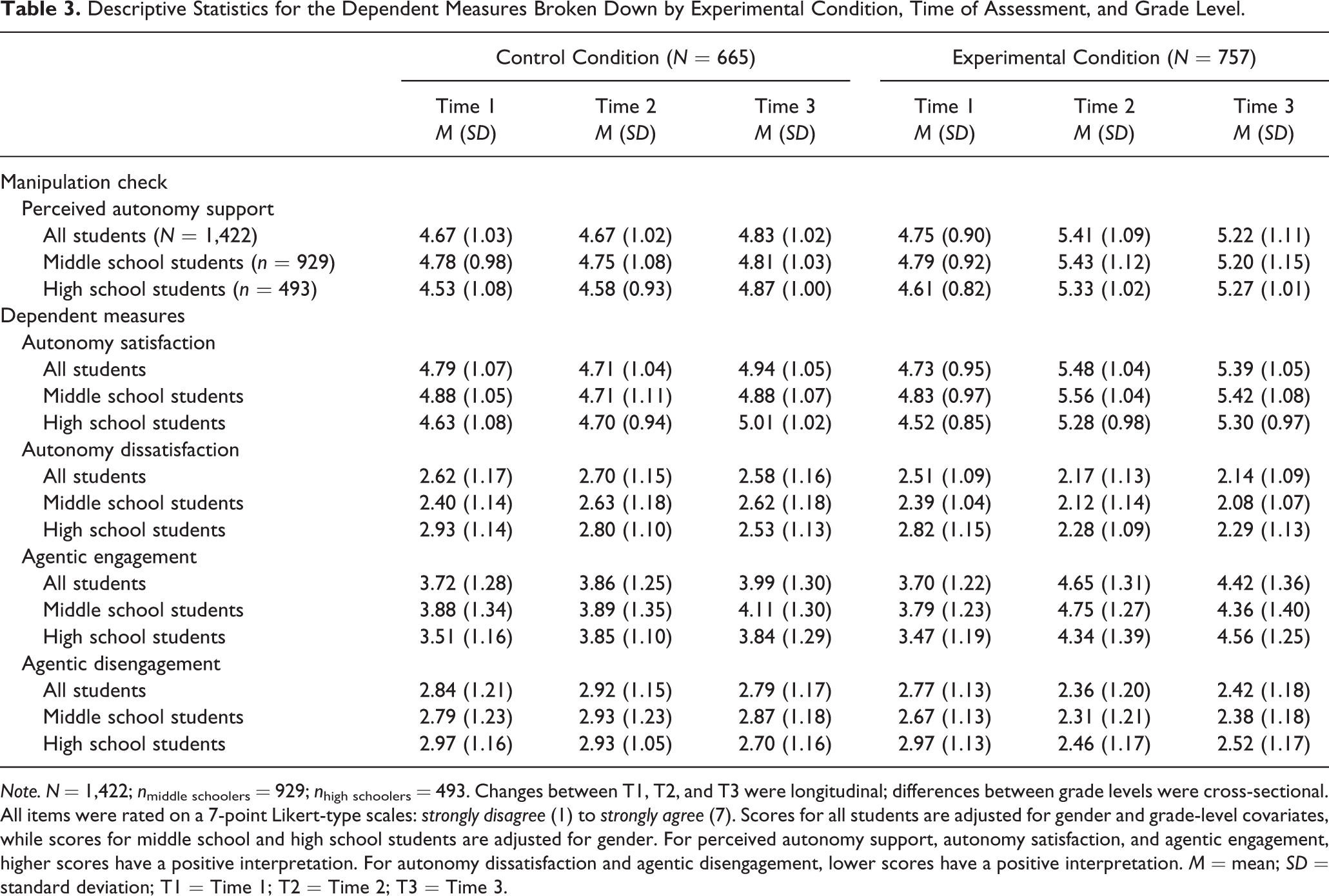
Note. N = 1,422; n middle schoolers = 929; n high schoolers = 493. Changes between T1, T2, and T3 were longitudinal; differences between grade levels were cross-sectional. All items were rated on a 7-point Likert-type scales: strongly disagree (1) to strongly agree (7). Scores for all students are adjusted for gender and grade-level covariates, while scores for middle school and high school students are adjusted for gender. For perceived autonomy support, autonomy satisfaction, and agentic engagement, higher scores have a positive interpretation. For autonomy dissatisfaction and agentic disengagement, lower scores have a positive interpretation. M = mean; SD = standard deviation; T1 = Time 1; T2 = Time 2; T3 = Time 3.
Intervention Effects
Manipulation check
For perceived autonomy support, the critical Condition × Time interaction was significant, t(2,744) = 8.08, p < .001. As reported in Table 3, perceived autonomy support increased for students of teachers in the ASIP experimental condition from T1 to T3 (Δ = +0.47) to a greater degree than it did for students of teachers in the control condition (Δ = +0.16).
Dependent measures
For autonomy satisfaction, the critical Condition × Time interaction was significant, t(2,744) = 10.71, p < .001. Autonomy satisfaction increased more from T1 to T3 for students of teachers in the ASIP experimental condition than it did for students of teachers in the control condition (Δs = +0.66 vs. +0.15).
For autonomy dissatisfaction, the critical Condition × Time interaction was significant, t(2,744) = 5.61, p < .001. Autonomy dissatisfaction decreased more from T1 to T3 for students of teachers in the ASIP experimental condition than it did for students of teachers in the control condition (Δs = −0.37 vs. −0.04).
For agentic engagement, the critical Condition × Time interaction was significant, t(2,744) = 8.10, p < .001. Agentic engagement increased more from T1 to T3 for students of teachers in the ASIP experimental condition than it did for students of teachers in the control condition (Δs = +0.72 vs. +0.27).
For agentic disengagement, the critical Condition × Time interaction was significant, t(2,744) = 5.74, p < .001. Agentic disengagement decreased more from T1 to T3 for students of teachers in the ASIP experimental condition than it did for students of teachers in the control condition (Δs = −0.32 vs. −0.05).
Overall, the significant Condition × Time interaction effects showed that the ASIP intervention was successful in (a) increasing adaptive motivation and engagement and (b) diminishing maladaptive motivation and (dis)engagement. Results also showed that the intervention effects were more pronounced at midyear than they were at year-end, suggesting that the intervention effects might have faded a bit in the second half of the year.
Test of the Measurement Model
The measurement model fit the data well, χ2(9,452) = 12,695.89, p < .001, root mean square error of approximation (RMSEA) = .026 (90% CI: .025, .028), standardized root mean squared residual (SRMR) = .041, and comparative fit index (CFI) = .994. Table 2 shows the descriptive statistics and factor loadings for all 78 individual indicators included in the measurement model, while Table 4 shows the descriptive statistics and intercorrelation matrix among experimental condition, the 15 latent variables, and the two statistical controls (gender, grade level).
Intercorrelation Matrix Among Experimental Condition, the 15 Dependent (Latent) Measures, and the Two Statistical Controls in the Hypothesized Model.
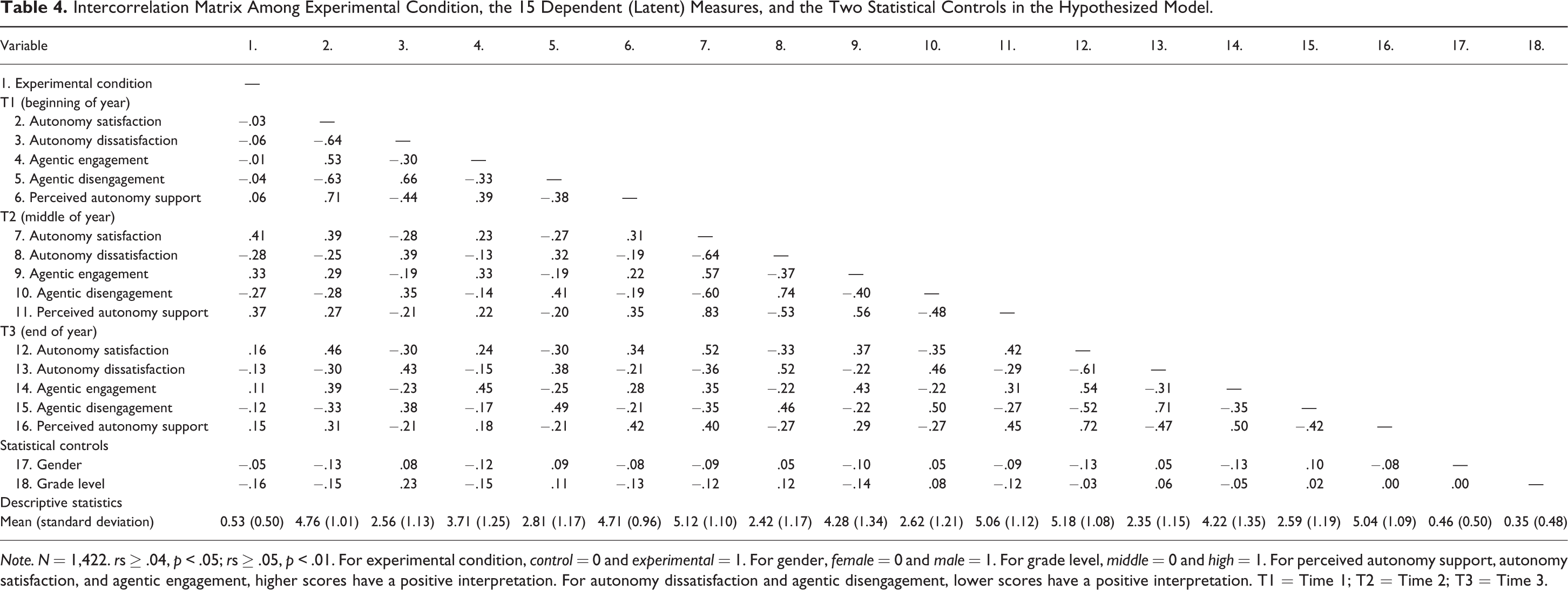
Note. N = 1,422. rs ≥ .04, p < .05; rs ≥ .05, p < .01. For experimental condition, control = 0 and experimental = 1. For gender, female = 0 and male = 1. For grade level, middle = 0 and high = 1. For perceived autonomy support, autonomy satisfaction, and agentic engagement, higher scores have a positive interpretation. For autonomy dissatisfaction and agentic disengagement, lower scores have a positive interpretation. T1 = Time 1; T2 = Time 2; T3 = Time 3.
Test of the Hypothesized Model
The hypothesized model also fit the data well, χ2(9,519) = 13,028.30, p < .001, RMSEA = .027 (90% CI: .026, .028), SRMR = .063, and CFI = .993. The path diagram showing the standardized estimate for each path in the model appears in Figure 2. For clarity, we do not show the T1 statistical controls (gender, grade level) in the figure, but we do report each of these paths in the full statistical results below.

Standardized β Weights [With 95% Confidence Intervals] From the Test of the Hypothesized Model.
Increased autonomy satisfaction
In the prediction of T2 autonomy satisfaction, experimental condition (i.e., manipulated autonomy support) was an individually significant predictor (B = .36, SE B = .02, β = .42, t = 17.89, p < .001), while T1 agentic engagement was not (B = .03, SE B = .02, β = .03, t = 1.44, p = .149), controlling for T1 autonomy satisfaction (β = .39, p < .001), grade level (β = .01, p = .665), and gender (β = −.01, p = .553).
In the prediction of T3 autonomy satisfaction, midyear increases in T2 agentic engagement was an individually significant predictor (B = .09, SE B = .02, β = .10, t = 4.12, p < .001), controlling for T2 autonomy satisfaction (β = .35, p < .001), T1 autonomy satisfaction (β = .32, p < .001), T1 agentic engagement (β = −.04, p = .092), grade level (β = .06, p = .005), and gender (β = −.05, p = .013).
Decreased autonomy dissatisfaction
In the prediction of T2 autonomy dissatisfaction, both experimental condition (i.e., manipulated autonomy support; B = −.23, SE B = .02, β = −.25, t = 10.53, p < .001) and T1 agentic disengagement (B = .12, SE B = .03, β = .11, t = 3.48, p < .001) were individually significant predictors, controlling for T1 autonomy dissatisfaction (β = .31, p < .001), grade level (β = −.01, p = .682), and gender (β = −.01, p = .738).
In the prediction of T3 autonomy dissatisfaction, midyear decreases in T2 agentic disengagement was an individually significant predictor (B = .11, SE B = .03, β = .11, t = 3.41, p < .001), controlling for T2 autonomy dissatisfaction (β = .33, p < .001), T1 autonomy dissatisfaction (β = .21, p < .001), T1 agentic disengagement (β = .10, p = .002), grade level (β = −.04, p = .054), and gender (β = .00, p = .870).
Increased agentic engagement
In the prediction of T2 agentic engagement, both experimental condition (B = .31, SE B = .02, β = .33, t = 13.67, p < .001) and T1 autonomy satisfaction (B = .15, SE B = .04, β = .13, t = 4.34, p < .001) were individually significant predictors, controlling for T1 agentic engagement (β = .26, p < .001), grade level (β = −.03, p = .243), and gender (β = −.03, p = .143).
In the prediction of T3 agentic engagement, midyear increases in T2 autonomy satisfaction was an individually significant predictor (B = .10, SE B = .03, β = .09, t = 3.05, p = .002), controlling for T2 agentic engagement (β = .26, p < .001), T1 agentic engagement (β = .28, p < .001), T1 autonomy satisfaction (β = .14, p < .001), grade level (β = .06, p = .008), and gender (β = −.04, p = .079).
Decreased agentic disengagement
In the prediction of T2 agentic disengagement, both experimental condition (B = −.23, SE B = .02, β = −.26, t = 10.61, p < .001) and T1 autonomy dissatisfaction (B = .15, SE B = .03, β = .14, t = 4.37, p < .001) were individually significant predictors, controlling for T1 agentic disengagement (β = .31, p < .001), grade level (β = −.03, p = .173), and gender (β = .00, p = .966).
In the prediction of T3 agentic disengagement, midyear decreases in T2 autonomy dissatisfaction was an individually significant predictor (B = .17, SE B = .03, β = .17, t = 5.03, p < .001), controlling for T2 agentic disengagement (β = .23, p < .001), T1 agentic disengagement (β = .28, p < .001), T1 autonomy dissatisfaction (β = .04, p = .262), grade level (β = −.06, p = .008), and gender (β = −.04, p = .040).
Increased autonomy support
In the prediction of T2 perceived autonomy support, both T1 agentic engagement (B = .09, SE B = .02, β = .09, t = 3.90, p < .001) and T1 agentic disengagement (B = −.05, SE B = .02, β = −05, t = 2.31, p = .021) were individually significant predictors, controlling for experimental condition (β = .35, p < .001), T1 perceived autonomy support (β = .27, p < .001), grade level (β = −.01, p = .664), and gender (β = −.04, p = .103).
In the prediction of T3 perceived autonomy support, both midyear increases in T2 agentic engagement (B = .05, SE B = .02, β = .06, t = 2.04, p = .042) and decreases in T2 agentic disengagement (B = −.05, SE B = .02, β = −.05, t = 1.96, p = .050) were individually significant predictors, controlling for T2 perceived autonomy support (β = .31, p < .001), T1 perceived autonomy support (β = .30, p < .001), T1 agentic engagement (β = −.02, p = .366), T1 agentic disengagement (β = −.01, p = .569), grade level (β = .09, p < .001), and gender (β = −.02, p = .355).
Supplemental Analyses: Grade-Level Differences
As reported earlier (in the Preliminary Analyses), middle schoolers showed a better perceived autonomy support, autonomy satisfaction–dissatisfaction, and agentic engagement–disengagement profile than did high schoolers. To explore further these grade-level mean differences (see Table 3), we conducted supplemental analyses. To test whether the intervention effects applied equally to middle school and high school students, we repeated the earlier whole-sample HLM intervention effects tests but this time for only middle schoolers (n = 929) and for only high schoolers (n = 493). In the sample of only middle schoolers, all five Condition × Time interaction effects were significant: perceived autonomy support, t(1,790) = 6.21, p < .001; autonomy satisfaction, t(1,790) = 9.04, p < .001; autonomy dissatisfaction, t(1,790) = 5.48, p < .001; agentic engagement, t(1,790) = 7.05, p < .001; and agentic disengagement, t(1,790) = 4.60, p < .001. Similarly, in the sample of only high schoolers, the five Condition × Time interaction effects were again all significant: perceived autonomy support, t(968) = 4.56, p < .001; autonomy satisfaction, t(968) = 4.77, p < .001; autonomy dissatisfaction, t(968) = 2.49, p = .013; agentic engagement, t(968) = 4.34, p < .001; and agentic disengagement, t(968) = 2.96, p = .003.
To determine whether the hypothesized model fit the data the same for middle school and high school students, we repeated the test of the overall model (per Figure 1) first for only the middle schoolers and then only for the high schoolers. In both analyses, the repeated measures were nested within students and classrooms, but not within teachers because there were too few teachers in the high school sample for a meaningful analysis. For the 929 middle school students, the hypothesized model fit the data reasonably well, χ2(3,659) = 6,906.18, p < .001, RMSEA = .042 (90% CI: .041, .044), SRMR = .074, and CFI = .986. Similarly, the hypothesized model fit the data reasonably well for the 493 high school students, χ2(3,659) = 4,943.77, p < .001, RMSEA = .037 (90% CI: .035, .040), SRMR = .070, and CFI = .988. In both models, the magnitude of the standardized β weights was essentially the same as shown in Figure 2, though some of the significance levels for the β weights in the high school model were statistically nonsignificant due to the lower sample size (i.e., lower statistical power).
Discussion
Academic progress does not just happen. To make progress (e.g., learn a foreign language, become a better writer), students need to leave behind their passivity (i.e., agentic disengagement) to take on the personal initiative needed to acquire knowledge and to develop skill. The counterpunch to such personal agency is that the road to progress is fraught with difficult-to-overcome obstacles and devastating setbacks. Given these hurdles, students are vulnerable to suffer motivationally and, hence, to giving up (Skinner et al., 2014). Fortunately, students are not left to struggle on their own, as their teacher can take on a supportive role to help students develop greater resilience.
Teacher Support as a Pathway to Greater Resilience
We provided teachers with the professional developmental opportunity they needed to become significantly more autonomy supportive toward their students during instruction (participation in the ASIP). Being in the class of an autonomy-supportive teacher empowered students in four ways. First, access to autonomy-supportive teaching boosted students’ classroom experiences of autonomy need satisfaction. Autonomy satisfaction is empowering because it energizes interest-taking, challenge-seeking, initiative-taking, volitional internalization, and adaptive processing of stressful circumstances (Ryan & Deci, 2017; Weinstein et al., 2009). Second, access to autonomy-supportive teaching diminished experiences of autonomy need dissatisfaction. Third (and fourth), autonomy-supportive teaching both boosted students’ agentic engagement and diminished their agentic disengagement. Because these latter two effects have never been reported before in an ASIP, we explain their significance in detail.
When teachers learned how to become more autonomy supportive, their students responded with greater agentic engagement and lesser agentic disengagement. Manipulated autonomy support rather strongly boosted T2 agentic engagement (β = .33, p < .001), but its effect on T3 agentic engagement occurred via a midyear boost in autonomy satisfaction. Similarly, manipulated autonomy support rather strongly diminished T2 agentic disengagement (β = −.26, p < .001), but its effect on T3 agentic disengagement similarly occurred via a midyear reduction in autonomy dissatisfaction. Given the indirect effects on the T3 measures, it is tempting to conclude that the effect of manipulated autonomy support on students’ midyear agentic engagement and agentic disengagement was also only indirect. But there is a special reciprocal, even synchronous, relation between teacher-provided autonomy support, on the one hand, and students’ agentic engagement and disengagement, on the other hand. When teachers appreciate, encourage, and enthusiastically invite students’ input and initiative, then it makes sense that students might respond in kind and become more likely to speak up and offer their input. Similarly, when students speak up and let the teacher know what they want, need, and prefer, then it makes sense that teachers would respond in kind and become more autonomy supportive toward their students. The same patterns likely hold for agentic disengagement. If teachers do not invite students’ input, then it makes sense that students over time might turn increasingly passive, just as when students tend toward passivity, then their teachers might become less-and-less autonomy supportive.
We conclude that autonomy-supportive teaching directly supports all four of the following: increased autonomy satisfaction, decreased autonomy dissatisfaction, increased agentic engagement, and decreased agentic disengagement. These latter two effects (on agentic engagement and agentic disengagement), however, are likely both somewhat direct and somewhat indirect processes (i.e., mediated by autonomy satisfaction–dissatisfaction).
Students as Self-Catalysts to Greater Autonomy Satisfaction and Autonomy Support
By midyear, students in the classrooms of autonomy-supportive teachers displayed both greater agentic engagement and lesser agentic disengagement. But this was only one half of these students’ journey to develop greater academic resiliency.
Midyear (T2) gains in agentic engagement gave students the self-initiative they needed to create future autonomy need-satisfying experiences for themselves. Similarly, midyear declines in agentic disengagement nudged students out of their passivity that was otherwise leaving their autonomy need unfulfilled. These two effects can be seen in the two purple lines on the right side of Figure 1. The important point is that while autonomy-supportive teachers provided students with recurring opportunities to experience frequent autonomy satisfaction and infrequent autonomy dissatisfaction in the first half of the year, by the second half of the year, students were able to provide these classroom experiences for themselves—through their greater agentic engagement and lesser agentic disengagement.
These same students were also able to bring out greater autonomy support from their teachers. Teachers mostly became more autonomy supportive because of their participation in the ASIP intervention, but teachers also became more autonomy supportive when their students were agentically engaged and were not agentically disengaged. These “students affect teacher” effects were smaller in magnitude than were the “intervention affects teacher” effects (in terms of effect sizes or β weights), so the conclusion seems to be that teacher participation in an ASIP is an explicit pathway for teachers to become more autonomy supportive, while students’ high agency and low passivity are more subtle pathways to this same professional developmental accomplishment.
The Effect That Did Not Materialize
Beginning-year agency did not boost students’ midyear autonomy satisfaction, though beginning-year passivity did exacerbate midyear autonomy dissatisfaction. So, not being passive minimized autonomy dissatisfaction, but it was not the parallel case that being proactive yielded autonomy satisfaction. Interestingly, midyear changes in agentic engagement did lead to corresponding year-end changes in autonomy satisfaction, just as midyear changes in agentic disengagement led to corresponding year-end changes in autonomy dissatisfaction. To make sense of this overall pattern of findings, it seems necessary to make the distinction between initial agency and ASIP-enabled and autonomy-infused gains in agency. Speaking up, asking questions, and expressing preferences (T1 agency as an individual difference characteristic) did little to promote one’s midyear autonomy satisfaction (β = .03, p = .149), though it did increase T2 perceived autonomy support (β = .09, p < .001). Nevertheless, once these same acts of agentic engagement were motivationally energized by greater autonomy satisfaction, then that autonomy-fueled agency did produce its benefits, including both greater year-end autonomy satisfaction (β = .10, p < .001) and greater year-end perceived autonomy support (β = .06, p = .042). Thus, speaking up, asking questions, and expressing preferences as an authentic expression of one’s autonomy need satisfaction is the important classroom phenomenon. Being passive in class, on the other hand, was an unqualified pathway to declines in motivation and relationship support.
Possible Interventions
Several teacher-focused autonomy-supportive interventions have been implemented to confirm that teachers can learn how to become more autonomy supportive (Cheon et al., 2012, 2016, 2018). Student-focused agentic engagement interventions, however, have not yet been developed. Given the present findings, we are somewhat skeptical about the merits of such an intervention. An agentic engagement intervention would help students develop the skill of communicating their interests and voicing their suggestions, but a high level of beginning-year agentic engagement did not do much for the students in our study. To boost students’ agentic engagement, it seems more profitable to continue to work with teachers—via ASIPs—to create the classroom conditions in which students will naturally become more agentic—as a result of a teacher-supported boost in their autonomy need satisfaction. That is, at present, it makes more sense to give students interesting things to do and access to autonomy-supportive teachers than it does to work directly with students to show them how to become more agentically engaged in their own learning. If such an (agentic engagement) intervention did produce positive results, however, we suspect it might be because students were able to become less agentically disengaged. Still, this seems like an interesting question for future research to pursue.
Developmental Implications
Our sample included both middle school and high school students. This design feature allowed us to investigate both grade-level mean differences in motivation and engagement and process-related differences concerning the interrelations among autonomy support, autonomy need states, and patterns of engagement for early versus late adolescents. Mean-level differences were large and widespread, as middle schoolers showed the more positive classroom profile than did high schoolers (see Table 3). Processes differences, however, were practically nonexistent, as the hypothesized model fit the data roughly the same for middle school students as it did for high school students. Overall, these findings suggest two interpretations. First, the observed mean differences suggest that teaching, motivation, and engagement are different between the middle and high school classrooms included in our study. These grade-level differences suggest a possible environmental or classroom-based difference in school practices. Second, the observed grade-level differences suggest a possible developmental difference. As students move from high autonomy-supportive teaching in middle school to lower autonomy-supportive teaching in subsequent years, a cumulative effect may occur in which students developmentally lose some of their earlier autonomy satisfaction and agentic engagement and developmentally take on more autonomy dissatisfaction and agentic disengagement.
Limitations
Three methodological limitations constrain the conclusions that may be reached from this study. First, we assessed each dependent measure using only self-reported data from a single informant (i.e., students). The study could be made methodologically stronger with the addition of objective ratings. For instance, instead of (or in addition to) asking students to self-report their agentic engagement and disengagement, the teachers of these students could make these same ratings. For instance, in another ASIP-designed intervention study, teachers rated their students’ prosocial and antisocial behaviors (Cheon et al., 2018). In another study, classroom observers objectively scored teachers’ in-class autonomy-supportive instructional behaviors (Cheon et al., 2016). In both of these studies, dependent measures were assessed both objectively and with multiple informants.
Second, while our study included a measure of teachers’ autonomy support, it did not include a parallel measure of teachers’ autonomy indifference. This was a study limitation because we used students’ agentic disengagement to predict lower autonomy support instead of higher autonomy indifference. With indifferent instruction, the teacher provides instruction in a way that is unconcerned with or unresponsive to students’ need for autonomy. We did not include this measure simply because no such measure existed at the time of our study. But a measure of the indifferent motivating style has now been developed and validated (Bhavsar et al., 2019), so future research may be enriched by its inclusion.
Third, our study took place in PE classrooms. This circumstance raises two questions—“Do our PE-based findings generalize to other subject matters?” and “Does the resiliency these students developed in PE transfer in kind to resiliency in academic situations more generally?” As to generalization, a recent meta-analysis on the benefits of autonomy-supportive teaching found that the effect sizes observed in PE did not differ from effect sizes observed in all other subject matters (Patall, 2019). That said, we still recognize that the learning activities in PE are more skill based, while the learning activities in traditional subject matters are more knowledge based. As to transfer, we did find that what students learned in the first half of the year transferred to what occurred in the second half of the year. Still, it is not known if what students learned in the PE setting with one particular teacher might transfer to non-PE settings and to future teachers. This question seems like a good candidate for future research—perhaps by relying on the theory and methodology used in tests of the “trans-contextual model” of motivation (Hagger & Chatzisarantis, 2016).
Conclusion
Resilience is malleable. When teachers develop the professional skill needed to better support their students’ autonomy, their students then tend to develop greater resilience. Further, as students develop greater agency-based resiliency, they become increasingly able to generate for themselves the future high-quality motivation (autonomy satisfaction) and supportive relationships (autonomy support) they need to take the initiative—and leave behind the passivity—to make academic progress.
Footnotes
Funding
The author(s) disclosed receipt of the following financial support for the research, authorship, and/or publication of this article: This work was supported by the National Research Foundation of Korea Grant funded by the Korean Government (NRF-2014S1A5B8060944). This research was supported by Korea University Future Research Grant: 2018.09.01-2019.07.31.
