




Abstract
In this study, we develop a WeChat knowledge service system (WKSS) in university library based on SoLoMo. The aim is to build a comprehensive, open, mobile and smart knowledge service environment. It can realise the interaction between the three users, library and knowledge, and promote the dissemination and sharing of knowledge. By referencing the Internet frontier concept SoLoMo, this study designs a new mobile smart service system, including the system architecture design, the content design and the data association design. Then, this study develops the system, including the running environment configuration, the development of workflow, the core module and the system implementation. This system enables the provision of accurate, specific and more personalised service to each user. It also includes a portable mobile terminal to increase the accuracy of context awareness and enhance user convenience. This study makes up for the shortcomings of the library and increases the functions of personalisation, mobility and intelligence. It extends the way of mobile service in libraries and provides readers with better library mobile services, which was liked by readers.
1. Introduction
It is universally acknowledged that the library mainly provided the paper books management service in the past [1]. Now its main function has changed. Modern information technology has brought profound changes to university libraries, such as information service systems, which have opened up new digital, automated and networked information services. For the majority of teachers and students, it has greatly improved the efficiency of information services, expanded the ways and methods of knowledge acquisition, enriched the content and resources of information display and promoted the interaction between readers and libraries [2].
Nevertheless, the existing information service systems of university libraries are mostly based on the previous Internet application environment, such as web [3]. There are many shortcomings and problems in this type of information service systems. For example, the mobility of knowledge supply and service is not flexible enough, and the presentation of knowledge exchange and interaction is relatively simple. Furthermore, the relative speed of knowledge innovation and communication lags behind, it is impossible to implement location-aware knowledge service effectively, it does not form social networks for study and scientific research and so on [4,5].
More importantly, with the rapid development of mobile information technology, mobile terminals such as tablet PCs and mobile phones are increasingly becoming the mainstream of people’s daily lives. People in today’s society, especially teachers and students in colleges and universities, are more willing to use the mobile social networking platforms (such as Facebook, Twitter, Skype and WeChat) in order to obtain wealthy and varied knowledge in dispersed leisure [6–8].
Knowledge service system is a brand new information service system with the inevitable trend of future development [9]. This system addresses the knowledge needs of the service object. It is based on the collection, collation, analysis and application of knowledge and utilises a wealth of information resources and advanced information technology. In addition, this system can help clients propose new scientific research problems, provide reliable knowledge consulting services and form a viable knowledge activity solution [10]. Taking university libraries as an example, the knowledge service system of university libraries plays a very important role in knowledge management. The system provides users with active, continuous and embedded services through information processing, analysis and innovation to form knowledge products and functions to meet the user’s personalised and specialised knowledge needs.
Furthermore, WeChat is one of mobile application software based on smartphone, which can provide various mobile information services (MIS), including voice, video, pictures, text and group chat across platforms and terminals [11]. WeChat is the fastest growing mobile app and Internet service. The mobile application has the characteristics of strong user stickiness, accurate information dissemination and rich service content. SoLoMo is a front-end perspective for the design of the university library WeChat knowledge service system (WKSS). It is the perfect integration of social networking services (SNS), location-based services (LBS) and MIS. The SoLoMo-based university library WKSS can acquire the user’s learning interest, deeply perceive the user’s learning situation and provide users with mobile, personalised and intelligent knowledge services according to the user’s location status.
In summary, in order to realise knowledge sharing and knowledge exchange among users, and in order to create a comprehensive, open, mobile and intelligent knowledge service academic environment, this study developed the WKSS of university library based on SoLoMo model, aiming at solving the problems and shortcomings of the previous information service system of university libraries. This system relies on WeChat [12], which is the most famous and most influential social media platform in China, using the SoLoMo model as the front-end application model of the Internet. The system will become the knowledge port of learning and research activities for the vast number of teachers and students in the university.
2. Related research
2.1. The previous information service of university library
The previous information service system of university library mainly refers to ‘basic services’, ‘information services’ and ‘the training services’, which are based on the background of automation and network of digital library [13]. University libraries provide services to users through the web networks, and users access services through the web network. Figure 1 shows the flow of information service processes and content regarding previous university libraries. Basic services mainly include Book Loan (BL), Literature Retrieval (LR), Novelty Retrieval (NR) and Patent Information (PI). Information services mainly include Electronic Resources (ER), Academic Trends (AT), Thematic Information (TI) and Subject Knowledge. Training services mainly include Utilisation of Resources (UR), Database Lecture (DL), Course Training (CT) and Freshman Education (FE).
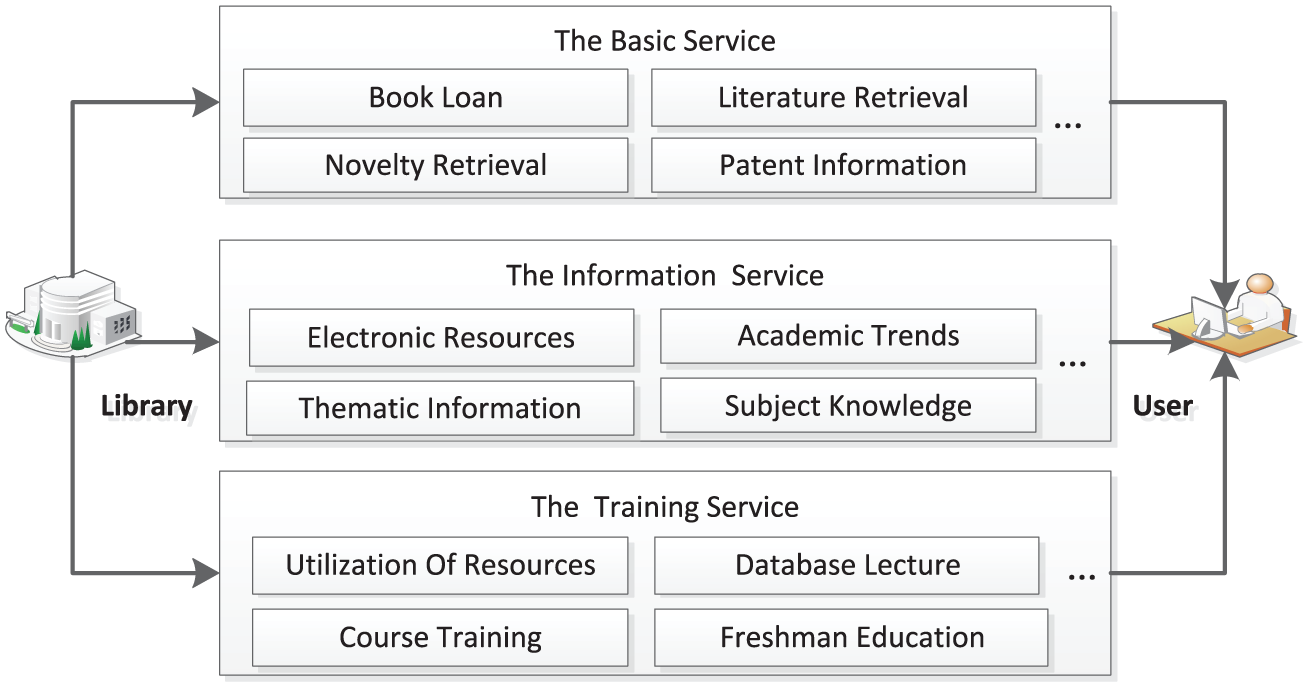
The process and content of the previous information service of university library.
Although it has effectively realised the automation, networking and digitalisation of the information service of university library [14], there are still many problems with the previous Internet information technology model. For example, (1) the form of service is relatively simple. If a person wants to gain knowledge service of library, he or she needs to find the computer first, instead of using a mobile phone that can access the knowledge service anytime and anywhere. (2) Information interaction is relatively weak. Users can only access knowledge services, but they cannot express their opinions. (3) The content of resources is relatively few. It can just provide text, pictures and a small amount of audio and video, but does not provide real-time video, voice, geographic coordinates and more. (4) Information dissemination is relatively slow. Although the information dissemination of the service has improved, it is still relatively slow compared with wireless networks.
2.2. WeChat knowledge service and SoLoMo
In February 2011, D John, the world’s most influential investor, proposed the latest application model for the Internet frontier – SoLoMo, which includes SNS, LBS and MIS. It can be considered as ‘SoLoMo = SNS + LBS + MIS’. The SoLoMo model has received wide attention from society and scholars, and is regarded as the future trend and new perspective of the Internet. The SoLoMo service model reconstructs the knowledge service environment for users, and at the same time it has simple, convenient, efficient and intelligent personality features. The ubiquitous mobile information technology, the sense of the location of the service context and the interactive social network space of the SoLoMo service model enable a huge shift in the acquisition, use, dissemination and creation of knowledge [15].
For university libraries, the emergence and application of SoLoMo service has brought a new round of theoretical research and practice innovation of knowledge service. For example, the New York public library provides users with some SoLoMo application services, such as Twitter, Facebook, Instagram and other, so that users can access and use various services and resources of the library anytime and anywhere. The Oregon State University library has launched a location-based travel service – Beaver Tracks, which describes the service functions in various locations in the museum to users, as well as pictures of related scenes. Min describes a library information system that utilises collective intelligence and cloud computing. He proposes a library mobile service model that is not limited by time and space [16]. The model has typical SoLoMo features. The rise of these emerging library services has important research significance and value, with SoLoMo features. This service greatly demonstrates the advantages of personalisation, convenience, openness and interaction. Moreover, this service is very attractive to both users and libraries.
WeChat is a Chinese social media application, which was developed by Tencent, which is a leading provider of Internet value-added service in China. It was first released in 2011, and by 2017 it was one of the largest standalone messaging apps by monthly active users, with over 938 million active users, 90% of whom were Chinese. At present, the application version of WeChat has been used in about more than 200 countries; it has more than 20 languages and over 85,000 application interfaces [17]. WeChat realises the application of service in various fields including public transportation, living facilities, medical fee and municipal, which is now one of the most important mobile Internet services [12]. And it was reported that more than 50% WeChat’s users spend over 90 min a day on the APP [8]. Because of users just with the mobile phone number registered to WeChat account rather than the other social software, which can register multiple accounts, the WeChat’s users have potentially huge value.
The Project ‘985’ is a construction project carried out by the government of the People’s Republic of China for the construction of several world-class universities and a number of internationally renowned high-level research universities [18]. The ‘985’ universities have a significant role in the entire society. They have strong forces, national support, hardware and software of affluent resources, strong academic atmosphere, excellent students and outstanding platform characteristics of culture, and social capital is widely recognised.
Table 1 shows the WeChat service in ‘985’ university libraries in China. Through investigation and study, we found that of the 39 libraries in the ‘985’ universities nationwide, 35 libraries had been opened for WeChat service by May 2017, accounting for 89.7%. In Chinese university libraries, a mounting number of libraries are planning to use WeChat to develop mobile knowledge service. The WeChat knowledge service shows a strong momentum of development.
The WeChat service in ‘985’ university libraries in China.
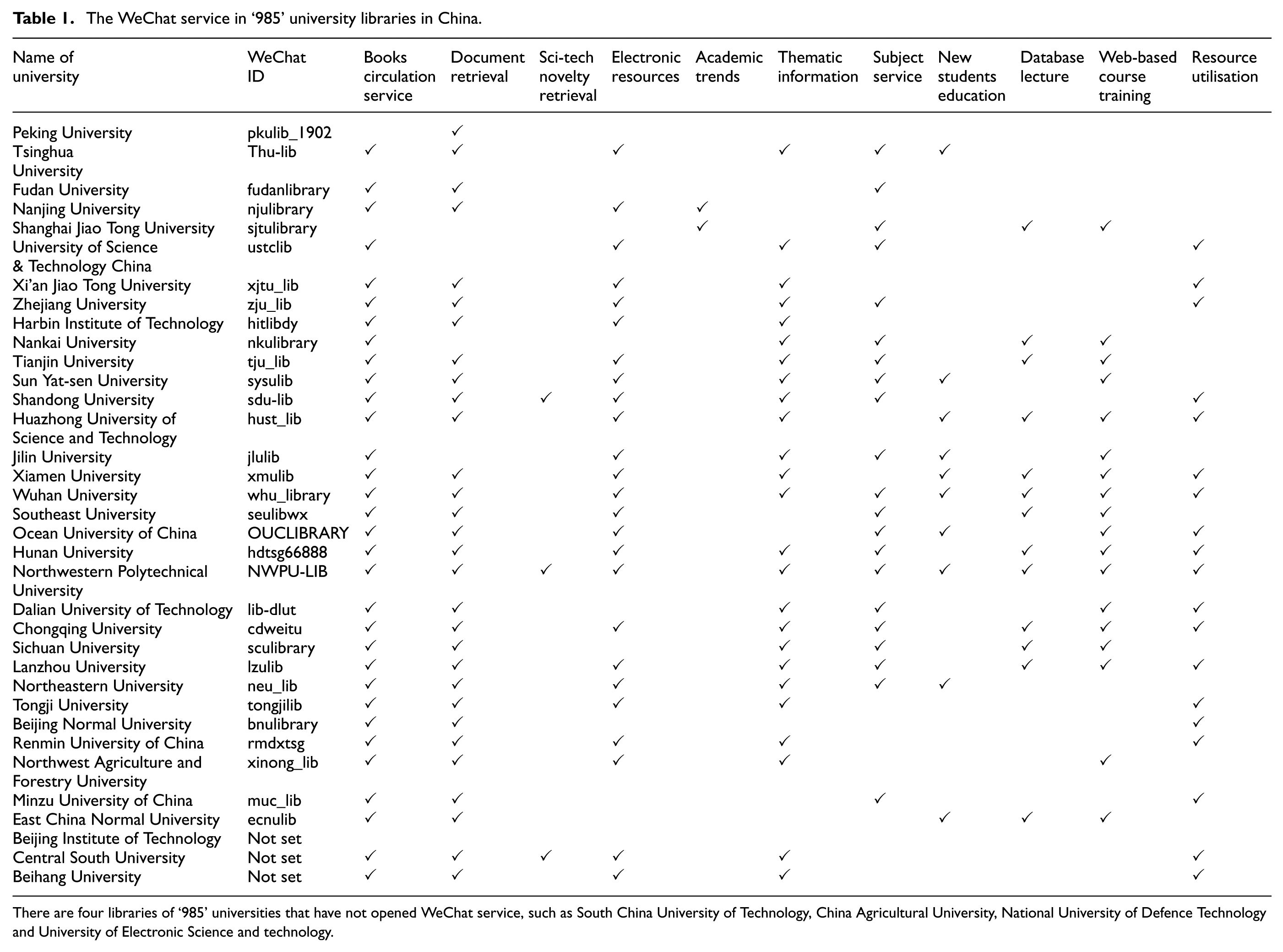
There are four libraries of ‘985’ universities that have not opened WeChat service, such as South China University of Technology, China Agricultural University, National University of Defence Technology and University of Electronic Science and technology.
2.3. WeChat knowledge service based on SoLoMo
At present, the main tools of university library knowledge services are WorldShare Service, Sierra, Intota, Open Skies, BLUEcloud Suite and so on. Through the research and analysis of relevant literature, the characteristics of knowledge service tools and WeChat knowledge services in university libraries are sorted out and compared. Table 2 shows the comparison of the library’s previous knowledge service and current WeChat knowledge service.
Comparison of the previous knowledge service and WeChat knowledge service of library.
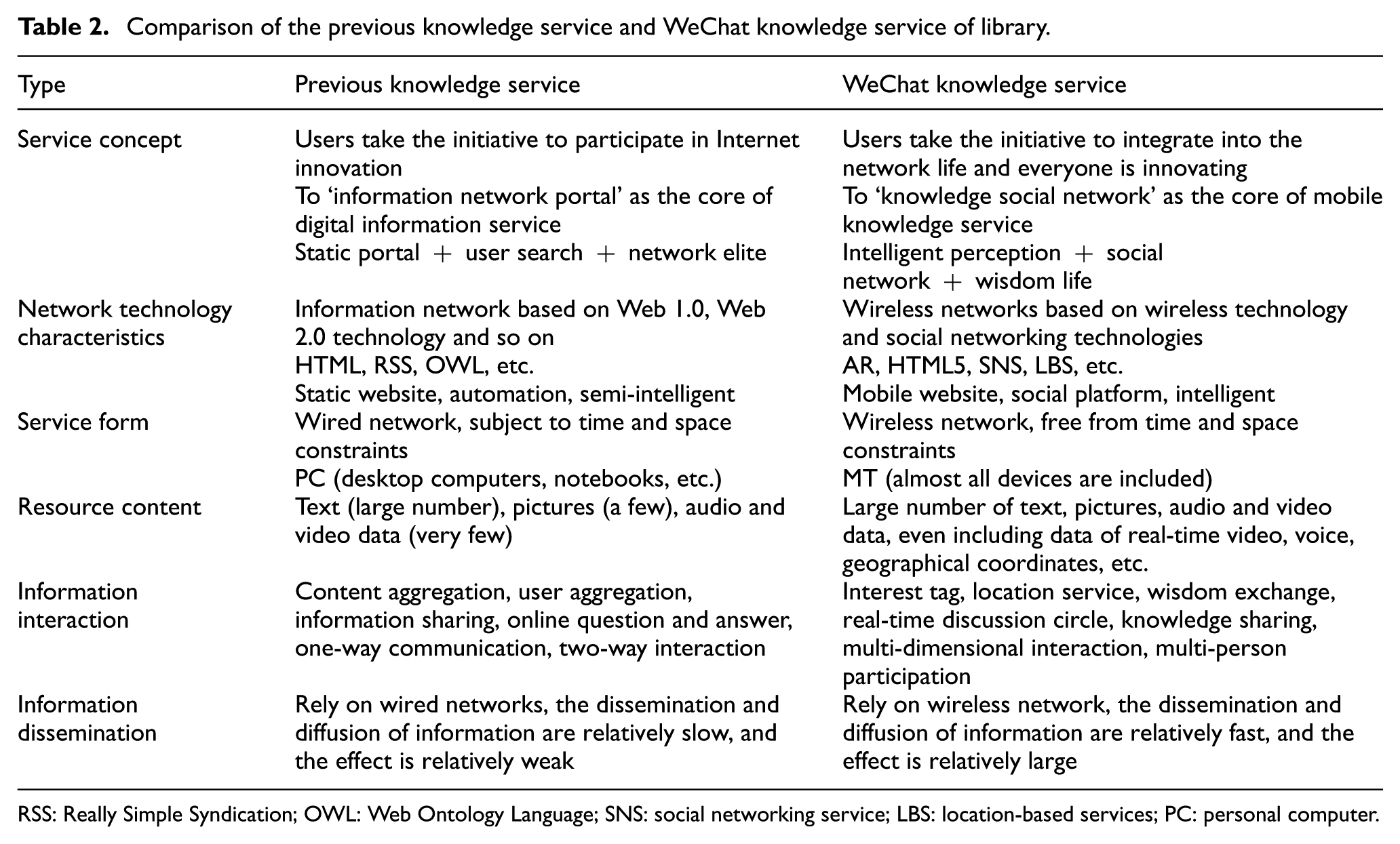
RSS: Really Simple Syndication; OWL: Web Ontology Language; SNS: social networking service; LBS: location-based services; PC: personal computer.
The application of SoLoMo in WeChat knowledge service has realised the automation, mobility and intelligence of knowledge service in university libraries. The advantages of this service are as follows:
Providing a new way to get knowledge for users anytime and anywhere. The previous information service of university library based on the web has to a certain extent expanded the way for users to acquire knowledge. When users use this service to acquire knowledge, they will still be affected and restricted by time and space. However, WKSS based on SoLoMo uses mobile information technology and virtual digital resources to break the boundaries of time and space of knowledge service; when users only need to pour attention into the WeChat public service number of the university library on their smartphone, they can acquire knowledge quickly, conveniently, anytime and anywhere.
Providing a wide range of knowledge services for libraries. First, the WKSS based on SoLoMo combines physical resources with virtualised resources and provides GPS location information service and MIS. There is one more point, users can construct the learning circle and find like-minded friends to realise the exchange and sharing of knowledge between each other. Subsequently, this service uses mobile information technology. And the service can provide abundant electronic resources for users, which effectively solves the problem of lack of reading physics places and so on.
Enhancing the comprehensive service ability of knowledge diffusion. The WKSS based on SoLoMo treats each user as a decentralised knowledge node. These decentralised knowledge nodes interact with each other and continue to form a user’s knowledge social network. For one affair, knowledge quickly spreads among different knowledge nodes by WeChat; for another, these knowledge nodes form many different knowledge social networks, which magnify the scope of knowledge diffusion. The use of this knowledge service in university libraries has greatly enhanced the comprehensive service ability of knowledge dissemination.
3. Designs of WKSS based on SoLoMo
3.1. The system architecture design
System architecture is the combination and design of the parts of the system in accordance with the design principle, and it is an abstract model of the components of the system. It is used to guide the implementation of the system, and it is the design and planning of system implementation [19]. In this study, we innovatively propose the system architecture for WKSS based on SoLoMo. Figure 2 shows the system architecture design of WKSS based on SoLoMo. The system architecture design is based on the original university library information service system and the WeChat service, according to the software design thought of SoLoMo model ‘SNS + LBS + MIS’ and using the method of mobile Internet service.
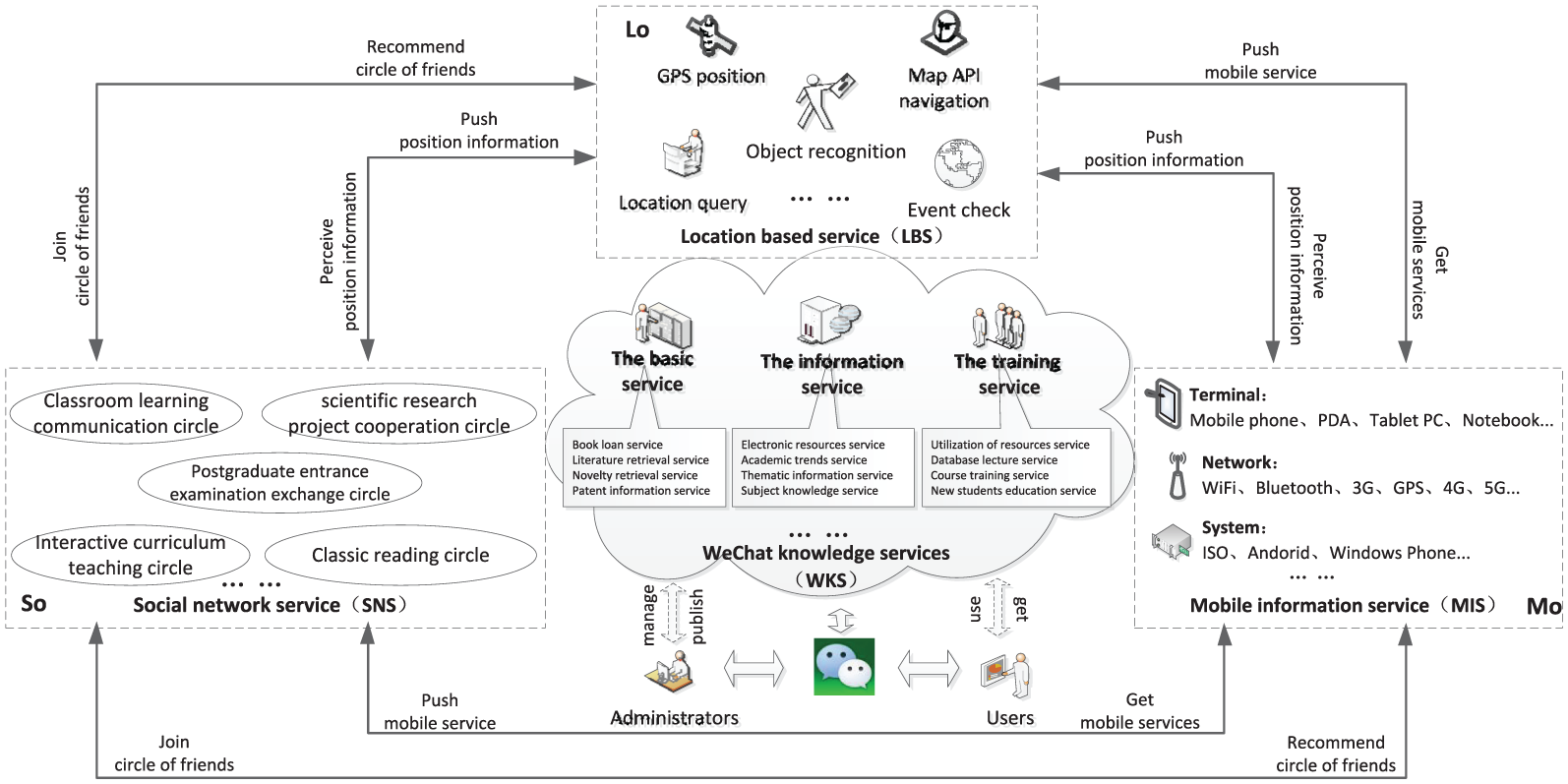
The system architecture design of WKSS based on SoLoMo.
The core service of the knowledge service system includes the basic service, the information service and the training service. The system takes WeChat as the carrier of knowledge service and combines new and special service functions, such as SNS, LBS and MIS. At the same time, the system provides users with integrated knowledge service, which is personalised, social, perceptive and mobile.
3.1.1. SNS
The SNS aims at the personalised interaction requirements for different users, using WeChat’s ‘friends circle’ function, and implements the interaction between users as well as users and libraries. For one thing, the library as the provider and leader of WeChat knowledge service develops and recommends users to participate in various and socially related knowledge services, such as classroom learning exchange, research project cooperation, interactive curriculum learning, classic book reading, entrance examination and postgraduate exchange. For another, the readers as the recipients and participants of WeChat knowledge service can find an army of friends of common interests to study, to discuss and to share knowledge each other, by SNS, and they can give the feedback to librarians to promote the development of libraries too [20].
3.1.2. LBS
The LBS aims at the stereoscopic information of different users, including one to determine the location information of users according to the user equipment, and the other to provide relevant knowledge service according to the location information. It makes use of the location and function of geographic information to realise the precise docking between virtual service and the real world, and enhances the user’s knowledge experience [15], such as GPS, API navigation, object identification, location query and event check. For example, (1) users can get the library’s new book resources, Internet service, lecture announcement information and so on, by positioning technology; (2) users can interact with strangers and get many new friends with the same interests, using WeChat ‘circle of friends’; (3) the library can recommend convenient service lines, convenient for users to handle the relevant business procedures. The application of LBS can not only realise personalised information service based on location information, but also greatly improve the efficiency and quality of knowledge service.
3.1.3. MIS
The MIS faces diversity of mobile terminals for different users and realises the innovation and reconstruction of library knowledge service process [17], using WeChat’s mobile information technology such as cross-mobile terminal, cross-wireless network and cross-operating platform. The portability of the mobile terminal makes the knowledge service of the library easily embedded into the daily learning life of the users and realises the fragmented service of library knowledge. The ubiquity of the wireless network makes the knowledge service of the library easy to push to the user’s front and realises the ubiquitous service of library knowledge. The compatibility of the operation platform makes the knowledge service of library rapidly emerge on the equipment of massive users, and realises the widespread and fast diffusion of library knowledge [21].
The SNS, LBS and MIS of the system architecture design of WKSS based on SoLoMo are relevant to each other, by perceiving location information, pushing position information, pushing mobile service, obtaining mobile service, recommending friends circle and joining friends circle.
3.2. The content design
In this study, the content design refers to the relevant content of the previous library knowledge service, and it draws on the development of the WeChat service in ‘985’ university libraries in China. The core content of the WKSS based on SoLoMo consists of three parts of knowledge service content, such as the basic service, the information service and the training service. Among them, the basic service mainly refers to the routine service of the library. The information service mainly refers to the service of information resources on the Internet. The training service mainly refers to the education and training of the teachers and students in the library. Table 3 shows the content design of WKSS based on SoLoMo.
The content design of WKSS based on SoLoMo.
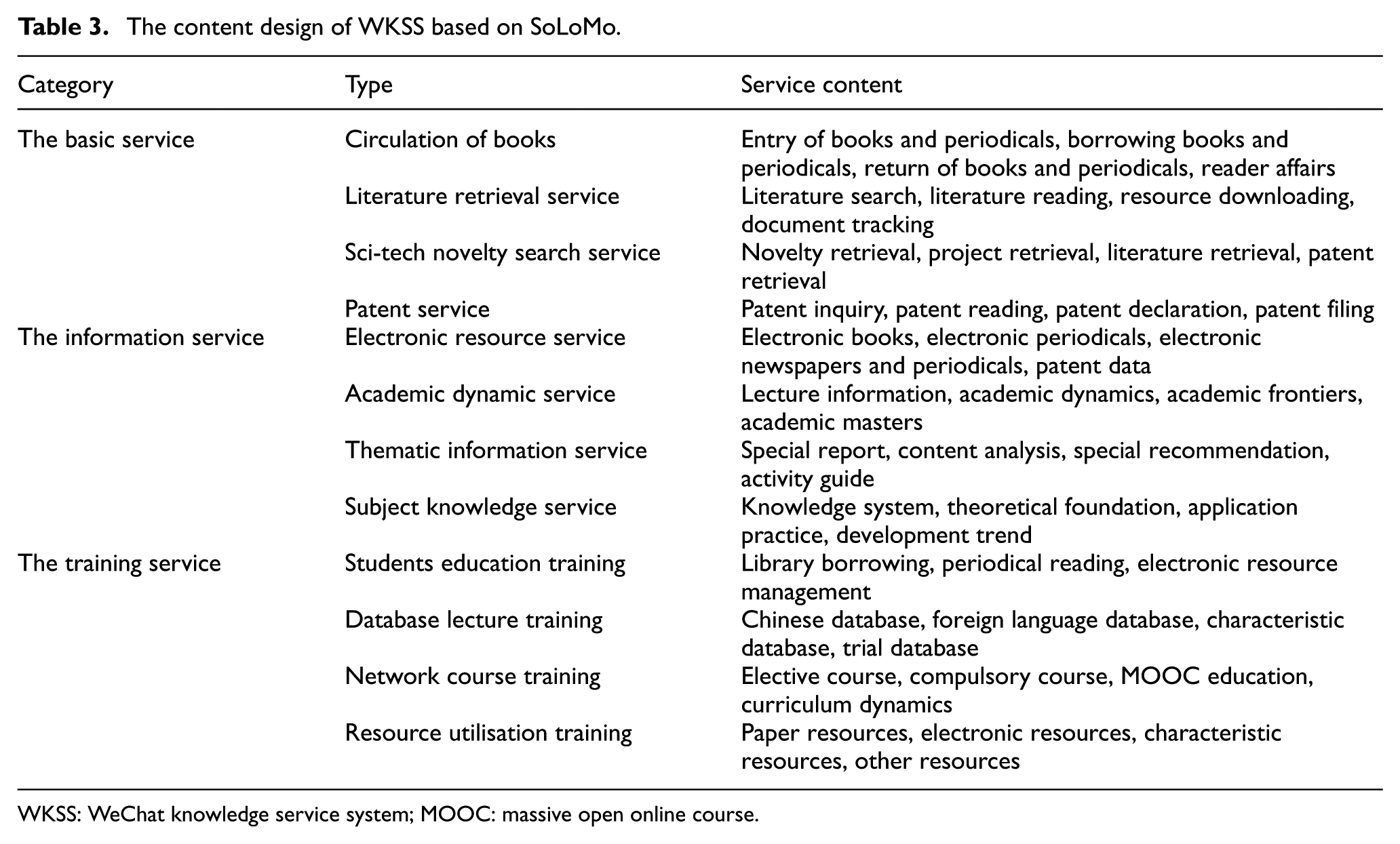
WKSS: WeChat knowledge service system; MOOC: massive open online course.
3.3. The data association design
Data association is an association, correlation or causal structure of the relevant data in the study objects [22]. It is a method of analysing structured data. Through the analysis of the data connection, it can make better use of data. It is not only the consequence of mutual connection between data, but also the interaction pattern and law of describing some internal attributes of affairs. Data association plays a significant role in knowledge representation, knowledge organisation and knowledge reasoning in the system process. The analysis of the data association process can help us better understand, analyse and deal with the problems encountered in the process of WeChat knowledge service.
In this study, the data association of the WKSS based on SoLoMo makes us clearly understand the data association process and related links among university libraries, users, service places and so on. It realises the interaction of perceived information (such as perceived location information, perceived mobile data, perceived user’s preferences) and data information (such as bibliographic data, resource data, user data), and provides the key basis and support for the development and implementation of the system. These are also different from the previous knowledge service of university libraries, as well as the innovation of knowledge service.
Figure 3 shows the data association design of WKSS based on SoLoMo, which accord with the related research [15,17], and combined with the software design thought of SoLoMo and the characteristics of WeChat knowledge service.
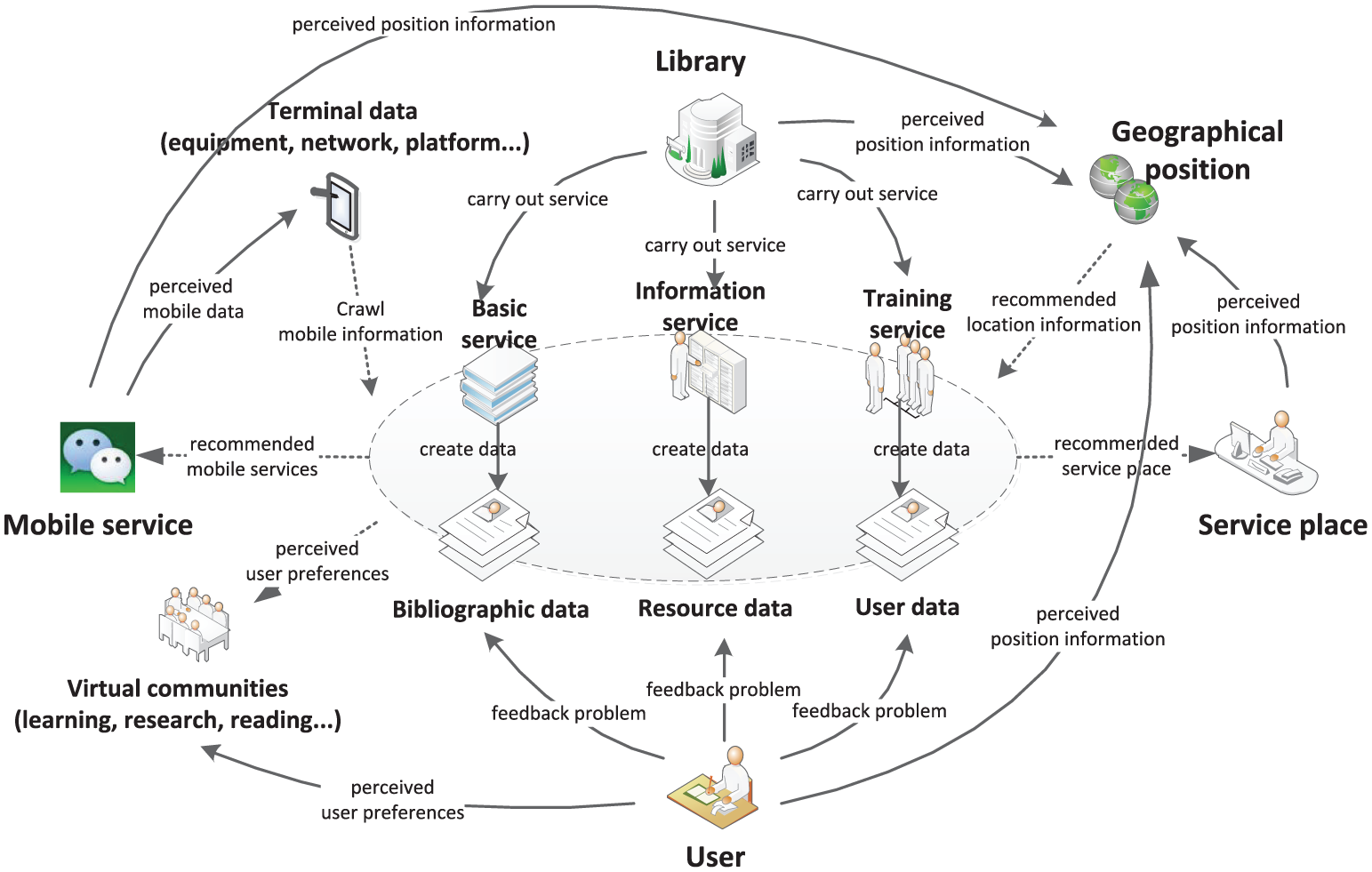
The data association design of WKSS based on SoLoMo.
From Figure 3, a clearer introduction and description of the operation process is as follows. First, the perceived location information in the system mainly comes from the library, the service place, the user or the mobile service terminal. Using location technology and location navigation technology, users can obtain location information recommendation service provided by the WKSS, such as book borrowing routes, book location navigation, business processing websites and the surrounding location information. Second, the personalised user data of knowledge service includes not only feedback data reflecting the users’ interest preferences, but also the data generated by the core service of the library. Finally, through the interaction of users’ interests and library service data, the system connects users, libraries, virtual communities and mobile service to realise knowledge exchange and sharing.
In a word, these data attributes of ‘mobile service terminal’, ‘virtual communities’ and ‘geographical position’ constitute the relation of each data. It makes libraries, users, mobile service and service place entities linked together. This ingenious and novel nature of the data association design makes it possible to build the WKSS based on SoLoMo.
4. Development of WKSS based on SoLoMo
In this study, the researchers have tried to develop a new WeChat knowledge service APP. And the design of the APP is novelty and feasibility, as well as the architecture and the implementation of it. At the same time, the researchers have integrated the thought of SoLoMo into the system and developed part of the core functionality module. The development of WKSS based on SoLoMo involves four parts: the running environment configuration, the development of the operation process, the development of the core module, and the system implementation effect.
4.1. Running environment configuration
Figure 4 presents the running environment configuration of the WKSS proposed in this study. The running environment provides the knowledge service via mobile devices. Usually, it includes the WeChat development model, hardware integration environment and software development environment. The following information describes the detailed content of the running environment configuration of the WKSS:
In general, the advanced functions of the WeChat development model for knowledge service include two modes: edit mode and development mode. The two modes have their own applicable scenes and cannot be used simultaneously. (1) Edit mode mainly has automatic reply and custom menu function. (2) Development mode is the mode for the development with the ability of operators.
Hardware integration environment includes the following: (1) The server for public accounts requires opening the public network IP address and must open 80 ports (site for record). Its main function is storage of information, running scripts and providing knowledge service. (2) The server for WeChat (or web server) is responsible for WeChat’s management side functions. (3) App Engine is a network application development platform provided by Internet technology service providers, in order to save the developer’s manpower, time and cost. It has two ways of free and charging.
Software development environment includes the following: (1) Integrated development environment (IDE; such as Eclipse, Intellij and Visual Studio). The IDE will usually integrate automatic keyword tips, code completion, debugging and code highlighting function, which improves the development of code efficiency. (2) Code browsing editor (such as Notepad++, EditPlus, Sublime and Text). As an important supplement to IDE, it is a common text editing tool, which makes the writing of code more flexible and lightweight. (3) Developing language environment (such as PHP, Java, .NET, Go, ASP, JSP, PHP, HTML5 and jQuery). Developers can choose the familiar development language according to their own habits and accomplish the deep development of the functions of WeChat knowledge service. (4) Data transmission environment (such as HTTP, GET, POST, XML and JSON). It can realise data encapsulation, data transmission, information transmission and information acquirement between users and WeChat knowledge service. (5) Data storage environment (such as MySQL, SQL Server and Oracle-). It realises the organisation, storage and management of large amounts of data and important data, so as to facilitate the query, statistics and analysis in the later stage.
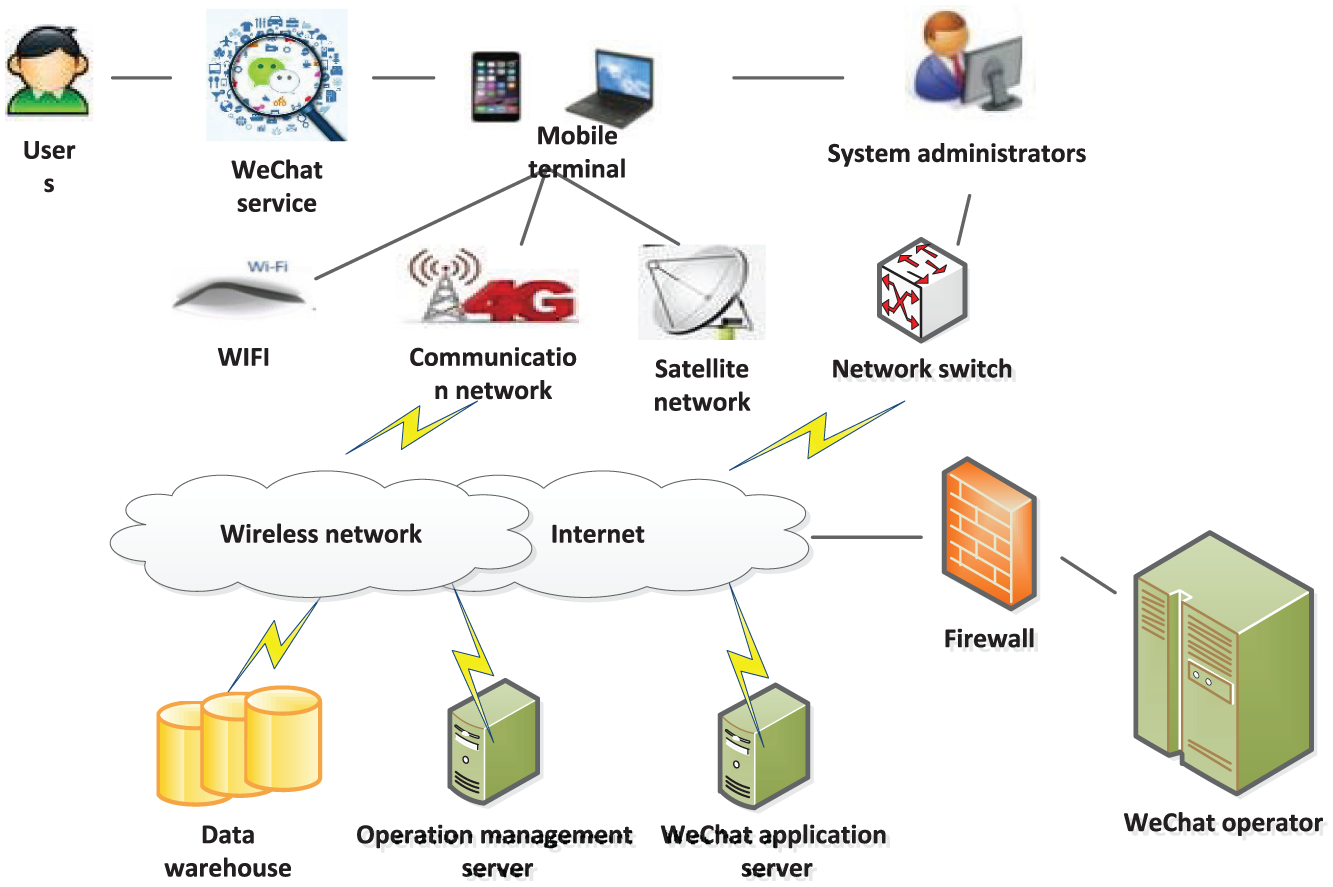
The running environment configuration of WKSS based on SoLoMo.
In this study, the specific running environment of WKSS is configured as follows: (1) The WeChat development model is ‘Development model’. (2) Two Lenovo computers are used as public accounts servers and WeChat servers. (3) The operating system is Windows 7, the IDE is Eclipse, code browser is written as Sublime Text, the development languages are PHP and Java, and the database is MySQL.
This study uses WeChat public platform, SoLoMo theory and the method of software design, by the function module on the basis of the existing knowledge service system. It realises the socialisation, perception and mobility of the comprehensive knowledge service of university library.
4.2. The development of workflow
Figure 5 presents the workflow of WKSS based on SoLoMo in this study. The workflow is to describe each component (programme, file, database, table, artificial process, etc.) within a system by graphic symbols, which describes the flow of information between components. It helps us thoroughly understand the system business process and is an important basis for a system analyst to do further analysis.
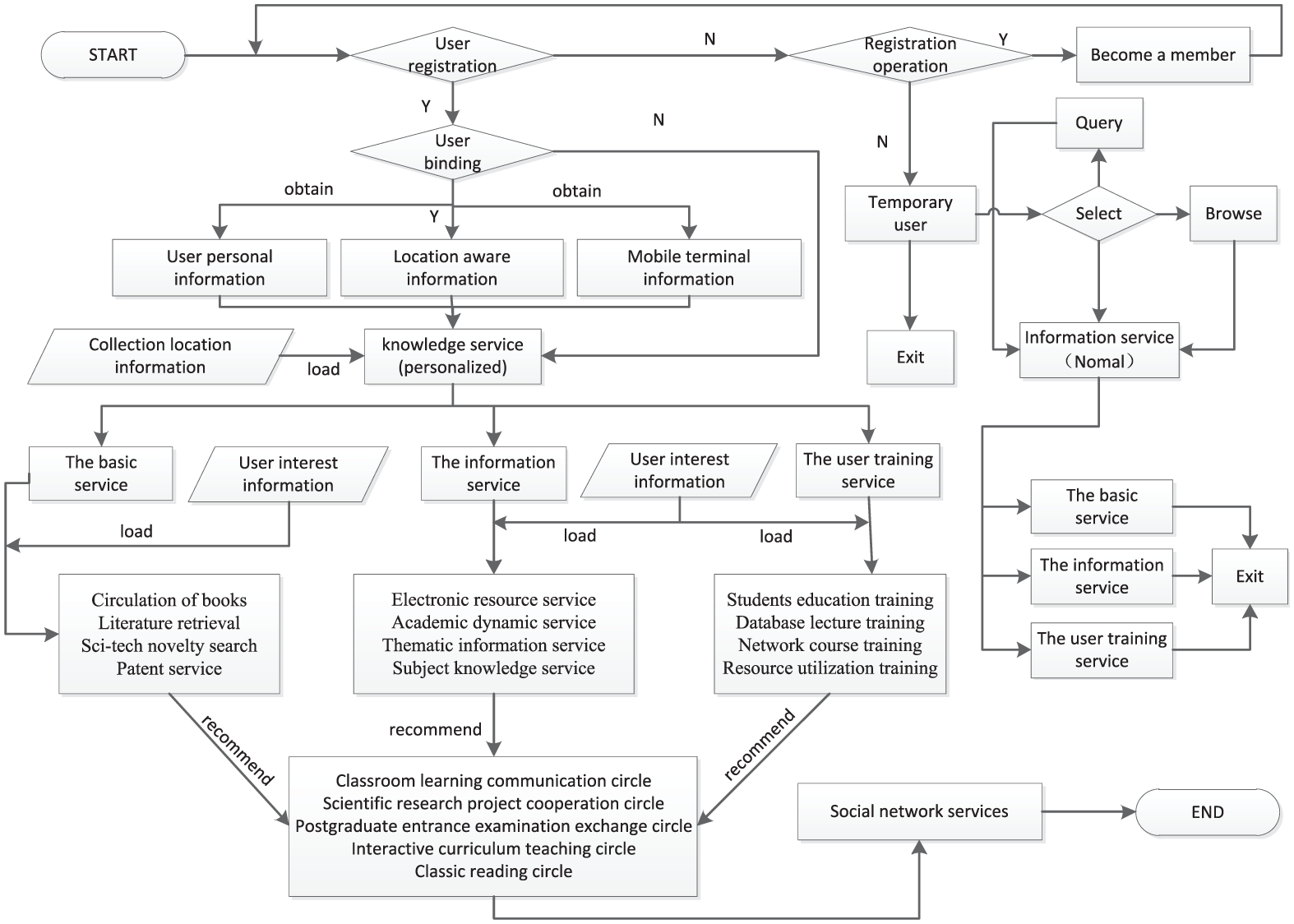
The workflow of WKSS based on SoLoMo.
In Figure 5, the operational process is as follows:
Step 1 – verify the user’s login identity. If the result of authentication is a registered user, the user can use all the personalised WeChat knowledge service functions in the system. Otherwise, when the result of authentication is a temporary user (non-registered user), the user can only use part of the service functions of the system, such as querying (browsing or viewing) the basic services of the system. At the same time, users can also become registered users by registration operation.
Step 2 – bind the user’s identity information. After confirming the identity of registered users, the system will prompt users whether they need to bind identity information. Once the user’s identity information is bound, the system will obtain key data such as user’s personal information, location awareness information and mobile terminal information. In addition, these data are correlated to prepare for subsequent loading of personalised knowledge services.
Step 3 – load knowledge service. According to the results of the related data such as identity, location and terminal in the second step of operation, the system carries out library knowledge service according to the specific service content selected by users. At the same time, it analyses and processes related data, such as user’s service acquisition preference, user’s geographic location and user’s mobile terminal status. Furthermore, on the basis of the above operations, the system recommends personalised knowledge services to users, such as SNS like learning and communication circle, scientific research cooperation circle, curriculum circle and so on.
In this study, the workflow of WKSS based on SoLoMo includes three contents:
Obtain user data information. Through the registration operation function, it obtains the basic information data of the users, such as the user’s personal information, location awareness information and mobile terminal information. Then this information is used as the basic data information of the user or the basic data of the user’s interest.
Determine the user’s behaviour. Through the judgement and selection of these corresponding operations, it provides users with personalised knowledge service content. For example, it determines whether the user is a registered user of the library, determines whether the user is willing to bind the individual’s relevant information, and determines the user’s specific operation options.
Load personalised service data. In the workflow of WeChat knowledge service, it uses user’s interest and operation behaviour to load service data and provides personalised WeChat knowledge service for users such as collection location information, user interest preferences and virtual social resources.
4.3. Development of the core module
4.3.1. Development interface
The development interface is an interface for users to acquire advanced functional experience, which helps university library developers to receive WeChat messages from their own servers and respond to them. The developer can use the development interface to access the WeChat public platform to develop knowledge service. There are three steps as follows: write the server configuration, verify the validity of the server address and implement business logic.
Step 1. Set up the URL for the message and event interfaces of the WeChat platform.
Step 2. The developer fills out the Token and generates the signature.
Step 3. Generates EncodingAESKey as the key for encryption and decryption.
In addition, message encryption and decryption will select a message type, according to the need of business. Once enabled, it takes effect immediately. It has three modes: plaintext mode, compatible mode and safe mode. Among them, the safe model is the recommended mode.
4.3.2. User management
User management is the indispensable core function of WeChat knowledge service, which realises the management functions of users. The system can obtain OpenID accounts with unique identification information. Through the account binding to achieve user information (including basic information, avatar, location, language and attention time), the user can achieve identity recognition. The user can obtain the pertinent knowledge service conveniently, promptly and accurately also. If the user does not need the function, it can also remove the function through the binding operation.
① The application code of user binding is applied as follows. …… $contentStr[] = array(“Title” ≥ “user binding”); “Description” ≥ “Click here to bind with the registered account in APP to view the information”; //Pass openID to the user binding page $openid = $_REQUEST[‘openid’]; //Verify openID, and Whether the user has bound the account number? $sql = “select name from basic_info where openid = ‘$openid’”; //Bind name and password to openID $sql = “update basic_info set openid = ‘$openid’ where name = ‘$name’ and userpassword = ‘$userpassword’”; …… ② The application code of user remove binding is applied as follows. …… $openid = $_REQUEST[‘openid’]; $sql = “update basic_info set openid = where openid = ‘$openid’”; $rs = mysql_query($sql, $conn); ……
4.3.3. Menu function
WeChat’s user-defined menu interface can complete the creation, query, deletion and navigation of each function module in WKSS. The menu is the button function. It has two forms: click event (click) and access to web pages (view). When the user clicks on the menu item, they can quickly access the appropriate content of the service. At present, the menu can be set up 3 ‘Root Menu’. Each of the following menus can be set up 5 ‘Sub Menu’. These 15 menus can meet the basic functional requirements of the majority of developers and users. Each ‘Root Menu’ can write up five Chinese characters at most, and each ‘Sub Menu’ can write up seven Chinese characters at most. Once exceeded, the excess part is replaced by ‘…’.
4.3.4. Geographic information perception
Geographic information perception is the innovation point of the system. On one hand, it can obtain the geographical position of users in real time. On the other hand, it can help the library understand the user’s habits and behaviour. The system senses and collects the data of geographic location information of users and then saves the data in the database. It realises the large data analysis of users, help predict the user’s learning and reading habits, provide LBS for users and provide the basis for the service strategy of the library.
There are two ways to obtain geographic location information: (1) single reporting – this approach is just reported one time at the beginning of WeChat’s use of knowledge service; (2) real-time reporting – after entering the dialogue, the approach is reported to the geographical location one time for a certain period of time (5 s). The geographic information data are pushed through the XML packet to the URL that the developer fills in. The XML packet consists of some important parameters: ToUserName (WeChat number), FromUserName (user OpenID), CreateTime (create time), MsgType (message type), Event (event type), Latitude (position latitude) and Longitude (position longitude).
When the WKSS acquires the user’s geographic information, the position map API can realise the coordinate conversion and transform the coordinates into the real location, which is convenient for visual application and data analysis. At present, a lot of position map APIs can be used, such as Baidu Geocoding API, Google Maps API and High moral map API. For example, the Baidu Geocoding API’s service address interface is: http://api.map.baidu.com/geocoder/v2/. It has many versions, such as Web service, static map and URI. It provides rich functions, such as basic map, location awareness, peripheral navigation, positioning service and reverse address location coding.
4.4. System implementation
Figure 6 shows the screenshot of the WKSS based on SoLoMo. In this case, the system’s first-level menu is set to ‘My Library’, ‘Cloud Reading’ and ‘Common Service’ as follows:
The ‘My Library’ module is mainly to realise the user binding and unbinding their information, to query books’ detailed information (version, collection, content, location, etc.) and to browse the library news bulletin. It provides personalised mobile knowledge service, such as user information perception and geographical location awareness. It includes ‘Bind Reader Card’, ‘Find Book’, ‘Borrow/Renew’, ‘News Bulletin’ and ‘Unbind Reader Card’.
The ‘Cloud Reading’ module is mainly to realise the recommendation of books and periodicals, the publication of public classes and the reading of electronic publications. It provides characteristic mobile knowledge service, such as social service recommendation and user preference recommendation. It includes ‘Good Book Recommendation’, ‘Open Class’, ‘Hot Book’, ‘Subscription Center’ and ‘Reading Periodical’.
The ‘Common Service’ module is mainly to realise the downloading of APP client of mobile knowledge service, the connection mode, knowledge sharing and intelligent service. It includes ‘Client Download’, ‘Contact Us’, ‘Star of Imagination’ and ‘Yuntian Wisdom’.

The screenshot of the WKSS.
5. Conclusion
With the development of new information technology by the Internet, the ‘SoLoMo’ mode brings new opportunities for the development of knowledge service innovation in university libraries, such as MIS, SNS and LBS [23]. This study proposes and develops an intelligent WKSS in university library based on SoLoMo. This system cannot just realise the whole university library service, such as basic service, information service and training service. Moreover, it can obtain and perceive the user’s data information (including personal data, location data and mobile terminal data) and can judge and predict user’s operation behaviour (including search behaviour, reading behaviour and social behaviour). The system provides users with personalised knowledge service based on social networks, location awareness and mobile applications.
There are four main contributions of this research: (1) In this study, it integrates the most advanced SoLoMo theory with WeChat mobile application and innovatively proposes a new WeChat knowledge service framework for university libraries based on SoLoMo, in the field of knowledge service in university libraries. Moreover, it can effectively implement the functions of MIS, SNS and LBS. (2) According to the characteristics of the knowledge service of university library, the study tries to design a new mobile knowledge service system, including system architecture, the data association process, running environment configuration, system workflow and system function module. A practical mobile application APP has been developed, which has increased the library’s ability to provide users with intelligent, perceptive and personalised service, thus making up for the shortcomings of existing library service. (3) The design of this system is novel and feasible. It combines the advantages of SNS, LBS and MIS. It can realise almost all the service contents of existing libraries and provide users with more convenient, fast, efficient and stable knowledge services. (4)The system has certain universality, which can be successfully implemented and applied not only in our library, but also can be transferred and extended to other libraries or knowledge service institutions, thus effectively improving the knowledge service ability of university libraries.
In the future, we will further improve the functions of the WKSS, according to the actual application and feedback of the system. As a core component of future knowledge services, we will promote and use this system in university libraries. Moreover, we make the system better meet the user’s knowledge needs.
Footnotes
Author contributions
M.C. contributed to conceptualisation and methodology; W.Z. wrote the paper and prepared the original draft.
Declaration of conflicting interests
The author(s) declared no potential conflicts of interest with respect to the research, authorship and/or publication of this article.
Funding
The author(s) disclosed receipt of the following financial support for the research, authorship and/or publication of this article: This research was supported by the National Natural Science Foundation of China (#71672111 and #71804056), Humanities and Social Sciences Research Project of the Ministry of Education of China (#18YJC630250), Hubei Provincial Technical Innovation Project (soft science research) (# 2018ADC052), China Postdoctoral Science Foundation (#2018M642033), Special Research Topic on Theory and Practice of Innovation Education in Guilin University of Technology (GUT2018CY18) and the Key Research Institute of Philosophies and Social Sciences in Guangxi Universities and Colleges (16YB001).
