



Abstract
This study is aimed at describing and analyzing WeChat services at the libraries of the top 50 universities in China. It first describes the services offered by WeChat and then provides an analysis of the WeChat services through three pathways – menu service, real-time reference, and message sending – and provides suggestions for improvement, meaning that library services can be better and more conveniently accessed via WeChat. This paper may be helpful to librarians interested in WeChat as a library service tool.
Keywords
Introduction
About WeChat
WeChat is a mobile instant messaging software application launched by Tencent, Inc. in China at the beginning of 2011. It is used to quickly send text and photos and provides voice communication to many people. At the end of March 2012, only 433 days after WeChat’s release, there were 100 million WeChat users. In just 6 months, by September 17, 2012, there were 200 million users. In the second quarter of 2016, the monthly active users of WeChat numbered 806 million and spanned 200 countries, and there were over 8 million WeChat official accounts [1]. WeChat operates in more than 20 languages, such as English, French, Japanese, and Korean. Today, as a mobile social medium, it is part of everyday life in China.
Background
To use WeChat, an individual or group sets up an official account on WeChat’s public platform webpage [2]. An applicant can then communicate with various groups using text, pictures, voice, and video. A WeChat official account is able to not only send information but also bundle features of other websites, which supply more personalized services.
With respect to gender, age, and occupation, 63% of WeChat users are male, 74% are young (aged 20–30 years), and 64% are university students [3]. To serve these students, many university libraries have adopted WeChat official accounts. Generally, libraries publish notices on their websites regarding established services, features, tips, and methods for accessing the library (a QR code or ID). Libraries use their welcome pages to promote and facilitate better use of WeChat.
WeChat (Weixin) is a mobile service platform that is developed and customized by a library based on a WeChat official account, which realizes mobile service functions by connecting with a library management system, such as digital resource retrieval, OPAC, e-books, or a personal library. Chen suggested that WeChat is a new type of library service with library knowledge as the main content and WeChat adopted as the platform [4].
A WeChat official account opened through the interface offers the capabilities of interactivity between the WeChat official account and patrons, and numerous possibilities for developing various customized functions. This development of functions with WeChat is much easier than it is with the individual APP of each intelligent terminal and provides a new solution to build mobile library services.
The principles of a WeChat official account are shown in Fig. 1. A WeChat official account is regarded as the message repeater. WeChat users send requests to a WeChat official account through cell phones, tablets, and other intelligent terminals. The WeChat official account then assembles the message collected from user requests and submits this to the library’s server, which acquires the message and deals with the data according to its business logic. Next, it reacts to the WeChat official account, and finally, the WeChat official account delivers the data to the user.
Principles of the WeChat official account.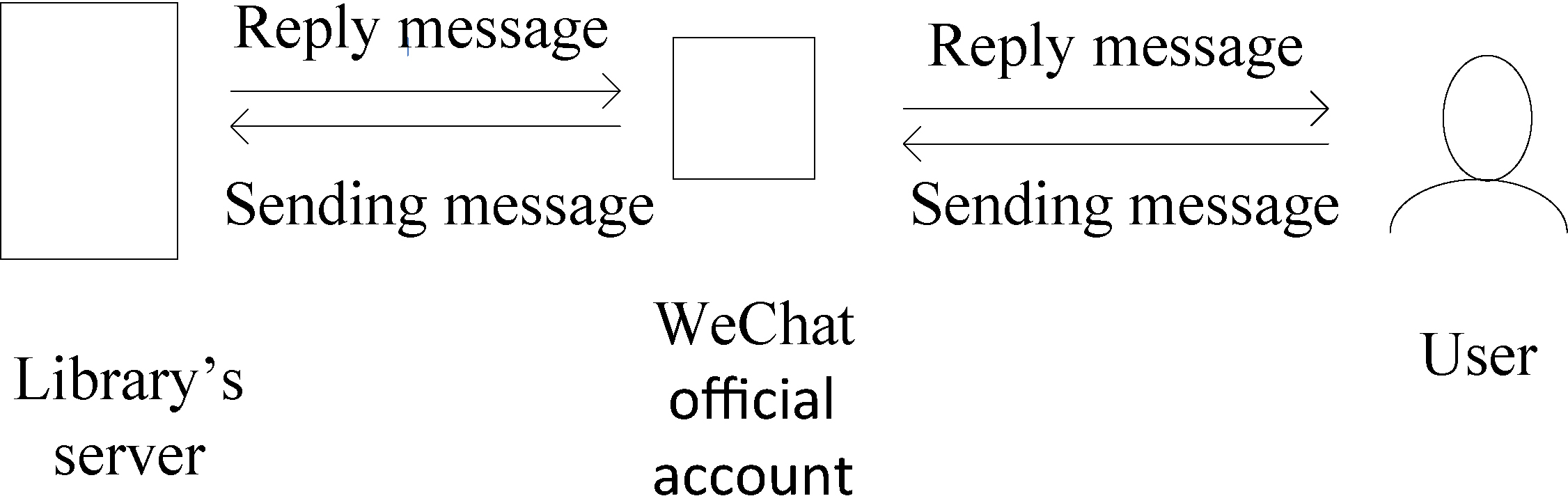
Mobile social media enables people to maintain and promote social connections with members of a social network. Essentially, mobile social media services provide an immediate online environment for information exchange among members of social networks. Social media are also easily accessible and immediately available as users always have a mobile device. This concept is derived from Counts and Fisher’s definition of mobile social networks [5]. Today, technological developments have led to the advancement of many social networking services, including WeChat, which is a social networking services platform.
Many studies indicate the benefits of social media in reference services and in promoting library resources and services [6, 7, 8], and some university library digital resources and services are fully utilized and developed through social media [9, 10]. Some scholars have noted challenges and obstacles in the process of using social media tools [11, 12], and other researchers have investigated the use of social media websites in libraries [13, 14, 15].
There are many well-known and similar instant messaging applications in many libraries in the world, including Twitter, Facebook, and others. Researchers have studied the use and effectiveness of such communication applications in school and library settings, as explained below.
Numerous studies describe the implementation of Twitter in the context of libraries. The West Palm Beach Public Library in Florida adopted Twitter as a free advertising tool for library updates, which also serves as a data provider and delivers links to library catalogs [16]. In a study, Bosque et al. explained that 101 academic libraries had a Twitter account and successfully communicated with patrons via Twitter [17]. French and Yeste confirmed Twitter’s considerable potential as a medium for disseminating knowledge and sharing information and documentation in a library [18]. Al-Daihani and AlAwadhi found that some academic libraries used Twitter as a multifaceted tool, and “News and announcements” was the type of information most often posted on Twitter by libraries, followed by “library collections” and “library services” [19].
Facebook is also widely used by libraries. Grgic found that Croatian school libraries only used the basic functions of Facebook during interactions of librarians and patrons [20]. Vassilakaki and Garoufallou considered that the creation of a librarian’s Facebook profile was the most important element, which was followed by group messages, wall posts, events, and friend lists [21]. Xia studied the effects of Facebook Groups on library marketing and found that success could come from the active organization of librarians and the use of more general topics [22]. Aharony analyzed the use of Facebook by the American public and academic libraries [23], and the results showed that both kinds of libraries use the information section and the wall, and all utilize Facebook as a way to deliver information to users, rather than as a venue for discussion.
Other tools
In addition, studies have investigated social media and library reference services. For example, a library of Peterson’s Four-Year Colleges in the U.S. used email, phone, chat, IM, text, and video chat to provide virtual reference services [24]. Many academic libraries in the U.S. and those in China use microblogs and social networks to deliver reference services [25]. Some Nigerian university libraries adopted Twitter, Facebook, and Ask-a-Librarian to support online reference services [26]. Overall, these papers show that instant messaging tools are helpful to library services. However, these studies do not deal with WeChat, which has many special functions for library services.
Social media in China
A few studies focus on popular social media networks in libraries across China, such as Renren (like Facebook), Sina microblog (like Twitter), and Tencent microblog [27, 28]. These social media networks are becoming increasingly popular among Chinese users and have been utilized in many universities and public libraries to promote their resources and services in China. Some scholars studied WeChat features and implementations at individual university libraries. Wei and Yang studied WeChat utilization in the Library of Chongqing University in China [29]. Zhu researched WeChat use in the Jinan Universities Library in China [30]. Chen et al. reported that an application of WeChat was used to encourage online readers to participate in library activities [31]. In addition, there are some articles regarding WeChat applications in a group of libraries. Zhou conducted a survey of WeChat application in 38 provincial public libraries in China [32]. Some articles explored the WeChat status of libraries of the top 39 universities in China and identified the main problems in terms of popularity, promotion methods, service forms, and content [33, 34, 35]. Most of these university libraries, however, were still using WeChat’s most basic functions.
The articles mentioned above regarding WeChat did not fully analyze the WeChat services of university libraries through multiple pathways. They did not carry out a detailed menu analysis or a theoretical assessment of WeChat services. Hence, in this study we investigate the WeChat services of university libraries in China in detail through three pathways that comprise menu service, real-time reference, and message sending.
Application of WeChat in the top 50 university libraries
Methodology
This paper investigates WeChat in the university libraries of the top 50 universities in the China University League Table [36]. The survey involves the official account opening, menu service, real-time reference, and message sending. Because it is reported that WeChat users account for more than 90% of Chinese smartphones [37], only mobile phone access was surveyed. To discover the WeChat official accounts of the top 50 university libraries, we logged on to a mobile client account, clicked the “official account” button, used “university name
At the same time, we conducted telephone surveys with 48 university libraries, which had opened WeChat accounts. The topic was whether the library provides real-time human replies on WeChat. Furthermore, we conducted interviews in five universities that belong to the Top 50 universities: Nanjing University, Southeast University, Nanjing University of Aeronautics and Astronautics, Nanjing Agricultural University, and Nanjing University of Science and Technology. We visited 20 readers in every university library to investigate how the library performs reference services on WeChat. The surveys and the interviews were conducted to provide us with a more in-depth and richer data set.
Results
Most of the data of this study come from information published by WeChat official accounts of the top 50 university libraries, and the data are summarized below.
Existence of WeChat official accounts at the top 50 university libraries
Table 1 shows that of the top 50 universities in China, 48 university libraries have opened WeChat official accounts; only two university libraries have not done so. Three libraries do not have their own separate WeChat accounts; however, the library names are listed on the menus of university WeChat accounts. Despite having opened a WeChat account, three other libraries do not utilize the services other than for sending a few messages.
WeChat accounts at top 50 university libraries
WeChat accounts at top 50 university libraries
We further verified the status of WeChat official accounts. “Verification” means that the official account was authenticated by Tencent, Inc. in China at the beginning of 2011. Tencent is a leading provider of Internet value-added services in China, and its products include QQ, WeChat, and Qzone [39]. The results show that 46 libraries have verified official accounts; only two libraries have not performed WeChat verification. Furthermore, 36 libraries have put their WeChat icons on the main pages of their respective sites. The remaining 12 libraries do not seem to promote WeChat sufficiently.
We studied the first message of these WeChat accounts. A first message is the custom message and the equivalent first push information – a “welcome message” or “automatic greeting” – that WeChat sends when a new user follows the library’s official account. The first one-to-many message also includes information on the platform’s capabilities, such as greetings, functions, contact information, and navigation services. In the sample, 45 libraries’ WeChat had sent a first message. Of these, 38 messages were judged to be effective because they had a functioning introduction or other concrete content. In total, the start-up condition of the WeChat official accounts of these university libraries is good, meaning that most of the libraries fully used the first message to promote themselves, but the other seven libraries may need to modify their services.
Profile of the WeChat official account.
Statistics of WeChat menus of top 50 university libraries
Statistics of WeChat menus of top 50 university libraries
Note: 3-C: communication, collaboration and creativity.
Profile of UI mobile library.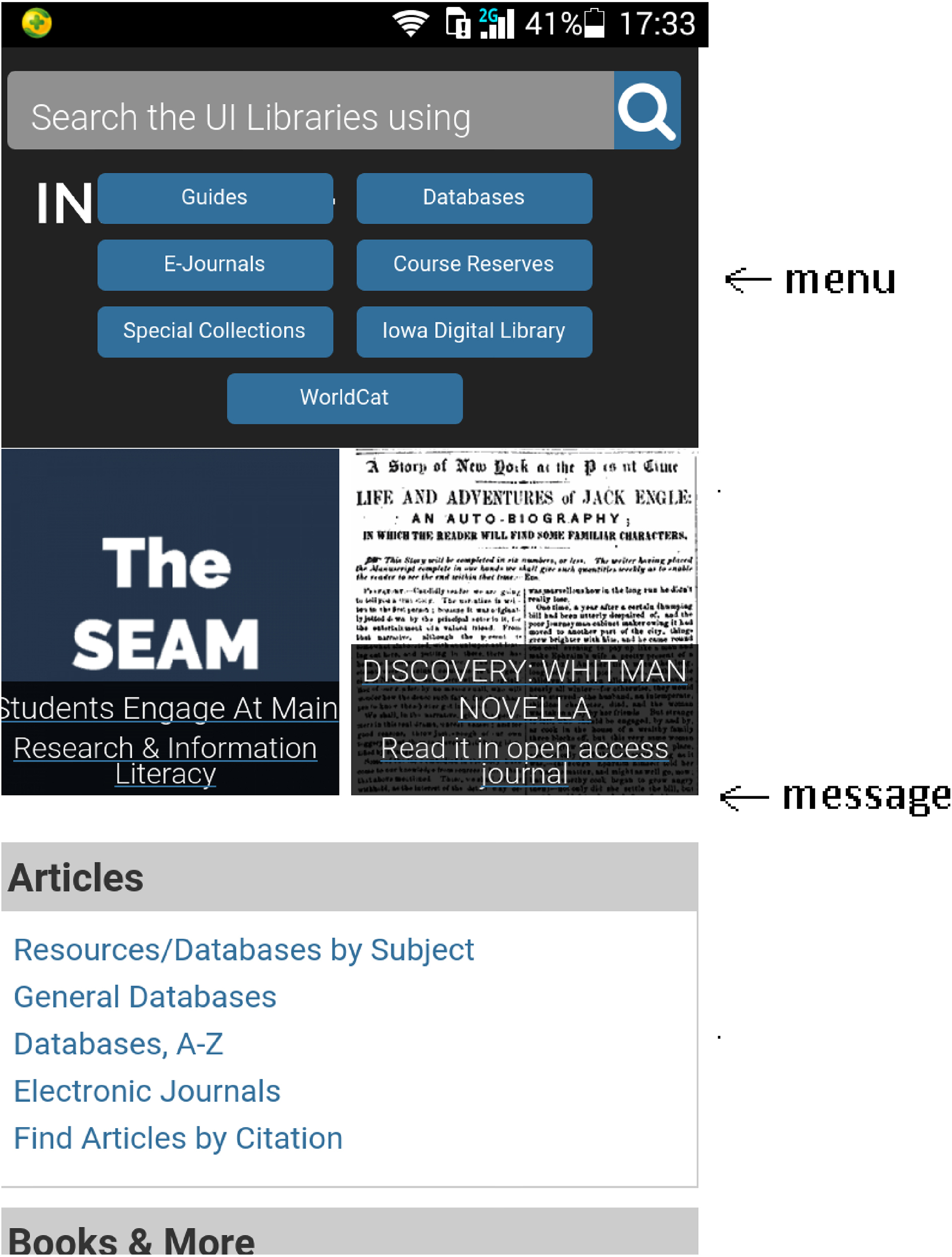
Figure 2 shows the profile of a WeChat official account. A WeChat official account has some special properties. Up to three menus can be built on the bottom bar; up to five submenus (pop-up menus) can be set up under each menu; and various messages can be located in the middle section of the page. In the right column of the profile, there is an introduction, including a menu, submenu, and message. To some degree, a library’s WeChat official account acts like a mobile library, or they are similar in function. Figure 3 is the profile of a UI mobile library, and in its right column, there is an introduction (menu and message). Most libraries have established menus on their WeChat official accounts and offer this menu service in China. This study examines all of the WeChat menus of the top 50 university libraries. Because these menus are named by the respective libraries, the menu names are diverse. Although some menus have similar names, they can represent different services, or the same services maybe given different names. For convenience, similar menu names were combined and counted. Owing to space limitations, a menu type was omitted if its total number (sum) was less than 5 and could not be combined. After all of the menu names were combined, we found that the menus can basically be classified into three major types, “resource”, “borrow service” and “message service”, as shown in Table 2. Under the first kind of menu, “resource”, four submenus can be named, including “collection retrieval”, “mobile library”, “academic finding”, and “E-book”. Under “borrow service”, five submenus can be classified. Five submenus can be built under the “message service” menu. Clearly, because most of these submenus can be reduced to a single-direction message supply, WeChat at most libraries offers this service. Details of the menus are described below.
a) Resource
The first kind of menu, “resource” is the main service content of a university library [40, 41]. In these libraries, WeChat has one or two submenus of this main menu. In the four submenus, the “collection retrieval” service is offered by 38 libraries (the highest number); “mobile library” is offered by 22 libraries; and “academic finding” is offered by 15 libraries (30%). The operation of these menus is straight forward. When a submenu is selected, natural language retrieval can be used. The first 10 items of the retrieval results are listed on WeChat; if needed, the other items of the results can be listed. It may be feasible to transfer the collection resources of a library into the “resource” menu of WeChat.
b) Borrow service
The second kind of menu, “borrow service” is a basic function of every library. “Renewal” and “good book”, two submenus supplied by 37 and 31 libraries, respectively, are considered to be important. “Micro-reading” and “purchase suggestion”, two other submenus, appear in 17 and 12 libraries, respectively. Moreover, 25 libraries (50%) set a “binding” submenu. This means that half of these university libraries require a reader to bind their borrow account with WeChat. A reader can retrieve documents, renew books, join reward activities, etc. only if her/his account is bound.
c) Message service
“Message service,” the third kind of menu, is also a necessary WeChat service. Here, 37 libraries think that “notice” which comprises activity announcements, news, etc., is important and offer this service. Further, 24 libraries’ WeChat services provide the “FAQ” submenu, which includes answers to common questions, borrowing regulations, and an introduction to the library. Further, “seat reservation” and “lecture”, two other services, are provided by 17 and 16 libraries, respectively. It is worth mentioning that only six (12%) libraries’ WeChat services supplied the “reference” menu service, which means that this service is a weak link in the WeChat services of university libraries, and that these libraries did not promote WeChat’s reference function adequately; hence, users did not know about this function of WeChat, nor did some librarians. In comparison, Gan and Zheng divided the menu services into seven kinds (or seven submenus) [42]. However, we felt that Gan and Zheng’s method may be not be sufficiently robust, and therefore, our menu has 12 submenus.
Condition of real-time reference
Human replies to WeChat queries
Generally, real-time reference includes preset replies and human replies in the WeChat application. A “preset reply” consists of help content that is set up beforehand and tied to numbers or keywords, such as 1) self-help printing and 2) lecture times, and forms a preset database. When a reader has a question, they send a keyword or number to receive an answer. The contents of a preset reply often comprise some basic questions. For example, the content of the preset database in the WeChat services of the Xidian University library is a collection of some common questions [42].
To investigate real-time reference in 48 libraries, a word group, was sent to every WeChat account of these libraries through the message edition bar at the bottom of WeChat official account pages. The authors collected and counted the responses as illustrated in Table 3. The WeChat services of 22 libraries gave feedback with preset replies, of which 15 responses were effective, consisting of concrete content. However, 17 other libraries did not give any response to the word group, demonstrating that these libraries had not paid enough attention to the real-time information of WeChat users, or WeChat is too new to be known by some librarians.
The WeChat services of 11 university libraries supplied a human reply to the word group. The status of the human reply was studied in detail as shown in Table 4. The response time varied: the fastest reply, by Xiaman University’s library, was recorded at 2 minutes. Four other libraries gave feedback in 8 minutes. The slowest time was recorded at 21.5 hours. The six other libraries sent feedbacks between 2 and 21 hours. The average response time of the 11 libraries was about 4.6 hours. In short, the response time was relatively slow as against students’ expectations of a WeChat service. The feedback style of the 11 libraries was through text or links.
Statistics on WeChat messages of the top 50 university libraries
All of the WeChat messages sent by the top 50 university libraries were combined and classified into nine categories. The statistics are shown in Table 5. We see that 44 libraries sent “library news” and 42 libraries sent “activity” messages. “Resource recommendation” and “service introduction”, the next two kinds of messages, were offered by 38 and 35 libraries, respectively. In addition, four messages involving “investigation”, “lecture lesson” and so on were sent by about 30% of the libraries. For comparison, Gan’s [43] investigation results regarding WeChat messages sent by 38 provincial public libraries show: libraries that sent “activity” and “library news” messages had the highest numbers; libraries that sent “service introduction” and “resource recommendation” messages were next, meaning that the two statistical results were similar concerning the top four kinds of message contents.
Statistics on WeChat messages of top 50 university libraries
Statistics on WeChat messages of top 50 university libraries
During the research, we found that libraries actively used WeChat in various ways. For example, during Reading Month in 2016, the Nanjing Agricultural University Library publicized the activity “Scan a QR code, obtain points” to attract student membership. If students bound themselves to WeChat, they could get points and even exchange them for a prize. This could prove to be an effective method of publicizing WeChat. Similarly, Nankai University conducted the activity “follow WeChat and reply, win a prize”. A short reply could earn the first 50 students a prize. This not only attracted students but also collected their feedback on WeChat.
Discussion
We found that 48 university libraries have opened WeChat official accounts and offer various services via three pathways: menu service, real-time reference, and message sending. However, the locations of these service contents are not always accurate. For example, although there is a “mobile library” submenu on one of the university Library WeChats, “mobile library” is still present in the preset reply.
Most of these university libraries have set up menu services, and the contents are distributed among “resource”, “borrow service” and “message service”. However, most of the WeChat services of these libraries still denote single-direction information supply.
We see that 22 (44%) libraries’ WeChat services provide preset replies. A preset reply meets readers’ need for real-time reference. When a patron has a question, they can use self-help to obtain an answer. Hence, it is more appropriate for help information, operating guides, and common questions to be provided through preset replies. In contrast, 11 (22%) university libraries give real-time human replies on WeChat; however, the average reply speed is slower. Why did only 22% of university libraries give real-time human replies on WeChat? After conducting interviews and telephone surveys, the authors uncovered the reasons. One reason is that many users do not know about the opportunity because the library does not publicize it well. Another reason is that some libraries still have not adopted this reference type.
The contents of messages sent by the libraries’ WeChat services mainly pertain to “library news”, “activity”, and so on. Moreover, only a few of the libraries conduct service development activities such as “knowledge popularization” and “investigation” that allow the contents of the messages to be rich and diverse.
Suggestions for improvement
We should promote the development of the WeChat reference service on the basis of Katz’s theory of digital reference service [44]. In the book, experts in the field explored the opportunities that real-time digital reference services can offer in a variety of library settings, and conveyed numerous opinions and theories about the growth of this new approach to answering reference questions. Furthermore, the results of this study and the summary of the related literature lead to some suggestions for university libraries to improve WeChat services. For example, 1) Chen et al. considered that WeChat should be used to encourage online readers to participate in library activities [31]; Zhou suggested that interaction between library’s WeChat and patrons should be emphasized [32]; and this study we found that some university libraries did not provide real-time human replies, and the content of the pre-set replies was not rich. Therefore, we should enhance communication with patrons. 2) Ma et al. pointed out that messages sent by many libraries were simple [34]. So, we should optimize the content of WeChat messages. 3) Gan proposed that only few libraries provided reference services using the menu [43]; and this study found that the menu names in many universities’ WeChats are inconsistent. Hence, development of the WeChat menu should be emphasized, as described below.
Emphasizing development of the WeChat menu
Important service items should be listed on the menu of a library’s WeChat to effectively reduce user time cost and help different users to explain their needs. How- ever, we found that WeChat menu services in the libraries under study lacked two-ways interaction between librarians and patrons. A university library should first sufficiently study user needs from the users’ perspective and then formulate a WeChat menu of essential content (including two-way interaction). In addition, the menu contents should be methodically and systematically classified for patron convenience.
Enhancing communication with patrons
WeChat offers real-time information communication in the one-to-many model by using a preset reply. This is a great benefit, and university libraries should better develop the preset reply. Moreover, to implement RUSA’s standards for virtual reference services, training should be conducted for reference librarians so that they understand the five basic components of providing reference services: approachability, interest, listening/inquiring, searching, and follow-up [45]. In addition, a university library can employ a person or team to manage WeChat and reply quickly to questions that cannot be automatically distinguished by WeChat software.
Optimizing the content of WeChat messages
The content of WeChat messages should be constructed such that it attracts more patrons. A valuable message can lead to patrons continuing to follow the page on which the message is displayed. Conversely, messages without value can lead to readers being unhappy or even discontinuing their following of the page. Therefore, libraries should analyze user feedback on WeChat messages at fixed intervals and adjust message content overtime.
Conclusion
This study draws an overall picture of the WeChat application in Chinese university libraries. The results of the study will deepen our understanding of how libraries currently use the new technologies to improve their services and strengthen their social media presence. Additionally, the findings will demonstrate how the application of freely accessible tools can be applied to untapped library services areas.
Footnotes
Acknowledgments
Social science funds of Jiangsu Province in China, 17SYC-117; Fundamental Research Funds for the Chinese Central Universities, KGL2017014, SKYZ2017018; CALIS agriculture literature funds, # 2017027; Funds of Library Society of Jiangsu province in China, 17YB07.