




Abstract
In recent years, several scientometrics and bibliometrics indicators were proposed to evaluate the scientific impact of individuals, institutions, colleges, universities and research teams. The h-index gives a breakthrough in the research community for assessing the scientific impact of an individual. It got a lot of attention due to its simplicity, and several other indicators were proposed to extend the properties of the h-index and to overcome its shortcomings. In this literature review, we have discussed the advantages and limitations of almost all scientometrics and bibliometrics indicators, which have been categorised into seven categories based on their properties: (1) complement of h-index, (2) based on total number of authors, (3) based on publication age, (4) combination of two indices, (5) based on excess citation count, (6) based on total publication count and (7) based on other variants. The primary objective of this article is to study all those indicators which have been proposed to evaluate the scientific impact of an individual researcher or a group of researchers.
1. Introduction
During the last few decades, it seems that the evaluation of the scientific impact of a scholar or a group of scholars was a significant assignment. In many cases, it is compulsory to know the scientific impact of a scholar, for example, at the time of hiring a new faculty member, promotion of faculty members and continuation of research grants. To do this, several citation and network-based metrics have been proposed by the scholars. In some cases, like the continuation of the research grant, the peer review process has been used [1,2]. One of the successful indicators, defined by Hirsch [3] named the h-index, was a major breakthrough in the scientific community for assessing the scientific impact of scholars and gained a lot of attention due to its simplicity. The h-index covers the productivity and the impact of scholars and is better than the total number of publications and mean number of citation counts [4,5]. However, the h-index does not consider the impact of excess citation count and leaves a huge amount of citation count unaccounted. It also fails in comparing the scientific impact of scholars that have similar index value. Based on the limitations of the h-index, several other indicators were proposed to overcome the shortcomings of the h-index and enhance the scientific evaluation process with more variability. The h-index shows the popularity of a scholar, but it does not mean that the scholar is more prestigious. This is because the h-index does not exclude the self-citation count and does not differentiate the source of the citation. The citation counts from different type of articles, such as patents, journal articles (reputed or non-reputed), conference proceedings and book chapters, are treated equally. However, the citation sources and the citation count have an impact on the quality of citation, which is generally not considered [6].
Nowadays, the increase in collaborations between scholars affects scientific productivity and the impact of research publications. In this case, if we consider the h-index as an assessment tool, then every scholar in multi-authored articles gets full credit of its citation count. However, the contributions of all scholars are not equal, so we cannot distribute citation equally to all scholars. In this context, several indices were designed to give credit to all scholars and evaluate the scientific impact of scholars based on their credit. Cole and Cole [7] consider only the first author; Price [8] gives equal fractional credit to all scholars, that is, 1/k, where k is the total number of scholars. Susan et al. [9], Sekercioglu [10] and Hagen [11] give credit to all scholars as per their proportional rank. Van Hooydonk [12] and Trueba and Guerrero [13] used the arithmetic counting for credit allocation, Egghe et al. [14] used the geometric series for credit allocation and several other methods are used to distribute shared credit among all scholars. Most of the indices used mathematical equation to share the credit among scholars, but we cannot express the contribution of scholars in the form, such as mathematical expression.
In scientific assessment of scholars, the h-index considers only a few highly cited articles. However, the articles having at least one citation count have significance in scientific assessment of scholars. In this context, García-Pérez [15] designed a multidimensional h-index that covers all cited articles. Several other indices use different mechanisms to consider the impact of all cited articles in scientific assessment of scholars. Apart from the total publications, the publication age also has significance in scientific assessment of scholars, but unfortunately, the h-index did not take this into account. As a result, two scholars who have different publication careers are not comparable.
It seems that any one indicator does not fulfil all the requirements of the process of scientific assessment of a scholar. Hence, a combination of two or more different types of indicators is required. The combination of the properties of two or more different measures is a good step to evaluate the scientific impact of individuals [16,17]. In this context, the hg-index [18],
The publication consistency is one of the main issues in scientific assessment process and most of the indices has not considered it. In some cases, it seems that some of the scholars have publications only during their doctoral research, post-doctoral research and when working on the research projects. However, others publish articles in a regular basis. This issue does not affect the h-index but has significance in scientific assessment. In this context, the career year h-indices were designed by Mahbuba and Rousseau [21]. Apart from these concepts, many other indices have been proposed by scholars who considered other parameters, such as core–tail ratio, what is the possibility of achieving next higher h-index value, a different citation process and many more. Furthermore, the consistency of the citation count has also been discussed and the hypes or fads of citation bubbles considered [22].
In the field of scientometrics/bibliometrics, several review articles have been published and tried to give a comparative summary of the proposed indices. First, Bornmann et al. [23] give a comparative analysis of the h-index with others nine variants and discuss the advantages and limitations of the h-index. In this article, the authors compared the h-index with m-quotient, g-index, h(2)-index, a-index, m-index, r-index, ar-index and
Comparison of the proposed survey with the existing surveys.
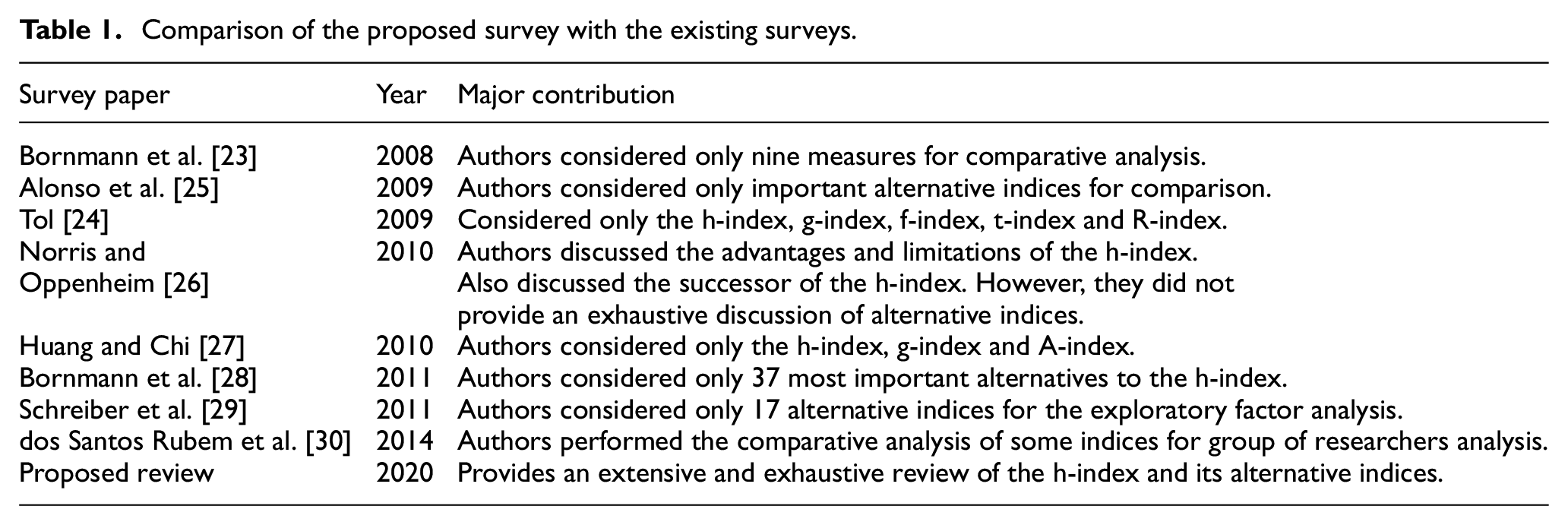
The proposed article provides an extensive literature review on h-index and its variants to focus on following points:
The definition of the h-index along with its advantages and limitations.
Literature review on the variants of the h-index, which are based on different parameters, such as total number of citation count, total publication age and total number of collaborators, normalized citation count based on number of co-authors, total number of citers (citing authors) and many more.
In this article, section ‘h-index’ presents the definition of the h-index along with its advantages and limitations. It further contains the definition of the variants of the h-index along with its advantages and limitations. The ‘Conclusion’ section concludes the review work and outlines the future scope.
2. h-index
To appraise the scientific impact of scholars, several publication-based indicators, such as the total number of publications, total citation count and the average number of citations per paper can be used. However, these indicators have limitations. For example, when considering the total number of publications, a scholar can publish a number of papers, but still have a low scientific attraction in the research community. When considering the total citation count, only a few articles with very high citation counts can hide the very low citation count values of the vast majority of the published articles. When considering the average number of citations per paper, it does not capture the importance of the high impact articles. Based on the limitations of these indicators, Hirsch [3] proposed a new indicator called h-index. Formally, the h-index is defined as follows: The h-index of a scholar is h if h of his/her research articles have at least h citation count each and rest of the articles may have h or less citation count.
The graphical representation of citation distribution of a scholar is shown in Figure 1.
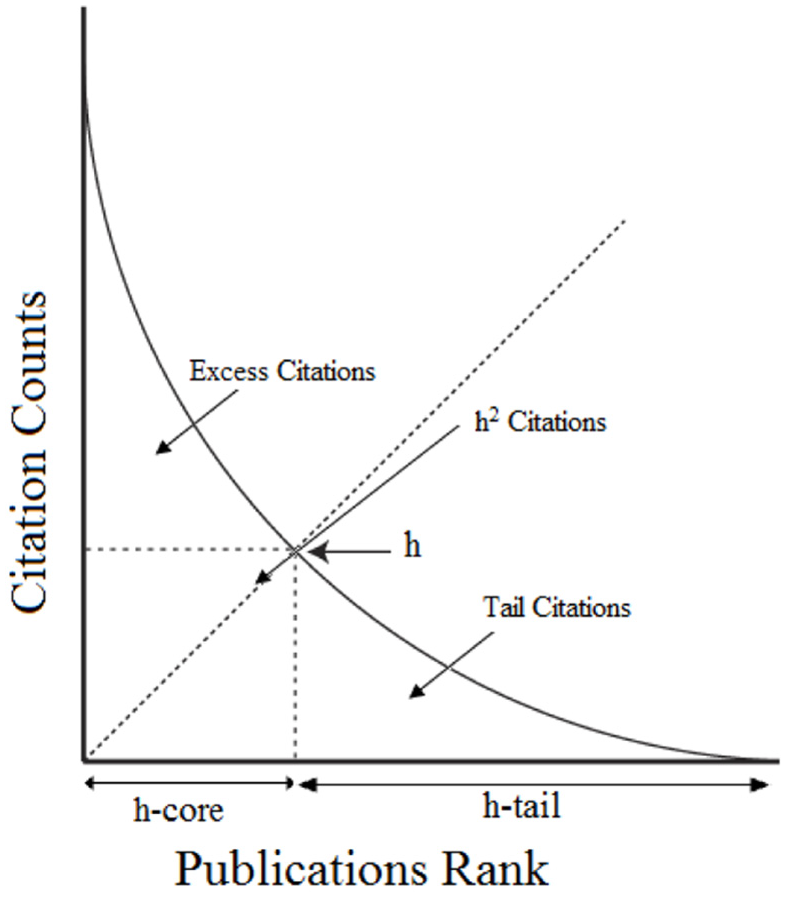
Citation distribution of scholars.
The graph-based definition of the h-index is that the h-index is the size of the largest square that fits under the curve (i.e.
For calculation of the h-index, first the publications are arranged in the descending order of their citation count. The publications are then assigned a rank based on their order in the sorted list. The h-index is the maximum rank of a publication where the citation count is equal to or greater than the rank of publication. This index almost covers all the productivity and impact of scholars.
In Figure 1, h represents the h-index,
2.1. Advantages and limitations
Every indicator has some advantages over the existing one and also has limitations. In this section, we are going to discuss some advantages and limitations that have been found during study of the h-index and its alternatives. The advantages of the h-index are the following:
It is very simple to compute [3] and does not require any data processing [34];
It produces a single number that combines both the quality and the quantity of the scholars’ publications [3];
It performs better than the total number of articles, total citation count, average citation count, citation per articles, number of highly cited articles, journal citation score and field citation score in scientific assessment of scholars [3,35];
It can be easily obtained from any publication indexing databases, such as Google Scholar, Web of Science, and so on [3,25,36];
It is closely related to the number of publications that have significant impact (citation count) on the research community [37];
A small error in the citation distribution does not result in a huge change in the index value [38,39];
A single highly cited article does not affect the index value [40]. Furthermore, small changes in the citation count of articles do not affect the index value much [36];
It can also be used for majoring the scientific impact of journals [41,42].
However, it suffers with some of shortcomings, which were addressed by Hirsch himself and other scholars:
The citation practice of articles is different in different fields, so it does not make sense to compare the scientific impact of scholars of different fields [3,43,37,44,45,46];
It is also not suitable in comparing the scientific impact of scholars who have different research careers [47];
Once an article is selected for h-core, further citation will not be important in scientific assessment [48,49];
It is very difficult to collect complete citation information of scholars;
It also considers the self-citation count in h-index computation [35];
It produces a single natural number that affects the discriminative power of h-index [50,51] when comparing two scholars with the same h-index value;
The index value never decreases [52];
Generally, a research article is written by a group of scholars who rarely contribute equally. However, the h-index gives full credit of citations to all scholars [53]. So, it is not fair in evaluating the scientific impact of scholars;
It does not give any extra credit to highly cited articles [54–56];
It completely ignores the impact of h-tail articles, whereas some of the h-tail articles’ citation counts are equal or very close to the h-index value [15,56];
The publications’ inconsistency also does not affect the index value [21,57].
To overcome the above-mentioned limitations, a lot of research has been done by scholars to provide an efficient alternative to assess the impact of scholars. Some scholars consider the original concept of the h-index and complement it with other parameters, such as consideration of more number of articles [48], impact of co-authors [58], age of the publications [59] and many more. Some scholars consider the impact of scholars and distribute the citation count among the co-authors and proposed several indices [60]. Some researchers state that a single index considers only one parameter in scientific assessment; instead of a single parameter, the combination of two or more indices would be better [16,17]. Many scholars state that the h-index suffers with big-hit problems, which means that the citation count above the h-index value is not much useful in h-index computation [55,56]. Many articles address these issues. Most of the indices consider only a small number of articles in scientific assessment of scholars, but the article that has at least one citation is also important in scientific assessment of scholars [15]. In this context, many studies have been done. Many studies consider other perspectives in scientific assessment of scholars, such as the total number of citers [61], total citation mention [62], coterminal citation count [63] and many more. Based on the variety of different concepts and mechanisms, the alternative indices of the h-index have been categorised into the following seven categories:
1. Complement of h-index (sec. 2.2).
2. Based on publication age.
3. Based on total number of authors.
4. Combination of two or more indices.
5. Based on excess citation count.
6. Based on the total number of publications.
7. Other types of indices.
(a) Based on core and tail citations.
(b) Based on improving h-index to higher values.
(c) Based on variants of citation process.
(d) Miscellaneous indices.
2.2. Complement of h-index
As discussed in the above section, the h-index does not give any extra credit to highly cited articles. To overcome this shortcoming of the h-index, several researchers complemented the h-index and gave alternatives to assess the scientific impact of scholars with the consideration of the impact of the highly cited h-core articles, the total number of h-core articles, the publication age and the total number of publications. The publication age is the number of years since the first publication of an author.
The citation count of an article shows the scientific impact of that article, and the highly cited articles play an important role in the scientific assessment of scholars. However, the h-index considers only the h number of citation count from the h-core articles, whereas many h-core articles have more than h-citation count. To overcome this big-hit problem of the h-index, the g-index has been proposed by Egghe [49]. The g-index gives more credit to highly cited articles and includes maximum number of articles’ citation in scientific assessment. Formally, it is defined as follows: The g-index of a scholar is the largest number g such that the top g articles have at least
The main objective of this index is to overcome the big-hit problem of the h-index, that is, ‘once an article is selected in h-core, further citation is not countable in scientific assessment’ [23]. The main difference between the h-index and the g-index is that the latter is based on the cumulative citation count, whereas the former is based on individual citation count of articles. The small number of highly cited articles gives the highest g-index than the greater number of averagely cited papers [18]; this is also one of the main limitations of the g-index [64]. To overcome the limitations of the g-index, Kosmulski [65] proposed a new index called h(2)-index, defined as follows: The h(2)-index of scholars is the highest natural number such that the h(2) most cited articles received at least
For example, if the h(2)-index of a scholar is 10, it means scholar’s 10 publications have a minimum of 100 citations each. This index is similar to the g-index, the only difference being the method of calculation. The g-index is based on cumulative sum of citation count, whereas the h(2)-index is based on individual citation count. This index considers only the few highly cited articles and penalises all those scholars who published articles having average citation counts. To overcome the limitations of the h(2)-index, Wu [66] proposed a new variant of h-index named w-index, and it is defined as: The w-index of scholars is w such that the top w articles have at least 10w citations each.
For example, if the w-index of a scholar is 5, it means that the scholar’s five articles have a minimum of 50 citations each. If the h(2)-index of a scholar is 5, it means scholar’s five articles have at least 25 citations each. The w-index is more or less similar to the h(2)-index, but it is less strict than the h(2)-index. It requires only 10 times citation count increment to increase the index value to next. It penalises all those young scholars who have just started working or those who do not have enough publications.
Tol [24] mentioned that the h-index used only highly cited publications; the g-index overcame this shortcoming of the h-index, but it is sensitive to non-cited articles. Based on this limitation, the author proposed two different indices called the f-index and t-index based on harmonic and geometric average. The f-index of an author is defined as

where
The f-index never goes beyond the total number of publications. This index gives higher weight to the least-cited articles as compared with the highly cited articles. Based on this limitation, the author proposed a new index called the t-index, defined as follows

This index uses many properties of the f-index. Both are comparatively difficult to calculate and their values lie between the h-index and the g-index.
Woeginger [67] proposed the other variants called the w-index. This is similar to the h-index: The w-index of a scholar is the largest value w for which their w articles have at least 1, 2, 3,.....w citation count.
Mathematically, it is defined as follows

where
The main difference between the h-index and the w-index is that the h-index describes the largest square area under the citation curve, whereas the w-index describes the largest isosceles right angle triangle under the citation curve.
Xu et al. [42] mentioned that the h-index can be used in comparing the scientific impact of scholars. However, the use of the h-index when comparing two scholars can be controversial because the total number of core elements and the citation count of core elements are often not same for two different scholars having a common h-index value. To overcome this limitation of the h-index, Xu et al. [42] proposed a new variant called the Gh-index. The Gh-index of a scholar

where
The above-mentioned indices consider only the highly cited articles; however, it seems that the number of highly cited articles and the citation count of the highly cited articles can be different for scholars with a common h-index value. The h-index fails in comparing the scientific impact of scholars in such a case. To overcome this limitation, Jin [68] proposed a new index called the A-index. Formally, it is defined as follows: The A-index of a scholar is the average number of h-core articles citation count.
Mathematically, it defined as follows

where A is the A-index of the scholar, h represents the h-index and
In the case of high h-index with lower citation count of h-core articles, the A-index may be penalised due to division by the h-index [69]. In such a case, the one or two highly influential articles reflect the overall index value. So, instead of the average number of citation count, the square root of the sum of h-core articles is more pertinent. Based on this assumption, Jin et al. [52] proposed another index called the R-index, which is further elaborated in the literature [52,70]. Formally, it is defined as follows: The R-index of scholars is the square root of the sum of h-core articles citation count.
Mathematically, the R-index is defined as follows

where h represents the h-index and
However, the R-index penalises all those scholars who have long h-cores. A bigger h-core may penalise the R-index and result in the possibility of getting a lower index value than the scholars having relatively smaller h-cores. To overcome this shortcoming, Panaretos and Malesios [71] proposed a new index called the The
Mathematically, the

where
However, this index also suffers with the variability in the citation count of the h-core. If h-core articles have less variation, it results in high The b-index of a scholar is b such that at least b articles belong to the top 10% of the publication in a specific field.
Mathematically, the b-index is defined as follows

where
The main objective of this index is to identify the field-specific prominent actor because no one is good in all fields. It shows the field-specific interest of scholars. However, the main limitation of this index is that its computation is very complex, when compared to other traditional indices like h-index.
The average and the square root of the citation count of the h-core articles have been used in scientific assessment of scholars in the A-index and R-index, respectively. Generally, it seems that the citation distribution of scholars’ articles is skewed; therefore, instead of the average or the square root of the citation count, the median number of citations is much better for assessing the scientific impact of scholars. In this way, Bornmann et al. [23] proposed a new index called the m-index. Formally, it is defined as follows: The m-index of a scholar is the median number of citation count of the h-core articles.
The
Egghe and Rousseau [74] state that the publication count and the citation count vary from scholar to scholar. The variation between the publication count and the citation count captures the sensitivity of the performance of scholars. Based on the sensitivity of the performance changes, authors proposed the weighted h-index

where
The weighted rank of the kth article is the ratio of cumulative sum of the citation count of the top

where
In the research community, the h-index is used in comparing the scientific impact of scholars. However, the h-index does not consider the research career of scholars. Hence, the question arises: ‘How can we compare the scientific impact of scholars having the same h-index but different research careers?’ Vaidya [59] argued that it is not fair to compare a scholar who gives 100% of his or her time with another scholar who gives only 40%, though both have the same h-index value. To overcome this limitation, the v-index was introduced. The v-index of a scholar is the h-index value adjusted with the publication age. Mathematically, the v-index is defined as follows

where
The presumption of the h-index is that its value is almost equal to the career length. Based on this concept, Burrell [75] proposed a new index called the m-quotient that can be used in comparing scientific impact of scholars with different publication age.
The m-quotient of scholars is defined as: m = h/
where
As discussed earlier, the h-index can be used in comparing the scientific impact of scholars. If we compare the scientific impact of two different scholars who do not have an equal number of articles, then it is not fair to use the h-index as a comparing tool. To overcome this limitation of the h-index, several new indicators complemented the h-index in the context of the total number of publications.
Sidiropoulos et al. [76] addressed the above-mentioned limitation of the h-index and proposed a new index called the Normalized h-index. Formally, it is defined as follows

where
Another similar approach called the v-index was proposed by Riikonen and Vihinen [77]. Formally, it is defined as follows: The v-index of a scholar is the ratio of h-index and total number of publications.
In recent years, collaboration among scholars plays an important role in completion of the research work. Hirsch [58] mentioned that an article with 20 citations and published by a group of scholars is played equally in the h-index with other articles with 20 citations but published by single authors. However, the significance of both articles is not the same. Based on this scenario, the author proposed a new index called the
The
This index is very difficult to calculate because it requires article citation count and co-authors’ h-index. Furthermore, this index also penalises articles published with collaborative efforts. Suppose an article got a good number of citations but the co-authors do not have h-index values equal to the citation count, then that article does not contribute to the
Basically, the
Apart from these indices, Fenner et al. [81] proposed another index called the The
Mathematically, it is defined as follows

where
Generally, indices are designed to complement the h-index with different variants but the effect of self-citation is either considered or ignored, still, such indices have some impact in the scientific career of scholars. In this context, Ferrara and Romero [82] mitigate the impact of self-citation and introduced a new index called Discounted h-index. The basic formula and computational method is

where h is the h-index, Cit represents the total citation count including self-citation, and ST represents the self-citation count. The basic property of this index is that, it discourages the self-citations. If an author has high self-citation count, then the author will get less index value as compared to the author who has lesser citation count. Vasil’evich Mikhailov [83] discussed the limitations of h-index and g-index and stated that only integer value is not sufficient to give the output of scholars’ scientific impact. In this context, author proposed the J-index. It is defined as follows: The maximal index value of a scholar is the total number of most frequently cited work (including self-citation) which has at least
For example, an author’s j-index value is 2, the author has at least two articles having 2 or more citation count because
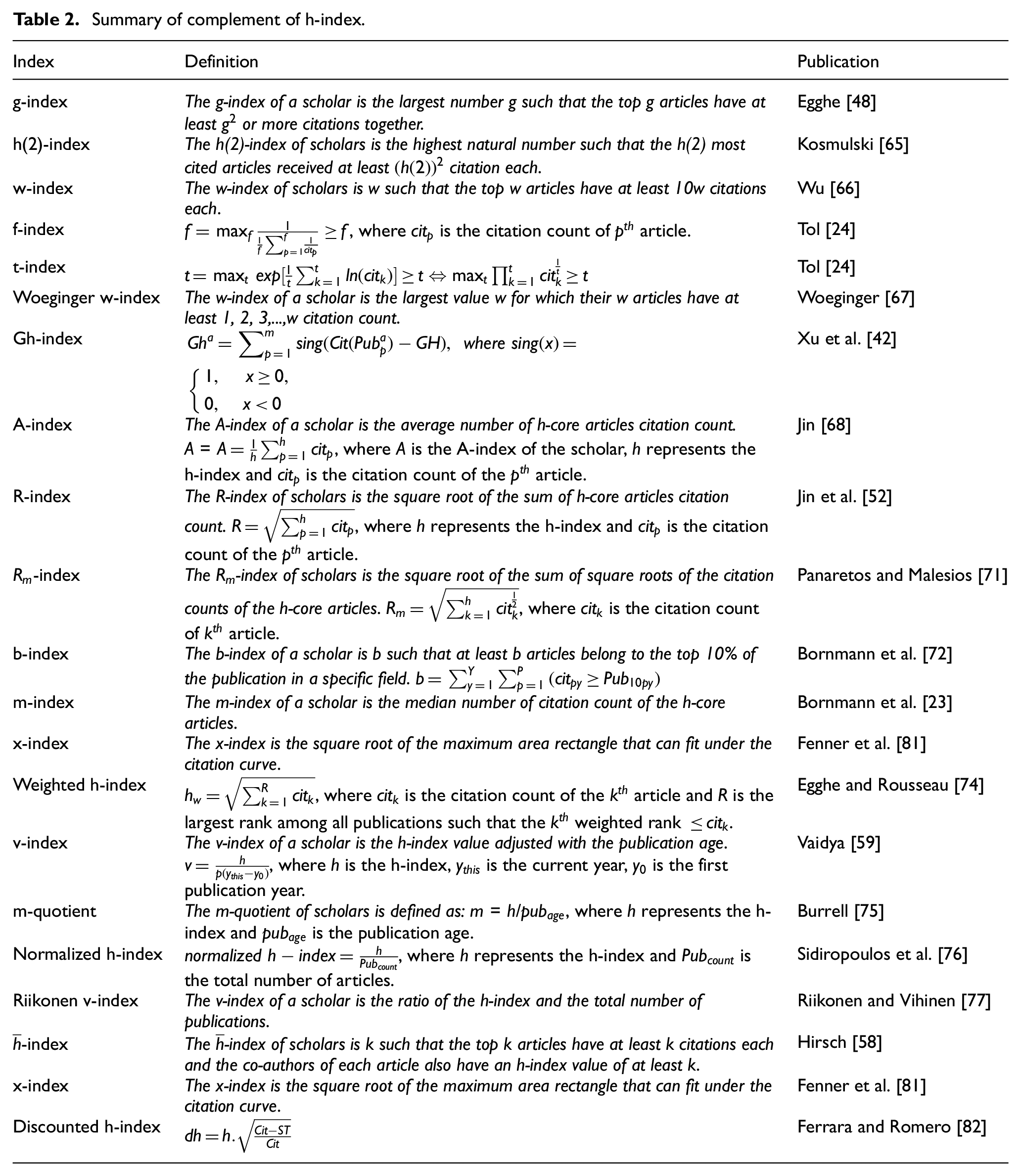
From the above discussion, it can be concluded that different researchers consider different parameters to enhance the acceptance of the original h-index without giving any new concepts. The research done till now in comparison to scientific impact of scholars is not sufficient and does not provide clarity; hence, some effort is needed in this context. If we compare the computation process of the above-discussed indices, then we can say that the computation process is little bit difficult as compared to the h-index. Summary of the indices that complemented the h-index is shown in Table 2. The computational complexity of the indices given in Table 2 is
Summary of complement of h-index.
2.3. Indices based on publication career
Generally, all citation-based metrics are solely based on the number of publications and their citation counts. Whenever we compare the productivity of scholars, only the total number of publications and their citation count are considered. However, the productivity of scholars is different at different stages of their careers [59]. For example, a scholar who is retired or not active in research, but his or her articles are getting regular citations, is considered prominent. Whereas, a young scholar, who has published quite a few papers but has a smaller number of citations (due to a shorter career) is not considered as prominent. Based on the above discussion, it is clear that the publication career of the scholars plays an important role in the scientific assessment of scholars and in comparing their scientific impact.
On these lines, Jin [84] and Jin et al. [52] mentioned that if two scholars have an equal citation count of h-core articles with different publication careers, then the h-index of both scholars is the same. However, this is not fair because their publication careers are different. To overcome this limitation of the h-index, the AR-index has been proposed, which considers the total career of scholars. Formally, the AR-index of a scholar is defined as follows

where
The main objective of this index is to give equal weightage to all the publications that are either published earlier or recently and are useful in comparing the scientific impact of scholars having different lengths of publication career. However, this index penalises all those articles that were published earlier. The index value may decrease over the time but helps in estimating the recent scientific impact instead of the total scientific impact.
Sidiropoulos et al. [76] proposed the contemporary h-index to give more credit to the citation of newer articles than the older ones. Formally, the contemporary h-index is defined as follows: The contemporary h-index of a scholar is
The score

where
If The trend h-index of a scholar is the largest number
The score of the kth article is defined as follows

where the symbols have the same meaning as defined in equation (16).
This index requires year-wise citations of all publications, which is one of its main limitations and makes its computation much more complex than the h-index. Another issue related to this index is the choice of
It is very difficult to differentiate between two scholars having equal h-index and equal citation counts in h-core articles. However, it seems that the h-index of some scholars remains unchanged for some time, while other scholars’ citation and h-index rise. In this context, the dynamic h-type-index (

where R(y) is the R-index of the scholar at the yth career year and
In this case, the value of y is set by the user, and it is very difficult to set a reasonable time window for the scientific assessment of a scholar. Instead of considering the total career of a scholar or any fixed time window, a decade-based assessment is more precise. Based on this concept, Kosmulski [86] proposed the h-index per decade The hpd-index of a scholar is hpd such that the hpd articles have at least hpd citation per decade (
The adjusted citation per decade is defined as follows

where
Instead of the total time window or decade-based scientific assessment, Fiala [87] considers only recent 3 years’ citation time window. Pan and Fortunato [88] used the last 5 years’ citation time window for the scientific assessment of scholars. Instead of fixed timestamp, a variable timestamp is much better [89]. Using this concept, Schreiber [89] considered a variable timestamp The timed h-index of a scholar is the largest integer k such that the k articles have at least k citation count each during the defined citation time window.
The decade year or fixed time window does not consider the overall impact of a scholar. It seems that some of the scholars published articles throughout their career, while other scholars published articles during their PhD career or published occasionally. In both cases, the evaluation of scientific impact of scholars is based on the citation count earned by such articles, but their contribution is very different. In this context, Mahbuba and Rousseau [21,90] proposed a set of indicators based on yearly impact of scholars. The year-based indices are classified into four categories, where source is year and the items are (1) the total number of publications in a particular year, (2) the total number of citations earned by all publications published in a particular year, (3) the total number of citations earned in a particular year from all publications that are published in any year and (4) diffusion of citation count based on the age of the publications.
(1)
To compute the career year h-index by publications, first the total number of publications in each publication year is calculated. Then, they are arranged in descending order of their total publication count. Then, the career year h-index by publications is the maximum rank in which the publication count is equal to or greater than the year rank. This year-based index considers the year-wise productivity of scholars. Suppose a scholar productivity is more than others but their scientific impact is much less, then we cannot say that the scholar is more prominent than others.
(2)
This index considers the total number of citations earned from all articles that are published in a particular year. This shows the productivity year impact of a scholar. Suppose a scholar published more number of articles in their earlier stage of career or selective year, then the index value is very low compared with the scholars who published articles regularly. So, instead of publications’ year citation, the citation year citation is more pertinent in scientific assessment.
(3)
To compute career year h-index by citations, we first calculate the total number of citations earned in every year from all publications that are published in any year. This index considers the year-wise impact of scholars and produces a single number that is equal or less than the total research career. This index may be influenced by the older articles. A good number of earlier published articles affect the index value significantly. Instead of only year-wise citation, the age of the publications may also play an important role in the scientific assessment. In this context, the diffusion-based h-index was designed.
(4)
The diffusion speed of the publication year
To overcome the big-hit problems or consideration of excess value in scientific assessment of scholars, the year-based EM-index has been proposed by Bihari and Tripathi [57] with three different parameters. The source of the year-based EM-index is year, and the items are (1) total publication count in a particular year, (2) publication year citation count and (3) citation year citations. Using these three different item values, the year-based EM-index has been designed and named as (1) year-based EM-index by publications, (2) year-based EM-index by publication year citation and (3) year-based EM-index by citations. The year-based EM-index is computed using the EM-index methodology which is discussed in Bihari and Tripathi [56]. The year-based EM-index produces a set of values along with the global index value. The elements of the year-based EM-index help in comparing scientific impact of scholar having similar index value. However, the career year h-indices and the year-based EM-index consider only the core item value and left some important items’ value that may have very near to the core item value. To incorporate the importance of such tail-item value with the consideration of excess citation value, the year-based
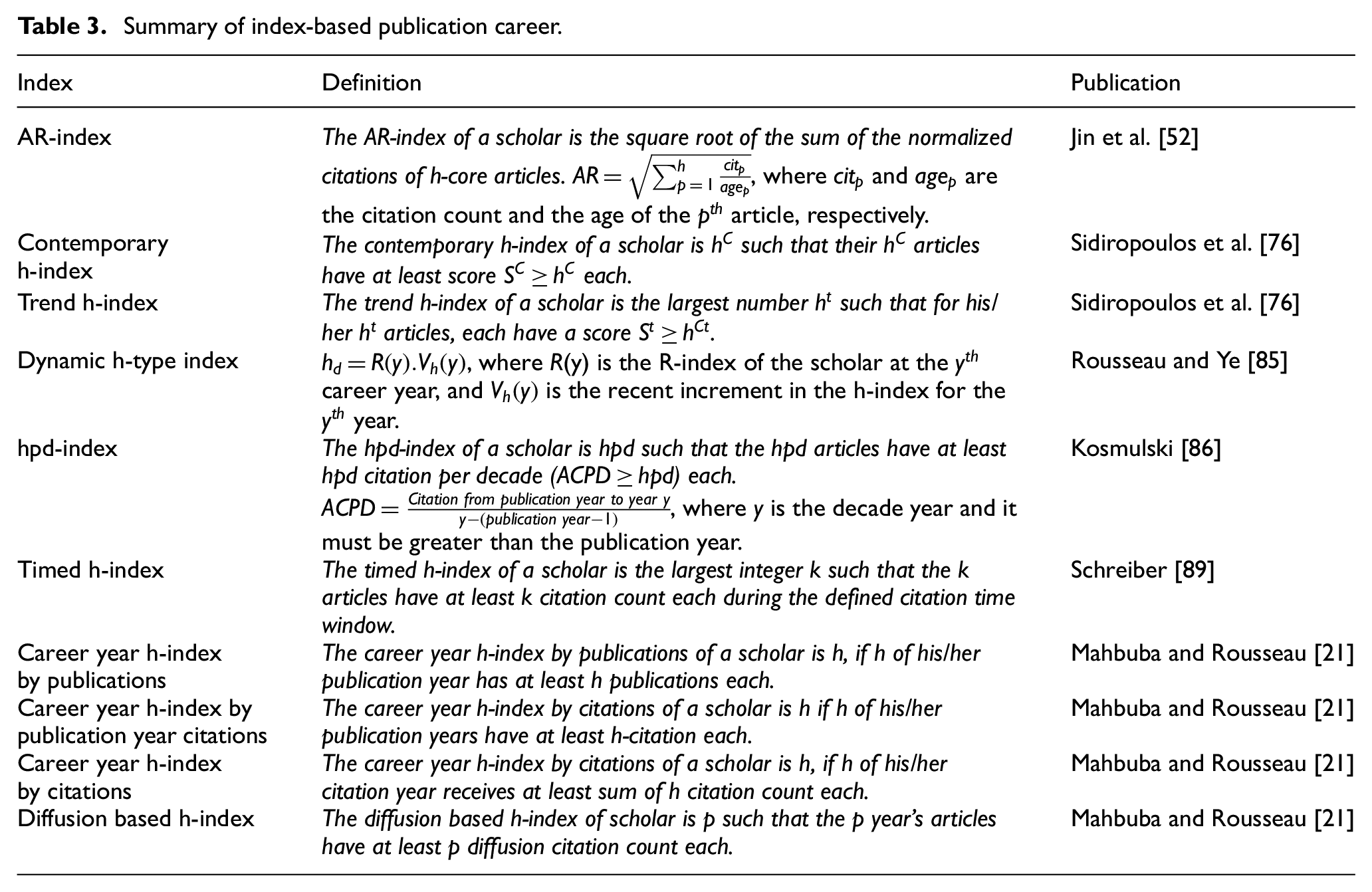
From the above discussion, it can be concluded that the career of the publication can be used as an important factor in the scientific assessment of scholars and helps in comparing the impact of junior and senior scientists. The research done till now in comparison to scientific impact of scholars is not sufficient and does not provide clarity; hence, some effort is required to put in this context. If we compare the above-discussed indices with the h-index, then we can found that the computation process is little bit difficult. However, the behaviour of most of the indices is almost similar. So, if we consider the computational complexity, then most of the case, it should be
Summary of index-based publication career.
2.4. Indices based on total number of authors
In the research community, most of the research work is done by a group of scholars, and the evaluation of the scientific impact of a scholar is based on their articles’ citation counts. In the scientific assessment process, all authors get full credit of articles’ citation count. However, rarely they contribute equally. To overcome this shortcoming, Cole and Cole [7] consider only the first author and completely ignore the co-authors. However, it is not fair in the case of multi-authored articles [60]. Lindsey [91] gives full credit to every scholar. Price [8] uses the fractional allocation between all authors, that is,
The citation count of an article should be distributed to all co-authors based on their role in the article [96]. However, it is very difficult to know the role of each scholar in an article. In this way, simply divide the h-index by the average number of scholars in h-core articles and name the proposed indicator as The
Mathematically, it is defined as follows

where
Furthermore, Imperial and Rodrguez-Navarro [97] discuss the impact of the

where
Furthermore, the authors discussed the equivalent number of co-authors, proportional (arithmetic) and geometric assignment to share credit among all scholars in a multi-authored article. In case of the equivalent number of co-authors, the credit share of an individual in an article is 1/k [12,98], where k is the total number of authors in the article. In case of arithmetic (proportional) assignment [12], the credit share of an individual (either author or co-author) in an article is defined as follows

where
In case of geometric assignment [14], the credit share of a scholar in an article is defined as follows

where the symbols have their meaning as defined in equation (22)
Based on these credit assignment schemes, the pure h-index of a scholar is defined as follows

where h is the h-index and

where the symbols have their meaning as defined in equation (22).
Using the same credit assignment scheme, the pure R-index of a scholar is defined as follows

where E(author) is the average number of scholar in the h-core articles, C(A, P) is defined in equation (22) and h(pub) is the set of h-core articles.
It seems that a scholar may get a high h-index, but he rarely contributes as a core author, while another scholar gets relatively lesser h-index, but mostly contributes as a core author. The h-index and the pure h-index do not account for this issue. To resolve this issue, Chai et al. [99] proposed a new index called the adaptive pure h-index (

If
Another similar approach, the Normalized
The normalized
Egghe [40] discussed the fractional credit allocation technique to share the credit among scholars in multi-authored articles and proposed the fractional h and g-index.
The fractional h-index (
Mathematically, it is defined as follows

where
The author applied the same technique to the g-index and proposed a new index called the fractional g-index.
The fractional g-index (
Mathematically, it is defined as follows

where the symbols have their meaning as defined in equation (28). Instead of fractional citation count, the fractional ranking of publications is used to design the fractional h-index (

where
Then the fractional h-index is defined as follows

where
Another similar approach proposed by Schreiber [101] called the
Instead of arithmetic and geometric distribution of citation counts, Hagen [102] suggested the harmonic counting method. The harmonic share of the kth author in an article is defined as follows

where k is the rank of author in the mth authored article.
Based on harmonic credit allocation, the harmonic h-index is defined as follows: The harmonic h-index of a scholar is
Similar approaches, the weighted h-index and weighted citation h-cut, have been discussed by Abbas [103]. These consider the total number of cited articles and the total number of co-authors. To share the citation credit among scholars, the positionally weighted and the equal weighted mechanisms are used. In the positionally weighted scheme, the first author gets more credit than the second one, and the second author gets more credit than the third one, and so on. Finally, the summation of all weights is normalized to 1. The weight of the

In an equally weighted scheme, all authors get equal weight, that is, 1/m where m is the total number of authors.
The weighted h-index of a scholar is the largest number k such that their k articles have at least k weighted citation aggregate each.
Mathematically, the weighted h-index is defined as follows

where P is the total credit score earned by positionally or equally weighted scheme,
The weighted citation h-cut of a scholar is the sum of the weighted citation count of the weighted h-core articles

where the symbols have their meaning as defined in equation (34).
In the last two or three decades, the number of co-authors has continuously increased [104–106]. This plays a critical role in the distribution of citations among the scholars. If the number of co-authors is more, then the distribution based on the average number of authors, arithmetic counting, geometric counting and the harmonic count is not fair. To resolve this issue, Zhang [107] designed a new index called the weighted h-index. In the weighted h-index, the shared credit of the first and the corresponding authors is 1 and the

where m is the total number of authors and j is the rank of the author.
For example, let an article published by five authors. Let the first and the last author be the primary and the corresponding author, respectively. Then, both of the authors get full credit for publication. The rest of the authors earn credit based on their rank using the proportional counting method. Using the weighted citation count, the weighted h-index is defined as follows: The weighted h-index of a scholar is w, if w of his/her articles have at least w weighted citation count each.
This index is similar to the
The overall h-index is the original h-index; the first author h-index is the h-index computed from the citation count of all those articles in which the scholar is present as a first author. The corresponding author h-index is the h-index computed from the citation count of all those articles in which the author is present as a corresponding author. Finally, the other contributor h-index is the h-index computed from citation count of all those articles in which the scholar is present neither as a main author nor as a corresponding author. The relatively high value of the first author h-index indicates that the author mostly worked as a primary author. The relatively high value of the corresponding author h-index indicates that the author mostly worked as a corresponding author, and the relatively high value of the other contributors’ h-index shows that the author mostly worked as a supportive author.
Instead of these four types of indicators, Bucur et al. [110] categorise authors into two categories: the primary author (main author and corresponding author) and non-primary author. With consideration of primary and non-primary author, the Hirsch(p,t) was proposed. Formally, it is defined as follows

where h(p) represents the h-index computed from the citation count of all those articles in which the author was present as a main or a corresponding author, and h(t) represents the overall h-index.
Suppose a scholar published three articles with two citations each. Out of these three, two articles were published as the primary author (main and corresponding author). Then, the h-index based on these two articles is 2 and the overall h-index is also 2. Hence, the Hirsch(p,t) = 2,2.
Another similar approach has been discussed by Wurtz and Schmidt [111]. The authors mentioned that the first, second, third and last author’s contribution is equal. Based on this scenario, authors proposed a new index called the Stratified h-index, which combines the following four types of indicators: (1) first authorship (
Instead of the distribution of citation among scholars, Aziz and Rozing [112] used the impact of collaborators in the scientific gain of scholars. To do this, the harmonic-weighted scheme and the rank of the authors are used to estimate the scientific impact of scholars in an article. The weight of the kth author in the mth authored article is defined as follows

where D is 0, if the article authored by the even number of author and 1/2 m, if the article is authored by an odd number of authors.
The sum of the weight of all articles is the number of monograph equivalent. The monograph equivalent is the total number of single authored articles. Then the profit (p)-index of a scholar is defined as follows

where

where
The value of the profit h-index lies between 0 and 1, where 0 indicates that all articles are written by the primary author, that is, the contribution of the co-authors is zero or the papers are singly authored.
Prathap [113] proposed fractional and Harmonic p-index to account for the number of authors. In the fractional p-index (

where
The total fractional citation count of an author is defined as follows

where
In the harmonic counting method, the weighted credit of the

where
Instead of arithmetical allocation of citation counts to an author, Galam [114] used the tailor-based allocation (TBA) mechanism to share credit among scholars and proposed a new index called index.
The gh-index of a scholar is k, if k of his/her articles have at least k TBA-based fractional citation count each.
In this mechanism, the extra credit



where
In the case of an article authored by two authors, the credit allocation has three choices: two to one-third, three to one-quarter and one to one-half. In the case of two to one-third, the extra credit is given to the first and the last author is 2 and 1, respectively, in three to one-quarter, the extra credit is 1 and 0, respectively, and in case of one to one-half, the extra credit given is 0 and 1, respectively, for the first and the last author, respectively. In the case of articles, authored by more than two authors, the decision of credit allocation depends on the choice.
Liu and Fang [115] presented a new mechanism to share credit among corresponding and non-corresponding authors. In this mechanism, the corresponding author gets more credit than the non-corresponding author. The credit of a scholar decreases, when the number of scholars increases. The following steps are used to share credit among scholars:
First, the sequence of authors is rearranged in the following way: first author, corresponding author and the rest of the authors in the original sequence. For example, an article has been written by four scholars A1, A2, A3 and A4. If A4 is the corresponding author, then the sequence is like A1, A4, A2 and A3.
The credit allocation to the

where
A smaller

The normalized credit score of an individual scholar is defined as follows

and

where
The citation allocation of the

Based on this credit allocation system, two different indices were proposed called CCA h-index (
The The
Generally, most of the indices give more credit to the first and the corresponding author; however, every author has their own importance in an article. The first and the corresponding author may have done most of the research work and guidance. The other authors may analyse the research work [116]. So we cannot discard the importance of non-primary authors. To consider the importance of non-corresponding authors, the absolute index (Ab-index) has been designed by Biswal [116]. In this index, the first author and the corresponding author get full credit and the rest of the authors get shares in decreasing arithmetic progression.
The Ab-index of a scholar is the sum of the partial credit earned from all articles in which the scholar is present either as a first, corresponding or a co-author.
Mathematically, the Ab-index of kth author is defined as follows

where

where
In single authored articles, the author gets 100% credit. In a case where there is one first author, one corresponding author and one other co-author, the credit share of the first and the corresponding author is 40% each, and 20% for the other author. In a case where the first author is also the corresponding author, the credit share is 66.67% and the remaining author gets 33.33% credit share. In a case where there are

where
Clearly, the computation of this index is a lot more complex than the h-index.
Altmann et al. [94] proposed a new index called RP-index (research productivity). This index is based on normalized citation count (each citation count is divided by the age of the publication) and the contribution factor of the individual researcher in the group. It is defined as follows

where
The RP-index of a scholar is RP, if RP of his/her articles have at least average RP normalized citation count each.
Mathematically, it is defined as follows

where

The contribution of collaborators also plays an important role in the scientific assessment of a scholar. Based on this concept, Abbasi et al. [117] and Abbasi et al. [93] proposed a new index called RC-index (researcher collaboration) and the CC-index (community collaboration).
The RC-index of a scholar is the largest number R such that their R co-authors have at least R average co-author collaboration value each.
Mathematically, the RC-index is defined as follows

where

where
After a slight modification of the RC-index, the

The
The community collaboration index called CC-index is defined as follows

After a slight modification of the CC-index, the

In this section, we have discussed a number of indices that consider the number of co-authors in the scientific assessment of scholars and the research articles. Several indices consider the total number of authors of h-core articles. Some of them are defined through somewhat complex mathematical equations, some consider the impact of only the first and corresponding author, and so on. These are all just an assumption because a research article does not have any information related to author contributions. After a long journey of scientific assessment of scholars, the sharing of credits among scholars is still an open challenge. This type of indices considers the mathematical equation to compute the index value; however, the h-index considers only the sorting and ranking mechanism. So, we can say that the computation process is little bit difficult. If we try to compute the computational complexity, then most of the indices come under the
Summary of index based on total number of authors.

TBA: tailor-based allocation; RC: researcher collaboration; CC: community collaboration
2.5. Indices based on the combination of two or more indices
To measure the scientific impact of scholars, several indices were proposed and every index measures the impact with different parameters. To find the global impact of a scholar, several parameters should be addressed that cover at least total productivity and the impact of scholars. Any single index covers only one parameter, so the combination of the advantages of two or more indices is more precise [16,17]. In this context, the hg-index,
The h-index considers only the highly cited articles and leaves a number of articles that are lesser cited. However, the g-index tries to use a maximum number of articles [18,118]. However, both of the indices do not meet the sufficient requirement of the scientific assessment of scholars [118]. So, the combination of these two indices called hg-index could be an effective alternative to assess the scientific impact of scholars [18]. Formally, it is defined as follows: The hg-index of a scholar is the geometric mean of the h and g-index.
Mathematically, the hg-index is defined as follows

where h and g represent the h-index and the g-index value of scholars.
The hg-index combines the advantages of h-index and g-index to produce a value near to the h-index than to g-index. The lower h-index penalises the g-index and produces a lower index value.
Cabrerizo et al. [19] categorise the indices into two categories: the first one is based on the productive core of a scholar, such as h-index [3], g-index [49], hg-index [18] and The
Mathematically, it is defined as follows

where the h and m are the h-index and m-index value of scholar.
The
Another index designed to combine the properties of

where rk(p) is the rank of author in article
The
Mathematically, it is defined as follows

where
In this section, we have discussed all those indices that combine the advantages of two or more indices. From the above discussion, we can conclude that the combination of two or more indices could be an effective alternative to citation-based indices, but still, each has limitations to emerge as a single index to completely assess the scientific impact of scholars. As similar to the above index categories, the computation process is little bit difficult as compared with the h-index. This type of indices requires to compute two different types of index, then only we can get the index value. The summary of index based on the combination of two or more indices is shown in Table 5.
Summary of index based on the combination of two or more indices.

2.6. Indices based on excess citation count
The scientific impact of an article is measured in terms of citation count, and the scientific impact of a scholar is computed based on the citation count of articles. An article that earned more citations than others is considered more influential and a scholar having a higher index value than others is considered a prominent actor. At some stage, further addition in citation counts of an article does not contribute in improving the values of most of the popular indices (h-index), but every citation count has its own importance in the scientific assessment of scholars. Such citations are called excess citations. To account for the importance of excess citation count, several indices were designed.
Let scholar

where

where
From the above discussion, we can conclude that neither the e-index nor the j-index fairly accounts for the excess citation count in the scientific assessment of scholars. The e-index considers only the excess citation count of h-core articles and completely ignores the core citation count. Hence, it would be difficult to imagine the scientific assessment of scholars without the core citation count. The j-index works on the concept of weighted incremental approach and how the weights are incremented is a highly debated subject. In this context, one recent index has been proposed by Bihari and Tripathi [56] named EM-index. The EM-index of an author is the square root of the sum of the component of EM-index. The component of the EM-index is the h-index calculated at multi-level. The first component of EM-index is the original h-index, and the second component is the h-index from the excess citation count of the h-core article. The third component is the h-index from the second-level excess citation count and so on. Mathematically, the EM-index is defined as follows

where m is the total number of component of the EM-index. This index helps to differentiate two different researchers with the same h-index value. This index considered both core and excess citation counts but still it ignores the tail articles’ citation counts.
In this section, we have discussed all those indices that are trying to give extra credit to highly cited articles. The e-index considered only the excess citation count, the j-index worked on 12 arbitrary weighted citation concepts and EM-index used a traditional approach for consideration of the impact of highly cited articles. From the above discussion, we can conclude that the current research is not sufficient in the context of excess citation count. This requires more attention in this section. This type of indices requires more computation as compared to the h-index. The computational complexity of this type of index is
Summary of index based on excess citation count.

2.7. Indices based on total publication
The scientific product of a scholar is research articles, and every article has its own impact on the research career of a scholar. However, the scientific assessment of a scholar is done with the help of only a few numbers of high impact articles and leaves many articles that have citation counts near to the h-index value. It seems that the articles with a citation count equal to or a little less than the h-index value are not used in the scientific assessment of a scholar. Such articles, referred to as h-tail articles, are obviously important; however, even the h-tail articles with fewer citations can be significant in assessing the impact of a scholar, and hence, should not be ignored. Motivated by this, several studies have been done to incorporate the impact of all those articles that are cited at least once.
Anderson et al. [120] proposed a new index called tapered h-index based on the total number of cited articles. Tapered h-index is defined based on the Ferrers graph of publications and their citation counts. This graph assigns positive scores to all publications with non-zero citation count. To score an h-index value of 1, only one article with one citation count is required; to score a value of 2, a scholar requires at least two publications with two citations each. The increment of h-index value from 1 to 2 requires three more citations: one for the existing article and two for the new article. This increment is shown in the Ferrer graph with the contribution score of 1/3 in Figure 2. The figure also shows the score of all other articles. In the Ferrer graph, a column represents a partition of citation counts of the articles and a row represents the total citation count. The largest square in the Ferrer graph is called Durfee square; its length represents the h-index value. The score of any citation in the Ferrer graph is defined as

where

This index tries to incorporate all citation counts in the scientific assessment of scholars, but the computation process of this index is a little bit more complex than the h-index.
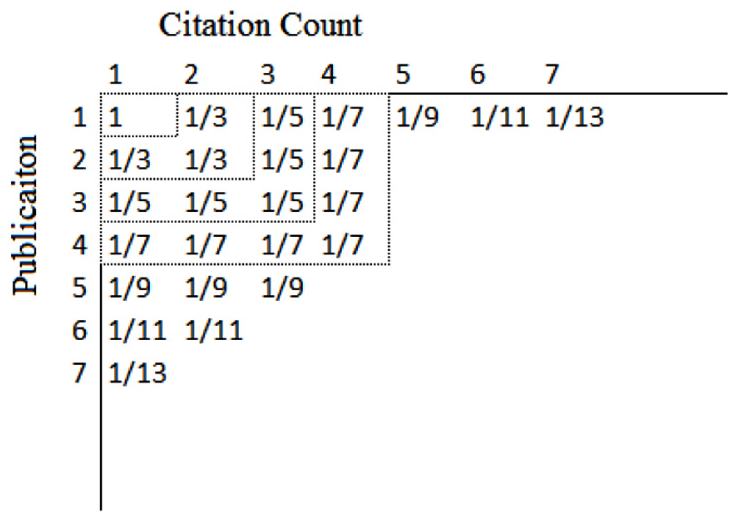
Score of articles in tapered h-index.
In this way, García-Pérez [15] proposed the multidimensional h-index to account for the importance of all cited articles. To compute the multidimensional h-index, first the citation count of all those articles that have at least one citation count is stored in an m-dimensional vector in descending order of citation count. Then, the multidimensional h-index is defined as H = (

where
The total number of components in multidimensional h-index is always less than or equal to the total cited publication count. If all articles have a single citation, then the total number of components in the multidimensional h-index is equal to the total number of publications, otherwise it is always less than the total cited publication count. The number of components and their values vary from scholar to scholar. This shows the significant difference between scholars.
For example, let a scholar publish 20 articles. Out of these 20, let 17 articles have at least one citation count: Cit = (100, 20, 20, 17, 10, 10, 9, 9, 8, 8, 5, 4, 4, 3, 2, 2, 1). Then, the components of the multidimensional h-index are {8, 4, 2, 2, 1}. If we take the reasonable minimum component value to be 4, then the components of the multidimensional h-index are {8, 4}. The sum of the component of the multidimensional h-index is 17 equal to the total number of cited publications. However, this index does not produce a global index value to show the overall impact of scholars. To overcome this limitation, Todeschini and Baccini [121] defined a new index called iteratively weighted h-index. The iteratively weighted h-index of a scholar is defined as follows

where
Franceschini and Maisano [34] proposed a new variant with additional signs to account for all the cited publications in scientific assessment. The additional sign is the total time range of all those articles that have at least one citation count. It is defined as follows

where
The main feature of this indicator is that it never decreases and is never more than the total publication career. For example, to compute the f-range, consider an artificial example of the publication history of scholar
Example of f-value.

The h-index of scholars is 5 and the f-value of scholar A = {2000, 1989, 2001, 2005, 2009, 2010} + 1 = 7. Here, + 1 is done to account for the preparation of the first article. The scientific impact of a scholar with this additional sign is categorised into the following four categories:
Low h-index and low f-value: this indicates new scholars;
Low h-index and high f-value: this indicates the scholar working for a long time but their research impact is relatively less;
High h-index and low f-value: this indicates a young prominent scholar;
High h-index and high f-value: this indicates that the scholar worked hard in the research community for a long time.
This index helps in comparing the scientific impact of scholars having different research careers.
Smith [122] proposed the Platinum H-index that covers the total citation count, total research career and the total publication count. Formally, it is defined as follows

where
The mh-index of a scholar is the square root of the product of h-index at every level and the square of citation count of an article is divided by the age of the publication.
Mathematically, it is defined as follows

where
To calculate the mh-index, first calculate the h-index from all those articles that have at least exactly one citation count. Then, calculate the h-index from all those articles that have two citation counts, and so on. Finally, calculation of the mh-index is done based on the previous calculated data.
All of the indices that consider the total publications do not account for the importance of citation count of all articles. To overcome this limitation, Bihari and Tripathi [56] proposed a new index called

where m is the total number of component in
In this section, we have discussed a number of indices that consider the total number of cited publications in the scientific assessment of scholars. Every indicator gives a perspective to consider the impact of the total number of articles, but none of the indices consider the total number of scholars and the total citation counts with the total number of publications. This may provide a good alternative in the scientific assessment of scholars. This type of index requires both total articles and their citation count with additional computation. This type of indices comes under the
Summary of index based on total publication count.

2.8. Indices based on other variants
Instead of the total number of publications, the age of publications, the number of co-authors, the excess citation count and so on, several indices consider other parameters, such as a successful paper, the total number of citers (reader), the citation curve and many more to assess the scientific impact of scholars. In this section, we are going to discuss all those indices which do not come under the above-discussed category of indices.
2.8.1 Based on core and tail citation
Generally, the citation count of a scholar’s articles is categorised into three categories: (1) the citation count used in h-index computation, (2) excess citation count and (3) the citation count not used in the h-index computation (tail citations). Bornmann et al. [124] referred to all those categories as the centre (the h-index citation count), upper (the excess citation count) and the lower (the tail articles citation count). Based on this distribution of citation count in the citation curve, the author proposed three different measures to evaluate the scientific impact of scholars:
These are defined as follows



where
The main objective of this index is to assess the scientific impact of scholars at three different levels, which resolves the excess and tail-citation issue of the h-index. A scholar having high value in the upper section shows the high impact of the scholar and is called a perfectionist scientist, while a scholar having a low value in the upper part and high value in the lower part shows the low impact of the scholar (huge number of publications with less citation). A scholar having high centre value shows the average impact of the scholar in the community. Instead of three different measures, only one measure should be used in the scientific assessment of scholars [125]. To do it in this way, Zhang [125] proposed an improved version of

where
Fred and Rousseau [126] proposed the k-index that covers the core-tail citation ratio of a scholar. It is also called the tail-core ratio. Formally it is defined as follows

where
The k-index of a scholar at time

After a slight rearrangement, the above can be defined as follows

This index suffers with divide by zero problem when h-tail is zero and also it gives an average impact of scholars [127]. To overcome the divide by zero problem of the k-index, Chen et al. [128] modified the k-index as the

Moreover, the two-sided h-index by García-Pérez [129] considers the core-tail ratio and states that the citation curves of two different scholars having equal or similar h-index value are different because of the variation of citation count in their h-core and h-tail publications. The two-sided h-index of a scholar for length

where
The negative scripted element is calculated by finding the highest rank
In this subsection, we have discussed all those indices that estimate the scientific impact of scholars based on the h-core and h-tail articles citation count. However, most of the indices are very difficult to compute when compared with the h-index.
2.8.2 Based on improvement of h-index to the higher value
The h-index considers only a few highly influential articles and can be limited due to the complete ignorance of h-tail articles’ citations. Ignoring h-tail articles is not good because some of the articles have equal or little less citation counts than the h-index value. Such h-tail articles are obviously important in the improvement of the next higher h-index. Motivated by this, Ruane and Tol [130] proposed a new variant of the h-index named the rational h-index (

where
The maximum number of citations required to reach the next higher h-index is 2 h + 1. This index is similar to the h-index and, the only difference is the fractional part of the index value.
Another similar approach discussed by Guns and Rousseau [131] is called the real h-index. Mathematically, the real h-index (

where h is the h-index and
Wu [132] proposed the w(q)-index, where

where

where

where

where
In this subsection, we have discussed all those indices that try to gauge how the index value will increase to the next higher value in the near future. Each of the indices gives its own mechanism to improve the index value to the next higher value.
2.8.3 Based on variants of citation process
The impact of an article is measured in terms of the citation count, which refers to all those articles that cite the given article. However, it seems that a single article is cited by multiple articles of a scholar [134]. Hence, instead of the total citation count, the total number of unique citers (readers) [135] can be an effective alternative to assess the scientific impact of an article. Motivated by this, Isola and Wolfram [61] used the total number of unique citers to assess the scientific impact of an article and proposed a new index called the ch-index. Formally, it is defined as follows: The ch-index of a scholar is k if k of his/her articles have at least k citers each.
To compute the ch-index, first we calculate the citers of every article. Then, we sort the publications in the descending order of their citer count. The ch-index is the largest rank corresponding to their citer count. However, one of the main difficulties with the ch-index is to find the total number of citers of an article because none of the publication databases have citer information. So, it is a very challenging task to do.
Katsaros et al. [63] gave an alternative way to measure the total impact of an article by the number of distinct cited scholars called the coterminal citation count and proposed a new index called the f-index. The f-index of a scholar is defined as follows: The f-index of a scholar is k if k of his/her articles have at least k coterminal citation each.
The coterminal citation count of an article is the dot product of m-dimensional quantities and

The quantities of citing article are defined as

For calculation of the f-index, we first calculate the coterminal citations of all articles, then arrange all articles in descending order of their coterminal citation count. Then the f-index of a scholar is the largest rank in which the coterminal citation count is greater than or equal to the rank. This index tries to remove the author repetation from the citation process. However, it is little bit difficult to compute.
An article is written with the help of other articles it refers to. In this way, the impact of an article can be based on the impact of the referred articles. If an article refers to a highly influential article, then it has a good chance of gaining higher impact in future. Along these lines, Schubert [136] proposed the single publication h-index. The single publication h-index is based on the highly cited referred articles. For the calculation of the single publication h-index, first we arrange the referred articles in the descending order of their citation counts. The single publication h-index is the h-index value from the reference list. Using the single publication h-index, Egghe [137] proposed the indirect h-index. For the calculation of the indirect h-index, we first calculate the single publication h-index of all publications. Then, we arrange all the publications in the descending order of their single publication h-index. The indirect h-index of a scholar is defined as follows: The indirect h-index of a scholar is k, if k of his/her articles have at least k single publication h-index each.
Egghe [138] discussed the indirect h-index and improved this index based on Lotka’s principle

where

Another index based on single publication h-index is the average h-index: The average h-index of a scholar is the average of the single publication h-index of h-core articles.
Mathematically, it is defined as

However, the single publication h-index is very difficult to calculate because none of the publication databases have information related to reference citation count.
The citation count of an article is influenced by the self-citation count, citations from co-authors’ articles and from institutional colleagues. All those types of citations are treated as self-citation. Instead of the total number of citation count, the total number of international recognition is a much better way to know the scientific impact of an article. Based on this international recognition, Kosmulski [139] proposed the The
The international recognition of an article is the sum of all those articles that refer to other country scholars’ publications. To compute the
In research articles, it seems that some of the references are cited once while some are cited multiple times. In both cases, the citation count of an article remains the same. However, if an article is cited more than once in an article, that means it has more impact in this article. Instead of total citation count, total citation mentioned may be a good alternative. So, instead of total citation count, the total number of distinct authors or the total number of international recognition, the total number of citation mention could be used as an effective alternative to assess the impact of an article. To incorporate the citation mentioned, Wan and Liu [62] proposed a new index called the wl-index.
The wl-index of a scholar is the largest integer k, if k of his/her articles have at least k citation mentioned each.
This is a good concept for assessing the impact of an article and scholars’ impact. However, the problem is in finding the total number of citation mention of an article because no publication database has this information.
In this subsection, we have discussed all those indices that are based on alternative citation processes of an article. Every index gives its own benchmark to know the scientific impact of articles and scholars. However, still it is open to find the impact of an article because many parameters, such as importance of cited article, importance of citing author, publication venue and many others, can be considered for measuring the scientific impact of an article.
2.8.4 Miscellaneous indices
Many other indices that have not been covered under the above-mentioned categories have been covered in this section. They are also important in the scientific assessment of scholars. All such indices mentioned in this section are trivial to calculate compared with the other indices mentioned previously.
Van Eck and Waltman [54] mentioned that the h-index definition is somewhat arbitrary [4,140] being based on the number of highly cited articles. A single arbitrary number is not fair in assessing the scientific impact of scholars and while comparing two different scholars. To overcome this limitation, Van Eck and Waltman [54] proposed a new index called
The
where
For example, let scholar
The citation-based indices are designed based on the number of articles having significant amount of influence. The articles being considered are either journal articles, conference articles or book chapters. Furthermore, all of the articles are treated equally for the scientific assessment. However, every type of publication has its own impact and definitions. So, we cannot treat all equally. To overcome this limitation, Vinkler [141] proposed a new index based on an elite set of articles called

where
Bornmann and Daniel [142], Schubert and Glanzel [143] and Van Dalen and Henkens [144] use the speed of the citation count of an article to evaluate the scientific impact of scholars. The speed of the citation count is measured at the point at which the first citation count of an article is gained. For the calculation of the citation speed index of a scholar, first the total number of months after the article earns its first citation count is calculated for each of the publications. Then, the publication list is arranged in the descending order of their month count. The citation speed index of a scholar is then defined as: The citation speed index of a scholar is k, if k of his/her articles got the first citation at least k months ago.
Mathematically, it is defined as

where
This index penalises all those articles that have earned citations earlier.
Instead of a citation count of highly cited articles, the citation count of all those articles that have a significant amount of influence in the proportion of collaboration distance between the cited and the citing scholars has been used for the scientific assessment of scholars. Following this, Domingo-Ferrer and Torrab [145] and Bras-Amoros et al. [145] considered the impact of collaboration distance between the cited and the citing scholars and proposed the c-index. The collaboration distance between the cited and citing scholar is measured in two categories: (1) classical collaboration distance and (2) refined collaboration distance.
The classical collaboration distance is the total number of scholars who are present between the citing and the cited scholars. This collaboration distance requires at least one collaboration between any member of the citing and the cited scholars. For example, let scholar A1, A2, and A3 be the citing scholars, and scholar A7, A5, and A4 be the cited scholars. Let one collaboration between A2 and A5 be present; hence, the collaboration distance between scholar A1 and A4 is 4. The collaboration distance between cited and citing article is 1 because only one collaboration distance is present between these two articles.
In the refined collaboration distance, the distance between two scholars is the total collaboration path length, defined as follows

where
Based on these two types of collaboration distances, the c-index by Bras-Amorós et al.[145] is defined as follows

where
In the case of the c-index of an article, the quality function
Another variant of the h-index based on the number of success articles [146] was defined by Kosmulski [147]. If the total citation count of an article is more than the total number of references, then the article is called a success article. The score (SC) of the success of an article is defined as follows

where
The success article penalises all review articles because the review articles contain a huge number of references. This method also penalises the newly published articles. Suppose an article earns five citation counts and contains four references, then this article is called a success article. However, an article that earns 100 citation counts and contains 120 references does not count as a success article. To overcome this limitation, a new index was proposed by Kosmulski [147] to calculate the score of an article. Formally, it is defined as follows

The total success score of a scholar is the sum of the success score of all articles

where
In the case of multi-authored articles, the success score of an article is defined as follows

where
The citation of an article increases over time, so the age of an article is an important factor to evaluate the scientific impact of an article. Based on this factor, the score of an article is defined as follows

where
Furthermore, Franceschini et al. [148] discussed the success paper-based index and mentioned that it also suffers with excess citation count (as discussed in Franceschini and Maisano [149]). To overcome this limitation of the number of success paper (NSP)-based indicator, Franceschini et al. [148] proposed a new index called success-index. The success-index of a scholar is the sum of the score of all articles. Formally, it is defined as follows

where
An article consists of two components: (1) article citation count and (2) publication impact factor. However, generally only the number of citations is used and the impact factor of publications is completely ignored. Furthermore, the citation count of an article is categorised into the following categories:
A citation by scholars who have never worked with the cited scholar;
A citation by scholars who have never worked with the cited scholar, but have collaborated with an intermediate scholar(s);
A citation by the scholars who are co-authors in another publication;
A citation by the co-author except for researchers whom the individual scientific activity is established;
Self-citation.
Using the impact of different types of citation count and the publication impact factor, Mikhailov [150] proposed a new index named Summary Citation Index. The value of the reference is determined by the impact factor of publication venue [151]. The value coefficient (

where
The edition citation (EC) with additional coefficient

The value of
Finally, the author mentioned that

Generally, all of the indices produce only a single number to evaluate the scientific impact of scholars. In the process, they fail (1) to cover the yearly impact of scholars and (2) to compare the scientific impact of scholars. Motivated by this, Liu and Yang [51] discussed the h-index sequences and proposed the L-sequence. The L-sequence considers the entire research career of a scholar to determine the scientific impact. To define L-sequence, consider a scholar who has published
Apart from above indices, Bertoli-Barsotti and Lando [153] discussed the mathematical model of h-index. The mathematical model of h-index for a scholar is defined as follows

where

Here,
In this subsection, we have discussed all those indices which are a little bit difficult to compute because of them being based on complex mathematical models. Finally, we have concluded that in the field of scientometrics and bibliometrics, several indices covered several things to assess the scientific impact of scholars, but there is still an opportunity to improve the evaluation process of the scientific impact of scholars. Several indices complemented the h-index in the context of the total number of core items, whereas several others cover the impact of co-authors in scientific assessment. Apart from the core items and the number of co-authors, several indices consider the excess citation count of core articles, some consider the total number of cited articles, the total career of scholars and many more to enhance the scientific assessment of scholars. A huge number of indices use mathematical expressions to share credit among co-authors, but simply the use of mathematical formulas to express the contribution of scholars is not justifiable. So, in this regard, there is scope for further research. Finally, only a limited number of articles have addressed the impact of excess citation count.
From the above study, we found that a limited number of research has been conducted to account for the importance of excess citation count, tail articles citation count and the publications consistency. These all have a significance in the scientific assessment of scholars. Our research is solely based on the above-mentioned issues. The summary of the index based on other variants is shown in the Table 9.
Summary of index based other variants.
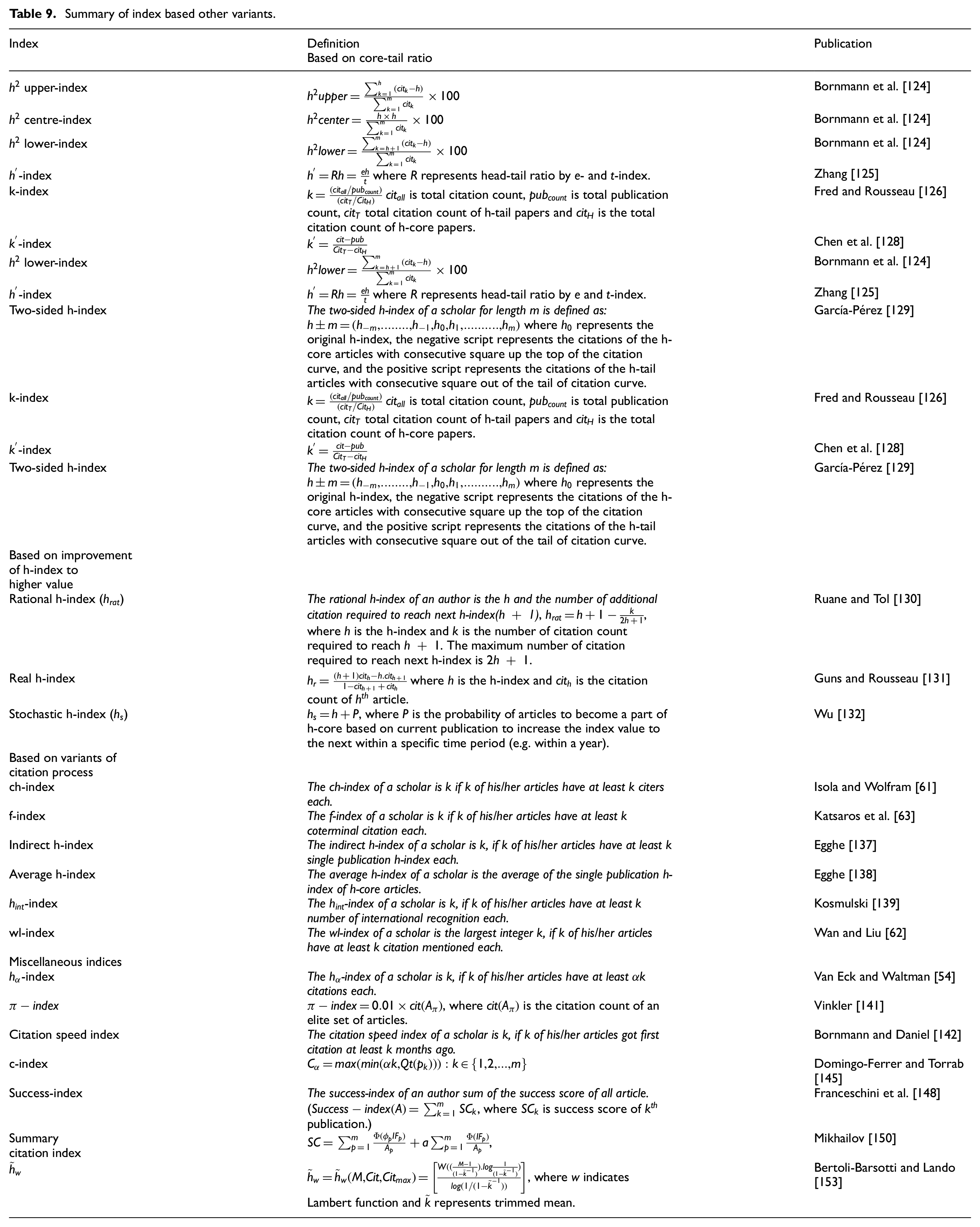
3. Conclusion
In this article, we have done an extensive literature review on h-index and its alternative indices. In the research community, h-index plays an important role in evaluating the scientific impact of an individual, institutions, college or university to grant a research project and a promotion or award. The h-index got a lot of attention due to its simplicity.
Based on the characteristics of h-index and also to overcome the limitation of h-index, several other indicators were proposed by eminent researchers. Some of the variants extended the properties of h-index to overcome h-index big-hit problems, while some eminent researchers proposed other variants of h-index to overcome the multi-authored problem. Many other indices were proposed to overcome publication age problems, excess citation count problem and total publication count issue. Some other variants combine the advantages of two or more indices to overcome the shortcomings of other indices. Several other indicators were proposed to consider other parameters, such as the number of citers, number of citation mentioned, L-factor, NSPs and many more.
During the study, it has been found that all indices are categorised into seven categories as a complement of h-index, based on total number of author, publication age, a combination of two or more indices, excess citation, total publication count and other variants.
In the research community, many other studies discuss the h-index and its alternatives theoretically and empirically and also discuss the advantages and limitations of proposed variants.
Footnotes
Acknowledgements
The authors thank anonymous reviewers for their helpful comments.
Declaration of conflicting interests
The author(s) declared no potential conflicts of interest with respect to the research, authorship and/or publication of this article.
Funding
The author(s) received no financial support for the research, authorship and/or publication of this article.
