



Abstract
Insufficient examination of social factors obscures the reason why non-human information sources are under-utilised by social groups with lower information literacy. This study explores the mechanism of information source selection (ISS) of Chinese migrant farmer workers (MFWs) in different industries by conducting a cross-context analysis. After iterative analyses of multiple cases, a theoretical model of information source selection within an individual’s information world is constructed. It explains why MFWs make more use of social capitals than non-human information sources in information seeking. Besides, the information needs are examined form both the needed information and the need itself. A classification of social capital as human information source is created and the roles that social capitals and non-human information sources play in ISS are identified. This study provides novel theoretical insights into the ‘old’ issue of ISS, and thus has practical implications for public information service providers and MFW-related policy makers.
Keywords
1. Introduction
Since Aguilar [1] initiated the research on environmental scanning in 1967, information source selection (ISS) has been embodied in information seeking behaviour models as an indispensable step now and then, for example, Leckie et al. [2]. Studies that mention ISS cover various professionals or social roles, such as engineers [3,4], business managers [5], enterprise employees [6], scholars [7], postgraduates [8], undergraduates [9], doctors [10], nurses [11], patients [12], consumers [13] and so on. In recent years, specialised studies on ISS have increased in the field of health information seeking [14–16]. Nevertheless, the inner mechanism of ISS in satisfying human information needs is far from being revealed, especially that of manual workers.
Manual workers have different characteristics in ISS from knowledge workers [3,9,17,18]. From the perspective of information poverty, Chatman discussed the importance of social capital as information source for the information poor, for example, temporary workers who came into an employment situation [19]. Temporary workers often have different social status, information worlds and habits of information acquisition from long-term workers. In China, migrant farmer workers (MFWs) are temporary workers without registered permanent urban residence. They come to cities from rural areas for temporary jobs in construction, manufacturing, retailing, express delivery and other service sectors. After finishing a project or temporary job, an MFW may have to migrate to another city for a new job. When arriving a strange city, an MFW is faced with various challenges, such as job-hunting [20], children’s school admission [21], job training [22], health security [23], asking for salary in arrears [24], social integration [25,26], interpersonal trust [27], policy enjoyment [28] and so on. Along with these challenges, a variety of information needs arise.
In significant life changes, an individual needs reliable, sensible and identifiable information [29]. In the process of migration, MFWs’ information acquisition is closely related to their income, security, right protection, and development [30,31]. To meet the information needs arising in various problem-solving contexts, MFWs have to seek information within their limited information worlds [32,33], which involve limited information sources that can be used in a new environment as well as their own low information literacies as most of them only have secondary or senior high school education. Arguably, ISS is critical to the success of an MFW’s information seeking and the subsequent problem-solving after they arrive in strange cities. Investigation into the mechanism of their ISS may not only help develop novel theoretical insights for information seeking research but also help improve the public information services for them.
However, although previous studies have explored some information problems faced by MFWs, such as information acquisition [34,35], information literacy [36], information inclusion [37] and so on, few of them have specially examined the decision-making in their ISS. To make up for this gap, this study will focus on revealing MFWs’ decision-making in ISS through a cross-context research. To achieve this research goal, the following sub-questions are put forward: What characterises the information needs of MFWs? What factors influence their decision on ISS in multiple contexts? What roles do different information sources play in meeting their information needs?
2. Literature review
2.1. Information needs
‘Information needs arise when an individual finds himself in a problem situation when he or she no longer can manage with the knowledge that he or she possesses’ [38]. Information needs, along with the anomalous state of knowledge [39], knowledge gaps [40] and uncertainty [41], are labelled as the motivators for information seeking [42,43]. To find information that satisfies his or her information needs is the goal of user’s information seeking activities [44]. It is even believed that the root of any information seeking is the concept of information needs [45,46]. To meet the information needs, information sources are evaluated and chosen [47].
Information needs are context depended. An individual’s information needs are closely related to his or her physiological, affective and cognitive needs [48]. Allen [49], Westbrook [50] and Agosto and Hughes-Hassell [51,52] proposed that information needs should be conceptualised in the context of problem-solving. Leckie et al. [2] put forward that ‘information needs arise out of situations pertaining to a specific task that is associated with one or more of the work roles played by the professional’. Miranda and Tarapanoff [53] classified information needs into cognitive, emotional and situational ones in business context. Shoham and Strauss [54] identified three groups of core information needs of immigrants: existence, relatedness and growth ones. The contextual elements of information needs have been fully explored [55,56], involving task [2,57,58], demographics (e.g. age, profession, specialisation, career stage, location) [59,60] and so on. MFWs’ information needs are determined by their internal and external contextual factors, and will be identified and classified through a multi-case study in this study.
In addition, the attributes of information need as a holistic concept have been discussed in a great deal of studies, involving importance [57,58], urgency [61,62], complexity [62–64], predictability [65], specificity and types [12], and so on. However, few of them have paid attention to the difference between the needed information and the need itself. This cursory use of the concept leads to its low explanatory power in examining ISS in detail and having been substituted by the concept of task in many situations. To better analyse the motivation for a specific ISS action, it is necessary to elaborate the picture of an information need by making distinction between the needed information and the need itself.
2.2. ISS
Information source is a real or virtual entity from which a person obtains information via certain channels. Organisational information sources were divided into internal and external ones [1,66–68]. For an individual, information sources were divided into interpersonal and non-interpersonal ones [69,70] or relational and non-relational ones [16]. Agarwal et al. [62] further classified interpersonal sources as face-to-face, letter or mail, telephone, email, online conversation or online forum, and classified non-interpersonal sources into book or handbook and online non-human sources. Liu et al. [71] found that young farmers in a village acquired employment information mainly through internal social capital when they prepared to work in cities.
Using previous studies for reference, this study classifies information sources into two types: social capital (human information sources) and non-human information sources. The former will be discussed in Section 2.3. The latter include four types: the Internet, libraries, mass media (such as TV, broadcasts and newspapers) and field information source. Here, the Internet as a non-human information source does not include one’s online friends made through instant messaging tools, such as Facebook, WeChat, and QQ.
When confronted with more than one source that can meet a specific information need, one’s ISS happens. Choice of information source directly influence the success of information seeking [72,73]. Professionals seek information from an endless number of sources, such as colleagues, librarians, handbooks, journal articles, and their own personal knowledge and experience [2]. ‘Everyday life information seeking (ELIS) practices tend to draw on the habitualized use of a limited number of sources which have been found useful in previous use contexts’ [74]. Based on the concept of information horizon put forward by Sonnenwald in 1999 [75], Savolainen and Kari [76] developed a concept of information source horizon that ‘enables one to put various information sources and channels in an order of preference to meet the requirements of information seeking’ based on one’s conceptions of the characteristics of information sources, particularly their accessibility and quality.
A variety of perceived attributes of information sources have been identified as the basis of choice, such as accessibility, usefulness, ease of use, credibility (trustworthiness or reliability), relevance, familiarity or prior success, comprehensiveness, authoritativeness, interactivity, timeliness, time pressure, packaging and cost [2,3,5,12,77–88]. Accessibility was further elaborated into physical (proximity)/approachability [3,16,87,89], relational [90] and cognitive ones [78–80].
Associated with information need, ISS is also context-dependent. Wang et al. [91] constructed an integrated ISS model based on literature, describing the influence of task and environment on ISS. Zhang [12] analysed the influence of information user’s features on his or her ISS, involving learning style, habit, interest, privacy concern, gender and education. Besides, the influence of user’s motivation or intention on ISS was also discussed [43,87,92]. Savolainen found that the major source preferences of information seekers for non-work purposes were content of information, and availability and accessibility, while the usability of information sources, user characteristics such as media habits, and situational factors were mentioned less frequently as preference criteria [93]. Rosenblum et al. [94] found that source preference across professional strata of dental clinicians vary with perceived question relevance.
2.3. Social capital
‘Social capital is a form of capital inherent in the structure of social relations, which means that a person can get financial or human capital from a friend, colleague or wider contacts’ [95]. Social capital includes obligations and expectations, information channels and social norms [96]. Woolcock and Narayan [97] and Putnam [98] distinguished between bonding and bridging social capital. Bonding social capital refers to resources that can be obtained from the closest and most homogeneous relations and is frequently associated with network density or closeness, trust and common norms [99]. Bridging social capital refers to the resources derived from ‘weaker’ or more distant relations and is related to the diversity of one’s social network [100]. Coffé and Geys [101] further defined binding social capital as a social network consisting of individuals with similar socioeconomic characteristics (age, gender and social class), and bridging social capital as a ‘crosscutting’ social network. Mateju and Vitásková [102] drew on the theory of social stratification to define linking social capital as ‘the links between units from different social strata, such as connections between a small community and state institutions’. The imbalance in social support networks and social discussion networks between MFWs and local inhabitants may hinder MFWs’ social inclusion, which might cause them to remain at the bottom of urban society for a long time [103].
Informational resources, trust and reciprocity coexist in a person’s social capital [97]. Robinson [104] found that adolescents draw on different information sources: personal social networks, educators and online information when planning educational and occupational careers. Mirzaei and Esmaeilzadeh [105] found that perceived channel richness positively influences individuals’ expectation of receiving informational and emotional support, willingness to share health information and engagement in online health communities. Johnson [72,73] conducted in-person interviews with 320 residents of Mongolia and found that social capital is a significant factor in explaining their preference for interpersonal information sources. Social networks can help job seekers to obtain position information [106,107]. As an outcome of rational choice, Chinese farmers frequently turn to genetic and geographic social networks to seek employment information when leaving their hometowns [108]. MFWs’ ability to build and expand relational network is important for them to obtain employment opportunities [109].
‘Social capital is one of the contextual factors that shape information practice in both organizational and everyday-life settings’ [110]. ‘Social networks play an important role in human information behavior through helping to define an individual’s information horizon and through actively participating in the human information process’ [75]. ‘Social networks promote information transmission’ [111], help actors access information in a broader context, and improve the quality, relevance and timeliness of information [112]. Social interactions are considered as an important complement of and are interwoven with in-group collaborative tourism information seeking [113]. Tötterman and Widén-Wulff [114] found that cultural differences and social norms are barriers to information sharing between university professors. Audunson et al. [115] used social capital theory to study the role of public libraries in fostering trust and social interaction as low intensive meeting places in three metropolitan Norwegian communities. Zimmer and Henry [85] found that the structural, cognitive and relational dimensions of social capital have significant positive influence on users’ perception of information quality and accessibility of interpersonal source.
3. Research design
3.1. Research method
To answer the research questions, multiple case study is adopted as the research method of this study. Case study method is generally used to examine a phenomenon in a natural setting [116] and ‘is particularly appropriate for research that focuses on “how” or “why” questions concerning a set of contemporary events’ [117]. Multiple case study is generally thought as a more robust design than single one since it ‘enables observation and analysis of a phenomenon in several settings’ [118]. For this study, multiple case design is appropriate for the cross-context analysis of MFWs’ ISS and the generalisation of research findings.
3.2. Research objectives
For an MFW, the contexts of ISS involve various situations of his or her work and life. Among them, employment is critical to his or her living-making in a long or short period of time. To find a satisfied job, MFWs often try every possible means to seek employment information from all available sources. For this reason, cases in the context of employment information seeking are used to develop theoretical categories and propositions of ISS. Another important context of MFWs’ ISS is legal right defending in which they need to make extra efforts to seek some complex information that they have never encountered before. Therefore, cases in the context of legal right defending are used to refine the results derived from the context of employment. Besides, cases related to the contexts of policy information acquisition, house-renting and learning are used to test the results. The research objectives are as follows:
Identify the information needs of and information sources selected by MFWs as well as their characteristics from all the cases.
Develop a theoretical model for the ISS of MFWs through the cases in job-hunting context.
Refine the model with the cases related to legal right defending.
Test the model with cases in other contexts.
3.3. Data collection
A semi-structured interview outline was developed, covering the following issues: (1) daily information needs; (2) consideration in ISS decision; (3) use of non-human information sources.
According to Yin [119], multiple case study follows replication logic instead of sampling logic. Interviews via face-to-face, online and phone channels were conducted from January 2012 to March 2018, involving four cities, Shanghai, Tianjin, Yinchuan (the capital of Ningxia Autonomous Region) and Baoding (a city in Hebei province). Shanghai is a developed metropolis that attracts a large number of MFWs from the south of China, whereas Tianjin is a large city that gathers many MFWs from the north. Yinchuan is a medium-sized city in the west, and Baoding is a small northern city. Two successive non-participatory observations were conducted, respectively, in a field of family interior decoration and that of courtyard decoration in Tianjin from March 2016 to October 2017. Besides, the author entered a QQ group of 83 MFWs with consent and conducted a successive non-participatory observation from January 2012 to January 2020.
During nearly 8 years, a total of 56 interviewees, including 52 MFWs from different industries, one manager of an advertising production company with more than 10 MFW employees and three decoration contractors who led MFW teams, participated in 41 one-to-one interviews and two focus group interviews. One focus group interview conducted in Tianjin involved eight male workers from a decoration company, and another one conducted in Shanghai involved six female cleaners of a university library. In total, 23 h 11 min of interviews and about 26 h of observations were recorded, and 102,000 Chinese words were transcribed.
4. Case analysis
4.1. Information needs of MFWs
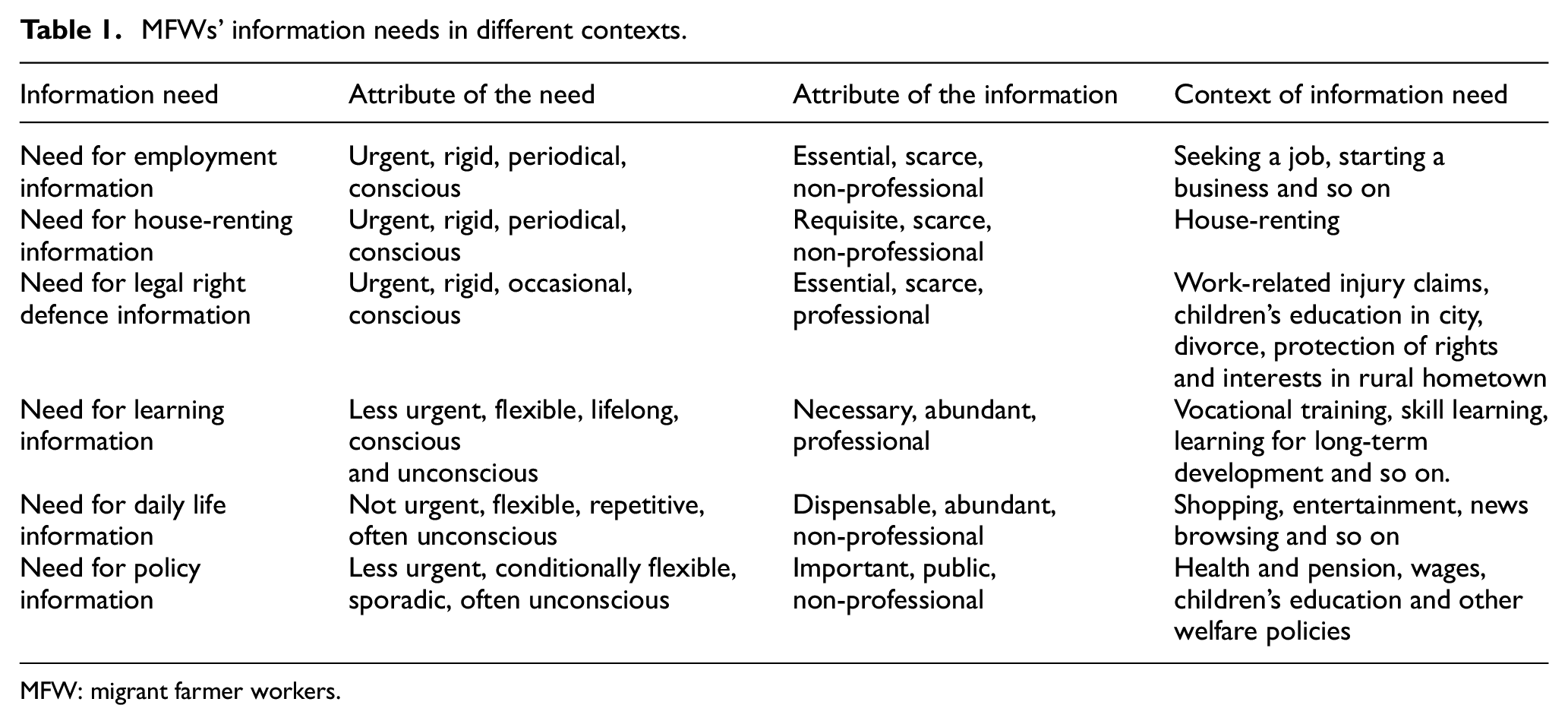
Five kinds of information need and their characteristics and contexts are identified. Each kind of information need comprises two parts, the needed information and the need itself. For an MFW, the need has attributes of urgency, periodicity, flexibility and perception state (conscious and unconscious), while the information has attributes of importance, scarcity and specialty, as shown in Table 1.
MFWs’ information needs in different contexts.
MFW: migrant farmer workers.
Before MFWs leave hometown, employment information is essential and the need is urgent for them. When they come to city, house-renting information is indispensable and the need is quite urgent. When they settle down and begin to work, very few of them may encounter legal right defending events, such as work-related injury claims, children’s education in city, divorce, right and interest protection in rural hometown and so on. This kind of information is extremely important for them, but not easy to access to for its specialty and their relatively low social status in city. Policy information related to MFWs often concerns their rights and interests, including health and pension, wages, children’s education, subsidy and other welfare. This kind of information need is less pressing but very important. Besides, learning knowledge and professional skills is also a long-term existing but often ignored need. This kind of information need is less urgent, self-motivated and implicit. According to the urgency of the need and the importance of the information, MFWs’ information needs can be presented in a quadrant, as shown in Figure 1.
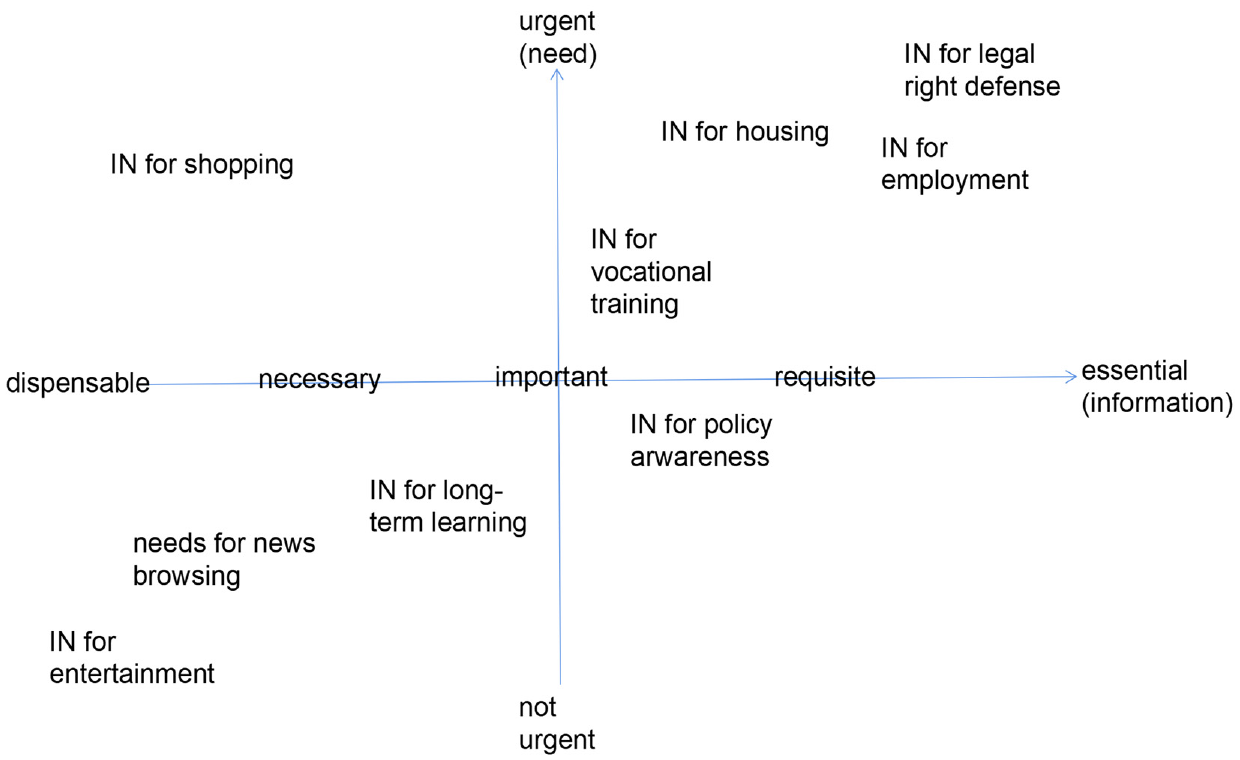
Information needs (IN) of MFWs in different contexts.
4.2. ISS in job-hunting
4.2.1. Case analysis
Most interviewees have more than once job-seeking experiences, especially those who work in industries of construction, decoration, cosmetology and restaurant. Of the 52 interviewed MFWs, 92% got information of their first job from family members, relatives or fellow-villagers, which can be categorised as bonding social capital. While working in city, some of them managed to expand social network. A bricklayer from Ningxia said, ‘A friend introduced a job in Inner Mongolia to me last year. I knew him when I worked in Gansu province a few years ago’. A cleaner who worked in a university library in Shanghai said, ‘A teacher (librarian) introduced my current part-time job (as a domestic worker)’. The ‘friend’ or the ‘teacher’ are new social relations built in workplaces, which can be categorised as bridging social capitals. Besides as information source, social capital brings added value. A decorator said, ‘Let me tell you. You will have no place to live if you go to Beijing. You will run out of money within three days if you live in a hotel 200 yuan per night. It would be really difficult if you have no acquaintances there’. Here, the ‘acquaintances’ means economic or emotional supports.
In addition to interpersonal relations, MFWs also obtain employment information from free labour markets, government labour agencies or commercial employment agencies, which can be named as urban social capital. In some cities, free labour markets emerge spontaneously at fixed locations. For example, many MFWs gather beside a flyover in Tianjin every morning and wait for temporary work. Employers who need additional or specialised temporary workers come to the market in early morning and take eligible workers to workplace after bargaining. The market often ends after 9:00 a.m. and most workers can get a work. These markets help MFWs reduce the cost of information seeking and mitigate the risk of getting fake information. Newcomers know these marketplaces from their relatives or villagers who have arrived earlier. This implies that urban social capital works through the interpersonal networks. It was also found that MFWs who work in developed cities are more likely to trust commercial employment agencies than those in small cities. Most of the cleaners in Shanghai got their part-time job through commercial agencies, whereas a decorator in Tianjin reported that he had been cheated by an employment agency in Baoding in 2009. These stories indicate that developed cities can offer more accessible, trustworthy and cheaper urban social capitals than underdeveloped cities.
Young MFWs occasionally obtain job information from friends made online, which can be categorised as virtual social capital. Compared with young MFWs, those over 40 years old have more difficulties in making friends via the Internet and are less likely to believe ‘people on the Internet’. ‘Online information is deceitful. You couldn’t find him if he ran away’, said a worker who never accessed the Internet. A decorator said, In a QQ group, I was introduced to a guy who had a work (project). But when I finished the work, he disappeared without payment, 80,000 yuan! … I couldn’t find him. Online people are not as reliable as fellow villagers.
This shows that credibility is the first important factor that influence an MFW’s ISS in job-seeking.
Some MFWs take the Internet as a job information source occasionally. An 18-year-old assistant barber said, ‘Most of my friends look for job on the website of “58 Same City” or “Ganji” (two recruitment websites)’. A cleaner below the age of 40 years said that her husband found his current job through a recruitment website. ‘If he depended on friends (to find a job), he had to do the same type of job as before. However, the present job (found on the Internet) is completely different and pays more’. This confirms that MFWs in developed city with better urban social capital are more likely to trust non-human information sources. This also implies that non-human sources may bring heterogeneous information with higher value.
A minority of MFWs go to factory sites to browse recruitment posters. An MFW over 60 years who worked in a feed mill said, ‘I rode a bike and looked around in this area (factory sites). When I saw a recruitment poster on the gate, I came … I live nearby’. Here, physical vicinity is an important condition for selecting field information source.
4.2.2. Social capital as information source
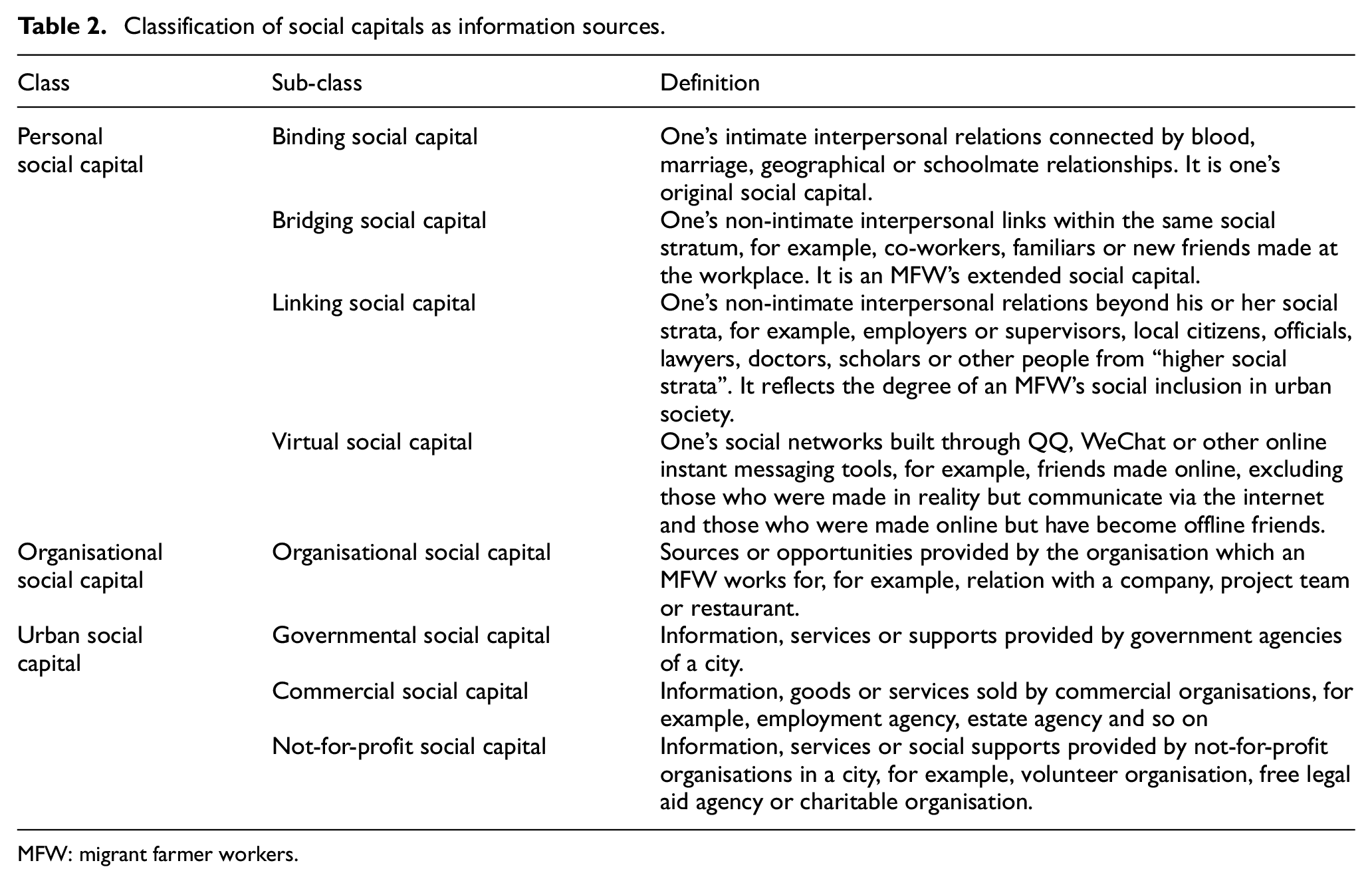
Sources from which MFWs acquire employment information can be categorised into three types: social capital, the Internet and working sites. The social capitals taken as information sources include three types: personal, organisational and urban ones, as shown in Table 2.
Classification of social capitals as information sources.
MFW: migrant farmer workers.
The personal social capital of an MFW can be classified into four types: the binding social capital, the bridging social capital, the linking social capital and the virtual social capital. Over time, one’s virtual social capital may evolve into realistic one as a ‘virtual friend’ may become an offline friend. The urban social capitals can be classified into non-profit, commercial and governmental ones. The organisational social capital is mainly provided by the contracting team or factory where an MFW works, which may be responsible for recommending a new job after a contract ends.
4.2.3. Decision mechanism of ISS in job-hunting
By iterative analyses and comparisons of the data, accessibility and credibility are identified as the chief consideration when an MFW selects employment information source. Accessibility involves spatial, economic, social and capability distance, and credibility depends on the observability of information authenticity, the traceability of information origin and the accountability of disinformation provider. Generally, MFWs are more likely to select personal social capital than non-human information sources when looking for a job because the former are more accessible and credible. Besides, the importance of the needed information (e.g. job information) influences an MFW’s deliberation because false information may bring great loss to him or her, which is often unacceptable for him or her given his or her low risk bearing capacity. An initial model of ISS in job-hunting is presented in Figure 2.
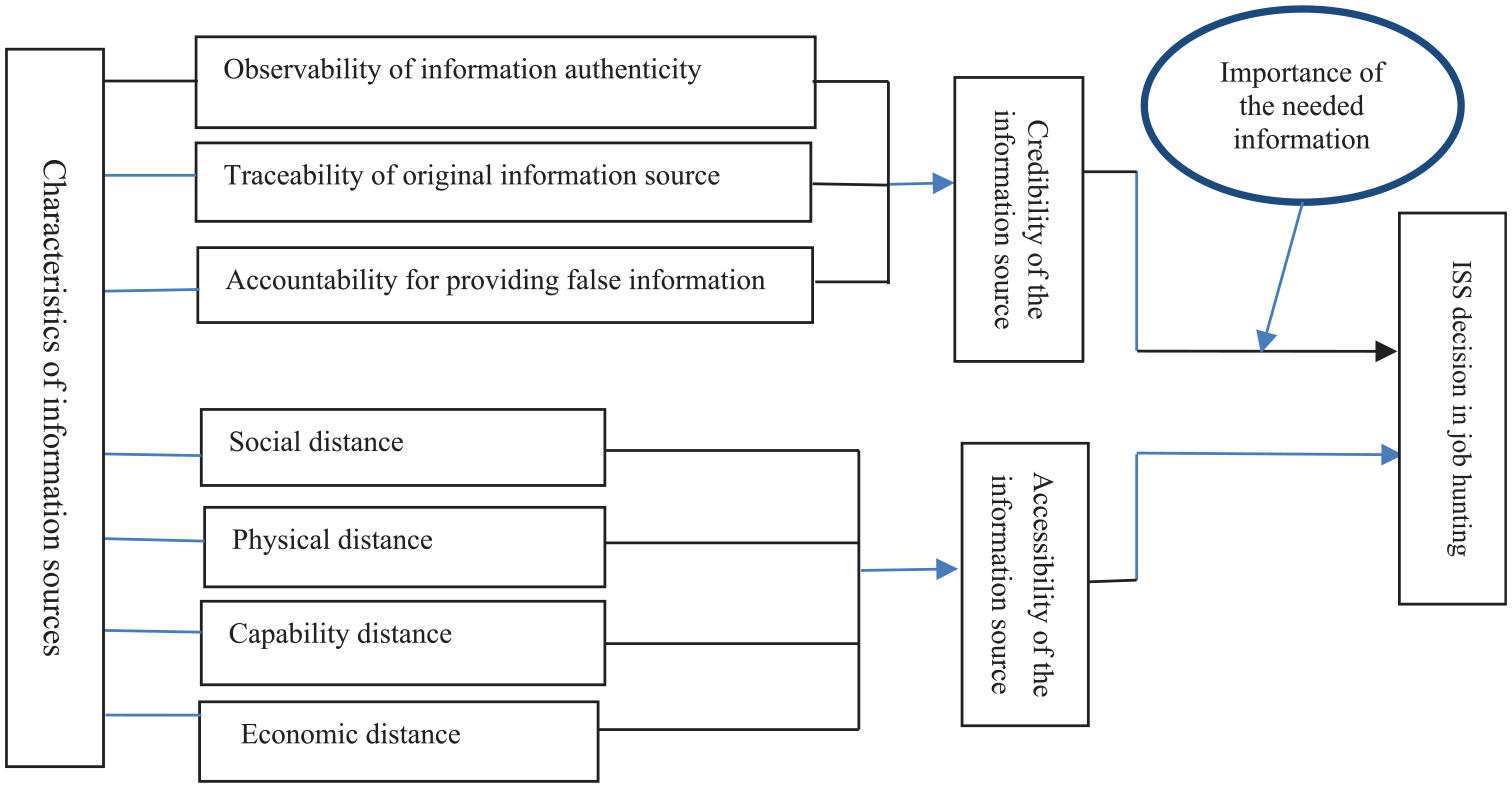
An initial ISS model of MFWs in job-hunting.
4.3. Refining the research results in the context of legal right defence
Six of the 52 MFWs interviewed had experienced one of the following events that need to defend legal right, injury on-the-job, domestic violence and divorce, accident happening to left-behind family members, children’s school admission, deception in job-seeking, and wage arrears. Half of them initiated a legal proceeding.
An MFW who had claimed injury on-the-job insurance compensation said, ‘At the beginning, I searched the Internet to look for a department in charge [online information]. The message on Baidu Knowing indicated to terminate the labor contract at first if there is one, and then go to the Labor Bureau to look up relevant documents [urban social capital]. Later, a lawyer introduced by a powerful elder of mine confirmed the procedure [linking social capital]’. A lady who was undergoing a divorce proceeding said that although she had found several legal provisions on the Internet [non-human information source], she could not understand them. ‘It looked like a law document… too long. I didn’t finish reading. I don’t understand it [understandability], let alone use’. With the help of a librarian [linking social capital], a cleaner successfully solved the problem of her child’s school admission after communicating with Shanghai Education Bureau [urban social capital]. Another cleaner said that a non-profit legal aid agency helped her husband claim back 70% of 1 month’s wages after quitting from a factory, ‘It (the legal aid agency) [urban social capital] was in the street that we passed by every day, with a phone number on the sign. Free service… After I called it, a gentleman came by car. Then, the money came back’. That’s not always the case, the interviewees No. 24 and No. 18 gave up the pursuit of their rights because the money involved is too little or the cost to claim is too high for them.
When attempting to acquire specialised and complex information, MFWs tend to use different information sources interchangeably. In the context of legal right defending, online information is often tried first for its accessibility, but may not be fully understood or trusted. Then a professional (for example, lawyer) or online QA system is selected to interpret complex documents, or to confirm or supplement the information obtained. The binding or bridging social capital with higher trustworthiness and accessibility mainly plays a role as an intermediary to professional sources. The general process of ISS in the context of legal right defence can be visualised as Figure 3.
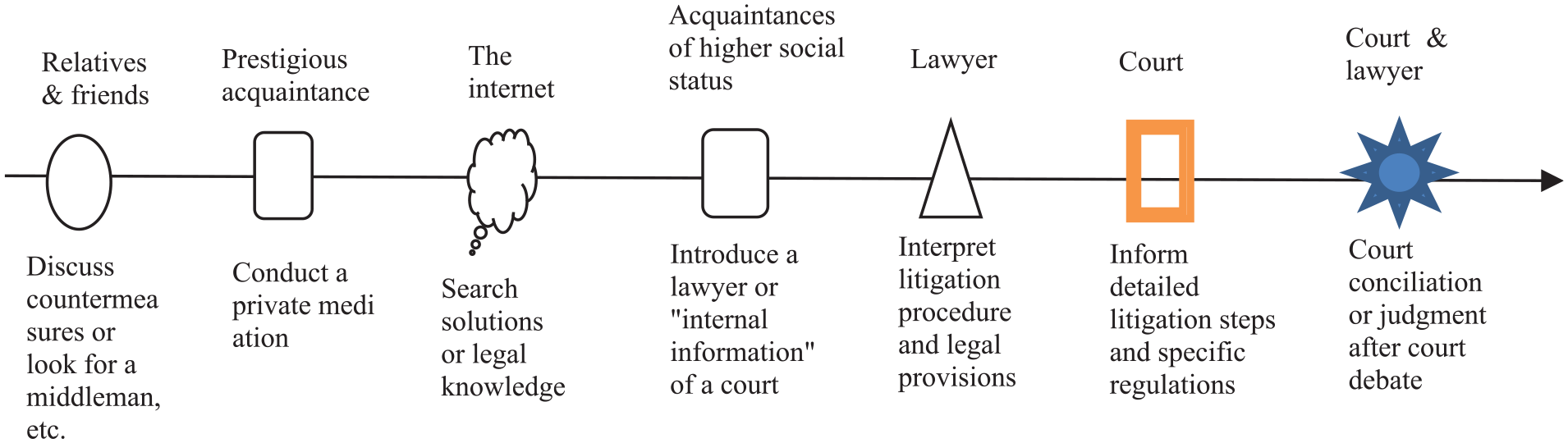
The ISS process of an MFW’s legal right defence.
4.4. Test of the research results in other contexts
Use the other three contexts, learning, policy awareness and housing renting, to test the research results obtained. As the information needed in these contexts are not so complex and the needs themself are not so urgent as that in the context of employment information seeking and legal right defending, only part of the research results that reflect contextual characteristics are presented.
4.4.1. Learning
The positions of MFWs often require professional skills, for example, welders, bricklayers, decorators, machine operators, and so on. They learnt professional skills mainly from five sources: (1) Family members or a master, particularly in building and decoration industries [binding social capital]; (2) Training provided by employers [organisational social capital]. (3) Technical schools or commercial training programmes, for example, for chef and tailor [urban social capital]. These sources are not appropriate for complex knowledge learning. A 27-year-old manager of a clothing shop said that he had failed in business negotiations because he knew little about tax affairs. ‘Nobody around me knew the knowledge’, he said. (4) Online friends. A young barber assistant joined a QQ group of peers. ‘I keep silent. Just observe and learn from other people’. (5) Non-human information sources, such as books, libraries, online resources and mass media. Case 25 managed a small factory and has strong innovative spirit. He had worked as teacher of primary school, salesman, worker of chemistry factory and project contractor before. He said, ‘I bought books once I started a new business. Reading is useful’.
It is interesting to find that MFWs make less use of non-human information sources than social capital in learning. The reasons are mainly as follows: (1) Many professional skills (tacit knowledge) cannot be learned without face-to-face demonstration. (2) Have no time. A young contractor in courtyard decoration said, ‘Workers work from morning till night. They are so tired that they fall asleep once they get home. They have no time to read books’. (3) For the lack of information search skills. Many MFWs do not know how to search and download online video courses. (4) An MFW’s learning motivation is closely related to his or her expectation on the instant return of a kind of knowledge. The knowledge that cannot be applied in the current work or yield immediate return is not thought to worth the time to learn even if it has long-term value. An exception is a 37-year-old technical worker in a feed mill who had got senior high school education. He learnt computer repairing skills in a commercial training class at his own expense in his spare time. He said, ‘The knowledge may be useful in the future’. He was right. When the feed mill where he worked went bankrupt 1 year later, he was soon recommended a new job as a computer technician.
4.4.2. Policy awareness
Policies concerning MFWs involve children’s school admission, right protection, medical care, pensions, unemployment insurance, hometown property protection and so on. For MFWs, policy information sources include official channels ( e.g., directional SMS), mass media and personal social capital. For example, in rural area, the village committee is responsible for informing every family about relevant policies or public affairs via broadcasting or door-to-door visit. Then, the family members inform the MFWs who work outside. In city, this duty is often carried out by the resident committee, or the employer. This means that governmental social capital is the main source of policy information.
4.4.3. House-renting
MFWs obtain house-renting information mainly from villagers or acquaintances who came to the city earlier. This results in the formation of communities of fellow-villagers in the suburbs, for example, Henan village or Anhui village. The binding social capital benefits MFWs in information sharing, risk response and emotional support. Meanwhile, it also reduces their motivation to establish links with local citizens or workers from other places and thus hampers their social inclusion in city in some way.
5. A theoretical model of ISS within an individual’s information world
The information world of an MFW consists all the information sources accessible to him or her, his or her own information capability and his or her information needs in various contexts. Based on the above cross-context analysis, a model of ISS within an individual’s information world is developed, as shown in Figure 4.
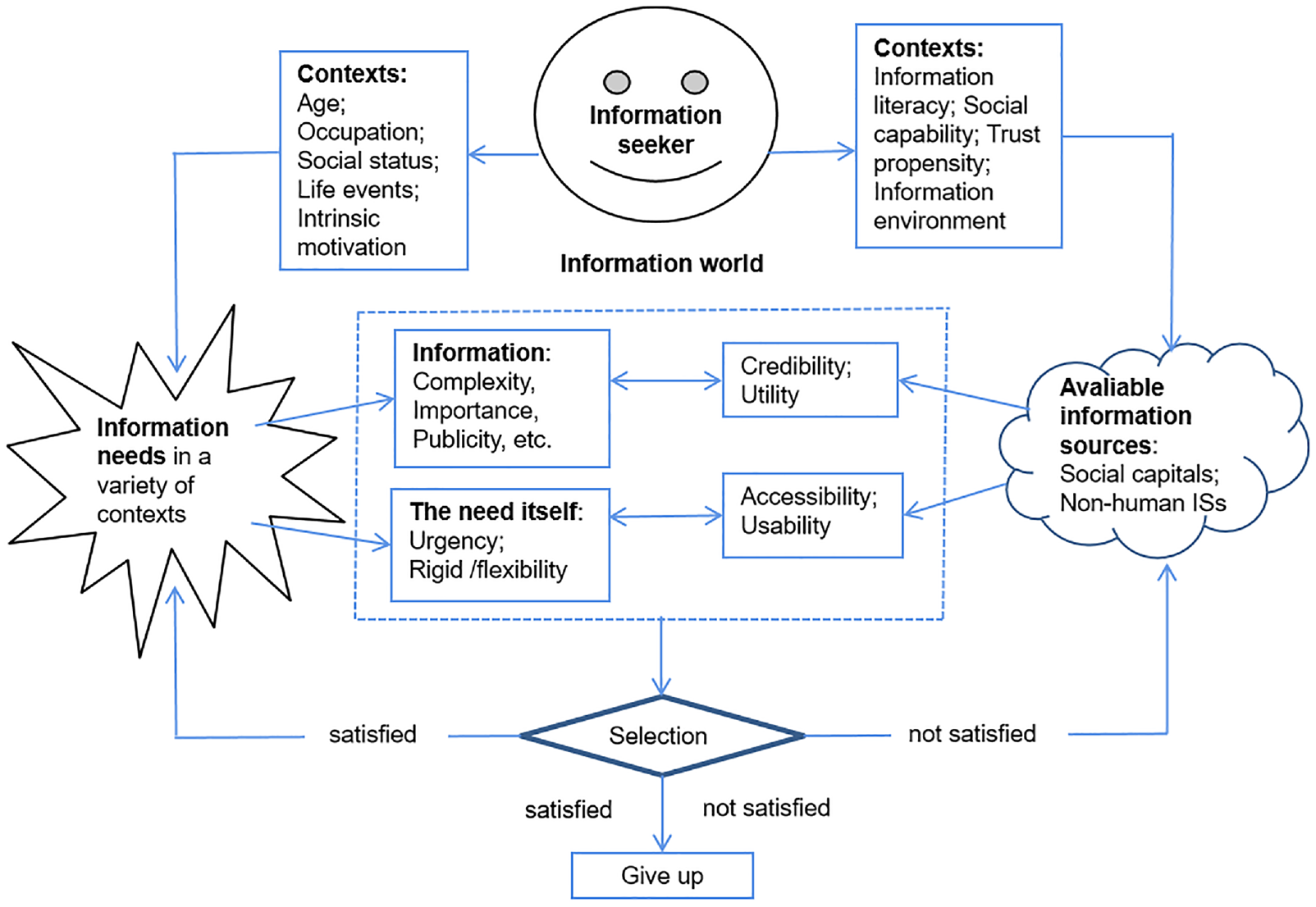
A theoretical model of information source selection within an individual’s information world.
The action of ISS is aimed at satisfying one’s conscious information needs in a specific context. When an individual decides to select one or more from available sources, he or she may have consciously or unconsciously judged its trustworthiness, accessibility, usability or added values. The weights of these criteria in his or her judgement are moderated by the complexity, importance and publicity of the needed information and the perceived urgency and flexibility of the need. Meanwhile, the number and quality of available information sources are determined by one’s social capabilities, information literacy and personality tendencies as well as his or her external information environment. Meanwhile, the type and characteristics of one’s information needs are influenced by his or her occupation, social status, age, education, and other contextual factors. Occasionally, an information need may be satisfied by unintentional encountering. Sometimes, new information needs (e.g. learning) may arise after one need is successfully satisfied. Some information needs may not be satisfied subject to limited available information sources, then one may give up or go back to readjust the information need. During the process of satisfying various information needs, one’s social capability or information seeking capability may get improved as a learning effect.
In the theoretical model of ISS within an individual’s information world, information seeker, information needs and information sources are three poles of ISS. Their characteristics are identified, as shown in Table 3.
Characteristics of three elements of ISS.
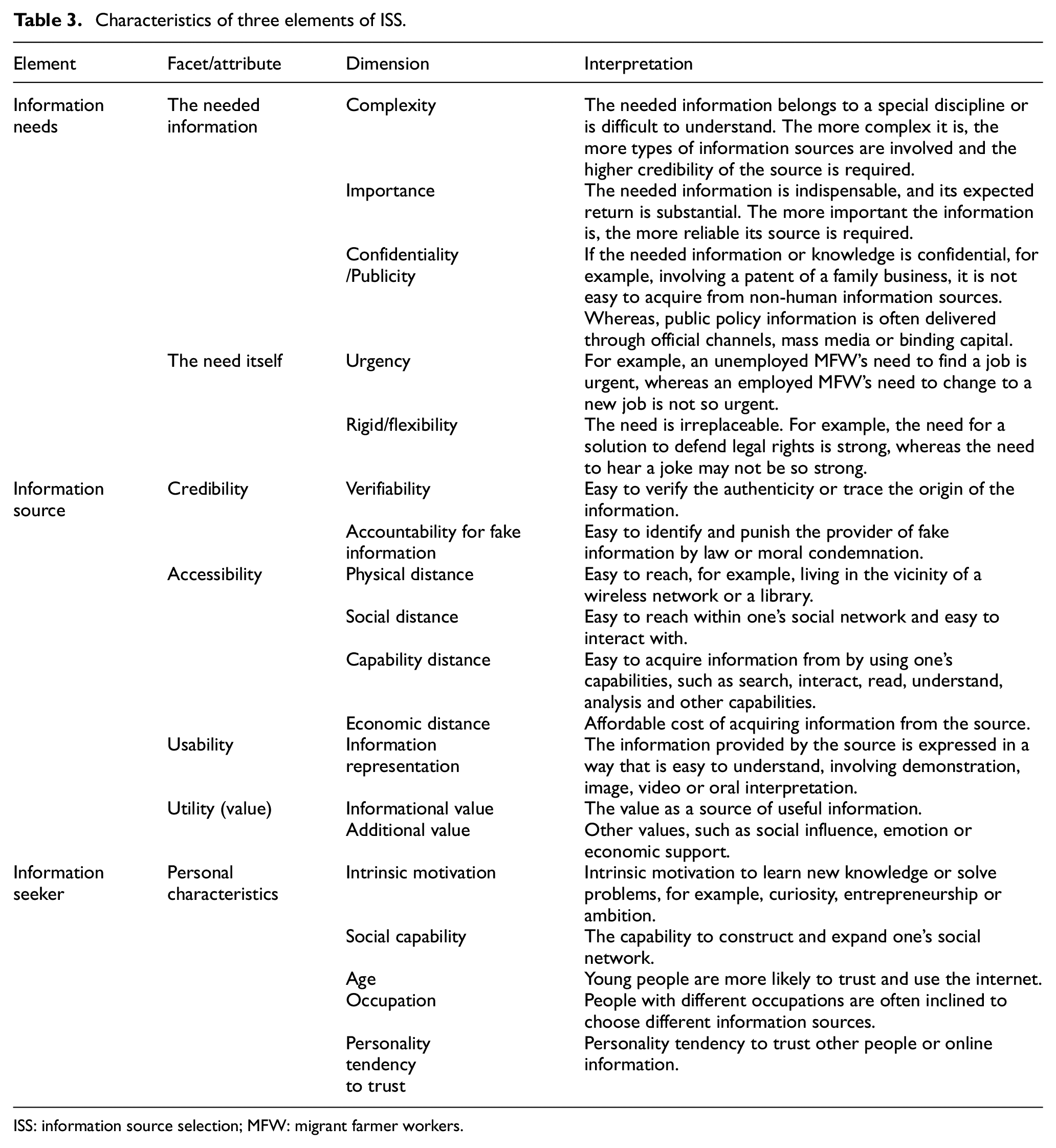
ISS: information source selection; MFW: migrant farmer workers.
In general, MFWs make more use of social capital than non-human information sources in different contexts because the former performs better than the latter in credibility, accessibility, usability and added value. For example, the linking social capital may bring heterogeneous resources and opportunities as weak tie but is not easy to reach; government agencies provide authoritative and trustworthy policy information, but its usability may be limited by an official language style or the social distance between citizens and government departments. The characteristics of the three elements of ISS that are shown in Table 3 can be taken as evaluation indicators to predict the success of one’s ISS.
6. Discussion and conclusion
6.1. Discussion
This study found that the complexity, importance, confidentiality or publicity of the needed information, and the urgency and flexibility of the need itself influence the ISS decision of MFWs. These findings are consistent with the results of previous studies that the complexity, importance, relevance and urgency of a search task impact users’ ISS [57,66,110,120]. Agarwal et al. [62] found that the more important a task is, the higher the information quality is required. This study also found that when one’s information need is complex or specialised, he or she tends to try more information sources alternately.
A classification of information sources including social capitals and non-human sources was constructed, which elaborates the distinction between interpersonal and non-interpersonal sources in previous studies [57,69,70]. Social capital includes three sub-classes: personal, organisational and urban ones. The personal social capital is divided into four types (binding, bridging, linking and virtual), and the urban social capital is divided into commercial, non-profit and governmental ones. This does not only deepen the research on social capital but also elaborate the concept of interpersonal information sources.
The perceived credibility, accessibility, usability and added value (utility) of information sources were found to have strong influence on the ISS of MFWs. Previous studies have proved the importance of the reliability, credibility or authenticity of information sources in ISS. Foster [121] found that managers seldom select social media as information sources for its low reliability when making important decisions. Baker et al. [122] also found that patients trust the information provided by doctors more than that from other sources. This study found that the verifiability of information authenticity, accountability for disinformation and the personality of the information seeker determine his or her judgement on the credibility of an information source. According to Granovetter [100], strong ties provide trust, whereas weak ties provide new opportunities. Because of the vulnerability to risk, MFWs prefer reliable information sources, such as binding and bridging social capitals.
The accessibility of an information source comprises physical, social, economic and capability dimensions. Accessibility is not only helpful in explaining the choice between social capital and non-human information sources but also helpful in explaining the choice between different types of social capital. Usability and its facet understandability have been identified by a large number of previous studies [123,124]. Zimmer et al. [90] found that information sources with higher usability are more convincing in organisational decision-making.
Different from previous studies, this study identified the added value of social capitals, such as economic or emotional support, social identity or social influence, and so on. From a different perspective, Zhang [12] put forward that relation may lead information seekers to make irrational choices in health information searching. This study found that social relations, particularly the linking social capital, can bring more positive value to MFWs.
The personal characteristics of the information seeker, such as intrinsic motivation, age, occupation, social capability and personality tendencies, were found to be influential in ISS decision. Previous studies have demonstrated the influence of age [125–128], occupation [4,129], and intrinsic motivation to learn [92] on individual’s information seeking. The contribution of this study is that it identified the influence of one’s social capability and personal tendency of trust on his or her information source extending and selecting.
This study found that MFWs are more likely to utilise social capitals than non-human information sources in information acquisition mainly because personal social capital and organisational social capital perform better in trustworthiness, accessibility, usability and additional value than other sources. Pereira and Barbosa [130] also found that consultants perceived that interpersonal information sources have stronger relevance and credibility than non-human sources. In addition, this study found that the urban social capital of developed cities is better built than that of underdeveloped cities, and the virtual personal social capital of the young is better developed than that of the older people.
A limitation of this study is that it did not directly compare MFWs’ ISS with that of mental workers who have higher information literacy or social status. However, it indirectly addresses the problem by analysing the relationships between the characteristics of MFWs’ information needs and their corresponding ISS strategies. Another limitation of this study, which is also a common flaw of qualitative case study, is that the newly constructed theoretical model has not been tested in experiments under stricter conditions. To generalise the research results, empirical studies will be conducted in the follow-up studies.
6.2. Research implications
The research findings of this study can help public libraries, information intermediaries or legal aid agencies better understand MFWs’ information needs and their ISS, and thus provide more pertinent services for them. A previous study found that some librarians of public libraries do not understand why the special reading rooms for MFWs are rarely used [131]. Another study found that few of the websites specially for MFWs had attracted enough MFW users [31]. The reason is that the libraries and websites did not understand the decision mechanism of the ISS of MFWs. The ISS model within an individual’s information world constructed in the present study can help information service providers better understand the information needs and the ISS process of information users, and develop more targeted service strategies for them.
This study also can help government agencies or non-profit agencies improve service quality for MFWs from the following aspects: (1) improve the construction of urban social capital or public infrastructure; (2) help MFWs extend linking social capital via organising public social activities or free labour markets; (3) disseminate policy information to scattered MFWs via more effective channels, such as directional SMS and WeChat message; and (4) encourage non-profit agencies or volunteers to provide specialised information service for different MFW groups.
6.3. Conclusion
This study reveals the decision mechanism of ISS through a cross-context analysis of Chinese MFWs in different industries. After iterative data analysis, the factors that influence MFWs’ decision in ISS, associated with information needs, information source and information seeker, and the relationships between them were identified and categorised. The characteristics of MFWs’ information needs are investigated in detail from the needed information and the need itself. An elaborated classification of social capital as human information source was created and the role that different social capitals and non-human information sources play in ISS was examined in depth. On this basis, a model of ISS within an individual’s information world was constructed, which can be used to explain the phenomenon that MFWs make more use of social capitals than non-human sources in meeting their information needs in multiple contexts. This study provides novel theoretical insights into the ‘old’ issue of ISS by deepening the research on the social capital as human information source and elaborating the research of information needs, and has practical implications for information service providers and MFW-related policy makers.
Footnotes
Acknowledgements
The author thanks the students who participated in interviews and record transcription in the past few years – doctoral students: Xin Zhang, Peng Song, Feng Chen, and Yujia Zhai, and master students: Hongqian Yan, Ying Wang, Zhaojing Li, Meiling Bai, Ge Wu, Yan Zhang and Qian Chen.
Declaration of conflicting interests
The author(s) declared no potential conflicts of interest with respect to the research, authorship, and/or publication of this article.
Funding
The author(s) disclosed receipt of the following financial support for the research, authorship, and/or publication of this article: This study is part of the project titled ‘Information Acquisition of Chinese Migrant Farmer Workers and the Construction of an Inter-Regional Public Information Service System for Them’, which is supported by the National Natural Science Foundation of China (Grant No. 71173121); and the major project of the National Social Science Foundation (Grant No. 20ZDA039).
