



Abstract
The purpose of this study was to examine the effect of perceived organisational policies (POPs) on knowledge management (KM) with regard to the moderating role of transformational leadership (TL) and librarians’ professional commitment. The study was conducted in three stages. First, the research moderating variables were chosen through an explorative study and surveying the librarians. Following the design of the theoretical model, the Delphi method was employed to validate it. Finally, the model was tested with a sample of 205 librarians working at Iranian state universities. To examine the causal relationships between the research instrument variables, the structural equation modelling technique and Smart PLS software were used. The results of the study revealed that POP was moderated through TL and the librarians’ professional commitment and affected the processes of knowledge acquisition and identification, knowledge generation and sharing, and knowledge application. The results, further, confirmed the strong effect of POP on professional commitment and the effect of TL on KM. The findings indicate that moderating the negative effects of POP in academic libraries could pave the way for the improvement of librarians’ job performance. To date, no empirical investigations have examined the effect of POP on KM in libraries with regard to the moderating role of TL and the librarians’ professional commitment. This study is assumed to fill this gap.
Keywords
1. Introduction
The development of librarians’ performance goes beyond a mere focus on their job description which is to perform the expected tasks. The librarians’ beyond-duty behaviours, affected by various factors, improve their performance and ensure their survival. This makes them more active to achieve the goals of libraries. According to the previous studies, the implementation of knowledge management (KM) processes in libraries paves the way for developing the librarians’ professional performance, increasing their beyond-duty behaviours and enabling the delivery of value-added services [1–3]. Some positive implications of KM implementation in libraries are the decrease in work duplication, the increase in working rate and the creation of initiations in performing tasks. Hence, many researchers have addressed the preconditions of KM, such as leadership empowerment [4,5], organisational learning [6,7] acquisition [8], transformational leadership (TL) [9], motivation [10] and employees’ satisfaction [11–13].
However, diversity in the goals and interests of the organisation staff provokes conflicts that negatively influence the staff’s perception and performance. This perception shapes certain political behaviours and hinders the staff’s performance development. Thus, negative organisational policies are among the main causes that debilitate the staff’s performance development [14]. Several studies have confirmed the effect of positive organisational policies on the staff’s performance development [15,16]. As such, positive or negative organisational policies are expected to affect KM implementation in organisations. The effect of policies on the performance of libraries and librarians is an underresearched area within the field of Library and Information Studies (LIS) [17–19]. No studies in LIS have investigated the effect of organisational policies on KM. This is a typical gap in LIS literature as organisational policies have just recently come to the researchers’ attention [20,21]. As Mintzberg [22] put it, organisations are political arenas and so are the libraries. Therefore, organisational policies in libraries are believed to affect the librarians’ performance [23].
In this study, perceived organisational policies (POPs) are defined as the librarians perceiving the formal or informal policy atmosphere of their workplace, power relations governing it, and the behaviour of other librarians and library managers. The perception of the policy atmosphere of the organisation plays a direct role in the librarians’ willingness to increase their self-interest or develop their professional performance. Therefore, in this study, POP is operationally defined as the conditions in which librarians, regarding the political atmosphere governing libraries, manage activities to gain, improve or practice power. The librarians’ use of this power may have positive or negative aspects. Any behaviour or activity by the librarians to remove conflicts and challenges in libraries to achieve organisational objectives is called positive POP. Negative POP refers to the librarians’ activities to meet their personal goals at the price of victimising the organisational goals or deceive other librarians or managers for that purpose. In other words, the librarians focus on achieving personal rather than organisational goals. For the definition of KM in libraries, the researchers drew on Kaffashan Kakhki et al. [24]. According to them, KM in academic libraries includes managing the processes of knowledge acquisition and identification, knowledge generation and sharing, and knowledge application to improve the librarians’ professional performance and create added value [24]. Given these processes, a wide range of the activities in academic libraries involves departing each process from the others. In the following, these practical activities are explained through some examples.
Academic libraries play a critical role in the development of educational, research and productivity services of universities [25,26]. Therefore, librarians are expected to improve their professional performance to achieve these goals [27,28]. The importance of KM in academic libraries has been acknowledged in the recent decade. Moreover, many studies have addressed the effect of KM implementation on improving the performance of academic libraries [29–31]. Although such plans are probably considered as the main solutions in this regard, one should not expect the complete achievement of the results of their implementation without considering the preconditions that affect KM and identifying their effect size [26,32,33]. It is envisaged that such identifications will not only improve the academic libraries’ ability to implement KM but also provide the opportunity to present unique and efficient relevant ideas. As a result, researchers must study, from different perspectives, the main factors that affect KM in academic libraries.
On one hand, the uniqueness of KM in LIS studies, and on the other hand, the current study’s perspective on analysing the effects of POP in academic libraries are the new topics that have not been addressed previously. In the current study, this is also true of the mediating role of TL and professional librarians’ commitment. Conducting any type of research on how POP influences the librarians’ various performances will not only serve to advance this important topic of study but it will also help to close research gaps in LIS.
Concerning the success of Iranian libraries in implementing KM, research evidence shows that these libraries are at a medium or low-medium level [34,35]. For example, the results showed that these libraries have not been very successful in acquiring and identifying the valued knowledge in and out of the libraries. They have neither acted successfully in applying knowledge in libraries through human-oriented or system-oriented methods. However, they have been more successful than other KM processes in developing and sharing knowledge among libraries through formal and informal meetings, holding workshops, launching workgroups and asking for the librarians’ cooperation in educational programmes [10]. Despite the librarians’ above-medium sense of attachment to their profession in Iran, no desirable organisational conditions are considered for them to improve their knowledge capacities [34–36]. Thus, the Iranian community could be a good sample in learning about the effect of essential factors, such as POP on KM. Besides, this study is believed to fill the research gap in assessing the moderating role of TL and librarians’ professional commitment. Therefore, the following research questions were proposed:
RQ1. From the librarians’ point of view, what factors play the most frequent moderating role between POP and KM?
RQ2. To what extent does POP affect KM in academic libraries?
RQ3. What is the effect size of each moderator variable on KM in this study?
2. Literature review
In this section, the theoretical and research backgrounds of the variables of the study are reviewed. Previous studies have tested different moderator variables that help to reduce the negative effects of POP. This study reviews the two highly important moderator variables of TL and professional commitment. More details will be presented in the research theoretical model.
2.1. KM processes
KM processes have been categorised numerously. Some of them are generation, distribution and utilisation of knowledge [37], acquisition, indexing, refining, communication, distribution and application of knowledge [38,39], and conceptualisation, knowledge generation and decision [40,41]. KM processes, as defined in this study, are categorised into three groups: ‘acquisition and identification of knowledge’, ‘generation and share of knowledge’, and ‘application of knowledge’. The first group processes are considered as the starting point of KM tasks in libraries. According to Nonaka [42] and Probst et al. [43], the knowledge that libraries need is identified through these processes. They form the internal and external resources of the organisation and will promote the librarians’ capabilities to generate knowledge. The behaviours related to these processes are not shaped simply by focusing on the librarians’ job descriptions. Thus, neglecting the factors that affect these processes will gradually lead to staff’s inactiveness in the acquisition and identification of knowledge [44,45]. Operationally, acquiring and identifying knowledge in libraries probably includes activities, such as focusing on human networks within and between organisations, documenting and making the librarians’ knowledge available, holding specialised meetings, applying the system of receiving suggestions in academic libraries, seeking advice from consultants out of the organisation and applying survey forms to collect the views of library clients.
The generation of knowledge includes tasks related to introducing new knowledge into the KM system and follows the acquisition and identification of knowledge. As Gottschalk [46] and Koloniari et al. [1] put it, knowledge is generated through social processes, collaboration, trust, providing opportunities for initiations, the culture of collaboration and librarians’ cognitive processes. Knowledge sharing also involves activities related to the flow of knowledge from one department/person to another and includes communication, translation, transformation, interpretation and knowledge refinement [14,31,47]. The generation and sharing of knowledge in academic libraries can be operationalised through several formal activities. These include holding various exhibitions in libraries, equipping libraries with software databases, preparing minutes of library meetings and registering them in a database for archiving, forming professional working groups, regular publication of performance reports of academic libraries, making letters and instructions available, and designing technological tools to provide online services, such as text chats and holding in-service (re)training for librarians. Informal activities, such as holding book review meetings, encouraging librarians to share their knowledge and professional experiences with others, holding educational tours or scientific visits and launching think tanks to improve performance can further increase the productivity of academic librarians. Although efforts have been made in previous studies to identify the factors that affect the generation and sharing processes of knowledge in libraries [1,48], no research, to date, was found in LIS that has examined the effect of POP on this process.
Finally, the need for knowledge application is vital as it facilitates the development of knowledge acquisition, identification, generation and sharing. Knowledge is not valuable per se unless it is used appropriately [46,49]. Moreover, success in KM implementation in academic libraries can be strongly related to the effective application of knowledge [26]. Kwakman [50] maintained that knowledge application is putting the ideas and the acquired knowledge into practice in libraries. Accordingly, one can consider knowledge application as a process through which knowledge is developed and a process that facilitates using it in different sections of libraries. The impact of this knowledge on increasing the effectiveness and efficiency of academic libraries must be revealed. Various influential factors should also be identified. This important goal is achieved by developing the application of knowledge in academic libraries through a set of formal activities, such as IT-aided coding and storing of the librarians’ knowledge, assessing the librarians’ and clients’ improved learning in educational programmes, using the valuable knowledge of clients in library service development, regular publication of the library journal for sharing library articles, experiences and reports, seeking experienced librarians in decision-making and managing academic library programmes. Informal activities, such as launching social and one-on-one communication networks, the librarians using e-mail, discussion groups or social networks to communicate with each other or with clients, can also be effective.
According to McKenzie et al. [51], all managers and librarians have a role in the effectiveness of knowledge in academic libraries. One such important role is managing knowledge processes. To optimise this role, it is necessary that researchers carefully identify the important and effective preconditions of knowledge processes [26].
2.2. POP and academic libraries
In recent years, POP has been widely studied in the literature of organisational behaviour. Policy behaviours are shaped in organisations and among the staff by disagreement, conflict, group participation manner and the fair or unfair distribution of power over how to achieve goals. Policy is a reality in the survival of organisations [22], and organisational behaviour researchers are interested in exploring how it is perceived [52,53]. It is so variously defined that we can hardly reach any consensus in its definition. Robbins et al. [54] proposed two general categories for these definitions. In their view, in the first category, organisational policies are defined as exerting influence to achieve the non-approved goals of an organisation or achieving the approved goals through non-approved methods. In the second category, all organisational behaviours are considered political. Some experts believe that the activities of an organisation’s staff create the political atmosphere and influence the policies, operations and organisational culture. This political atmosphere can motivate the staff and improve their job performance or can be destructive and negative based on their self-interest [55,56].
To measure the effects of POP on librarians’ performance, examining their perception of the organisation has been proposed as a logical solution [57,58]. The librarians’ perception of the organisation can be influenced by a variety of factors that increase positive or negative POP among librarians. Developing positive organisational policies in academic libraries may have several consequences, such as expanding teamwork, increasing the librarians supporting each other, developing coordination in how professional tasks are performed in libraries, reducing the librarians’ spite towards each other, increasing the librarians’ trust in their managers and colleagues and elevating the spirit of cooperation in libraries. Conversely, developing negative POP may have consequences, such as spreading gossip, showing inappropriate behaviour in libraries, establishing secret and informal relationships with library managers, hiding the required critical information, showing favouritism or lobbying towards certain groups in academic libraries.
Moreover, various factors can shape this perception. In academic libraries, POP is probably affected by several factors, including shifts in strategic macro plans of universities, budget fluctuations, change of goals and replacing managers of academic libraries at different periods. The type of perception yielded by such shifts may have a direct effect on the librarians’ willingness to increase self-interest or develop their job performance. If the librarians perceive the negative organisational policies, it is more probably that they face serious and destructive consequences. Based on their negative perception of the political atmosphere, they may take actions in line with the collective interests of the organisation. Consequently, the likelihood of any reduction in their professional commitment, job satisfaction, or job performance is not rejected [56,59].
Previous studies have shown that while negative POP has many other consequences, such as job stress, gossip, delays, unwillingness to change quickly, waste of time, long breaks during work, apathy, self-serving behaviours and reproaching colleagues, positive or moderated POP is motivating [14,20,55,60]. Nevertheless, this field calls for more research to explore how POP affects the librarians’ job performance or behavioural, cognitive and affective reactions in different organisations [56].
Both the theoretical and practical implications of this field are overlooked in LIS literature. Such studies are probably to explore the effectiveness of POP on the librarians’ performance and also explain the reasons behind anti-service behaviours in libraries. One cannot expect the managerial efforts to lead to the development of KM in libraries in a negative political atmosphere. By creating an inappropriate cultural atmosphere, negative POP will lead to behaviours, such as the librarians concealing their knowledge to secure self-interest, unwillingness to develop KM due to their defensive behaviours and limiting their knowledge interactions to seek superiority [18,29,56].
Despite all these consequences, it is still possible to moderate or reduce the negative effects of POP through moderating factors. Previous studies have especially focused on the role of TL and professional commitment in moderating POP and reducing their negative effects [9,56,61]. Therefore, to explore how the negative effects of POP on KM can be moderated in academic libraries, the following hypotheses were formulated:
H1. POP affects TL in academic libraries.
H2. POP affects the librarians’ professional commitment.
2.3. Transformational leadership
The theory of TL was developed by Burns (1978) and Bass (1985) [62,63]. It theorises a leadership style in which the leaders, based on their charismatic personality, can change the values and norms of their staff, and pave the way for them to go beyond expectations in achieving the goals of the organisation. This leadership style provides the possibility of modelling the leaders’ role for the staff to develop their productive behaviours [64]. By involving the staff in decision-making processes, transformative leaders facilitate the staff’s creativity and initiation through identifying and strengthening their potentials. In this style, the leader and his followers try to mutually increase motivation and power to prepare the conditions for the staff while playing their reference role. Thus, if the transformative leaders play an active role in implementing KM in libraries, they will help the librarians more to cooperate in KM by modelling their behaviour. Therefore, this leadership style is expected to pave the way for developing the librarians’ behaviours regarding KM implementation.
Several studies have been conducted in the field of TL development [59,65]. These include examining the consequences of TL, such as developing a shared organisational vision, developing models for implementing goals, collaboration, emotional motivation or assessing its effect on the staff’s performance. Several previous studies in LIS have also examined the role of TL in the librarians’ performance [66–69]. Few studies have also addressed assessing the effect of this type of leadership on KM in libraries [9]. The study of TL effects is not limited to specific organisations; it may be done in any organisation, including libraries. The TL-related studies available in American Library Association range from school libraries [70] to academic libraries [71]. These studies have emphasised the significance of having transformational leaders in libraries to keep up with changes and encounter competitors.
Transformational leaders in libraries can greatly improve job development and initiations in librarians. They can also play a constructive role in developing the librarians’ motivational incentives by supporting job development, focusing on individual growth and sharing professional knowledge [26,65,68]. Thus, it is expected that using TL, as a moderator, in organisational mechanisms will reduce the negative effects of destructive policies and increase the likelihood of the librarians’ more engagement with KM implementation. Previous studies also have confirmed the moderating role of TL in POP and the staff’s performance development [72]. As such, the following hypotheses were formulated to assess the effect of TL, as a moderator variable, on KM.
H3. Positive TL has a positive and significant effect on the process of knowledge acquisition and identification.
H4. Positive TL has a positive and significant effect on the process of knowledge generation and sharing.
H5. Positive TL has a positive and significant effect on the process of knowledge application.
2.4. Professional commitment
Most of our behaviours towards others in particular situations reflect our commitment to them. Without commitment, human behaviours lose meaning. It is a personal attribute in which humans commit themselves to fulfil their duties towards others without a supervisory system. Accordingly, professional commitment is individuals’ practical commitment to their professional duties based on their sense of responsibility and interest in a particular profession. Thus, professional commitment can greatly support the staff’s consistent behaviours to develop their organisational performance. Several studies on the effects of organisational commitment on staff behaviour have been vastly addressed in LIS literature. In such studies, organisational commitment is concerned with the librarians fulfilling their duties in libraries [73,74]. Professional commitment is similarly defined as individuals’ psychological attachment to and familiarity with their profession [75]. It can be associated with a state of mind that explains the desire to practice a profession. Professional commitment can be defined as the librarians’ emotional response or attitude to their profession and their sense of belonging [76]. It is expected that the librarians’ level of commitment to their profession directly affects the performance of libraries and the appearance of faithful behaviours. Hence, it is necessary to explore the impact of preconditions and the consequences of professional commitment in libraries.
LIS researchers in the field of Human Resource Management believe that committed librarians have a strong belief in the goals of their profession. They consciously strive to develop their professional standards to promote the profession by accepting the organisational goals [69,77]. These librarians are highly enthusiastic to enhance their skills and specialised knowledge by attending in-service training courses and scientific meetings related to the profession. Moreover, developing the librarians’ professional commitment will not only reduce their negative activities and attitudes but also bring about their active cooperation in various library activities. Thus, it seems that the librarians’ professional commitment moderates the negative effects of POP and affects KM. As this view has not been taken in LIS to date, the following hypotheses were formulated to test it:
H6. Librarians’ professional commitment has a positive and significant effect on the process of knowledge acquisition and identification.
H7. Librarians’ professional commitment has a positive and significant effect on the process of knowledge generation and sharing.
H8. Librarians’ professional commitment has a positive and significant effect on the process of knowledge application.
3. Research theoretical model
This study was triggered by the idea that if the research community adopts the moderated POP, it will probably develop a positive attitude towards KM implementation. To examine this idea more deeply and to reduce the negative effects of POP, the researchers decided to adopt a precise approach. A review of the previous studies showed that most researchers have selected the moderator variables based on the recognised theoretical relationships and have not taken into consideration the views of the research community for that purpose. To answer the first research question, while respecting the theoretical relationships as stated in previous studies, the researchers adopted the librarians’ views on the effectiveness of several related moderator variables (Figure 1).
In the first stage and through an explorative study, the main moderating factors between the dependent and independent variables were listed (Table 1). A survey form was designed to identify the significance of each factor. Three experts with relevant research backgrounds were invited to check the survey in terms of structure, clarity of items and concepts. The survey was distributed to 25 academic librarians, along with the description of each variable, to rate the most significant moderating factors between POP and KM from 1 (the lowest) to 10 (the highest). Finally, 21 librarians completed the form. The statistical results are shown in Table 1 with regard to the priority and the ranking mean of each factor.
Ranks of moderating factors between POP and KM processes based on the librarians’ views.

Due to the limited scope of research and given that TL (7.5) and professional commitment (6.5) are ahead of other moderators in terms of ranking means, it was assumed that the two variables play a stronger moderating role between POP and KM. Therefore, TL and professional commitment were selected as the moderator variables, and the theoretical model of research was designed. Future researchers can use the same method to survey the librarians regarding the degree of importance of mediating variables presented in Table 1. The libraries’ cultural distinctions, the social context in which they exist and other considerations may all play a role in the selection of librarians in different communities.
In the second stage before testing the theoretical model, the efficiency of the designed model was assessed by the experts’ agreement on the relationships between the variables and validation through the Delphi method [78]. For this purpose, a 24-item questionnaire was designed in which every three items represented one hypothesised relationship in the designed model. To conduct the Delphi study, 17 KM specialists were invited, out of which 12 responded positively. First, brief background and the goals of the research were sent to the panel along with the questionnaire which was in a binary format. They were requested to insert one if they agreed with the items (hypothesised relationships) and insert zero if they disagreed. They were also requested to send back their feedback and suggestions about the hypothesised relationships, the direction of relationships and the totality of the relationships in the proposed model.
A cut-off point was set to measure the extent of experts’ agreement and determine the validity of the theoretical model. The items with lower than 30% agreements were decided to be removed and those with lower than 70% revised [79]. Accordingly, no item (componential relationships) was removed. However, four items were decided to be revised. Thus, in the second round of the Delphi study, the items in need of revision were revised more carefully and with more objective instances. Having incorporated the modified items into the questionnaire, it was re-sent to the panel along with a report of the modifications. The second round of responses indicated the experts’ higher rate of agreement and confirmation of the relationships in the designed model.

Factors affecting KM processes, relationships in the theoretical model and the hypotheses.
The proposed model was assumed efficient as the moderator variables were selected based on the theoretical backgrounds and the librarians’ views. The relationships between the variables in the proposed model were also confirmed based on the experts’ assessment through a Delphi method. This prepared the conditions for testing the model practically with a survey approach in the third stage of research.
4. Methodology
4.1. Research population and sample
The population of the study consisted of the librarians working at the Iranian state universities. It was estimated that there are more than 140 state universities in Iran out of which 23 are more than 30 years old and are among the largest and most valid state universities. Most of these universities have 10 faculties and more than 10,000 students at different educational levels. The librarians of these universities were selected as the population of this study. A review of the website of these libraries and universities revealed that 430 librarians work in those libraries. A sample of 205 librarians was selected based on Morgan and Krejcie’s Table. The data collection instrument was the questionnaire which was distributed among the sample members. Overall, 197 librarians responded to the questionnaire, out of which 194 were complete and analyzable.
4.2. Data analysis method
The structural equation modelling technique and the Smart PLS software were used to examine the relationships between research variables. This technique enables researchers to test research hypotheses and examine the relationships designed in LIS theoretical models [80].
5. Results
5.1. Demographic findings
The demographic information collected in the third stage of research demonstrated that out of the 194 respondents, 128 were female and 66 were male. The age average of the respondents was between 35 and 45 years. More than 75% of them had above 5 years of experience. As for their educational degrees, 71% had BA and 29% had MA degrees. More than 79% of the respondents were working as librarians, and 21% were in managerial positions (Table 2).
Demographics of the respondents.

5.2. Research measurement instrument
A questionnaire consisting of 25 items on a five-value Likert-type scale (from 1 ‘strongly agree’ to 5 ‘strongly disagree’) was designed to test the research hypotheses. Five items were devoted to the librarians’ professional commitment and four items to every one of the other variables (Table 3). For the design of POP items, the researchers referred to Kacmar and Ferris [78] study, for TL, to the study of Wang et al. [82], for professional commitment, to Chang and Choi [75] study, and for KM, to the study of Ugwu and Okore [9] and Kaffashan Kakhki et al. [24]. Then, the extracted items were adjusted to the context, population and objectives of this article. To examine and confirm the validity of the measurement instrument, it was given to five LIS and KM specialists. Finally, after incorporating the modifications, the formal validity of the instrument was confirmed. The reliability of the questionnaire was assessed through a pre-test with 30 subjects. Cronbach’s alpha coefficient for the research variables proved to be above 0.80 (the acceptable level of score reliability) [83].
Means and standard deviations of items.

SD: standard deviation; KM: knowledge management.
Items listed above are an abbreviated version of those used in the 25-item instrument.
Table 3 shows the means and standard deviations of the items of the research instrument. The items of the research instrument had an acceptable reliability coefficient. The items under POP (Table 3) were formulated to investigate the librarians’ perception of formal and informal policies that govern the libraries, such as power hierarchy, the existence of instructions, procedures and the like to elucidate tasks and duties, the extent of fairness perceived by librarians and their interest in cooperating or not cooperating in teamwork.
5.3. Validity and reliability of the measurement instrument
In Cronbach’s alpha, the variables of every theoretical model are assumed to have equal weights and are equally important. Hence, to measure the validity and reliability of the theoretical models and to solve this problem, the composite reliability index of Wetzels et al. [84] is used. Acceptable values of composite reliability should be greater than 0.7 [85]. The results in Table 4 show that all indexes in Cronbach’s alpha and composite reliability were greater than 0.7, hence confirming the validity and reliability of the measuring instrument.
Reliability and validity values.

Convergent validity index (CV) was used in this study Barclay et al. [86] to measure the latent variable by the observable ones. To measure CV, three conditions (average variance extracted (AVE) > 0.5, CR > AVE, CR > 0.7) are necessary, Fornell and Larcker [85]. This index indicates the high correlation of the items for measuring each category. Table 4 demonstrates the AVE for each of the variables of the theoretical model. Since the AVE values for each variable had the three necessary conditions, the measurement model was judged to have an acceptable CV.
The SSE/SSO index was used to assess the quality of the model and the mutual validity between the variables. SSE/SSO index measures how the path pattern can predict observable variables from their corresponding latent variables. Based on the results of this test (Table 5), positive values were obtained which indicate the quality of the research measurement model.
Sum of Squares of Observations (SSO) and Sum of Squared Errors (SSE) for cross-validation.

5.4. Measurement model results
Structural equation modelling includes the fitness of the model and factor load measurement. The goodness of fitness (GOF) is the index for measuring the fitness of structural models. GOF, with a value between 0 and 1 enables researchers to monitor the overall fitness of the theoretical model. Wetzels et al. [84] considered the three values of 0.01, 0.25 and 0.36 for weak, medium and strong fitness, respectively. Data analysis showed that the value obtained for the GOF index in the theoretical model was 0.34 which indicates an acceptable and strong fitness of the model.
In structural equation modelling, each of the research hypotheses is defined as a relationship in the research model. In this method, two indicators are used to measure hypotheses. The first indicator, called the fitness index, examines all hypotheses and the relationships between them in a general model. If the fitness index value is greater than 0.36, it means that all the hypotheses with their cause-and-effect relationships are at an acceptable level. The second indicator for measuring hypotheses is called factor loads. Each factor load shows the intensity of the relationship between two variables in each hypothesis. If the factor loads are greater than 0.36, it means that the relationship between the variables and their correlation is at an acceptable level for confirming the hypothesis. Based on the aforementioned and data analysis results, it can be claimed that all research hypotheses were confirmed.
Factor loads of the hypothetical relationships between the factors under investigation are shown in a linear structural pattern. This figure illustrates the path coefficients, intensity and effect size of each variable. The final model of the research showed the significance of all the paths under investigation (Figure 2).
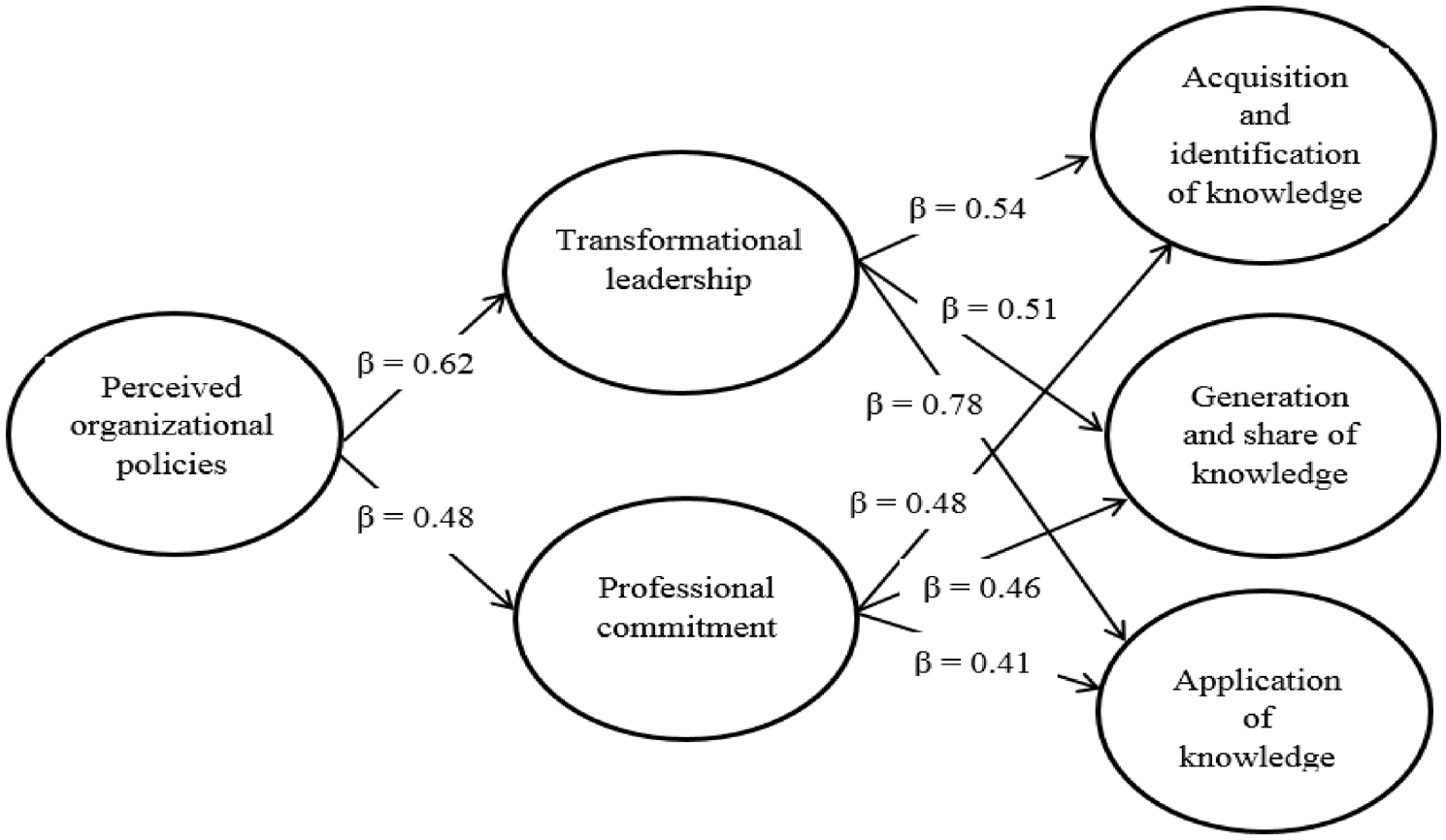
The final model and results of hypotheses testing.
Table 6 illustrates the significance of correlations between variables and also the effect size of these correlations with t statistic. If the t statistic is smaller than 1.96, the hypothesis will be rejected.
Summary of hypothesis testing results.

POP: perceived organisational policies; TL: transformational leadership.
Table 6 indicates that POP had a positive and significant effect on TL (β = 0.62, t = 24/30) and the librarians’ professional commitment (β = 0.48, t = 35.61). Confirming the first and second hypotheses indicates that the librarians’ interest in teamwork will increase if they find the power distribution in an academic library fair and if the instructions and procedures clearly define their assigned duties and tasks. Developing KM in academic libraries also calls for the librarians’ active cooperation. This cooperation can have a positive and significant effect on transformative leaders and the librarians’ professional commitment. Also, TL has a positive and significant effect on the acquisition and identification of knowledge (β = 0.54, t = 26.21), generation and sharing of knowledge (β = 0.51, t = 30.12) and application of knowledge (β = 0.78, t = 52/23). Confirming the third and fourth hypotheses shows a positive and significant effect of TL on KM. Accordingly, transformative leaders can moderate negative POP by creating a positive outlook of developing KM in academic libraries, collaborating with librarians in resolving professional challenges, encouraging librarians to fulfil their KM-related duties properly and supporting the librarians’ cooperation in KM-related decision-making.
Moreover, the librarians’ professional commitment had a positive and significant effect on the acquisition and identification of knowledge (β = 0.48, t = 24/48), generation and sharing of knowledge (β = 0.46, t = 17/44) and application of knowledge (β = 0.41, t = 18/86). These effects were assessed through testing hypotheses 6–8. It was shown that the effects of negative POP were greatly reduced or moderated by the librarians’ trust in their profession, and accepting the positive effects of KM implementation in academic libraries is committed to keeping relationships with their colleagues to develop KM in libraries, seeking advantage from other librarians’ knowledge or academic libraries successful in KM implementation and their interest in the continuous growth of service quality through developing a set of KM-related activities.
6. Discussion
The study started with the following research questions:
RQ1. From the librarians’ point of view, what factors play the most frequent moderating role between POP and KM?
RQ2. To what extent does the POP affect KM in academic libraries?
RQ3. What is the size of the effect of each moderator variable on KM in this study?
Following the extraction of the moderator variables from previous studies, the researchers collected the views of 21 academic librarians on the importance of these variables (Table 1) to answer the first research question. From the librarians’ perspective, TL (an organisational moderator) and professional commitment (an individual moderator) had the highest moderating effect compared with the other moderators. They were selected as the moderator variables in this study. One may attribute the selection of TL to its powerful authority in an organisation. Moreover, TL had probably a determining role in reinforcing the librarians’ specific behaviours, such as the KM-related ones due to some factors, such as filling the gaps between librarians and library leaders, creating a sense of empathy and caring for individuals’ decisions and opinions. In addition, professional commitment can be regarded as an effective factor in enhancing the perception of organisational policies and reducing the negative effects of such policies on KM due to creating a sense of trust in librarians, empowering their job commitment and motivating them to constantly improve service quality in libraries.
The direct and indirect effects of the variables under investigation were analysed to answer the second and third research questions. The total effect of variables was also measured (Table 7).
The direct and indirect relationships between the variables.

As shown in Table 7, the calculated coefficients and t values for each path of direct and indirect factors that affect KM implementation bring us to the conclusion that POP had a significant effect on the acquisition and identification of knowledge (0.56), the generation and sharing of knowledge (0.54), and the application of knowledge (0.68). When we speak about POP, as a factor affecting the librarians’ performance, we speak of both the positive and negative aspects. This indicates that librarians may feel the political atmosphere in the library as positive or negative depending on their observation and perception of a fair distribution of power or responsibility, clarity in instructions and interactions. If they perceive it positively, they welcome more TL strategies and with leaders’ stronger belief in the support and empathy, they will easily acknowledge their clear outlook for libraries. The factor load (β = 0.62, t = 30.24) of POP on TL was indicative of this claim and the direct effect of POP on TL.
If they perceive the organisational policies negatively, TL will play a moderating role. This indicates that TL strategies attempt to create a sense of sympathy, and involving librarians can reduce the negative effects of organisational policies. TL efforts to involve librarians can affect their perception of the fair distribution of power in libraries. Also, library leaders, sympathising with librarians, can reduce the negative perception caused by the existing unfair procedures. Thus, it is expectable that POP, whether negative or positive, can reduce the librarians’ concerns about knowledge sharing, reinforce their morale in the application of knowledge and motivate them by moderating TL. The sum of indirect loads (0.62 × 0.78) + (0.62 × 0.51) + (0.62 × 0.54) = 1.13 shows the indirect effect of POP (as TL) on KM. The results revealed that the moderating role of TL is more tangible and greater than the librarians’ professional commitment. This is probably because organisational policies are the perception of the organisational atmosphere, and TL (as an organisational moderator) plays a vital role than the librarians’ professional commitment.
The results of this study also confirmed the moderating role of the librarians’ professional commitment. Based on the results (β = 0.48, t = 35.61), it is expected that different aspects of POP, such as the fair distribution of power and duties or clarity of procedures and guidelines, as an understanding of library conditions, directly affect the librarians’ professional commitment. The results (0.48 × 0.48) + (0.48 × 0.46) + (0.48 × 41) = 0.66 also showed that professional commitment due to creating a sense of responsibility, respect for colleagues, and their experiences and motivation to promote the work quality can moderate the negative effects of POP on willingness to learn, exchanging opinions with colleagues or establishing knowledge interactions among the librarians if they perceived it negatively. By moderating professional commitment, POP had a considerable indirect effect (0.66) on KM.
According to the results, to guarantee success in KM implementation in libraries, managers of academic libraries should not only focus on POP but also the generation of positive policies and developing them through TL more than before. To support KM plans and initiatives, managers of academic libraries should adopt policies to enhance the librarians’ professional commitment. KM implementation in an organisation is not enough for providing a KM mechanism; therefore, individuals must be motivated to apply that mechanism and collaborate in this process. In addition to proposing ideas for preparing and supporting KM implementation, this study can help to identify the damages of these processes and reveal to managers the important factors affecting such processes.
7. Conclusion
In this study, the effect of POP on KM was examined in academic libraries. KM is believed to be one of the main requirements and concerns of managers of academic libraries for several reasons including the importance of service development, improving the librarians’ professional performance, developing beyond-duty behaviours, increasing knowledge interactions, maintaining a competitive advantage over information providers and other competitors. Acquisition and identification of knowledge help libraries to promote their initiative services. The creation and sharing of knowledge and its application will not only facilitate the development of knowledge interactions and enhancement of the librarians’ capabilities but also provide user-tailored plans. Thus, researchers should address the factors affecting these processes. In this study, the researchers selected POP from among the various factors affecting the KM implementation.
POP affects many knowledge interactions, power relations, formal and informal rules and decision-making climate. As the results of the study showed, TL and professional commitment are among the factors that moderate the effects of POP and play a critical role in KM implementation. This result is both theoretically and practically important. Theoretically, the results have highlighted a new approach to KM and explained the relationship between POP and KM in academic libraries. Furthermore, by adopting the librarians’ views on the importance of various moderators, this study offered a new perspective on TL and the librarians’ professional commitment. Although formulating POPs have always been regarded as the responsibility of library managers, this study indicated how variables, such as TL and professional commitment, might create a positive workspace for the librarians to fulfil their responsibilities while reducing the negative aspects of POP. In theory, this approach to LIS rarely has a background.
The proposed theoretical model proved efficient in assessing the direct and indirect effects of the variables having been confirmed by the experts through the Delphi study. These approaches can provide future researchers with a valuable theoretical basis. It is also worth noting that by studying the effects of personal factors, such as professional commitment, and organisational factors, such as TL, this model has been able to validate the impact of major and general subjects with respect to academic libraries as organisations. Upgrading the model by looking at the effects of other variables including organisational citizenship behaviour, librarians’ collaborative activities and their perceived trust or fairness could be a goal of future study. Upgrading the model will allow for the examination of other variables’ positive or negative effects on POP and the librarians’ various activities. The path has been paved by designing and testing this theoretical model as a prototype. It is crucial to highlight that the proposed model is not an absolute one, and researchers may want to address other elements, such as librarians’ reactions to POP in different communities. As a result, this model can be modified with reference to the communities’ or librarians’ level of farewell to undertake empirical study in other countries or a variety of libraries and to address broader social problems in LIS.
It is expected that the theoretical views conceptualised in this study lead to an increase in research on the effect of POP on the performance of libraries. Developing research in this domain will also enable comparing how POP affects the performance of libraries in various countries concerning their level of development. It is expected that the negative aspects of POP have a declining trend in developed countries, where they are relatively stable in their policies, compared with developing countries. The researchers were unable to make a cross-cultural comparison of the topic under study due to the limited scope of the research and the lack of similar studies in LIS. If there were supporting research in LIS, such cross-cultural studies could be regarded theoretically valuable.
Practically, the results of this study opened new horizons for the academic library managers to support KM and drew their attention to the important effects of POP, leadership style, and the librarians’ professional commitment for more support of KM programmes. From this perspective, some practical implications in academic libraries that can largely neutralise or moderate the negative effects of POP are focusing on involving the librarians in decision-making processes and avoiding biased decisions in favour of specific groups, higher accountability of library managers, reducing unfair judgements of managers in resolving conflicts, visualising a bright future for the librarians’ profession based on meritocracy, increasing interactions between POP and the moderator of TL and the librarians’ professional commitment, holding training courses for library managers to learn the principles of TL, strengthening the librarians’ communication skills, focusing on selecting library managers based on meritocracy, encouraging librarians to express their views without fearing its negative consequences, encouraging KM implementation through incentives (such as salary incentives, bonuses or promotion incentives) and developing the librarians’ knowledge interactions. The development of such measures seems to be fruitful, especially in academic libraries in developing or underdeveloped countries, which are probably to face greater political instability in the organisational aspects. As such, researchers can be optimistic about the desired KM implementation in such libraries.
Finally, the article contributes to the literature in three ways:
The current study’s initial contribution to the literature was a concurrent test of the relationship between POP, TL, professional commitment and KM in academic libraries with no LIS background.
The findings of this study offer perspectives on the ongoing debates about the moderating role of TL and professional commitment in relationship between POP and KM in academic libraries.
The Iranian libraries were used as a study sample. These libraries contain a non-western content, which is relatively scant in LIS empirical literature. As a result, librarians and managers, particularly in Asian countries and the Middle East, may find it valuable.
8. Research limitations and future studies
The current study has various limitations that will need to be addressed in future research. The first limitation concerns the study’s sample size. Because the study focused on academic libraries, the findings should be tentatively generalised to other libraries, such as public libraries, specialised libraries, etc. The second limitation relates to the research being conducted in a developing country (Iran). Despite the fact that there are many similarities between Iranian academic libraries and those in Western or American universities, the current study was unable to provide a clear picture of POP, TL, professional commitment and KM in the two communities. As a result, conducting a comparative and cross-cultural study proved difficult. Thus, it is still critical that readers pay attention to the contextual distinctions while generalising the findings of the study. Future research can employ data collected from other countries or libraries to corroborate the findings of this study and the efficacy of the proposed model. The third limitation was the failure to consider the impact of demographic variables on the variables under consideration, which necessitates further research in the future. According to Gibson [88] and Kacmar et al. [89], members of power groups in organisations (e.g. women and minorities) may experience workplace politics differently. Gender and job experience can also influence how staff members react to the actors’ political behaviour [52].
The moderators of TL (an organisational variable) and librarians’ professional commitment (a personal variable) were studied in the current study. Researchers can look into how POP and KM affect other personal and organisational variables in libraries. Furthermore, adopting the model proposed in this study to different types of libraries (public, specialised, etc.) can boost its credibility and assist management in making long-term plans. Finally, the researchers hope that the current study will open the way for future research into ways to reduce the negative impact of POP that diverts librarians from their positive path and job behaviours. It is expected that other researchers will minimise the limitations of qualitative and quantitative evidence of POP in LIS with their exclusive viewpoints.
Footnotes
Declaration of conflicting interests
The author(s) declared no potential conflicts of interest for the research, authorship and/or publication of this article.
Funding
The author(s) received no financial support for the research, authorship and/or publication of this article.
